Asset Information Handover Guidelines from Planning and Construction to Operations and Maintenance (2024)
Chapter: 10 Asset Information Handover Road Maps

CHAPTER 10
Asset Information Handover Road Maps
Understanding asset information handover and developing a culture that supports it within your airport organization will help improve the overall effectiveness of the process. Asset information handover will be most effective and efficient when the individuals who are responsible for it understand its importance and are dedicated to ensuring its success. These individuals need to understand the importance of having accurate data and information on a newly constructed asset to operate and maintain it.
A road map is a tool that assists with understanding a process, breaking it down into short- or long-term tasks. In developing an asset information handover road map, it is important to focus not only on the process tasks but also on the available technologies for conducting the process, such as BIM.
This chapter touches on the various topics discussed elsewhere in this guide and presents an example road map (shown in Figure 14) to serve as a reference when developing your internal
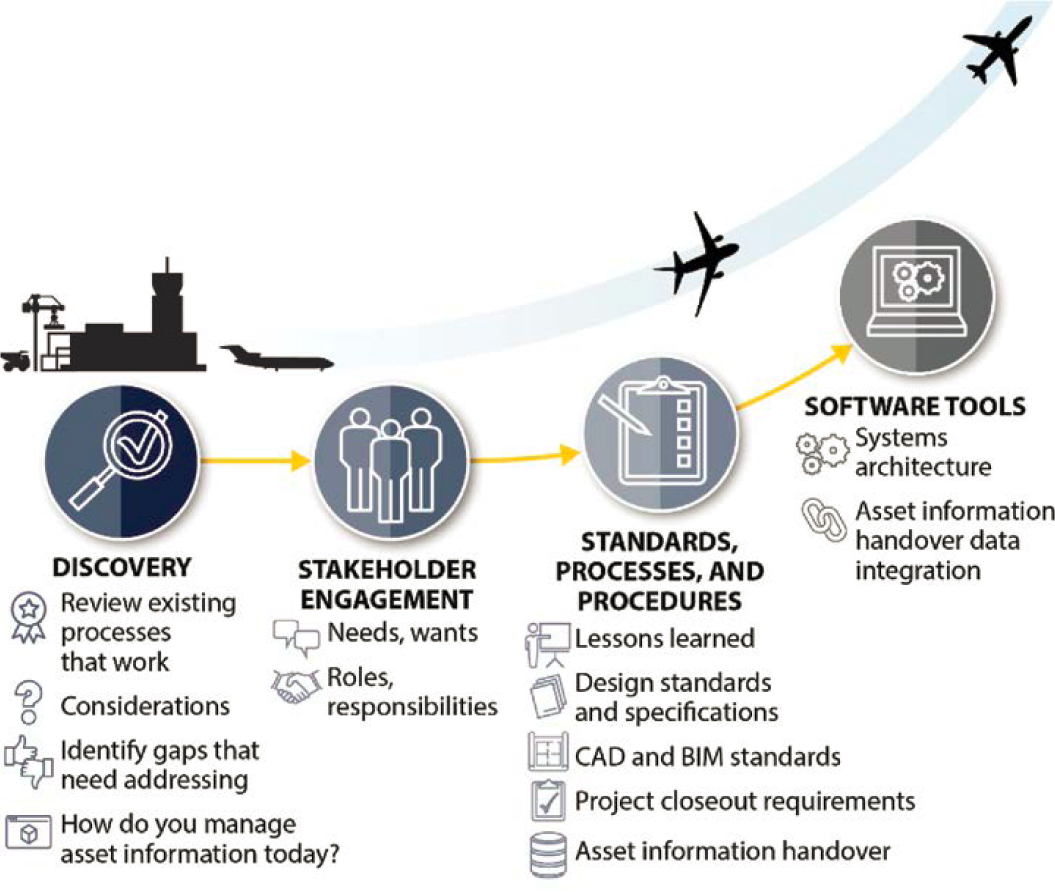
processes. In addition, extensive commentary has been provided specifically addressing BIM data acquisition processes during design and construction through to ownership and acceptance of BIM data (see Appendix E). It does not matter if BIM is part of the asset information handover deliverable process or not, the thought processes and requirements are the same.
Discovery
Understanding what you might already know or have in place as part of asset information handover is important. Begin with a review of existing published documents, contracts, design guidelines, processes, and procedures applicable to design and construction projects, as well as documents related to asset management, operations, maintenance, and planning. How does your airport currently plan for future capital asset investment? Is there a documented process in place outlining that procedure?
Are there any additional documents (processes/procedures) that should be developed to make the overall process complete? Are there some departments that have some familiarity with the concept of project closeout and asset information handover, or is it completely foreign to everyone involved? It is important to find out what airport staff do on a daily basis with respect to planning, design, and construction of assets, as well as operation, maintenance, and management of assets. It is equally important to learn how airport staff obtain, receive, store, handle, and use asset data.
To begin, how does the maintenance department currently take care of the airport? Are work order type activities documented, and if so, how are they documented and where? Does your staff know which building systems or equipment items require more attention than others, as well as which manufacturers’ and vendors’ products work more effectively? Is this type of information captured, and if so, where? The asset information handover process and the data gained during project closeout activities directly connect with a more strategic asset management program.
Ask yourself if existing documentation of the processes and procedures for asset information handover is reviewed and followed, or if it should be revised. If the existing processes and procedures are viable, should staff be informed that they exist and trained on the processes to ensure that they are followed? This is an often overlooked part of the onboarding process for new employees. Sometimes new employees have to learn processes or procedures on their own, without specific instructional guidelines, which can result in wasted time and money. Sometimes improving compliance might be as simple as ensuring that an existing SOP is followed or that newly hired employees are made aware of the processes. Alternatively, once you have reviewed existing processes and procedures, maybe you have identified issues created by advancements in technology and processes, and the existing processes simply need to be updated.
How does your airport manage project closeout information? Do you have rooms full of old paper documents that represent your built environment? It was not that many years ago that paper documents were the project closeout deliverables of all construction projects, and they typically wound up in a closet, storage room, or basement. This type of storage turns out to be useless if it is not organized so that staff can readily access the information that they need when they need it. If your airport is still using a paper-based process for managing project closeout information, it is important to think through how going forward, this process will assist stakeholders in finding the information they need or create barriers to finding information.
Considering how your airport currently stores and manages project closeout information, think about the future and how advancements in software and information technology will affect
the amount of project closeout data made available to you as the airport owner. The data you receive during asset information handover could become quite unmanageable unless there is a plan and documented procedures in place to store, manage, and retrieve that data.
Stakeholder Engagement
Gaining and then keeping stakeholder engagement in asset information handover is crucial. Look at the asset information handover process as a culture that should be inherently understood and supported by the internal airport stakeholders responsible for implementing portions of the process. In most airport organizations, it appears that asset information handover is supported by multiple groups or multiple individuals. At some airports, those with larger capital programs, third-party consultant teams support the information developed as part of the project, so expecting asset information handover to be a “culture” becomes a bit of a challenge.
Developing a process that defines the roles of the groups (and individuals) involved in asset information handover, whether internal or external, will help achieve a successful asset information handover process. But just who are the stakeholders in asset development? These stakeholders are those internal departments and staff whose daily responsibilities have a role in some aspect of traditional planning, design, and construction activities, or airport operations, maintenance, and future capital project planning.
It is not enough to identify these groups of people and individuals, they must be asked to participate and become involved in various parts of the process. They must feel that their voices are heard, their preferences and concerns are addressed, and that others in the asset information handover or project development process understand their specific needs and/or wants. If this is not the case, they may well quit contributing to the group. Asset information will only become useful to all of those who need and request specific data and documents if they can know early—during the project planning, design, and construction process—that they will eventually obtain the information they need to do whatever it is they are required to perform as part of the airport position role.
Once your stakeholders have been identified, defining their roles and responsibilities within a responsibility assignment matrix (typically referred to as a RACI diagram or chart) might prove to be a useful communication tool during meetings or within published SOPs. This type of diagram stands for the four key expectations for stakeholders: responsible, accountable, consulted, and informed. It should help clarify who is responsible for what across multiple departments and these departmental expectations.
The RACI matrix shown in Table 3 provides an example of the stakeholder roles and responsibilities for various project-related actions in an airport by internal department or group. The following (RACI) codes are used:
- R: Responsible. Those who do the work.
- A: Accountable. The one ultimately accountable for the correct and thorough completion of the deliverable or task (only one approver per task).
- C: Consulted. Those whose opinions are sought (two-way communications).
- I: Informed. Those who are kept up-to-date on progress (one-way communication).
Standards, Processes, and Procedures
Just what are “lessons learned”? This term refers to whatever information might be gained from an activity as part of a project, what worked or what didn’t, and what your users would care to repeat (or not) in the future. The purpose of documenting lessons learned is to benefit from them
Table 3. Example roles RACI matrix.
| Task, Deliverable, Requirement, or Responsibility | Director, C-Suite Level | Standards, Codes | Planning | Design, Engineering | Information Technology | Operations | Maintenance | Procurement/Contracts | Controls/Project Management |
|---|---|---|---|---|---|---|---|---|---|
| Establish Project Planning Process | I | R | A | R | C | C | C | I | I |
| Prioritize Projects | A | C | R | R | I | R | R | I | I |
| Manage Design Projects | I | R | R | A | I | I | R | R | R |
| Develop Design, Specifications, CAD, and BIM Standards | I | A | R | R | R | R | R | C | C |
| Ensure Compliance with Standards | I | R | R | A | R | R | R | R | C |
| Manage Construction Projects | I | R | R | A | C | C | C | C | C |
| Monitor Project Closeout Submittals and Asset Information Handover | I | R | R | R | R | R | R | R | A |
Note. R = Responsible, A = Accountable, C = Consulted, I = Informed
and to compile your findings so that future project participants can understand what worked and what didn’t. Updating your processes and procedures with such lessons learned (as shown in Figure 12) should have a positive impact on your project efficiencies and team effectiveness and therefore the bottom line. For example, if one project team endures several change orders that lead to increased construction costs, reflecting on the reason for the multiple change orders could result in changes to the process that help a future project team avoid this problem. Documenting a problem can help teams avoid making a similar mistake in the future.
In addition to developing an asset information handover procedure, consider having a procedure that applies to every document your airport develops to benefit from the lessons learned regardless of the subject matter. Develop a lessons-learned procedure document or process so internal staff knows their voices will be heard and that an internal process can be improved.
When it comes to design and construction projects, team members have thoughts as to how the process should be improved. Sharing these ideas can become a team-building experience especially when you have a smaller group of people who are continually involved with design and construction projects.
A suggested SOP for a lessons-learned process document is to identify a recipient to whom other team members can send their observations and recommendations. If you want to define a form or format for providing this material, such as email or an intranet site, ensure that it is a format in which the received observations and recommendations can be preserved for future reference. Discuss this process of documenting observations throughout the design and construction process—not just at the end—to ensure that all such opportunities for improvement are documented.
Finally, don’t go through the effort of documenting lessons learned if you then don’t do anything with the suggestions. Even if a stakeholder’s observations end up not being incorporated into process and procedure updates, the observation should be acknowledged and feedback provided on why it was not used. If there is no response, your stakeholders may assume that their opinions are not valued.
Design Standards and Specifications
Design standards serve as guidelines for your design requirements and represent discretionary requirements whereas specifications are intended to describe in greater detail the product qualities and installation methods of what is shown on the drawings. The drawings and specifications, by contract, are complementary. Creating an internal process on how a design standard or an internal set of specifications is developed and maintained and by which department will impact your projects and the assets these projects create. The Division 01 specifications sections contain the project closeout requirements and should be considered a part of the development of this specifications standard.
Building Information Modeling and Computer-Aided Design Standards
If BIM is being considered or has already been undertaken by your airport, then having pertinent and specific processes in place is of even greater import. This does depend on the goals for having BIM. If BIM is intended to represent an active, constantly updated master set of every building within your airport, this will require resources to maintain and a defined process that is adhered to.
Software Tools
Most airports have software applications for activities ranging from accounting and payroll to tracking work orders. Not every software application requires an SOP to outline its use, but there may be a requirement to outline how one software application interacts or integrates with another software application, sharing data to the benefit of the end users. An example of such integration would be how BIM data can be migrated into finance and accounting software or EAM systems or CMMSs. The section “Example Project Phases Specific to BIM Data Activities” specifically addresses the data activities and deliverables involved with BIM data submittals throughout the life of a project and offers additional examples of project road maps.
Software systems architecture is the structure needed to understand the software system, the reason for collecting data in that structure, its elements, and the relationships across the various elements or components. A software system that helps manage and maintain the built environment is loosely referred to as an asset register. The asset register represents a building, roadway, or other constructed asset, similar to a drawing (e.g., blueprint).
When it comes to asset information handover, what asset information is it you as an airport owner, want or need to know about your constructed assets? Required data about buildings, the airfield, and landside assets must be defined within the project manual of every design and construction project. The process of requesting certain information as part of project closeout is a routine part of such projects, and requesting the data you need to properly care for and manage constructed assets is of great importance.
Documenting your asset information handover requirements in the Division 01 project closeout specifications sections facilitates this communication process. Division 01 specifications sections are a part of the contract and require contractor teams to provide whatever is spelled out within. However, the same can be said of BIM and the use of that technology on most design and construction projects today.
Example Project Phases Specific to Building Information Modeling Data Activities
The following paragraphs discuss the illustrated example road maps (see Chapter 9, Figures 6 through 12) of how BIM evolves from the traditional phases of design and construction to asset ownership and facility management. Establishing and requiring BIM as a project closeout deliverable is a very complex process, and not many airports currently have staff qualified to even read BIM files, let alone develop, establish, and then implement a BIM project closeout process.
Figure 15 illustrates where handoffs (or “drops”) of data occur and, if quality management practices are followed, when they should take place. The design team will develop electronic document files that will ultimately be provided to the construction team. This “data drop” is the first opportunity for a failed handoff of data.
During the planning and design phases, the design team creates the first instances of assets within BIM. It is at this time that basic asset information should be available, and the BIM should be populated with basic asset names, descriptions, and classifications. The primary asset data management objectives should be to provide a basic accounting for the types of assets present in the project and approximate quantities and to establish naming and identification nomenclature that will carry throughout the project.
At the completion of the design phase, sufficient content should reside in BIM to perform an initial review—this part of the process is identified as “Data Drop 1—Design Package” in Figure 15 and is typically performed when the 100 percent design package is submitted to the airport. For more information, see Appendix E.
During the construction phase, the volume and quality of asset data will be refined dramatically as the contractor team should be able to include more specific information related to the manufacturers, makes, and models of various assets that will be installed in the project. By the end of this phase, this contractor team should be able to verify the actual installed makes and models and the unique data relative to the assets, including serial numbers, install dates, warranty information, and relevant supporting documentation like wiring diagrams and O&M manuals.
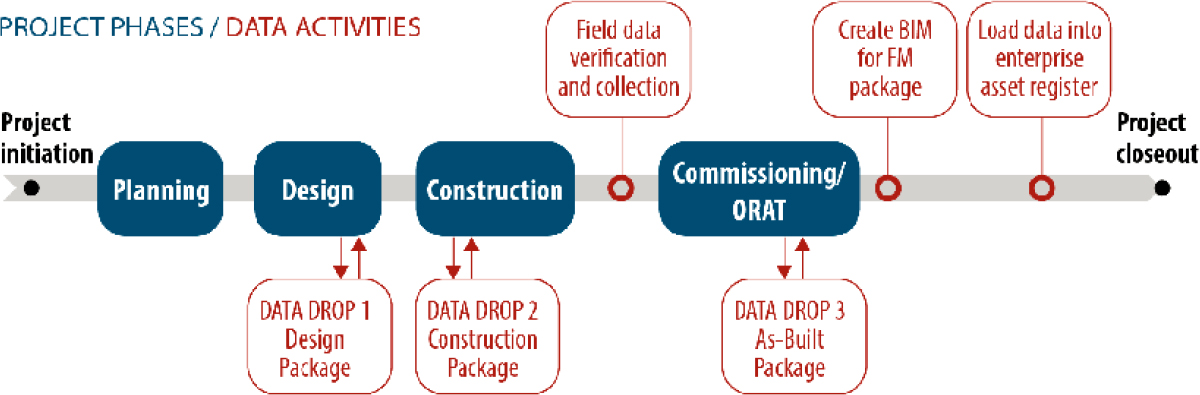
Figure 15. Data drops.
To ensure that downstream field data verification and collection efforts will be effective, a second data drop, “Data Drop 2—Construction Package,” should be performed to verify the BIM data against the specified standards. This data drop typically occurs in alignment with a review of the submitted construction packages that airport staff are to approve for construction.
The third data drop review occurs after the construction BIM and asset data have been field verified. This will typically be toward the end of the commissioning or ORAT phase, but because equipment and building systems may be installed and commissioned on vastly different schedules, this third data review could be conducted at staggered times based on data readiness.
After the as-built packages have been verified, it is a best practice to “Create BIM for FM package” as shown in Figure 15 by converting the as-built construction BIM (“FM” road map refers to “facility management”). This conversion process consists of cleaning up the BIM files to remove elements relevant to construction coordination that are not relevant to O&M. This process makes the BIM easier for airport staff to integrate and navigate and improves its performance in model viewers.
The final asset information handover activity for a BIM is to “Load Data into Enterprise Asset Register.” It is at this time that the provided data sets are extracted, formatted, and loaded into the airport’s EAM system or CMMS infrastructure. The asset register could be a dedicated common data environment (CDE) that supports all software application systems, or it could be specific to the enterprise applications that the airport uses for asset management.
Appendix E provides a more detailed discussion (with accompanying road maps) of BIM during asset information handover and the suggested data drop reviews.
Implementing Change
If implementing asset information handover as a process is something new to your staff, you might have to consider a change management process to help ensure that the airport staff will accept and support their “new” roles and responsibilities. Many departments and individuals contribute to the built environment, not just one or two, and it is important for everyone to not only understand their roles but also to buy into and champion the processes associated with successful asset information handover—throughout planning, design, and construction.
Change management is a part of every business, and airports must continuously keep up with the advancements in technologies, regulations, government requirements, and customer expectations. In a way, change management occurs at airports every day, with staff adapting and shifting. A formal change management process in some instances might be needed, with training to help staff adjust.
If change management is implemented correctly, everyone will benefit, but change management success will not necessarily guarantee a successful asset information handover. If only you could ensure each project was completed on time and within budget, and that every project record document or requested project closeout submittal was received and was accurate. Change is difficult and so is project closeout and asset information handover.
Version Management
Road maps are meant to be ever-evolving, like internal standards documents. You will learn and grow, and they will also grow and conceivably require adjustments. If use of the road maps as educational communication tools is successful, ensure that they remain current with whatever path your processes and procedures might take. If your processes are updated annually, ensure that the accompanying charts, road maps, and tables are also updated to remain current.


