Principles and Practices for a Federal Statistical Agency: Eighth Edition (2025)
Chapter: 1 Introduction
1
Introduction
Highlights
- The nation relies on high-quality statistical information.
- The nation has a decentralized statistical system. Within the federal government, there are 16 recognized statistical agencies and units, and over 100 statistical programs. States, localities, and tribal governments provide essential data for federal statistics. They and other groups are important users of federal data.
- Recent changes in federal law expanded the responsibilities of federal statistical agencies and established new roles for Statistical Officials in other federal agencies.
- Technical methods to develop and link new data sources have expanded across disciplines and applications.
- A common foundation for defining expectations for federal statistical practice is necessary.
- With periodic updates, this report has long helped to unify the federal statistical system. It remains an important tool to communicate shared expectations and to guide statistical policymaking.
- The board members of the Committee on National Statistics were tasked by the National Academies of Sciences, Engineering, and Medicine to review the prior edition of this report and
- determine if revisions were necessary to reflect current federal policy and national interests.
- The board determined that the principles and practices of the prior edition should remain intact, although examples and references should be updated and the overall text reorganized to improve accessibility. This eighth edition reflects these modest changes.
AN ESSENTIAL AND COMPLEX SYSTEM
A number of features of the U.S. statistical system have remained constant across decades—the high value of national statistics to our society, the decentralized and federated nature of statistical production, and the unique responsibilities entrusted to federal statistical agencies. Yet, our national data infrastructure also has changed over time to reflect the needs of society. Some recent changes have affected the organization and expansion of the system, access to federal statistics, and the potential impact of federal statistical agencies on evidence-making.
The Value of National Statistics
National statistics help the public shape their country. They help individuals and households to make decisions about where to live, work, and attend school. National statistics inform decisions of businesses and other organizations about market changes and opportunities. They provide essential information for policymakers and program administrators at all governmental levels to identify the public’s needs and interests as well as the efficacy of public policies. National statistics are a resource to researchers and scientists. Even more broadly, the effective operation of a democratic system of government depends on the unhindered flow of impartial, scientifically based statistical information to its citizens on a wide range of issues. These issues range from employment, growth in the economy, and the cost of living to crime victimization, family structure, physical and mental health, educational attainment, and energy use and the environment.
A Decentralized and Federated Statistical System
In the United States, the national statistical system is highly decentralized. Rather than being managed by a single government agency (as is the
case in many other countries), the responsibility for producing federal statistics is shared across several specialized federal agencies. Further, many of these federal agencies rely on data from state, local, and tribal governments as well as other entities to produce national statistics.
This section summarizes the key features of the U.S. national statistical system. See Figure 1-1. Authorities, agency membership, structure, and work processes are discussed in detail in Appendices A and B, available in the online copy of this report.
The Office of the Chief Statistician of the United States
Through the director of the Office of Management and Budget (OMB), the Chief Statistician of the United States has the responsibility of coordinating domestic and international federal statistical policy (Foundations for Evidence-Based Policymaking Act of 2018, 2019; Paperwork Reduction Act, 1995).
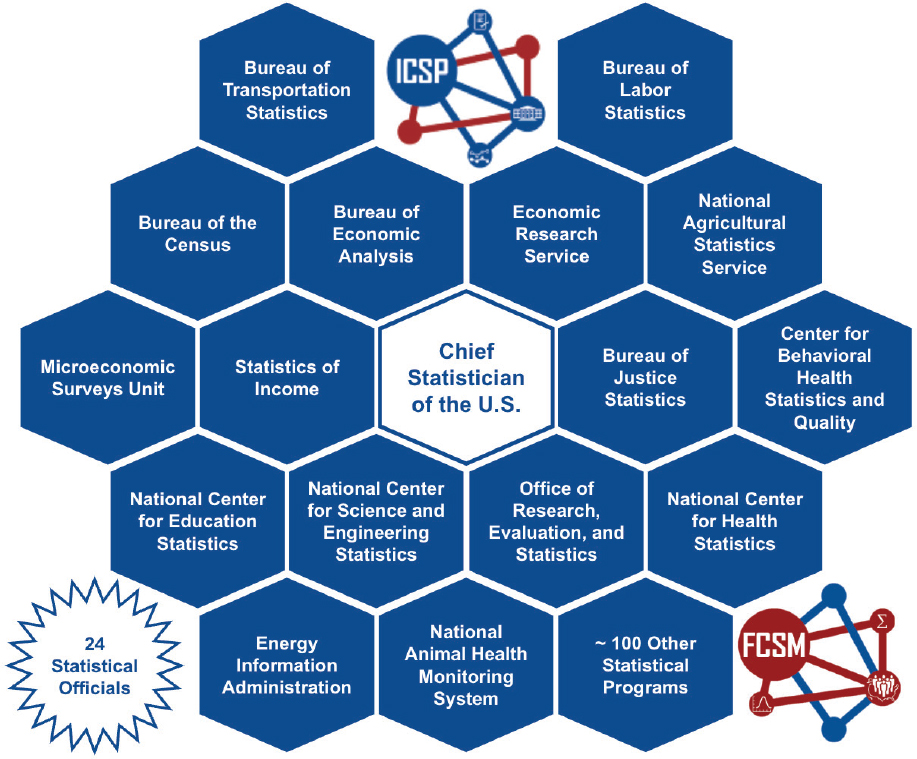
SOURCE: https://www.statspolicy.gov/about/#office-chief
Federal Statistical Agencies and Units
In the United States, the responsibility for collecting the necessary data to generate statistics for public use is distributed among a set of agencies and organizational units in the executive branch. A federal statistical agency or unit is defined in law as “[…] An agency or organizational unit of the executive branch whose activities are predominantly the collection, compilation, processing, or analysis of information for statistical purposes” (Foundations for Evidence-Based Policymaking Act of 2018, 2019).
At present, there are 13 recognized statistical agencies1 and three recognized statistical units2 located in cabinet departments and independent agencies.3 In addition, over 100 program, policy, and research agencies have sizable statistical activities, many of which feed into the production of statistics from the recognized agencies (OMB, 2023b).
State, Local, and Tribal Agencies
State, local, and tribal agencies collect data as part of the administration of federal programs such as Temporary Assistance to Needy Families, Unemployment Insurance, the Supplemental Nutrition Assistance Program (SNAP or foodstamps), Medicaid, highway funding, and energy assistance, among others. In addition, there are extensive federal-state cooperative networks that enable the production of essential federal statistics, such as births and deaths;4 K–12 education;5 employment and wages;6 and health.7
___________________
1 The U.S. recognized federal statistical agencies are (13): Bureau of Economic Analysis (Department of Commerce); Bureau of Justice Statistics (Department of Justice); Bureau of Labor Statistics (Department of Labor); Bureau of Transportation Statistics (Department of Transportation); Census Bureau (Department of Commerce); Economic Research Service (Department of Agriculture); Energy Information Agency (Department of Energy); National Agricultural Statistics Service (Department of Agriculture); National Center for Education Statistics (Department of Education); National Center for Health Statistics (Department of Health and Human Services); National Center for Science and Engineering Statistics (National Science Foundation); Office of Research, Evaluation, and Statistics (Social Security Administration); and Statistics of Income (Department of the Treasury; Foundations for Evidence-Based Policymaking Act of 2018, 2019).
2 There are three recognized federal statistical units: Microeconomic Surveys Unit (Federal Reserve Board); Center for Behavioral Health Statistics and Quality (Substance Abuse and Mental Health Services Administration, Department of Health and Human Services); and National Animal Health Monitoring System (Animal and Plant Health Inspection Service, Department of Agriculture; Foundations for Evidence-Based Policymaking Act of 2018, 2019).
3 An organizational chart is included in Appendix B.
4 https://www.cdc.gov/nchs/nvss/index.htm
6 https://www.bls.gov/cew/; https://www.bls.gov/oes/; https://lehd.ces.census.gov/
7 https://www.bls.gov/iif/overview/soii-overview.htm; https://www.cdc.gov/mmwr/index.html
These data are compiled by federal agencies and used to describe the operation of programs, evaluate programs, inform policy and the public, and support budgeting. They also feed into important federal-state statistical programs, such as vital statistics on births and deaths.
Private Organizations
Federal statistical agencies cannot collect all of the data that they seek on their own. Many private organizations conduct data collection and analysis activities of interest to federal statistical agencies. The organizations can be for-profit, nonprofit, and/or academically affiliated. For example, there are research organizations that assist federal data collection and production. Additionally, there are firms that collect data for commercial purposes, such as credit bureaus, insurance companies, banks, and payroll companies. There are also commercial data brokers that collect, buy, and aggregate data, which they can sell to researchers or statistical agencies. Data provided by such private sources are increasingly important inputs to the federal statistical system (see Expanded Availability of New Data Sources, below). In some cases, these data products fill (whether in perception or reality) data user needs that are unmet by federal statistical agencies. To responsibly make use of these data products, federal statistical agencies must carefully examine the integrity of the data provided by such private organizations.
Unique Responsibilities
Federal statistical agencies and units have unique responsibilities that set them apart from other federal agencies. Although the subject matter varies, each statistical agency has a mission to acquire, produce, and disseminate information for statistical purposes. Because the value of national statistics is great, the definition and, subsequently, the responsibilities of federal statistical agencies are established in law. As the demand for national statistics in supporting evidence-based policymaking grows, new responsibilities and roles have been added in law, and more are expected to be developed in future regulation.
Historical Responsibilities
The Confidential Information Protection and Statistical Efficiency Act of 2002 defined a federal statistical agency or unit as “[…] an agency or organizational unit of the executive branch whose activities are predominantly the collection, compilation, processing, or analysis of information
for statistical purposes.” (See Confidential Information Protection and Statistical Efficiency Act, 2002, Sec 2 (8).8)
The Foundations for Evidence-Based Policymaking Act of 2018, also known as the Evidence Act, codified the following set of responsibilities9:
- Produce and disseminate relevant and timely statistical information;
- Conduct credible and accurate statistical activities;
- Conduct objective statistical activities; and
- Protect the trust of information providers by ensuring the confidentiality and exclusive statistical use of their responses.10
Importantly, “statistical purpose or use” was also defined in law. It (a) means the description, estimation, or analysis of the characteristics of groups, without identifying the individuals or organizations that comprise such groups; and (b) includes the development, implementation, or maintenance of methods, technical or administrative procedures, or information resources that support the purposes described in subparagraph A (Confidential Information Protection and Statistical Efficiency Act, 2002). In contrast, a “nonstatistical purpose” is defined as using data in identifiable form for such purposes as “administrative, regulatory, law enforcement, adjudicatory, or other purpose that affects the rights, privileges, and benefits of a particular, identifiable respondent.”11
As an example, consider information that might be collected on a person’s income by a federal agency. A statistical agency or unit would only collect and use that information to compute statistics such as median income, the percentage of families below the poverty line, or the percentage eligible for SNAP benefits. A program agency might collect and use that information to determine whether that individual or family was eligible to receive SNAP or other benefits, and then grant or deny those benefits based upon that information. This latter use would be a nonstatistical purpose, and statistical agencies are generally prohibited by law from using their data in this manner.
Expanded Responsibilities of Statistical Officials
As discussed throughout this report, the Evidence Act made many changes in roles and responsibilities for evidence-building and the generation
___________________
8 Appendix A provides an extensive overview of the statutory, regulatory, and policy basis guiding U.S. federal statistical practice, which dates back to the 1930s.
9 These responsibilities codified OMB Statistical Policy Directive No. 1 as part of the Evidence Act (OMB, 2014b).
10 44 USC § 3563(a)(1).
11 44 USC § 3561(8)(a).
of statistics in the federal government. Among the most impactful for the statistical agencies may be their expanded role within their respective departments. This has given them and their heads (as Statistical Officials for their departments) new responsibilities and opportunities related to the statistical use of data for providing evidence for program evaluation, working in many departments and agencies with the people named as Chief Data Officers and Evaluation Officers under the Act (OMB, 2024e). So, too, the Evidence Act expanded the role of the Chief Statistician in coordinating expanded data sharing among agencies and access to confidential data for evidence building.
Because the Evidence Act requires implementing regulations and guidance from OMB, only some of which have been issued as of the writing of this volume (see Appendix A), many details regarding the roles of the new officers and their relationships with the statistical agency heads are yet to be determined. To achieve the long-term goals of greater use of government administrative and survey data for statistical purposes and for the public good, the broader statistical, research, and evaluation communities will need to come together in a productive dialogue. This dialogue will determine the appropriate principles and practices for these expanding statistical and evaluation activities and for the programs and units within which they are occurring, with potential impact on future editions of this report.
Expanded Availability of New Data Sources
Over the past decade, declining survey response rates have contributed to an increased need to use administrative data, private-sector data, and other sources of uncurated data to supplement or, in some cases, replace existing survey systems to produce federal statistics. Part D of the Evidence Act envisions that, unless expressly prohibited by law, federal statistical agencies generally should have access to federal administrative data for statistical purposes. More recently, interest has grown in linked or blended data—that is, combining data files initially collected to be used separately. The advantages and disadvantages of using data initially collected for nonstatistical purposes to produce statistics, as well as linked or blended data, have been well documented (National Academies of Sciences, Engineering, and Medicine [NASEM], 2017a,b,d, 2023b,c, 2024c).12 Benefits include efficiency, robustness of data files, and reduction of public burden. Challenges include the assessment of quality, equity, and interoperability of data and measures, reliability of data sources (including potential cost),
___________________
12 See, for example, https://www.statspolicy.gov/assets/docs/ICSP-The%20Use%20of%20Private%20Datasets%20by%20Federal%20Statistical%20Programs-1-6-2023.pdf
transparency, confidentiality,13 and (potentially) concerns over informed consent. Ultimately, navigating responsible statistical use of new data sources within their unique statutory requirements poses further challenges to federal statistical agencies within a changing national data infrastructure.
THE PURPOSE OF THIS REPORT
This report is a tool to communicate the unique responsibilities of federal statistical agencies and to provide guidance to their staffs on how to achieve them. It does this by providing a common foundation in the form of principles and practices, referencing each to responsibilities established by law, regulation, and/or policy. The report distinguishes between “principles,” which are fundamental and intrinsic to the concept of a federal statistical agency, and “practices,” which are ways and means of making the basic principles operational and facilitating an agency’s adherence to them.
The principles and practices in this report remain guidelines, not prescriptions. They are aspirational in nature to foster better decision making. The report is intended to assist statistical agencies and units, as well as other agencies, including state and local agencies, as they engage in statistical activities, and to inform legislative and executive branch decision makers, data users, and others about the characteristics of statistical agencies that enable them to serve the common good.
OUR APPROACH
The preparation of this report is unique among National Academies reports. Because P&P is intended to reflect and uphold the most salient guidance for the federal statistical system as a whole, the authoring committee is the Committee on National Statistics (CNSTAT) itself, due to its role serving as an independent, objective, and centralizing influence on the system.
Additionally, the periodicity of this report is unique. Since issuing the second edition in 2001, CNSTAT has issued an edition to coincide with the start of each new presidential term. This serves two key functions: to communicate with a new audience regarding these principles and practices,
___________________
13 Note that the Confidential Information and Statistical Efficiency Act of 2002, Title V of the E-Government Act and reauthorized in 2018 as Title III of the Evidence Act, requires that information acquired (including administrative or other alternative data sources) under a pledge of confidentiality and for exclusively statistical purposes shall only be used for statistical purposes. This information shall not be disclosed in identifiable form without the informed consent of the respondent (Confidential Information and Statistical Efficiency Act of 2018, 2019).
and to account for the expected, ongoing changes in society and the federal statistical system.
Accordingly, for this eighth edition, CNSTAT was charged with the following statement of task:
The National Academies of Sciences, Engineering, and Medicine will convene an ad hoc committee to update Principles and Practices for a Federal Statistical Agency, which provides advice on what constitutes an effective federal statistical agency. The report will take into account changes in laws, regulations, and other aspects of the environment for federal statistical agencies that have taken place since the release of the seventh edition.
To conduct its work, CNSTAT reviewed prior editions of P&P and took note of recent changes in the statutory, regulatory, and policy environment as well as the data user community. The form of P&P is unique in another manner. Unlike many other National Academies reports, the recommendations of this report are articulated in the principles and practices as guidelines, not prescriptions.
The principles and practices described in this edition remain largely unchanged from the prior edition. The updates made to this volume instead consider how changes in the federal statistical system and the environment in which it operates intersect with these long-standing guidelines. Throughout, the volume accounts for the wide-ranging observed and anticipated impacts of the Foundations for Evidence-Based Policymaking Act of 2018, which expanded the role of heads of the recognized statistical agencies and units in their departments and prescribed an enlarged role for federal surveys and administrative records to be used in support of sound policymaking. A glossary and tightened terminology have been added to improve accessibility to an ever-widening audience. The appendices have been extensively updated and rearranged for ease of reference.
OVERVIEW
After this Introduction, Chapter 2 provides an overview of the value of national statistics. Chapter 3 presents five basic interrelated principles that statistical agencies must embody to carry out their mission fully. Chapter 4 discusses 10 important practices that provide the means for statistical agencies to implement the five principles. The first four practices pertain to an agency’s operations, internally and within the federal government, while practices 5 through 7 bridge internal operations and external relations with the professional statistical and research communities, and practices 8 through 10 face externally, toward an agency’s key constituents: data users,
BOX 1-1
Principles and Practices
Five principles guide federal statistical agency programs:
- Relevance to Policy Issues and Society
- Credibility Among Data Users and Stakeholders
- Trust Among the Public and Data Subjects
- Independence from Political and Other Undue External Influence
- Continual Improvement and Innovation
Ten practices support achievement of these principles:
- A Clearly Defined and Well-Accepted Mission
- Necessary Authority and Procedures to Protect Independence
- Commitment to Quality and Professional Standards of Practice
- Professional Advancement of Staff
- An Active Research Program
- Strong Internal and External Evaluation Processes for an Agency’s Statistical Programs
- Coordination and Collaboration with Other Agencies
- Respect for Data Subjects and Data Holders and Protection of Their Data
- Dissemination of Statistical Products That Meet Users’ Needs
- Openness About Sources and Limitations of the Data Provided
data subjects, and data holders. Chapters 3 and 4 include commentary on each principle and practice.
Three appendices are provided as a resource in the online edition. Appendix A summarizes the history of federal legislation, regulations, and executive policy memoranda and other guidance corresponding to the principles contained in this report. Appendix B summarizes the history and organization of the federal statistical system, recognized statistical agencies and units, Statistical Officials in other federal agencies, and the coordinating function of OMB. Appendix C summarizes several national and international frameworks for guiding official statistics.


