The Next Decade of Discovery in Solar and Space Physics: Exploring and Safeguarding Humanity's Home in Space (2025)
Chapter: 3 Solar and Space Physics in the Service of Humanity
3
Solar and Space Physics in the Service of Humanity
3.1 INTRODUCTION: SPACE WEATHER—IMPERATIVE AND OPPORTUNITY
The solar flare on September 1, 1859, and its associated geomagnetic storm—the Carrington Event—is thought to be the largest space weather event ever recorded. Arcing from currents induced in telegraph wires caused fires in both the United States and Europe. (Cliver and Dietrich 2013)
On May 23, 1967, the Air Force prepared aircraft for war, thinking the nation’s surveillance radars in polar regions were being jammed by the Soviet Union. Just in time, military space weather forecasters conveyed information about the solar storm’s potential to disrupt radar and radio communications. (Knipp 2016)
The August 4, 1972, flare, shock, and geomagnetic storm are components of a Carrington-class event. The event was associated with a nearly instantaneous, unintended detonation of dozens of sea mines near Hai Phong, North Vietnam. The event also occurred between the Apollo 16 and 17 missions. Had astronauts been on the surface of or orbiting the Moon, they would have received a near-lethal radiation dose. (Knipp et al. 2018)
On March 13, 1989, the largest magnetic storm of the last century caused widespread effects on power systems including a blackout of the Hydro-Québec system. (Boteler 2019)
In 2002, communication disruptions from space weather are believed to have led to the tragic deaths of U.S. service members at the Battle of Takur Ghar in Afghanistan. (JHU APL 2024a)
On February 3, 2022, SpaceX Starlink launched and subsequently lost 38 of 49 satellites due to enhanced neutral density associated with a geomagnetic storm. (Fang et al. 2022)
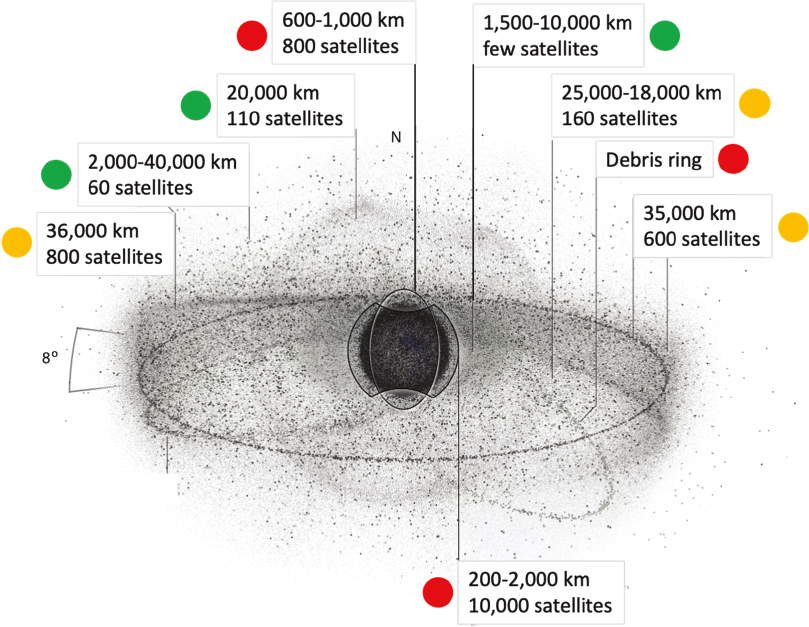
Space weather—variations in the space environment between the Sun and Earth—directly connects humanity’s well-being and geospace. Over the past decade, the need to understand and predict space weather has grown considerably driven by a burgeoning space industry and a society increasingly reliant on technologies that are vulnerable to its impacts. For example, with the advancement of launch technologies and miniaturization of spacecraft instrumentation, the number of active spacecraft orbiting Earth has grown from roughly 1,200 in 2013 to almost 10,000 a decade later, with more than 8,000 of these in low Earth orbit (LEO). This growth, combined with the highly variable upper atmospheric drag conditions that result from increased solar activity of the approaching solar maximum, underscores the critical need for improved scientific understanding and services for efficient space traffic management.
As the number of assets in space grows, the space weather user base has expanded beyond the traditional communication and Earth observation fields to encompass a wide range of public and private industries. In the past decade, the number of space weather customers subscribing to the National Oceanic and Atmospheric Administration (NOAA) Space Weather Prediction Center (SWPC) products has grown by a factor of 2.5, from 30,000 to almost 80,000 (see Figure 3-1 and Box 3-1).
Another major development is the revitalization of crewed space missions with the National Aeronautics and Space Administration (NASA) Artemis program targeting a permanent presence on the lunar surface and, eventually, a crewed mission to Mars. The harsh and unpredictable radiation conditions outside Earth’s shielding atmosphere and geomagnetic field challenge the solar and space physics community to provide an adequately detailed scientific basis for the monitoring, prediction, and protection mechanisms needed to protect the crew.
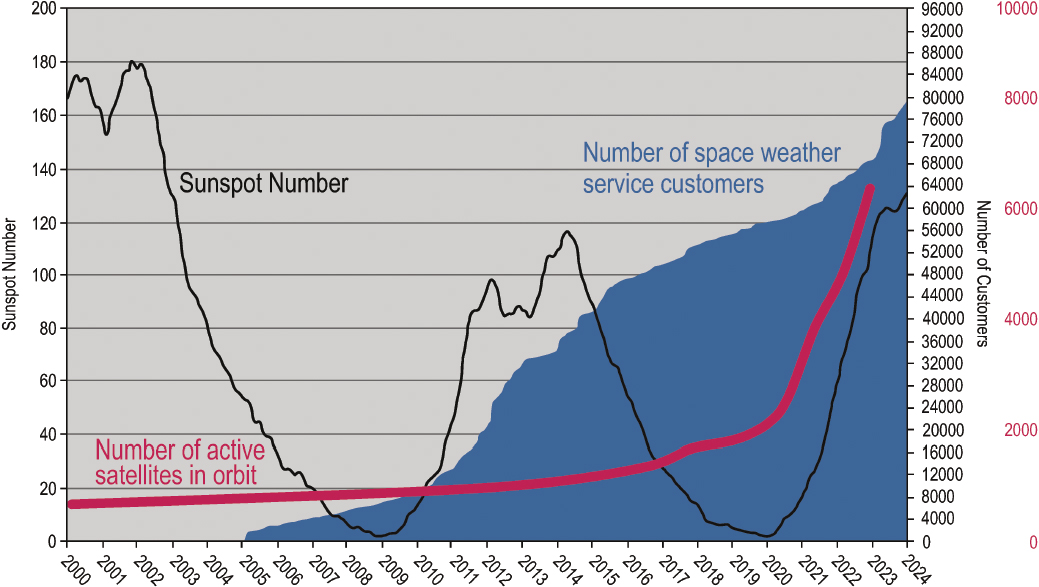
SOURCES: Adapted from NWS/NOAA Space Weather Prediction Center (n.d.); Satellite data from J. McDowell (2024), https://planet4589.org. CC BY 4.0.
BOX 3-1
Space Weather Impacts from a Monthly-Occurring Storm to a “Once in 100 Years” Event
Starlink Event. In February 2022, medium-level solar activity caused a sequence of two moderate geomagnetic storms. SpaceX launched a batch of 49 Starlink satellites into the period following the peak of the first storm, with an intent to park the spacecraft on temporary orbits at 210 km altitude to be later raised to their final orbits. However, there is evidence that the increased atmospheric drag caused by storm-enhanced atmospheric density contributed to deorbiting and subsequent reentry loss of 38 of the spacecraft. This unfortunate event demonstrates the importance of considering space weather effects even during such relatively commonly occurring moderate events.
Carrington Event. In September 1859, English amateur astronomers Richard Carrington and Richard Hodgson recorded an impressive solar flare. The following day, Earth experienced history’s most intense magnetic storm, with telegraph systems failing all over Europe and North America and auroral displays, normally confined to polar latitudes, visible in the tropics. Atmospheric charging lasted for more than a day, during which telegraph operators were not able to transmit or receive dispatches, but, instead, could unplug their batteries and transmit messages using only the power of the auroral current. An event of this magnitude today would cause immense damage to both ground- and space-based systems, and the recovery would take years and billions of dollars. A 2008 U.S. National Research Council report estimated that if a September 1859–size coronal mass ejection hit Earth now, the cost could be between $1 trillion and $2 trillion (in the first year alone) to repair the damage, and it could take 10 years to recover.
SOURCES: Starlink event: Fang. T.-W., A. Kubaryk, D. Goldstein, Z. Li, T. Fuller-Rowell, G. Milward, H.J. Singer, et al., 2022, “Space Weather Environment During the SpaceX Starlink Satellite Loss in February 2022,” Space Weather 20:11, https://doi.org/10.1029/2022SW003193. Carrington event: National Research Council, 2008, Severe Space Weather Events: Understanding Societal and Economic Impacts: A Workshop Report, The National Academies Press, https://doi.org/10.17226/12507.
Advanced space weather services, such as predictions, warnings, and risk assessment (including worst-case scenarios), are based on scientific understanding of the interconnected “system of systems” that comprise the heliosphere, from solar eruptions (any episodic release of energy) to their impact on Earth’s space environment, atmosphere, and infrastructure on the ground. Advances in space weather capabilities can only be achieved through new observations from the Sun to Earth, improved modeling of the systems and their interactions, and implementation of advanced technologies that go from observing systems to data distribution, computational models, and prediction systems. Thus, the solar and space physics community plays a critical role in the space weather enterprise. Indeed, space weather is inseparably tied to the science themes questions presented in Chapter 2.
The past decade was pivotal in how the federal government regards space weather. It is now widely recognized that developing the requisite understanding, observational systems, and services requires coordination and collaboration across federal and other agencies, commercial companies, and the research community, as well as other national and international players. It was also a pivotal decade because the federal government recognized that space weather is a related but separate endeavor from basic solar and space science research (seen, e.g., in the development of the 2015 National Space Weather Strategy and Action Plan and its 2019 update; NSTC 2023). This distinction was also recognized in the landmark 2020 Promoting Research and Observations of Space Weather to Improve the Forecasting of Tomorrow Act (PROSWIFT Act; P.L. 116-181), which, most importantly, also outlined the roles and responsibilities of key federal agencies and mandates that the agencies coordinate their activities across the different interest groups. The PROSWIFT Act did not authorize funds for implementation of the multiagency framework, and many of activities will require additional funding.
Recently, in December 2023, a memorandum of agreement (MoA) was signed by NASA, the National Science Foundation (NSF), NOAA, and the Department of the Air Force (DAF) to broaden the implementation of their
space weather activities. With these coordination and collaboration structures in place, this decadal survey’s statement of task considers space weather to be a central element of the strategy for solar and space physics.
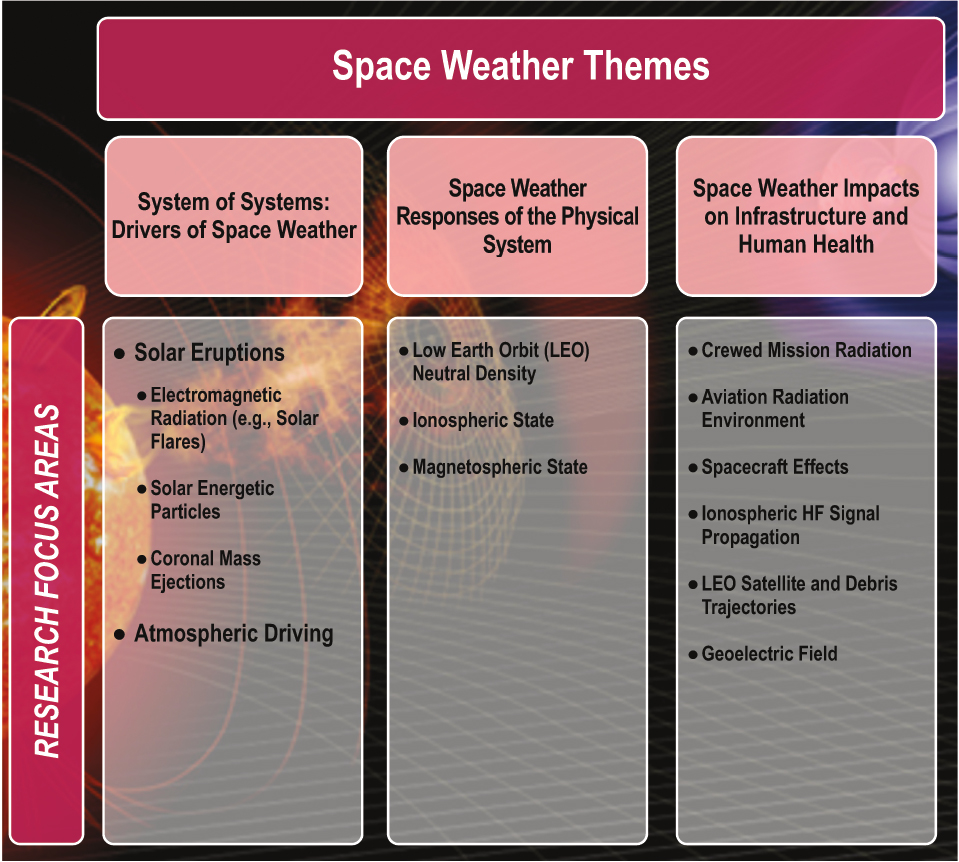
Successful space weather predictions start from discovery research. The highest-priority research topics for the decade fall under the following three themes (see Figure 3-2) that capture the drivers, responses, and impacts of space weather:
- System of Systems: Drivers of Space Weather
- Space Weather Responses of the Physical System
- Space Weather Impacts on Infrastructure and Human Health
Unlike basic research, much of space weather research is focused on the development of information products that assist in economically significant decision-making, including national security, health, and safety. Thus, the research focus areas under these three themes are motivated by research outcomes rather than guiding questions, as is the case for basic research focus areas introduced in Chapter 2. The space weather research focus areas listed in Figure 3-2
SOURCES: Composed by AJ Galaviz III, Southwest Research Institute; Background image from NASA.
NOTE: O2R, operations to research.
SOURCE: NOAA Space Weather Prediction Testbed, “R2O2R Overview,” https://testbed.swpc.noaa.gov/r2o2r/r2o2r-overview, accessed May 21, 2024.
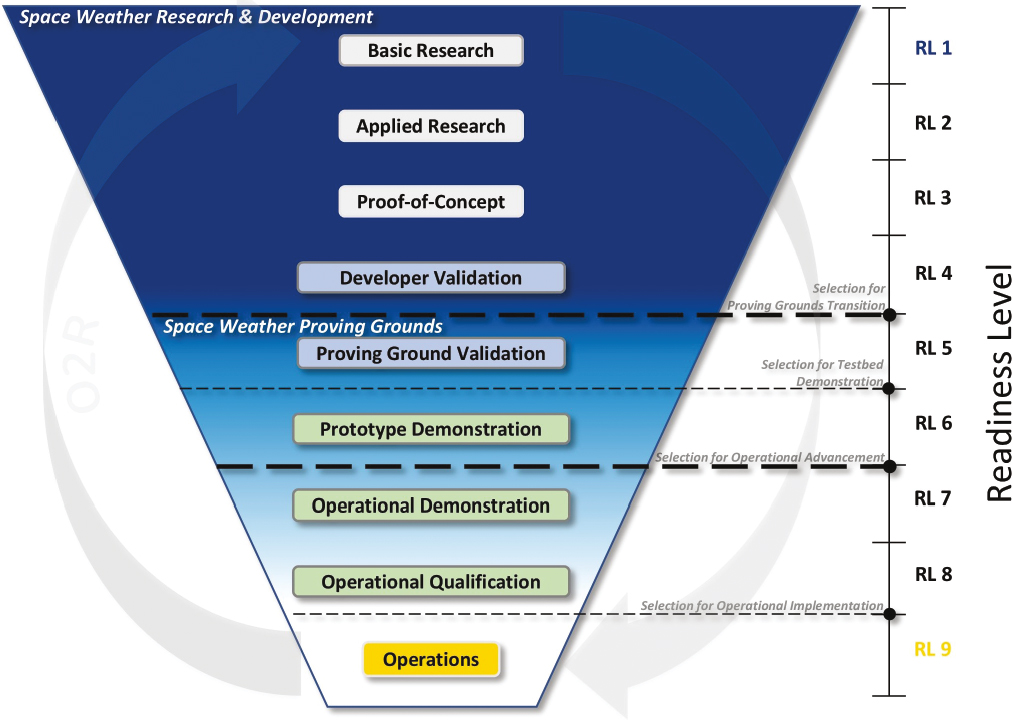
are the most compelling research needs identified for the next decade. However, prioritization of space weather research must be continuously assessed through a process that involves strong interaction between the research, operations, and user communities. This transition of research results to operations, and feedback from the users to the research community is referred to as the research-to-operations-to-research (R2O2R) cycle (Figure 3-3).
With sufficient investments, significant progress will be made on each of the space weather themes and their associated research focus areas in the next decade. Obtaining a multihour forecast capability for solar energetic particles (SEPs) would mean significantly reduced risk for human operations in space, be that in LEO or in the lunar environment. This multihour forecast capability is critical to the Artemis program and to future missions to Mars. The ability to forecast coronal mass ejection (CME) impacts and their magnetic field structure 24 hours in advance would enable spacecraft and power system operators to take mitigating actions, avoiding damage that can cost hundreds of millions of dollars (NRC 2008; Oughton 2018). Perhaps the fastest growing problem arises from the rapidly increasing number of spacecraft and debris in LEO. Space traffic management costs associated with collision avoidance are already significant; an ability to predict the thermospheric density would relieve some monitoring needs and reduce the risks and losses associated with the increasingly probable collisions in a highly crowded environment. Monitoring and modeling the LEO space environment, known as space situational awareness, is thus of critical importance for the next decade.
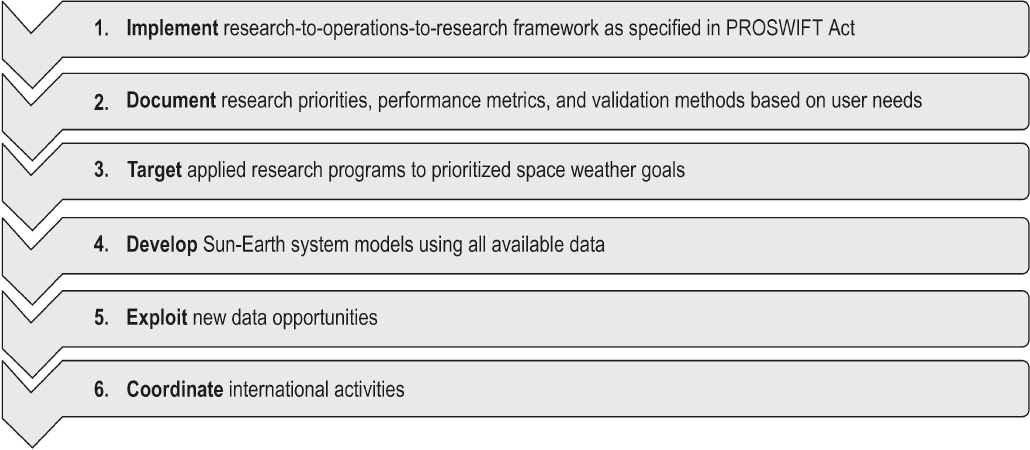
The space weather research strategy arising from the mission statement presented in Chapter 1 (see Figure 1-15) builds on the research-to-operations and operations to research framework as specified in the PROSWIFT Act. Effective use of resources requires documenting priorities and metrics of success as well as allocation of research funding to projects that develop the highest-priority applications. Priorities for investments in research and transition efforts must be based on assessments of expected impacts as well as the cost-effectiveness of the investments. The strategy includes both model development and creative use of emerging opportunities. Last, because space weather is a phenomenon with instantaneous effects worldwide, the best results will come from strong international collaboration. These considerations guided the development of a six-element space weather strategy as part of this decadal survey (Figure 3-4). While the National Space Weather Strategy and Action Plan (NSTC 2023) sets national priorities with detailed actions mandated in the PROSWIFT Act, the decadal survey strategy addresses those issues that have strong ties to the solar and space physics research community and have high potential for major advances in the next decade.
Parallel to the science themes and guiding questions introduced in Chapter 2, Section 3.2 provides a detailed discussion of the space weather research focus areas (see Figure 3-2). Many of these have significant fundamental research components and strong parallels to the science themes in Chapter 2. The remainder of Chapter 3 details the six elements of the space weather strategy introduced above (Figure 3-4) and includes all space-weather related conclusions and recommendations. The conclusions and recommendations are included in Chapter 3 so that it is a self-contained report on space weather aspects of solar and space physics. However, these strategic elements, while sharing science and operational components, have strong ties to the overall decadal strategy for solar and space physics, thus the space weather recommendations are referred to in Chapter 5 as part of the integrated research strategy.
3.2 SPACE WEATHER RESEARCH
With the recent increase in space-based activities and society’s growing dependence on technologies vulnerable to space weather, there is a growing urgency to establish more efficient pathways toward improved scientific understanding of space weather phenomena and concomitant development of service capabilities. In the next decade,
the solar and space physics community will contribute to the space weather enterprise by addressing research needs that are organized here into three broad themes:
- Theme 1—System of Systems Drivers of Space Weather. The renewed interest in crewed space exploration adds to the need of predicting the radiation environment from the upper atmosphere and LEO to the lunar environment and beyond. The Sun emits high-energy particles, plasma clouds, and photon radiation, each of which have their specific space weather impacts. Increasing the accuracy and lead time for a prediction of when a solar eruption will occur is imperative for mitigating the impacts of hazardous energetic particles that can reach Earth within only tens of minutes (see Figure 3-5). Advances needed to protect assets on Earth, and human life and technological systems in space, can only be provided through basic research addressing current knowledge gaps that often relate to connections between different regions, and across spatial and temporal scales.
- Theme 2—Space Weather Responses of the Physical System. The particles and plasma clouds that expand through space impact and interact with Earth’s space environment through a variety of processes and at a range of very different timescales. These processes, together with processes in the lower atmosphere, influence the dynamical states of the magnetosphere, ionosphere, and atmosphere systems. To predict the state of the space environment from the atmosphere through interplanetary space, it is necessary to understand how the particles, plasmas, and fields travel from the Sun outward, and how they interact and influence the background solar wind, Earth’s magnetosphere, ionosphere, and atmosphere.
- Theme 3—Space Weather Impacts on Infrastructure and Human Health. The variability in the space environment that is driven by space weather causes a variety of impacts on technologies in space, in the air, and on the ground as well as communication systems between space and ground. Understanding the impacts on specific systems and on humans onboard aircraft and in space requires modeling of the physical system impacts on technology and human tissue. Achieving such capabilities at the speed and reliability required for operational products calls for new advancements using high-performance computing, artificial intelligence, and data science.
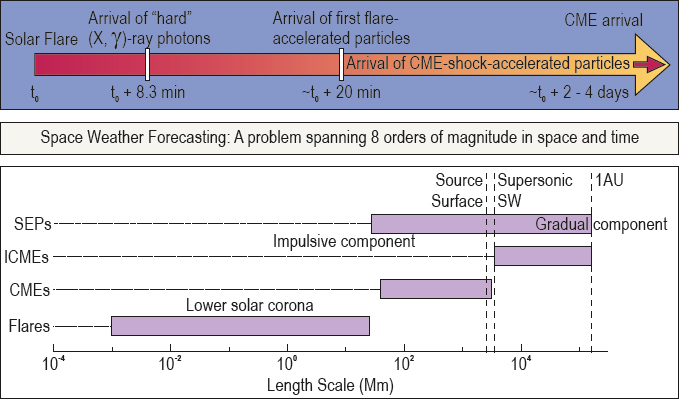
NOTE: ICME, interplanetary coronal mass ejection; SEP, solar energetic particle; SW, solar wind.
SOURCES: Composed by AJ Galaviz III, Southwest Research Institute; Adapted from Georgoulis et al. (2024), https://doi.org/10.1016/j.asr.2024.02.030. CC BY-NC-ND 4.0.
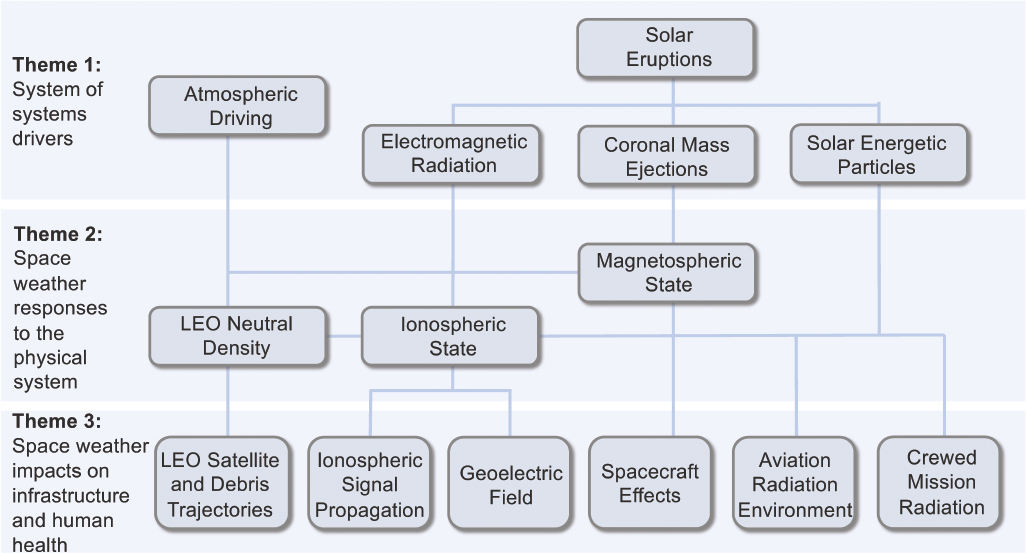
Figure 3-6 illustrates the space weather research themes as a flow chart from drivers to responses of the system, to impacts on technology and humans. The figure is not meant to illustrate the interconnectedness of the Sun–Earth system, but rather process flow embeds the research focus areas already introduced in Figure 3-2 and described in more detail below.
Figure 3-7 illustrates the multitude of space weather impacts that research must address in the next decade. While it is clear that avoiding collisions in LEO and protecting humans from radiation storms as humanity ventures further into space are high priorities for the next decade, the prioritization and sequencing of the integrated research strategy requires ongoing assessments of numerical modeling skill, infrastructure risk, and anticipated return on investment.
3.2.1 Theme 1—System-of-Systems Drivers of Space Weather
Solar Magnetic Eruptions and Solar Energetic Particles
Solar magnetic eruptions, or just solar eruptions, are any episodic release of energy and are the root cause phenomenon behind all extreme space weather (see Figures 3-2 and 3-6). They are the origin of solar flares that cause ionospheric disturbances, CMEs that drive geomagnetic storms impacting the entire near-Earth space environment, and SEPs that are known to disable spacecraft and damage human health. Furthermore, solar eruptions are phenomena capable of generating once in 100 years extreme space weather events that have the potential for creating worldwide disruptions that cost billions of dollars (NRC 2008).
Currently, the SWPC issues up to 72-hour probabilistic eruption forecasts, but even 24-hour forecasts have such high false alarm rates that their use in decision-making is limited. The critical need for improving predictions is amplified by the proliferation of LEO spacecraft and the renewed interest in crewed spaceflight beyond LEO, including establishment of a lunar base. Solar active regions can evolve into an eruptive state within 24 hours, putting severe limitations on what is feasible to achieve. However, given sufficient investments for research,
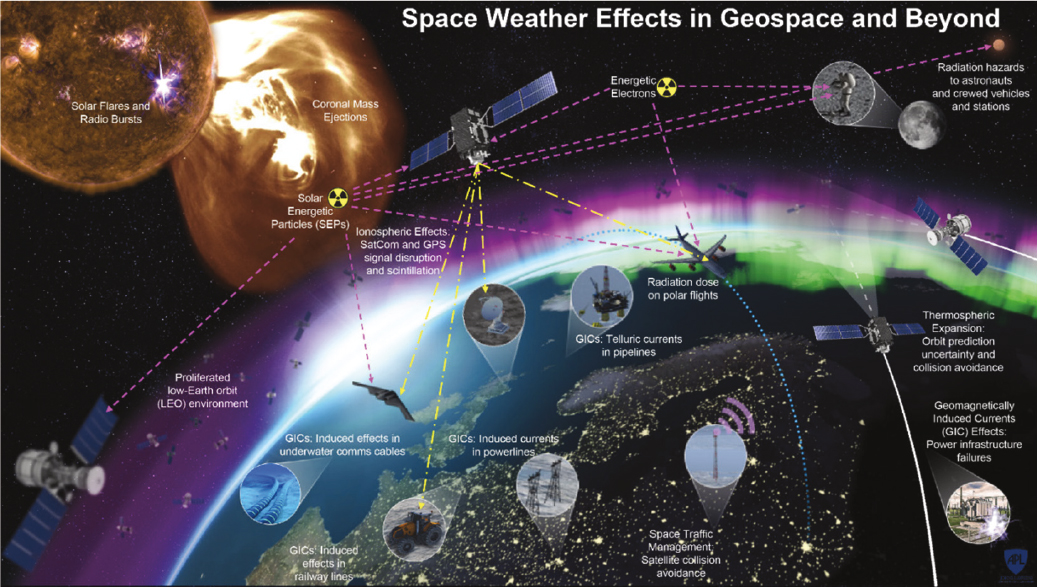
SOURCE: NASA (2021), compiled by APL.
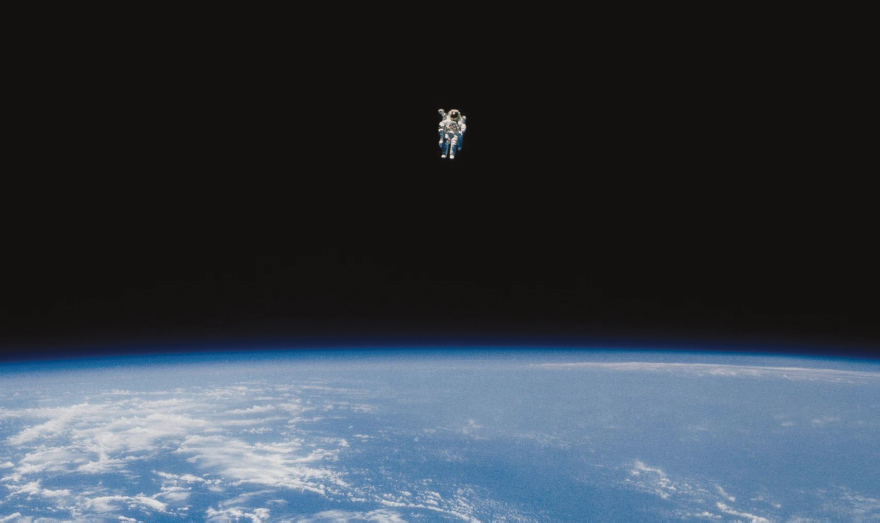
machine learning eruption models combined with high-quality solar imaging have the potential to achieve accurate and actionable 12-hour eruption forecasts in the next decade. Even 6-hour SEP forecasts would facilitate better decision-making and mitigating actions for users such as those responsible for astronaut safety (Figure 3-8), spacecraft launches, and aviation route planning.
The outcome of this research focus area is the development of accurate, actionable, and reliable probabilistic forecasts of solar flares (>M1) with 12-hour lead time and of associated SEP events with 6-hour lead time. Achieving this lead time, accuracy, and reliability requires simultaneous, inter-calibrated, full-Sun (including the poles and all longitudes) measurements of the magnetic field and solar atmospheric structure combined with coronagraphic imaging. Advanced data assimilation methods are then able to track active regions over their lifetimes, establish magnetic connectivity to the solar source regions from any point in the inner solar system, and determine CME and energetic particle trajectories as they launch from the solar surface. SEP event predictions also require analysis of CME propagation from the Sun to Earth’s environment (see below).
Coronal Mass Ejections
CMEs impacting Earth’s space environment drive the largest geomagnetic storms and associated space weather impacts. The out-of-the-ecliptic interplanetary magnetic field (Bz) polarity and magnitude and the solar wind speed are the key attributes of a CME that drive explosive reconfiguration events. When a CME is “geoeffective,” high-particle fluxes are produced in the magnetosphere, which are hazardous to space infrastructure and large electric currents in the auroral ionosphere and have the potential to damage power networks and disturb communications, navigation, and positioning systems.
Currently, the radial velocity of an Earth-directed CME is deduced from coronagraph observations to some degree of accuracy, which gives a lead time of 24–48 hours before the CME impacts Earth. However, the magnetic
SOURCE: NASA (2024a).
field orientation is only measured in situ in the solar wind, and such observations available from the Lagrange point L1 provide only 30–60 minutes of lead time before arrival at Earth. While 24-hour geomagnetic storm severity forecasts desired by many users may be beyond reach in the next decade, any increase in the lead time will be a significant improvement. For example, spacecraft operators need lead times of 6 to 12 hours to anticipate impacts from a CME-driven space weather event.
The outcome of this research focus area is a 12-hour lead time forecast of the CME magnetic field and a 2–3 hour upwind nowcast of other CME characteristics. The magnetic field forecast requires continuous, multiviewpoint, remote observations of CMEs combined with realistic numerical models of their propagation through the solar wind. To improve accuracy, physics-based models need to be augmented with data using modern data assimilation techniques. The increased lead time for short-term nowcasts requires upstream measurements much farther from Earth than those currently made by solar wind monitors at L1 (1.5 million km from Earth) to 15 million km upstream, while improvements in accuracy and all-clear forecasts call for observations just outside Earth’s magnetosphere.
Atmospheric Driving
The low-latitude region of Earth’s upper atmosphere is confined to the dipolar region of Earth’s magnetic field and thus is relatively well shielded from magnetospheric and solar wind variability. As a result of this shielding, the quiet time, low-latitude ionospheric scintillations that disrupt radio links are driven internally. Because these scintillations are not linked to geomagnetic storms, they may occur during both magnetically quiet and active periods.
Currently, it is thought that under magnetically quiet conditions, the major factor needed to destabilize the ionosphere and cause scintillation is the post-sunset enhancement of the equatorial- and low-latitude eastward electric fields and associated upward plasma drifts. The electric field responds to driving by the solar wind and magnetosphere (penetration electric field) from above, but also to complex forcing from the lower atmosphere. These effects are currently unresolved. Lower atmosphere waves and tides may contribute significantly to the
quiet time post-sunset electric field, but the lack of full characterization of these waves and tides makes modeling of ionospheric phenomena challenging.
The outcome of this research focus area is to quantify how forcing from the lower atmosphere via gravity waves drives ionospheric scintillations. Including the scintillation drivers would enable critically important improvements to existing ionospheric correction models and avoid disruption of radio links used for civilian and military applications. Advancement in this research focus area requires investigation of the role of gravity waves for the formation of quiet time ionospheric disturbances. Advancement is only achievable through coordinated observations from heterogeneous space (first and foremost the Geospace Dynamics Constellation [GDC] and Dynamical Neutral Atmosphere–Ionosphere Coupling [DYNAMIC] missions) and distributed ground-based observation networks.
3.2.2 Theme 2—Space Weather Responses of the Physical System
Low Earth Orbit Neutral Density
Large geomagnetic storms (most often driven by CMEs) cause atmospheric upwelling and local density increases that cause spacecraft in LEO to lose tens of kilometers in altitude, leading to large deviations from their predicted orbits (Berger et al. 2023). The thermospheric neutral density is the largest source of uncertainty in satellite orbit predictions, and thus directly impacts safe operation of satellites.
In mid-June 2024, there were more than 9,000 spacecraft in LEO at altitudes between 400 and 1,200 km from Earth, two-thirds of which belong to Starlink, SpaceX’s constellation (Faleti 2024). This total may increase by an order of magnitude or more in the coming decade (Falle et al. 2023). Such congestion leads to a vast space traffic management problem, which currently involves tens of hours of operator time spent each week tracking orbits of both spacecraft and debris, and planning mitigation actions (Figure 3-9). Furthermore, new missions face limitations of orbits usable to them because of this debris. This problem is sufficiently serious that it may jeopardize the use of LEO for space-based applications, which would be a tremendous setback for scientific research, university education, commercial activity, and public (environmental and other) services. Currently it is costing additional time and funds to continually replan orbits for research spacecraft. For example, the Tandem Reconnection and Cusp Electrodynamics Reconnaissance Satellites (TRACERS) mission, which is still in development, is on its third orbit altitude replan since the Small Explorer (SMEX) mission was proposed.
There is a great need for accurate forecasts of thermospheric density changes during severe geomagnetic storms because these forecasts are used to estimate storm-time trajectory changes of LEO satellites and debris. Currently, NOAA SWPC uses the Whole Atmosphere Model-Ionosphere Plasmasphere Electrodynamics (WAM-IPE) physics-based model that provides the thermospheric density and composition and includes the effects of solar activity.
The outcome of this research focus area is to develop an accurate and reliable thermospheric density model that incorporates advanced data assimilation capabilities and produces a 24–48 hour forecast of thermospheric density during geomagnetic storm conditions. This requires basic research to quantify the lower atmospheric influences on the ionosphere–thermosphere system—for example, through gravity and large-scale waves. To increase the forecast skill, prediction capability, and accuracy, physics-based modeling needs to be improved via data assimilation, artificial intelligence, and multimodel ensembles. Furthermore, additional environmental measurements are needed at LEO with good coverage in both altitude and latitude.
Ionospheric State and Magnetospheric State
As auroras are magnetically connected to Earth’s magnetosphere, their dynamics and location serve as an indicator of the overall state of the space environment. The latitude of auroral boundaries is a proxy for energy input from the solar wind into the space environment and specifically into the ionosphere and thermosphere, while also revealing the regions on the ground where the most severe space weather impacts will occur. At low latitudes, enhanced intense and unstable ionospheric density structures during geomagnetic storm periods are a growing concern for many civilian, commercial, and military domains.
SOURCE: Image courtesy of Pablo Carlos Budassi.
Current models for the auroral ionosphere lack the detail necessary for them to be used as inputs to models operated by the user community to gauge impacts. On the ground, the geoelectric field arising in response to auroral currents drives disturbances in power transmission networks, pipelines, undersea cables, railways, and other long conducting systems. Power transmission system impacts include reduced lifespan or failure of transformers, as well as voltage instability and possible collapse of regional networks.
Resolving the ionospheric structuring and dynamics at all latitudes is critical to technologies that rely on radio wave signals, be they satellite communication for positioning, navigation, and timing services or high-frequency communications that make use of signals reflected off the ionosphere. Enhanced electron density and structuring impacts signal paths, absorption, and noise throughout the globe, and thus may cause debilitating effects to operational systems.
The outcome of this research focus area is to develop a nowcast capability for comprehensive characterization of magnetospheric and ionospheric conditions, including SEP access; energetic particle and plasma transport, acceleration, and loss; auroral activity (e.g., its intensity, boundaries, and energy inputs); equatorial ionospheric dynamics and variability during sunset and sunrise; and preconditioning influences. Ionospheric and magnetospheric conditions can be monitored by a combination of ground- and space-based measurements, but only if these measurements have sufficient resolution and coverage.
Currently, ground-based instrument networks cover land areas very unevenly and do not cover the oceans at all. LEO satellites measure the state of ionospheric density as well as the precipitating particle populations that are needed to drive the ionospheric models. Polar cap potential specification using radar systems such as the
Super Dual Auroral Radar Network (SuperDARN) and field-aligned current measurements from satellite systems such as the Active Magnetosphere and Planetary Electrodynamics Response Experiment (AMPERE) are valuable for evaluation of the energy input rates. Similarly, ground measurements by heterogeneous instruments, such as the recommended Distributed Arrays of Scientific Heterogeneous Instruments (DASHI) network (see Chapter 5), provide key ionospheric state parameter fields (e.g., density variability and its driving mechanism) and their spatiotemporal coupling on multiple scales, thereby enabling transformative advances to nowcasting and forecasting capabilities. The Geostationary Operational Environmental Satellite (GOES) fleet monitors the magnetospheric state at geostationary orbit, but there are no missions monitoring the heart of the radiation belts inside geostationary orbit or the radiation environment and plasma acceleration processes outside geostationary orbit.
Reanalysis
Although not listed as a focus area of this particular theme, an important capability to develop over the next decade for all areas of Sun-Earth modeling is “reanalysis.” Reanalysis refers to the process of creating a long-term reconstruction of the state space (i.e., the set of possible configurations) in the space weather environment, typically generated with data-assimilative numerical simulation models. End users of this process include, for example, vehicle anomaly analysts and designers, who use reanalysis to refine data from the past that determine either specific conditions during a past or ongoing mission or to establish cumulative and worst-case transient design environments. Reanalysis is also a key process in improving forecasting models. For example, when new data sources become available, or if previous errors in observations are identified and corrected, or when potential model improvements need to be validated, reanalysis of the state space over a given period (typically containing challenging events) serves to illuminate model performance gains or losses.
Currently, reanalysis in space weather is limited to a handful of studies reporting long-term numerical simulations—usually not data assimilative—with some simulating every storm during a long period of time. Such “free running model simulations” without data assimilation are not generally recognized as reanalysis runs, because they do not include improved input data or specific model improvements demonstrating superior state space specification.
The objective is development of a robust reanalysis capability for forecast or nowcast models with established community standard input data sets for all key space weather drivers and impacts. Advances in this research focus area require publicly accessible repositories of standard state space models of the magnetosphere and the ionosphere–thermosphere–mesosphere system, spanning many solar cycles. These reanalysis runs would be based on state-of-the-art numerical simulation models, either research or operational, and are expected to include data assimilation to correct the models to realistic states.
3.2.3 Theme 3—Space Weather Impacts on Infrastructure and Human Health
Crewed Mission Radiation
The outcome of this research focus area is to characterize and monitor the space weather environment in cislunar space and on the lunar surface in support of the Artemis program. For crewed missions, especially those outside Earth’s magnetosphere, the primary space weather risk is the high fluence of energetic particle radiation that comprises the SEPs and the galactic cosmic ray population, which can cause both acute and long-term health impacts and damage spacecraft systems. NASA is currently expanding its crewed missions to the Moon and eventually to Mars, which creates substantial pressure on safeguarding both technology and humans in high-altitude space outside the shield provided by Earth’s atmosphere and magnetic field. Whether the Moon is in the solar wind or within Earth’s magnetosphere, it is directly exposed to SEPs. The Moon may also encounter energetic electron impacts, either from magnetotail reconnection events or from solar energetic electrons. To safeguard the infrastructure and crew in LEO, in the inner magnetosphere, or en route to or on the Moon requires continuous monitoring of the radiation environment in the entire space from the near-Earth region out to lunar orbit. Protecting corresponding systems on the way to Mars will require the capability to monitor the entire inner heliosphere,
because the relative locations of Earth and Mars vary over the 24-month Martian year. The Lunar Gateway space weather instrumentation will characterize the radiation environment inside and outside of the vehicle and have the potential to improve understanding of the radiation impacts to systems.
Aviation Radiation Environment
The outcome of this research focus area is to develop an accurate and reliable aviation radiation nowcast and forecast for airline operators during large SEP events. The operators need forecasts of SEP timing, intensity, and spectra with sufficient lead time to take preventive action. The quantification of the lead time requires consultation with airlines. Furthermore, an accurate real-time model for the geomagnetic field is required to improve the accuracy of models in the high-latitude regions. Currently, uncertainties of the field configuration lead to errors of an order of magnitude in SEP flux estimates. Research is needed to improve the radiation transport models that describe the particle paths through the space environment and aircraft structures, as well as to assess the human radiation exposure and impacts on the aircraft electronic systems.
Spacecraft Effects
The outcome of this research focus area is to develop a reliable probabilistic forecast of surface charging (3-day lead time), internal charging (28-day lead time), single event effects (SEEs; 6-hour lead time), and event total dose (1-day lead time) for all orbits. Energetic particle penetration to the spacecraft internal parts can lead to discharge events that can damage or even disable the subsystems. Surface charging and discharging at solar panels lead to degradation and reduction of power production. SEE damage can occur when energetic protons penetrate spacecraft electronics, leading to bit flips that can cause unintended spacecraft operations. Satellite, human spaceflight, and launch operators need forecasts of these impacts with sufficient lead time to take mitigating actions. Such forecasts require knowledge of energetic particle fluxes both of solar origin and those accelerated within the magnetosphere.
Ionospheric High-Frequency Signal Propagation
The outcome of this research focus area is to develop 30-minute to 1-hour lead time forecasts of radio wave signal impacts throughout the ionosphere. User requirements are already pushing beyond current nowcast and forecast systems toward higher temporal- and spatial-scale nowcasts, with a need for more capable probabilistic forecasts. Basic research efforts are needed to develop coupled ionospheric models with sufficient resolution to capture key space weather impacts at regional and local scales. Observationally, this requires continuation of current ground-based operations, an expansion of ground-based coverage in key geographic areas, expansion of satellite-based radio occultation data sources, and an advancement of real-time systems to reduce data latency (across ground and space) to support operational systems. Current nowcast and forecast capabilities for the absorption of radio signals in the ionospheric D region, important for the aviation industry, will also benefit from improved solar energetic particle forecasts, as described above in Section 3.2.1.
Low Earth Orbit Satellite and Debris Trajectories
The outcome of this research focus area is to develop an integrated modeling framework for predicting LEO satellite and debris trajectories during geomagnetic storms that combines an accurate space weather environmental forecasting model, an advanced satellite forcing model, and a model that enables object track forecasting. As one element of the process, a dedicated mission to explore gas–surface interactions and forcing at different LEO altitudes and latitudes would be needed to specify the aerodynamics involved in the processes, which falls outside the scope of solar and space physics. A radar-tracking calibration satellite fleet providing baseline trajectories of well-calibrated objects would be beneficial for validation and calibration of both trajectory prediction models and thermospheric density models.
Geoelectric Field
The outcome of this research focus area is to develop a reliable probabilistic forecasting (1 hour) of geoelectric field with increased spatial resolution (200 km) for addressing space weather impacts on the ground. This will require completion of the national magnetotelluric survey, and a similar survey for the U.S.–Canada border region. Current models need improved spatial resolution to better characterize the regional impacts and direct measurements of the geoelectric field for model validation. Probabilistic forecast models are needed for grid operator use. Such forecasts require knowledge of the solar wind and interplanetary magnetic field orientation as well as monitoring of the ground magnetic field variations.
3.3 STRATEGY FOR THE NEXT DECADE
This section introduces the six strategic elements that comprise the conclusions and recommendations for space weather. These recommendations are part of an integrated research strategy for solar and space physics, thus are also referred to in Chapter 5.
3.3.1 Implementation of the Research-to-Operations-to-Research Framework
In December 2023, NASA, NOAA, NSF, and DAF signed an MoA outlining the collaborations needed to improve transitioning space weather research into operational forecasts and to enhance feedback from operational applications into research, known as R2O2R. The agreement builds on an earlier National Science and Technology Council Space Weather R2O2R framework document, which established a formal structure for the R2O2R enterprise (see Tables 3-1 and 3-2). The framework document also expresses the importance of communication and collaboration between federal departments and agencies, academia, commercial enterprises, customers, and international organizations.
Conclusion: The NOAA-NASA R2O2R framework agreement, together with the quad-agency MoA between NOAA, NASA, NSF, and DAF, will facilitate the transition of new developments in space weather research to operational services and address the existing communication gaps between the user and research communities, as specified in the PROSWIFT Act.
These agreements outline formal actions to be conducted, including prioritization of user needs and agency actions based on estimated return on investment, transition of research capabilities into operations, enhanced coordination between research modeling and forecasting centers, and communication of operational needs among the agencies. Full implementation of this framework will be essential for significant progress on the space weather research focus areas in this decadal survey (see Figure 3-2). This decadal survey does not provide specific guidance on how the agencies should implement the R2O2R framework. Rather, as outlined in this chapter, it provides a strategy to ensure that research and development efforts are focused on high-impact, high-priority needs with an R2O2R framework that will address critical national needs.
An important focus of the PROSWIFT Act is the acquisition and dissemination of space weather data. Specifically for NSF, the PROSWIFT Act requires the agency to
(1) Make available to the public key data streams from the platforms and facilities . . . for research and to support space weather model development; (2) develop experimental models for scientific purposes; and (3) support the transition of the experimental models to operations where appropriate.
Furthermore, the Act calls for NSF to “continue to provide space weather data through ground-based facilities, including radars, lidars, magnetometers, neutron monitors, radio receivers, aurora and airglow imagers, spectrometers, interferometers, and solar observatories.”
TABLE 3-1 Recent National Space Weather Policy Objectives
| Year | Document | Source | Objective |
|---|---|---|---|
| 2015 | National Space Weather Strategy and Action Plan | National Science and Technology Council (NSTC) | Integrate national space weather effort |
| 2016 | Executive Order—Coordinating Efforts to Prepare the Nation for Space Weather Events | White House | Define roles and responsibilities for federal agencies, Office of Science and Technology Policy, and OMB |
| 2016 | Charter of the Subcommittee on Space Weather Operations, Research, and Mitigation (SWORM) | Committee on Environmental, Natural Resources, and Sustainability, NSTC | Establish SWORM subcommittee as the interagency body to coordinate federal departments and agencies |
| 2019 | National Space Weather Strategy and Action Plan | NSTC | Identify strategic objectives and actions to achieve a space-weather-ready nation |
| 2019 | Federal Operating Concept for Impending Space Weather Events | Department of Homeland Security | Prepare for and respond to space weather events |
| 2020 | Promoting Research and Observations of Space Weather to Improve the Forecasting of Tomorrow (PROSWIFT) Act | P.L. 116-181, 116th Congress | Prepare and protect against social and economic impacts of space weather |
| 2021 | U.S. Space Priorities Framework | White House | Bolster the health and vitality of the U.S. space sectors |
| 2022 | Space Weather Research-to-Operations and Operations-to-Research Framework | Committee on Environmental, Natural Resources, and Sustainability, NSTC (SWORM Subcommittee) | Establish formal interagency structure for effective R2O2R |
| 2022 | Space Weather Roundtable | P.L. 116-181 | Established to facilitate understanding of science and to enhance space weather forecasting capabilities |
Conclusion: Implementation of these actions will span and require collaboration across multiple NSF divisions. New research infrastructure, such as the next generation Global Oscillations Network Group (ngGONG), the Frequency Agile Solar Radiotelescope (FASR), and the ground-based DASHI, would bring significant new contributions to observing the space weather drivers and impacts, as strategic assets of the R2O2R framework.
Recommendation 3-1: The National Science Foundation should develop an agencywide strategic space weather plan. The plan, as directed by the PROSWIFT Act, should include the incorporation of data streams for space weather purposes from both currently available ground-based facilities and networks, as well as those that would become available after implementation of the decadal survey’s recommendations for ground-based observations. It should also support experimental model development and transition to operations. The development and implementation of the strategic plan is likely to require augmentations to the current level of effort and budget.
Following this strategy would imply that NSF would seek to expand and augment the current ground-based assets under NSF management into a coordinated, heterogeneous instrument network with specific contributions to space weather. Further contributions by NSF could be funding for developing near-real-time space weather data streams and for making those publicly available (see the PROSWIFT Act). Recognizing the strong ties between
TABLE 3-2 Space Weather Roles of Government Agencies as Defined in the 2020 PROSWIFT Act
| Agency | Role |
|---|---|
| Department of Defense | Supports operational space weather research, monitoring, and forecasting for the department’s unique missions and applications. |
| Department of the Interior | Collects, distributes, and archives operational ground-based magnetometer data in the United States and its territories, works with the international community to improve global geophysical monitoring, and develops crustal conductivity models to assess and mitigate risks from space weather-induced electric ground currents, as well as provide data to improve geomagnetic field models (e.g., the Water Measurement Manual) that are used for operation. |
| Federal Aviation Administration | Provides operational requirements for space weather services in support of aviation and coordinates these requirements with the International Civil Aviation Organization and integrates space weather data and products into the Next Generation Air Transportation navigation and communication Systems. |
| National Aeronautics and Space Administration | Provides support to increase the understanding of the fundamental physics of the Sun–Earth system through basic research, space-based observations, and modeling, developing new space-based technologies and missions, and monitoring of space weather for NASA’s space missions. |
| National Oceanic and Atmospheric Administration | Provides operational space weather monitoring, forecasting, and long-term data archiving and access for civil applications, maintains ground-based and space-based assets to provide observations needed for space weather forecasting, prediction, and warnings, provides research to support operational responsibilities, and develops requirements for space weather forecasting technologies and science. |
| National Science Foundation | Provides support to increase the understanding of the Sun–Earth system through ground-based measurements, technologies, and modeling. |
SOURCE: Data from “Title 51–National and Commercial Space Programs.” Pub. L. 111-314, §3, Dec. 18, 2010, 124 Stat. 3328.
basic research and space weather application development, NSF is encouraged to continue its current efforts to support space weather research in all parts of the chain, including fundamental physical processes, model and method development, transition to operations, and application development, to meet the PROSWIFT Act mandates.
3.3.2 Documentation of Research Priorities, Performance Metrics, and Validation Methods
The growing investments in space weather are a direct response to the growing need for space weather services to protect national infrastructure, improve economic activity, and safeguard lives and property. In a cost-constrained environment, it is important that strategic investments focus on the highest-priority service needs and areas where the most significant benefits can be realized.
Tangible progress on space weather services needs to be based on knowledge of the impacts and customer actions that will be enabled by the enhanced services (Table 3-3). The foundation for prioritizing R2O2R activities is a quantitative assessment of current capabilities and an understanding of the gaps between current capabilities and the needs of industry and government. For such an assessment, it is critically important to have a comprehensive and objective set of performance metrics and validation methods to evaluate the performance of models and service products as well as to quantify their significance for customer mitigation actions and economic impacts. Such metrics need to be developed by the operational agencies and industry. These metrics can then be used to set research priorities that are informed by identification and prioritization of the capabilities that are the most urgent and for which substantial progress can be expected within the next decade.
The rapid growth of space weather users and the swift changes of their needs calls for frequent communication about the capabilities and gaps between customers and industrial and academic partners. The service requirements need to be continuously updated as technologies and applications evolve, and as new mitigation measures are employed.
TABLE 3-3 Recent Assessments of Economic Impacts, Customer Needs, and Gaps
| Impact Area | Economic Impactsa | Customer Needsb | NASA Gap Analysisc | Benchmark Reportd |
|---|---|---|---|---|
| Electric Power | ✓ | ✓ | ✓ | ✓ |
| Satellite Radiation/Charging | ✓ | ✓ | ✓ | ✓ |
| Navigation | ✓ | ✓ | ✓ | ✓ |
| Communication | ✓ | ✓ | ✓ | ✓ |
| Aviation | ✓ | ✓ | ✓ | |
| Agriculture | ✓ | ✓ | ✓ | |
| Emergency Management | ✓ | ✓ | ||
| Satellite Collision Avoidance | ✓ | ✓ | ||
| NASA Robotic Exploration | ✓ | |||
| NASA Human Exploration | ✓ |
a Abt Associates. 2017. “Social and Economic Impacts of Space Weather in the United States.” Bethesda, MD. https://www.weather.gov/media/news/SpaceWeatherEconomicImpactsReportOct-2017.pdf.
b Abt Associates, Inc., U.S. National Weather Service, Space Weather Prediction Center. 2019. “Customer Needs and Requirements for Space Weather Products and Services.” Rockville, MD. https://repository.library.noaa.gov/view/noaa/29107.
c Johns Hopkins University Applied Physics Laboratory. 2021. “Space Weather Science and Observation Gap Analysis for the National Aeronautics and Space Administration.” Laurel, MD. https://smd-cms.nasa.gov/wp-content/uploads/2023/11/gapanalysisreport-full-final.pdf.
d Reeves, G., Institute for Defense Analysis—Science and Technology Policy Institute. 2019. “Next Step Space Weather Benchmarks.” IDA Group Report NS GR-10982. Alexandria, VA. https://www.ida.org/-/media/feature/publications/n/ne/next-step-space-weather-benchmarks/gr-10982.ashx.
Conclusion: The PROSWIFT Act tasks the Space Weather Advisory Group (SWAG) to conduct a user survey, to be reevaluated not less than every 3 years, to “assess the adequacy of current federal government goals for lead time, accuracy, coverage, timeliness, data rate, and data quality for space weather observations and forecasting.” As these surveys are currently in the planning stage, the results needed for prioritization of activities are not yet available, and the research community lacks a clear set of targets to work toward.
Recommendation 3-2: The National Oceanic and Atmospheric Administration (NOAA) and the Department of Defense (DoD) should build upon the periodically repeated Space Weather Advisory Group surveys of space weather product users to document the highest-priority customer needs and the best performance metrics and validation methods for available space weather applications. The results should be used to identify high-priority space weather research goals. In addition, processes should be developed to ensure communication of these priorities across NOAA, DoD, the National Aeronautics and Space Administration, and the National Science Foundation to be used when setting research priorities in the agencies’ space weather–related programs.
Based on (1) an established process to communicate with industry and government to understand their space weather needs; (2) documentation of the performance metrics and validation information for operational models and products; and (3) identification of potential mitigating actions that could be taken with improved space weather information, it is then possible for NOAA and DoD to recommend priorities for near-term and long-term service targets. It is expected that the validation of research models will continue to be supported by NASA and NSF.
Conclusion: This decadal survey outlines a number of important research focus areas that are not further prioritized owing to lack of accurate understanding of current and future user needs. However, the decadal survey committee recognizes the growing space traffic management problems at LEO caused by increased number of spacecraft and debris as a critically important issue. Future mitigation actions will likely include regulation for faster deorbiting of post-operational spacecraft, which will increase the total costs and require
new technology development for deorbiting spacecraft without propulsion. Unless carefully implemented, such regulation can be particularly harmful to university and other academically oriented groups launching CubeSats, whose impact to the space traffic management problem will in all cases remain small if not insignificant.
3.3.3 Targeting Applied Research Programs
Space weather, as with many other application-oriented disciplines, has its genesis in basic research. The solar and space physics community has established a solid foundation of scientific understanding—numerical models have been developed, and a Sun-to-Earth observing infrastructure is in place. To serve space weather users, further efforts are needed that center on applied research and innovations that convert this basic understanding into specific applications. New sophisticated techniques are needed for optimizing available data and models for space weather forecasts.
Current targeted research programs—such as NSF’s Advancing National Space Weather Expertise and Research toward Societal Resilience (ANSWERS) and those supported by NASA’s Living With a Star (LWS) program, Space Weather Program, and Heliophysics Research Program—provide valuable opportunities for the research community to focus on science questions that advance space weather capabilities.1 Targeted funding from NOAA—and to some extent the Air Force Office of Space Research—has supported important research-to-operations transition and application development efforts. However, as each agency operates based on its own priorities, the current funding structure does not have mechanisms in place to prioritize the targeted research and development efforts according to the highest-priority customer needs.
Conclusion: By coordinating the space weather research programs of NASA, NSF, NOAA (see Recommendation 3-4), and DoD, the national research effort will focus on the highest user needs, and it will effectively integrate advances in basic science into the development of targeted applications.
Conclusion: The increased importance of space weather has created growing workforce needs in areas of application development, research to operations transitions, mitigation planning, and execution. Stable, coordinated applied research programs help to create healthy career paths for applications-oriented space weather research to meet the workforce needs.
Recommendation 3-3: National Science Foundation (NSF) and the National Aeronautics and Space Administration (NASA) space weather research programs (such as NSF’s Advancing National Space Weather Expertise and Research toward Societal Resilience [ANSWERS] and NASA’s Heliophysics Space Weather Programs) should be targeted to prioritized space weather goals (see Recommendation 3-2).
The research priorities set according to the customer needs will be identified through the user surveys conducted by the SWAG and through other user surveys and government efforts (Recommendation 3-2). Initial priorities will likely include prediction of solar eruptions, SEP forecasts, and improved models for the neutral atmosphere to address the current issue regarding space debris.
3.3.4 Developing Sun–Earth System Models Using All Available Data
The dynamical environment from the Sun to Earth is an interconnected system of systems that can only be understood and accurately predicted when treated in its entirety. The complexity of the drivers, responses, and impacts in the space weather system call for approaches that invoke state-of-the-art modeling, data assimilation and data science methods, and artificial intelligence applications. A resilient infrastructure for real-time data taking and distribution, as well as forward-looking instrument technology development, are needed to support current and future operational space weather requirements.
___________________
1 This paragraph was modified following the release of the report to accurately reflect NASA’s targeted research programs.
Assimilative system models have accelerated progress in operational forecasting in Earth science, and such methods are now entering the Sun–Earth system modeling and space weather enterprise. The data scarcity problem in space weather science is twofold. While the vast space environment remains grossly under-sampled, current models under-utilize the available data owing to lack of assimilative methods and computational processing power as well as real-time data acquisition and distribution processes.
Conclusion: Society’s space weather needs are served by combining in situ and remote sensing, space- and ground-based observations, and state-of-the-art models that focus both on modeling from the Sun out to the heliosphere and from the Earth system to space. This combination would provide space weather end users with accurate, on-demand resources to predict the consequences of space weather on systems distributed on and around Earth and throughout the solar system.
New needs for such efforts include the increased presence of humans and infrastructure beyond LEO (with particular focus on radiation dose) and increased commercial space activity in LEO (with particular focus on neutral density variations). The increased presence of humans in outer space requires characterization and monitoring of the space weather environment in cislunar space and on the lunar surface, and later en route to Mars and on the Martian surface. Modeling efforts would likely focus on the SEPs and the radiation environment in general. However, these efforts would also encompass the plasma effects arising from large solar eruption events. Space traffic management and broader space situational awareness at LEO requires improved understanding of variations, especially of the thermospheric density in response to solar and magnetospheric activity. Space weather research and modeling programs make important contributions to these high-priority efforts.
Conclusion: The development of advanced data assimilation capabilities is important for conducting observing system experiments (OSEs) and observing system simulation experiments (OSSEs) that quantitatively determine the value of observations for accurate specifications and forecasts. These new data assimilation capabilities are important not just for improving research and operational services, but also for their ability to inform decisions on future investments in the observing system, which is a capability is currently lacking.
Different from that of large-scale science models, space weather modeling efforts are focused on transition to operations, development of new models to meet particular user needs, as well as development of tools that address the quality and improvement of the forecasts. Besides physics-based modeling, these efforts often employ other methods, including data assimilation, artificial intelligence methods, and ensemble modeling. These models make use of the growing availability of distributed ground-based and space-based observations from research and operational missions and instruments, and from national, international, and commercial providers. The contribution of individual data sources to forecast and specification accuracy is quantified through OSEs and OSSEs, and through reanalysis of past observations.
Recommendation 3-4: The National Oceanic and Atmospheric Administration should establish a space weather research program. It should partner with the Department of Defense to develop large-scale predictive space weather models that can meet operational requirements, which may differ from those of scientific research models. Model development should make use of the versatile set of available space weather data.
In some cases, space weather modeling may be able to leverage or benefit from synergies with the science modeling efforts. In other cases, space weather models with specific user-driven applications, may need to be developed from scratch.
3.3.5 Exploitation of New Data Opportunities
Accurate and timely space weather services rely on numerical models driven by near-real-time observations from the relevant parts of the Sun–Earth system. NOAA has an operational satellite fleet (Figure 3-10), and NASA
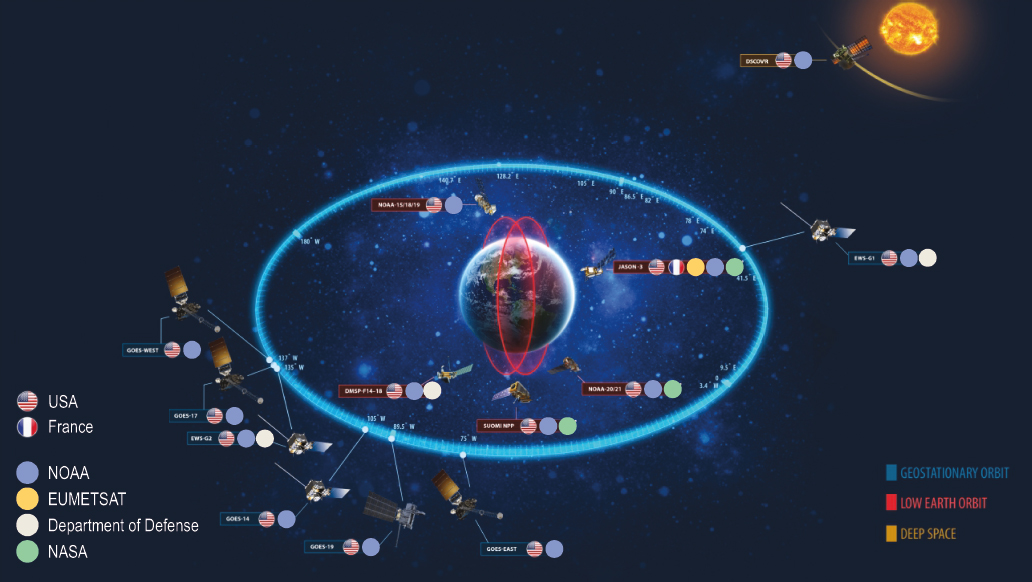
SOURCE: Modified by AJ Galaviz III, Southwest Research Institute from NOAA (2024).
has operated some of its research spacecraft in an operational mode for 2 decades. New opportunities will arise from combining these assets with information from NSF ground-based facilities, international missions, and commercial providers. However, these heterogeneous data sets require careful intercalibration as well as new methods for data access and incorporation into the models.
NASA’s LWS program targets basic research problems that have direct relevance to space weather. To some extent, the NASA Heliophysics System Observatory, which targets fundamental research questions, also provides near-real-time data for operational space weather services. The new Space Weather Program within NASA’s Heliophysics Division is an ideal vehicle to test and validate concepts and to demonstrate the value of measurements that would then be candidates for long-term acquisition through operational systems.
In the next decade, the exploitation of data for space weather research will take advantage of both NASA’s and NOAA’s satellite fleets. NOAA’s planned space weather observations portfolio includes operational monitoring from multiple locations, including the L1 and L5 Lagrange points (in partnership with the European Space Agency [ESA]), geostationary orbit, LEO, and highly elliptical orbits as well as input from ground-based observations.2 Of these, LEO observations are still largely lacking, while they will be critically important for the development of atmospheric density and broader ionosphere–thermosphere models. However, LEO observations from NASA’s GDC and DYNAMIC missions helps fill in this shortcoming. This NASA-NOAA partnership is one example of many partnerships that exploit capabilities of several agencies. NOAA’s program will be carried out in partnership with other government agencies, international partners, and commercial providers. As the combined observing infrastructure of all the partners evolves beyond current capabilities, it will be a substantial research task to quantify the societal and economic advantages of these investments to justify long-term operational support.
Data purchases from commercial providers is an emerging opportunity that has the potential to significantly expand space data coverage, especially at LEO (see Table 3-4). As the number of commercial satellites increases, the opportunities to include space weather instruments on spacecraft in distributed orbits also increases. If the
___________________
2 Some of these observations were mandated by the PROSWIFT Act. See Lugaz (2020).
TABLE 3-4 NOAA’s Commercial Data Program
| Years | Opportunity | Purpose |
|---|---|---|
| 2016–2018 | Commercial Weather Data Pilot Round 1: Radio Occultation Data | Seeks on-orbit radio occultation data from commercial sources for the purpose of demonstrating data quality and potential value to NOAA’s weather forecasts and warnings. Space weather requirements were not included. |
| 2018–2019 | Commercial Weather Data Pilot Round 2: Radio Occultation Data | Similar to Round 1, but with space weather ionosphere measurements included as nonmandatory proposed specifications. Ionosphere total electron content measurements were provided and assessed. |
| 2020–2022 | Commercial Purchase: Radio Occultation Data Buy 1 | Ionosphere measurements were not required, but considered as examples of capabilities that may be considered for purchase. Ionosphere total electron content measurements were provided and assessed. |
| 2022–2027 | Commercial Weather Data Pilot Round 3: Space Weather Data | Seeks measurements from Global Navigation Satellite System receivers that will enable derivation of ionospheric products that meet the needs of operational space weather models and applications. Ionosphere measurements of total electron content and scintillation were provided and are being assessed. |
| 2023–2028 | Commercial Purchase: Radio Occultation Data Buy 2 | Ionosphere data requirements included as an option for contractors to propose. NOAA has the option to purchase low-latency total electron content and scintillation measurements in a future delivery order. |
SOURCE: Office of Space Commerce (2023).
market for space weather data develops favorably, it is also possible that companies will find it profitable to include space weather instruments on their spacecraft to sell the data to the government and/or directly to space weather users. However, there are challenges regarding commercial data purchases. These include lack of existing business models for data production, availability of reasonably priced instruments that do not drive requirements on the platform, availability of real-time data acquisition, and intercalibration of the then heterogeneous instrument network.
Conclusion: In the next decade, space weather data will comprise a heterogeneous set of ground-based and space-based observations from government and commercial sources. Effective use of these data will require (1) intercalibration across the data sources, (2) quantification of their contribution to forecast and specification accuracy, and (3) methods and tools to access the distributed data sources. Efforts are needed to establish targets for data types and their spatial/temporal coverage needed to improve numerical models as well as to develop suitable data assimilation methods. Furthermore, mechanisms are needed to test new observational technologies and assess their value to the space weather enterprise.
Conclusion: NASA’s Space Weather Program in the Heliophysics Division is an effective bridge between the LWS mission to focus on research that has space weather applications and NOAA’s deployment of operational space weather assets. The current Space Weather Program needs to expand to include not only demonstration instruments, like the instrument on the ESA Vigil mission, but also possible standalone space weather demonstration missions. The current Space Weather Program budget is insufficient to accommodate this expansion.
Recommendation 3-5: As part of an overall increase in the Heliophysics Division budget, the National Aeronautics and Space Administration should grow the spaceflight element of the Space Weather Program to support larger stand-alone space weather demonstration missions with a cost cap comparable to the Heliophysics Small Explorers (i.e., approximately $150 million in fiscal year 2024).
Space weather pilot missions could include either stand-alone missions or missions of opportunity. These missions could target research observations or techniques that have either been identified as the highest-priority customer needs or as showing the most promise for improving the quality of space weather applications. Using jointly developed metrics and transition plans, the new capabilities would later be transferred from NASA to NOAA operations. In Chapter 5, a budget range is provided for this recommendation. However, this budget range is only notional, and demonstration of different technologies may require a range of mission sizes from CubeSats to much larger missions, and the operational realization of any technological advancement may not be a mission of the same size.
Space weather demonstration instrument packages could be included on commercial or NASA satellites. In either case, it is important that the space weather instrument package is considered as part of the mission design from early on, to avoid complications to the spacecraft and/or communication system design or other challenges driven by the diverging needs of the primary mission and the space weather augmentation.
Recommendation 3-6: NASA should consider space weather enhancements for all National Aeronautics and Space Administration (NASA) missions during preformulation and should look for opportunities to include space weather enhancements on other federal agency missions. Such investments could be realized through the NASA Heliophysics Space Weather Program (see Recommendation 3-5).
Space weather enhancements could include additional instruments, improvements on planned research measurements, or enhancements in data cadence, latency, or availability. Examples from the decadal survey’s Panel on Space Weather and Applications assessment of mission concepts that went through the technical, risk, and cost estimate process are shown in Appendix G. For strategic missions, space weather enhancements would be evaluated during early preformulation by the science and technology definition teams. An example of a successful addition of important space weather capabilities on a NASA science mission is the Active Link for Real-Time (I-ALiRT) system on the Interstellar Mapping and Acceleration Probe spacecraft. The I-ALiRT system will provide real-time measurements from the L1 point to complement NOAA’s Space Weather Follow On-Lagrange 1 (SWFO-L1) mission. Both IMAP and SWFO-L1 will be launched in 2025. Another example is the Defense Meteorological Satellite Program carried the space environment monitoring (SEM) package. With the termination of this program, SEM packages could be targeted for LEO Earth science strategic missions. Other space weather enhancement options could include targeted missions of opportunity or space weather enhancement options for the Explorer program.
Recommendation 3-7: To take advantage of new data opportunities, the National Oceanic and Atmospheric Administration (NOAA) should assess the value (e.g., through observing system experiments or observing system simulation experiments) of new data streams (e.g., from the National Aeronautics and Space Administration’s research satellites or proof-of-concept studies) and incorporate those that promise to make substantial quantitative improvements into operational services. These data could also come from other ground- and space-based instruments, from U.S. agencies partnering with NOAA, commercial entities, and international partners.
3.3.6 Coordination of International Activities
The increased international interest in space weather represents an opportunity to develop partnerships to increase the availability and global coverage of ground-based and space-based observations and to accelerate the development of numerical prediction models. A good example of such collaboration is the recently signed agreement between NOAA and ESA involving ESA’s Vigil mission and NOAA’s L1 monitor, to be placed on complementary orbits to monitor the Sun and the solar wind. Both organizations will provide identical instruments to be included onboard both satellites, and data from the two satellites will be shared.
TABLE 3-5 Organizations Supporting Space Weather Coordination
| Organization | Tasks |
|---|---|
| Committee on Space Research (COSPAR) | Advances understanding of the space environment. Develops and validates space environment models. Identifies research and observations gaps. Publishes space weather science roadmaps. |
| Coordination Group for Meteorological Satellites (CGMS), 2015– | Coordinates space weather activities among meteorological satellite operators. Maintains space weather operational measurements baseline. Identifies space weather needs and requirements. Develops data intercalibration procedures. |
| International Civil Aviation Organization (ICAO), 2019– | Promotes the safety of civil aviation. Sets standards for safety, efficiency, and environmental protection. Provides space weather advisories through a consortium of 19 countries. |
| International Space Environment Service (ISES) | Provides real-time forecasting and monitoring of space weather. Facilitates international communication and service coordination. Advances space weather capabilities and promotes understanding of space weather impacts. |
| United Nations Office for Outer Space Affairs (UNOOSA) | Coordinates member nations to promote international cooperation in space science exploration and utilization ground- and space-based data as well as technology for sustainable economic and social development. |
| World Meteorological Organization (WMO), 2010– | Specializes in collaboration among meteorological, hydrological, and space weather service providers. Supports a globally integrated infrastructure for the exchange of data, information, and products. Maintains observing requirements and gap analyses. Encourages research activities. |
A number of international organizations are taking coordination actions regarding space weather activities (Table 3-5). The World Meteorological Organization recently established an Expert Team on Space Weather that targets to support coordination and access to globally distributed data, update observing requirements, review advances in prediction capabilities, and provide guidance on operational service delivery (WMO 2020). The Coordination Group for Meteorological Satellites is developing procedures to inter-calibrate space weather measurements from the increasing number of instruments onboard meteorological satellites. The International Civil Aviation Organization provides services for civil aviation, including advisories for communication outages, navigation errors, and enhanced radiation levels. The United Nations Office for Outer Space Affairs coordinates and promotes international cooperation in the peaceful use and exploration of space, and in the utilization of space science data and technology for sustainable economic and social development.
To promote basic and applied research in space weather, the Committee on Space Research (COSPAR) and International Living with a Star commissioned a roadmap for space weather research. Currently, the COSPAR Panel on Space Weather is organizing a broad international effort to update and transfer the roadmap to a community-driven document. The expanding interest among the research community and service providers demonstrates the opportunity to grow capabilities by coordinating effectively with global partners across the full research-to-operation spectrum.
Conclusion: U.S. participation in international coordination and collaboration activities can advance both the availability of global space weather observations and development of advanced methodologies to assimilate those measurements into the system models. Strong international frameworks both within the research community and within international organizations now exist to facilitate collaborations. It is important that in this rapidly evolving field, the United States maintains its global strategic leadership.
TABLE 3-6 Space Weather Operational Outcomes That Are Achievable in the Next Decade
| Space Weather Themes | Research Focus Areas | Operational Outcomes |
|---|---|---|
| System of Systems: Drivers of Space Weather | Solar flares and solar energetic particles (SEPs) | >12-hour forecast for solar eruptions and >6 hours for SEPs |
| Coronal mass ejections | 12-hour forecast for coronal mass ejections and their magnetic fields | |
| Atmospheric driving | Quantify the contributions of gravity waves that may seed ionospheric irregularities that produce scintillations | |
| Space Weather Responses of the Physical System | Low Earth orbit (LEO) neutral density | 24-hour forecast of thermospheric density during geomagnetic storms for LEO spacecraft operators |
| Ionospheric and magnetospheric states | Nowcast of ionospheric and magnetospheric state parameters including radiation environment, auroras, and ionospheric currents | |
| Reanalysis | Reanalysis capability for forecast/nowcast models to assess and validate models and forecast methods | |
| Space Weather Impacts on Infrastructure and Human Health | Crewed mission radiation | Characterize and monitor space radiation environment for crewed and robotic missions |
| Aviation radiation environment | Aviation radiation nowcasts and forecasts during large SEP events | |
| Spacecraft effects | Forecasts of spacecraft effects with multiday lead time | |
| Ionospheric high-frequency (HF) signal propagation | 1-hour ionospheric HF signal propagation disturbance forecasts | |
| LEO satellite and debris trajectories | Model for LEO satellite and debris trajectories | |
| Geoelectric field | 1-hour geoelectric field variation forecasts with 200 km spatial resolution for power system operators |
3.4 SYNOPSIS
This chapter has mapped challenging research goals (Section 3.2) to an ambitious space weather strategy (Section 3.3), with the objective of defining a path for advancing understanding of space weather science as well as transitioning that knowledge to operations that address user needs. As space weather is driven by the highly variable output from the Sun and the complex processes that take place in the heliosystem, success is critically dependent on availability of an observational network that covers the key regions and produces data products with minimal time delay. Table 3-6 summarizes the target observational needs and operational outcomes for each research theme and focus area. These priority improvements in operational capabilities are achievable in the next decade with sufficient investment. Table 3-7 highlights some of the observational needs by research theme. Comparison with the corresponding tables in Chapter 2 reveals that while the details may vary, the basic needs are quite similar. The similarities emphasize the interlinking of the science and space weather themes, like two sides of the same coin, and highlight the opportunities for collaboration and communication between the science and operational communities.
The six-point research strategy presented in this chapter includes recommendations for actions directed toward the research community that are necessary to enable the research to operations chain.
TABLE 3-7 Space Weather Research Themes, Goals, and Observational Needs Related to Reaching the Goals
| Space Weather Themes | Research Focus Areas | Observation Needs |
|---|---|---|
| System of Systems: Drivers of Space Weather | Solar flares and solar energetic particles (SEPs) | Simultaneous, inter-calibrated full-Sun measurements of the magnetic field and atmospheric structure, coronagraphic imaging |
| Coronal mass ejections | Continuous, multiviewpoint, remote observations of coronal mass ejections; Sub-L1 upstream solar wind and interplanetary magnetic field measurements | |
| Atmospheric driving | Coordinated observations from heterogeneous space-based (GDC and DYNAMIC) and distributed ground-based observation networks | |
| Space Weather Responses of the Physical System | Low Earth orbit (LEO) neutral density | Environmental measurements at LEO with good altitude and latitude coverage |
| Ionospheric and magnetospheric states | Precipitating particle populations from all latitudes at LEO; polar cap potential; field-aligned currents; ionospheric irregularities; SEP access; and energetic particle and plasma transport, acceleration, and loss | |
| Reanalysis | Repositories of state space models of the magnetosphere and the ionosphere–thermosphere–mesosphere system, spanning many solar cycles | |
| Space Weather Impacts on Infrastructure and Human Health | Crewed mission radiation | Continuous monitoring of the radiation environment from the LEO to lunar orbit; for Martian missions for entire inner heliosphere |
| Aviation radiation environment | SEP timing, intensity, and spectra | |
| Spacecraft effects | Energetic particle environment in the magnetosphere | |
| Ionospheric high-frequency signal propagation | Ground-based coverage in key geographic areas, satellite-based radio occultation | |
| LEO satellite and debris trajectories | Gas-surface interactions and forcing at different LEO altitudes and latitudes | |
| Geoelectric field | Geomagnetic field variations at high spatial and temporal resolution |
Research advances that occur over the next decade will be an essential element of the recommended improvements to the R2O2R cycle involving government agencies, academia, private industry, and international partners. Although multiple government agencies have space weather efforts (including NASA, NSF, NOAA, the Department of Energy, the U.S. Geological Survey, and the U.S. Air Force), these efforts are not yet well coordinated.
Research efforts are typically not targeted to specific protective actions, and research advances often are not directly usable as improved space weather information. For example, NASA’s Van Allen Probes mission obtained valuable measurements throughout the inner magnetosphere where satellites are vulnerable to radiation impacts. However, NOAA did not have a physics-based numerical prediction model that could use these data while they were available. Despite numerous scientific discoveries from this mission, the knowledge gained has not yet resulted in improved services. Similarly, with GDC and DYNAMIC expected to obtain comprehensive measurements of Earth’s ionosphere and upper atmosphere, NOAA currently does not have a numerical model that will efficiently ingest these data to improve the nation’s satellite collision avoidance and space traffic coordination capabilities.
These issues can be resolved in the next decade if existing interagency agreements, already approved by the government agencies, are fully implemented. Following the direction of the PROSWIFT Act, the framework agreement, and the quad-agency MoA, the multiagency executive board and steering committee will work within the national effort to ensure that agency efforts are focused and that they achieve measurable results. The research community will know what advances are needed. And when advances are made, they will be implemented in operational services with quantifiable value.
3.5 REFERENCES
Abt Associates. 2017. “Social and Economic Impacts of Space Weather in the United States.” https://www.weather.gov/media/news/SpaceWeatherEconomicImpactsReportOct-2017.pdf.
Abt Associates. 2019. “Customer Needs and Requirements for Space Weather Products and Services.” National Weather Service, Space Weather Prediction Center. https://repository.library.noaa.gov/view/noaa/29107.
Berger, T.E., M. Dominique, G. Lucas, M. Pilinski, V. Ray, R. Sewell, E.K. Sutton, et al. 2023. “The Thermosphere is a Drag: The 2022 Starlink Incident and the Threat of Geomagnetic Storms to Low Earth Orbit Space Operations.” Space Weather 21(3). https://doi.org/10.1029/2022sw003330.
Boteler, D.H. 2019. “A 21st Century View of the March 1989 Magnetic Storm.” Space Weather 17:1427–1441. https://doi.org/10.1029/2019SW002278.
Budassi, P.C. 2023. “Space Sustainability.” Presentation of the Diverse Dozen at ASCEND. https://pablocarlosbudassi.com/2021/02/space-sustainability.html.
Cliver, E.W., and W.F. Dietrich. 2013. “The 1859 Space Weather Event Revisited: Limits of Extreme Activity.” Journal of Space Weather and Space Climate 3:A31. https://doi.org/10.1051/swsc/2013053.
Falle, A., E. Wright, A. Boley, and M. Byers. 2023. “One Million (Paper) Satellites.” Science 382(6667):150–152. https://doi.org/10.1126/science.adi4639.
Fang. T.-W., A. Kubaryk, D. Goldstein, Z. Li, T. Fuller-Rowell, G. Milward, H.J. Singer, et al. 2022. “Space Weather Environment During the SpaceX Starlink Satellite Loss in February 2022.” Space Weather 20:11. https://doi.org/10.1029/2022SW003193.
Georgoulis, M.K., S.L. Yardley, J.A. Guerra, S.A. Murray, A. Ahmadzadeh, A. Anastasiadis, R. Angryk, et al. 2024. “Prediction of Solar Energetic Events Impacting Space Weather Conditions.” Advances in Space Research. https://doi.org/10.1016/j.asr.2024.02.030.
JHU APL (Johns Hopkins University Applied Physics Laboratory). 2021. “Space Weather Science and Observation Gap Analysis for the National Aeronautics and Space Administration.” https://smd-cms.nasa.gov/wp-content/uploads/2023/11/gapanalysisreport-full-final.pdf.
JHU APL. 2024a. “Space Weather and Heliophysics,” https://www.jhuapl.edu/work/expertise/space-weather-and-heliophysics.
JHU APL. 2024b. “Space Weather: Impact of Space Weather Events.” https://www.jhuapl.edu/work/projects-and-missions/space-weather.
Knipp, D.J., B.J. Fraser, M.A. Shea, and D.F. Smart. 2018. “On the Little Known Consequences of the 4 August 1972 Ultra-Fast Coronal Mass Ejecta: Facts, Commentary, and Call to Action.” Space Weather 16:11. https://doi.org/10.1029/2018SW002024.
Knipp, D.J., A.C. Ramsay, E.D. Beard, A.L. Boright, W.B. Cade, I.M. Hewins, R.H. McFadden, et al. 2016. “The May 1967 Great Storm and Radio Disruption Event: Extreme Space Weather and Extraordinary Responses.” Space Weather 14:614–633. https://doi.org/10.1002/2016SW001423.
Lugaz, N. 2020. “PROSWIFT Bill and the 2020 Space Weather Operations and Research Infrastructure Workshop from the National Academies of Sciences, Engineering, and Medicine.” Space Weather 18(10). https://doi.org/10.1029/2020sw002628.
McDowell J. 2024. “Satellite Statistics: Satellite and Debris Population: Active Sats vs Time.” https://planet4589.org/space/stats/active.html.
NASA (National Aeronautics and Space Administration). 2021. Space Weather Science and Observation Gap Analysis for the National Aeronautics and Space Administration (NASA): A Report to NASA’s Space Weather Science Application Program. Compiled by Applied Physics Laboratory, September 2020–2021. https://smd-cms.nasa.gov/wp-content/uploads/2023/11/gapanalysisreport-full-final.pdf.
NASA. 2024a. “The Iconic Photos from STS-41-B: Documenting the First Untethered Spacewalk.” https://www.nasa.gov/history/photos-from-sts-41b.
NASA. 2024b. “Space Weather Overview.” Last updated March 4, 2024. https://science.nasa.gov/heliophysics/focus-areas/space-weather.
NOAA (National Oceanic and Atmospheric Administration). n.d.a. “R202R Overview.” Space Weather Prediction Testbed. https://testbed.swpc.noaa.gov/r2o2r/r2o2r-overview. Accessed May 21, 2024.
NOAA. n.d.b. “Customer Growth SWPC Product Subscription Service.” Space Weather Prediction Center. https://www.swpc.noaa.gov/content/subscription-services.
NOAA. 2023. “Commercial Data Program (CDP).” Office of Space Commerce. https://www.space.commerce.gov/businesswith-noaa/commercial-weather-data-pilot-cwdp.
NOAA. 2024. “Currently Flying.” National Environment Satellite, Data, and Information Service. https://www.nesdis.noaa.gov/our-satellites/currently-flying.
NRC (National Research Council). 2008. Severe Space Weather Events: Understanding Societal and Economic Impacts: A Workshop Report. The National Academies Press. https://doi.org/10.17226/12507.
NSTC (National Science and Technology Council). 2023. “Implementation Plan of the National Space Weather Strategy and Action Plan: A Report by the Space Weather Operations, Research, and Mitigation Subcommittee Committee on Homeland and National Security of the National Science and Technology Council.” https://www.whitehouse.gov/wp-content/uploads/2023/12/Implementation-Plan-for-National-Space-Weather-Strategy-12212023.pdf.
Office of Space Commerce. 2023. “Commercial Data Program (CDP).” https://www.space.commerce.gov/business-with-noaa/commercial-weather-data-pilot-cwdp.
Oughton, E. 2018. “The Economic Impact of Critical National Infrastructure Failure Due to Space Weather.” Natural Hazard Science, Oxford Research Encyclopedias. https://arxiv.org/ftp/arxiv/papers/2106/2106.08945.pdf.
Reeves, G. 2019. “Next Step Space Weather Benchmarks.” IDA Group Report NS GR-10982. Institute for Defense Analysis, Science and Technology Policy Institute. https://www.ida.org/-/media/feature/publications/n/ne/next-step-space-weather-benchmarks/gr-10982.ashx.
Statista. 2023. “Number of Active Satellites from 1957–2022.” https://www.statista.com/statistics/897719/number-of-activesatellites-by-year.
WMO (World Meteorological Organization). 2020. “Expert Team on Space Weather (ET-SWx).” https://community.wmo.int/en/governance/commission-membership/commission-observation-infrastructure-and-information-systems-infcom/standing-committee-data-processing-applied-earth-system-modelling-and-prediction-sc-esmp/expert-team-space-weather-et-swxr.


