The Next Decade of Discovery in Solar and Space Physics: Exploring and Safeguarding Humanity's Home in Space (2025)
Chapter: 4 Toward a Thriving Solar and Space Physics Community
4
Toward a Thriving Solar and Space Physics Community
The decadal themes presented in Chapters 2 and 3 encompass basic research and space weather focus areas for which significant progress can be made with adequate investment. These themes range from understanding the underlying physical processes that drive the Sun–Earth environment, venturing into new environments to test theories and make new discoveries, and advancing space weather research, from physical drivers to effects on society. The starting point for realizing these scientific advancements is the health and vitality of the solar and space physics community. Although there are issues of diversity across all science, technology, engineering, and mathematics (STEM) fields, this report focuses on the practicalities of addressing those issues for the solar and space physics community. Adequate investment is required to ensure a productive and diverse workforce that can realize the vision for solar and space physics.
Since 2020 several National Academies of Sciences, Engineering, and Medicine studies and reports have evaluated the space sciences profession, particularly focusing on the Science Mission Directorate (SMD) of the National Aeronautics and Space Administration (NASA). Two National Academies reports addressed the profession: Advancing Diversity, Equity, Inclusion, and Accessibility in the Leadership of Competed Space Missions (NASEM 2022a; hereafter, the Advancing DEIA report) considered the career pathways and institutional process that produce mission leaders, and Foundations of a Healthy and Vital Research Community for NASA Science (NASEM 2022b; hereafter, the Foundations report) considered the scientific research community within SMD, converging on the following six attributes of community health and vitality:
- Clarity of science for efficient research and public support, using clear scientific questions to guide research solicitations;
- A representative workforce of U.S. society in general, demonstrating diversity, inclusion, equity, and competence across a broad range of characteristics;
- Sustaining a diverse science enterprise through outreach, acceptance, and development;
- Adequate funding;
- Resilience to emerging challenges; and
- Community standards of conduct.
This decadal survey includes the work of the Panel on the State of the Profession, a diverse group of scientists from a range of backgrounds and career levels, including social scientists. The panel report (see Appendix F) identifies barriers and suggests solutions for the advancement of a healthy and sustainable solar and space physics community in the next decade.
Guided by that panel report, the 450 white papers submitted by the solar and space physics community to this decadal survey (referred to in this report as community input papers), and the Advancing DEIA and Foundations reports, the committee identified focus areas that fall under four themes: see Figure 4-1. Targeted investments in each of these focus areas will invigorate the state of the profession over the next decade.
An important concept throughout this report is DEIA+, which is the acronym for diversity, equity, inclusion, and accessibility, a phrase used to define policies, behaviors, and beliefs that support the opportunity for all to
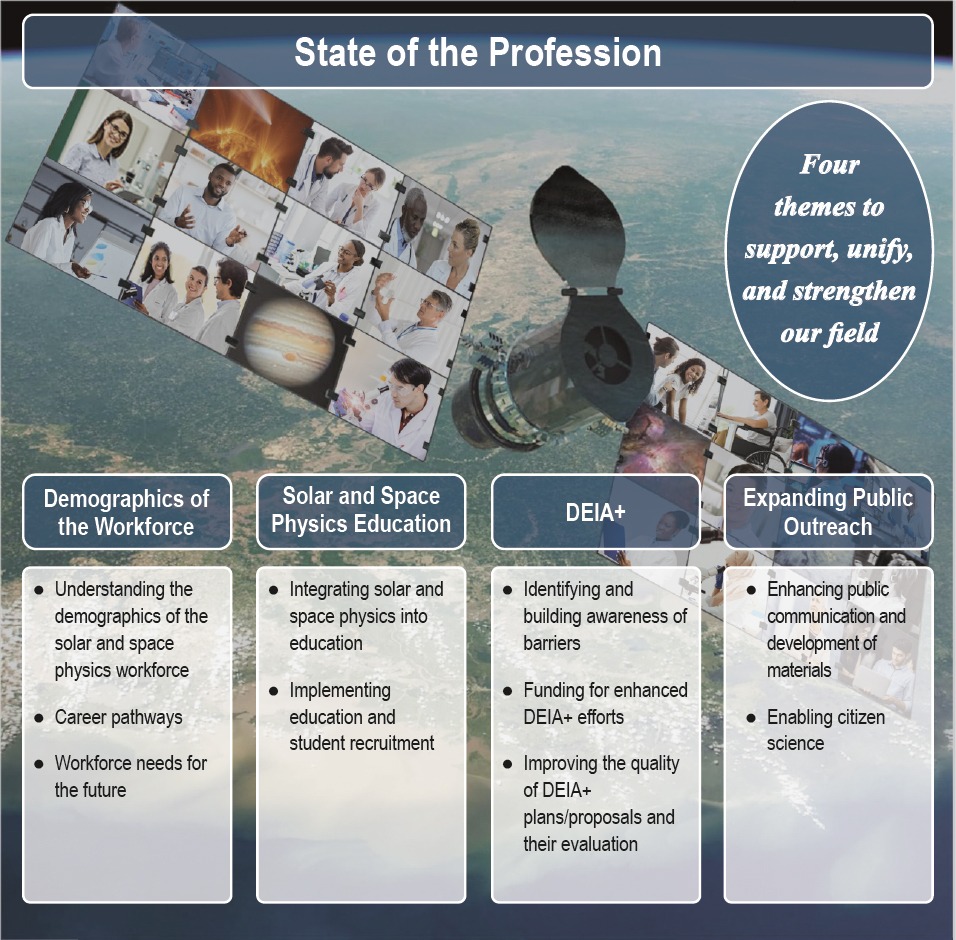
NOTE: DEIA+, diversity, equity, inclusion, and accessibility, as well as anti-racism, accountability, and justice.
SOURCE: For source information on the images in this figure, see the note at the end of the chapter.
participate and develop within a community. The “+” includes anti-racism, accountability, and justice. Additional helpful definitions are included in Appendix F and in NASEM (2022a).
The first section below provides an overview of the solar and space physics community and discusses opportunities and challenges associated with a field that is broad and draws on technical expertise from a wide range of disciplines.1 The subsequent four sections present the current demographics and desired future characteristics of the field: a diverse workforce that engages in interdisciplinary collaborations and makes advances in scientific research and practical applications. The first covers the importance of understanding the demographics of the field and associated challenges (Theme 1), along with recommendations for ensuring recruitment and retention of a diverse workforce with a broad range of skills and expertise. This will require better incorporation of solar and space physics into mainstream STEM education (Theme 2); better support for DEIA+, (Theme 3); and enhanced engagement with the general public to generate excitement about the field (Theme 4).
4.1 THE SOLAR AND SPACE PHYSICS COMMUNITY
The solar and space physics discipline comprises the study of the space environment, including the coupled Sun and heliosphere, as well as the magnetospheres, ionospheres, and neutral upper atmospheres of Earth and other planets. The solar and space physics community consists of the interconnected systems of individuals, departments, and institutions that are associated with a variety of funders, professional societies, and societal needs.
Currently, solar and space physics is one of the umbrella terms that encompass the different components of the discipline. Within NASA’s SMD, the term “heliophysics” is used to clearly distinguish it from Earth sciences, astrophysics, and planetary science disciplines. Understanding the people who make up the current solar and space physics community and the ability to study trends to assess the health and vitality of the discipline continues to be difficult due to the lack of a standard name for the discipline within different organizations. Those names include:
- Solar and space physics (the National Academies),
- Heliophysics (NASA), Geospace Sciences and Solar Physics (in separate divisions of the National Science Foundation [NSF]),
- Space Weather (the National Oceanic and Atmospheric Administration [NOAA], the U.S. Air Force, and the American Meteorological Society),
- Space Physics and Aeronomy (SPA) (American Geophysical Union [AGU]),
- Solar Physics (Solar Physics Division [SPD] of the American Astronomical Society [AAS]), and
- Various other permutations within universities.
The lack of a common name was raised in the 2013 solar and space physics decadal survey report (NRC 2013; hereafter, 2013 decadal survey) and continues to hinder the community’s ability to articulate its science broadly to the public and invested parties, as well as assess the state of the profession.
To elaborate, this lack of a unique identity raises three significant challenges for the profession:
- Data gathering: To understand the profession and its evolution, demographic information is critical. Specifically, tracking this information can help to ensure that a strong future workforce is recruited, receives the right training, and is healthy and sustainable. In order to consistently collect accurate demographics data, a common label is needed for the field.
___________________
1From NASEM (2022a): “Several studies have demonstrated that multiple forms of diversity are beneficial to the creativity, innovation, and impact of science teams (Hong and Campbell et al. 2013; Freeman and Huang 2014a,b). Although social scientists continue to try to understand how specific forms of diversity (e.g., racial/ethnic, gender, career stage diversity) relate to various aspects of team performance, it is generally understood that, when engaged productively in an inclusive environment, diverse perspectives, experiences, and backgrounds can strengthen teams and lead to better science (Sommers 2006; Diaz-Garcia et al. 2013; 2017). Accordingly, the National Aeronautics and Space Administration’s (NASA’s) Vision for Scientific Excellence notes, ‘diversity is a key driver of innovation and more diverse organizations are more innovative. . . . NASA believes in the importance of diverse and inclusive teams to tackle strategic problems and maximize scientific return’ (NASA 2020b).”
- Recruitment: To recruit a diverse workforce (on many dimensions), better exposure to the field of solar and space physics is needed in schools and colleges; every science textbook could describe the space environment and mention the Sun, the magnetic fields of Earth, and planets.
- Public outreach: While solar and space physics science is exciting and has important ramifications for life and society on Earth as well as in space, public awareness of the subject is lacking (while there is better awareness of astronomy). The public does not associate the subject with an independent scientific field or a professional community. Better communication, including a wider variety of appealing graphics and animations, will help to raise public awareness of the valuable science of solar and space physics.
Conclusion: A common name for the field that can be broadly called solar and space physics would improve efforts in data gathering, recruitment, education, and public outreach.
There are challenges to deciding on a common name that are rooted in the different orientations of U.S. agencies engaged in solar and space physics research and operations, and even among different divisions within an agency. All of the names considered by the decadal committee introduced a bias toward particular subdisciplines in the field. A solar and space physics consortium (discussed below) that solicits input from the community could be an important mechanism for addressing this issue. In this report, the broad term “solar and space physics” is used.
4.2 THEME 1—DEMOGRAPHICS OF THE WORKFORCE
The solar and space physics profession comprises a myriad of subdisciplines, existing at the intersections among plasma physics, practicalities of the space environment, engineering, Earth science, planetary science, and astronomy. The emerging subfield of space weather encompasses not just academic science, but also applied sciences and commercial endeavors. In addition to foundational scientific knowledge, advancements in basic research and space weather require expertise in computational modeling, engineering, applied mathematics, data science, and prediction methodologies, as well as management, communications, and operations.
Historically, the “workforce” has referred to potential principal investigators (PIs) or their students who proposed studies related to solar and space physics to agency funders. In reality, the workforce includes academics, research scientists (including those at government labs, universities, and federally funded research and development centers, and in industry and private institutions), postdoctoral researchers, and graduate and undergraduate students working in subfields in solar and space physics. Moreover, consideration of the solar and space physics workforce has not historically recognized the engineers, computer scientists, management personnel, and others who support and enable the science and space weather applications. Additionally, the field is expanding into new areas, such as comparative studies of stars and planetary systems, that require a broad range of expertise and increased collaboration.
Conclusion: As the field of solar and space physics expands from pure academics to include more applied areas, the understanding of the workforce—both in description and by numbers—needs to evolve, for example, to include how many soft-money researchers, early career scientists, civil servants, data analysts, and tenured faculty are working in the field.
4.2.1 Understanding the Demographics
Preparation for the 2013 decadal survey included a demographics survey, carried out in 2011 (White et al. 2011; hereafter, the “2011 workforce survey”). For the current decadal survey, there was no specific workforce survey carried out by the agencies, despite a survey having been recommended by the midterm assessment report on progress toward implementation of the 2013 decadal survey’s recommendations (NASEM 2020b). The report of the Panel on the State of the Profession includes demographic data from the Coupling, Energetics, and Dynamics of Atmospheric Regions (CEDAR) program and Geospace Environment Modeling (GEM) workshops, as well as from analysis of proposals submitted to NSF and NASA. Demographics of the overall space sciences
workforce are also presented in recent NASA and National Academies reports (NASA 2023b; NASEM 2022a,b) and reviewed in Bagenal (2023).
Despite incomplete data, the subsections below review the available demographic data as sliced from a variety of viewpoints: the total size of the workforce; the statistical significance of surveys; gender, race, ethnicity, and national origin; and evolution over time. It is important to note that the terminology used in surveys to describe gender, race, and ethnicity has changed over the past decade. In this report, gender is described as man or woman except where the original survey used male or female. A continuing challenge is the lack of comprehensive and complete demographic data.
Size of the Solar and Space Physics Workforce
The total size of the U.S. workforce in solar and space physics is difficult to quantify. The 2011 workforce survey request was sent to 2,560 unique email addresses (from the AGU Space Physics and Aeronomy Section SPA), the AAS SPD, the Space Weather Week attendee lists, and the NSF list of PIs). If the 8 percent of respondents who were students are removed, that leaves an estimated 2,355 PhD scientists in the solar and space physics workforce in 2011. Without a complete repeat survey, it is hard to accurately determine changes to this number over the past decade. Membership in the largest professional organization, AGU SPA (about 63 percent of whom reside within the United States), has fluctuated by about 10 percent from 2013 to 2023. As the solar and space physics field expands, particularly into such applications as space weather, broader groups in the profession need to be carefully surveyed.
One way to quantify the workforce is to look at the personal profiles submitted through the NASA Solicitation and Proposal Integrated Review and Evaluation System (NSPIRES), an online proposal tool. In 2023, NASA’s Office of the Chief Scientist provided data on the number of unique names attached to proposals submitted by PIs and co-investigators (Co-Is) at U.S. institutions. These data did not include proposals for student fellowships, early career grants, or researchers directly funded by missions. (Data on graduate students and early career scientists have been gathered by organizations such as CEDAR; GEM; and the Solar, Heliospheric, and INterplanetary Environment [SHINE] program).
Figure 4-2 shows the total number of unique names of PIs and Co-Is for the different divisions in SMD between 2011 and 2021. The data for the Heliophysics Division shows a flat profile of almost 1,000 people who submitted proposals each year, about 39 percent of the 2,355 U.S. PhD scientists in the 2011 workforce survey.
Table 4-1 compares the populations from the 2011 workforce survey and the 2023 NASA Researcher Demographics Report (NASA 2023b). Note that in the 2011 workforce survey, 66 percent of respondents said they sought funding outside their employment institution, 74 percent from NASA, and 46 percent from NSF.
A rough estimate of growth in the field can be obtained by counting job advertisements. As reported by the Panel on the State of the Profession, Moldwin et al. (2016) compiled the number of job advertisements posted in the AGU SPA and the AAS SPD newsletters for postdoctoral, research scientist, and faculty positions, as well as the number of new PhDs granted each year in solar and space physics from North American universities. In 2010 (just into the recession of 2008–2009), global postdoc, research scientist, and faculty job ads fell to the lowest levels in the decade (and ads for faculty positions fell to just 7 from the typical 15–25 per year from 2001 to 2009). Since 2016, the number of ads in all three positions has increased, reaching an all-time high (Moldwin 2023). However, absent a quantitative census to determine the size of the field, it is impossible to say whether these increases are sufficient to keep pace with expansion of the discipline into emerging areas. Additionally, workforce increases are difficult to compare with overall funding increases due to the complexity of defining the field in terms of both people and fractions of agency budgets.
Statistical Issues with “Prefer Not to Answer”
Most surveys have an option to not answer questions about one’s personal information (e.g., age, gender, race, ethnicity). Often 15–20 percent of people respond, “prefer not to answer” (PNA), probably for a variety

NOTES: Student fellowships and early career awards were not included. Co-I, co-investigator; NSPIRES, NASA Solicitation and Proposal Integrated Review and Evaluation System; PI, principal investigator.
SOURCE: Based on data from NTRS (2023).
TABLE 4-1 Comparison of Survey and NSPIRES Populations
| Survey | Who Was Polled | Totala | NSPIRESb | NSPIRES/Total (%) |
|---|---|---|---|---|
| Astronomy and Astrophysics 2018 | AASc | 4,127 | 1,265 | 31 |
| Planetary Sciences 2020 | AAS Division for Planetary Sciences, Lunar and Planetary Science Conference, Geological Society of America | 4,568 | 1,986 | 43 |
| Solar, Space, and Upper Atmosphere Physicists | AGU Space Physics and Aeronomy, AAS Solar Physics Division, Space Weather Week, attendees, NSF PIs | 2,344 | 913 | 39 |
a Total membership in U.S. with a PhD with unique names.
b Median number of unique names of PIs and co-Is submitting to NASA’s NSPIRES system 2011–2021.
c Sample of 3,354 members polled; 26 percent of respondents were students.
NOTES: AAS, American Astronomical Society; AGU, American Geophysical Union; NSF, National Science Foundation; NSPIRES, NASA Solicitation and Proposal Integrated Review and Evaluation System; PI, principal investigator.
SOURCES: Based on data from Pold and Ivie (2018); Porter et al. (2020); White et al. (2011).
of reasons (there are anecdotal explanations but no studies of any systemic causes), which has a significant effect on the statistical validity of the results. The percentage of PNAs has decreased from 2014 to 2020 in the NASA NSPIRES database (NASA 2023b) and the proposal success rates of PNAs are similar for those who provide personal information. In contrast, a study of proposals submitted to the NSF Directorate for Geosciences (GEO) (before 2019) shows lower acceptance rates of proposals from applicants in historically minoritized communities and a distinct decline in percentage of proposers who provide demographic information (Chen et al. 2022). To better capture trends for the solar and space physics community, such a study needs to be carried out for the NSF Division of Atmospheric and Geospace Sciences, which accounts for a small fraction of scientists in GEO.
Gender
Until recently, only a binary choice of gender (male/female or man/woman) was available on surveys. More recent surveys have expanded the choice to include nonbinary, but the statistical significance of such data is strongly affected by many PNAs. From the Panel on the State of the Profession (in Appendix F):
From 2016 to 2021 the SPA “primary” AGU membership (3,600) and total (5,600) membership (AGU allows members to indicate “primary” sections and multiple other section affiliations such as Planetary or Atmospheric or Education) was fairly steady. The AGU SPA primary section affiliation membership in 2021 was 23.9 percent women compared to 33 percent of all AGU members, 35 percent for Planetary Scientists (Bagenal 2023) and the 17 percent representation by women found in the previous decadal survey snapshot taken in 2013. In 2017, 31 percent of American Astronomical Society members were women (Pold and Ivie 2018). Taken at face value, the solar and space physics community has made progress in representation by women (17 to 24 percent) but is still underrepresented in comparison to the broader Earth and Space Science Community and to other space science disciplines.
Figure 4-3 shows that the gender of proposers to Heliophysics grant opportunities through the NASA NSPIRES online system did not change substantially between 2014 and 2020; the percentage of NASA proposals submitted by applicants identifying as women has varied between 16 and 21 percent, and those identifying as men varied between 67 and 71 percent. Over the same period, the percentage of PNAs ranged between 11 and 16 percent. Such large total numbers of PNAs suggests that the changes in submissions by women may not be statistically significant.
Conclusion: To accurately assess the demographics of the solar and space physics community, professional organizations and funding agencies need to communicate the importance of providing one’s demographic information when submitting proposals. It needs to be clear to proposers that this demographic information is not available to reviewers. Regular reminders to update one’s personal profile could be sent out to the community; ideally, such reminders would not be connected with proposal deadlines.
Race, Ethnicity, and National Origin
Survey questions about race and ethnicity have evolved from a choice of White vs. non-White to a range of categories (e.g., Black/African American, Latinx/Hispanic, and American Indian/Alaska Native/Pacific Islander). Total numbers of racially minoritized individuals in the field remain small, sometimes too small to be reported (<1 percent). The CEDAR workshop data (2021–2022) show student and early career populations are considerably more diverse than the senior scientists (see Appendix F, Figures F-3 to F-6).
As shown in Figure 4-4, the demographics of the solar and space physics workforce are largely White men. The percentage of women is lower for heliophysics than the other areas of space science, but that may be partly related to the fact that the demographic data are from a survey carried out several years earlier than for the other fields. The stark lack of non-White populations is clear across all fields. Note that the data for heliophysics in Figure 4-4 came from the 2011 survey; a modern survey may show increased diversity.

NOTE: PNA, prefer not to answer.
SOURCE: NTRS (2023).

NOTE: The demographic data were derived from workforce surveys: astrophysics in 2018, Earth sciences in 2018, solar and space physics/heliophysics in 2011, and planetary science in 2020.
SOURCES: Based on data from AIP Statistical Research Center (2018); Bernard and Cooperdock (2018); NASEM (2022a); NCSES (2023); Pold and Ivie (2018); Porter and Ivie (2019); Porter et al. (2020); White et al. (2011).

SOURCE: NCSES (2023).
Evolution with Time
Looking across the national workforce in all STEM fields, NSF (2023) showed significant diversification of the workforce from 2011 to 2021, though access for those with disabilities remains very limited: see Figure 4-5.
Specifically looking at the solar and space physics community in Figure 4-6, the NASA NSPIRES data on the demographics of proposing PIs and co-Is to the Heliophysics Division show an increasing percentage of proposals

NOTES: Data for Black/African American, American Indian/Alaska Native, Native Hawaiian and other Pacific Islander, and multiracial researchers remain below the 1 percent level (too low to be included in the figure). These terms are used by NASA in accordance with guidance from the Equal Employment Opportunity Commission. Co-I, co-investigator; NSPIRES, NASA Solicitation and Proposal Integrated Review and Evaluation System; PI, principal investigator.
SOURCE: NASA (2023b).
submitted by Asian researchers with little change for Hispanic researchers, while submissions by Black/African American, American Indian/Alaska Native, Native Hawaiian and other Pacific Islander, and multiracial researchers remain below the 1 percent level (too low to be included in Figure 4-6). According to the 2023 census results, the U.S. population demographic is 58 percent white (not including Hispanic or Latino), 20 percent Hispanic or Latino, 14 percent African American, and 6 percent Asian. While Figure 4-5 shows that race and ethnicity percentages in STEM are trending to be much more aligned with the population, Figure 4-4 shows that the space sciences are unfortunately lagging behind.
Solutions: The Need for Better Data
Performing community surveys is a difficult task, but it is worth the effort. The information provided by demographic surveys is crucial for informing agencies about the success of initiatives to further DEIA+ goals. The lack of reliable demographic data has been discussed in other reports, with several variations of suggested solutions (NASEM 2022a,b, 2023a,b). For example, the Foundations report (NASEM 2022b) recommended that funding be provided to one or more umbrella organizations (such as the American Institute of Physics [AIP]) to conduct longitudinal studies of demographics in solar and space physics. With the currently available data, it is not possible to discuss intersectionality—how different social categories such as race and gender interact with each other to shape experiences and opportunities—due to small sample numbers of some demographics. In the future, if appropriate data are available, an intersectional view would be highly beneficial.
Conclusion: To address issues related to the state of the profession, the solar and space physics community needs to understand the demographics of the past, current, and potential future workforce. Because the solar and space physics workforce spans a broad range of disciplines, gathering the requisite data is complicated.
Conclusion: Demographics of proposal success rates need to be transparently evaluated to assess progress at different agencies, including NSF and NASA.
Recommendation 4-1: The National Aeronautics and Space Administration, the National Science Foundation, and the National Oceanic and Atmospheric Administration should fund either a professional organization (or group of organizations) or a team of researchers to develop a method to systematically gather demographic information of the current workforce in solar and space physics and obtain past demographic information (where possible) to assess demographic changes. A primary objective of this effort would be to initiate a sustainable structure for continuous, longitudinal data gathering, including at the level of undergraduate majors and conference attendees, to assess the potential future workforce and determine if the pool is sufficient to meet the needs of solar and space physics. Initial results should be provided in advance of the start of the midterm assessment of the present decadal survey.
Because the solar and space physics workforce is spread across multiple professional organizations, the data gathering should be coordinated by an umbrella organization or team of researchers in the form of a solar and space physics consortium. Demographic data-gathering surveys need to involve social science expertise, specifically, demographers and survey researchers, and they need to draw from previous surveys, such as the NSF Survey of Earned Doctorates (NSF 2023). To assist in both the immediate need for information and the desire to have a sustained, long-term tracking of data in place, it is recommended that the agencies aspire to a short-term and a long-term goal.
The short-term goal is to conduct a survey immediately that is cross-cutting and comprehensive to understand the current state of the demographics in the profession, including a survey of academic institutions that are producing bachelor of science (BS), master’s, and PhD graduates who may end up in the field. This may be undertaken by an umbrella organization or by a team of researchers in solar and space physics who apply for funding in response to a solicitation. The results of this survey would be most useful if disseminated publicly prior to the midterm assessment.
The long-term goal is to establish a framework for longevity to provide longitudinal views of the evolving workforce. This phase will likely require an umbrella organization in collaboration with the various agencies. It could be one part of a solar and space physics consortium that has broader purposes such as outreach, education, and advocacy. It is vital that survey experts are committed to conducting thorough solar and space physics community surveys, analyzing the outcome, and making the outcomes publicly available on a regular basis.
To expeditiously accomplish the above short- and long-term goals, a committee could be convened, consisting of representatives from the relevant agencies, to decide the best course of action in each case and determine the funding structure.
4.2.2 Career Pathways
NASA, NSF, and NOAA support of a solar and space physics consortium would enable the balance between the number of PhDs, postdocs, and permanent positions to be assessed, along with the balance between soft-money and hard-money permanent positions. Sharing the results of such regular assessments will inform those considering heliophysics career paths and help the community address imbalances. The potential roles of a solar and space physics consortium are detailed in several other recommendations in this chapter.
Figure 4-7 presents a conception of career pathways in solar and space physics in the broader context of STEM careers. The traditional assumption is that STEM careers are a single pipeline that flows from undergraduate training to a graduate degree and into the profession. In reality, there are multiple career paths that can bring people

NOTES: See Appendix F for a more detailed version of this figure that includes specific suggestions of how to improve and expand the pathways to a successful career. DEIA+, diversity, equity, inclusion, and accessibility, as well as anti-racism, accountability, and justice; STEM, science, technology, engineering, and mathematics.
SOURCE: Adapted from R.L. Batchelor, H. Ali, K.G. Gardner-Vandy, A.U. Gold, J.A. MacKinnon and P.M. Asher. 2021. “Reimagining STEM Workforce Development as a Braided River.” Eos 102. https://doi.org/10.1029/2021EO157277. CC BY-NC-ND 3.0.
into—and sometimes out of—their solar and space physics careers, as depicted in Figure 4-7. To understand the limited diversity of the workforce, it is necessary to explore the various pathways people follow throughout their careers. What are the entry points and at what stages do people leave the field?
4.2.2.1 Undergraduate Programs
The 2011 workforce survey showed that most (62 percent) of the solar and space physics workforce obtained bachelor’s degrees in physics. The AIP regularly gathers and publishes data from physics departments across the United States. Figure 4-8 shows the change in gender representation in physics careers at universities, with a major dropoff in the percentage of women participating in physics between high school and completion of a bachelor’s degree. Multiple studies over the past 3 decades show this major decline in participation of women. More recent studies show racially and ethnically minoritized individuals in STEM drop out in the first couple of years of college (Seymour and Hewitt 1997; Seymour and Hunter 2019). The percentage of racially minoritized groups along such an academic career path is even smaller, with similar dropoff between the high school and college levels.
Addressing the major drop in participation in STEM fields between high school and college requires attention at both levels. While high school education is controlled locally, there are ways for science outreach activities—particularly involving the excitement of space exploration—that could have significant impact (discussed further below). There are many suggestions for addressing the high dropout rate of historically excluded populations from STEM fields in the early years at college, many of which need to be addressed locally at the university or departmental level. Those suggestions include improving the quality of teaching of freshman calculus and physics courses and including working with science education researchers. However, there are important contributions that can be made at the national level, specifically, the development and funding of Research Experiences for Undergraduates (REU) and Bridge programs, as well as supplementing research grants to include support of student involvement in research through mentorships and scholarships. In addition, the AIP runs a national Task Force to Elevate African American Representation in Undergraduate Physics & Astronomy (TEAM-UP) to increase undergraduate participation and degree completion (AIP 2023c).
With the solar and space physics workforce evolving to include more applied fields, it is important that such internship programs for undergraduates are broadly advertised to departments beyond physics, including engineering, computer science, data science, Earth sciences, planetary science, and astrophysical science. These departments

SOURCES: Composed by AJ Galaviz III, Southwest Research Institute; Based on data from AIP (2022, 2023a,b).
have students who might be attracted by a positive research experience and thus consider a career in solar and space physics (see further discussion below).
Graduate Programs
It is difficult to assess the workforce in the field of solar and space physics because the disciplines of degrees held by researchers are evolving, spreading from mainly physics to other fields, such as atmospheric science, geosciences, computer science, aerospace engineering, and an increasing number of programs focused on solar and space physics. The 2011 workforce survey shows that the percentage of the solar and space physics workforce with doctorates in physics has decreased from 40 percent (for 1999 and earlier PhDs) to 27 percent (for 2000 and later PhDs). As the number of departments offering graduate programs in solar and space physics has increased, an increasing percentage of solar and space physics researchers obtain their PhDs in the specialized fields of space physics and solar physics. How such PhDs are counted by the AIP surveys is not clear.
Figure 4-9 shows the demographics of physics PhD recipients. While the total numbers have fluctuated and risen overall for the past 30 years, the percentage representations have not changed much. The current gender and race and ethnicity distributions in Figure 4-9 are similar to those across the heliophysics workforce shown in the demographics statistics presented above. Figure 4-9 shows that although the total number of PhDs in physics has increased by 22 percent in 2010–2020, the percentage awarded to men and women has remained the same at 80 percent and 20 percent, respectively. The percentage of PhDs in physics awarded to U.S. and non-U.S. citizens has remained roughly the same (54 percent and 46 percent, respectively as of 2019). The percentage of PhDs awarded to Latinx/Hispanic students has increased steadily to 2 percent. The percentage of Black/African Americans remains well below the 1 percent level. Both of these percentages remain considerably below the general STEM workforce shown in Figure 4-5 (15 percent and 9 percent, respectively, in 2021).
There are several studies examining how graduate-level education could be improved and how to diversify the student population. For example, Posselt (2020) contains a succinct list of actions related to recruitment, admissions, mentoring, support, and creating conditions conducive to equity in graduate programs.

SOURCES: Based on data from AIP (2022); Mulvey et al. (2021); Nicolson and Mulvey (2022).
International Workforce
It is important to note the continued presence of non-U.S. PhD students. As noted in the Advancing DEIA report (NASEM 2022a):
Data from the American Institute of Physics show that for the past ~30 years, about half of the PhDs in physics were awarded by U.S. universities to foreign-born scientists. Many such students stay in the United States pursuing research careers. Additionally, non-U.S. scientists immigrate as postdoctoral researchers. Thus, a significant fraction of the space science workforce are foreign-born scientists and engineers who make substantial contributions to NASA’s space missions. They also contribute to the diversity of the space sciences workforce, with respect to gender and race/ethnicity. (p. 13)
Although this report focused on NASA missions, the same issues apply across the solar and space physics workforce.
A 2020 report from the American Academy of Arts and Sciences, The Perils of Complacency: America at a Tipping Point in Science and Engineering, addressed this issue. One of their key messages is:
The United States is in severe danger of no longer being the premier destination for science and engineering talent. An increasingly unwelcome environment for foreign talent, together with a failure to cultivate an adequate domestic science and engineering workforce, threatens a decline in American health, prosperity, and national security. (p. 10)
Conclusion: The solar and space physics workforce includes a significant number of researchers educated or trained abroad, and the workforce can be expected to evolve with global political and societal changes. The reliance of the U.S. solar and space physics research on foreign-born and -educated talent needs to be recognized.
4.2.3 Workforce Needs of the Future
The workforce is changing and will continue to change in the coming years. At the same time, the needs of the field are evolving. Intrinsic to the science themes from Chapters 2 and 3 is the need for expertise in various areas, including but not limited to computer and data science, artificial intelligence, machine learning, big data, software development, industry-specific engineering. Techniques and advancements made in the finance and technology sectors can also be highly relevant. This broadening of knowledge areas that can contribute to the field, along with academically engaging projects, might attract individuals with those skill sets, benefitting the field with their expertise.
Solar and space physics has traditionally been siloed into several subareas, with little overlap or blending areas across them. Moreover, there has been no efficient outreach to other fields that are connected either through research topics or methodologies. The committee’s vision for the future of the field changes that perspective to one that is outward facing and promotes collaborating across disciplines. Figure 4-10 shows the myriad disciplines that meet and overlap to define the expanding concept of solar and space physics.
Conclusion: Solar and space physics research benefits from an emphasis on interdisciplinary teams with overlapping expertise. Such teams can involve experts in applied math, space weather prediction, machine learning, data management, and computational applications, among others, working with solar and space physics scientists to achieve the research goals.
Physics degrees represent a pathway that can lead to a variety of high-tech careers other than physics research. The finance, technology, and the energy sectors in particular, and other industries and government entities in general, highly value the skills that are developed through a standard physics education. The growth of the space industry and space weather applications industry has created a new job market for solar and space physics experts at various levels. Conversely, solar and space physics research teams increasingly include experts from other

NOTE: DoD, Department of Defense; DoE, Department of Energy; NASA, National Aeronautics and Space Administration; NOAA, National Oceanic and Atmospheric Administration; R2O2R, research-to-operations-to-research.
Conclusion: Solar and space physics needs to engage with professionals in engineering, computer science, and management, to encourage pathways into projects in the solar and space physics fields. A solar and space physics consortium could coordinate these efforts.
Related to this new, expansive definition of the field and the workforce that underlies it, there are needs that require attention in moving forward into the next decade. The rest of this chapter details how to best support this expanding and evolving workforce and how to cultivate that workforce to attract those most enthusiastic about discovery in solar and space physics.
high-tech careers. To attract top talent to the myriad fields that involve solar and space physics, students need to be exposed to the science and the career opportunities associated with it as early as possible and at the very latest in general undergraduate courses. Data scientists, computer scientists, and others with those skill sets will be more attracted to job opportunities in solar and space physics research fields if they have previously been introduced to and engaged in those fields.
4.3 THEME 2—SOLAR AND SPACE PHYSICS EDUCATION
4.3.1 Incorporating Solar and Space Physics in K–12 and College Education
To raise public awareness of solar and space physics and to broaden the career options in the field, the subject needs to be introduced in K–12 education and incorporated into classes from undergraduate to MS to PhD curriculums. This broader education is also necessary in areas other than physics, including astronomy; applied sciences, such as aerospace and electrical engineering; and environmental science programs. College education
is the backbone of recruitment into the field, as well as the best mechanism for raising public awareness about the importance of solar and space physics research. K–12 education ensures that college programs attract the best students from diverse backgrounds.
To illustrate the depth of the issue, examples of several prominent undergraduate introductory astrophysics and general education astronomy textbooks that are nearly devoid of solar and space physics topics include: The Cosmic Perspective: The Solar System (Bennett 2019), An Introduction to Modern Astrophysics (Carroll and Ostlie 2017), and Astronomy (Fraknoi et al. 2016). Also often missing from the content are the foundational drivers of space weather—the magnetic fields and plasmas emerging from the solar surface, filling interplanetary space with the solar wind, and interacting with the geomagnetic field. Rather, the focus is only on interior processes of the Sun and geomagnetism as it relates to Earth’s geology, with the space science component omitted entirely. Fraknoi et al. (2016) is the only text to mention the consequences of space weather, but it does so without explaining the role of magnetic fields or plasma.
Many students who are not majoring in STEM studies take general astronomy courses to fulfill a natural science requirement with a topic in which they are interested (Impey and Buxner 2020). For a vast majority of these students, the astronomy course will be their last exposure to formal science education. Some progress has been made to include solar and space physics material into undergraduate education by either incorporating material into undergraduate courses or by teaching a class on space weather or space science. These are individual solutions that are undertaken by only a few professors at a handful of universities across the country. In other cases, undergraduate material about space weather is often discussed in terms of hazards. This approach is in contrast to the way in which hurricanes or volcanoes are discussed in the context of a desire to understand the natural world, in addition to teaching about their effects. An incredible opportunity exists to build topics in solar and space physics into full courses or to integrate them with astronomy to create student and public consciousness about the field. This opportunity is not currently being leveraged to its full potential.
At the K–12 level, the implementation of discipline-specific subject matter is more complex since schools are often teaching to well-defined curricula with very narrow learning objectives. However, many educators are free to enhance the standard material with extra topics that catch the students’ interest, especially if that material contains concepts related to the primary curriculum. Several examples include an app-based textbook developed by Big Kid Science, Totality, which focuses on solar eclipses but also has much of the science background included in an accessible way. Other examples are a general solar and space science textbook aimed at middle and high school levels, Solar Science (Schatz and Fraknoi 2016) and a PDF textbook available from NOAA’s Space Weather Prediction Center aimed at junior high and high school students, Solar Physics and Terrestrial Effects (Briggs and Carlisle 2016). Finally, there are multiple examples of curriculum-enhancing resources that have been produced through one-off grant opportunities, such as Space Weather UnderGround, started at the University of New Hampshire2 and being expanded to the University of Alaska Fairbanks.3
There have been several concerted efforts to present space physics to students at the undergraduate level, starting with Introduction to Space Physics by Kivelson and Russell (first edition, 1995). Understanding Space Weather and the Physics Behind It by Knipp (2011), and An Introduction to Space Weather by Moldwin (2008)—both focusing on space weather—attempt to appeal to a general science audience. However, to effectively reach a broader audience, modest sections on space sciences are needed in the standard textbooks, including those in Earth sciences, atmospheric sciences, and environmental sciences, as well as the full range of physics and aerospace texts from introductory undergraduate to graduate levels. Furthermore, imaginative, colorful graphics could make the Sun and magnetosphere as familiar to middle school and high school students as the globe of Earth and help with retention of information on solar and space physics (Bobek and Tversky 2016). Relatable, real-life examples would extend the reach of the material, and interactive activities would engage students on a deeper level (Goldberg et al. 2010). All these resources require significant input from the current space physics
___________________
2University of New Hampshire Institute for the Study of Earth, Oceans, and Space, “Space Weather Underground,” https://eos.unh.edu/space-science-center/outreach/space-weather-underground, accessed May 21, 2024.
3University of Alaska Fairbanks Space Weather Underground, “Space Weather Underground Project,” https://sites.google.com/alaska.edu/swug/home, accessed May 21, 2024.
community; they could be produced through add-on, supplemental funding to research and analysis projects, as well as missions.
Conclusion: Solar and space physics science has not been fully incorporated into U.S. education at either the K–12 or undergraduate level in the same way that astronomy and astrophysics, Earth sciences, and planetary science have been. Consequently, the recruitment of students and professionals into solar and space physics is less than it could be.
Conclusion: The absence of exposure to solar and space physics in K–12 or early college courses means many students are unaware of the field. To meet future workforce needs and attract talented STEM students from a broad range of backgrounds, solar and space physics needs to be promoted through early educational experiences, in which a solar and space physics consortium could play a significant role.
Recommendation 4-2: Funding agencies should expand the reach of solar and space sciences in education by expanding the definition of the National Science Foundation’s “broader impacts/societal impacts” and the National Aeronautics and Space Administration’s “broadening impacts” to specifically include developing solar and space science educational materials aimed at K–12 and college students.
4.3.2 Implementing Education and Student Recruitment
Increasing the Number of Faculty in Solar and Space Physics
One major factor limiting the exposure of students to solar and space physics is the lack of scientists in this field on the faculty at universities. As noted above, creating the foundations of a strong workforce requires cultivation of significant interest in solar and space physics early on in college as students start to assess options for future career pathways. Education is key to this mission.
University professors often teach large “service” courses that expose a variety of students from majors other than physics or astronomy. There is an enormous untapped opportunity to reach that same number of students with topics centered around solar and space physics and discuss their relevance to society. In addition, university faculty and researchers often employ students as research assistants, including those with backgrounds in physics and astronomy, engineering, mathematics, and even chemistry or biology. This is yet another way to expose students to research at a crucial point in their decision-making process related to future career goals. Finally, university faculty often engage in large-scale public outreach, including K–12 students. Activities can include public demonstration events; public night-sky observing nights; classroom visits; summer internship and research experience activities; event-specific outreach, such as events revolving around solar eclipses; and discipline-specific organizational events, such as the Conference for Undergraduate Women in Physics, the American Physical Society student conferences, and the physics congresses organized by the Society of Physics Students (PhysCon). These activities can serve to initiate the first sparks of interest that may attract students to the field. Additionally, minority-serving institutions represent an important untapped resource for recruiting students into the field (NASEM 2019).
University faculty and researchers represent the fulcrum of this interaction, serving as a bridge between public and professional, education and expertise. Furthermore, university faculty are the ones providing the intensive student training, through grants and awards, necessary to grow the future workforce in solar and space physics. Currently, there is additional pressure to this already strained system in the form of shuttering departments, colleges, and entire institutions as the college-bound population shrinks.
Conclusion: University PIs and faculty who teach courses and have major research support are well positioned to broaden the reach of solar and space physics education, as well as provide focused training to students already engaged in those sciences.
The Faculty Development in geoSpace Science (FDSS) opportunity created by the NSF Division of Atmospheric and Geospace Sciences (AGS)4 created a significant increase in the number of solar and space physics faculty at national educational institutions. This competitive program funds the creation of new tenure-track faculty positions at U.S. universities and colleges by offering 5 years of salary funding and start-up resources to an institution as a means of encouraging hiring in the specific area of solar and space physics in science, engineering, or related departments. This incentive can be highly attractive to an institution and thus represents an opportunity for a department to hire in this area and gain a coveted faculty position for solar and space physics.
Since the first cohort of FDSS faculty members was hired in 2004, NSF has increased the cadence of FDSS opportunities, which has been beneficial to solar and space physics. Seventeen faculty members have been hired through the FDSS program: eight in 2004, two in 2014, and seven in 2019; only two have left the institution for which they were hired in an FDSS position. All but one faculty member hired prior to the 2019 competition have been tenured. The one exception became a director for a renowned university-based space physics laboratory. Thus, the FDSS program has been highly successful at promoting early career researchers into positions through which they can contribute to the field in a significant way, including in educational and mentorship roles.
While it can be beneficial to establish new solar and space physics group, faculty members are often more successful in organizations where there are multiple researchers and professors working on similar topics in one location, a “critical mass.” A faculty cohort can share resources, host seminar speakers, recruit students and postdocs, and achieve adequate class enrollments. However, institutions that have previously received an FDSS award are ineligible to submit additional proposals (NSF 2023), which may leave new FDSS faculty members without a meaningful support network and mentoring. Allowing a previous FDSS institution to propose again is one way to alleviate that possibility and achieve critical mass. Another way to achieve critical mass is through cluster hiring, hiring more than one emerging researcher at the same time to form a cohort. In some cases, cluster hires have been extremely productive, leading to research and mentoring success as well as a higher satisfaction with the positions. Cluster hiring could deepen the value of the FDSS program and improve the likelihood of maintaining a strong solar and space physics program at a particular university (see NASEM 2022a).
NSF has already started implementing targeted FDSS opportunities to minority-serving institutions and emerging research institutions, which is a potentially transformative change. However, the FDSS program does not target teaching-oriented (non–research 1 [R1]) institutions. The potential of these institutions for strengthening and diversifying the STEM workforce has been previously identified (NASEM 2019); faculty development in solar and space physics at these institutions could help to leverage this underused resource. Mentor–mentee partnerships between teaching-oriented and R1 institutions are supported in other disciplines by NSF and the Department of Defense and could be an additional model to consider. In all cases, ensuring that new faculty have adequate support and mentoring is critical for their success.
Conclusion: The FDSS program has been successful in expanding solar and space physics to more and different types of universities. Expanding the program by allowing cluster hiring applications from existing strongholds of solar and space physics and continuing targeted calls for minority-serving institutions could be beneficial for the success and longevity of solar and space physics faculty at FDSS institutions.
Recommendation 4-3: The National Science Foundation (NSF) should continue and expand support for the Faculty Development in geoSpace Sciences (FDSS) program in solar and space physics at universities. Specifically, the cadence of opportunities should be increased and occur on a regular schedule, and the number of hires for each new opportunity should be approximately the same.
___________________
4“The Geospace Section of the NSF Division of Atmospheric and Geospace Sciences (AGS) offers funding for the creation of new tenure-track faculty positions within the disciplines that comprise the AGS Geospace programs to ensure their vitality at U.S. universities and colleges. The aim of the Faculty Development in geoSpace Science (FDSS) is to integrate topics in geospace science including solar and space physics and space weather research into natural sciences or engineering or related departments at U.S. institutions of higher education (IHE).” U.S. National Science Foundation. April 6, 2023. “Faculty Development in geospacer Science (FDSS).” See https://new.nsf.gov/funding/opportunities/faculty-development-geospace-science-fdss.
NSF should consider allowing proposals for cluster hires and allowing previous FDSS institutions to propose again.
Expanding Opportunities for Student Research
Solar and space physics would benefit from efforts to expand the reach of research opportunities in solar and space physics. Such an expansion would aid in recruitment efforts, and top talent would be more easily attracted to the field after having exposure to research. As discussed above, many university faculty lead these kinds of research opportunities at educational institutions, but there are also examples of summer internships, schools, and other training activities hosted by national and government labs, as well as university-affiliated research centers: see Figure 4-11.
The Advancing Diversity report (NASEM 2022a) found that, “Decades of educational research suggest that early and ongoing experiences with authentic research—experiences that engage students not only in learning about but actually doing research—is key to retaining students generally and URM [underrepresented minority] students specifically” (p. 76).
Long-standing hallmark programs include NSF REUs, NASA’s Heliophysics Summer School, and NSF’s Space Weather Summer School, as well as such funding opportunities as Future Investigators in NASA Earth and Space Science and Technology (FINESST) fellowships (previously the Graduate Student Researchers Program), the NSF Graduate Research Fellowships Program, the NSF Integrative Graduate Education and Research Traineeship Program, and the NASA National Space Grant College and Fellowship Project opportunities offered through state universities. In addition to these relatively centralized programs, summer schools, internships, research appointments, and student workshops have been supported by individual PIs and faculty members or teams of researchers. These programs are hosted by a variety of institutions, from university campuses to government laboratories, such as the Los Alamos National Laboratory and the year-long National Astronomy Consortium program at the National Radio Astronomy Observatory.
Every research opportunity plays a unique role in an ecosystem of experiences available to students. This ecosystem needs to be fostered and encouraged to grow, in various directions, to provide opportunities for all interested students. These opportunities can be facilitated in many ways (e.g., through expansion of REU programs), and by increasingly allowing researchers to request funding supplements to support new or expanded research opportunities, especially ones that use novel methods of connecting with students. Support for a variety of research opportunities can help bring in more students by providing options other than the full summer research experiences that require relocation. Shorter, immersive undergraduate experiences that last for 1–2 weeks can be attractive to a different subset of the student population than the traditional 8- to 12-week REU experience, particularly students who need full-time jobs in the summer months or have personal or family commitments (Jaynes and Meerdink 2022). To this point, such research experiences need to be funded adequately such that students are paid a living wage to attend, and travel and housing costs are deferred. Participation options can be expanded as well, by offering hybrid attendance options or virtual connectivity at staggered times for small cohorts of students in different time zones.
As these experiences form a critical part of training for both undergraduate and graduate students, agencies could encourage hosts to include skill-building activities in their research experience programs. These activities could focus not only on exposure to science training and research skills, but also on collaboration and career building. Examples could be seminars and meant to improve collaborative working skills and enhance positive team dynamics in a group, as well as such interpersonal skill-building activities as mini-workshops on bystander intervention and microaggressions. A solar and space physics consortium could be helpful to pool resources for these experiences, share best practices, and assist in advertising to undergraduate and graduate institutions.
Recommendation 4-4: Funding agencies should expand the reach of solar and space physics by increasing funding opportunities for researchers to lead summer schools, workshops, and other skill-building activities for undergraduate and graduate students. Funding these activities should include time for the researchers who lead them as well as resources, such as paid stipends to address equity, for the students. Such research supplements should require gathering and reporting data on participants, activities, and their impact.

SOURCE: (Top) Courtesy of Allison Jaynes, University of Iowa; (Middle and Bottom) Courtesy of Fran Bagenal, University of Colorado Boulder.
4.4 THEME 3—DEIA+
4.4.1 Building Awareness
The report of the Panel on the State of the Profession (Appendix F) suggests creating or continuing committees that focus on DEIA+ initiatives (Suggestion 4) and considering current best practices, such as acknowledging and adjusting for the common incorrect beliefs that continue to be perpetuated. There are many
challenges: Change-resisting gatekeepers make institutional change difficult, and universities in some states have lost their DEIA+ organizations and others are adapting to the recent Supreme Court decision (Students for Fair Admissions, Inc. v. President and Fellows of Harvard College 2023). Making changes throughout the institution is challenging as often it is the same people, time after time, who attend DEIA+ awareness training and outreach sessions. Unconscious bias is pervasive and affects the review of proposals, interactions among colleagues, and the actions of program officers and supervisors at all levels. Changing the still-existing cultures that protect harassment and exclusion requires creative and progressive methods to dismantle them by the agencies, and by extension the community. Furthermore, university DEIA+ programs can have a role in improving the culture of academia, particularly at the early stages of student careers. Organizations such as the American Physical Society offer to set up a visiting committee to carry out climate studies at academic departments and institutes (APS 2024). These committees can identify and suggest steps to mitigate adverse conditions in the workplace
Various reports have distilled best practices that can be followed for advancing DEIA+ in the solar and space physics communities, including Advancing DEIA in the Leadership of Competed Space Missions (NASEM 2022a); Foundations of a Healthy and Vital Research Community for NASA Science (NASEM 2022b); and in the sciences in general, such as Unequal Treatment Revisited (NASEM 2024) and Minority Serving Institutions (NASEM 2019). The question then needs to be asked: Why has such little progress been made in this area?
The recent Heliophysics Division Inclusion, Diversity, Equity, and Accessibility working group, which is the Heliophysics arm of the NASA Equity Action Plan (NASA 2023a), is a positive step in the direction of strategic DEIA+ advances. The group has been charged with several tasks, including recommending action and policy changes that align with the DEIA mission of the Heliophysics Division. Building on successful implementation is key, such as NASA’s Bridge Program, which aims to develop partnerships with historically under-resourced institutions while engaging in NASA science. It is too early yet to assess the overall success of these newer programs. The NSF Significant Opportunities in Atmospheric Research and Science (SOARS) program, managed by the University Corporation for Atmospheric Research, is an example of the highly successful implementation of a bridge-style program. SOARS mentors students who identify as historically marginalized in science in the undergraduate-to-graduate school transition phase and provide research experience opportunities. Their long-term trends are impressive: over 90 percent of SOARS program participants continue to graduate school (UCAR 2024).
Conclusion: The solar and space physics community and funding agencies need to identify and be aware of barriers for people from historically marginalized groups in STEM who work in the field and jointly address the need to be more inclusive.
The report of the Panel on the State of the Profession, as well as the reports cited above include a wealth of knowledge and suggestions that could be considered by relevant invested parties as they work to craft meaningful actions. Here is another avenue in which a solar and space physics consortium could be immensely beneficial, by aggregating resources and coordinating dissemination to researchers, as well as compiling assessments of ongoing programs.
4.4.2 Enhancing DEIA+ in Research
DEIA+ represents a wide range of topics, encompassing diversity, equity, inclusion, accessibility, anti-racism, accountability, and more. The report of the Panel on the State of the Profession (in Appendix F) includes an extensive discussion on the definition of this all-encompassing term and the implications it has for how research is conducted in collaboration with others. Effort and attention going toward DEIA+ actions repay the work several times over by building a community of supportive, enthusiastic researchers who are excited to collaborate, eager to help each other, and feel safe and respected in their working environments. While this report focuses on specific activities that are within the scope of research grants and contracts and can thus be implemented in the near future, there are many additional suggestions in the panel report that are worth careful consideration by the relevant agencies. In particular, one aspect directly within agencies’ purviews, related to proposal DEIA+ plans, can be addressed at this time, as discussed below.
According to Science 2020–2024: A Vision for Scientific Excellence, one of NASA’s strategies is to “increase the diversity of thought and backgrounds represented across the entire SMD portfolio through a more inclusive environment” (NASA, 2020 [updated 2023], p. 23). In 2021, NASA began piloting requiring inclusion plans as part of research proposals. The ways in which an inclusion plan can meet these needs are varied, and SMD provides a short list of references about inclusion plan pilot programs and barriers to inclusivity in STEM overall.5 Several of the relatively large programs in Heliophysics already require diversity and inclusion plans, including the Explorers program,6 DRIVE Centers, and Space Weather Centers of Excellence. Currently, there is a pilot program to extend the requirement to other program elements in the Research Opportunities in Space and Earth Sciences (ROSES) framework. ROSES 2024 states that inclusion plan evaluations currently “will not contribute to adjectival ratings or selection recommendations” for proposals (NASA 2024c, p. 8).
DEIA+ plans developed as part of research proposals encourage the project team to consider and discuss all the issues encompassed by the term. Teams reflect on ways they are best positioned to contribute to positive changes within the DEIA+ space. Explicit inclusion of such plans also ensures that sufficient resources are dedicated by the project to the promotion of DEIA+ ideas. While successful DEIA+ plans need to have built-in evaluation metrics and techniques for periodic assessment, metrics are not required in the current DEIA+ system. A subpanel of DEIA+ experts on all the panels that assess large missions or research proposals would be able to provide guidance and feedback on the DEIA+ plans of the proposing teams.
Additionally, when possible, supplemental funding channels could be made available to groups that wish to go above and beyond with DEIA+ initiatives that may require the involvement of professional organizations or individuals or otherwise require more resources than are generally accounted for in the course of a standard DEIA+ portion of a large proposal. Furthermore, those researchers submitting smaller proposals that do not require DEIA+ plans need to be able to access supplemental funding if they wish to include a DEIA+ component that requires additional resources. Such new funding channels would work best if they are transparent and clearly communicated to the community (because not everyone is familiar with what comprises a DEIA+ activity). An analogous example of supplemental funding for a separate purpose is the NASA Supplements for Open-Source Science which supports the addition of an open science component to an existing award. A similar model could be used to support DEIA+ activities. Supplemental funding opportunities would support those who wish to participate in advancing DEIA+ goals without overburdening smaller projects with additional requirements.
Time and effort dedicated to DEIA+ activities in the current environment are slowed down by the lack of understanding of the types of activities that fall under this category and by the lack of visibility, merit, and explicit recognition of those activities. It would be beneficial for agencies to disseminate examples of successful DEIA+ initiatives (with involvement by the PIs) to the community. These would provide a template for successful future DEIA+ plans and would recognize the PI and the team for an aspect of their work that is often not rewarded. Sharing of successful strategies (and ones that did not work) needs to become more commonplace and could be better facilitated by the agencies. Simple actions—such as wide social media engagement with positive DEIA+ messaging, mentorship networks and training, awareness seminars about various topics, and broad recognition of colleagues and contributors—are all robust examples of DEIA+ initiatives that can be part of a larger plan: see Figure 4-12. Agencies can collate and summarize these actions as part of materials that are developed to guide PIs when they are producing their custom DEIA+ plans as part of their preproposal activities.
A further challenge in implementing DEIA+ plans is that they are often poorly tied to broader efforts that are already under way. Almost all universities and research institutions have their own DEI plans and actions, but the proposed activities seldom directly draw from these resources. Similarly, agencywide efforts in DEIA+ are almost never available to proposers, leaving them to design plans of their own, which may be less effective than plugging into existing networks and frameworks. More attention needs to be placed on promoting and inviting researchers to partner with agencies to take advantage of ongoing activities. The frustration that many researchers feel when
___________________
5NASA, “Inclusion Plan Resources,” updated May 2024, https://science.nasa.gov/researchers/inclusion.
6The 2022 Small Explorers call for proposals required a two-page diversity and inclusion plan. One of the evaluation factors for the proposal is the probability of science team success, including the diversity and inclusion plan (NASA 2022).

SOURCE: Image courtesy of the SHIELD DRIVE Science Center, https://shielddrivecenter.com. Image credit: Victoria Pereira.
having to develop their own DEIA+ plans can be avoided by publicizing and encouraging these partnership opportunities. Lastly, education and public outreach initiatives often overlap directly with the goals of DEIA+ activities and can therefore be leveraged to make science more accessible in a variety of ways.
Recommendation 4-5: To be proactive about enhancing DEIA+ (diversity, equity, inclusion, and accessibility, as well as anti-racism, accountability, and justice) across the solar and space physics workforce including recruitment, working environments, and retention for all research and mission teams, all the relevant agencies, including the National Aeronautics and Space Administration and the National Science Foundation, should, when possible:
- Continue and enhance funding of DEIA+ activities by (1) requiring DEIA+ plans for large proposals (more than $1 million) and (2) making supplemental funding available for optional DEIA+ activities as part of proposals;
- Enhance the opportunities for the science community to participate in existing host organization–based or agencywide DEIA+ efforts; and
- Improve the quality and review process of proposed DEIA+ plans by (1) providing sample activities or successful examples of DEIA+ plans to the community; and (2) reviewing DEIA+ plans associated with large proposals in panels whose members have the appropriate expertise to provide concrete and constructive feedback for improvement.
Many of the topics addressed within this theme and recommendations to promote change have been described at length in prior reports, including NASEM (2022a,b). These prior discussions contain valuable information not repeated here, including the use of dual-anonymous proposal review processes and active education about the unintentional biases that inform decision-making and how to combat those instincts.
4.5 THEME 4—EXPANDING PUBLIC OUTREACH AND PARTICIPATION
4.5.1 Public Communication and Materials
Public outreach has far-reaching effects on education, policy, legislation, and public opinion. Public engagement can be achieved in myriad ways: encouraging citizen science participation, science communication pathways, and tie-ins to art and literature, and leveraging of popular culture, social media, and more. Popularizing the science of solar and space physics increases attention and supports the field to embark on ambitious discoveries. The excitement that is generated by rallying around large discoveries (e.g., the Apollo and Voyager programs) is invaluable for public outreach and ripples outward for decades. Notable recent efforts include the Heliophysics Big Year (NASA n.d.) and The Sun, Moon, and You (NOAA) efforts that encourage individuals to celebrate the Sun and its influence on Earth and the solar system. These efforts capitalized on the 2023 and 2024 annular and total solar eclipses and the Parker Solar Probe mission’s closest approach to the Sun: see Figure 4-13. However, outreach efforts need to be sustained and expanded to have a significant influence on the public.

SOURCE: (Top) NASA/Bill Ingalls; (Bottom) NASA/Kristen Perrin.
One way to increase visibility is through so-called STEAM initiatives, or STEM plus art, by fostering art exhibits, printed materials in collaboration with artists and writers, and visual art projects. Agencies can promote these activities by leveraging STEAM partnerships and collecting current best practices in engaging the public through outreach to communities and education centers. Previous successful outreach campaigns can be assessed, evaluated, and used as models for future efforts, using resources from the agencies earmarked for this purpose. A solar and space physics consortium could aid with this task.
Conclusion: The space science community needs to have a data bank of resources and materials to draw from that communicate to the public what solar and space physics is and how it affects society. Such a data bank would include enticing, impactful, and regularly updated material accessible on the websites of all relevant agencies, including NASA, NSF, and NOAA.
Various opportunities for connecting with the public are not being well leveraged. For example, the National Air and Space Museum in Washington, DC, contains only a small space weather display, without offering the context of the solar system surrounding Earth or the many ways the Sun influences it. Additionally, very few examples related to solar and space physics are currently available on the NASA+ website (NASA 2024b). Some of these deficiencies may be addressed by better organization of strategic communications and outreach offices within the agencies. Agencies can focus on efforts to make the science of solar and space physics more accessible, including overhauling the public-facing websites serving the discipline.
4.5.2 Citizen Science
“Citizen science,” sometimes called participatory science, refers to collaborative work between teams of scientists and nonscientists. Typically, citizen scientists engage in identification or classification of phenomena by combing through previously collected data, or they collect data themselves through the use of photography, audio recording, and other collection methods available to them. One of the biggest success stories of citizen science in the solar and space physics domain came from the discovery of STEVE, an upper atmosphere strong thermal emission velocity enhancement (MacDonald et al. 2018). This work is continued by a public–private collaboration between aurora-watchers, the University of Calgary, and Aurorasaurus, a citizen science site where one can report sightings of the aurora around the world (see Figure 4-14).
Another recent and engaging citizen science project is the NASA-funded HARP: Heliophysics Audified: Resonances in Plasma. HARP offers a graphical interface online (Figure 4-15) where participants can listen to plasma wave observations from spacecraft that have been translated to audio frequencies. Participants identify patterns in the audio to help researchers pick out specific events within a vast data set.
Professional societies, together with nonprofit STEM partners, can help connect and engage those interested in and involved with citizen science to add pathways into the solar and space physics braided stream and enable science literacy, science communication, and public engagement (see Figure 4-7, above).
Recommendation 4-6: Funding agencies should increase the volume and dissemination of materials that communicate solar and space physics research results and their societal impacts to the general public. The National Science Foundation and the National Aeronautics and Space Administration should increase outreach programs related to active missions, ground-based facilities, and research and expand support of citizen science and participatory science.
The community is enthusiastic about participating in outreach activities but adequate funding mechanisms either do not exist or are not obvious. The current NASA SMD Science Activation program is a good example of a starting point for these kinds of initiatives.7 More efforts in these areas are needed to bolster public support of the science of solar and space physics.
___________________
7For more information, see the NASA SciAct program and the 2020 NASEM report NASA’s Science Activation Program: Achievements and Opportunities.
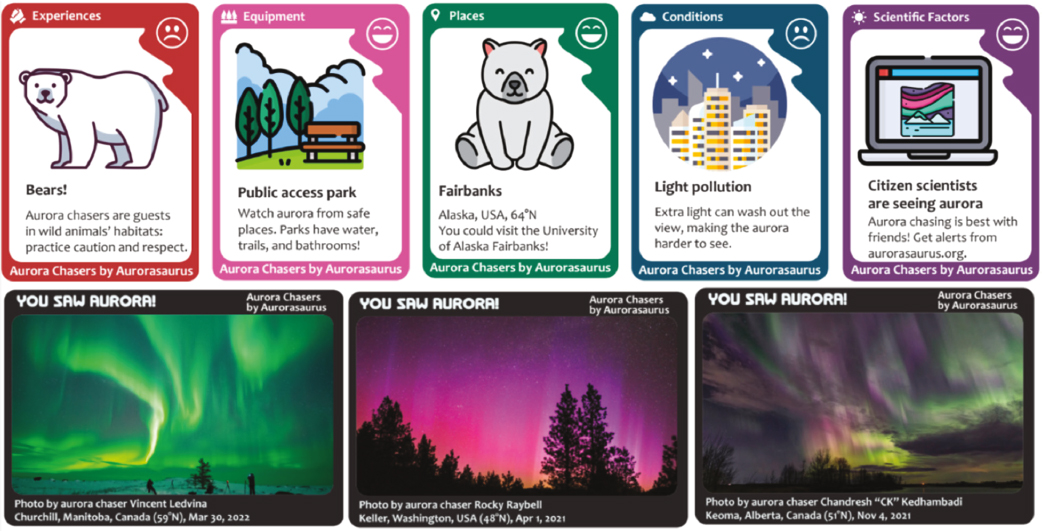
NOTE: STEAM, science, technology, engineering, art, and mathematics.
SOURCES: (Top row) Aurora Chasers is an educational card game created by Aurorasaurus, a participatory science project supported by NSF and NASA. The game is openly licensed under CC BY-NC-SA; (Bottom row) Aurora Chasers is an educational card game created by Aurorasaurus, a participatory science project supported by NSF and NASA. The game is openly licensed under CC BY-NC-SA. Card photos shown are generously provided by Aurorasaurus Ambassadors Vincent Ledvina, Rocky Raybell, and Chandresh “CK” Kedhambadi, and are reproduced with permission.

SOURCE: Heliophysics Audified: Resonances in Plasmas Team (Space Science Institute, UCLA, Virginia Tech, Auralab Technologies Inc., Imperial College, NASA GSFC, NOAA/NCEI)/Space Science Institute.
One method is for agencies to enhance funding for the “broader impacts” components of proposals (including those for NASA grants and missions). The inclusion of material related to public outreach in those sections of proposals could be encouraged as one means of fulfilling the broadening impacts requirements, depending, of course, on the interest level of the proposers. Pending additional funding, supplements to awards could be offered to proposers who wish to embark on larger outreach and education projects. More work can be done to facilitate outreach and broader impacts as part of mission projects in the framework of the agencies’ own efforts.
4.6 SYNOPSIS
This chapter emphasizes two key points: that the research profession of solar and space physics needs the necessary workforce to address the science goals and that the necessary healthy, vibrant, diverse workforce will not be appropriately educated and trained unless funding increases. As the field develops—including into applied areas, such as space weather and across interdisciplinary boundaries—education and training need to broaden into different fields. To keep track of the evolving workforce, demographic data need to be regularly gathered across the whole field.
4.7 REFERENCES
AIP (American Institute of Physics). 2022. “The Number of Doctorates Earned in Physics, 2014–15 to 2018–19.” https://www.aip.org/statistics/resources/number-doctorates-earned-physics-2014-15-2018-19.
AIP. 2023a. “Number of Bachelor’s Degrees Earned in Physics, Classes 1987 through 2022.” https://www.aip.org/statistics/data-graphics/number-bachelors-degrees-earned-physics-classes-1987-through-2022.
AIP. 2023b. “Percent of Physics Faculty Members Who Are Women, 2002–2022.” https://www.aip.org/statistics/data-graphics/percent-physics-faculty-members-who-are-women-2002-2022.
AIP. 2023c. “TEAM-UP Project.” https://www.aip.org/diversity-initiatives/team-up-task-force.
AMACAD (American Academy of Arts and Sciences). 2020. “The Perils of Complacency: America at a Tipping Point in Science and Engineering.” https://www.amacad.org/publication/perils-of-complacency.
APS (American Physical Society). 2024. “Improving the Climate in Physics.” https://www.aps.org/initiatives/inclusion/climate.
Aurorasaurus. n.d. https://www.aurorasaurus.org. Accessed May 21, 2024.
Aurorasaurus. 2023. “Aurora Chasers: The Game!” August 22. https://blog.aurorasaurus.org/?p=1957.
Bagenal, F. 2023. “Enhancing demographics and career pathways of the space physics workforce in the US.” Frontiers in Astronomy and Space Science 10. https://doi.org/10.3389/fspas.2023.1130803.
Bennett, J.O., M.O. Donahue, N. Schneider, and M. Voit. 2019. The Cosmic Perspective: The Solar System. 9th ed. Pearson.
Bernard, R.E., and E.H.G. Cooperdock. 2018. “No Progress on Diversity in 40 Years.” Nature Geoscience 11:292–295. https://doi.org/10.1038/s41561-018-0116-6.
Big Kid Science. 2024. “Totality.” The American Astronomical Society. https://www.bigkidscience.com/eclipse.
Bobek, E., and B. Tyversky. 2016. “Creating Visual Explanations Improves Learning.” Cognitive Research: Principles and Implications 1(27). https://doi.org/10.1186/s41235-016-0031-6.
Briggs, R.P., and R.J. Carlisle. 2016. “Solar Physics and Terrestrial Effects: A Curriculum Guide for Teachers Grade 7–12.” National Oceanic and Atmospheric Administration Space Weather Prediction Center. https://www.swpc.noaa.gov/sites/default/files/images/u2/Solar%20Physics%20And%20Terrestrial%20Physics.pdf.
Carroll, B.W., and D.A. Ostlie. 2017. An Introduction to Modern Physics. 2nd ed. Cambridge University Press.
Chen, C.Y., S.S. Kahanamoku, A. Tripati, R.A. Alegado, V.R. Morris, K. Andrade, and J. Hosbey. 2022. “Meta-Research: Systemic Racial Disparities in Funding Rates at the National Science Foundation.” eLife 11. https://doi.org/10.7554/eLife.83071.
Fraknoi, A., D. Morrison, and S. Wolff. 2016. Astronomy (The Textbook). 1st ed. XanEdu Publishing.
Golberg, F., V. Otero., and S. Robinson. 2010. “Design Principles for Effective Physics Instruction: A Case from Physics and Everyday Thinking.” American Journal of Physics 78:1265–1277. https://doi.org/10.1119/1.3480026.
Impey, C., and S. Buxner. 2020. Astronomy Education, Volume 1: Evidence-Based Instruction for Introductory Courses. American Astronomical Society, IOP Astronomy.
Jaynes, A., and S. Meerdink. 2022. “The Edge of Space Academy: An Example of an Immersive and Experiential Summer Undergraduate Research Program.” Paper presented at the American Geophysical Union Fall Meeting 2022. Chicago: American Geophysical Union.
Kivelson, M.G., and C.T. Russell. 1995. Introduction to Space Physics. 1st ed. Cambridge University Press.
Knipp, D. 2011. Understanding Space Weather and the Physics Behind It. 1st ed. McGraw Hill.
MacDonald, E.A., E. Donovan, Y. Nishimura, N.A. Case, D.M. Gillies, B. Gallardo-Lacourt, W.E. Archer, et al. 2018. “New Science in Plain Sight: Citizen Scientists Lead to the Discovery of Optical Structure in the Upper Atmosphere.” Science Advances 4(3). https://doi.org/doi:10.1126/sciadv.aaq0030.
Moldwin, M. 2008. An Introduction to Space Weather. Cambridge University Press.
Moldwin, M.B. 2023. “Heliophysics Job Ad Data Set (2011–2020).” https://dx.doi.org/10.7302/22450.
Moldwin, M.B., J. Torrence, L.A. Moldwin, and C. Morrow. 2013. “Is There an Appropriate Balance between the Number of Solar and Space Physics PhDs and the Jobs Available?” Space Weather 11:445–448. https://doi.org/10.1002/swe.20075.
Mulvey, P., S. Nicholson, and J. Pold. 2021. “Trends in Physics PhDs.” American Institute of Physics. https://ww2.aip.org/statistics/trends-in-physics-phds.
NASA (National Aeronautics and Space Administration). 2022. “Announcement of Opportunity: Heliophysics Explorers Program 2022 Small Explorer (SMEX).” https://nspires.nasaprs.com/external/viewrepositorydocument?cmdocumentid=896350&solicitationId={9C68D821-8CB0-F01B-DE23-36A6112255E9}&viewSolicitationDocument=1.
NASA. 2023a. “Mission Equity: The Mission Continues – 2023 NASA Equity Action Plan.” https://www.nasa.gov/mission-equity.
NASA. 2023b. “NASA Researcher Demographics: 2023 Report.” Office of the Chief Scientist. https://www.nasa.gov/wp-content/uploads/2023/04/researcher-demographics-2023-report.pdf.
NASA. 2024a. “The Heliophysics Big Year.” https://science.nasa.gov/sun/helio-big-year. Accessed May 21, 2024.
NASA. 2024b. “NASA+ Home.” https://plus.nasa.gov.
NASA. 2024c. “Research Opportunities in Space and Earth Sciences – 2024 (ROSES-2024).” https://nspires.nasaprs.com/external/viewrepositorydocument?cmdocumentid=983947.
NASA SciAct Program. n.d. “Learn: Science Activation.” https://science.nasa.gov/learn. Accessed May 21, 2024.
NASEM (National Academies of Sciences, Engineering, and Medicine). 2019. Minority Serving Institutions: America’s Underutilized Resource for Strengthening the STEM Workforce. The National Academies Press. https://doi.org/10.17226/25257.
NASEM. 2020a. NASA’s Science Activation Program: Achievements and Opportunities. The National Academies Press. https://doi.org/10.17226/25569.
NASEM. 2020b. Progress Toward Implementation of the 2013 Decadal Survey for Solar and Space Physics: A Midterm Assessment. The National Academies Press. https://doi.org/10.17226/25668.
NASEM. 2022a. Advancing Diversity, Equity, Inclusion, and Accessibility in the Leadership of Competed Space Missions. The National Academies Press. https://doi.org/10.17226/26385.
NASEM. 2022b. Foundations of a Healthy and Vital Research Community for NASA Science. The National Academies Press. https://doi.org/10.17226/26575.
NASEM. 2023a. Origins, Worlds, and Life: A Decadal Strategy for Planetary Science and Astrobiology 2023–2032. The National Academies Press. https://doi.org/10.17226/26522.
NASEM. 2023b. Pathways to Discovery in Astronomy and Astrophysics for the 2020s. The National Academies Press. https://doi.org/10.17226/26141.
NASEM. 2024. Unequal Treatment Revisited: The Current State of Racial and Ethnic Disparities in Health Care: Proceedings of a Workshop. The National Academies Press. https://doi.org/10.17226/27448.
NCSES (National Center for Science and Engineering Statistics). 2023. “Diversity and STEM: Women, Minorities, and Persons with Disabilities 2023.” Special Report NSF 23-315. National Science Foundation. https://ncses.nsf.gov/wmpd.
Nicolson, S., and P. Mulvey. 2022. “Roster of Physics Departments with Enrollment and Degree Data, 2021: Results from the 2021 Survey of Enrollments and Degrees.” American Institute of Physics. https://ww2.aip.org/statistics/roster-of-physics-departments-with-enrollment-and-degree-data-2021.
NSF (National Science Foundation). n.d. “Faculty Development in geoSpace Science (FDSS).” https://new.nsf.gov/funding/opportunities/faculty-development-geospace-science-fdss. Accessed April 6, 2023.
NSF. 2023a. “NSF 23-577: Faculty Development in geoSpace Science (FDSS).” https://new.nsf.gov/funding/opportunities/faculty-development-geospace-science-fdss/nsf23-577/solicitation.
NSF. 2023b. “Survey of Earned Doctorates.” Updated September 28. https://ncses.nsf.gov/pubs/nsf24300.
NTRS (NASA Technical Report Server). 2023. “NASA Researcher Demographics: 2023 Report.” Office of the Chief Scientist. https://ntrs.nasa.gov/citations/20230011026.
Pold, J., and R. Ivie. 2018. “Workforce Survey of 2018 US AAS Members: Summary Results.” American Institute of Physics – Statistical Research Center. https://aas.org/sites/default/files/2019-10/AAS-Members-Workforce-Survey-final.pdf.
Porter, A.M., and R. Ivie. 2019. “Women in Physics and Astronomy, 2019.” American Institute of Physics Statistical Research Center. https://www.aip.org/statistics/reports/women-physics-and-astronomy-2019.
Porter, A.M., S. White, and J. Dollison. 2020. “2020 Survey of the Planetary Science Workforce.” American Institute of Physics Statistical Research Center. https://dps.aas.org/sites/dps.aas.org/files/reports/2020/Results_from_the_2020_Survey_of_the_Planetary_Science_Workforce.pdf.
Posselt, J.R. 2020. Equity in Science: Representation, Culture, and the Dynamics of Change in Graduation Education. Stanford University Press.
Schatz, D., and A. Fraknoi. 2016. Solar Science: Exploring Sunspots, Seasons, Eclipses, and More. National Science Teaching Association Press.
Seymour, E., and N.M. Hewitt. 1997. Talking About Leaving: Why Undergraduates Leave the Sciences. Westview Press.
Seymour, E., and A.B. Hunter. 2019. Talking About Leaving Revisited: Persistence, Relocation, and Loss in Undergraduate STEM Education. Springer Nature. https://doi.org/10.1007/978-3-030-25304-2.
Solar Wind with Hydrogen Ion Charge Exchange and Large-scale Dynamics (SHIELD) Drive Science Center. “SHIELD Webinars.” https://shielddrivecenter.com/shield-webinars. Accessed May 21, 2024.
Students for Fair Admissions, Inc. v. President and Fellows of Harvard College. 2023. 600 U.S. 181.
UCAR (University Corporation for Atmospheric Research). 2024. “Significant Opportunities in Atmospheric Research and Science (SOARS).” https://soars.ucar.edu.
University of Alaska Fairbanks Space Weather Underground. “Space Weather Underground Project.” https://sites.google.com/alaska.edu/swug/home. Accessed May 21, 2024.
University of New Hampshire Institute for the Study of Earth, Oceans, and Space. “Space Weather Underground. https://eos.unh.edu/space-science-center/outreach/space-weather-underground. Accessed May 21, 2024.
White, S., G. Anderson, and R. Ivie. 2011. “Results from the 2011 Survey of Solar, Space and Upper Atmospheric Physicists.” American Institute of Physics, Statistical Research Center. https://deepblue.lib.umich.edu/bitstream/handle/2027.42/166102/SSP-Decadal-AIP-Survey.pdf.
SOURCES FOR IMAGES IN FIGURE 4-1
Composed by AJ Galaviz III, Southwest Research Institute; Background by Tim Warchocki. Left panel images from left to right: (Top row) ©DC Studio/Adobe Stock, ©muratart/Adobe Stock, ©gpointstudio/Adobe Stock, ©wavebreak3/Adobe Stock; (Middle row) ©BGStock72/Adobe Stock, ©Prostock-studio/Adobe Stock, ©Krakenimages.com/Adobe Stock, ©Martin Barraud/Caia Image/Adobe Stock; (Bottom row) ©alfa27/Adobe Stock, ©Syda Productions/Adobe Stock, NASA/ESA/A. Simon (Goddard Space Flight Center)/M.H. Wong (University of California, Berkeley), ©Quality Stock Arts/Adobe Stock. Right panel images from left to right: (Top row) ©eggeeggjiew/Adobe Stock, ©Serhii/Adobe Stock, ©Framestock/Adobe Stock, ©Viacheslav Yakobchuk/Adobe Stock; (Middle row) NASA/ESA/Massimo Robberto (STScI, ESA)/Hubble Space Telescope Orion Treasury Project Team, ©Cultura Allies/Adobe Stock, NASA, ©sofiko14/Adobe Stock; (Bottom row) ©Syda Productions/Adobe Stock), ©Viacheslav Yakobchuk/Adobe Stock, ©Alberto/Adobe Stock, ©eakgrungenerd/Adobe Stock.


