The Next Decade of Discovery in Solar and Space Physics: Exploring and Safeguarding Humanity's Home in Space (2025)
Chapter: Appendix B: Report of the Panel on the Physics of the Sun and Heliosphere
B
Report of the Panel on the Physics of the Sun and Heliosphere
Solar and heliospheric physics covers a vast domain, extending from the core of the Sun to the boundary between the heliosphere and interstellar space. This field aims to understand how the Sun generates energy, how it powers the solar dynamo that creates and sustains a complex and highly variable magnetic field, and how it forms and upholds the heliosphere, the farthest reaches of the Sun’s atmosphere. It seeks to unravel what drives solar activity, how the solar wind is formed and evolves on its journey from the corona to the heliopause (HP), and how the heliosphere interacts with the interstellar medium.
There are important practical aspects to this field. The heliosphere is humanity’s home in the galaxy, and the dynamic interactions it contains have consequences for a society that is reliant on space-based and ground-based technologies impacted by the sudden and violent energy releases occurring throughout the space environment. Understanding these interactions is essential for protecting life on Earth and for safeguarding humanity as it expands to the Moon, Mars, and beyond.
B.1 STATE OF THE FIELD
The previous decade has seen many new discoveries and considerable advances in the basic understanding of solar and heliospheric physics. Tasked with identifying the highest-priority science goals (PSGs) related to the Sun, the heliosphere, the very local interstellar medium, and pertinent emerging interdisciplinary opportunities, the Panel on the Physics of the Sun and Heliosphere (SHP) considered the wealth of significant accomplishments from the past decade to guide the next. Here, the panel lists several of these achievements, organized by the overarching PSGs (not in prioritized order)—that will guide solar and heliospheric science in the coming years. Each section lists several key new discoveries as well as important science questions that have arisen from these and other recent revelations.
B.1.1 How Does the Sun Maintain Its Magnetic Activity Globally from Pole to Pole?
The previous decade included a much weaker sunspot cycle, with a considerably lower mean sunspot number, than the two that preceded it. This followed a period of very weak solar activity and a long, deep sunspot minimum. The solar wind flux and magnetic field were considerably weaker during the previous solar minimum, while the flux of galactic cosmic rays reached the highest on record. New discoveries continue to be made from operational
missions within the Heliophysics Systems Observatory (HSO) and solar ground-based facilities—now including the Daniel K. Inouye Solar Telescope, the most advanced solar telescope in the world. The past decade has also seen great progress in solar dynamo modeling, which has always been a challenging problem because the dynamo is inherently a multi-spatial-scale system. The “mean field model,” capturing physics of small scales via parametrizations, and full three-dimensional (3D) models, targeting explicit dynamics over a wider range of scales, are gradually converging toward a unified understanding of the dynamo that will likely come to fruition in the next decade when the physics of polar regions will be addressed.
Highlights of additional major science advancements from the past decade include the following:
- Numerical modeling of the solar dynamo: 3D global magnetohydrodynamic (MHD) simulations are now producing results that are relevant to the solar case, including the reversal of the solar field polarity (toroidal field reversals) and key aspects of the well-known butterfly diagram. Mean field models now well represent important aspects of the dynamo process such as magnetic buoyancy, nonlinear “quenching” of turbulent diffusion, and kinetic helicity, which result in realistic torsional oscillation patterns seen in helioseismology observations.
- Helioseismic measurements of solar rotation and meridional circulation: A major advancement of helioseismology has been the accurate measurement of solar rotation as a function of both latitude and radius in the convection zone, tachocline, and interior. While helioseismic techniques cannot measure magnetic fields directly, recent observational advances in solar rotation and meridional flow measurements have shown that the fields’ amplitudes and variations are clearly influencing velocity dynamics, allowing us to probe the structure and strength of subsurface solar magnetic fields.
- Discovery of Rossby waves: One of the major, unanticipated discoveries of the past decade is the detection of Rossby waves in the Sun (Figure B-1). These inertial waves, first detected in Earth’s atmosphere, occur in thin spherical shells owing to the latitude variation of the Coriolis forces. Terrestrial Rossby waves interact with the mean zonal flow to produce “jet streams” that steer the daily weather. Analogously, solar Rossby waves can interact with solar differential rotation and toroidal magnetic fields to affect the distribution of active regions and enhance bursts of solar activity.
Some of the key questions remaining in this field include the following: Does the meridional flow go all the way to the pole or do counter-cells occur? At what latitude do the polar fields reverse? What is the nature of polar vortices? What is the temperature difference between the poles and the equator? This topic will be explored further in Section B.2.1.
B.1.2 How Do the Sun’s Magnetic Fields and Radiation Environments Connect Throughout the Heliosphere?
The past decade has seen a significant increase in the understanding of the physics of the solar chromosphere, corona, and solar wind. Parker Solar Probe (PSP) was launched in 2018 and has markedly advanced the understanding of how the solar magnetic field is connected with the inner heliosphere. The seamless coverage of spectral diagnostics from the photosphere into the low corona—by the Interface Region Imaging Spectrograph (IRIS) satellite and a host of complementary, high-resolution, ground- and space-instruments—now allows researchers to precisely investigate the connectivity between solar surface drivers and phenomena observed in the upper atmosphere. This effort is supported by increasingly sophisticated numerical models of the solar atmosphere that now include critical nonequilibrium effects such as time-dependent ionization and ion-neutral interactions, which greatly affect the structure of the chromosphere and transition region (TR). Some of these models are starting to reproduce quintessential chromospheric features such as spicules or fibrils.
Highlights of additional major science advancements from the past decade include the following:
- First advances in understanding the slow solar wind: Periodic density and magnetic structures are commonly observed in the slow solar wind, indicating a source related to intermittent plasma release associated with

SOURCE: Dikpati and McIntosh (2020), https://doi.org/10.1029/2018SW002109. CC BY 4.0.
- interchange reconnection. Pseudostreamers are a prime location for interchange reconnection, with observed structure size scales that are consistent with those found in the periodic structures. Models of the solar coronal magnetic field driven by photospheric flows show ubiquitous interchange reconnection along coronal hole boundaries between open and closed fields, which is likely the dominant process capable of explaining key observations of the slow solar wind, including more variability, and enhanced ionic and elemental composition.
- Proving the existence of nonthermal particles in coronal nano-flares: It has long been thought that quiescent active regions are heated primarily by so-called nanoflares, episodes of small-scale magnetic reconnection leading to nonthermal accelerated particles and impulsive heating of the coronal plasma, but there has been no direct proof. IRIS ultraviolet (UV) spectroscopy of the chromospheric and TR response to small, rapid coronal heating events has revealed that for a large fraction of them the observed velocity pattern can be explained only by a population of coronal nonthermal electrons, dissipating their energy in the lower atmosphere. This pattern has been confirmed by highly sensitive hard X-ray (HXR) observations with the Nuclear Spectroscopic Telescope Array (NuSTAR) astrophysics satellite, which have unambiguously proven the presence of nonthermal accelerated particles in small-scale events.
- Discovery of a highly structured solar wind magnetic field near the Sun and magnetic “switchbacks”: PSP observed complex magnetic structure in the solar wind, including the existence of “magnetic switchbacks” (Figure B-2). Beyond a few solar radii, the interplanetary magnetic field (IMF) was expected to be nearly radial; however, PSP found it to contain numerous structures in which the field reverses direction. Researchers have connected the timing of the occurrence of switchbacks to variations in the solar wind velocity and have identified their solar source, providing strong evidence that interchange reconnection is the likely origin of the fast solar wind.
- Measuring the magnetic wave origin of First Ionization Potential (FIP) bias in active regions: Exciting results, obtained by combining coronal spectroscopy and first observations of chromospheric magnetic field temporal variations, have recently demonstrated a likely origin of the “FIP bias” (the overabundance of elements with low FIP as measured in coronal plasma). Its spatial distribution observationally links to sites of strong Alfvénic perturbations in the chromosphere, providing strong evidence that the fractionation process producing the FIP bias is powered by the conversion of magnetic waves in the chromosphere.
Some of the key questions remaining in this field include the following: How does the lack of far-side and polar observations of the Sun impact the ability to accurately describe global solar wind, coronal mass ejection (CME), and energetic particle propagation? What role do interchange reconnection and waves and turbulence play in generating the solar wind, and how do they imprint on the fast and slow solar wind? What is the role of

SOURCE: S. Bale, S. Badman, J. Bonnell, et al., 2019, “Highly Structured Slow Solar Wind Emerging from an Equatorial Coronal Hole,” Nature 576:237–242, https://doi.org/10.1038/s41586-019-1818-7, reproduced with permission from SNCSC.
the chromospheric magnetic field in shaping the corona and solar wind? This topic will be explored further in Section B.2.2.
B.1.3 How Do Solar Explosions Unleash Their Energy Throughout the Heliosphere?
The past decade saw a key breakthrough in solar-flare science: the direct mapping of magnetic fields, which power these explosive phenomena, near the acceleration region through the use of the radio astronomical telescope EOVSA (Expanded Owens Valley Solar Array) with microwave imaging spectroscopy (Figure B-3). Prior to this breakthrough, this magnetic energy release could only be inferred indirectly, by comparing the pre- and post-flare photospheric magnetic fields or tracking the motion/evolution of plasma-confining extreme ultraviolet (EUV)/X-ray loops or flare footpoints/ribbons. Multispacecraft observations have also made pivotal advances. The twin Solar Terrestrial Relations Observatory (STEREO) spacecraft combined with the Advanced Composition Explorer (ACE), for example, revealed that solar energetic particles (SEPs) are dispersed in longitude far more than was expected. CMEs are a key driver of space weather, and understanding how they are released and propagate in the heliosphere endures as a major research thrust. Tests of the traditional CME structure paradigm have become considerably more stringent in the past decade, as analyses increasingly utilize data from multiple spacecraft to study structure and kinematics, from PSP showing particles accelerating toward the Sun from the inner heliosphere to Voyager measuring the passage of CMEs in the outer heliosphere.
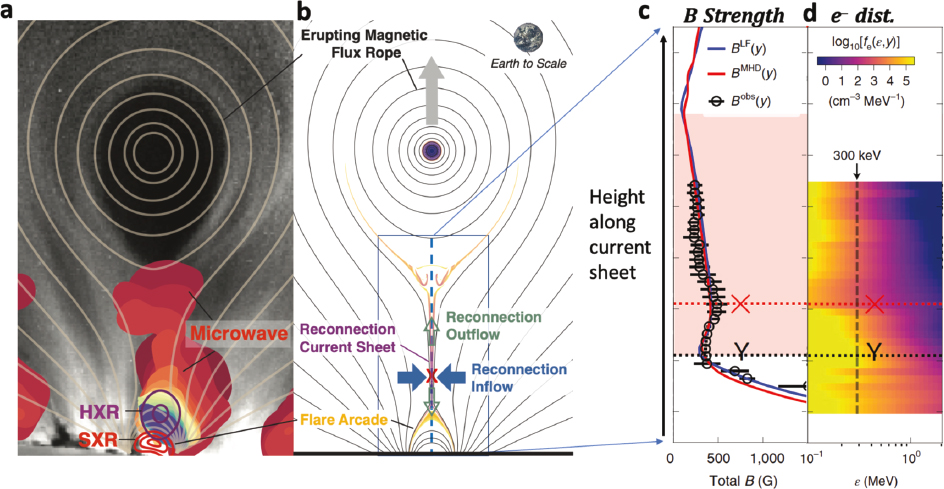
SOURCES: (Left and right) Adapted from B. Chen, C. Shen, D.E. Gary, et al., 2020, “Measurement of Magnetic Field and Relativistic Electrons Along a Solar Flare Current Sheet,” Nature Astronomy 4:1140–1147, reproduced with permission from SNCSC; (Middle) Committee created.
Highlights of additional major science advancements from the past decade include the following:
- First observations of SEPs backstreaming from distant co-rotating interaction regions: PSP has provided the first measurements of energetic particles from global solar wind stream interaction regions, and the particles are seen to be moving toward the Sun. The acceleration site is far from the spacecraft, suggesting very efficient transport in the interplanetary magnetic field with a long mean-free path.
- New multispacecraft observations of CME structure: In 2014, a CME was observed by no fewer than 10 National Aeronautics and Space Administration (NASA) and European Space Agency (ESA) spacecraft, from the Sun all the way out to Voyager 2 in the outer heliosphere. PSP has provided the first close-up images of transients while they are still near the Sun. These observations are opening new questions about CME structure and evolution.
- Discovery of large numbers of coronal and precipitating electrons in solar flares: Researchers discovered that coronal sources in certain solar flares had extremely high nonthermal density. The inferred energy flux of electrons precipitating into the solar atmosphere during the impulsive phase of certain solar flares is also far greater than previously expected, as extreme as ~1013 erg s−1 cm−2. This value is far outside the realm of the basic assumptions in HXR modeling that has been ubiquitously used for the past 50 years.
- Discovery of SEPs dispersed widely in helio-longitude: SEPs from a compact source on the Sun were seen by multiple separate spacecraft near 1 AU and were quite widely separated in longitude. This separation was unexpected because it was thought that SEPs were mostly guided by the Parker spiral magnetic field, but these results indicate that SEPs undergo considerable cross-field transport. It remains unclear how and where this efficient transport occurs. In addition, for energetic electron events associated with HXR flares, it has been found that less than 1 percent of the total energetic electron population managed to escape to interplanetary space, which further underpins the importance of understanding the transport processes from near the Sun and into interplanetary space.
Some of the key questions remaining in this field include the following: What is responsible for the extremely efficient particle acceleration within solar flares? How are SEPs transported into the heliosphere in both longitude and latitude? What causes the wide range of variability in the composition of SEPs? How do CMEs evolve from the Sun to 1 AU? This topic will be explored further in Section B.2.3.
B.1.4 How Is Our Home in the Galaxy Sustained by the Sun and Its Interaction with the Local Interstellar Medium?
The past decade has been a period of tremendous progress in the science of the outer heliosphere. The Voyagers, now making the first in situ measurements of the local interstellar medium (LISM), continue their epic journeys. Each has now crossed the HP, the heliospheric boundary separating plasma of solar origin from that of the LISM. They discovered unusual variations in galactic cosmic rays (GCRs)—particulate radiation mostly produced in supernovae remnants—that permeate the galaxy and enter the solar system where they are modulated by the heliosphere. The Interstellar Boundary Explorer (IBEX) continues to probe the global heliosphere, including an enigmatic enhancement of energetic neutral atoms (ENAs) coming from the outer heliosphere (the “IBEX Ribbon”). New Horizons contributes through the first outer heliosphere measurements of pickup ions (PUIs), produced when an interstellar atom is ionized and representing a nonthermal population in the solar wind, as well as low-energy ions.
Highlights of additional major science advancements from the past decade include the following:
- Voyagers crossing of the HP: The Voyager 1 HP crossing in 2012, at a heliocentric distance of 121 AU, was identified by the detection of plasma waves. The local plasma density was determined to be 0.08 cm−3, close to the predicted value. Voyager 2 crossed the HP in 2018 at a distance of 119 AU from the Sun. Voyager 1 does not have a functioning plasma instrument; and while Voyager 2 does, it has not directly measured the LISM plasma. The HP crossing was also identified by the complete disappearance of anomalous cosmic rays (ACRs), a type of cosmic ray produced in the heliosphere and most likely accelerated at the solar
- wind termination shock (TS). The Voyagers are now measuring the GCR spectrum in interstellar space, unmodulated by the heliosphere.
- Proof that the heliosphere responds to solar-cycle variations: IBEX ENA maps collected over the past decade have revealed a sudden and intense heating of the heliosheath resulting from a large increase in dynamic pressure of the solar wind after a long period of weak solar activity, convincingly demonstrating the heliospheric response to changes in solar activity (Figure B-4). The IBEX Ribbon as well has changed with time on the scale of years, reflecting changes from the solar cycle.
- The IBEX Ribbon originates in a region of trapped solar wind beyond the heliopause: The IBEX Ribbon is a feature that appears in ENA maps of the sky that is oriented along the locus of points where outward lines-of-sight from the Sun are perpendicular to the interstellar magnetic field (ISMF) draped around the heliosphere. Numerous theories have been proposed in the past decade to explain the origin of the Ribbon. A preponderance of evidence now suggests the Ribbon results from a multistep “secondary ENA” process whereby outgoing neutralized solar wind travels unimpeded beyond the heliopause is then reionized and captured by the draped ISMF, and then reneutralized several years later, producing a population of secondary ENAs, some of which return to the inner heliosphere and observed as the Ribbon. Research is ongoing to explain the details of exactly how the ion population is captured and retained.
- First measurements of the magnetic field in the LISM: The magnetic field increased at the HP crossing, but, surprisingly, its direction only changed slightly, counter to predictions. The field strength in the LISM measured by Voyager 1 was ~4.6 μG and was later observed to be somewhat higher by Voyager 2, at ~5.8 μG. This implies that the magnetic pressure is some 40 percent different at the two separate
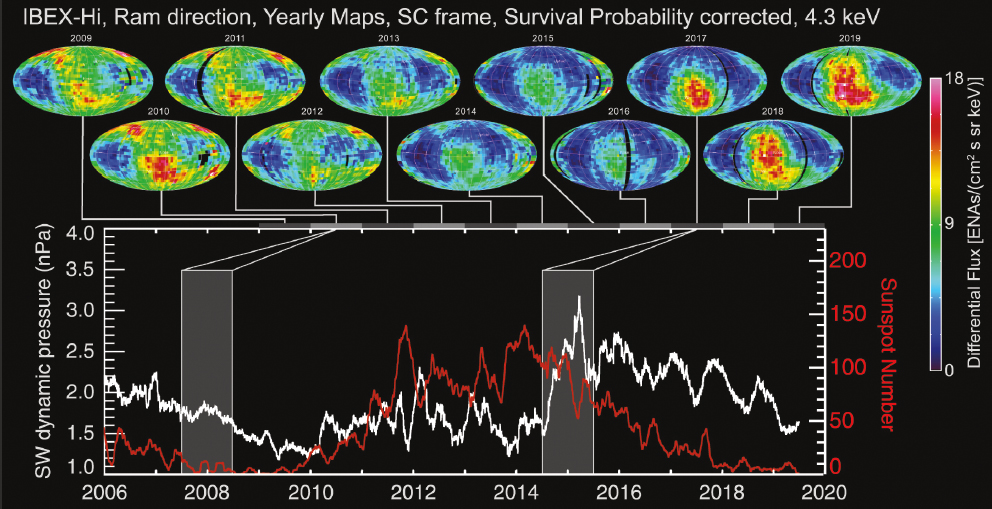
SOURCE: D.J. McComas, M. Bzowski, M.A. Dayeh, et al., 2020, “Solar Cycle of Imaging the Global Heliosphere: Interstellar Boundary Explorer (IBEX) Observations from 2009–2019,” Astrophysical Journal Supplement Series 248(2):26, https://doi.org/10.3847/1538-4365/ab8dc2. © AAS. Reproduced with permission.
- crossing points, suggesting an asymmetry in the way in which the LISM magnetic field drapes around the heliosphere. The field strength of ~4.6–5.8 μG is larger than predictions, but within the range of expected variations owing to LISM turbulence.
- Discovery of shock-like plasma disturbances in the LISM: The plasma waves that led to the discovery that Voyager 1 had crossed the HP have been observed at other times as well, deeper into the LISM. These waves resemble shock-like structures and are certainly large-scale global disturbances passing the spacecraft, much thicker than shocks observed inside the heliosphere for many years.
Some of the key questions remaining in this field include the following: What is the geometric shape of the heliosphere? How are GCRs modulated across the HP and within the heliosheath? What is the PUI distribution across the termination shock and within the heliosheath? This topic will be explored further in Section B.2.4.
The panel considered the prodigious achievements of the Sun and heliosphere community, the valuable inputs provided through 187 contributed community input papers, and the space- and ground-based capabilities available now and in the near future, to assess the current state of the field. This assessment was used to identify the science goals moving forward for the community, including near-term PSGs, a longer-range goal (LRG), and emerging opportunities (EOs). The panel identified four PSGs, each described in Section B.2. The LRG is detailed in Section B.3. Two EOs are introduced in Section B.4. The current and envisioned guiding research activities, including enabling space-based mission concepts and ground-based facilities for the next decade, are described at length in Section B.5. Included in this last section are considerations addressing broader community needs and enabling opportunities.
B.2 PRIORITY SCIENCE GOALS
The four Sun and heliosphere PSGs are described in this section along with a description of the research and analysis development programs supporting these activities. For each goal, the panel lays the groundwork for the relevance and importance of the science and describes the current research activities for each objective. The panel identifies prevalent current and planned observational resources that are available, both space- and ground-based, and outlines the state of theory, modeling, and simulations relevant to addressing these goals. Last, the panel discusses how these goals are motivated by the current state of the field and describes their contribution to system-level science.
B.2.1 Priority Science Goal 1
Since the discovery that the solar photosphere is covered by magnetic fields in 1908, scientists have come to realize that the overwhelming majority of solar variability is driven by magnetism. This variability happens over decadal timescales in the form of the solar magnetic cycle, quasi-annual/quasi-biennial timescales of solar activity in the form of solar “seasons,” weeks-to-months timescales in the form of active regions emergence and decay, and minutes-to-hours timescales in the form of flares and CMEs. The question of how the Sun maintains its magnetic activity globally has pervaded all previous decadal surveys in different guises, and there has been substantial progress in the ability to observe and simulate all of these different timescales. However, owing to lack of knowledge of flows and fields in the polar regions and greater depths (Figure B-5), the understanding of the solar dynamo and activity cycle and their connections to the evolution of the 3D corona remain crucially incomplete.
While global measures of meridional circulation as a function of latitude and depth have continued in the past decade, focus has also extended on determining the role of local active regions’ flows in modulating the global meridional circulation as a function of latitude and time. Long-term data collection efforts have helped in deriving the variation in differential rotation and variation in the tachocline properties as a function of the solar cycle. Progress has been made in inferring the emergence and existence of active regions on the far-side of the Sun. One of the newest discoveries of helioseismology over the past decade has been detecting Rossby waves and other inertial waves in low latitudes. How the flows and waves behave at the polar latitudes and globally around the whole Sun and whether longitude dependence exists in the meridional circulation are not known yet.

SOURCE: Nandy et al. (2023), https://doi.org/10.3847/25c2cfeb.1160b0ef. CC BY 4.0.
PSG 1 (Table B-1) captures the community’s need to push forward the understanding of what makes the Sun a star, with an emphasis on polar measurements. The objectives highlight the critical role that solar plasma flows and magnetic fields play in driving all observed solar phenomena from the photosphere to the edge of the heliosphere and stress that the solar poles remain outside of observational capabilities, thus representing one of the final observational frontiers in solar physics.
Current Research Activity
Priority Science Goal 1, Objective 1.a
The solar poles seed the magnetic fields that generate and shape future solar cycles. However, there is limited understanding on where and how the polar fields connect to dynamo generation across the whole convection zone. Achieving this objective requires direct observations of the polar fields, including information about the subduction mechanisms that connect polar fields and toroidal belts (such as meridional circulation). It also requires a better understanding of the polar differential rotation, including the possible existence of a polar vortex and the thickness of the tachocline at the poles (Figure B-6).
TABLE B-1 Sun and Heliosphere Priority Science Goal (PSG) 1 and Objectives
| PSG 1 (of 4) | Objectives |
|---|---|
| How does the Sun maintain its magnetic activity globally from pole to pole? |
|

SOURCE: Featherstone et al. (2023), https://doi.org/10.3847/25c2cfeb.240cbaca. CC BY 4.0.
Priority Science Goal, Objective 1.b
Magnetic fields, generated by the solar dynamo, manifest at the surface in the form of active regions. Extensive efforts have been made to model the movement of magnetic flux from the dynamo layers to the surface by convective instability and magnetic buoyancy effects. Their emergence and evolution drive the evolution of coronal structure and energetics. To accomplish this objective, it is necessary first to understand what processes govern magnetic flux emergence through the surface and their specific latitude–longitude distribution, and then to integrate modeling efforts combining flux emergence from dynamo layers to the surface with the evolution of the global corona. This work needs to be combined with a sustained effort to measure magnetic fields directly in the chromosphere and corona, as well as to expand observational capabilities to observe the full solar surface, with multiviewpoint observations to jointly build a comprehensive picture of the entire process.
Priority Science Goal, Objective 1.c
While global flows, like differential rotation and meridional circulation (two major ingredients of solar dynamo models), have been measured successfully at the surface up to a latitude of about 60 degrees through helioseismic techniques, knowledge about their profiles in latitude, longitude, and depth is still lacking. Solar Rossby waves and inertial oscillations were detected within the past decade and have been shown to nonlinearly interact with mean (longitude-averaged) flows and magnetic fields in a complex fashion, which may explain the observed nonaxisymmetric (longitude-dependent) distribution of surface active regions. This nonlinearity is just one example of the key questions raised concerning the interaction between these waves and oscillations that need to be explored in the next decade.
A topmost priority in the next decade is to refine helioseismic techniques to enable new important measurements. These techniques include the ability to measure the thickness of the tachocline as a function of latitude, to determine whether global flows have longitudinal structures and to distinguish between inertial oscillations and large-scale convective motions as a function of convection zone depth. This capability will allow us to finally resolve the long-standing inconsistencies between helioseismic observations of convective velocities and global convective model-outputs.
Priority Science Goal, Objective 1.d
Every aspect of the way the Sun drives variability in the solar system is connected to the solar cycle via active region emergence and decay. Achieving this objective thus requires the coordination between surface and helioseismic measurements to infer changes in the subsurface toroidal field. Also needed is an understanding of how changes in large-scale solar flows determine subsequent changes at the surface and in the atmosphere. It is imperative to modernize historical data such that they can be combined with current data to produce a long-term

SOURCE: A. Muñoz-Jaramillo and J.M. Vaquero, 2019, “Visualization of the Challenges and Limitations of the Long-Term Sunspot Number Record,” Nature Astronomy 3:205–211, https://www.nature.com/articles/s41550-018-0638-2, Springer Nature.
homogeneous observational baseline (Figure B-7), including as many sunspot cycles’ worth of observations of magnetic fields, plage, coronal bright points, and coronal structures as possible.
Observational Resources
To study the Sun’s internal structure, SDO’s Helioseismic and Magnetic Imager (HMI) and the Solar and Heliospheric Observatory’s (SOHO’s) Michelson Doppler Imager (MDI) (MDI until 2011) make full-disk measurements from which differential rotation, meridional circulation, and Rossby waves are inferred from frequency shifts in acoustic modes of the Sun. These measurements are also used to study domains from the Sun’s outer atmosphere to the solar wind, spanning the spatial progression from small-scale local dynamics to global dynamics in the form of synoptic maps. Although SDO/HMI observations of the evolution of flows and magnetic fields inform all four objectives, their range is limited to latitude below 60 degrees and to the visible disk of the Sun.
The ground-based instruments of the Global Oscillation Network Group (GONG), a network of six identical observatories distributed all over the globe, guarantee a continuous coverage of the Sun, providing measurements similar to SDO/HMI (although at a lower spatial resolution). The Sun’s internal oscillations, caused by sound waves that travel through its interior, are studied to learn about the physical properties of the Sun’s interior, such as its temperature, pressure, composition, rotation, meridional circulation, and inertial waves. The GONG high-resolution spectrographs provide full-disk, high-cadence Doppler shift maps caused by these oscillations for helioseismology studies. GONG measurements of the line-of-sight photospheric magnetic field over the full disk, at a ~10 min cadence, are used to produce extrapolated models of the 3D coronal and heliospheric magnetic field.
Like all full-disk instruments observing from the ecliptic, GONG has latitudinal coverage for flows and fields up to roughly 60 degrees north and south. Hence, GONG can also contribute to achieve all four objectives. Great benefit has been achieved by having HMI and GONG operating simultaneously using different instrumental techniques allowing mutual validation of helioseismic results. While the use of helioseismic holography techniques has made far-side imaging possible from these instruments’ data, in order to make further progress in the next decade, observations from 65 degrees latitude up to the poles as well as simultaneous views of 360 degrees longitude are necessary.
The Solar Orbiter (SO) mission includes a magnetograph (Polarimetric and Helioseismic Imager [PHI]) that can measure complex near-surface flows, meridional flows, and differential rotation at the surface, up to 65 degrees latitude and an EUV imager (EUI) that will measure and characterize plasma flows that transport magnetic fields. The out-of-the-ecliptic phase of SO, beginning in 2027, would provide some information about polar regions and hence new constraints for solar dynamo models, but the observations will only cover a few weeks per year. In 2030, SO is set to reach an orbital inclination of 34 degrees, which will give a better view of the poles but yet will not allow for the multimonth monitoring of the polar flows needed to be detected by helioseismology, and hence comprehensive understanding of dynamo and polar field evolution will remain incomplete.
The Hinode mission’s Solar Optical Telescope (SOT) infers the Sun’s magnetic fields up to 70 degrees latitude to study what drives solar eruptions and powers the solar atmosphere. SOT measures Zeeman/Stokes parameters to obtain both strength and direction of the magnetic fields associated with the eruptions. This instrument has been successfully resolving polar fields for more than a solar cycle up to about 70 degrees (beyond which the spatial resolution decreases owing to foreshortening) and will remain the best source of polar field measurements until a truly polar mission is implemented. Complementary Hinode instruments produce X-ray images and EUV spectroscopy to diagnose temperature and pressure in the corona above the photospheric fields.
The Polarimeter to Unify the Corona and Heliosphere (PUNCH) is an upcoming (~2025) Small Explorer (SMEX) mission developed to understand how the mass and energy in the Sun’s corona form the solar wind and globally evolve. PUNCH consists of four synchronized Earth-orbiting satellites, each containing four instruments, with the goal of producing a continuous picture of the whole inner heliosphere.
The Upgraded Coronal Multi-channel Polarimeter (UCoMP) is a ground-based 20 cm aperture Lyot coronagraph with a Stokes polarimeter. It can image the intensity, linear Stokes polarization, Doppler shift, and line width across coronal emission lines in the visible and near-infrared (IR), up to 2 R⊙ (1.56 R⊙ in the polar direction). Joint analysis of different emission lines provides information about global coronal variations of density and temperature as well as dynamics and magnetic field direction in the plane of the sky. Recent studies on the propagation of waves in the low corona have provided estimates of the magnetic field strength in defined regions.
The Kodaikanal Solar Observatory (KoSO) has one of the world’s longest-term digitized full-disk solar data archives in white light (1904–2017), Ca II K (1904–2007), and H-α (1912–2007) enabling analysis of solar flows, meridional circulation, and differential rotation as well as the evolutionary patterns of polar faculae and active regions. The images have been recorded with optical telescopes, including a 15-cm-aperture photoheliograph and twin 6-cm-diameter spectroheliographs, which provide the full-disk photographs of the Sun in K-α and H-α. Mount Wilson Observatory has similar records.
Theory, Modeling, and Simulations
Significant theoretical effort to understand how the Sun maintains its magnetic activity globally has enabled us make substantial progress during the past decade—thanks to significant improvement to models of the solar magnetic field through several NASA programs: HSR (Heliophysics Supporting Research), HTMS (Heliophysics Theory, Modeling, and Simulations), LWS-FST (Living With a Star Focus Science Topic), LWS Strategic Capability, and NASA Diversify, Realize, Integrate, Venture, Educate (DRIVE) Science Centers, as well as National Science Foundation (NSF) programs (e.g., Next-Generation Software for Data-driven Models of Space Weather with Quantified Uncertainties [SWQU], Advancing National Space Weather Expertise and Research toward Societal Resilience [ANSWERS], and Science and Technology Centers [STC]), and an increased level of computational power.
While scientists are still not close to a global turbulent MHD simulation of the solar interior, surface, and atmosphere that can simulate decades of evolution, all the different models used to understand solar magnetism have clearly begun to overlap in the relevant spatial and temporal scales they simulate, as well as reproducing solar-like behavior with a fidelity that was not possible 10 years ago.
Surface flux transport simulations (simulations of the surface radial magnetic field, driven by prescribed flux emergence and flows) have transitioned from modeling turbulent convection as a diffusive process to the inclusion of realistic convective turbulent flows. This advancement in modeling techniques, coupled with better means
for assimilating solar magnetograms (and far-side EUV images), has resulted in simulations that bear an uncanny resemblance to real observations and are used to fill observational gaps on the solar far-side.
High-resolution turbulent convective simulations (full 3D MHD simulations of wedges of the solar convection zone encompassing the near surface layers and photosphere) now involve significantly larger wedges and higher resolution and coupling of subsurface convection with simulations of the lower corona. This improvement has enabled the simulation of a wide range of solar magnetic phenomena (e.g., quiet Sun, sunspots, and flux emergence) as well as that of surface solar observables that are almost impossible to distinguish from real observations.
Global anelastic simulations (3D MHD simulations of the part of the global convection zone in which the global dynamo operates) have attained solar-like oscillatory behavior and routinely produce solar-like cycles. This realistic reproduction has enabled the systematic exploration of simulated stars with solar-like cyclic behavior, which in turn has sharpened the focus on the importance of rotation and convection in the establishment of solar global flows like differential rotation (including or not a tachocline), meridional circulation, and the roles they play in the global dynamo.
Kinematic mean-field dynamo models (simulations of the mean solar magnetic field that abstract the turbulence velocity field through an electromotive force and turbulent diffusion) have been generalized from two-dimensional (2D) to 3D models. This advance has led to synergies between mean-field models that can separate small-scale turbulence and large-scale dynamics along with full 3D MHD simulations. Such a step forward has enabled breakthroughs by simulating buoyancy instability-driven emergences of bipolar magnetic regions, torsional oscillation patterns, and extended solar cycle. What is still lacking is input of physical processes happening in the polar regions as well as comparisons between model-outputs and observations there.
Atmospheric Rossby waves (the large meandering patterns occurring in the atmospheres of rotating celestial bodies owing to variation of the Coriolis force with latitude and/or differential heating from the Sun) have been used for terrestrial weather prediction for several decades. By contrast, solar Rossby waves were an unanticipated observational discovery made only in the middle of the past decade. Since then, the development of solar Rossby waves theory and modeling as well as further observational evidence grew quickly, and their nonlinear dynamics have given hints on the roles Rossby waves play in determining the spatio-temporal distribution of active regions. Nevertheless, it is not known for sure yet where they are generated and exactly how they manifest at the surface and solar atmosphere, and so it is necessary to further develop modeling capability. What roles do Rossby waves and other inertial waves play in short-term, decadal, and long-term solar variability, and thus in space weather and climate? To how high a latitude do Rossby waves reach, and what are their longitude patterns around the whole Sun?
The NASA DRIVE Science Center “COFFIES,” led by Stanford University, is producing cutting-edge global models for studying the “Consequences Of Fields and Flows in the Interior and Exterior of the Sun,” with an internationally collaborative team of 85 researchers to expand the understanding of the Sun to simulate where and when active regions emerge and to develop the capability to forecast activity cycles and solar magnetic variability. In parallel, a non-U.S. “Whole Sun Project,” funded by the European Research Council, is a collaborative effort among European universities and institutes to develop a complete Sun model to determine over the next 6 years how the interior magnetic field is generated and how it creates sunspots on its surface and eruptions in its highly stratified atmosphere.
Motivation for the Goal
At the beginning of the past decade, the researchers in this field still had an incomplete understanding the processes that determine the global distribution of magnetic fields, their cyclic evolution, and the spatio-temporal patterns of polar fields, all of which are necessary to understand and predict the next solar activity cycle. Synoptic maps derived from through observation from ground-based and space-borne magnetograms, such as GONG, SDO/HMI, successfully provided observations of photospheric magnetism and global flows (differential rotation and meridional circulation) up to about 60 degrees, on both front and back sides, as well as how active region inflow cells modulate to create time-variation in meridional flow. Differential rotation is also accurately determined up to 60 degrees, as well as the global coronal structure, but it is not known yet whether (1) the polar regions spin up or spin down, with associated vortices like Jupiter, or (2) a reverse-flow exists beyond 60 degrees, and/or there
is a longitude dependence in this flow. Hinode/SOT showed that the pole is not filled with a diffuse field, but it contains highly concentrated unipolar patches. STEREO A and B provided invaluable synchronous observations, which led to discovery of inertial waves. (Unfortunately, such observations were extremely limited owing to the loss of STEREO B.) Currently, the integrated polar flux is the best predictor of the subsequent solar cycle strength, which is highly dependent on global flows, but there is no clear evidence as to whether this relationship is causal or correlational.
PSG 1 emphasizes the need to carry out studies of the Sun that have long-term global coverage. There are currently two major gaps in observations: (1) measurements are largely limited to the Sun–Earth line; that is, synchronous observations of near and far-side are severely limited; and (2) with ground-based and space-borne instruments only in the ecliptic plane, observations of polar regions are severely limited. Expanding observational coverage to the poles and the far-side of the Sun is necessary to probe deeper into the interior of the Sun, to measure the full open magnetic flux in the heliosphere, and to determine how active regions’ magnetic fields are distributed around the Sun and drift toward the poles to cause polar fields. Pole-to-pole observations at all solar longitudes along with simulations will be essential in the next decade toward developing a complete understanding of the dynamo generation of magnetic fields and their emergence at the photosphere (including their spatio-temporal distribution), and how they shape the global corona and heliosphere.
System-Level Science Contributions
PSG 1 is intimately connected with all the SHP science goals, including the SHP LRG and EOs. There are three main points of synergy: variability, energetics, and context.
First, variability in the decadal, quasiannual, and weeks/months timescales provides the backdrop against which both magnetic and radiative environments in the corona and heliosphere are established (PSG 2); it determines the frequency of explosive events and the heliospheric structure in which they dissipate in the solar system (PSG 3); and it determines the environment in which cosmic rays are propagated from outside the heliosphere (PSG 4).
Second, energetics driven by the spatio-temporal evolution of global magnetic fields provide the energy and structure that determines the origin and properties of the solar wind (PSG 2) and determines the relative intensity of explosive events (PSG 3).
Third, the observation of global magnetism and the way it structures heliospheric plasma is necessary to provide context to direct measurements of coronal and heliospheric magnetic fields (LRG) and well-measured global plasma flows and magnetism (from pole to pole) will play a critical role in constraining the dynamic regime that contextualizes what kind of star the Sun is (EO 1).
B.2.2 Priority Science Goal 2
The generation of the solar atmosphere and its expansion into the extended heliosphere depend on a complex interplay of multiple elements even in periods of low solar activity, including subsurface and convective flows, magnetic, sound and plasma waves, and, most importantly, the ever-changing magnetic field that permeates it. In order to understand such a complex and interconnected system, researchers need to jointly address fundamental phenomena, such as the transport and dissipation of nonthermal energy from the photospheric reservoir to produce and energize the dynamical and spatially structured chromosphere and corona; the creation of the solar wind and its spatio-temporal structuring at different scales; and the structure and evolution of the magnetic field in the outer atmosphere and heliosphere.
Recent developments in the capability to infer the chromospheric and coronal magnetic field strength and topology, as well as novel observations from multiple vantage points within the ecliptic, are paving the way to a “system science” approach. Together with a number of complementary facilities and missions scheduled to commence or ramp up operation in the next few years, this capability will allow researchers to causally connect the fundamental phenomena creating the solar atmosphere as a whole—from the solar surface to the heliosphere.
PSG 2 (Table B-2) captures the community’s need to more comprehensively understand the physical interconnections linking the Sun through the heliosphere. This goal also has obvious ties to the broad astrophysical questions
TABLE B-2 Sun and Heliosphere Priority Science Goal (PSG) 2 and Objectives
| PSG 2 (of 4) | Objectives |
|---|---|
| How do the Sun’s magnetic fields and radiation environments connect throughout the heliosphere? |
|
of how stars create their atmosphere and influence their environment and how this determines the habitability of stellar systems besides our own.
Current Research Activity
Priority Science Goal 2, Objective 2.a
The constant interaction between photospheric flows and surface magnetic fields is ultimately responsible for structuring the solar corona both in quiet and active regions. Yet researchers are just starting to uncover the detailed operation of many different processes, including how the dynamics of small-scale magnetic elements (at granular sizes and below) influence the response of the upper atmosphere, and how the highly variable chromospheric magnetic topology and plasma density mediate the transfer of mass and energy to the corona and beyond. Substantial progress on this topic will require a multipronged approach, including high-resolution, high-cadence measurements of both the photospheric and chromospheric vector magnetic field; multiwavelength diagnostics of the coronal emission; reliable inversion techniques to obtain the thermodynamic plasma parameters and their evolution; as well as realistic numerical simulations of the highly coupled solar atmosphere.
Priority Science Goal, Objective 2.b
Outside of transient, explosive events like flares, the Sun maintains a multi-million-degree corona in both quiet and active regions that are characterized by closed magnetic configurations. Within coronal holes, dominated by open fields, temperatures around 1 MK are sustained. The exact mechanisms that heat the corona and accelerate the solar wind continue to be debated, but there is a growing body of evidence that they operate on small spatial and temporal scales, mediated by the overall coronal magnetic structure. Furthermore, many of the physical transitions and processes that govern the acceleration of coronal outflow are thought to occur in the middle corona (1.5–6.0 R⊙; see Figure B-8), a region currently lacking significant observational coverage. High-cadence diagnostics of the plasma (temperature, density, composition) and particle (distribution, localization) throughout the corona, including the middle corona, will need to be applied in concert with high-resolution data from the lower atmosphere, as well as with in situ measurements of fields and plasma properties. Polar observations, both in situ and remote sensing, will be extremely valuable as they provide a direct view of the processes leading to the acceleration of the fast solar wind.
Priority Science Goal, Objective 2.c
The coronal and heliospheric magnetic field provide a pathway for energetic particles accelerated near the Sun to expand out into the heliosphere, at times over wide latitudinal and longitudinal ranges, indicating complex magnetic connections in the inner heliosphere. Both the structure of the coronal field and its temporal evolution as well as the nature of the extension of the coronal field into the heliosphere via the interplanetary magnetic field are currently poorly understood, and studies rely mostly on extrapolations from surface magnetic fields and global models. This suffers from a number of limitations, including the fact that the usual assumption of force-free

NOTE: CME, coronal mass ejection; EUV, extreme ultraviolet.
SOURCES: West et al. (2022b), https://doi.org/10.1007/s11207-023-02170-1. CC BY 4.0; Sun image from West et al. (2022a), https://doi.org/10.1007/S11207-022-02063-9. CC BY 4.0.
field is not satisfied in the photosphere. A concerted effort at improving extrapolations by using multiheight field measurements, as well as reliably estimating the coronal field and its evolution using a variety of diagnostics, together with measurements of in situ fields and plasma properties in different points of the inner heliosphere, are necessary to make substantial progress.
Priority Science Goal, Objective 2.d
The solar wind is observed to vary over a range of spatial and temporal scales, with processes interacting across these scales. Most measurements of solar wind variability have been conducted with single spacecraft observations, making it difficult to disentangle spatial and temporal variations. Additionally, determining the source of the variability is a challenge as both heliospheric processes and processes in the solar corona can imprint their changing plasma characteristics on the wind. Faster solar wind from coronal holes is observed to be less variable in many ways than slower solar wind from outside of coronal holes and from equatorial regions. Determining the origin of this variability, whether it is owing to local kinetic processes or underlying global solar activity, is critical
to understand the connection between the solar atmosphere and the solar wind, as well as the influence/interaction of the solar wind on/with the space environments of solar system objects throughout the heliosphere.
Observational Resources
Many of the existing and near-future solar missions and ground-based facilities are relevant to PSG 2. Notably, during the past decade there has been an increased focus on the complementarity of these multiwavelength, multidiagnostics facilities that attempt to relate phenomena observed in the upper atmosphere and solar wind to their source regions at the solar surface.
Large-aperture ground-based telescopes equipped with Adaptive Optics systems, such as the Dunn Solar Telescope (DST), the Swedish Solar Tower (SST), the 1.6 m Big Bear Solar Observatory Goode Solar Telescope (BBSO/GST), or the recently commissioned 4 m Inouye Solar Telescope can observe the solar surface at very high spatial resolution. This resolution is necessary to clarify how small-scale phenomena of magneto-convective origin might structure the upper solar atmosphere, both in quiet and active regions. As a relevant example, recent remarkable GST observations of the photospheric magnetic field at scales of less than 200 km on the Sun highlighted how dynamic minority-polarity intrusions in the magnetic network actively cancel with the dominant polarity field, driving an upper atmospheric response in the form of intermittent chromospheric spicules and coronal jetlets, which are likely an important source of energy injection into the corona. Spicules have indeed been observed with IRIS and SDO to be heated to transition region and even coronal temperatures, while jetlets have been observed by SDO’s Atmospheric Imaging Assembly (AIA) as intermittent hot-plasma outflows, possibly related to the nascent solar wind. A similar picture, detailing how quiet-Sun coronal loops connect and respond to surface regions harboring weak and rapidly evolving (<5 minutes) magnetic elements, has been inferred by using SO/PHI and EUI. The 4 m optical/IR Inouye, recommended in previous decadal surveys and currently in the operational commissioning phase, is now truly pushing this frontier by showing that the relevant spatial scales might be even smaller. Figure B-9 shows how the footpoints of magnetic flux tubes, identified by intergranular bright points, are actually only 30–50 km wide at the solar surface.
Measurements of flux tube dynamics (including transverse and rotational motions) and of their photospheric field strength and topology will be necessary to assess the energy available in these magneto-convective phenomena. Stereoscopic observations of these photospheric magnetic fields with PHI, together with instruments along the Sun-Earth line, will allow for regular removal of the 180 degrees ambiguity in the orientation of the transverse component even for small scale features, greatly aiding in the derivation of the chromospheric fields’ topology. The coronal response might be estimated using coronal imagers such as SDO/AIA (assuming they will continue operating) but to make sustained progress, a spatial resolution of order 20–300 km (depending on the wavelength and height), as demonstrated by the High-resolution Coronal imager (Hi-C) in previous rocket flights, and as now provided by SO/EUI, will be necessary. Thus, coordinated campaigns will be a critical tool to ensure that common targets are observed by multiple facilities during the relatively short remote sensing windows planned for SO (three 10-day periods per orbit). In the near future, the high-cadence EUV context-imager of the Multi-slit Solar Explorer (MUSE) and the EUV High-throughput Spectroscopic Telescope (EUVST) missions (launch currently set for 2027 and 2028, respectively) will be momentous for this PSG, both providing complementary EUV spectroscopy with high spatial (down to ~200 km) and temporal (few seconds) resolution.
Ultimately, however, reliable assessments of the energetics of events in the upper solar atmosphere require information on density, temperature, and velocity—that is, spectroscopical capabilities. Chromospheric and transition region spectra acquired with the IRIS UV imaging-spectrograph, in operation since 2013, have contributed multiple critical insights—for example, highlighting the role of reconnection as a result of flux emergence in heating the low solar atmosphere; confirming the presence of nonthermal particles in coronal nanoflares; identifying resonant absorption and dissipation of Alfvénic waves; and elucidating the mechanisms of thermal nonequilibrium and thermal instability in the corona. Coronal spectroscopy has been performed by the EUV Imaging Spectrometer (EIS) on board Hinode since 2006, providing notable results such as coronal plasma composition and its spatial variation, or the presence of high-velocity coronal upflows and heating in the periphery of (quiescent) active regions, which have been associated with chromospheric spicules and the origin of the slow solar wind. Still, its relatively

SOURCE: NSO/NSF/AURA, https://nso.edu/telescopes/dkist/first-light-cropped-image. CC BY 4.0.
low cadence (tens of minutes) and coarse spatial resolution (~2,000 km) are now hindering further progress. With their enhanced performances, the EUV coronal spectrograph SPICE on SO, as well as the upcoming MUSE and EUVST missions, will make headway toward resolving the sources of energy flow into the corona.
An even larger step toward resolution would include the combination of soft X-ray (SXR) and hard X-ray (HXR) imaging and spectroscopy, because these regimes contain key diagnostic wavelengths for disambiguating between coronal heating mechanisms—namely, wave versus impulsive (e.g., nanoflare) heating. Heretofore, the technologies needed to make such measurements have been out of reach owing to sensitive fabrication tolerances and lack of analysis techniques; however, pioneering instruments and analysis tools have finally become available, thanks to the NASA sounding rocket and CubeSat programs, which can spectrally probe active region loop heating. Owing to the complexity and breadth of coronal temperature distributions (many orders of magnitude in brightness across more than an order of magnitude in temperature), the greatest advances in understanding the impulsivity of coronal heating will come from combining EUV with both SXR and HXR measurements in an optimized, consistent, and systematic way. In addition to these thermal diagnostics, nonthermal particles produced by extremely small reconnection events (i.e., nanoflares) have been regarded as one outstanding driver for coronal heating. Although their presence has been suggested by HXR observations of their more energetic counterparts by the NuSTAR and the Reuven Ramaty High Energy Solar Spectroscopic Imager (RHESSI), ubiquitous UV transient brightenings observed by IRIS, and, more recently, in situ measurements made by PSP, direct observations of the nonthermal signatures have been elusive. Measurements of nonthermal electrons, as diagnosed via sensitive HXR and radio imaging spectroscopy observations, would strongly constrain the energy input and impulsivity of coronal heating.
The continuous coverage of SDO instruments has been a vital asset for most solar, heliospheric, and space weather studies in the past decade; notably, maps of photospheric and chromospheric intensities from HMI and
AIA are necessary to accurately identify the position and context of high-resolution, small, fields-of-view observations (such as those provided by IRIS, Hinode, and Inouye) on the solar disk. The full-disk maps of photospheric magnetic field from SDO/HMI, as well as from NSF’s GONG or Synoptic Optical Long-term Investigations of the Sun (SOLIS) facilities, are routinely used to estimate the magnetic field strength and topology in the corona and the heliosphere. These are necessary to understand the flow of mass and energy that heat and energize the corona, solar wind, and energetic particles.
Despite increasingly realistic assumptions about the forced and nonpotential nature of the photospheric field and other constraints, it has been challenging to critically test the accuracy of these extrapolations. Direct field measurements in the upper solar atmosphere, as well as their use to improve extrapolations, remain a long-term goal for the solar community. Steps in this direction are now being taken, such as high-sensitivity polarimetric measurements in the chromosphere (using Fabry-Perot systems like DST/Interferometric Bidimensional Spectropolarimeter [IBIS] and SST/CRisp Imaging SpectroPolarimeter [CRISP]; IR spectrographs such as Inouye/Visible Spectro-Polarimeter [ViSP] and GREGOR/GREGOR Infrared Spectrograph [GRIS]; or UV spectrographs like the Chromospheric Layer Spectropolarimeter [CLASP] sounding rocket) that are providing initial results on the full vector chromospheric fields in plage regions. If selected past Phase A, the Chromospheric Magnetism Explorer (CMEx) SMEX mission will be a dedicated facility to diagnose magnetism from the solar photosphere to the transition region. Linear polarization of visible and near-IR coronal lines in off-limb structures has long been utilized by the Coronal Multi-channel Polarimeter (CoMP) coronagraph and its successor UCoMP to infer the direction of the coronal magnetic field for structures as extended as 2 R⊙.
Acquiring the coronal field strength, however, requires precise measurements of the Zeeman circular polarization signal, orders of magnitude weaker than the linear one. Currently only Inouye, with its large collecting area, offers the possibility to derive such a quantity at high resolution over active-region-size fields of view, with initial results only now being realized. Other, complementary techniques are also being tested at this moment, including time-distance coronal seismology; magnetically induced transition of EUV lines (magnetic-field-induced transition [MIT], a new diagnostic technique that leverages a peculiar atomic physic configuration of Fe X, giving rise to an additional transition of the 257.26 Å EUV line in the presence of a magnetic field); and microwave observations of gyroresonance and gyro-synchrotron emission from thermal and nonthermal electrons in active regions. A robust effort will be required in the next decade to obtain reliable and consistent estimates of the vector field in the corona using this variety of methods (see also the LRG in Section B.3).
The heliospheric component of the HSO fleet has grown remarkably in the past decade. Recent missions such as PSP and SO enable heliospheric observations in the poorly sampled inner heliosphere, improving the ability to make connections between the coronal and the interplanetary medium, including the solar wind. These missions, along with L1/1 AU missions like the Atmospheric Composition Explorer (ACE), Wind, Deep Space Climate Observatory (DSCOVR), STEREO, Ulysses which explored out to 5.4 AU, New Horizons, and the Voyager spacecraft have given us critical insight into the global structure of the heliosphere and in situ processes that affect particles and magnetic fields in the heliosphere. These heliospheric measurements also provide insight into the influence of the dynamic solar atmosphere on its extension out into the solar system. In particular, the combination of in situ measurements of plasma, waves, energetic particles, and magnetic fields provide information on the state and evolution of the solar wind and inform its connection back to the Sun.
These measurements have mostly been made at a distance of 1 AU, with some planetary missions providing data from other vantage points. Ulysses ended in 2009, ending access to the out-of-ecliptic view of the solar wind, in particular access to the polar regions above the Sun. As discussed in the Section B.2.2 discussion of PSG 2.a, SO will give us a new chance to sample the heliosphere out of the ecliptic (in the later years of the mission, up to 35 degrees) and give us a new vantage point in the inner heliosphere, with complementary instrumentation to PSP. SO provides both remote sensing and in situ observations of solar wind plasma, energetic particles, and processes in the inner heliosphere for the first time from the same platform. PSP provides measurements of the plasma, magnetic field, and energetic particles in the inner heliosphere and into the corona as close as ~9 R⊙, but with limited remote sensing instrumentation.
To bridge the gap between in situ and remote sensing measurements of the Sun, instruments like the Wide-Field Imager for Parker Solar Probe (WISPR) and the Heliospheric Imager on SO (SoloHI) provide views of the
earliest stages of the solar wind, as plasma erupts and flows out of the corona and merges into the interplanetary medium. These instruments reveal the structure, density, and velocity profiles of flows inside 1 AU. The future PUNCH mission will similarly image the inner heliosphere, along with a complementary coronagraph and student-provided X-ray spectrometer.
The HelioSwarm mission, with a planned launch in 2028, will consist of a constellation of nine spacecraft in a polyhedral configuration, with separations ranging from MHD (3,000 km) to sub-ion (50 km) scales. The goal of this mission is to examine the 3D nature of turbulence in the heliosphere and how it drives the transport of mass, momentum, and energy in the heliosphere and beyond. HelioSwarm’s orbit will take it into the solar wind, magnetosphere, and magnetosheath.
Theory, Modeling, and Simulations
Theory and modeling efforts are a vital component of the system-science approach that characterizes PSG 2. First and foremost, models can “fill the gap” of the currently sparse observations of crucial parameters like the coronal magnetic field, which is the building block of all magnetic connectivity studies. Furthermore, they represent a necessary tool to properly interpret spectral signatures formed by a host of physical processes such as magnetic reconnection, waves, and shock dissipation, and so on that contribute to the creation of the highly dynamic outer solar atmosphere.
State-of-the-art, time-dependent, 3D MHD simulations of the solar atmosphere (e.g., Bifrost, Max Planck Institute for Solar System Research/University of Chicago Radiative MHD [MURaM], Radiative MHD Extensive Numerical Solver [RAMENS], Alfven Wave Solar Model [AWSoM], Athena++, and Adaptively Refined MHD Solver [ARMS]) achieve a high degree of realism and are starting to emulate many observed phenomena, including surface magneto-convection, chromospheric fine structure, and even the emergence process of flare-productive active regions leading to coronal flaring signatures and CMEs. Thanks to the increasing level of computational power, simulations are now starting to explore the effects of important nonidealized processes such as radiative scattering or nonequilibrium hydrogen and helium ionization (Figure B-10). Future developments will also need to move beyond the single-fluid approximation of MHD and consider the effects of multifluid approximation interactions to properly understand the partially ionized chromosphere, a crucial interface region responsible for many coronal properties, such as the observed abundance variations between open and closed field structures. A goal within the next decade is that of physically coupling such models of the solar atmosphere to those of the solar interior (see Section B.2.1), to reproduce the whole process of magnetic field generation, transport and emergence at the surface, and the consequent shaping of the solar atmosphere.
Together with these ab initio models, an important line of research now involves data-driven models of the solar coronal magnetic field and its evolution, such as the Coronal Global Evolutionary Model (CGEM). These models incorporate observed, time-dependent boundary conditions (e.g., the vector magnetic field maps from SDO/HMI) and use various techniques to derive electric fields or plasma velocities necessary to infer the field at different heights. Of particular note is the recent use of neural-network techniques to estimate the all-important surface transverse flows, particularly difficult to measure via direct observations. How to properly incorporate the increasing number of multiheight observations (all obtained at different cadences and resolution) in the models remains an active subject of research.
A proper comparison of the models with the real physical conditions in the solar atmosphere requires reliable and accurate inversions of observed spectro-polarimetric diagnostics. Most of the current techniques use relatively coarse assumptions, including one-dimensional (1D), spatially independent atmospheres, hydrostatic equilibrium, without any reference to nonequilibrium, self-consistent physical processes. A concerted effort is now required to improve these techniques, including a better theoretical understanding of 3D radiative transfer deviations from high-energy, time dependent, nonlocal thermodynamic equilibrium hydrogen ionization. Given the enormous volume of data provided by current telescopes, as well as the high computational costs of spectral inversions, efficient exploitation of computing resources is necessary, and efforts are under way to understand how machine learning approaches can accelerate the process. The complementary approach of forward-modeling the spectral observables in the realistic model atmospheres is also of large value, because it facilitates determining

SOURCE: J. Martinez-Sykora, J. Leenaarts, B. De Pontieu, D. Nóbrega-Siverio, V.H. Hansteen, M. Carlsson, and M. Szydlarski, 2020, “Ion–Neutral Interactions and Nonequilibrium Ionization in the Solar Chromosphere,” Astrophysical Journal 889(2):95, https://doi.org/10.3847/1538-4357/ab643f. © AAS. Reproduced with permission.
the sensitivity of different observables to specific physical conditions in the source atmosphere and, in turn, the identification of missing physics in the models.
Models of the solar corona, when paired with heliospheric models, can provide the best opportunities to map heliospheric plasma and structures back to the Sun; however, even these suffer significant ambiguity into how the magnetic field above the Alfvén surface (the region beyond which most disturbances in the solar wind are unable to propagate back to the photosphere) connects down into specific magnetic structures on the surface. Models like the S-Web, Wang-Sheeley-Arge (WSA), and Space Weather Modeling Framework/AWSOM have made significant advances in more accurately describing the connections between the Sun and the solar wind and heliosphere, but still suffer from incomplete treatment and understanding of physical processes in the corona and heliosphere. For example, the lack of observations of the polar coronal fields significantly impact the ability of these models to correctly specify polar fields and thus realistically model the connections at high latitude. Work is ongoing to connect remote observations of the Sun with heliospheric observations, with models that extend from the solar corona out into the heliosphere, providing a framework for connecting these two regions. Where available, observations can be leveraged to constrain these models both at the Sun and also in the heliosphere. The models inform the understanding of the physics and connections, but ambiguity and difficulty still persist in truly making direct connections between the models and data.
In addition to MHD models describing the interplay between the magnetic field and plasma, kinetic models and models of particle acceleration and transport are key to understanding solar and heliospheric processes and their interconnection. In particular, processes like magnetic reconnection, turbulence, and wave-particle interactions must be treated with kinetic simulations. Models of particle acceleration and turbulent reconnection include
Particle in Cell (PIC) simulations and Vlasov simulations, which can be computationally expensive and do not make predictions on temporal and spatial scales that are observable with remote sensing techniques. Some of these simulation techniques may benefit from advanced algorithms, including machine learning and advanced graphics processing unit–accelerated codes. Further integrating kinetic simulations with MHD models into hybrid models will be key to improving descriptions of the heliosphere.
Solar and heliospheric models have also been extended to other star/planetary systems. As more and more exoplanets are identified around host stars, the question of the influence of their local space environment on their habitability needs to be addressed (see Section B.4.1). Initial work with MHD models has been extended to other astrospheres. This work continues and can be augmented with increased complexity into the next decade. There is a clear need for interdisciplinary work between the astrophysics community and the solar and heliophysics community in terms of collaborative model development and implementation.
Motivation for the Goal
The past decade has witnessed impressive advances in observational and modeling capabilities of the quiescent solar atmosphere and wind. Many of the novel results have further cemented the concept that small-scale phenomena play a fundamental role in creating and structuring the outer atmosphere. Modern facilities like the GST, Inouye, or SO are now available to study in great detail the photospheric flows and magnetic fields that are the ultimate source of the energy necessary for the existence of a corona and wind. However, substantial progress will require a consistent, system-wide approach where these “photospheric inputs” can be causally connected with the properties of the outer atmosphere.
PSG 2 details multiple areas where new development is needed to further advance knowledge of this highly interconnected system. These include high-resolution coronal imaging and spectroscopy to uncover the fundamental characteristics of heating processes; next-generation, highly sensitive radio and HXR instruments to provide unambiguous diagnostics of nonthermal particles in the corona; and remote sensing and in situ observations of solar wind plasma, energetic particles, and processes in the inner heliosphere from multiple vantages around the Sun. Direct observations of the polar magnetic fields and wind properties ultimately will be needed to properly model the magnetic connectivity at high heliospheric latitudes. Most importantly, major efforts will need to be devoted to obtaining reliable, direct measurements of the strength and topology of the magnetic field in the chromosphere and corona, which critically modulates the flow of energy and mass in the whole atmosphere and heliosphere.
System-Level Science Contributions
Making connections between the phenomena observed in the heliosphere and their solar sources is challenging as the plasma originates in the corona where dynamic processes drive the evolution and connections of the coronal magnetic field on timescales of minutes to hours. After radially expanding, the rotation of the Sun creates a magnetic field that can be approximated by the Parker spiral, but evidence from SEP acceleration and transport in the heliosphere across wide longitudinal ranges indicates that the connections back to the Sun do not always follow a simple Parker spiral. These deviations observed in the propagation of SEPs may depend on the background solar wind structure and cross-field diffusion of particles.
Observations of SEPs reveal important insights into physical processes occurring both at their source as well as those influencing their propagation to where they are observed. In the heliosphere, local processes such as acceleration at shocks, plasma compressions, and magnetic reconnection modify the energy of particles, while propagation within plasma turbulence leads to particle scattering and diffusion, and within large-scale structures and current sheets, there are also drift motions. Understanding these processes reveals the nature of the heliospheric magnetic field. The existence of quiet-time high-energy tails on solar wind velocity distributions suggests a persistent stochastic acceleration process occurring in the solar wind in the heliosphere, likely related to turbulence, and which may become more important in the outer heliosphere. Relating SEP characteristics to their solar sources is an area of active research, but this is largely unexplored in the polar regions of the heliosphere. In the energy
range between high-energy SEPs and low-energy thermal particles are suprathermal particles whose physics is presumably affected by small-scale kinetic processes. Missions that study local kinetic processes are necessary to improve the understanding of particle acceleration and transport at shocks and in quiet solar wind. The upcoming HelioSwarm and Interstellar Mapping and Acceleration Probe (IMAP) missions are expected to provide significant new observations, complementing those of PSP and SO.
Solar wind heavy ion and elemental composition measures are vital tools for tracing heliospheric plasma back to coronal and chromospheric sources at the Sun. These observational tools are critical to understanding the heating, energization, density structures, dynamic processes, and elemental fractionation in the solar atmosphere. Heavy ion composition also serves as an invaluable tool to identify and classify different sources of plasma (e.g., the interstellar medium, comets, planetary atmospheres) throughout the heliosphere. Inclusion of heavy ion composition measurements on future missions will be critical in supporting connectivity science.
Reconnection is a fundamental process throughout the heliosphere, from the Sun to the outer reaches. Close to the Sun, in addition to driving larger explosive events, reconnection may serve to heat the corona and transport open magnetic flux via interchange reconnection between open fields and closed magnetic fields in large coronal loops. Evidence for the presence of ubiquitous small-scale magnetic reconnection events is thought to exist in the prevalence of switchbacks in the interplanetary magnetic field and energetic particles observed by PSP. Reconnection in the heliosphere can modify the topology of the global heliospheric magnetic field, eroding the magnetic flux added from CMEs. Reconnection exhausts observed in the heliosphere have been shown to be statistically associated with MHD turbulence–driven magnetic field fluctuations. Remote sensing observations of small-scale reconnection events provide crucial input on the energy balance and transport of the solar corona and heliosphere. Meanwhile, a detailed understanding of physical processes from macroscopic to kinetic scales (i.e., down to size scales smaller than the ion gyroradius) through in situ observations and modeling is necessary to further advance studies of phenomena such as magnetic reconnection, turbulence, and collisionless shocks.
B.2.3 Priority Science Goal 3
Solar explosions are the most energetic phenomena in the solar system. Thanks to their proximity, they serve as an excellent laboratory to study fundamental physical processes, including magnetic reconnection, particle acceleration, plasma heating, and shock waves. Meanwhile, large solar eruptive events are the most important drivers for space weather. They affect the entire heliosphere, including, most critically, the near-Earth and deep space environment where humans live and work or where they may someday hope to travel. This science goal also has extensive ties to astrophysical contexts outside the solar system, as questions of how particles are accelerated and how plasma is energized and ejected are ubiquitous across diverse astrophysical phenomena. Furthermore, the explosive release of energy is fundamental to understanding the habitability of stellar systems besides our own and provides signatures that can be studied in other systems.
PSG 3 (Table B-3) captures the community need to understand the origin of solar explosions and how they unleash their energy throughout the heliosphere. This goal is an outstanding, and pressing, motivation of the next decade.
TABLE B-3 Sun and Heliosphere Priority Science Goal (PSG) 3 and Objectives
| PSG 3 (of 4) | Objectives |
|---|---|
| How do solar explosions unleash their energy throughout the heliosphere? |
|
Current Research Activity
Priority Science Goal, Objective 3.a
The first objective of PSG 3 addresses the origin and initiation of solar explosions from small to large scales. Achieving progress will require comprehensive knowledge of the vector magnetic field in the photosphere, chromosphere, and corona, as well as diverse and detailed measurements of the plasma environment. The latter includes temperatures, densities, and velocity distributions of all relevant particle species, both before and after magnetic energy release has occurred.
Priority Science Goal, Objective 3.b
The sudden release of magnetic energy in solar explosions is rapidly converted into other forms of energy and quickly transported to both the lower solar atmosphere and interplanetary space. A significant portion of the released energy is contained in energetic particles and heated plasma. However, the detailed physical mechanisms underlying the energy release and transport processes remain poorly understood. To make substantial progress in the next decade, a quantitative determination of the energetic electron and ion distribution over a wide region is required—from the initiation of the solar explosions to their evolution in the upper solar corona and heliosphere—with sufficient spatial, temporal, and spectral resolution.
Priority Science Goal, Objective 3.c
When a solar eruption occurs, a large amount of coronal mass is often ejected into interplanetary space as a CME. Large solar eruptions affect the entire heliosphere and are key drivers of space weather. Therefore, it is critical to characterize their temporally and spatially evolving properties, including magnetic field, momentum, energy, and composition, from the solar surface through interplanetary space. In addition, fast CMEs are often accompanied by shock waves, which are believed to be the main accelerators for SEPs—one of the main concerns for space operations and astronaut safety. Measuring the shock waves and the associated SEP acceleration processes are of profound interest in both fundamental research and space weather applications.
Priority Science Goal, Objective 3.d
Mitigating the impacts of the most extreme space weather events driven by large solar eruptions relies on the ability to accurately predict solar eruptions in advance. Despite progress in the past decade, such a capability is still out of reach and still lies mostly in the domain of basic research. This effort ties closely to the understanding of the fundamental physics at work in magnetic energy release; for example, the use of hot precursor emission to signal the start of a large flare depends critically on understanding the mechanisms by which such hot plasma is released. Similarly, reliable forecasting and nowcasting could tremendously increase the scientific return from science missions by enabling optimal choices of observing plans and by providing flare triggers.
Observational Resources
The past decade has seen rapid development of multiwavelength imaging spectroscopy remote sensing observations and new in situ measurements from different helio-longitudes and distances. These advances have greatly enhanced the capability of constraining the vector magnetic field in the solar atmosphere, the thermal environment in the corona, and the sources and distribution of solar plasma, energetic particles, shocks, waves, and turbulence; all are key measurements in order to advance understanding of the magnetic energy storage, sudden release, and subsequent energy conversion underlying the explosive phenomena on the Sun. Table B-5 (shown later in the chapter) summarizes the mapping between the objectives of PSG 3 and these key measurements.
Most knowledge of solar magnetic fields pre- and post-eruption currently comes from photospheric vector magnetograms, such as those currently supplied by SDO/HMI, which have been playing a vital role in providing high-resolution, high-quality data for more than a full solar cycle. Additional instruments that can perform such vector magnetogram measurements on smaller fields of view include Hinode/SOT, BBSO/GST, DST, Inouye,
and a handful of other international instruments. To obtain the magnetic field in the corona where the primary energy release occurs, extrapolations are often performed using the photospheric vector magnetograms as the bottom boundary. While these extrapolations have been useful, they do not replace the value of actual measurements of the coronal magnetic field. Over the past decade, novel instruments at multiple wavelengths have started to offer new knowledge of the coronal magnetic field. EOVSA has demonstrated, for the first time, the ability to constrain the time-varying coronal magnetic field during eruptive flares via microwave imaging spectroscopy observations of gyrosynchrotron radiation. It has also allowed the magnetic field distribution along a reconnection current sheet to be derived, which agrees very well with predictions based on the standard eruptive flare model (see Figure B-3). At optical/IR wavelengths, Inouye now offers the possibility to measure the coronal magnetic field for a small field of view via high-resolution, high-sensitivity imaging spectropolarimetry. The CoMP instrument, a small optical coronagraph, also provides measurements of the linear polarization to infer the direction of the coronal magnetic fields.
During flares and eruptions, magnetic reconnection plays a central role in releasing stored energy. Studying the plasma environment and signatures of reconnection requires detailed knowledge of the plasma at and near the reconnection site, as well as throughout the resulting flare. Observationally, multiband, high-angular-resolution, and high-cadence full-disk EUV observations from SDO/AIA have provided an unprecedented view of the multithermal plasma frozen in the prereconnection and freshly reconnected magnetic flux tubes. Additional instruments that have provided important insights at optical, EUV, and X-ray wavelengths include BBSO/GST, SO/EUI, Hinode/XRT, and, more recently, Inouye. Moreover, instruments that employ slit EUV and UV spectroscopy, such as Hinode/EIS and IRIS, have provided additional diagnostics of the plasma density, temperature, and velocity in the close vicinity of the reconnection site. EUVST, MUSE, CMEx, and the EUV CME and Coronal Connectivity Observatory (ECCCO) (the latter two are in Phase A) all work in the near- to extreme UV regime, with a planned/potential launch later in this solar cycle and promise to make significant advances in this regard with a higher angular resolution, larger field of view, improved imaging spectroscopy capabilities, and better spectral coverage. In situ measurements have also played a vital role. Studies of, for example, magnetic reconnection events in Earth’s magnetotail by the Magnetospheric MultiScale (MMS) mission have resolved into kinetic scales of the reconnection processes. And as noted in Section B.2.2, PSP has observed magnetic “switchbacks” and SEPs in the near-Sun solar wind, which may be related to the ubiquitous interchange reconnection events on the solar surface.
Understanding the detailed mechanisms underlying the efficient energization of particles and plasma and the subsequent energy transport requires a quantitative determination of the energetic electron and ion distribution over a wide region—from the initiation of flares/CMEs to their evolution in the upper solar corona and heliosphere—with sufficient spatial, temporal, and spectral resolution. To achieve this goal, multiwavelength remote sensing imaging spectroscopy observations of flares/CMEs at high energies (i.e., radio, EUV, and SXRs), HXRs, and gamma rays) are critical. In situ observations are also key in characterizing the distribution of energetic electrons and ions of different species. For measuring the energetic electrons, in the past 2 decades, there has been transformational progress with the operation of RHESSI from 2002 to 2018, which provided imaging spectroscopy in X-rays and gamma rays and, more recently, SO/Spectrometer Telescope for Imaging X-rays (STIX) in X-rays. For characterizing the multithermal hot plasma heated by flares and eruptions, high-resolution, multiband EUV and SXR imaging observations from, for example, SDO/AIA and Hinode/XRT have played a central role. For instance, the combination of the thermal and nonthermal observations has resulted in a more detailed understanding of phenomena such as quasi-periodic pulsations (QPPs), which may provide a unique diagnostic linking reconnection and particle acceleration with magnetically induced oscillatory behavior at the flaring region (Figure B-11). In addition, EUV, UV, and X-ray spectroscopy observations from Hinode/EIS, IRIS, RHESSI (and upcoming instruments such as MUSE and EUVST) have provided or will provide key diagnostics of the density, temperature, composition, and dynamics of the heated plasma.
At radio wavelengths, thanks to upgraded and new instruments such as the Karl G. Jansky Very Large Array (VLA), the Low Frequency Array (LOFAR), and the Murchison Widefield Array (MWA), researchers have also enjoyed the transition from interferometric imaging at a few discrete frequencies to true radio imaging spectroscopy over broad frequency bands. Exciting progress has been made in diagnosing energetic electrons with radio

NOTE: AIA, Atmospheric Imaging Assembly; GOES, Geostationary Operational Environmental Satellite.
SOURCE: B.P. Clarke, L.A. Hayes, P.T. Gallagher, S.A. Maloney, and E.P. Carley, 2021, “Quasi-Periodic Particle Acceleration in a Solar Flare,” Astrophysical Journal 910(2):123, https://doi.org/10.3847/1538-4357/abe463. © AAS. Reproduced with permission.
imaging spectroscopy. In particular, EOVSA has started to offer diagnostics of spatially resolved energetic electron distribution in solar flares with microwave imaging spectroscopy. At longer wavelengths, the Owens Valley Radio Observatory’s Long Wavelength Array (OVRO-LWA) is starting to provide daily imaging spectroscopy observations of various solar radio bursts in the middle corona generated by energetic electrons. In space, the Sun Radio Interferometer Space Experiment (SunRISE) Mission, currently set to launch in 2025, will observe radio bursts at even longer wavelengths inaccessible from the ground in an effort to study electron acceleration and transport processes in the upper corona.
Meanwhile, in situ observations of energetic electrons made by instruments onboard Wind, ACE, STEREO, PSP, and SO provide complementary information on energetic electrons that manage to escape to the interplanetary space. Comparisons of the energetic electron population derived from remote sensing and in situ observations have sometimes yielded rather surprising results. For example, only <1 percent of the total number of energetic electrons have been found to escape into interplanetary space in a number of solar flares/jets associated with impulsive in situ energetic electron events.
For energetic ions, unlike their electron counterpart, much of the diagnostics have relied on in situ observations. PSP and SO, in conjunction with Wind, ACE, and STEREO, have opened a new window to study suprathermal and energetic particles from different heliocentric distances, longitudes, and latitudes. For remote sensing techniques aimed at diagnosing energetic ions near the Sun, gamma-ray observations are the primary method. RHESSI had coverage in the gamma-ray regime; however, it lacked the sensitivity to provide routine imaging spectroscopy for gamma-ray sources in flares. In one event, energetic ion footpoints were imaged by RHESSI through their nuclear gamma-ray line emission. They were found to be located in the vicinity of, but not coinciding with, their energetic electron counterpart, offering crucial insights into the ion acceleration processes. More recently, the Fermi Large Area Telescope (LAT) has offered surprising detections of gamma-ray sources associated with behind-the-limb flares, which have been interpreted as precipitated energetic ions originating from the widespread shock front.
Solar eruptions are one of the most important drivers of space weather. In the past decade, substantial progress in tracking the timing, kinematics, and morphology of solar eruptions has been made by using white-light coronagraph images from SOHO/LASCO, STEREO/COR, STEREO/HI, and Coronal Solar Magnetism Observatory (COSMO) K-Cor, as well as multiband EUV images from SDO/AIA, STEREO/EUVI, Geostationary Operational Environmental Satellite (GOES)-R/Solar Ultraviolet Imager (SUVI), and SO’s EUI. At the solar surface, instruments such as BBSO/GST, Inouye, and the future MUSE and EUVST have also provided or will soon provide important insights into the initiation process of solar eruptions with extremely high angular resolution and time cadence, despite having a limited field of view. More recently, PSP and SO have provided unprecedented images of solar eruptions close to the Sun through their white-light coronagraphs (Figure B-12). Radio imaging spectroscopy observations of type II radio bursts made by LOFAR have started to reveal the location and evolution of CME-driven shocks

NOTE: STEREO, Solar Terrestrial Relations Observatory; WISPR, Wide-Field Imager for Parker Solar Probe.
SOURCE: Romeo et al. (2023), https://doi.org/10.3847/1538-4357/ace62e. CC BY 4.0.
and their associated energetic electrons. In a few cases, faint gyrosynchrotron radiation from the erupting CMEs themselves has been observed by MWA in meter waves, offering a new tool to constrain the magnetic fields and energetic electrons entrained with CMEs. The recent commission of OVRO-LWA will greatly advance such studies with its large number of antennas for interferometry and solar-dedicated observing backends. With a wide-field EUV imager and spectrograph, ECCCO (if selected past Phase A) will track and characterize CMEs in the middle corona range (~1.5–3 solar radii). In addition, PUNCH will soon provide imaging of the CMEs at larger distances (~6–180 solar radii) with its four spacecraft equipped with one white-light coronagraph and three heliospheric imagers.
In interplanetary space, in situ observations made by PSP, SO, STEREO, and other near-Earth instruments (e.g., Wind, ACE) have provided detailed measurements of the magnetic field, thermal structure, energetic particle distributions, and elemental abundances of interplanetary CMEs (or ICMEs) as they arrive at the spacecraft. These in situ studies not only constrain the thermal history and energetics of CME release but also allow us to trace heliospheric plasma back to its sources at the Sun. For example, low-charge heavy ions have been observed to be associated with prominence eruptions, serving as a useful tool for tracing the evolution of structures from the Sun out into the heliosphere.
Theory, Modeling, and Simulations
Theory, modeling, and simulations are vitally important for addressing the variety of science topics related to PSG 3. Combined with the multifaceted remote sensing and in situ observations described above, solar explosive events serve as an ideal laboratory for carrying out such theoretical and modeling studies. However, because the spatial scales of the fundamental processes underlying solar explosive events, which include magnetic reconnection, particle acceleration/transport, shocks, waves, and turbulence and span many orders of magnitude all the way from kinetic scales (a few tens of meters) to global scales (the size of a solar active region to the entire solar system), there are significant challenges in developing comprehensive codes and tools to faithfully model these processes.
In the past decade, exciting progress has been made in developing sophisticated MHD models with state-of-the-art codes and ever-increasing computing power. In particular, recent, large 3D MHD simulations have yielded a high degree of realism for reproducing certain observed phenomena in solar flares. Some results of recent studies have led to new insights that may have reshaped understanding—for example, a recent study uses synthetic observations derived from 3D resistive MHD simulations to demonstrate through modeling that “supra-arcade downflows” could result from secondary magneto-fluid instabilities in the turbulent region above the flare arcade. Meanwhile, data-driven MHD simulations based on realistic observational data have also blossomed. Examples include those using the observed, time-dependent photospheric magnetic fields and/or flows to drive the simulations (Figure B-13).
Energetic charged particles carry a significant portion of the total energy released in solar explosive events. They are responsible for producing a variety of bright emissions across the electromagnetic spectrum from the photosphere to the corona (either directly or indirectly). The particles that escaped to interplanetary space, known as SEPs, also have strong space weather implications. However, modeling the acceleration and transport of the charged particles, as well as how they interact with the plasma environment, requires detailed knowledge of the relevant processes down to kinetic scales. Although limited by their small domain size, PIC simulations have provided much insight into these processes. Recently, large 3D PIC simulations have, for the first time, managed to produce power-law spectra for both energetic electrons and ions in 3D low-beta magnetic reconnection systems, which have long been suggested by observations but have not been reproduced by previous PIC simulations.
Significant progress has also been made in macroscopic particle simulations. Some models employ an analytical approach to model energetic electrons in an MHD framework. Other models combine the 1D radiation hydrodynamics model RADYN with Fokker Planck simulations or observational constraints to study the response from the lower atmosphere by particle beams. Recently, efforts have been made to carry out particle acceleration and transport modeling within an MHD skeleton to simulate the time-dependent distribution of energetic particles in a macroscopic domain. An exciting breakthrough in this regard has been made through the “kglobal” model, which marks the first macroscopic simulation of magnetic reconnection that incorporates both MHD and particle processes in a self-consistent manner.

SOURCE: Rempel et al. (2023), https://doi.org/10.3847/1538-4357/aced4d. CC BY 4.0.
As for solar eruptions that enter the upper solar corona and interplanetary space, modeling plays a key role in understanding the evolution and dynamics of the erupting material in 3D, as well as predictions for potential space weather threats. Models for reconstructing the 3D CME structures using multiperspective measurements from SOHO and STEREO have been widely used. For numerical simulations that address global scales, leading codes include AWSoM, MHD Algorithm outside a Sphere (MAS), and the heliospheric model WSA. Modeling also plays an important role in reconstructing the characteristics of the magnetic flux ropes using in situ measurements of ICMEs. There have also been efforts to simulate particle acceleration by CME-driven shocks, corotating interaction regions (CIRs), and stream interaction regions (SIRs).
Motivation for the Goal
Understanding the physical processes underlying solar explosive events has been a priority goal for the 2013 solar and space physics decadal survey (NRC 2013; hereafter the “2013 decadal survey”). Despite the substantial
progress made, it is still far from being accomplished. In light of the current strategies, PSG 3 targets the areas where new development is needed to make further progress. The “Needed Capabilities” column of Table B-5 (shown later in the chapter) outlines the required capabilities to address each of the four objectives. They are briefly discussed below in the context of existing capabilities.
First, current capabilities in measuring the coronal magnetic field remain limited. At optical/IR wavelengths, owing to its small aperture, CoMP is unable to detect the Stokes V signal needed to measure the coronal magnetic field strength. Although Inouye is poised to make breakthroughs, thanks to its large aperture and high sensitivity, its slit spectrograph and relatively small field of view make it difficult to see the “big picture.” Moreover, because the solar disk is millions of times brighter than the coronal signal in optical/IR, the coronagraphs are inherently limited to measurements off the solar limb. While microwave imaging spectroscopy allows coronal magnetic fields to be constrained both against the disk and off limb, EOVSA does not have sufficient dynamic range, imaging fidelity, and resolution to derive detailed coronal magnetic field maps outside strong flare sources and active regions. For magnetic field measurements of solar eruptions and solar wind in the upper corona and interplanetary space, only occasional remote sensing and in situ measurements have been made. Such a lack of capabilities in directly measuring coronal magnetic fields calls for the development of new instruments and methods in multiple wavelengths (described further in the SHP LRG, Section B.3).
For detecting and quantifying energetic electrons from solar explosive events, remote sensing HXR and radio observations have been the primary means. At present, one profound limitation lies in their sensitivity and dynamic range available for imaging spectroscopy. In HXRs, owing to the indirect imaging method that RHESSI employed, the dynamic range was limited to 10:1 or so. As such, the coronal HXR sources, which are of particular interest thanks to their proximity to the presumed particle acceleration site, are usually overpowered by the bright footpoint sources. At radio wavelengths, owing to the small number of antennas, EOVSA has similar limitations in dynamic range. Such a limitation has hampered the ability to trace and quantify the energetic electron distribution over a broader flaring region, which is required to pinpoint the electron acceleration site and disentangle the acceleration and transport processes. Ergo, locating and quantifying energetic ions from the solar surface to interplanetary space has been critically lacking.
Consequently, very little is known about where and how energetic ions are accelerated in solar flares, despite the fact that these ions may contain as much energy as energetic electrons. While Fermi/LAT has provided new insights, it has too coarse of an angular resolution to precisely pinpoint the source location. As such, to make significant progress, a next-generation gamma-ray spectral imager with extremely high sensitivity and improved resolution is required.
For a full understanding of how the Sun ejects the coronal plasma and energizes particles over the entire lifetime of an explosive event, it is necessary to combine multiwavelength remote sensing observations of its source region and spatial-temporal evolution with in situ measurements of the resulting plasma and particles throughout the heliosphere. Such studies not only help to constrain the conditions of particle acceleration and plasma heating, but also elucidate the transport effects experienced by the particles along their journey. Achieving this goal requires not only comprehensive multiwavelength remote sensing observations, but also continued in situ measurements of energetic electrons, ions of multiple species and charge states, and neutral atoms from heliospheric locations that sample as many longitudes and latitudes as possible. Additionally, multispacecraft constellations or networks of space- and ground-based telescopes with complementary instrumentation will be required to reconstruct the 3D structures of CMEs/shocks and to determine the latitudinal and longitudinal extent of energetic particle populations accelerated close to the Sun.
More precise and accurate forecasting of solar explosive events is needed both in order to further explore energy release at the Sun and to mitigate the impacts of energy release on interplanetary radiation environments. An example of the former is that many telescopes have small fields of view and thus miss a lot of flares unless they happen to be pointed in the right location. Accurate predictions of when and where the events are going to occur would allow more telescopes to better capture the events, which is especially important during the multimessenger era of observations. Investigations of flare and CME forecasting for space weather purposes need to be closely tied to studies of fundamental physics. For example, studies of magnetic field configurations that are likely to erupt might eventually lead to the prediction of eruption direction and angular extent as well as whether
an eruption will have a southward-directed magnetic field when it arrives at Earth (a crucial parameter for assessing geoeffectiveness). The accurate prediction and understanding of CMEs impacting Earth’s magnetosphere is not the only need. As society prepares for the advent of interplanetary human travel and the return of astronauts to the Moon, a much more thorough understanding of how solar activity affects radiation environments will be required. Certainly, for environments outside the terrestrial magnetosphere, a large amount of advance warning could significantly lower risks to humans and technology.
To improve the forecasting and nowcasting of solar explosive events and to accurately predict their effects on interplanetary radiation environments, significant work on observations and modeling is needed. Flare forecasting requires not only observationally constrained vector magnetogram information (discussed above), but also modeling that can elucidate the locations and quantity of magnetic stress buildup. In addition, forecasting and nowcasting require measurements of early emission signatures, such as radio and HXRs (which come from accelerated particles produced early in the event), EUV/UV/H-α signatures that indicate energy deposition to the lower atmosphere, SXRs to provide a rough estimate of the total energy released in an event, as well as in situ measurements of highly energetic particles that arrive at the spacecraft at nearly the speed of light. A key aspect of all these instruments is that the data and modeling output need to be available in near real time in order to be useful for near-term forecasting and nowcasting.
System-Level Science Contributions
The study of solar explosive events spans essentially all regions of the solar system—from flux emergence in the solar interior, to energy release in the solar corona, to their propagation and evolution in the heliosphere, and to their impacts on Earth’s and other planetary systems’ magnetospheres and lower atmospheres. Therefore, understanding the origin and the associated physical processes of solar explosive events constitutes one of the most important contributions to system-level science for solar and space physics.
This science goal makes vital contributions to EO 1 (Section B.4.1), relating solar and stellar activity, which is particularly important as more and more exoplanets have been discovered, some of which are located within the so-called habitable zone. However, the particle and radiation environment around the exoplanets, known as the “exo-space weather” induced by the stellar wind and transient explosive events from their host stars, may drastically change the evolution and habitability of these exoplanets. The study of the exo-space weather is still in its infancy; an improved understanding of exo-space weather relies on advances in unraveling the underlying physics behind the explosive events and their impacts on the planetary systems in our own solar system.
These objectives are also critically linked to EO 2 (see Section B.4.2), which highlights the significant impacts that solar activity has on human deep space travel. As the Artemis and Mars-forward programs ramp up the frequency and duration of humans spending time in unsheltered space environs, it is crucial to have the capacity to understand and predict the radiation environments that astronauts are inhabiting.
B.2.4 Priority Science Goal 4
The outer heliosphere and LISM are largely unexplored frontiers with new discoveries awaiting. Understanding the heliosphere is vital to understand our home in the galaxy. GCRs, a major space weather hazard harmful to humans and that permeate the galaxy, are significantly shielded by the heliosphere. This moderation bears a direct impact on protecting life on Earth. Moreover, study of the heliosphere/LISM interaction cuts across disciplines, because the heliosphere resembles astrospheres that surround other stars (see Table B-4).
The interaction between the Sun and the LISM creates a number of boundaries and a wide diversity in plasma physics processes. The heliosphere itself is a vast region carved out of the LISM by the solar wind (Figure B-14). The supersonic and super-Alfvénic solar wind is heated and slowed at the TS, which was crossed by Voyager 1 and 2 in 2004, and 2008, respectively. Beyond the TS is the HP, a boundary which separates plasma of solar origin with that of interstellar origin. The region between the TS and HP is known as the heliosheath. The plasma of the outer heliosphere contains a variety of species including solar wind ions and electrons, and even neutral solar wind atoms, interstellar neutral atoms, PUIs from both interstellar and solar origin, dust, and cosmic rays,
both of galactic origin (GCRs) and of heliospheric origin (ACRs). Voyager 1 and 2 each crossed the HP in 2012 and 2018, respectively.
TABLE B-4 Sun and Heliosphere Priority Science Goal (PSG) 4 and Objectives
| PSG 4 (of 4) | Objectives |
|---|---|
| How is our home in the galaxy sustained by the Sun and its interaction with the local interstellar medium (LISM)? |
|
Current Research Activity
PSG 4.a
The overall shape of the heliosphere, what physical processes determine the shape, and how it evolves is unknown and under debate, but is an area in which researchers anticipate much progress in the next decade. In the broadest terms, the heliosphere is formed by the balance of the outward pressure of the solar wind with the inward pressure of the LISM. Indeed, a nascent understanding of the shape of the heliosphere has been made with IBEX by correlating temporal variation in ENA observations to variations in the solar wind dynamic pres-

SOURCE: NASA/JPL-Caltech.

SOURCES: (Left) Izmodenov and Alexashov (2020), https://doi.org/10.1051/0004-6361/201937058. CC BY 4.0; (Middle) M. Opher, A. Loeb, J. Drake, and G. Toth, 2020, “A Small and Round Heliosphere Suggested by Magnetohydrodynamic Modelling of Pick-Up Ions,” Nature Astronomy 4:675–683, reproduced with permission from SNCSC; (Right) M. Zhang, N.V. Pogorelov, Y. Zhang, H.B. Hu, and R. Schlickeiser, 2020, “The Original Anisotropy of TeV Cosmic Rays in the Local Interstellar Medium,” Astrophysical Journal 889(2):97, https://doi.org/10.3847/1538-4357/ab643c. © AAS. Reproduced with permission.
sure observed in the inner heliosphere, which supports this picture. However, there are many unknowns, such as how the polar extension of the Sun’s magnetic field affects the shape of the heliosphere, and how the tail of the heliosphere interacts and mixes with the LISM (Figure B-15). Is it a long and extended comet-like tail, or does the tail break apart into turbulent eddies? Questions also persist regarding the structure of the boundary layers of the heliosphere and how they evolve. What is the nature and structure of the heliopause? What are the physical processes that form the IBEX Ribbon and determine its extent and shape? What is the nature of the hydrogen wall and the bow wave or shock?
Priority Science Goal, Objective 4.b
A major finding from IBEX is that the heliosheath responds rapidly (on timescales of <6 months) to changes in solar wind variation and is thus strongly coupled to the solar cycle. Yet to be resolved is to what degree and how the size of the heliosphere changes over time as well as exactly what physical processes drive its evolution. In addition, there remain puzzles concerning Voyager in situ observations of suprathermal ions and cosmic rays in the heliosheath, particularly whether they are related to solar cycle variations or caused by variations related to their proximity to the heliospheric current sheet in the heliosheath. The changing solar cycle leads to variations in the IMF strength, turbulence, and polarity, which affect transport coefficients, acceleration rates at shocks, and cosmic-ray drift patterns. On longer timescales, the heliosphere is affected by variations in the LISM. The heliosphere is now exiting the Local Interstellar Cloud (LIC) and on its way to the G cloud. Upper limits on interstellar Mg II absorption in the direction of the Sun’s motion predict that the heliosphere will leave the LIC in fewer than 1,900 years. A long time to be sure, but it is possible that the heliosphere will intercept smaller scale inhomogeneities in ISM properties in this transition zone. Ultimately, as the heliosphere leaves the LIC, dramatic changes are expected in the size of the heliosphere, the properties of the solar wind, and the composition of the interstellar neutrals.
Priority Science Goal, Objective 4.c
More than any other particle population, understanding the formation, heating, and evolution of PUIs is essential for understanding the physics of how the heliosphere is formed and sustained. PUIs originate
when neutral interstellar gas that permeates the heliosphere is ionized and “picked up” by the solar wind as it flows outward. It is important to track the evolution of the PUIs and to determine how the properties of the interstellar neutral source varies throughout the heliosphere. By the time the solar wind reaches the outer heliosphere, PUIs carry the bulk of the thermal energy; and beyond the TS, PUIs dominate the force balance in the heliosheath against the LISM pressure. Heliosheath PUIs that escape beyond the HP may be a secondary source of Ribbon ENAs. How PUIs (and ACRs) transit across the HP will provide important information on the nature of the HP.
Priority Science Goal, Objective 4.d
Where ACRs are accelerated remains an open question. A leading theory is that they originate at the flanks of the heliosphere, but there are other theories, such as acceleration by magnetic reconnection or turbulent plasma compressions in the heliosheath. With regard to GCRs, it is not understood how the heliosheath and HP are so effective at modulating GCR intensity, as was noted by the Voyagers (see Figure B-16). Central to this is understanding how turbulence affects charged-particle transport, which is at the very core of the understanding of GCR modulation throughout the heliosphere.
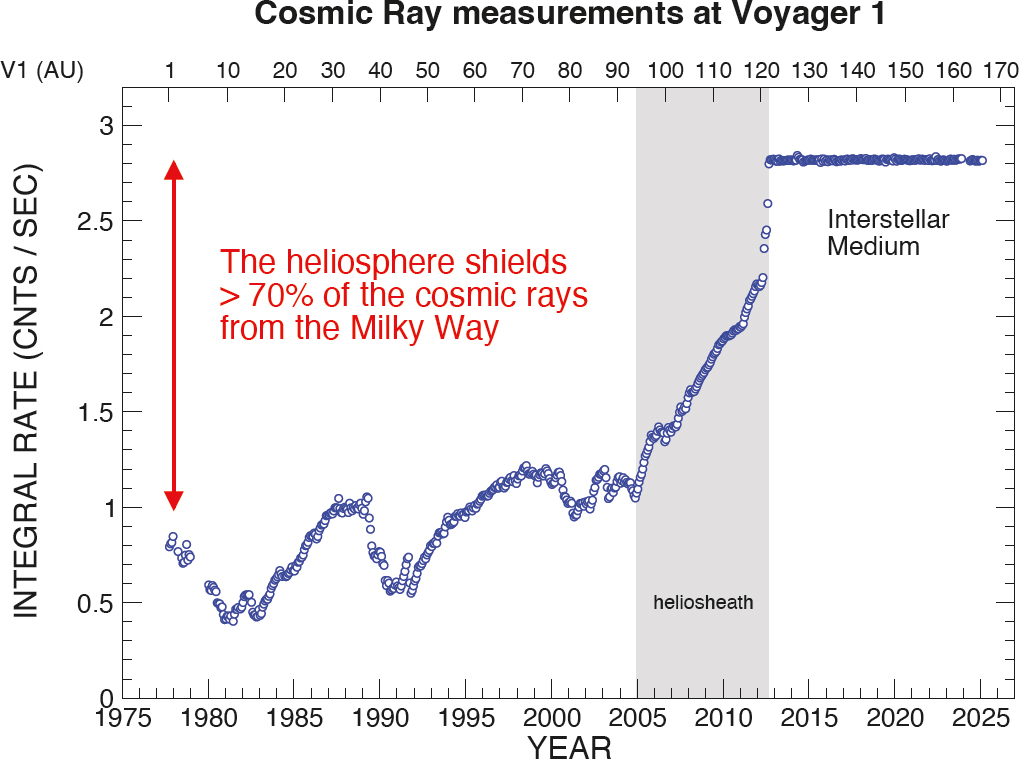
SOURCE: Opher et al. (2023), https://doi.org/10.3389/fspas.2023.1143909. CC BY 4.0.
In addition to the above research thrusts, the panel notes that the distribution of dust in the heliosphere provides important information about the heliosphere, as well as having broader implications related to understanding the origin of the solar system and the nature of our home in the galaxy. The sources of dust grains vary widely from those produced by planets, moons, comets, asteroids, and meteoroids, and possibly even from outside the heliosphere of interstellar origin, such as from asymptotic branch stars and supernovae explosions. Dust grains are charged by solar UV and interaction with the solar wind. As such, in addition to gravitational and radiation pressure forces, including Poyting-Robertson drag, the paths of dust grains in the solar system are also affected by electric and magnetic fields. The mass-to-charge ratio is a critical parameter, as is the ratio of the radiation pressure force relative to that of gravity. These are largely determined by the size of the dust grains. Thus, understanding the size distribution of dust in the heliosphere will significantly improve the understanding of the origins of dust grains. The distribution and properties of dust are also important probes of the heliospheric structure.
Observational Resources
It is truly remarkable how much has been learned about the nature of the outer heliosphere and LISM from the two venerable Voyager spacecraft and the Earth-orbiting IBEX mission. Observations from these spacecraft have provided rich inputs for the modeling community, leading to sophisticated simulations of the global heliosphere and theoretical insights into particle processes at the TS and beyond.
Currently, the Voyager 1 and 2 spacecraft are returning measurements from the LISM near the heliosphere (sometimes called the very local interstellar medium [VLISM]) on plasma waves, magnetic fields, and cosmic rays. The Voyagers do not store data onboard and only return data during certain times each day. Thus, there are numerous data gaps. The Voyager team has recently implemented a revision of the Voyager operational plan to extend the mission life to perhaps 2040, although diminishing power margins will require the last of the particle instruments to end operation around 2029. Voyager 2 has a functioning plasma instrument to measure density and velocity, but it is not well suited to measure the plasma of the LISM, which is too cold and not moving in the right direction to be easily measured by the instrument that was designed to measure the solar wind.
Both spacecraft measure ions from about 30 keV to more than 100 MeV in a number of directions, and both measure ACRs and GCRs, with three separate telescopes, providing some information on the anisotropy of these particles, which is enhanced further through spacecraft roll maneuvers. This information is particularly important with regards to the question of the source of ACRs, one of the key objectives of PSG 4. There is a gap in the coverage between about 1 keV and 30 keV. This energy range is critical because this is where interstellar PUIs would be most easily observed. In the outer heliosphere, PUIs are the dominant component to the overall pressure of the plasma and are also a significant component to the density. Yet, neither Voyager spacecraft has instrumentation to measure this component of the plasma.
New Horizons, at 58 AU from the Sun (as of January 2024), has instrumentation to measure PUIs. Indeed, it is the only spacecraft to visit the outer heliosphere to have PUI measurement capability, making it an invaluable addition to the HSO. While it is still well inside the radius of the TS, traveling at 3.5 AU/year, it could potentially cross it in the coming decade. The spacecraft also has instrumentation to measure energetic ions and will allow researchers to determine whether the heating and acceleration of PUIs at the TS are the source of low-energy ACRs, at least locally where the spacecraft crosses the shock. A key limitation of New Horizons, however, is the lack of magnetic field measurements.
The IBEX mission provides maps of ENAs that are produced in the outer heliosphere. ENAs are produced when a charged particle attains an electron via charge exchange with preexisting neutral atoms—for example, cold interstellar gas. ENAs reveal the charged-particle environment of the outer heliosphere, but current measurements are limited to line-of-sight integrations—analogous to photon observations of optically thin material—rather than in situ measurements. These maps are extremely useful for inferring properties of the global heliosphere, and the energy distribution of charged particles over a large volume. Using known charge-exchange cross sections, plasma ion distributions can be derived. Most of these particles come from the heliosheath. The Voyagers provide “ground truth” measurements in the ~0.03–1 MeV energy range, which is a higher energy range than the ENA maps produced by IBEX but do provide some comparative information. These maps also help reveal the physics
occurring in the VLISM, which is presumably where the source of the IBEX Ribbon is located. The source is likely secondary PUIs, which are created by the charge exchange between energetic neutral solar wind atoms with the ionized component of the LISM gas. These secondary PUIs move under the influence of electric and magnetic fields in the LISM, and their distribution is inferred from observations of the Ribbon.
In the next decade, IMAP will provide considerably more detailed ENA maps, with greater instrument sensitivity, a higher spatial resolution, and a larger energy range. IMAP will provide unprecedented, high-resolution, and broad-energy-range measurements of ENAs coming from the outer heliosphere, creating all-sky ENA maps that track spatial and temporal variations in the structure of the heliosheath, carrying on the work of IBEX. Comparisons of the higher-resolution global ENA maps from IMAP with large-scale MHD modeling of the heliosphere will be capable of determining structure on smaller scales, such as from Rayleigh-Taylor-like instabilities near the HP. The combined higher spatial and energy resolutions will provide the necessary observations to determine the origin of the Ribbon.
IBEX has also continued to make progress in determining the properties of interstellar neutrals, in particular helium, through their direct measurement. Interstellar neutral atoms are an important component of the particle populations in the heliosphere. In fact, neutrals are the dominant species in the outer heliosphere and in the LISM where the medium is only partially ionized. Their influence on fields and plasma, however, occurs on very large scales (several tens of astronomical units) owing to their weak interaction with the ionized component. However, they do play a consequential role in the global structure of the heliosphere. For instance, IBEX measurements of the flow velocity and temperature of interstellar helium have been applied to the question of whether there is a bow shock in the upwind direction of the LISM flow beyond the HP. These measurements, along with determination of the IMF direction derived from the IBEX Ribbon geometry, continue to build the case that there is no bow shock, but rather a bow wave.
In addition to the spacecraft exploring the outer heliosphere, those in the inner heliosphere as part of the HSO, such as ACE and the in situ complement of the IMAP mission, provide important measurements of the solar wind and interplanetary magnetic field, which provide boundary conditions for large-scale models of the heliosphere. In addition, the measurements from these spacecraft allow us to relate the passage of solar structures at 1 AU to those seen in IBEX and IMAP ENA maps. This correlation informs us of the heliosphere’s response to the Sun.
Another interesting diagnostic of the heliosphere demonstrated in the past decade is that of the arrival direction of teraelectronvolt-energy cosmic rays at Earth. While the intensity of cosmic rays of this energy are not affected by the heliosphere in the same way as lower-energy galactic cosmic rays (tens of megaelectronvolts to several gigaelectronvolts), the electric and magnetic fields within the heliosphere do influence the motion of these particles. Thus, observations of the anisotropy of teraelectronvolt-energy cosmic rays, combined with large-scale computer modeling of the trajectories of these particles through the heliosphere, can be used to infer global properties of the heliosphere.
Neutron monitors are a valuable resource, providing measurements of the intensity of cosmic rays at the top of Earth’s atmosphere. They provide information over a broad range of timescales, such as solar-cycle variations caused by the heliospheric modulation of GCRs. They also measure shorter timescale variations related to transient solar phenomena such as ground-level enhancements, lasting minutes to hours, caused by extremely intense solar proton events, and Forbush-decreases, on scales of days to weeks, caused by the passage of very fast CMEs that reduce the intensity of GCRs. Thus, neutron monitors are important to the understanding of the local space radiation environment and also provide a critical in situ measurement of GCRs that can be compared to models of GCR modulation in the heliosphere.
Earth-based radio telescopes such as the LOFAR can detect signals known as interplanetary scintillation, which provide essential information on the 3D structure of the solar wind near the Sun. This knowledge is important for providing an inner boundary condition to global MHD models and for interpretation of temporal variations in ENA maps. It is also important for constructing ENA maps because solar wind properties across heliolatitudes are necessary to calculate ENA survival probabilities.
Theory, Modeling, and Simulations
Theory, modeling, and numerical simulations are extremely important to the science of the outer heliosphere. Generally, this is supported by small research and analysis grants—including the HTMS program, Heliophysics
Supporting Research Program, and guest investigators—but also by the NASA Drive Science Center “Our Heliospheric Shield” (SHIELD), discussed below. In a recent competition of the Guest Investigator program (Research Opportunities in Space and Earth Science [ROSES] 2019), there were five proposals related to outer heliospheric research. In addition, outer heliospheric research has been supported by the NSF Division of Atmospheric and Geospace Sciences (AGS), which includes the highly successful annual SHINE workshop where there are routinely special sessions that focus on this science.
Global models of the heliosphere provide the basic structure and shape of the heliosphere, as well as the response of its boundaries to variations from the Sun. It is known that these models overestimate the thickness of the heliosheath, and this is a particular focus area of investigation. Is it a time-dependent effect, caused by the solar cycle, or is there missing physics? Global models also reveal intriguing small-scale structures, including those driven Rayleigh-Taylor and other instabilities, as well as features such as a plasma depletion layers and the hydrogen wall—all of which remain to be tested against in situ observations.
Motivation for the Goal
At the beginning of the past decade, researchers still had a fairly rudimentary understanding of the processes that formed and sustained the global heliosphere. At that time, Voyager 1 had just crossed the HP, Voyager 2 was still within the heliosheath, and IBEX had discovered a mysterious Ribbon of enhanced ENA emission that had been entirely unanticipated by the theoretical community. By the end of the decade, both Voyagers had crossed into the LISM, revealing a remarkably steady GCR flux compared to what was observed in the heliosheath, observing the echoes of solar transients in the LISM, and discovering that the magnetic field was still oriented as it had been interior to the HP—implying that it had yet to “unwind” to the expected ISM direction. IBEX observations showed definitively that the heliosheath responds rapidly to changes in solar variability and that the Ribbon was most likely located beyond the HP and was formed by a “secondary ENA” process. New Horizons has shown that by the time the solar wind reaches the outer heliosphere, most of the energy is carried by the PUIs, and thus this population dominates the dynamics of the TS and heliosheath.
Informed by all that has been learned about the heliosphere the past decade, the panel has honed PSG 4 to target the areas where deeper investigation is required to complete the picture of our home in the galaxy. It focuses on exploring what produces spatial and temporal variability, figuring out the shape of the heliosphere, nailing down the origins of the Ribbon, diving into the details of PUI physics across the outer heliosphere and LISM, and solving the mysteries of ACR origination and GCR modulation. The IMAP mission will tackle many of these inquiries, but fully addressing this science goal will require an interstellar probe.
System-Level Science Contributions
The study of how the heliosphere is formed and sustained requires a systemwide understanding of the evolution of the solar wind and the solar magnetic field. The conditions that control the formation of the interstellar boundary are established deep within the inner heliosphere where PUIs are first entrained in the solar wind from an “inner source” of interplanetary dust grains. As the solar wind flows outward, it crosses a huge range of density, temperature, and spatial domains, and thus, achieving a complete picture of the solar wind’s physical state from the Sun to HP requires measurements from the whole HSO, including from PSP and SO to ACE, STEREO, IMAP, New Horizons, the Voyagers, and ultimately, an interstellar probe.
PSG 4 is tied to system-level science in another way, as it is closely connected with EO 1, targeting multidisciplinary research focusing on solar and stellar activity. Just as the Sun is Earth’s closest star, and thus serves as a laboratory for understanding stars throughout the galaxy, our heliosphere is our closest astrosphere, and its study informs the understanding of other astrospheres and how they interact with their own local ISMs. In turn, through the systematic study of other astrospheres, their diverse properties will be sure to teach us about our heliosphere—not only as it is now, but how it may have been in the past and will be in the future, under different ISM conditions, and thus foretelling the journey of our home as it travels through the galaxy.
B.2.5 Role of Research and Analysis Development Grant Programs
Much of the scientific output of the Sun and heliosphere (SH) community is carried out via smaller grants through programs across agencies. These programs are essential to the health of the SH community because they fund the many researchers not directly supported by space missions or ground facility programs. They also enable research that falls outside the purview of a specific mission’s or facility’s science objectives.
Current funding opportunities related to SH can be classified in the following five main categories: (1) funding that is closely aligned with mission goals (mission aligned), (2) general funding to advance the understanding of heliospheric physics (general), (3) targeted funding that occasionally focuses on proposals relevant to SH (targeted), (4) funding that focuses on the creation of large overarching collaborations of scientists which aim to enable science that is not possible through small grants (systemic), and (5) programs targeted at instrument technology development and low-cost deployment (instrumentation).
- Mission-aligned funding opportunities include NASA’s guest investigator programs—both specific (e.g., NASA SO Guest Investigators) and open (NASA Heliophysics Guest Investigator [HGI]).1
- General funding opportunities include NASA’s Heliophysics Supporting Research (HSR) and NSF’s Solar Terrestrial and Solar, Heliospheric, and Interplanetary Environment (SHINE), as well as Astronomy and Astrophysics Research Grants (AAG) programs. It is worth noting that while NSF-Astronomy supports construction and operation of large solar facilities (including Inouye and, if successful, the future COSMO and the Frequency-Agile Solar Radiotelescope [FASR]), the AAG is a highly competitive program for general research in astronomy, which implies that no dedicated funding is available for scientific exploitation of such facilities. These funding opportunities are the broadest calls, and they act as an umbrella for many ideas and areas strongly informed by the decadal survey reports. The NASA HTMS program has a strong focus on taking advantage of advances in computational resources to improve the understanding of the heliosphere. Selections in these programs depend on proposal pressure. Moreover, proposal pressure is reasonably related to the occurrence of new missions; for example, there is likely to be an increase in outer-heliosphere proposals when IMAP launches.
- Targeted funding opportunities have topics that can change from year to year, often of relevance to SH. The main example of this approach is NASA’s Living With a Star (LWS) program, which selects topics based in part on community input.2 Also of relevance to SH objectives are the Heliophysics Space Weather R2O2R (Research-to-Operations-to-Research) and O2R (Operations-to-Research) programs, which support the development of numerical models and/or data utilization techniques that both advance space weather forecasting capabilities and improved fundamental scientific understanding. Recent thematic opportunities from NSF include the Windows on the Universe—The Era of Multimessenger Astrophysics program, of relevance for many SH topics.
- Systemic funding opportunities include NASA’s DRIVE Science Centers, which aim to support science that requires more than individual investigators or small teams and were a response to the 2013 decadal survey. Some example centers that this initiative funded are “Consequences Of Fields and Flows in the Interior and Exterior of the Sun” (COFFIES) with the objective to expand the understanding of the Sun to develop the capability to forecast activity cycles and solar magnetic variability, “Our Heliospheric Shield” (SHIELD) with the aim of tackling grand-challenge science questions pertaining to the outer heliosphere, and “Solar Flare Energy Release” (SolFER), whose goal is to understand the release of magnetic field energy and associated particle acceleration in flares in the solar corona. The just-announced opportunity to develop Artificial Intelligence Research Institutes (a collaboration among NSF, the Department of Defense, the National Institute of Standards and Technology, and private foundations or corporations) might prove crucial for research in multiple heliospheric topics.
___________________
1This paragraph was modified after release of the report to accurately reflect updated process for funding opportunities.
2This paragraph was modified after release of the report to accurately reflect the process for selecting topics for targeted funding opportunities.
- Instrumentation funding opportunities include the NASA Heliophysics Technology and Instrument Development for Science (H-TIDeS), Heliophysics Flight Opportunities Studies (H-FOS), Heliophysics Flight Opportunities in Research and Technology (H-FORT), and Heliophysics Low Cost Access to Space (H-LCAS) programs. These programs provide a vital pathway for the community to undertake instrumentation development, raise technology readiness, and carry out science demonstration missions, often in anticipation of proposing new instrument concepts for larger NASA missions. Over the past decade, NASA has invested significant resources into these programs, such that there is now a clear progression for researchers to follow from initial concept to flight (e.g., from H-TIDeS to H-FOS to H-FORT). This program is particularly important for those institutions that do not have significant internal program development funding and could otherwise not compete with the major centers.
Within NSF, the Advanced Technologies and Instrumentation for the Astronomical Sciences (ATI) program provides both individual and collaborative research grants for the development of new technologies and instrumentation for use in ground-based astronomy and astrophysics, including innovative technologies and instruments at high technical risk. The Major Research Infrastructure (MRI) program supports the development and acquisition of critical research instrumentation, with the potential to open new opportunities to advance the frontiers in science and engineering research. MRI awards also aim at enhancing research training of students. The Mid-scale Research Infrastructure-1 Program (MSRI-1) supports either the design or implementation of unique and compelling infrastructure projects with costs up to $20 million.
B.3 LONGER-RANGE GOAL
Longer-Range Goal: Revolutionize the understanding of dynamic solar processes through rapid, direct observational measurements of magnetic fields throughout the solar atmosphere and inner heliosphere.
The solar corona and solar wind are largely dominated by magnetic fields, from the low corona into the interplanetary medium (IPM). Such fields are central to how the plasma is heated, how the quiescent solar wind is accelerated, how transients within it are launched, and how energetic particles within it are transported. Progress in understanding these processes is severely curtailed by just how limited capabilities are for measuring field properties beyond the solar photosphere. This LRG is driven by the recognition that new capabilities for measuring coronal and IPM fields must be developed, and then infrastructure built to provide routine coronal and IPM field data products, for both scientific and space weather forecasting purposes. These measurements need to be made on timescales commensurate with dynamic solar activity (e.g., flare energy release timescales that probe localized magnetic field responses beyond globally averaged pre- and post-eruption measurements), are best without reliance on modeling extrapolations, and need to encompass a global view of the activity (versus point measurements or severely limited fields of view). Enabling 3D measurements of the coronal and IPM magnetic fields would constitute the ultimate achievement of this LRG and would revolutionize the understanding of the interconnected fundamental processes throughout the heliosphere.
B.3.1 Motivation and Current Research Activity
Coronal Fields
Most current methodologies for inferring coronal field strengths and orientations rely on extrapolations from photospheric field measurements provided by various ground- and space-based magnetographs. The simplest and still widely used technique is the potential field source surface (PFSS) approach, which dates back to the 1960s and is not computationally expensive. Somewhat more sophisticated are nonlinear force free field (NLFFF) extrapolations. At least for static coronal structures, PFSS and NLFFF extrapolations have been found to be reasonably consistent with more sophisticated MHD modeling, although the quality of agreement with the actual solar corona is less clear.
Field extrapolations from the photosphere naturally carry significant uncertainty, which can be revealed by comparing chromospheric fields predicted by extrapolations from the photosphere with chromospheric magnetograms. Uncertainties can be expected to be even larger higher up in the corona. A new diagnostic technique has recently been developed to measure the magnetic field strength in active regions using a single Fe X line observed by Hinode/EIS. However, this does not provide any direct information on the magnetic field vector orientation and cannot detect the weaker coronal magnetic fields found in coronal holes and the quiet Sun. The limitations of existing indirect techniques for inferring coronal fields are even more pronounced when considering the need to know how coronal fields change during eruptive phenomena, when direct measurement of field strength before, during, and after the eruption are necessary to improve the understanding of the physical processes involved in this activity. Zeeman polarimetry of cooled coronal plasma (observable in typical chromospheric lines such as Ca II or He I in the near-IR) holds promise of alleviating this problem in some cases, offering the opportunity to derive the coronal field strength in post-flare active regions and cold loops, at high spatial and temporal resolution.
An important step toward the remote sensing of coronal fields was the development CoMP, integrated into the Mauna Loa Solar Observatory (MLSO), which observed from 2011 to 2018, diagnosing the magnetic field direction by measuring the linear polarization of coronal Fe XIII lines at 1074.7 and 1079.8 nm. CoMP has since been replaced by UCoMP, which has an expanded field of view and is observing coronal lines at multiple temperatures. An example of how such data can be useful for studying the pre-eruptive states of CMEs is in Figure B-17, which shows a pseudostreamer from April 2015 observed in quiescence with CoMP, but which is later observed erupting in SDO/AIA and SOHO/LASCO. Images of this pseudostreamer from SDO/AIA and MLSO/CoMP are shown in Figure B-17, along with the polarization measurements that lead to inferences about field topology.
A significant limitation of CoMP/UCoMP is its small aperture (20 cm), which makes it infeasible to measure the weak circular polarization component (Stokes V) to derive the field strength or observe with a sufficiently rapid time cadence to study dynamic phenomena. This limitation will be overcome by Inouye. With its 4 m aperture and coronagraphic capabilities, Inouye will provide rapid measurements of the coronal field vector at 10 resolution, offering unique constraints on both coronal fine structure and field characteristics. However, the field of view of Inouye is limited to only ~59. Thus, capturing eruptive phenomena will almost certainly require a global field of view, such as for the proposed 1.5 m COSMO telescope. Ground-based observatories always have limitations of nighttime and inclement weather. Observing from space would alleviate such issues and also would provide spectropolarimetric opportunities outside the IR. The potential of H Lyman-α coronal spectropolarimetry in the UV is being explored, with instrument concepts such as Coronal Lyman-Alpha Resonance Observatory (CLARO) and mission concepts proposed in community input papers, such as COMPLETE (“A Flagship Mission for Complete Understanding of 3D Coronal Magnetic Energy Release”).
A disadvantage of optical/IR approaches to measuring coronal fields is that they can only do so above the limb and not on the disk. This constraint does not apply in the radio, where the Stokes V signal of the coronal magnetic field via thermal free–free emission is prominent in both locations. Despite the potential of radio observations for deriving the detailed morphology of coronal cavities (both on the limb and against the disk) and accurately mapping line-of-sight field strength, current radio facilities do not have the adequate imaging fidelity, dynamic range, and polarization purity necessary to make such measurements. EOVSA represents a pathfinder for future arrays that could make such measurements. A strong flare from September 2017 provided an opportunity for EOVSA to show radio’s potential for dynamic field measurements. Figure B-3 shows how during this event EOVSA measured both the dynamically changing magnetic field strength and connectivity of the erupting source as well as the spatially and temporally evolving electron distribution function, placing new constraints on the magnetic energy release in the flaring source.
Inferring coronal field properties from spectropolarimetric data, whether optical/IR or radio, requires a significant effort to model such data. Various codes have been published to do such analyses and could be further developed (e.g., FORWARD, Coronal Line Emission Database [CLEDB], and Python package for Coronal Emission Line Polarization [pyCELP]), with the goal of using all available information (e.g., multiple lines) to infer the full vector magnetic fields under distinct sets of assumptions. Tomographic techniques are also an active area of research. Currently, all polarimetric methodologies are subject to degeneracies, and suitable disambiguation methods have not yet been developed. Devising an inversion method that leverages both polarization and velocity information appears promising, and a goal to be implemented in the near future.
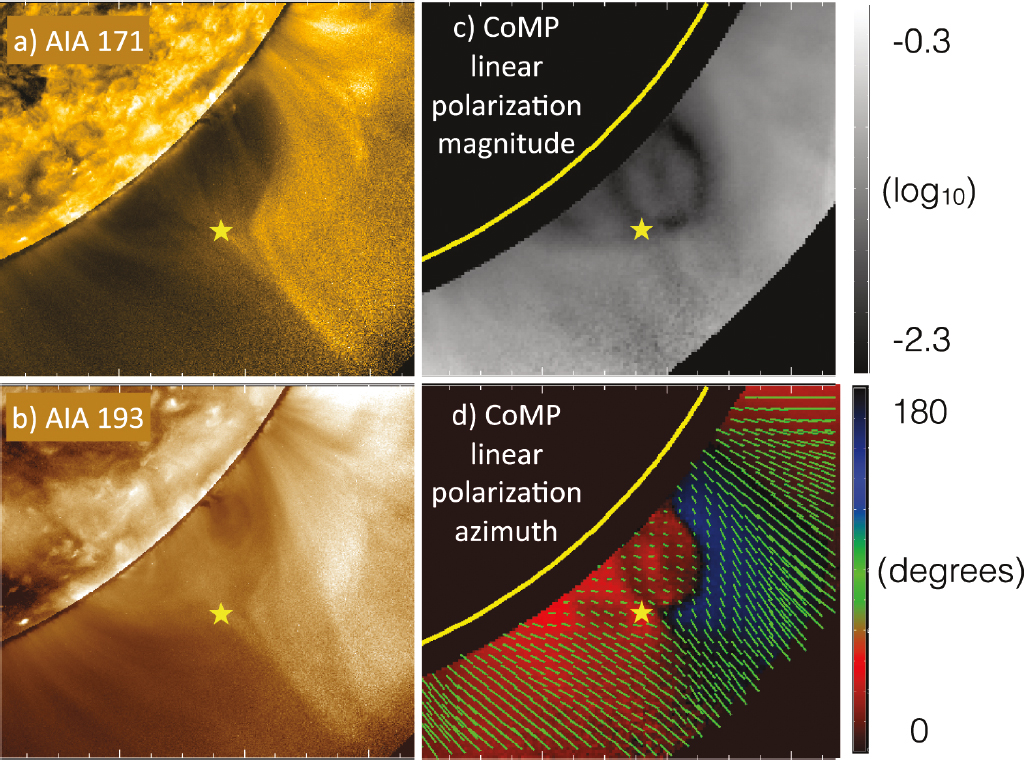
SOURCE: S. Gibson, K. Dalmasse, L.A. Rachmeler, et al., 2017, “Magnetic Nulls and Super-Radial Expansion in the Solar Corona,” Astrophysical Journal Letters 840:L13, https://doi.org/10.3847/2041-8213/aa6fac. © AAS. Reproduced with permission.
Interplanetary Fields
Analogous to the situation for coronal fields, the only current way to model interplanetary fields in a global sense is to extrapolate upward from photospheric fields provided by magnetograms. A PFSS model is generally used to provide field magnitudes at the source surface (typically at 2.5 R⊙), where the field is assumed to become purely radial. A time-dependent, data-driven MHD code is then used to extrapolate into the IPM all the way to 1 AU, and beyond if required. The PFSS model not only provides field boundary conditions at the source surface but also generally provides solar wind velocity information as well, using the semi-empirical WSA technique relating field expansion factors to solar wind speed. The MHD code used by the National Oceanic and Atmospheric Administration (NOAA) Space Weather Prediction Center (SWPC) for this purpose is called Enlil, which not only provides predictions for quiescent wind at Earth, but also provides a model of the ambient solar wind into which CMEs can be launched. With constraints on a CME’s initial velocity, spatial extent, and trajectory direction provided by space-based coronagraphs, Enlil therefore offers a real-time forecasting capability for predicting CME arrival time at Earth.
Such modeling naturally has significant limitations. Although it has some demonstrated success at roughly reproducing wind properties observed at 1 AU; it is not, for example, helpful for predicting the north-south magnetic field component (Bz) during CME impacts at Earth, which is the quantity that is most predictive of geoeffectiveness. Predicting Bz or studying interplanetary plasma physics processes in any detail requires the kind of detailed information about IPM field properties that can only be provided by direct measurement. Observationally, almost everything that is known about IPM fields comes from spacecraft equipped with magnetometers. Such spacecraft currently include dedicated solar wind sentinels at 1 AU, such as Wind, ACE, and DSCOVR operating at the Sun-Earth Lagrange 1 (L1) point; and STEREO-A, which drifts in longitude relative to Earth by about 22 degrees of heliographic longitude per year per year. The magnetometer-equipped IMAP and the Space Weather Follow On L1 mission (SWFO-L1) spacecraft will soon join the L1 contingent of spacecraft when launched in 2025. The PSP and SO missions are currently studying IPM fields inside 1 AU. There are also various planetary missions that include magnetometers, such as BepiColombo operating inside 1 AU, and Mars Atmosphere and Volatile EvolutioN (MAVEN) outside 1 AU at Mars. Notably, New Horizons does not have a magnetometer, thus handicapping the ability to track evolution of the IPM into the outer heliosphere.
Spacecraft are point probes of local IPM plasma properties, and therefore only provide 1D tracks through solar wind structures, which is a problem when trying to study IPM physical processes or infer large-scale morphology. For example, the dominant paradigm for CME structure is the magnetic flux rope (MFR). A schematic representation of an MFR is in the left panel of Figure B-18, and if it is viewed edge-on, it would look something like the PSP/WISPR image in the right panel. A number of methodologies exist for inferring 3D MFR structures from 1D plasma and field tracks provided by individual spacecraft. However, these extrapolations from 1D to 3D rely on many dubious assumptions, and there are often large discrepancies between MFR structures inferred from in situ data and those inferred from imaging. Significant improvement could be realized if a CME could be sampled by many spacecraft, collectively providing a more comprehensive 3D picture of the CME’s structure and providing more stringent tests of the MFR paradigm. This need is one argument for the development of constellation mission concepts, involving the coordination of multiple spacecraft to study IPM structures and processes. It has already become increasingly common for CME analyses to utilize multiple spacecraft, but currently this relies on chance alignments of existing missions within the HSO architecture.

SOURCES: (Left) T.H. Zurbuchen and I.G. Richardson, 2006, “In-Situ Solar Wind and Magnetic Field Signatures of Interplanetary Coronal Mass Ejections,” Space Science Review 123:31–43, reproduced with permission from SNCSC; (Right) Howard et al. (2022), https://doi.org/10.3847/1538-4357/ac7ff5. CC BY 4.0.
Constellations with smaller spacecraft separations are needed to study smaller-scale IPM processes, such as turbulence, particle acceleration, and magnetic reconnection. Such constellations currently include the magnetosphere-focused MMS mission, and the future HelioSwarm mission to explore the near-Earth solar wind, with a possible launch date in 2028. A focus of HelioSwarm will be to determine the dynamical nature of solar wind turbulence. While missions like MMS and HelioSwarm focus on kinetic or microscales, and NASA’s HSO concept focuses on macroscale IPM structures, it has been noted that there is an intermediate-size scale that is relatively unexplored, which has been given the term “mesoscale.” Kinetic scales represent the end of the turbulent cascade that is driven by large-scale solar wind structures. The intermediate mesoscale dynamics represents the critical scale needed to understand cross-scale processes in the solar wind. Last, the experience of missions like MMS demonstrates that interpreting plasma and field data from constellations requires not only the multispacecraft sampling itself, but also support for the research necessary to interpret the data, including theory, simulation, and laboratory experiments.
The ideal observational diagnostic for IPM fields would be one involving remote sensing, allowing solar wind and CME fields to be probed from a distance. Currently, the only remote sensing candidate is radio Faraday rotation, which provides a diagnostic of both the strength and orientation of the magnetic field along the observed line of sight to any background polarized radio source. The Faraday rotation signatures of CMEs have been probed with interplanetary spacecraft as background sources. Astrophysical background sources (e.g., pulsars or active galactic nuclei) can also be used, but their faintness means that a powerful radio array such as VLA or LOFAR must then be utilized to observe the signal. The community input paper concept for the MOST mission proposes the deployment of four 1 AU spacecraft spaced along a semicircular span of helio-longitude, each equipped with a radio receiver/transmitter to make Faraday rotation measurements between the spacecraft along four lines-of-sight crossing the inner heliosphere. Figure B-19 shows an example of using VLA to probe CME field structure.
B.3.2 Why Is This a Longer-Range Goal?
In contrast to 30 years ago, we are now living in an era where high-resolution, high-quality photospheric magnetograms are continuously available, and it is assumed that this will continue in perpetuity. Likewise, space-based missions now provide synoptic EUV and/or X-ray observations of the low and middle corona, and white-light coronagraphs continuously monitor the upper corona and catalog CMEs erupting into the IPM. Once again,

SOURCE: B.E. Wood, S. Tun-Beltran, J.E. Kooi, E.J. Polisensky, and T. Nieves-Chinchilla, 2020, “Inferences About the Magnetic Field Structure of a CME with Both In Situ and Faraday Rotation Constraints,” Astrophysical Journal 896:99, https://doi.org/10.3847/1538-4357/ab93b8. © AAS. Reproduced with permission.
it is commonly assumed that this coronal monitoring will continue in perpetuity, in some form, for both scientific research and for space weather–forecasting purposes. However, none of this coronal monitoring provides direct magnetic field information and is heavily reliant on modeling. A long-term plan for developing the ability to supplement synoptic magnetograms with 3D coronal field maps in the low and middle corona could yield transformational advancements in coronal physics. Likewise, developing the ability to monitor fields in the IPM would markedly advance studies of interplanetary plasma physics and provide new space weather forecasting capabilities, particularly Bz forecasting at Earth for geoeffective transients. None of this is attainable in the timescale of a single decadal survey period, because the ideal techniques for measuring coronal and IPM fields are not yet established. Thus, the development of a coronal/IPM field monitoring infrastructure must be considered a longer-range goal.
B.4 EMERGING OPPORTUNITIES
B.4.1 Emerging Opportunity 1
Emerging Opportunity 1 (EO 1): Enable opportunities for multidisciplinary research to holistically explore how solar and stellar activity and the interactions of stars with their interstellar environments impact planetary systems.
Recent years have seen an exploding interest in establishing how stellar winds, flares, CMEs, and the local interstellar environment affect exoplanets and their habitability. EO 1 seeks to support these interests and to take advantage of frontier research and astrophysical/solar instrumental resources by encouraging interdisciplinary heliophysics/astrophysics studies of solar and stellar activity and of astrosphere/interstellar medium interactions. Understanding stellar activity relies heavily on solar observations, because the Sun is the only star that can be observed in proximity. However, solar physics can also benefit from stellar observations. For example, observations of Sun-like stars of different ages and activity levels inform about what solar activity might have been like in the past, and what it might be like in the future.
Motivation and Current Activity
Solar/Stellar Flares
Many stars are known to produce flares analogous to solar flares, albeit some with energies that are 1,000–10,000 times larger than are experienced from the Sun. The observational literature on solar and stellar flares is vast, with both solar and stellar flares being observed at wavelengths ranging from radio to gamma rays, and everything in between. However, the lack of spatial resolution for stars means that relatively little is still known about how stellar eruptive processes differ fundamentally from the Sun. Thus, the solar example provides guidance for modeling efforts that seek to understand stellar data. The most active stars rotate much faster than the current-day Sun, and they in turn provide a glimpse into the high-energy radiation environment of the early solar system.
Besides spatial resolution, another advantage of solar flare studies is continuous monitoring. A number of ground- and space-based solar observatories, past and present, have provided continuous monitoring of the Sun at various wavelengths, allowing a large number of solar flares to be studied comprehensively. Multiwavelength coverage of stellar flares is rarer, given the logistical arrangements for a flare-monitoring campaign with a variety of highly competitive ground- and space-based assets. Radio gyrosynchrotron observations at optically thick (2–10 GHz) and thin (>10 GHz) frequencies are available for both solar and stellar flares, and they offer comparative opportunities to study the properties of particle acceleration within different stellar magnetic environments. However, there are almost no optical observations of solar flares that are analogous to those that are widely available for stellar flares (e.g., from Kepler, the Transiting Exoplanet Survey Satellite [TESS], and broadband spectroscopy). Instead, solar observations emphasize high spatial and spectral resolution to the detriment of large spectral coverage. Figure B-20 represents a comparison of how solar and stellar flares are observed in the optical/near-UV, with a spatially resolved image of a solar flare site, with only single-line spectroscopy available in

SOURCE: Kowalski (2022), https://doi.org/10.3389/fspas.2022.1034458. CC BY 4.0.
selected points, shown next to a stellar superflare spectrum covering all the H Balmer lines observed from an M dwarf star. These stars are thought to be the most common hosts of habitable zone exoplanets.
A holistic understanding of the physical origin and environmental effects of stellar eruptive events relies on leveraging advances in imaging spectroscopy and radiative MHD modeling of the Sun over the next decade. Even with the unprecedented successes of IRIS in observing solar flare dynamics over the past decade, much is still poorly understood about the critical impulsive phase at the onset of solar flares, and by extension, stellar flares. Better comparison of solar and stellar flare characteristics could be enabled by new solar capabilities to capture spectra over a 2D region simultaneously with sufficient spatial, spectral, and temporal resolution across a wide wavelength range containing most of the optical diagnostics that are commonly observed in stellar flares. The future Multi-slit Solar Explorer (MUSE) mission represents an important step toward simultaneous spectroscopy and 2D imaging, albeit in the EUV. New solar imaging spectroscopic capabilities utilizing developments in integral field technologies will forge novel pathways that leverage the vast archives of stellar data from ground-based observatories and NASA’s space missions (e.g., Kepler, TESS). This technology will naturally complement the recent directions in the advancements in radio imaging spectroscopy (e.g., with EOVSA; Figure B-3) of the magnetic field changes and particle acceleration that power solar eruptive events.
The emerging capabilities of new solar MHD codes and techniques will be leveraged and extended to the astrophysical environments of stars, providing the needed physical information on spatial scales extending from the chromosphere to the wider realm of the astrosphere and ISM, which modulate GCRs and habitable zone conditions.
Solar/Stellar Winds, Coronal Mass Ejections, and Astrospheres
Coronal winds analogous to that of the Sun are unfortunately very hard to observe around other stars. The most successful technique for studying stellar winds so far is by using UV spectra from the Hubble Space Telescope to detect H Lyman-α absorption from interaction regions between the winds and the surrounding interstellar medium—that is, astrospheric absorption. With guidance from MHD models, mass loss rate estimates can be inferred from the astrospheric absorption, and an example of such an astrospheric model is shown in Figure B-21(b). These model astrospheres are computed using codes first developed to model the global heliosphere, such as that in Figure B-21(a). The astrospheric absorption diagnostic has so far provided only 22 mass loss rate measurements (plus a number of upper limits). Furthermore, this diagnostic is measuring the average wind ram pressure over long timescales, typically years to decades depending on the size of the astrosphere. Thus, it is unknown whether the detected stellar winds are dominated by quiescent wind or CMEs.
Stellar CME candidates are typically found via observations that are not the means by which solar CMEs are studied, meaning that it is not entirely certain that the same phenomenon is being seen. A number of stellar CME

SOURCES: (Left) Müller and Zank (2004); (Right) B.E. Wood, H. Muller, S. Redfield, et al., 2021, “New Observational Constraints on the Winds of M Dwarf Stars,” Astrophysical Journal 915:37, https://doi.org/10.3847/1538-4357/abfda5. © AAS. Reproduced with permission.
claims originate from detection of blueshifted H-α emission or absorption after stellar flares. On the Sun, such observations would be called signatures of prominence/filament eruptions, or chromospheric evaporation into confined structures. While there are certainly cases where prominence material ends up incorporated into a CME that escapes the Sun, this is not always the case, so an H-α signature by itself would not necessarily be considered an unambiguous CME detection. Blueshifted coronal lines observed in SXR spectra after stellar flares have also been observed and interpreted as a CME signature.
One solar CME detection technique that does have potential applicability to how stars are observed is coronal dimming, demonstrated using full-disk SDO Extreme ultraviolet Variability Experiment (EVE) observations of low-temperature coronal lines like Fe IX at 171 Å. In stellar SXR observations, there are post-flare coronal dimmings that have been observed, which have been interpreted as possible CMEs. Figure B-22 compares a coronal dimming seen in a Sun-as-a-star spectrum from SDO/EVE with a post-flare dimming seen for the M dwarf Proxima Cen in XMM-Newton SXR data. However, in broadband SXR observations of the Sun there can be dimmings that are intrinsic to the active region and not associated with a CME.
Type II radio bursts are another promising stellar CME detection technique that relates well to how CMEs are observed on the Sun. Such observations would have the added benefit of indicating the CME speed through the rate of change in radio frequency. Unfortunately, attempts to detect type II bursts from frequently flaring M dwarfs have so far proved unsuccessful. The stellar type II nondetections call into question the existence of fast, massive CMEs that are generally assumed to accompany the extremely energetic flares from M dwarf stars. Further evidence for this comes from the modest mass loss rate measurements for active M stars from the astrospheric absorption technique, suggesting that the frequent and energetic flaring is not always accompanied by massive CME eruptions.
The Sun itself may provide clues for what is happening on active flare stars, as there are many cases of strong flares with no associated CME. A well-studied example from October 2014 is a series of X-class flares from active
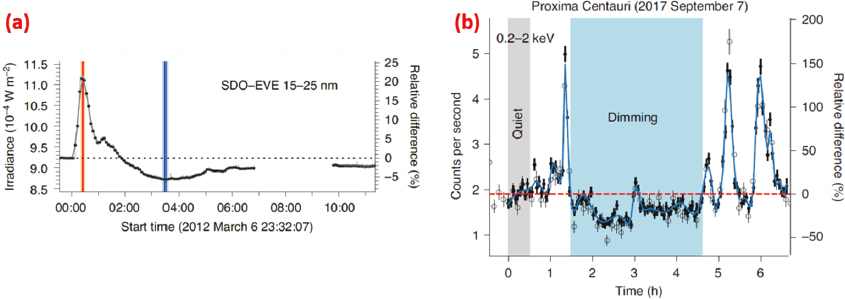
SOURCE: A.M. Veronig, P. Odert, M. Leitzinger, K. Dissauer, N.C. Fleck, and H.S. Hudson, 2021, “Indications of Stellar Coronal Mass Ejections Through Coronal Dimmings,” Nature Astronomy 5:697–706, reproduced with permission from SNCSC.
region (AR) NOAA 12192, the largest AR of solar cycle 24. Almost none of the flares from AR 12192 had associated CMEs. On the Sun, this is unusual, but on active stars perhaps it is the norm. Strong magnetic fields overlying an active region can inhibit CME eruption. Numerical simulations of CMEs on active stars made in recent years include models of such confined eruptions.
Aside from their role in providing a rare means by which stellar winds can be detected, astrospheres are also of interest because they provide protective cocoons for life on potentially habitable planets, shielding them from harmful GCRs. On long timescales, the nature of astrospheric structures can change dramatically as different interstellar environments are encountered. Extreme examples include very dense molecular clouds and supernova shock waves, both of which can potentially compress the heliosphere and astrospheres enough to place planets outside their protective boundaries. There is evidence that events of this sort occurred as recently as 2–3 million years ago to the heliosphere, with possibly drastic effects on Earth’s climate and biological systems. Models of the global heliosphere and astrospheres are being used to assess the impacts of such encounters.
Modeling Stellar Winds
MHD modeling of stellar winds/CMEs and their interactions with exoplanets began not long after exoplanets were discovered. Some stellar wind models are very reminiscent of Enlil-like solar models, using photospheric magnetograms, a PFSS extrapolation, and the WSA prescription to provide field and velocity estimates at the inner source surface boundary. This estimation is enabled by ground-based stellar spectropolarimetric monitoring that has recently provided crude stellar magnetograms even for relatively inactive, slowly rotating stars, information that had not long ago been available only for the most active and rapidly rotating of stars. However, the spatial resolution of such stellar magnetograms is naturally much lower than for the Sun.
Other types of stellar modeling include a coronal model at an inner boundary condition, constrained by coronal emissions, using empirical knowledge of how solar emission and magnetic fields are related. Such stellar modeling often relies on flux–flux scaling relations, such as those relating X-ray flux to H Lyman-α flux. Comparisons are made between the relations derived from the Sun and those that are possible from stars. Fluxes from optically thick lines are sometimes used as magnetic proxies on other stars.
It appears that the most detrimental effects on exoplanet atmospheres would be caused by a scaled-up Carrington CME and its associated energetic protons, rather than the electromagnetic effects of a large flare, but as noted above, our knowledge of the characteristics of stellar CMEs is very limited. Many MHD models that seek to
study this numerically utilize the same codes used to model solar wind/CME propagation in the heliosphere, and interaction with Earth’s magnetosphere. Enhanced eruption energies or accelerated particle fluxes are assumed to explore magnetic eruptions and atmospheric heating in particularly active stars, with potential ramifications for the habitability of exoplanets around such stars.
The current modeling approach attempts to embed the simulations in a realistic stellar environment—in terms of magnetic topology, magnetic field strength, and gravitational acceleration—all of which may be significantly different from the Sun. The various plasma instabilities, from those that trigger eruptions to those in the process of high-energy particle propagation, take on different thresholds and behaviors in the conditions that are inferred in stellar environments. For example, for active stars there is the likelihood of stronger overlying fields and larger coronal densities compared to the Sun, which could in principle inhibit CME eruption. As empirical extrapolations require both radiative and particle fluxes for assessments of the exoplanet environments, a holistic approach that incorporates both in models is required. This integration also includes particle acceleration models, which in a solar context have achieved important advances in reproducing power-law distributions over many decades in energy through magnetic island circularization and coalescence. These particle acceleration models have not yet been applied to other stellar environments.
Exoplanet transit observations are most known for allowing the detection of exoplanets around other stars, and in some cases for studying extended exoplanetary atmospheres by detecting atmospheric absorption during transit. However, the photometric transit profiles can also be used to resolve stellar surface features that are otherwise unresolvable. Stellar surface brightness variations can be inferred from the transit light curves, which can test models of stellar surface flux based on extrapolations from the Sun. Further advancement can only be achieved through better knowledge of magnetoconvection using the sophisticated treatments of MURaM, Bifrost, Stagger, COnservative COde for the COmputation of COmpressible COnvection in a BOx of L Dimensions with l=2,3 (CO5BOLD), and so on, with the ultimate goal of modeling the 3D time-dependent stellar atmospheric structure from the photosphere through the corona. These models can be advanced to not only help provide better heterogeneous models of stars based on current advances in heliophysics, but they would also shed light into the otherwise unknown missing processes in the solar paradigm, which derives from a single star over one small fraction of time within its entire life. Further advancements in MHD models that have been developed for the study of spatially resolved radiative phenomena observed on the Sun can provide answers about the origin of physical processes behind the flux–flux scaling relations of stars and other stellar phenomena, many of which are now thought to be relevant to prebiotic chemistry in exoplanet atmospheres and the development of planetary systems. An important example is the origin of flare quasi-periodic pulsations, which have been observed in many types of stars and in the Sun.
Why Is This an Emerging Opportunity?
The topic of stellar activity and its effects on exoplanets is one that seems more central to stellar astrophysics and planetary science than heliophysics, but given that knowledge of the nearby Sun will always greatly exceed that of any other star, solar physics has a crucial role to play in this research. The discovery of the first exoplanet orbiting a Sun-like star in 1995 is undoubtedly one of the most important astrophysical developments in recent history, even winning a Nobel Prize in Physics in 2019. The number of known exoplanets has ballooned to more than 5,000. Most known exoplanets orbit very close to their stars, magnifying the potential impact of stellar activity on these planets. These include habitable-zone exoplanets around faint M dwarfs (see Figure B-23), which are particularly numerous and can be surprisingly active. Understanding stellar activity will therefore remain a very important astrophysics goal for some time. However, studying activity on distant stars is much harder than studying solar activity, so stellar understanding will necessarily rely heavily on the solar example, and this research must therefore engage the heliophysics community as well.
There is also a need for creating mechanisms for collaborative synergies in basic and applied studies of solar and stellar eruptive events. Improving support for such cross-disciplinary research includes encouraging heliophysics research that is motivated in part by considerations of the wider astrophysical community. For example, many of the same numerical modeling codes that have been developed to model the solar wind and its magnetospheric interactions have also been used to model stellar winds and exoplanet interactions. As a result, considering the

SOURCE: Alvarado-Gomez et al. (2020), https://doi.org/10.3847/2041-8213/abb885. CC BY 4.0.
needs of both solar and stellar communities would support further development of such codes. Another example concerns stellar CMEs. As noted above, there is increasing evidence that the frequent, very energetic flares seen from very active stars may not be accompanied by massive CMEs, suggesting that such flares may be confined eruptions, as are sometimes observed on the Sun. This provides increased motivation for future studies of these confined solar eruptions, in order to better understand the coronal environments that lead to them, which may be more common on active stars than they are on the Sun.
It would also be beneficial for funding agencies to explicitly provide more opportunities for cross-disciplinary studies between the heliophysics, astrophysics, and planetary communities. This could involve, for example, coordinated “centers of excellence” support, analogous to the NASA Astrobiology Institutes, the Heliophysics DRIVE centers, or the joint NSF/NASA funding structures that have supported multiple-institution space weather research networks. Narrower efforts could be supported through existing funding programs within NASA and NSF. For example, within NASA, the Heliophysics Division could offer support through targeted cross-disciplinary focus science topics chosen for funding within the LWS program. Within the Astrophysics and Planetary Science divisions, support could be offered through an expanded Exoplanets Research Program or Habitable Worlds Program, designed to encourage participation of the heliophysics community.
B.4.2 Emerging Opportunity 2
Emerging Opportunity 2: Leverage upcoming opportunities through the lunar, Mars, and planetary exploration programs to enable cross-cutting solar and heliospheric research from emerging platforms and unique environments.
Human activities on and near the Moon, planned to begin in this decade, are significantly impacted by processes originating at the Sun, such as high-energy particle radiation associated with SEPs, and possibly deleterious
effects stemming from the solar wind interaction with the Moon and planetary atmospheres. Heliophysics provides critical support for, and also stands to benefit from, the lunar, Mars, and planetary exploration programs that are core to NASA’s mission priorities. EO 2 leverages these programs to enable unique and practical SH research while benefiting deep space expeditions. Several heliophysics mission and instrumentation concepts provide critical observations and measurements that support such exploratory endeavors. Conversely, these deep space exploration programs provide unique opportunities for heliophysics to study multiscale processes occurring in the lunar and Martian environment, which is important, and connected to, the general understanding of the heliospheric environment.
Motivation and Current Activity
Emerging Exploration Programs and Infrastructure
The Artemis program is a major endeavor being undertaken by NASA with commercial and international partners to establish and maintain a human presence on the Moon and in cislunar space. The technologies developed and lessons learned from these deep space habitation efforts will propel the next major leap toward human exploration of Mars. The infrastructure being developed and built for these efforts will provide exciting and unique opportunities that can enable heliophysics and space weather research with additional emphasis needed on space weather forecasting and nowcasting.
- Lunar surface: The primary objective of the Artemis program is to establish exploratory base camps on the lunar surface, transporting astronauts from orbit to the surface via the Human Landing System. These locations could serve as opportunities for heliophysics research on the lunar surface through measurements enabled by access to unique environments with the aid of human intervention that would be otherwise unobtainable.
The Commercial Lunar Payload Services (CLPS) is a collaboration between NASA and industry that facilitates delivery of a variety of commercial services and payloads to the Moon. Heliophysics science can provide considerable support to these commercial endeavors. Indeed, one of the first payloads selected to be delivered by CLPS (Lunar Environment Heliospheric X-ray Imager [LEXI]) will study the interaction between Earth’s magnetosphere and the solar wind.
- Cislunar space: Gateway is a lunar orbiting space station that will serve as an outpost for astronauts in the Artemis program and can serve as an excellent opportunity for heliophysics science in cislunar space (i.e., within the Moon’s orbit). The station can host instruments, both external and internal, to study the Sun and the deep space environment. Gateway will have a uniquely situated orbit about the Moon’s poles that enables measurements both within Earth’s magnetosphere and within the unprotected space radiation environment, providing solar viewing opportunities as well as exposure to GCRs and intense SEP events. The platform is an ideal outpost for measuring these particles in a planetary environment. To that end, the initial manifest for Gateway includes pathfinder external instrument suites provided by NASA (Heliophysics Environmental and Radiation Measurement Experiment Suite [HERMES]) and ESA (European Radiation Sensors Array [ERSA]) to measure high-energy-particle radiation with the expectation of future payload opportunities.
Additional infrastructure capabilities associated with Gateway are currently in the concept, design, and/or development phase. For instance, logistics modules will be used to transport cargo and supplies to Gateway and have the potential to serve as additional observational platforms for instrumentation post-delivery. CubeSat deployment from Gateway into cislunar space is another potential science-enabling capability (e.g., using the moon as a coronagraph to study the solar corona) to consider for advocacy by the Heliophysics Division.
- Communications: Currently, spacecraft in the HSO rely heavily on an oversubscribed Deep Space Network. The LunaNet (or lunar internet), which is aimed at supporting lunar exploration, activities, and eventually beyond, is an important opportunity to provide an additional resource for an expanding network of spacecraft and payloads.
As these infrastructure opportunities begin to take shape, the science community stands to benefit greatly from increased engagement between the Heliophysics Division and the CLPS, Gateway, and LunaNet programs to identify synergies, to provide capability requirement inputs, and to expand and highlight payload opportunities.
Heliophysics and the Moon
In 2007, the Subpanel for Heliophysics Science and the Moon to the NASA Advisory Council Heliophysics Subcommittee published the report Heliophysics Science and the Moon: Potential Solar and Space Physics Science for Lunar Exploration, which identified numerous ways that the science of heliophysics will benefit from the now imminent exploration of the Moon as part of the Artemis program. Figure B-24 from this report illustrates a few of the many important plasma physics–related processes that result from the Sun’s interaction with the Moon.
The interaction of the Moon with the solar wind, Earth’s magnetosphere, and energetic particle radiation environment represents an ideal environment for studying a range of solar and heliospheric science problems over a broad range of scales. Below, the panel lists several specific heliophysics science problems that would significantly benefit from increased exploration of the lunar environment.
- Lunar magnetic fields and solar wind interaction: The Moon does not have a global magnetic field like Earth; however, there are numerous localized concentrations of magnetic fields (magcons) that dot its surface. They are often found in close correlation with craters and also seem to correlate with albedo features on the Moon, known as lunar swirls. These magcons are strong enough to provide small-scale mini-magnetospheres that shield the lunar surface from the solar wind.
The interaction of the solar wind with a magcon is a kinetic physics process that is likely complicated by interactions with high-albedo lunar swirls. The albedo of the Moon depends on the impact history of the solar wind via space weathering, and the swirls are thought to be regions that are shielded from the impact of the solar wind. Close study of this, especially on the lunar surface, would establish, or rule out, this explanation. The interaction with the magcons is also known to be associated with the reflection of solar wind ions, even before they strike the lunar surface (Figure B-25), which has been detected by previous lunar-orbiting spacecraft. These ion beams can lead to further plasma instabilities at altitudes a few hundred kilometers or more above the lunar surface. Targeted observations are needed to understand the creation and consequences of these instabilities.

SOURCE: NASA (2007).

SOURCE: Saito et al. (2012), https://doi.org/10.5047/eps.2011.07.011. CC BY 4.0.
- Plasma instabilities produced by wave-particle interactions: Although the solar wind is primarily absorbed by the Moon, there is a long wake in the down-wind direction, forming a plasma cavity on the lunar dark side. Ions and electron beams can fill this region by moving along or across local turbulent fields, driving plasma instabilities. Meanwhile, on the sunward side of the Moon, electrons are lost in the local plasma distribution via absorption of solar wind electrons by the lunar regolith through a poorly understood process. The resulting anisotropic plasma distribution is another source of plasma instabilities in this region. The Moon is also a source of charged particles through either charge exchange processes near the surface, photoemission, secondary electrons, or reflection of particles by magnetic fields near the surface, which all contribute to a variety of plasma instabilities occurring over a broad range of frequencies. All of these processes can be simulated but are largely unexplored observationally.
- Shocks and magnetic reconnection: The interaction of the solar wind with magcons create shocks and are thus potential sites of magnetic reconnection, modified by the local plasma environment compared to reconnection occurring elsewhere in the heliosphere. Near the Moon’s surface, electrons remain magnetized because of their small radius of gyration about the strong magnetic fields, while ions move with little deflection by the magnetic field owing to their much larger gyroradius. The physics of this interaction is analogous to the diffusion region in studies of magnetic reconnection. Moreover, the magnetic field geometry near the magcon can resemble that commonly associated with magnetic reconnection. As an example, just to the left of the “ion heating” region noted in Figure B-25, interplanetary magnetic field lines (not shown) may resemble a typical X-point pattern.
Much new insight can be gained through close study of the particle distributions and fields near the surface of the Moon and extending to a few hundreds of kilometers above it. At heights of about 100–200 km above the magcon, a bow shock may exist as the solar wind is slowed there, analogous to Earth’s bow shock. The thickness of this shock is likely of the same order as the magcon itself. The interaction is almost certainly dynamic, owing to the different directions at which the solar wind arrives at the Moon and turbulent variations in its flux, and likely involves numerous smaller-scale shocks.
- Dusty plasma environment: Aside from the solar wind plasma, a variety of reflected ion and electron populations, and the presence of PUIs, there is also considerable dust in the exosphere of the Moon. Dust can be a major impediment to human and robotic activities on the lunar surface, and its distribution and transport near the Moon must be better understood. The Moon is an excellent laboratory for studying dusty, multicomponent plasmas. Hand-sketched drawings by Apollo-17 astronaut E.N. Cernan near the Moon revealed at least two separate components to the lunar dust environment that remain poorly understood. The large-scale hazy glow in these sketches is zodiacal light caused by the scattering of light off of interplanetary dust near the Sun, while the more streaky features are composed of exospheric dust near the lunar surface plus shadows from craters and light scattering off of lunar dust. The levitation of dust, caused by electric fields associated with solar UV and plasma interaction near the surface, and the transport of dust, is an important problem in the physics of dusty plasmas and a major challenge for deep space habitation.
- High-energy particle radiation: The surface of the Moon as well as the orbiting Gateway provide an important opportunity to make measurements of energetic particles over a critical energy gap from about 0.3–4 GeV between the high-energy end of SEPs and the low-energy end of GCRs. Currently, one instrument onboard the International Space Station (ISS) measures ions in this energy range, but the data are not readily available. Moreover, the ISS is in low Earth orbit, well inside Earth’s magnetosphere. Cosmic ray instruments in cislunar orbit would be a major advance in the study of both GCR modulation by the Sun, and also the origin of intense, high-energy SEP events. This science is also critical with regards to human activity in space. While GCRs are at their lowest during solar maximum, unpredictable and hazardous SEP events occur regularly during solar maximum. Measurements of GCRs and SEPs from the cislunar region would address critical science questions concerning the transport and energy-dependence of GCRs as well as the acceleration of SEPs, and lunar samples may potentially provide historical records of significant past SEP events. Synergizing observations from Earth-based neutron monitors would further enhance their scientific return.
Heliophysics, Mars, and Planetary Sciences
Concurrent to the Artemis program, NASA has begun identifying the resources and technologies needed to enable Mars-forward missions through its Moon to Mars Architecture studies. The success of these truly deep space exploration missions will depend on a mature understanding of the radiation environment and space weather hazards to protect astronauts and technological resources en route to and at Mars. Identification and development of essential information and instrumentation during the Artemis era is a critical implementation need to add to and further enhance programs already in place, such as the Space Radiation Analysis Group that currently assesses astronaut exposure risk. Planning for and development of radiation and solar wind monitors as well as forecasting and nowcasting tools at Mars must begin within this decade.
In turn, heliophysics can leverage the enabling infrastructure (e.g., rideshares, operational resources) to not only support these missions (e.g., through solar wind and radiation measurements) but to also perform fundamental research in an accessible, interactive, deep space environment. Exploration near Mars and on the Martian surface provides exciting opportunities for synergistic scientific discoveries between the heliophysics and planetary sciences, including cosmic radiation impacts on planetary habitability in a thin atmosphere, solar wind and transient interaction with weak planetary magnetospheres, coupling between the solar wind and the Martian ionosphere, and solar influence on planetary surface composition.
Why Is This an Emerging Opportunity?
The renewed emphasis from NASA for human deep space exploration hastens the recognition of the Artemis and Moon to Mars programs as emerging opportunities for the heliophysics community. These programs are receiving unprecedented support for implementation by the U.S. government, international agencies, and commercial partners. Timing is critical for providing capability recommendations into the infrastructure as it is being designed and implemented by the participating agencies.
Leveraging the integrated capabilities of these deep space exploration programs integrates a broad list of research disciplines, including fundamental solar physics, magnetospheric and planetary science, space weather, space biology and life sciences, and human health. A wealth of science objectives are enabled by these emerging platforms through a shared need to understand, predict, and react to the dynamic interplanetary environment.
B.5 RESEARCH ACTIVITIES FOR THE DECADE
This section presents an ambitious research plan guided by the science goals and emerging opportunities identified by the SHP and described in the previous sections. Section B.5.1 outlines the degree to which current research activities can address these objectives and where gaps exist that need to be filled by new initiatives or upgrades to existing programs. Table B-5 further enumerates these gaps and summarizes the measurements needed to meet the PSG objectives and lists the capabilities needed to execute these measurements. Specific measurement requirements are intentionally absent from Table B-5, because the panel does not wish to be prescriptive and rather leave it to mission planners to specify requirements that best meet the science objectives. Section B.5.2 presents new space mission and ground facility concepts that the panel has determined best address the goals. Section B.5.3 discusses how these new missions and facilities, if realized, can be integrated into the HSO and presents additional considerations for how the HSO can be further upgraded to meet SH needs. Looking beyond new major facilities and space missions, it is important to consider how the rest of the SH research infrastructure must evolve to meet program goals. To that end, Section B.5.4 considers areas in which investment is needed to get the most out of new and existing programs.
B.5.1 Priority Science Goals—Capabilities, Opportunities, and Major Gaps
Priority Science Goal 1
Thanks to GONG, SOLIS, SOHO, and SDO, an invaluable synoptic set of observations of solar surface magnetism, solar plasma flows, and coronal evolution has been amassed. Synoptic full disk measurements have been supplemented by Hinode/SOT’s high-resolution measurements of the solar magnetic field, which in the next decade will be significantly enhanced by Inouye. Rapid increases in high-performance computational power has led to a significant leap in the ability to simulate different aspects of solar magnetism and the solar cycle, including magnetohydrodynamic simulations that reproduce with remarkable fidelity surface magnetism observations, as well as simulations of the convective envelope that can reproduce solar-like, large-scale flow fields and oscillatory cycles.
The understanding of the solar dynamo and how it leads to the wide range of observed magnetic behavior critically requires the continuation of synoptic observation programs. It is vital that researchers retain the capability of making full-disk spectropolarimetry measurements that allow determination of solar magnetic fields and plasma flows. However, it has become clear that having observations limited to the Sun–Earth line represents an observational gap that must be closed during the coming decade. This gap has two main components: the lack of solar polar observations and the lack of solar far-side observations.
In the case of the solar poles, it has become increasingly evident that they play a central role in the long-term evolution of the solar dynamo. However, when it comes to modeling, the observational uncertainty associated with the solar poles prevents researchers from discriminating between models that have different behavior at high latitudes but otherwise match active longitude behavior equally well. Additionally, convective simulations hint at the possibility of using the poles as a diagnostic region that will help contextualize solar convection within that of other stars.
In the case of the solar far-side, the usefulness of the 360 degrees coverage enabled by the STEREO mission has already been seen, although limited only to the solar corona. Combining continuous 360 degrees spectropolarimetric measurements with coronal measurements would allow for better understanding of the process of emergence and evolution of active regions in a way that has never been possible. This will be particularly enlightening in the case of the largest active regions, which have lifetimes that can span several solar rotations.
TABLE B-5 Needed Capabilities to Advance the Sun and Heliosphere (Unranked) Priority Science Goals (PSGs)
| Objectives | Requirements | Example Measurements | Needed Capabilities |
|---|---|---|---|
| PSG 1. How does the Sun maintain its magnetic activity globally from pole to pole? | |||
| 1.a. Determine the role of the polar and high latitude magnetic fields and flows in the evolution of the solar dynamo. 1.b. Determine how the dynamo-generated field emerges through the surface and shapes the 3D structure of the solar atmosphere and heliosphere. 1.c. Determine the nature of global flows and inertial waves at all latitudes, down to tachocline depth, and their relationship to the solar dynamo. 1.d. Determine how solar magnetism changes over the solar cycle, from the solar interior, and through the highly coupled solar atmosphere. | Vector observations of magnetic fields and flows in polar regions for at least 1 month on each pole at a 5-minute cadence (1.a, 1.b, 1.c) | Vector magnetic fields at high latitudes up to pole | Long-term (several months) spectropolarimetric observations of the polar regions |
| Helioseismic measurement of flows at high latitudes | High resolution Doppler measurements | ||
| Magnetic flux emergence processes and connection to global corona (1.a, 1.b, 1.c) | Latitude–longitude distribution of emergence | Global synchronous (front and back side) multiviewpoint magnetogram and doppler measurements | |
| Global magnetic structure of solar atmosphere | |||
| Multiviewpoint observations of surface | |||
| Helioseismic measurements of tachocline thickness, global flows, inertial waves at all latitudes and depths (1.a, 1.b, 1.c) | Latitude–longitude measurements of velocities and magnetic fields down to tachocline | Multiyear multiviewpoint doppler measurements including equatorial near-side, far-side, and polar regions | |
| Separate Rossby waves and inertial oscillations from convective motions | |||
| Joint surface and helioseismic measurements. Modernize historical data to produce a long-term homogeneous observational baseline (1.a, 1.b, 1.c, 1.d) | Coordinated surface and helioseismic velocity measurements | Modernization, intercalibration, and homogenization of historical records, providing a multidecadal, multicycle observational set | |
| Long-term homogeneous records of fields, plage, coronal bright points, and coronal structure | |||
| PSG 2. How do the Sun’s magnetic fields and radiation environments connect throughout the heliosphere? | |||
| 2.a. Demonstrate how photospheric and chromospheric dynamics drive the corona. 2.b. Determine the role quasi-steady processes play in the heating of the solar corona and the acceleration of the solar wind and nonthermal particles. 2.c. Understand how the magnetic field of the corona and inner heliosphere is structured, how it evolves, and how it connects to and influences the interplanetary magnetic field on varying timescales. | Magnetic field strengths and topology in the solar atmosphere (2.a, 2.b, 2.c, 2.d) | Vector photospheric and chromospheric B field | High spatial resolution, high cadence optical and NIR imaging spectropolarimetry |
| Vector coronal B field | Combination of radio, optical/IR, EUV spectropolarimetry | ||
| Photospheric drivers: power spectra of MHD waves, and tangling of field lines (2.a, 2.b, 2.d) | 3D surface flows | High spatial resolution, high cadence optical imaging spectroscopy | |
| Thermal response of upper solar atmosphere (2.1, 2.b, 2.d) | Thermal plasma distribution and composition | Remote: high resolution, high cadence radio, optical/IR, EUV, and SXR imaging spectroscopy | |
| In situ: multipoint, multiscale velocity vector, density, temperature measurements | |||
| Spatial, temporal, and spectral distribution of energetic particles and their composition (2.b, 2.d) | Energetic electron distribution | Remote: high-dynamic-range radio and HXR imaging spectropolarimetry | |
| In situ: multipoint, multiscale electron spectral measurements | |||
| Objectives | Requirements | Example Measurements | Needed Capabilities |
|---|---|---|---|
| 2.d. Trace the origin of solar wind variability, and identify the extent to which it is owing to local kinetic processes or underlying global solar activity. | Energetic ion/neutron distribution and composition | Remote: sensitive gamma ray imaging spectroscopy | |
| In situ: multipoint, multiscale, multispecies electron/ion/neutron spectral measurements and composition | |||
| Time varying and spatially distributed measurements of the heliospheric magnetic field. Distribution, dynamics, composition, and thermal properties of magnetized plasma (protons, alphas and heavy ions), suprathermal properties (2.b, 2.c, 2.d) | In situ magnetic fields, Properties of bulk solar wind plasma (electrons, protons, alphas and heavy ions), Suprathermal ion properties, Ion and element composition. Radio wave properties | Remote: EUV measurements, magnetograms, spectroscopy, coronal fields, heliospheric imaging | |
| In situ: multipoint, multiscale, multispecies electron/ion/neutron energy measurements, velocity distributions, composition, and in situ magnetic fields, radio waves. | |||
| PSG 3. How do solar explosions unleash their energy throughout the heliosphere? | |||
| 3.a. Determine how and where magnetic energy is stored and suddenly released, from kinetic to global scales, to drive solar transient events. 3.b. Understand the dominant energy conversion and transport mechanisms that energize plasma and particles throughout the heliosphere. 3.c. Measure and track the rapidly evolving properties of solar eruptions from the solar surface through interplanetary space. 3.d. Improve methods for forecasting and nowcasting of solar eruptions at the Sun and for predicting the subsequent impacts on interplanetary radiation environments. | Vector magnetic field in the solar atmosphere before, during, and after the events (3.a, 3.b, 3.c, 3.d) | Vector photospheric magnetic field | High spatial resolution, high cadence optical imaging spectropolarimetry |
| Vector chromospheric magnetic field | High spatial resolution, high cadence infrared imaging spectropolarimetry | ||
| Vector coronal magnetic field | Combination of radio, optical/IR, EUV spectropolarimetry | ||
| Spatial, temporal, and spectral distribution of energetic particles and their composition (3.b, 3.c, 3.d) | Energetic electron distribution | Remote: high-dynamic-range radio and HXR imaging spectropolarimetry | |
| In situ: multipoint, multiscale electron spectral measurements | |||
| Energetic ion/neutron distribution and composition | Remote: sensitive gamma ray imaging spectroscopy | ||
| In situ: multipoint, multiscale, multispecies ion/neutron spectral measurements and composition | |||
| Distribution, dynamics, composition, and thermal properties of magnetized plasma (3.a, 3.b, 3.c, 3.d) | Thermal plasma kinetics, distribution and composition | Remote: high resolution, high cadence radio, optical/IR, EUV, and SXR imaging spectroscopy | |
| In situ: multipoint, multiscale velocity vector, density, temperature measurements for electrons, ions, including heavy ions | |||
| Initiation, distribution, and evolution of shocks and waves (3.b, 3.c, 3.d) | Turbulence and waves | Remote: dm-m radio imaging spectroscopy, multi-LOS Faraday rotation observations | |
| Objectives | Requirements | Example Measurements | Needed Capabilities |
|---|---|---|---|
| Shock location, morphology, and strength | Remote: White-light coronagraph imaging from multiple perspectives | ||
| In situ: multipoint, high-cadence measurements of B, n, T, v | |||
| PSG 4. How is our home in the galaxy sustained by the Sun and its interaction with the local interstellar medium? | |||
| 4.a. Ascertain the physical processes from the Sun to the LISM that shape the heliosphere and determine the spatial and temporal dependence of its boundaries. 4.b. Establish how the dynamics and evolution of the global heliosphere are affected by solar activity, and by the LISM and its inhomogeneities. 4.c. Determine how pickup ions are heated and accelerated across the termination shock, evolve in the heliosheath, and escape across the heliopause into the LISM. 4.d. Infer how and where anomalous cosmic rays are accelerated, and how they and galactic cosmic rays are modulated by the Sun, heliosphere, and LISM. | Spatial structure and temporal variations of the heliosheath and LISM through remote sensing from inside and outside the heliosphere (4.a, 4.b) | ENA imaging of heliosheath and ribbon from a changing vantage point | ENA imager operating out to ≳100 AU beyond heliopause at energies from 1 to 100 keV |
| Unraveling of processing and filtration of interstellar hydrogen, helium and other species by the heliosphere; properties of pristine interstellar neutrals | Neutral mass spectrometer operating from 3 AU (outside the H ionization cavity) to LISM | ||
| Interstellar dust composition along outward trajectory from 1 AU to LISM | Interstellar dust analyzer operating from the inner heliosphere into the LISM | ||
| The physical processes that form the Ribbon and determine its extent, shape, and temporal variability (4.a, 4.b) | ENA imaging from a changing vantage point | ENA imager operating out to ≳100 AU beyond heliopause at energies from 1 to 100 keV | |
| Ion, neutral and magnetic field observations through the ribbon | Neutral mass spectrometer, thermal and suprathermal plasma spectrometers, and fluxgate magnetometer operating along trajectory through heliosphere, heliosheath, and into LISM | ||
| The complete ion distribution function at thermal, suprathermal and high energies, across the termination shock and throughout the heliosheath, and across the heliopause where they escape (4.a, 4.b, 4.c, 4.d) | Thermal, pick-up (suprathermal), and energetic ion distribution and composition, vector magnetic fields along outward trajectory from 1 AU to LISM | Ion and electron plasma spectrometers, suprathermal plasma spectrometer, energetic ion and electron telescopes, and fluxgate magnetometers operating along trajectory through heliosphere, heliosheath and into LISM | |
| Particle acceleration, energy dissipation, shocks and transients throughout heliosphere and LISM (4.a, 4.b, 4.c, 4.d) | Turbulence and wave-particle measurements along outward trajectory from 1 AU to LISM | Magnetometer and plasma wave probe, along with particle instruments, operating along trajectory throughout heliosphere, heliosheath, and into LISM | |
| Spatial and temporal variation of the spectra and anisotropy of galactic and anomalous cosmic rays, throughout the heliosphere and in the LISM (4.a,4.d) | GCR and ACR fluxes, spectra, composition and anisotropy into the LISM | Cosmic ray spectrometer with composition capability operating along trajectory throughout heliosphere, heliosheath, and into LISM | |
NOTES: These are capabilities that are either currently unavailable (or partially available) and need to be developed or are technologically ready but have not been implemented in this new context. Acronyms defined in Appendix H.
Having simultaneous coverage of the solar poles, far-side, and near side (i.e., 4π coverage) will give us an unprecedented perspective on the Sun as a global magnetic system, including the ability to perform a new generation of helioseismic inversions that will transform the ability to understand the 3D structure and variability of solar rotation, meridional circulation, and their role in driving the solar cycle. This, in combination with 4π magnetic and coronal measurements, will give insight into how kinetic energy is transformed into magnetic energy, as well as a complete picture of how this energy emerges into the solar photosphere and is subsequently released to shape the entire heliosphere. Importantly, 4π coverage will significantly improve our operational space weather capabilities, including the ability to forecast solar irradiance in advance, as well as have a complete understanding on the magnetic state of the corona that is currently impossible without knowledge of magnetic regions in the solar far-side. The panel refers the reader to the report by the Panel on Space Weather Science and Applications (see Appendix E) for more details.
Priority Science Goal 2
Detailed knowledge of dynamic processes over small scales in the solar atmosphere and of chromospheric magnetic fields are needed to fully understand the transfer of mass and energy in the solar atmosphere. The outstanding question of how the solar wind is heated and accelerated depends on this knowledge. PSP has discovered that interchange reconnection is the likely source of the fast solar wind inside of coronal holes. A combination of Alfvén waves and reconnection further heat and accelerate the solar wind. The mechanisms responsible for the slow solar wind remain unresolved but likely occur on small time and spatial scales and depend directly on the coronal magnetic field structure and dynamics.
In order to resolve these regions and their dynamics, new measurements of temperature, density, and composition are needed at high time cadence and high spatial resolution. The combination of recently operational, or near-future, facilities such as Inouye, SO, MUSE, and EUVST is poised to provide fundamentally new results on these topics by, for example, systematic studies of the dynamics of photospheric magnetic elements to obtain power spectra of MHD wave energy transport, coupled with measures of their photospheric field anchors as well as the associated coronal response, in particular the presence and amplitude of turbulent flows. Still needed are definitive and consistent measurements of the hottest coronal plasmas at dynamic and quiescent times, as well as nonthermal measurements. SXR and HXR spectral imaging of the corona, when combined with broad multiwavelength studies extending into the EUV, will reveal the degree to which coronal energization processes are impulsive versus steady. HXR and microwave measurements reveal the presence of any accelerated electrons, which is a direct probe of energization mechanisms. The astrophysical observatory, NuSTAR, combined with the Focusing Optics X-ray Solar Imager (FOXSI) sounding rocket experiments have served as pathfinders in placing constraints on these processes. Going forward, solar-dedicated observatories with increased sensitivity across all of these wavelength regimes along with the capability of directly imaging HXRs will be necessary to fully measure the nonthermal contributions to the quiescent closed and open corona. These nonthermal assessments can be directly paired with in situ measurements in the middle corona and interplanetary space to study energization of the solar wind from its source. Still needed are definitive and consistent measurements of the hottest coronal plasmas at dynamic and quiescent times, as well as direct detection and measurements of nonthermal particles in extremely small energy release events.
In magnetically open regions, coronal spectroscopy will establish the link between remote sensing and in situ measurements, because it can fully characterize the plasma properties of the source region, to be compared with in situ wind measurements. Inouye, UCoMP, and other complementary techniques and instrumentation will advance the knowledge of strength and topology of the magnetic field in the chromosphere and corona, both at global and active region size, and provide new insight into how heating, acceleration, and expansion occur in the corona and inner heliosphere. Dedicated facilities that obtain synoptic, long-term, vector coronal magnetic field measurements will be necessary to understand how the global field relates to the evolving heliosphere at long (solar cycle) timescales. There is a need for instrumentation that can undertake high-resolution, off-limb spectroscopy to determine the temperature, density, and composition of the middle corona in order to fill in the observational gap in this region where almost all of the physical transitions and processes that control coronal outflow into the heliosphere occur.
As with PSG 1, a lack of observations of the polar regions of the Sun increases the uncertainty of behavior of the polar magnetic field, and subsequently the inner boundary conditions for solar and heliospheric models and reduces the ability to adequately describe the physics in these regions. Both high spatial resolution observations from the ground, and observations from outside the ecliptic plane, will be necessary to overcome these limitations.
It has become increasingly clear that single-point heliospheric observations are not sufficient to fully understand the origin, evolution, and propagation of the solar wind, and the connection from the Sun to the heliosphere. Connecting magnetic structures in the heliosphere back to their origin at the Sun requires disentangling complex magnetic field connectivity and time-varying fields and processes. Additionally, sparse heavy ion composition measurements limit the ability to trace heliospheric structures back to their sources, energization processes, energy partition, and release mechanisms. Connection science requires distributed measurements from constellation missions to track the evolution and physical processes occurring in the heliosphere that connect these phenomena back to the Sun. These measurements will better constrain model conditions at the Sun and in the heliosphere. It is equally important to support theory and model development, data analysis, and new mission development in order to move forward on this goal.
Priority Science Goal 3
Thanks to the successful operations of spacecraft including SDO/AIA, Hinode, RHESSI, IRIS, STEREO, and SO, and ground-based instruments such as EOVSA, DST, BBSO/GST, and CoMP, the previous decade has seen outstanding progress in realizing high-resolution imaging and/or spectroscopy of the Sun in a broad wavelength regime from radio to gamma rays. Together with in situ measurements of plasma and charged particles of various species in the near-Sun space and interplanetary space by PSP and SO, such capabilities have reshaped the understanding of solar explosive events. Recently operational or upcoming instruments such as Inouye, UCoMP, MUSE, EUVST, and potentially ECCCO (Phase A) are poised to further advance such studies in optical, IR, and EUV, and UV wavelengths, particularly for understanding the magnetized, multithermal plasma from the photosphere to corona. However, to unravel magnetic energy release, particle acceleration and transport in a much broader region, the next major breakthroughs call for next-generation instruments in radio and HXRs that can achieve imaging spectroscopy with a superior image dynamic range orders of magnitude better than currently available (extending the range from just a few times 10:1 to more than 1000:1) along with a high image fidelity. In HXRs, new instruments that employ direct focusing optics promise to achieve such a capability. In radio wavelengths, ground-based interferometric array concepts that can provide dense UV coverage would make key breakthroughs in a highly complementary wavelength regime. In addition, to better understand energetic ions, a highly sensitive gamma-ray instrument with imaging spectroscopy capabilities is required.
In order to systematically study the Sun’s magnetic field before, during, and after eruptive events, it is required to derive the vector magnetic field at multiple altitudes and over a wide region, particularly in the corona where the energy release occurs, at a high enough cadence to capture the changes that lead up to and occur during the event. In the past decade, researchers have enjoyed detailed measurements of the photospheric vector magnetic field made by SDO/HMI and complemented by high-resolution measurements from BBSO/GST, Hinode, DST, and now Inouye. Upcoming instruments on space- and ground-based observatories, including the Chromosphere and Prominence Magnetometer (ChroMag) instrument of COSMO, SOLIS, and potentially CMEx (Phase A), are poised to greatly advance the measurements of vector field in the chromosphere. For measuring the coronal magnetic field, however, despite that initial breakthroughs have been made with EOVSA, CoMP and, very soon, Inouye’s Cryogenic Near-IR Spectro-Polarimeter (Cryo-NIRSP) instrument, this capability is still very much in its infancy. To further advance the capabilities of measuring the coronal magnetic field over a broad region, significant development of instrumentation and methods across different wavelength regimes is required. As an example, advanced radio techniques can enable measurements of the rapidly varying coronal magnetic field in solar flares and CMEs from low to middle corona while offering new capabilities of measuring the coronal field in active regions and quiet Sun, both against the disk and off limb. Additional measurements to consider developing that target coronal magnetic field diagnostics include those that utilize recently identified magnetically sensitive EUV spectral lines or take advantage of either sensitive IR or UV polarimetry over the global corona. Such a crucial
gap in the knowledge of the volumic coronal magnetic field from near the solar surface to the interplanetary space and the need to make progress on this ground are further tied to the LRG identified by the panel.
Over the past decade, observations of solar explosive events and energetic particles from multiple vantage points offered by, for example, STEREO, SO, and PSP in combination with Earth-based instruments, have provided unprecedented insights into the 3D structure and evolution of CMEs, the spread of solar energetic particles, and more. For a full understanding of how the Sun ejects the coronal plasma and energizes particles over the entire lifetime of an explosive event, and for greatly advancing the ability to predict space weather impacts, it is necessary to combine multiwavelength, multiperspective remote sensing observations of its source region and spatial-temporal evolution with in situ measurements of the resulting plasma and particles throughout the heliosphere. To make significant progress, multispacecraft constellations or networks of space- and ground-based telescopes with complementary instrumentation will be required.
Priority Science Goal 4
The previous decade has seen a remarkable maturation in the understanding of our home in the galaxy, and at the same time has exposed how much researchers still do not comprehend. The field is approaching a limit to what can be learned through in situ and remote sensing observations from 1 AU. The Voyagers, New Horizons, and IMAP will continue to provide discoveries, but to bring about a truly transformational leap in understanding of how the heliosphere is sustained by the Sun and the local interstellar medium requires a mission carrying a full complement of instruments targeted for direct exploration of the outer heliosphere and LISM—namely, an interstellar probe.
IBEX, the Voyagers, and advanced modeling have revealed much about the processes that shape the heliosphere and how heliosphere evolution is affected by solar activity and the LISM. In the near future, IMAP will enable new discoveries into spatial and temporal variations of the heliosphere caused by solar activity. IMAP will produce accurate high-resolution ENA spectra that can be used to infer the line-of-sight-integrated distribution of heliosheath ions. To press further, an interstellar probe measuring ENAs at a vantage point other than 1 AU would provide crucial new information. Additionally, in situ observations along trajectories other than those provided by the Voyagers will provide additional direct determinations of the locations of the TS and HP. A trajectory that transits through the IBEX Ribbon, believed to be located beyond the HP, will inform ion retention physics models needed to explain the existence of the Ribbon. The Voyagers will continue to measure disturbances and their effects on GCRs in the LISM. However, true advances in determining the origin and properties of these unusual structures will only be possible with the capabilities and longevity of an interstellar probe that can operate hundreds of astronomical units past the HP.
Voyager, IBEX, and New Horizons have shown that PUIs are the dominant particle population in the outer heliosphere and within the heliosheath. Thus, determining how PUIs are heated and accelerated is critical for understanding the physical processes that govern the heliosheath and the interface with the LISM. New Horizons will fill a major gap in the understanding of the plasma physics of the outer heliosphere by measuring interstellar PUIs at the TS and beyond. New Horizons will make the first measurements of the heating of PUIs across the TS, which will occur within the next decade. However, because New Horizons does not provide magnetic field measurements, and it will not likely survive to the HP, the picture will be incomplete until an interstellar probe journeys deep into the heliosheath, across the HP, and into the LISM.
With more capable interstellar neutral instrumentation than IBEX, as well as the ability to detect interstellar dust and measure the Ly-α helioglow, IMAP will markedly advance the knowledge of the LISM. However, from the vantage of 1 AU, only a heavily processed and filtrated remnant of the interstellar medium is observed, and involved, post-measurement analysis is required to infer LISM properties. In fact, the most abundant interstellar constituent, interstellar hydrogen, is nearly undetectable at 1 AU, as Earth is situated in a hydrogen ionization cavity that extends to ~3–5 AU. Because of their importance to the physics of the interaction between the Sun and LISM in creating the heliosphere, it is critical to accurately characterize the interstellar neutral population, including their density, velocity, temperature, and composition, on an outbound trajectory through the heliosphere and into the LISM itself.
Voyager and IBEX have provided intriguing findings about ACR acceleration and GCR modulation, such as ACRs may originate at the flanks of the heliosphere, and that the heliosheath and HP are very effective at modulating GCR intensities. An interstellar probe will measure the complete distribution function from thermal energies (~keV) to cosmic-ray energies (~100–300 MeV), as well as particle anisotropies. As an interstellar probe transits the heliosheath, HP, and LISM, these measurements will provide the needed measurements to determine the source of ACRs and to understand GCR modulation.
Longer-Range Goal
The longer-range goal (LRG) identified by the SHP focuses on the need to improve capabilities for measuring magnetic fields in the corona and in the IPM. Current measurements include spectropolarimetric coronal diagnostics provided by optical/IR instruments, such as UCoMP and Inouye, as well as radio observations from EOVSA. Magnetic fields in the IPM are observed directly by numerous spacecraft with magnetometers, principally ACE, Wind, STEREO, PSP, and SO.
It is still a long way from having routine coronal field data products that are analogous to the photospheric magnetograms that have for decades been commonly available from both ground- and space-based sources. Multiple observing approaches need to be explored in the near future (e.g., ground-based optical/IR spectropolarimetry, ground-based radio spectropolarimetry, space-based spectropolarimetry), in order to establish the best long-term activity for measuring coronal fields regularly with sufficiently high spatial and temporal resolution. In the IPM, there’s benefit in moving beyond the analysis of fields measured only along single tracks provided by single spacecraft. The most obvious path forward involves future constellation mission concepts designed to allow multiple spacecraft to probe IPM structures. New observational radio capabilities could also be relevant, with radio Faraday rotation being the only known way to probe IPM fields with remote sensing.
Emerging Opportunity 1
Past and present observations of the Sun remain crucial for the understanding of how stellar activity (e.g., flares, CMEs, winds) can affect exoplanets orbiting other stars. The solar example is essential for interpreting observations of stellar activity, which generally lack the spatial resolution available in solar data. Still, the applicability of the solar example can be questionable in many instances. This problem is particularly acute in studying stellar winds and CMEs, as the ability to study winds and CMEs on stars remains very limited, using observational methodologies quite different from how the solar wind and solar CMEs are observed. Observational efforts made on both the solar and stellar sides may help bridge this gap. Importantly, because stellar winds shape the astrospheres of other stars, comparative studies between the heliosphere and other astrospheres can be used to back out the nature of stellar winds and magnetic fields. A critical asset in this regard will be an interstellar probe that directly samples the outer heliosphere and LISM, providing inputs into models of astrosphere/ISM interactions. Programmatically, cross-disciplinary studies involving heliophysicists, stellar astrophysicists, and planetary researchers would support further investigation.
Emerging Opportunity 2
Exploration is at the core of NASA’s mission priorities. The current agency-led expedition program, Artemis, will establish lunar bases with a human presence in the next decade along with a lunar-orbiting station, Gateway, all with an eye toward sending humans to Mars. Inhabiting an environment unprotected from deep space radiation carries inherent risks to biology and infrastructure, creating a critical need for practical input from the SH communities regarding dynamic radiation environments (i.e., space weather). Meanwhile, these exploration programs are building infrastructure in previously inaccessible environments that can provide unique and exciting research opportunities in SH science, including the lunar bases, instrument platforms onboard or directed from Gateway, and a new communication network. These opportunities lend themselves to supporting a broad multidisciplinary portfolio and a range of instrumentation, similar to (but smaller than) what has been supported by the ISS. Time is
of the essence for the NASA Heliophysics Division to become part of the Artemis and Moon to Mars infrastructure and mission strategy.
B.5.2 New Mission Concepts and Facilities
This section presents the strategic space mission and ground facility element of the SHP research activity. For the present decadal survey, the scientific community submitted several space-based mission and ground-based facility concepts addressing a diverse set of compelling science questions. The panel considered the degree to which these concepts addressed the SHP science goals and also their technological readiness. Of the 12 space mission concepts considered by the panel, five candidates were put forward to the steering committee for technical feasibility, risk, and cost review through the technical, risk, and cost evaluation (TRACE) process (see Appendix G). The candidates were derived from the community input paper concepts but are not necessarily identical to them and often reflect a combination of those papers. To underline this mission concept construction process, the names assigned to the candidates are intentionally generic in nature so as not to imply endorsement of any one particular community input paper concept. The SHP also reviewed multiple community input papers proposing new ground-based facilities, and based on these and inputs from other sources, selected three facilities that most effectively address the SH science goals (FASR, Next Generation Global Oscillations Network Group [ngGONG], and COSMO) for consideration by the steering committee.
Figure B-26 presents a matrix illustrating how the capabilities of each of the selected space mission and ground facility concepts will address the SHP’s (unranked) PSGs and associated objectives. Each concept is rated by the degree to which it contributes to the specific goals and objectives. Note that implementation of the entire program would make major advances in all SH goals.

NOTE: Acronyms defined in Appendix H.
Space-Based Mission Concepts
Global Heliospheric Constellation
Owing to PSP, SO, STEREO, SDO, and the other elements of the HSO, fantastic progress has been made in the past decade to advance understanding of the global structure and dynamics of the Sun and inner heliosphere. To make the next big leap in the understanding of the solar dynamo, the origin of the solar cycle, causes of solar activity, and how the heliosphere is generated and evolves, will require long-term simultaneous observations of the Sun and heliosphere from multiple vantages, including the solar poles. The GHC concept takes a holistic observational strategy by placing a constellation of spacecraft around the Sun to make both remote sensing and in situ observations of the Sun and heliosphere with nearly 4π-steradian coverage. GHC consists of an SPO plus an Ecliptic Heliospheric Constellation (EHC). The single SPO spacecraft would nominally achieve a solar latitude of ~75 degrees or more. In conjunction, the EHC spacecraft, located at 1 AU, would be distributed at three locations—namely, one at Earth and two parked between 90 degrees and 120 degrees from the Sun–Earth line (one ahead of Earth and one behind). The combined science capability from having full longitudinal coverage in the ecliptic and from multiple long-duration (>3 months) polar passes will truly escalate the understanding of the Sun–heliosphere system. GHC carries out ground-breaking science across three of the panel goals: PSGs 1–3.
The panel recognizes the ambitious nature of GHC and therefore has divided GHC into the two distinct mission elements, SPO and EHC, so that they could be independently evaluated in the TRACE process in the event that programmatic needs require a staged execution. These elements are described in greater detail in the next two sections. Although presented as standalone mission concepts, the “whole is greater than the sum of its parts,” and the most impactful progress is made through the execution of the full GHC concept, as indicated in Figure B-26.
Solar Polar Orbiter: The Sun’s poles are the last unexplored frontier of the inner heliosphere. In recent years, researchers have come to realize that achieving science closure in solar physics will require direct observation of the solar polar regions, hence the single-most impactful solar mission of the next decade is a solar polar mission. SPO addresses fundamental unanswered questions such as: How does the solar dynamo generate cycling magnetic fields? How does it drive solar activity and shape the heliosphere over the solar cycle? Polar vector magnetograph observations provide insight into these questions by probing the nature of deep convection, which drives the solar dynamo engine and ultimately shapes the solar cycle. A mission to the solar poles is at heart one of discovery: There are no measurements of how differential rotation behaves at the poles—Do the poles spin up or spin down? What does convection look like at the poles? Are there complex polar vortex flows like those discovered on Jupiter and Saturn? Are there meridional counter-circulation cells? What is the strength of the polar magnetic flux? Is there enough to resolve the “open-flux problem?”
The polar vantage provided by SPO also reveals a unique, new view of the corona and heliosphere. It will resolve the longitudinal structure of the streamer belt, as well as the longitudinal and radial evolution of transients and CIRs in the ecliptic plane. Combined with in situ plasma and energetic particle measurements, SPO will investigate the latitude variation of the steady-state and dynamic connections between the Sun and heliosphere. Ulysses revealed the unexpected nature of the high-latitude solar wind, but without any solar imaging instrumentation, the understanding of how polar coronal structure and dynamics map into the heliosphere is profoundly incomplete. Soon, SO will fly up to 30 degrees latitude, but this will only provide glimpses of the solar polar regions and will not allow for multimonth monitoring of the polar flows needed for helioseismology, and SO will not enter into the steady high-speed stream flow present during solar minimum.
SPO finally makes the connections between the properties of the high-latitude solar wind plasma and composition as well as energetic particles and the solar source. Indeed, SPO will transformationally inform all of the science objectives of PSG 1 and make significant contributions to many of those of PSGs 2 and 3. Summarizing the key science objectives of SPO:
- Understand how polar magnetic fields and flows are connected to the Sun’s global dynamics and the mechanisms that drive the solar dynamo, which ultimately shape the solar activity cycle.
- Determine how high-latitude coronal magnetic field topology connects the Sun and heliosphere throughout the solar cycle.
- Determine how coronal longitudinal structure and dynamics shapes the solar wind throughout the solar cycle.
- Understand the sources and transport from equator to pole of energetic particles through the inner heliosphere.
The surveyed SPO concept provides the needed observations through multiple polar passes (~12 in a 10-year primary mission; 6 in a 5-year extended mission) lasting more than 100 days on average (see Figure B-27) over the course of a decade to cover a full solar cycle. A Jupiter gravity assist would place SPO into a polar orbit, and an Earth gravity assist would be used to reduce the aphelion and to circularize the orbit to a ~3-year period (a Venus gravity assist is another option).
Ecliptic Heliospheric Constellation: The EHC addresses many of the same science questions as the SPO, but in a complementary manner. EHC provides continuous observations of the solar surface with unprecedented coverage on account of its complete long-term 360 degrees longitudinal coverage of the solar surface. This coverage provides critical observational capabilities to address questions impossible to answer from a single viewpoint, or from only brief happenstance distributions of multiple spacecraft.
For helioseismology, EHC enables a three-fold increase in observational depth, owing to the fact that the depth to which the solar interior can be probed scales with the horizontal distance over which the measurements are taken. This delving will provide new knowledge of critical regions like the tachocline, the structure and shape of which plays crucial roles in determining global distributions of active regions. Long, synchronous observations by EHC over all longitudes (1) enable determination of the number of meridional cells with latitude and depth; (2) remove mode degeneracies, resolving controversies about subsurface structures; and (3) determine the roles Rossby waves and other inertial waves play in driving the 3D dynamo and longitude-dependent solar cycle features. EHC solar far-side observations will be used to validate helioseismic holography, a promising technique in ground-based helioseismology (e.g., a future ngGONG network) for viewing far-side solar activity for decades into the future. This technique can be extended to develop asteroseismic holography to track far-side activity on other stars.
EHC provides full longitudinal continuity to follow the evolution of magnetic structures and the buildup of energy in the solar corona. Such comprehensive surveillance enables the discovery of the physical processes leading

SOURCE: Adapted from TRACE trajectory analysis provided by The Aerospace Corporation.
to the formation of complex sunspot active regions and filaments prone to eruption and advances the understanding of long-range interactions leading to sympathetic eruptions. Currently, it is not possible to consistently track the evolution of active regions as they rotate to the solar far-side or detect the emergence of new far-side active regions, greatly hindering the ability to forecast solar eruptions. EHC’s full longitudinal coverage allows us to build much more accurate synoptic maps of the photospheric magnetic field that are used as the boundary conditions for global coronal and MHD solar wind models. More complete input boundary conditions, along with improved measurements of the longitudinal evolution of solar wind structure through EHC’s in situ plasma and composition measurements, enables a leap in accuracy of solar wind models that in turn will have a transformative impact on the building of space weather forecasting capability.
EHC’s simultaneous viewing from multiple vantages enables stereoscopic observations of atmospheric features like coronal loops and CMEs, overcoming the complications of 3D reconstruction from 2D plane-of-sky projected observations. Multiple viewpoints also allow for better determination of the vector field at the photosphere (i.e., azimuth disambiguation). Importantly, the long duration of the EHC mission and its stable orbital configuration will provide the continuity needed to capture many more such events than STEREO.
In summary, as a standalone mission concept, EHC will have a transformative impact on most of the science objectives of PSG 1 and many of those of PSGs 2 and 3. The baseline science mission, to cover most of a solar cycle, is 10 years. Summarizing the key science objectives of EHC:
- Understand the role of surface and subsurface flows and toroidal magnetic field instabilities in producing the cyclic solar dynamo.
- Understand the conditions that precipitate solar explosive activity and the role of magnetic field connections across large scales.
- Determine how conditions in the solar wind vary with longitude in response to changing global solar conditions over the course of the solar cycle.
GHC instrumentation and descope considerations: The SPO spacecraft and the two EHC ecliptic orbit spacecraft (EHC-ecliptic) ideally have the following instrument suites (all based on instrumentation with high technological readiness):
- Doppler vector magnetograph—dopplergrams with 3+ month high-latitude continuity and magnetograms to quantify polar magnetic flux along with continuous ecliptic coverage
- EUV imager—EUV images out to 3 solar radii
- White-light coronagraph—view of extended corona
- Heliospheric imager—longitudinal views of transients from polar vantage
- Magnetometer—in situ vector magnetic fields
- Ion–electron spectrometer—solar wind proton and electron speed, density, and temperature
- Ion mass spectrometer—composition and kinetic properties of solar wind heavy ions
- Energetic particle suite—electrons—0.01–10 MeV, ions: 0.01–300 MeV/nuc
The EHC Earth-orbiting spacecraft (EHC-Geostationary [GEO]) has only the remote sensing instrumentation listed above. This spacecraft is included as part of the baseline EHC concept on account of the aging of SDO, which has already experienced significant instrument degradation. EHC-GEO has similar capability to SDO but with more streamlined and compact instrumentation. No in situ package is included on EHC-GEO, as it is assumed that IMAP will provide the necessary in situ measurements.
In terms of descope options, as mentioned above, the single-most compelling element of the GHC mission is the SPO. If budget considerations do not allow for the full constellation, then a staged approach could be considered, first flying the polar component as a stand-alone mission, and flying EHC at a later time. That said, the overall science impact of GHC would be markedly increased with significant temporal overlap between the SPO and EHC operational phases. An alternative means of reducing EHC cost would be to not include EHC-GEO. This descope would only be sensible if NASA decides to replace the capability of SDO by other means.
An Interstellar Probe
Scientists are only beginning to understand the evolutionary path of the heliosphere through the galaxy and how the Sun produces and maintains the vast heliosphere. It is now understood that the heliosphere dramatically changes over time, as it passes through galactic clouds or is impacted by shock waves from nearby supernovae. Indeed, even over the course of a solar cycle, it has been learned from IBEX that the heliosphere is highly dynamic and keenly sensitive to the properties of the outflowing solar wind. IBEX will soon be followed by IMAP, which will carry out even higher fidelity remote observations of the heliosheath. But only through the direct measurement of the plasma and gas interactions that span the reaches from Earth into the LISM will researchers be able to unravel the interactions that uphold and drive the heliosphere. An interstellar probe will surpass the legacy of Voyager and New Horizons of direct in situ measurements of the outer heliosphere and beyond by being fully instrumented for focused study of the heliosphere and VLISM. With an interstellar probe, all of the target science objectives of PSG 4 are addressed by undertaking a journey to interstellar space with a focused mission to understand our home in the galaxy (see Interstellar Probe Mission Concept Study Report; NASA [2021]).
An interstellar probe would transect the heliosphere from one to several hundreds of astronomical units with a comprehensive suite of state-of-the-art instrumentation to make critical observations to answer these fundamental questions:
- How is the heliosphere upheld by the physical processes from the Sun to the VLISM?
- How do the Sun’s activity and the interstellar medium, with its possible inhomogeneity, influence the dynamics and evolution of the global heliosphere?
- How do the current VLISM properties inform the understanding of the evolutionary path of the heliosphere?
To answer these questions, the Interstellar Probe concept is a spin-stabilized spacecraft hosting a full complement of in situ instruments that make charged-particle measurements covering the full energy range of a few electronvolts to gigaelectronvolts, ensuring there are no energy gaps. Equally important are observations of interstellar neutrals and dust along with the remote sensing of heliospheric ENAs and Lyman-α. All instruments in the notional payload are at a high level of technological readiness. The primary science phase lasts 50 years, beginning right after commissioning, broken into three mission phases (Figure B-28): The heliosphere phase targets the detailed evolution of the solar wind and its transients, and the growing dominance of PUIs in carrying the internal energy of the flow. Remote ENA and Lyman-α imaging will provide a “movie” of the heliosphere from a changing vantage point, reaching the TS after about 12 years, or a full solar cycle. The heliosheath phase explores the heliosheath over ~5 years, measuring for the first time suprathermal ions that dominate the bulk plasma dynamics. The interstellar phase begins after crossing the HP with continuous in situ measurements and remote ENA and Lyman-α images looking back at the heliosphere, giving us the first view of our home from the “outside.”
Specific science objectives, all strongly tied to PSG 4, span investigations related to fundamental properties of the solar wind beyond 1 AU to the nature of the pristine ISM:
- Resolve the birth and evolution of interstellar and inner-source PUIs.
- Determine the physical processes that control the extent and shape of the IBEX Ribbon and belt.
- Determine particle acceleration mechanisms occurring at the TS and particle evolution across the heliosheath that uphold the force balance and their global manifestations.
- Characterize the nature and structure of the heliospheric boundary and how it is modified by solar dynamics.
- Determine the properties and inhomogeneity of the VLISM and the extent and impact of solar disturbances.
- Determine the sources and dominant acceleration mechanisms of ACRs.
- Constrain the origin of GCRs and characterize how GCR intensities are modulated by variations in heliosheath properties.
The baseline mission design calls for a 2036 launch by a Space Launch System (SLS) Block 2 and a Jupiter gravity assist to achieve an exit velocity of 7.0 AU/year. The target exit trajectory is 80 degrees from the nose, toward 180 degrees ecliptic longitude and –20 degrees ecliptic latitude transecting the heliosphere in an unexplored

NOTE: Acronyms defined in Appendix H.
SOURCE: Brandt et al. (2023), https://doi.org/10.1007/s11214-022-00943-x. CC BY 4.0.
direction, intersecting the IBEX Ribbon and offering a scientifically compelling external side-view ENA image. Because of the long duration of the mission, a robust mission longevity design is planned, including system redundancy, a long-duration parts reliability testing program, and plans for maintaining the flight system, ground infrastructure, and mission staffing for 50 years of operation.
If future science budgets allow, an augmented mission adds planetary science and astrophysics goals “Understand the origin and evolution of planetary systems” and “Explore the universe beyond our circumsolar dust cloud,” enabled by removal of the Lyman-α imager and the addition of a visible-IR mapper for geological and compositional analysis of dwarf planets, and an IR mapper optimized for astrophysics investigations. An augmented mission is highly strategic by making Interstellar Probe truly cross-divisional, allowing for cost-effective combining of resources across NASA Heliophysics, Planetary Science, and Astrophysics. The inclusion of international partners leverages common science objectives. Strong interest has been expressed by European partners in contributing substantially to Interstellar Probe, both with science instrumentation and European deep space communication assets (Wimmer-Schweingruber et al. 2022). Indeed, an additional science objective, to test the Law of Universal Gravitation at 100 AU scales via use of the radio communication system, has been proposed by European contributors.
If, on the other hand, budget demands require descoping, substantial savings may be realized by use of a less powerful non-SLS heavy launch vehicle. This vehicle change results in a lower exit velocity—for example, a Falcon Heavy launch yields a speed of 5.2 AU/year, increasing the time to the TS from 12 to 16 years, and the heliosheath crossing time from 5 to 7 years. Although a delay in arrival at the TS is not ideal, arguably a longer heliosheath passage allows for more time to achieve heliosheath science objectives. Another trade to consider
is reducing the primary mission duration, and hence reducing the demands on parts longevity certification. The baseline duration of the interstellar phase is 33 years (to reach 350 AU at 7 AU/year). The design lifetime could be scaled back to, say, 30 years to 200 AU, with an extended mission to 350 AU (albeit at higher longevity risk).
Multipoint Comprehensive Eruptive Mission
The Multipoint Comprehensive Eruptive Mission (MCEM) concept aims to understand the causal links between the Sun’s evolving 3D magnetic field and many forms of energy release and transport in the corona, and includes the following science goals:
- Understand the global magnetic energy storage available prior to an impulsive event and how it transforms during sudden energy release.
- Understand the magnetic drivers of coronal heating and the solar wind.
- Determine the scaling laws associated with eruptive energy release.
- Construct a globally coherent picture of solar energetic particle sources and subsequent impacts of their acceleration through the heliosphere.
MCEM includes two spacecraft at L1 and one at L4, each with a set of instruments chosen to maximize the benefit of the multiviewpoint measurement for studying energy release in solar eruptions. As a baseline, the primary L1 spacecraft includes heritage instrumentation consisting of a photospheric magnetograph, an EUV filter-gram imager, SXR and HXR spectroscopic imagers, and an ENA spectroscopic imager. Optimally, an instrument capable of directly measuring coronal magnetic fields would be included at L1, possibly also at L4. However, such space-based technology has not yet been demonstrated for coronal applications at a cadence commensurate with eruptive events, although its development is of such importance that it has been highlighted as the SHP LRG. Also at L1, but on a separate spacecraft owing to its size, is a gamma-ray spectroscopic imager for studying ions accelerated at the Sun. The L4 spacecraft includes a photospheric magnetograph, essential for obtaining source region magnetic fields at the limb.
With this arrangement, the L1 instruments provide unprecedented insight into high-energy particles and plasma at the Sun in eruptive events. The HXR instrument directly probes the locations, timing, and energetics of accelerated electrons, while the gamma-ray and ENA instruments provide the same for accelerated ions. The SXR and EUV instruments provide measurements of flare-heated plasma. The two photospheric magnetographs (with different viewpoints) ensure that the vector photospheric magnetic field is unambiguous, allowing for magnetic field extrapolation from the photosphere, ideally to be combined with coronal field measurements.
Many individual elements on the MCEM concept provide unprecedented capabilities for observing high-energy phenomena but are based on a history of development through smaller (in some cases, suborbital) missions. For example, the use of focusing optics for the HXR instrument (through the sounding rocket program), rather than the indirect imaging of past HXR missions, provides orders of magnitude increased sensitivity and, critically, the ability to measure flare-accelerated electrons directly at their acceleration sites in the solar atmosphere. Advances in gamma-ray imaging (through the balloon program) enable the dawn of a new capability for solar observations. Spectroscopic SXR imaging is also demonstrating rapid technological advancements (through the sounding rocket and CubeSat programs), promising to provide a definitive opportunity to distinguish the drivers of active region and flare heating.
While these instruments individually carry the promise of significant advances in the understanding of flare-related events, utilizing them as a single coordinated observatory enables a necessary coherent understanding of fundamental high-energy processes in the solar atmosphere (e.g., see Figure B-29). Integral to the MCEM concept is the co-analysis of data from all the instruments. Toward this effort, all instruments would produce data that is designed to be co-analyzed together. This concept includes a robust spatio-temporal modeling element that will be a standard part of data analysis. When MCEM observes a large eruptive event at the limb (e.g., the famous 2017 September 10 X-class flare), precise measurements will be made of all sources of accelerated particles and heated plasma with simultaneous magnetic field measurements. This stereoscopic view allows for the synchronous study of coronal dynamics and related photospheric impacts.

SOURCE: Glesener (2023), https://doi.org/10.3847/25c2cfeb.78fa7c49. CC BY 4.0.
While nearly all of the mission concepts surveyed by the panel stressed the capacity of the Deep Space Network and related resources, the MCEM concept is particularly telemetry intensive. For the full multipoint complement of spacecraft to achieve maximal success, optical communications need to be fully realized and implemented.
Heliospheric Dynamics Transient Constellation
The Heliospheric Dynamics Transient Constellation (HDTC) mission concept involves the launch of a constellation of spacecraft to study large-scale structures in the inner heliosphere, particularly ICMEs. Much of what is known about the plasma and field properties of ICMEs comes from spacecraft that encounter them, but there are limitations to how much can be learned about global ICME morphology from a single spacecraft track through such a large structure. Future progress toward understanding ICMEs, and how they evolve as they move away from the Sun, requires being able to measure their properties in detail at multiple points, and at different distances from the Sun. There have been cases in the past where ICMEs have encountered more than one spacecraft, but those instances are relatively few, as they rely on fortuitous alignments of spacecraft with different mission goals and instrument complements. HDTC would be the first mission explicitly designed to provide sampling of ICME structure at multiple locations (Figure B-30).
The version of the HDTC concept considered by the panel involves seven spacecraft with identical complements of instruments for measuring plasma and field properties. This suite includes magnetometers, solar wind plasma and composition instrumentation, suprathermal ion and SEP detectors, a solar wind electron detector, and an instrument for studying radio waves. Each spacecraft would also carry a single remote sensing instrument to complement the in situ measurements. Three spacecraft would carry photospheric magnetographs to ensure knowledge of the field topology underlying the ICMEs observed by the mission, even if they happen to erupt on the far-side of the Sun where Earth-based assets are not observing. For similar reasons, one spacecraft would carry an EUV imager. The remaining three spacecraft would carry heliospheric white-light imagers that could image the ICMEs in the inner heliosphere. In many cases, these imagers could image ICMEs as they pass over other spacecraft in the constellation, allowing connections to be made between ICME structures observed in situ and those seen in the images.

SOURCE: Szabo et al. (2022), https://doi.org/10.3847/25c2cfeb.7fb78e78. CC BY 4.0.
The HDTC spacecraft would be launched toward Venus, with a single Venus encounter placing the spacecraft into different final elliptical orbits with distances from the Sun typically ranging between 0.4–0.9 AU. The goal of the final orbital configuration is to have four to six spacecraft within 90 degrees of each other at all times, in order to provide proper sampling of ICMEs that happen to hit the constellation. Such unprecedented sampling of ICME structure would test theoretical understanding of underlying ICME magnetic morphology. Radial alignments of spacecraft would allow an assessment of the degree to which ICMEs can become distorted by their interactions with the ambient solar wind, and with other ICMEs. The EUV imager and photospheric magnetograms provide an essential connection to the ICME source regions. These multipoint observations would allow an exploration of how SEPs are accelerated and transported from their origins along ICME shocks. The data from these spacecraft would represent a valuable contribution to the HSO concept, and as a step toward an interplanetary field monitoring capability, it contributes to the SH LRG. Last, the mission could be a pathfinder toward a future operational space weather constellation focused on monitoring the Sun–Earth line.
The science objectives addressed by the HDTC mission concept significantly contribute to PSGs 2 and 3 and include:
- Use multipoint probing of ICMEs to provide stringent tests of models for ICME structure, particularly the magnetic flux rope paradigm.
- Probe ICMEs at different distances from the Sun to ascertain how ICME structures change during travel through the interplanetary medium, and how this might affect geoeffectiveness when directed toward Earth.
- Use multipoint sampling along interplanetary shocks to provide stringent tests of models for energetic particle acceleration and transport.
- Study the global structure of quiescent solar wind structures such as CIRs and SIRs.
All instruments have heritage and are technologically ready. The design concept has natural descope options, if necessary. The mission science goals are addressed most directly by the in situ measurements, so some or all of the remote sensing instruments could be removed. Indeed, the remote sensing requirements would be essentially
obviated if the GHC/EHC mission proceeds. The number of spacecraft could also be reduced by one without a dramatic decrease in the percentage of time that there are 4 spacecraft within the desired 90 degrees.
Ground-Based Facilities
Frequency Agile Solar Radiotelescope
Solar radio emission provides unique and powerful diagnostics for a variety of physical processes in both the quiescent and active Sun. This fortuitous result is owing to a number of distinct emission mechanisms that operate at radio wavelengths that probe thermal plasma, nonthermal electrons, coronal magnetic fields, shocks, and waves. FASR is a next-generation solar-dedicated radio telescope that will bring exciting and transformative advances to several targeted objectives relevant to solar and heliophysics (namely, PSGs 1–3), which include:
- Making quantitative measurements of coronal magnetic fields in solar active regions/quiescent coronal cavities and their evolution before, during, and after solar flares and CMEs.
- Quantifying magnetic energy release and conversion in solar flares and, by measuring the spatial and temporal evolution of the energetic electron distribution in a broad flare region, providing fundamental constraints for electron acceleration and transport mechanisms.
- Providing near-real-time observations of CMEs from the low to the middle corona as well as associated shocks, which are major drivers for SEPs. Monitoring other key space weather drivers including intense solar radio bursts and F10.7 sources.
- Sharpening understanding of coronal heating and solar wind acceleration by detecting and quantifying thermal and nonthermal components of extremely weak energy release events throughout the quiescent solar atmosphere.
- Constraining the temperature, density, magnetic structure, and dynamics of the quiescent and active solar atmosphere in multiple layers from the chromosphere all the way to the middle corona.
In the past decade, thanks to the dedication of new instrumentation, solar radio astronomy enjoyed a significant advance from imaging at sparse frequencies or total-power dynamic spectroscopy to true imaging spectroscopy. In particular, as a pathfinder for FASR, EOVSA—consisting of 13 antennas working from 1–18 GHz—has made breakthroughs in measuring the dynamically evolving coronal magnetic field and the distribution of energetic electrons in the energy release region of solar flares. FASR is poised to make the next giant leap in several key SH objectives with its superior capability of broadband dynamic imaging spectropolarimetry, enabling entirely new insights into fundamental processes. FASR will produce a polarized spectrum along every line of sight toward the Sun at high time and angular resolution, effectively imaging the Sun’s atmosphere in 3D from the chromosphere well up into the middle corona with unprecedentedly high fidelity and high dynamic range; that is, faithfully reproducing extremely faint details of the emission in the presence of bright sources—a compatibility on par with modern cameras that employ direct imaging. By imaging over a broad frequency range with high quality and resolution, FASR captures the precise state of the solar chromosphere and corona in 3D as a coupled system on timescales as short as 10 ms.
As a solar-dedicated facility, FASR will observe the full solar disk every day. FASR’s camera-like capability across a very broad frequency range, combined with its simultaneous high spectral, temporal, and angular resolution will open up many new windows to bring remarkable advances to solar and space weather sciences. Its unique measurements at long wavelengths are also highly complementary to the existing fleet of space-borne missions and ground-based facilities, as well as the other missions/facilities deemed as high priorities by the panel.
FASR consists of two interferometric array subsystems, each comprising of on the order of 100 antennas, which together cover an unprecedented two-orders-of-magnitude frequency range from 200 MHz to 20 GHz. The exact number, type, and configuration of the antennas in each array are chosen to optimize its imaging capabilities in order to address the key science objectives outlined above. The antennas will be distributed over an area with
a diameter of ~4 km, providing an angular resolution of 10 at 20 GHz. FASR exploits radio astronomy techniques that have a substantial heritage, namely, Fourier synthesis imaging. The successful operations of FASR’s pathfinder, EOVSA, have demonstrated FASR’s scientific potential and have retired essentially all technical risks. There are no technological impediments to building FASR.
Despite being prioritized by several previous decadal surveys, FASR has not yet received funding for construction, primarily owing to the lack of an appropriate funding vehicle in past years. With the availability of NSF’s new MSRI line, such a funding vehicle now exists. It is therefore a timely imperative to implement FASR and, upon its commissioning, support its operations as a community facility.
Coronal Solar Magnetism Observatory
The dynamical evolution and reconfiguration of the magnetic field in the upper solar atmosphere are critical processes underlying the origin of the quiescent, hot solar corona, the solar wind, and extended heliosphere, as well as the impulsive release of energy in large-scale solar flares and eruptions. Proper assessments of the field strength and topology, as well as of local plasma thermodynamic parameters are necessary to derive the energy associated with these events. However, to date, there are still very few direct measurements of the coronal magnetic field to support models. The community is deeply invested in this topic, as testified by numerous complementary techniques that have emerged in recent years to estimate the coronal field (LRG, Section B.3). By providing synoptic observations of both magnetic field and plasma properties of the whole upper solar atmosphere (up to about 2 R⊙, COSMO will fill this critical information gap, as already recognized in the 2013 decadal survey. With a suite of three complementary instruments, a large field of view and synoptic operations, COSMO will address many of the target science objectives of PSGs 1–3.
The high-level science objectives provided by the COSMO community input paper are
- Understand the storage and release of magnetic energy by characterizing the physical processes leading up to eruptions.
- Understand CME dynamics and consequences for shocks by characterizing local and global interactions.
- Determine the role of waves in solar atmospheric heating and solar wind acceleration by characterizing spatial and temporal wave properties.
- Understand how the coronal magnetic field relates to the solar dynamo and evolving global heliosphere by characterizing variations on solar cycle timescales.
The central instrument of COSMO is a stand-alone, 1.5 m (refractive) coronagraph with a field of view from 1.03 to 2 R⊙ and a spatial resolution of 20, the Large Coronagraph (LC). LC builds on the heritage of well-established instruments like CoMP and the newly commissioned UCoMP, employing tunable filters to obtain spectro-polarimetric observations in a variety of coronal lines in the visible and near-IR, sampling plasma up to 5 MK. The multiline capability provides the plasma density and velocity both along the line-of-sight (LOS) and in the plane of the sky (POS), while the linear polarization of the emitted lines is a measure of the POS direction of the magnetic field. This technique is mature and has proven uniquely valuable to assess the magnetic configurations leading to eruptions. The LOS strength of the field will be recovered from the Zeeman effect observed in circular polarization; while the signal is extremely low (of order of 10−3 of the coronal emission), the feasibility of this technique is currently being validated by first results with the coronal instruments of Inouye. The collecting area and spatial sampling of the LC ensures that the necessary measurements can be obtained on timescales of minutes. This measure will be combined with estimates of the POS field strength derived from the phase speed of Alfvén waves through coronal seismology.
The COSMO suite comprises two other instruments highly complementary to LC: a full-disk/limb imaging spectropolarimeter (ChroMag) producing photospheric and chromospheric full-disk magnetic field maps at 1-min cadence, and a white-light K-coronagraph (K-Cor) imaging the sky up to 3 R⊙ with a cadence of 15 sec. A large telescope on the ground allows for high time cadence, upgradeable instruments, and, most importantly, a long period of operation (decades).
Multiple science objectives can be addressed with the COSMO suite of instruments, both on short and long (decade) timescales, including, for example, the following:
- Constrain the evolution of the global magnetic field on solar cycle timescales.
- Define how the chromospheric magnetic field shapes the global magnetic field.
- Determine the effect of magnetic fields on coronal plasma properties.
- Constrain the contribution of Alfvénic to chromospheric/coronal heating.
- Characterize acceleration and transport mechanisms in the solar wind.
- Identify which magnetic configurations determine the timing, location, and extent of free energy release.
- Quantify the magnetic energy buildup prior to an eruption and discriminate between models of CME drivers.
- Determine the mechanisms driving CME acceleration, expansion, and formation of shocks in the middle corona.
- Improve SEP forecast and warnings.
COSMO is in an advanced state of design. The K-Cor white-light coronagraph is already operational, while Chro-Mag will be deployed soon to MLSO. Supported by an NSF grant, the LC is now undergoing final design and construction cost determination along with a site survey campaign. In parallel to hardware development, the project is actively promoting development of modeling and analysis tools, including forward modeling of Stokes profiles of coronal forbidden lines, tomographic reconstruction of vector fields from polarization measurements, time-distance coronal seismology, and inversion of coronal polarization diagnostics.
COSMO will observe the whole Sun, every day, with a synoptic program and community-driven campaigns. This consistent coverage makes it highly complementary to other solar telescopes and missions, enhancing the value of other ground- and space-based HSO assets.
Next-Generation Global Observations Network Group
Long-term, continuous, ground-based, full disk observations of the Sun are essential for understanding and predicting solar activity and the space weather and climate variations that are driven by the variable Sun. Such observations have been carried out by two worldwide networks: Solar Observing Optical Network (SOON) and GONG. Together these networks provide nearly continuous observations of active regions and H-alpha emission, helioseismic measurements of solar velocities, magnetic fields, and eruptive phenomena. These observations are essential for both fundamental research and operations concerning prediction of space weather hazards. Both SOON and GONG instruments are nearing the end of their useful life (~2030), are becoming technologically obsolete, and need to be replaced and upgraded. Multiple agencies (DoD, NASA, and NSF) and their operational units and grantees are dependent on these systems for carrying out their funded missions.
The next generation of the GONG network (ngGONG) with upgraded and augmented instrumentation would centrally support multiple scientific objectives within PSGs 1–3 as well as SH EO 1, including the following:
- Helioseismology as a window into the Sun’s interior and far-side
- Origin of solar and stellar magnetic fields
- Understanding and predicting solar eruptions and space weather
- Understanding magnetic “connectivity” throughout the heliosphere
- Understanding the Sun as a star, in support of fundamental astrophysics and physics of stars
- Providing physical, environmental context for high resolution and space missions
ngGONG instruments would cover both a wider range of solar phenomena than current systems, as well as observe with higher spatial resolution. The network would include spectropolarimeters for measuring magnetic fields at multiple heights; broadband imagers and coronagraphs for observing violent solar ejecta; and high-resolution and high-cadence Doppler velocity instruments for helioseismic measurements, while at the same time preserving current capabilities required for space weather operations. All of the upgrades are technologically ready for implementation.
By its global nature, ngGONG is necessarily internationally deployed and provides strong operational value. Thus, it would be beneficial to share costs between international partners as well as between domestic government agencies, such as with NOAA.
Project Readiness
Project readiness as deemed by the panel, with applicable augmentations and adjustments, is described above per mission concept and ground-based facility. All of the concepts have substantial components that are technologically ready. However, a common thread—namely, for the space-based missions—is the critical need for higher telemetry and data processing capabilities. This issue is further amplified for constellations and satellites with deep space orbits. To this end, the panel has provided a mission-enabling infrastructure consideration concerning high-data-volume missions in Section B.5.4, “Mission Enabling.”
Living with a Star and Solar Terrestrial Probes Mission Line
The Solar Terrestrial Probes (STP) program addresses the following objectives:
- STP-1: Understand the fundamental physical processes of the complex space environment throughout the solar system, which includes the flow of energy and charged material, known as plasma, as well as a dynamic system of magnetic and electric fields.
- STP-2: Understand how human society, technological systems, and the habitability of planets are affected by solar variability and planetary magnetic fields.
- STP-3: Develop the capability to predict the extreme and dynamic conditions in space in order to maximize the safety and productivity of human and robotic explorers.
The LWS program goals relevant to SH goals, as stated in the LWS report 10-Year Vision Beyond 2015 (NASA 2015), include the following:
- LWS-1: Deliver the understanding and modeling required for useful prediction of the variable solar particulate and radiative environment at the Earth, Moon, Mars, and throughout the solar system.
- LWS-2: Develop a fuller understanding of how and to what degree variations in the Sun’s radiative and particulate outputs will in conjunction with other forcing factors affect regional and global climate in the present century.
Furthermore, the LWS program supports 10 strategic science areas (SSAs; updated in 2019 from the 2015 report). The SSAs relevant to SH goals are as follows:
- SSA-I: Origins and Variability of Global Solar Processes
- SSA-II: Solar Eruptive and Transient Heliospheric Phenomena
- SSA-III: Acceleration and Transport of Energetic Particles in the Heliosphere
- SSA-IV: Variability of the Geomagnetic environment
- SSAI-IX: Solar Impacts on Climate
- SSA-X: Stellar Impacts on Planetary Habitability
The GHC, SPO, and EHC mission concepts encompass exploring both fundamental processes and understanding their impacts on society as they aim to capture a truly global view of the Sun. The science goals from these concepts are central to STP-1, STP-3, LWS-1, and LWS-2 and directly relate to SSA-I (particularly SPO) and SSA-II (particularly EHC), with supporting contributions to SSA-III, SSA-IV, SSA-IX, and SSA-X.
An Interstellar Probe would address fundamental knowledge gaps within STP-1 and STP-3, the latter being tied to the understanding of GCR and ACR propagation and modulation.
The MCEM concept applies to both the STP and LWS programs, addressing STP-1, STP-3, LWS-1, and LWS-2, as it seeks to understand fundamental physical processes related to high-energy phenomena with applications to their societal impacts through the study of underlying eruption drivers and subsequent radiation environments. The goals also directly relate to SSA-II and -III, with supporting contributions to SSA-I.
The HDTC mission concept is primarily connected to the LWS program—namely, LWS-1 and LWS-2 along with SSA-II and SSA-III—as it focuses on capturing CME measurements as they propagate through interplanetary space en route to 1 AU. The mission concept goals also support the STP program by contributing to major knowledge gaps in the understanding of ICME structure and evolution.
Interdisciplinary/System Science Approach
The mission concepts and facilities put forward by the panel all have ambitious and far-reaching science goals and objectives that naturally lend themselves to system-level science and interdisciplinary studies.
Contributions to system science include providing complete global context of the variable magnetic and radiative environments in the corona and heliosphere; connecting the global solar magnetic field with plasma and particle distributions in the solar wind; capturing the birth, flow, and dissipation of explosive events and escaped energetic particles from multiple vantage points and/or scale sizes; constraining the solar wind parameters impacting the outer heliosphere and cosmic ray populations; and characterizing the formation and boundary conditions of the entire heliosphere. The level of impact that each mission concept and facility has on these system-level contributions is summarized in Figure B-26.
PSGs 1–3 and associated missions/facilities all tie into understanding various heliospheric radiation and magnetic field environments as well as the physics of space weather, which provide critical inputs for magnetosphere and ionosphere–thermosphere–mesosphere research. These goals also map to NASA’s core exploration programs, providing unique opportunities for interdisciplinary studies incorporating lunar and planetary science (EO 2). PSG 4 enables comparative studies between the heliosphere and the astrospheres of other stars in the galaxy. All of the PSGs provide an opportunity for advanced interdisciplinary studies with astrophysics through a bi-directional flow of information (EO 1). The LRG is a common thread pervading many of the SH goals and objectives.
Supporting functional team engagement between these communities (both internal and external to SH) through programs such as LWS and through cross-divisional funding is key to enabling truly system-level collaboration and interdisciplinary studies.
B.5.3 Heliophysics System Observatory
By the NASA definition, the HSO comprises the fleet of operational spacecraft observing the Sun, heliospheric space, geospace, and planetary environments to understand the solar system through a concerted effort. The current fleet operated by NASA along with international partners is extensive in its pursuit of foundational science goals but lacks key constituents relevant to SH objectives, including maintained direct observations of the solar poles from high latitudes; maintained global coverage of the Sun from multiple vantage points; high-energy imaging and spectroscopy capturing nonthermal processes during energetic events; in situ mesoscale measurements covering structural extents of propagating CMEs; and the capability to measure rapidly evolving coronal magnetic fields. The steady degradation of the Voyager spacecraft is also resulting in a conspicuous gap in the exploration of the furthest reaches of the Sun’s atmosphere—although it is critical to continue the operation of New Horizons as it transits the outer heliosphere and enters the heliosheath. As New Horizons is currently managed by the Planetary Science Division, it behooves NASA to coordinate science and operations management between the Heliophysics and Planetary Science Divisions. The mission concepts put forward by the panel as priorities directly address these gaps in the HSO infrastructure from the SH perspective.
The HSO would markedly benefit from increased operational synergy within the space-based fleet, but also, critically, with ground-based facilities. Not all measurements need to be taken from above Earth’s atmosphere, such as baseline photospheric magnetic field measurements, and indeed some cannot be owing to launch vehicle, spacecraft accommodation, and telemetry constraints. Equally true, Earth’s atmosphere shields us from observing
critical solar physical processes from the ground, including nearly all emission more energetic than the visible spectrum and interplanetary fields and composition. Making concerted use of complementary measurements between ground- and space-based instrumentation through an “expanded HSO” is necessary to reduce resources lost toward redundancy and to fill critical knowledge gaps.
There are elements currently within the HSO that have become baseline architecture, precipitating the need to maintain and/or enhance their capability. The continuous full-Sun EUV coverage by SDO since 2010 is a prime example as these observations have become fundamentally salient for tracing hot plasma flows and connectivity for a wide breadth of SH research. Continuing to maintain the capabilities of SDO (either as part of the EHC constellation or as a standalone mission), ideally with added spectral diagnostics, is an acute need for the SH communities. Another key example of continued needed capabilities are in situ measurements of the solar wind, including plasma and field diagnostics, such as those that have been provided by Wind and ACE and will be improved upon by the upcoming IMAP mission.
Combining the current state of the HSO with the priority space-based mission concepts and ground-based facilities along with the support of critical elements described by the panel would result in a tremendously robust research program for the Heliophysics Division. All of these elements combined, especially if coordinated more productively with existing ground-based facilities, would enable a solar system view of the Sun and its entire influence—from the inner workings of our stellar neighbor to its interaction with the interstellar medium and from particles accelerated at local reconnection sites to their subsequent impacts at planetary bodies.
B.5.4 New Research and Infrastructure Considerations
The SHP has identified areas in which new attention or increased resources could significantly enhance the ability to realize the SH science goals and emerging opportunities (see Table B-6 later in the chapter). The considerations presented here are based in large part on the community input papers submitted to the decadal survey. The considerations fall into four categories: Mission-Enabling; Observation and Instrumentation; Data, Theory, and Modeling; and Programmatic.
Mission Enabling
High-Data-Volume Missions
Executing much of the SHP’s identified research activity requires deployment of multispacecraft and distant heliosphere missions that will generate high data volumes, placing unprecedented demand on ground receiver networks. Indeed, telemetry allocations for current and upcoming missions are already taxing the Deep Space Network. It is imperative that a major expansion of the Deep Space Network capacity and development of optical communication technology will be required to match the coming demand. Concurrently, investments are needed in improving smart onboard processing capabilities.
In addition to the telemetry concerns, the processing demands of these anticipated high-volume data sets could easily stretch beyond the capacity of any single mission. In order to make full use of the investment in these data sets, a new funding paradigm that removes some of the burden from the mission teams and increases the reach of funded analysis opportunities would significantly optimize data usage.
Access to Space
NASA’s Heliophysics Low Cost Access to Space (H-LCAS), Flight Opportunities in Research and Technology (H-FORT), and Technology and Instrument Development for Science (H-TIDeS) programs have been demonstrably successful at enabling and maturing key flight technologies that would otherwise be untestable. These programs support laboratory-based technology development as well as environmental testing through sounding rockets, high-altitude balloons, and CubeSats. Commercial opportunities have also recently become available with complementary capabilities, adding available resources to a highly subscribed infrastructure. These programs uniquely accept high-risk, high-reward projects and, in turn, improve the return on investment from Explorer- to flagship-size missions that rely
TABLE B-6 Sun and Heliosphere Goals, Objectives, and Opportunities
| Goals | Objectives |
|---|---|
| PSG 1: How does the Sun maintain its magnetic activity globally from pole to pole? |
|
| PSG 2: How do the Sun’s magnetic fields and radiation environments connect throughout the heliosphere? |
|
| PSG 3: How do solar explosions unleash their energy throughout the heliosphere? |
|
| PSG 4: How is our home in the galaxy sustained by the Sun and its interaction with the local interstellar medium? |
|
| Longer-range goal | Revolutionize our understanding of dynamic solar processes through rapid, direct observational measurements of magnetic fields throughout the solar atmosphere and inner heliosphere. |
| Emerging opportunities | Enable opportunities for multidisciplinary research to holistically explore how solar and stellar activity and the interactions of stars with their interstellar environments impact planetary systems. |
| Leverage upcoming opportunities through the lunar, Mars, and planetary exploration programs to enable cross-cutting solar and heliospheric research from emerging platforms and unique environments. |
NOTE: Acronyms defined in Appendix H.
on mature technologies to buy down risk. The panel recognizes the immense value of these programs, not only to mature technology but also to develop a diverse workforce and encourages elevated support in the coming decade.
Multipoint Mission Capability
Multispacecraft missions are becoming an increasingly necessary component of the HSO to tackle progressively complex and targeted science objectives. Indeed, a significant fraction of the SH community input papers submitted called for multipoint or constellation missions. Exploring low-cost platforms that can support heliophysics payloads is therefore a pertinent investment. Solar sails, for example, are a potential multispacecraft enabling
technology, and demonstrations of their use and other relevant technologies for heliophysics applications would be of considerable benefit in the long-term vision of multipoint observation feasibility.
Observation and Instrumentation
Middle Corona Observations and Instrumentation Development
High-resolution spectroscopic emission-line measurements in the middle corona (~1.2–6 R⊙, building on the successes of SOHO Ultraviolet Coronagraphy Spectrometer, are required to further the understanding of formation, heating and acceleration of the solar wind, initiation and release of CMEs, and formation of CME shocks. Spectroscopy of coronal hydrogen and heavy ions provides direct measurements of particle distributions from which density, nonthermal heating, and outflow speeds can be traced as a function of altitude. Currently, there is an observational gap in this range (see Figure B-8), because no currently flying missions host instrumentation able to make high-resolution spectroscopic measurements. Advancing the technological readiness of next-generation instrumentation targeting the middle corona is of strategic importance and requires investment at the instrument development stage, through programs such as H-TIDeS and H-FORT (or their equivalent) to prepare for deployment on future missions.
High-Energy Observations
Solar flare accelerated particles compose a huge fraction of the flare energy budget. They influence how eruptive events develop, are an important source of high-energy particles found in the heliosphere, and are the single-most important corollary to other areas of high-energy astrophysics. RHESSI transformed the knowledge of the properties of high-energy particles in solar eruptions. It also revealed new gaps in the understanding of energy transport within the solar atmosphere and the heliosphere (e.g., coronal sources of accelerated particles above flare loops, quasi-periodic pulsations in HXR signatures, and the displacement between HXR and gamma-ray sources).
The high-energy solar physics community exploded during the operational years of RHESSI. However, there is no currently operational or planned U.S. mission to study the high-energy Sun and continue with this momentum. Focusing HXR optics technology and gamma-ray detectors have been developed over the past decade and are ready to be leveraged. Concurrently, rapid development has occurred in spectroscopic imaging at high thermal energies, which is crucial for constraining active region and flare heating sources. It is important to take advantage of the past decade of high-energy technology development as well as the expertise from generations of solar physicists trained to interpret high-energy spectra before these capabilities are lost.
Heliospheric Mesoscale Observations
There is a need for the development of heliophysics missions capable of studying space plasmas on intermediate “mesoscales,” which connect microphysical kinetic processes to large-scale solar wind structures. The current HSO concept for monitoring the Sun and inner heliosphere is very much focused on large-scale structures and processes, while past and near future constellation missions such as MMS and HelioSwarm are focused on small-scale kinetic physics, leaving a large gap in between the two that needs to be filled. For example, HSO observations can reveal the large-scale characteristics of shocks, and small constellations (and individual spacecraft) might be able to study very local particle acceleration at that shock, but currently nonexistent mesoscale observations are needed to observe how localized deformations in shock shape affect particle production and transport by that shock as a whole. More broadly, mesoscale observations could allow us to understand how large-scale solar wind variability cascades down to smaller scale sizes, thereby affecting microphysical processes that are important for understanding and predicting solar wind behavior.
Support for Inouye Solar Telescope and Other Ground-Based Observatories
The 4 m, visible-IR Inouye observatory is the largest solar facility supported by NSF. Still in its commissioning phase, Inouye is starting to produce scientific results that point to its potential to accelerate the understanding of many crucial physical processes operating at the Sun and the heliosphere. Of great interest for the LRG as
identified by the panel, the first detection of the elusive coronal Stokes V signal in an active region has just been reported, holding promise of consistent measurements of the coronal magnetic field.
It is essential that NSF provides continuous support for Inouye scientific operations to fully achieve the scientific potential of this major investment. This support includes maintenance and upgrading of critical components (e.g., high-speed cameras, integral field units, and state-of-the-art adaptive optics systems like multiconjugate adaptive optics and limb-adaptive optics), as well as second-generation instruments addressing pressing scientific questions. Of equal importance is increased support for data analysis and development of advanced techniques, necessary to maximize the science yield from the very large volume of data obtained. In addition, smaller, university-led instruments and facilities contributing to ground-based observatories provide critical infrastructure, both scientifically and academically. The panel strongly encourages continuing support for these programs.
Data, Theory, and Modeling
Data and Modeling Standards and Integration
Characterizing the SH system requires a wide variety of data (e.g., remote sensing, in situ detectors, imagers, and spectrographs) and theoretical models (e.g., atomic physics models and MHD and radiative transfer models) that are highly heterogeneous in their applicability and approximations, cadence, resolution, and time coverage, and diagnostic capabilities.
Currently, many complex data sets require intensive processing before physical parameters can be derived and analyzed, and often these data products are not optimized for integration with physical models. The sheer data volumes involved, both from observations and models, also make local analysis less and less feasible. The required resources or expertise acts as an obstacle to accessibility and results in a fragmented research community.
During the past decade, there has been progress by the HSO through integrated data delivery services (such as the Virtual Solar Observatory [VSO]) and a common platform for running community provided models in NASA’s Community Coordinated Modeling Center (CCMC). However, the burden of model and data assimilation still largely relies on each individual researcher and/or research group. At a minimum, guaranteed support for missions and facilities would increase production of “science-ready” data products and lower the barrier of entry for new users and facilitate scientific use of the data. Another useful investment focus would be research on how to better combine heterogeneous data to obtain physical results that cannot be produced by single observations.
On a larger scale, the panel considered the benefits of an agency-funded center devoted to the creation of standards for the integration and homogenization of data and models. This center could be an extension of the CCMC, could also be part of the National Solar Observatory (building on the success and expertise of the VSO) or, even better, could integrate both. Such a center could have a tremendous impact in enabling multidisciplinary research, akin to the impact of the University Corporation for Atmospheric Research (UCAR) with the development of the Network Common Data Form (NetCDF) format and would significantly lessen the burden that is currently placed on individual researchers for data processing and integration.
The overarching mandates of this center would ideally include:
- Development of a central database by unifying data from current major databases that would allow the ongoing contribution of atomic results and modeling codes from the community.
- Utilization of novel formats for data distribution and analysis like Zarr3 to help the heliophysics community take advantage of cloud computing and noncentralized data repositories, as well as designing strategies for the modernization of existing repositories. This implementation includes investigating novel data formats better suited to multidimensional data and cloud-based computing.
- Design the architecture for data distribution in upcoming missions and how to integrate existing missions within such architecture. This architecture can leverage expertise within and without heliophysics, such as data architecture developed by Inouye, Vera C. Rubin’s Large Synoptic Survey Telescope (LSST), PanGEO, and so on.
___________________
3Zarr is an open-source data format designed to store and manage large multi-dimensional arrays in a chunked, compressed manner (Zarr. dev 2025).
- Design and oversee machine learning applications that take advantage of this infrastructure to enable better data compression, fill gaps on data, modernize historical data, unify atomic physics data sets and models, and so on.
- Provide guidelines for the ethical use of artificial intelligence in heliophysics.
Modernization of Theory and Modeling Support and Infrastructure
Theory and modeling are vitally important to the continued success of heliophysics research. They form a critical understanding from fundamental principles that motivate new areas of science, and contribute to interpretation and prediction of observations, which are becoming increasingly detailed with modern instrumentation. Theory and modeling also play a key role in the development of new ways to visualize the data and can improve the design of new instruments while enhancing the overall scientific return of space missions. A key consideration from this panel is that theory and modeling continue to be supported.
The past decade has seen greatly increased computational capacity, with cloud resources, storage and analysis, and artificial intelligence. Numerical modeling in heliophysics has advanced to the level where it can take advantage of these and other new opportunities to tackle new challenges, including advancing comprehensive data-driven models and real-time prediction of solar events. At the same time, the cost of the hardware, software, and person power needed to harness these new and emerging technologies has become as expensive as space missions.
To take full advantage of the heterogeneity of modern computational architecture in developing complex models in heliospheric physics requires an expert workforce with overlapping expertise. Specifically, computational physicists with software engineering skills and software engineers with knowledge of the heliospheric science will be required. Heliophysics problems require multiscale, multiphysics plasma models with vast dynamic ranges in time and space, data-model fusion, and a continuously improving theoretical toolkit. Further challenges in the next decade include improving model-fidelity through a higher level of error analysis, uncertainty quantification, and data assimilation. Ensemble modeling and multimodel ensemble modeling will be the essential components to reach such a high level. New methods of data assimilation specific to heliophysics need to be developed, because traditional data assimilation may not always be applicable.
Existing NASA programs such as HSR, HTMS, LWS-FST, LWS Strategic Capabilities, and NASA DRIVE Science Centers, as well as NSF programs such as SWQU, ANSWERS, SHINE, STC, are important foundations and merit continuation. However, these programs cannot fully answer the computing challenges that the new decade poses. Specific problems in SH physics would be ripe for breakthroughs if only the advantage of the existing and nascent computing power is utilized.
Additionally, heliospheric models are meant to serve the community rather than just the developers. For the next decade, the large teams with overlapping expertise mentioned above are necessary to achieve this, alongside a flagship community science models program. Such a task force might consider (1) benchmarking other NASA divisions (e.g., Earth Sciences), other agencies (NSF, DOE), and international organizations for community models; (2) defining the scope of the program; and (3) outlining a possible implementation of a program for the U.S. heliophysics community.
Maintain a Robust Outer Heliosphere Research Program
Continued support for outer heliosphere research is important for understanding our home in the galaxy. Large-scale computer modeling, for example, is one of the primary ways in which a global picture of the heliosphere and its critical boundaries is obtained. Such models must include realistic boundary conditions in order to understand how solar disturbances propagate throughout the heliosphere. The models must be constrained by spacecraft observations, particularly in the location of boundaries and the nature of plasma flows and fields.
Other important research areas include (1) the properties and propagation of dust in the heliosphere, which provides important, and perhaps under-appreciated, information about the history of the heliosphere; (2) the interaction of cosmic rays with the heliosphere—such as ACRs, GCRs, and TeV-energy CRs, which are deflected by, and create gamma rays with, their impact with the Sun—and their solar cycle dependence; (3) kinetic modeling of
the heating and evolution of PUIs in the heliosheath, and the evolution of disturbances in the LISM. This research program will enhance the scientific return of the Voyager missions, and the upcoming IMAP mission, and are of critical importance for interpreting observations of a future interstellar probe mission.
Moreover, this research involves fundamental multicomponent plasma physics processes that occur throughout the heliosphere, such as particle acceleration and heating, magnetic reconnection, turbulence, and instabilities. This science is also at the boundary of both astrophysics and heliophysics, providing an excellent opportunity of cross-disciplinary collaboration.
Programmatic Considerations
Expansion of Explorer Program to Include a High-Cap Mission Line
It would be valuable to extend the Heliophysics Explorer mission class to include a principal investigator (PI)-managed mission line with a $600 million to $1 billion (fiscal year [FY] 2023) cost cap that would fill the capacity gap between Medium-Class Explorers (MIDEX) ($300 million, FY 2023) and flagship (>$1 billion). The ambitious SH science goals for the coming decade exacerbate an existing gap between the measurement requirements needed for tackling present science questions and the resources available to mission opportunities to adequately address them. This new mission line would be analogous with the highly successful Discovery Mission Program, to which the planetary science decadal survey (NASEM 2023) recommended an increase of cost cap to $800 million in FY 2025, and the new PI-led Astrophysics Probe Explorer (APEX) mission line, with cost cap up to their flagship mission bound of ~$1 billion. It would be advisable for science objectives to remain generally open, but within the scope of the LWS and STP directed science lines.
Timeliness of Proposal Awards
A worrying trend of routinely delayed proposal awards is becoming increasingly problematic for the community. Delayed awards often lead to wasted use of resources from unnecessary development of additional proposals while awaiting the delayed results. Even more concerning, however, is the impact that these delays have on students, postdocs, and early-career professionals whose education and career trajectories can be irrevocably affected by awards announced off-cycle (e.g., after the start of the academic year). It is critical that proposal calls not overlap with related open calls and that award cycles take into account key decision point timelines for the target community.
Streamline NASA Heliophysics Mission Development Oversight Requirements
It is important for the NASA Heliophysics Division to consider a review of mission development management practices to find ways to streamline these procedures and reduce burden on the mission teams. Heliophysics missions have seen a marked increase in costs over the past decade that greatly outstrip inflation. This escalation can be attributed to multiple factors, but a major contributor is a steady increase in the level of oversight and the number of reporting requirements levied on the spacecraft and instrument teams, with no perceived concomitant improvement in mission reliability. It will become increasingly difficult to execute SH science goals if mission oversight costs are not reigned in.
Support for Laboratory Plasma and Atomic Physics
Similar to the justification for cross-disciplinary studies covered in EO 1, support for laboratory astrophysics will enable further scientific advancement because it provides unique environments in which to observe plasma phenomena and disentangle spatio-temporal characteristics of plasmas. In a controlled laboratory setting, plasma behavior can be probed at a level of detail that is not possible in space. This field of research provides unmatched opportunities to measure and quantify the interactions between macroscale physics and microscale dynamics in three dimensions, such as in the case of probing reconnection, shocks, and turbulence in a laboratory setting. The knowledge gained from these experiments will be invaluable to deciphering multispacecraft observations of
the associated heliospheric phenomena and inform 3D models and simulations. Success in this field will require dedicated funding over the long term, as well as educational experiences and tools to train new generations of students to design and run experiments.
Much of the ability to study energization and acceleration of plasma depends on the understanding of atomic physics. Currently, much of the models and interpretation of solar spectra and solar wind charge states rely on availability and accuracy of atomic and molecular data. Expanding atomic databases to include physics that depart from the standard assumptions will be critical to capturing nonthermal and nonequilibrium physics both in heliophysics and astrophysics. Lastly, it is critical to quantify the limitations of atomic and molecular data, because the uncertainties in these quantities propagate into their research applications and subsequent interpretation. These improved atomic and molecular data can be validated in laboratory and observational astrophysics.
B.6 REFERENCES
Alvarado-Gomez, J.D., J.J. Drake, C. Garraffo, O. Cohen, K. Poppenhaeger, R.K. Yadav, and S.P. Moschou. 2020. “An Earth-Like Stellar Wind Environment for Proxima Centauri c.” The Astrophysical Journal Letters 902:L9. https://doi.org/10.3847/2041-8213/abb885.
Bale, S.D., S.T. Badman, J.W. Bonnell, T.A. Bowen, D. Burgess, A.W. Case, C.A. Cattell, et al. 2019. “Highly Structured Slow Solar Wind Emerging from an Equatorial Coronal Hole.” Nature 576:237–242. https://doi.org/10.1038/s41586-019-1818-7.
Brandt, P.C., E. Provornikova, S.D. Bale, A. Cocoros, R. DeMajistre, K. Dialynas, H.A. Elliott, et al. 2023. “Future Exploration of the Outer Heliosphere and Very Local Interstellar Medium by Interstellar Probe.” Space Science Review 219:18. https://doi.org/10.1007/s11214-022-00943-x.
Chen, B., C. Shen, D.E. Gary, K.K. Reeves, G.D. Fleishman, S. Yu, F. Guo, et al. 2020. “Measurement of Magnetic Field and Relativistic Electrons Along a Solar Flare Current Sheet.” Nature Astronomy 4:1140–1147. https://doi.org/10.1038/s41550-020-1147-7.
Clarke, B.P., L.A. Hayes, P.T. Gallagher, S.A. Maloney, and E.P. Carley. 2021. “Quasi-Periodic Particle Acceleration in a Solar Flare.” The Astrophysical Journal 910(2):123. https://doi.org/10.3847/1538-4357/abe463.
Dikpati, M., and S.W. McIntosh. 2020. “Space Weather Challenge and Forecasting Implications of Rossby Waves.” Space Weather 18:e2018SW002109. https://doi.org/10.1029/2018SW002109.
Featherstone, N.A., K.C. Augustson, J. Aurnou, C. Blume, B.P. Brown, N. Brummell, K.J. Burns, et al. 2023. “The Puzzling Structure of Solar Convection: Window into the Dynamo.” Community input paper submitted to the Decadal Survey on Solar and Space Physics. National Academies of Sciences, Engineering, and Medicine.
Gibson, S., K. Dalmasse, L.A. Rachmeler, M.L. Rosa, S. Tomczyk, G. Toma, J. Burkepile, and M. Galloy. 2017. “Magnetic Nulls and Super-Radial Expansion in the Solar Corona.” The Astrophysical Journal Letters 840:L13. https://doi.org/10.3847/2041-8213/aa6fac.
Glesener, L. 2023. “The Need for Focused, Hard X-ray Investigations of the Sun.” Community input paper submitted to the Decadal Survey on Solar and Space Physics. National Academies of Sciences, Engineering, and Medicine.
Hawley, S.L., and B.R. Pettersen. 1991. “The Great Flare of 1985 April 12 on AD Leonis,” The Astrophysical Journal 378:725–741. https://adsabs.harvard.edu/pdf/1991ApJ...378..725H.
Howard, R.A., G. Stenborg, A. Vourlidas, B.M. Gallagher, M.G. Linton, P. Hess, N.B. Rich, and P.C. Liewer. 2022. “Overview of the Remote Sensing Observations from PSP Solar Encounter 10 with Perihelion at 13.3 R.” The Astrophysical Journal 935:43. https://doi.org/10.3847/1538-4357/ac7ff5.
Izmodenov, V.V., and D.B. Alexashov. 2020. “Magnitude and Direction of the Local Interstellar Magnetic Field Inferred from Voyager 1 and 2 Interstellar Data and Global Heliospheric Model.” Astronomy and Astrophysics 633:L12. https://doi.org/10.1051/0004-6361/201937058.
Kowalski, A. 2022. “Near-Ultraviolet Continuum Modeling of the 1985 April 12 Great Flare of AD Leo.” Frontiers in Astronomy and Space Science 9:351. https://doi.org/10.3389/fspas.2022.1034458.
Lin, H., T. Anan, G. Cauzzi, L. Fletcher, P. Huang, A. Kowalski, M. Kramar, et al. 2023. “Development of Integral Field Spectrographs to Revolutionize Spectroscopic Observations of Solar Flares and other Energetic Solar Eruptions.” Community input paper submitted to the Decadal Survey on Solar and Space Physics. National Academies of Sciences, Engineering, and Medicine.
Martinez-Sykora, J., J. Leenaarts, B. Pontieu, D. Nobrega-Siverio, V.H. Hansteen, M. Carlsson, M. Szydlarski, et al. 2020. “Ion–Neutral Interactions and Nonequilibrium Ionization in the Solar Chromosphere.” The Astrophysical Journal 889:95. https://doi.org/10.3847/1538-4357/ab643f.
McComas, D.J., M. Bzowski, M.A. Dayeh, R. DeMajistre, H.O. Funsten, P.H. Janzen, I. Kowalska-Leszcznska, et al. 2020. “Solar Cycle of Imaging the Global Heliosphere: Interstellar Boundary Explorer (IBEX) Observations from 2009–2019.” The Astrophysical Journal Supplement Series 248:26. https://doi.org/10.3847/1538-4365/ab8dc2.
Müller, H.-R., and G.P. Zank. 2004. “Heliospheric Filtration of Interstellar Heavy Atoms: Sensitivity to Hydrogen Background,” Journal of Geophysical Research 109:A07104. https://doi.org/10.1029/2003JA010269.
Muñoz-Jaramillo, A., and J.M. Vaquero. 2019. “Visualization of the Challenges and Limitations of the Long-Term Sunspot Number Record.” Nature Astronomy 3:205–211.
Musset, S., J.C. Buitraggo-Casas, L. Glesener, S. Bongiorno, S. Courtade, P.S. Athiray, J. Vievering, et al. 2019. “Ghost-Ray Reduction and Early Results from the Third FOXSI Sounding Rocket Flight.” Proceedings SPIE 11118, UV, X-Ray, and Gamma-Ray Space Instrumentation for Astronomy XXI:1111812. https://doi.org/10.1117/12.2530029.
Nandy, D., D. Banerjee, P. Bhowmik, A.S. Brun, R.H. Cameron, S.E. Gibson, S. Hanasoge, et al. 2023. “Exploring the Solar Poles: The Last Great Frontier of the Sun.” Community input paper submitted to the Decadal Survey on Solar and Space Physics. National Academies of Sciences, Engineering, and Medicine.
NASA (National Aeronautics and Space Administration). 2007. “Heliophysics Science and the Moon: Potential Solar and Space Physics Science for Lunar Exploration.” Report to the NASA Advisory Council Heliophysics Subcommittee. https://ntrs.nasa.gov/api/citations/20090010241/downloads/20090010241.pdf.
NASA. 2015. Heliophysics Living with a Star Program: Enabling Science, Technology, and Exploration to Advance Society: 10-Year Vision Beyond 2015.
NASA. 2021. Interstellar Probe: Humanity’s Journey to Interstellar Space. NASA Solar and Space Physics Mission Concept Study for the Solar and Space Physics 2023–2032 Decadal Survey. https://interstellarprobe.jhuapl.edu.
NASA Photo Journal. “PIA22835: Two Interstellar Travelers. Voyager Interstellar Mission.” https://voyager.jpl.nasa.gov.
NASEM (National Academies of Sciences, Engineering, and Medicine). 2023. Origins, Worlds, and Life: Planetary Science and Astrobiology in the Next Decade. The National Academies Press. https://doi.org/10.17226/27209.
NRC (National Research Council). 2013. Solar and Space Physics: A Science for a Technological Society. The National Academies Press. https://doi.org/10.17226/13060.
NSO (National Solar Observatory). 2024. “Inouye Solar Telescope: First Light.” https://nso.edu/inouye-solar-telescope-first-light.
Opher, M., A. Loeb, J. Drake, and G. Toth. 2020. “A Small and Round Heliosphere Suggested by Magnetohydrodynamic Modelling of Pick-up Ions.” Nature Astronomy 4:675–683. https://doi.org/10.1038/s41550-020-1036-0.
Opher, M., J. Richardson, G. Zank, V. Florinski, J. Giacalone, J.M. Sokol, G. Toth, et al. 2023. “Solar Wind Hydrogen Ion Charge Exchange and Large-Scale Dynamics (SHIELD) Drive Science Center.” Frontiers in Astronomy and Space Science 10:1143909. https://doi.org/10.3389/fspas.2023.1143909.
Rempel, M., G. Chintzoglou, M. Cheung, Y. Fan, and L. Kleint. 2023. “Comprehensive Radiative MHD Simulations of Eruptive Flares above Collisional Polarity Inversion Lines.” The Astrophysical Journal 955:2(105). https://doi.org/10.3847/1538-4357/aced4d.
Romeo, O.M., C.R. Braga, S.T. Badman, D.E. Larson, M.L. Stevens, J. Huang, T. Phan, et al. 2023. “Near-Sun In Situ and Remote-Sensing Observations of a Coronal Mass Ejection and Its Effect on the Heliospheric Current Sheet.” The Astrophysical Journal 954(2):168. https://doi.org/10.3847/1538-4357/ace62e.
Saito, Y., M.N. Nishino, M. Fujimoto, T. Yamamoto, S. Yokota, H. Tsunakawa, and H. Shibuya. 2012. “Simultaneous Observation of the Electron Acceleration and Ion Deceleration over Lunar Magnetic Anomalies.” Earth, Planets and Space 64:83–92. https://doi.org/10.5047/eps.2011.07.011.
Seaton, D.B., M.J. West, D.B. Wexler, C.R. Gilly, J.E. Kooi, E.I. Mason, J.P. Mason, et al. 2023. “A Strategy to Close Key Questions About the Middle Solar Corona During This Decade.” Community input paper submitted to the Decadal Survey on Solar and Space Physics. National Academies of Sciences, Engineering, and Medicine.
Szabo, A., G. Ho, L. Jian, D. Lario, and T. Nieves-Chinchilla. 2023. “ICME Structure and Evolution in the Inner Heliosphere.” Community input paper submitted to the Decadal Survey on Solar and Space Physics. National Academies of Sciences, Engineering, and Medicine.
Veronig, A.M., P. Odert, M. Leitzinger, K. Dissauer, N.C. Fleck, and H.S. Hudson. 2021. “Indications of Stellar Coronal Mass Ejections Through Coronal Dimmings.” Nature Astronomy 5:697–706. https://doi.org/10.1038/s41550-021-01345-9.
West, M.J., D.B. Seaton, E. D’Huys, M. Mierla, M. Laurenza, K.A. Meyer, D. Berghmans, L.R. Rachmeler, L. Rodriguez, and K. Stegen. 2022a. “A Review of the Extended EUV Corona Observed by the Sun Watcher with Active Pixels and Image Processing (SWAP) Instrument.” Solar Physics 297(10):1–47. https://doi.org/10.1007/S11207-022-02063-9.
West, M.J., D.B. Seaton, D. Wexler, J. Raymond, G. Zanna, Y. Rivera, A. Kobelski, et al. 2022b. “Defining the Middle Corona.” Solar Physics. https://doi.org/10.48550/arXiv.2208.04485.
Wimmer-Schweingruber, R.F., N. André, S. Barabash, P. Brandt, T. Horbury, L. Iess, B. Lavraud, R. McNutt, et al. 2022. “STELLA—In Situ Investigations of the Very Local Interstellar Medium.” Community input paper submitted to the Decadal Survey on Solar and Space Physics. National Academies of Sciences, Engineering, and Medicine.
Wood, B.E., S. Tun-Beltran, J.E. Kooi, E.J. Polisensky, T. Nieves-Chinchilla. 2020. “Inferences about the Magnetic Field Structure of a CME with Both In Situ and Faraday Rotation Constraints.” The Astrophysical Journal 896:99. https://doi.org/10.3847/1538-4357/ab93b8.
Wood, B.E., H. Muller, S. Redfield, F. Konow, H. Vannier, J.L. Linsky, A. Youngblood, et al. 2021. “New Observational Constraints on the Winds of M Dwarf Stars.” The Astrophysical Journal 915:37. https://doi.org/10.3847/1538-4357/abfda5.
Zarr.dev. 2025. “Zarr: Chunked, Compressed, N-Dimensional Arrays.” https://zarr.dev.
Zhang, M., N.V. Pogorelov, Y. Zhang, H.B. Hu, and R. Schlickeiser. 2020. “The Original Anisotropy of TeV Cosmic Rays in the Local Interstellar Medium.” The Astrophysical Journal 889(2):97. https://doi.org/10.3847/1538-4357/ab643c.
Zurbuchen, T.H., and I.G. Richardson. 2006. “In Situ Solar Wind and Magnetic Field Signatures of Interplanetary Coronal Mass Ejections.” Space Science Review 123:31–43. https://doi.org/10.1007/s11214-006-9010-4.


