Strategic Report on Research and Development in Biotechnology for Defense Innovation (2025)
Chapter: Summary
Summary
The convergence of biotechnology with artificial intelligence (AI), machine learning (ML), and laboratory automation represents a transformative frontier with profound implications across a wide range of sectors, from health and agriculture to biomanufacturing and environmental remediation. This report focuses on biotechnology innovations that relate to defense, particularly advances in and applications of design and development of bio-based materials and living systems with novel functional activities that are outside the health, agriculture, and traditional biodefense space. The recommendations are directed at a broad array of actors including the U.S. Department of Defense (DoD) and other U.S. government agencies with a primary mission of national security and defense, in part because the committee and sponsor recognize that DoD does not operate alone in this mission. Further, because the sponsor is a Congressional Commission, the report is designed to inform potential actions by Congress to leverage advances at the intersection of AI/ML, automated experimentation, and biotechnology for national security and defense. Throughout this report, the term “national security” refers to this limited part of a larger biotechnology and biomanufacturing effort focused on bio-based materials.
The Committee’s approach to this report was guided by a mandate from the National Security Commission on Emerging Biotechnologies. The report is the final product of a comprehensive project that included the Standing Committee on Advances and National Security Implications of Transdisciplinary Biotechnology’s workshop on Artificial Intelligence and Automated Laboratories for Biotechnology: Leveraging Opportunities and Mitigating Risks, and three meetings of experts. A number of consensus report committee members also participated as Standing Committee Members and attended the workshop and meetings of experts. These activities provided a foundation of information that helped to frame the report’s perspectives. The conclusions and recommendations described in this and subsequent chapters advise on how the DoD and U.S. national security agencies can leverage and transition advances at the intersection of AI/ML, automated experimentation, and biotechnology for their own uses. The Committee’s emphasis on creating an integrated research and development (R&D) network was born out of the recognition that existing silos in research, data infrastructure, and experimental capabilities impede the full realization of these technologies for defense applications. The intersection of AI/ML and biotechnology—envisioned in this report as the “Biotechnology Coupled with Artificial Intelligence and Transformative Automation for Laboratory Yielding Strategic Technologies” (BioCATALYST) network—could enable the United States to address national security challenges with unprecedented speed and effectiveness. Through the integration of computational models, high-throughput experimentation, and advanced data analytics, the network aims to revolutionize how we understand and apply biological systems for defense and national security applications.
The national security landscape is rapidly evolving, driven by both technological advancements and emerging global threats. Biotechnology, combined with AI and automation, offers a new strategic toolkit for
addressing these challenges. By harnessing these tools, the United States can accelerate the discovery and development of bio-based materials, enhance operational efficiency, and improve its response to biological threats. Additionally, AI-enabled biotechnology can fortify U.S. supply chains, reduce reliance on foreign technologies, and position the country as a leader in the responsible use of biotechnologies for defense.
However, these advancements also come with risks. The potential for misuse, ethical concerns, and the need for stringent governance frameworks to guide the safe and responsible development of these technologies are critical issues explored in this report. Without a coordinated approach to harnessing these technologies, the United States risks falling behind adversaries who are also investing heavily in biotechnologies for both civilian and military applications.
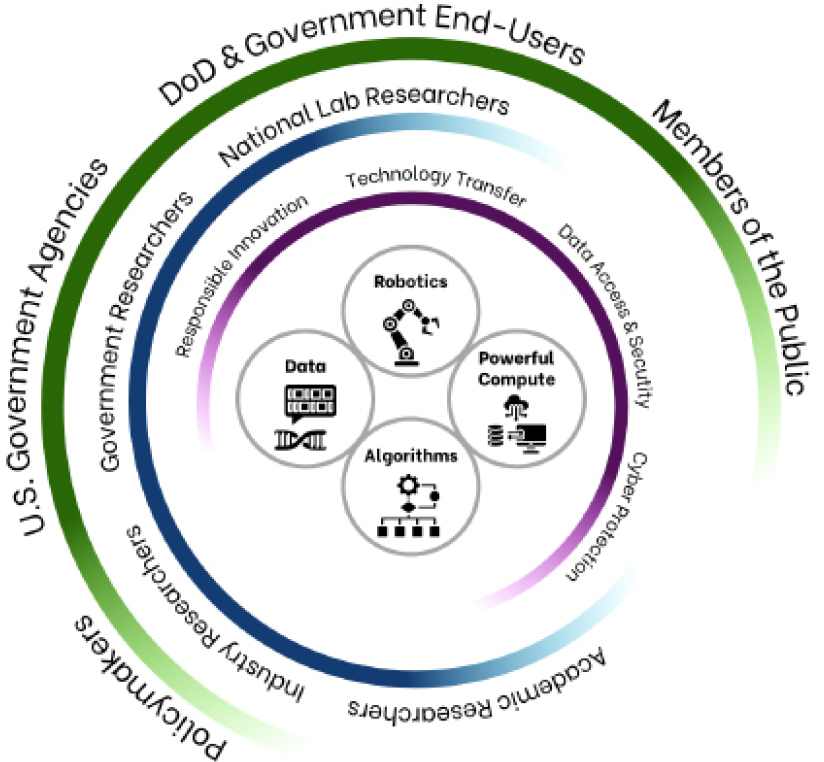
SOURCE: Created by members of the National Academies Committee on Biotechnology Capabilities for National Security Needs—Leveraging Advances in Transdisciplinary Biotechnology.
The cornerstone of this report is a strategic vision for connecting scientists and technologists to build on, leverage, and tailor advances at the intersection of AI/ML, automated experimentation, and biotechnology to drive innovation in defense-related biotechnologies, which the committee visualizes as the BioCATALYST network. Clearly, the DoD and the Office of the Director of National Intelligence would be principal participants and leaders in this proposed network because of their primary roles in maintaining U.S. defense and national security. However, the network, or any effort, would require coordination and collaboration with actors across the U.S. government, private sector, and academia with expertise in biotechnology and its broader applications—not only to garner broad support of the network, but also to ensure alignment of its objectives with national defense priorities and the specific needs of diverse national security and defense constituencies. The network would also establish standards for data sharing, AI-experiment integration, and risk management, ensuring that innovations are developed responsibly and in compliance with international norms and treaties.
This report is structured as a guide on the current landscape of AI-enabled biotechnology, the opportunities it presents, and the challenges it poses. The recommendations presented throughout this report are crucial to address long-standing challenges that have limited research, development, prototyping, testing and evaluation, and eventual use of biotechnologies. Addressing these challenges will help to advance U.S. national security and defense by improving the performance of existing capabilities, enabling the creation of domestic supply chains of valuable products, reducing reliance on processes and chemicals that are harmful to the environment, and/or adding new capabilities not currently possible with established technologies. Although these efforts may more broadly benefit other sectors, this report and recommendations focus on the U.S. national security and defense communities.
Conclusion 1: New, integrated approaches to using AI models and automated experimentation in biotechnology R&D that harness scientific networks, expand access to unique computational and experimental infrastructure, and accelerate progress toward significant benefits for national security and U.S competitiveness are needed. Standards for interoperability of data, AI/ML tools and libraries, and DevSecOps are critical to the computational capacity to support novel design and development of molecules and living systems.
Recommendation 1: The National Security Commission on Emerging Biotechnology should recommend the creation of an interdisciplinary, interagency network, the Biotechnology Coupled with Artificial Intelligence and Transformative Automation for Laboratory Yielding Strategic Technologies, or BioCATALYST, that focuses on a defined set of research and development at the intersection of artificial intelligence/machine learning (AI/ML), automated experimentation, and biotechnology that addresses national security and defense needs. The U.S. Department of Defense and Office of the Director of National Intelligence should take leadership roles for the network in coordination with the U.S. Department of Energy, the U.S. Department of Health and Human Services, the National Institutes of Standards and Technology, and the National Science Foundation. This interagency group should develop strategic goals and boundaries for integrating and advancing AI/ML and automation, and their integration with the life sciences, to drive innovation across a variety of biotechnologies with the aim to enhance existing and add new applications for protecting U.S. national security and defense in a responsible manner. This strategic plan should clearly describe its approach to sustained investment in the necessary infrastructure, expertise, and data systems outlined in subsequent recommendations in this report. The network should be organized around established principles to delineate clear roles and responsibilities; mechanisms for regular communications and evaluation of progress; and mechanisms for sharing data, information, and biotechnologies across agencies responsible for national security and defense and the research community.
Recommendation 2: The BioCATALYST research and development network should establish and maintain curated artificial intelligence–ready datasets as sustained network resources. These datasets should address the full range of national security community needs and be managed at required security levels. Access to these datasets should be available via a tiered system that enables differential access to data that may be associated with different levels of sensitivity, with data that have the lowest level of national security sensitivity being publicly available and data that have the highest level of national security sensitivity being classified.
Recommendation 3: The U.S. Department of Defense (DoD) should have the BioCATALYST network implement pilot test beds that enable requirements mapping for needs that are not predefined and demonstration of comparative technological advantage, usability and results, and commercial viability. These test beds should include experts from the DoD service laboratories, particularly those involved in TBRSC (Tri-Service Biotechnology for a Resilient Supply Chain); the DoD biomanufacturing entities; relevant biotechnology industry and academia; and potential transition partners and/or end users. These test beds should incorporate knowledge about research and development trends in artificial intelligence/machine learning, automated experimentation, biotechnologies, and the biofoundaries to inform and appropriately tailor requirements that could leverage these advances to address DoD needs.
Recommendation 4: To address the lack of transition partners, the BioCATALYST network should create a process for transitioning basic and applied research to advanced development by U.S. government and/or private-sector partners, including engagement of partners and management of research and development at the earliest possible stage of product development.
This report underscores the critical need for the United States to invest in an integrated approach to biotechnology R&D, particularly in the context of AI and automation. The recommendations aim to ensure that the United States remains at the forefront of biotechnology innovation while safeguarding against the risks associated with its misuse. The creation of the BioCATALYST network is central to this vision, offering a blueprint for a national strategy that enhances defense capabilities, secures supply chains, and positions the United States as a global leader in the responsible development of AI-enabled biotechnologies.
As the United States, along with its allies and partners, seeks to harness AI- and automation-enabled biotechnology for economic, ecological, humanitarian, and defense purposes, ensuring—and transparently demonstrating—compliance with international norms and treaties will be critical. In particular, adherence to the Biological and Toxin Weapons Convention must be communicated clearly to the global community. This commitment builds international trust and underscores the responsible use of advanced biotechnologies in alignment with global security and ethical standards.


