Strategic Report on Research and Development in Biotechnology for Defense Innovation (2025)
Chapter: 3 Creating a Research and Development Network for National Security and Defense: The BioCATALYST Network
3
Creating a Research and Development Network for National Security and Defense: The BioCATALYST Network
Recognizing that the sponsor is a Congressional Commission, this and subsequent chapters offer a strategic, long-term vision for shaping an R&D ecosystem tailored to biotechnologies enabled by AI/ML and automated experimentation. This vision includes identifying, leveraging, and tailoring research and development activities and technologies, focusing on the design and development of bio-based materials and living systems with novel functional activities relevant to national security and defense capabilities.
Progress at the leading edge of AI/ML and biotechnology convergence requires a new infrastructure that can keep pace with rapid advances and involves large datasets, large-scale computing, fast networks, and laboratory automation. To create and sustain an R&D network capable of addressing critical national security and defense capability needs now and into the future, the committee envisions the development of a robust national R&D network of AI-biotechnology hubs: the Biotechnology Coupled with Artificial Intelligence and Transformative Automation for Laboratory Yielding Strategic Technologies (BioCATALYST) network. The BioCATALYST network would provide a unique combination of high-performance AI and data analytics resources, large-scale datasets, and core experimental resources. It is envisioned to help overcome existing challenges in translating basic and applied research on bio-based materials and living systems with novel functions for national security and defense applications, and to provide opportunities to sustain and grow organizations that are critical to this research. Further, these resources would overcome or otherwise reduce many existing barriers that limit advancement and use of biotechnologies for national security impact (e.g., data curation, network protocols, software setup, heterogeneous laboratory interfaces).
Figure 3.1 describes an infrastructure that would achieve the vision for the BioCATALYST network. As envisioned, the direct beneficiaries of the R&D activities of this network are the U.S. Department of Defense (DoD), the Office of the Director of National Intelligence (ODNI), and other U.S. government agencies whose primary missions are in national security. However, the advances gained through this network are expected to benefit other agencies and organizations that are part of the biotechnology R&D enterprise, including industry, academia, and international partners. This chapter focuses on the infrastructure for R&D needed to support this vision.
The BioCATALYST network is envisioned to operate at multiple levels including both the unclassified level to maximize collaboration and sharing of scientific data, knowledge, and tools, and the classified level to enable secure analysis, design, development, and application of biotechnology innovations that support the unique needs of the national security and defense communities. The unclassified level would ensure that R&D activities can leverage new knowledge, expertise, and technologies for continued innovation and advancement. Given the evolving nature of risks and threats involving biotechnology advances, particularly those at the interface between the digital and physical worlds of biology, the secure environment would enable cleared network members to engage in research, data analysis, and information sharing through secure
channels in support of the national security and defense mission. Moreover, a classified component within the network would facilitate deeper integration with other national security efforts, fostering collaboration between DoD, ODNI, and relevant research entities.
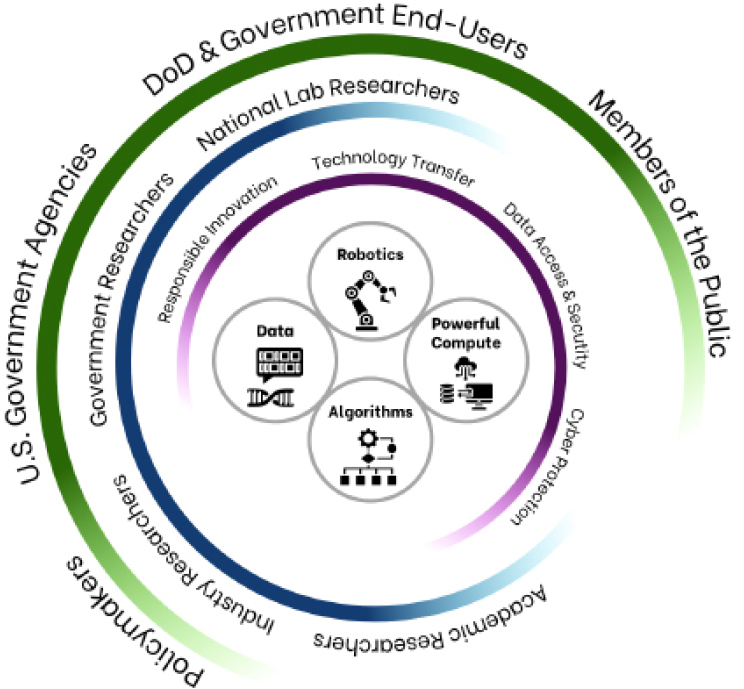
SOURCE: Created by members of the National Academies Committee on Biotechnology Capabilities for National Security Needs—Leveraging Advances in Transdisciplinary Biotechnology.
Highlighting not only the benefits for national security, economic competitiveness, and scientific innovation but also the unique focus on integrating AI/ML, automated experimentation, and biotechnology for defense and national security applications will be critical in building a strong coalition of support. The BioCATALYST network would engage universities, industry partners, and other public-sector entities, particularly at the unclassified level, by providing access to cutting-edge research infrastructure and data sharing capabilities at the intersection of AI, automated experimentation, and biotechnology. By fostering collaborative opportunities with universities and research institutions at the unclassified level, the network can serve as a bridge between cutting-edge research and applied biotechnologies in defense contexts. In addition, building strong partnerships with the private sector could bolster support for the network and uplift the biomaterials industry. Biotechnology companies and AI/ML and automation firms are vital contributors to the innovation ecosystem for design and development of novel bio-based materials and living
systems. Furthermore, interagency collaboration is crucial for building on existing federal investments in engineering biology and biotechnologies more broadly. Engaging with relevant agencies, such as the National Science Foundation and U.S. Department of Energy (DOE) Office of Science and Joint Genome Institute, could foster an integrated approach to biotechnology R&D that reflects national priorities for defense and the bio-based economy while maintaining an interdisciplinary focus. Support from these agencies also would demonstrate that the BioCATALYST network is complementary to existing federal efforts rather than duplicative, ensuring efficient use of public resources.
This vision of a BioCATALYST network involves leadership and support across the U.S. government to support an integrated AI/ML and biotechnology R&D agenda at university, private sector, and government facilities that benefits U.S. national security (Figure 3.2). Given the purpose of the network and its primary beneficiaries, the DoD and ODNI could play leadership roles in developing and sustaining the network, enabling sharing of knowledge, technologies, and expertise that may benefit defense and intelligence capabilities, and navigating the policies and prioritization process that maximally leverages biotechnology solutions for national security needs. Other U.S. government agencies that play a role in the broader national security and biodefense arenas would support and benefit from this network. DOE is well positioned to work with industry partners to plan and implement AI, data, and computing hubs with the required base of AI, simulation, data analytics and management, and workflow tools needed to support R&D of the network facilities. The U.S. Department of Health and Human Services and the National Science Foundation Technologies, Innovation, and Partnerships Directorate, are well placed to plan and develop the experimental hubs, including integration of cloud lab-based infrastructure and technologies within the basic and applied research infrastructure. The National Institutes of Standards and Technology of the U.S. Department of Commerce plays a crucial role in establishing standards for integrating data and workflow processes that are required to link multiple hubs to integrate AI-experimental and computational workflows.
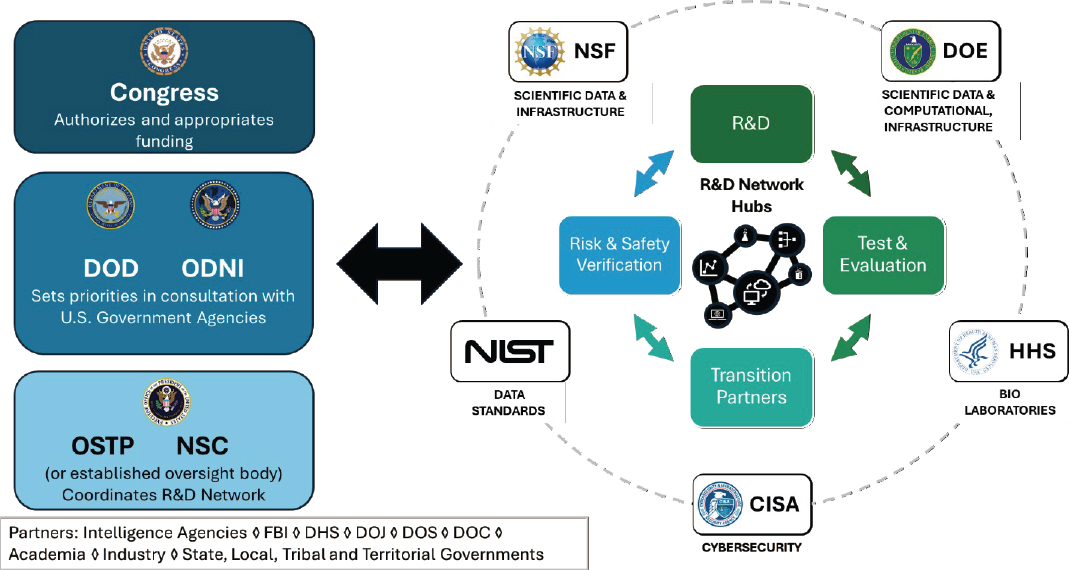
SOURCE: Created by members of the National Academies Committee on Biotechnology Capabilities for National Security Needs—Leveraging Advances in Transdisciplinary Biotechnology.
Recommendation 1: The National Security Commission on Emerging Biotechnology should recommend the creation of an interdisciplinary, interagency network, the Biotechnology Coupled with Artificial Intelligence and Transformative Automation for Laboratory Yielding Strategic Technologies, or BioCATALYST, that focuses on a defined set of research and development at the intersection of artificial intelligence/machine learning (AI/ML), automated experimentation, and biotechnology that addresses national security and defense needs. The U.S. Department of Defense and Office of the Director of National Intelligence should take leadership roles for the network in coordination with the U.S. Department of Energy, the U.S. Department of Health and Human Services, the National Institutes of Standards and Technology, and the National Science Foundation. This interagency group should develop strategic goals for integrating and advancing AI/ML and automation, and their integration with the life sciences, to drive innovation across a variety of biotechnologies with the aim to enhance existing and add new applications for protecting U.S. national security and defense in a responsible manner. This strategic plan should clearly describe its approach to sustained investment in the necessary infrastructure, expertise, and data systems outlined in subsequent recommendations in this report. The network should be organized around established principles to delineate clear roles and responsibilities; mechanisms for regular communications and evaluation of progress; and mechanisms for sharing data, information, and biotechnologies across agencies responsible for national security and defense and the research community.
To realize this vision of a BioCATALYST network, legislative actions, whether changes to existing authorities for DoD and ODNI, authorization of the new program, and/or appropriation of funds for strategic, long-term investment in such a network likely will be needed. Further, leveraging R&D activities across non-national security and national security and defense agencies may involve some policy actions to enable sharing of knowledge, technologies, and data. The total cost for a national-level network that enables cooperation across the U.S. government and with the private sector, academic institutions, and national laboratories is challenging to calculate because the costs may vary by the organizations involved in the effort; the degree to which existing research can be built upon (versus, having to create newly for DoD and/or U.S. national security agencies); the degree to which existing infrastructure for data storage and analysis can be used; the amount of indirect costs for compliance with all federal, state, local, tribal, and territorial laws; the degree to which a ready workforce exists and/or has to be trained; the cost of computing infrastructure; the cost of cybersecurity protections; and other similar factors.
If the policy and financial situations are favorable to and high-level support exists for creating the network, the following timeline may be estimated:
- Years 1–3 (near term): create the foundational infrastructure, initial databases and associated infrastructure, and proof-of-concept for integrating AI/ML and automated experimentation in biotechnology research and development;
- Years 4–5 (mid-term): scale the network, expand the datasets, and refine AI/ML models;
- Years 6–7 (mid-term): integrate AI/ML and full-scale automated experimentation into biotechnology R&D systems (i.e., operationalization); and
- Years 8–10 (long-term): achieve full network maturity.
Much like cost, this timeline estimate depends on several factors including existing infrastructure on which to build and maintain existing partnerships across the U.S. interagency and nongovernmental community; existing workforce and policy landscape; and high-level support and strategic vision to support such an effort and to improve testing, evaluation, and transition of basic and applied research to advanced development of AI/ML, automated experimentation, and biotechnology. The example of the National In-
stitutes of Health’s National Center for Advancing Translational Sciences’ Biomedical Data Translator program,1 which was initiated in 2018, can inform understanding of possible implementation steps and estimated timeline and cost.
To ensure the successful establishment and long-term sustainability of the BioCATALYST network, implementation would follow a stepwise approach that begins with addressing known national security and defense needs before progressing to more advanced, innovative R&D. By concentrating on well-established challenges, the network can rapidly demonstrate its value and deliver solutions that directly contribute to national security. This early focus on known needs also provides an opportunity to build trust and confidence in the network. By producing actionable outcomes for immediate needs, the network can validate its operational infrastucture, data-sharing mechanisms, and collaborative partnerships. Success in these initial efforts will generate momentum, attract greater participation from a broader range of actors, and lay a solid foundation for future growth. As the BioCATALYST network matures and demonstrates its ability to address immediate needs, it can progressively expand its focus to include more exploratory and forward-looking research aimed at driving innovation. This strategy maximizes the initial impact of the network and fosters an environment that encourages experimentation and long-term advancement in biotechnology, ultimately strengthening the United States’ ability to remain at the forefront of defense innovation.
Once the BioCATALYST network has successfully demonstrated its utility to the national security-oriented R&D ecosystem and the broader research enterprise, focus can expand to include international collaboration and the immense opportunities it offers for scientific advancement, resource sharing, and the acceleration of innovation. The network may evolve into a premier hub for biotechnology research for national security and defense in the United States, and its role in facilitating collaboration with international partners will become an increasingly important and complex issue. Although the network’s primary objective will be to advance defense innovation and enhance national security through the integration of AI/ML, automated experimentation, and biotechnology, the global nature of science and technology cannot be overlooked. Biotechnology, in particular, is a domain that thrives on international collaboration from shared challenges posed by biological threats, health crises, and environmental concerns, which provide common ground for the United States to engage with its international allies and partners. However, engaging in the international arena will require addressing critical questions about balancing openness with security, particularly in the context of multi-use biotechnologies that could be exploited for malicious purposes. As such, the BioCATALYST network will need to navigate the complexities of international engagement while maintaining a strong focus on safeguarding U.S. national security interests.
The recommendations included throughout this report are crucial to address long-standing challenges that have limited research, development, prototyping, testing and evaluation, and eventual use of biotechnologies. Addressing these challenges will help to advance U.S. national security and defense by improving the performance of existing capabilities, enabling the creation of domestic supply chains of valuable products, reducing reliance on processes and chemicals that are harmful to the environment, and/or adding new capabilities not currently possible with established technologies. The recommendations are written in a manner that illustrates how a coordinated network (e.g., BioCATALYST network) could address essential priorities such as integrating biotechnology with AI/ML, automation, and other transformative technologies; drive innovation; and enhance strategic capabilities across multiple agencies and the research community. The initiatives outlined in the report recommendations are fundamental to ensuring the United States remains at the forefront of both national defense and biotechnology innovation, and their implementation will yield significant benefits.
___________________
1See https://ncats.nih.gov/research/research-activities/translator (accessed October 11, 2024).
ROLE OF PUBLIC AND PRIVATE COMPONENTS
Both public- and private-sector resources will play important roles in establishing and sustaining a national AI and biotechnology R&D network. Public-sector capabilities and organizations such as national laboratories, service laboratories, and others have critical capabilities, resources, and facilities to contribute to the network. Their abilities to work at both unclassified and classified levels will be of particular importance for national security applications. Private-sector organizations (e.g., industry, universities, nongovernmental organizations, Federally Funded Research and Development Centers, and University Affiliated Research Centers (UARCs)) provide state-of-the-art AI and biotechnologies capabilities, expand the reach of the partnership to include cloud computing and cloud laboratories, and connect work throughout the network to transition paths to broader applications.
PRACTICAL AND OPERATIONAL FACTORS ENABLING INVESTMENTS
Expertise in AI/ML, Automation, and Biotechnology
Development and operation of network hubs require experts across multiple areas of AI/ML, computing, data science, biotechnology, and laboratory automation, several of whom would be cleared to enable translation of advances to address national security challenges. The expertise provided in these general areas provide broad support to users in the R&D network who may lack these specific capabilities. In addition, unique, cross-cutting combinations of skills are also needed. Examples of areas where specialized skills are needed include the following:
- Distributed data management and access control, particularly at very large scales. The ability to treat distributed data in the network as a unified resource is a foundational capability for the network.
- AI integrated with mechanistic simulation models. Data-driven ML models have domains of applicability limited by their training sets. Integration with simulation-driven models can provide a path to expanding model predictive domains.
- Complex computational-experimental workflow languages and tools. Integrated AI and biotechnology applications require complex workflows that may combine AI training and inference, simulation runs, experimental design operations, biosynthesis processes, and operation of multiple experimental assays. Describing these workflows in a systematic language-based approach makes the workflow a data object in the network that can be saved, reused, and analyzed.
- Robotic interaction with laboratory automation systems.
- Safety and security technologies at the intersection of AI and biotechnology.
Development and Security of High-Quality Datasets
Expediting scientific breakthroughs in AI and biotechnology requires integration of complex heterogeneous, dynamic, and distributed data streams. This integration is crucial for creating rich, robust, and curated datasets required for effective model training and validation. Enabling these advances will require the establishment of a government-sponsored data integrator to integrate, manage, archive, harmonize, and document heterogeneous AI-ready datasets to support research. Several technical challenges related to data have been described during the past several years, including bias (ATCC, 2022; Hunter, 2021; Plevkova et al., 2020; Webb et al., 2022), limited reproducibility and verifiability (Baker, 2016), variability of data standards for different biological data and metadata (“Biological Data Standards Cluster,” n.d.; Interagency
Working Group on Data for the Bioeconomy, 2023), interoperability, and variable quality and accuracy (National Research Council, 2005; National Science and Technology Council, 2023). In addition, existing policies governing data access and sharing have led to variable access of biological data internationally and, in some cases, a lack of reciprocity of data access (Berger and Schneck, 2019).
The 2022 Executive Order on Advancing Biotechnology and Biomanufacturing Innovation for a Sustainable, Safe, and Secure American Bioeconomy2 established a “Data for the Bioeconomy Initiative (Data Initiative) that will ensure that high-quality, wide-ranging, easily accessible, and secure biological data sets can drive breakthroughs for the United States bioeconomy.” Following the Executive Order, the U.S. National Science and Technology Council released a report in 2023 detailing specific actions that the U.S. government could take to address existing gaps in data, federal data infrastructure, and computational capabilities to achieve the United States’ bold goals for biotechnology and biomanufacturing (National Science and Technology Council, 2023). This report highlights several data challenges, including (a) biological data does not always follow the FAIR (findable, accessible, interoperable, and reusable) principles; (b) data from federal investments often are stored in “individual research datasets”; (c) the data are highly diverse (e.g., by type of molecule, cell, organism, timescales, collection methodologies, scales) and each often are associated with different metadata; and (d) sustained infrastructure is lacking for data collection, use and analysis, and curation. The U.S. government identified seven primary actions for addressing these challenges (Interagency Working Group on Data for the Bioeconomy, 2023), including:
- “Dedicated long-term funding mechanisms for data and computational resources and infrastructure.
- Standards to establish common best practices that foster and strengthen a shared U.S. bioeconomy data ecosystem.
- Biodata catalogue to identify extant data and metadata.
- Security practices and policies that secure the data landscape while supporting innovation.
- Workforce to drive U.S. leadership in the bioeconomy of the future.
- Strategically targeted areas for rapid transformation (STARTs) to determine viability and impact and chart a course for larger investments.
- Coordination of intergovernmental investments, efforts, and resources.”
Although these challenges and actions were developed specifically for the bio-based economy, they also apply to data needed for R&D of biotechnology and biomanufacturing for national defense purposes.
To maximize the potential for new discoveries, leveraging of private and public sources across all classification levels (i.e., unclassified, classified, proprietary, confidential) is needed. As part of the BioCATALYST network, partnerships with industry and private data owners will be critical to its success because private data (e.g., proprietary, commercial) may provide greater insights and complement research activities that enable new discoveries (Munsamy et al., 2024). Thorough due diligence is critical to avoid violating intellectual property (IP) and personal privacy rights. Access to private data also may include obtaining specific consent for the use of identifiable data, ensuring data anonymization and encryption, and implementing compartmentalization of data with secure, limited access and regular auditing of usage. Also needed may be innovative approaches to incentivize or otherwise enable private data owners to share data with a broader R&D community, particularly when they perceive the significant investment required to generate and then make available those data as affecting their competitive advantage (NASEM, 2024). Because of the heterogeneity and complexity of the type, collection methods, and characterization of various data streams, significant technical and governance challenges may exist and need to be resolved. Several strategies have been developed (U.S. Department of Defense, 2020) and some progress has been made to address these challenges. However, several other challenges remain including data standardization; data quality; massive synthetic data; knowledge gained from well-studied areas to predict outcomes of less characterized
___________________
2See Exec. Order No. 14081, 87 C.F.R. 56849 (2022), https://www.federalregister.gov/d/2022-20167 (accessed August 22, 2024).
applications; and data security, specifically ensuring the accuracy, reliability, integrity, validity, provenance, and encryption of critical datasets. Synthetic data, which often reflect known molecules, biological processes, and rules governing living systems, are used to fill data gaps when high-quality datasets are scarce.
High-quality datasets are critical to converting observations to knowledge to decision advantage. These datasets should encompass a diverse range of modalities and provide comprehensive information at various resolutions from individual molecules to ecosystem-level data including biological, clinical as appropriate, and other relevant data (e.g., satellite data, mobility data, and human behavioral data).
Infrastructure Requirements
The shared data ecosystem
In such a network, data are the integrating element. Data specify complex AI-experimental workflows, instruct automated experimental hardware, and return experimental results. Each network hub provides locally connected AI and experimental systems; multiple hubs can connect to execute larger-scale workflows. Given the national security goals of the network, it should encompass: (a) a system that supports multiple security levels for data and operations; and (b) access to high-bandwidth network connections at multiple security levels to fully implement network operations. Multiple security levels enable both focused national security R&D and basic and early-stage research with uncleared, cross-disciplinary experts.
The network would build on and extend ongoing work on biodata standards and experimental design protocols (Bard and Rhee, 2004; Wilkinson et al., 2016). Because everything connects, the network can capture detailed records of the data and control operations associated with every workflow. These records become data objects that can be operated on and reasoned with–enabling workflow optimization, IP and regulatory compliance, and education. This data ecosystem would support the functionality and tools needed across the application space including the following:
- Data cataloging and directory services to support data findability across the network.
- Data and metadata naming, formatting, and translation services to enable data integration in complex workflows.
- Provenance services for recording accesses and operations on data objects.
- Data access controls for managing data sharing across network users.
Access to large, curated data are often a barrier to working in AI-enabled bioscience applications. A central function of the network is to provide pre-curated and ML-ready datasets to accelerate the startup of projects in selected national security application areas. Access authorization at multiple security levels will provide open access for educational and research users, controlled access for industry engagement, and secure access for national security applications.
Conclusion 2: Data are the fuel that drives the ongoing convergence of AI and biotechnology. Expanded access to well-curated and managed datasets explicitly designed for AI model training and validation at appropriate security levels will enable progress to national security impacts.
Recommendation 2: The BioCATALYST research and development network should establish and maintain curated artificial intelligence–ready datasets as sustained network resources. These datasets should address the full range of national security community needs and be managed at required security levels. Access to these datasets should be available via a tiered system that enables differential access to data that may be associated with different levels of
sensitivity, with data that have the lowest level of national security sensitivity being publicly available and data that have the highest level of national security sensitivity being classified.
The U.S. government has issued policies to make all unclassified scientific data openly available for research benefit and to protect data such as human genomic data (The White House, 2024). These and other similar policies, with which U.S. government agencies must comply, run counter to national security concerns about asymmetric access to research data and human genomic and health data. The tiered system of data access may be one way to navigate these policies. One example demonstrating the feasibility of implementing tiered access to data is the NIH All of Us Research Program that has a three-tiered data access infrastructure for sharing participant health, genomic, and other data collected through the program.
Computing and data hubs providing AI and computational tools and resources
The BioCATALYST network would provide access to the state-of-the-art AI/ML, biological simulation capabilities, and data analytics tools and environments needed for R&D of AI-enabled biotechnologies. The environment in which users can access these data, analytic tools, and environment would be informed using human-centered design to ensure maximal usage. For example, computing resources ranging from cloud access for small graphics processing unit clusters to supercomputing-scale systems are needed for biosystem modeling and design at full complexity. ML model training and molecular dynamics simulation capabilities using a significant amount of graphics processing units and central processing unit cores have been applied in biosystem design and optimization (Nobile et al., 2017). For national security applications, access to classified computing with compatible data and software environments are important. Strategic collaborations between high-performance, commercial computing and cloud providers (e.g., Amazon Web-Services and Microsoft) are critical to acquire the scale of computing and data needs and to facilitate the ongoing integration of new technologies.
Conclusion 3: One of the most important functions of the computing and data hubs would be to provide expertise in developing and operating complex workflows in an environment that enables different levels of access (i.e., unclassified, public access and classified access) and incorporate multiple ML and simulation models, iterative optimization processes, and network-based data access and experimental control operations. DOE national laboratories and selected industry and academic partners could help to provide these unique and limited-availability skills.
Experimental hubs providing laboratory automation tools and wet-lab resources
Integrating AI-enabled data analytics, predictive modeling, and design optimization with automated laboratory equipment would enable new types of automated workflows in which computational models drive experimental design and newly obtained data extend the domains and performance of computational models. The types of experimental hardware and systems needed in the BioCATALYST network applications are expected to vary more than they do for the data and computational resources because of the diversity of experimental procedures involved in biotechnology R&D efforts. Drawing from existing efforts within the private sector, the network would focus on providing standardized interfaces to connect to laboratory equipment (e.g., LIMS interfaces) and tools to develop and manage integrated workflows. The network hubs could work with providers of cloud laboratory capabilities with AI/ML analysis and learning loops that would allow improvement and optimization of models and high-throughput experimentation (NASEM, 2024).
Conclusion 4: Experimental network hubs will need to have sufficient laboratory capacity that would enable high-quality experimentation at a low cost and large scale, generate large amounts of data in an automated, procedural fashion that produces verifiable and reproducible datasets. Certain hubs may be purposed for generating large amounts of data to inform R&D, whereas others may be purposed for biomanufacturing. Regardless of their purpose, hubs will need to incorporate elements of automation and AI/ML that interface with traditional wet-laboratory experimental systems to improve research, development, and scale-up of biotechnologies to address national security challenges. An example is bioreactors with a cloud component that allow for long-term monitoring of cultures, facilitating improved data collection and analysis.
Policy and Governance Frameworks
The governance landscape of advances in biotechnology, regardless of whether AI models or fully automated laboratories are used, is a tapestry of policies addressing risks of the products to the environment, agriculture, and human health (e.g., Coordinated Framework for the Regulation of Biotechnology Products,3 NIH Guidelines for Research Involving Recombinant or Synthetic Nucleic Acid Molecules4); risks of the research to scientists working with viruses and bacteria (Biosafety in Microbiological and Biomedical Laboratories5 and relevant occupational health policies); risks of malicious use of knowledge, skills, technologies, and biological agents by actors with harmful intent (Federal Select Agent Program6; U.S. Government Policy for Oversight of Dual Use Research of Concern and Pathogens with Enhanced Pandemic Potential7); ethical considerations of research involving animals and humans (U.S. Government Principles for the Utilization and Care of Vertebrate Animals Used in Testing, Research, and Training8; Public Health Service Policy on Humane Care and Use of Laboratory Animals9; Guide for the Care and Use of Laboratory Animals10; Animal Welfare Act and Regulations11; The Federal Policy for the Protection of Human Subjects12); and investment in biotechnology-related research, development, possibly commercialization, and use. Layered on this landscape are policies that apply to any area of research, not only biotechnology, including those governing data collection, generation, access, and use (National Security Decision Directive—189,13 Guidance to Make Federally Funded Research Freely Available Without Delay,14 Executive Order on Preventing Access to Americans’ Bulk Sensitive Personal Data and United States Government-Related Data by Countries of Concern15); protection of the methods, knowledge, and products
___________________
3See https://usbiotechnologyregulation.mrp.usda.gov/biotechnologygov/about/about (accessed September 27, 2024).
4See https://osp.od.nih.gov/wp-content/uploads/NIH_Guidelines.pdf (accessed September 27, 2024).
5See https://www.cdc.gov/labs/pdf/SF__19_308133-A_BMBL6_00-BOOK-WEB-final-3.pdf (accessed September 27, 2024).
6See https://www.selectagents.gov/index.htm (accessed September 27, 2024).
7See https://www.whitehouse.gov/wp-content/uploads/2024/05/USG-Policy-for-Oversight-of-DURC-and-PEPP.pdf (accessed September 27, 2024).
8See https://olaw.nih.gov/policies-laws/gov-principles.htm (accessed September 27, 2024).
9See https://olaw.nih.gov/policies-laws/phs-policy.htm (accessed September 27, 2024).
10See https://doi.org/10.17226/12910 (accessed September 27, 2024)
11See https://www.aphis.usda.gov/media/document/17164/file (accessed September 27, 2024).
12See https://www.hhs.gov/ohrp/regulations-and-policy/regulations/common-rule/index.html (accessed September 27, 2024).
13See https://irp.fas.org/offdocs/nsdd/nsdd-189.htm (accessed September 27, 2024).
14See https://www.whitehouse.gov/ostp/news-updates/2022/08/25/ostp-issues-guidance-to-make-federally-funded-research-freely-available-without-delay/ (accessed September 27, 2024).
15See https://www.whitehouse.gov/briefing-room/presidential-actions/2024/02/28/executive-order-on-preventing-access-to-americans-bulk-sensitive-personal-data-and-united-states-government-related-data-by-countries-of-concern/ (accessed September 27, 2024).
of research (research security policies); and export of weapons of mass destruction–related organisms, technologies, and equipment (The U.S. Export Control System and the Export Control Reform Act of 201816). Focusing on defense applications of science and technology, policies limiting the effects of armed conflict (International Humanitarian Law17) and prohibiting the development and stockpiling of biological weapons (Biological and Toxins Weapons Convention and the United States’ law implementing the treaty, Biological Weapons Anti-Terrorism Act of 198918) also may apply. Finally, policies, still in development, governing the safe and ethical use of AI models further complicate the landscape governing research, development, and application of AI-enabled biotechnologies.
The BioCATALYST network is envisioned to develop strategic partnerships that incentivize both companies and researchers to actively engage. A critical component of these partnerships would involve the establishment of agreements on the sharing of IP including specific training data, models, and trade secrets. However, companies are likely to participate only if the regulatory frameworks and agreements are practical, manageable, and aligned with their strategic goals and business interests. To facilitate public-private partnerships, the BioCATALYST network would benefit from identifying and adopting critical components of proven models of shared IP that balance the interests of all parties involved for the benefit of all involved. One example of such an approach is the manufacturing innovation institute created and funded by DoD, “BioMADE.”19 BioMADE members, including companies and universities, agree to varying degrees of transparency and joint ownership or liberal licensing of their IP. Adopting similar frameworks could bridge the gap between research and operationalization in this network. BioMADE aims to address challenges in transitioning products from the laboratory to industry, and efforts by the Engineering Biology Research Consortium seek to help DoD and the National Institute of Standards and Technology in developing technology roadmaps and standards for engineering biology (Taraseva, 2023). However, BioMADE has no initiatives to date that leverage AI/ML tools despite their potential for enhancing biomanufacturing capabilities.
Understanding the relevance and limitations of existing policies to ensure the research, development, and application of AI-enabled biotechnologies in the BioCATALYST network are done ethically, responsibly, safely, and securely, and mechanisms exist for reporting and addressing concerns is important.
___________________
16See https://crsreports.congress.gov/product/pdf/R/R46814 (accessed September 27, 2024).
17See https://legal.un.org/avl/studymaterials/rcil-laac/2017/book1_2.pdf (accessed September 27, 2024).
18See https://www.law.cornell.edu/uscode/text/18/2332a (accessed October 11, 2024), https://www.law.cornell.edu/uscode/text/18/2339A (accessed October 11, 2024), and https://www.law.cornell.edu/uscode/text/18/832 (accessed October 11, 2024).
19See https://www.biomade.org/ (accessed August 22, 2024).


