Transforming Undergraduate STEM Education: Supporting Equitable and Effective Teaching (2025)
Chapter: 7 Student Pathways Through Undergraduate STEM Curricula
7
Student Pathways Through Undergraduate STEM Curricula
The committee recognizes that their charge could be narrowly interpreted as a series of issues related to individual science, technology, engineering, and mathematics (STEM) courses, but that this focus would miss many important aspects that influence whether students experience equitable and effective STEM learning experiences. Students experience undergraduate STEM education as a series of courses and also as an array of interconnected interactions with peers, advisors, academic units, and various offices in one or, often, more than one college or university. These student experiences vary due to institution type, discipline, program structure, and course format in addition to more student-specific academic and non-academic factors (e.g., race, gender, etc.; see Chapters 2 and 3 for a more detailed discussion). In the big picture the key issue to keep in mind is that less than half of undergraduates are first-time full-time college students coming straight from high school graduation (National Center for Education Statistics, 2024b).
This chapter explores some aspects of the varied, complex pathways students take through STEM education and into the workforce. It acknowledges that students do not simply follow the designed or enacted curriculum described in Chapter 6; instead, there is an experienced curriculum: the way students actually navigate undergraduate STEM curricula. The chapter begins with a discussion of the complex and nuanced concept of motivation to pursue STEM, recognizing that in this space student agency and employment goals interact with instructor and societal expectations. It links the concept of motivation to the Principles for Equitable and Effective Teaching, as described in Chapters 4 and 5. We then go on to discuss the
development of a STEM identity. Along with this, we investigate some of the specific decision and transition points where students sometimes switch away from studying STEM, or from post-secondary education altogether. This includes a closer look at the transition from high school to college, transfer between institutions, and other aspects of student experiences in higher education institutions.
STUDENT MOTIVATION TO PURSUE STEM AND DEVELOPMENT OF STEM IDENTITY
Students choose to study STEM for a variety of reasons including in- and out-of-school experiences with STEM topics and issues before enrolling in college (Principle 3: Affective and social dimensions). Students may be motivated to study STEM because of their curiosity about the natural or designed world, a desire to use STEM to improve the world, and/or a perception about the value or importance of STEM in society. Recent empirical work has highlighted the roles of aspirations, motivation, and attitudes in STEM education and learning (e.g., Kujawa, 2013; Wang, 2013b; Wang et al., 2017a,b, 2020). One study found that students describe affective reasons for choosing to study STEM more frequently than they indicated a choice of STEM because it would lead to a future career or financial rewards (Thiry & Weston, 2019). Another key aspect of students’ decisions to study STEM related to their perceptions of themselves and their abilities. Many students report having chosen a STEM major because they are interested in or passionate about the subject area, that they enjoy it, and are skilled in it. Research has shown that students’ math and science self-efficacy beliefs positively predict intent to transfer into STEM fields (Wang et al., 2017a).
Development of a STEM identity can also influence students’ choice of field of study and how they navigate that pathway, a topic captured in Principle 4: Identity and a sense of belonging (Rodriguez et al., 2019a; Teshera-Levye et al., 2023). One study explored how focusing on identity development can improve success in STEM for Women of Color (Rodriguez et al., 2017). This may be particularly important for community college students who often have less extensive ties to disciplinary research communities and sometimes have lower levels of STEM identity (Teshera-Levye et al., 2023). Additionally, studies have shown the importance of STEM instructors’ mindset beliefs (Canning et al., 2022; Muenks et al., 2020; White et al., 2024). Emphasizing the potential for growth, rather than emphasizing fixed abilities, can indicate to students that STEM fields offer opportunities to fulfill their goals. Students can perceive when faculty endorse growth- versus fixed-mindset beliefs and designed STEM courses to advance
communal and individual goals; these perceptions can increase students’ interest in pursuing STEM education and careers (Fuesting et al., 2019).
TRANSITIONS FROM HIGH SCHOOL TO COLLEGE
The transition from high school to college is a critical period when students who feel underprepared may choose to switch out of intended STEM majors (Thiry, 2019). While many students take STEM courses in high school, the opportunity to access these courses and the preparation that they provide for success in undergraduate STEM education is not equitable. Studies have shown that exposure to STEM preparatory college coursework varies significantly by race, geography, and community income. Call to Action for Science Education: Building Opportunity for the Future, published by the National Academies in 2021, reported that
high-poverty schools are at least 1.5 times as likely as low-poverty schools to lack advanced coursework in mathematics and science (NASEM, 2019a) […] 14 percent of schools that enroll the fewest numbers of Black, Latino/a and Indigenous students offer no biology courses, 18 percent offer no chemistry courses and 31 percent offer no physics courses. In contrast, in schools that enroll large percentages of Black, Latino/a and Indigenous students, 29 percent offer no biology courses, 42 percent offer no chemistry courses, and 59 percent offer no physics courses. Similar trends in lack of access to science courses can be seen in schools enrolling significant numbers of students living at or below the poverty line (ExcelinEd, 2018). (pp. 30–31)
There are many strategies that programs and institutions use to try to mitigate the challenges of this transition and support students. Some programs target specific student populations (by geography, discipline, or student identity). while others are open to the wider student population. Out-of-school learning at museums and in clubs as well as internships provide students access to STEM while they are still in high school. Dual enrollment programs or options engage students in academic learning at the college level while they are in high school. Advising and mentoring approaches can help students learn about potential career options and postsecondary educational opportunities. State initiatives sometimes provide vocational learning opportunities. In this section we go into more detail on dual enrollment, bridge programs, and supports for students in foundational courses.
Dual Enrollment Courses and Programs
Dual enrollment courses and programs (also known as concurrent enrollment or dual credit) have emerged as a means of providing a way for students to enroll in college courses while still in high school. These courses and programs enable students to access advanced courses and to accrue college credits early and sometimes at a lower cost than for high school graduates. These opportunities expand student exposure to college STEM courses (Zinth, 2014, 2019), and in several states, they have an intentional focus on students who would otherwise not have access to them (e.g., Martinez et al., 2017). Dual enrollment courses and programs enable students interested in STEM to study topics that are not available to them in their regular course offerings and may help increase engagement, motivation, or STEM identity—all from choosing to participate in a special course. These courses can be offered at a high school, on a college campus, or online. Secondary school teachers may be required to have certain credentials (e.g., a master’s degree in the discipline) to teach these courses. One type of dual enrollment program involves Early College High Schools, some of which have a specialized curriculum in STEM, health care, K–12 teacher preparation, or another more targeted field than the typical high school curriculum. These schools can get students on track to an undergraduate degree earlier by providing additional information about what college is like or more information about STEM pathways and careers. Exposure to college STEM courses via dual credit enrollment has been shown to have a significant positive impact on STEM career intention (Corin et al., 2020). Dual enrollment can also reduce total college tuition costs (which can be especially helpful for students and families in low-income brackets) and accelerate college degree attainment (Ison, 2022; Lee et al., 2022; Partridge et al., 2021; Schaller et al., 2023). However, dual enrollment can be challenging for students to navigate in multiple ways. There are equity issues to consider (Hooper & Harrington, 2022; Williams & Perry, 2020). Furthermore, students can encounter different expectations on college campuses than they would in their high schools (Hu & Chan, 2021). Dual enrollment experiences also may alter their previous college plans in unanticipated ways. For example, students may feel constrained to continue their education at in-state schools where they are more likely to be granted credit for courses already taken, since not all colleges or universities will accept the credits they have already earned or may restrict which of those credits can count toward their intended major. One study found that dual enrollment students were less likely to receive bachelor’s degrees if they did not enter a four-year institution immediately after high school (Jagesic et al., 2022). Additional research would be beneficial to better understand the positive
experiences some dual enrollment students have in career and technical education (CTE) pathways (Edmunds et al., 2024).
Bridge and First-Year Support Programs
Many institutions have found ways to support students by investing in STEM readiness, such as mathematics and introductory science courses. These programs provide supports ranging from pre-college engagement to wrap-around services in critical foundational courses (Hallet et al., 2020; Kezar & Kitchen, 2020).
Bridge programs are often designed to start in the summer to prepare students for fall courses and can include social events as well as academic initiatives. These programs are designed to build community and provide early intervention to support the performance of students who may benefit from additional resources to increase their ability to succeed in foundational courses (Bradford et al., 2021; Cabrera et al., 2013; Ghazzawi et al., 2021; Grace-Odeleye & Santiago, 2019; Hallett et al., 2020; Kallison & Stader, 2012; Palmer et al., 2010). Such initiatives may also be called a variation on Summer Success Academy, Summer Start, or Jump Start (e.g., Albany State University,1 Coppin State University,2 Durham Technical College,3 George Washington University,4 and Clemson University5).
There are also examples of strategies and models that can disrupt the culture of “weeding out” students in the collegiate space and provide the support and resources needed for all students to thrive equitably (Aizenman et al., 2022). California State University–Fresno, for example, proactively developed a learning community approach called the Building Opportunities through Networks of Discovery (BOND) program that has been proven to effectively support first-year student retention in STEM pathways (Cowan et al., 2022). This program counters the traditional “weed-out” method of education by fostering an environment where first-year students are supported, nurtured, and ultimately prepared for higher-level STEM courses. It provides students with dedicated courses on scientific method
___________________
1 More information about the Summer Success Academy at Albany State University is available at https://www.asurams.edu/enrollment-management/summersuccess.php
2 More information about the Summer Academic Success Academy at Coppin State University is available at https://www.coppin.edu/sasa
3 More information about the Summer Success Academy at Durham Technical College is available at https://www.durhamtech.edu/summer-camps/summer-success-academy
4 More information about the GW Jump Start Summer Success Program at George Washington University is available at https://studentsuccess.gwu.edu/gw-jump-start-summer-success-program
5 More infomration about the Summer Start Program at Clemson University is available at https://www.clemson.edu/admissions/summer-start/index.html
and evidence use, a community, peer mentors, guaranteed enrollment in other courses, and technology support.6
NAVIGATING PATHWAYS WITHIN COLLEGE
Once students enroll at a college or university, there are several factors that define their experienced curriculum or the actual STEM pathway they end up taking (see Chapter 6 for more discussion of intended, enacted, and experiences curricula). These include the choices students make about how, when, and where to take courses, and their experiences within those courses. Poor teaching, poorly designed courses, and harsh grading practices influence their decisions to persist in STEM (Holland, 2019). Other factors include personal circumstances, finances, age, family status, and the availability of accessible learning opportunities (e.g., Holland et al., 2019b). As a result of these complex, interrelated factors, students do not always journey linearly through higher education. As discussed in Chapter 3, students take courses within an institution, vertically between institutions (e.g., transfer from a community college to a four-year institution), and laterally between institutions (e.g., transfer from one four-year institution to another). In this section, we explore the factors that influence student choice in the experienced curriculum—that is, how they navigate pathways of study in their undergraduate education.
STEM fields are known for their highly structured curriculum with specific prerequisites and a relatively rigid order in which courses need to be taken. This can require students to understand complexities of the intended curriculum (e.g., the program-level outcomes for a degree, certificate, or program developed by academic units or a group of instructors, as described in Chapter 6). Instructors may easily see why certain prerequisites are needed or understand why a major requires courses offered by another department or program (such as why engineering students need to take calculus, or why biology students need to take chemistry). However, it can be hard for students to understand when an entire course is required when only a fraction of the material is relevant for future study in their major. These requirements are not only confusing to students; they can at times develop a life of their own as tools that decrease enrollment in higher-level courses (when students fail or become discouraged by the course requirements they are sometimes not able to progress on in the curriculum). This complexity of the curriculum can have a number of unintended consequences, including added time to degree and decreased motivation to persist. A few studies have sought to analyze how students experience STEM education in terms
___________________
6 More about the CSM BOND program at Fresno State University is available at https://csm.fresnostate.edu/fye/index.html
of the curricular structures they must navigate (e.g., Lattuca & Stark, 2009; Smart et al., 2000). Students make course choices with limited insight into why courses are ordered the way that they are. The research that is available suggests a murky relationship between the enacted and experienced curricula (Lattuca & Brown, 2023). Some institutions have developed support structures to help students identify and navigate pathways through the first couple years of college (see Box 7-1 for an example).
BOX 7-1
Pathway Reform at Fond du Lac Tribal and Community College
Fond du Lac Tribal and Community College (FDLTCC) in Cloquet, Minnesota, serves many Indigenous students. Its main tribal affiliation is with the Fond du Lac Band of Lake Superior Chippewa, although it also serves the Mille Lacs Band of Ojibwe of northeastern Minnesota (Goose, 2024). It offers biology and general sciences transfer pathway courses as well as nursing, health, and environmental sciences programs in addition to a few other programs.a
FDLTCC is one of the colleges in the 2017 Tribal College and University cohort of the Achieving the Dream (ATD) network. ATD works with institutions, mainly community colleges, to improve student success by supporting college instructors and administrators in making change.
The institution recently received a spotlight award from Achieving the Dream in recognition of the success they have had in several metrics that measure student progress through their educational journeys. Through multiple coordinated initiatives, they have achieved at-scale reform in an institution that serves students of many cultures, but with needs that are unique to the institution, location, and identities of staff and students.
Momentum metrics track student progress in the early years that are associated with their outcomes in the later years. Metrics are conceptually grouped into (a) credit momentum measuring the number of college-level credits student completed in their first year, (b) gateway course momentum measuring the take- and-pass rate of math and English courses in their first year, and (c) persistence momentum measuring the retention rate from the first to the second term (Belfield et al., 2019).
The college’s targeted approach included the implementation of a co-requisite math model that resulted in increases in learning and outcomes and an elevated math enrollment. The model was designed to serve low enrollment in math class and low completion rates. Students receive maximum exposure to ideas and concepts through taking developmental math and college-level statistics in the same semester. The percentage of students placed in developmental education that completed college-level math satisfactorily increased from 18% in the 2019–2020 academic year to 61% in 2022–2023 (Achieving the Dream, 2024).
__________________
When students must declare a major upon application to a college or university, they often do not yet understand what the course or career path would be like in that discipline. This may lead to a desire to change majors or may complicate their effort to navigate the curriculum. When students do not need to declare a major until later, they sometimes make choices that lead to a longer time to degree by not entering a course sequence at the start of their undergraduate studies. When more students would like to choose a major than the academic unit can support, the navigation gets even more complex. Some majors are designated as limited enrollment, sometimes with higher admissions standards, and students are restricted from choosing that program or encounter restrictions on joining after enrollment. Programs sometimes also choose to create other tools for managing the size of their programs, such as setting GPA requirements, rules about credit accrual, or academic performance in a specific course as a prerequisite for admission; these allow popular majors to manage their cohort and course sizes (Nespor, 2012). Student decisions to repeat content or to enroll (or avoid) remediation courses are potentially informed by their intended major and their goals. For example, students intending to go into medicine are often quite focused on GPA, and their grades in foundational STEM courses can influence whether they are able to continue in their chosen field (Barr et al., 2008; Lovecchio & Dundes, 2002; Stratton & Elam, 2014; Zhang et al., 2020). These gatekeeping mechanisms often rely on courses that cross departments, which can further complicate individual students’ pathways (e.g., their experienced curriculum).
Because pathways do not necessarily follow a simple or linear progression, instructors and academic leaders would benefit from studying course sequences to identify the coursework structure of STEM majors. As an example, research on students’ pathways into and through chemical engineering courses is shown in Figure 7-1. In their first year, students take introductory and advanced general chemistry before progressing into their chemical engineering coursework. At the start of their second year, students take an introductory chemical engineering course, an “assessment” course that includes the equivalency of a candidacy exam, and continue to progress through organic chemistry. The initial chemistry sequence is a prerequisite for introductory chemical engineering, the assessment, and the organic chemistry course. These courses then yield a set of complex interdependencies where organic chemistry is the gateway to chemical thermodynamics. To be off track in only one set of interdependencies threatens to forestall all of the momentum of a student in their coursework trajectory (Brown et al., 2023).
Another important element to consider is the impact of departmental, college, and university policies on student pathways through undergraduate STEM learning. Numerous policies can impact students’ ability to begin or
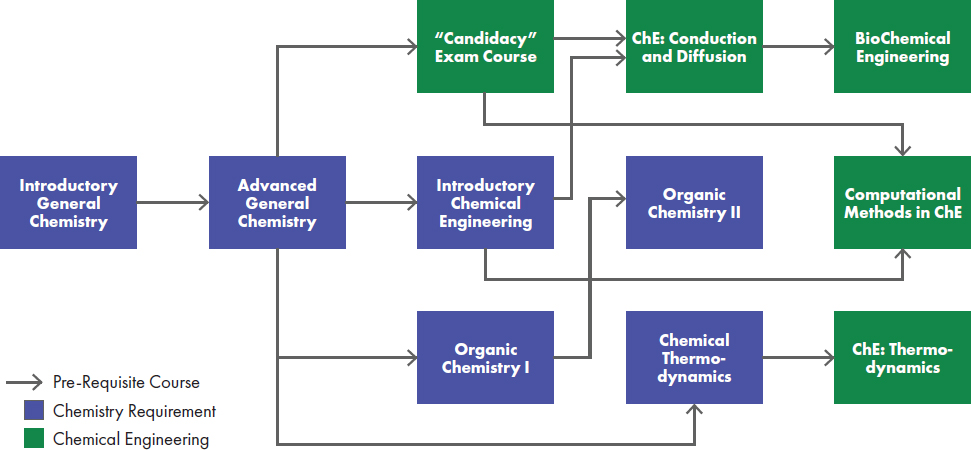
NOTE: The pathway illustrated only represents the chemistry requirements for chemical engineering majors and the requisite courses that they feed into. It does not include the equally complex general education and engineering gateway courses also required of students. Missing are required math course, other introductory STEM courses, and breadth courses that prepare students to participate as citizens in a pluralistic democracy.
SOURCE: Brown (2024).
continue studying STEM, such as those related to course withdrawal, who can repeat a course and what happens to the prior grade, cutoffs for course passing, number of times a course can be repeated, limited enrollment major policies, transfer articulations, and registration policies. Policies that mainly apply to instructors also influence the extent of equitable and effective effective teaching (e.g., policies around how teaching evaluation is considered in merit and promotion, approaches to evaluating teaching, expectations of teaching from various faculty types, teaching professional development expectations, resources for various levels of faculty that are teaching, representation of faculty in various teaching roles in teaching decisions).
The Role of Teaching and Learning Environments
Learning environments play a key role in student learning, with quantitative survey data and student interviews alike reinforcing that students frequently encounter gendered or chilly STEM learning environments (Jorstad et al., 2017; Marco-Bujosa et al., 2021; Wickersham & Wang, 2016). These issues extend across settings and modalities, including in-person and online courses, laboratory and field work experiences, and also as co-curricular activities (e.g., Cayubit, 2021; Kaufmann & Vallade, 2022). While most studies focus on classroom learning environments, undergraduates frequently engage in learning outside the classroom as well. Undergraduate research, internships, and co-ops are common (e.g., the University of Toronto’s Professional Experience Year,7 cooperative education at Drexel University,8 the co-op program at Northeastern University,9 etc.). These approaches provide opportunity for students to align experience in STEM alongside professionals in their disciplines and to clarify their career plans as they learn. They also provide an opportunity for students to build on their interests in alignment with Principle 2: Leveraging diverse interests, goals, knowledge, and experiences.
Another approach that builds on student interests, goals, knowledge, and experiences is competency-based education (CBE) or outcome-based education (Chappell et al., 2020; Morcke et al., 2013). CBE allows students to apply their prior knowledge and experience to attain a degree at a more customized pace depending on their existing skills and knowledge and level of support needs (Johnstone & Soares, 2014). CBE can sometimes
___________________
7 More information about the Professional Experience Year is available at https://undergrad.engineering.utoronto.ca/experiential-learning/professional-experience-year-pey/
8 More information about Drexel cooperative education is available at https://drexel.edu/academics/co-op
9 More information about the co-op programs at Northeastern University is available at https://www.northeastern.edu/experiential-learning/co-op/
be a better fit for students who do not enjoy traditional classroom experiences and would prefer to have a more self-directed learning experience (Boyer et al., 2022). Some CBE programs are designed to help bridge the college-to-career gap by giving learners the real-world skills needed for their chosen profession. For example, South Texas College offered an Affordable Baccalaureate Program10 beginning in 2014 that offered credit for prior learning and experiences, such as training taken in the military as well as a one-price model where students could take seven-week online courses toward a bachelor’s degree in fields such as computer and information technologies, medical and health services, technology management, or nursing (Ashford, 2019). Western Governors University (WGU)11 works entirely on a CBE model, where students pay a flat rate per session and can earn as many credits as desired in six months.12 All courses are online but offered via two different models. One study by WGU faculty found that the “enhanced” online instruction afforded students more control over the order and pace of the content, and practice and assessments were given in various interactive formats (Gyll & Hayes, 2024).
Existing research on students’ learning and progress along STEM pathways concentrates on the classroom environment and the role of faculty. These environments can shape a student’s experience and success, with supportive, warmer environments resulting in greater beliefs in STEM skills (e.g., Stack Hankey et al., 2019) and greater success overall (Starobin et al., 2016). For commuter students, and for community college students in particular, the classroom space tends to be the major (if not the sole) venue where they engage with professors and fellow students on campus (Deil-Amen, 2011). While community colleges are generally credited for their positive learning environments (Allen et al., 2022), evidence is mixed concerning the environments in CTE and STEM disciplines. Bahr et al. (2023b) tested the impact of STEM environments on students leaving STEM, even if they have demonstrated potential in their STEM courses. The results of their multilevel logistic regression model of student data from the community college system in California indicated complex experiences with what they termed marginalizing environments. On the other hand, in a small qualitative study, Berhane et al. (2023) showed that, at community colleges, Black engineering students’ persistence and transfer pathways
___________________
10 More information about the Texas Affordable Baccalaureate Program is available at https://er.educause.edu/articles/2015/4/the-texas-affordable-baccalaureate-program
11 More information about Western Governors University is available at https://nces.ed.gov/ipeds/institution-profile/433387
12 More information about the course structure at Western Governors University is available at https://www.wgu.edu/student-experience.html
were bolstered by positive engineering environments that featured engaging classrooms and strong advisor support.
Research using observations and student interviews suggested that there are gendered experiences in CTE environments and that, although such environments seemed supportive on the surface, women encountered discriminatory interactions with peers. This ethnographic case study of CTE students conducted at a mid-Atlantic community college identified consistent female isolation, pedagogy denoted by traditional lecture and a competitive classroom environment, and gendered language that invalidated women and their learning (Lester, 2010; Lester et al., 2016, 2017). Because such experiences can make these students feel isolated and like they do not belong or cannot succeed in STEM fields, they may lose confidence or become disengaged in learning. These experiences have an added layer of complexity for students with intersecting identities, such as women of color. Choi’s (2024) narrative interviews of 12 current or former community college Women of Color in STEM highlighted feelings of isolation as both women and students of color, as well as pushing back on both gender and cultural norms. While Allen et al. (2022) found similar gendered and racialized experiences based on interviews with Black women in STEM starting at community colleges, the experiences were concentrated at four-year institutions after they transferred. Regardless of where these experiences occur, People of Color and/or women pursuing STEM disciplines often draw on their resilience or other coping mechanisms to persist despite hostile learning environments (e.g., Acevedo et al., 2021). These results collectively show that teaching and learning in STEM remains a critical area in need of revisiting to improve student pathways and success among these groups.
Empirical work on community college environments in STEM also focuses on faculty attitudes, behaviors, and interactions. For instance, Packard et al. (2011) interviewed 30 female students in STEM from five community colleges. Drawing on a phenomenological approach, findings revealed faculty to be inspiring with their knowledge, experience, patience, caring nature, and encouragement for these students, which helped them learn and persist. Allen et al.’s (2022) grounded theory study using 120 student interviews in North Carolina showed that some students in STEM had positive classroom experiences like rewarding hands-on work and faculty who encouraged their pursuit and success in STEM at the community college. In another study, Jackson and Laanan (2015) applied hierarchical sequential regression models on survey data from community college STEM transfer students in a Midwest state. They found that students’ experiences with community college faculty tended to yield a positive adjustment when transferring to a university. These findings collectively show that community college faculty tend to play a supportive role as students navigate STEM learning and pathways.
Career and Technical Education Programs
In the community college context, CTE and STEM are distinct areas with significant overlap (Michaels & Liu, 2020). STEM encompasses science, technology, engineering, and mathematics disciplinary areas and their subdisciplines and often denotes the academic transfer courses that are aimed at building toward advanced STEM studies at a four-year institution (Van Noy & Zeidenberg, 2017). CTE, also referred to as technical, occupational, and vocational education (Kisker et al., 2023), spans from high school into post-secondary education (Association for Career & Technical Education, 2024). CTE fields represent a wide range of disciplines (e.g., health, business, manufacturing, etc.) focused on developing knowledge and skills for industry needs.13 CTE courses often lead to intact sub-baccalaureate-level credentials for entry into the workforce and are traditionally not intended for transfer. That is, “CTE provides occupational preparation and training that often culminates in shorter-term credentials such as certificates; it may or may not provide credits that can be used for college degrees” (Dalporto & Tessler, 2020). However, in more recent years, there has been a growth in offerings that are transferrable at the baccalaureate level (Bragg & Soler, 2017; Bragg et al., 2022; Makela et al., 2012; Wright-Kim, 2022).
There are various pathways through CTE programs, including traditional certificates, diplomas, associate degrees, and even bachelor’s degrees (Van Noy & Zeidenberg, 2017). Stackable credentials, also known as microcredentials, are sequential qualifications that students can build on toward higher-level credentials (Bohn & McConville, 2018; Perea, 2020); they have also emerged in recent years as additional routes students can take in CTE. Career pathway programs represent yet another route, this one involving partnering with local employers; these do not require students to leave their jobs for extended periods (Soliz, 2023). Instead, career pathways provide interconnected programs that lead to credentials but allow students several points of departure if they want or need to return to their jobs (Soliz, 2023).
___________________
13 Based on the definitions by the National Center for Education Statistics and the Association for Career & Technical Education, CTE includes agriculture, arts and communication, natural resources, business, management, finance, communications, computer and information sciences, construction, education, engineering, architecture, health sciences, hospitality, manufacturing, marketing, protective services, and transportation, to name a few (Association for Career & Technical Education, 2024; National Center for Education Statistics, n.d.a).
Experiences of Diverse Student Populations
Students’ prior knowledge influences how they learn (as reflected in Principle 2: Leveraging diverse interests, goals, knowledge, and experiences). Students from underrepresented backgrounds in STEM pathways encounter disparate experiences within and beyond the classroom. Research reveals that students of color, women, older students, and individuals with mental health and learning challenges have unique experiences in these disciplines that impact how they learn, progress, and succeed (Hurtado et al., 2008) Empirical work focused on students of color in STEM, particularly Black and Latina/o students, is limited but growing. This line of research illuminates both similarities with and departures from general community college student experiences in STEM. Qaqish et al.’s (2020) narrative examination of interviews with 13 Black engineering students revealed the role of community with other students and faculty in facilitating their learning success. Qualitative research on Black students in STEM more broadly points to cultural, science, and STEM identities as important elements that bolster their experiences and success (García et al., 2019; Jackson Smith, 2016). With regard to Latina/o students, existing evidence tends to underscore the invalidation that this group encounters, such as unsupportive faculty, limited guidance and mentoring, and a lack of sense of belonging (Acevedo et al., 2021). This requires that these students rely on their resilience, resistance, and aspirations to persist in STEM (e.g., Acevedo et al., 2021; Choi, 2024; Lawson & Fong, 2024; Rincón et al., 2020). Rincón et al.’s (2020) phenomenological study based on 16 student interviews suggests that that Latinx students in STEM resisted institutional values and expectations that focused on the individual and instead centered community to persist. Similarly, women and women of color in STEM navigate complicated community college environments. Starobin and Laanan (2008) analyzed interviews with women in STEM from two community colleges and discovered that women encountered stereotypes or a lack of support in pursuing STEM.
Based on their analysis of a national sample from the Community College Student Experience Questionnaire, Strayhorn et al. (2013) revealed that Black and White students in STEM were more satisfied with their community college experience than Latina/o students. At the same time, the researchers also found that Latina/o students experienced greater learning gains compared with their White counterparts. These findings suggest that learning and experiences are complicated, warranting additional research to unpack these variations across different student identities. Berhane et al. (2023) conducted interviews and focus groups with Black community college students in engineering and found that the students felt largely supported by their community colleges, particularly with regard to personal
connections with faculty and advisor guidance in navigating and securing institutional resources.
There is limited but growing work on adults in STEM/CTE programs. Based on interviews with 18 adult students who transferred from a community college into engineering at a four-year institution, Allen and Zhang (2016) found that these students were highly motivated and strategic in navigating STEM pathways and learning. These students still encounter learning environments that impact their sense of belonging and confidence in their ability to succeed, as revealed in Wang’s (2020) mixed methods longitudinal study, which showed that adult students studying STEM pointed out that their classrooms and course activities tended to be designed with traditional-aged students in mind. As a result, being in learning spaces that do not recognize and value the adult student experience can negatively shaped those students’ self-perceptions as learners. This is an opportunity for institutions and faculty to push back on these narratives of adult students and instead provide evidence and encouragement that they can equally succeed. For community college students, for whom there is a greater prevalence of non-academic responsibilities such as employment and family care (Baugus, 2019; Bryant, 2016; Deil-Amen, 2011; Lovell, 2014), payoff, fit, transferability, place, flexibility, and mobility are important factors (Wickersham, 2020).
The prevalence of students with disabilities in the undergraduate population continues to grow, and colleges and universities are working to adapt and support these students (Center for Higher Education Policy and Practice, 2024a; Chini, 20243; Perez & Johnston, 2023). The programs and supports currently available vary widely; disability resource or service centers are now common, and there has been an increase in focused support programs, sometimes at an additional cost on top of tuition (Aquino & Scott, 2022; Kravetz & Wax, 2023; Li et al., 2023; Rush, 2023; West, 2019). Online courses and programs for students with disabilities are also receiving increased attention (Center for Higher Education Policy and Practice, 2024b). Looking at a nationally representative sample of students with autism spectrum disorder who majored in STEM, Wei et al. (2014) found that these students were more likely to persist and transfer as compared with their counterparts in non-STEM fields. Interviews with CTE instructors at two community colleges revealed that faculty were challenged by how to best support disabled students during college and transition them successfully into the workforce, but they also recognized the value of the innovative insights these students can bring CTE programs and fields (Nachman, 2024). A study drawing on qualitative interviews with students with high-incidence disabilities in STEM (Friedensen et al., 2021) showed that those who had attended a community college commented on the strong support they received there.
Holistically supporting the diverse needs of underserved students in an equitable way requires funding, with external funding a common source. Federal programs such as TRIO (U.S. Department of Education, 2024b) and the Building Infrastructure Leading to Diversity (BUILD) initiative (U.S. Department of Health and Human Services, 2024) are examples of externally funded programs that provide wrap-around support for students as they enter and proceed through higher education. TRIO includes eight federal programs for low-income individuals, first-generation college students, and individuals with disabilities. The TRIO programs include Upward Bound Math-Science (U.S. Department of Education, 2023) and Ronald E. McNair Postbaccalaureate Achievement (U.S. Department of Education, 2024a), among others. Programs such as these can provide the practices that have been shown to promote STEM identity, persistence, and intention to proceed in STEM education and careers (Linn et al., 2015; National Academies, 2019b; Ramos et al., 2024), and academic success (Aikens et al., 2017; Atkins et al., 2020). Examples of these practices include undergraduate research experiences, mentoring, cultural events, and financial literacy support (U.S. Department of Education, 2024b). Similarly, the National Institutes of Health funds the BUILD initiative to promote innovative strategies and programming to enhance representation in biomedical research careers. Mentoring and exposure to research are focal points for these programs as well (U.S. Department of Health and Human Services, 2024). Collectively, these programs can address the holistic needs of students, supporting them in their learning pathway through undergraduate STEM and as they journey toward careers in STEM or postgraduate education. Despite their demonstrated successes, only a fraction (approximately 10% for TRIO programs) of eligible students have opportunities to participate in these types of externally funded programs (Kisker et al., 2023).
Other funding opportunities focus on more specific populations or disciplines. For example, Opportunities for Enhancing Diversity in the Geosciences, a funding program at the National Science Foundation, ran from 2001 to 2013, granting over $50 million to approximately 200 projects that spanned a wide range of audiences, institution types, and strategies (Karsten, 2019). One of the commonly employed strategies that addressed barriers to participation is building pathways into and through the geosciences at two-year colleges and Minority Serving Institutions. These pathways were only effective and sustained beyond the grant period, however, through authentic institutional collaborations and partnerships in which each institution (and their representatives) are full, respected partners.
TRANSFER BETWEEN INSTITUTIONS
Community colleges and technical colleges provide educational opportunities for a large segment of the U.S. population: nearly half of first-time undergraduate students are enrolled in community colleges (Mountjoy, 2022). Community colleges typically offer associate (two-year) degrees and certifications, and many community college students plan to transfer to four-year colleges/universities to obtain additional degrees (bachelor’s, master’s, and others). However, the transfer process looks different depending on the institutions involved, state educational policies, and other critical factors. In many cases students who have completed courses with good grades at community colleges have trouble receiving credit for these learning experiences at the institutions where they wish to transfer. These receiving institutions are often not as supportive in helping students to navigate continued STEM study as they could be (Jabbar et al., 2021; Thiry et al., 2023).
Without intentional support and intervention, students pursuing STEM education through community and technical colleges tend to experience low completion and transfer rates. For all fields of study, national data reveal that 16% of students who start at community colleges attained a bachelor’s degree within six years, despite 80% saying that was their goal (Van Noy & Zeidenberg, 2017). National enrollment data show that of all transfer-aspiring students aiming to major in STEM, only about 12% ended up transferring into a STEM major within six years (Wang, 2013a). This pattern has persisted through the years, with some state-level estimates demonstrating STEM transfer to hover around 7% within three years of starting at community college and STEM bachelor’s degree completion to be even lower among all entering transfer-intending students, barely 4% (Fink et al., 2024). There are disparities in outcomes based on race and ethnicity. Fink et al. (2024) report that states with the largest share of community college students who are low-income, Black, or older fall below the national average in terms of bachelor’s completion rates. Velasco et al. (2024) report that 10% of Hispanic students who begin and finish at a baccalaureate-granting institution earn a degree in science and mathematics; only 6% of Hispanic students who transfer from a community college and graduate with a bachelor’s degree earn one in a science or mathematics discipline.
These outcomes suggest a continued misalignment between access and success and reflect the fact that students’ goals continue to be (dis)served by a highly complex, convoluted STEM transfer system (Taylor & Jain, 2017; Wang, 2020; Wickersham, 2020). This system includes limited program and/or transfer structures (Bailey et al., 2015a) and a variety of momentum and friction points (Wang, 2015, 2017). Research on post-STEM transfer experiences suggests one issue may be a less supportive overall environment
for students at receiving institutions. Many students reported their community college spaces to be more positive and supportive than the institutions they transferred to (Allen et al., 2022). These findings align with work by Flores et al. (2023), who conducted 12 focus groups with students and found that transfer students pointed to faculty attitudes and behaviors in STEM that created a hierarchical, competitive environment that ultimately marginalized transfer students. Elliott and Lakin’s (2020) research further revealed that faculty assumptions of students’ prior knowledge resulted in a challenging and marginalizing learning environment. Focusing on computing in particular, Blaney et al. (2024) combined surveys and interviews with women transfer students in southern California, bringing to light a lack of receptive environments experienced by students in this discipline post transfer. This evidence largely indicates that post-transfer STEM learning spaces continue to present significant challenges and friction points for community college students.
Over the past few decades, many states have improved formal partnerships and articulation agreements in an attempt to facilitate transfer pathways and make it easier for students to continue their studies after community college. These partnerships and articulation agreements often serve as major factors that support pathways into STEM departments and majors. For example, in Georgia, core courses that are taken and passed at community colleges within the University System of Georgia (USG) automatically transfer to any four-year institution in the state system provided that the major is the same (University System of Georgia, n.d.). Two-year transfers from outside USG must go through equivalency evaluation to see if credits are accepted and used to satisfy degree requirements. For transfers from community colleges to private institutions, the policies and procedures will be determined at an institutional level. In recent years, transfers from technical colleges (where the focus is on learning technical skills and practicing skills needed for the workforce) to four-year institutions have increased, suggesting that students who desire higher education have myriad options as to how they access, navigate, and curate their educational pathways.
There are several aspects of articulation agreements that can be targeted to better support equitable and effective outcomes for students across institution types. Partnerships in which instructors form relationships across institutions and develop an understanding of the student populations and their goals and experiences seem to lead to better supports and resources to help students navigate the transfer and ultimately earn a degree. An example of this type of multi-institutional program pathway is the (STEM) network, a five-institution consortium consisting of two community colleges and three private institutions located on Long Island, New York. This consortium leverages the proximity of the five institutions to increase pathway opportunities for students within the network (Santangelo et al., 2021b). Faculty from all five institutions play a critical and intentional role
in defining and refining pathways for students, and strong collaboration and shared input are central to the success of this model. Another factor to consider is that not all colleges and universities offer all STEM fields of study. This is of particular interest for engineering. Multiple examples exist of “3-2” programs for engineering where students start at one institution and take general education as well as science and mathematics prerequisite courses during their first three years of undergraduate study and then move to another institution for two years to enroll in engineering-specific courses and ultimately earn a bachelor’s or master’s engineering degree; these programs feed from hundreds of mainly small colleges to universities such as Columbia University and Washington University in St. Louis.14
SUMMARY
Numerous small studies have been done that help increase understanding of pathways different student populations take in and through undergraduate STEM. These studies often focus on the supports provided by specialized programs designed to help defined student populations. While the experiences and results are often positive much work remains to determine how to adapt the useful insights from this type of work to larger systemic change efforts. Numerous analyses have examined student motivation and transitions from high school to post-secondary education and found variations in experiences between different subpopulations of students. Dual enrollment, CTE programs, and transfer pathways all illustrate the critical role that community colleges play in the overall undergraduate STEM education system. Increased attention by instructors and administrators to the preferences and circumstance of the large numbers of students who participate in these programs and pathways has the potential to help improve STEM learning experiences for many students.
Conclusion 7.1: Students in science, technology, engineering, and mathematics take many paths through the higher education landscape, including transitions within and across institutions and use of different modalities (e.g., online courses, hybrid/hyflex, in-person instruction, internships, and apprenticeships). Although the availability of diverse pathways provides choices and options for students, it also increases the complexity of their learning experiences. This diversity in learning experiences makes it even more important to employ equitable and effective instructional practices that are responsive to students’ interests and previous experiences.
___________________
14 For example, https://brownschool.washu.edu/academics/3-2-programs/ and https://gustavus.edu/engineering/dual_degree.php
Conclusion 7.2: Transitions from high school to post-secondary and from community colleges to baccalaureate-granting institutions are challenging for students to navigate and can exacerbate existing inequities. Mentorship, guidance, and support can facilitate the transitions, help students make informed decisions about their own learning, and potentially address inequities.
Conclusion 7.3: Students who transfer between institutions are often required to repeat courses because policies at the receiving institution (a) do not accept credits due to a perceived lack of quality, (b) are complex and hard to navigate, and (c) do not provide sufficient orientation and support for newly arrived students. Obstacles to smooth transfer pathways from community colleges to baccalaureate-granting institutions are likely to disproportionately impact first-generation, low-income, or minoritized students, further exacerbating their already disproportionate representation.
Conclusion 7.4: Career and technical education (CTE) is an important pathway to science, technology, engineering, and mathematics jobs. CTE programs often work collaboratively with industry advisory boards and employers to gain information that instructors and academic units can use for the backward design of competency-based curricula.


