Electricity System Operability and Reliability Under Increasing Complexity: Proceedings of a Workshop (2025)
Chapter: 6 Breakout Discussions: Opportunities for the Future Grid
6
Breakout Discussions: Opportunities for the Future Grid
To close out the workshop, participants built on the context and ideas discussed previously to drill deeper into the needs and opportunities in four topic areas during a second set of concurrent breakout discussions. Representatives from each group summarized the issues that were discussed and Workshop Planning Committee Chair Annaswamy offered closing reflections on the workshop as a whole.
THE ROLE OF VIRTUAL POWER PLANTS
This breakout session was moderated by Debra Lew, executive director, Energy Systems Integration Group. Virtual power plants (VPPs) support managing distributed energy resource (DER) aggregations (DERAs) with centralized controls to provide dispatchable energy. Participants in this group discussed how VPPs might fit into an overarching vision for the electric power system of the future, informed by findings from the Brattle Group report Real Reliability: The Value of Virtual Power (Hledik and Peters 2023). For example, one goal could be to leverage VPPs to match the current grid’s quality and reliability while significantly improving flexibility, resilience, and local value streams for greater sharing of societal benefits. Yet the optimal setup of a VPP depends on the circumstances, because VPPs can treat DERs as either resources of power or load reducers. In addition, several participants noted that there is not a consistent definition of a VPP, and every state’s energy ecosystem is different, creating a heterogenous landscape for VPP development and
deployment. While the fundamental concept of VPPs is not necessarily new—a participant pointed out that smart thermostats are essentially a type of VPP—participants highlighted how shifting the terminology used in discussions of these technologies could impact how they are perceived and the degree to which they are adopted.
VPPs have enormous potential: they can help utilities meet the coming load growth and enhance resource adequacy, improve energy equity and affordability, support local values, and offer wide-ranging societal benefits. However, to turn this potential into reality, utilities need visibility and transparency into the grid contributions of VPPs. Some participants noted that data centers, which both require and generate electricity, have the technology necessary to act as VPPs but often restrict how much data is shared with utilities, hindering load forecasting. There are also important challenges in VPP adoption more broadly. For example, aggregation may (or may not) be location-constrained, depending on what types of grid services are involved; there can be interoperability issues and onerous telemetry and storage requirements; and there are gaps in utilities’ planning for how inevitable legacy issues may affect resource adequacy. Appropriate cybersecurity measures are also critical for the effective use of VPPs, participants noted.
Moving forward, participants said that it will be important to coordinate and define the competitive relationships and overlapping responsibilities among DERAs, utilities, wholesale and regional transmission organization (RTO) markets, and even adjacent industries such as telecommunications. As articulated in earlier workshop discussions, regulatory frameworks need to be aligned with desired outcomes in order to reap the benefits of a given solution. In the case of VPPs, it is important to clarify what utilities truly need to successfully incorporate VPPs; what basic services people expect from utilities; how demand response impacts reliability; and what cost structures—for both customers and utilities—are the most effective, fair, predictable, and certain. Participants provided Green Mountain Power in Vermont as an example of a utility leading in incorporating VPPs, from which other providers could learn. Participants suggested that answering these questions can help to inform a clear regulatory framework to move forward.
GRID PLANNING NEEDS AND TECHNICAL ARCHITECTURES
This breakout session was moderated by Anjan Bose (NAE), Regents Professor Distinguished Professor in Power, Washington State University. This group primarily focused on steps to reimagine transmission planning, highlighting discussions from a recent workshop held by the North American Electric Reliability Corporation (NERC) and the National
Academy of Engineering (see Figure 6-1). As the grid has evolved in recent years, transmission planning has lagged behind, and participants said that the traditional energy planning process is ill-equipped to handle today’s grid and its future needs. First, utilities need consistent resource adequacy planning to calculate the duration and magnitude of estimated load loss, especially during stress events that cross multiple jurisdictions. Second, there is a need to coordinate generation and transmission adequacy across interconnections. To better predict dynamic energy demands and tease out transmission constraints, utilities can also conduct long-term, highly granular chronological studies and incorporate stochastic analyses into new load forecasting tools. Last, there is a need for long-range planning that accepts inevitable uncertainties, that factors in resource retirement, and that can quickly be revised to incorporate new technologies and cost-sensitivity analyses.
Planning for extreme weather events that affect generation—and can have cascading effects across large swaths of North America—is of particular concern. DERs can reduce costs and increase reliability, even during stress conditions, but to do so requires a strong transmission network to address bottlenecks, enable energy exchanges, and interconnect diverse DERs. Several participants posited that building that network will require energy stakeholders to collaborate on consistent and credible planning with transparent assumptions, comparable metrics and processes, and vetted analyses, all of which need to be shared widely to create much more visibility across the entire energy ecosystem.
In addition, with the appropriate resources and authority, some participants suggested that NERC could establish national resource adequacy standards and universal resilience metrics. Given that grid resiliency only becomes more important as more of our daily life becomes electrified, they also underscored the value of greater consistency in transmission planning across North American grids to facilitate improved capabilities for energy sharing and other benefits.
OPPORTUNITIES FOR MUNICIPAL UTILITIES AND ENERGY COOPERATIVES
This breakout session was moderated by Murali Baggu, laboratory program manager for grid integration, National Renewable Energy Laboratory. Municipal utilities (munis) and energy cooperatives (co-ops) face a different set of opportunities and constraints than RTOs and independent service operators (ISOs). This group examined approaches to DER integration that might be well suited for these types of utilities. Participants suggested that munis and co-ops could experiment with DERs and share their results widely to demonstrate to existing customers
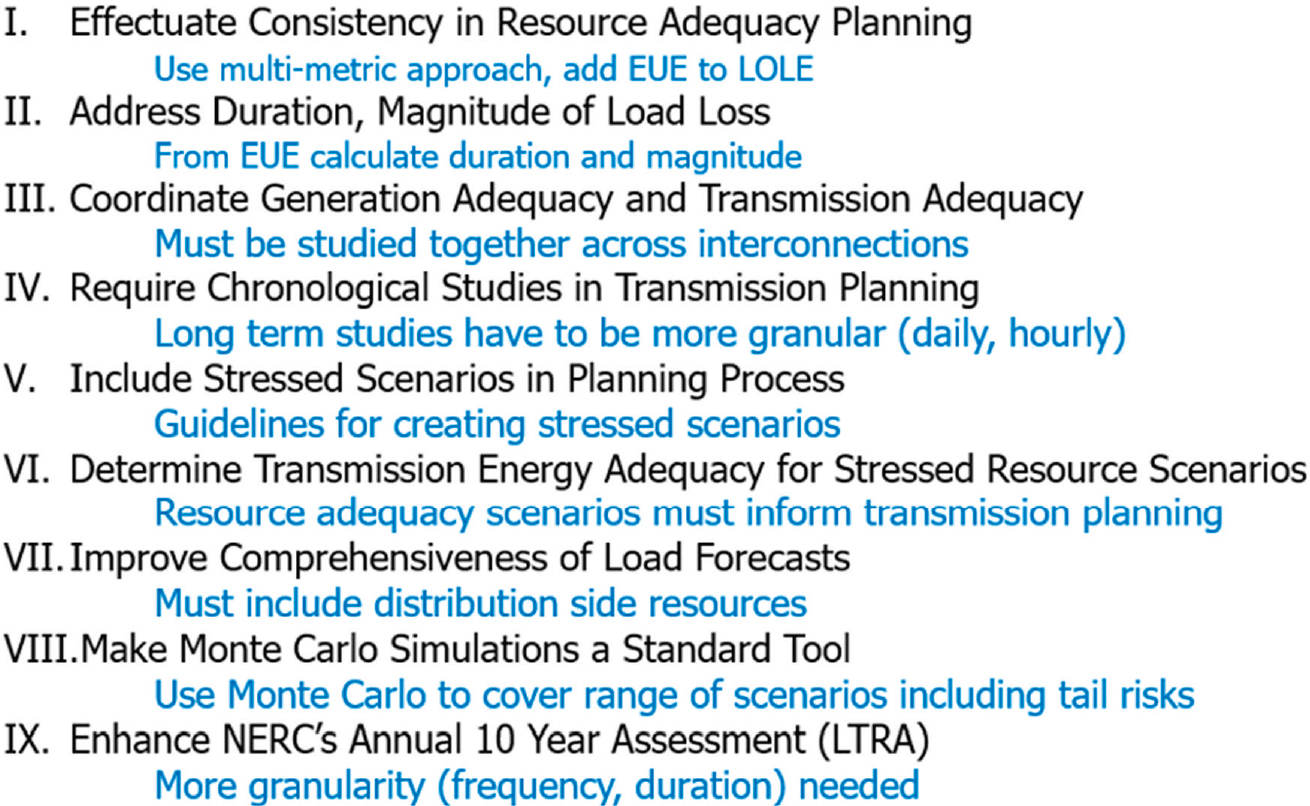
NOTE: EUE = expected unserved energy; LOLE = loss of load expectation; LTRA = long-term reliability assessment; NERC = North American Electric Reliability Corporation.
SOURCES: Lauby (2024); created using data from NERC and NAE Section 6 (2024).
and bigger utilities that DERs are win-win, bringing benefits to both sides of the meter. They noted that co-ops can own and store more energy assets than munis, and have experimented more with DERs, but munis may be particularly well positioned to integrate electric vehicle charging benefits into people’s homes or provide DER-powered public services, improving energy resiliency.
Munis and co-ops, which generally have smaller staffs and greater resource limitations compared with larger utilities, can benefit from “plug-and-play” solutions that are modular, standardized, easy to incorporate, and need very little technical assistance, participants said. Their small size also puts them in a good position to experiment with derisking options for customers or reliability and load loss issues. Participants pointed out that DERs can help co-ops and munis improve resilience—for example, by leveraging microgrids—and reduce the need to build and maintain long lines in rural areas, which can be expensive. Participants also noted the challenges of political bias affecting decision making at munis and co-ops, which could hamper the uptake of promising technologies and efforts to reduce greenhouse gas emissions.
Because co-ops have to demonstrate benefits to their members, and munis are taxpayer-funded, improving energy equity is an important priority. Participants suggested that better practices could improve community engagement—for example, they noted that using easy-to-understand language can gain customers’ trust and buy-in more quickly.
BUILDING A MORE RESILIENT ELECTRICITY SYSTEM THAT SERVES COMMUNITIES EQUITABLY
This breakout session was moderated by Elizabeth Stein, state policy director, Institute for Policy Integrity, New York University School of Law. In contrast to reliability, there has been markedly less attention paid to establishing metrics for resilience in the electric power industry. This group examined strategies for measuring and enhancing resilience, in terms of both the grid itself and the communities that the grid serves. They outlined a need for performance-based, attribute-based, and equity-focused resilience metrics. To create such metrics, they suggested identifying which parts of utility systems fail the most; where those points intersect with vulnerable communities; and the specific needs, attributes, and baseline resiliency level of the communities served.
Measuring and standardizing approaches to grid resilience can help utilities provide communities with a suitable—and suitably funded—portfolio of solutions and safety measures for withstanding and recovering from stressed conditions. In developing plans and solutions, some participants emphasized the need to base assumptions on future climate
projections rather than past or present conditions. They also suggested that capital investments should be aligned with resilience metrics, but noted that different utilities will make different decisions. For example, munis, which have a stronger mandate to consider societal benefits, might consider installing microgrids in vulnerable communities for localized energy resilience.
To support equity and consider the energy resilience of communities from a broader perspective, participants pointed out that it is useful to consider not only a community’s relationship to electricity but the role of other critical sectors like transportation, water, and natural gas. Participants suggested that utilities can focus on engaging communities in developing resilience objectives and creating resource-sharing plans to minimize harm during outages, including buildings that are able to share their energy resources beyond their individual need.
Humans are social creatures, and participants pointed out that DERs offer new opportunities to share resources. To create more resilient systems with greater mutual benefits, they suggested drawing inspiration from natural systems. In contrast with brittle just-in-time supply chains, natural systems often have built-in resource diversity and redundancy, giving them the flexibility to better withstand disruptions and failures. Participants suggested that encouraging resource diversity and redundancy, with intentionality and visibility, can help to build a more resilient energy future, especially for vulnerable communities and in the context of high-impact, low-frequency events.
CLOSING REFLECTIONS
Offering closing reflections to wrap up the workshop, Annaswamy reiterated that the challenge of maintaining and enhancing operability and reliability in the electric power system is an incredibly complex problem. Given that the current system was architected over the course of a century, changing how we plan and how we operate is understandably going to be difficult to do at scale and at speed. The goal of the workshop was to gather key stakeholders together to get a sense of the key challenges and concerns, and Annaswamy praised participants for their engagement and commitment to discussing the issues honestly and in depth. “We got you all in the same room, and my sense is that we were able to hear each other. But … we now go on to the important step of actually listening to each other, understanding, and collaborating … [to] move toward realizing our goals,” she concluded.


