Roundtable on Obesity Solutions 10th Anniversary: Looking Back, Moving Forward: Proceedings of a Symposium (2025)
Chapter: 5 Exploring the State of Obesity Now
5
Exploring the State of Obesity Now
There have been major shifts in the obesity environment over the last several decades, said William H. Dietz, The George Washington University. There are new effective medications and progress in obesity care. For example, he said, the U.S. Office of Personnel Management recently mandated coverage of these medications for federal employees. The number of publications related to obesity has grown dramatically, with just over 10,000 publications between 1990 and 1994, and 145,000 publications between 2020 and 2024. There is increasing acknowledgment of the role of obesity in related diseases; for example, the American Heart Association has a new initiative on cardiovascular-kidney-metabolic health.1 There has also been progress on the legislative front, said Dietz, with the Treat and Reduce Obesity Act moving forward through Congress.2 On the downside, however, the $1 billion investment in childhood obesity by the Robert Wood Johnson Foundation is coming to an end after 20 years of shaping the field.
In this symposium session, Dietz explored where the field of obesity is currently, and where it may be going in the future. He covered a variety of topics related to obesity, including prevalence trends, ideas on causality, new GLP-1 medications, prevention in children, and moving beyond the causal systems map.
___________________
1 https://www.heart.org/en/professional/cardiovascular-kidney-metabolic-health (accessed October 4, 2024).
2 https://waysandmeans.house.gov/wp-content/uploads/2024/06/Ways-and-Means-Description-of-the-AINS-to-H.R.-4818-Green-Sheet.pdf (accessed October 4, 2024).
PREVALENCE TRENDS
Data on obesity over the last 60 years show an inflection point around 1975, said Dietz (Figure 5-1). The trend is similar among men and women of all ages, suggesting a common exposure that has not been widely appreciated. The same pattern is seen in data from other regions of the world, although there is a lag of about 20 years (Suminska et al., 2022). Currently, only about 8 percent of global obesity is attributable to the United States. Dietz said that he believes that whatever is causing the increase in obesity is being exported from the United States to the rest of the world.
Another global phenomenon, said Dietz, is changes in the prevalence of both obesity and undernutrition; this “double burden” increased in 162 countries over a 20-year period. He noted that where the double burden has increased, the increase is attributable to increases in obesity, and where the double burden has decreased, the decrease is attributable to decreases in undernutrition. In other words, he said, the prevalence of obesity is getting worse and the prevalence of undernutrition is getting better.
Children in the United States have experienced increases in obesity similar to those seen in adults (Figure 5-2). Prevalence began to rise in the mid-1970s and has continued to rise in children 6–11 and
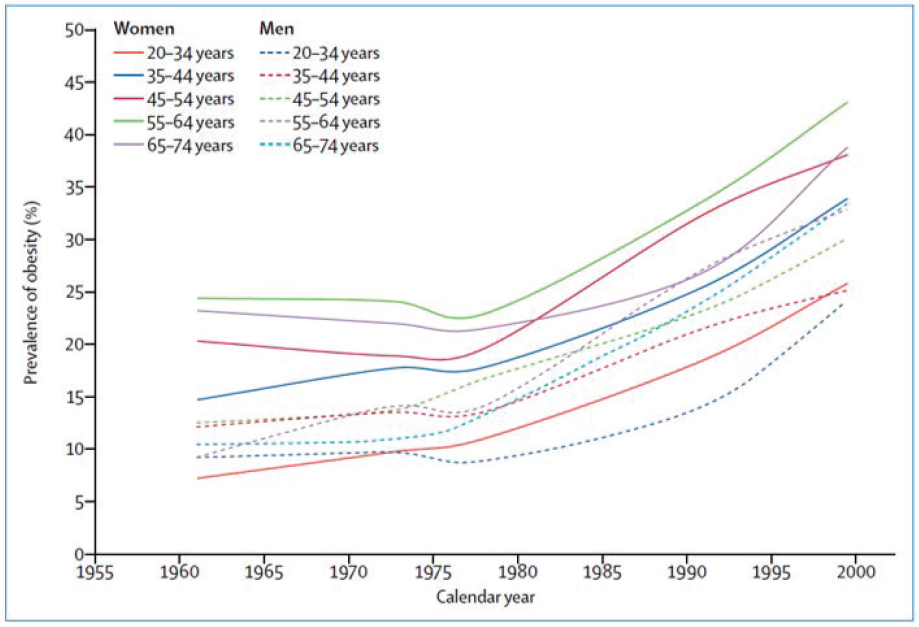
SOURCES: Presented by William Dietz, July 24, 2024; Rodgers et al., 2018. Reprinted with permission from Elsevier, CC-BY-NC-ND 4.0.
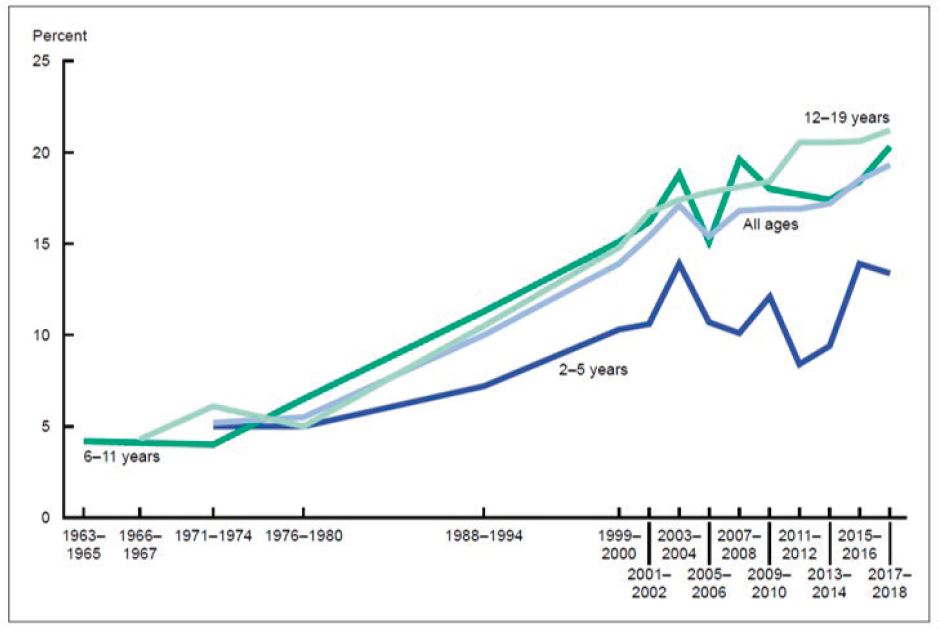
SOURCES: Presented by William Dietz, July 24, 2024; Fryar et al., 2020. Reprinted with permission from National Center for Health Statistics.
12–19 years. However, children ages 2–5 years old have taken a different route. Prevalence of obesity in this group began to decline around 2003 and has fluctuated since.
Dietz said that this pattern suggests that the causes of origin—those factors which predispose or predict the prevalence of obesity—are different than the causes of course. That is, he explained, there are factors that affect changes in obesity, and those factors may differ for children and adolescents. Only about half of adult obesity begins in childhood, so there is a need to identify and address the determinants of both childhood and adult obesity. Dietz said that one potentially effective approach would be to focus on preventing the development of obesity in young adults; this could possibly reduce both adult prevalence and the prevalence in their children. This dual approach, he said, is one worth pursuing.
Dietz shared his theory that morbidity and mortality secondary to obesity has lowered life expectancy in the United States. As seen in Figure 5-3, the United States has the lowest trajectory of life expectancy at birth in select high-income countries. Attributing this decrease to obesity is a hypothesis, he said, but there is a “realistic expectation that that is the case.”
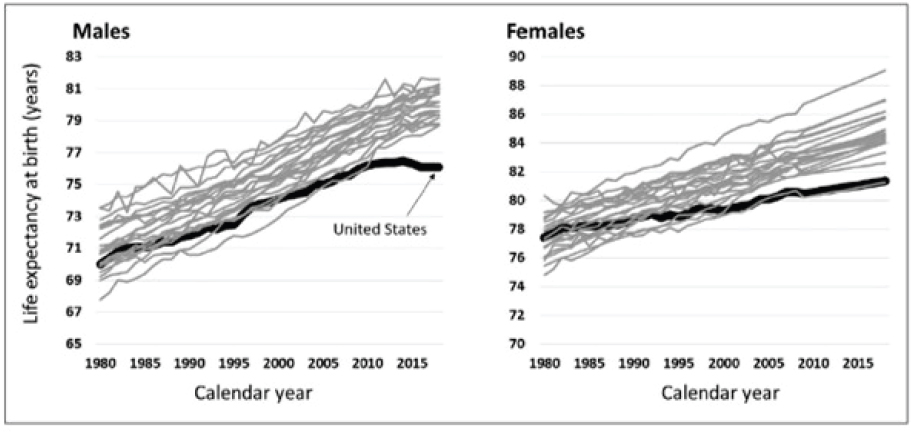
SOURCES: Presented by William Dietz, July 24, 2024; Montez, J. K., M. D. Hayward, and A. Zajacova. 2021. Trends in U.S. population health: Copyright © 2024 by Sage Publications. Reprinted by Permission of Sage Publications.
RETHINKING CAUSALITY
Dietz highlighted recent research exploring potential causes of obesity. One paper looked at the association between obesity and the intake of high-fructose corn syrup and ultra-processed foods (Bray, 2023). The rise in ultra-processed foods began around the same time as the rise in obesity in the 1980s, while the increase in high-fructose corn syrup began several years earlier. Dietz noted that high-fructose corn syrup could actually be a surrogate of measures of ultra-processed foods.
Another researcher explored obesity in the context of obesogens like “forever chemicals” (Baillie-Hamilton, 2002). The fluorochemicals perfluoro-octanesulfonic acid (PFOS) and polyfluroalkyl substances (PFAS) began to be manufactured in the 1970s, around the same time as the rise in obesity. These and other chemical disruptors like bisphenol A, phthalates, and other plasticizers are ubiquitous, said Dietz. They are detectable in over 16,000 products and 45 percent of tap water, and there are significant blood levels in pets, birds, wild animals, and humans. Health effects associated with these chemicals include obesity, diabetes, liver disease, issues with fetal development, impaired immune function, and early breast development. Importantly, said Dietz, PFOS and PFAS were not present in blood samples collected before 1969–1971; this finding strengthens the argument that these exposures may have a causal relationship with obesity.
Dietz said that he thinks that both the consumption of ultra-processed foods and the exposure to forever chemicals may be contributing factors to the rise in obesity. He noted that these two factors differ in that the consumption of ultra-processed foods is malleable, whereas the exposure to forever chemicals cannot be changed. This research suggests that there may be a constant driver of obesity that is attributable to obesogens that is independent of other factors, and it may not be able to be changed. This has implications, said Dietz, for the ability to prevent obesity, and that emphasis needs to be put on treatment.
A symposium participant asked Dietz to elaborate on what is known about the connection between PFAS and obesity. He replied that there is one interesting study about how fluorocarbons affect the carbohydrate insulin model, as well as the energy balance model. Another study shows that the levels of PFAS in nursing mothers decrease, which means that the chemical is being transferred to the infant. Dietz said that there may not be any way to reduce levels of PFAS, so research is needed on how to effectively counter the effect instead.
A participant said this reminded him of a paper he read that discussed the higher rates of obesity in Black women and the potential relationship to chemical hair processing. He noted that while we all live in an obesogenic environment, people have different levels of exposure. For example, everyone has some exposure to PFAS, but some people work in a factory that produces PFAS. He asked Dietz if there could be ways to identify and quantify these different exposures and develop strategies to minimize the harm. Dietz agreed that disparities could be related to different exposures in the environment; for example, people who rely on ultra-processed foods are also exposed to higher levels of PFAS in the packaging of these foods. Related to ultra-processed foods, Sullivan asked Dietz if the school lunch program, which has improved thanks to nutrient standards, could also include requirements for limits on ultra-processed foods. Dietz said this was a “great idea” because dietary patterns may be more important than the caloric content of foods.
GLP-1 MEDICATIONS
The new GLP-1 agonists have already transformed obesity care, said Dietz. He shared data from a trial of one of these medications, tirzepatide. In this trial, all participants participated in an initial 12-week run-in period of intensive lifestyle intervention; those that lost 5 percent of their body weight or more were then randomized into tirzepatide and control groups. He noted that the slope of the weight loss in the first 12 weeks was nearly identical to the slope of weight loss once tirzepatide was introduced (Figure 5-4). This observation suggests that intensive behavioral therapy

NOTE: Blue triangle = tirzepatide introduced at week 0, white square = control.
SOURCES: Presented by William Dietz, July 24, 2024; Wadden et al., 2023. Reprinted with permission from Springer Nature, CC BY 4.0.
should not be discounted as an effective treatment, and there may be opportunities to think more broadly about how to change the environment to amplify the effects or targets of behavioral therapy. With all of the GLP-1 medications, said Dietz, weight loss occurs and then plateaus; in the tirzepatide study the plateau occurred around 60 weeks. To maintain the weight loss, one approach would be to simply continue the drug. Dietz argued that there is a need to think more formally about how to achieve weight maintenance during this period; he suggested that alternative drugs such as phentermine could be used to maintain weight loss at a lower cost.
Looking critically at the data on GLP-1 drugs, both clinical trial and general use are associated with racial and socioeconomic disparities and inequities. There is a lower rate of participation of people of color in trials; lower participation may obscure different responses, or increase concerns about drug effects, thereby exacerbating existing disparities and inequities in obesity. Further, said Dietz, drug trials have been limited to physiologic response, so there is little evidence about how factors like race, culture, and socioeconomic class affect the use of these medications and their therapeutic outcomes. An additional challenge with the use of GLP-1 medications is that their widespread use will threaten the recognition of the importance of obesity prevention. “We will not be able to treat our way out of the obesity pandemic,” said Dietz, so it is critical to consider how to identify and change the conditions under which obesity
occurs. For example, if PFAS exposures are a driver of obesity, research is needed to determine what protects against obesity in those who do not develop it but have the same exposure.
While these drugs have changed the landscape of obesity, the bias against people with obesity now extends to obesity medications. People who are on these drugs are accused of “taking the easy way out.” This failure to recognize obesity as a disease and the continued emphasis on personal responsibility is problematic, said Dietz.
THE IMPLICATIONS OF CLINICAL TRIALS OF PREVENTION IN CHILDREN
There have been two major multicenter trials of pediatric obesity prevention, said Dietz. The Girls Health Enrichment Multisite Studies study was a 2-year intervention directed at 8- to 10-year-old low-income African American girls (Obarzanek and Pratt, 2003). The Childhood Obesity Prevention and Treatment Research study was a 3-year intervention directed at low-income African American or Hispanic children who were either 2–5 years old or in middle school (Pratt et al., 2013). These were “superbly designed studies” of behavior change, said Dietz, with components addressing family, community, physical activity, TV viewing, primary care, and skill building. Nonetheless, there was no effect of the intervention compared to controls on the prevalence of obesity.
One potential explanation for the lack of effect is that the socioeconomic social determinants of obesity were not addressed. For example, among participants in Cleveland, 30 percent were food insecure, 30 percent lacked access to a grocery store, and 25 percent changed their residence yearly. Crime rates were three times those of adjacent counties, and one child in the study was shot in a drive-by shooting. This study took place in an area where the social determinants probably outweighed any consideration of the behavior change necessary to achieve weight loss, said Dietz.
He called attention to Kumanyika’s Equity Oriented Obesity Prevention Framework (Figure 2-2, earlier) as well as a model called “Pair of ACEs,” which refers to adverse childhood experiences and adverse community environments (Figure 5-5). It has been known for some time that exposure to adverse childhood experiences is associated with adult obesity, but Dietz said what is unique about this model is that it explores the underpinnings of these experiences such as poverty, discrimination, poor housing, and violence. What is needed, he said, are trials directed at these social and structural determinants of obesity to see if obesity is reduced or prevented as a secondary benefit. The primary benefit ought to be on these social determinants, but there may be a secondary benefit to obesity prevention.
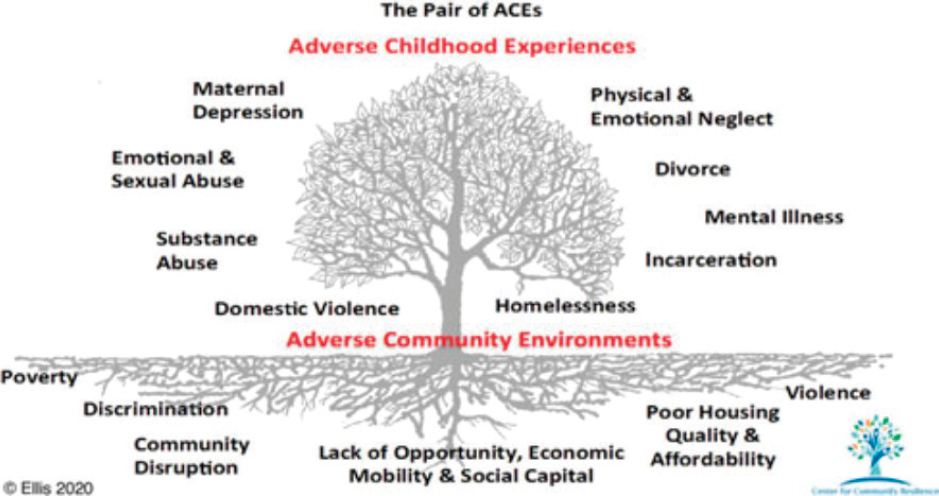
NOTE: ACE = adverse childhood experience and adverse community environment.
SOURCES: Presented by William Dietz, July 24, 2024; Ellis et al., 2022. Reprinted with permission from Wolters Kluwer Health, Inc., CC-BY-NC-ND.
MOVING BEYOND THE ROUNDTABLE’S CAUSAL SYSTEMS MAP
Dietz shared the obesity systems map that Economos had discussed earlier. He noted that one thing that is missing from the map is the “how.” While the map has helped the roundtable to understand how different pieces are related to each other, he said that not enough thought has been given to how to model outcomes and where the leverage points are. This will be a challenge moving forward, he said. Another thing that is missing from the map is the macro factors that affect everyone; for example, multinational food corporations are not on the map but certainly play a role in obesity. Dietz encouraged roundtable members and symposium participants to think broadly about the determinants of obesity, and shared a quote that resonated with him:
The focus on social determinants of health needs to be matched with an equal concern for the commercial determinants of health … and the political determinants of health and the interface between these determinants. (Kickbusch, 2012)
CLOSING REMARKS
In closing, Dietz offered several suggestions for the roundtable to focus on in the future:
- Identifying effective strategies to reverse reliance on ultra-processed foods.
- Initiating further research to determine what distinguishes those who are vulnerable to the effects of PFAS from those who are resistant.
- The shared interest in obesity by the American Heart Association, American Diabetes Association, American Cancer Society, American Association for the Study of Liver Diseases, and health care delivery systems offer collaborative opportunities to focus on prevention and treatment. The roundtable should convene and drive these efforts.
- Identifying and highlighting successful efforts to address structural racism.
- Moving beyond the what of the roundtable’s causal loop diagram to the how.
- Increasing the roundtable’s focus on the dominant role of industry.
This page intentionally left blank.


