Roundtable on Obesity Solutions 10th Anniversary: Looking Back, Moving Forward: Proceedings of a Symposium (2025)
Chapter: 7 Alternative Perspectives on the Future of Obesity Solutions
7
Alternative Perspectives on the Future of Obesity Solutions
Megan Nechanicky, General Mills, introduced panelists for this symposium session, which focused on alternative perspectives on obesity solutions.
CONSUMER PERSPECTIVES
NielsenIQ (NIQ) is a global marketing research firm that captures data from 90 countries on consumer purchasing, said Sherry Frey, NIQ. She shared data on trends that are relevant to the issue of obesity. Since 2016, NIQ has asked consumers about conditions they or someone in their household has. In 2024, about 23 percent of respondents said someone was experiencing obesity or overweight. Interestingly, said Frey, overweight/obesity is one of three conditions for which self-reports have gone down over time, from a high of 29.2 in 2018 to the current 23 percent (Figure 7-1). Frey hypothesized that this may be attributable to the normalization of overweight/obesity.
Households that reported having a family member with overweight/obesity were two to three times more likely to also report conditions including prediabetes, diabetes, irritable bowel syndrome, restless leg syndrome, and gum disease. Some of these are tied directly to nutrition and some are not, she said, but it is important to note that these households have more challenges, including income. NIQ also asked respondents how they are treating their overweight/obesity. The majority say they are treating with diet (55 percent) and exercise (51 percent), with fewer using vitamins and supplements, prescription medications, and over-the-counter medications.
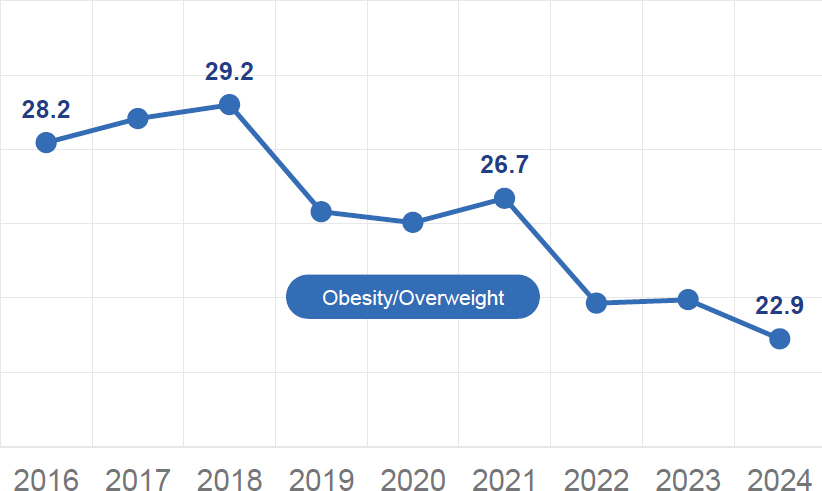
NOTE: NIQ = NielsenIQ.
SOURCES: Presentation by Sherry Frey on July 24, 2024. Data from NielsenIQ Health Shopper Survey, 2016–2024.
Around a quarter say that they do not do anything to treat or manage their overweight/obesity, she said.
NIQ has the ability to see what consumers who report conditions are buying, said Frey. Households that reported a family member with overweight/obesity were among the highest purchasers of ultra-processed foods but also among the highest purchasers of fresh produce. Compared to all households, these households are more likely to self-report that they prioritize buying foods that are low sugar, low sodium, high protein, free from high-fructose corn syrup, and low fat. Food and beverage products with claims about weight management make up a small percentage of food products, said Frey, and sales have been declining in recent years. Sales of weight management supplements are also on the decline, with the exception of berberine, which rose 438 percent after going viral on social media platforms as “nature’s Ozempic.”
A partnership with Management Science Associates has allowed NIQ to take panel data and match it with de-identified medical records to measure the use of GLP-1 medications. The age at first prescription is trending younger, said Frey, and, as anticipated, use has increased among people who have obesity but not diabetes. On average, patients who have obesity and diabetes take the medication for a longer period, compared to patients who have obesity but not diabetes. Frey said NIQ also has data on how
consumption changes over time for people using GLP-1 medications. In the first 90 days, there is a reduction in alcohol consumption, with some alcohol categories rebounding. Initial findings saw patients pull back on consumption of vegetables in the first 90 days, which Frey suggested could be caused by digestive issues, and increase consumption of protein snacks. She said the data show a “tale of two consumers.” Some patients taking GLP-1 medications are demonstrating healthier behavior patterns, while others are consuming more snack foods and taking “more trips to the convenience store.”
NIQ also tracks shifts in what consumers buy with regard to the nutrition label, said Frey. Total sales of food and beverage have increased, but increases have been particularly concentrated in foods with lower sodium, and in the middle range of total fat and added sugars. There has also been growth in sales of high-protein foods, and new formulations of products that have over 25 grams of protein per serving. Frey said that while initial analysis of self-report data does not show differences by race/ethnicity or region, there are opportunities to drill down in data on consumption to see if there are specific challenges in certain communities.
OBESITY IN AN ECONOMICS FRAME
For many reasons, economics can be a useful framework for addressing the obesity epidemic, said John Cawley, Cornell University. One particular reason is that economics offers specific criteria for when and how the government should intervene in markets. The economic rationale for government intervention is to fix market failures, Cawley said, and he highlighted three specific criteria that are relevant to obesity: internalize negative externalities, ensure consumers have the necessary information to make informed decisions, and protect consumers when they are not acting “rationally.”
Internalize Negative Externalities
There are substantial externalities associated with obesity, said Cawley. Relative to individuals with healthy weight, obesity raises annual medical care costs by thousands of dollars, and the additional expenditures increase with the severity of the obesity (Biener et al., 2024). For individuals with class 1 obesity (body mass index [BMI] of 30 to less than 35), costs rise by 73 percent or $1,902 per year. For those with class 2 obesity (BMI of 35 to less than 40), costs rise by 129 percent or $3,336 per year. For those with class 3 obesity (BMI of 40 or greater), costs are 253 percent higher, or $6,493 per year. Roughly 95 percent of the costs of treating obesity-related illness are borne by third-party payers, said Cawley. Ultimately, these costs are covered by taxpayers if the payer is Medicare or Medicaid,
or by everyone who pays health insurance premia if the payer is private health insurance. Cawley shared a graph that provides a visual of the average annual medical expenditures associated with each unit of BMI in adults (Biener et al., 2024). Interestingly, he said, the costs remain relatively flat around a BMI of 30, which is the threshold for obesity. Reducing BMI around this level would not reduce costs by much, he said; the real potential for cost savings is where there is exponential growth in costs, around a BMI of 35 to 40 and up.
There have been attempts by policy makers to address these externalities, said Cawley; the most widespread approach is to tax sugar-sweetened beverages (SSBs). These taxes have been enacted around the globe over the last 20 years, with the goal of increasing the costs of these beverages to consumers and leading them to make a different and, it is hoped, healthier choice. Cawley and other researchers have studied the effects of the taxes and have found that the taxes are largely—but not entirely—passed on to consumers in the form of higher retail prices (Cawley et al., 2021). Other studies have found that SSB taxes significantly reduce consumer purchases and store sales within the taxing jurisdiction (Cawley and Frisvold, 2023). Cawley noted that there are fewer studies on consumption or effect on BMI, in part because of challenges in measuring those outcomes.
Improve Consumer Information
Another approach for addressing obesity by correcting a market failure is to improve the information that consumers have when making decisions, such as including calorie information on menus, said Cawley. One prominent law that addressed this issue was the Affordable Care Act (ACA) of 2010, a provision of which imposed a nationwide menu label law. Cawley and his colleagues conducted a study on the effect of this law on consumer behavior (Cawley et al., 2020). They conducted the study in two full-service, sit-down restaurants, and randomized parties of guests as they entered. The control group received the standard menu, while the treatment group received the same menu but with calorie labels added, in the format required by ACA. Based on data from 5,500 diners, Cawley et al. found that the calorie counts significantly reduced the number of calories that people ordered at dinner by 45 calories on average, or about 3 percent (Cawley et al., 2020). Cawley noted that over 5 years, this reduction would be associated with a 1- to 1.5-pound reduction in weight. This approach is not a “silver bullet,” he said, but it may be one successful part of a more comprehensive strategy.
Irrational Consumer Behavior
The third market failure that is relevant to obesity, said Cawley, is behavior by consumers that is not rational—that is, not in their own best interests. This can be a more challenging area for intervention, he said, because of the risk of paternalism. One example is that people may have “time inconsistent preferences,” where they know the choices that would be most beneficial in the long term but tend to succumb to temptation and choose immediate gratification instead. The strongest case for intervention is when people report that they keep making mistakes and they ask for help. To help people make more “rational” decisions, Cawley said that precommitment devices, such as bariatric surgery, can be useful. If someone wants to reduce their eating but is not able to do so through other means, bariatric surgery can “force their future selves to adhere to a lower-calorie diet.”
A case can also be made for helping children make better decisions because research on brain development shows that their neocortex—responsible for making rational decisions—is not fully developed until around age 25. One approach in this area, said Cawley, is regulating advertising of energy-dense foods to children. He noted, however, that this approach can be challenging to implement in the United States given the latitude of commercial free speech.
Moving Forward
Using economics as a framework, Cawley offered several suggestions for approaches to address obesity:
- Internalizing externalities associated with obesity through taxes on energy-dense food and drink, with the amount of tax determined by the size of the externality.
- Subsidizing cost-effective methods of treatment and prevention.
- Providing consumers missing useful information in a way they can easily use, such as front-of-packaging labels on groceries and nutrition information on menus.
- For children, reducing harm from “irrational” behavior by regulating harmful marketing.
- For adults, reducing harm from “irrational” behavior by offering precommitment devices to limit overconsumption (e.g., bariatric surgery).
TECHNOLOGY AND ARTIFICIAL INTELLIGENCE
To illustrate the issues involved with technology and artificial intelligence (AI), Thomas N. Robinson, Stanford University, began by painting a picture. It is the year 2029, and the roundtable is celebrating its 15th anniversary. Maria is a single mom living in the city, and like many people, she has a busy life and struggles to maintain a healthy weight. In the morning, she wakes up refreshed. Her personal AI assistant named Bot has set her smart bed based on her circadian rhythms. Her smart bed also monitors her body composition, and her smart skin patches and smart toilet assesses her metabolome, proteome, and gut microbiome. However, none of Maria’s data ever leaves her devices. She’s opted to allow researchers to use her data in an anonymized way using federated data analysis, and her family’s data are never sold or shared.
“Good morning, Maria,” says Bot. “Your sleep quality was excellent last night. Your weight is stable, and your metabolism is in your desired range. I’ve suggested a recipe for breakfast.” Maria’s smart refrigerator monitors the food she has, what she likes to cook, and what she and her kids like to eat and how much. Bot suggests recipes to meet Maria’s optimal nutritional needs, orders groceries automatically, and provides feedback and suggestions. If Maria enjoys occasional unhealthy snacks, Bot incorporates them into the rest of her plans, so she doesn’t feel guilty. Bot’s decision making is personalized to Maria’s selected values and priorities for health, environmental sustainability, and worker and animal welfare, and is constantly learning from Maria’s and her children’s behaviors and emotions. When Maria uses her smartphone, smart glasses, or other screens, Bot blocks advertising and marketing, misinformation, and other harmful content and steers her to things that, according to her brain monitor, improve her mood and things she finds useful or educational, and it keeps her connected with her family and community.
In the evening, Maria and her children play an outdoor, physically active, augmented reality game in a nearby park. City planners have used AI to place parks, trails, and bike lanes to increase outdoor play, walking, biking, and public transportation. If Bot detects any important changes in Maria’s or her children’s health or future risks, it schedules virtual consultations with the appropriate medical specialists, and their AI, to help her adjust her plan. If further intervention is warranted, she is matched to the optimal treatment based on her biology, behavior, and values. So, because of this, Maria feels like she has agency to help her family optimize their health and well-being.
Robinson told symposium participants that the capabilities of many of the technologies described in this story exist today and can do almost everything described. Given this reality, what are the implications for those
studying and developing innovative new interventions for obesity? Based on his experience with his own digital research, Robinson argued that the future will be a world with less theory and more of a balance between deductive (top-down) and inductive (bottom-up) approaches to theorizing and science. In addition, there will need to be a greater emphasis on complexity and interdependence; saying that our current systems maps will appear “like a child’s drawing.”
Another big shift, said Robinson, will be an emphasis on idiosyncrasy in experiences, with a move away from generalizability and toward transferability. Everyone will have their own unique experiences and data, and the unit of analysis will be each individual person rather than populations. Models will be built specifically for one person and transferred to other individuals, rather than attempting to find a single, generalizable solution for everyone. There will also be a need to address brief, but very consequential experiences, what his group is referring to as finding “needles in a haystack” that produce oversized effects.
Robinson then shared an alternative story of the future. In this story, also set in 2029, Maria wakes up feeling groggy after staying up late, unable to tear herself away from the new TikTok super app. Data from her smart bed, smart toilet, and skin patches are sold to her medical, life, and auto insurance companies, and Bot alerts her that her poor sleep, poor diet, and recent weight gain will result in insurance premium increases. Maria’s smart fridge flashes advertisements for high calorie, ultra-processed foods, cleverly marketed as sustainable and healthy products, knowing exactly what messages she is likely to respond to. Promoted foods are automatically added to her shopping cart. Data from all her wearable and smart connected devices are sold to marketers for precision marketing. When she is feeling stressed, she removes her monitors and hides in her car to gobble down an ice cream as quickly as possible, worried about being found out by her insurance companies, yet they already have her purchase data.
At her workplace, robots and drones have eliminated almost all physical exertion during work. Maria’s children’s school has partnered with fast-food chains, promoting their so-called healthier options through gamified apps that track the kids’ eating habits. Social posts and safety apps alert her to crimes committed in her city and make Maria fear letting her children play outside. They spend their evenings using addictive apps and games that keep them inside and sedentary.
When Maria schedules virtual consultations with medical providers, both she and her providers receive targeted marketing from pharmaceutical companies based on information from her medical record and their discussion during the visit. Further, based on purchase data about elected officials and government employees, corporations and their lobbyists have identified optimal strategies to prevent any legislation or regulations that will hinder
their access to and use of data. In this future, Maria feels like she has very little agency to help her family optimize their health and well-being.
Some would argue that this is more likely to be the direction we are headed, said Robinson. He recommended the issues that need to be addressed now if we want to instead move toward the first future he described. First, there is a need to contend with issues of transparency and data privacy. Users should be informed and give explicit consent to the collection, use, and sharing of their data, and there should be strict limitations on how data can be used. Second, Robinson said that there is a reliable pattern of technical innovations increasing socioeconomic disparities, so there is a need for active policies to ensure equitable access and unbiased AI. Third, ethical AI standards for the development of algorithms are needed to ensure that AI models are equitable, unbiased, and incorporate human values. Finally, said Robinson, to make sure that technology works for us instead of against us, we need a system of accountability that can hold people and companies liable for violating ethical standards or contributing harm, including externalities.
Unfortunately, there has been no meaningful legislation or regulation in these areas in the United States, said Robinson. There is a lot of profit to be made in data harvesting and surveillance, and the corporations that are involved are powerful. “It is upon all of us to raise alarms” about what we see happening with technology, said Robinson, and it is imperative that people bring their public health and obesity perspectives to the conversation.
A GLOBAL FOOD SYSTEM PERSPECTIVE
Despite the advent of GLP-1 medications, said Jessica Fanzo, Columbia University, food systems still have an important role to play in mitigating obesity. Food systems deliver our diets, and diets are a major risk factor of global morbidity and mortality. Four of the top five risk factors for mortality globally are related to diets: high systolic blood pressure, dietary risks, high fasting plasma glucose, and high body-mass index (Murray et al., 2020). Access to healthy diets is a challenge for many, said Fanzo, and this is because of a combination of factors: food prices, food availability, physical access, cultural factors, knowledge and abilities, and psychosocial resources (Figure 7-2). Globally, 2.8 billion people cannot afford a healthy diet. The types of foods available in different parts of the world vary, but sales of ultra-processed foods are increasing in many areas and are projected to continue to rise. Ultra-processed foods are easily traded, cheap to make, cheap to buy, tasty, and convenient, said Fanzo, but there is significant evidence linking these foods to poor health.
“For food systems to deliver healthy diets, we need to understand and address the “three Cs:” climate change, the long tail of COVID,
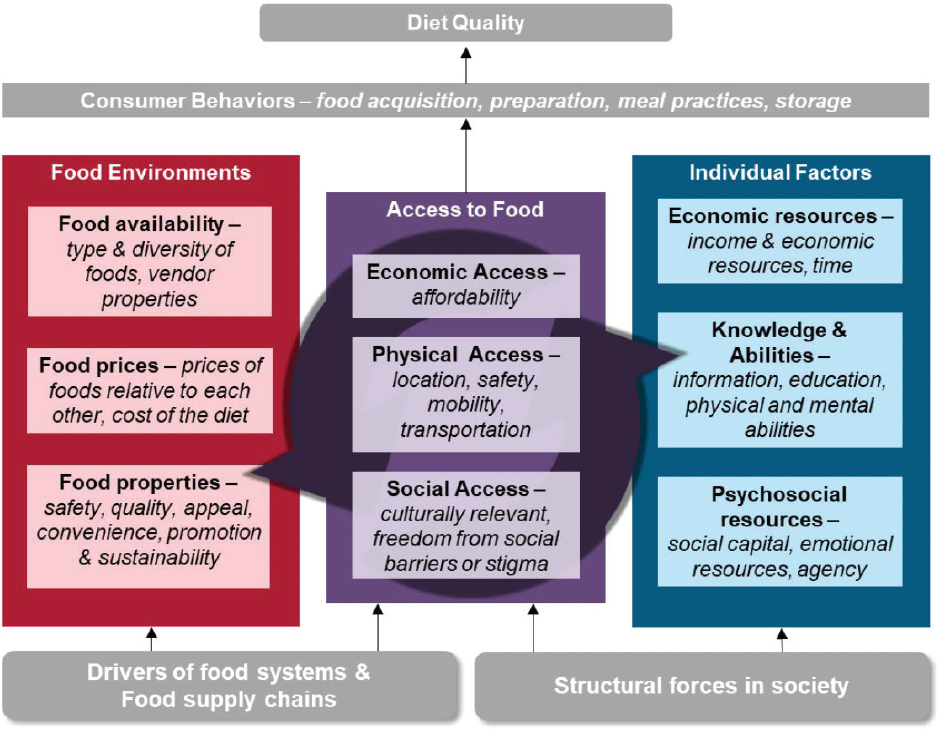
SOURCES: Presented by Jessica Fanzo, July 24, 2024; Schneider et al., 2023. Reprinted with permission from Food System Economics Commission, CC-BY-NC-SA 4.0.
and conflict,” said Fanzo. She explained that these three factors affect food, finance, fuel, fodder, and fertilizer prices around the world, and that together, all of these factors negatively affect food security, diet and health, environmental sustainability, and livelihoods. Climate change has and will continue to significantly deteriorate food systems and diet quality. Warming temperatures, altered rain patterns, rising sea levels, heat, extreme events, floods, droughts, and heat waves decrease the ability of the food system to grow high-quality food and to move food around the planet. This contributes to a number of negative outcomes, including undernutrition, overweight, obesity, and noncommunicable diseases, said Fanzo.
Addressing climate change—specifically, meeting the Paris climate change targets—will require multilevel food systems action, argued Fanzo. Continuing with “business as usual” in the food sector will exceed the temperature goals set in Paris, so change is necessary. Changes need to be made in three areas: food production, food consumption, and food loss and waste. Moving toward more plant-dominant diets and consuming a
healthy number of calories would go a long way toward meeting climate goals, she said, but action in all areas is necessary. The food system agenda and the climate agenda are linked, said Fanzo; both are critically important for health outcomes and obesity mitigation.


