Implementing Data Governance at Transportation Agencies: Volume 1: Implementation Guide (2024)
Chapter: 7 Sample Materials
7. Sample Materials
Overview
This chapter provides sample materials that support data governance implementation. Table 7 lists the resources included and indicates the chapter(s) of this Guide to which they relate.
Table 7. Tackling Other Data Governance Challenges
| Resource | Relevant Chapter(s) |
|---|---|
| Data Governance Policy Outline | 2. Why Data Governance 3. Getting Started |
| Sample Stakeholder Interview Questions | 3. Getting Started |
| Data Governance Body Charter Outline | 4. Roles and Responsibilities |
| Sample Data Stewardship Domain Models | 4. Roles and Responsibilities |
| Sample Competencies for an Agency Data Lead | 4. Roles and Responsibilities |
| Sample Data Element Standard | 5. Data Governance in Action |
| Data Sharing Agreement Outline | 5. Data Governance in Action |
| Data Proposal Intake Questions | 5. Data Governance in Action |
| Sample Data Flow Diagram | 5. Data Governance in Action |
| Sample RACI Chart | 6. Tackling Common Challenges |
Data Governance Policy Outline
| Section | Description | Sample Content |
| Header | Provide reference information for managing the policy |
|
| Purpose | State why the policy has been created. | This policy sets forth a department-wide approach to data governance to ensure a holistic, integrated, strategic approach to managing, processing, controlling, archiving and retrieving data and information to meet Department business needs. |
| Background | Describe what data governance is and how it aligns with state-level statutes or policies and agency strategic goals. |
Data and information are strategic assets of the Department and must be actively governed in order to preserve and enhance their value and meet legal requirements around privacy and confidentiality.
Data governance is a widely used practice in the public and private sectors to establish corporate oversight for new data development and ensure that existing data is maintained and used properly. Data governance establishes clear points of accountability for data quality and access and facilitates coordinated decision making about data for the benefit of the organization. It formalizes roles, responsibilities, policies and protocols for collecting, defining, structuring, describing, storing, protecting, and sharing data. |
| Section | Description | Sample Content |
| Policy | Describe the data governance functions, structures/bodies and roles to be established. |
The Department shall establish Data Governance structures and roles to carry out:
|
| Definitions | Provide definitions for the terms used in the policy | Data Steward: a person with data-related responsibilities as set by a Data Governance or Data Stewardship program, typically a Subject Matter Expert |
| Responsibilities | Describe the responsibilities of specific roles | Data Stewards will be accountable for managing shared data for the common benefit of the Department. Stewards will ensure the quality, security, retention, timeliness, availability and reliability of the data. Stewards will be accountable for informing users of the proper use of the data. Stewards will authorize changes within their data domains and will grant or withhold security access rights to the data in accordance with other information resource management policies. |
Sample Stakeholder Interview Questions
Part 1: Your Use of Data
- What kind(s) of data do you use, produce and/or manage?
- For data users:
- Are you generally able to find the data you need?
- Are there any types of data that would be valuable to you but aren’t currently available?
- Are you able to understand data when you get it?
- Have you observed any issues with data quality?
- Do you have any suggestions for improving data availability, quality or usability?
- For data producers and managers:
- How are the data you produce or manage used?
- Have you received any feedback from the users about the quality or usability of your data? (Describe)
- What improvements would you like to make in your data management processes? What resources would be needed to make these improvements?
- What changes are on the horizon that may affect the ways you produce or manage your data (e.g. new technologies, new requirements)?
- Do you have documented data quality management procedures?
- What kind of documentation do you maintain about your data? (e.g. metadata files, manuals, data dictionaries, data models, etc.)?
Part 2: Agency Data Strengths and Weaknesses
- What is the agency doing well with respect to managing and providing data for decision making? What enables this success?
- What are the agency’s most valuable data sources and tools?
- What are the biggest pain points in the agency around data? What is needed to fix these issues?
- What goals do you have in mind for improving data? In what timeframe?
- On a scale of 1-10 (where 1 is poor and 10 is excellent), how well do you think the agency is doing relative to where we should be with respect to:
- Having the data needed to make good strategic and operational decisions
- Translating data to usable information (via analysis, interpretation, and presentation)
- Making sure employees know what data are available
- Making sure that new data gathering efforts do not duplicate what we already have
- Making sure data are usable – e.g. via maps, reports, dashboards
- Sharing agency information with external stakeholders and the public
- Are there specific areas where you feel the agency is over-investing in data? Under-investing?
- Looking five years into the future, what types of changes do you anticipate with respect to how the agency will be using, acquiring, managing, and using data and information? What do you think the agency needs to do to get ready for these changes?
Data Governance Body Charter Outline
| Section | Description | Sample Content |
| Background | Provide a high-level overview of why the group is being established and what it’s role is. | Executive Management has identified the need to implement an enterprise-wide data governance framework. Implementation requires development of a set of policies, procedures, and best practices as well as a hierarchical governance structure that can develop, approve and implement the required solutions. The <Agency X> Data Governance Board (Board) is the mid-level decision-making and policy-recommending authority for matters related to data governance for all divisions and districts. The Board elevates policy items and any items the Board is unable to agree on internally to the Data Governance Council for resolution and/or direction. |
| Goals | State the goals that the group will strive to achieve. | The Board ensures that data governance is implemented and maintained in a sustainable fashion that emphasizes cross-functional collaboration, communication, consistency, and cooperation through the adoption of fair, reasonable, and followed policies, procedures, standards, and guidance. |
| Purpose | Identify the functions of the group |
The Data Governance Board:
|
| Section | Description | Sample Content |
| Members | Identify the names and/or roles of the members of the group |
|
| Meetings | Identify the frequency of meetings | Meetings shall be held quarterly, on the 3rd Wednesday of January, April, July, and October. |
| Roles and Responsibilities | Expectations for different members | Co-Chairs – establish meeting agendas, facilitate communication with other groups, ensure that action items are documented and assigned. Members - Attend and actively participate in meetings, ensure that the agency is progressing towards effective data governance practices, raise issues and challenges that hinder effective data governance practices, evaluate changes to existing policy, evaluate new policy. |
| Decision Process | Describe how decisions will be made | Decisions are made by consensus. A quorum of Board members if required to make decisions. A quorum is a super majority (over 75%) of the voting members. Alternates are expected to participate and have decision-making authority when substituting for a member. |
| Signatures | Names, Titles, Signatures and Dates for all voting members |
Sample Data Stewardship Domain Models
Minnesota DOT
Planning, Programming and Project Data Domain
- Construction Project Data (Hwy Construction)
- Cost Estimating, Cost Management & General Project Management Data
- Design & Geometric Data
- Environmental Process Data
- Information Technology (IT) Project Data
- Project Scheduling Data
- Research Project Data
- Transportation Investment Management Data
- Value Engineering Data
Supporting Assets Data Domain
- Administrative Data
- Building & Facility Data
- Consumable Inventory Data
- Data Governance
- Equipment & Fleet Data
- Fuel Data
- Information Technology (IT) Inventory Data
- Library & Archive Data
- MnDOT Business Application Data
- Non-MnDOT Owned Asset Data
- Road Material Data
- Survey Control Network Data
- Tower Data
Financial Data Domain
- Budget Data
- Contract, Agreement, & Grant Data
- Contractor, Consultant, Grantee, Vendor & Supplier Data
- Debt Data
- External Audit Data
- Fund Data
- Local Government (State Aid) Financial Data
- Procurement Data
- Source (Revenue) Data
- Transaction Data
- Trunk Hwy Road Construction Letting & Contract Data
- Use (Expenditure) Data
HR Data Domain
- ADA Title I Data
- Affirmative Action Data
- Applicant Data
- Complaint & Investigation Data - HR
- Employee Data
- Labor & Management Relations Data
- Position & Organization Data
- Training & Certification Data
- Workers’ Compensation Data
- Workforce Management & Skill Data
- Workplace Safety & Health Data
Recorded Events Data Domain
- Air Passenger & Flight Data
- Bicycle & Pedestrian Count Data
- Commodity Movement Data
- Construction Diary Data
- Crash Data
- Emergency Management Data
- Extraordinary Enforcement Data
- Global Sensor Data
- Maintenance Activity Data
- Material Testing Data
- Radio Communication Data
- Roadway Condition Data
- Subsurface Utility Marking Data
- Traffic Count, Traffic Monitoring & Weight Data
- Traveler Information Data
Infrastructure Data Domain
- Airport Data
- Bicycle Data
- Bridge Data
- Drainage Structure Data
- Interchange, Intersection & Section Data
- Parking Facility Data
- Pavement Condition Data
- Pedestrian Infrastructure (Sidewalk) Data
- Rail Crossing Data
- Right-of-Way & Contaminated Property Data
- Roadway Data
- Safety Feature Data
- Traffic Control Device & Technology Data
Regulatory Data Domain
- Aircraft Registration Data
- Commercial Vehicle Regulation & Inspection Data
- Commissioner’s Order Data
- Data Practices Data
- Delegation of Authority Data
- Dispute Resolution & Settlement Data
- Enforcement Data
- Equal Employment Opportunity (EEO) Data
- Intergovernmental Affairs & Legislative Data
- Internal Audit Data
- Permit & Authorization Data
- Policy Data
- Prevailing Wage Data
- Records Retention Data
- Security Data
- Small Business Contracting Data
- Speed Limit Authority Data
- Tariff Data
- Title II & Title VI Data
- Tort Claim Data
Business Stakeholder/Customer Data Domain
- City & County Partner Data
- Customer Market Research Data
- Internal & External Communication Data
- Modal Stakeholder Data - Aeronautics/Airport
- Modal Stakeholder Data - Bicycle/Pedestrian
- Modal Stakeholder Data - Commercial Vehicle
- Modal Stakeholder Data - Passenger Rail
- Modal Stakeholder Data - Railway & Commercial Freight
- Modal Stakeholder Data - Waterway
- Tribal Partner Data
Spatial Data Domain
- Boundary & Mapping Data
- Coordinate-based Data
- Feature Offset Data
- Imagery & Remote Sensor Data
- Linear Referencing Data
Florida DOT
Florida DOT organizes stewardship based on organizational functional areas. The following functions were identified in 2015 as part of the governance program design process. Florida DOT’s functions have evolved since then.
| Development | Operations | Support |
| Design | Construction | Comptroller |
| Freight & Logistics | Emergency Management | Contracts Administration |
| Planning | Maintenance | Performance Management |
| Program Management | Materials | Procurement |
| Right of Way | Safety | Public Information |
| Work Program & Budget | Traffic Operations | Research Center |
| GIS | ||
| General Council | ||
| Finance & Administration |
Sample Competencies for an Agency Data Lead
This profile is an edited and condensed version of material from the Oregon Data Literacy Framework.
Expectations for an Agency Data Lead
- Comprehensive understanding of the organization’s data assets and how they contribute strategic value
- Expert resource on data governance, metadata, data privacy and security
- Able to shape the organization’s data and information management strategy and practices
- Able to shape the structure of organizational data governance frameworks
- Knowledge of data collection options and their pros and cons
- Expert resource for seeking out new sources of data or identifying new ways of using existing sources of data
- Able to establish metadata standards
- Able to create standards and practices to ensure ethical data practices and limit potential bias, misinterpretation, or misuse
- Understands data modeling techniques and when to employ them
- Can perform data integration using standard tools and can implement quality controls
- Has a comprehensive knowledge of different data cleaning methods
- Can advise others on the use of data quality measures to make accurate assessments of data fitness-for purpose
- Is familiar with and maintains a basic understanding of statistical methodologies and concepts relevant to the agency
- Can create basic visualizations such as tables and graphs
- Can interpret novel reports and graphical representations of data
- Can develop and deliver effective narrative to communicate insights drawn from a range of data sources and outputs
- Able to critically evaluate data sources for reliability, validity, equity, and relevance to decision being considered
Sample Data Element Standard
|
Subject:
Local Agency Identification |
Effective Date:
01/01/2024 |
Last Reviewed:
01/01/2024 |
|
Applies To:
All Agency Employees |
Revision No.
2 |
|
| Approval Signature (Date) |
PURPOSE:
This standard defines how agencies such as state, local and transit are represented for project data in agency datasets and database systems. It is intended to enhance consistency and interoperability between database systems.
GENERAL INFORMATION:
There is currently no source system of record (SSOR) for agency data which impacts data consistency and interoperability. Agency information may be represented differently across database systems. There is no enterprise data standard for agency data, so values may be duplicated or mis-represented, affecting their accuracy.
This standard defines how such data will be represented to improve data consistency, accuracy and interoperability.
STANDARD:
The authoritative source system of record (SSOR) for agency ID shall be the <NAME> database system which will manage the addition of new agencies and updates of existing agencies. New agencies will be assigned a unique identifier.
Agency data shall follow this standard, which requires information on agency ID, name, description, location and history (start and end dates). In addition, new data fields have been established to represent changes in agency status over time with agency start and end dates. For example, an agency’s name may change over time. This standard will allow the agency to track its new and previous name along with its unique agency ID.
REFERENCES:
Agency ID data specification
FINANCIAL IMPACT:
Training may be required for new and current staff to prepare them for meeting these new requirements. For example, data custodians and staff may need training on proper agency data entry.
Some project reports may need to be updated to accommodate for all required fields. As a result, some programs may require additional resources to update and maintain their revised report templates.
Staff time will be saved from manually checking, reviewing and revising data. Valid agency data improves efficiency and decision making.
Sample Data Sharing Agreement Outline
| Section | Description | Sample Content |
| Header | Identify the subject and parties to the agreement; state the statutory authority enabling the agreement (if applicable) | Data Sharing Agreement between XYZ DOT and ABC City for exchange of construction schedule and location data, pursuant to the authority granted by <statutory reference>. |
| Purpose | State the purpose of the data sharing agreement | Both XYZ DOT and the City of ABC maintain data on construction project locations and schedules managed by the respective agencies. Sharing these data would enable better coordination of projects to gain efficiencies and mitigate impacts on travelers. |
| Definitions | Define terms referenced in the agreement |
“Data” means the data elements listed and described in Annex A to this agreement.
“Data Exchange” means a process whereby one-party requests Data and the other party responds by transmitting the requested Data. This process may or may not be automated or scheduled. “Parties” means XYZ DOT and ABC City. |
| Statutory Language | Reference relevant legislation and identify applicable exemptions and exclusions |
| Section | Description | Sample Content |
| Terms of Use |
Conditions for sharing the data and consequences for violating these conditions.
Include any disclaimers or warranties here |
Requester requires the Data for the purpose of <describe> and agrees to the use of the Data solely for that purpose.
Requester will make use of the Data in the following manner: < describe> Except as required by law, the transfer of any portion of the Data to another party must be authorized by the agency that owns the data. Reproduction of data compilations for sale purposes is prohibited, unless expressly authorized through a separate data licensing agreement. Errors may exist in the data as provided. All users accept the data as is, with all faults, and assume all responsibility for use thereof, and further covenant and agree to hold the parties to this agreement harmless from and against any damage, loss, or liability arising from any use of the product. Violation of this agreement will result in denial of updated data and in termination of rights to use the data |
| Agreement | How and when data will be shared – including responsibilities of the different parties to the agreement (e.g. Data Requestor, Data Provider) |
The Parties agree to exchange the Data in GIS format on a quarterly basis starting on <date> through the termination of this agreement.
The recipient party agrees that the data will not be reproduced, transmitted, or otherwise disclosed. The data will be maintained on individual computers belonging to each of the qualified users named in this agreement and will not be placed on a shared computer network. The data will not be distributed to the general public, made available on the internet, or transmitted via e-mail. This Data Sharing Agreement may only be amended or supplemented to provide for additional opportunities to share data development; otherwise, it shall remain in effect until terminated either by mutual consent of the parties or by cancellation by thirty (30) days written notice from one party to the other party. Nothing herein shall be construed as obligating the Parties to expend funds, or involve either party in any contract or other obligation for future payment of money, in excess of appropriations authorized by law and administratively available for this work. |
| Security and Privacy | How sensitive and confidential data will be protected |
The Data Recipient agrees to protect the confidentiality of the information transferred in accordance with the law.
The Parties agree not to disclose the data to any individual or agency not authorized by the agreement. |
| Signatures | Names, Titles, Signatures and Dates |
Data Proposal Intake Questions
The questions below are based on Florida DOT’s Technology Proposal Initial Intake Form, which is used to initiate consideration of a new software development, data or data collection project. Florida DOT assigns an IT business analyst to support the originator in completing the intake form in a complete and consistent manner.
-
1. Proposal Information
-
1.1. Title
-
1.2. Originator Name, Phone and Email
-
1.3. Sponsor Name
-
1.4. Enterprise Data Steward Name
-
1.5. Business Owner of the Product – Office and Individual
-
1.6. Lead for the Proposal Process
-
1.7. Estimated Cost (< $1M, $1-5M, $5-10M, >$10M)
-
-
2. Objectives and Products
-
2.1. Describe the business problem or need that this proposal is intended to address and explain how this will solve the business need
-
2.2. What are the tangible deliverables from this project?
-
-
3. Impact, Risks and Benefits
-
3.1. List the stakeholders directly and indirectly impacted (both positively and negatively) by this proposal and indicate how they will be impacted.
-
3.2. Identify the risks associated with this project – will they increase or decrease?
-
3.3. What are the risks of not doing this project?
-
3.4. What benefits will the agency realize by doing this project?
-
3.5. Describe how this project will:
-
3.5.1. Enhance mobility
-
3.5.2. Improve safety
-
3.5.3. Enable us to solve transportation challenges in a new way
-
3.5.4. Provide a solution that creates better transportation outcomes
-
3.5.5. Further the mission of the agency
-
-
-
4. Urgency
-
4.1. Is this project mission critical?
-
4.2. Does this proposal respond to a mandate?
-
4.3. What is the source of the mandate? (FHWA, Legislature, State Technology Agency, Agency Executives, Other)
-
4.4. What is the related statute/act for the mandate (if applicable)
-
4.5. Is there a deadline for meeting this mandate?
-
-
5. Other
-
5.1. Does this project duplicate an existing effort in the Agency?
-
5.2. Is this project an effort that has failed before?
-
5.3. Should this project be endorsed for statewide deployment?
-
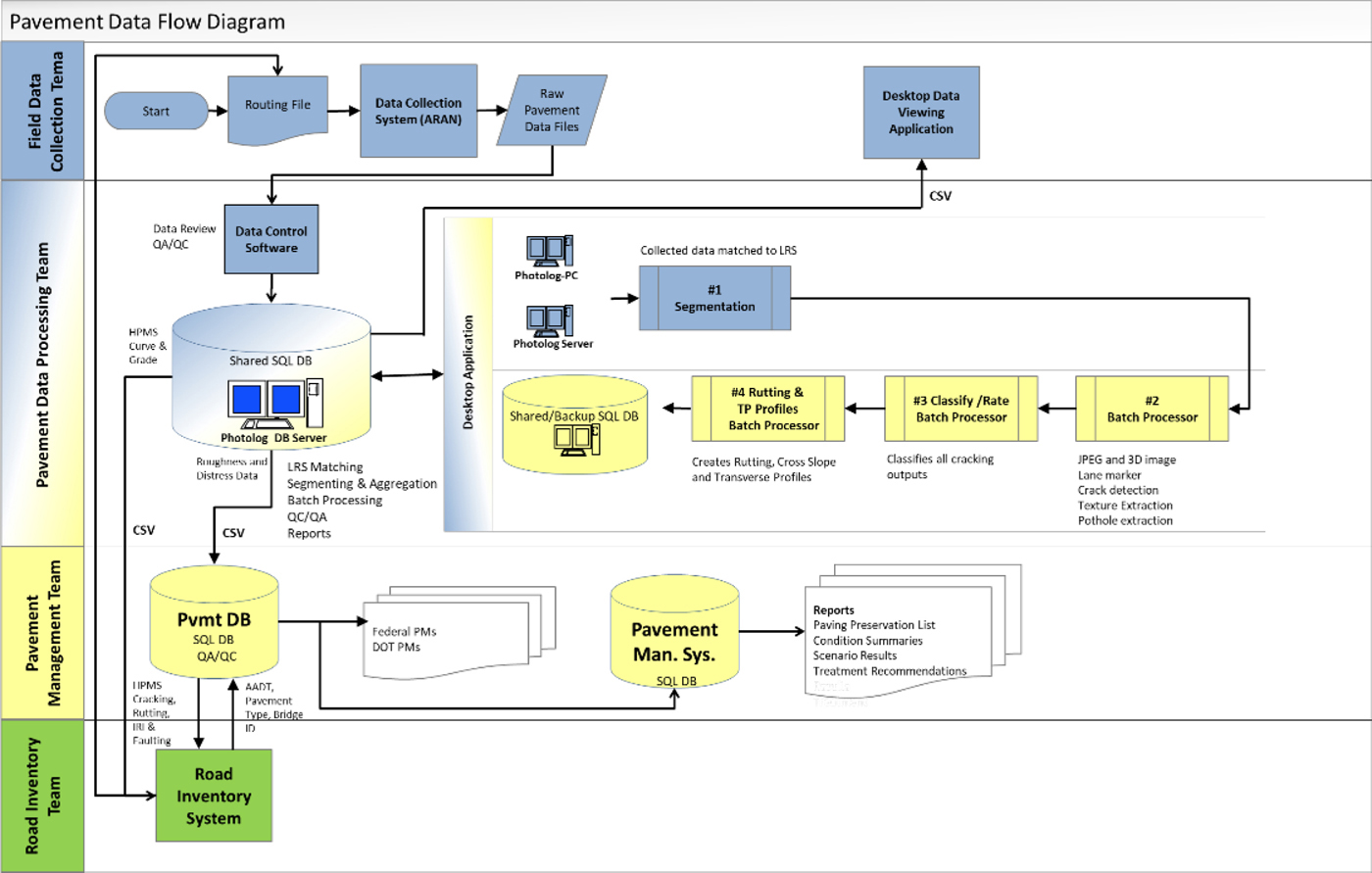
Sample Data Flow Diagram
The following is an example data flow diagram describing the process of pavement field data collection, processing, loading and reporting – intended as an illustration of a documentation practice that can be beneficial for onboarding new staff.
Sample RACI Chart for Data Governance (DG)
| Activity: | DG Lead/DG Body | DG Staff | Business Data Stewards | Business Data Owners/Unit Managers | Data Custodians/DB Developers | IT Lead |
|---|---|---|---|---|---|---|
| Data Governance Policy | A | R | I | C | I | C |
| Data Element Standards | A | R | R | I | C | C |
| Data Quality Management Standard Processes | A | R | C | I | R | C |
| Data Quality and Documentation | I | I | R | A | R | I |
| New Data Collection/Purchases | C | C | R | A | I | C |
| New Application Development | C | I | C | A | R | R |
| Data Dictionaries, Catalogs, Business Glossaries | A | R | R | C | C | C |
R = Responsible. Those doing the work
A = Accountable. Those approving the work (only one per activity)
C = Consulted. Those who may contribute to the work being done
I = Informed. Those kept up to date on the progress of the work/task


