Macroeconomic Implications for Decarbonization Policies and Actions: Proceedings of a Workshop (2025)
Chapter: Current Progress
Current Progress
To set the stage for the workshop discussions, Jae Edmonds of Pacific Northwest National Laboratory and the University of Maryland moderated two opening keynote presentations on the first day focused on the current state of decarbonization. The speakers, Steven Davis of Stanford University and Nat Bullard of Halcyon, discussed which decarbonization approaches have had the greatest impact to date and where more innovation, investment, or policy changes may facilitate further progress.
KEYNOTE: TAKING STOCK OF ENERGY TRANSITION RESEARCH
Steven Davis highlighted insights from research on the energy transition. He opened by noting that the costs of important decarbonization technologies, such as wind energy, solar energy, and electric vehicle (EV) batteries, have rapidly fallen as their adoption has risen (USGCRP et al. 2023). However, Davis posited that achieving true decarbonization will require further progress on two fronts: additional cost-effective innovations to address difficult-to-replace emissions sources, and attention to non-cost considerations.
Davis pointed to a need for cost-effective innovations to address the three main emissions categories that are, today, most challenging to abate: highly reliable electricity (used here to refer to electricity that is not intermittent), aviation and long-distance transportation fuel, and emissions from the production of structural materials. To address the issue of reliability, he said that avenues for affordably managing the variability in solar and wind energy generation could include new generator designs, incentives for reduced energy use during certain times, expanded energy storage, or a combination of these strategies. He noted that different options for energy storage have very different characteristics, such as the long-duration storage offered by power-to-gas-to-power approaches (following an annual or seasonal pattern) versus the daily charging and discharging of batteries (following a daily/nightly pattern) (Dowling et al. 2020).
For aviation and long-distance transportation, a reliance on energy-dense liquid fuels has limited the ability to meaningfully reduce emissions (Bergero et al. 2023). The only current cost-efficient options for airplanes’ specialized internal combustion engines are conventional fossil fuels; sustainable aviation fuels (SAFs) have been developed, but they are not yet cost-effective, have other negative environmental impacts, or have challenging supply constraints. However, the European Union (E.U.) has set some requirements around the use of SAFs, and Davis suggested that more research into improving their effectiveness could spur further progress.
Finally, fossil fuels are still the most cost-effective way to generate the extreme heat required for the production of industrial materials like cement and steel, making these processes substantial contributors to total CO2 emissions. While studies have shown that innovations in alternative fuels such as biomass and hydrogen, improvements in efficiency, and technologies such as carbon capture and storage (CCS) could create pathways toward decarbonization of these processes (Fennell, Davis, and Mohammed 2021), Davis said that more research and development is needed to accelerate progress in this space.
Models are useful for predicting the benefits and trade-offs of and synergies among developments that may affect these three emissions categories. Emerging models such as Python for Power System Analysis;1 Engineering, Economic, and Environmental Electricity Simulation Tool;2 the National Energy Modeling System;3 and the Regional Energy Deployment System4 are improving the ability to resolve energy dispatch at the hourly scale, optimize infrastructure for specific locations, and predict future energy use to inform cost-optimized solutions and pathways. Davis added that incorporating satellite imaging and remote sensing data could also help identify opportunities to expand the energy system while managing emissions.
While cost optimization is important, Davis emphasized that addressing non-cost issues will also be essential for achieving decarbonization. For example, considerations around natural resource constraints, environmental justice, and international relations raise social, environmental, and economic questions that influence policymaking and implementation. Each net-zero scenario will have different benefits and drawbacks depending on which approaches are adopted and where they are located. For example, Davis said, the energy infrastructure to support vastly expanded renewable generation will require enormous amounts of land, and converting fossil-fuel energy generation sites into clean-energy facilities (or adding carbon dioxide removal operations to offset residual emissions)
___________________
1 See https://pypsa.org/.
2 See https://e4st.com/.
can have both welcome and unwelcome impacts for local communities—in some cases, potentially resulting in a continuation of disproportionate harms in vulnerable communities. Davis also pointed out that materials relevant to advancing decarbonization are distributed unevenly around the globe and follow different patterns of distribution than those of fossil energy resources. As a result, strategies for obtaining these materials will have implications for national security, energy security, and international relations.
Moving forward, Davis suggested that on the cost side, further research could help to target investments in innovation to address the costs and performance characteristics that have the greatest impact on net-zero system costs, as well as elucidate how different levels and types of policy intervention may change the outlook for specific technologies and system costs. He concluded that to understand and address non-cost considerations, it will be important to further explore the impacts of natural resource constraints such as land and water; political economy factors such as regulatory capture and international trade; social license issues such as jobs, environmental justice, and perceptions of safety; and co-benefits or trade-offs such as air quality, resilience to extreme events, and conservation.
KEYNOTE: THE DECARBONIZATION TRAJECTORY
Nat Bullard reviewed encouraging trends along with some of the headwinds faced in the quest to achieve decarbonization. On the positive side, he pointed out that the electricity sector has been rapidly decarbonizing, with solar and wind energy generation increasing more rapidly, in absolute terms, than any other generation source in history (Figure 1). He attributed this progress largely to improvements in green energy materials, costs, and capabilities—the payoff from decades of research and development that has, for example, substantially brought down the price of solar energy generation and markedly increased the energy density of batteries (International Renewable Energy Agency 2023; Zu and Li 2011). Annual investment in clean energy and grids is now in the trillions and has overtaken fossil fuel investments (Figure 2). In addition, certain sectors, such as solar energy, now face few manufacturing limits; wind and solar energy are close to meeting all incremental electricity demand; and global EV sales have grown while internal combustion vehicle sales have fallen for seven years running, with EVs representing 18 percent of total sales of passenger vehicles in 2023. While there is still a long way to go, especially in areas such as improving long-haul aviation emissions, Bullard emphasized that important progress is happening.
However, there remain significant headwinds to achieving full decarbonization. One is the rapid growth in electricity demand driven by electrification and the expansion of energy-hungry data centers and artificial intelligence (AI) systems. Another, as Davis discussed, is the challenge of addressing hard-to-abate emissions sources like aviation fuel and industrial production of steel, cement,
and petrochemicals. Production of SAF is rising rapidly, but SAFs still only represented an estimated 0.6 percent of total aviation fuel produced in 2024. Multiple strategies are being pursued to meet emissions reductions goals in industrial production, including through investments in hydrogen, electrification, efficiency, and CCS, but challenges remain. For example, the costs of CCS technologies have remained high, limiting their adoption and impact (Bacilieri, Black, and Way 2023). Finally, a global challenge—but one that has local implications—is the wide variation in energy and emissions trajectories in different countries around

SOURCE: Presented by Bullard on September 12, 2024 (adapted from data from Ember n.d.).
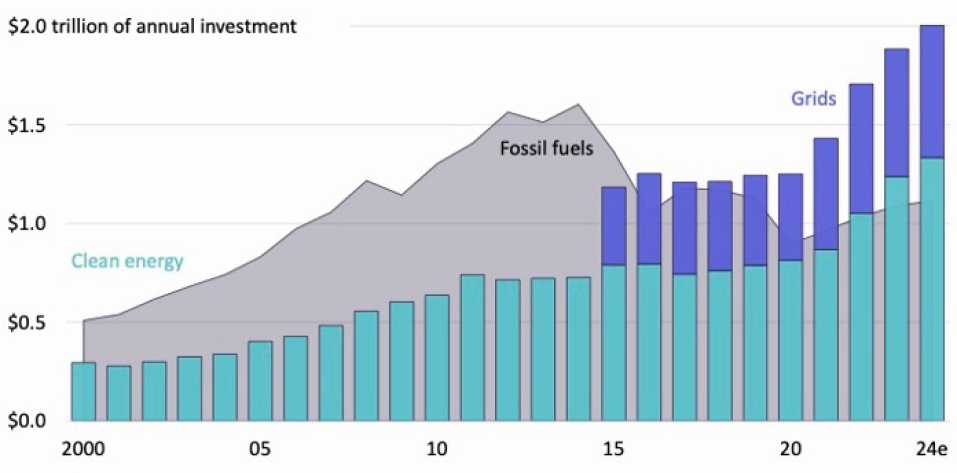
SOURCE: Presented by Bullard on September 12, 2024 (adapted from data from IEA 2024).
the globe. Even as emissions fall in the United States and Europe, they have risen in China, India, and much of the rest of the world (Figure 3) (Friedlingstein et al. 2023).
DISCUSSION
In a discussion following the speakers’ remarks, attendees considered the role of various energy sources in decarbonization, the feasibility of decarbonization goals, and potential policy initiatives to facilitate progress.
In reply to a question from Tim Lenton, University of Exeter, regarding the portion of energy use that may ultimately come from green hydrogen, Bullard and Davis stated that hydrogen is likely to represent an important source of clean energy only in a few niche areas, rather than as a widespread fuel source. Bullard cautioned that its suitability for use in certain industrial scenarios may lead people to overestimate its potential use in other areas and have the unintended effect of curtailing exploration of more cost-effective options. Davis agreed, noting that green hydrogen remains very expensive to produce and is unlikely to be used at the scale we currently use natural gas, for example.
Chris Field, Stanford University, brought up the role of low-carbon solutions, such as natural gas in combination with CCS, as part of the decarbonization pathway. Davis posited that a network of natural gas CCS facilities is not likely to be the most cost-effective way to manage the variability of renewables. He suggested that such solutions could play a role in meeting the last 1 percent of electricity reliability needs in certain places, and Bullard agreed, noting that the last 1 percent is a very challenging problem; however, both speakers noted that the economics

SOURCE: Presented by Bullard on September 12, 2024 (adapted from data from Friedlingstein et al. 2023).
of this approach make it an expensive and challenging solution. In addition, Bullard noted that in many countries, renewables will be primarily competing not with natural gas but with coal and liquified natural gas, so even if the United States were to pursue a more costly natural-gas strategy for meeting reliability needs, the same model is unlikely to be adopted in much of the rest of the world.
When asked by Scott Barstow, American Psychological Association Services, about the feasibility of meeting carbon emissions goals, Davis expressed his belief that the world is not on track to have net-zero emissions by 2050, given that global emissions are continuing to increase while renewables are being deployed too slowly to offset them. Bullard agreed, stating that the United States is “devouring our carbon budget” at the expense of the future. While more technological improvements are needed, he emphasized that reducing costs and solving issues around obtaining necessary raw materials are equally important to the feasibility of decarbonization. Davis and Bullard also added that models can help to identify future deployment priorities by accounting for both the costs and efficiencies of new technologies.
Marc Hafstead, Resources for the Future, asked the speakers to explore policy options for the next 5-10 years. Bullard suggested that the United States could set ambitious goals for each decarbonization technology and remove policy barriers that inhibit market-promoted solutions. Davis agreed with Bullard on the importance of removing barriers and suggested that policy changes could help to address long interconnection queues and support the expansion of bulk transmission, factors that currently limit the deployment of renewable generation. In addition, both speakers noted that policies that de-risk technological innovation could help to accelerate development and deployment. For example, the federal government could support new technologies through block buy contracts or other policies that ensure a market will be ready to buy products such as cement and steel that are made using alternative production technologies.


