Implementation of Uncrewed Aircraft Systems Operational Capabilities: A Guide (2025)
Chapter: 3 Use Cases and Applications for UAS and AAM
CHAPTER 3
Use Cases and Applications for UAS and AAM
Building on the review of the technology and trends, this chapter provides an overview of the existing use cases for UAS by state DOTs, highlighting the diverse applications across various states. The adoption rates of UAS in the following five core use cases are presented:
- Surveying and Mapping.
- Structure Inspection.
- Construction Monitoring or Quantity Measurements.
- Emergency Response.
- Public Outreach.
The data underscore the prevalence of UAS in surveying activities, with 83 percent of state DOTs actively using UAS for this purpose. Additionally, the chapter delves into additional use cases showcasing the versatility of UAS and the benefits of incorporating UAS into transportation workflows, including reduced risk for work zone injuries, lower costs, and significant savings in inspection processes.
Following the exploration of UAS in transportation, the chapter transitions to the emerging field of AAM. The transformative potential of AAM across use cases such as UAS package delivery, air taxis, and RAM is explored. Overall, this chapter provides an overview of the current and potential use cases or applications of UAS and AAM in transportation.
Current State DOT Use Cases for UAS
As noted in Chapter 2, all state DOTs are using UAS in one way or another, with some states having integrated UAS into the workflows of many traditional data collection processes. Table 2 depicts the states and US territories that are actively using UAS across the five core use cases noted earlier. This information is constantly changing as state DOTs explore various ways to leverage UAS as a supplemental tool and determine which use cases UAS will serve them best. Table 2 is a snapshot of the information that was current at the time of this writing. Surveying and Mapping is the most adopted use case, with 83 percent of the states and US territories actively using UAS to assist with surveying activities. Structure Inspection and Construction Monitoring or Quantity Measurements both follow closely behind with adoption rates of 77 percent and 74 percent, respectively.
Aside from these five core use cases, state DOTs are deploying UAS across many other use cases within their operations. Hubbard and Hubbard (2020a) identified more than 40 use cases in their analysis of UAS integration by transportation agencies, many of which are shown in Table 3.
Table 2. UAS utilization across five core use cases.
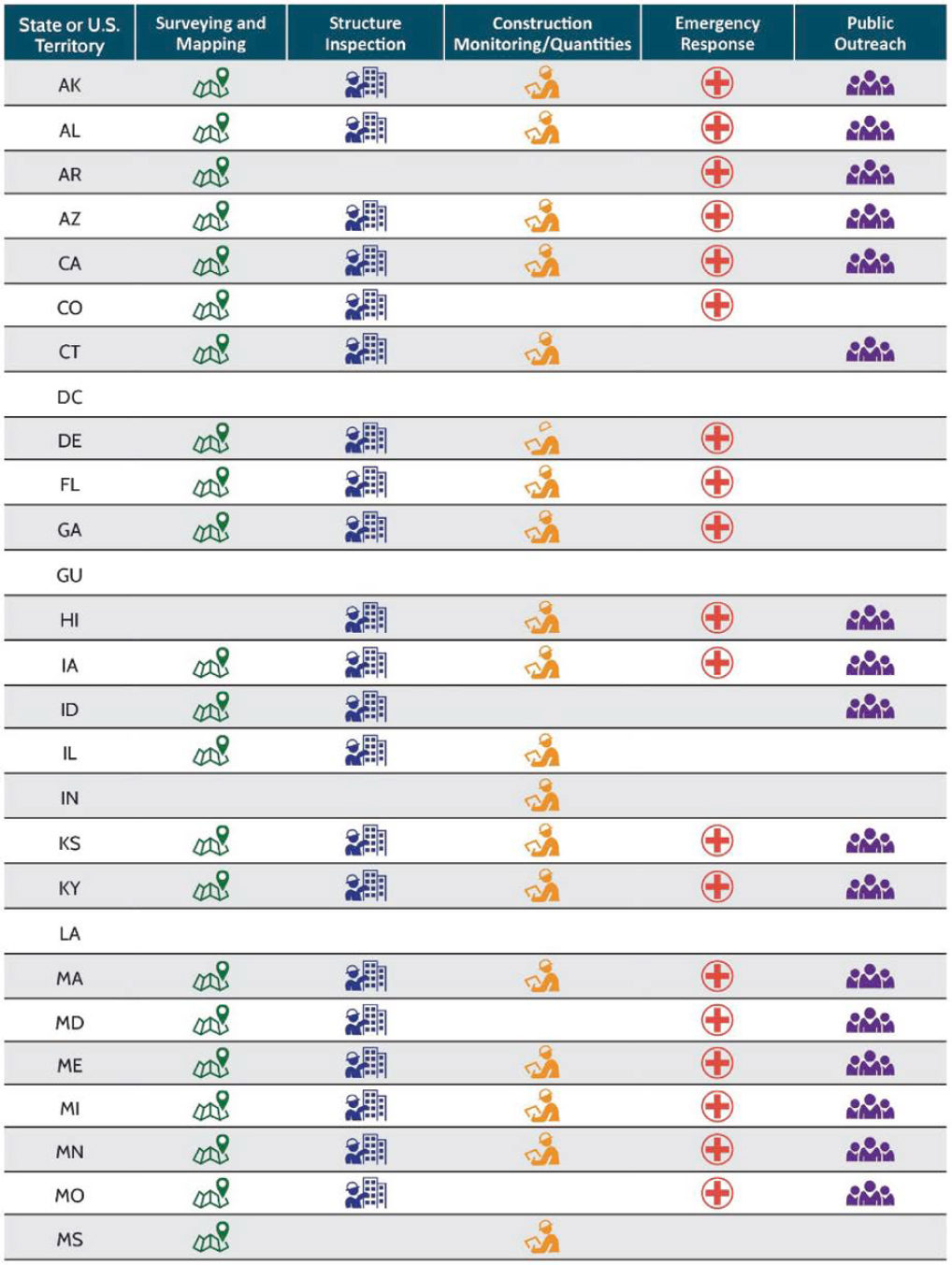
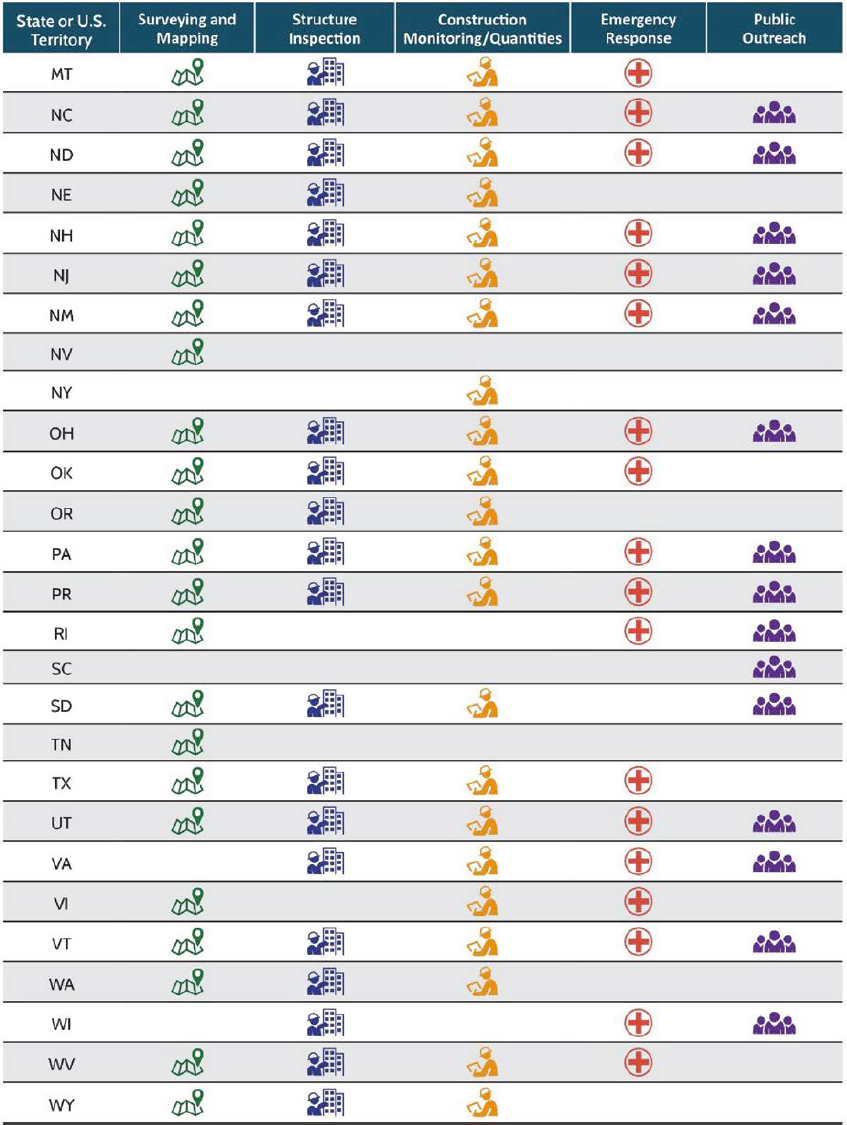
Source: Updated from Wheeler et al. (2023a).
Table 3. Additional UAS use cases.
| Roadway and bridge |
|
| Construction |
|
| Emergency response |
|
| Environmental monitoring |
|
| Airport and aviation |
|
| Other |
Source: Adapted from Hubbard and Hubbard (2020a).
Notes:
1 Roadway, rail, and pedestrian bridges
2 Including wetlands
3 Monuments and statues
4 Including compliance with the ADA requirements
One of the noted use cases within the Roadway and Bridge row in Table 3 is high mast pole inspections. New Jersey DOT has extensive experience using UAS to assist with the inspection of these poles and reports reduced risk for work zone injuries and lower costs due to the reduced need for lane closures (Stott 2021). Minnesota DOT is a leading agency in the use of UAS as a supplemental tool for bridge inspections. Table 4 shows a cost comparison of the various bridge inspections completed using traditional methods and using UAS to assist with the bridge inspection. Minnesota DOT reports an average savings of 40 percent when using UAS as a supplemental tool while inspecting bridges (Mallela et al. 2022a).
The California DOT (Caltrans) has been an early adopter of UAS technology and has had great success using it in construction monitoring and measuring stockpiles. In one instance, Caltrans used UAS-collected data to prove that more than $60,000 in contractor work claims were inaccurate; Caltrans rejected the bill with no claims of protest due to the accurate UAS-collected construction and quantity measurement data (Chamberlin 2022).
Table 4. Comparison of traditional and UAS inspection costs for Minnesota DOT.
| Structure | Traditional Inspection Cost | UAS Assisted Inspection Cost | Savings +/- | Savings Percentage |
|---|---|---|---|---|
| 19538 | $1,080 | $1,860 | $-780 | -72% |
| 4175 | $15,980 | $13,160 | $2,280 | 18% |
| 27004 | $6,080 | $4,340 | $1,740 | 29% |
| 27201 | $2,160 | $1,620 | $540 | 25% |
| MDTA Bridges | $40,800 | $19,800 | $21,000 | 51% |
| 2440 | $2,160 | $1,320 | $840 | 39% |
| 27831 | $2,580 | $540 | $2,040 | 79% |
| 82045 | $2,660 | $1,920 | $740 | 28% |
| 92080 | $2,580 | $1,350 | $1,230 | 48% |
| 92090 | $2,410 | $1,570 | $840 | 35% |
| 62504 | $3,660 | $1,020 | $2,640 | 72% |
| 82502 | $3,240 | $2,400 | $840 | 26% |
Source: Mallela et al. (2022a).
Other unique use cases discussed during the focus groups for this project included the identification of invasive species and wetland analysis. By using UAS to search for and identify invasive species in dangerous or challenging terrain, crews can operate from a safer environment. UAS provide the ability to reach difficult-to-access areas and enable comprehensive surveillance and monitoring of environmental concerns. UAS are also used to survey and collect data regarding impacts on wetlands and water quality. UAS can provide high-resolution aerial data, enabling precise assessments of wetland conditions and water quality. The Ohio DOT is also using UAS to assist with finding lost wellheads and documenting their exact locations. Emergency response emerged as another critical use case for UAS among focus group participants who emphasized the value of UAS in assisting during emergencies. UAS can rapidly survey disaster areas, identify hazards, and support rescue efforts by providing real-time data. The ability of UAS to access hard-to-reach or hazardous locations and deliver resources and messages to victims makes them invaluable tools in emergency response scenarios. UAS can also assist in emergency recovery; for example, the Massachusetts DOT (MassDOT) often assists the United States Coast Guard by using UAS to help identify buoy placement in harbors after a storm, which allows this task to be completed significantly faster.
AAM Use Cases
AAM is a rapidly emerging field that could augment existing transportation systems across a variety of use cases. AAM vehicles, such as eVTOL aircraft, could be used for a variety of noise-sensitive applications, from quieter wildlife management missions to law enforcement. Primarily, the focus for eVTOL aircraft is the possibility of providing new transportation options for people and goods and, through greater connectivity, assisting in meeting needs for food, transportation, and medical deserts.
While numerous potential use cases exist for AAM, this section focuses on the following main subsets or categories under the AAM umbrella term:
- Aerial Package Delivery: UAS are being used to deliver packages to distribution centers, businesses, and even the homes of people in test markets. As this use case matures, it could change the way people shop and receive everything from commercial deliveries to medication.
- Air Taxis: AAM vehicles could be used to provide scheduled or on-demand transportation services for people and cargo. The idea of air transportation in an urban or regional environment is not new; rather, it has been a focus for many decades and accomplished at various levels using helicopters. The foundation for these services exists, and now the technology and investments have advanced in a way that the next generation of aircraft could potentially scale these services in a more efficient way than traditional aviation.
- RAM: Using existing aviation infrastructure and AAM technologies, greater regional connectivity could be established, providing a reliable transportation network between rural and urban areas.
The development of AAM is still in its early stages, but there is potential for this technology to positively affect the way people live and their access to necessary resources.
Aerial Package Delivery
Aerial package delivery using larger UAS presents a current AAM use case with the potential for large-scale future operations. In spring 2022, it was estimated that more than 2,000 daily UAS package deliveries were occurring across the globe (Cornell et al. 2023). On April 19, 2019, a UAS was used for the first time to deliver a human organ for transplant in Baltimore, Maryland (Coffey 2019). Zipline is an example of a UAS package delivery company. In 2016, Zipline began operating in Rwanda by delivering blood and other medical supplies. In May 2020, Zipline partnered with Novant Health and began delivering COVID-19 supplies in North Carolina (Mehrtens 2020), and in October 2022, Zipline began UAS deliveries of prescription medications to Intermountain Healthcare customers in Salt Lake County, Utah (Zipline – Instant Logistics 2022). As of January 2024, Zipline has completed 888,254 commercial deliveries and flown over 63 million miles with UAS across its global operation (Zipline – Instant Logistics 2024). Zipline is one example of many companies delivering small packages via UAS; while Zipline operates a fixed-wing UAS, other companies use multi-copter UAS for deliveries, as seen in Figure 5.
Currently, most UAS package deliveries are executed by small aircraft that typically transport packages weighing less than 10 pounds. Larger UAS are in various stages of development, testing, and certification. For example, Elroy Air’s Chaparral aircraft can autonomously deliver up to 500 pounds of cargo across a 300-mile range. The Chaparral is designed to operate as a larger system; the aircraft is capable of disconnecting from the cargo pod and autonomously positioning

and connecting to the next loaded cargo pod for the next operation (Elroy Air 2023). Figure 6 represents a larger UAS and cargo pod concept.
The FAA has supported these UAS innovations and is working with state, local, and tribal governments, as well as with industry, to enable this emerging use case. The FAA created a regulatory path for large-scale commercial operations of UAS package delivery services through 14 CFR Part 135, air carrier certification. As of February 2023, the FAA has issued four standard Part 135 Air Carrier certificates to companies operating UAS package delivery services (FAA n.d.).
While UAS package delivery is still in its early stages in the United States, many companies are currently offering or testing these services in addition to Zipline. A sampling of the companies that are currently offering UAS package delivery services in the United States includes:
- Amazon Prime Air: Amazon has been testing drone package delivery in the United States since 2016. Amazon is delivering packages via UAS in two test markets in California and Texas and plans to expand its UAS delivery service to more cities in the coming years (Amazon 2024).
- Walmart: Walmart has also been testing UAS package delivery at multiple locations in Utah, Texas, Arkansas, Arizona, and Florida. The company has partnered with several UAS provider companies across these test markets. Walmart expanded its UAS delivery service with these two companies in 2024 to cover almost 2 million additional households in the Dallas-Fort Worth area (Walmart Inc. 2024).
- United Parcel Service: United Parcel Service (UPS) has been testing UAS delivery in the United States since 2018 and was the first company to receive a standard Part 135 Air Carrier certificate to operate UAS (FAA n.d.). UPS Flight Forward has focused primarily on medical deliveries. In 2021, it was the first to deliver COVID-19 vaccines via UAS (UPS 2021).
- FedEx: While the earlier examples are largely focused on UAS package deliveries of 10 pounds or less, FedEx is exploring the use of UAS for 300 to 500 pounds of payload. FedEx has partnered with Elroy Air, and together, they are testing the use of the Chaparral’s autonomous large UAS for cargo transportation (Elroy Air 2022).
The goods that are currently being delivered by UAS are limited to smaller items, typically weighing 10 pounds or less. Walmart is offering tens of thousands of items that can be delivered via UAS; these items include food, medicine, and personal care products (Guggina 2022). As drone

technology continues to develop, it is likely that the range and type of goods that can be delivered by UAS will expand.
UAS package deliveries can assist in meeting the needs of medical deserts (i.e., areas where people do not have adequate access to medical resources) (Mallela et al. 2022a). Greater connectivity via UAS and the establishment of distribution centers can also greatly assist in meeting the needs of food deserts or areas where there is inadequate access to food options (Utilities One 2023). The FAA is currently working on regulations that will allow for the widespread use of UAS for commercial deliveries. Once these regulations are in place, it is likely that UAS package delivery services across the United States will expand rapidly.
Air Taxis
AAM aircraft, such as eVTOLs, could provide scheduled or on-demand transportation for people. Integrating aerial transportation into existing transportation systems could provide another travel option for people to get to where they need to go in an efficient and environmentally friendly way.
Air taxis are still in their early stages of development in the United States and internationally, but a number of companies have made great progress on these aircraft. Joby Aviation was founded in 2009 and has flown more than 30,000 miles with its full-scale prototype electric air taxi. The company has developed its eVTOL aircraft to be able to carry four passengers and one crew member, fly up to 150 miles on a single charge, and hopes to launch commercial services in 2025, but this is contingent on FAA aircraft certification (Joby Aviation 2023). Figure 7 shows a Joby electric air taxi flight demonstration in New York City in November 2023.
Most air taxis that are under development are fully electric and use distributed electric propulsion technology because electric motors are more efficient than combustion engines and produce zero emissions. However, several companies are developing hydrogen-powered air taxis; hydrogen fuel cells are more efficient than batteries and have a longer range. An overview of these different aircraft and technologies is provided in Chapter 2.
Air taxis are a promising new technology with the potential to reinforce and strengthen existing transportation ecosystems. As the technology continues to develop and the regulations are put in place, the United States will likely see a steady expansion of air taxi services throughout select markets.

Figure 7. Joby electric air taxi.
Regional Air Mobility
RAM represents a visionary approach to transforming transportation within and between communities, leveraging emerging aviation technologies to enhance connectivity, efficiency, and accessibility (Antcliff et al. 2021). RAM involves the use of eVTOLs; conventional aircraft retrofitted with electric or hybrid powerplants, hydrogen aircraft, and other technologies such as autonomy to facilitate short-haul air travel, particularly in regions where traditional transportation infrastructure may be limited.
RAM aims to bridge the gap between urban and rural areas. Communities that are currently underserved by traditional transportation infrastructure can benefit from RAM, gaining access to faster and more reliable transportation options. The United States has more than 5,000 public-use airports throughout the country, but only 30 of these airports provide more than 70 percent of the air services (Antcliff et al. 2021). Existing infrastructure can be leveraged to enable RAM, which, in addition to providing reliable connectivity, can provide more efficient movement of people, medical supplies, and emergency personnel, especially in times of crisis. Improved connectivity through RAM could stimulate economic growth by facilitating the movement of people and goods. Businesses could thrive when connected efficiently to regional and urban markets.


