Incorporating Technologies into Airport In-Terminal Concessions Programs: A Primer (2025)
Chapter: The Primer
1. Introduction to the Primer
The Primer will provide airports with an overview of incorporating technology into airport in-terminal concessions programs. Alongside ACRP Research Report 279: Framework and Tools for Incorporating Technologies into Airport In-Terminal Concessions Programs (the Framework) and the Self-Assessment Tool, the Primer will assist airports in identifying, evaluating, selecting, and incorporating technologies into their in-terminal concessions programs. The Primer has been developed with due consideration for airport and customer needs and requirements. Both the Framework and the Self-Assessment Tool can be found on the National Academies Press website (nap.nationalacademies.org) by searching for ACRP Research Report 279.
1.1 The Goal of Research
- This research-based Primer presents background and contextual information so that the reader better understands the basics, as well as the issues related to incorporating technology into airport in-terminal concessions programs. As such, the Primer summarizes the results of the research into the approaches used by leading U.S. airports with reputations for innovation, integration of emerging technologies, and excellent customer experiences. It also provides a guide to the passenger airport journey, airport customer needs, and an understanding of the rapidly expanding airport technology environment, which challenges airports’ procurement and implementation processes.
- To further assist the reader, the Primer also defines and describes relevant current and emerging technologies and trends, as well as documenting the role of technology in the evolving landscape of airport in-terminal concessions programs, with an emphasis on developments since 2019. The Primer documents the results of an Airport Survey and an Airport Passenger Survey conducted to support this research and validate the findings and recommendations in the Framework. In addition to consumer insights, stakeholder perspectives were also probed and evaluated. As a result of this research, the importance of early collaboration with all stakeholders, the workforce implications of technological advancements, and the impact of various business models on technology adoption were identified, are documented in this Primer, and culminate in best practices for the reader to consider implementing at their airport.
- The Primer is complemented by a companion Framework and Self-Assessment Tool that is practical, scalable, and adaptable to specific airport characteristics and needs. The Framework and Self-Assessment Tool are provided to help the reader design and implement existing and emerging technology into their in-terminal concessions programs. Readers can access.
1.2 Navigating the Primer
The Primer is organized as follows:
Table 1. Primer Overview
| Chapter | Short Summary |
|---|---|
| Chapter 1: Introduction to the Primer | Chapter 1 gives the reader an overview of the research goal and support in navigating the Primer. An understanding of the research approach and the methodology used to investigate the impact and integration of technology in airport concessions is also provided. |
| Chapter | Short Summary |
|---|---|
| Chapter 2: Guide to the Traveler’s Airport Journey | The second chapter considers every step of a passenger’s journey—from planning and ticket purchase to arriving at the destination airport and heading for their destination. At each step of the way, the passenger may make use, passively or actively, of a wide variety of technology that can assist them in their journey. This chapter discusses these human/technology intersections, what choices or actions lead up to the intersections, and what may result, depending on whether the traveler engages with technology in some way or does not use it. Both the inbound and outbound trips are covered together because the departure and arrival activities, as well as the technology possibly in use, are similar. |
| Chapter 3: The Evolving Landscape of Airport Concessions | Chapter 3 discusses four important foundational concepts that underpin successful approaches to incorporating technologies into airport in-terminal concessions: (1) It provides an understanding of the overall trends in the airport concessions landscape and consumer behavior, (2) the pandemic-driven technological shifts in airport concessions and consumer behavior, (3) the role of e-commerce and omnichannel platforms in modern airport retail, and, (4) the resulting need for a comprehensive understanding of technology in airport concessions. |
| Chapter 4: Setting the Scene: Technologies in Airport Concessions | Chapter 4 gives the reader detailed lists identifying the current and emerging technologies (since 2019) being used within airport in-terminal concessions programs. It also describes how each technology is being used to enhance the experience for airport customers. Chapter 4 also documents technology’s three major roles in enhancing the concessions experience and the key areas of the experience that technology addresses within each of these roles. |
| Chapter 5: Visualizing the Passenger Journey in Airport Concessions | Chapter 5 allows the reader a more focused appreciation of the enabling technology utilized at various journey points during arrivals and departures. Complementing this perspective, the results of an Airport Passenger Survey conducted by the research team provide key insights into customer views and preferences related to technology in airport concessions. Four passenger personas were also identified and detailed using the survey responses. Additionally, the significant benefits that technology brings to the passenger experience for both the airport and the passenger are enumerated. |
| Chapter 6: Consumer Insights and Technological Trends | Recognizing that consumer purchasing habits have significantly changed, this chapter provides a breakdown of key consumer trends uncovered as a result of the research. The impact of these trends on airport concessions is also itemized. |
| Chapter 7: Stakeholder Perspectives and Interviews | Chapter 7 provides an overview of the study’s interview process and how relevant stakeholders were selected. It also offers a summary of the insights of the airports, concessionaires, technology vendors, and industry thought leaders. Common themes and notable innovations are identified from across all of the insights garnered from each of these stakeholders. |
| Chapter 8: Business Models, Local Concessions, and Stakeholder Engagement | Chapter 8 provides a summary of the different business models (concessions agreements) for running concessions programs at U.S. airports, many of which influence a concessionaire’s willingness to invest in technology. This chapter also highlights the challenges and opportunities that are unique to local and small business concessions and the critical importance of collaborating with and engaging key external stakeholders. |
| Chapter | Short Summary |
|---|---|
| Chapter 9: Workforce Implications of Technological Advancements | Chapter 9 reviews the dramatic changes experienced by implementing technology within the airport ecosystem. These changes have had a concomitant impact on the skillsets required by airport employees. Employers are also experiencing challenges regarding recruiting and managing Generation Z and beyond. Recommendations are offered regarding steps to be taken to mitigate these impacts and challenges for the good of the employee, the airport, and ultimately the customers they serve. |
| Chapter 10: Case Studies and Best Practices | Chapter 10 provides examples of a variety of successful uses of technology in airport in-terminal concessions. Case studies highlighting the technology used and lessons learned from discussions with Dallas Fort Worth International Airport, Miami International Airport, Cincinnati/Northern Kentucky International Airport, Concessions Management LLC, Rezcomm, and Veovo are included in the report. A comparative analysis of in-terminal and non-airport concessions is also provided, which shows variation due to several factors inherent in their operational environment. |
1.3 Research Approach and Methodology
A multifaceted methodology to thoroughly investigate the impact and integration of technology in airport concessions was employed to produce this report. Each component of the methodology significantly contributed to forming a solid foundation for detailed analysis and informed conclusions. The approach utilized provided a comprehensive perspective on the interplay between technology and airport concessions, fostering a nuanced understanding of their relationship. The research methodology included the following:
- A Literature Review. Before embarking on primary data collection, a comprehensive literature review of more than 75 resources was conducted to establish a solid theoretical foundation. This review encompassed a wide range of academic and industry publications, focusing on the evolution of airport technology, the dynamics of airport concessions, and the changing patterns of passenger behavior. It provided critical insight into existing studies that helped identify gaps in knowledge to shape the direction of subsequent data collection efforts.
- Airport Passenger Survey. The Airport Passenger Survey was a key component of primary data collection. Data were gathered in Fall 2023 from a nonprobability panel of 1,200 individuals who flew at least twice during the past year. This approach ensured a diverse representation of air travelers. The survey captured both quantitative and qualitative data, offering insight into passenger habits, preferences, and experiences. The collected data was weighted to Census demographics to enhance its representativeness. To analyze the data, advanced statistical techniques in Stata (www.stata.com), including K-means cluster analysis, were utilized. This method segmented
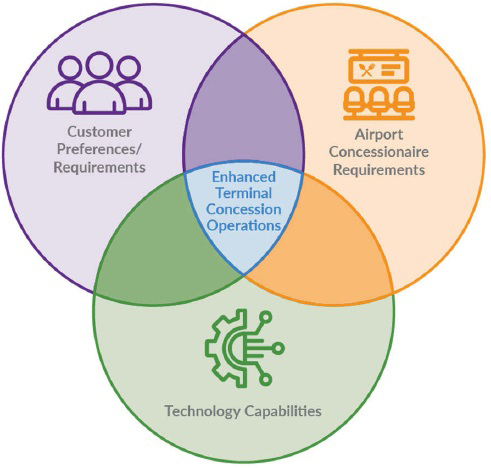
- travelers into distinct groups based on shared characteristics and survey responses, aiding in the creation of four high-level traveler personas. These personas provide a nuanced understanding of different traveler types, their behaviors, and preferences, especially in relation to airport technology and concessions.
- Interviews With Airport and Non-Airport Executives. Complementing the Airport Passenger Survey, the research team conducted interviews with executives and managers from airports, concessionaires, and technology sectors globally. These interviews delved into the operational, strategic, and technological aspects of airport concessions. The insights from these interviews were invaluable, offering real-world perspectives on the integration and impact of emerging technologies in airport environments.
- Airport Survey. Airport staff from various airports worldwide, differing in size, passenger volume, and management structure, were invited to participate in the Airport Survey. This survey aimed to gather firsthand information on the adoption, use, and economic impact of innovative technologies within airport in-terminal concessions. The responses provided a wide view of current industry trends, preferences, and perceptions.

1.4 Limitations of the Research
Due to the smaller sample size used in this research, caution should be exercised when generalizing the results and care should be taken not to draw conclusions beyond the research sample. This Primer’s commentary on the research is intended to assist the airport industry in understanding how technology can be incorporated into airport concessions. While the commentary cannot be generalized to the entire population of airports, the findings do highlight potential opportunities for airports and are broadly illustrative of the different factors that airports can consider when utilizing technology in their concessions operations.
In addition, the research aims to provide an understanding of not only the available technologies but also how passengers, airport employees, and concession operators may use these technologies to gain an understanding of relationships among airports, their stakeholders, and technology. Each airport needs to assess its own organization’s ability to enhance its technology program in relation to its concessions program and its passengers. Finally, the examples cited in the Primer are presented for illustrative purposes only and do not constitute an endorsement for use.
2. Guide to the Traveler’s Airport Journey
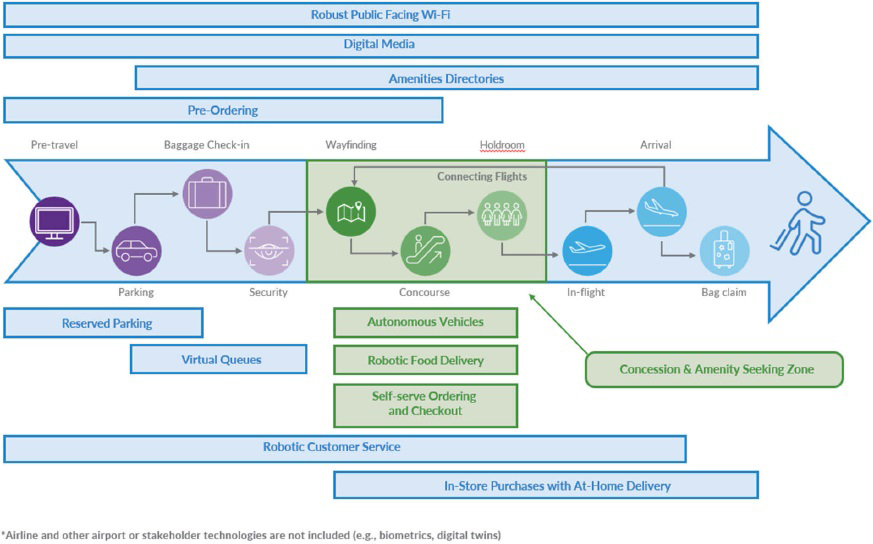
The travel ribbon—or passenger journey, as it is otherwise known—has adapted and expanded due to the significant influx of technology every step of the way. The passenger journey represented in this report is specific to the possible touchpoints where passengers may have the opportunity to interact with
airport in-terminal concessions. Because there are now opportunities for travelers to place orders for food and beverage (F&B) options or make retail purchases for pick-up at the airport, the passenger’s journey starts well before the traveler arrives at the airport. Furthermore, the journey can continue until after the passenger departs the airport because some airport retailers provide options for ordering or purchasing goods in the airport for delivery at home.
2.1 Pre-Travel
Technology has also found ways to help travelers prepare for their trips. Travelers can now check-in from anywhere for their flights on virtually all major airlines 24 hours before departure. This has significantly affected how passengers plan their trip to the airport. Because of information that is available to them, passengers may check either the airport’s or the airline’s website.
The airport’s webpage is often the best place to start considering the diverse ways of getting to the airport. John F. Kennedy International Airport (JFK) in New York offers information on numerous travel options to help passengers arrive on time for their flights, as well as opportunities for passengers to reserve parking or pre-order food once they arrive at the airport (Rhodes 2024). Parking data is provided, including how full the lots are and the parking rates in each. Some airport websites also provide information on the real-time or predicted queue at passenger screening checkpoints. Technology allows travelers to compare the services provided, the cost, and other factors to help them make better decisions with reduced stress. From this project’s Airport Passenger Survey, it is clear that passengers prefer that airports provide more information about their journey rather than less information, such as wait times at security checkpoints, food/restaurant offers, and parking availability (see Section 6.1 for more details).
2.2 Parking
While airport parking is not within the terminal, this is an important step in the passenger journey. Besides providing airports with a significant portion of their non-aeronautical revenues, passengers’ experiences with parking can influence their concession purchases and their overall airport experience. A more reliable and faster parking experience gives passengers more time in the terminal to shop and eat.
Additionally, airports that offer reserved parking or other parking services, such as valet parking, have an opportunity to cross-promote in-terminal concession offerings, as well as collect important data on these passengers.
2.3 Passenger Check-in/Bag Check
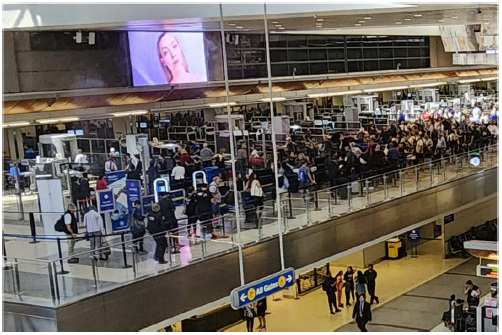
Having arrived at the airport, the technologically savvy traveler has likely already checked-in with their airline; received their boarding pass virtually; paid for checked baggage, if necessary; and been permitted to bypass check-in counters if the traveler has no checked baggage or their airline has adopted self-bag tagging. These various applications of technology have significantly reduced crowding in airport ticket halls, providing a significant time savings and an enhanced customer experience for travelers. Getting travelers to the gate as expeditiously as possible also provides the opportunity for increased non-aeronautical revenue for the airport operator and concessionaires.
Source: ICF
2.4 Passenger Security Checkpoint
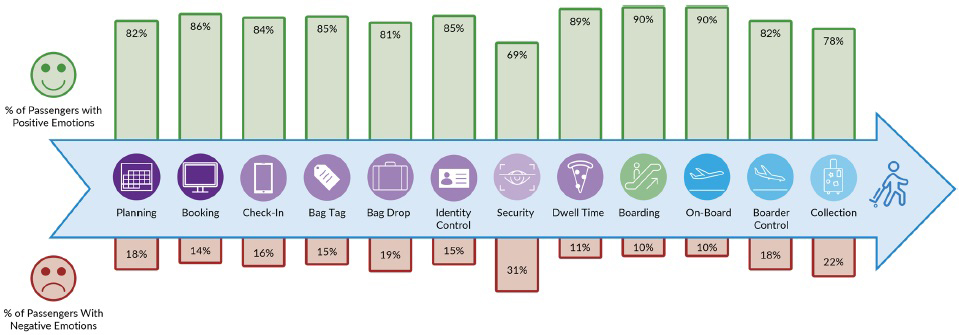
The next step in the travel ribbon, usually the one that causes the most stress, is joining the queue to pass through the Transportation Security Administration’s (TSA) security checkpoints. While it is unlikely that going through security will ever become stress-free, technology has entered this aspect of the travel journey to help diminish the stress on technology users (while potentially increasing the stress of nonusers).
De-peaking wait times at passenger security screening checkpoints through virtual queues is one aspect of security technology that offers a means to more efficient use of checkpoint equipment and thus diminishes lines. Using a virtual queue, passengers are able reserve a time to enter the screening checkpoint at a less busy time than they might otherwise enter the screening queue. This has the effort of minimizing their wait time for themselves as well as for others.
Source: ICF
While not a new concept (most people have put their names on a waiting list at a restaurant and waited for a text or phone call), it has only recently been used in airports. In 2021, Seattle-Tacoma International Airport introduced “Spot Saver.” While it had been under development before the pandemic, its importance and priority were elevated as airports attempted to find a way to diminish lines and person-to-person exposure. This was seen as a way to improve customer service and to free passengers to do other activities in the airport while waiting (Youd 2021). Other airports also deployed virtual queuing in 2021-2022, including Denver International Airport (DEN) and Boston Logan International Airport. DEN’s solution was biometric-based, allowing people with health risks to use a dedicated lane. Five additional airports also ran pilot programs during this period.
The significance of virtual queuing with regard to concessions is that it allows passengers to pass through security more quickly and therefore spend more time in the holdrooms, with opportunities to shop at the concessions (Airport Cooperative Research Program 2022).
2.5 Wayfinding
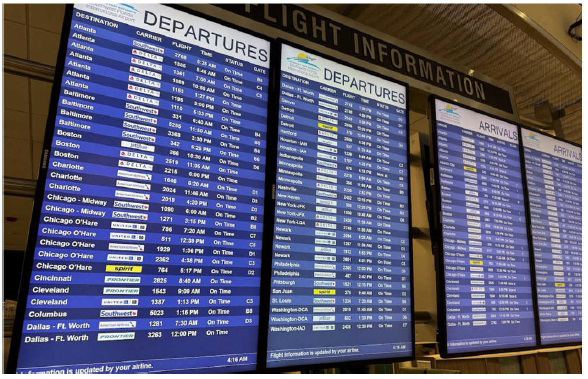
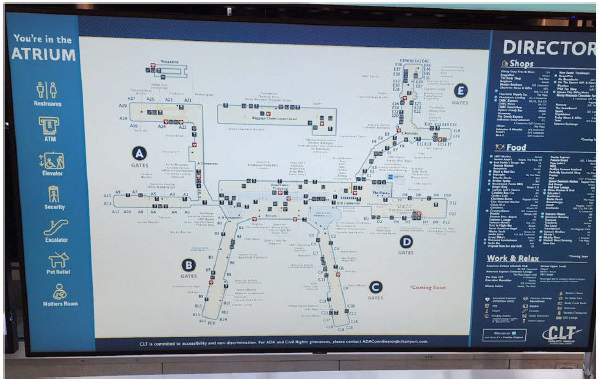
After clearing the passenger screening process, travelers continue their journey. Most travelers will now look for the location of their departure gate, restrooms, and amenities, such as F&B outlets. They may also want to confirm the departure time and gate information for their upcoming flight. The airline’s app is one way of doing this. Many travelers also use an airport’s Flight Information Display System (FIDS). To assist passengers with finding amenities more quickly, many airports are deploying interactive location directories.
Source: ICF
Besides being more appealing than the older static displays, the content can be easily updated by the airport to reflect the current amenity offerings. Passengers can often interact with these displays to show only the types of service that may be of interest to them or that may be open.
2.6 Concourse
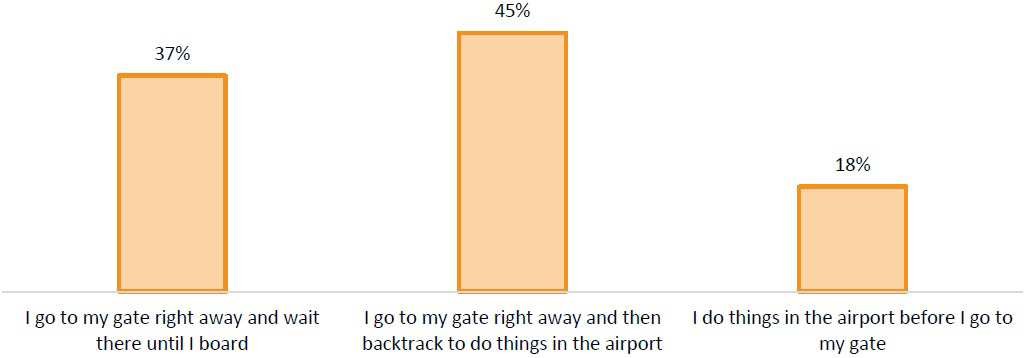
As passengers make their way to the departure gates, they typically do one of three things: (1) they go directly to the gate and wait until they board their flight, (2) they go directly to the gate and then backtrack to do other things until their flight boards, or (3) they will do other things on their way to their gate. The behaviors are listed in order of airport revenue opportunities, where the “gate huggers” are least likely to make concession purchases and the last group is most likely to make purchases. By providing passengers with clear wayfinding information with updated flight departure information, they are most likely to fall into the desirable last group.
Which of the following best describes what you do after security?
- Airport Advertising. Airport advertising has advanced significantly. Gone are the days of paper dioramas that required physical updating. Airport advertising is also no longer a one-way source of information. Many airport advertising firms use technology to collect information on who and how many people view their airport ads. Some digital billboards and screens are equipped with cameras that use facial recognition technology to estimate the number of distinct views of the ads and to gather information on the demographics of these viewers, including age and gender. They can also monitor the emotional response to the ads. This technology, by TruMedia, was first launched at Copenhagen Airport, Kastrup (CPH), the international airport serving Denmark’s capital region and southern Sweden. They installed 550 screens for advertising, with sensors connected to the screens, gathering information on the number of passersby, the number of people who stop, their age group, and their gender. Initially, the information was gathered to provide advertisers with information on who their messages were reaching. No images were recorded, and no uniquely identifiable data can be extracted. Furthermore, it allowed the airport and its advertising provider to narrowly target advertising campaigns for specific travelers.
Source: ICF
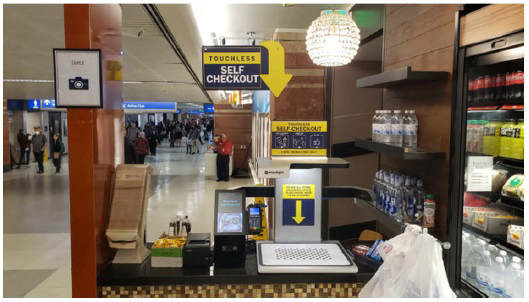
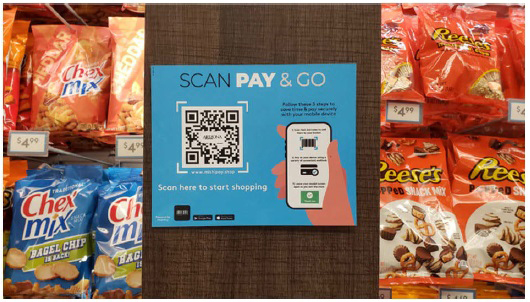
- Self-Serve Kiosks. The use of technology in airport concessions is also increasing. As with virtual queuing, much of the growth of concession technology was spurred by the COVID-19 pandemic; however, it has since found its place in increasing sales and reducing costs for concession operators. One of the earlier technologies utilized in airports was ordering kiosks. Primarily, the kiosks utilized in airports are for individual brands and are installed in or near the concession unit to allow customers to place their orders without having to queue. Kiosks offer the additional advantage of being more accurate as the customer can select toppings and extras with full knowledge of any additional cost for add-ons, which prevents customers from coming back and saying that they were not aware of what they were purchasing or that they would pay more for upgrades to their food. Multiunit kiosks were sometimes placed in food courts, operating similarly to the common use self-serve kiosks used for airline passenger check-in.
Source: ICF
- Artificial Intelligence (AI). It is expected that AI-powered equipment will find its place in the airport quick-serve industry during the study period (2023–2031) (Patel 2022). Primary growth is seen in restaurant management software and smart gadgets. For example, customer wait times can be extrapolated based on past data. Automated ordering can minimize spoiled food waste and lost sales due to products being out of stock. These tools can also save money for the restaurant by not ordering products before they are needed, thus reducing the investment in inventory. These
- ordering tools can also be used to calculate the true value to the individual unit of sales or specials, eliminating the human nature to buy because an item is on sale, even if the product is not needed.
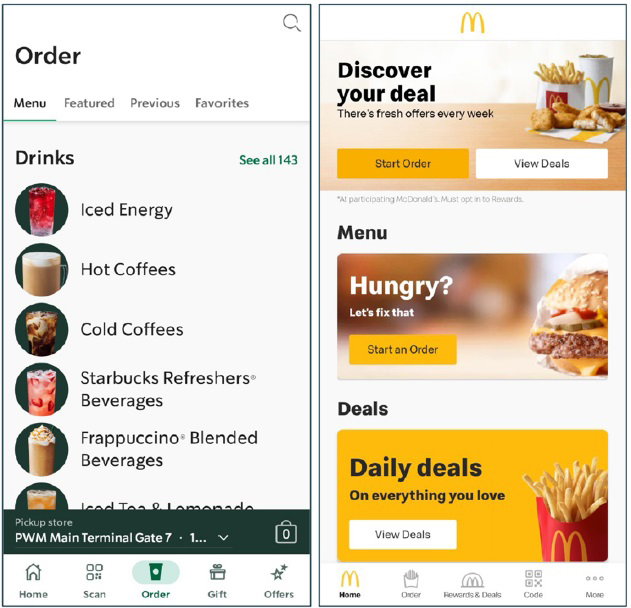
- Mobile Apps. The use of apps in airports has only seen moderate uptake. While companies with their own apps have seen frequent use (e.g., Starbucks and McDonald’s), there has been little success in developing and using an app that allows for ordering from multiple store locations unique to each airport. Before the pandemic, a handful of apps had trials in various airports in the United States. Of those, only Grab (later Servy), which was acquired by Collinson, a company that does work in omnichannel airport e-commerce, has survived. Though it is unknown if the services provide customers with a true level of convenience because while they can order remotely, they are still expected to go to the operation to pick up their orders.
Sources: Starbucks mobile application (LH); McDonald’s mobile application (RH). Accessed September 5, 2024.
- Personal Delivery. Los Angeles World Airports, the Los Angeles International Airport (LAX) operator, has launched an ordering and delivery app in partnership with concession developer URW, enterprise self-service platform Servy, and delivery service AtYourGate. The app builds on the success of the airport’s LAXOrderNow.com mobile ordering platform. While ordering from concessions was available airport-wide, delivery was initially rolled out only in the Tom Bradley International Terminal and West Gates. Travelers could scan Quick Response (QR) codes throughout the terminal or visit the website to place orders, and if the delivery service is available, they could choose it during checkout (for an additional fee).
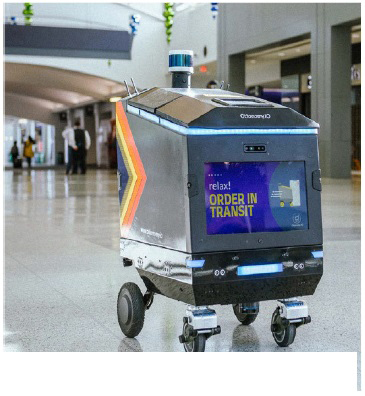
- Robotic Delivery. Cincinnati/Northern Kentucky International Airport (CVG) and Ottonomy launched a test fleet of food and retail delivery Ottobots. Customers could order from select food and retail stores operated by a single operator (Paradies Lagardère). When the customer placed their order, all they needed to do was enter their gate number, and when the order was prepared, the store would place it in an Ottobot. When it reached the gate, the customer would use a QR code to
Source: Ottonomy
- open the robot’s secure carry-chamber to remove their order.
2.7 Airport Technology Environment
Airports, airlines, and concessionaires are encountering unique challenges in their operations and within the airport industry. Shifting customer purchasing behaviors, the evolving e-commerce landscape, and digitalization are disrupting their traditional revenue streams and business models.
“Digitalization is the use of digital technologies to change a business model and provide new revenue and value-producing opportunities; it is the process of moving to a digital business.” (Gartner n.d.)
Passenger buying behavior has fundamentally changed with the advent of digitalization, transforming how concessionaires, airports, and customers conduct business. The positive aspect is that, if properly embraced, digitalization offers airports significant opportunities to discover new methods for achieving this requires airports to collaborate with key ce environment (e-commerce). Figure 13 illustrates the generating core non-aviation revenues. However, stakeholders to establish a digital airport commer relationships among these key stakeholders.

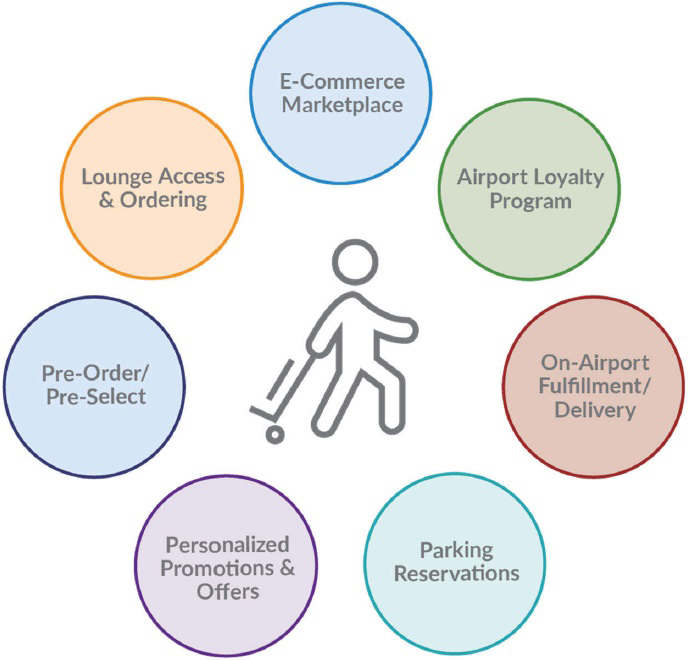
As part of the suite of customer-facing technologies, e-commerce has caused airports, concessionaires, and airlines to revisit the sale of goods and services from a passenger journey perspective, as shown in Figure 14. This perspective introduces new roles in which technology can be deployed at the airport as part of an integrated concessions program.
3. The Evolving Landscape of Airport Concessions
3.1 Overall Trends in the Airport Concessions Landscape and Consumer Behavior
The U.S. airport industry is evolving, and project leadership should determine how concessions design and its business will be affected so it can be addressed pragmatically yet ambitiously. To consider airport concessions trends, we should look at what remains the same in the aviation industry and what is changing or is likely to change.
Much Remains the Same:
- Air travel demand will experience continued growth but will have occasional downturns.
- Airline economics will remain largely intact.
- The air travel journey and airport experience will remain stressful for many passengers.
- Customer centricity needs to be at the heart of everything airports do.
However, Much Is Changing or Is Likely to Change:
- Business and international travel are recovering slowly.
- Airports need to redefine relationships with customers, concessions, and their host communities.
- Sustainability is foremost on consumers’ minds, especially younger travelers.
- Curating delightful airport guest experiences is evolving as an airport strategic objective as airports adopt a hospitality model in the delivery of airport experiences and services.
- As Americans age, older travelers will join people with disabilities (visible and invisible) and other special needs, thereby comprising an even larger portion of the market. This will require a significant investment in equipment and other services to ease travel for passengers with mobility, visual, and/or hearing impairments.
- Digitalization, AI, and experiential technology (i.e., the use of technology to create immersive experiences for guests/customers that engage all of the senses and often have an aspect of personalization) will transform significant aspects of the airport experience, including airport commercial business.
- Airports will need to be more innovative with regard to revenue generation and service delivery.
Before exploring airport concessions trends, a look at megatrends is important. Megatrends outside of airports are often the precursors of what the airport industry might adopt. Relevant megatrends, as of 2024, include the following:
- Sustainability
- Experiential Offerings
- Incorporating and Leveraging Technology
- Food Trends
- The Evolution of the Customer
- Omnichannel Shopping
The restaurant and retail industries assess trends annually in order to maximize revenue; some megatrends resonate with airport operators, concessionaires, and customers, but not all.
3.1.1 Sustainability
Sustainable practices at airports are essential for long-term economic resilience. Airports and their partners are seeking financially and environmentally sustainable practices. As such, sustainability remains a primary focus for airport vendors, airports, and customers in 2024, and likely will continue to be an important aspect of all types of businesses. Sustainability is a long-term trend and remains at the top of many organizations’ priorities. F&B operators consume substantial amounts of electricity, fuel, and water, and quick-service restaurants generate substantial amounts of trash from unconsumed products, single-use wrappers, and plastic waste (Electricity Plans 2022).
Retail operators’ sustainability efforts focus on reducing packaging waste, reusing displays and signage, and consuming more environmentally sustainable power. Their methods of pursuing sustainability are substantially similar to those of food service operations.
Sustainability is believed to be a megatrend and a driving force behind many of the choices that airports and airport concession operators will make in the near future. While airport concessions are not the largest contributors to airport-generated pollution, they are front and center and highly visible, and their actions allow the airport to show its efforts in areas that are most visible to the public. However, sustainability efforts should be measured to be recognized. This requires key performance indicators (KPIs) or quantifiable metrics and a means to collect and report these KPIs.
3.1.2 Experiential Offerings
Experiential dining is more popular than ever, especially among millennials, Generation X, and Generation Z customers. Restaurant guests are looking for unique experiences that can be achieved at various times throughout a meal and can come in many different forms, including thematic products and décor, views, sustainability-focused meals featuring locally sourced food, and surprising menu items. As an example of why experiential dining is a trend, according to Yelp, searches for “underwater restaurants” were up 263% in 2023, while searches for dinner theaters were up 109% (Yelp 2022).
While a wide variety of experiences are possible, the rules surrounding airports and the limitations regarding the time available to potential diners somewhat limit the opportunities. For example, facility availability limits the possibilities for rooftop and outdoor dining in airports. However, many airline and credit card clubs see the benefits of creating outdoor terraces for their members. Most of these terraces either feature food or allow members to carry food from other areas onto the terrace.
To measure passenger demand and the level of success of new concepts, airports need to track the performance of each concept using transaction sales data collected from the concessionaires.
Experiential Dining.
Experiential dining in airports can be found in many of the same forms found streetside. Experiential dining at airports has been a well-established concept for quite some time. At London’s Heathrow Airport (LHR), The Perfectionist’s Café delights travelers with a rich but casual design. The design also incorporates open kitchen elements, such as a wood-fired pizza oven and a curing chamber.
Aburi-EN, inside of the Singapore Changi International Airport (SIN), serves fine Australian and Japanese wagyu beef. Kansai International Airport (KIX) in Osaka, Japan, has a conveyor belt sushi concept that also has interactive displays.
Wine bars, such as Vino Volo, offer guests the opportunity to enjoy wine flights tailored to their individual preferences. The knowledgeable Vino Volo staff introduces the wines and provides valuable information, guiding the guest to explore the diverse and fascinating world of wines.
Throughout the country, musical performances have entertained diners in airport restaurants. Notably, Austin-Bergstrom International Airport (AUS) has one of the most robust music programs. Other noteworthy airport music programs include those in Nashville, New Orleans, and Denver. In New Orleans, several locations have open kitchens that allow diners to watch the kitchen staff work through service, be mesmerized by the flames in the pizza ovens, or listen to the manager work through the orders.
Outdoor Dining.
Outdoor dining is a growing trend in airports, too. Diners at the Mumbai Chhatrapati Shivaji Maharaj International Airport’s (BOM) All Day Diner have access to outside seating. This location is also landside, providing a different airport user segment with the benefits of outdoor seating.

Source: Changi Airport
The cactus garden on the rooftop of SIN’s Terminal 1 has dining service available for those who want to bask in the sun and enjoy the views. Palm Springs, Long Beach, and Tampa are just a few airports where outdoor dining has been implemented. Inspired by the positive effects of outdoor dining, some airports have designed concepts to bring the outdoors into the terminal. In some airport concepts, to evoke the feeling of outdoor seating, the indoor restaurant spaces utilize skylights and windows to let natural light in. Simple structures, such as
pergolas, are used to keep an open, airy atmosphere. The choice of materials often includes naturally occurring elements, such as wood and stone, or iconic exterior elements, such as bricks and marble. To enhance the outdoor ambiance, designers also incorporate plants.
Large and Open Retail Designs.
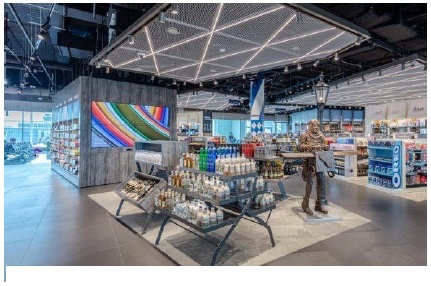
International airports have long recognized the advantages of large and open designs at convenience and duty-free concepts. Large and open designs increase access and visibility to the products inside, draw passengers in, and stimulate impulse shopping. Spacious layouts allow passengers to move around comfortably, increasing the time spent shopping. This design also supports a store-in-a-store concept. Similar designs are implemented in Munich, Dubai, and Cancun.
Source: Umdasch Group
In recent years, in such airports as Nashville, Detroit, and San Francisco, concessionaires have been incorporating concepts within concepts to optimize their revenue potential. This approach can ensure that the concept is relevant during all times of the day and can provide capital investment and operational efficiencies. The practice also provides concessionaires with the flexibility to change concepts more frequently. The Bower Bay Shops in LaGuardia Airport(LGA) are 15,000 square feet of shopping in a “store within a store” format. Concessionaires are also incorporating large and open news convenience locations.
Digital Media.
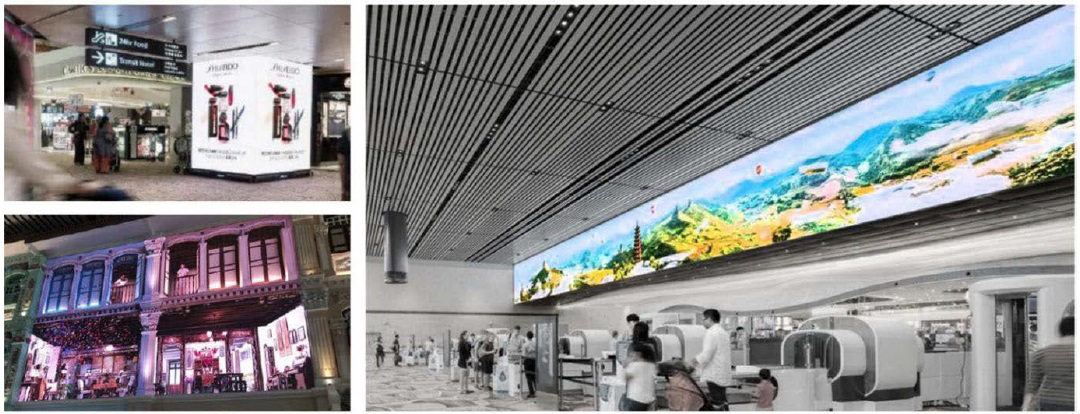
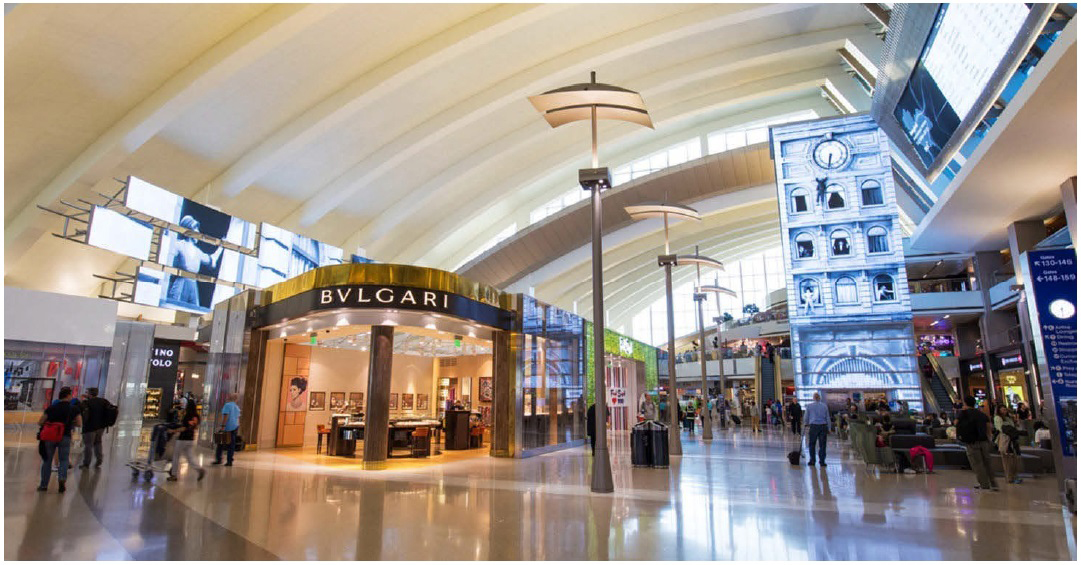
In terms of digital media, large-scale dynamic digital installations have been incorporated into several international airports, immersing passengers and giving the potential to generate revenue. At SIN, digital technologies augment the interior environment, enhancing the passenger experience at multiple touchpoints. Large-format digital panels have been immersing passengers into company brands at U.S. airports for some time. In 2023, Orlando International Airport’s (MCO) Concourse C opened with massive light-emitting diode walls that utilize cameras and AI to integrate passengers’ silhouettes into content to provide passengers with a sense of place. At LAX, large-format displays were installed to capture revenue for interactive retail partnerships, create a unique shopping experience, and boost revenue.
Sources: JCDecaux (ULH); The Moodie Davitt Report (LLH); Moment Factory (RH)
Source: Moment Factory
Immersive experiences play a role in getting passengers to arrive early. Shanghai’s Hongqiao International Airport hosted the Louis Vuitton “Time Capsule” video display exhibition, where passengers explore different models of a custom-made Louis Vuitton trunk made of liquid crystal display screens in a room surrounded by projections of stunning visuals. These sorts of unexpected touches excite passengers and reinforce their decision to come early to the airport and are additional ways for the airport to generate revenue and for the brands to convert customers or build loyalty.
3.1.3 Food Trends
In some cases, the food itself can be considered a technological innovation. Current trends in the food industry are emerging due to technological advancements and shifting consumer awareness toward the environment. Consumers are becoming activists to protect the planet through their shopping and dining choices. While these are current trends, they also remain future food trends that will continue to evolve to reflect the expected growing emphasis on sustainability and innovative food production methods.
- Cell-Based and Cultivated Meat: Cell-based meat production could become more widespread, offering a sustainable and ethical alternative to conventional meat. The annual compound growth rate for the cultured meat market is expected to be 51% from 2023 to 2030 (Grand View Research 2023). Insect-based protein and algae could gain popularity as consumers seek diverse and sustainable protein options.
- Innovative Snacking: The snacking industry might witness a surge in creative and nutritious snack options, such as plant-based snacks, protein-rich bars, and functional snacks that target specific health needs.
3.1.4 Evolution of the Customer
There is an increase in value-seeking consumers who prioritize a well-balanced combination of quality, affordability, and functionality in their buying choices. This shift in consumer behavior is driving companies to innovate and offer products that not only meet but exceed these expectations. Brands that can effectively balance these three elements are likely to see increased customer loyalty and market share. Additionally, businesses are focusing on transparent communication and sustainable practices because these factors are becoming increasingly important to value-seeking consumers. By understanding and adapting to these evolving preferences using data and business intelligence tools, companies can better position themselves for long-term success in a competitive market.
As value-seeking consumers’ preferences evolve at an unprecedented pace, companies should rely on data and feedback to quickly adapt and meet their changing needs; however, it is essential to recognize that these sources might not always provide the complete picture.
3.1.5 Other Technologies
As a result of the COVID-19 pandemic, one of the largest sustained changes has been the conversion to and growth of e-commerce. The change in how people shop continues to evolve; however, the change to e-commerce has been rapid, revolutionary, and irreversible. Consumers spend a growing share of their money online, primarily because of the convenience of shopping from wherever they are. According to CommerceIQ, 64% of global consumers are excited to be able to purchase multiple brands through one retailer (CommerceIQ 2022). Retailers such as Amazon, Walmart, and Target have invested heavily in omnichannel and logistic solutions to deliver orders in as few as 2 hours. According to the U.S. Department of Commerce, Food and Beverage Program, e-commerce sales grew 8.6% during the first quarter (Q1) 2024 compared with Q1 2023 versus a total retail sales increase of 1.5% (U.S. Department of Commerce 2024).
E-commerce has also significantly affected the at-home food service market. Food delivery services, such as DoorDash and Uber Eats, became ubiquitous during the pandemic and have continued to be major factors in the market. E-commerce food sales grew 7.5% in Q1 2024 over Q1 2023 (U.S. Department of Commerce 2024).
The growth and expansion of AI will have a massive effect on the retail and F&B markets through 2024 and beyond. From science fiction to a factor in everyday life, AI has the potential to revolutionize virtually everything human beings do, making tasks easier, less repetitive, and more thorough. Some of the ways in which AI is transforming these markets, and will continue to do so, include the following:
- Demand Forecasting/Inventory Optimization. Improve inventory management by utilizing demand forecasting to minimize stockouts and overstocking based on predicted customer demand. These will reduce waste spoilage and inventory carry costs, while helping to ensure that products are always available for the consumer.
- Supply Chain Efficiency. Enhance supply chain processes, from logistics to warehousing, enabling faster deliveries and smoother operations.
- Personalized Marketing. AI enables personalized marketing based on customer preferences, which increases consumer engagement and loyalty by offering tailored promotions.
- Customer Support. AI-powered chatbots provide 24/7 assistance with faster response times, ensuring positive customer satisfaction.
- Quality Control. AI has an additional role in the food service industry of the future. The responsibility of handling, inspecting, and maintaining food quality currently resides primarily with humans, who are prone to human error, need breaks, get tired, and so forth. A lapse in such
- monitoring can have drastic consequences. AI can continuously monitor food conditions based on pre-established parameters. Using AI, chatbots can then interact with human participants in the quality chains, facilitating communications to address the problems that the chatbots uncovered (Matthewson 2024).
- Menu Optimization. AI tools can analyze customer preferences and sales data to optimize menu offering by daypart. This data is then tied into the ordering system, ensuring that the operator can provide the items in greatest demand at the appropriate times.
- AI and Machine Learning. AI and machine learning are now being used in self-checkout kiosks to gather information about the customer and make menu recommendations on screen.
- Robotics. From 2018 to 2021, Montreal International Airport (YUL) and HMS Host, now known as Avolta, deployed a humanoid robot. The robot was provided with directions to gates, restrooms, and Avolta’s F&B locations in the terminal. The robot could also give menu and wine/food pairing suggestions, as is the case today at Oakland International Airport (OAK). Another use of robotics is seen at Narita International Airport in Japan (NRT), where AI-powered robots patrol the airport. When the robot identifies irregularities, it notifies an operator who then dispatches security guards.
- Delivery Services. Some services deliver food and retail items directly to passengers at the airport. One such service is AtYourGate, which currently provides its delivery services, sometimes working with Servy and at other times with the airport using its app, at approximately 17–19 airports. The service originated at San Diego International Airport through their Airport Innovation Lab (Carr 2019). AtYourGate provides a digital marketplace (or operates through the airport’s app) and the convenience of delivery to passengers wherever a passenger might be in the airport. Passengers can order what they want from participating airport retailers and food vendors and have it brought to them.
- Online Marketplace. London’s Heathrow Airport (LHR) offers a robust electronic marketplace for passengers, both current and future. Through a system called Reserve and Collect, passengers departing on future flights can shop at all stores in all terminals at LHR, select the merchandise they wish to purchase, and reserve it. To pick up their order, passengers either go to the store location in the terminal from which they are traveling or, if the store is not located in the terminal from which they are departing, the merchandise is brought to a pick-up point in another terminal. At the intersection of technology and the human touch, Heathrow also offers a complimentary personal shopper service, where the traveler can book a personal shopper who is knowledgeable about the offer and the shopper’s interests (and language) based on the shopper’s response to a few questions when they request the service (Heathrow Airport Limited 2024). These services are designed to expand available food and retail options and provide greater convenience for passengers and employees as well.
- Virtual Queuing Apps. American Express uses a virtual queuing app at their Centurion Lounges, using their app when overcrowded conditions require that customers wait their turn to enter the lounge.
These strategies aim to cater to the evolving needs of passengers, particularly younger and digital-savvy consumers. However, it is important to note that most travel retailers are still in the early stages of developing digital and omnichannel strategies (Anastasi, et al. 2022).
3.2 Pandemic-Driven Technological Shifts in Airport Concessions and Consumer Behavior
The COVID-19 pandemic of 2020–2021 (and beyond, to a greater or lesser extent) has led to permanent changes in consumer behavior. Katherine Cullen, the National Retail Federation’s senior director of industry and consumer insights, said “We’re seeing consumers of all age groups saying that the shopping behaviors that changed during the pandemic are now habits they’re going to continue.” (Medina 2021). Even while a 2023 study completed for the Transportation Research Board found that the changes were not completely sticking, it also found that post-pandemic, many people tended to use in-person and online shopping as complementary, increasing their shopping behavior overall (Diaz-Gutierrez 2023). This finding was indicated long before the pandemic, however. A 2012 article found that the Internet as a shopping channel tended to have a complementary effect on in-store shopping, not a replacement effect (Cao 2012). However, no studies specifically referenced airport shopping behavior and pandemic-induced changes. This leaves primarily observational information as the only data available on the topic of pandemic-driven technology shifts.
Once air traffic began to return, one of the major impacts of the pandemic was the extreme reluctance of airport concession employees to return to work. It is unknown whether this was due to fear of contagion, unemployment payments by state or federal governments being equal to or greater than the wages they had previously received, the quality of the jobs in airports, or a desire to move on to different employment that was now easier to access. It is believed that all four of these factors, and possibly others, affected the choices made by workers. A lack of workers often led to problems with keeping concessions open during all contractually agreed-upon hours. While airports understood the issues, nonetheless, they put significant pressure on the concessionaires to keep the concession locations open due to the airports’ need for the revenues generated.
As a result, concessionaires sought solutions, and one of the most popular choices was to automate the payment system so that it required fewer employees. While self-checkout has been a popular option in supermarkets since the 1980s, its use accelerated in the early 2000s on the street and had been piloted, primarily by the firm OTG in airports, through the use of iPads placed at every seat within a restaurant and often in adjacent seating areas that would have previously been part of an airline’s holdroom. However, one drawback of the iPad system was that it required human contact for payments (in certain cases, or if the customer wanted to use cash). There were also limitations to ordering for a group: If each person input their own order on the iPad in front of them, each person was required to pay separately, which could result in food being delivered to the group in a somewhat random order (e.g., desserts arrive before meals; one person’s meal comes early, the next person’s meal arrives 15 minutes later; drinks are delivered at random times while waiting for food, or after the food was delivered).
A variation on this—self-ordering and payment kiosks—also became more popular. These kiosks were placed near counter service (also known as quick service or fast food) concessions or, in some cases, on the front counter where a person had previously taken orders. More often than not, a kiosk was brand-specific. Still, in cases where a single operator was responsible for multiple brands within a food court or area, the kiosk might allow the customer to order from multiple brands (although usually, they were not able to order from two brands on the same order, so a customer could not order a Carl’s Chicken Sandwich and a McDonald’s Chocolate Shake, for example). These kiosks could allow more orders to be processed faster and allow the units’ operators to concentrate their labor force on food production, not customer service. They remain popular in both airports and streetside locations.
Like Grubhub and Uber Eats, attempts were made to establish similar airport ordering and delivery apps. If customers could order without getting into queues, it would have helped improve customer social distancing without ordering queues stretching out farther than a food court was designed to handle. While the technology for ordering was relatively simple and already developed and tested, the challenge would
be to manage the delivery function. Some apps, such as Grab (later Servy), offered pre-ordering but could only offer delivery when paired with another company. Initially, Airport Sherpa was its chosen partner, which attempted a pilot program at Dallas Fort Worth International Airport (DFW). Sales through the Grab app were approximately $2.00 higher per order than orders placed at the counter during the test period (Petrie 2019). Following that, Servy and another app—AtYourGate—partnered in multiple airports to offer similar services (Aviation Pros 2021). While these programs are still operating, they have not had the impact on the industry that was originally envisioned.
Self-checkout in airports started when OTG convenience stores introduced such technology in New York area airports in 1995. With the pandemic, however, self-checkout mushroomed in retail convenience stores by larger operators, often removing the entire former cash register areas and replacing them with banks of self-checkout machines. Concessionaires needed less staff to keep their retail facilities operating. However, there were numerous unforeseen negative consequences in several areas, including the following:
- Lack of accessibility for disabled travelers.
- A hesitancy to utilize self-checkout by those less comfortable with technology.
- Perceived lower levels of customer service, including significant stock shortages and outages, particularly in lower volume stores (assuming that vendors concentrated limited restocking staff in higher volume stores and restocked lower volume stores less frequently) and customer difficulty with finding someone to ask questions of or to assist them in the case of a machine malfunction.
- Reduced customer interaction, which, while seen as an advantage by certain groups of consumers (younger, more tech-savvy travelers), was not considered a positive factor by most travelers. Also, without customer interaction, opportunities to plus-sell to consumers and increase the value of the purchase were lost, as was the impact a positive customer interaction can have on a consumer’s travel experience.
- Significantly greater opportunities for theft—not ringing up all items; using a lesser priced item’s tag and scanning it in lieu of the tag from a higher priced item; product theft by potential criminals who believe that they are not being watched; or potential customers who need help or have a question, react poorly after waiting for what they perceive to be an excessive amount of time, and who just take the item (and anything else they had been planning to purchase).
In the early 2020s, AI-driven stores were also considered an alternative to traditional staffed locations. In such stores, a person would pre-enroll with Amazon, Google, or the store operator, logging a valid credit card. The person was then allowed entry into the store by swiping/tapping the credit card or potentially via biometric identification, which might include face matching, fingerprints, or palm matching. In December 2021, a new, frictionless version of Camden Food Express, using Zippin technology, was introduced at JFK in Terminal 4. Customers entered via their registered credit card and then could select from a number of pre-packaged snacks or meal substitutes.
A collaboration between Pernod Ricard Global Travel Retail and Lotte Duty Free has created a unique, AI-powered experience that completely transformed retail in an airport setting. This groundbreaking idea in an airport setting pushes the boundaries of retail through a combination of technology, customization, and imagination. Reflecting the world-class Singapore Changi International Airport’s (SIN) passenger-focused and technology-driven vision, the newly opened boutique offers a range of immersive experiences and services, ranging from an AI virtual ambassador to digitalized merchandising units, to robotic bartenders, and VIP tastings. Teo Chew Hoon, Changi Airport Group’s Managing Director, Airside Concessions, said:
“We are proud to launch the Martell AI-powered boutique, which harnesses the power of data and technology to deliver personalized customer-centric experiences; a key tenet of the Changi Airport retail experience.” (Brownlow 2023)
Situated in Changi’s Terminal 1 Lotte Duty Free store, the interactive exhibit features the “Martell Untouchable Taste” tool, which will guide shoppers through the different Martell range, and provides personalized tasting recommendations based on their inputs. This analyzed result is then sent to the Martell robot bartender, who will then serve the desired beverage to the customer. The integration of this innovative experience demonstrates Changi’s desire to continue improving passenger experience through the use of new technologies (Brownlow 2023).
Besides retail, self-serving kiosks are also introduced in currency exchange, like the ones installed at LHR by Travelex in 2023. The automation of currency exchange is significant for airports that may find it challenging to support staffed currency exchange locations.
3.3 The Role of E-Commerce and Omnichannel Platforms in Modern Airport Retail
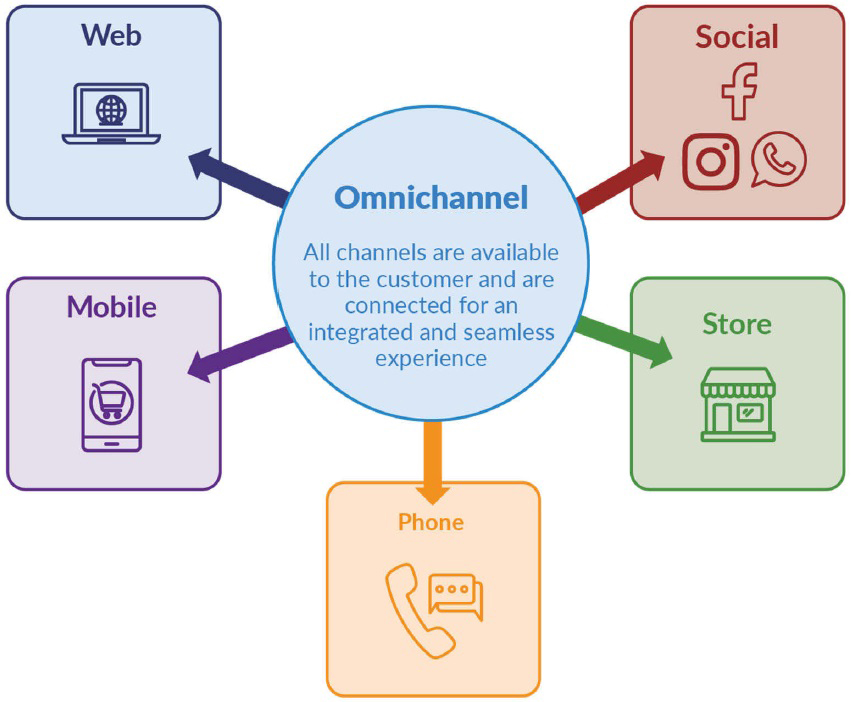
Omnichannel shopping is revolutionizing retail with integrated social and mobile commerce for seamless customer experiences. An omnichannel platform connects the online and physical worlds. Omnichannel retail, or e-commerce omnichannel, refers to the sales approach of using multiple channels that focus on delivering a unified purchasing experience to customers regardless of whether the shopping occurs across all channels or whether it is from in-store kiosks or other digital channels. Omnichannel e-commerce may include online storefronts, brick-and-mortar stores, e-commerce marketplaces, and social media-supported stores. Passengers can browse online, reserve items, and pick them up at the store or have them delivered to their gate. Omnichannel platforms can gather data and offer targeted promotions or recommendations based on travel details and past purchases and distribute that information to passengers through a variety of communication channels. Data from the e-commerce platform (e.g., past purchases, travel information) could be used to suggest relevant products or promotions across other channels, such as airport kiosks or loyalty program emails. Additionally, the omnichannel platform reduces congestion at physical stores and optimizes inventory management for concessionaires.
Examples of omnichannel offerings include Nike’s social media presence on platforms such as Instagram and Facebook, which complements its mobile app, allowing customers to browse and purchase products on social media and the app interchangeably. Lyft has seamlessly integrated its ride-ordering service into Google Maps, making it effortless for users to book a Lyft ride while looking for directions. DoorDash collaborated with Instagram to enable users to order food delivery from restaurants directly within the Instagram app. Wayfair, Bonobos, and Made In, originally e-commerce ventures, have all expanded to include brick-and-mortar stores in response to their growing popularity. This move allows customers to try on clothing or see cookware before purchasing, offering greater flexibility and enhancing the overall customer experience.
Technology and omnichannel shopping go hand in hand and need to be addressed as one. The newest means of an alternative approach to shopping includes technological solutions. Internationally, airports are capitalizing on omnichannel shopping by not only having brick-and-mortar stores but also having an e-commerce presence. Airports employ a variety of omnichannel marketing strategies to enhance the passenger experience and boost retail sales. Some key strategies are found below.
3.3.1 Digital Platforms and In-Store Shopping
International airports are supported by a variety of self-checkout solutions. At Munich International Airport (MUC), passengers can scan or tap a bar code on the shelf, which opens a website where the passenger can complete the transaction. At airports with significant international traffic, the value
proposition of high-end products in duty-free stores continues to stimulate sales. To further stimulate retail sales, international airport operators such as LHR and SIN provide additional savings if passengers order online.
Traditional airport retail has limitations. Travelers are pressed for time, and physical stores only offer a fraction of what could be available. This is where e-commerce and omnichannel platforms come in, transforming the airport concession experience from a rushed, limited affair to a convenient and potentially personalized one.
3.3.2 E-Commerce Platform
Supporting an omnichannel approach is the underlying e-commerce platform. An e-commerce platform for airport concessions is essentially an online marketplace specifically designed for airports. It allows passengers to browse, pre-order, and purchase items offered by airport concessionaires—think duty-free shops, restaurants, and cafes—all from their mobile devices. The following are key features of an e-commerce platform:
- Pre-Order and Collect. Passengers can browse menus for F&Bs; shop from a variety of retail stores, including duty-free items; and pay for them online before reaching the airport. This saves them time upon arrival by skipping queues and avoiding waiting in line.
- Wider Selection. Unlike physical stores limited by space, an e-commerce platform can showcase a much larger variety of products, giving passengers more options.
- Convenience. The platform is accessible from anywhere, anytime, allowing passengers to shop on their phones or tablets at their own pace.
An airport e-commerce platform would allow you to browse the airport shops, find the specific brand you need, pay for it online, and then simply pick it up at a designated location within the airport before your flight.
Unlike an e-Commerce platform, an omnichannel platform is not a single platform itself but rather a concept that integrates various channels (e.g., physical store front, web app, social media) to create a seamless shopping experience for passengers. An omnichannel platform addresses these issues by connecting various channels into a unified system:
- E-Commerce Platform. Passengers can browse and pre-order duty-free items, restaurant meals, or other concessionaire offerings through their phones or tablets before arriving at the airport.
- Physical Stores. These stores remain, however the omnichannel approach enhances their functionality. Passengers can use the e-commerce platform to reserve items for faster pick-up or browse menus digitally.
- Airport Apps. These apps can integrate with the omnichannel platform, allowing passengers to access the same features (e.g., browsing, pre-ordering) directly within the airport app.
- Loyalty Programs. Data from the omnichannel platform (e.g., purchase history, travel preferences) can be used to offer personalized promotions or recommendations through loyalty programs.
3.3.3 Omnichannel Considerations
The landscape of e-commerce platforms for airports with omnichannel capabilities is evolving, and some vendors are moving toward offering more comprehensive solutions. This is what needs to be considered:
- Maturity of the Market. Omnichannel solutions for airports are a relatively new concept. While some vendors are expanding their offerings, established e-commerce platforms might not have fully integrated omnichannel features yet.
- Vendor Capabilities. It is important to research different vendors to see their specific offerings. Some may provide a core e-commerce platform with the ability to integrate with third-party omnichannel solutions (e.g., delivery services, loyalty programs). Others might be developing their own omnichannel functionalities.
- Customization Needs. Consider the level of customization required. If a highly tailored omnichannel experience is required, different solutions from various vendors may need to be integrated. Below are some approaches to consider:
- Single Vendor With Integrated Features. Some vendors might offer an e-commerce platform with built-in omnichannel capabilities, such as order fulfillment options (e.g., pick-up at store, delivery) and basic data integration for personalization.
- Platform and Integration. An e-commerce platform with strong application programming interface (API) capabilities can be chosen and integrated with separate solutions for omnichannel functionalities, such as delivery or loyalty programs.
- Best-in-Class Approach. For specific needs, combining a best-in-class e-commerce platform with separate best-in-class solutions for omnichannel features can be selected. This requires more technical expertise for integration but offers maximum flexibility.
3.3.4 Airport and Passenger Benefits
Airports can benefit significantly from implementing both an e-commerce platform and an omnichannel strategy. Here is a breakdown of the advantages:
For Passengers:
- Convenience and Time Savings. Passengers can pre-order or browse menus, saving them from waiting in lines and rushing through the airport.
- Wider Selection. Passengers have access to a much larger variety of products compared with physical stores.
- Personalized Experience. Omnichannel platforms can offer targeted recommendations and promotions based on preferences and travel details.
For Airports:
- Increased Revenue. E-commerce opens new revenue streams through pre-orders and greater product selection. Omnichannel strategies can further boost sales through targeted promotions.
- Enhanced Passenger Satisfaction. Convenience, time-saving options, and a wider variety of products lead to happier travelers, potentially improving overall airport ratings, and increased non-aeronautical revenue.
- Data-Driven Insights. Platforms provide valuable data on passenger behavior and preferences. This allows airports to optimize their offerings and marketing strategies, and potentially improve terminal layouts based on passenger flow.
- Operational Efficiency and Enhanced Airport Ambiance. E-commerce can reduce congestion and thereby enhance the ambiance at physical stores, while omnichannel delivery options can minimize foot traffic altogether. This frees up staff and allows for better resource allocation.
In conclusion, e-commerce and omnichannel platforms are powerful tools for airports to use to improve passenger experience, generate additional revenue, and gain valuable data-driven insights. By implementing both options, airports can create a future-proof food, beverage, retail, and entertainment strategy that caters to the evolving needs and wants of modern travelers.
3.4 The Need for Comprehensive Understanding of Technology in Airport Concessions
Airport management needs to have a deep understanding of technology in airport concessions for several reasons:
- Infrastructure for Concessionaires. For a smooth and seamless rollout of new technologies by concessionaires, airports should establish the necessary infrastructure, such as sufficient Wi-Fi bandwidth, to enable the effective use of the technology.
- Technology in Solicitations. Airports should prepare their solicitation documents with language that specifies their expectations for the use of certain technologies by concessionaires. Specific or general requests can be made. This is in line with the latest trends to enhance the customer experience through technology.
- Improving Sales and the Customer Experience. Airports should not solely rely on their concessionaires to identify technologies that improve sales and the customer experience. They can also introduce their own technological innovations for commercial program improvements. For example, airports can enhance sales and the customer experience by implementing technologies, such as apps, which allow for pre-ordering before arrival or potential in-terminal delivery of products.
- Financial Impact on Concessionaires. The introduction of technology solutions for the concessions program brings additional costs that were not part of the profit and loss forecasts 5 years ago. Rents required by request for proposals (RFPs) need to take these costs into account. The escalating capital and operating costs have put pressure on the existing business model of in-terminal concessions. At the same time, e-commerce may negatively affect sales, especially for specialty retailers.
- Understanding Challenges as a Landlord. Concessionaires might face challenges when implementing technologies. As a good partner, the airport should provide the necessary support to enable the concessionaire to deliver digital solutions. The introduction of new concession technologies does not end there. Airports need to understand the challenges and opportunities that these technologies might present, how they would meet customer needs, and their effect on airport and concession operations. It is important to note that customer complaints about technology are likely to be directed at the airport rather than the concessionaire, so it is crucial to understand the details of these technologies.
4. Setting the Scene: Technologies in Airport Concessions
4.1 Defining Current and Emerging Technologies Since 2019
Airport concession programs encompass a wide range of retail, dining, and service offerings provided to travelers within an airport. These programs are evolving rapidly due to advancements in technology. Here is a detailed look at the current and emerging technologies shaping airport concessions.
Table 2 lists and defines the current technologies in in-terminal concession programs, either directly or indirectly:
Table 2. Current Technologies for In-Terminal Concessions
| Current Technology | Application |
|---|---|
| Mobile Ordering and Payment |
|
| Self-Service Kiosks |
|
| Digital Signage |
|
| Point-of-Sale Systems (POS) |
|
| Advanced Kitchen Technology |
|
| Loyalty Program |
|
| Wi-Fi/Bluetooth Mobile Phone Tracking |
|
| Automated Retail |
|
| Current Technology | Application |
|---|---|
| Wi-Fi and Connectivity Solutions |
|
| Business Analytics and Business Intelligence Tools |
|
Table 3 lists and defines the emerging technologies in in-terminal concession programs, either directly or indirectly:
Table 3. Emerging Technologies for In-Terminal Concessions
| Emerging Technology | Application |
|---|---|
| AI |
|
| Robotics and Automation |
|
| Digital Marketplace/Omnichannel Retail |
|
| Augmented Reality (AR) and Virtual Reality (VR) |
|
| Biometric Solutions |
|
| Emerging Technology | Application |
|---|---|
| Internet of Things (IoT) |
|
| Blockchain Technology |
|
| Light Detection and Ranging (LiDAR) |
|
| Virtual Queuing |
|
| 5G/Citizens Broadband Radio Service/Private Wireless Networks |
|
| Virtual Food Hall/Ghost Kitchen |
|
These are just a few examples, and the landscape is constantly evolving. The key for airport concessions is to leverage technology to improve the passenger experience, increase efficiency, and boost revenue.
4.2 Documenting the Role of Technology in Enhancing the Airport Concessions Experience
The airport concessions experience encompasses the variety of services and amenities available to travelers, including retail stores, dining options, lounges, and other passenger services. In recent years, technology has significantly transformed this experience, enhancing convenience, efficiency, entertainment, and satisfaction for passengers. Once known for long lines, limited choices, and generic offerings, airport concessions are embracing technology to create a smoother, more personalized, and ultimately more enjoyable experience for travelers.
Based on the industry research conducted by the ICF Team, three major roles in terms of technology as business drivers were identified as the focus of airport in-terminal concession programs. See Table 4 for the key areas being addressed by technology in each of these major roles:
Table 4. Business Drivers for Technologies
| Role of Technology – Business Drivers | Key Areas Being Addressed |
|---|---|
| Helping to Understand and Address Customers’ Needs |
|
| Optimizing Concession Operations |
|
| Boosting Revenues |
|
Technology has greatly affected the airport concessions experience, making it more efficient, convenient, and enjoyable for travelers. From digital retail and contactless payments to AR navigation and personalized marketing, these innovations have transformed how passengers interact with airport services. As technology continues to evolve, the future of airport concessions promises even more advanced and integrated solutions, further enhancing the travel experience.
5. Visualizing the Passenger Journey in Airport Concessions
5.1 Visualizing the Passenger Journey
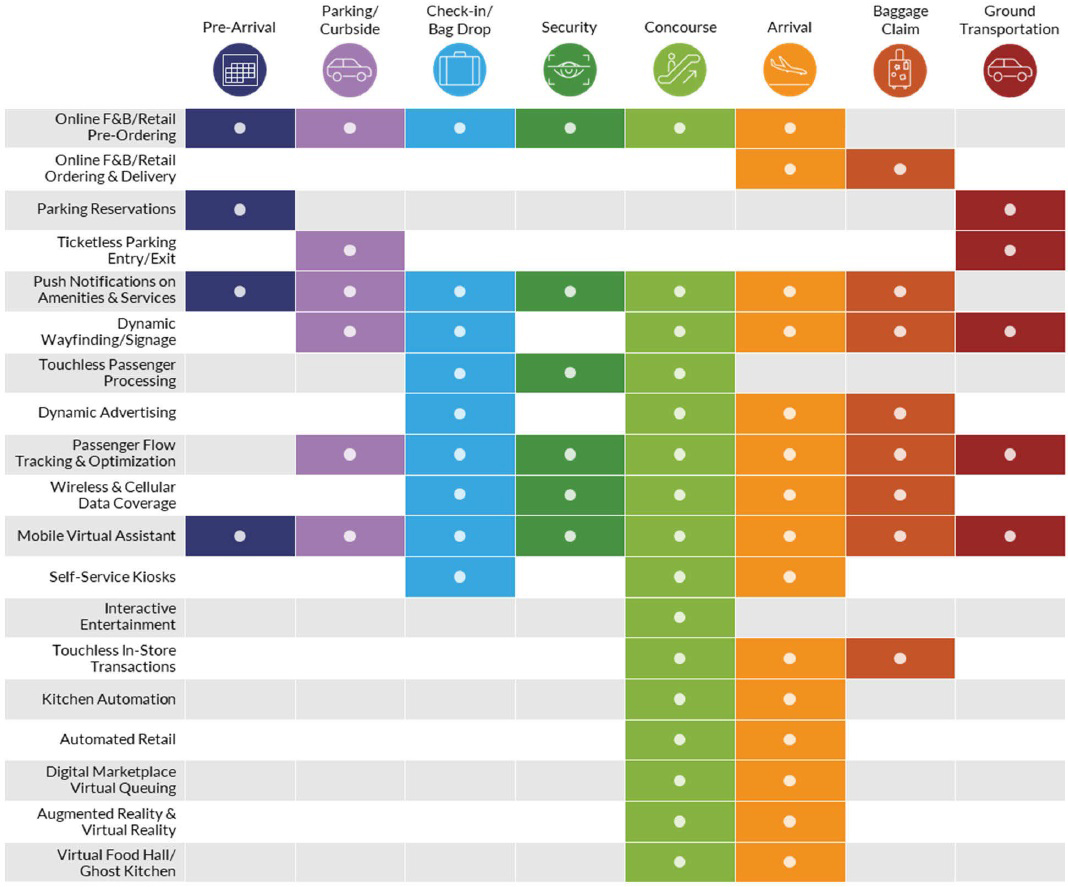
The following graphics depict the enabling technology and applications at the various touchpoints of the passenger journey for both arrivals and departures. Note that Federal Inspection Services was not included because that facility is under the authority of U.S. Customs and Border Protection, and generally concession outlets are not located in these areas.
5.2 Passenger Views and Preferences Regarding Technology in Airport Concessions
Ideally, each airport would have the resources to collect data on their passengers to understand the characteristics of their passengers either by conducting this research on their own or by using services such as J.D. Power & Associates or Airports Council International (ACI) World’s Airport Service Quality (ASQ) programs; however, understandably, most have neither the resources nor have they prioritized this relative to other initiatives.
Along these lines, the ICF Team conducted an Airport Passenger Survey, which offers key insights into air travel experiences, drawing from a representative sample of 1,200 individuals who had flown at least twice during the past year. The survey’s findings encompass various aspects of travel habits, preferences, technology use, and spending behaviors.
Using the survey results, the research team then identified four passenger personas that airports can use when considering technology initiatives. These general personas can assist airports regarding the relationship that different passenger groups may have with technology.
5.3 Summary of the Findings from the Airport Passenger Survey
Travel Habits and Preferences.
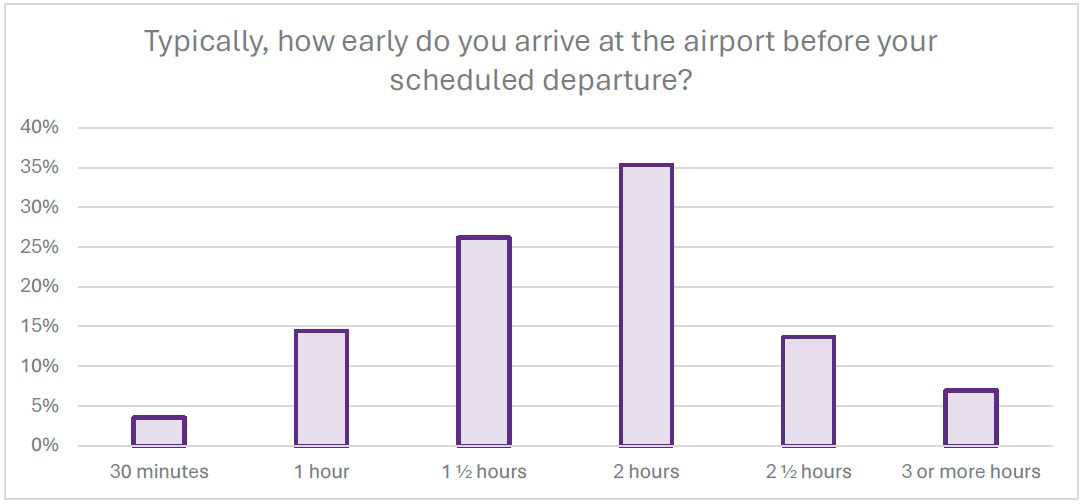
Approximately 72% of the respondents flew twice during the past year. The survey indicated that leisure travel is the primary reason for flying, with 40% citing rest and relaxation, followed by 38% visiting friends or family, and 35% who are on family vacations. More than one-third of the participants (35%) typically arrived at the airport 2 hours before their flight, which is a behavior that is more common among older travelers.
Technology and Communication.
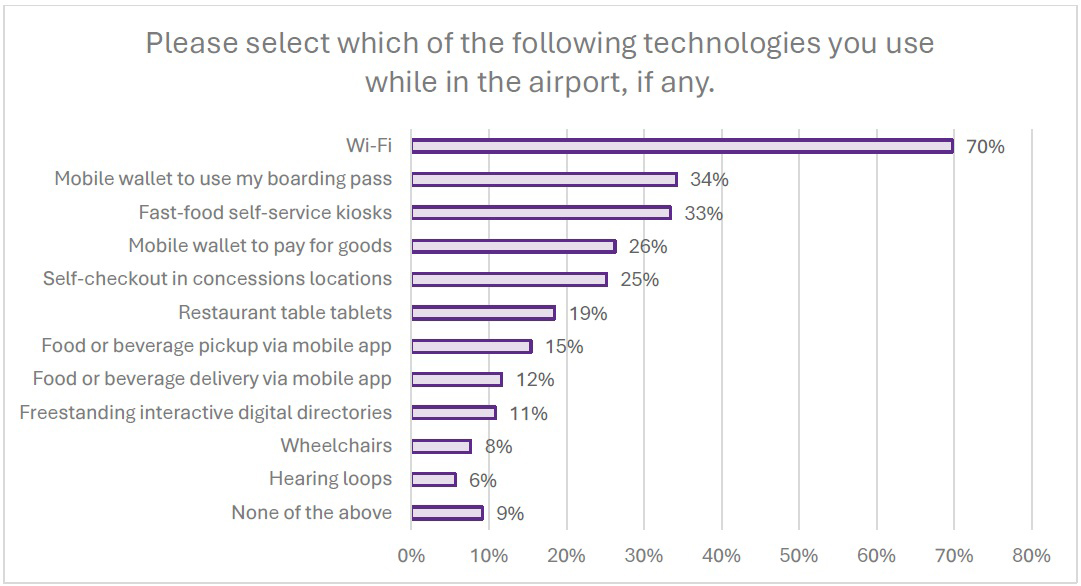
The reliance on technology was significant, with 88% of the respondents carrying smartphones during their travels. Airport Wi-Fi usage was high, with 70% of the participants using this service, thus emphasizing the need for strong digital infrastructure in airports. Mobile wallets and self-service kiosks are also used by a sizeable portion of the respondents.
Spending at the Airport.
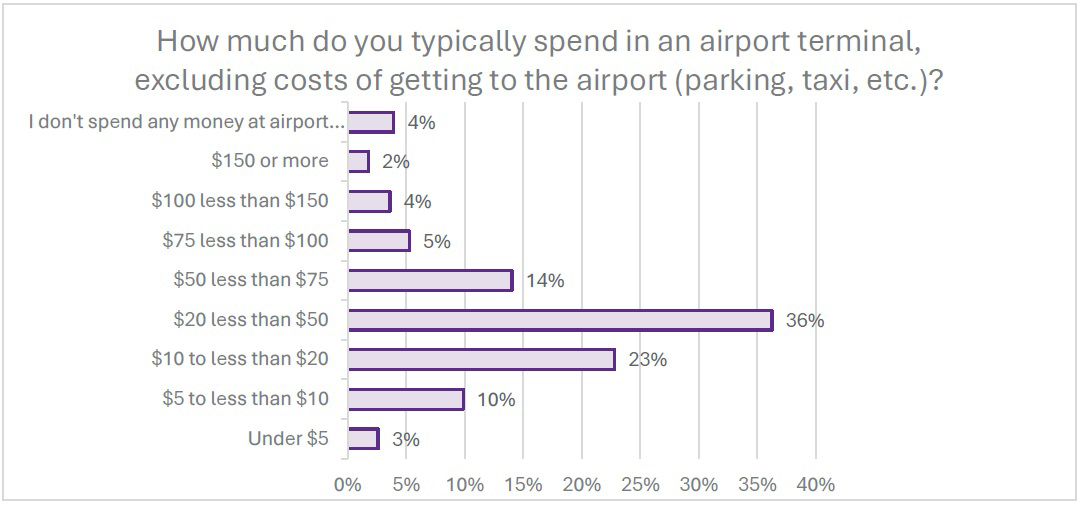
The survey revealed spending trends within airport terminals, with more than a third of the respondents (36%) spending between $20 and $50. Younger travelers, particularly those ages 23 to 38, showed a higher propensity to spend, with 41% typically spending more than $50. Conversely, older travelers, specifically those age 65 and above, were more conservative in their spending habits, with 18% typically spending $10 or less in an airport terminal.
Summary:
The survey’s findings underscore the pivotal role of technology in modern air travel. The high comfort level with smartphones, digital booking platforms, and Wi-Fi usage among passengers signifies a paradigm shift in the travel experience. This trend reflects a growing expectation for seamless, technology-driven interactions throughout the journey—from planning and booking flights to navigating airports. As this digital integration becomes increasingly ingrained in the traveler’s journey, it highlights an opportunity for the travel industry to further innovate and enhance the overall efficiency and enjoyment of air travel.
5.4 Passenger Personas
The results of the Airport Passenger Survey served as the basis for identifying a range of travelers frequenting airports. The four high-level personas were created by analyzing this dataset by studying trends, patterns, and correlations among the data that was collected. These personas are not just fictional representations but are grounded in real data and survey research. They encompass various traits, such as demographic attributes, psychographic attributes, core motivations, pain points, and technographics, providing a comprehensive view of different traveler types.
The Role and Impact of Personas in the Airport Ecosystem.
Personas serve a critical role in contextualizing passenger journeys within the airport ecosystem. They allow for the mapping of unique passenger experiences, catering to the distinct ways in which different customers interact with brands, services, and technology. This leads to more relevant and personalized experiences for travelers at scale. Personas simplify design tasks and focus on the varied needs among different customer groups. They unify teams around a common language and understanding of stakeholder groups, humanize market segment data, and build a deeper connection to stakeholders. This approach is pivotal in creating customer-centric experiences, guiding future research efforts, and aiding in decision-making.
Utilizing Personas for Enhanced Airport Experiences.
While there is no limit to how many personas can be created, it is best to remain focused and targeted. Identifying the most important stakeholders (e.g., primary customers, employee groups, purchase influencers) will help do this. At their core, personas are about painting a fuller picture of stakeholders to build a brand (or, in the case of airports, an ecosystem) and better design options and experiences. Knowing which characteristics influence customer perceptions and behaviors will help airports and concessionaires connect better with them. A primary objective of incorporating technology into an airport’s concessions program is to enhance the customer experience. To accomplish this goal, airports should first understand who their customers are and how they relate to technology.
Defining Key Traveler Personas for Technology and Concessions in Airports.
In analyzing the responses from the Airport Passenger Survey, four distinct airport passenger personas were identified, each representing unique interactions with and attitudes toward technology. These personas include (1) the Tech-Savvy Young Explorer, a younger, technology-enthusiastic traveler; (2) the Digitally Engaged Family Navigator, who leverages digital tools for efficient family travel; (3) the Connected Business Professional, who relies heavily on technology for business travel efficiency; and (4) the Golden Age Leisure Enthusiast, an older traveler who prefers a more traditional approach to travel and technology. These personas, derived from comprehensive data analysis, offer valuable insights for airports and concessionaires to understand and cater to the diverse technological needs and preferences of different traveler segments, enabling the creation of tailored and satisfying airport experiences.
The following four passenger personas in Figure 24 were categorized as part of the Airport Passenger Survey with their weighted response allocation.
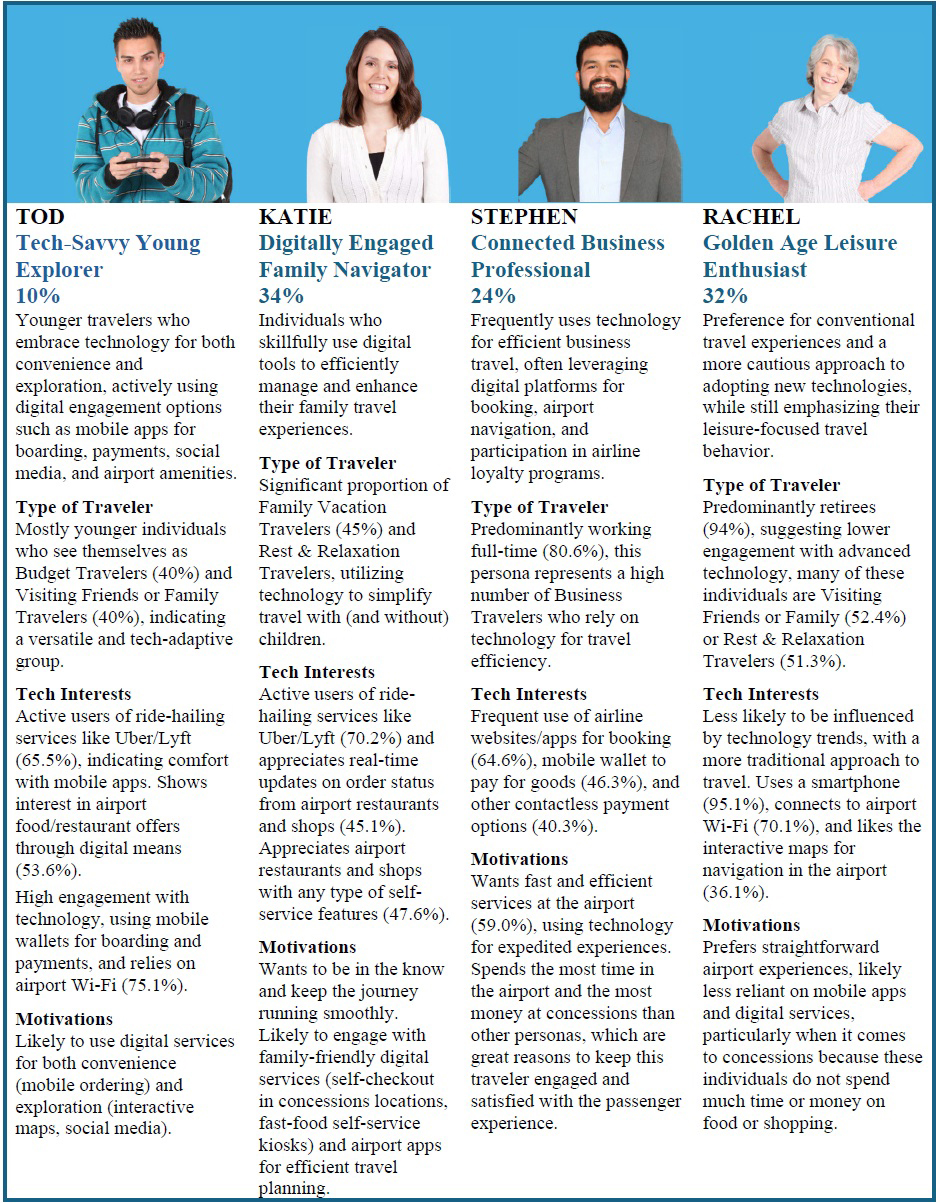
- Tech-Savvy Young Explorer (Tod). Younger traveler; frequent technology user; spends money on fast food and tech-related conveniences.
- Digitally Engaged Family Navigator (Katie). Uses digital tools for family travel efficiency; spends on grab-and-go snacks and meals.
- Connected Business Professional (Stephen). Frequent business traveler; high spender on diverse airport services.
- Golden Age Leisure Enthusiast (Rachel). Prefers traditional travel experiences; spends minimally at airports.
Airports can use these personas when considering how technology is incorporated into their in-terminal concession programs. Some key commonalities across personas include the following:
- Convenience and Efficiency. Desire for streamlined travel experiences.
- Technology Usage. Reliance on digital tools for various travel-related tasks.
- Real-Time Updates. Importance of timely information on flight status and other services.
Based on the findings of the various personas of passengers, the ICF Team identified the following opportunities for airports to consider as they develop airport concession technology programs:
- Communication and Engagement. Improve strategies to ensure timely and relevant passenger information.
- Leveraging Passenger Feedback. Use insights to bridge gaps between passenger expectations and reality.
- Digital Services in Concessions. Enhance dining and shopping experiences with digital menus and contactless payments.
5.5 The Relationship Between the Passenger Experience and Technological Advancements
The relationship between passenger experience and technological advancements at airports today, particularly concerning concession programs, is multifaceted and significant. Technological advancements are increasingly being utilized to enhance passenger experience by making airport concession programs more efficient, personalized, and convenient.
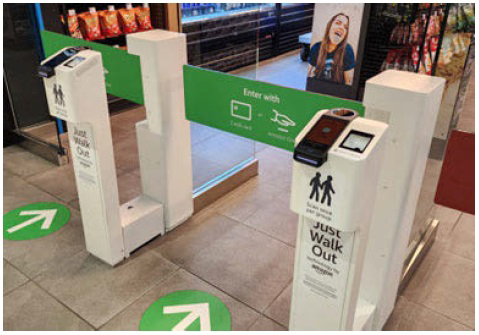
Source: ICF
The following are some of the key aspects of the relationship between airport passengers and technology:
- Improved Efficiency, More Time to Spend
- Self-service kiosks and mobile check-in reduce lines, freeing up passengers to browse shops and restaurants.
- Real-time flight information and digital signage help passengers navigate efficiently, maximizing their time for shopping and dining.
- Personalized Experiences
- Location-based services can target advertising and promotions to passengers based on their needs and preferences.
- Biometric technology with digital wallets could allow for seamless, contactless purchases at concessions.
- Enhanced Entertainment and Relaxation
- Faster Wi-Fi and charging stations allow passengers to stay connected and entertained while waiting.
- VR experiences could offer new ways for passengers to relax or even “travel” to destinations within the airport.
- Data-Driven Insights
- Airports can use data from passenger movements and purchases to tailor concession offerings and optimize pricing.
- This can lead to a more curated selection of shops and restaurants that cater directly to passenger preferences.
- While technology can enhance the experience, it is crucial to ensure a balance with human interaction for those who prefer it.
- Accessibility for all passengers, regardless of tech-savviness, is essential.
- Data privacy concerns need to be addressed with clear communication and strong security measures.
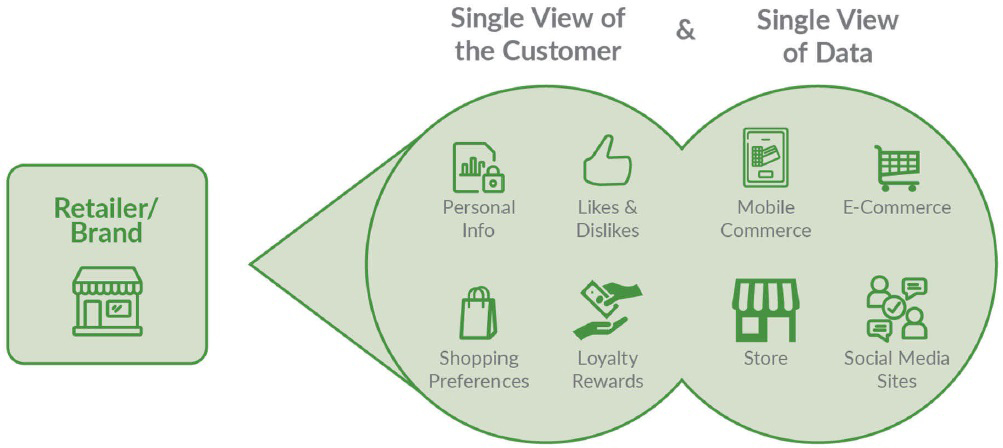
As technology continues to evolve, the integration of these advancements into concession programs will likely become even more sophisticated, further improving the passenger experience.
6. Consumer Insights and Technological Trends
6.1 Airport Consumer Insights and Technological Trends
The integration of technology in travel is deeply woven into the modern traveler’s experience. With smartphones as essential travel companions and airport Wi-Fi usage at high levels, the digital landscape is reshaping expectations and operations within the travel industry. The ubiquity of smartphones in the travel domain was unmistakably highlighted in the survey, with an overwhelming 88% of the respondents indicating that they carry smartphones during travel. The survey also revealed a substantial reliance on airport Wi-Fi, with 70% of the Golden Age Leisure Enthusiasts using this service. This finding emphasizes the need for robust and reliable digital infrastructure to accommodate most travelers who see Internet connectivity as integral to their journeys. Regarding data security, 52% of the travelers expressed apprehension about their personal information.
Passengers report wanting more real-time information on security checkpoint wait times and parking availability; they also want information on concession opportunities and offers as shown in Figure 27.
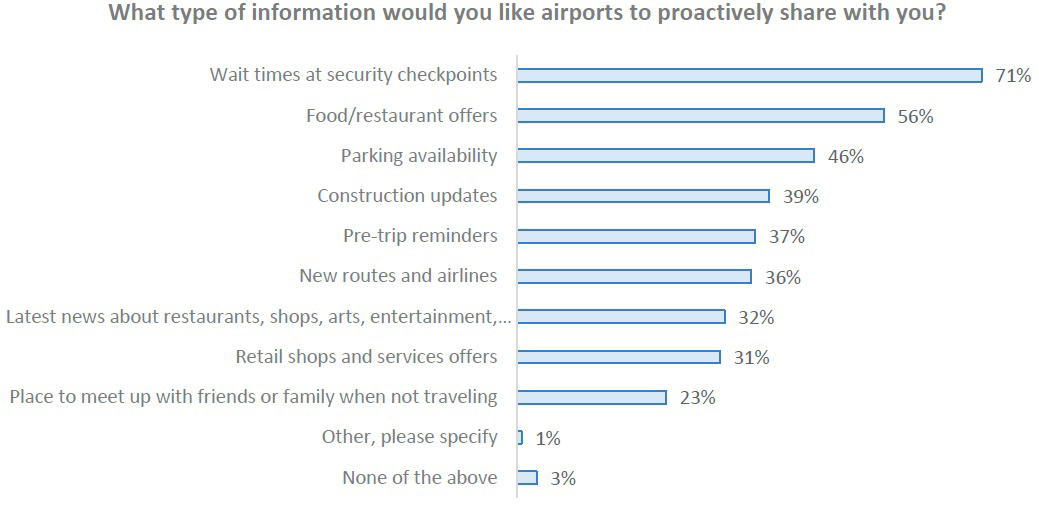
Furthermore, the appreciation for modern technological conveniences, such as contactless payments, real-time updates, and self-service options, was evident, with 37% to 39% of the respondents valuing these features (as shown in Figure 28). These preferences indicate a growing demand for efficient, technology-driven services at airports and by airlines. In particular, about half of all respondents belonging to the personas of Tech-Savvy Young Explorer and Digitally Engaged Family Navigator are interested in digitized food/restaurant experience like digital menus, order status updates, and self-service features.
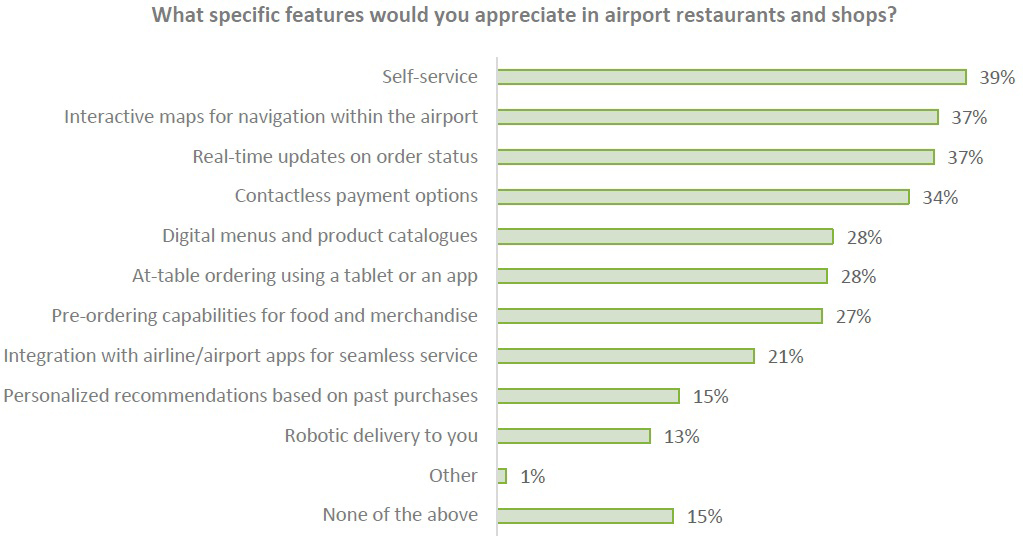
The survey also highlighted a strong preference for digital platforms in the booking process, with 76% of the respondents favoring airline websites or apps. Another finding is the preference for TSA PreCheck, with 30% of the survey participants favoring this Trusted Traveler Program. This preference indicates a desire for streamlined and expedited travel processes, signaling an opportunity for similar programs that enhance travel efficiency. Additionally, the reliance on flight display boards at gates (56%) and boarding passes (47%) for gate numbers and flight status information highlights the importance of clear and real-time information within the airport environment. The survey also revealed preferences regarding how travelers wish to receive information from airports. A clear majority prefer to receive updates via text/SMS (66%) and email (56%).
The survey results reveal widespread comfort with technology among air passengers, regardless of age. Approximately 85% of the participants reported a high level of comfort with using technology. Whether it is booking flights online, accessing real-time travel updates via smartphone apps, or utilizing contactless payment methods, passengers are increasingly relying on technology to enhance their travel experiences. This holds particularly true for Connected Business Professionals who greatly appreciate quick and efficient airport services. However, a mere 26% of the respondents followed or monitored airport social media accounts, which suggests either a potential area for airports to expand their digital outreach and engagement strategies, or for airports to assess the value of these developing outlets.
The study underscores the significant role of technology in enhancing the travel experience, with a high reliance on smartphones, digital booking platforms, and airport Wi-Fi. This reliance on technology is juxtaposed with some concern about data security and privacy, emphasizing the need for a balance between technological advancement and data protection.
Furthermore, the survey reveals differences in airport behaviors and spending patterns based on age, with older travelers tending to arrive earlier and spend less, and younger travelers displaying a higher propensity to spend more within the airport. The findings also stress the importance of efficient, technology-driven services, and the growing demand for streamlined travel processes, as evidenced by the preference for programs such as TSA PreCheck. The data also suggests potential areas for improvement in airport
amenities and concessions, especially addressing long waits at security and the perceived high cost of goods and services. Overall, the ACRP Airport Passenger Survey provides valuable information that can be leveraged by airports, airport concessionaires, technology solution providers, airlines, and policymakers to enhance the air travel experience, ensuring that it meets the evolving needs and preferences of the traveling public.
6.2 Assessing Changes in Consumer Buying Habits and the Effect on Airport Concessions
In recent years, consumer purchasing habits have been significantly altered, and airports are not exempt from this trend. Here is a breakdown of key trends and their impact on airport concessions:
Key Trends:
- There is a heightened consumer awareness of health and safety, leading to increased demand for contactless services.
- Consumers are increasingly seeking experiences over products.
- There is a growing expectation for personalized and customized shopping experiences.
- Younger travelers, who are tech-savvy and value experiences over material goods, are influencing the types of products and services offered in airports.
- Passengers are more informed than ever.
- Passengers have more buying options.
- Passengers expect comprehensive services.
- Unlike in the past, most purchasing decisions being made today are made in advance, rather than impulse purchasing.
- Customer engagement and conversion rate does not necessarily grow at the same rate as passenger number.
- Business travelers make purchasing decisions in advance, while leisure travelers make more impulsive purchases and have more dwell time.
Impact on Airport Concessions:
- Shifting Retail Mix. Traditional airport stores that sell generic travel items may see a decline. There could be a rise in the following:
- Experiential Retail. Think pop-up stores, local brands, or interactive installations.
- Specialty Stores. Catering to specific needs, such as electronics, health and wellness, or business essentials.
- F&Bs. Focus on healthy, grab-and-go options alongside local specialties.
- Digital Integration. Click-and-collect options, in-store kiosks for pre-ordering, and seamless mobile payment integration.
- Focus on Technology. Airports will need to incorporate technology to enhance the shopping experience.
- Interactive Displays. Interactive displays for product information and promotions.
- Dynamic Signage. Digital signage for wayfinding and targeted advertising.
- Self-Service. Self-checkout kiosks for faster transactions.
- Robotics. Robots for the delivery of orders and the bussing of tables.
- Mobile Wallets and Contactless Payments. The shift toward digital wallets and contactless payments is streamlining transactions and affecting how travelers spend money at the airport.
- Value and Convenience. Passengers are more budget conscious and time-sensitive. This means a focus on value propositions and convenient grab-and-go options.
- E-Commerce and Omnichannel Strategies. Airports are incorporating e-commerce platforms to allow travelers to shop online and pick up their purchases at the airport, thus enhancing convenience. This reduces impulse buying at airports. By creating a digital marketplace, airports can offer their customers personalized products and services, while tapping into potential new revenue streams.
- In-Store Technologies. The use of AR and VR for product visualization and interactive experiences is becoming more common in airport retail settings.
- Data-Driven Strategies. Understanding consumer behavior through data analytics will be crucial. This will help airports tailor offerings and optimize pricing.
- Retail Space Utilization. Airports may need to reconfigure retail spaces to accommodate new types of stores and services, such as wellness centers or pop-up shops featuring local artisans.
- Loyalty Programs and Incentives. Enhancing loyalty programs to include more benefits and incentives for frequent travelers can drive repeat purchases and customer loyalty.
Changes in consumer buying habits are having a significant effect on airport settings, necessitating that airports and retailers adapt to meet evolving traveler expectations. By embracing technological advancements and catering to the preferences of different traveler demographics, airport retail can continue to thrive and enhance the overall travel experience, as well as non-aeronautical revenue.
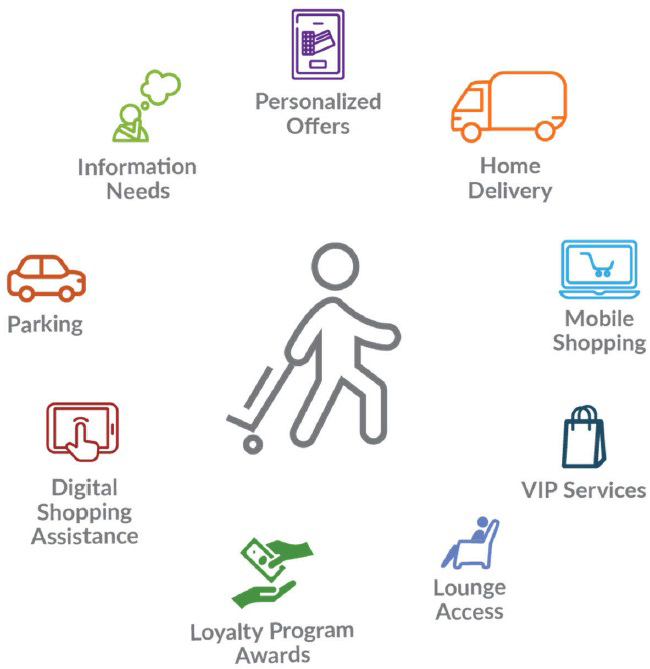
7. Stakeholder Perspectives and Interviews
7.1 Overview of the Interview Process and Stakeholder Selection
As part of the Data Collection task of the project, the ICF Team interviewed a variety of airports, technology and solution providers, concessionaires, and other industry thought leaders.
To develop a final selection of who to interview, the ICF Team developed a list of best-in-class airports around the globe based on 2020–2022 recipients of the ACI World’s ASQ, J.D. Power North American Airport Study, and SkyTrax awards, indicating excellence in customer experience. The team then leveraged our many industry contacts (and made some cold calls) to curate a diverse list of airports, well-regarded technology and solution providers, key concessionaires, and other consultancies to interview regarding their innovation practices related to airport in-terminal concessions programs.
Although not all interview targets were able to support the interview process, 24 interviews were conducted with the following breakout: 11 with U.S. airports, seven with technology and solution providers, three with notable concessionaires, and three with thought leaders/consultancies.
As part of the interview process, the team developed a list of interview questions tailored specifically to each of the interviewee target groups, such as airports, concessionaires, technology providers, and others. Our objective was to determine which technology programs were being adopted for concession programs, their challenges, successes, lessons learned, and thoughts for the future.
Each set of interview questions was designed to foster 45–60 minutes of productive conversation. While we followed the conversation and subject matter naturally throughout the interviews, we also asked as many of the same category-specific questions to each interviewee as possible to foster direct comparisons. Maintaining this hybrid structured/natural approach to interviewing proved to be helpful as we answered our important guiding questions and made discoveries when interviewees took a few minutes to expound on their initiatives and experiences.
All interviews were conducted virtually with pertinent points of contact at each organization, usually chief innovation officers and/or commercial program managers. The ICF Team recorded and transcribed interviews where allowed. Most interviewees agreed to be recorded and quoted (pending specific approvals) in our final research. Figure 30 depicts the airports that were interviewed:
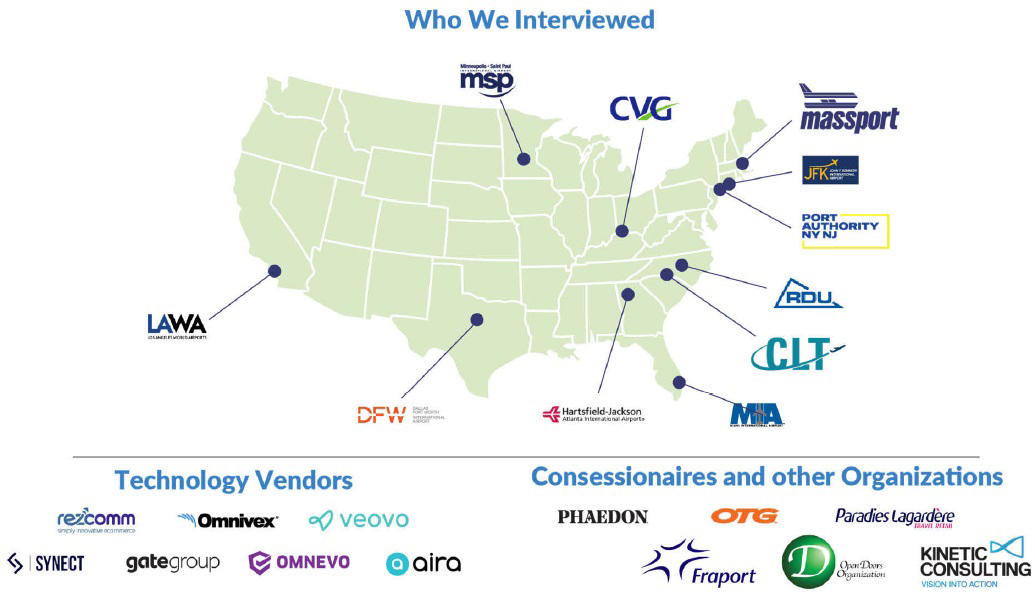
7.2 Key Insights from Airport Stakeholders
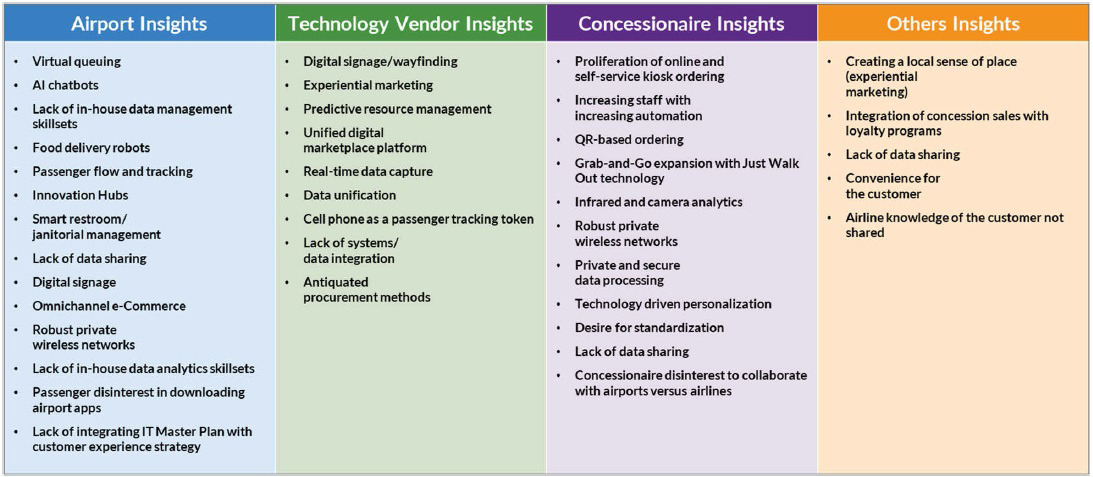
7.2.1 Airport Insights
A variety of insights were obtained during the airport stakeholder interviews. Below is a summary of insights into several innovations through our airport interviews:
- Virtual Queuing. Several airports [Minneapolis-St. Paul International Airport (MSP), Seattle-Tacoma International Airport (SEA), Orlando International Airport (MCO), Phoenix Sky Harbor International Airport (PHX), and JFK] have deployed virtual queuing technology at the security checkpoints to optimize passenger dwell time in order to increase F&B/retail revenue opportunities. Integration with digital signage/wayfinding is also being utilized to offer passengers choices in order to take advantage of the increased dwell time. For instance, LAX is in the process of implementing a virtual queuing program.
- AI Chatbots. The Port Authority of New York and New Jersey (PANYNJ) is offering a new approach to passenger assistance via AI-driven chatbots for facility and flight.
- Data Management Skill Sets/Resources. MSP uses third-party IT consultants for data management when in-house capabilities are lacking.
- Food Delivery Robots. These are popular with leisure travelers in Cincinnati/Northern Kentucky International Airport (CVG) who arrive at the airport early, especially those traveling with children.
- Wi-Fi Mobile Tracking. CVG uses mobile phone tracking data to guide holiday gift-wrapping kiosk hours and days of operation. In general, it is another technique for passenger flow tracking that is useful to retail stores for better understanding customer behavior, optimizing product placement, and improving in-store marketing strategies.
- Multilingual Self-Service Kiosk. JFK provides passengers with kiosks enabled with AI that can translate verbal commands instantly.
- Passenger Feedback Surveys with Chatbot Integration. Miami International Airport (MIA), George Bush Intercontinental Airport (IAH), and William P. Hobby Airport (HOU) leverage J.D. Power’s Passenger View Wi-Fi-enabled micro-survey solution to obtain real-time Voice of Customer (VOC) data.
- Innovation Hub. CVG, MSP and PANYNJ each have created “Innovation Hubs” to promote, coordinate, and test new technologies and the application of these technologies. PANYNJ’s Innovation Hub fields all requests for technology-related projects and uses checklist-based methodologies for each project type, funding the alternatives that check the most boxes.
- Smart Restroom Solutions/Janitorial Management. MIA uses TRAX Analytics software to monitor restroom usage and occupancy, alerting facilities staff to cleaning and closure needs.
According to the interviews, the two most important lessons that airports have learned recently are:
- Airport-specific mobile applications are unsuccessful. Travelers are not downloading these apps as expected, and some airports have scrapped their mobile app initiatives altogether and are moving toward web apps that can be accessed via QR code on airport signage or the airport website.
- The airport’s IT or Digital Master Plan should be aligned with the airport’s customer experience strategy. These two have historically been, in many cases, siloed and misaligned. This can no longer be the case as it creates too many operational inefficiencies and missed opportunities to implement a strategic, holistic approach to creating an airport-wide brand and a comprehensive, unique airport experience door-to-door.
Common themes captured in discussions with the airports
- The need for data standardization and integrated point-of-sale systems
- Installing enhanced digital signage throughout all terminals
- Activating loyalty programs as part of the airport concessions program
- Offering omnichannel e-commerce platforms as a retail alternative in developing the digital marketplace
- Employing technology roadmaps—narrative building tools for planning concessions technology programs, which allows vendors to opt in or out before executing the initiative
- The need for robust Wi-Fi and cellular 5G-enabled IT infrastructure
- Inadequate budget and/or staff to support in-house advanced data analytics
- Challenges when negotiating with larger commercial tenants to access point-of-sale system data
- A general interest in benchmarking performance against other airports
- A general desire for more granular passenger flow and facility interaction data (e.g., tracking dwell time, purchases)
Common themes captured in discussions with the airports
- The need for data standardization and integrated point-of-sale systems
- Installing enhanced digital signage throughout all terminals
- Activating loyalty programs as part of the airport concessions program
- Offering omnichannel e-commerce platforms as a retail alternative in developing the digital marketplace
- Employing technology roadmaps—narrative building tools for planning concessions technology programs, which allows vendors to opt in or out before executing the initiative
- The need for robust Wi-Fi and cellular 5G-enabled IT infrastructure
- Inadequate budget and/or staff to support in-house advanced data analytics
- Challenges when negotiating with larger commercial tenants to access point-of-sale system data
- A general interest in benchmarking performance against other airports
- A general desire for more granular passenger flow and facility interaction data (e.g., tracking dwell time, purchases)
Most of the airports interviewed have, at a minimum, deployed at least one impressive airport technology concessions program initiative or perspective. One airport interviewed has shown clear indifference toward digital modernization and innovations within their in-terminal concession programs.
7.2.2 Technology Vendor Insights
The ICF Team interviewed four technology vendors who serve the airport in-terminal concessions space in various capacities. Below are the firms interviewed:
- Omnivex (digital signage)
- Rezcomm (airport digital marketplace)
- Synect (digital signage)
- Veovo (airport performance and passenger experience data analytics)
The following are some innovations identified during the technology vendor interviews:
- Digital Signage/Wayfinding. Airports are using digital signage to guide customers toward open or less crowded concessions and restrooms throughout the day, based on machine learning, passenger tracking, and capacity constraint data. This opens a new advertising marketplace and provides new revenue opportunities for terminal operators; some concessionaires may pay to be listed prominently on digital signs during peak periods.
- Experiential Marketing. The role of retail has evolved from encouraging spending to enhancing the overall customer experience. Large U.S. airports are now following in the footsteps of their overseas counterparts in attempting to become retail destinations in themselves.
- Predictive Staffing. To accommodate peak travel hours and days, airports are utilizing passenger flow solutions.
- Unified Digital Marketplace Platform. Airports are now seeking to utilize a unified platform to tie in the e-commerce, Omnichannel, loyalty programs, airport lounge, and virtual queuing offerings under an integrated environment.
Common themes found in the technology vendor interviews
- The importance of real-time information sharing to passengers regarding closures, long lines, waits at concessions, and so forth, which satisfies the customer’s need to have more control over their journey.
- Data unification projects as key to fostering a more comprehensive understanding of an airport’s operations and more informed decision-making.
- The use of mobile phones for tracking and monitoring passenger flow.
- A lack of integration: Most airports have not integrated concessions into their IT stack. Airport interviewees reported that either concessionaire resistance or a lack of airport (authority) budget is the primary causes of this.
- The fact that one bad experience at an airport is enough to make a passenger avoid it as much as possible on future trips: The aim for all stakeholders is to make the terminal experience as seamless as possible through multiple practical measures.
- Lengthy procurement methods utilized by airports for technology.
Common themes found in the technology vendor interviews
- The importance of real-time information sharing to passengers regarding closures, long lines, waits at concessions, and so forth, which satisfies the customer’s need to have more control over their journey.
- Data unification projects as key to fostering a more comprehensive understanding of an airport’s operations and more informed decision-making.
- The use of mobile phones for tracking and monitoring passenger flow.
- A lack of integration: Most airports have not integrated concessions into their IT stack. Airport interviewees reported that either concessionaire resistance or a lack of airport (authority) budget is the primary causes of this.
- The fact that one bad experience at an airport is enough to make a passenger avoid it as much as possible on future trips: The aim for all stakeholders is to make the terminal experience as seamless as possible through multiple practical measures.
- Lengthy procurement methods utilized by airports for technology.
7.2.3 Concessionaire Insights
The ICF Team interviewed three airport concessionaires:
- OTG Management
- Paradies Lagardère
- Fraport AG
Concessionaires have been the most challenging to reach and are hesitant to discuss different technological and process innovations, perhaps to protect their competitive advantage.
The ICF Team uncovered several innovations through the concessionaire interviews:
- Self-Service Kiosks. They increase food service efficiency because of instant information flow to the kitchen.
- Increased Staffing With Increased Automation. Passengers crave both digitalization and human assistance, so concessionaires have hired more staff and moved them out from behind the counter to the floor, where they can assist customers. This is called a “high tech, high touch” approach to retail.
- QR Code-Based Ordering. This method is now commonplace at F&B concessions because it does not require passengers to download mobile apps.
- Grab-and-Go Expansion. Concessionaires are expanding the grab-and-go concept beyond F&B (see Amazon’s Just Walk Out stores).
- Infrared and Camera Analytics. Cameras and infrared sensors are being used for just-in-time stocking, both on the merchandise shelves and in back-of-house storage.
- Cross-Selling. Opening a restaurant’s menu and kitchen to a neighboring wine bar can increase options and customer satisfaction.
- Internal Wi-Fi Networks. OTG has installed private networks in airports to handle their own concessions’ data needs.
- Data “Clean Rooms.” They are controlled environments where data can be processed and analyzed while ensuring that it remains private and secure.
- Efficient Staffing. Predictive staffing for peak travel periods allows for better utilization of resources.
Common themes found in the concessionaire interviews
- Technology-Driven Personalization.iPads and tablet orders are out. Mobile ordering from personal devices is in. The goal is to place all commerce abilities in the customers’ hands.
- Desire for Standardization in Concession Practices.Concessionaires expressed a desire for airports to standardize the reporting requirements on concessionaires. This includes not only how monthly certified statements are reported to airports for billing and reporting purposes but increasingly for transaction sales data. The concessionaires indicated that there would be much less reluctance to provide the more detailed transaction sales data if the format were standardized across airports.
- Non-Robust Network/Wireless Infrastructure.Concessionaires felt that many airports have inadequate infrastructure in the areas of wired and wireless network coverage and bandwidth at aging airport terminals.
- Lack of Data Sharing.If the airport cannot provide access to passenger data, then the concessionaire cannot provide adequate sales data. The concessionaires stated that simply getting access to an airport’s Flight Information Display System (FIDS) is not adequate for making planning and operational decisions. The concessionaires need both future passenger flow numbers and more real-time passenger flow data to adapt to real-time conditions, such as irregular operations.
- Preference for Collaborating With Airlines.Concessionaires indicated a strong preference for collaborating with airlines (as they have more customer interactions than airports) on omnichannel or cross-utilization offers (e.g., integrating loyalty programs).
Common themes found in the concessionaire interviews
- Technology-Driven Personalization.iPads and tablet orders are out. Mobile ordering from personal devices is in. The goal is to place all commerce abilities in the customers’ hands.
- Desire for Standardization in Concession Practices.Concessionaires clearly expressed a desire for airports to standardize the reporting requirements on concessionaires. This includes not only how monthly certified statements are reported to airports for billing and reporting purposes but increasingly for transaction sales data. The concessionaires indicated that there would be much less reluctance to provide the more detailed transaction sales data if the format were standardized across airports.
- Non-Robust Network/Wireless Infrastructure.Concessionaires felt that many airports have inadequate infrastructure in the areas of wired and wireless network coverage and bandwidth at aging airport terminals.
- Lack of Data Sharing.If the airport cannot provide access to passenger data, then the concessionaire cannot provide adequate sales data. The concessionaires stated that simply getting access to an airport’s Flight Information Display System (FIDS) is not adequate for making planning and operational decisions. The concessionaires need both future passenger flow numbers and more real-time passenger flow data to adapt to real-time conditions, such as irregular operations.
- Preference for Collaborating With Airlines.Concessionaires indicated a strong preference for collaborating with airlines (as they have more customer interactions than airports) on omnichannel or cross-utilization offers (e.g., integrating loyalty programs).
7.2.4 Other Interviews
The ICF Team has interviewed two industry thought leaders:
- Kinetic Consultancy (high-traffic industry business architects)
- Phaedon (brand storytelling, customer loyalty)
The ICF Team uncovered several notable innovations through our industry thought leader (“other”) interviews:
- Creating a Local Sense of Place. Guaranteeing local offerings, culture, and feel in concession programs is a trending approach. The airport is the first impression of a city or region and should welcome visitors to the area with a local flair. The downtown area of a city and any nearby natural landmarks will benchmark customer expectations when they arrive. For example, the Ronald Reagan Washington National Airport offers Ben’s Chili Bowl as a food option and has even named generic F&B concessions after Washington, D.C.’s famous U Street.
- Non-Airport-Specific Loyalty Point Programs. Passengers feel limited by enrolling in an airport loyalty program because those accrued points can only be used at that one airport when, in fact, they frequent many different airports. One way to enhance these programs is to leverage existing programs with wide acceptance, such as Delta SkyMiles, for purchases at every concession at an airport, which then could be used at other airports or an airline.
Common themes found in the industry thought leader (“other”) interviews
- Data Sharing.Again, there is a strong emphasis on a need for better data integration and sharing among all stakeholders.
- Convenience for the Customer.Airports have a uniquely captive audience, so make sure that they enjoy their time there and want to come back on future trips.
- Airline Ownership of the Airport Customer.The airline knows everything about the traveler while everyone else just knows fragments of their story.
Common themes found in the industry thought leader (“other”) interviews
- Data Sharing.Again, there is a strong emphasis on a need for better data integration and sharing among all stakeholders.
- Convenience for the Customer.Airports have a uniquely captive audience, so make sure that they enjoy their time there and want to come back on future trips.
- Airline Ownership of the Airport Customer.The airline knows everything about the traveler while everyone else just knows fragments of their story.
Key observations that the ICF Team discovered through the “other” interview process were as follows:
- Airports that are not always well-informed about industry trends/innovations generally do not prioritize the customer experience.
- There were chronic complaints about data reporting, specifically the frequency of reporting and formatting. Data standardization seems like a clear “must” moving forward in the industry. It would reduce long-term costs, increase efficiency for all stakeholders, and will also allow for accurate and timely benchmarking against past and peer performance.
7.3 Stakeholder Feedback and Recommendations for Technology Integration
All stakeholders indicated that technology integration is a challenge, especially if existing systems have been around for some time and are not built with open standard interfaces. Nonetheless, several stakeholders provided their recommendations and thoughts on this topic. Below are several recommendations that were made:
- Understand whether the data you want to obtain exists and is accessible.
- Know the purpose of technology integration before spending your efforts on integration. Know the challenge that you are trying to solve or what improvements you want to achieve and then align the technology to support your overall goals.
- Engage all applicable stakeholders to gain program support and engage the IT Group in your early planning efforts.
- Ensure that the solutions being procured can integrate with existing legacy systems and are scalable for the future.
- Adhere to industry standards, such as ACI World’s Aviation Community Recommended Information Services and open APIs.
- Technology integration without robust infrastructure will not provide any gains in system throughput.
8. Business Models, Local Concessions, and Stakeholder Engagement
8.1 The Impact of Concessions Contracting Models on the Adoption of Technology
Certain management methodology approaches are believed to be more conducive to employing concessions-related technologies than others. Before we explore which management alternatives may be more conducive than others, let us explain these management approaches.
All U.S. airports, except Raleigh-Durham International Airport (RDU) and two other small airports, use one of six common concessions management methodologies. Additionally, some airports use multiple methodologies (hybrids). The choice of the right management methodology is key to the success of an airport’s concessions program. The right methodology is unique to an airport and its situation at the time of the decision.
8.1.1 Concessions Contracting Models
Direct Leasing
Under this management methodology, an airport leases all its concessions space, usually in groups of one to three stores per package. An airport operating under this model has the most control over its concessions program, but it also requires significantly more effort than any other management methodology on the part of airport staff in order to implement it successfully. The airport can also target the type of program they wish to have, focusing on local operators and/or well-known local/regional brands if desired. Implementing this approach requires more concessions-focused staff with significant specialized knowledge of leasing and store/mall management. San Francisco International Airport (SFO) and Portland International Airport (PDX) are recognized as leaders in this approach.
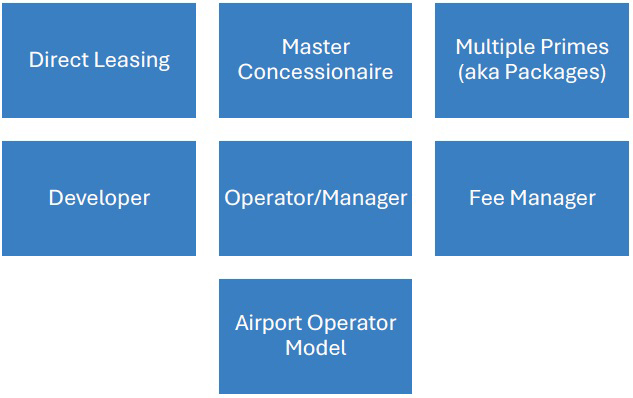
Master Concessionaire
This approach is likely the easiest management methodology for an airport to administer. The airport only has to manage one concessionaire contract (or one contract per concession type [i.e., one F&B concessionaire and one retail concessionaire]). This model became less popular in the late 1980s as airports began to see the value of competition in an airport concessions program. The only remaining large airport that continues to utilize this model is Charlotte Douglas International Airport (CLT), which has had contracts with HMSHost for food and Paradies Lagardère for retail for decades. Fort Lauderdale-Hollywood International Airport (FLL) uses a variation of this model. The airport has four terminals. HMSHost operates the food in two terminals and Hudson operates the retail. In the other two, Delaware North operates the food and Paradies Lagardère the retail.
Multiple Prime Operators/Packages
Airports that use this approach offer multiple packages of locations, usually consisting of three to 10 units, depending on the overall program size. Some airports have offered small packages of one or two units
to create smaller opportunities that are more appropriate for either non-airport contractors who have never been able to succeed in competition with the large national vendors or for airport-experienced vendors who might have only gained their experience as subcontractors (or joint venture partners) to a larger firm. Packages can be either food only, retail only, or a combination of the two because all major U.S. contractors can now propose mixed opportunities, either with their own operations experience or as a team with another operator. As with the Master Concessionaire model, the winners of larger packages will operate some locations themselves and either sublease or create joint ventures to operate other locations to meet Airport Concessions Disadvantaged Business Enterprise Program (ACDBE) participation goals. This is the most common airport concessions management methodology in the United States at this time. Southwest Florida International Airport (RSW), Minneapolis-St. Paul International Airport (MSP), and San Diego International Airport (SAN) are examples of three airports currently using this approach.
Developer
In this management model, all concessions spaces are leased to the developer, who then directly leases them to operators for single or multiple locations. When the developer model was introduced, the developer would lease individual locations or small packages (two or three units) to independent operators, often local and frequently ACDBE-certified. Programs under this traditional model, such as Pittsburgh International Airport (PIT) and Baltimore/Washington International Thurgood Marshall Airport (BWI), run by Fraport and its predecessor companies BAA USA and AirMall USA, and Boston Logan International Airport (BOS), with Fraport and URW Airports each responsible for two terminals, are well-respected in the industry for the diversity of their programs, often with 50% or more ACDBE participation. PIT, BOS, and BWI acted very much like a regional mall. However, more recently, developers have taken to acting as if they are leasing a prime concessionaire model, giving all of the food locations to one operator and all of the retail locations to another and then expecting these sublessees to sub-sublease or develop joint ventures to operate units that generate enough sales to meet airport ACDBE goals. These programs are far less locally focused and bring in fewer small operators (although it is likely that the lessee will operate units where they have either licensed the brand or which are proprietary brands that are not local, but whose names sound local (e.g., “Best of Baltimore” or “Front Street Bar,” which do not exist outside of the airport). Fraport utilizes this methodology to manage Nashville International Airport (BNA), and URW Airports uses it for Chicago O’Hare International Airport (ORD) Terminal 5.
Operator/Manager
Prime operators proposed this approach to respond to airports that had chosen the developer methodology. Rather than presenting a Master Concessionaire or Packages methodology that the airport had likely already considered and rejected, they renamed them as the operator/manager (O/M) methodology and presented it as the same as the developer. The major difference is that the developer cannot operate any locations, while under this methodology, the selected company can operate, often up to a limit, such as a percentage of total concessions space or a number of units. The O/M must then sublease the remainder of the program to third-party operators, with joint ventures between the O/M and the small operators permitted and thus featured prominently. If all remaining spaces are subleased to entities not contractually related to the O/M, this is similar to the Multiple Primes/Package methodology. If the “independent” operations are primarily joint ventures or subleases to affiliate companies, the O/M is, in effect, operating most or all of the program, turning the program into a Master Concessionaire contract in disguise.
Airport Operator
The largest barrier to entry to airport concessions is likely the cost of participation in an airport program, followed closely by the lack of knowledge of how to do business in an airport environment. To address these issues and permit the airport a greater level of control over the concessions operations that are not available in any other management methodologies, a few airports are experimenting with an Airport Operator model. In this model, the airport is a joint venture partner with operators, a methodology that is
not uncommon outside the United States, especially in duty-free concessions, but which has not been tried in the United States until now. The airport’s contributions to the joint venture include the concessions location, fit and finish (except for signage or unique trademarked signature decoration/signage), accounting services, banking services, and significant knowledge of how to do business in the specific market. The operator brings local brand awareness, operating knowledge, and unique trademarks or service marks to brand the concessions location.
The operator may also need to provide any unique cooking equipment that is particular to the brand’s operation. In this model, the operator runs the day-to-day business, is responsible for managing the staff, and makes a daily deposit of each day’s revenue into an account owned by the airport (less the operator’s fee) for this specific partnership (thus, two operations under this model require two bank accounts, three operations require three accounts, and so on). It is then the airport’s responsibility to do the daily and monthly books for the operation and prepare a monthly true-up to ensure that both parties receive the share of daily revenues that it expected. There is usually a profit-sharing clause in such contracts. Expenses (e.g., operator’s share, airport’s share, maintenance, labor) are covered. The airport has access to the POS system (because the airport provides it as part of the build-out), so it has access to levels of information about a concession’s operation that have been unavailable to the airport.
Fee Manager
A fee manager supplies expertise and personnel as an extension of airport staff. Unlike the developer model, the leases are between the airport and the concessionaire, not the developer/fee manager and the operating concessionaires. Fee manager responsibilities often include contract (lease) administration, lease compliance, and program management, ensuring that concessionaires whose leases are held with the airport meet their contractual obligations and contribute to the customer experience. The fee manager may develop and implement airport-wide promotions to increase sales at all concessions, usually utilizing a monthly marketing fee paid by the concessionaires. The fee manager may participate in space planning but generally does not make any investment in the airport or the concessions programs except to build out and furnish their own offices. Chicago O’Hare International Airport (ORD) uses this approach to manage the concessions program. When Boston Logan International Airport (BOS) last solicited management for the concessions program, they called it a fee manager, but still required a significant investment, making it, in actuality, a developer solution.
8.1.2 Management Methodologies and Technology
Certain management methodologies are better suited to facilitate the integration of technologies to enhance concessions sales throughput or improve the customer experience. At the heart of this analysis lies the airport’s ability to shape technology adoption directly through investment decisions or indirectly through day-to-day management.
The initial concessions solicitation for proposals serves as the primary opportunity for an airport to express its desire or mandate for concessionaires to introduce technologies that enhance passenger experiences and drive sales. During this phase, concessionaires factor in technology investment costs within their profit and loss statements, ultimately affecting their ability to meet the rent requirements outlined in the solicitation.
However, airports may encounter challenges if they request concessionaires to invest in technologies midway through an existing agreement without adjusting other lease terms (e.g., rent or lease term). Therefore, the solicitation process is crucial for airports to advocate for technology investments and ensure that lease agreements incorporate technological advancement provisions. Appleton International Airport’s RFP, issued in January 2024, required the following from the proposers:
- Incorporate technology in a meaningful way that will enhance the passenger experience.
- Highlight the proposed technology to be used within the program to increase sales and improve the guest experience. Uses of technology may either be front-of-house (e.g., self-check or remote ordering) or back-of-house (e.g., automated inventory management system, maintenance management system). Specify what technology will be implemented with the opening of the program.
- Any supporting information for technology that may be implemented to drive sales and create a differentiated customer experience, such as just walk out, self-checkout, and self-ordering, along with any information regarding technology, such as POS equipment, video cameras/video management systems, or other innovative solutions that will enhance operations management.
Table 5 summarizes the ease with which an airport might employ concessions technologies related to each concessions management model.
Table 5. Concessions Management Models and Technology Deployment
| Model | Entity Most Likely to Contribute to Technology | Primary Driver for Adding Technology | Primary Challenges for Adding Technology |
|---|---|---|---|
| Direct Leasing | Airport | Airports can bring to their direct lessees preferred technologies and ask concessionaires for capital contributions as a first step before determining the level of investment required of the airport. | Challenging for concessionaires either due to the awareness of technological advancements and/or costs, especially independent and local concessionaires that have not operated previously in the airport environment and who may have limited access to capital. Coordinating independent operators to participate in an airport-wide technology is challenging. |
| Master Concessionaire | Concessionaire | The brand owner may have initiatives in place to add technologies for a competitive advantage during the RFP process. | Potentially unmotivated to invest due to a lack of competition by any other airport concessions lessee. |
| Multiple Prime Operators/Packages | Concessionaire | Different corporations may have different plans in place to add different technologies for a competitive advantage. | Large portfolios of space managed by a prime operator may result in spreading out significant technology investment costs, although cloud-based technology is not sensitive to the number of units in the portfolio. |
| Model | Entity Most Likely to Contribute to Technology | Primary Driver for Adding Technology | Primary Challenges for Adding Technology |
|---|---|---|---|
| Developer | Developer and its sublessees (concessionaires) | Driving top-line sales is the primary motivation of a developer, similar to the airport’s primary goal. Profit is not a priority for a developer. | While the developer may contribute to the investment, technology implementation still requires tenant cooperation and (likely) investment, similar to Direct Leasing. Coordination among individual sublessees is required for technologies that are common among all concessionaires. |
| Operator/Manager | Concessionaire | Corporations may have initiatives in place to add technologies for a competitive advantage. This will also require investment by sublessees and joint venture partners who may lack capital. | Coordination among individual sublessees and the operator/manager’s own operations. Little influence over its sublessees to employ technology unless the sublessee is also a joint venture partner. |
| Airport Operator | Airport | The airport has control over the concessions operations. The airport can establish technologies to be employed and then managed by the brands. | The airport needs to be attuned to industry trends and what technologies will drive customer experience and sales. |
| Fee Manager | Airport | Will follow the direction of the airport; does not establish policy but could influence the airport’s decisions with research and recommendations. | Likely involved in project management/implementation. |
Figure 33 provides a visual plot of the influence of technology implementation based on the management methodology employed by the airport. It indicates that the Multiple Prime, Developer, or Master Concessionaire models are best suited to have concessionaires bring technological advancements to the airport market versus the Direct Leasing model, which is believed to have a higher probability of capital investments by the airport.
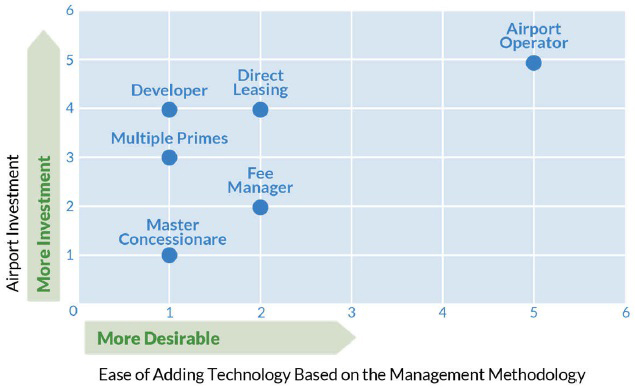
Table 6 identifies some of the more widely implemented concessions technologies and maps them against the management methodologies used in their programs. For the purposes of this discussion, the fee manager model and Operator/Manager model are excluded because (1) the direct model does not directly affect the deployment of technologies in concessions programs, and (2) the Operator/Manager model is, as described above, essentially the same as the Multiple Primes model. It should be noted that the conclusion is that the specific technology deployed is not directly related to the management methodology in use.
Table 6. Technologies and Concessions Management Models
| Technology | Direct Leasing | Multiple Primes | Master Concessionaire | Developer | Airport Operator | Operator/Manager |
|---|---|---|---|---|---|---|
| Mobile Pre-Ordering | X | X | X | X | X | X |
| Delivery Services (e.g., At Your Gate, Uber Eats) | X | X | X | X | ||
| Self-Checkout (e.g., MishiPay, Just Walk Out, Hudson Non-Stop) | X | X | X | X | X | X |
| Vending Machine Shop (e.g., 24/7) | X | X | X | X | X | X |
| Contactless Payment Kiosks | X | X | X | X | X | X |
8.2 Challenges and Opportunities for Local and Small Business Concessions
Local and small business concession operators are somewhat challenged when it comes to accessing some technologies. Generally, these small business operators have limited access to capital to invest in the technology and, because of size, have less opportunity to realize the financial benefits of the technology. Additionally, the benefits of investing in technology are most feasible when spread out over larger operations due to the often fixed-price nature of acquiring, implementing, and supporting technology.
Certainly, some technologies, such as less sophisticated POS, are scalable and necessary for the smaller operators. Other technology offerings, such as loyalty programs, e-commerce/omnichannel
platforms, robotic delivery systems, or sophisticated business analytics, may be well outside the financial means of small businesses.
However, airports can play a role in assisting local and small businesses gain access to these technologies by providing common technology platforms and data to these businesses. One example would be where an airport provides a robust and secure private/5G network for the tenant to use to conduct their own business, as well as providing free and easily accessible public Wi-Fi so that passengers can easily access information on concession opportunities. Another example could be for an airport to implement and actively promote its own loyalty program that highlights the concession opportunities. Lastly, airports can assist the local and small businesses with access to data that these operators may not have readily available, such as sales benchmarking data or predictive and real-time passenger flow data.
9. The Workforce Implications of Technological Advancements
9.1 Assessing the Impact on Staffing and Skill Sets
The dramatic changes experienced as a result of the successful implementation of technology within the airport ecosystem often have a concomitant impact on the airport’s workforce and staff. As documented in the recent report The Evolution of Airports – Travel Trends in the Next 30 Years, five megatrends were identified that affected the future of airports. They included technological innovation, the changing workforce, and the passenger experience revolution. According to this report published in 2023, “approximately 54% of the 11.3 million people working in the aviation industry work in airports.” However, the report also noted that labor shortages which began since COVID-19 continued to persist, and they remain as a threat to limit the industry’s ability to meet the growing demand for air travel going forward (Oliver Wyman Forum 2023).
Looking ahead, emerging technologies that transform airport operations and concessions will significantly change passengers’ experiences and the workforce’s roles. Labor skills will be more specialized. Customer-facing airport staff will need to enhance their customer service techniques and airport operations staff will need new skills to cope with advanced IT, digital, cybersecurity, and engineering technology. In light of these changes, airports will need to address the importance of early employee engagement; the challenge of attracting and motivating Generation Z and beyond to choose what, in the past, were viewed as exciting airport careers; and the need to collaborate with academia to develop the talent and the training needed to support the demands of tomorrow’s workforce.
10. Case Studies and Best Practices
As a part of the research effort, the ICF Team developed several case studies. These case studies provided lessons learned and examples of a variety of successful uses of technology in airport in-terminal concessions. Case studies were based on interviews with several airports, concessionaires, and vendor/solution providers.
10.1 Dallas Fort Worth International Airport (DFW)
Change Management Is Key for a Culture of Innovation to Flourish
Airports should carefully evaluate their organizational structure and focus before embracing technology to enhance their airport concessions program. It may not be enough to just start implementing new concessions technology. Instead, organizations should cultivate an innovative culture and prioritize change management to ensure a greater likelihood of success. When an airport aims for innovation in
concessions or any other aspect of airport operations, effective change management becomes critical for a seamless transition. Consideration should be given to the following four key aspects in this process:
- Change Readiness. Change readiness is fundamental. Airport leadership should foster this within their teams to manage the uncertainties that come with innovation. Essentially it means preparing the organization to adapt efficiently and effectively to new processes, technologies, or strategies. Just as a skilled tightrope walker adjusts their balance while crossing a high wire, airport organizations should maintain agility and adaptability when navigating the uncharted territories of innovation.
- Transformational Leadership. Inspiring employees to embrace change is crucial. DFW aligned its vision with the airport’s goals, empowering individuals to drive innovation. They created an entirely new department and even trained their employees on how to think like an innovator, allowing them the flexibility to question current processes and procedures. This gave employees an aligned sense of purpose, motivating teams to think out of their comfort zones and embrace new working approaches.
- Continuous Learning Culture. Building resilience in dynamic airport environments requires a culture of continuous learning. Teams thrive when they embrace ongoing improvement. By encouraging curiosity, adaptability, and a hunger for knowledge, organizations create a foundation for successful innovation.
- Strategic Alignment. DFW aligns goals and resources strategically, ensuring that their innovative strategies harmonize with the airport’s business objectives. The Revenue Management and Customer Experience Divisions work closely with the Innovation Group.
Like many airports, DFW has historically had in place an Information Technology Division. DFW, however, leaped forward in 2018 by establishing an Innovation Division tasked with reshaping the airport’s culture as it pertains to delivering technological advances and identifying best practices, and emerging technology trends. This division also ensures that innovation aligns with the airport’s strategic plan and is recognized through rewards and recognition. In summary, DFW created a new culture of open communication, collaboration, and experimentation.
DFW applies more focus on an evolutionary approach to innovation, requiring the airport to have buy-in from leadership and workers, and applying solutions for immediate wins. This was a cultural change for the airport when first introduced. Once the changes in the culture and structural organization took place, DFW created an environment that embraced innovative thinking. DFW implemented various technologies to enhance the concession operations and customer satisfaction:
- DFW has implemented self-serve kiosks and touch-and-pay options that allow customers to order and pay quickly and conveniently.
- Online ordering platforms led to an increase in the average transaction value and offer convenience and control to customers.
- Amazon Just Walk Out and other Just Check Out concepts enable customers to shop without interacting with staff or cashiers, simply using sensors and cameras to track purchases.
- Sensors on concessions’ security enclosures feed into the airport’s information center and integrated operations center, providing real-time data on which concessions are open. This information is reported on DFW’s website and the mobile app to inform passengers, and also to provide an incentive for concessionaires to operate efficiently, understanding the impact on customer service.
- DFW is collecting sales transaction data from its concessionaires from their POS. This data is stored in DFW’s data lake where business intelligence tools are used by the commercial management staff to optimize the concession operations. This is also shared with concessionaires so that they can benchmark their performance against other DFW concessionaires.
Lessons Learned:
Change management not only keeps innovation on track but also provides an environment where creativity can flourish. Even with an innovative strategy likely to bring widespread improvement, involving all stakeholders through effective change management is critical for success.
10.2 Miami International Airport (MIA)
Stakeholder Collaboration and Airport Employee Involvement
The MIA takes a very broad-based approach to innovation, collaboration, and stakeholder engagement. MIA focuses on an open and collaborative approach, working with airport stakeholders and industry partners to address how it can best improve the customer experience through innovation. The airport’s Innovation Team is constantly scanning and benchmarking across diverse venues to identify innovative ideas. They utilize data analytics to identify and test innovative solutions sometimes on a pilot basis and often opt to use an incremental approach to innovation/technology implementation that builds on prior success and leverages the airport’s existing infrastructure. Sharing innovation, technology, and data, as well as profits, with concessionaires, airlines, and others as appropriate has been key to the airport’s successful implementation of technology to enhance customer experiences within the airport’s concessions program.
The MIA Innovation Team created an airport-wide culture that understands what is occurring within the airport footprint. MIA is focused on identifying top priorities and needs where innovative solutions can provide additional value now. By so doing, MIA believes that it is optimizing and leveraging the airport experience for customers, employees, and concession revenue.
In addition to changing airport culture to be more informed, more inventive, and less risk averse, MIA is also focusing on restoring the luster and excitement of airport employment. The willingness to work at airports has decreased exponentially post-COVID. This has had severe implications across MIA; however, the impact has affected concessions where service levels have suffered and, in some instances, concessions’ hours of operation have been reduced. Technology alone does not solve all of these “people-related” issues. Therefore, MIA is also exploring opportunities to attract talented people to consider airport employment once again to restore the appropriate balance between the right innovative, technological solutions and the right team members who work alongside those solutions.
The following solutions are being enacted at MIA, leveraging their approach to rapid ideation, buy-in, stakeholder engagement, and “proof of concept” pilots that jumpstart implementation and help ensure success, collaboration, the elimination of organizational and data silos, and restoring the luster of airport employment:
- Development of cross-functional teams. MIA is piloting a grab-and-go food order system that is embedded in their MIA To-Go mobile app. This solution is extremely beneficial for connecting passengers with little time and is viewed to be a boon to MIA’s non-aeronautical revenue. MIA concessions also have separate lines to pick up these orders to expedite the customer’s journey. Building on the pilot’s success, MIA plans to collaborate with airlines with a greater passenger base about connecting MIA To-Go with their airline apps so that airline passengers can use MIA’s food ordering capability. This will leverage the technology and additional value by providing a better customer experience and increased profit sharing for all participants.
- Developing KPIs and success measures. MIA is exploring an MIA loyalty program that will use an integrative system that mimics common POS systems without requiring their replacement. They have identified a tool that allows the airport to insert a widget on the backend of each POS that harnesses the same data as a common POS. AI will also be leveraged to assist MIA and its partner concessionaires in making decisions that will benefit customers and increase sales. Collaboration, buy-in, piloting, and profit sharing will once again be leveraged to ensure a phased-in, incremental approach to innovation.
- Interoperability and compatibility with other technology infrastructure. MIA is trialing two chatbots that are accessible to MIA customers via Messenger and WhatsApp, which in combination allow customers to easily get information typically obtained from MIA’s airport app. This omnichannel engagement approach is accessible by voice or text. If the first iteration of the pilot trials is worthwhile, an enhancement to embed the MIA grab-and-go food ordering app will follow. When airlines come on board, MIA will sunset their mobile airport app.
- Identifying relevant stakeholders for coordination/trust and support. Open Doors, in a 2015 study, estimated that U.S. travelers with disabilities spent $58.7 billion on their travel alone and this number is expected to grow. To allow these valued customers to make independent use of the airport’s concessions and amenities, MIA recently launched “Voice,” a technological solution to assist customers who are hearing or visually impaired, speak a foreign language or sign language, or need other assistance. Voice is launched from a mobile app and, once initiated, the customer interacts with a live person who can assist them while at the airport. MIA is also exploring robotic wheelchairs to provide an enhanced level of service to airport customers with reduced mobility. Furthermore, MIA also is thinking about exploring a concierge wheelchair service.
Lessons Learned:
Airports can easily benefit from MIA’s strategic and holistic approach to changing their airport culture to enhance customer experiences through technology in their airport’s concessions. They would do this by introducing early collaboration with stakeholders and industry partners, rapid ideation and early buy-in through collaborative brainstorming, use of “proof of concept” pilots, phased implementation of projects to build on success, the offer of profit sharing, the elimination of internal and external silos, and restoring the excitement of airport employment to sustain a future-ready customer experience mindset.
10.3 Cincinnati/Northern Kentucky International Airport (CVG)
The Airport as a Test Bed for the Evaluation of Technologies
While airlines “own” most of the travel journey—from check-in to boarding to baggage claim at the destination—CVG’s goal is to build thicker bookends on the journey, reclaiming the commercial ground that airports have lost to airline mobile apps.
CVG’s Innovation Team embraces an “incubator model” of innovation which seizes the immense opportunity that being an airport provides. Having thousands of different and transient daily visitors creates the perfect test bed for innovations that should be immediately understood by, and useful for, new users. In other words, CVG views their airport as a living lab. By embracing autonomy, digital twins, shrewd partnerships, and deliberate long-term innovative strategies, CVG has become a beacon in the airport innovation space.
CVG’s Innovation Team sources ideas by observing startup companies, entertainment venues, and trend-defining TikTok. Once the Innovation team identifies a promising idea, they develop cross-functional teams comprised of airport management, concessionaires, and end-users to “storyboard” technological and
process innovation life cycles from procurement through long-term integration. These teams work to identify relevant external stakeholders for coordination, trust, and support pre- and post-implementation.
The following are enacted solutions at CVG:
- Identifying relevant external stakeholders for coordination/trust and support. CVG partnered with Ottonomy to develop a gate delivery system using autonomous robots (Ottobots), which transport select online concession orders directly to passengers within 7–12 minutes of placing the order. Ottonomy has also developed and maintained the QR-based web application where passengers place orders from their devices. CVG worked closely and extensively with Ottonomy to ensure that the system of roving robots would work in a busy airport terminal, adding lights and chimes to the robots that alert nearby persons of their presence. At the gate, the purchaser scans another QR code on the robot to “unlock” their order. To keep the system quick and practical, CVG provides gate delivery for four of its most popular concessions in Concourse A. Furthermore, scaled-back digital menus offer the most popular items with limited customization options.
- Determining the technology preferences of various customer demographics. CVG initially launched the Ottobots in business travel-oriented Concourse B but quickly switched to leisure travel-oriented Concourse A. CVG, employing their living lab method, observed that Concourse B travelers (being more frequent and time-constrained travelers) arrive at the airport later, leaving less time for concession purchases and gate delivery. Consequently, this leaves less time to figure out a new technology and wait up to 12 minutes for order fulfillment. Concourse A travelers (being less frequent travelers and often with children in tow) arrive at the airport earlier and stay close to the gate area, making them an empirically better demographic for gate delivery.
- Identifying potential risks (e.g., data privacy, operations, security). Before autonomous gate delivery could happen, CVG needed to create detailed digital maps of its terminals. In 2020, CVG took advantage of the COVID-19 travel slowdown and partnered with a company that deployed LiDAR-equipped robots to roam the airport campus inside and out, creating comprehensive digital twins of CVG’s terminals and apron areas. CVG uses the digital twins to aid facility maintenance and Ottobot navigation. Many of the LiDAR providers who approached CVG were based in nations potentially unfriendly to the United States, creating an unexpected but important challenge for partner selection.
Relocating the Ottobots to Concourse A has proven successful for CVG, not only providing utility to gate-hugging passengers but also providing a source of commerce-driving entertainment and curiosity. Creating comprehensive digital twins of the indoor and outdoor areas of the airport has not only generated useful data for facilities’ teams but has also made possible many future innovations at CVG, especially those involving autonomous robots for cleaning, apron, and back-of-house delivery services.
CVG will imminently install autonomous wheelchairs for terminal navigation that would allow users to request stops at different concessions between the main terminal and the gates. CVG Innovation also plans to incorporate FIDS-backed digital advertisements promoting concessions that cater to different customers based on the day’s flights, which is especially useful for international travelers.
Lastly, CVG wants to create an all-encompassing e-commerce platform where users can create accounts and receive trip curation benefits from the moment they leave home to the moment they board their flight. As a premium service, CVG would embed blockchain in the user’s account that would log all transactions made on the platform for hyper-curated travel experiences. The incubation model of innovation will be crucial to these more experimental innovations.
Lessons Learned:
Airports can benefit a great deal from viewing their terminals as “incubators,” or living labs, for innovative processes and technologies, given the uniquely captive and transient nature of
these facilities. Additionally, developing long-term innovative strategies and taking the time to assemble cross-functional teams who can storyboard proposed implementations and weigh in on their impacts are crucial for developing airport-wide cohesion and stakeholder buy-in. In the near future, airports should consider leveraging social media channels. These sites provide windows into trends and consumer preferences across generations. Travel influencers, indeed, have influence and this influence can be measured.
10.4 OTG Concessions Management, LLC
Collaboration Between the Airport and Concessionaires
OTG is an airport F&B facilities operator. They serve airport customers by selling personalized experiences by forming technology and procedures for customers. By transitioning from the tabletop iPad ordering kiosks to web applications of the present, partnering with airlines to “surprise and delight” their common customers, and cross-utilizing existing infrastructure, OTG has introduced a new concessions paradigm.
OTG operates F&B concessions and select retail in 11 of North America’s busiest airports. OTG changed the concessions landscape in October 2010 by introducing iPad self-service kiosks at many of its outlets (for reference, the iPad was introduced in March 2010). OTG recently replaced the iPad kiosks with ordering apps that customers use on their own mobile devices. In what they call a “disruption to their disruption,” OTG swiftly removed all iPads from their concessions and replaced them with their QR-based mobile ordering platform, flo Xgen. Recognizing that most customers no longer wish to download mobile apps, flo Xgen is a web application that requires no downloading and houses all ordering, customizing, and purchasing functions for OTG’s concessions. OTG’s innovations have improved business and customer satisfaction.
The following were enacted solutions introduced by OTG:
- Assessing consumer buying habits. Once OTG implemented self-service technology, it changed its view on F&B concessions. By removing the pressure of a human server and giving customers more time to peruse the menu, OTG found that customers ordered more and customized their orders far more, avoiding any embarrassment that some might feel doing both of these things in front of wait staff, which allows customers to create their own experience and has boosted concessions engagement. OTG also caters to an important customer base by offering mobile pre-ordering to inbound flight crews and providing gate delivery upon their arrival. Orders are placed directly through OTG’s website. This offering requires stakeholder collaboration, not a robust mobile app.
- QR-based mobile ordering. OTG’s shift from iPad ordering kiosks to mobile ordering via the QR-based web application has improved their concessions operations. Digital ordering has increased takeaway business and passenger capture rates; OTG can serve more customers without the limitations of available seating in their restaurants. Passengers facing tight connections or taking early/late flights (when most concessions are closed) often experience long ordering queues and forgo an F&B purchase. Mobile ordering eliminates the need to wait in queues and permits advance ordering, which is ready for pick-up when the passenger reaches the concession. Putting more control and flexibility in the customers’ hands boosts satisfaction with the concession, the airport, and ultimately the entire travel experience.
- Identifying operational efficiencies and challenges. OTG recognized that employing tableside wait staff is inefficient during peak periods as servers take several orders at once and then load them into the system all at once. This both inundates the kitchen and introduces a lag between order placement and order processing. Enabling QR-based mobile ordering through flo Xgen has
- smoothed out order flows at sit-down restaurants, enhancing kitchen efficiency and eliminating the lag between order placement and order processing. In the highly time-constrained airport environment, an added benefit of mobile ordering is instant payment—customers pay when they place the order. This eliminates both the separate POS invisible to the customer and the lag caused by servers manually processing payments.
- Interoperability and compatibility with other technological infrastructure. Where neighboring F&B outlets exist, OTG cross-utilizes their menus and kitchens to enhance offerings. For example, at Newark Liberty International Airport, OTG operates neighboring DAILY, a pizza kitchen, and Oeno, a wine bar. Italian cuisine and wine being a classic pairing, OTG offers both menus at both locations, offering Oeno customers DAILY’s food offerings and offering DAILY customers Oeno’s extensive wine list. This cross-utilization of resources not only effectively doubles offerings for customers but also effectively doubles the sales potential at both outlets.
- Linking loyalty programs. One of OTG’s services enables customers to link their airline loyalty programs to their OTG account, facilitated by airline partnerships. These partnerships offer customers personalized services like Surprise and Delight, a program that occasionally waives the cost of a traveler’s airport meal as a thanks for airline loyalty. OTG also allows customers to pay for F&B purchases with airline miles. Business travelers frequently purchase alcohol with airline miles – alcohol typically being an unallowable company expense. OTG found that, when given the choice to earn miles (e.g., earn 5x miles with this purchase) or spend miles, customers typically choose to spend miles. Thus, the program has enhanced alcohol purchases in OTG’s concessions.
OTG also hosts digital vouchers from airlines during delays, which the airline transmits directly to customers for redemption at CIBO Express Gourmet Markets or other OTG F&B units. OTG heralds digital voucher hosting as an effective collaboration between concessionaires and airlines to serve their common customers.
- Understanding the impact of technology on the concession’s workforce. OTG stresses that technology is a tool for enhancing the customer experience, not replacing people. Since implementing self-service at their outlets, OTG has increased staffing and, in some cases, doubled staffing to assist customers with the technology. At CIBO Express Gourmet Market locations, OTG has adjusted staff roles. Previously behind-the-counter cashiers are now providing on-floor technology assistance and interaction about the merchandise.
In the future, OTG plans to deepen their data analytics to create better design day forecast schedules or performance benchmarking and continue forging useful innovations and maintaining staff so that no customer is left behind. OTG warns not to underestimate the technological savviness of the average customer; with all innovations, past and present, they have observed adoption rates that are quicker than expected. Behind the scenes, OTG aims to quicken the movement of stock from airport loading docks to in-terminal concession outlets without disrupting passengers.
Lessons Learned:
Airports and concessionaires can work together to increase customer empowerment and enhance the customer experience. Airports can leverage their relationships with their concessionaires to eliminate lags, allow pre-ordering, and place merchandise where it is easily seen, realizing that passengers’ hurried state may cause them to miss good offerings – that customer ordering a personal pizza also wants something to read on their flight, so why not install a magazine rack by the checkout of the fast-casual pizzeria?
10.5 Rezcomm
Omnichannel/E-Commerce Platform Tied to the Airport Loyalty Program
Airports now see passengers as online consumers, which can boost revenue. To facilitate this, airports need a unified digital marketplace platform that integrates various systems for efficient management of concession-related transactions and operations. The challenge is that many airports use disparate solutions that are not integrated, making implementation difficult.
Rezcomm, a digital marketplace solution provider for airports, has unified concessions programs. This includes e-commerce for F&B and retail, travel booking services, airport loyalty programs, parking reservations, marketing, lounge access, and virtual queuing. Their digital marketplace platform integrates with legacy airport applications and third-party solutions. As a result, online purchases at these airports have increased, justifying the investment. According to Rezcomm, some airports have seen passenger participation in online shopping rise from 5% to 35%.
Airports aim to create a digital marketplace through their web app (without downloading an app) or website to increase concessions revenue by personalizing the shopping and services experience. This requires significant integration efforts to cover key passenger journey touchpoints for concession-related transactions. Additionally, airports want to capture data trends to better understand passenger buying habits, maximize revenue opportunities, and have concessionaires support the digital marketplace.
The following are the types of solutions that Rezcomm is offering airports. The bulk of the clients are in Europe and Asia at this time; however, some U.S. airports, such as Raleigh-Durham International Airport, are utilizing Rezcomm services:
- The concessions business model affects the identification and adoption of new technologies. Rezcomm’s platform enables airports to offer their own branded digital marketplace for concession programs, supporting various business models. By leveraging the platform’s metrics, airports and concessionaires can identify effective concepts and media channels, allowing for quick adjustments to meet customer needs. This cloud-based software as a service solution operates on a pay-as-you-go basis, requiring no upfront capital expenditures from airports. Supported modules include a travel-related reservation system, an omnichannel e-commerce system for purchasing products/services via website, web app, or in-store, gate or home delivery, marketing and communication, and operational and business intelligence for airports. The platform’s ease of integration with third-party systems facilitates data sharing.
- Identifying operational efficiencies and challenges. Access to the app requires no downloading and can be done by visiting the airport website or reading QR codes placed strategically at the airport. All first-time users require only an email entry. Additionally, parking reservation modules can be added with a pre-integrated Loyalty & Rewards module, which can be personalized to the passenger. Loyalty & Rewards programs can promote cross-selling services with digital coupons and promotions. Because the app can be adjusted to assess different offerings and promotions, airports can leverage this tool to enhance sales and the provision of services.
The benefits achieved vary by airport; however, the following are areas of improvement worth noting:
- Ease of integration with third-party systems/applications.
- Increased online revenue.
- Increased percentage of passengers making online purchases when tied to loyalty programs with promotions for cross-selling (one airport went from 5% to 35% participation).
- Increased passenger data capture and AI are allowing airports to optimize and focus their marketing and promotional efforts through personalization to further increase revenue.
- At first, most airports pilot the program on a small scale and then, over time, add more products/services. For example, starting with travel-related reservations and parking reservations tied to a loyalty program offering retail vouchers for concessions might be a good way to start. Over time, add more services for passengers.
Airports are convincing airport concessionaires that their products and services can have increased visibility by being supported on the airport platform rather than solely on their apps. The same holds for the airlines. This is a potential win-win for all.
Lessons Learned:
Solutions, such as those offered by Rezcomm, help airports satisfy consumers’ demands for parking, travel, and shopping while providing comprehensive data through smart passenger profiling. Rezcomm’s integrated platform for airport sales, marketing, and customer-centric analytics enables airports to better understand their passengers’ needs and behaviors.
10.6 Veovo
Passenger Demand Capacity Forecasting
In today’s environment, airport customers want a more personalized experience, in part, by accessing information about their airport journey. Airport customers want to know about queue lengths at security checkpoints and concession outlets. Concessionaires want access to predictive, real-time, and historical passenger flow data on a localized basis so they can plan accordingly to maximize their revenue and minimize their expenses. Lastly, airports want access to the same passenger flow data for their business planning purposes and to share with their concessionaires, as well as with passengers.
Veovo provides airport operational system software products, which include a solution to provide predictive, real-time, and historical passenger flow data on a localized basis within a terminal building. The data inputs are collected from several sources and the predictions are calibrated to increase in accuracy by leveraging AI. Veovo’s solutions can be used to break down data silos and integrate data across different airport departments and stakeholders, such as marketing, IT, operations, concessionaires, and retailers. The data can also be pushed out to the passengers so they can better plan their airport visit.
Airports want to understand passenger flows in their facilities so they can predict and avoid bottlenecks, place appropriate concession outlets that will serve passengers, and monitor passenger spending behaviors. Because passenger flow information can be used by multiple functions within an airport to enhance revenue and customer service and for operational purposes, such as minimizing queues and bottlenecks, this information inherently breaks down organizational silos by making available data that benefits many airport functions and enhances collaboration. The level of accuracy needed is dependent on the available data sources. Likewise, the required level of accuracy can drive the type of data collection methods. Additionally, the system can generate heat maps to show the flow and density of passengers in different areas of the airport, and further help with planning and optimization.
Veovo’s solutions allow airports to address the following challenge areas:
- Assessing consumer buying habits. Combining localized passenger flow data with sales activity gives airports and concessionaires the ability to understand capture rates at a granular level for each zone within a terminal.
- Determining the technology preferences of various customer demographics. Monitoring purchasing behaviors by the type of available technology offerings allows airports to better
- understand the relationship between technology and different types of passenger attributes. These differences could be influenced by the type of airline, the characteristics of the flights in the local area of the terminal, the time of day, and the types of technology accessible to passengers, such as online or pre-ordering, self-service, or fully staffed service.
- Defining KPIs and success measures. Besides better understanding the relationship between technology options and passengers, KPIs can be used to understand how they can best maximize the concession offerings and levels of service.
- Interoperability and compatibility with other technology infrastructure. Veovo’s data can be used directly through its reporting dashboards and tools or be integrated into other airport systems. One example is pushing queue length and dwell time information to passengers through the airport’s public-facing content management system.
- Potential impacts of technology on the concessions’ workforce. Using the predictive passenger flow information, concessionaires can refine their staffing levels and stocking schedules. Also, the airports and concessionaires can work together to refine the hours of operation to reflect the level of passenger activity in order to enhance the concessionaires’ profitability.
- The following airports are representative of how Veovo’s passenger flow and forecasting tools are being used in Europe and North America:
- Budapest Ferenc Liszt International Airport (BUD)/Hungary. Veovo conducted a pilot at Budapest International Airport to measure the number of storefront walkers, visitors, and customers for a retail shop, using camera-based sensors. Even though sales activity was available, the discrete customer flow data was able to determine the capture rates of how many passengers passed by the shop, how many slowed down but did not go into the shop, how many entered the shop, and how many of these resulted in a sales transaction.
- Keflavik International Airport (KEF)/Iceland. Veovo is providing passenger forecasting and flow services to Isavia, the operator of Keflavik International Airport. This allows the airport to work to locate the right concession venue in the right location, as well as to fine-tune product offerings and service levels.
- Cincinnati/Northern Kentucky International Airport (CVG). CVG is using Veovo’s passenger flow management to analyze how travelers, airport processes, and airlines interact in order to improve planning and enhance productivity, provide quicker respond to passenger needs, and explore new revenue opportunities.
- Avinor Airports/Norway. Passenger forecasting solutions have been rolled out at all 42 Avinor airports in Norway. This data is used for operational and commercial planning purposes to allow Avinor to understand the flow of passengers through the airports, which, in turn, is used by both Avinor and the concessionaires for operational and planning purposes with the ultimate goals of enhancing the customer experience and maximizing revenues.
Lessons Learned:
Veovo’s solutions are relevant to airport concessions for the following reasons:
- Measuring Program Effectiveness. Veovo provides the tools to measure the baseline passenger behavior and the impact of promotions or interventions on concession area traffic.
- Scalability. The solution can be deployed in selected areas or across the entire airport, depending on the level of data and insights required. The solution can also integrate with other platforms, such as flight data, digital signage, or customer management systems. This means that airports with different technology capabilities and needs can implement a solution tailored to their environment.
- Sensor Agnostic. The solution can use different types of sensors, such as LiDAR, stereoscopic cameras, or device tracking, in addition to accessing flight schedules, depending on the environment and the area of interest. This means that airports with different levels of infrastructure and technology can conduct meaningful passenger flow and forecast analytics.
- Integration With Content Management Systems. Data from the Veovo solutions can be shared with the content management systems driving digital signage to personalize the content directed to different groups of passengers based on their destinations, languages, and arrival curves.
11. Comparative Analysis of In-Terminal and Non-Airport Concessions
The adaptation to new technologies between airport in-terminal concessionaires and non-airport concessionaires can vary significantly due to several factors inherent to their operational environments. Based on the ICF Team’s research, the following key comparative factors have been highlighted:
- Regulatory Environment. Airports often have stricter security and operational regulations that affect technology adoption. For example, any new technology deployed in an airport must meet stringent security standards and may require extensive testing and approval processes.
- Customer Expectations. Airports cater to many different groups of travelers with varying expectations. Technology adoption in airports often focuses on improving passenger experience, such as self-service kiosks for check-in or mobile apps for navigation and services.
- Infrastructure Constraints. Airports have complex infrastructures with existing systems that may limit the integration of new technologies. Non-airport concessionaires may have more flexibility in choosing and implementing technologies that align directly with their operational needs.
- Operational Scale. Airports typically operate on a large scale with multiple stakeholders involved, which can complicate the adoption of new technologies that need to be standardized across different terminals and regions. Non-airport concessionaires may have smaller scale operations that allow for quicker decision-making and implementation of new technologies.
- Cost Considerations. Technology adoption in airports often involves significant costs, including infrastructure upgrades and training. Non-airport concessionaires may face similar challenges but might have more flexibility in managing costs based on their specific business models and customer bases.
- Competitive Pressures. Both airport and non-airport concessionaires face competition; however, the nature of the competition and the importance of technology can differ. In airports, technology adoption can be a critical factor in attracting and retaining customers due to the convenience and efficiency it offers in a high-traffic environment.
In summary, while both types of concessionaires aim to leverage technology to enhance their operations and customer experience, the adaptation process can be more complex and regulated for airport in-terminal concessionaires. Non-airport concessionaires may have more agility in adopting new technologies tailored to their specific needs and market conditions. The specific challenges and advantages will depend on the type of technology, the size and resources of the business, and the specific airport regulations.
12. Notable Observations
The literature review, Airport Passenger Survey, Airport Survey, airport and non-airport interviews, and case studies all yielded varying information with different perspectives on how technology is being
integrated into in-terminal airport concessions, which have been noted in the prior pages. The following is a list of notable observations selected from the research findings that are particularly relevant for successful technology integration into in-terminal airport concessions:
- Technologies that are introduced into the airport concession programs are primarily introduced by the concession operators and the airports have little influence on what technologies are introduced. The exceptions are where airports can call for technology through their concession tender/procurement process or where airports may work collaboratively with the concession operators.
- Airports, as landlords, can provide robust and secure IT infrastructure networks to passengers, as well as to its tenants, similar in manor to providing traditional utilities such as electricity and water. Concessionaires are looking to airports to continually improve that network infrastructure as the need to transmit larger and larger amounts of data grows.
- Passengers of all types want more personalized and more accessible services when traveling on their passenger journey. The most universal need is a sense of personal control over their journey, including access to information so that they can make decisions which influence their perception of their journey. This could be as basic as offering different ways for passengers to find F&B outlets to offering different ordering and payment options.
- There is a struggle primarily among airlines, airports, and concessionaires to control the passenger experience. Both airlines and concessionaires have obvious direct business incentives to leverage revenue opportunities and fend off potential competition for “their” customers; however, airports also play a role in providing customer service.
- Passengers experience the disjointedness and feel that lack of collaboration among their travel journey service providers. Customer-facing technology and apps should be aligned with the overall customer experience.
- Concessionaires are looking to airports to share more meaningful information with them. This information includes forecasted, real-time, and historical passenger flow data down to a zone within a terminal. This would allow concessionaires to better optimize their operations and better respond to either planned airline flight schedules or irregular operations.
- Concessionaires would be more willing to share sales transaction data with airports for analytical purposes if there are standard reporting requirements among airports.
- It would be easier for technology service providers to enter the airport marketplace if procurement processes could be updated to reflect that increasingly rapidly changing technology section, where both the solution providers and the airports share the risk.
- Ultimately, for airports to leverage technology in their in-terminal concession programs, it comes down to people, processes, and systems, not the technology itself. In fact, there is an opportunity for airports to enhance the way that their passengers and business partners—the concessionaires—leverage existing and useful technology through communication, collaboration, taking on risk, and planning strategically for change.


