Quality Management for Digital Model–Based Project Development and Delivery (2025)

Chapter: APPENDIX G: IHEEP 2023 WORKSHOP SUMMARY

Previous Chapter: APPENDIX F: TASK 8 METHODOLOGY REVIEW FEEDBACK
Suggested Citation: "APPENDIX G: IHEEP 2023 WORKSHOP SUMMARY." National Academies of Sciences, Engineering, and Medicine. 2025. Quality Management for Digital Model–Based Project Development and Delivery. Washington, DC: The National Academies Press. doi: 10.17226/29172.

APPENDIX G. IHEEP 2023 WORKSHOP SUMMARY

Workshop Materials

The 90-minute workshop agenda included an icebreaker, a project overview presentation, two surveys, and two group activities. At the end of the workshop, facilitators recapped the workshop and shared next steps with the participants. After the icebreaker activity, facilitators shared a short presentation focused on:

  • Workshop goals and objectives.
  • Quality management standards and concepts.
  • Gaps in quality management framework for 3D digital delivery.
  • NCHRP Project 10-113 goals and framework.

Two surveys were conducted during the workshop:

  • Participant benchmark survey was conducted to capture information about attendees. This survey was designed to benchmark the answers provided based on the roles and responsibilities of those in attendance.
  • Feedback on review description survey was conducted to capture input on the digital delivery quality framework developed by the research team as part of the Task 8 Methodology. Answers from this survey were used in the final preparation of the guide during Phase III.

Two activities were designed to capture input from participants to assist the research team with updating the methodology that was ultimately used in Phase III of the project to develop the guide.

Activity #1. Defining Quality. The desired outcome for this activity was to capture feedback on determining criteria for assessing the quality of a 3D model. For this activity, the participants were instructed to:

  • Collect ideas from everyone in their groups.
  • Organize ideas into groups of thoughts.
  • Vote to identify group priorities.
Suggested Citation: "APPENDIX G: IHEEP 2023 WORKSHOP SUMMARY." National Academies of Sciences, Engineering, and Medicine. 2025. Quality Management for Digital Model–Based Project Development and Delivery. Washington, DC: The National Academies Press. doi: 10.17226/29172.

Activity #2. Review Definitions. The desired outcome for this activity was to gather input on the model review definitions previously developed by the research team. Due to time constraints, the workshop focused on only reviewing the Discipline Design and the Roadway 3D Model Integrity definitions.

Workshop Feedback

Workshop participants were provided with a survey to capture feedback on the digital delivery quality framework developed by the team. A summary of the questions and responses is presented below:

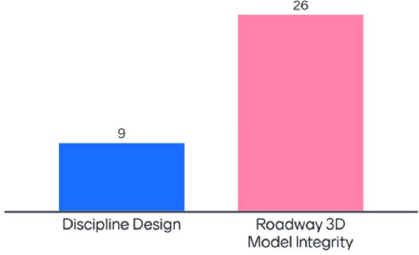
  1. Which review did you choose?

The graph shows a horizontal axis with two labeled bars. The data given in the graph are as follows: Discipline design: 9; Roadway 3D model integrity: 26.

  1. To what extent do you agree with these statements about the review DESCRIPTION?
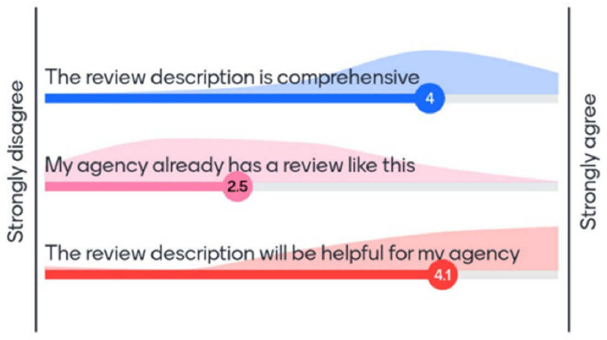
The right side of the scale reads, Strongly agree. The left side of the scale reads, Strongly disagree. The data given in the graph are described as follows: The review description is comprehensive: 4, closer to the right side of the scale than the left; My agency already has a review like this: 2.5, closer to the left side than the right; The review description will be helpful for my agency: 4.1, closer to the right side than the left.

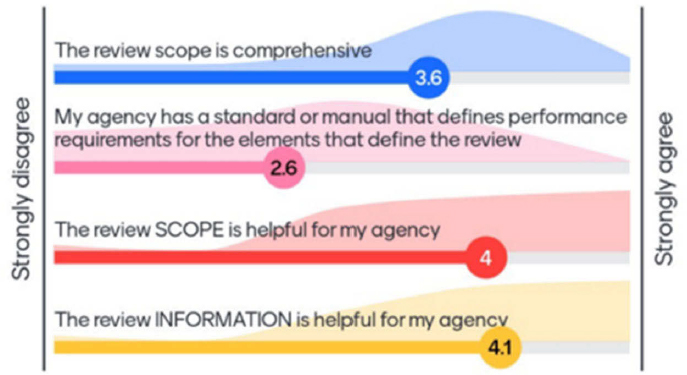
  1. To what extent do you agree with these statements about the review SCOPE and INFORMATION?
Suggested Citation: "APPENDIX G: IHEEP 2023 WORKSHOP SUMMARY." National Academies of Sciences, Engineering, and Medicine. 2025. Quality Management for Digital Model–Based Project Development and Delivery. Washington, DC: The National Academies Press. doi: 10.17226/29172.

The right side of the scale reads, Strongly agree. The left side of the scale reads, Strongly disagree. The data given in the graph are described as follows: The review scope is comprehensive: 3.6, closer to the right side than the left; My agency has a standard or manual that defines performance requirements for the elements that define the review: 2.6, closer to the left side than the right; The review SCOPE is helpful for my agency: 4, closer to the right side than the left; The review INFORMATION is helpful for my agency: 4.1, closer to the right side than the left.

  1. To what extent do you agree with these statements about the review PROCESS?
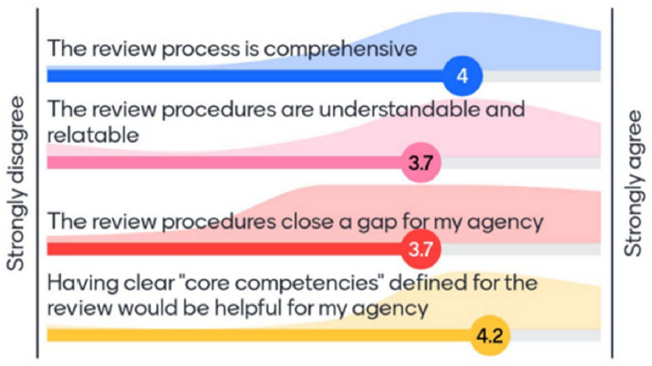
The right side of the scale reads, Strongly agree. The left side of the scale reads, Strongly disagree. The data given in the graph are described as follows: The review scope is comprehensive: 3.6, closer to the right side than the left; My agency has a standard or manual that defines performance requirements for the elements that define the review: 2.6, closer to the left side than the right; The review SCOPE is helpful for my agency: 4, closer to the right side than the left; The review INFORMATION is helpful for my agency: 4.1, closer to the right side than the left.

  1. Please provide any constructive feedback:
    • Need a data section – GIGO
    • Very comprehensive and well done!
    • May be helpful to suggestion methods of tracking review for staff to know where said documents are in preparation for an audit.
    • This document is a great start to iterate from. The only suggestion that I have is based on where the review occurs. Not realistic for all review to occur in the authoring tools. Needs to be online.
Suggested Citation: "APPENDIX G: IHEEP 2023 WORKSHOP SUMMARY." National Academies of Sciences, Engineering, and Medicine. 2025. Quality Management for Digital Model–Based Project Development and Delivery. Washington, DC: The National Academies Press. doi: 10.17226/29172.
    • I think there should be more comprehensive standards that relate specifically to the 3D elements. Spikes in surfaces are a good start, but maybe providing a heat map or surface to identify slopes.
    • Emphasizes the need for non-CADD users to have a tool for checks. Construction staff are vital.
    • There are issues with the description especially in regard to DTM. Today’s SW does not allow crossing lines in DTM., smoothing a DTM reduces accuracy. Not enough time for thorough review.
    • The document was put together strongly and not so technical where someone could not understand it.
    • Excellent maximum expected side slope conditions. Surface overlap inspection between surfacing layers of roadways. The ins from bridge embankment to road subgrade. Hard checks on topo surface at conecti.
    • The review process is very simple and I’d be nervous it doesn’t cover enough detail for a thorough review.
    • The document provides an excellent starting point for an agency SOP.
    • Nice job.
    • The session flew by. Very engaging and interesting 10/10.
    • Thinking about how modeling is supposed to make us better at examining visuals – some visual representations of these processes would help a lot.
    • Contiguous should be replaced by something like ‘conveys design intent.’ Often small gaps are intentionally placed in models to avoid voids and peaks.
    • For surface accuracy, discuss model triangulation edges/tie-ins.
    • Checklists should include reports to allow data output tables etc.
    • Add steps in process to review data reports.
Suggested Citation: "APPENDIX G: IHEEP 2023 WORKSHOP SUMMARY." National Academies of Sciences, Engineering, and Medicine. 2025. Quality Management for Digital Model–Based Project Development and Delivery. Washington, DC: The National Academies Press. doi: 10.17226/29172.
  1. Does your agency require project quality plans?
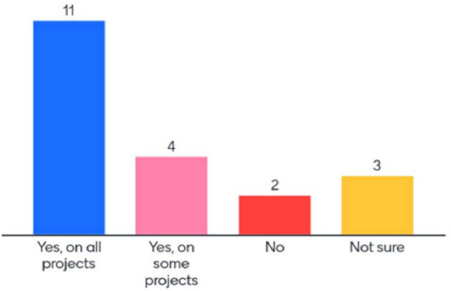
The graph shows a horizontal axis with four labeled bars. The data given in the graph are as follows: Yes, on all projects: 11; Yes, on some projects: 4; No: 2; Not sure: 3.

  1. To what extent do you agree with these statements about Project Quality Plans?
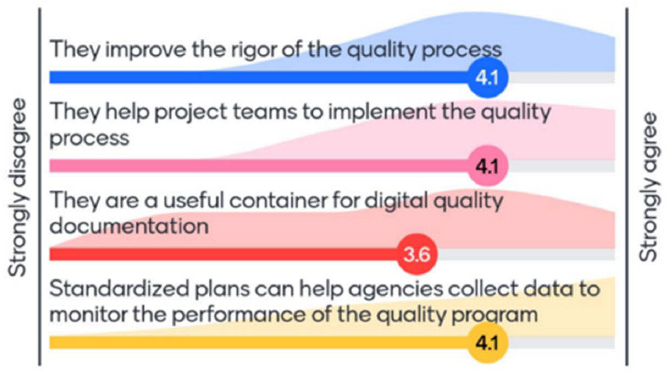
The right side of the scale reads, Strongly agree. The left side of the scale reads, Strongly disagree. The data given in the graph are all closer to the right side of the scale than the left, and they are described as follows: They improve the rigor of the quality process: 4.1; They help project teams to implement the quality process: 4.1; They are a useful container for digital quality documentation: 3.6; Standardized plans can help agencies collect data to monitor the performance of the quality program: 4.1.

  1. To what extent do you agree with these statements about Project Quality Plans?
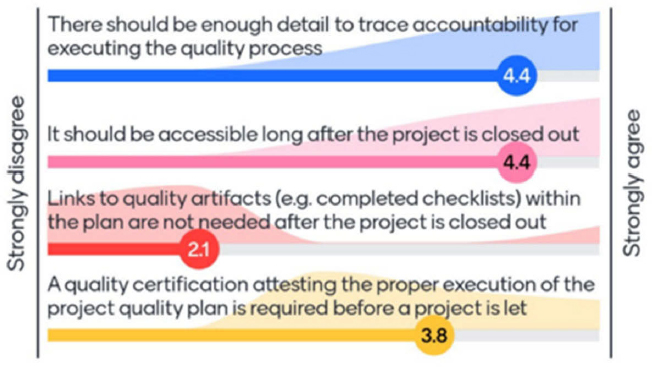
The right side of the scale reads, Strongly agree. The left side of the scale reads, Strongly disagree. The data given in the graph are described as follows: There should be enough detail to trace accountability for executing the quality process: 4.4, close to the right side of the scale; It should be accessible long after the project is closed out: 4.4, close to the right side of the scale; Links to quality artifacts (for example: Completed checklists) within the plan are not needed after the project is closed out: 2.1, closer to the left side than the right; A quality certification attesting the proper execution of the project quality plan is required before a project is let: 3.8, closer to the right side than the left.

Suggested Citation: "APPENDIX G: IHEEP 2023 WORKSHOP SUMMARY." National Academies of Sciences, Engineering, and Medicine. 2025. Quality Management for Digital Model–Based Project Development and Delivery. Washington, DC: The National Academies Press. doi: 10.17226/29172.
Page 136
Suggested Citation: "APPENDIX G: IHEEP 2023 WORKSHOP SUMMARY." National Academies of Sciences, Engineering, and Medicine. 2025. Quality Management for Digital Model–Based Project Development and Delivery. Washington, DC: The National Academies Press. doi: 10.17226/29172.
Page 137
Suggested Citation: "APPENDIX G: IHEEP 2023 WORKSHOP SUMMARY." National Academies of Sciences, Engineering, and Medicine. 2025. Quality Management for Digital Model–Based Project Development and Delivery. Washington, DC: The National Academies Press. doi: 10.17226/29172.
Page 138
Suggested Citation: "APPENDIX G: IHEEP 2023 WORKSHOP SUMMARY." National Academies of Sciences, Engineering, and Medicine. 2025. Quality Management for Digital Model–Based Project Development and Delivery. Washington, DC: The National Academies Press. doi: 10.17226/29172.
Page 139
Suggested Citation: "APPENDIX G: IHEEP 2023 WORKSHOP SUMMARY." National Academies of Sciences, Engineering, and Medicine. 2025. Quality Management for Digital Model–Based Project Development and Delivery. Washington, DC: The National Academies Press. doi: 10.17226/29172.
Page 140
Next Chapter: APPENDIX H: OUTPUTS FROM TASK 13 VIRTUAL WORKSHOPS
Subscribe to Email from the National Academies
Keep up with all of the activities, publications, and events by subscribing to free updates by email.