The Status of Informal Science and Engineering Education: Proceedings of a Convocation (2026)
Chapter: 4 New Insights for Supporting Learners and Learning in Informal Settings
4
New Insights for Supporting Learners and Learning in Informal Settings
Opening Day 2 of the convocation, Kirsten Ellenbogen, chair of the planning committee and president and CEO of Great Lakes Science Center, shared her thoughts about Day 1. She began by noting some of the themes that emerged from participants’ reflections on the past 15 years of informal science and engineering education (ISEE). First, many of the reflections centered on the positive growth that the field has experienced, which has been facilitated by a several field-building efforts: the Museum Learning Collaborative, the Center for Informal Learning and Schools, the National Informal STEM Education (NISE) Network,1 the Center for Advancement of Informal Science Education (CAISE), and the Reimagining Equity and Values in Informal STEM Education (REVISE) Center.2 She also explained that research on the establishment and growth of new fields coalesces around the concept that field maturation involves several milestones or standards:
- differentiation from other fields,
- mobilization,
- legitimacy-building,
- evolution of vocabulary or concepts (e.g., what counts as learning),
- persistence (i.e., permanence as an established specialty area), and
- the ability to intersect with other fields (i.e., “reaching out to other fields and influencing them and working in other fields, or vice versa”).
___________________
1 To learn more about the NISE Network, see https://www.nisenet.org/
2 To learn more about CAISE, see https://informalscience.org/about-caise/. To learn more about REVISE, see https://informalscience.org/
Ellenbogen celebrated the fact that Day 1’s discussions were rife with examples of the ISEE field meeting these milestones. She also highlighted the important work fostered by “boundary crossing” (i.e., learning from and working with other fields) to make connections between the ISEE field and adjacent fields, including science communication and civic science, youth development, and public policy. This boundary crossing should be thoughtfully done and is “great evidence of a mature field.”
Also highlighted was the emergence of collaborative practices within the field, including co-design of programs that center identity, based on Strand 6 from Learning Science in Informal Environments: People, Places, and Pursuits (LSIE) (National Research Council, 2009)—that is, “learners in informal environments think about themselves as science learners and develop an identity as someone who knows about, uses, and sometimes contributes to science.” (See Box 1-1 for a list of the six strands of science learning.) Ellenbogen attributed the significant advancements in the field and the nature of current work to Strand 6. This centering of identity and collaboration, she said, also affects measurement methodologies, as reflected in the shift from thinking about audiences as “output—as in, ‘How many did you reach?’”—to thinking about them “truly as drivers of the program” and “the program being in the person.”
With respect to gaps, challenges, and remaining needs to move forward, Ellenbogen noted that many participants stressed the need to better market the field to make it more widely recognized. They noted that some professionals who work in the field are not aware of the field, and that the field is not well represented “in the room” when many critical decisions are being made. Ellenbogen added that the increasing adaption of ISEE practices and their movement into formal education settings is complicating efforts to make the case for the value of ISEE and its distinctness as a field. Additionally, many participants raised the need for better coordination across ecosystems to enhance the dissemination of knowledge and mitigate “unproductive repetition.”
Discussions during Day 1 also emphasized the challenge of guiding and growing the ISEE field during disruptive times. Ellenbogen shared a relevant quote from one participant: “In times of great disruption, we are forced to focus on what’s essential. We have to ask hard questions. We should ask ourselves, what should we stop doing?” Ellenbogen agreed that this question is essential when a field is under stress, and spotlighting the nature of Day 1’s discussion on policy (see Chapter 3), she urged participants to continue discussions during Day 2 about strategies for “how we’re able to work in
“In times of great disruption, we are forced to focus on what’s essential. We have to ask hard questions. We should ask ourselves, what should we stop doing?”
these times in particular.” She also observed that discussions about advancing the work of the field in the present moment intersected with those about trust in science, scientists, and institutions, emphasizing that different constraints in education and science institutions affect levels of trust. She said that trust tends to be relatively high for museums and called attention to the recently published consensus study titled Understanding and Addressing Misinformation About Science (National Academies, 2025b). This study reflects “an extremely thoughtful understanding of trust . . . and it’s absolutely vital in our field that we’re paying attention to it, particularly as we work through this period of time.”
Setting the stage for Day 2, Ellenbogen highlighted some of the questions from the first day including the following: “Whose voice? Who’s setting the direction? Who owns the program? Who’s shifting the research agenda?” She noted the rich discussion about the needs for more inclusion of adults, both as caregivers in a family and as lifelong learners, and to work more closely with other scientists. She also shared some “calls to action” to be mindful of during Day 2: identifying which measures matter in the rapidly changing digital media landscape, and who is responsible for doing so; bolstering systemic change efforts to support equity and access; and reexamining institutions’ stances to move from “being neutral” to “being for all.” Ellenbogen reiterated the Statement of Task mandate to look ahead, noting that the forthcoming sessions would address these topics in a variety of ways. She also urged participants to “weigh in and get things on the record on what those next steps should be,” noting the opportunities built into the schedule to facilitate conversation and reflection.
NEW INSIGHTS ABOUT LEARNING SCIENCE AND ENGINEERING IN INFORMAL SETTINGS
The first panel of Day 2 explored advancements in research and practice that have increased understanding of learning and learners in informal science and engineering environments since the publication of LSIE, including who is represented in the learner population, how they learn across a wide range of environments, and how to design for learning to support different ways of teaching and learning. Panel moderator Joe Heimlich, planning committee member and lead research strategist at the Center of Science and Industry (COSI), grounded the conversation by asking the panelists to consider the understanding of learning and learners before LSIE: “Where did we think learning happened? Who were the learners? What were the contexts? And how did learning happen?” Heimlich also provided additional considerations for the panel’s conversation about how disparate pieces come together to form a field: As different practices and interests emerge, “How do they come together? How do they coalesce? How do they
bond across and between the internal disciplines—whether it’s engineering, formal science, informal science, [or] environmental science?” He encouraged the panel to ponder the opportunities, assets, and obligations that emerge at this “maturation stage.”
By way of introduction, Heimlich asked the panelists to describe the field before the publication of LSIE in one word. Amaris Alanis-Ribeiro, director of forestry and science, technology, engineering, and mathematics (STEM) at the Hispanic Access Foundation, said, “Blue.” “Lost,” said Monica Cardella, director of the School of Universal Computing, Construction, and Engineering Education (SUCCEED) and professor of engineering and computing education, Florida International University. Veronica Garcia-Luis, director of diversity, equity, and inclusion, the Exploratorium, offered “Emerging.” “Schoolish,” said Kylie Peppler, professor of informatics, Donald Bren School of Information and Computer Sciences, University of California, Irvine, adding that “public perceptions were schoolish.” Tina Phillips, assistant director of engagement in science and nature, Cornell Lab of Ornithology, Cornell University, put forward “Disparate.” As a follow-up to these responses, Heimlich asked the panelists to consider the perspectives on learning and learners in informal science environments at the time. “What were we thinking at the beginning of the emergence of this lost, blue, schoolish group, and as you enter through this disparate time, how did the field move into a different version of itself, or become itself, or start to become itself?”
Commenting on the state of the field before the publication of LSIE, Garcia-Luis stressed all of the work devoted to making a case for the legitimacy of informal spaces as sites of learning—work that LSIE both legitimized and furthered. For Garcia-Luis, in the area of visitor research and evaluation, this early work involved not only “figuring out what the visitor experience was in these spaces of informal learning” but also using the resulting data to argue for the legitimacy of both the evaluation work and the learning. Similarly, Cardella noted that learning experiences in out-of-school settings were not properly validated. She pointed to research on formative experiences in informal learning environments that pre-dated LSIE, including her experiences as an engineering graduate student at the American Educational Research Association Conference, where she first encountered the concept of learning in out-of-school time (LOST). She noted that the acronym was sadly fitting because these learning experiences were often overlooked. Peppler recalled how, as a newly hired professor when LSIE was published, she saw evidence of this major shift within one of the country’s largest schools of education in the increased recognition by the faculty that “learning could happen anywhere and everywhere; it wasn’t just [within] the boundary of schools.” She commented that this shift within academia at the time was “shocking.” Alanis-Ribeiro described a feeling of navigating new (blue) waters as she worked to transfer knowledge and
skills from formal education to informal science learning around 2009. She recalled focusing on how she wanted learning to happen: “We wanted youth to learn about science, and that became doing science, and doing it with scientists and engineers and for their own communities.”
Phillips, working within the area of participatory science, noted that LSIE was instrumental in the coalescence of citizen science as a field. Without LSIE, she said, “I don’t think citizen science would be where it is now in terms of really understanding [itself] and the outcomes and impacts of the field.” In 2009, when citizen science was just taking off, there were many projects but “no real sense of who was benefiting.” LSIE and a contemporaneous publication, Framework for Evaluating Impacts of Informal Science Education Projects (Friedman, 2008), laid the foundation for a framework around citizen science that included a crucial focus on outcomes and the development of shared measures known collectively as DEVISE.3 This focus enabled practitioners and scholars to compare outcomes across programs, which in turn led to much deeper understanding about the aspects of learning, including “the role of interest in science and nature, efficacy, motivation and behavior, environmental stewardship, and skills of science inquiry.” She also noted that many convocation participants were on the DEVISE advisory board and therefore contributed to these advancements as well.
Trends Over Time Concerning Learners and Learning
The expansive sense of learning captured and validated by LSIE was accompanied by a corresponding expansiveness in understanding who is a learner and of how to design for learners in more equitable ways within ISEE. Heimlich referred to this trend when asking the panel to comment on how the field’s understanding of learning and learners has shifted over the years. Panel members discussed various shifts in research and practice in terms of approaches to understanding learning and learners, the role of the learner, the place of learning, and the age of the learner.
Approaches to Understanding Learning and Learners
Peppler discussed the ways that informal STEM education has evolved toward identity-based, sociocultural, community-centered approaches, tracing an arc of change from 2009 to the present and noting that the field was undergoing a sociocultural turn in 2009, with an increased focus on the community and lifelong/life-wide learning (see below for more on lifelong and life-wide learning). She said that this evolution has continued into the
___________________
3 For more information about Developing, Validating, and Implementing Situated Evaluation Instruments (DEVISE), see https://www.birds.cornell.edu/citizenscience/measuring-outcomes/
present to now include concepts such as connected learning, “which combines our personal interests and identity development together with our social relationships.” This “evolution of theories” can alter fixed ideas of who learners are in ways that “open up different opportunities,” she noted. Concepts of connected learning can also change “notions of what our role [as the researcher or practitioner] could be” and how the ISEE field starts to think about connecting together as an out-of-school ecosystem, Peppler continued.
Garcia-Luis highlighted shifts in the research and evaluation space that began to consider diversity, equity, and inclusion from a systemic perspective, leading to a paradigm shift from thinking about access in terms of simply broadening participation to thinking about what access looks like in efforts to move toward equity. She mentioned that efforts focused on STEM identities have increased, which has prompted researchers and practitioners to contemplate their own STEM identities in their respective organizations, as well as the effects of those identities on learning and growing the field. She continued, “We make up the field, and we therefore also influence how and what we study, what the initiatives are, and what we’re putting forth . . . and so are we thinking about STEM more from a culturally-based point of view?” This point of view, she said, is especially important in work to shift from access as participation to access as equitable experiences. Self-reflection must be combined with attunement to the practices, knowledge, and needs of the community and participants: “In order for us to move toward equity in earnest, it really begins with thinking about the paradigms and the pedagogy—and also the communities and audiences—that we are here to engage with.”
The Role of the Learner
Alanis-Ribeiro noted the importance of continuing to interrogate “how we are thinking about people” to avoid falling into old habits of “us and them” or as an outside expert coming into a local community. Although there has been much innovative thinking around where programming can happen, she observed that the thinking around “the ‘who’ still needs a bit more work.” This comment echoed those from Day 1 about the ways that informal STEM education can beneficially expand or alter roles. For example, in her comments on the poster session (see Chapter 2), Diane Miller, former vice president of educational programs at the Detroit Zoological Society and co-principal investigator and director of affiliate programs and research to practice at REVISE, noted an emphasis on shifting the roles of participants, so that learners are not asked to passively receive wisdom and knowledge from “a scientist” who teaches but rather to learn “what the scientist is learning” and to inhabit this role of scientist themselves.
This shift involves not only helping participants to see the expert as a [fellow] learner but also designing programs that center participants’ interests and ways of knowing and pose questions such as, “What is the scientist learning? What is the teacher learning? When are we learners? When are we students? How do we exchange these roles?”
Paying attention to what learners bring to the table can also lead to a new awareness of learners’ roles or identities outside of the moment of a specific learning experience and, with that, an expanded sense of their expertise. Audience member Camsie McAdams, member of the STEM Next Opportunity Fund and director of the Institute for a STEM-Ready America, wondered about approaches to leverage the role that families play as moderators and choosers of content for young children. Relatedly, Cardella raised the point that parents, in particular, are rarely viewed as individuals who can bring their own rich knowledge and experiences to support their child’s learning. As an example from her own experience working with her children’s schools, she is typically viewed solely as a parent and not as an expert in engineering and education, even though, because of such expertise, she “might have something to offer.” This sort of parental expertise, she asserted, is often an untapped resource. She also noted the importance of thinking of parents as learners as well. She said that she often learns from her children, who develop their own expertise in areas such as new media. Although family programs are usually designed with the intent of supporting learning in children, “I think the opposite is true too, that the kids can support their own parents’ learning,” which programs could be designed to leverage. She shared that one of the most significant advances within recent years is the anti-deficit framing of all learners—to include parents and kids alike—and therefore informal learning environments should afford experiences where family members are learning together. Echoing this last sentiment, Phillips noted that this shift has opened up learning to everyone from “cradle to gray,” which means that “there is no boundary for who is the learner in this space.”
The Place of Learning
“One of the things that LSIE did for the field is break away from the notion that learning only takes place in a formal school system,” Phillips said. This break, she noted, made room for the notion that learning can take place essentially everywhere and, more importantly, that this type of learning is legitimate, too, no matter the context and environment. “There’s experiential learning, in situ learning, and everyday learning that happens. . . . It can happen inside your home, in a park, in a neighborhood, anywhere . . . and it’s valid.” She emphasized that this perspective enabled the emergence of other new perspectives and approaches around learning, including the use of sociocultural perspectives to think about learning in
“a variety of learning environments for informal science education.” In citizen science, for example, experiential learning brought with it “really, really valuable sociocultural perspectives.” Alanis-Ribeiro concurred with the notion of learning in very diverse contexts, referring to her own experiences in nontraditional places, such as “doing science in a church in partnership with faith-based organizations.” She shared that she has worked in many outdoor spaces, adding that “‘outdoor’ is not just a national park; it’s your local urban concrete.” She urged the audience to use these places and spaces to further expand thinking about approaches to informal science education, including the roles that people occupy and the true meaning of outreach and engaging communities around science.
The Age of Learners
Audience member Megan Ennes, assistant curator of museum education, University of Florida, noted that when asking the larger question of “who are our learners,” people “often default to thinking about audiences in terms of youth,” which can influence research and practice alike. Similarly, Heidi Schweingruber, director of the Board on Science Education, National Academies, reminded participants that a key goal of science education in general is not only to expand access to children and youth but also to connect people to science for the rest of their lives, and that informal science education is well positioned to help meet this goal.
Peppler observed that there are programs that leverage the desire of adults to be lifelong learners, including crafting communities that focus on learning math, Guerilla Science events,4 and programming in bars around the science of attraction. In the participatory science world, Phillips explained, the majority of participants are aged 50 and older, and when designing programming for older adults, “we know we have to have certain supports for them, like social connection, technology accessibility, and . . . physical accessibility.” Although youth are involved, to a certain extent, in participatory science, the audience has a significant gap of people aged 25–50: “There’s a big black box in terms of the age when we’re rearing families.” These ages are often when people are bringing children to museums, but, Phillips notes, most programming is aimed at the children and the potential exists for this age group to be more engaged in their own right. Adding to this idea, Cardella observed that becoming a parent is a “critical moment of learning” and wondered whether this moment can be
___________________
4 Founded in 2008, the mission of Guerilla Science is to revolutionize how people connect with science through transformative experiences, from stretching traditional boundaries of how people engage with science to inspiring them to examine the everyday and the spectacular with an alternative perspective. For more information about Guerilla Science, visit https://guerillascience.org/
leveraged through programming that supports “people who are adults as they’re going through this learning process.”
Alanis-Ribeiro observed that adults aged 18–24 and neither in high school nor the workforce (i.e., in college or trade school) represent another population for whom a connection with STEM can be made. “We can bring them into manufacturing or other areas of STEM.” She also raised the importance of intergenerational learning: Having younger people “work with elders and ancestral knowledge has been [something] very beautiful that I’ve seen in terms of ages across the lifespan.” In this vein, Schweingruber observed that informal science education is “a space to grapple with aging” and foster connection across generations, which is especially valuable in a society that “discards” older people. This includes experts and leaders in the field, who might ask themselves, “How do I become a wise elder?” Such work, Schweingruber argued, involves setting ego aside, sharing knowledge, and being open to new ideas.
Practices to Make Learning More Equitable
Panelists also discussed efforts to make learning more equitable and specifically shared insights on the ways that practices—and practitioners themselves—have changed over the years. Speakers stressed the importance of learning experiences that prioritized and were shaped by relationships and connections, and highlighted efforts that have either driven or have been driven by an expansive sense of who the learners are. Cardella began by noting that LSIE did not include engineering; that engineering education in schools has only been offered for about 25 years; and that, even within formal education, the engineering that students learn can vary a lot by state. Therefore, many of the current facilitators in ISEE may not have received extensive, if any, engineering education at all. She reiterated the point made by Ron Ottinger, executive director, STEM Next Opportunity Fund, on Day 1, that people without STEM backgrounds can indeed facilitate successful STEM learning experiences but they need critical resources and supports to do so, given that learning engineering in informal environments is “a bit different and has some nuances” compared to science, for example. Highlighting the New York Hall of Science’s practitioner guide, Using Narratives to Support Empathy and Engineering,5 as an important resource for facilitators, she noted the increased emphasis on empathy in engineering, which has shifted practice at a fundamental level: “Engineering is [not only] about solving problems, but even more so, it’s about understanding problems . . . and really developing a deep understanding of the context of the problem of the people who are going to be impacted as well as solving [the] problems.” Relatedly,
___________________
5 The Using Narratives to Support Empathy and Engineering guide is available at https://www.nysci.org/pdf/Using-Narratives-to-Support-Empathy-and-Engineering_ScreenView.pdf
audience member Jessica Sickler, principal, J. Sickler Consulting, commented that over the past 15 years, empathy has increasingly been viewed as an outcome and/or strategy and widely applied in engineering and conservation education (in zoos and aquariums). However, she added, adopting empathy as an outcome or strategy is complex, and each discipline should carefully and deeply consider how to use empathy within its particular work.
Practices around project design have also evolved in a number of ways, and Phillips listed some best practices from the participatory sciences. She shared that the most successful projects are those designed to attract diverse learners, exist in diverse settings, and enable multiple entry points—for example, participants might collect data, analyze data, and/or help form initial questions based on their interests. These projects are often flexible and adaptable, learner guided (i.e., elicit and integrate the knowledge of participants), and based in questions and goals that are relevant to participants (i.e., culturally relevant). Phillips noted that all of these factors help to maintain and sustain the initial interest that brings learners into these spaces and reflect intentional designing to develop interest and identity within a project. Alanis-Ribeiro raised the importance of continuing to evolve design practices and “dig deeper” particularly in relation to identity. She asserted that although “we know the ideas around equity and access,” the idea of identity is not yet fully understood. “We really have to think about being responsive to the identities and the complexity of intersectionality when we’re designing.” She highlighted her own work in which she initially developed STEM programming predominantly for girls in Chicago and then made a conceptual and practical pivot after reading a report about how the Chicago Public School system was “failing Black boys.” Cardella also shared that within engineering, a lot of exciting work is focused on particular populations, such as children on the autism spectrum and children in rural areas.
Tools and Resources That Support New Practices
Over time, several tools and resources have been developed and used to shift practices in the field. For example, Heimlich mentioned the development of clearinghouses such as informalscience.org,6 which have been “invaluable in providing a place where we have a shared repository [of evidence-based research and practices in informal STEM education] and access to things that we would not have had access to in the past.” Peppler agreed that documenting and sharing practices, as well as theory and research related to those practices, are important components in building effective practices across the field. She wondered, “How do we do this in
___________________
6 For more information about informalscience.org (currently managed by the REVISE Center, formerly managed by CAISE), see https://informalscience.org/
our networks so that we are not constantly reinventing the wheel?” This work is especially important, she said, because “this is a field where we have a lot of turnover, [and] we have a lot of challenges just trying to codify what it is that we do.” Peppler explained that the New York Hall of Science developed the aforementioned Using Narratives to Support Empathy and Engineering as a documentation tool for museum practitioners. This guide not only discusses the engineering education goals that an exhibition might have (e.g., to engage girls) but also outlines design principles that might support the achievement of those goals and provides an observation tool that helps practitioners to document outcomes. Peppler also highlighted the “Making Connections” project that she leads as a part of a collaboration between the Connected Learning Lab at the University of California, Irvine, and the STEM Next network.7 The project has defined eight still-evolving strategies “to serve as tools for making connections across settings to support STEM transitions and unlock academic, workforce-related, and civic opportunities for all youth, especially underrepresented groups like girls, youth of color, and youth from low-income families.” These strategies also provide some clarity around how to think about pathways for youth into lifelong STEM learning, regardless of what field they enter, and the already existing practices that can be shared as a part of coalition-building across sectors to support such pathways (e.g., peer mentoring models).
Garcia-Luis reiterated the need to be mindful of practitioners—particularly exhibit developers—when developing tools. She described a “female-responsive design framework” for exhibitions that she helped to develop at the Exploratorium as a part of the Exhibit Designs for Girls’ Engagement (EDGE) project,8 which sought to “identify the most important design attributes for engaging girls at STEM exhibits.” She shared that the project identified nine design attributes that could guide future exhibition design or prompt reflection on existing collections and exhibitions. Garcia-Luis explained that in developing the framework, her team aimed to support practitioners’ application of this framework in the spaces where they work and was therefore intentional about its usability for practitioners and how it could support their familiarity with the research and theoretical grounding for the framework. Alanis-Ribeiro shared that in her experience, the most helpful tools to support practice are professional learning cohorts and communities to test ideas. “I needed the safe space [along with] the groups to be able to process some of these thoughts and ideas and then be able to come back and be creative in my practice and see myself as part of the community.”
___________________
7 For more information about the “Making Connections” toolkit, see https://stemnext.org/stem-pathways/
8 For more information about the Exploratorium’s EDGE Project, see https://www.exploratorium.edu/education/research-evaluation/edge
This kind of collaborative environment is what enables “some of the co-creation that we have heard about over the last day.”
Next Steps for Supporting Learners and Learning
Heimlich asked the panelists to reflect on the questions that should be asked to discern the next steps to supporting learning and learners. “What should the questions be driving us [toward] as we look at where we are going both in the future and in the current tumultuous time?” He encouraged panelists to use the lens of maturation, situating their reflections on next steps within the broader arc of field-wide development. Across the discussion, panelists and audience members raised a number of possible next steps related to shifting perspectives to build relational infrastructure and foster inclusivity, expanding measurement and evaluation approaches, and strengthening ties between informal and formal STEM education.
Shifting Perspectives to Build Relational Infrastructure and Foster Inclusivity
Alanis-Ribeiro offered perspectives on how building relationships and connections not only support informal STEM learning but also serve as a form of relational infrastructure for the field. She explained that although STEM has often been thought of in capitalist terms—particularly in relation to national workforce goals—it might also be thought of as a source of social capital. In terms of social capital, she described STEM learning as a way to engage communities in science that works for their own good, lifting up and leveraging already existing assets rather than working from a deficit perspective (i.e., that the community’s role is only one of need). She asserted that cultivating an assets-based mindset and challenging deficit-based approaches are critical next steps for the field, and that cultivating “reciprocal relationships” is central to bringing together people in community (through, e.g., mutual aid and neighbors learning from each other, as was experienced during and after Hurricane Katrina and during COVID-19) and connecting the identity, needs, and interests of the local community with science learning experiences. With this perspective in mind, she wondered, “How can we learn from each other, see the assets that we each bring, and leverage those assets and formulate what’s next for the next 10 years?” Peppler noted that the ideas of social capital and assets-based approaches align with the concepts of connected learning, all of which reflect the opportunities that emerge from relationships. Additionally, she highlighted the importance of leveraging relationships with community institutions to work toward more representation of the field in the broader community and world. She explained that building bridges between people
in science and engineering with people outside of the field is another part of this relational infrastructure. For example, she said, engineering outreach by people in the field (e.g., students, faculty) has increased the presence of engineering in schools, community organizations, museums, etc. Cardella agreed, explaining that the history of engineering education in colleges of engineering is longer than that in K–12 schools, and faculty and students in these spaces have been working to connect with communities, schools, and museums. She also noted that many of the undergraduate students at her university come from the local community, and so leveraging these community ties can help to build the bridge that is needed to connect the work of people in the community with the work of informal education researchers and practitioners.
In terms of next steps, Phillips stressed the need to think more strategically about inclusive project design—that is, “how our projects and programs invite everyone to participate.” Similarly, audience member Ann Miller, executive director, Science is Elemental, urged participants to consider ways to better reach people who do not view themselves as interested in science and therefore may not visit a museum. Alanis-Ribeiro agreed with the need for more intentionality around creating inclusive spaces, adding that even when spaces are not inclusive, specific communities of interested people make their own spaces. She pointed to Black, Indigenous, and People of Color (BIPOC) birder groups, for example, that have carved out space for themselves, noting that such groups can add cultural richness to the bird identification lexicon by providing Spanish terminologies. Further, while these communities may not necessarily form groups to promote their own ways of knowing and learning or to learn the science about birds, their efforts reflect “how a community survives and does things during disruptive times” and in the absence of inclusivity.
In light of this part of the discussion, an audience member pointed to the need for further discussion about learning in groups and the way that informal science education can expand—and be broadened by—this aspect of learning. A lot of science in formal education settings is now group work, this person explained, but science is also being done informally in families—another kind of group.
Expanding Measurement and Evaluation Approaches
Importantly, also needed is infrastructure that balances a field-wide vision with the specific needs, identities, interests, and questions of individual communities, Peppler said (echoing a comment by Jamie Bell during Day 1). This gap in the understanding and research of the field should be prioritized, she argued. “How do we start to understand and start to study” the specificity and uniqueness of environments and share knowledge across different
sectors and communities? She referred to work in this area by Nichole Pinkard, who is “constantly getting us to think about how our communities [are unique]: the same programs that might work well in Pittsburgh or in Chicago are not going to work well in L.A., for example” (see the next section for Pinkard’s comments about how learning ecosystems support this perspective). Future research, Peppler continued, should prioritize the building of “collective goals” that can hold the field together while ensuring the necessary specificity. She reiterated previous comments by participants on Day 1 about balancing common, field-wide goals with tailored goals for different informal settings. Similarly, Cardella emphasized the need to retain a sense of the “complexity” of informal learning spaces, while attending to the variety of learning environments. The current context of budget cuts, reductions, and uncertainty offers an opportunity to intentionally create infrastructure that serves collective goals, commented an audience member. This person suggested that this type of work might include the development of shared systems, platforms, and frameworks that can serve as a touchstone even as sectors differentiate themselves. Cardella agreed and highlighted the relevance of engineering design research here, which shows that deep understanding of all of the constraints of a particular context can actually lead to opportunities for creativity.
Elaborating on this idea of collective goals as a research priority, Peppler noted that existing research contains much knowledge about programs and individuals but not much about collectives, communities, the differences between environments, and sociocultural dimensions. “Our research really falls flat when we think about those infrastructural issues,” and therefore the question becomes “how to study these aspects that differ from place to place comparatively.” Peppler stated that assessment and reflections should reflect the field’s shift toward a concept of learning that is connected and relational; currently, assessments remain rooted in cognitive ideas, and sociocultural assessments largely do not exist. “A lot more innovation in assessment is needed” to create methodologies that can measure social capital, for example. She said that this innovation will be especially important in the work to “create[e] the systems that we want.”
Strengthening Ties Between Informal and Formal STEM Education
“How has informal science evolved in its coalition-building and cross-pollination within formal education? (Or is it still distinct with minimal overlap?)” Audience member Stephen Alkins, diversity, equity, and inclusion officer/principal investigator at TERC, director for vision and accountability at the REVISE Center, and committee member, Boston Public Schools, posed this question to the panelists, asking them to comment on ways to “formalize” informal science practices and perspectives within formal education
settings. Specifically, he wondered, how might informal science education inform the development of School 2.0 and use elements in informal science education to push formal education norms, such as the way that time is used and is more open-ended in the out-of-school space? Alkins offered the example of Scratch, a coding language program developed for children by the Massachusetts Institute of Technology.9 The program was originally designed for out-of-school spaces, “but because it engendered so much learning, the teachers were pulling it in like crazy. . . . Good design can have a way of being transportable and inspirational to schools.” However, Alkins added, transportability into the formal environment does not mean that the positive experience will be replicated; thought and care are required “to keep the good learning going.”
Peppler commented on the importance of developing a broader vision that can guide the field in leveraging out-of-school learning’s potential to serve as a model for School 2.0. “I would love for schools to start to look like out-of-school learning rather than feeling this push to keep us separate.” This work relies in part on building infrastructure within the informal science education field that enables the sharing of a “vision” of education via models based on the idea that “learning is always happening in these very, very rich ways.” It is also important, Peppler asserted, “[that we] really steward that vision so that School 2.0 looks more like out-of-school learning.”
Similarly, Cardella noted that a flexible perspective on the relationship between formal and informal science education can inform practice in fruitful ways. She continued that it is helpful to view informal and formal as “two different [intersecting] axes” or a spectrum rather than enforcing a rigid dichotomy. She urged participants to acknowledge and work within a “blurrier” distinction, where students encounter “in-between spaces” of learning, such as industry internships, whereby they have a learning experience that is concurrent with but different from an engineering classroom.
Cultivating these sorts of informal learning environments and experiences might help to address a “massive misalignment” between what students are learning in formal education spaces and what the workforce needs/expects, said audience member Heidi Cian, research specialist, Maine Mathematics and Science Alliance. She shared that in her work with the Afterschool Coaching for Reflective Educators in STEM (ACRES) program,10 she is observing increasing external expectations to connect youth with STEM careers. She asserted that out-of-school programs’ responses to these increased expectations could be a model for School 2.0, and she pointed to emerging thought around a framework that could help to connect students to the workforce through, for example, internships, externships,
___________________
9 For more information on Scratch, see https://scratch.mit.edu/
10 For more information on the ACRES program, see https://mmsa.org/projects/acres/
collaborations between communities and museum educators, or teachers or part-time workers who “have a foot in different worlds” and can bring material from that other world to their students. However, Cian also noted the tension with an “internal” desire for these out-of-school programs to be “promising, culturally nurturing spaces.”
Alternately, topics—rather than workforce goals—might help to build bridges between informal and formal education. Alanis-Ribeiro pointed to climate education as one area that pushes into both in-school and out-of-school education. These “complex, context-based” topics can span formal and informal education settings as well as disciplines.
Further Topics for the Field to Grapple With
Audience members and panelists raised a number of topics that could not be fully addressed in the time allotted. The role of mobile technologies, especially in participatory science, is an emerging area that is prompting practitioners and researchers to ask new questions, Phillips said. Some apps, for example, enable people to collect data and participate outside of localized learning environments. She pointed to the Merlin Bird ID app developed by the Cornell Lab of Ornithology, which enables users to identify birds in a number of ways, including song, photo, and description.11 Phillips raised questions related to this technology: Do apps like Merlin enhance or diminish learning? Is there a need for facilitation, enticement, or other forms of support that encourage people to “actually learn the sounds of the birds” rather than simply get the answer right away? To this end, she mentioned that the role of AI is another topic that will demand further discernment, research, and innovation as the technology develops.
Peppler noted that the field must highlight and leverage the mental and physical health benefits of lifelong science learning. “There is a real space and opportunity for informal science education, which is largely driven by people’s interests to highlight the . . . benefits of being involved in that kind of learning.” Cardella agreed, as did an audience member who encouraged more research on the benefits of going out into nature.
Ottinger shared that positive youth development is a missing body of research that is critical to the field. He explained that some of the research that was funded during his time at the Noyce Foundation found that facilitators or educators who had training and a background in positive youth development could more easily make STEM activities and programming “come alive for kids because they understood what it meant to motivate kids.” He shared that each year, about 18 million youth are served by the major youth development organizations such as 4H, Boys and Girls Clubs,
___________________
11 For more information on the Merlin Bird ID app, see https://merlin.allaboutbirds.org/
and YMCA, and that “the field is richer because organizations like these have gotten into STEM.”
Because work of attending to the unique communities and environments in which learning happens involves an equity dimension (as discussed in the next section on ecosystems and in Chapters 2 and 5), audience member Ivel Gontan, REVISE Center manager, TERC, urged participants to consider “how the field is thinking about DEAI [diversity, equity, access, and inclusion] in the next 15 years and the opportunities and challenges that will exist.”
Finally, Heimlich asked one last question of the panelists: What does the future look like, in one word? Alanis-Ribeiro answered, “Green.” Cardella said, “Critical.” “Coalition-building,” responded Garcia-Luis. “Connected,” said Peppler, and Phillips closed out the panel with “Dynamic.”
THE ROLE OF ECOSYSTEMS IN ADVANCING INFORMAL SCIENCE AND ENGINEERING LEARNING
The second panel of the day explored educational ecosystems for supporting learners and learning within the ISEE field. Moderator Kevin Crowley, planning committee member and professor of education, senior scientist at the Learning Research and Development Center, and co-director of the University of Pittsburgh Center for Learning in Out-of-School Environments (UPCLOSE), University of Pittsburgh, opened the discussion by connecting some of his personal experience working in the field to LSIE, particularly noting the importance of LSIE in helping people from across disciplines understand how they might work together: “It was a call to join in on common problems, and it made us multidisciplinary.” It also provided “traction in how we define learning, how we think about facilitation, and how we think about settings for informal science learning.” One “transformational” concept that emerged in the work of the Learning in Informal and Formal Environments (LIFE) Center12 and then echoed in LSIE was the concept of [learning] ecosystems—“how place, social [aspects], and culture get together with learning.” Addressed only briefly in LSIE, Crowley noted, the concept has evolved and taken hold in the 15 years since. “It’s not just a way to think about [ourselves in terms of] we’re a network, we’re connected, it’s a collective, but it’s a fundamentally different way to think about learning and teaching—being together on lifelong pathways.”
___________________
12 The LIFE Center was established in 2004 as a multi-institution National Science Foundation Science of Learning Center hosted at the University of Washington in partnership with Stanford University and SRI International. The LIFE Center seeks to develop and test principles about the social foundations of human learning in informal and formal environments with the goal of enhancing human learning from infancy to adulthood. For more information, see http://life-slc.org/
Supporting Science and Engineering Learning Through an Ecosystem Approach
Marijke Hecht, assistant professor of environmental education in the School of Environment and Natural Resources, the Ohio State University, laid the groundwork for the panel discussion by providing an overview of “Supporting Science and Engineering Learning Through an Ecosystem Approach,” a paper commissioned by the planning committee to explore ecosystems thinking and how it can be used to sustain more resilient and equitable learning experiences.13 Specifically, she highlighted how ecosystems thinking can facilitate learning from and with the natural world as well as provide a way to conceptualize learning as it happens across the lifespan and connects with social histories and cultures. Throughout her presentation, Hecht noted connections between learning ecosystems and biological ecosystems, reinforcing the ecological and natural origins of ecosystems thinking and using the biological ecosystems model as an organizational structure to think about learning ecosystems. This framing, she explained, has implications for the design of learning environments.
The application of ecosystems thinking to learning has been growing in popularity across education sectors, Hecht said, with STEM, and science education especially embracing this model. That said, ecosystems thinking in the education realm has continued to evolve. Early learning ecosystems imagery put students at the center of the system, and the language was very school-based (i.e., students vs. learners). However, Hecht noted, learning ecosystems are not individualized—that is, many little ecosystems with individual students at the center of each one. Rather, they are socioecological systems that comprise multidirectional interactions of and connections among their many elements. In this, they resemble biological ecosystems—that is, systems made of interconnected parts with no center. With an ecosystems perspective, learners are central to the mission of education, but they are not the center, Hecht explained. They are elements within the larger interconnected system, and, significantly, they not only are influenced by other elements of the system but also influence these other elements. “In a learning ecosystem, this shifts focus away from individual learners and towards relationship and interactions between system elements” (Hecht, 2025a, p. 4). This perspective also opens up opportunities to design learning ecosystems that attend to the practices and processes that support the linkages between learning ecosystem elements, she explained.
Features of Ecosystems
Hecht first described ecosystems as complex; they are dynamic and unpredictable (i.e., the effects of one change in the system cannot be predicted).
___________________
13 To read the full commissioned paper, see https://www.nationalacademies.org/projects/DBASSE-BOSE-24-02/event/44757
She emphasized the importance of distinguishing between a complicated system and a complex system. A complicated system might be intricate and involved but ultimately can be replicated, whereas a complex system cannot be replicated because of its dynamism: the interconnected parts of the system exhibit emergent and dynamic patterns of nonlinear and unpredictable behavior, and every instance and situation is unique (Hecht, 2025b). Therefore, Hecht noted that “efforts to make educational improvements cannot rely on linear approaches, but instead require collaborative, iterative work that can adapt and respond to actual current conditions in flexible ways” (Hecht, 2025a, p. 6).
A second feature of ecosystems is that they exist across different sizes and scales and are nested—that is, a learning ecosystem at the neighborhood level exists within a larger ecosystem at a city level, within a state, within a region, and so on. Therefore, the flows of energy between different scales are multidirectional.
Multilateral flows of energy, ideas, and power create useful tensions between the scales of individual action, collective action, and institutional forces that operate across time and space in learning ecosystems. Ideally, learning ecosystems can support individual agency at the same time that they push against systemic forces that impede equitable educational experiences. (Hecht, 2025a, p. 8)
Hecht wondered, for example, how giving some power to learners—whether children, youth, or adults—might change the design of the learning ecosystems.
Lastly, ecosystems are situated in place (i.e., a combination of space and time). This concept of place, Hecht explained, comprises the material space (e.g., a room or park) and temporal depth (i.e., the history, present, and future of a space). Place is also complex; every context is different and cannot be replicated. In seeking to manage the complexity of place in relation to learning, Hecht noted the usefulness of insights from adaptive management, which involves attending to what is happening in the moment and acting responsively, in “contextual ways,” rather than assuming that every situation will respond the same way to a specific intervention. She shared that adaptive management has been adopted in some educational science work and voiced the hope that this could be extended even more.
Important Factors for Understanding the Health of Ecosystems
Hecht also discussed three factors that are important for understanding the health of ecosystems: disturbances, keystones, and indicators. She illustrated this cluster using examples from nature. First, she noted that floods are natural disturbances that can be destructive in some cases while necessary for how an ecosystem maintains itself (e.g., riverine systems) in other cases. Disturbances are events or other things that disrupt the usual
flow of energy throughout the system in some way and therefore force changes to the system’s function. In designing for restoration and resilience in the face of these natural disturbances, she explained, it is important to intentionally support elements of the system that drive energy through that system, which are called keystones. Hecht pointed to the reintroduction of wolves to Yellowstone National Park as an example of how supporting keystone species can positively affect the health of the entire ecosystem. Third, some elements are known as indicators—parts of an ecosystem that reveal whether it is healthy or struggling. Hecht explained that although indicators provide helpful information, they are not the focus of ecosystem design. The mayfly is an example of an indicator; although the presence of mayflies indicates the existence of good water quality, mayflies are not the central focus of ecological restoration design.
Turning from natural ecosystems to learning ecosystems, Hecht considered which elements might be the keystones and indicators, and how the field might better understand and leverage these elements to promote the health and resilience of learning ecosystems in the face of disturbances (see Figure 4-1). She proposed that learners could be thought of as indicators, which would mean that the system would not be designed around learners; rather, their health would reveal the health of the whole system. Potential keystones, she observed, might be educators and intermediary organizations, and, at present, disturbances can be seen in the form of the changes in federal policy and funding priorities.
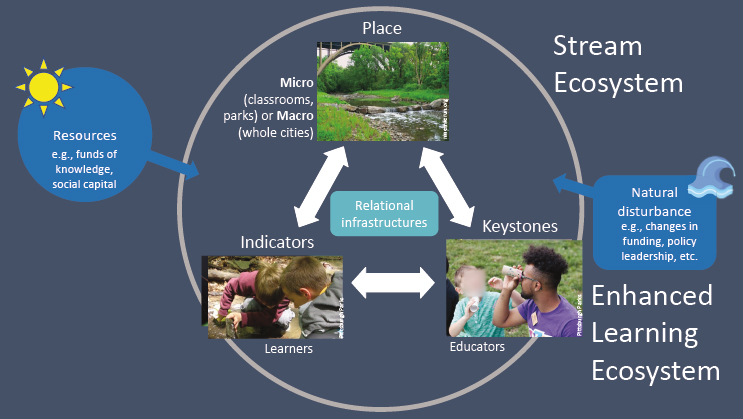
SOURCE: Hecht (2025b, slide 7).
She explained that the concepts of keystone and indicator species can help to shape the field’s distribution of resources: “Our approach then might be to focus resources, including funding, capacity-building, and structural supports, on educators and intermediary organizations.” Furthermore, ecosystems thinking—with educators as keystones and learners as indicators—also surfaced the importance of attending to relational infrastructures (i.e., the practices and processes that support the linkages between learning ecosystem elements), she observed, using a term introduced by Caren Cooper during the Day 1 panel on goals for the field. Hecht asserted that designing for resilience and health—in this case, in ways that support relational infrastructures—can aid survival of disturbances (Hecht, 2025b).
Considerations for Measuring the Health of Learning Ecosystems
Regarding efforts to design for health and resilience, Hecht wondered about what the ISEE field still needs to consider as it works to envision and build learning ecosystems infrastructure based in relationships and connection. One consideration she highlighted is the need for a clearer, shared understanding and definition of what a healthy learning ecosystem looks like and how to measure health in this context. Learners might be one indicator that can be used to measure health, but there may be others as well, she suggested. She added that establishing a shared understanding of a health learning ecosystem also involves identifying the keystones to focus on when designing interventions across different scales of the system.
A second consideration for the field to explore is what adaptive management looks like and, particularly, how to cultivate relational infrastructures as a part of this approach. Hecht noted the importance of learning from research and practice in other fields to inform employment of adaptive management approaches, such as scientists working on climate systems modeling and building network pathways. She contended that in the case of education, adaptive management approaches should involve more than simply building connections and granting access, because “connection and access are not the same thing as equity. We need to support interactions and relational infrastructure to really address systemic inequities” (Hecht, 2025b). Finally, Hecht said, the most difficult challenge facing the field is being able to accept disturbance (which is inevitable) and foster resilience. Biological systems might provide some “cues and clues” about how to address this challenge in learning ecosystems. Following this overview, Crowley turned to the rest of the panel to elaborate on the affordances of an ecosystems perspective based on their own research and practice expertise.
“Connection and access are not the same thing as equity. We need to support interactions and relational infrastructure to really address systemic inequities” (Hecht, 2025b).
Ecosystems Thinking as a Paradigm Shift
Panelist Tom Akiva, professor of youth development and chair of the Department of Health and Human Development, University of Pittsburgh, spoke about his experience using an ecosystem approach in youth development, with adolescents in particular. He connected this work with his past work in camp settings, which he considers to be essentially ecosystems: “settings where particular structures, albeit with certain constraints and allowances, support learning in unique ways.”
Akiva stressed that the ecosystem approach is not a supplemental way of doing things but rather a paradigm shift within the field of education. Recalling Hecht, he emphasized that the approach situates learning within a complex, dynamic system, wherein the elements in the system change the system, which requires people to be reflexive. It also requires the development of different research and evaluation tools and adoption of adaptive management practices. Akiva further explained that with its focus on complexity, ecosystems thinking involves shifting the focus from nodes in the system to links—that is, focusing on the dynamic interconnectedness of the various elements, and how these connections are built and supported. He asserted that this thinking also moves away from a positivist framework, which is reflected in most educational research. Further, it offers rich potential for change: The ecosystem model “provides something that’s new and lets us envision and invest toward a future versus randomized controlled trials that tell us about something that worked in the past.”
An Ecosystem Approach to Intentionally Designing for Connected Learning
When the goal is building an “interconnected system” within and across communities in intentional and sustained ways, attention to infrastructure is absolutely essential. Nichole Pinkard, Alice Hamilton Professor of Learning Sciences at Northwestern University, turned the conversation more specifically to the learning infrastructure of communities and its importance to the well-being of the system: “When we talk about learning ecosystems, we often focus on programs, people, and participation. But ecosystems are only as resilient as the infrastructure underneath them.”
“When we talk about learning ecosystems, we often focus on programs, people, and participation. But ecosystems are only as resilient as the infrastructure underneath them.”
Pinkard noted that attending to infrastructure involves asking, “What does it take to design learning that flows across systems (formal, informal, and familial)?” Further, how do we make that “flow” visible, equitable, and
actionable? She calls the specific ecosystem approach that she employs in her work “opportunity landscaping”—a “sociotechnical process for mapping, documenting, and optimizing the learning infrastructure of a community.” Through this process, the unique patterns of opportunities and limitations within a specific community are brought to light, showing “who gets to participate, what it takes to do so, and how systems either support or block access over time.” Opportunity landscaping can support not only positive change to the system but also more effective design because it can help to predict how a program may or may not work within the community’s infrastructure. For example, “If a program doesn’t fit [the community’s] structure, like a STEM lab that requires transportation across town or a club needing late night access, then we need to add extra support.” Pinkard highlighted five core elements that effectively support understanding of the learning infrastructure or opportunities for learning within a community: social and technical infrastructure, policies and data agreements, social practices, sustained support, and local insight (see Box 4-1).
Pinkard closed her remarks with an illustration of an interconnected system of opportunities. Drawing an analogy between opportunity landscaping and sports, she noted that when a young person excels at, for example, basketball, “it’s never because of one coach or one team. It’s because they’ve moved through an interconnected system, with open gyms, park leagues, travel teams, high school sports, and state tournaments.” The existence of such a system is not incidental; therefore, in the context of informal education, “How are we building that interconnected system within our local communities [and] across our system, such that landscaping becomes more intentional and less accidental?”
The Role of Institutions in Building Ecosystems
Institutions often play a role in “anchoring and supporting the building of ecosystems,” Crowley commented, asking Steve Snyder and Heather Jameson to share their perspectives on this topic. Snyder, president and CEO, Fleet Science Center, discussed the San Diego STEM Ecosystem Project (where he is also a member of the Executive Leadership Team).14 Jameson, strategic initiatives lead, Montana Afterschool Alliance, spoke about the Montana STEM Ecosystem,15 which was built by the Montana Afterschool Alliance to span rural communities, and the annual Montana STEM Summit.
___________________
14 For more information about the San Diego STEM Ecosystem Project, see https://www.sdstemecosystem.org/
15 For more information about the Montana STEM Ecosystem, see https://www.mtafterschoolalliance.org/stem-ecosystem
BOX 4-1
Five Core Elements That Support Understanding of Learning Infrastructure
- Social and technical infrastructure: Platforms that enable coordination (e.g., alignment of calendars) and information and data sharing (e.g., participation and registration data) for navigating programming opportunities across sectors such as schools, libraries, parks, and community-based organizations (e.g., My CHI, My Future, a digital platform that connects youth with Chicago’s out-of-school ecosystem; and Digital Backpack 65, a digital platform for families in Evanston, IL, to connect with area programs and events).
- Policies and data agreements: Clear, ethical, and secure policies across sectors for data sharing that are tailored to their specific contexts and that enable partners to review past data and see long-term patterns of engagement or exclusion and system gaps.
- Social practices: Shared language, boundary spanners/intermediaries, organizational capacity, and new routines that foster a culture that enables collective reflection and planning, and mutual trust around data sharing and use (i.e., data are not coded as surveillance, and people trust that the data they share will not be used against them).
- Sustained support: Intentional investment in staff, convenings, systems, and strategy. Such support is central to the well-being of initiatives, not an “add-on,” and includes long-term funding to sustain programs after the initial setup investment.
- Local insight: Seeing what supports are already in place (perhaps for different programs) and considering whether those supports will also work for new programming. This also helps to identify what new supports might be needed.
SOURCE: Developed from Pinkard presentation at the Convocation on the Status of Informal Science and Engineering Education.
The San Diego STEM Ecosystem Project
Snyder shared that the Fleet Science Center’s involvement in the San Diego STEM Ecosystem Project arose from an “organizational” decision to fundamentally shift the nature of its ISEE work by putting the community at the center of all the work; shifting from learning goals to the goals and aspirations of communities; and determining how STEM learning, resource skills, and other supports can help advance those goals. To accomplish this goal, the Fleet Science Center adopted an ecosystem framework, which was viewed as one that would “really help to move beyond . . . just the collaboration or the collective action kind of frameworks.” Snyder reported that
the San Diego STEM Ecosystem Project grew very quickly; 90 people were initially involved, but within six months, 320 organizations and 42 school districts served by those organizations also became involved. Additionally, he shared that this work has illuminated how an ecosystem model can shape informal science education.
First, an ecosystems model can help to reframe thinking around the relationship between the informal education (in this case, a museum) and the formal education system. He explained that conventional thinking casts formal education as a “standard model,” wherein the formal school system is “the educational center of gravity of all learning” and informal learning environments and experiences are satellites that orbit around it. By contrast, in the ecosystem model, formal education is “simply one element of this larger dynamic learning system, and that is a very exciting notion.” As Hecht stated in her presentation, an ecosystem approach “makes room” for informal education. Snyder represented this metaphorically: “While [formal education] may be sort of the ‘apex educator’ of the [learning] system, it is now a tiger in the jungle; it’s not the jungle itself.”
Second, an ecosystems model can help to elevate the particular needs of communities and neighborhoods and to inform scaling and adaptation for each new environment: “Each of those [embedded] ecosystems is itself its own unique piece, and just as we have to tailor our work to the learner, we have to tailor our role to that particular community and particular local context.” This area, as Akiva noted in his remarks, warrants more research: “Every giant ecosystem is made up of a whole bunch of miniature interactions,” including the interaction between two people. To tailor this work, more research on these interactions at every scale is needed.
Third, Snyder continued, the interconnectedness of an ecosystems model demands the development of “educational proprioception”—that is, “a heightened awareness of what others are doing so that we can understand how the actions we’re taking either support or disturb the web of experiences that learners are working their way through.” “We need to also recognize that our work is situated in the work of every other informal education organization, every community group, every scientist, every engineer, [and] every experience that people are having in school, out of school, and after school,” he explained. Responsible are not only learners and communities but also the system itself: “We are all effectively stewards of that learning ecology, and it is complicated and messy and costly, but when it works and we start seeing the ecosystem relationships build and a shared purpose emerge, we see some really fantastic things happen.” Importantly, Snyder pointed out that understanding the ecosystem and nurturing its resilience and health requires a substantial investment in relationship-building across the network.
The Montana STEM Ecosystem
Led by the Montana Afterschool Alliance, the Montana STEM Ecosystem initiative is focused on ecosystem-building at the community and regional levels, Jameson said. It grew out of the Montana STEM Summit, which has been held annually since 2017, and is supported by various state networks and funders; this year was the first year that this summit was hosted by the Montana STEM Ecosystem itself. The Montana STEM Ecosystem solicits input from communities, conducts landscape assessments of the work already occurring in communities, and determines how to support local efforts from a statewide level, said Jameson.
Jameson stressed the importance of connection and conversation in this work, adding that in a predominantly rural state, where 96 percent of the school districts are classified as small and rural, innovation is required to bring together people across large swaths of physical distances. (Montana averages a population density of seven people per square mile.) This innovation has included a heavy reliance on “guiding leadership teams” composed of cross-sector partners from industry, distance learning, the K–12 education system, higher education, and out-of-school time to connect with different communities. Thus, the ecosystem itself, rather than a single person or institution, becomes the hub for work that grows out of community-level conversations. Those conversations serve as “launching points” of connection that are then, through the ecosystem, carried on across initiatives. Jameson described the ecosystem as “holding space” for connection across communities, initiatives, and institutions. In this, the Montana STEM Ecosystem supports individual communities’ work to meet their needs by providing a central hub that increases the accessibility of resources and strategies and reduces the duplication of efforts, she noted.
Jameson shared that the initiative has also sought to center communities in this work. By starting at the community level to make connections and provide space for conversation, room is made for communities and individuals who have previously not been included in these conversations, Jameson said. The goal is that “we’ll be able to amplify and share those voices of our providers, the youth-serving professionals, and our community members.” She noted, too, that this strategy has been successful: “We’re seeing a lot of sparks from those conversations and hearing a lot of voices.” This success was particularly evident during the most recent Montana STEM Summit, in April 2025, when “some of the most heartfelt and heartwarming remarks were that these are opportunities for voices to be heard—voices that have not been at the table before.” Jameson highlighted the increase in youth voices particularly; one panel—for youth, by youth—was a highlight of the summit, with participants clearly engaged, passionate, and energized. “One of the biggest comments was that their brains aren’t
tired. And the whole room erupted in laughter and were instantly engaged.” Jameson commented that this youth engagement has become a touchstone for the rest of the summit: “It’s great to hear from the youth themselves and to have the ability as an ecosystem to bring their voices to the table as well.”
How Ecosystems Foster Hope Amid Disturbance
“Disturbances are an expected part of ecosystems,” Crowley stated, by way of asking the panelists to reflect on what gives them hope in the midst of the present tumultuous moment. Hecht acknowledged that the global impacts of ecological disturbances (e.g., habitat loss and climate change) and policy and funding changes can cause a lot of anxiety. However, hope can come from realizing that disturbances have occurred over a very long timescale in the past, yet some things survived, as will be the case for the current disturbance. She raised the concept of refugia (from biology), noting that, for example, not everything died during the last glaciation because organisms, including humans, were able to find locations that supported continued life. Building on the concept of refugia, Hecht wondered, “What do cultural refugia look like at this moment, and how might cultural refugia allow us to weather a very, very dramatic disturbance?” The smallest scale of relational infrastructure (e.g., the convocation itself, families served by a program, one-on-one relationships) could be viewed as refugia; with this in mind, “can we create pockets of small landscapes” that can preserve the field and move it forward? Hecht said that as an “infrastructural tool,” this preservation effort might look like “building relationships not only with people but with place.”
Elaborating on the idea of refugia, audience member Gina Navoa Svarovsky, faculty director at the Center for Broader Impacts and professor of the practice at the Institute for Educational Initiatives, University of Notre Dame, reminded participants that individuals who survive difficult times are those with privilege and access to resources. She noted the importance of not only taking shelter in one’s own place of refuge but also connecting with others “in their places of survival.” Also important is consideration of how as a field and “as boundary crossers” bridges can be built with other fields and leaders. This connection is essential to ensuring that vulnerable or marginalized populations also have access to places of refuge, resources, and connection to others: “We’ve got to make sure that we’re not leaving behind the people we’re committing to support and elevate.”
Pinkard described finding hope “out of the ashes, in some sense.” For example, she said, funding cuts, expiration of COVID-19 relief funds, and other drivers of scarcity are starting to force educational systems to rethink what they are doing: “How [do we] do more with our limited resources?” This situation can drive institutions to build relationships across sectors
(e.g., schools, parks, libraries, museums) and engage in an “ecosystem conversation” rather than act independently. “There’s been so much money in the system that you could sort of do your own thing.” With the loss of funding sources, Pinkard said, we may see “survival of the most connected.” This situation also opens up the opportunity to help people to reconnect “in ways that hold all of our civic resources accountable for playing the role that they can play.” She also pointed to excitement about the possibility that these conditions—although difficult—might lead to a broader embrace of “learning lifestyles” in which the formal education system is only one node in a broader ecosystem. Snyder said that he finds hope in “the entire ecosystem ethos,” which is inherently relational and inherently collective. It is, he said, a “community coming together to look at its way forward” and the opposite of the zero-sum model, where one can only win if another loses. Snyder noted that hope also comes from the fact that people understand the ecosystem approach and want to work in this way.
The energy of the youth who are showing up ready to engage and learn bring hope and energy, Jameson noted. Recalling the idea that “they aren’t tired,” she reported being energized by her work to elevate their needs and voices and by their charge to the policymakers, industry leads, CEOs, higher education professionals, and others in the room to not be tired as well. She also pointed to the hopeful work of facilitating connections and conversations between sectors via the Montana STEM Ecosystem initiative. For example, Jameson described connecting what educators might need from workforce or industry leaders to what workforce and industry leaders might need from educators, rather than having them talk past each other. She said that “having those conversations taking place together [in the same room], co-designing from the community base up, and continuing to work with interested and engaged youth” gives her hope that the work can move forward. Building on the importance of youth energy, Akiva pointed to The Future of Youth Development: Building Systems and Strengthening Programs (National Academies, 2025a), a consensus report that he coauthored, which discusses the critical role that ecosystems play in positive youth development. He highlighted two of the report’s recommendations that give him hope: (1) “[I]nvest in adult practitioners and their well-being,” which echoes Hecht’s earlier suggestion to focus on educators as keystone species, and (2) “continue to build infrastructure,” which includes supporting the work of intermediaries and is connected to Pinkard’s ongoing work. Akiva also offered a mnemonic coined by Karen Pitman that has helped him to remember the purpose of ecosystems: “ECOsystems,” where the first three letters stand for “every connection optimized.” He noted that the connections can be between topics within one’s own mind, between experiences in different learning settings, or between the adults in the system who are supporting the learning. “How do we build more of those connections so
that the amazing learning journeys that some kids get to have—often kids with a lot of preexisting resources—are more common and more supported for all kids?”
Discussion
How do we balance the work of developing and sustaining ecosystems with the reality of individual egos? Gontan posed this question to the panelists, continuing, “Who gets the credit and the funding to steer the movement, influence how this infrastructure gets built, and determine where the power is held and shared, or not?” Pinkard suggested that social network mapping as a part of an infrastructure approach can reveal who is doing the work and who is not, who is not at the table but should be, and who are the linchpins. This mapping can help “knock down some of that ego,” she noted. Snyder observed that ecosystems work aligns with leveraging “enlightened self-interest.” He explained, “There are gains to be made and positionality to be had in a community by playing the generous role in an ecosystem where there is power.” Jameson commented that the ecosystem model provides an opportunity for egos to come together to create collective action.
Hecht commented that disturbance leads to opportunity and that “recogniz[ing] that dramatic change offers opportunity for transformational change” can be helpful. This moment is a good one to determine how to take advantage of the “portal door opening” created by the changes that are being “forced on us,” and to do so without “ego.” In this same vein, Akiva advised attending to the inertia of existing systems as a potential obstacle; existing power structures can keep old practices and patterns in place because people benefit from them. He contended that it is important to interrogate head-on, “Who’s benefitting from preventing us from moving to a more equitable ecosystem approach?”
How might scientists perform public engagement work in ways that support ecosystems? Jen Parsons, civic science fellow, American Physical Society, asked this question of the panel, noting the increased interest among scientists to employ a public engagement approach as opposed to the historical outreach approach, and she wondered, “What kinds of supports could be provided to these scientists so that they are a supportive and not an extractive part of these ecosystems?” How can they “build trust, approach partners with humility, and better understand their community’s needs?” Panelists stressed the importance of scientists seeing themselves as part of the ecosystem, community engagement in other fields, and leveraging intermediaries.
Hecht stressed the benefit of scientists embracing their role as “super informal keystones.” She noted that most scientists are very “schooley”—that is, even if they consider themselves to be a part of the learning ecosystem, they tend to view their role and learning in general in terms of formal academic
interactions. If they can see themselves as a part of the system in a much looser, broader way, then they might see the great impact that they could have or are already having: “These interactions that you have with the scientist in everyday life, in your learning landscape of your everyday life, can be very, very powerful . . . that neighbor who convinces you that science is cool.” Snyder pointed to a growing body of work on community engagement from other sectors (e.g., science centers) as a good resource. This material documents evolving practices and theories around true engagement with community, which involves listening, building trust over time, and building relationships. Intermediary organizations can also play a very important role in facilitating connections between scientists and the community; “it’s a lot of work and a lot of time,” Snyder said, and shared that some of his staff’s time is fully allocated to this facilitation. When intermediaries help to build connections, scientists and engineers, who might otherwise not have the time, can engage in ways that benefit the ecosystem as a whole.
Building on the topic of the role of brokers and intermediaries, Marsha Semmel, independent consultant, asked the panel to elaborate on what “broker” means in the context of pathways for learners and for learning organizations. Pinkard defined a broker as the person who ensures that individuals are matched up with opportunities that are right and possible for them. Thus, she commented, everyone’s a broker to some extent; likewise, this work is widespread: “I view brokering as a strategy that has to be all around us.” This concept of brokering is embedded in the social practices needed for effective opportunity landscaping (see Box 4-1); she identified boundary spanning and intermediary work—that is, brokering—as one social practice that fosters a culture of collective and collaborative efforts. Effective brokering involves discerning “natural next steps,” Pinkard continued. She highlighted the need for a broker to understand the available options, the opportunities, and the individual being brokered for. She also asserted that at an infrastructural level, the field should be striving to make it easier for individuals to engage in this type of work and to encourage more people to embrace their role as a broker. She wondered, how do we make the work of brokering “approachable and digestible and actionable?” Jameson commented that in her work, brokering entails “switching from just one knowledge holder, just one source of information” to an ecosystem model, where information is “channeled through interconnected webs and different linkage points as well.”
Further Topics for the Field to Grapple With
Jayatri Das, chief bioscientist at the Franklin Institute, raised the topic of expanding the ecosystems model to other problems at other scales, asking the audience to consider whether ecosystems models might be applied across
networks and then filtered down, or whether they must begin at the grassroots and grow up. She noted that this thought emerged from her thinking about the intersection of ISEE with other fields as a sign of field maturity.
Fanuel Muindi, professor of practice in the Department of Communication Studies and director of the Civic Science Media Lab, Northeastern University, highlighted the need for evolving forms of assessment and evaluation and wondered about the indicators that should be used for the measurement of ecosystem health. Karen Peterman, president, Catalyst Consulting Group, also turned to evaluation, noting that LSIE “did a beautiful job of setting us up to think about outcomes,” but work around assessing process is needed. The ecosystem framework is useful in expanding evaluation practice because “it broadens the perspective of what we’re asked to evaluate and how we’re asked to think about things like health and brokering and the relational infrastructure that’s there and that we need to build.” Developing ways to evaluate links, for example, is an area needing exploration, she said. In general, Peterman said, the intersection of ecosystems and evaluation provides an opportunity for collaborative work to develop assessment processes and practices “that don’t compromise the system itself but are actually additive to the work that we’re all trying to do.”
Joanna Garner, research professor and executive director of the Center for Educational Partnerships, Old Dominion University, highlighted the importance of accounting for the complexity and dynamism of individuals themselves when contemplating the different layers of ecosystems. She emphasized that individual learners may behave differently in the same setting over time and that viewing learning as “an emergent phenomenon that is situated within the individual constructs and the interplay among those constructs” can shift how researchers and practitioners think about their work. This perspective, she said, can encourage the adoption of theoretical perspectives that are “interaction-driven rather than component-driven” and avoid the assumption that “the aggregate level represents the individual level and vice versa.” Herein, the perspective would be as “interventionists who design probabilistically for perturbations and not for engineering assembly-line outcomes.” To this end, she said that “the ecosystem of who works in [the ISEE] field may need to change” to bring in “individuals with different skill sets and methodologies pertaining to complex systems.”
This page intentionally left blank.


