Addressing Liability Issues of Proactive Safety Improvements (2026)
Chapter: VIII. SELECT AGENCY PRACTICES AND PROPOSED GUIDANCE LANGUAGE
(a) The development of the access management methodology under section (3)(b) may include the following factors:
. . . .
(J) Safety planning tools, data and resources such as the department’s Safety Priority Index System, Analysis Procedures Manual, Roadway Departure Plan, Bicycle/Pedestrian Safety Plan, and Highway Safety Manual predictive models that identify areas of existing and future safety concerns. When considering safety factors as part of the methodology, the safety concerns and issues must be documented by a professional engineer as defined in [Or. Admin. R.] 734-051-1070.
F. Executive Deliberative Process
The executive deliberative process privilege shields certain documents from disclosure: preliminary drafts and notes; correspondence with private individuals, other than correspondence which is intended to give notice of final action of a public agency; preliminary recommendations, and preliminary memoranda in which opinions are expressed or policies formulated or recommended.
The purpose of the privilege is to give government agencies the ability to engage freely in deliberative policy making process; by encouraging frank discussion. In some jurisdictions this privilege has been extended to information provided to the agency by their consultants.147
Courts, in determining whether the privilege should be applied, consider such factors as the degree of confidentiality and sensitivity of the communication, the time elapsed after deliberation was concluded and after communications were made, and whether deliberation is ongoing.148
Practice note: The deliberative process exceptions is not as much a legal defense as it is a tool in the legal toolbox. The agency can prevent disclosure of materials while it considers which proactive safety solutions to adopt, which ones to discard, and formulates the finalization of its decision-making process.
For instance, if the agency had cumulative data that indicated a condition needed remediation, but the remediation had not yet been selected, scheduled, or programmed, the data may be protected from disclosure with this doctrine. Some agencies have had a positive experience in using this privilege to shield data, and others have had a positive experience after disclosing this type of information because it assists in showing a deliberative process, enhancing the argument that the action they planned to take was discretionary.149
G. Sovereign Immunity
Sovereign immunity is enjoyed by many states. The concept behind sovereign immunity is that the state or other governmental agency can be found responsible for injuries caused by the public entity or its employees only in certain circumstances, usually a “dangerous condition” of public property or when a public employee breaches an obligation, such as the obligation to drive a motor vehicle safely. For example, Oklahoma statute reads as follows:
The State of Oklahoma does hereby adopt the doctrine of sovereign immunity. The state, its political subdivisions, and all their employees acting within the scope of their employment, whether performing governmental or proprietary functions, shall be immune from liability for torts.150
H. Section Wrap Up
This section includes an analysis of existing administrative rules, internal practices, state laws, and legal immunities that are used by state agencies to defend dangerous condition claims. These rules and other concepts could be modified by other agencies and incorporated in their practices to form the basis of legislation or rules that could be the basis of the defense to a dangerous condition claim and used to limit the plaintiff’s use of cumulative predictive data in tort actions.
VIII. SELECT AGENCY PRACTICES AND PROPOSED GUIDANCE LANGUAGE
This section includes selected agency and industry data-driven practices as well as other practices that have been found to be helpful to the governmental agency in defending legal claims against it. This section also provides model language that could be included in agency guidance.
A. Accident Data as Basis for Roadway Improvements
As referenced earlier in this digest, a plaintiff can attempt to use accident or other data to show that an agency had notice of a road defect and should have taken steps to address it prior to the plaintiff’s injury. Details such as accident location, frequency, severity, traffic counts, and typical speed of the driver have long been available for the agency engineer to review. The other tool traditionally available to the agency was data derived from crash reports prepared by law enforcement.
The crash location review practice could be enhanced with the inclusion of video or other detection systems for the location studied so the practitioner can also observe the lighting at the time of the crash, the size of the vehicles involved, the time of day and whether that factor had an impact on the crash, and the specific angle of the striking vehicle(s). That data can be developed using light detection and ranging (lidar) or cameras. Discussion of those methodologies could be the basis of an agency’s defense of a crash that occurred at a location that was studied with this review process in mind, along with documentation of the manner in which this information was used.
B. Prioritization of Projects Based on Study of Data
An agency that prioritizes projects based on budget or other criteria could use a road audit methodology to frame its defense
___________________
147 See e.g. City of Colorado Springs v. White, 967 P.2d 1042 (Colo. 1998).
148 Gwich’in Steering Committee v. State, Office of the Governor, 10 P.3d 572 (Alaska 2000).
149 See, for example, Estate of Sima Maiti v. Commonwealth Transp. Cabinet, Claim No. 2007-545 (2010).
150 OKLA. STAT. tit. 51 § 152.1 (2024).
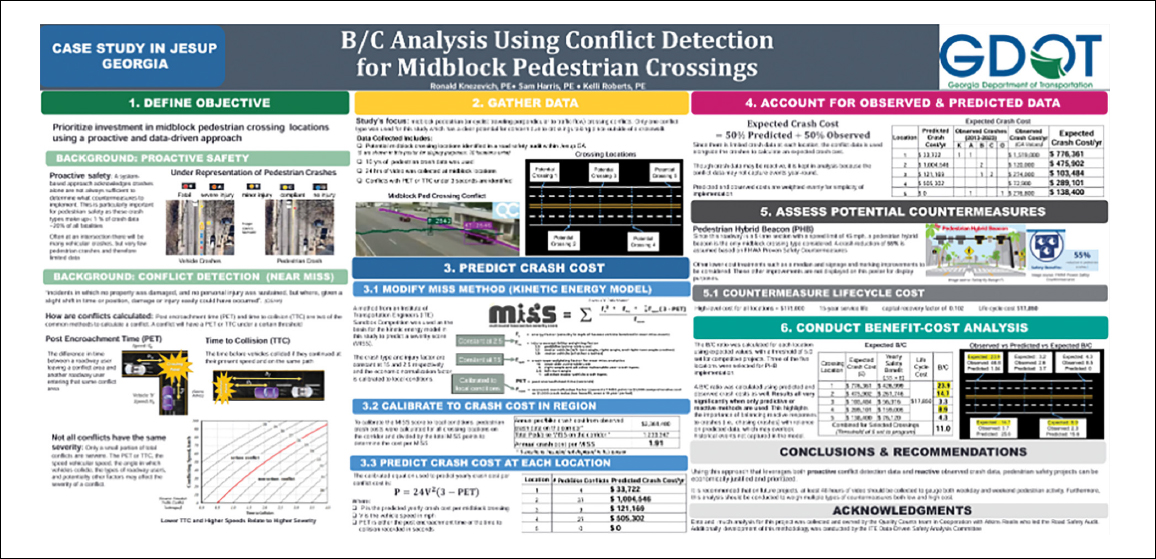
of a dangerous condition claim. Data collected in a road audit, or a countermeasure study, could be used as the basis of the defense of a dangerous road condition claim if the agency wanted to show the methodology, or decision-making process used to select a certain countermeasure at an intersection or the reason it prioritized one project over another. The poster in Figure 1 was presented at the October 2024 AASHTO Safety Conference in Houston, Texas, by Georgia DOT. The information contained within it could be used to explain the agency’s actions in prioritizing midblock pedestrian crossing improvements in the defense of a case involving a fact pattern with pedestrian crossings.
Pavement Friction Data
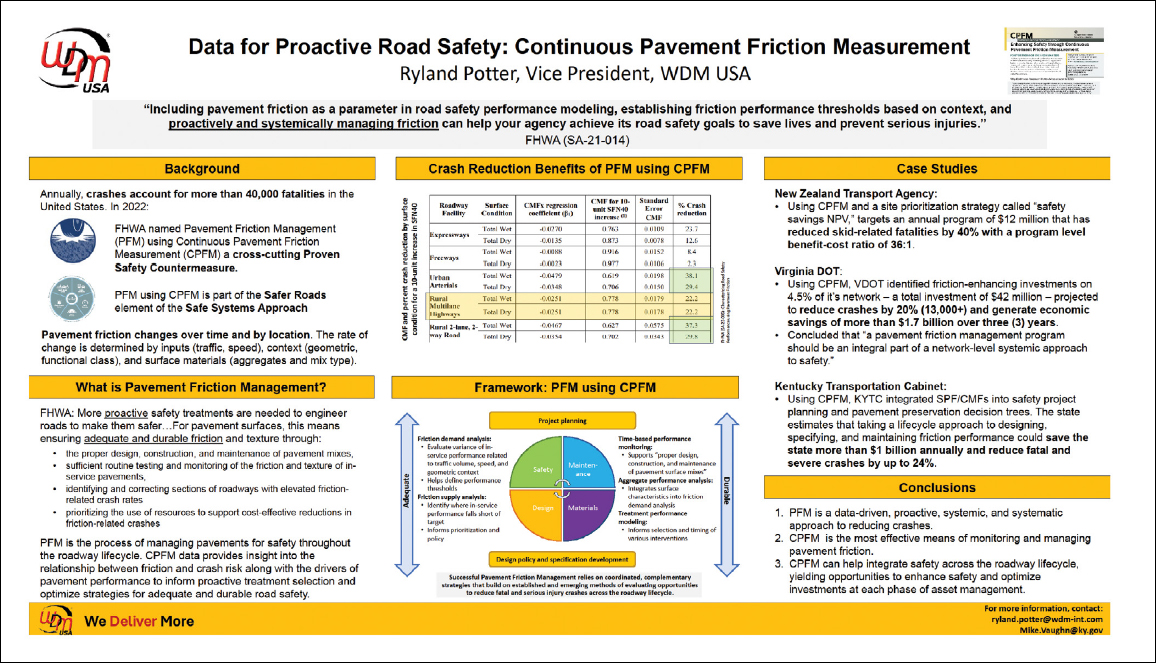
Similarly, a poster presented at the October 2024 AASHTO Safety Conference in Houston, Texas, by the Kentucky Cabinet titled “Data for Proactive Road Safety: Continuous Pavement Friction Measurement” (Figure 2) details the methodology used by the Cabinet to establish the crash reduction benefits of pavement friction measurement. The agency estimates that it can use a “lifecycle” approach to save more than one billion dollars and reduce fatal and severe crashes by 24 percent. This poster could be used as the basis of the Cabinet’s defense of its practices of implementing the lifecycle approach in selecting pavement projects.
C. Language Found in Green Book, Roadside Design Guide, and Highway Safety Manual
This section includes language found in the guidance that is published by AASHTO. It is included in this digest to provide either a starting point or an additional resource for practitioners who are developing or reviewing internal guidance and seeking out flexible model language. The following text is taken directly from the preface or foreword (in pertinent part) of each of these publications:
A Policy on Geometric Design of Highways and Streets (AASHTO’s Green Book)
The fact that new design values are presented herein does not imply that existing streets and highways are unsafe, nor does it mandate the initiation of improvement projects. This publication is not intended as a policy for resurfacing, restoration, or rehabilitation (3R) projects. For projects of this type, where major revisions to horizontal or vertical curvature are not necessary or practical, existing design values may be retained. Specific site investigations and crash history analysis often indicate that the existing design features are performing in a satisfactory manner. The cost of full reconstruction for those facilities, particularly where major realignment is not needed, will often not be justified.
. . . .
The intent of this policy is to provide guidance to the designer by referencing a recommended range of values for critical dimensions. It is not intended to be a detailed design manual that could supersede the need for the application of sounds principles by the knowledgeable design professional. Sufficient Flexibility is permitted to encourage independent designs tailored to particular situations.
. . . .
The highway, vehicle and individual users are all integral partes of transportation safety and efficiency. While this document primarily addresses geometric design issues, a properly equipped and maintained vehicle and reasonable and prudent performance
by the users are also necessary for safe and efficient operation of the transportation facility.151
AASHTO’s Roadside Design Guide
[T]his book is a guide. It is not a standard, nor is it a design policy. It is intended to be used as a resource document from which individual highway agencies can develop standards and policies. Although much of the material in the guide can be considered universal in its application, several recommendations are subjective in nature and may need modification to fit local conditions. However, it is important that significant deviations from the guide be based on operational experience and objective analysis.152
Chapter one contains this additional language:
This guide is intended to represent the spectrum of commonly available roadside design alternatives. In most cases, these alternatives have shown significant benefits in appropriately selected filed conditions. Many of these roadside enhancements have, over time, demonstrated their ability in the field to improve roadside safety condition. In many areas, this publication strives to give the advantages and disadvantages of roadside technology. With this information, designers can make more knowledgeable decisions about the best applications for individual projects. However, no attempt is made or implied to offer every single roadside enhancement design technique or technology.
Finally, this guide is not intended to be used as a standard or a policy statement. This document is made available to be a resource for current information in the area of roadside design. Agencies may choose to use this information as one reference on which to build the roadside design criteria best suited to their particular location and projects. Knowledgeable design, practically applied at the project level, offers the greatest potential for a continually improved transportation system.153
AASHTO’s Highway Safety Manual
The Highway Safety Manual preface states as follows (in pertinent part):
The HSM is not a legal standard of care as to the information contained herein. Instead, the HSM provides analytical tools and techniques for quantifying the potential effects of decisions made in planning, design, operations and maintenance. There is no such thing as “absolute safety” notwithstanding efforts by government to maintain, improve and operate highway facilities to the highest level that governmental funding allows. There is risk in all highway transportation. That risk is inherent due to the variability of user behaviors, environmental conditions and other factors over which the government has no control. A universal objective is to reduce the number and severity of crashes within the limits of available resources, science, technology, and legislatively mandated priorities. Because these considerations are constantly changing, it is unlikely, if not impossible, that any highway facility can be “state of the art” . . . The HSM is not intended to be a substitute for the exercise of sound engineering judgment. No standard or conduct or any duty
___________________
151 AASHTO, A POLICY ON GEOMETRIC DESIGN OF HIGHWAYS AND STREETS (4th ed., 2001).
152 AASHTO, ROADSIDE DESIGN GUIDE (4th ed., 2011).
153 Id. at 6.


