Revenue and Financing Alternatives for Medium and Small U.S. Airports in an Evolving Landscape (2026)
Chapter: 5 Practical Strategies and Best Practices

CHAPTER 5
Practical Strategies and Best Practices
5.1 Introduction
Outreach and engagement with an array of airports and other entities yielded a variety of practical strategies and best practices to meet capital, operational, and service-related needs. The insights gained from this outreach have been compiled into a database, which can be found at nationalacademies.org/publications by searching for ACRP Research Report 285: Revenue and Financing Alternatives for Medium and Small U.S. Airports in an Evolving Landscape. This resource is designed to help airports easily identify initiatives that align with their specific operational contexts.
The data in the database inform this chapter and present a selection of strategies and best practices organized around three main focus areas:
- Capital funding and financing
- Revenue (diversification, production, and enhancement)
- Financial management
The findings from this analysis are intended to support airports in evaluating strategies that may improve revenue generation and strengthen their capacity to fund or finance airport improvements. Additionally, the analysis illustrates potential interconnections among these areas. While not all practices or resources are universally applicable, many may prove relevant or valuable depending on an airportʼs unique needs and circumstances.
5.2 Capital Funding and Financing
The ability of public airports to receive grant funding for certain types of projects is a major part of the business model of every airport within the NPIAS. Grant funds typically assist airports with large capital construction expenses that they could not afford. Due to the infrastructure requirements to support aeronautical activities (e.g., runways, taxiways, and apron), the smaller the airport, the more reliant it is on grant funding. Grant funding is the lifeblood of the smaller airport business model because generated revenue alone can neither sustain required infrastructure nor generate enough revenue to pay for expansion projects.
Airport capital funding and the use of financing resources are fundamental to the operating success of every airport in the United States. The air transportation system in the United States is designed to create funding from a variety of aviation sources such as fuel taxes, airline ticket/security fees, PFCs, and other aeronautical and non-aeronautical revenue sources. These fees are either directly used at the airport of origin or are resourced to the government to be delivered to the nationʼs airports through a variety of FAA grant programs.
Airport Funding and Financing Sources
Airports benefit from a variety of funding sources through programs at the federal, state, and often local levels of government.
The following are the most commonly used airport funding and financing sources.
- Federal Funds: Federal grants are a key source of funding for infrastructure projects, such as runway repairs and terminal expansions, and airfield improvements. While these grants are vital, they typically do not cover the full cost of large-scale projects, necessitating the need for additional funding sources. Examples of some of the key federal grant program are:
- AIP: AIP is a federal grant program that helps fund development and maintenance of public-use airports. It is the primary funding source for small and medium airports in the United States for safety, maintenance, and public-development–related projects and is managed by the FAA. The program is funded by Congress through the Airport and Airway Trust Fund, which is supported by user fees from airline tickets and aviation fuel sales. The program is funded in excess of $3 billion dollars annually. These grants are typically split into entitlement and discretionary funding grants and are awarded to each airport based on certain formulas and criteria. According to the FAA AIP program overview, an AIP grant covers 75% of eligible costs for a medium-hub airport and 90% to 95% of eligible costs for small primary airports (FAA 2022).
- AIG/IIJA: AIGs are another type of federal grant designed to fund airport improvements, including for runways, taxiways, terminals, and safety-related projects. According to the FAA, the AIG will provide $14.5 billion in funding over 5 years that started in FY 2022 (FAA 2025a). The funding can be granted to both primary and nonprimary airports.
- Airport Terminal Program (ATP/IIJA): The ATP is a grant program that funds development of airport terminals and traffic control towers. This was created to combat the aging of airport infrastructure. Eligible projects can include modernizing terminals, constructing or expanding airport facilities, airfield safety, on-airport rail access projects, and updating airport air traffic control towers. The ATP has provided or will provide $1 billion in funding over 5 years beginning in FY 2022.
- Military Airport Program (MAP): The MAP helps convert old military airfields into public airports. This program provides grants to civil sponsors wanting to build, improve, or upgrade aviation facilities for public use, including parking lots, fuel farms, hangars, utility systems, access roads, cargo buildings, and related infrastructure.
- VALE: VALE is a federal initiative through the FAA that encourages airports to implement clean technology projects to reduce ground-level emissions at commercial airports. It credits airports with air quality credits that can be redeemed for future airport development.
- State and Local Grants: Many state and local governments provide grants to support airport infrastructure, helping to fill funding gaps when federal funds fall short of a projectʼs total cost. These grants can be crucial for smaller-scale improvements or as matching funds for federal grants.
- State Aviation Grant Programs: State aviation grant programs are financial aid programs funded by a state government that provide state monetary assistance to public-use airports. These programs vary widely from state to state in terms of the availability of aviation funding sources and state program guidelines. State aviation program dollars are often used to supplement the local match from FAA grants. As an example, the Florida Department of Transportation has a robust program exceeding $250 million annually to provide airports with stand-alone project support, and a local sponsor match is generally required. State grants tend to allow for an increased variety of eligible projects, such as for hangar construction, parking infrastructure, and other revenue-generating infrastructure improvements.
- Commerce/Business Grants: A variety of states offer grant programs through entities such as the Department of Commerce or state and local economic development authorities.
- Sponsor Local Match/Revenue: A local match is often needed for federal or state airport grants. For example, a 90/10 project grant for $100,000 may require a 10% local match of $10,000 with the grant amount covering the remaining $90,000. Local match dollars are typically provided by aeronautical and non-aeronautical revenue sources at the airport. Certain projects funded through programs such as the FAA Noise Improvement Program allow for local matches from airport user fees such as PFCs, which can be particularly helpful for airports with limited local funding sources.
- PFCs: A PFC is a fee paid by many airline passengers in the United States to help maintain airports. In most cases, the PFC is included in the ticket price, and the amount can vary depending on the destination airport. PFCs are currently charged up to $4.50 per flight segment, with a maximum of two flight segments per one-way trip or four flight segments for a round-trip flight. These fees are used for maintenance or a variety of different improvements around the airfield. Most commercial service airports in the United States participate in the PFC program and allocate the revenue for safety, security, capacity, or noise reduction projects.
- CFCs: A CFC is a fee collected by airports, typically from rental car transactions but in some cases from parking facility payments as well, to fund the development and operation of ground transportation infrastructure. These charges differ depending on the contract with the airport. They can be used for construction of new rental facilities, for improvements to existing rental facilities, to pay for operating expenses, to pay for a busing system from the terminal to the rental car facility, and so forth. The flexibility of CFCs allows them to be used for a variety of projects and operating costs.
- Airport Revenue Bonds (Tax Exempt): Airport revenue bonds are municipal bonds that help fund airport construction, expansion, or improvement. Most of the time, these bonds are secured from the airportʼs operating revenue and are repaid through revenue streams such as PFCs, landing fees, parking, and retail concessions. These revenue streams may be generated from airline activity and other aeronautical and non-aeronautical sources.
- Taxes: Communities may include a fund in property taxes such as an ad valorem tax to assist with airport operating costs. Taxes can take the form of a mileage or parcel fee specific to an airport over a set period of time. Some states have tax codes that allow a penny tax to be voted on by constituents to fund specific infrastructure projects, including at airports. For example, to fund projects such as terminals, Wyoming airports often use a sixth penny tax, which is a sales tax that is specifically used for capital projects.
- Debt/Financing: Bonds are commonly used to finance large-scale infrastructure projects. Airports may issue revenue bonds, which are repaid from future revenues generated by the airport, or general obligation bonds, which are backed by local government tax revenues. Bonds are less likely to be used by smaller airports but are good options that can be explored.
- PPPs: PPPs are generally long-term contracts between a public entity and a private entity to operate facilities at an airport. PPPs can range from a lease agreement to operate or manage a facility or terminal or an agreement to operate the airport entirely.
Traditional Funding Strategies
Grant funding is essential for airports, especially smaller ones, as it helps cover large capital construction expenses that they cannot afford on their own. Smaller airports are particularly dependent on these funds to support necessary infrastructure such as runways, taxiways, and aprons. Without grant funding, these airports struggle to maintain operations or invest in expansion projects since the revenue the airports generate is often insufficient for these needs.
Funding can come from federal, state, and local sources, each with its own requirements and matching fund obligations. The most common funding strategy for almost all small and medium airports in the United States is the use of the AIP combined with a state grant program and a local
match from the sponsor. Typically, the total project cost is divided into a 90%—5%—5% split, respectively, for eligible expenses. The actual percentage breakdown will depend on the AIP program year, with percentages varying from 90% to 100% of the total eligible project cost.
The FAAʼs AIP funding is determined, in part, by the airportʼs status category. Primary airports (i.e., commercial service airports with more than 10,000 annual enplanements) receive a minimum of $1.3 million annually in entitlement dollars. Nonprimary airports (commercial service airports with between 2,500 and 10,000 annual enplanements) receive $150,000 annually in entitlement dollars. The AIP program also uses discretionary dollars to supplement entitlement funds, which helps to bridge the gap of total project costs for approved projects.
The AIP uses a mix of entitlement and discretionary dollars to provide airports of all sizes with the ability to maintain safe and efficient airport service based on the National Priority System (NPS), which ranks projects according to safety, capacity, and other criteria. Airports that use and rely on PFCs and CFCs to pay for specific airport projects and bond debt service are highly sensitive to air carrier passenger enplanement counts. Thus, a decrease in passenger enplanements could significantly affect an airportʼs ability to support capital improvement plan (CIP) projects or bond repayments.
The FAAʼs grant system is designed to distribute funds equitably among U.S. airports included in the NPIAS. This approach ensures that airports of all sizes and financial capacities can develop and maintain safe and effective aeronautical services for their communities and the national airspace system. Each year, Congress allocates these funds through the FAA AIP, provides oversight of the PFC program, and supports additional grant initiatives established in the federal budget to address specific needs and national priorities.
Depending on the governmentʼs targeted initiatives and other available supplemental programs, airports can leverage additional grant opportunities using short-term, congressionally funded infrastructure programs. These programs are often targeted to assist airports with military assets at the airport, provide airports emergency funding during local or national emergencies, or assist airports with special programs such as green energy and environmental sustainability efforts.
Federal and typical state grants generally involve grant assurances. Grant assurances are obligations airports must agree to in order to accept the funds. According to the FAA, such grant obligations per the AIP Handbook “require the recipients to maintain and operate their facilities safely and efficiently and in accordance with specified conditions” (FAA 2025b). These assurances can vary depending on the awarding agency and type of project (i.e., a runway construction project funded through an FAA grant may require different assurances than a hangar construction project funded by a state aviation agency).
Often, airport projects are too large to be funded entirely by the grant system, or the projectʼs scope is ineligible for grant funding. This is often the case during airport terminal renovations, airport hangar development projects, and other needed infrastructure development that does not meet the criteria for federal grant programs. Airports must then use local funding or procure long-term financing with airport revenue bonds.
Additionally, airports leverage local revenue sources to fund operational and capital program budgets. Using both aeronautical and non-aeronautical revenue streams is necessary for an airport to establish a successful CIP and prove reliability in achieving programming goals. One common revenue-generating user fee is the CFC, which generates revenue from car rental transactions at the airport.
The use of local revenue funds generally comes with fewer restrictions on the airport sponsor, thus allowing for more flexibility to complete projects that might otherwise not meet the eligibility requirements of a federally funded program. Airport bonds are also used to secure funding
for major investments through long-term amortized loans, which support projects like terminal construction and roadway expansion. These initiatives can enhance revenue flow, increase capacity, and improve the overall infrastructure of the airport.
Novel Funding Strategies
Novel funding strategies may involve innovative revenue sources such as renewable energy, PPPs, ad valorem taxes, investment tax credits, or grants other than from the FAA or U.S. DOT. One example of a PPP is Luis Munoz Marin International Airport (SJU) in Puerto Rico, which is privately operated by Aerostar Airport Holdings (Aerostar). Aerostar has a 40-year lease to manage and operate the airport. Revenue sharing was negotiated within the lease agreement and includes the investment of nearly $1.4 billion in capital improvements. During the interview with the research team, Aerostar leadership described its investments, strategies for revenue enhancements, and overall success of the agreement. Additional detail on SJUʼs funding and revenue strategy is discussed in the following section.
Best Practices
Here are five best practices for airports to effectively leverage grants and manage multiyear capital improvement programs:
- Prioritize Projects: To maximize AIP grants, rank airport projects in the 5-year CIP according to the NPS and local match funding.
- Advance Low-Ranking Projects: Use state grants, CFCs, and airport bonds for revenue and capacity projects that may not meet NPS/AIP criteria.
- Leverage PFC Revenue: Apply PFC revenue to bond payments, noise mitigation programs, and other eligible projects.
- Schedule Wisely: Align large projects in the annual capital improvement program with years of increased AIP participation to reduce local match requirements.
- Consult Experts: Engage specialized airport financial consultants to optimize revenue and diversify funding strategies.
5.3 Diversification, Production, and Enhancement of Revenue
Overview
As previously mentioned, airports collect revenue from various activities and incur expenses for various activities required to support their operations. Every airportʼs goal is to be financially self-sustaining, and the FAA encourages all airports to be economically stable within their grant assurances. However, the smaller the airport, the more difficult it is to reach and maintain sustainability.
Many aeronautical and non-aeronautical revenue strategies are available for small to medium airports. Each airport must consider its individual context of market and operating conditions, strengths, and challenges when identifying revenue production strategies or initiatives for adoption.
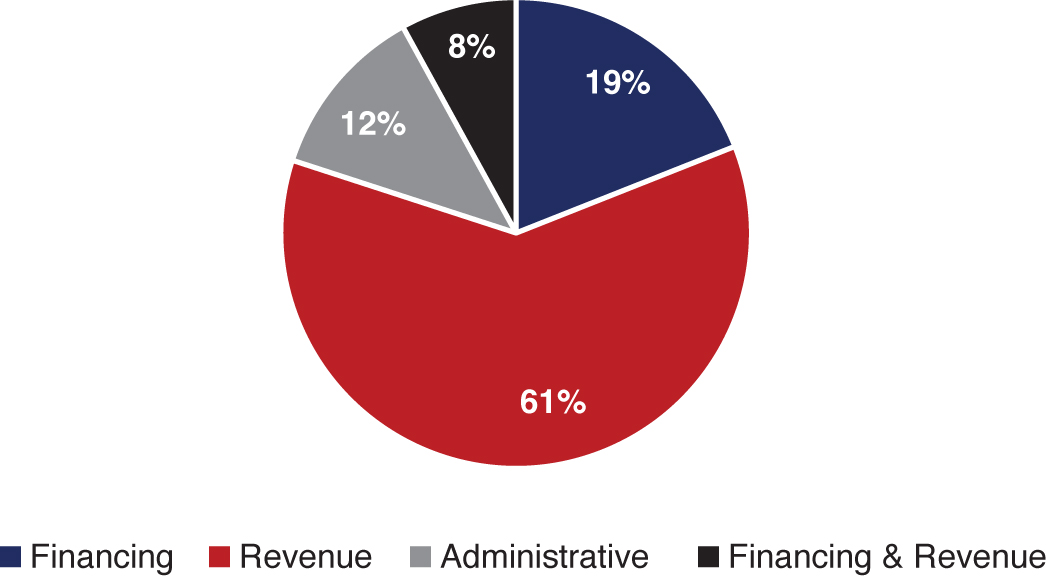
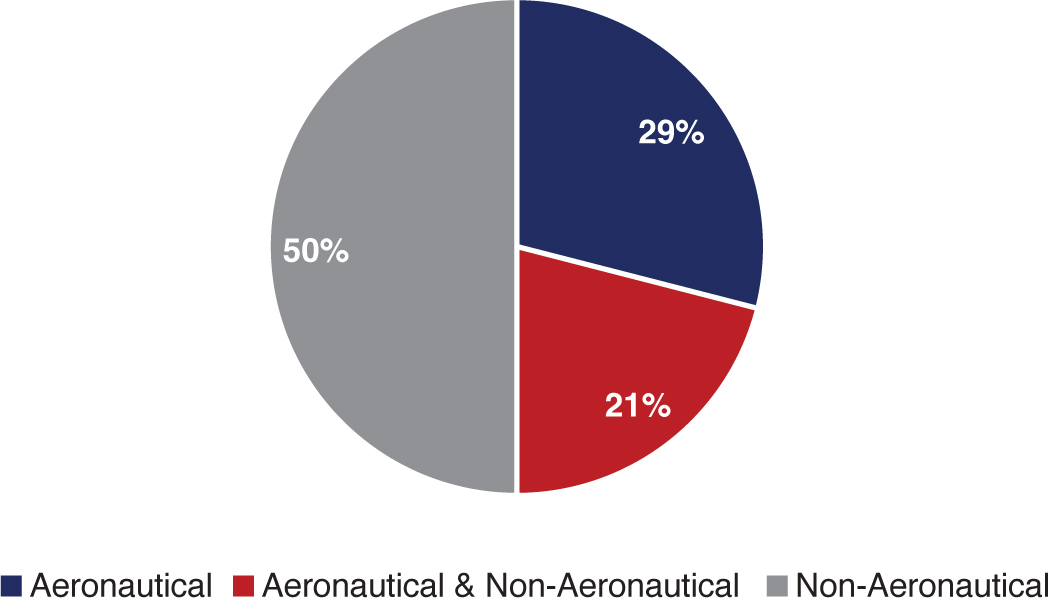
The following sections describe several aeronautical and non-aeronautical revenue sources identified and examined by the research team. Interviews and engagement were conducted with participating airports to share information and perspectives about specific revenue strategies or initiatives they have implemented. Revenue initiatives and categories reported by the airports interviewed are shown in Figures 3 and 4. Figure 3 summarizes the categories of initiatives
Long Description.
The pie chart illustrates the distribution of four categories: Financing at 19 percent, Revenue at 61 percent, Administrative at 12 percent, and Financing and Revenue at 8 percent. Each segment is labeled with its respective percentage.
Long Description.
The pie chart illustrates the distribution of three categories: aeronautical at 29 percent, aeronautical and non-aeronautical at 21 percent, and non-aeronautical at 50 percent. Each segment is labeled with its respective percentage.
reported by participating airports, including those focused solely on revenue, solely on financing, on a combination of revenue and financing, or on administrative actions. Please also see the database that accompanies this report, which documents the revenue initiatives identified by participating airports and includes examples from many of the revenue categories described here.
Aeronautical Revenue Sources
Aeronautical revenue refers to revenue generated from activities related to aircraft operations. This revenue forms the foundation of an airportʼs revenue generation, but it is also highly susceptible to fluctuations in air carrier activity and can be significantly affected by changes in airline service, natural disasters, and other events that diminish airline passenger activity.
Aeronautical revenue sources include:
- Landing Fees: Charges to an aircraft operator for the use of runways and airside infrastructure when landing an aircraft. Fees are often based on aircraft size.
- Terminal Rent: Rent charged to airlines for the use of terminal space, typically on a square footage basis. Terminal rent traditionally covers an airlineʼs access and use of gate/hold areas, back-office space, airline ticket counters, ground support areas, and baggage claim and baggage makeup areas. A terminal lease agreement between the airport and airline specifies all conditions agreed upon by these parties.
- Hangar Rentals: Rent charged, according to lease conditions, to aircraft owners for hangar space. Rates are often based on hangar square footage or aircraft type.
- Tie-Down Fees: Fees charged to aircraft owners for outdoor tie-down storage in a designated airside location. This type of storage is often used on a short-term basis and for smaller private aircraft.
- Aeronautical Land Leases: Land designated for aeronautical use and located within the airfield fence is leased to an individual or organization for aeronautical use or development. Aeronautical land-lease rates are based on a combination of market conditions, demand, and site features. Per FAA grant assurances, aeronautical land-lease rates must be “fair, reasonable, and non-discriminatory” (FAA 2023b), meaning the rate must help recover airport operating costs and promote financial self-sufficiency but should not yield excessive profits.
- Aeronautical Facility Leases or Sales: Airport-owned aeronautical facilities or infrastructure are leased or sold outright to aviation operators.
- Airport-Operated Aviation Services: The airport owns, staffs, and operates revenue-producing aviation facilities or services, such as FBOs or ground-handling services.
- Fuel Flowage Fees: A fee is added to on-airport fuel sales and collected by the airport according to the amount of fuel purchased.
- PFCs: Fees of up to $4.50 per passenger are charged to non-aeronautical revenue sources.
Luis Munoz Marin International Airport
SJU in Puerto Rico is focusing on cargo as a significant opportunity to increase revenue and enhance its economic viability. The airport is collaborating with key stakeholders, including Amazon and FedEx.
- Amazon has expressed interest in expanding its operations by either rehabilitating the existing facility or constructing a new building. Presently, demand for available land leases exceeds the supply, which the airport is leveraging to create additional future revenue sources.
- FedEx has recently completed the construction of a new facility for its operations. The airport assessed this need and proceeded with a $10 million project, which included a new long-term lease agreement. This development is anticipated to enhance revenue projections and deliver a solid return on investment.
Eagle County Regional Airport
EGE in Colorado enlisted the help of an air service development consultant to establish and update airline service contracts. The new contracts have helped increase revenue and close any gaps from previous agreements and have also positioned the airport favorably for attracting new airlines.
Non-Aeronautical Revenue Sources
Non-aeronautical revenue, which is revenue unrelated to aircraft operations, provides the airport with a stable and diversified income source that permits the airport sponsor to maintain more consistent revenue flow during downturns in air carrier service and related passenger enplanement counts.
- Non-Aeronautical Land Leases: Subject to FAA land use regulations and approvals, land that is not required for aeronautical purposes may be leased for non-aeronautical uses like commercial or industrial development. Airports must set non-aeronautical lease rates at fair market value.
- Parking Revenue: Customer parking is a major source of non-aeronautical airport revenue. Rates are typically set according to capacity, demand, convenience, and amenities. Many airports offer options like parking garages and short- and long-term lots, which vary in cost and convenience.
- In-Terminal Rent: Terminal space is leased to non-airline commercial operations that provide services to airport passengers. Common examples include leases held by TSA or food and beverage concessionaires. Lease conditions are case-specific and may consist of both base rent and a set percentage of the lesseeʼs gross revenue.
- Rental Car Service Facility Rent: Rental car companies pay rent to operate in airport facilities, including customer service spaces and facilities to clean, refuel, and service rental cars.
- Rental Car Parking Rent: Fees are charged to rental car companies for vehicle parking or storage in designated airport facilities.
- Commercial Taxi, Bus, and Ride-Share Services Fees: Commercial transportation operators (taxi, bus, ride-share services) are charged to operate from the airport.
- Advertising (Terminal and On-Campus): Airports receive fees for advertising displays or signage in the terminal or at other airport locations.
- Non-Terminal Facility Rent: Income from the lease of non-terminal airport facilities or built spaces (e.g., office buildings, hotels, or operational structures).
Long Beach Airport
LGB serves approximately three to four million passengers annually, with Southwest Airlines as the primary carrier, along with Delta and Hawaiian Airlines. Due to its proximity to Los Angeles International Airport, LGB exemplifies a primary small-hub airport that caters to the demands of the surrounding suburban market. LGB operates self-sufficiently, with airport revenues fully covering its capital and operational financial requirements. To enhance revenue flow and support the aviation complex, LGB has capitalized on the following primary revenue initiatives:
- Implementing pick-up and drop-off fees for transportation network companies (TNCs), including fees for hotel shuttles.
- Increasing onsite parking fees and installing new parking equipment, including updated software and hardware, while offering pre-pay options to customers.
- Rebidding rental car concessions for a new rental car facility, which has led to increased capacity, updated contracts, and streamlined operations. This initiative is expected to enhance revenue as passenger numbers were projected to exceed four million in 2024.
Vancouver International Airport
YVR strongly emphasizes ongoing investments in commercial services, including terminal retail and food and beverage units, as well as real estate development. Market research and consultations with concessionaires and other key stakeholders guide these investments. The airportʼs land development strategy aims to identify high-priority land parcels that can be developed in the short term for revenue generation. Up-front costs associated with these initiatives encompass feasibility studies for both commercial services and real estate, construction expenses for terminal concessions, site investigations, and appraisals for land development. The anticipated benefits of these investments include diversification from relying solely on aeronautical revenue as the primary income source. This diversification contributes to the airportʼs financial resilience by generating non-aeronautical revenue, which ultimately helps to reduce the cost per passenger.
Casper–Natrona County International Airport
CPR in Wyoming is implementing several traditional revenue-enhancing strategies; however, one notable non-traditional revenue model involves using the airportʼs observation deck for weddings and other small non-aviation functions. While the airport does not aim to transform into a wedding venue, it has effectively capitalized on a niche market that appeals to low-budget
and low-stress events. The annual rental income generated from this initiative ranges from approximately $3,000 to $4,000, and there are minimal overhead costs involved. This innovative approach contributes positively to the bottom line and enhances the overall perception of the facility.
Eugene Airport
In 2021, EUG faced a challenge when three airlines, including Southwest, began service. The terminal was already at full capacity. To address this, the airport used a provision in its airline contracts to notify airlines of a 30-day change from preferential-use gates to a common-use system.
This decision required an investment of about $2 million from the airport. The new system allowed airlines to operate at any gate, which increased flexibility. As a result, EUG has experienced a 41% increase in passengers since 2021. Although the increase in larger aircraft and flights has caused some operational challenges, the airport reached peak capacity in 2024.
Patrick Leahy Burlington International Airport
BTV in Vermont has developed a unique strategy for maximizing land use and achieving a high return. In collaboration with the Vermont Air National Guard (VTANG), the airport has established an agreement that allows VTANG to fully fund ARFF needs, which include personnel, equipment, and training. This partnership is estimated to provide an annual benefit of $4 million to the airport. As a result, BTV can allocate PFCs, AIP funds, and state and local dollars to other eligible projects.
Killeen Regional Airport
GRK in Texas is a small joint-use airport that acts as a general contractor through its relationship with the Base Fort Cavazos Army base. An intergovernmental service agreement (IGSA) for $3 million per year, with rate increases, allows the airport to operate financially in a fully self-sufficient manner. The airport provides pavement management, electrical support, and other services to support the IGSA.
Best Practices
Best practices for revenue enhancement are discussed in the following.
- Diversify revenue sources to mitigate economic fluctuations and enhance stability through a strong non-aeronautical revenue base.
- Assess available airport space for revenue-generation opportunities, utilizing underused areas both inside and outside the terminal.
- Evaluate operational models of airport services, analyzing customer service quality and revenue potential to decide between in-house management and outsourcing.
- Maximize and optimize traditional revenue streams to enhance financial performance.
- Adapt successful strategies from large-hub airports to improve operations.
- Maintain demographic awareness and customize approaches to meet specific market needs.
- Develop and strengthen partnerships with municipal and economic development organizations to support revenue initiatives.
- Foster a strong relationship with the FAA and understand the priorities of the Airports District Office (ADO) staff to ensure effective collaboration.
- Regularly evaluate leases for compliance and ensure that they include inflation adjustments or other appropriate rental escalations.
5.4 Financial Management
Overview
Small and medium airports face significant financial challenges, yet they typically possess limited resources to help managers navigate these challenges. Airports rely on core grant funding to sustain daily operations, support staffing, and maintain facilities. However, they rarely have excess funds to invest in their long-term financial sustainability.
By implementing strategic financial management practices, airport managers can strengthen their finances, generate new revenue streams, and secure matching funds for outside grants and investments. This section explores key financial strategies and provides tools to help small and medium airports build a more stable financial future.
Revenue Sources and Financial Management Strategies
As part of this study, the research team interviewed representatives from 30 airports and related entities to identify financial management strategies that have proven successful. The insights gained from these interviews highlight opportunities for airports looking to replicate effective funding and revenue-generation models.
Most airports rely on CIPs to secure funding through FAA and state infrastructure programs. To maximize these funds, they also leverage their own revenue sources, such as PFCs or bonds and commercial lending from their ownership entity.
Beyond public funding, many small and medium airports continue to prioritize aeronautical revenue, particularly terminal rentals. However, many have not expanded beyond these traditional revenue streams due to limited resources, perceived complexity, or a lack of opportunities. Other aeronautical revenue sources include landing fees and fuel flowage fees.
Additional strategies that can benefit these airports include:
- Expanding air service or attracting more passengers and operations,
- Optimizing concessions to generate greater revenue,
- Enhancing parking operations, including premium and digital services,
- Exploring real estate development to create long-term funding programs, and
- Developing creative agreements with airlines that offer mutual benefits.
Some advanced strategies fall outside the direct control of airport management but are still worth considering. These include PPPs and revenue-sharing models, which allow airports to attract private investment for infrastructure and service expansions.
In todayʼs evolving landscape, it is critical for airports to adopt strategies that create diversified revenue streams to support capital projects and operational expenses.
The research identified more than 100 initiatives in the project database in use across airports:
- 60% were revenue-based, focusing on non-aeronautical and aeronautical income.
- 20% were finance-based, including grants, bonds, and investment tools.
- The remainder were hybrid strategies or administrative approaches.
- Nearly half of all strategies were non-aeronautical, which demonstrates the growing importance of alternative revenue sources.
The strategies identified in this report fall into several key categories that reflect the diverse ways airports generate revenue, fund capital improvement projects, and enhance the passenger experience. While traditional revenue sources such as leases, parking, and concessions remain the most commonly used, new revenue-generation opportunities through, for example, sustainability initiatives and electric aviation infrastructure, are gaining traction.
The following sections explore each category in detail. Figure 5 shows the diversity of revenue and financing initiatives within the database.
Real Estate and Land Utilization
Real estate is a fundamental revenue source for airports, with land and building leases (18 cases) the most frequently mentioned mechanism. Airports use their land through leases to tenants, including airlines, cargo operators, and private developers. Land development (10 cases) can be a proactive strategy to use airport property for commercial, industrial, and aviation-related activities. Although less common, the sale of facilities (one case) can be a strategic move to divest unused properties while ensuring long-term revenue streams through ground leases or joint-development agreements. Event space rental (two cases) illustrates an opportunity for an airport to serve as a venue for conferences and community events. The presence of FBOs (four cases) highlights the significance of private aviation support services, often in long-term lease agreements.
Featured Strategy: Land/Building Leases
Airports maximize revenue through long-term leases for commercial, industrial, and aviation-related tenants. Structuring agreements to include revenue-sharing models or inflation-adjusted

Note: eGSE = electric ground support equipment, Evtol = electric vertical take-off and landing aircraft, RON = remain overnight.
Long Description.
The x-axis represents various initiatives or mechanisms. The y-axis represents the number of cases from 0 to 20 in increments of 2. The data given in the bar graph are as follows: Land or Building leases: 18. Parking: 13. Land development: 10. Contract review: 9. Federal program or grant, or initiative: 7. State program or grant, or initiative: 6. Concessions: 7. Advertising and marketing: 5. Bond: 4. Customer facility charge (CFC): 4. Fixed-based operator: 4. Maintenance; repair; overhaul facility: 3. Event space rental: 2. Renewable energy generation: 2. Special grant: 2. TNC or taxi fee: 2. Aeronautical fees: 1. Air carriers: 1. Commercial or flight school: 1. Construction fee: 1. Customs and border patrol: 1. Electric aircraft or eGSE or Evtol: 1. Energy or utility: 1. Foundation or charity, or non-profit: 1. Fuel flowage: 1. Ground handling: 1. Investments: 1. Landing fee: 1. Passenger Facility Charge (PFC): 1. Performance tracking: 1. Rental car: 1. Sale of facilities: 1. Tax levy: 1. Tie-down or RON or Hangar fees: 1.
rent escalations ensures sustained financial growth. Calgary International Airport uses Amadeus PROPworks (linked to enterprise asset planning/management using Oracle) for its property management team to successfully track lease agreements.
Parking and Ground Transportation
Parking and ground transportation include parking and rental car fees, CFCs, tie-down/remain overnight/hangar fees, and TNC/taxi fees.
Ground access is a key revenue driver, with parking (13 cases) ranking among the top revenue generators for many airports. As ride-sharing services continue to affect traditional parking revenues, airports have introduced TNC/taxi fees (two cases) to offset revenue losses. Rental car revenue (one case) remains an essential revenue generator, often supported by a CFC (four cases) to fund related infrastructure. For general aviation, tie-down/remain overnight (RON)/hangar fees (one case) provide a steady income stream.
Featured Strategy: Parking
With parking remaining a significant revenue driver, airports have implemented premium services, valet options, and digital reservations to optimize occupancy and increase per-vehicle revenue. Electric vehicle charging stations may also add value. Syracuse Hancock International Airport expanded the existing employee lot for passenger parking and moved employee parking to a farther-away economy lot. This has increased passenger parking closer to the terminal and has resulted in fewer passengers parking on terminal roadways or in unsafe parking areas.
Concessions, Advertising, and Passenger Services
Retail, food and beverage, and passenger amenities are a large part of non-aeronautical revenues. Concessions (six cases) are still important, with airports continually updating vendors and products to meet passenger expectations. Advertising and marketing (five cases) play an increasing role in revenue diversification. The inclusion of performance tracking (one case) shows an opportunity to use data-driven strategies to optimize passenger spending.
Featured Strategy: Advertising and Marketing
Airports leverage digital displays, experiential activations, and sponsorships to increase advertising revenue, targeting passengers and non-traveling visitors in high-traffic areas. Lafayette Regional Airport has successfully brought its advertising and marketing initiative in-house to sell ad space on digital boards within the airport. The cost of this program is low and primarily involves staff time and minor setup costs.
Financial Mechanisms and Capital Funding
Airports rely on various financial tools to fund capital projects. Bonds (four cases) and tax levies (one case) are stable funding mechanisms, often supplemented by investments (one case). Other fees such as PFCs (one case) help airports finance infrastructure improvements. Public funding through federal programs/grants/initiatives (seven cases) and state programs/grants/initiatives (six cases) are still critical funding sources. Additionally, special grants (two cases) are creative ways airports can supplement funds for large projects or implement smaller projects.
Featured Strategy: Bonds
Airports use bond financing to fund major capital improvement projects, which ensures long-term financial sustainability while keeping user fees competitive. Sacramento International Airport used a double-barrel bond structure to finance approximately $480 million in new bond
money for capital development. This double-barrel bond structure allowed the airport to increase its debt coverage on general airport revenues by financing using projected PFC revenues.
Contract Revenue and Compliance
Contract review (nine cases) emphasizes the importance of ensuring that lease agreements, vendor contracts, and other agreements align with airport financial objectives. Special grants (two cases) also play a role, particularly when tied to specific contractual obligations.
Featured Strategy: Contract Review
Regular contract audits and renegotiations ensure that lease agreements, concessions, and service provider contracts remain competitive and aligned with market conditions. Centennial Airport conducts an annual review of its leases, including a review of escalation clauses. The airport has learned that by using GIS, not only can it visualize and manage contract agreements and facilities, but it can also support work order tracking, operations, and maintenance activities.
Best Practices
Often, small and medium airports experience challenges in financing capital projects due to their smaller allocation of AIP entitlement funds and the limited availability of other AIP discretionary funds, other federal and state funds, and local matching funds. In addition, small airports generate less funding from PFCs and CFCs because they have fewer annual enplanements. These airports have sought innovative revenue strategies to support their capital programs and O&M budgets, including through the methods discussed in the following:
- Reducing the number of external service contracts they have in favor of bringing some services in-house to be managed by airport staff (e.g., parking, curbside management, sanitation, and advertising).
- Bringing in contract services, such as concession management. (EGE increased revenues significantly by contracting out a concessionaire program.)
- Optimizing revenue from customer vehicle parking. Strategies include electronic tolling (to reduce labor costs), pre-booking programs (to guarantee revenues), and optimized pricing programs among parking offerings.
- Using Microsoftʼs Power BI to report and review revenue and costs using various metrics. GRRʼs Power BI dashboard is used as an economic tool to support the setting of rates and charges and to evaluate revenue generation on a real-time basis.
- Using of non-aeronautical land to generate revenues (local energy production, non-aeronautical leases, hotel properties, additional parking, and so forth).
- Reducing utility costs through general energy reduction and energy reduction rebates, as well as through generating and selling back energy (solar, natural gas, and so forth).
- Keeping track of accounts receivable and maintaining tight contracts to mitigate any issues.
- Continuously engaging with the FAA ADO, which is essential for anticipating federal and state grant opportunities and navigating potential regulatory challenges.
5.5 Analysis and Findings
Airports function as complex systems where both aeronautical and non-aeronautical revenue streams are intricately linked. Successful airports recognize that these revenue streams do not operate in isolation. By prioritizing the passenger experience, they foster an environment encouraging travelers to select their facilities. This strategic focus results in growth across multiple dimensions, including an increase in passenger volume that leads to more flights, stronger
partnerships with airlines, and heightened consumer spending across concessions, parking, and other amenities.
Airports that adopt a customer-centric approach are yielding significant results. Some have developed all-in-one platforms for travel planning, integrating features such as parking reservations, local discounts, and prompts for additional services directly into their websites. These innovations not only enhance the customer journey but also contribute to revenue generation. Moreover, airports are expanding their premium parking offerings, implementing dynamic pricing strategies, and advancing consolidated rent-a-car (CONRAC) development to optimize operational flow and maximize high-value space.
Beyond the terminal, many airports are exploring creative long-term strategies to expand and diversify their revenue bases. These strategies include repurposing hangars for MRO operations, launching their own FBOs, and managing ground-handling services in-house. In-house service provision allows airports to obtain a greater margin on earnings while providing higher levels of customer service. Airports may also leverage technology, such as through using SharePoint systems for lease milestone tracking and Power BI dashboards for monitoring financial performance.
Additionally, some airports lease event space, collaborate or partner with economic development offices, and invest in sustainable initiatives such as solar energy or SAF generation.
Overall, the success of an airport hinges on its ability to operate as a cohesive business entity with passengers at the center of every decision. From contract management to community engagement and facility development, each aspect contributes to a broader financial sustainability strategy, user satisfaction, and operational resilience. Airports that perceive all functions as integral components of a unified system are poised for continued success.


