Buy America Requirements for Federally Obligated Airports (2026)
Chapter: VII. WAIVER CRITERIA AND IMPLEMENTATION
VII. WAIVER CRITERIA AND IMPLEMENTATION
A. Waiver Categories
There are several circumstances pursuant to which the domestic content requirements may be waived by the head of a federal agency, such as USDOT and its modal administrations. Section 50101 of Title 49 provides that the Buy America requirements may be waived if the Secretary of Transportation concludes that
- Applying the Buy American Preferences would be inconsistent with the public interest;
- The steel or goods produced in the United States are not produced in a sufficient and reasonably available amount or are not of a satisfactory quality;
- When the cost of components and subcomponents produced in the United States is more than 60 percent of the cost of all components of the facility or equipment procured and final assembly occurs in the United States; or
- Including domestic material will increase the cost of the overall project by more than 25 percent.150
ARRA’s waiver requirements are somewhat different:
- None of the funds appropriated or otherwise made available by this Act may be used for a project for the construction, alteration, maintenance, or repair of a public building or public work unless all of the iron, steel, and manufactured goods used in the project are produced in the United States.
- Subsection (a) shall not apply in any case or category of cases in which the head of the Federal department or agency involved finds that—
- applying subsection (a) would be inconsistent with the public interest;
- iron, steel, and the relevant manufactured goods are not produced in the United States in sufficient and reasonably available quantities and of a satisfactory quality; or
- inclusion of iron, steel, and manufactured goods produced in the United States will increase the cost of the overall project by more than 25 percent.
- If the head of a Federal department or agency determines that it is necessary to waive the application of subsection (a) based on a finding under subsection (b), the head of the department or agency shall publish in the Federal Register a detailed written justification as to why the provision is being waived.
- This section shall be applied in a manner consistent with United States obligations under international agreements.151
Subject to the procedures described below, BABA allows the heads of federal agencies (e.g., the USDOT Secretary or the FAA Administrator) to issue a waiver if they conclude that
- [A]pplying the domestic content procurement preference would be inconsistent with the public interest;
- [T]ypes of iron, steel, manufactured products, or construction materials are not produced in the United States in sufficient and reasonably available quantities or of a satisfactory quality; or
- [T]he inclusion of iron, steel, manufactured products, or construction materials produced in the United States will increase the cost of the overall project by more than 25 percent.152
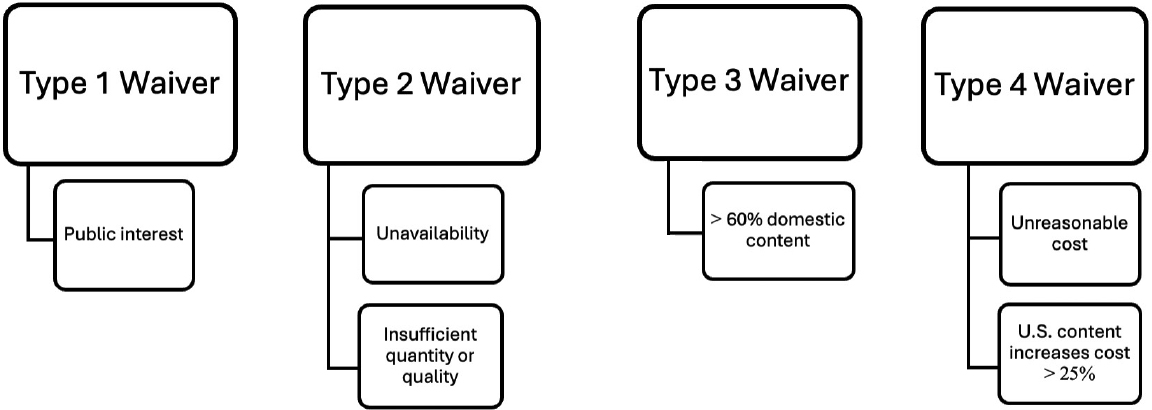
When the Buy America waiver provisions of 49 U.S.C. § 50101 (which as noted earlier is explicitly applicable to the FAA) are blended with those of ARRA and BABA, four categories of waivers are applicable to airport infrastructure projects. Figure 2 graphically depicts these four types of waivers.
1. Type I Waiver, Public Interest
Inclusion of the domestic procurement preference for such products would be inconsistent with the public interest.153 A public interest waiver should be project-specific wherever possible. It may be granted if the product would not meet the nonavailability or unreasonable cost waiver criteria but would nevertheless satisfy important policy goals. The policy objectives of BABA are as follows:
- Invest in the installation, upgrading, or replacing of public infrastructure;
- Ensure that such infrastructure is produced in the United States by American labor;
- Ensure that materials procured with federal funds are produced by domestic firms that employ American workers;
- Ensure that construction materials used in public infrastructure are produced domestically;
- Ensure that federal funds are invested “in companies and processes using the highest labor and environmental standards in the world”;
- Ensure that taxpayer funds are not used to reward companies that have moved their operations, capital, and jobs offshore and to countries with less vigorous energy efficiency and
___________________
150 FAA, Buy America Preference Requirements, https://www.faa.gov/airports/aip/buy_american (last visited May 6, 2025).
151 American Recovery and Reinvestment Act of 2009 § 1605. Use of American Iron, Steel, and Manufactured Goods (Pub. L. 111–5, § 1605, 123 Stat. 303. Feb. 17, 2009), https://www.govinfo.gov/content/pkg/PLAW-111publ5/pdf/PLAW-111publ5.pdf (last visited May 10, 2025).
152 BABA § 70914(b).
153 49 U.S.C. § 50101(b)(1); BABA § 70914(b); 2 CFR 184.7(a), https://www.ecfr.gov/current/title-2/subtitle-A/chapter-I/part-184 (last visited Sep. 4, 2024), and https://www.federalregister.gov/documents/2023/08/23/2023-17724/guidance-for-grants-and-agreements (last visited Nov. 25, 2024).
- pollution reduction standards than those in the United States; and
- Expand domestic content federal procurement preferences, and federal-aid procurement programs, for investment in public infrastructure, including airports.154
According to the OMB, such waivers should be project-specific wherever possible, and “must be used judiciously and construed to ensure the maximum utilization of goods, products, and materials produced in the United States.”155
In the interest of efficiency and ease of the regulatory burden for recipients, agencies may consider issuing a small number of general applicability public interest waivers. According to the OMB, such considerations as the following may be relevant in satisfying the public interest standard:
the nature and amount of resources available to the recipient, the value of the items, goods, or materials in question, the potential domestic economic impacts, and other policy considerations, including sustainability, equity, accessibility, performance standards, and the domestic content (if any) of and conditions under which the non-qualifying good was produced.156
The USDOT issued a Buy America waiver for de minimis costs and small grants for
iron and steel, manufactured products, and construction materials used in projects funded under DOT-administered financial assistance programs for iron, steel, manufactured products, and construction materials under a single financial assistance award for which:
- The total value of the non-compliant products is no more than the lesser of $1,000,000 or 5% of total applicable costs for the project; or
- The total amount of Federal financial assistance applied to the project, through awards or subawards, is below $500,000.157
BABA also requires that the Buy America requirements be applied in a manner consistent with U.S. obligations under international trade agreements.158 In issuing a waiver based on foreign content, the agency shall, in consultation with the International Trade Administration (if such consultation is deemed helpful), assess “whether a significant portion of the cost advantage of the product is the result of the use of dumped steel, iron, or manufactured goods . . . .”159 The executive order accompanying BABA requires that
before granting a waiver in the public interest, the relevant granting agency shall assess whether a significant portion of the cost advantage of a foreign-sourced product is the result of the use of dumped steel, iron, or manufactured goods or the use of injuriously subsidized steel, iron, or manufactured goods. The granting agency may consult with the International Trade Administration in making this assessment if the granting agency deems such consultation to be helpful.160
___________________
154 BABA § 70911.
155 OMB, Memorandum M-24-02 at 11, https://www.whitehouse.gov/wp-content/uploads/2023/10/M-24-02-Buy-America-Implementation-Guidance-Update.pdf (last visited Mar. 11, 2024).
156 Id. at 11-12.
157 USDOT, Waiver of Buy America Requirements for De Minimis Costs and Small Grants, https://www.federalregister.gov/documents/2023/08/16/2023-17602/waiver-of-buy-america-requirements-for-de-minimis-costs-and-small-grants (last visited Sep. 16, 2025).
158 See BABA §§ 70914(e), 70925, 70934, 70937(b).
159 BABA § 70921(a).
160 Executive Order 14005 § 5; Ensuring the Future Is Made in All of America by All of America’s Workers (Jan. 25, 2021), https://www.federalregister.gov/documents/2021/01/28/2021-02038/ensuring-the-future-is-made-in-all-of-america-by-all-of-americas-workers (last visited Sep. 15, 2025).
2. Type II Waiver, Nonavailability
One or more domestically produced steel or iron components, manufactured products, or construction materials of acceptable quality or sufficient and reasonable quantity are unavailable; in granting such a waiver, the agency should evaluate whether the recipient has engaged in thorough market research and has adequately considered alternative products or materials.161 The FAA typically limits its nationwide non-availability waivers for equipment or products to a maximum term of 5 years.162
3. Type III Waiver, 60% Domestic
The cost of components and subcomponents of U.S. origin exceeds 60% of the cost of all components of the facility or equipment, and final assembly has occurred in the United States.163164 The USDOT takes the position that
The Buy American waiver allowances for Type I, II, and IV waivers in the FAA statute are similar to the waiver allowances provided in other USDOT programs, . . . However, Type III waivers are very different and are better understood as a method of compliance with the Buy American statute, rather than as a waiver of those requirements in the traditional sense.165
For AIP grants for a Type III waiver, the FAA requires
- A completed Buy American Content Percentage Calculation Worksheet, or the equivalent. However, labor costs should not be included.166
- A completed Buy American Product Final Assembly Questionnaire, or the equivalent.
- A written certification that any major structural steel used in their equipment is of 100% U.S. origin. However, modest amounts of steel (other than structural steel) contained in components and subcomponents (e.g., nuts, bolts, and clips) may be foreign.167
4. Type IV Waiver, Unreasonable Cost
The use of U.S.-produced iron, steel, manufactured products, or construction materials would increase the overall cost of the project by more than 25%.168 However, labor costs are not to be included in the calculation of the cost of components.169
B. Waiver Procedures
The FAA has two categories of Buy American certifications:
- Construction projects involving the replacement, repair, and reconstruction of airfield surfaces (e.g., runways, taxiways, aprons, roadways, parking lots); and
- Equipment and buildings projects involving the acquisition of equipment (e.g., snow removal equipment, navigational aids, wind cones) and the construction of buildings (e.g., hangars, terminals, lighting vaults, firefighting and rescue buildings).170
The FAA also sometimes issues project-specific waivers, which expire at the close of the award.
Waiver requests must be in writing. The federal agency identifies the format, contents and supporting documentation.171 “Sponsors desiring a Type 2 waiver should submit their waiver request, with justification, before issuing a solicitation for bids or a request for proposal for a project. The Sponsor must submit a Type 2, Type 3, or Type 4 waiver request prior to executing the contract.”172 For the construction of a facility (e.g., terminal buildings, terminal renovation, or buildings housing snow removal equipment), the FAA expects the sponsor to submit the waiver application after bidding is solicited, but prior to contract
___________________
161 OMB, Memorandum M-24-02 at 17, https://www.whitehouse.gov/wp-content/uploads/2023/10/M-24-02-Buy-America-Implementation-Guidance-Update.pdf (last visited Mar. 11, 2024).
162 USDOT, DOT’s Identification of Federal Financial Assistance Infrastructure Programs Subject to the Build America, Buy America Provisions of the Infrastructure Investment and Jobs Act 25-26 (January 2022), https://www.transportation.gov/sites/dot.gov/files/2022-01/DOT%20Report%20on%20Financial%20Assistance%20Infrastructure%20Programs.pdf (last visited Mar. 30, 2025).
163 USDOT, DOT’s Identification of Federal Financial Assistance Infrastructure Programs Subject to the Build America, Buy America Provisions of the Infrastructure Investment and Jobs Act 7 (January 2022), https://www.transportation.gov/sites/dot.gov/files/2022-01/DOT%20Report%20on%20Financial%20Assistance%20Infrastructure%20Programs.pdf (last visited Mar. 30, 2025).
164 See Joey Haughney, Build America Buy America Act – Federal Aviation Administration (FAA) Compliance and Waivers in the Spotlight (May 9, 2024), https://www.consensusdocs.org/build-america-buy-america-act-federal-aviation-administration-faa-compliance-and-waivers-in-the-spotlight/ (last visited March 10, 2026).
165 See DOT’s Identification of Federal Financial Assistance Infrastructure Programs Subject to the Build America, Buy America Provisions of the Infrastructure Investment and Jobs Act (January 2022), at 7, https://www.transportation.gov/sites/dot.gov/files/2022-01/DOT%20Report%20on%20Financial%20Assistance%20Infrastructure%20Programs.pdf (last visited Sep. 16, 2025).
166 49 U.S.C. § 50101(c).
167 FAA, AIP Handbook Appendix X, https://www.faa.gov/airports/aip/aip_handbook/?Chapter=Appendix (last visited Dec. 2, 2024). The FAA’s Content Percentage Calculation Worksheet is Form 5100-136, https://www.faa.gov/forms/index.cfm/go/document.information/documentID/1027494 (last visited Dec. 11, 2024). See also Certification of Compliance with FAA Buy American Preference—Construction Projects, https://www.shreveportla.gov/DocumentCenter/View/25520/Buy-America-Certification (last visited May 13, 2025).
168 49 U.S.C. § 50101(b)(4). See FAA, AIP Handbook Appendix X, https://www.faa.gov/airports/aip/aip_handbook/?Chapter=Appendix (last visited Dec. 2, 2024), and FAA, Appendix A4 (May 24, 2023), https://www.faa.gov/general/contract-provision-guidelines-obligated-sponsors-and-airport-improvement-program-projects (last visited Dec. 2, 2024).
169 49 U.S.C. § 50101(c). See FAA, Buy American Preference Requirements, available at: https://www.faa.gov/airports/aip/buy_american (last visited Dec. 13, 2024).
170 FAA, Contract Provision Guidelines for Obligated Sponsors and Airport Improvement Program Projects, at A4 8-9 May 24, 2023), https://www.faa.gov/sites/faa.gov/files/2023-01/combined-federal-contract-provisions-2023-1-20.pdf (last visited Sep. 16, 2025).
171 OMB, Memorandum M-24-02 at 17, https://www.whitehouse.gov/wp-content/uploads/2023/10/M-24-02-Buy-America-Implementation-Guidance-Update.pdf (last visited Mar. 11, 2025).
172 FAA, Contract Provision Guidelines for Obligated Sponsors and Airport Improvement Program Projects Issued on May 24, 2023, at 7, https://www.faa.gov/sites/faa.gov/files/2023-05/combined-federal-contract-provisions-2023-05-24.pdf (last visited July 16, 2025).
execution.173 Before granting a waiver, the FAA must conclude that the recipient has provided sufficient documentation stating that no domestic product is available within the aforementioned restrictions. The waiver justification should include comparative cost data for U.S. vis-à-vis foreign product alternatives.174
BABA requires that if the federal funding agency (e.g., Secretary of Transportation) concludes that a waiver should be granted, the agency head must provide a detailed written justification therefor and certify that the agency attempted a “good faith effort to solicit bids for domestic products.”175 The waiver proposal should be submitted by the FAA to the OMB’s MIAO for review and made publicly available on a website designated by it and the GSA.176 It should also be cross-posted on a GSA website177 at least 15 days prior to its effective date, so as to allow public comment thereon.178 However, the Government Accountability Office (GAO) notes that “[w]here there is an urgent need in an unforeseen and exigent circumstance, agencies are not required to make a procurement waiver request available for public comment for 15 days.” When the agency determines a waiver needs expedited approval, it is required to report a waiver within 30 days of granting the award.179
Each proposed or final draft of a waiver submitted to MIAO should include the following:
- Waiver type (nonavailability, unreasonable cost, or public interest).
- Recipient name and Unique Entity Identifier (UEI).
- Federal awarding agency organizational information (e.g., Common Government-wide Accounting Classification (CGAC) Agency Code).
- Financial assistance listing name and number.
- Federal financial assistance program name.
- Federal Award Identification Number (FAIN) (if available or applicable).
- Federal financial assistance funding amount.
- Total estimated infrastructure expenditures, including all federal and non-Federal funds (if applicable).
- Infrastructure project description and location (to the extent known).
- In the case of general applicability waivers, a description of the relevant federal program(s)—including information on the size and scale of the program(s), an estimate of the dollar amount of Federal financial assistance that would be subject to the waiver, and an estimate of how many infrastructure projects would be subject to the waiver.
- List of iron or steel item(s), manufactured products, and construction material(s) proposed to be excepted from Buy America requirements, including name, cost, country(ies) of origin (if known), and relevant Product and Service Code (PSC) and North American Industry Classification System (NAICS) code for each.
- A description of efforts made (e.g., market research, industry outreach, etc.) by the Federal awarding agency and, in the case of a project or award specific waiver, by the recipient, in an attempt to avoid the need for a waiver. Such a description may cite, if applicable, the absence of any Buy America-compliant bids received in response to a solicitation.
- Market research, where applicable, should include relevant details, including who conducted the market research, when it was conducted, sources that were used, and the methods used to conduct the research.
- Anticipated impact if no waiver is issued.
- For final waivers, any relevant comments received through the public comment period, and the agency’s response to those comments. 180
General applicability waivers are subject to a 30-day review. The MIAO may also request a 30-day review where the waiver covers issues of particular importance to U.S. supply chains or involves significant federal funding.181
Transparency is much enhanced by publication of waiver applications and approvals. The Secretary of Transportation must also provide an annual report to relevant committees of the U.S. Congress describing requested and granted waivers.182
___________________
173 Model bidding solicitation clauses may be found at FAA, Contract Provision Guidelines for Obligated Sponsors and Airport Improvement Program Projects Issued on May 24, 2023, at 8 and 9, https://www.faa.gov/sites/faa.gov/files/2023-05/combined-federal-contract-provisions-2023-05-24.pdf (last visited Dec. 11, 2024).
174 OMB, Memorandum M-24-02 at 10, https://www.whitehouse.gov/wp-content/uploads/2023/10/M-24-02-Buy-America-Implementation-Guidance-Update.pdf (last visited Mar. 11, 2025).
175 Id. at 7, https://www.whitehouse.gov/wp-content/uploads/2023/10/M-24-02-Buy-America-Implementation-Guidance-Update.pdf (last visited Mar. 19, 2025).
176 Id. The OMB website provides a list of all federal agency Buy America websites containing Buy America waivers. See https://www.madeinamerica.gov/resources/financial-assistance/ (last visited Sep. 15, 2025). The FAA “publishes approved waivers on the FAA website for 10 days for public and industry comment before the waiver shall become effective for use by the airport sponsor.” FAA Buy American Preference Implementation of IIJA, BABA, and Executive Order 14005 Fact Sheet ¶22, https://www.faa.gov/sites/faa.gov/files/BABA-Executive-Order-14005.pdf (last visited July 16, 2025).
177 https://www.madeinamerica.gov/ (last visited Nov. 26, 2024).
178 2 CFR § 184.7(d), https://www.federalregister.gov/documents/2023/08/23/2023-17724/guidance-for-grants-and-agreements (last visited Nov. 25, 2024).
179 GAO, Federal Contracting: Opportunities Exist to Improve the Reporting of Waivers to Domestic Preference Laws 6 (December 2023), https://www.gao.gov/assets/d24106166.pdf (last visited Dec. 13, 2024).
180 OMB, Memorandum M-24-02 at 7-8, https://www.whitehouse.gov/wp-content/uploads/2023/10/M-24-02-Buy-America-Implementation-Guidance-Update.pdf (last visited Mar. 11, 2025).
181 Id. at 6.
182 Pub. L. 115–254, div. B, title I, § 167, Oct. 5, 2018, 132 Stat. 3227, and BABA §§ 70914(c), 70916 (d). See e.g., https://outlook.office.com/mail/inbox/id/AAMkADkzZmMzOWNmLTg1NGMtNDkyYi04MTg0LTM2ZmE5ZTdkYWExMwBGAAAAAADWy935GMIHSaNfPD8P%2FJtCBwDorxIUvKCeTp2Yrm3ok6OLAAAAXHWUAACx7rbTZgw8SY9pW7xT4FDnAAgP7ZVkAAA%3D/sxs/AAMkADkzZmMzOWNmLTg1NGMtNDkyYi04MTg0LTM2ZmE5ZTdkYWExMwBGAAAAAADWy935GMIHSaNfPD8P%2FJtCBwDorxIUvKCeTp2Yrm3ok6OLAAAAXHWUAACx7rbTZgw8SY9pW7xT4FDnAAgP7ZVkAAABEgAQAAhim0rqmSBOr4N6emjkHfc%3D (visited January 26, 2025).
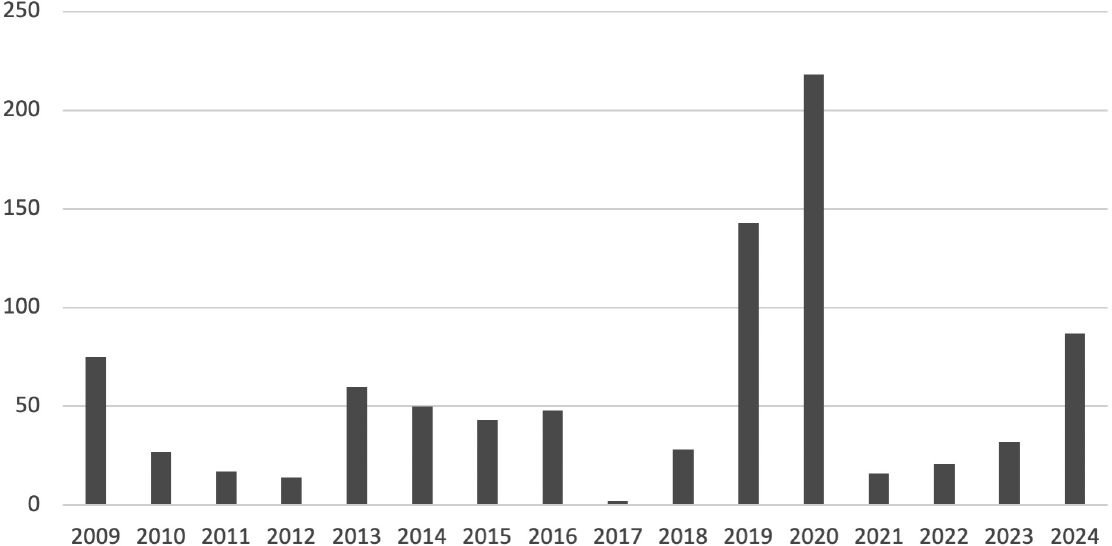
Figure 3. Number of FAA nationwide waivers, 2009-2024.
Proposed and final waivers may be accessed through the following USDOT website: https://www.transportation.gov/office-policy/transportation-policy/made-in-america.
The FAA Office of Airports maintains an updated list of projects and products waiver approvals from the Buy American requirements for nationwide and project-specific use:
The FAA Nationwide Buy American Waivers Issued list may be found at https://www.faa.gov/airports/aip/buy_american/nationwide_waivers_issued.
FAA project-specific waivers may be found at https://www.faa.gov/airports/aip/buy_american/project_specific_waivers_issued and www.faa.gov/airports/aip/buy_american/.
Analyses of waivers as listed on these websites reveal specific patterns and trends. The FAA has issued 881 nationwide waivers since 2009 (Figure 3). All of these waivers have been Type III (equipment/building). The peak year for issuing these waivers was 2020 in which 218 waivers were granted. All waivers issued before May 9, 2021, have expired. since they were originally granted for a 5-year period. The equipment for which waivers were approved includes such items as runway and taxiway lights, weather observing systems, LED lights and signs, underground electrical cables, constant current regulators, paints, fast chargers and electric charging systems, and reflective glass beads.
An examination of FAA project-specific waivers reveals a much larger number of waivers granted over a shorter period (Figure 4). Since August 5, 2019, a total of 1,945 waivers have been granted: 1,321 Type III construction project waivers, 621 Type III equipment/building waivers, and 3 Type IV waivers. The peak year for waivers was 2019, when 1,192 waivers were granted, nearly all of which were for Type III construction projects. As is the case for nationwide waivers, all project-specific waivers issued before May 9, 2021, have expired. Type III construction project waivers were granted for items such as new terminal replacement and expansion, water systems for drainage and utilities, new runways, taxiways, aprons, access roads, egress lanes, airfield lighting replacement, baggage handling units, noise mitigation measures, security
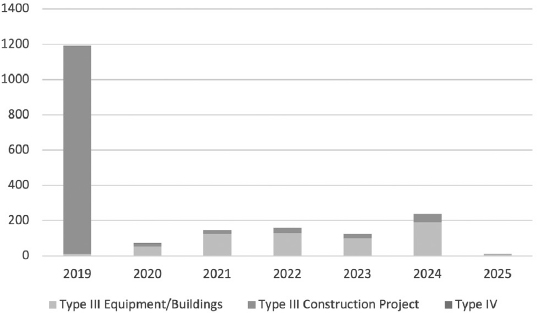
Figure 4. Number of FAA project-specific waivers, 2019-2025.
enhancements, residential sound insulation programs, solar panel and photovoltaic systems, passenger boarding bridges, and fuel farms. Type III equipment/building waivers were for snow removal and deicing equipment, trucks, electric vehicles, shuttle buses, aircraft rescue and firefighting vehicles, airport lighting, runway resurfacing, fuel tanks, sound insulation, fencing, fixed and moving walkways, and emergency power equipment. Type IV waivers were for parking lot maintenance, snowplows, and snow blowers.
Waivers may be time-limited or phased out over time. If not limited to specific projects, the OMB recommends that waivers apply only to specified items, products, and materials necessary for the project. Broad, expansive waivers receive enhanced scrutiny from the MIAO. Waivers should include conditions that advance the policies of BABA.183 General applicability waivers are expected to be targeted and time-limited.184
C. Nationwide/General Applicability Waivers
Nationwide, or general applicability, waivers apply across several agency projects or awards. They can be either product specific or non-product specific. As a general rule, they must be reviewed within 5 years from the date of issuance. Notice must be published in the Federal Register describing their justification and inviting public comments within 30 days. BABA requires that federal agencies review at least every 5 years existing general applicability waivers of Buy America requirements by publishing a notice in the Federal Register that “(i) describes the justification for a general applicability waiver; and (ii) requests public comments for a period of not less than 30 days on the continued need for a general applicability waiver.”185 The issuing agency must also publish its conclusion on whether to continue the general applicability waiver in light of comments received regarding the post in the Federal Register.186
In issuing waivers, agencies must be mindful of the requirements of the Administrative Procedure Act. For example, in 2012, the Secretary of Transportation announced a new national waiver to the Buy America requirements for (1) “manufactured” products containing less than 90% steel or iron and (2) “miscellaneous steel and iron” products available “off-the-shelf” or “necessary to encase, assemble and construct” manufactured products. As an example, “a faucet or bolt that is made of 100 percent steel or iron now is exempt from the Buy America requirement.”187 Also exempted were “miscellaneous steel or iron components, subcomponents and hardware necessary to encase, assemble and construct [manufactured products, such as] cabinets, covers, shelves, clamps, fittings, sleeves, washers, bolts, nuts, screws, tie wire, spacers, chairs, lifting hooks, faucets, door hinges, etc.,” on grounds that it is difficult to discern which internal components thereof are domestic or foreign.188
A federal district court struck down both exemptions, concluding that the selection of the 90% threshold was arbitrary and capricious and that prior regulations require that “all manufacturing processes for these materials must occur in the United States” except for steel products that fall below a “minimal use” threshold. Moreover, the court found that in issuing the national exemption, the USDOT had failed to follow the notice and comment requirements of the Administrative Procedure Act.189
Products listed on FAA Nationwide Buy American Waivers Issued are exempt for a maximum of 5 years and do not require additional submission of domestic content data while they are on the list.190
VIII. SUMMARY/CONCLUSION
Domestic content requirements for federally funded projects were inaugurated in 1933 and have been supplemented in a long line of legislation directly impacting transportation projects. The IIJA provides significant funding for infrastructure projects, which include a wide array of airport landside and airside projects, including intermodal facilities. BABA augments previous Buy America laws and regulations. Simply put, BABA prohibits federal funds from being spent on an infrastructure project unless all (1) iron and steel, (2) manufactured products, and (3) construction materials are produced in the United States. While this is the principal intent of the law, BABA provides some allowances to the 100% domestic content requirements and includes procedures for waivers of these strict requirements.
The FAA requires that the bidder/offeror certify in writing whether its bid consists of 100% domestically produced iron and steel, manufactured products, and construction materials (minus labor or retail markup), and if it does not, the bidder/offeror must seek a waiver. A waiver may be granted if
___________________
183 OMB, Memorandum M-24-02 at 9, https://www.whitehouse.gov/wp-content/uploads/2023/10/M-24-02-Buy-America-Implementation-Guidance-Update.pdf (last visited Mar. 11, 2025).
184 Id. at 10, https://www.whitehouse.gov/wp-content/uploads/2023/10/M-24-02-Buy-America-Implementation-Guidance-Update.pdf (last visited Mar. 11, 2025).
185 BABA § 70914(d). “The FAA incorporated the five-year limitation to all nationwide (general applicability) waivers pursuant to BABA requirements. To clarify, the documentation used to consider the waiver must be updated on all expired waivers. Products with expired waiver documentation must be updated and resubmitted to the FAA for consideration of renewal.”
186 Until November 15, 2026, these requirements do not apply to any product-specific waiver issued prior to May 19, 2021. Office of Management and Budget, Memorandum M-24-02 for the Heads of Executive Departments and Agencies 13 (Oct. 25, 2023) available at: https://www.whitehouse.gov/wp-content/uploads/2023/10/M-24-02-Buy-America-Implementation-Guidance-Update.pdf (last visited March 11, 2025).
187 United Steel, Paper and Forestry, Rubber, Manufacturing, Energy, Allied Industrial and Service Workers International Union, et al. v. Federal Highway Administration, et al., 151 F. Supp. 3d 76, 79-80 (D.D.C. 2015).
188 Id. at 90.
189 Id. at 92.
190 FAA, Contract Provision Guidelines for Obligated Sponsors and Airport Improvement Program Projects Issued on May 24, 2023 at 8, https://www.faa.gov/sites/faa.gov/files/2023-05/combined-federal-contract-provisions-2023-05-24.pdf (last visited Dec. 11, 2024).
- Domestic procurement would be inconsistent with the public interest;
- Domestically produced iron and steel, manufactured products, or construction materials are unavailable in sufficient quality or quantity;
- Costs of components and subcomponents of U.S. origin exceed 60% of the total cost; or
- The use of domestically produced items would increase the cost of the project by more than 25%.
Transparency is enhanced with several websites provided by USDOT and FAA that list waivers, applications, and approvals and elaborate on the regulatory requirements described herein.
In conclusion, Congress has determined that most federal tax dollars to build or improve airside and landside airport infrastructure are to be spent on American companies employing American workers producing American products.


