Overcoming Barriers to Implementing Research Outcomes (2026)
Chapter: Appendix C: Working Backwards Toward Implementation

APPENDIX C
Working Backwards Toward Implementation
A successful method for tackling research implementation is to begin with the end in mind, that is, to work backwards. Clearly identifying the value that successful adoption of outcomes will bring to your organization and the communities you serve can guide strategic decisions, help navigate challenges, and ensure that implementation efforts remain focused on real-world impact.
This appendix adapts Amazonʼs method for executing this approach (3). Originally developed to drive product innovation, the approach starts by imagining a future in which the idea has already been successfully implemented. The team then creates a mock press release and FAQs that describe the problem solved, the beneficiaries, and the measurable impact. This helps clarify the vision, define success, and align stakeholders before any development begins. The concept of working backwards is not exclusive to Amazon. Conventional wisdom supports the notion of envisioning your desired outcome and then setting goals or milestones that lead toward that vision.
A sample outline of Amazonʼs mock-up of a press release includes flashy headers that target the intended audience, a clear description of the problem that the proposed product solves, and how the product solves this problem. The mock-up also includes hypothetical quotes from a companyʼs spokesperson celebrating the release of the new product and from customers emphasizing the benefits the product delivers (19). A complete press release mock-up includes the project title, end user identification, a summary of the anticipated product or impact, the problem addressed, the benefit of the innovation, a leadership quote, how to get started, a call to action, and signatures of drafters and approvers. This technique has served Amazon very well, resulting in the development of hugely successful products, such as Kindle, Alexa, and Amazon Web Services (20).
Applying the Concept of Working Backwards to DOT Research Programs
Of course, a state department of transportation (DOT) research program operates very differently from Amazon or any other technology company. However, there are many parallels that can be drawn between industry product development and state DOT research programs. Both seek to foster innovation by exploring new ideas, processes, and technologies that hold promise for improving the status quo and invest in good ideas with high promise for implementation. Therefore, the same process that helps industry shape products to its customers’ needs may also help state DOTs shape research outcomes for improved implementation.
While the development of a research implementation plan achieves a goal similar to Amazonʼs mock press release, Amazon emphasizes that the product must solve a real need in an attractive and easy-to-adopt way for the development process to be worth it. Most transportation agencies conduct a needs assessment before issuing a research request for proposal and initiating research.
However, there is an opportunity to narrow the direction of those projects early and often, ensuring that the customerʼs original vision remains on track and has not been lost along the way.
To customize this exercise to address an agencyʼs individual needs, Table C-1 provides a nonexhaustive list of prompts that could be included in an announcement of anticipated research. An additional benefit of the exercise is that it aids efforts to track project benefits or research program impacts. A program can leverage completed documents to identify how many projects had an impact on public safety, furthered a specific agency goal, or targeted a specific department. To streamline this process, agencies may consider requiring responses in multiple-choice or other structured formats that can be easily summarized in a dashboard or report.

Long Description.
The table has 16 rows and 3 columns. The column headers in Row 1 are: Field; Description or Example; This is Similar to (ellipsis). Row 2: Project Title; Descriptive name or title for project; blank. Row 3: End User Identification; Name of departments, teams, or job roles that will apply research outcomes in their operating procedures; blank. Row 4: Summary; Summary of the project’s purpose with emphasis on how the end product will address the initial need; blank. Row 5: Problem or Research Need; Summary of the problem or need that inspired the research project; blank. Row 6: Research Objectives; Description of the research project’s goals, objectives, and aims; blank. Row 7: Benefit; Description of the benefits of implementing this new innovation; Estimated return on investment; Contribution to Agency Mission or Values. Row 8: Estimated return on investment; Estimate of qualitative or quantitative savings or gains resulting from implementing research outcomes; Benefit, Contribution to Agency Mission or Values. Row 9: Agency Leadership Quote; A hypothetical or real quote from a leader within the agency announcing support for the implementation; Contribution to Agency Mission or Values. Row 10: End User Quote; A hypothetical or real quote from an end user that describes how they experienced benefits from the implementation; Contribution to Public Safety or Experience or Satisfaction. Row 11: How to Get Started; The first action that an end user would take to apply the research outcomes, for example, reading a white paper or accessing a link; blank. Row 12: Contribution to Agency Mission or Values; Indication of how the research project supports the progress of agencywide priorities; Company Leadership Quote. Row 13: Contribution to Public Safety or Experience or Satisfaction; Indication of how the research project will affect the average citizen; End User Quote. Row 14: Implementation Timeline; Summary of major implementation milestones and schedule; blank. Row 15: Potential Risks; Summary of risks that may arise from the project outcomes; blank. Row 16: Signatures; Signatures from document authors and approvers; blank.
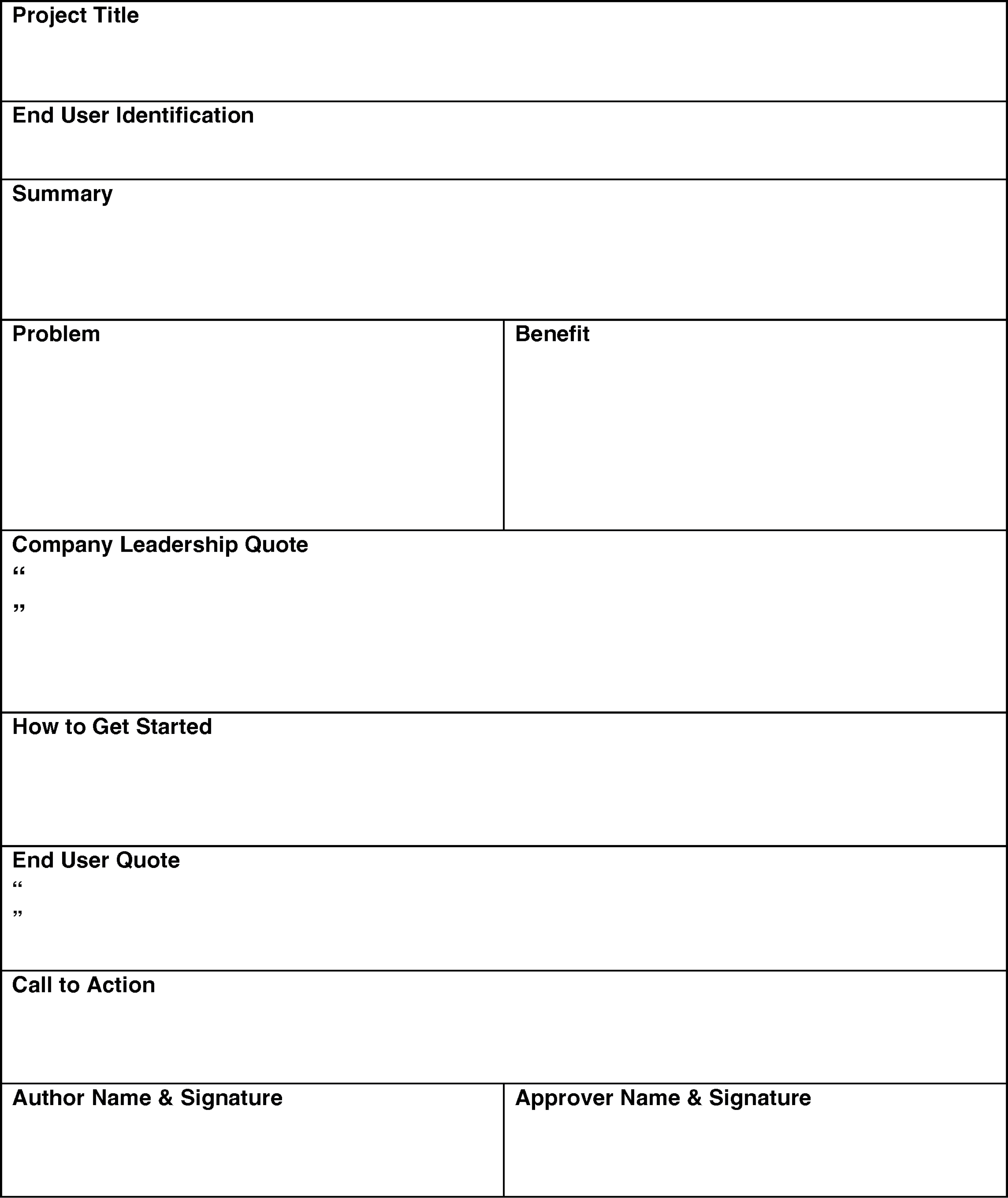
Examples of a template of these prompts and a sample response follow.
Example of a Template for an Announcement of Anticipated Research
Long Description.
The template form has fields for the following information: Project Title, End User Identification, Summary, Problem, Benefit, Company Leadership Quote, How to Get Started, End User Quote, Call to Action, Author Name and Signature, Approver Name and Signature.
Example of an Announcement of Anticipated Research

Long Description.
The example shows the template of the announcement form with fields filled in. Project Title: Developing Design Guidance and Public Outreach Materials for Alternative Intersections. End User Identification: DOT Location and Design and Communications. Summary: This project will develop more detailed design guidelines for Restricted Crossing U-Turn intersections, RCUTʼs, as well as videos, FAQ s, and outreach materials for public hearings. Problem: Lack of design consistency for alternative intersections and pushback from the public on proposed designs. Benefit: More consistent guidance to designers and better communication of benefits in terms of operations and safety. Company Leadership Quote: “This project really helped us deploy more RCUTʼs. It made life easier for designers and helped the public understand why we were proposing this design.” How to Get Started: Designers can consult revised sections in our agency’s roadway design guide. Communicators can use off-the-shelf ready materials in public hearings. End User Quote: “I went to a public hearing for an RCUT and was met with positive reactions from the public, unlike before!” Call to Action: Consult the new guidance and learn more about how to get well-designed RCUTʼs deployed! The bottom of the form includes two sets of fields for Author Name and Signature and Date Signed.


