Training Materials to Implement Context Classifications (2026)
Chapter: 5 Action Plan Follow-Up Meetings and Peer Exchange
Chapter 5: Action Plan Follow-Up Meetings and Peer Exchange
Following the in-person workshops, there were two opportunities to follow up with the selected state DOTs. The first, as part of Task 5, occurred approximately six months after the workshops. The research team met individually with each state DOT to review its progress towards context classification implementation and identify lessons learned. This follow-up also included a survey to collect information on progress so far. The second opportunity, as part of Task 6, was a virtual peer exchange with all three DOTs that was conducted approximately 10 months after the workshops. The peer exchange also included state DOTs that were further along in their implementation activities, including Florida, Oregon, Tennessee, and Minnesota DOTs. The peer exchange provided an opportunity for the research states to make connections with each other as well as with states that have worked through the challenges they are currently facing. The following summarizes the key takeaways and lessons learned from each state DOT.
NEVADA DOT
Initial Progress
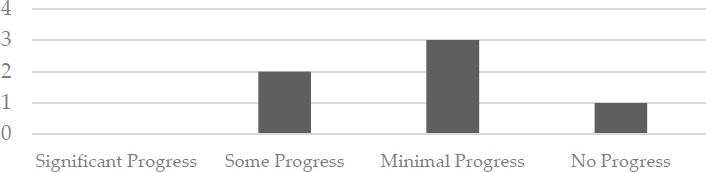
As part of the Task 5 survey, the majority of Nevada DOT staff indicated they had made some or minimal progress (see Figure 5-1).
During the follow-up meetings, staff shared that progress had been made on several topics:
- Context map: Nevada DOT secured Front Office support and budget approval to develop a statewide context classification map, with a consultant onboard to assist with development. They are using NCHRP Research Report 1022 as a reference.
- New core team members: Staff shared the forthcoming context map will be housed in the Roadway Systems Section of the Planning Division. To support this and other data management efforts, they added a Roadway Systems representative to the core team. They were also working on increasing district representation on the core team.
- Regular core team meetings: Since the workshop, the core team had met about once every other month. Aside from the new members mentioned above, they felt they had the right group to move the various actions forward.
- Identified manuals to update and division responsible: Staff reviewed the list of manuals that would likely need to be updated and their typical revision cycles. They were hoping to take advantage of regular update cycles to balance staff workload.
- Confirmed terminology: Staff decided that “roadway environments” would be the official term moving forward, though “context” was still used informally in discussions. They found “roadway environments” was more easily understood by people outside of engineering.
- Training: To address frequent team member changes and support consistent understanding, staff were developing training both at a high level and tailored to specific business functions.
Anecdotally, staff mentioned that roadway environments/contexts were being talked about more often, especially in the Traffic Safety Engineering and Traffic Operations Divisions. They noted that the action plan provided structure, enabling small wins and perpetuating momentum en route to implementation.
Nevada DOT identified several next steps it plans to take after the context map was complete. Planning staff intended to revisit the One Nevada needs assessment process to consider updating some of the criteria. They were also thinking through best practices of how to transfer roadways to a local agency if the roadway environment changes in a way that is more focused on local travel needs. They were also working on a communication context rollout strategy. They expressed interest in pairing the rollout with training opportunities for staff.
Challenges
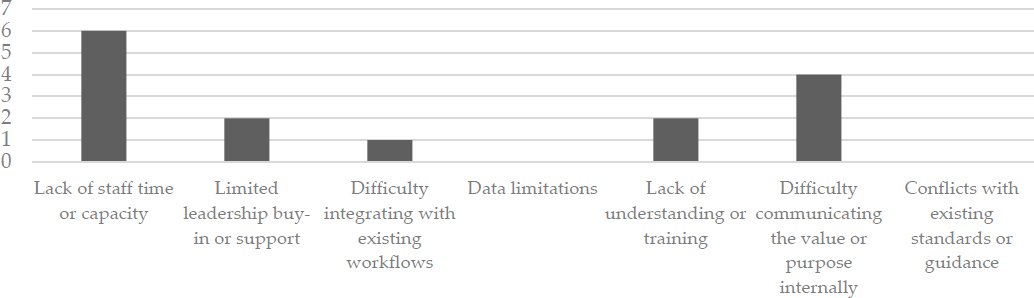
The most common challenge cited by Nevada DOT staff was the lack of staff time (see Figure 5-2)—a consistent theme among all three state DOTs. During the Task 5 meeting, this topic came up in especially in relation to manual updates. As noted above, the research team discussed the benefit incorporating updates into regular update cycles would have on staff time. The consultant support for the statewide map was expected to help with staff time challenges.

Staff time constraints similarly posed a challenge to getting district support for the maintenance of new treatments. District staff, also stretched thin, do not always have the resources to maintain new and/or additional treatments.
Advice for Other Agencies
Nevada DOT staff emphasized the need to identify all internal stakeholders and teams impacted by context classification early. This effort can help streamline committee formation and project direction. Agencies should prioritize internal education and communication to build buy-in and clarify roles.
Staff also expressed the importance of understanding your agency’s data landscape and resource needs. Leveraging existing or ongoing research and tools for efforts like statewide mapping can be a helpful starting point, but DOTs should recognize that using others’ models is not always straightforward and that some adaptation will be needed.
KANSAS DOT
Initial Progress
As part of the Task 5 survey, the majority of Kansas DOT staff indicated they had made some or minimal progress (see Figure 5-3).

Based on the survey results and follow-up discussions, Kansas DOT made progress in the following areas:
- Drive to Zero (DTZ) Plan: This plan included specific strategies that align directly with context classification implementation. The plan identified steps to develop guidance for safe, context-sensitive multimodal accommodations and establishes a practice of reviewing projects during scoping to determine the need for speed management. The DTZ team was waiting on the official Kansas DOT context classifications to identify target speeds.
-
Establishing context classifications: Staff, with help from a consultant team, had preliminary conversations about the ideal contexts for the state. There were two main context groups discussed:
- Rural/Rural Town/Rural Crossroad/Industrial/Suburban Neighborhood/Suburban Commercial/Urban; and
- Rural/Rural Transition/Rural Town/Industrial/Suburban Commercial/Urban.
The classifications were still conceptual and will require some testing with real-world applications. Kansas DOT noted some local agencies, including Wyandotte County, are using context and could serve as a model.
- Summary of What and Why: Kansas DOT staff created a 2-page summary to explain the purpose of implementing context and how context aligns with the agency’s goals. The summary was a helpful tool for champions to increase support from agency leadership.
- Review of the City Connecting Links: A “City Connecting Link” is a maintenance agreement between Kansas DOT and local agencies. Funding through the program is tied to number of lanes, which can create barriers to implementing pedestrian and bicycle facilities, especially as part of a road diet. DOT staff conducted an initial audit of what is covered by the program and believe there may be flexibility in how City Connecting Link responsibilities are interpreted. The staff’s next step was to document prior road diet project successes and failures.
- Regular core team meetings: Leading up to the Task 5 follow-up meeting, Kansas DOT staff had not been regularly meeting as a core team given their competing priorities for time. As part of that meeting, leadership encouraged staff to prioritize regular meetings. During the Task 6 peer exchange, Kansas DOT staff noted that the regular core team check-in meetings have helped maintain accountability and momentum.
- Speed management: One of the key challenges identified during the workshop was speed management and designing for speed transition zones. Kansas DOT was working on a speed management initiative to use speed complaints as a metric for assessing transition zone effectiveness.
Overall, staff shared that the greatest success following the workshop was that staff are now talking about context more. There had been a noticeable increase in multimodal considerations early in project scoping. More staff were thinking about context and incorporating it informally, which was starting to create a shift in internal culture.
Challenges
The most common challenges cited by Kansas DOT staff were lack of staff time and difficulty communicating the value internally (see Figure 5-4). The “What and Why” summary described above helped to communicate the value of context, but there was still lack of clarity over leadership’s interest in whether staff should prioritize time to implementation efforts. The Task 5 follow-up meeting helped confirm that core team meetings and action plan progress were agency priorities.
Consultant support originally identified to help advance the context classification categories had been paused. The lack of consultant support placed additional burden on internal staff. The consultant pause did, however, allow agency staff to regroup and confirm how they wanted to best engage consultants in the future. Staff were in the process of deciding how to map contexts, handle updates, communicate limitations with initial mapping, and address potential conflicts with municipalities that have their own context plans.
Staff also mentioned that FHWA’s removal of Complete Streets resources from its website had created a challenge. Kansas DOT was originally tying its context implementation to a Complete Streets initiative, but now there is uncertainty whether that initiative will move forward. Staff confirmed there was no formal policy requiring them to use Complete Streets language and that they were previously using it for consistency with the Infrastructure Investment and Jobs Act. They felt they could continue the effort with the context terminology regardless of next steps related to Complete Streets.
Advice for Other Agencies
Kansas DOT staff emphasized the importance of having adequate staff resources as well as a clear understanding of available data and how to mine it. It is important to understand your data landscape early. They also stressed the value of strong internal communication and patience, as well as the need to avoid focusing too much on setbacks.
MAINE DOT
Current Progress
Similar to the other states, the majority of Maine DOT staff indicated they had made some or minimal progress (Figure 5-5). Of the three states selected, Maine was the farthest into implementation at the start of the project. During the Task 5 follow-up meeting, staff clarified that during the first two years of their effort, there was consistent progress made and that context implementation was a primary focus of the Research and Innovation Office. More recently, staff had been integrating the work done into everyday processes. While it felt like progress was slower, it may be a result of the previous hard work and context starting to feel like a more natural part of day-to-day activities.

The following summarizes specific progress made since the workshop:
- Using context classification in scoping process: Maine DOT staff were starting to integrate context into their scoping checklist. Context was used to identify projects that need a Complete Streets review. These reviews were being done on projects outside of rural contexts and for project types that might allow for additional scope items. Staff mentioned an example where the Bridge Program sent a project back to the Planning Section because they thought it could benefit from a Complete Streets review.
- Context map: Maine DOT staff launched their preliminary context map in December 2024 and invited comments from their MPO partners. Since then, they integrated the data into the agency’s linear reference system and added it to their public website. They established a context committee and held their first meeting to review feedback from municipalities and MPOs.
- Communication with internal and external partners: Maine DOT staff were planning to start sharing the scoping checklist with MPOs for projects going forward to get their input early in the project process. The agency champion also gave a presentation at the Maine Highway and Regional Annual Meeting to DOT staff. The presentation provided updates on the context map and scoping checklist.
- Context-based speed studies: Staff were starting to integrate context into speed studies, using an adapted version of the NCHRP Report 966 spreadsheet. Speed results were slightly lower than traditional methods and remain consistent with engineering judgment. The agency was also exploring probe data (e.g., TomTom) to flag locations where operating speeds exceed context-based maximums.
It was clear from the follow-up meetings that Maine DOT staff were interacting frequently on context-related issues. There were multiple times during the Task 5 follow-up meeting that staff from Research and Innovation, Planning, and Traffic would start brainstorming a specific challenge. For example, they were discussing how to approach local partners’ requests to change context based on speed studies. DOT staff were all well versed in the current status of the initiative and in how the meeting could move these topics forward. This was a good sign that the Maine DOT staff are operating well as a multidisciplinary team.
Challenges
The most common challenges cited by Maine DOT staff were lack of staff time and difficulty integrating context into existing workflows (see Figure 5-6). While Maine DOT was generally advanced in its implementation, staff noted that with the transition of the effort from Research and Innovation to implementation in other sections, it would be helpful to identify a leader of the action plan. Design was notably absent from the follow-up meeting, with one of the key staff involved in the workshop having transitioned to another role. The Active Transportation group within Planning was leading next steps through the scoping process. As Maine DOT continues through the implementation process it can offer insight into what success looks like when the implementation effort is driven more by planning than by design.
Other challenges Maine DOT was facing were more technical, including a desire for a more structured and well-defined process for managing and updating context data, especially as feedback from towns increases. The DOT also wanted to integrate context classification more deeply into design standards and performance-based design.

Advice for Other Agencies
As Maine DOT was relatively far along in the implementation process, it offered a few of its lessons learned to other agencies starting the process:
- Maintain a willingness to have open dialogue and iterate through decisions to get to the best outcome. Be flexible, revising the approach as you learn new information.
- Identify early successes. Find the places where the new approach is likely to work well and then share the success stories. This can be done through demonstration or pilot projects.
- Tailor national tools to agency needs. There are a lot of existing resources so agencies do not need to start from scratch, but they also should not be afraid to adapt the tools to meet their needs. There can be significant effort required for manual review and “smoothing” of automated mapping results.
- Account for the complexity and importance of context names (e.g., a community’s resistance to being labeled “suburban”). Plan for careful communication with regional planners and MPOs early for feedback and validation.
- Plan for ongoing data management and regular updates, not just during initial rollout.


