Slotted Schedules for Corridors with Mixed Freight and Passenger Operations (2026)
Chapter: Interviews
upgrades (e.g., new sidings or crossovers) would unlock additional capacity. Conversely, they can be used to demonstrate that proposed passenger services can operate within existing constraints, offering a persuasive basis for negotiation with host freight railroads.
It is important to distinguish between the maximum capacity represented by a slot catalog and the intended maximum practical utilization of that capacity by actual trains. In the United States, where freight trains and intercity passenger trains operate over long distances and do not routinely adhere to precise schedules, slotted schedules work best with a slot catalog that contains many more available slots than actual trains. This approach allows for some flexibility with respect to when trains arrive at the shared-use railroad segment. For passenger trains, having periodic vacant or empty slots in the slot catalog allows a late-arriving train to drop back into a later available slot without negatively affecting freight trains or other passenger trains. For freight operations, where trains generally do not operate on a fixed timetable, trains can arrive at the shared-use territory and wait a relatively short and predicable time for the next available slot for that type of train and then have a clear and delay-free path through the entire shared-use corridor.
In corridors where passenger agencies seek to expand service windows or frequencies, slotted schedules provide a credible, technically grounded method for demonstrating that service expansion is possible without degrading freight performance. Slotted schedules convert a qualitative debate about capacity into a quantitative planning tool.
Illustrative Prototype and Modeling Approach
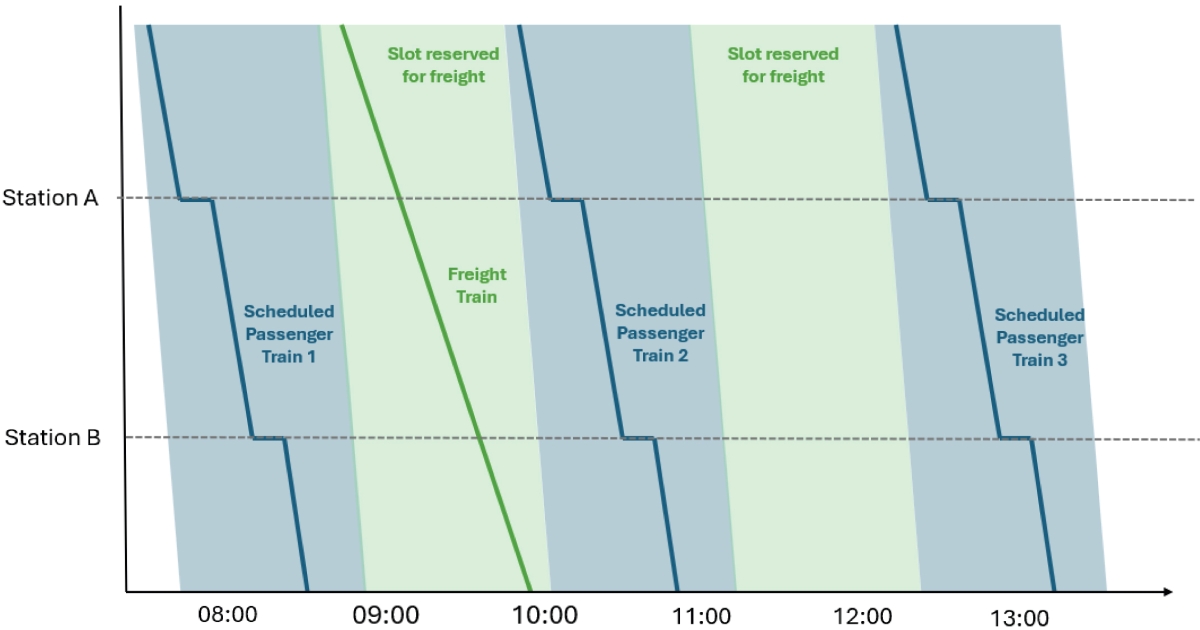
To support the conceptual discussion of slotted schedules, Figure 1 is a simplified string-line diagram that illustrates how train movements and reserved time–space slots can be organized along a shared-use rail corridor. The prototype is based on a hypothetical, single-direction segment and highlights the key planning principles of slotted scheduling.
In the diagram, passenger train movements are shown in blue and represent a series of scheduled trips along the corridor, each occupying a specific time window. These passenger movements are distributed throughout the day to reflect consistent service intervals. Freight train slots are shown in green, indicating the time–space windows reserved for freight train movement. These freight slots are interspersed between passenger trains to avoid conflicts and preserve operational flexibility.
Shaded regions on the diagram distinguish between periods where the corridor is reserved exclusively for passenger operations and periods where freight train movements are permitted. This reflects a realistic operational approach in U.S. shared corridors, where freight might be restricted during peak passenger windows and accommodated in pre-allocated slots during off-peak periods.
The freight train illustrated in the diagram is assigned a slot during one of these permitted windows. If the freight train misses its initial slot—due to late arrival, staging delays, or other unforeseen issues—it can wait until the next available freight slot. The diagram shows how slotted schedules offer resilience and flexibility by allowing missed or delayed freight movements to be absorbed in later windows without interfering with passenger service.
INTERVIEWS
Overview
The research team interviewed 15 SMEs involved in mixed-use passenger and freight rail operations to understand how slotted schedules have been developed and implemented across the
Long Description.
The diagram presents a schedule between Station A and Station B. Time runs from 08:00 to 13:00 along the horizontal axis. Three scheduled passenger trains are shown as step lines labeled Scheduled Passenger Train 1, Scheduled Passenger Train 2, and Scheduled Passenger Train 3. These lines move within blue bands from Station A to Station B across the time axis. Two green bands or slots labeled Slot reserved for freight appear between the passenger train bands, including a slot around 09:00 to 10:00 and another slot around 11:00 to 12:00. A diagonal straight line labeled Freight Train passes through the green slot from around 09:00 to 10:00.
United States. Key insights are summarized below in response to the following guiding questions:
- How have passenger train schedules been developed or implemented? Were slotted schedules considered or implemented?
- What kinds of infrastructure or operational changes were needed to implement these? How was train dispatching handled?
- What data, tools, or modeling approaches were most important in the analysis?
- How did coordination/negotiation between passenger agencies and freight railroads typically work? How were decisions made about capital investment and agreements reached on the permitted quantity and characteristics of passenger service?
SMEs highlighted case studies that illustrate varied approaches to implementing slotted schedules or temporally or physically separating passenger and freight traffic. These case examples offer insights into institutional arrangements, operational strategies, train dispatching methods, infrastructure investments, and relationship-building efforts that shaped successful shared-use agreements.
Case Studies: Approaches to Shared Use
The case studies below demonstrate the range of strategies employed to integrate passenger rail service in mixed freight and passenger corridors in the United States. Not all these case studies involve the use of formal slotted schedules, but they offer valuable insights and lessons from mixed-use operations, including temporal separation, physical separation (i.e., providing parallel track capacity), public acquisition of right-of-way, and negotiated access agreements, which can inform the evaluation and potential implementation of slotted service in similar contexts.
Dallas Area Rapid Transit and North Central Texas Council of Governments
- Dallas Area Rapid Transit (DART) implemented passenger rail service on a corridor formerly owned by BNSF Railway by purchasing the line outright.
- Although DART now owns and operates the corridor, BNSF retained rights to continue freight operations and to plan for future service growth.
- This arrangement requires periodic coordination between DART and BNSF to assess operational needs and capacity constraints. The agreementʼs structure protects BNSFʼs ability to expand its business and allows DART to prioritize passenger service.
- North Central Texas Council of Governments played a critical role in facilitating negotiations among public agencies and freight railroads, including purchasing underutilized lines from Union Pacific Railroad (UPRR) and the main yard in downtown Dallas. SMEs shared that the involvement of a regional planning entity helped to broker shared-use agreements and align long-term transportation and economic development goals across multiple jurisdictions.
Metra, Chicago
- Metra operates in one of the most complex shared-use rail environments in the United States, with approximately 600 Metra trains and 600 freight trains operating daily in the Chicago region, in addition to Amtrak service. Metra dispatches most of its services and shares infrastructure with multiple Class I Railroads. BNSF dispatches the BNSF-owned line that runs from Chicago westward to Aurora, which is the busiest shared-use freight and passenger corridor in the United States.
- During peak hours (4:30 a.m. to 9:00 a.m. and 3:30 p.m. to 7:00 p.m.), freight trains generally are held. Freight typically runs overnight. On the BNSF Aurora Line, freight and passenger trains are comingled in a two- and three-track corridor at all times of day, including the weekday commuter peaks.
- Metra develops its timetables according to service needs, using clockface scheduling and operating plans for core services. Modeling tools such as RTC are used to assess impacts, though limited transparency from freight railroads (e.g., lack of visibility into Union Pacific freight movements) can constrain planning.
- Strong relationships and ongoing communication are key to resolving conflicts. Metra develops its timetables based on service goals and negotiates with freight operators afterward. Metra maintains regular meetings with freight operators and infrastructure owners to manage shared use and resolve operational issues. Because of differing business models and performance priorities, SMEs emphasized that effective coordination depends on consistent communication and established relationships.
San Joaquin Corridor, California
- BNSF-owned corridor in the California Central Valley and San Joaquin Valley.
- Intercity passenger trains sponsored by the SJJPA operate between Bakersfield and Stockton, with some trains continuing to Oakland via BNSF and UPRR right-of-way and other trains continuing to Sacramento via UPRR.
- SJJPA negotiated an agreement with BNSF that included developing a slotted schedule for passenger and freight trains, targeted investment in additional track capacity to support meets and overtakes at prescribed locations, and incrementally increasing the frequency of passenger train service as capital investments are made.
SunRail, Florida
- Operates under a temporal separation agreement, with Florida purchasing 61 miles of CSX-owned right-of-way for $200 million, allowing it to prioritize passenger operations.
- Freight is restricted during peak passenger hours (e.g., no freight allowed from 6 a.m. to 11 p.m.). Coal trains are held and released only during midday lulls.
- Success factors included financial investment, rerouting freight to alternate lines, and having a public-sector champion to facilitate communication with the freight owner.
Other Systems
Other systems have varying degrees of slotted schedules or temporal separation:
- Altamont Corridor Express, Capitol Corridor, and Caltrain commuter rail service in Northern California.
- Metrolink commuter rail system and North County Transit District commuter rail serving Southern California.
- Chicago–St. Louis corridor in Illinois, UPRR-owned and hosting mixed freight and passenger operations, including 100-mph Amtrak service.
- South Shore Line serving Northern Indiana.
Prerequisite Infrastructure or Operational Changes
To support mixed passenger and freight operations, several types of infrastructure investments have been implemented:
- Track upgrades where needed.
- Installing quad gates and upgraded warning systems at grade crossings.
- Constructing double-track segments, new or extended sidings, and upgraded junctions.
Investments are typically focused on addressing freight–passenger conflicts and unlocking corridor capacity. In many cases, infrastructure improvements involve extending existing sidings or creating new passing sections, which eventually function as double or triple track over portions of the corridor. This is important given the length of modern freight trains, which require substantial siding capacity to avoid blocking mainline movements.
SMEs noted that infrastructure upgrades are often the price of admission for passenger service. Freight railroads might expect public agencies to fund any capital needs required to preserve or enhance freight capacity. Many successful agreements involved public agencies purchasing the right-of-way outright (e.g., DART, SunRail, North Carolina Railroad, and rail corridors in Virginia and eastern Massachusetts), allowing passenger rail operators greater control over scheduling and capital planning.
Useful Data, Tools, or Modeling Approaches
Key Tools and Approaches
SMEs identified several tools as essential for testing schedule feasibility and robustness while supporting communication between agencies:
- RTC modeling is a widely used tool to test schedule feasibility, simulate delays, and assess capacity impacts.
- Viriato was used by Metrolink in schedule planning.
- String-line diagrams and operating plans are essential for visualizing slot catalogs and communicating among owners, operators, agencies, and stakeholders.
- Dynamic simulation modeling is especially valuable in capacity-constrained corridors; however, SMEs noted that it can be excessive if capacity is not a limiting factor.
Limitations
The tools are useful, but SMEs noted constraints associated with using them:
- Modeling alone is insufficient; to be effective, it should be translated to train dispatching procedures and general operating instructions or guidelines.
- Freight railroads rarely share internal operations data, which makes it challenging for the sponsors of passenger rail service to model shared-use corridors.
- Where data and forecasts of freight operations are limited, modeling a range of scenarios making reasonable assumptions about future levels of service and the future mix of train types can provide valuable information and frame the future within reasonable boundary conditions.
Coordination and Negotiation Between Passenger Agencies and Freight Railroads
Key Elements of Effective Coordination
Key themes emerged from the SME discussions regarding effective coordination and communication among passenger and freight railroads:
- Strong relationships and communication are critical. Frequent meetings build trust, even if freight railroads remain protective of their operations.
- Prospective sponsors of passenger service generally need to be prepared to commit significant capital investment to enable reliable and mutually successful mixed passenger-freight operations.
- Clear incentives and funding help move negotiations forward.
- Public ownership of right-of-way simplifies coordination. Where freight maintains ownership, the companiesʼ default position is often No until provided an incentive otherwise.
Freight Rail Perspective
SMEs emphasized that understanding the freight railroad perspective is essential to developing workable agreements. Following are the key priorities and concerns raised by freight operators:
- Freight railroads typically do not agree to sell slots because of the operational rigidity it introduces. Instead, they negotiate access agreements, which preserve their ability to maintain flexible service for freight customers.
- Freight railroads also prioritize room for future growth.
- Freight railroads typically allow new passenger services only when infrastructure upgrades are made to ensure freight operations remain unaffected.
- Railroads require regular track maintenance windows, which must be built into the operating plan, along with the slot catalogs in the case of slotted schedules.
Passenger Rail Perspective
SMEs identified the factors that public agencies or passenger rail operators consider in planning an expansion of existing passenger


