Out-of-Service Utility Facilities: Management Throughout the Highway Life Cycle (2026)
Chapter: 1 Introduction: Utility Interactions with the Transportation System

CHAPTER 1
Introduction: Utility Interactions with the Transportation System
Utilities, including electricity, potable and nonpotable water, sanitary sewers, oil and natural gas, and telecommunications, are essential services that support modern life and economic activities. They provide the necessary infrastructure for homes, businesses, and industries to function efficiently and are typically managed by government agencies, private companies, or a combination of both to ensure citizens have reliable access to critical resources.
Public transportation networks provide much of the physical space in the unpaved right-of-way along public roads needed to connect utility services to the consumer.
Utilities and the transportation system are deeply interconnected. Transportation infrastructure, including roads, railways, airports, and ports, relies on utilities for lighting, signaling, and operational efficiency. Public transportation networks provide much of the physical space in the unpaved right-of-way along public roads needed to connect utility services to the consumer. Although transportation agencies purchase right-of-way for the express purpose of providing transportation infrastructure, utilities may use the right-of-way to provide services if the utility facilities do not negatively impact the safety of the traveling public and the structural integrity of the transportation system and are in accordance with state laws, regulations, and policies.
Access to the public right-of-way is usually limited to public utilities, that is, utility providers that serve a public need with services that are accessible by the public. Because the service that utilities provide is seen as a public benefit, access to the public right-of-way is typically granted to the utility free of charge or at a minimal fee. As a result, public utilities are located along many highways in the United States, apart from federal or controlled-access highways, which might be subject to additional rules. However, space in the public right-of-way for utilities is limited, and often several utility types and providers compete for access to the real estate. As a result, public utilitiesʼ access to the right-of-way is subject to transportation agency rules for utility accommodation.
Challenges of Managing Utilities in the Public Right-of-Way
Despite all the benefits of utility access in the right-of-way to both the utility owner and the public, utility facilities can create problems during highway construction—particularly when highways need to expand. Typically, transportation agencies purchase additional right-of-way and coordinate with utility owners to move utility facilities in conflict with planned transportation infrastructure before highway construction begins. In the process of coordinating highway construction activities with adjacent utilities, some utilities might be avoided and be allowed to remain in place, while others can be relocated as part of the construction contract.
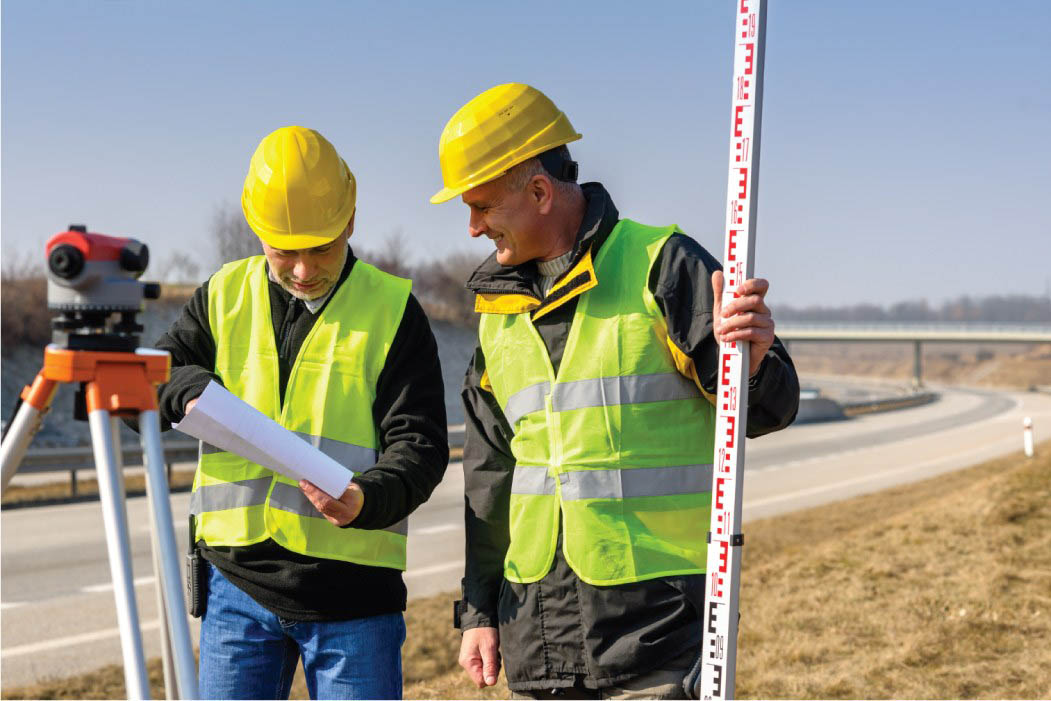
To determine which utilities need to be moved or adjusted on a highway project, transportation agencies rely to a large degree on information from utility owners, which are contacted during the planning and design phases of a highway construction project. This information is typically supplemented by information collected by surveyors or subsurface utility engineering (SUE) consultants in the field that can employ geophysical and other technology to detect buried utilities.
Utilities not detected during project design can have serious monetary and time impacts during construction.
While these efforts typically find a majority of buried utilities, no technology or process to date guarantees detection of all utilities within the limits of a project. Utilities that are no longer used by the utility owner [otherwise known as abandoned or out-of-service (OOS) utilities] often remain undetected because the original utility owner might be out of business or the current utility owner might not have records or may otherwise be unaware of the facility. Utilities that remain undetected during project design and are then eventually discovered during the construction phase of a project can have serious impacts in terms of contractor claims and project delays.
This guide uses the term “out-of-service” in lieu of “abandoned” to avoid any perceived issues with regard to the utility ownerʼs responsibilities.
Overview of OOS Utility Facilities
What Is an OOS Utility?
In the context of transportation systems, OOS utility facilities, sometimes referred to as “abandoned,” “inactive,” “retired,” or “idled” utilities, are utilities located in or adjacent to transportation right-of-way that are not in use, either temporarily or permanently. For example, a gas utility provider might have a gas service line in the public right-of-way that is no longer being used. Since it could be expensive to remove the buried line, a more economical solution could be to abandon the line or place it out of service with the transportation agency. If the transportation agency agrees, the utility owner would need to follow the agencyʼs rule for abandonment, which often stipulates purging, cutting, capping, and filling of the abandoned line. Transportation agencies also occasionally allow utilities to abandon lines when the removal of a buried line would cause damage to sensitive areas, such as protected species habitats in the right-of-way.
States typically have rules that define the utility ownerʼs responsibilities for its abandoned utilities, such as the responsibility to maintain records describing utility type and location.
As discussed in Chapter 2 in more detail, states use a variety of terms to describe utilities that are no longer in use or for which the owner is unknown or cannot be located. Many refer to these as “abandoned” utilities. However, using the term “abandoned” to describe a utility that is no longer in use has been debated, since abandonment might imply that the utility owner no longer has any responsibility for the facility. States typically have rules that define the utility ownerʼs responsibilities for its abandoned utilities, such as the following:
- Responsibility to maintain utility records describing utility type and location.
- Responsibility for costs associated with the removal of the facility when needed and for costs associated with the restoration of the right-of-way following removal.
Where feasible, this guide uses the term “out-of-service” in lieu of “abandoned” to avoid any perceived issues with regard to the utility ownerʼs responsibilities. However, to avoid any confusion, when referring to specific state rules or policies, the guide uses the term used by those policies, often “abandon” or “abandonment.”
What Are Typical Problems with OOS Utilities?
OOS utility facilities can have major disruptive impacts during highway project construction, especially if the existence of such utilities is discovered during the construction phase of a highway project and if questions about ownership, utility type, and other risk factors exist.
Certain OOS facilities, especially those that failed to follow the rules for placing them out of service, can pose substantial safety risks to the environment, the public, and construction workers. In addition, OOS facilities can result in costly and unnecessary delays if damaged during project construction. The risk of environmental impacts and hazards to people and construction workers varies depending on the type of OOS facility. While communication lines that are out of service typically pose a low risk to people and the environment, pipelines that carry hazardous liquids and gases can pose a significant risk.
OOS facilities that fail to follow the rules for placing them out of service can pose substantial safety risks to the environment, the public, and construction workers.
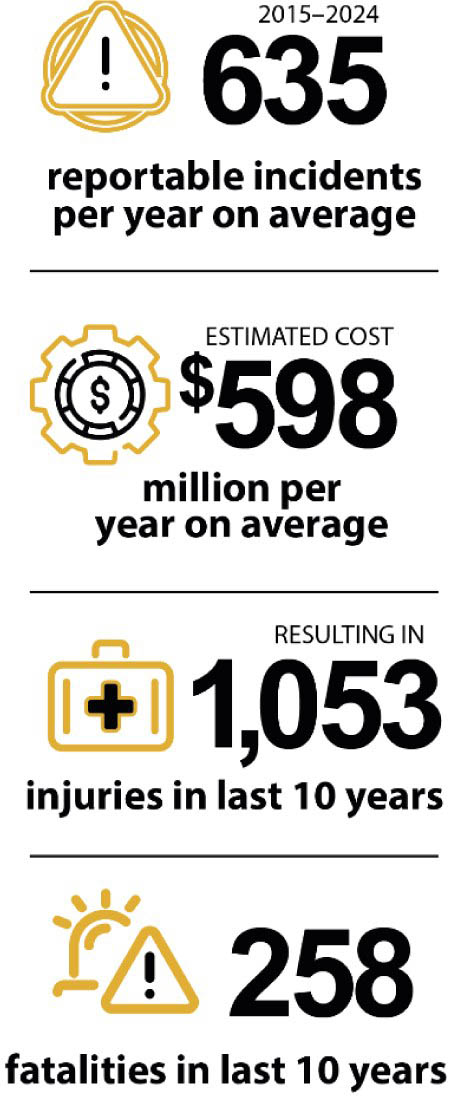
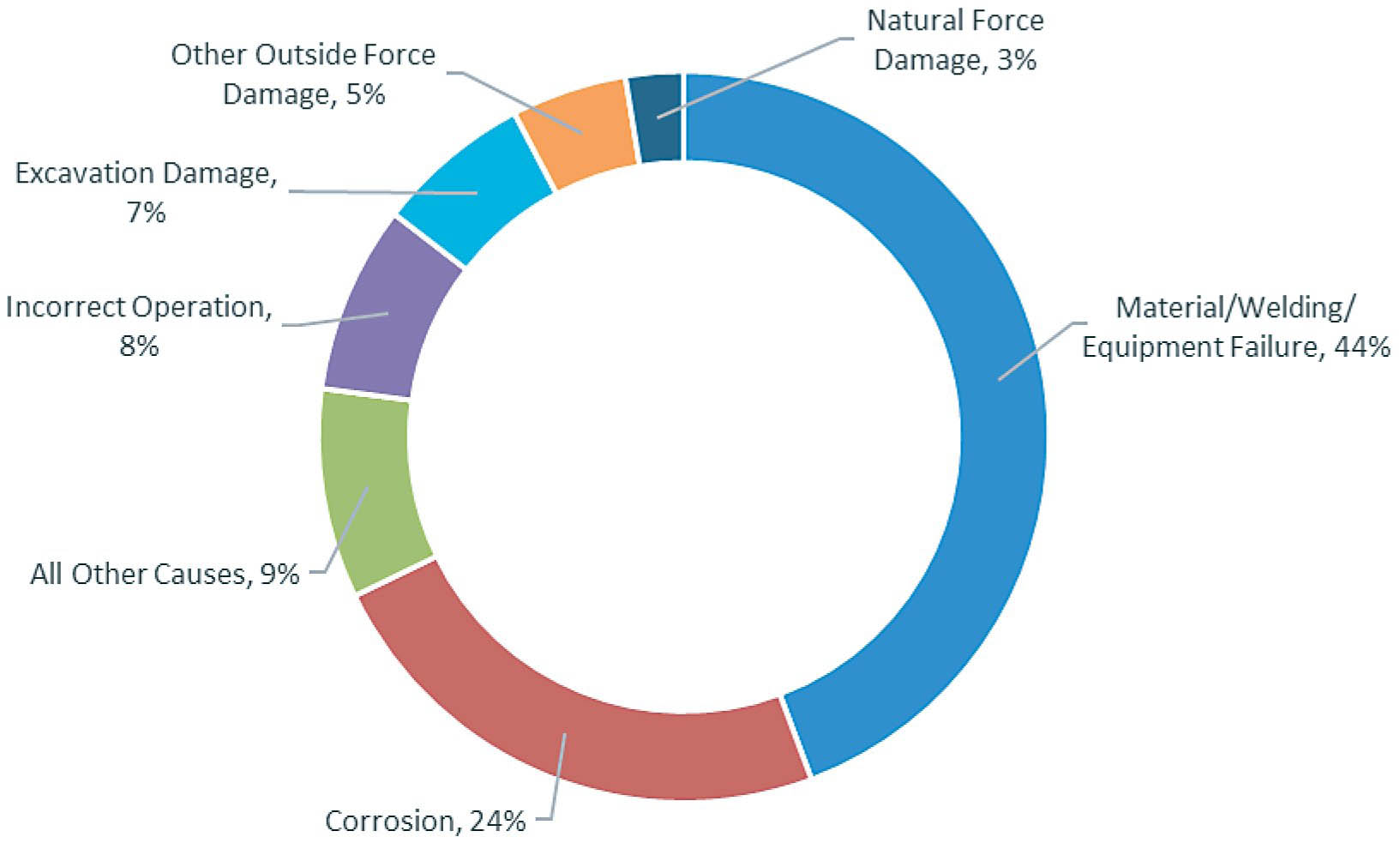
The Pipeline Incident Reporting System managed by the Pipeline and Hazardous Materials Safety Administration (PHMSA) collects information about pipeline incidents nationwide. Although the data do not differentiate between active and OOS pipelines, they provide information about the causes of pipeline incidents. During the 10-year period between 2015 and 2024, there were 635 reportable incidents per year on average, resulting in a total estimated cost of $598 million per year on average (1). In that time frame, pipeline incidents resulted in 1,053 injuries to people and 258 fatalities (Figure 1). For 2024, the data show that the majority of incidents were caused by either corrosion or failure of material, welding, or equipment—causes that become more likely as the utility facility ages (Figure 2).
It is important for transportation agencies to be aware of management strategies being used across the country.
Source: PHMSA (1).
Long Description.
The infographic covers the period from 2015 to 2024. It shows an average of 635 reportable incidents per year. The estimated cost is 598 million dollars annually. Over the last ten years, these incidents resulted in 1,053 injuries. Additionally, there were 258 fatalities in the same period. Icons accompany each statistic, including a warning sign, a dollar sign, a medical cross, and a caution symbol.
Efficient management of OOS facilities spans the entire life cycle of a highway facility, including project development and delivery, as well as facility operations and maintenance. Many different ways to manage OOS facilities exist, and transportation agencies need to be aware of management strategies being used across the country.
Overview of the Guide
This guide was developed as part of NCHRP project 08-148, “A Guide for Management of Out-of-Service Facilities.” The goal of the project was to define how OOS facilities impact functions of the right-of-way during the highway life cycle, including planning, design, construction,
Source: PHMSA (1).
Long Description.
The pie chart illustrates the distribution of seven categories. Material, welding, or equipment failure is the largest at 44 percent. Corrosion follows at 24 percent. All other causes account for 9 percent. Incorrect operation contributes 8 percent. Excavation damage is 7 percent. Other outside force damage is 5 percent. Natural force damage is the smallest at 3 percent. Each segment is labeled with its respective percentage.
and operations and maintenance, and how negative impacts of OOS facilities can be resolved or mitigated. Information provided in this guide is based on the following activities completed by the research team over the course of the project:
- Conduct of a critical review of practices related to OOS facilities from across the country;
- Conduct of a survey of practitioners to document current practices and initiatives, data gaps, and relevant design and data standards and specifications;
- Conduct of a series of case studies to evaluate considerations related to OOS facility costs, delays, and safety concerns;
- Analysis of available information to develop robust approaches for locating OOS facilities, managing their presence in the right-of-way, and addressing issues related to OOS facilities during the entire highway life cycle; and
- Development of guidelines for locating, managing, and addressing OOS facilities in the right-of-way.
To learn more about the research project and its methodology and for in-depth discussion of the research findings, please see the conduct of research report, NCHRP Web-Only Document 454: Developing a Guide to Manage Out-of-Service Utility Facilities, available at nationalacademies.org/publications.
Purpose of this Guide
This volume provides guidance on practices for locating, identifying, tracking, and managing OOS facilities throughout the highway life cycle. The information in this guide is intended to complement information in the national guide on utility accommodation, AASHTOʼs Guide for Accommodating Utilities Within Highways and Freeways (2).
Who Will Find the Guide Useful?
This guide is written to provide transportation officials with insight into the management of OOS facilities so that they may avoid negative impacts during transportation projects. Transportation officials such as planners, designers, surveyors, utility coordinators, and construction managers can use this guide to learn about the risks associated with OOS facilities and potential strategies for managing them more effectively. Transportation officials in administrative roles can use this guide to make changes to transportation agency business processes and to administrative rules. Consultants and contractors can use this guide to learn about strategies for avoiding OOS facilities during construction projects and to address OOS facilities during construction projects if they have not been avoided during the project design phase. Utility owners can learn more about the perspective of transportation agencies and how proactive management of OOS facilities can provide meaningful benefits for both transportation officials and utility owners. The guide will also be useful to any stakeholder that wants to increase awareness about the issue of OOS utility management (Figure 3).
Organization
The remainder of this guide is organized as follows:
- Chapter 2 provides a discussion of terminology, including terms used at the federal level and terms used by state transportation agencies.
- Chapter 3 discusses applicable laws, regulations, and policies at the federal and state levels.
- Chapter 4 discusses hazardous materials transported in OOS facilities and includes an overview of federal and state management guidelines.

Long Description.
The flowchart lists five users: 1, transportation officials learn risks and strategies to manage OOS facilities. 2, DOT administrators make changes to business processes and administrative rules. 3, Consultants and contractors learn strategies to avoid and address OOS facilities during construction projects. 4, Utility owners gain perspective of transportation agencies and see how proactive management provides benefits. 5, Other stakeholders increase awareness about the issue of OOS utility management.
- Chapter 5 discusses risks associated with OOS facilities.
- Chapter 6 provides an overview of the depiction and management of OOS facility data.
- Chapter 7 provides an overview of OOS facility management during the project development process.
- References and a list of abbreviations and acronyms are provided at the end of the volume.


