The Future of U.S. Nuclear Weapons Policy (1997)

Chapter: B The Buildup and Builddown of Nuclear Forces

Previous Chapter: A Biographical Sketches of Committee Members
Suggested Citation: "B The Buildup and Builddown of Nuclear Forces." National Academy of Sciences. 1997. The Future of U.S. Nuclear Weapons Policy. Washington, DC: The National Academies Press. doi: 10.17226/5796.

Appendix B—
The Buildup and Builddown of Nuclear Forces

Chapter 1 of this report discusses the evolution of the world's nuclear forces during the Cold War and the development of the constraining influences on that evolution. This appendix presents data describing this rise and fall in graphical form.

Unfortunately, the information available to support graphical summaries of this kind from unclassified official U.S. government sources is only fragmentary. Reproduced here, therefore, are data on U.S., Soviet/Russian, British, Chinese, and French forces from the Natural Resources Defense Council (NRDC).1

There are considerable uncertainties in these figures, due to definitional ambiguities, disagreements among sources, and basic lack of information. Tabulation includes "on-line" forces, irrespective of their alert status, and those off-line, that is, in repair or modification. Nonoperational units and test units are not included. Naturally the data on Soviet/Russian, French, Chinese, and British forces are based on estimates, with sources frequently disagreeing. The references from which these graphs are taken contain an extensive discussion of sources and numerous qualifications about the reliability of the data.

Fortunately, precision in these numbers is not required to make a number of broad observations:

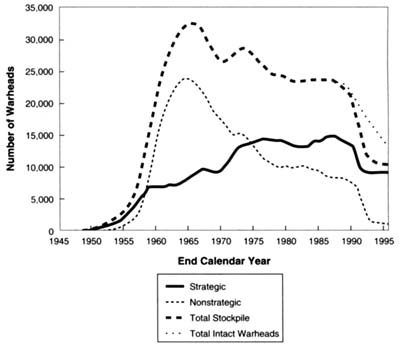
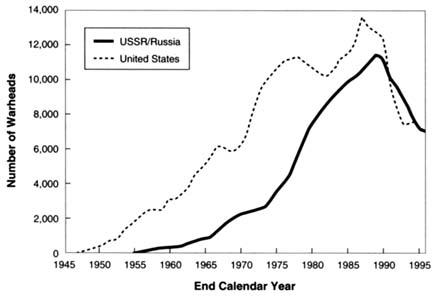
  • During the buildup, the United States led the Soviet Union in numbers of nuclear weapons by 6 to 10 years.

  • The peak buildup rate in the nuclear weapons stockpiles, particularly that of the United States (about 5,000 weapons per year) was substantially larger than the currently feasible dismantlement rate (about 1,500 to 2,000 weapons per year).

Suggested Citation: "B The Buildup and Builddown of Nuclear Forces." National Academy of Sciences. 1997. The Future of U.S. Nuclear Weapons Policy. Washington, DC: The National Academies Press. doi: 10.17226/5796.
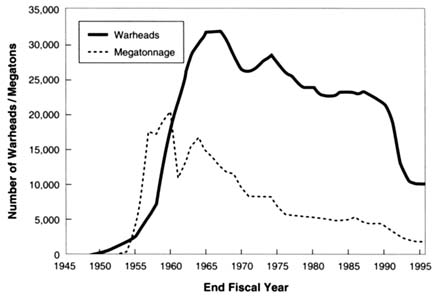
  • U.S. total megatonnage declined steadily from the mid-1960s (and remained considerably below Soviet megatonnage). The average yield of the U.S. nuclear weapons declined from its peak above 1 megaton to just above 200 kilotons today.

  • The number of nonstrategic (tactical) nuclear warheads has declined much more sharply than that of strategic warheads, but Russian tactical warheads are expected to remain more numerous than those of the United States.

  • The total stockpiles of both Russia and the United States today remain above the 10,000-warhead level.

  • While a tabulation of Soviet nuclear megatonnage is not included in this appendix, total Soviet megatonnage remained considerably higher than that of the United States in the latter part of the Cold War.

NOTE

1.  

The data on U.S. and Soviet/Russian forces are taken from Robert S. Norris and Thomas B. Cochran, ''Nuclear Weapons Databook: U.S.-U.S.S.R./Russian Strategic Offensive Nuclear Forces, 1945-96" (Washington, D.C.: Natural Resources Defense Council, January 1997). The figure on British, Chinese, and French forces is created from NRDC data that appear as a regular feature in the Bulletin of the Atomic Scientists. These data are from "Nuclear Notebook: Estimated Nuclear Stockpiles 1945-1993," Bulletin of the Atomic Scientists, vol. 49, no. 10 (December 1993), p. 57.

Suggested Citation: "B The Buildup and Builddown of Nuclear Forces." National Academy of Sciences. 1997. The Future of U.S. Nuclear Weapons Policy. Washington, DC: The National Academies Press. doi: 10.17226/5796.

FIGURE B.1 U.S.-USSR/Russian total strategic launchers (force loadings), 1945-1996. Source: Natural Resources Defense Council.

FIGURE B.2 U.S.-USSR/Russian total strategic warheads (force loadings), 1945-1996. Source: Natural Resources Defense Council.

Suggested Citation: "B The Buildup and Builddown of Nuclear Forces." National Academy of Sciences. 1997. The Future of U.S. Nuclear Weapons Policy. Washington, DC: The National Academies Press. doi: 10.17226/5796.

FIGURE B.3 U.S. nuclear stockpile, 1945-1996. Source: Natural Resources Defense Council.

FIGURE B.4 U.S. -USSR/Russian nuclear stockpile, 1949-1996. Source: Natural Resources Defense Council.

Suggested Citation: "B The Buildup and Builddown of Nuclear Forces." National Academy of Sciences. 1997. The Future of U.S. Nuclear Weapons Policy. Washington, DC: The National Academies Press. doi: 10.17226/5796.

FIGURE B.5 U.S.-USSR/Russian nuclear stockpile, 1945-1996. Source: Natural Resources Defense Council.

FIGURE B.6 U.S. nuclear warheads and megatonnage by fiscal year. Source: Natural Resources Defense Council.

Suggested Citation: "B The Buildup and Builddown of Nuclear Forces." National Academy of Sciences. 1997. The Future of U.S. Nuclear Weapons Policy. Washington, DC: The National Academies Press. doi: 10.17226/5796.

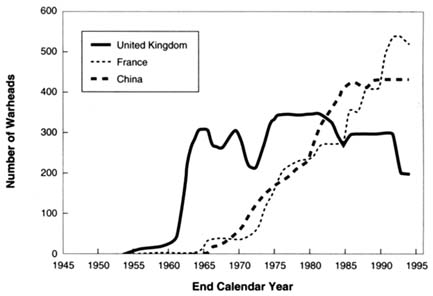
FIGURE B.7 Estimated nuclear weapons stockpiles of the UK, France, and China, 1950-1993. Source: Data provided by the Natural Resources Defense Council.

Suggested Citation: "B The Buildup and Builddown of Nuclear Forces." National Academy of Sciences. 1997. The Future of U.S. Nuclear Weapons Policy. Washington, DC: The National Academies Press. doi: 10.17226/5796.
Page 105
Suggested Citation: "B The Buildup and Builddown of Nuclear Forces." National Academy of Sciences. 1997. The Future of U.S. Nuclear Weapons Policy. Washington, DC: The National Academies Press. doi: 10.17226/5796.
Page 106
Suggested Citation: "B The Buildup and Builddown of Nuclear Forces." National Academy of Sciences. 1997. The Future of U.S. Nuclear Weapons Policy. Washington, DC: The National Academies Press. doi: 10.17226/5796.
Page 107
Suggested Citation: "B The Buildup and Builddown of Nuclear Forces." National Academy of Sciences. 1997. The Future of U.S. Nuclear Weapons Policy. Washington, DC: The National Academies Press. doi: 10.17226/5796.
Page 108
Suggested Citation: "B The Buildup and Builddown of Nuclear Forces." National Academy of Sciences. 1997. The Future of U.S. Nuclear Weapons Policy. Washington, DC: The National Academies Press. doi: 10.17226/5796.
Page 109
Suggested Citation: "B The Buildup and Builddown of Nuclear Forces." National Academy of Sciences. 1997. The Future of U.S. Nuclear Weapons Policy. Washington, DC: The National Academies Press. doi: 10.17226/5796.
Page 110
Subscribe to Email from the National Academies
Keep up with all of the activities, publications, and events by subscribing to free updates by email.