Exploration of Near Earth Objects (1998)
Chapter: 3 Future Research Activities
3
Future Research Activities
Detecting Near-Earth Objects.
The estimated population of NEOs1 includes approximately 1400 Earth crossers (Atens, Apollos, and Earth-crossing Amors) of at least 1-km size and an additional ~1500 noncrossing Amors. As of April 1998, about 140 known Earth crossers and some 120 noncrossing Amors were of this size. Thus, the discovery of NEOs is estimated to be about 9% complete for objects larger than 1 km in diameter. Although the task is well begun, the vast majority of NEOs remain to be found.2
In the past few years the annual rate of discovery of Earth crossers larger than 1 km has been at about 1% of the estimated remaining population.3 However, new CCD detection systems that are becoming available for dedicated search telescopes will permit an increase in the discovery rate by an order of magnitude. Three systems (Table 3.1) whose development is being supported by NASA include the Near-Earth Asteroid Tracking (NEAT) CCD camera, developed by the Jet Propulsion Laboratory (JPL) and currently in use on a U.S. Air Force Ground-based Electro-Optical Deep-space Surveillance System (GEODSS) 1.0-m telescope; the Lowell Observatory Near-Earth Object Survey (LONEOS), which utilizes a dedicated 0.6-m Schmidt telescope; and the Spacewatch system of the University of Arizona, currently operating a 0.9-m telescope, with the addition of a 1.8-m telescope now under construction.
The LONEOS system, which began test observations in 1997, has an instantaneous field of view of 3° × 3° and an expected threshold of detection of about V magnitude 19.5. In full operation, LONEOS will be capable of
TABLE 3.1 NASA-Supported Surveys of NEOs
|
Program |
Survey Telescope |
Aperture (m) |
|
Spacewatch, University of Arizona |
Existing telescope |
0.9 |
|
|
Telescope under construction |
1.8 |
|
LONEOS, Lowell Observatory |
Schmidt telescope (near completion) |
0.58 |
|
NEAT, Jet Propulsion Laboratory |
U.S. Air Force GEODSS telescope |
1.0 |
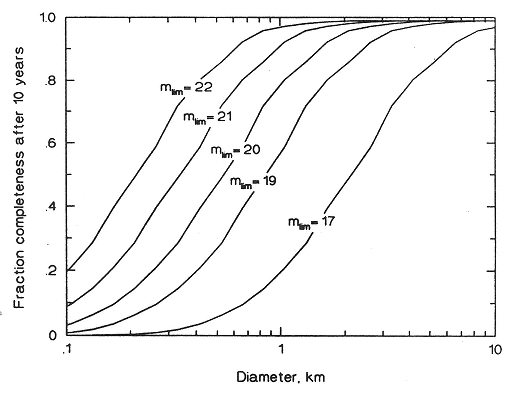
Figure 3.1
Survey completeness after 10 years versus diameter of NEOs for various system-limiting magnitudes. All-sky coverage (approximately 15,000 degree2) is assumed each month. The photographic Schmidt telescope on Palomar Mountain (~0.5-m aperture) is capable of all-sky coverage to a limiting magnitude of 17. A single 0.5-m CCD system (e.g., LONEOS) should be able to achieve all-sky coverage to a limiting magnitude of 19. A system of one or two 1-m telescopes should be able to survey to about limiting magnitude 20. To reach limiting magnitude 21 will probably take a system of several 2-m telescopes.
covering the entire accessible sky (about 15,000 degree2) each month to detect all observable asteroids to apparent magnitude 19.5. It is expected that about 80% of the Earth-crossing objects of 1-km diameter or greater could be detected by LONEOS in 10 years of full operation (see Figure 3.1). It must be noted, however, that LONEOS by itself could not carry out sufficient astrometric follow-up observations to obtain reliable orbits on the NEOs detected. To do this would require an approximate doubling of telescopic resources (either a second dedicated telescope of comparable aperture or the use of multiple smaller telescopes).
If the 1.8-m Spacewatch telescope under construction were to be instrumented with appropriate large-format CCDs, it could be operated in a program similar to that of LONEOS. Such a program would lead to detection of about 95% of Earth crossers of 1-km size in 10 years (see curve for limiting magnitude 22 in Figure 3.1). The LONEOS and Spacewatch systems used in a coordinated program of detection and orbit determination could yield the orbital elements for about 1000 new Earth-crossing asteroids larger than 1-km diameter, as well as thousands of smaller NEOs, in 10 to 15 years. Continued support of these projects would be necessary to achieve this goal. Participation of the NEAT system and international observers would ensure that high-precision orbits were obtained for most of the bright NEOs discovered. COMPLEX supports the coordination of ongoing NEO search programs.
There is a possibility that the U.S. Air Force, as an expansion of the NEAT project, will undertake a more intensive survey of NEOs in collaboration with NASA, using the U.S. Air Force's GEODSS satellite-tracking network upgraded with large-format CCD cameras. Such a program would have a capability similar to that of the
combined LONEOS and Spacewatch surveys. COMPLEX supports the U.S. Air Force's involvement in this effort.
Issues Related to Increased Discoveries of Near-Earth Objects
Given the greatly increased rate of NEO discoveries that will follow from the surveys described above, a database system that will not be overwhelmed with new information must be developed. The role of the Spaceguard Foundation, at present an international advocacy organization for the study of NEOs and the hazard they pose, is undefined and unclear. The Minor Planets Center had already demonstrated its capability in handling a similar, though smaller, database. The same organization could potentially handle the task of cataloging all new NEO discoveries, with augmented funding.
The survey will probably find a few objects that, for a period of time (a few weeks to a few years), have a significant probability of hitting Earth, before it eventually is shown (in all probability) that they will not. NASA and the astronomers engaged in discovering NEOs must address the question of how to behave responsibly in the public arena, in terms of reporting and explaining any potentially threatening discoveries. Some preliminary work on this problem has already been published,4 but this difficult and important issue requires that protocols be established. Organizations such as the International Astronomical Union and COSPAR may have a role to play in this task.
Observations Needed To Identify Objects of High Scientific Interest
The Space Studies Board has stated previously that reconnaissance and initial exploration of asteroids by spacecraft constitute a high-priority goal.5 Three classes of observations are required to identify targets of sufficient scientific interest to justify exploration by spacecraft:
- Identification, which includes detection and astrometry to determine orbits. When possible, astrometric observations by radar are effective in securing highly accurate orbits because the precision of these measurements is greater than that of optical observations.
- Classification by use of photometric data and orbital parameters to assign the object to one of several broad categories: Earth approaching or not, taxonomic category, and asteroidal or cometary behavior.
- Quantitative description requiring characterization of the object in as much detail as possible using a diverse set of observations, such as size, shape, rotation, and composition. A full set of physical parameters desired for NEO quantitative description includes the following:
-
- Size is best determined by measuring both visible and thermal infrared flux densities. Albedo and mean-diameter estimates can be obtained if both visible and thermal properties are determined. If only visible observations are obtained, as in most cases, the diameter can be estimated from an assumed albedo based on spectral classification.
- Rotation is determined from repeated observations at a single wavelength, providing a light curve from which the object's spin rate can be obtained. If coupled with radar or thermal infrared observations, information on the shape of the object (spherical or elongate) can be obtained.
- Surface roughness and shape can be characterized by radar.
- Emission of gas and dust, such as seen in faint comae, may be detected. Such emissions can potentially distinguish objects of a cometary nature.
-
Surface composition in a global sense requires spectrophotometric or spectroscopic observations over the range 0.3 to 2.5 microns. With higher spectral resolution, the mineralogical composition can be obtained for certain classes of asteroids. Regolith properties and aspects of the space “weathering” of NEOs can be determined from multiangle photometry and thermal-infrared measurements.
In favorable cases, surface mapping can be carried out by radar observations, allowing the recognition of features of geologic interest such as craters, stratification, or possibly fracture systems. As the asteroid rotates and different parts of its surface come into view, spatial variations in its spectral properties can be determined if the
- telescope is large enough or the object is close enough. These spectral variations can be related to spatial differences in surface composition.
- Asteroidal satellites can be sought using occultations, adaptive optics, or coronagraphic techniques.
These observations should provide the basis for selection of NEO targets of high scientific interest for exploration by spacecraft.
Opportunities for Low-Cost Missions
Advantages of Robotic Missions to Near-Earth Objects
Laboratory studies have shown that meteorites (and hence the asteroids from which they may have been derived) display a great variety of mineral assemblages, chemical and isotopic compositions, and physical properties, but these studies have also told us much more. A few examples of important measurements possible only, or best done, in the laboratory are quantitative age determination; thermal, shock, and irradiation histories; detailed mineralogy; trace element and isotopic measurements; and the inclusion of interstellar grains. All of this information is critical for reconstructing an object's geologic history. Laboratory studies have obvious advantages over telescopic and spacecraft observations, particularly in the far richer variety of instruments, the flexibility of experimental designs to meet the needs of specific samples, and the possibility of successive experiments. This rich store of information can be transferred to our knowledge of asteroids as soon as one question is answered: Which asteroid types are the parents or siblings of which meteorite classes? Telescopic observations of NEOs, particularly by visible and near-infrared spectroscopy, likewise reveal a rich variety of objects.
Meteorites are important geologic materials, but they are samples out of context. Spacecraft data on NEOs and returned samples provide this critical context for relating diverse lithologies and understanding the processes that formed them. Since most NEOs are fragments of larger objects, they also allow direct sampling of otherwise inaccessible interiors of differentiated objects. NEOs are, in reality, small planets with distinctive structures and geologic histories, and these can best be understood by close-range observations from spacecraft, complemented with returned samples.
Although most meteorite classes presumably originate from some asteroid type, not all asteroids supply meteorites. That is, in our present state of understanding, the variety of asteroids is almost certainly greater than that of meteorites now in collections, and NEOs may represent unsampled types and dormant comets. Nevertheless, we should expect new knowledge and new opportunities as our mission-based science database grows.
Current and Planned Robotic Missions to Near-Earth Objects
The Space Studies Board has previously noted that Discovery-class spacecraft missions to asteroids and comets provide great scientific return for the funds invested.6 Spacecraft missions to NEOs can be classified into three types with progressively greater complexity, scientific yield, and cost: flyby, rendezvous, and rendezvous with sample return. There can be no doubt that rendezvous, with a well-selected instrument set and close approach capability, makes possible much more definitive study of a given object than does a flyby. The added value provided by sample return is likely to be great, and the Space Studies Board and its committees have repeatedly noted that the return of asteroid samples for laboratory analysis will be necessary to meet the objectives of continuing solar system science.7,8
The following ongoing or already approved spacecraft missions relate directly to the exploration of near-Earth objects:9
- Near-Earth Asteroid Rendezvous is the first of NASA's Discovery class and will be the first spacecraft to orbit an asteroid. The spacecraft flew by (253) Mathilde, a main-belt asteroid, in June 1997 and will rendezvous with (433) Eros, one of the largest Earth-approaching asteroids, in February 1999. The encounter with Mathilde, the largest asteroid (approximately 60 km in diameter) ever visited by a spacecraft, provided the first close-up
- images of a C-type object. Eros, with dimensions of 14 × 14 × 40 km, is an S-type asteroid with heterogeneous surface composition. Data to be obtained for Eros include measurement of bulk properties (size, shape, volume, gravity field, spin state), surface properties (elemental and mineralogical composition, texture, topography, geology), and internal properties (mass distribution, magnetic field).
The NEAR spacecraft, launched in February 1996, carries an instrument payload that includes a multispectral imaging system, an x-ray/gamma-ray spectrometer, a near-infrared spectrometer, a magnetometer, a laser rangefinder, and a radio science experiment. After insertion of the spacecraft into polar orbit around Eros, the science payload should provide sufficient data for nearly complete topographic and geologic maps showing features as small as a few meters across. Spectral types will be mapped at a resolution of a few meters, mineral abundances at a resolution of several hundred meters, and major and minor radioactive elements at a similar or coarser scale. Thus, the NEAR mission should provide a major advance in our knowledge of the composition and geologic evolution of this asteroid.
- Deep Space 1, NASA's first New Millennium program deep-space technology demonstration mission, is planned for launch in July 1998. Although this mission will be driven by the requirements of technology validation (especially solar electric propulsion), it will encounter an asteroid, a comet, and the planet Mars. The first encounter will be with the Amor asteroid (3352) McAuliffe in January 1999, and the second with the periodic comet West-Kohoutek-Ikemura in June 2000. No physical studies have yet been carried out on McAuliffe. The asteroid may be about 2 km in diameter if it is an S type, or about 5 km in diameter if it is a C type. An integrated camera-spectrometer will be used to determine the sizes and shapes of both bodies, as well as the spectral reflectance of their surface materials.
- Stardust, the fourth of NASA's Discovery missions, will be launched in February 1999. It will capture a sample of dust particles from comet P/Wild 2 and return it to Earth for laboratory analysis. A deflection of this comet during an encounter with Jupiter in 1974 reduced its perihelion distance from 5 to 1.5 AU, and so this object is now Earth approaching. The spacecraft will approach the comet nucleus within 50 km, using on-board optical navigation, and a particle mass spectrometer provided by Germany will obtain in-flight data on very fine particles. During interplanetary cruise, a second set of collectors will collect dust grains currently entering the solar system from interstellar space. The samples will be returned to Earth in January 2006.
- Muses-C is an asteroid sample-return mission to be carried out by Japan's Institute of Space and Astronautical Science, with participation by NASA. Its scheduled launch is January 2002. It will rendezvous with (4660) Nereus (approximately 1 km in diameter, probably either a C-type or an M-type asteroid) in September 2003. Nereus is one of the most accessible NEOs so far discovered. In addition to a ballistic sampling device, the nominal instrument payload of Muses-C includes a CCD camera, an x-ray spectrometer, a secondary ion mass spectrometer, a dust collector, and a laser rangefinder. Prior to sampling, the asteroid will be mapped with the on-board instruments. After two months on station at Nereus, the spacecraft will return a sample to Earth, arriving in January 2006. Muses-C is also intended to demonstrate a solar electric propulsion system, autonomous guidance and navigation, and direct hyperbolic reentry of the sample capsule.
References
1. E.M. Shoemaker, R.F. Wolfe, and C.S. Shoemaker, “Asteroid and comet flux in the neighborhood of Earth,” pp. 155–170 in Global Catastrophes in Earth History, V.L. Sharpton and P.D. Ward, eds., Geological Society of America Special Paper 247, Geological Society of America, Boulder, Colo., 1990.
2. Solar System Exploration Division, Office of Space Sciences, Report of the Near-Earth Objects Survey Working Group, NASA, Washington, D.C. , 1995.
3. D. Morrison, ed., The Spaceguard Survey, Report of the NASA International Near-Earth-Object Detection Workshop, Jet Propulsion Laboratory, Pasadena, Calif., 1992, 50 pp. plus appendixes.
4. R.P. Binzel, “A near-Earth object hazard index,” Annals of the New York Academy of Sciences, 822:545–551, 1997.
5. Space Science Board, National Research Council, Strategy for the Exploration of Primitive Solar-System Bodies—Asteroids, Comets, and Meteoroids: 1980–1990, National Academy Press, Washington, D.C., 1980, p. 15.
6. Space Studies Board, National Research Council, The Role of Small Missions in Planetary and Lunar Exploration, National Academy Press, Washington, D.C., 1995, p. 12.
7. Space Studies Board, National Research Council, An Integrated Strategy for the Planetary Sciences: 1995–2010, National Academy Press, Washington, D.C., 1994, p. 66.
8. Space Science Board, National Research Council, Strategy for the Exploration of Primitive Solar-System Bodies—Asteroids, Comets, and Meteoroids: 1980–1990, National Academy Press, Washington, D.C., 1980, p. 53.
9. H.Y. McSween, “The role of meteoritics in spaceflight missions, and vice versa,” Meteoritics and Planetary Sciences 31:727–738, 1997.


