Lesbian Health: Current Assessment and Directions for the Future (1999)
Chapter: Executive Summary
Executive Summary
Despite growing attention to research on women's health over the past decade, the health problems of some subgroups of women have continued to receive relatively little attention. Lesbians are one such subgroup. Although the body of research on lesbian health is growing, much of the research to date has methodological limitations, such as the lack of appropriate comparison groups, that make it difficult to draw clear conclusions about the health status and health risks of this group of women.
The Institute of Medicine (IOM) Committee on Lesbian Health Research Priorities was convened in July 1997 to:
- assess the strength of the science base regarding the physical and mental health of lesbians,
- review the methodological challenges involved in conducting research on lesbian health, and
- suggest areas for research attention.
The study was funded by the National Institutes of Health (NIH) Office of Research on Women's Health, with the Centers for Disease Control and Prevention (CDC) also contributing funding through the NIH.
A primary charge of the committee was to organize and convene an
invitational workshop to examine these issues. The workshop, held in October 1997, focused on the challenges involved in designing and conducting research on lesbian health, some of the contextual issues that can make it more difficult to conduct such research, and lesbians' risk for particular health conditions including cancer, mental health problems, substance abuse, HIV infection, and sexually transmitted diseases. Lesbians' use of and access to health care services were also discussed. The workshop involved 21 invited speakers, public testimony from more than a dozen presenters, and approximately 50 interested members of the public who also participated in the discussion.
This report is based on the committee's deliberations and reflects its review and evaluation of the scientific literature on lesbian health and of information presented at the workshop. The committee's conclusions and recommendations, which are outlined here, are presented in detail in the full report. It is important to recognize that this is a workshop-study report with recommendations and that the committee's information gathering and deliberations were thus limited compared to those of a full IOM study.
The committee identified several important reasons for directing attention to the study of lesbian health issues:
- To gain knowledge to improve the health status and health care of lesbians. Lesbians share many health risks and experiences in the health care system with women in general. For lesbians' health care to be both cost-effective and appropriate, the scope of their health problems must be better understood. Knowledge of areas in which the health of lesbians differs from that of other women may provide insights to improve the health of all women.
- To confirm beliefs and to counter misconceptions about the health risks of lesbians. In the face of little empirical information, there are numerous beliefs, myths, and misconceptions about the health risks of lesbians that can affect their health outcomes. These beliefs are often shared both by health care providers and by lesbians themselves. Some of these beliefs may be true; others are not. These beliefs include perceptions that lesbians do not need regular Pap tests or routine gyneco-
- logical care, that they do not contract HIV/AIDS, and that there is an epidemic of breast cancer in the lesbian community.
- To identify health conditions for which lesbians are at risk or tend to be at greater risk than heterosexual women or women in general. A large body of epidemiological research has identified factors that place people at risk for health and mental health problems, with gender differences existing for many of these risk factors. However, because information about subjects' sexual preferences has not been collected in these studies, it is not possible to determine whether the lesbians who presumably are included in the samples differed from or were like other women with respect to these risk factors. In fact, some factors assumed to place women at risk for or to protect them against health disorders might not be present at the same levels or operate in the same ways for lesbians. In addition to facing many of the same stressors as heterosexual women, women who self-identify as lesbian may also experience stressors not commonly faced by heterosexual women, such as "stigmatization" both within and outside the health care setting. It is important to identify and understand those factors that are unique to lesbians and their impact on health.
The committee spent a significant amount of time discussing how to define lesbian sexual orientation. There is no standard definition of what constitutes a "lesbian." In general, sexual orientation is most often described as including behavioral, affective (i.e., desire or attraction), and cognitive (i.e., identity) dimensions that occur along continua (Laumann et al., 1994). Women may exhibit differing degrees of same-sex sexual behavior, desire, or identity, in combinations that vary from person to person. Among the 150 women in Laumann et al. (1994) who claimed at least one of the three dimensions of same-sex orientation (current same-sex desire, current identity as homosexual or bisexual, or same-sex behavior since age 18), Figure 1 shows that almost 60% of them stated desire only, and only 15.3% of them stated all three dimensions of same-sex orientation.
It is important to note that views of sexual identity and sexual behavior can vary significantly across cultures and among racial and ethnic groups, so it should not be assumed that a lesbian sexual orientation or
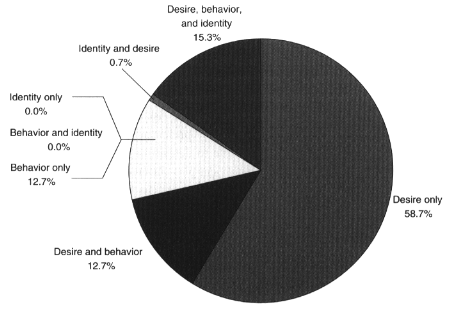
Figure 1
Interrelation of the different dimensions of same-sex orientation (current desire, current or past same-sex behavior, current identity as homosexual or bisexual) for 150 women (8.6% of the total 1,749) who report any adult same-sex orientation.
SOURCE: Laumann et al. (1994).
identity is the same for lesbians of different racial, ethnic, or cultural backgrounds. In particular, it should not be assumed that racial and ethnic minority cultures share views of lesbian sexual orientation identical with those of the dominant culture. The committee notes that there is a dearth of research on racial and ethnic minority lesbians.
For the purposes of this report, the committee agreed that it should focus on women who have sex with or primary emotional partnerships with women. Because so little research is available about bisexual women and because the degree to which the results of research on lesbians also apply to bisexual women is unknown, the committee considers bisexual women to be a different category or subgroup of women than lesbians for the purposes of this report.
The committee strongly believes that there is no one "right" way to define "lesbian." Thus, a researcher designing a study on lesbian health
should develop measures that gather information about the aspects of lesbian orientation that are relevant to the specific project at hand. Adopting this approach does not avoid the issue of establishing a lesbian definition. Rather, it builds on the need to accept the complexity of sexual orientation and the social context in which it is embedded. In essence, "lesbian" should be defined to reflect the needs of specific research studies, interventions, or programs of care within generally accepted conceptual boundaries, with a recognition of the three dimensions through which sexual orientation is most often defined: behavior, desire, and identity (see Figure 1).
The committee examined lesbian health from several different perspectives. When examined together, these various approaches can provide a more complete picture of the complexity involved in looking at lesbian health:
- Lesbians in the larger contexts of society, the health care system, and women in general. The contexts in which lesbians live provide a framework for understanding the complexity of their lives. For example, lesbians have historically been the target of prejudice and discrimination, both public and private, and the stigmatization of homosexuality remains widespread in our society. Although many kinds of abuse and discrimination against lesbians have been documented clearly, their impact on physical and mental health still remains to be studied. Lesbians' access to health care services may be affected by such factors as the lack of culturally competent providers1 and the presence of homophobia2 among providers, more limited access to health insurance because lesbians cannot share in spousal benefits, and the growing development of managed care systems that may potentially limit lesbians' access to lesbian-friendly providers. Finally, it is important to remember that lesbians confront the same kinds of health risks as do all women.
- Health of lesbians across the life span. All women face developmental challenges as they grow from childhood through adolescence
|
1 |
Culturally competent provider refers to having a set of skills to give appropriate high-quality services to individuals from cultures different from the provider's. |
|
2 |
Meaning fear of homosexuality. |
- to adulthood and old age. In addition to these predictable challenges, lesbians may encounter special situations associated with their sexual orientation, such as adverse societal attitudes, family rejection, and internalized homophobia. In particular, lesbians must negotiate the process of coming out, or revealing their lesbian identity.
- Specific physical and mental health concerns of lesbians, including risk and protective factors that affect these problems. There is a great deal of speculation, with some attendant evidence, that lesbians may be at heightened risk for some health problems. Large data gaps exist, however, in knowledge about lesbian health, and the population-based information necessary to determine relative health risks of lesbians is not available. The committee examined the available data on a number of possible health risks for lesbians and reviewed what is known regarding lesbians' risk for a variety of health conditions including cancer, cardiovascular disease, sexually transmitted diseases, HIV / AIDS, and mental health and substance abuse problems. Given the limited availability of data that would allow a comparison of lesbian with heterosexual women, the committee did not find that lesbians are at higher risk for any particular health problem simply because they have a lesbian sexual orientation. Rather, differential risks may arise, for example, because some risk or protective factors may be more common among lesbians (e.g., higher rates of nulliparity, which is associated with increased risk for breast cancer), they may experience differential access to health care services (e.g., because of fear of coming out to health care providers), and they are exposed to stress effects of homophobia. Little is known, however, about the specific impact of these risk factors on lesbian health, and even less about any unique protective factors and how they may operate. The committee further notes that misconceptions about risk for certain health problems can negatively affect both the ability of lesbians to seek health care and the treatment itself. For example, it is important for lesbians, just as it is for heterosexual women, to obtain regular Pap tests.
Conducting research on lesbian health presents numerous challenges. First, lesbians are a population subgroup without a standard definition, and partly because of this, they are a difficult subgroup to readily identify for study. Second, lesbians constitute a small percentage of women and, in
addition, are dispersed throughout the population of women, making it difficult and expensive to obtain a population based sample (or probability sample) of lesbians. Third, many in the lesbian community distrust medical research and researchers, which may result in the failure of lesbians to disclose their lesbian orientation in research studies. Fourth, there has been little funding support for research on lesbian health topics. It is not surprising, then, that methodologically rigorous large-scale studies are lacking in this area.
Although the body of research on lesbian health is growing and there are now a number of well-designed, methodologically sophisticated studies examining these issues, methodological limitations are consistently found in much of the research on lesbian health:
- Inconsistencies in the way sexual orientation is defined, as well as the lack of standard measures, make it difficult to compare findings across studies. Although the committee concludes that there are numerous ways to legitimately define lesbian sexual orientation in research studies, researchers have usually failed to state their definition and their reason(s) for using it.
- The use of small nonprobability samples limits the generalizability of research results. Most lesbian health studies have relied on nonprobability samples. In particular, many studies have used convenience samples—for example, from lesbian bars, music festivals, or gay and lesbian organizations—that are not likely to be representative of the general population of lesbians. Most samples of lesbians, furthermore, have been predominantly white, middle-class, well educated, and between 25 and 40 years old and thus are not representative of other groups of lesbians, for example, from other socioeconomic or racial and ethnic groups.
- The lack of appropriate control or comparison groups makes it difficult to assess the health of lesbians relative to other subgroups of women. Few studies have allowed direct comparisons between lesbians and other subgroups of women (e.g., heterosexual women) by using the same sampling strategies to identify subjects across sexual orientations and by including measures of sexual orientation.
- The lack of longitudinal data limits an understanding of
- lesbian development and its implications for how to define and measure lesbian sexual orientation. Most existing studies portray cross sections of experience at one point in time and so cannot address compelling questions of behavior, identity, or attraction across time. Prospective, longitudinal studies are essential for understanding the vulnerability, resilience, and well-being of lesbians across their life span.
Although it can be particularly challenging to design and conduct research on lesbian health for a number of reasons (e.g., the difficulty in identifying a lesbian population subgroup from which to select a probability sample), several strategies can be used to increase the quality of research. The use of computer-assisted interviews can increase disclosure of information, and different sampling techniques can be used to produce more representative study samples.
In addition to the methodological challenges to conducting research on lesbian health, the committee identified several contextual factors that researchers must also overcome. For example, researchers studying lesbian health may experience discrimination because of the stigma associated with this population. There are relatively few researchers working on lesbian-related issues; thus, researchers can feel isolated, and students conducting lesbian-related research may lack mentors. In addition, funding for research on lesbian health has been limited and difficulties have been reported in publishing research findings.
Researchers must also establish tics with the lesbian community in order to conduct studies. Pervasive stereotypes about lesbian life, coupled with the limited visibility of this community, create the risk that researchers who fail to familiarize themselves with the community will misinterpret or misunderstand the implications of their results. This undermines the willingness of the community to provide information freely.
Research on controversial or sensitive topics such as sexual behavior, sexual orientation, or drug use is usually politically sensitive, and researchers interested in doing wide-scale studies of sexual behaviors often face political challenges to the conduct of such research. At the workshop, several possible political responses were identified that could negatively affect the future of research on lesbian health, including legislative denial of the existence of lesbians or failure to recognize lesbian health issues.
Ethical issues are also extremely important to lesbian health research. Participating in research brings potential risks for lesbians both as individual research participants and as lesbians. For example, an individual's lesbian sexual orientation might be disclosed to others (e.g., through shared use of databases if these data include identifiers), and research information could be used in some way to discriminate against or stigmatize lesbians in general. The increased need to protect confidentiality arises both because lesbians are often stigmatized and because some same-sex behaviors are illegal in some jurisdictions. The committee acknowledges these potential risks, but it also believes that significant benefits can accrue to all women from studies of lesbian health, provided that individual rights are carefully protected. These benefits include identifying areas of increased risk that need attention and identifying gaps in health care services, as well as increasing understanding of the negative impact of homophobia on health.
Conclusions
Following its broad review of what is known about lesbian health and the factors that influence it, the committee reached three major conclusions:
Conclusion 1: Additional data are required to determine if lesbians may be at higher risk for certain health problems. Further research is needed to determine the absolute and relative magnitudes of such risk and to better understand the risk and protective factors that influence lesbian health.
Conclusion 2: There are significant barriers to conducting research on lesbian health, including lack of funding, which have limited the development of more sophisticated studies, data analyses, and the publication of results.
Conclusion 3: Research on lesbian health, especially the development of more sophisticated methodologies to conduct such research, will help advance scientific knowledge that is also of benefit to other population groups, including rare or hard-to-identify population subgroups and women in general.
The committee identified several gaps and priorities for additional research, which follow:
Research Gaps and Priorities
- Priority 1: Research is needed to better understand the physical and mental health status of lesbians and to determine whether there are health problems for which lesbians are at higher risk as well as conditions for which protective factors operate to reduce risk to health of lesbians. There is some evidence that lesbians may be at heightened risk for some health problems. There are, however, large gaps in the knowledge about lesbian health, and the population-based data needed to determine their relative health risks are not available. It is critical that such research include consideration of the impact of socioeconomic and cultural factors on the health of lesbians.
- Priority 2: Research is needed to better understand how to define sexual orientation in general and lesbian sexual orientation in particular and to better understand the diversity of the lesbian population. Definitions of lesbian samples in research studies have varied widely along the multiple dimensions of sexual orientation: sexual identity, sexual behavior, and attraction or desire. Population-based data on ''lesbians" are needed to better understand these dimensions of sexual orientation and the interrelationships among them, the characteristics of the population and how these characteristics interrelate with health status, and the diversity of the population.
- Priority 3: Research is needed to identify possible barriers to access to mental and physical health care services for lesbians and ways to increase their access to these services. It is commonly believed in the lesbian community that lesbians do not use traditional health services at the same levels as other women, although population-based data are not available to determine the severity of this problem. Nonetheless, the committee did identify a number of barriers to access to mental and physical health care services for lesbians. These include structural barriers such as the potential impact of managed care and the lack of legal recognition of relationship partners; financial barriers, which may impede access to health insurance coverage; and personal and cultural
- barriers, including attitudes of health care providers and the lack of cultural competency among providers for addressing the needs of lesbian clients. Developing a better understanding of the health care barriers that lesbians face could help improve access for other underserved groups as well.
Recommendations
The committee makes eight recommendations for improving the knowledge base on lesbian health.
Recommendation 1: Public and private funding to support research on lesbian health needs to be increased in order to enhance knowledge about risks to health and protective factors, to improve methodologies for gathering information about lesbian health, to increase understanding of the diversity of the lesbian population, and to improve lesbians' access to mental and physical health care services.
A long-term federal funding commitment to lesbian health research is needed that is responsive to the ongoing needs of the lesbian population. Foundations and other government entities are also urged to fund research on lesbian health.
Recommendation 2: Methodological research needs to be funded and conducted to improve measurement of the various dimensions of lesbian sexual orientation.
Methodological research is needed to refine the techniques available to study the full picture of lesbian health, including women of different racial and ethnic backgrounds, social classes, ages and birth cohorts, religious affiliations, and geographical locations. Although existing questions on surveys about sexual orientation are adequate for many research purposes, further work is required to improve their validity. Research is needed to determine the best ways to ask questions about lesbian sexual
orientation, including the use of alternative wording and innovative technologies so as to obtain maximum disclosure. Methodological research is also needed to explore the feasibility of using different sampling techniques, by themselves or in combination, for rare or hard-to-identify population subgroups, in order to obtain a probability sample of the lesbian population subgroup.
Recommendation 3: Researchers should routinely consider including questions about sexual orientation on data collection forms in relevant studies in the behavioral and biomedical sciences to capture the full range of female experience and to increase knowledge about associations between sexual orientation and health status.
Current methodologies allow the collection of information on sexual orientation with sufficient precision to discover important relationships between orientation and other factors. Further, such questions have been used successfully in a number of research areas with different populations. Consideration should be given to including questions about sexual identity, behavior, and attraction or desire in ongoing and future federal studies, assessing multiple dimensions whenever possible and addressing the rationale for including each question. Such studies would include, for example, those in which an association between sexual orientation and health can be hypothesized or in which discrimination based on sexual orientation may result in differential access to health care services. Pilot studies are needed to test the feasibility of including these types of questions, with careful attention given to protecting confidentiality and assessing response bias and its impact on disclosure.
Researchers submitting proposals for federally funded research, whether unsolicited R01s, responses to Program Announcements, or responses to Requests for Proposals, should routinely evaluate whether or not they should include sexual orientation questions as they would other sociodemographic questions in their protocols. NIH review groups should be encouraged to consider whether or not sexual orientation should be
assessed in proposed studies, and recommend inclusion of this field when it would strengthen the value of the results.
Recommendation 4: Researchers studying lesbian health should consider the full range of racial, ethnic, and socioeconomic diversity among lesbians when designing studies on lesbian health; strive to include members of the lesbian study population in the development and conduct of research; and give special attention to protecting the confidentiality and privacy of the study population.
Because there are wide social and cultural differences in the health-related stressors, risks, and protective factors to which lesbians are exposed in different social and cultural milieus, the committee recommends that studies of lesbian health include the full range of variations in race and ethnicity, social class, age, and socioeconomic status. Given the current lack of knowledge about lesbian health issues, it is imperative that researchers strive to involve members of the lesbian population being studied in the development, conduct, and dissemination of research on lesbian health. This is particularly important as a way of identifying lesbians for inclusion in research samples and securing their participation. As noted previously, the committee also urges that special attention be given to ensuring both confidentiality and the protection of human subjects in lesbian health research.
Recommendation 5: A large-scale probability survey should be funded to determine the range of expression of sexual orientation among an women and the prevalence of various risk and protective factors for health by sexual orientation.
To date no large scale probability studies on health have been conducted that collect information on sexual orientation. Conducting such a study would greatly increase knowledge about and understanding of sexual orientation in women, and improve understanding of the relationships
among the dimensions of sexual orientation and health status and health behaviors.
Recommendation 6: Conferences should be held on an ongoing basis to disseminate information about the conduct and results of research on lesbian health, including the protection of human subjects.
NIH and CDC should support periodic multidisciplinary conferences on lesbian health research methods and results. The first of these conferences should take place within the next two years, with subsequent meetings to occur on a regular basis.
Given that the field of lesbian health research is still in its infancy and many researchers and members of institutional review boards are not aware of the ethical issues that need to be considered in the conduct of this research, the committee further urges that NIH in collaboration with CDC sponsor a conference on the ethical issues involved in conducting research on lesbian health, including issues related to privacy and confidentiality, future use of data, recruitment of subjects, and informed consent. This conference would be designed to inform members of institutional review boards, researchers, and members of federal review panels and should involve representatives from the lesbian community.
Recommendation 7: Federal agencies, including the National Institutes of Health and the Centers for Disease Control and Prevention, foundations, health professional associations, and academic institutions should develop and support mechanisms for broadly disseminating information and knowledge about lesbian health to health care providers, researchers, and the public.
A clearinghouse for research on lesbian health should be established to make both published and unpublished research (e.g., conference papers) available to researchers and the public; this information should be made available on-line as well.
Training programs on lesbian health and the special issues involved
in working with lesbians should be developed for a wide range of providers, including pediatricians, psychologists and psychiatrists, substance abuse counselors and other treatment staff, general practitioners, obstetricians and gynecologists, and social workers. The committee also urges that health and mental health professional organizations feature discussions of lesbian health and the conduct of lesbian health research at their annual meetings.
Recommendation 8: The committee encourages development of strategies to train researchers in conducting lesbian health research at both the predoctoral and the postdoctoral levels.
Surveys of lesbians in academic settings and of graduate students indicate that individuals interested in conducting research on issues affecting lesbians face numerous barriers. In addition to the personal stigma they sometimes experience, it can be difficult to find mentors or sponsors and the funding needed to conduct the research. The availability of training funds would increase the ability of young researchers to pursue careers in lesbian health research and would enhance their skills in managing the challenges of conducting research in this area. A variety of strategies might be used to increase training opportunities for lesbian health researchers—for example, including lesbian health in the scope of pre- and postdoctoral programs in all health professions. In addition, NIH institutes should consider targeting training grants on lesbian health or including lesbian research in the scope of existing training grants. Foundations and academic institutions should also consider providing training support in this area.
Reference
Laumann EO, Gagnon JH, Michael RT, Michaels S. 1994. The Social Organization of Sexuality: Sexual Practices in the United States. Chicago: University of Chicago Press.


