Previous Chapter: Index
Suggested Citation: "Supplementary Pictures." National Research Council. 2000. 50 Years of Ocean Discovery: National Science Foundation 1950-2000. Washington, DC: The National Academies Press. doi: 10.17226/9702.

PLATE 1 A hydrothermal vent community with the giant tubeworm (Riftia pachyptila). mussels (Bathymodiolus thermophilus). and crabs (Bythograea thermydron) at the Rose Garden hydrothermal vent on the Galapagos Rift at a depth of 2,500 m. Photo by Fred Grassle.
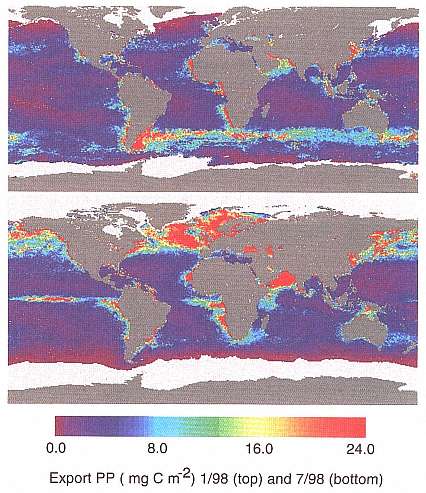
PLATE 2 Global estimates of export (or new) primary production for January 1998 (top) and July 1998 (bottom). Total primary production was estimated using Sea WiFS estimate of surface chlorophyll, sea surface temperature, surface irradiance and a temperature-dependent model of PBopt (Behrenfeld and Falkowski, 1997). Total primary production was converted to export primary production by the Eppley and Peterson (1979) relationship. Figure by Paul Falkowski.
Suggested Citation: "Supplementary Pictures." National Research Council. 2000. 50 Years of Ocean Discovery: National Science Foundation 1950-2000. Washington, DC: The National Academies Press. doi: 10.17226/9702.

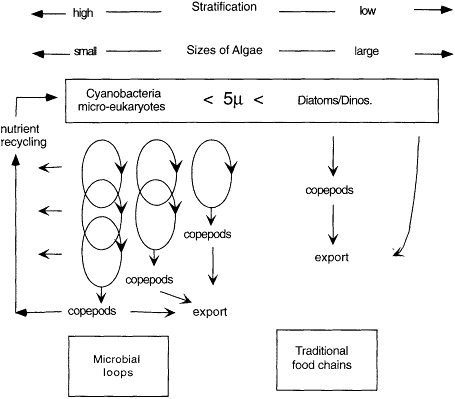
PLATE 3a A simple representation of microbial loops and the changes in food web structure with decreasing rates of nutrient input from right to left. This figure, based on Azam et al. (1983) and Cushing (1989). is reprinted from Figure 1 in Steele (1998), with permission from Proceedings of the Royal Society of London.

PLATE 3b A conceptual diagram showing the current concept of the predominate food web structure in the pelagic water column. Recognition of the role of microbes has added a suite of new trophic levels to the classic "diatom-zooplankton-fish" food chain. Organisms at the lower left, whose sizes are indicated roughly by the adjacent scale bar, are responsible for the fluxes indicated by arrows. This figure was originally developed by P. Johnson for the OEUVRE workshop described in Jumars' paper in this volume.
Suggested Citation: "Supplementary Pictures." National Research Council. 2000. 50 Years of Ocean Discovery: National Science Foundation 1950-2000. Washington, DC: The National Academies Press. doi: 10.17226/9702.

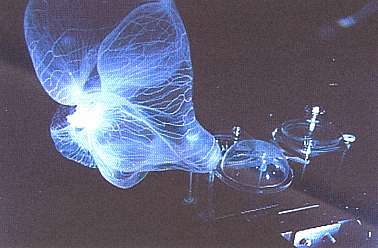
Plate 4 One of the large gelatinous organisms, Deepstaria enigmatica, that have been recently found to be very abundant in mesopelagic waters of the world ocean. This medusa was photographed in Monterey Bay by Kevin Raskoff © MBARI, 1998.

Plate 5 The Red Sea parted, allowing Moses and the Israelites to escape the pursuing soldiers of the Pharaoh (By permission of Pictures Now! Powered by Wood River Media, Inc. 1998 Wood River Media. June 1998. http://www.lycos.com/picturethis/religion/judaism/history/bible-stories/crossing_the_red_sea/310521.html).

Suggested Citation: "Supplementary Pictures." National Research Council. 2000. 50 Years of Ocean Discovery: National Science Foundation 1950-2000. Washington, DC: The National Academies Press. doi: 10.17226/9702.

Plate 6 (drawn by Mike Dormer)(top) I confess to a certain nostalgia for the days when the ONR princes dispensed their largess to a few ocean courtiers. (bottom) 50 years later, our courtier has a problem.

Suggested Citation: "Supplementary Pictures." National Research Council. 2000. 50 Years of Ocean Discovery: National Science Foundation 1950-2000. Washington, DC: The National Academies Press. doi: 10.17226/9702.

PLATE 7 Between symposium sessions, participants viewed posters in the Academy’s Great Hall (top photo; see Appendix C for a list of poster titles).

Another feature of the symposium was an exhibition of photos of marine organisms (center and bottom) in the NAS Auditorium Gallery entitled Watery Beauties: Discovering Ocean Life. Contribu-tors to the exhibition were Alice Alldredge, James King, Jan Rines, Larry Madin, and Marsh Youngbluth.

Suggested Citation: "Supplementary Pictures." National Research Council. 2000. 50 Years of Ocean Discovery: National Science Foundation 1950-2000. Washington, DC: The National Academies Press. doi: 10.17226/9702.

PLATE 8 An important feature of the symposium was the participation of several generations of ocean scientists and both current and past staff of the National Science Foundation (NSF). 32 students from 28 U.S. ocean science institutions participated in the symposium. The top photo shows five of the student participants (from left to right - Cristin Conaway, Dana Lane, Kara Lavender, Juli Dyble, and Janelle Fleming).
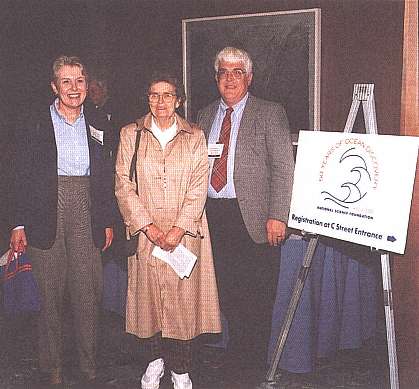
Several retired NSF ocean science staff and former rotators participated in the symposium. The bottom photo shows Sandra Toye (left), Jennieve Gillooly (middle), and John Morrison (right).
Suggested Citation: "Supplementary Pictures." National Research Council. 2000. 50 Years of Ocean Discovery: National Science Foundation 1950-2000. Washington, DC: The National Academies Press. doi: 10.17226/9702.

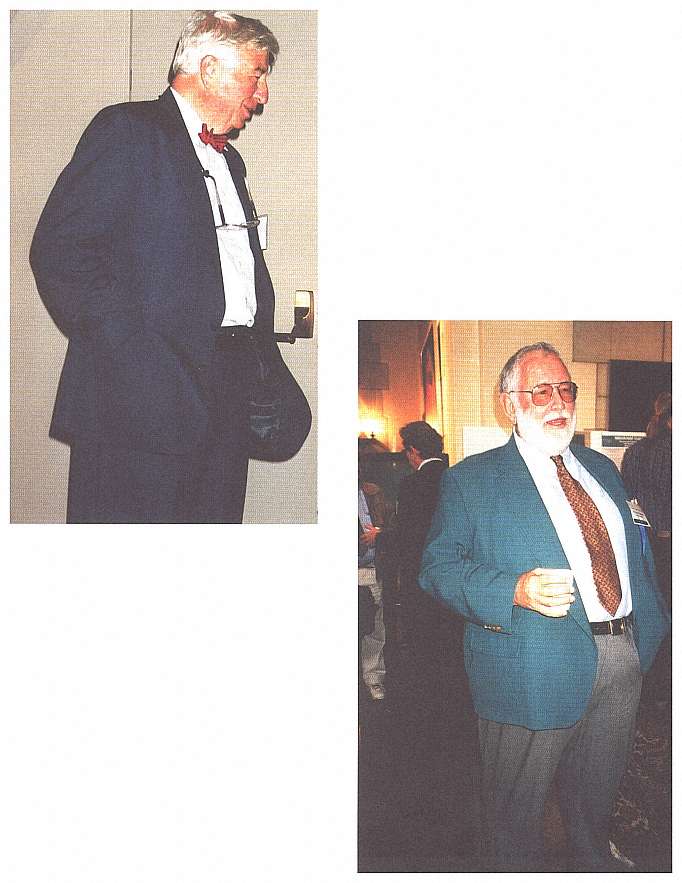
PLATE 9 John Knauss (left) and Dick Barber (below) gave the first two presentations of the symposium. Both have been influential in ocean science and policy over the past decades.

Suggested Citation: "Supplementary Pictures." National Research Council. 2000. 50 Years of Ocean Discovery: National Science Foundation 1950-2000. Washington, DC: The National Academies Press. doi: 10.17226/9702.

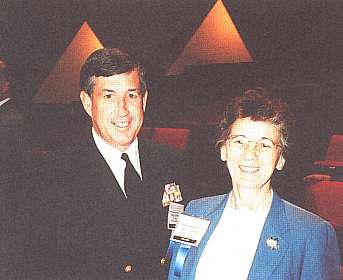
PLATE 10 RADM Paul Gaffney (Chief of Naval Research) and Dr. Rita Colwell (Director of the National Science Foundation) were among the agency heads who closed the symposium with their thoughts about the future of ocean sciences in the United States.
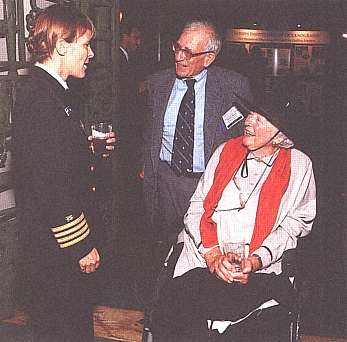
Capt. Diann Lynn (left) speaks with Walter and Judith Munk during one of the breaks.
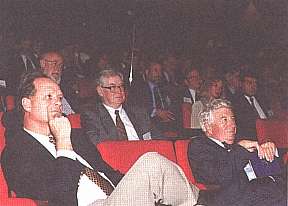
The audience listens as Sandra Toye introduces the featured speaker of the symposium, Dr. Robert Ballard (President of the Institute for Exploration in Mystic, Connecticut). Dr. Ballard and Dr. John Knauss are seated in the front row.

Suggested Citation: "Supplementary Pictures." National Research Council. 2000. 50 Years of Ocean Discovery: National Science Foundation 1950-2000. Washington, DC: The National Academies Press. doi: 10.17226/9702.
Page 271
Suggested Citation: "Supplementary Pictures." National Research Council. 2000. 50 Years of Ocean Discovery: National Science Foundation 1950-2000. Washington, DC: The National Academies Press. doi: 10.17226/9702.
Page 272
Suggested Citation: "Supplementary Pictures." National Research Council. 2000. 50 Years of Ocean Discovery: National Science Foundation 1950-2000. Washington, DC: The National Academies Press. doi: 10.17226/9702.
Page 273
Suggested Citation: "Supplementary Pictures." National Research Council. 2000. 50 Years of Ocean Discovery: National Science Foundation 1950-2000. Washington, DC: The National Academies Press. doi: 10.17226/9702.
Page 274
Suggested Citation: "Supplementary Pictures." National Research Council. 2000. 50 Years of Ocean Discovery: National Science Foundation 1950-2000. Washington, DC: The National Academies Press. doi: 10.17226/9702.
Page 275
Suggested Citation: "Supplementary Pictures." National Research Council. 2000. 50 Years of Ocean Discovery: National Science Foundation 1950-2000. Washington, DC: The National Academies Press. doi: 10.17226/9702.
Page 276
Suggested Citation: "Supplementary Pictures." National Research Council. 2000. 50 Years of Ocean Discovery: National Science Foundation 1950-2000. Washington, DC: The National Academies Press. doi: 10.17226/9702.
Page 277
Suggested Citation: "Supplementary Pictures." National Research Council. 2000. 50 Years of Ocean Discovery: National Science Foundation 1950-2000. Washington, DC: The National Academies Press. doi: 10.17226/9702.
Page 278
Subscribe to Email from the National Academies
Keep up with all of the activities, publications, and events by subscribing to free updates by email.