Previous Chapter: Appendix B Database Descriptions
Suggested Citation: "Appendix C Signaling Pathways." National Research Council. 2000. Scientific Frontiers in Developmental Toxicology and Risk Assessment. Washington, DC: The National Academies Press. doi: 10.17226/9871.

Appendix C
Signaling Pathways

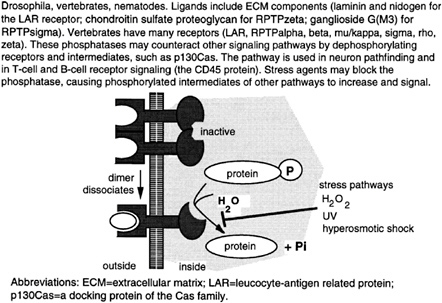
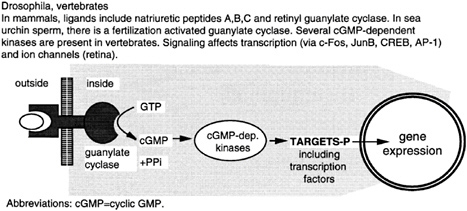
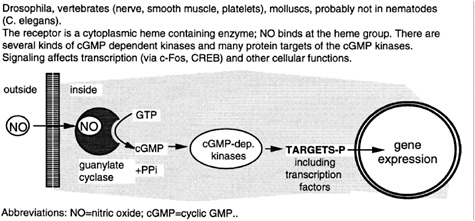
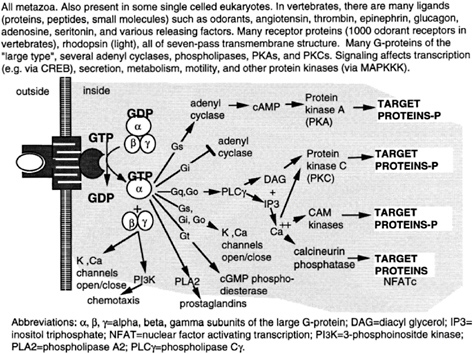
Seventeen intercellular signal transduction pathways are currently known with regard to the identity of their ligands, transduction intermediates, kinases, and targets. These are illustrated in Panels 1-17. Several were discovered in the course of the analysis of developmental mutants of Drosophila. Since no new mutant has been discovered recently in the continuing analysis of mutants, it is expected that most are already known. Pathways 1-6 are used extensively in early development, for example, axis specification and germ layer formation, as well as later. Pathways 7-10 are used in later development, including organogenesis and tissue renewal. Pathways 11-17 are used extensively in the physiological function of differentiated cells of the fetus, juvenile, and adult.

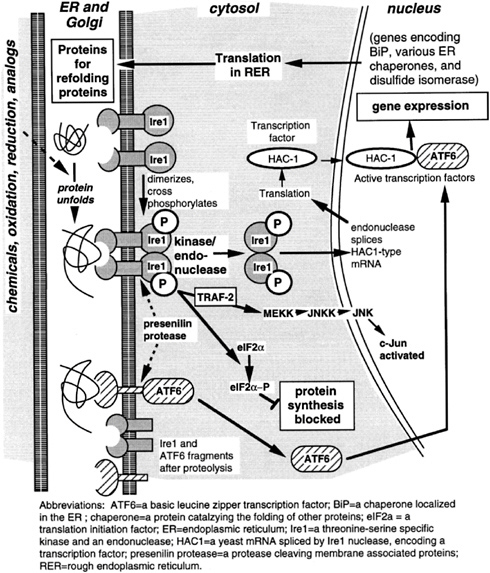
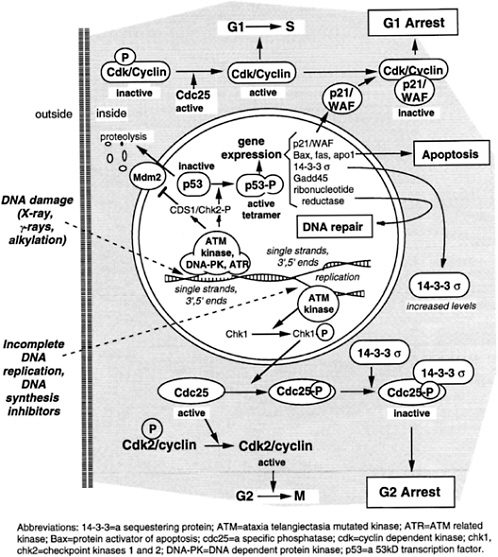
Approximately twelve intracellular pathways of checkpoint controls and molecular stress responses are currently known. Three are illustrated in Panels 18 and 19, and several are listed in Table 6-7. Panel 18 shows the ER-Golgi unfolded protein response, a molecular stress response of the cell to various chemical (e.g., ethanol, dithiothreitol) or physical (e.g. heat) conditions that lead to loss of function by protein unfolding (“denaturation”). The response leads to increased chaperone protein levels in the ER and Golgi, which increase refolding and restore function. The pathway also acts as a G1/S checkpoint control when naturally unstable proteins are produced. Panel 19 shows the p53 related stress response to DNA damage (genotoxic stress) leading to G1/S or G2/M arrest until repair is completed (upper half of panel). The pathway also acts as a checkpoint control monitoring DNA synthesis, imposing G2/M arrest until it is finished, via phosphorylation of the cdc25 phosphatase (lower half of panel).
Suggested Citation: "Appendix C Signaling Pathways." National Research Council. 2000. Scientific Frontiers in Developmental Toxicology and Risk Assessment. Washington, DC: The National Academies Press. doi: 10.17226/9871.

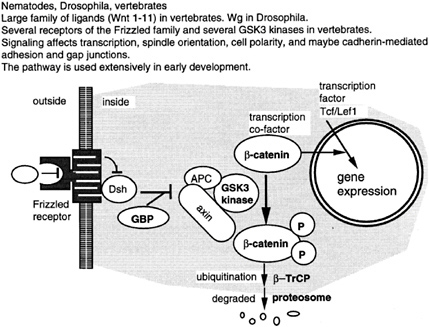
1A. Wnt pathway via β–catenin

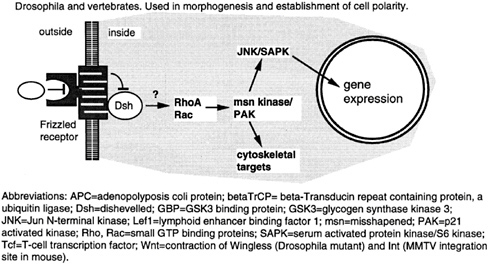
1B. Wnt pathway via JNK (planar cell polarity pathway)

Suggested Citation: "Appendix C Signaling Pathways." National Research Council. 2000. Scientific Frontiers in Developmental Toxicology and Risk Assessment. Washington, DC: The National Academies Press. doi: 10.17226/9871.

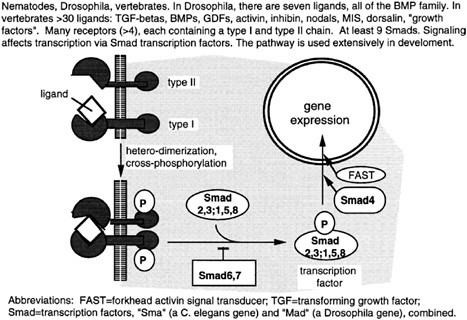
2. Receptor serine/threonine kinase (TGF-β receptor) pathway

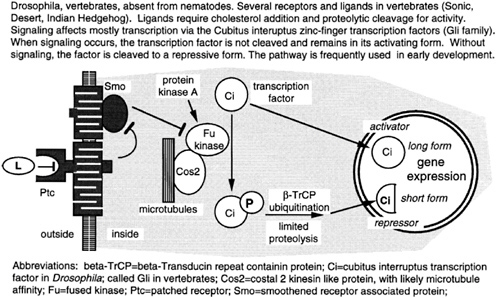
3. Hedgehog pathway (Patched receptor protein)

Suggested Citation: "Appendix C Signaling Pathways." National Research Council. 2000. Scientific Frontiers in Developmental Toxicology and Risk Assessment. Washington, DC: The National Academies Press. doi: 10.17226/9871.

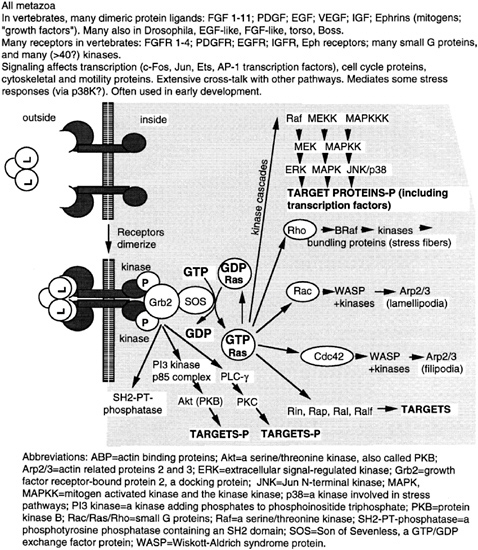
4. Receptor tyrosine kinase pathway (small G-protein [Ras] linked)

Suggested Citation: "Appendix C Signaling Pathways." National Research Council. 2000. Scientific Frontiers in Developmental Toxicology and Risk Assessment. Washington, DC: The National Academies Press. doi: 10.17226/9871.

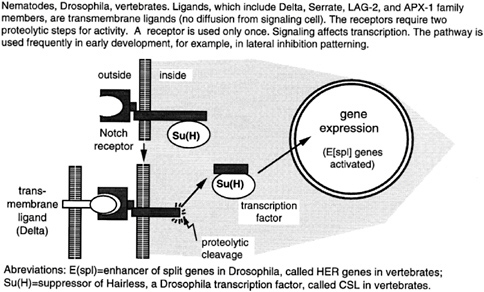
5. Notch-Delta pathway

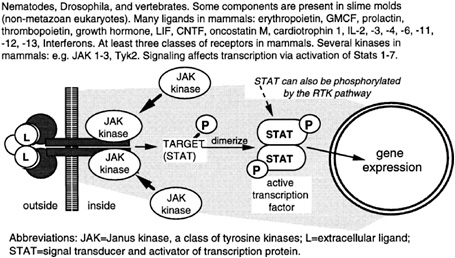
6. Receptor-linked cytoplasmic tyrosine kinase (cytokine) pathway

Suggested Citation: "Appendix C Signaling Pathways." National Research Council. 2000. Scientific Frontiers in Developmental Toxicology and Risk Assessment. Washington, DC: The National Academies Press. doi: 10.17226/9871.

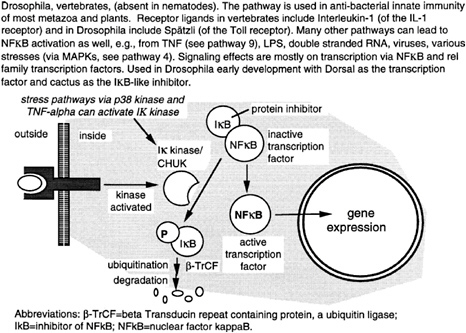
7. IL1froll receptor; NF-kappaB pathway

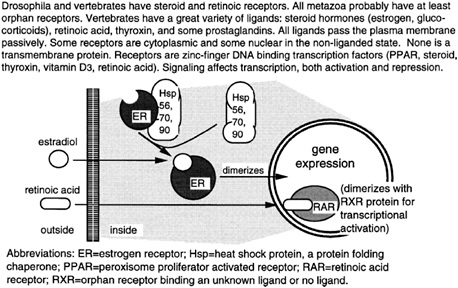
8. Nuclear hormone receptor pathway

Suggested Citation: "Appendix C Signaling Pathways." National Research Council. 2000. Scientific Frontiers in Developmental Toxicology and Risk Assessment. Washington, DC: The National Academies Press. doi: 10.17226/9871.

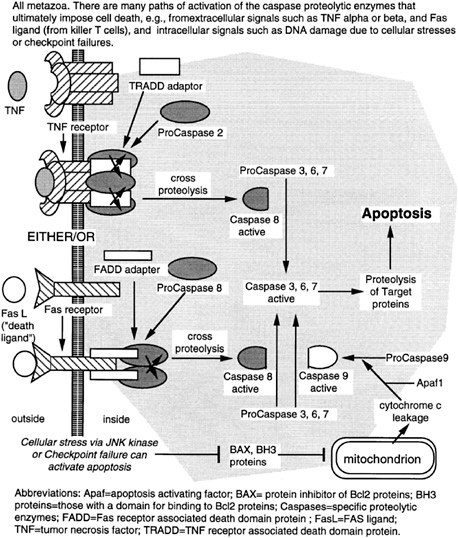
9. Apoptosis pathway (cell death pathway)

Suggested Citation: "Appendix C Signaling Pathways." National Research Council. 2000. Scientific Frontiers in Developmental Toxicology and Risk Assessment. Washington, DC: The National Academies Press. doi: 10.17226/9871.

10. Receptor protein tyrosine phosphatase (RPTPs) pathway

11. Receptor guanylate cyclase pathway

Suggested Citation: "Appendix C Signaling Pathways." National Research Council. 2000. Scientific Frontiers in Developmental Toxicology and Risk Assessment. Washington, DC: The National Academies Press. doi: 10.17226/9871.

12. Nitric oxide receptor pathway

13. G-protein coupled receptor (large G-protein) pathway

Suggested Citation: "Appendix C Signaling Pathways." National Research Council. 2000. Scientific Frontiers in Developmental Toxicology and Risk Assessment. Washington, DC: The National Academies Press. doi: 10.17226/9871.

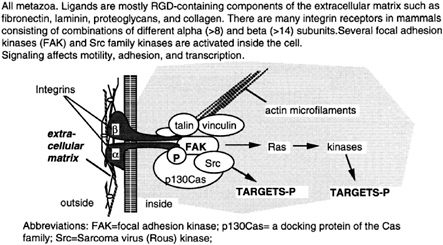
14. Integrin pathway

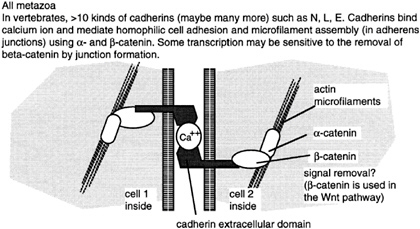
15. Cadherin pathway

Suggested Citation: "Appendix C Signaling Pathways." National Research Council. 2000. Scientific Frontiers in Developmental Toxicology and Risk Assessment. Washington, DC: The National Academies Press. doi: 10.17226/9871.

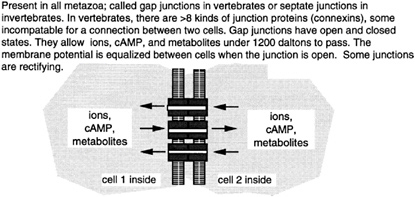
16. Gap junction pathway

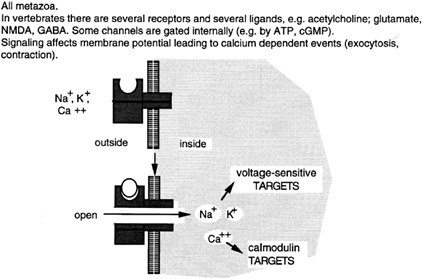
17. Ligand-gated cation channel pathway

Suggested Citation: "Appendix C Signaling Pathways." National Research Council. 2000. Scientific Frontiers in Developmental Toxicology and Risk Assessment. Washington, DC: The National Academies Press. doi: 10.17226/9871.

18. A stress response: The unfolded protein response (UPR)

Suggested Citation: "Appendix C Signaling Pathways." National Research Council. 2000. Scientific Frontiers in Developmental Toxicology and Risk Assessment. Washington, DC: The National Academies Press. doi: 10.17226/9871.

19. Stress responses and checkpoints for DNA damage and replication.

Suggested Citation: "Appendix C Signaling Pathways." National Research Council. 2000. Scientific Frontiers in Developmental Toxicology and Risk Assessment. Washington, DC: The National Academies Press. doi: 10.17226/9871.
Page 296
Suggested Citation: "Appendix C Signaling Pathways." National Research Council. 2000. Scientific Frontiers in Developmental Toxicology and Risk Assessment. Washington, DC: The National Academies Press. doi: 10.17226/9871.
Page 297
Suggested Citation: "Appendix C Signaling Pathways." National Research Council. 2000. Scientific Frontiers in Developmental Toxicology and Risk Assessment. Washington, DC: The National Academies Press. doi: 10.17226/9871.
Page 298
Suggested Citation: "Appendix C Signaling Pathways." National Research Council. 2000. Scientific Frontiers in Developmental Toxicology and Risk Assessment. Washington, DC: The National Academies Press. doi: 10.17226/9871.
Page 299
Suggested Citation: "Appendix C Signaling Pathways." National Research Council. 2000. Scientific Frontiers in Developmental Toxicology and Risk Assessment. Washington, DC: The National Academies Press. doi: 10.17226/9871.
Page 300
Suggested Citation: "Appendix C Signaling Pathways." National Research Council. 2000. Scientific Frontiers in Developmental Toxicology and Risk Assessment. Washington, DC: The National Academies Press. doi: 10.17226/9871.
Page 301
Suggested Citation: "Appendix C Signaling Pathways." National Research Council. 2000. Scientific Frontiers in Developmental Toxicology and Risk Assessment. Washington, DC: The National Academies Press. doi: 10.17226/9871.
Page 302
Suggested Citation: "Appendix C Signaling Pathways." National Research Council. 2000. Scientific Frontiers in Developmental Toxicology and Risk Assessment. Washington, DC: The National Academies Press. doi: 10.17226/9871.
Page 303
Suggested Citation: "Appendix C Signaling Pathways." National Research Council. 2000. Scientific Frontiers in Developmental Toxicology and Risk Assessment. Washington, DC: The National Academies Press. doi: 10.17226/9871.
Page 304
Suggested Citation: "Appendix C Signaling Pathways." National Research Council. 2000. Scientific Frontiers in Developmental Toxicology and Risk Assessment. Washington, DC: The National Academies Press. doi: 10.17226/9871.
Page 305
Suggested Citation: "Appendix C Signaling Pathways." National Research Council. 2000. Scientific Frontiers in Developmental Toxicology and Risk Assessment. Washington, DC: The National Academies Press. doi: 10.17226/9871.
Page 306
Suggested Citation: "Appendix C Signaling Pathways." National Research Council. 2000. Scientific Frontiers in Developmental Toxicology and Risk Assessment. Washington, DC: The National Academies Press. doi: 10.17226/9871.
Page 307
Suggested Citation: "Appendix C Signaling Pathways." National Research Council. 2000. Scientific Frontiers in Developmental Toxicology and Risk Assessment. Washington, DC: The National Academies Press. doi: 10.17226/9871.
Page 308
Next Chapter: Appendix D Biographical Information on the Committee on Developmental Toxicology
Subscribe to Emails from the National Academies
Stay up to date on activities, publications, and events by subscribing to email updates.