Dietary Patterns to Prevent and Manage Diet-Related Disease Across the Lifespan: Proceedings of a Workshop (2024)
Chapter: 2 Setting the Stage on Dietary Patterns and Chronic Disease
2
Setting the Stage on Dietary Patterns and Chronic Disease
The speakers in the first session, moderated by Cindy Davis, U.S. Department of Agriculture, reviewed historical methods for assessing dietary patterns and discussed the potential for using more dynamic methods to better characterize a healthy dietary trajectory across the life course. Speakers also examined potential dietary biomarkers, reviewed the evidence connecting diet to chronic disease, and shared an evolutionary biology perspective on the developmental origins of health and disease.
DIETARY PATTERN ASSESSMENT ACROSS THE LIFE COURSE
Jill Reedy, National Institutes of Health, began by reviewing use of the evidence base generated from analyses of single nutrients to determine the relationship between diet and health outcomes. She characterized this as a reductionist approach, however, as nutrients and foods are seldom eaten in isolation, and there are many potential synergies among dietary components. Therefore, she suggested, an alternative, integrative approach would consider the effects of whole eating patterns. She recounted efforts over the past decade to synthesize evidence, define dietary patterns, advance assessment methods, and draft frameworks for studying the food supply at all levels. Specifically, she said, researchers have been considering how best to conceptualize diet as a multidimensional behavior and exposure.
According to Reedy, this shift began when the 2010 Dietary Guidelines for Americans (DGA) report drew attention to dietary patterns; however, she said, the committee found it difficult to draw conclusions about the role of dietary patterns in health outcomes because of varying analytical
approaches, which typically fall into three categories: data driven (such as factor analysis and cluster analysis), investigator driven (such as diet quality index scores), and hybrid (such as reduced-rank regression). In 2012, the International Conference on Diet and Activity Methods focused on how to advance the assessment of dietary patterns. Reedy pointed out that most research to this point had focused on the single dimension of what food is eaten. The draft framework developed by the conference encompassed multiple layers across the food supply, capturing not only what is eaten but also when, where, why, and how. Reedy explained that at this time, researchers became increasingly aware that individuals cannot be expected to make healthy choices if those options are not readily available.
Subsequently, Reedy continued, the Dietary Patterns Methods Project was established, with the goal of strengthening evidence and establishing a systematic method for analyzing dietary patterns ahead of the forthcoming revision of the DGA. Working with various large cohorts to achieve sufficient power, researchers found common underlying constructs across four selected indices: the Healthy Eating Index (HEI), the Alternative HEI, the Alternate Mediterranean Diet Score, and the Dietary Approaches to Stop Hypertension (DASH) score. Despite differences in methods, dietary components examined, and scoring approaches, Reedy said, the researchers found that higher diet quality was associated with lower mortality across three distinct cohorts and all four indices (Liese et al., 2015). This study therefore showed that there are multiple ways to eat a healthy diet and provided an opportunity to use dietary patterns to inform policy makers and guideline developers.
In 2015, Reedy reported, the Dietary Guidelines Advisory Committee used dietary patterns as the core of its conceptual model and framed its findings accordingly, while also noting that the components of an overall diet may have synergistic and cumulative effects on health and disease. According to Reedy, this shift in thinking was pivotal in influencing how the DGA would be framed going forward. The focus of subsequent committee deliberations began to shift from simply tracking what food components are being eaten to considering eating frequency and time-restricted eating. The recommendations of the most recent DGA are presented by life stage and include discussion of a healthy eating trajectory, she added. There is great interest in this idea of a healthy eating trajectory across the life course, she noted, and she displayed a figure showing dietary trajectories through different life-course stages (Figure 2-1), a perspective that helps identify target points for intervention and how they might be used in models with healthy outcomes. To this point, for example, the HEI originally covered only ages 2 years and older, but it now includes ages 12 to 23 months, providing new considerations for the early stage of healthy eating. The first 2 years of life is a period of rapid growth and development, Reedy observed,
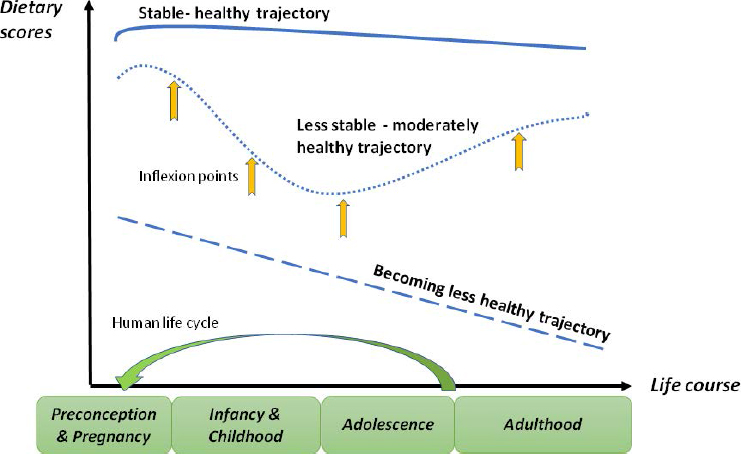
SOURCES: Presented by Jill Reedy on August 15, 2023, from Chong, 2022. Reprinted with permission from Cambridge University Press.
so thinking about how to conceptualize and assess dietary intake in this stage is an important opportunity.
Reedy shared another way to visualize and assess dietary patterns by considering different components that underlie a total score and using that information in modeling. Figure 2-2, based on data from the National Health and Nutrition Examination Survey, 2011–2018, shows 13 components depicted on a spider web graph, plotted along its axis as a percentage of its maximum points, from 0 to 100 percent. She explained that a perfect score reflects optimal alignment with recommendations, with intake of components recommended for moderate consumption (saturated fats, added sugars, sodium, and refined grains) being low and intake of all other components being high. For toddlers aged 12 to 23 months, she elaborated, the score was higher for components such as total and whole fruits, dairy foods, and total protein foods, but lower for whole grains and total vegetables. The scores continued to decrease for each adolescent age group. For adults, the 19- to 59-year-old group had suboptimal scores, but a slight increase was observed for the age 60 and older group.
Lastly, Reedy presented a case study for the first 6 months of life, assessing the recommendation to feed infants exclusively human milk (or formula when human milk is unavailable) and exploring ways to answer questions of what, when, where, why, and who. Many surveys are not
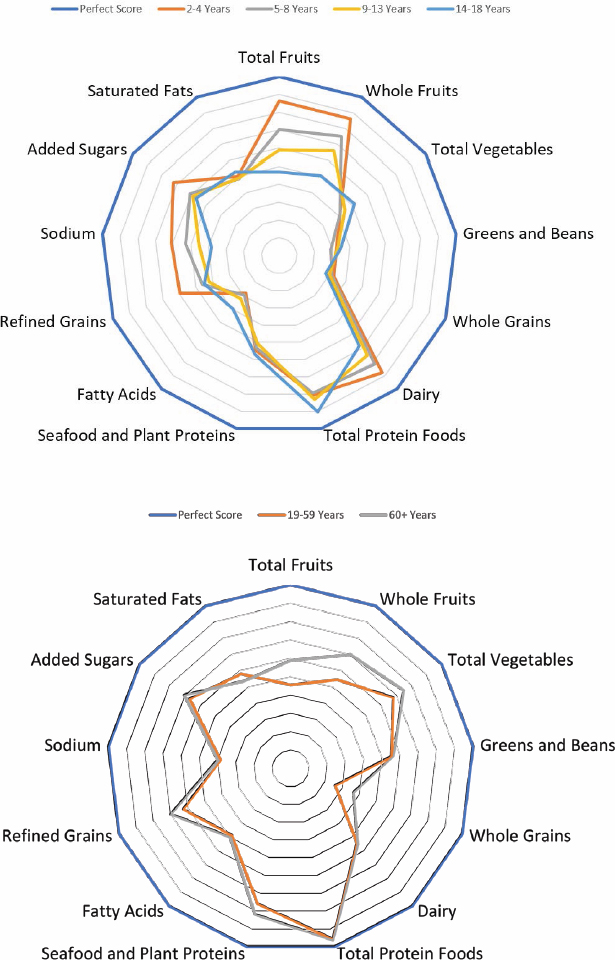
SOURCES: Presented by Jill Reedy on August 15, 2023, data from Herrick et al., 2023; Lerman et al., 2023; Pannucci et al., 2023; and Shams-White et al., 2023.
asking these questions, she said, even though they have the tools to do so. The questions are relevant in all life stages, she observed, but this context is even more important for children in the first 2 years of life. While much of the work in nutrition has focused historically on optimizing nutrients as the primary exposure, she stressed the potential of incorporating other data layers, such as temporal eating patterns; behavioral factors, which can be captured using innovative technology; and geospatial coding.
In summary, Reedy highlighted opportunities and challenges to consider when measuring and modeling the multiple dimensions of dietary patterns at different life stages. She gave the examples of using a shared conceptual framework across research questions, developing methods and models that fully capture total dietary patterns at different life stages, considering the timing and frequency of dietary patterns, and applying systems-oriented approaches that take into account measures of related exposures and their interactions within the context of dietary patterns.
BEYOND TRADITIONAL NUTRITION MARKERS FOR ASSESSING DIETARY QUALITY AND CHRONIC DISEASE RISK
The human diet is an extremely complex exposure, said Johanna Lampe, Fred Hutchinson Cancer Center, and when it comes to understanding the effects of diet on chronic disease, it is necessary to think about the totality of diet. The simpler dietary assessment instruments are, the more potential there is for bias and inaccuracies in measurement, she added, so more approaches are needed to help objectively capture dietary intake. Lampe pointed to dietary biomarkers as a way to provide a more objective evaluation of exposure to nutrients and dietary constituents, validate dietary assessments, calibrate dietary intake data, and establish biological links. Complementing the development of dietary biomarkers over the past decades, she observed, has been the development of -omics technologies, which allow analysis of up to thousands of compounds in a biologic sample, even making it possible to look at the impact of diet on the microbiome.
Lampe shared some examples of applications of dietary pattern biomarkers to illustrate approaches being used and opportunities for their expansion. She focused mainly on studies of standardized dietary patterns with the goal of evaluating the association between dietary patterns and biomarkers. First, she reviewed work from the American Cancer Society looking at a serum untargeted metabolomic profile in a cancer prevention cohort (McCullough et al., 2019). The researchers found varying metabolites, and the different diet pattern indices used also showed differences in the kinds of metabolites captured. For example, the HEI captured several phytochemicals (labeled as xenobiotics) found in various foods. However, Lampe explained, many metabolites have yet to be identified in these
untargeted metabolomics platforms, so gaps in knowledge persist as to what compounds help define different diet scores. She added that, looking at predicting adherence to a healthy dietary pattern, these researchers found that just having data on more metabolites is not necessarily better for prediction; in some cases, data on just one or two metabolites can be as useful for predicting adherence as having data on all of them available.
The gut microbiome is also emerging as a way to monitor diet quality, Lampe continued, as there is an association between diet quality and fecal microbial diversity: greater diversity is typically a marker of a healthy microbiome and is often achieved through higher fruit and vegetable intake. Most analyses characterizing gut microbial activity are conducted using stool samples, she pointed out, characterizing this as a limitation of the technology currently available. One study evaluating gut microbial community structure in relation to adherence to the HEI-2010 showed significant differences between the lowest and highest tertiles of HEI scores (Maskarinec et al., 2019). According to Lampe, several groups of bacteria associated with adherence to the HEI-2010 diet were involved in fiber fermentation. The researchers evaluated a spider plot depicting the 12 component scores of the HEI-2010 (see Figure 2-3) and found that the intake of particular subsets of fruit and vegetables was the major contributor to differences in
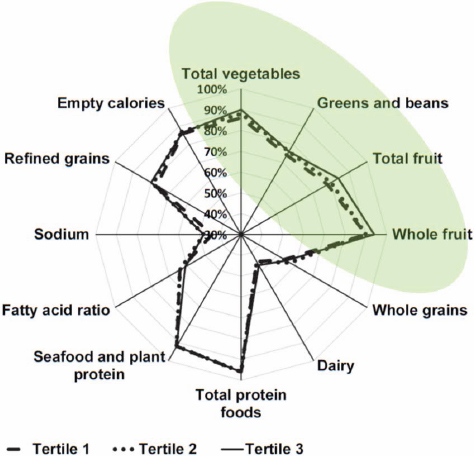
SOURCES: Presented by Johanna Lampe on August 15, 2023, from Maskarinec et al., 2019. Reprinted with permission from Elsevier.
the alpha diversity of the microbiome, with little effect being due to refined grains and other components on the plot. Lampe added that other studies have also supported the finding that healthy dietary patterns are associated with an abundance of fiber-fermenting microbes (Peters et al., 2023).
Lampe went on to describe another approach to looking at biomarkers and diet quality—the use of controlled interventions. She cited an analysis comparing the DASH diet against two other diets in a controlled feeding study. The researchers found that multiple metabolites appeared on the metabolomics platform, including many lipid compounds, which were substantially different across diets (Rebholz et al., 2018). Lampe cautioned, however, that taking this analysis to the next level of application to observational studies is complicated and biomarkers cannot necessarily be generalized from a controlled feeding study to the broader food intake of a general population.
Shifting to another approach to biomarker discovery, Lampe discussed work on developing new dietary biomarkers through the Nutrition and Physical Activity Feeding Study. Unlike studies in which all participants consume the same food, the researchers in this study provided each woman with food that resembled her usual diet. The initial step, Lampe explained, was to demonstrate proof of concept and determine whether this study design could elucidate a relationship between serum measures of certain nutrients and the actual intake of those nutrients in the feeding study (Lampe et al., 2017). She reported that robust associations were found between nutrients and their biomarkers, and this finding is now being applied to dietary patterns (Neuhouser et al., 2021). As another example, Lampe referenced a collaboration between researchers studying two different populations. In the Spanish PREDIMED trial, participants’ adherence to the Mediterranean diet was associated with a metabolomic signature of 67 metabolites. These metabolites were then shown to independently predict cardiovascular disease risk in the Harvard U.S. Nurses’ Health Studies I and II and Health Professionals Follow-up Study (Li et al., 2020).
In summary, Lampe pointed to the variety of -omics approaches that have emerged over the past several decades that can be applied to dietary patterns and diet quality. The most progress, she noted, has been realized in metabolomics biomarkers in blood and urine as objective measures of dietary intake. She added, however, that gaps remain with respect to replication with more ethnically diverse populations, and longitudinal studies examining biomarkers in the context of chronic disease progression.
REVIEW OF THE EVIDENCE ON DIETARY PATTERNS AND CHRONIC DISEASE ACROSS THE LIFESPAN
Edward L. Giovannucci, Harvard University, began by reviewing the three main approaches for evaluating dietary patterns: use of indices or
scores based on prior knowledge, empirical analysis based on dietary data, and the hypothesis-oriented approach. For the available indices, he pointed to the frequent overlap among dietary patterns, but he noted that the indices do differ in how they treat certain items. Turning to the empirical method, he explained that it typically involves a principal component analysis. With this method, he observed, there is general concordance in the derived dietary patterns across diverse countries, although some differences exist based on culture or availability of items (e.g., prevalence of sugar-sweetened beverages). Finally, he elaborated on the hypothesis approach, which entails selecting biomarkers and then examining the diet to see what foods predict those biomarkers. He noted that some of the biomarkers studied this way, such as low-density lipoprotein cholesterol, have proven to be strong predictors, but that further studies of this method are needed for it to be more robust. As an example of an empirical or hybrid approach, he shared a study done with different cohorts in which C-peptide and inflammatory markers were selected as biomarkers. Overall, the results showed what might be expected of proinsulinemic and proinflammatory patterns. Giovannucci noted that there is also a fair amount of overlap between these two patterns, which makes sense as inflammation is a determinant of insulin resistance.
Giovannucci went on to state that researchers study dietary patterns for multiple reasons, such as an improved ability to identify additive and synergistic effects of individual nutrients or foods. Moreover, he said, studying an overall dietary pattern inherently accounts for substitution of foods and reduces the problem of confounding seen in many nutritional studies. According to Giovannucci, focusing on individual foods can exaggerate beneficial effects of specific items while ignoring those foods that may have a deleterious effect on health, so defining the overall dietary pattern is more likely to provide a realistic estimate of the potential effect of the diet on chronic disease. The bottom line, he observed, is identifying shared attributes among different dietary patterns and seeing how they relate to major chronic diseases. Giovannucci shared some recent results of a study in this area comparing eight different dietary patterns. The researchers found that the Alternative HEI, the Mediterranean diet, a plant-based diet, a diabetes risk-reduction pattern, and the DASH diet were all strongly protective, being associated with an up to 24 percent reduction in risk of chronic disease (Wang et al., 2023). Giovannucci added that several of the diets were quite similar in their risk reduction.
In conclusion, Giovannucci observed that there are different pathways for disease and that there is clearly much overlap in dietary patterns. He identified three factors involved in predicting disease: the strength of the association between a diet and a particular intermediate, the importance of the intermediate with the specific disease, and the relative importance of the
disease. The key message, he suggested, is that dietary patterns represent a useful approach for research and public health messaging, and multiple varied approaches to assessing these patterns have been shown to converge on consistent dietary factors in disease.
DEVELOPMENTAL ORIGINS OF CHRONIC DISEASE AND THE INFLUENCE OF DIET
Robert Waterland, Baylor College of Medicine, highlighted his laboratory’s recent discovery that the entire field of epigenetic epidemiology has a major problem affecting its work, and that this problem extends to work toward understanding the developmental origins of health and disease (DOHaD). He shared a magazine cover story from 1999 about how the odds of obesity, cancer, and heart attack are determined when an individual is still in the womb. This phenomenon refers to a paradigm postulating that during critical periods of development, nutrients and other environmental stimuli can affect developmental pathways and have a permanent effect on chronic disease risk. Waterland added that this kind of metabolic imprinting can be thought of as adaptive responses to early nutrition (Waterland and Garza, 1999).
According to Waterland, one potential mechanism explaining the lifelong persistence of metabolic imprinting is epigenetics, defined as the study of mitotically heritable, stable alterations in gene expression potential not caused by changes in DNA sequence. As the best example of this, he cited cell type–specific gene expression potential. Essentially all cells in the human body contain the same DNA (one’s entire genome), he elaborated, but different cell types express different subsets of those genes, as established during early development—so some cells become skin cells and others become eye cells, for example. Waterland then framed most of his remarks around an exception to this phenomenon: systemic interindividual epigenetic variation—in which differences are seen among individuals but few differences among different cell types or tissues within each individual.
To understand epigenetic etiology from a DOHaD perspective, Waterland continued, it helps to consider a two-step causal pathway: first, an early environmental exposure during a critical period of development must induce an epigenetic change; then, this change must persist into later life to influence risk of some disease. Waterland described how 20 years ago, in an animal model example, his group demonstrated such a pathway for the first time by showing that methyl donor supplementation of female mice before and during pregnancy permanently increased DNA methylation (an epigenetic mark) at the agouti viable yellow locus in their offspring, causing a shift in their coat color toward brown (Waterland and Jirtle, 2003). Motivated by such animal studies, the researchers set out to see whether they
could identify metastable epialleles in humans based on their characteristic systemic interindividual variation in DNA methylation. They identified putative metastable epialleles, and through a collaboration in The Gambia found that season of conception (a proxy for maternal nutritional status) influences the establishment of DNA methylation at these loci. Specifically, Waterland elaborated, children conceived in the rainy season tended to have higher methylation at candidate metastable epialleles compared with those conceived in the dry season (Waterland et al., 2010). Another study showed this finding was indeed related to variation in maternal nutritional status around the time of conception (Dominguez-Salas et al., 2014). Essentially, Waterland summarized, early nutrition has an important influence on the establishment of these persistent methylation marks in humans.
With all the collective work in this area from his and other groups, Waterland said it is now clear that these metastable epiallele regions are an obvious place to focus. He explained that testing the second step in the two-step causal pathway—associations among these induced epigenetic changes and risk of later disease—is epigenetic epidemiology. He cautioned, however, that epigenetic epidemiology is much more complicated than genetic epidemiology. He identified one problem as reverse causality—even if epigenetic differences are seen between individuals with and without disease, it can be difficult to determine whether these are a cause or consequence of the disease. According to Waterland, the newest obstacle confronting the field (the “major problem” he referred to in his introduction) is that epigenetic epidemiologists have, for more than a decade, standardized to using Illumina methylation arrays; however, more than 95 percent of the methylation sites interrogated by these arrays show negligible interindividual variation in normal somatic tissue (Gunasekara et al., 2023). Without interindividual variation, he stressed, it is impossible to detect population-level associations (Gunasekara and Waterland, 2019).
Waterland asserted that this problem influences nearly every study in the field, as the Illumina arrays have for more than 10 years been the default tool for epigenetic epidemiology. The problem came to his group’s attention following a large screening study in 2019 that identified nearly 10,000 correlated regions of systemic interindividual epigenetic variation (CoRSIVs) (Gunasekara et al., 2019). Waterland explained that metastable epialleles are a subset of CoRSIVs. His group also showed that, although strongly genetically determined, CoRSIVs (not just metastable epialleles) exhibit sensitivity to periconceptional nutrition. Waterland firmly believes that, given the systemic nature of their interindividual variation and their sensitivity to periconceptional environment, a focus on CoRSIVs will greatly improve the ability to detect associations with disease, and called for a fresh start in the field of epigenetic epidemiology.
DISCUSSION
A participant asked about key scientific gaps and areas for improving understanding of the relationship between different food components and dietary patterns and risk of chronic disease. Reedy pointed to opportunities offered by the healthy eating trajectory and how it might be modeled. She noted that historically, the field has looked at this dynamic phenomenon in a static way, and that time-varying models across the life course show promise. Lampe asserted that having enough variation in intake of a food within a study population is critical for understanding that food’s impact on risk of disease. “If we don’t see a relationship,” she asked, “is it because no one is eating a certain food or because they are all eating the same amount?” Giovannucci highlighted the challenge of balancing whether to group items together or study them individually in research, citing the nutritional component differences among many fruits and vegetables. Finally, Waterland offered that it is important to focus on dietary patterns in women before and during early pregnancy, as those choices have the potential to influence, for life, the function of every cell in her child’s body.
Another participant emphasized the need to look at diet within the total context of behavioral variables, such as exercise and energy expenditure. Giovannucci pointed to the many overlapping and sometimes redundant pathways involved. Looking at insulin and inflammatory patterns, for example, someone who is inactive and has excess weight tends to also be insulin resistant, so diet is even more important for that individual. Reedy added that it will always be important to embed the HEI or some other pattern within the broader context of other modifiable risk factors. She also highlighted the opportunity to make models that measure dietary patterns nimbler and more nuanced, perhaps by looking upstream and considering how various social determinants of health influence risk factors.
This page intentionally left blank.


