Planning and Operations Initiatives to Support Nighttime Transit Ridership (2025)
Chapter: 4 Case Examples

CHAPTER 4
Case Examples
This chapter highlights the key takeaways of case examples with a sample of transit agencies with initiatives to support nighttime transit ridership and economy. Table 4 includes overview information about each case example selected, including agency name, location, and the area of focus. The following sections contain information about the efforts undertaken, including key challenges, notable practices, and lessons learned from each transit agency or case example.
Additional desktop reviews and interviews with key planning staff from transit agencies were conducted to develop the case examples. The transit agencies profiled in this section were determined by criteria including, but not limited to, geographic setting, pre- and post-pandemic ridership, transit modes offered, agency staff size, nightlife visibility (e.g., Las Vegas, New York
Focus |
Agency |
City |
Service Area |
Nighttime |
|---|---|---|---|---|
INTERVIEWED AGENCIES |
||||
Safety |
Valley Metro |
Phoenix, AZ |
500,220 |
|
Operational Solutions |
San Francisco Municipal Transportation Authority (Muni) |
San Francisco, CA |
842,754 |
|
Resources |
City of Dekalb |
Dekalb, IL |
50,091 |
|
Ridership Patterns and Recovery |
RTC Southern Nevada |
Las Vegas, NV |
2,265,461 |
|
Partnerships |
Capital Metropolitan Agency (CapMetro) |
Austin, TX |
1,330,916 |
|
OTHER SELECTED AGENCIES |
||||
Safety |
TriMet |
Portland, OR |
1,558,315 |
|
Ridership Patterns and Recovery |
Greater Richmond Transportation Commission (GRTC) |
Richmond, VA |
452,319 |
|
City, New Orleans, Miami), average household income in the jurisdiction, and rate of in-person employment in the jurisdiction.
Seven candidate agencies were selected for potential interviews. Agencies were able to indicate interest in the agency survey to be contacted for a follow-up interview. The seven agencies were contacted via email, and five responded with interest in being interviewed (Table 4). One-hour interviews were conducted via virtual call between April 10 and April 26, 2024.
Safety
Agency Overview
Valley Metro is the umbrella public transportation brand for planning and transit operations within Maricopa County, AZ. The Valley Metro Regional Public Transportation Authority (RPTA) is a member-city agency that plans bus and paratransit service in the area, while Valley Metro Rail plans and operates rail services in the county (Figure 27). The agency operates all light rail and streetcar services independently and operates bus services jointly with 19 member cities in the Metro Phoenix area. Additionally, some member agencies fully plan and operate services under the Valley Metro brand umbrella. RPTA has a service area of 665 square miles and a service area population of approximately 2.9 million residents. In comparison, Valley Metro Railʼs service area is 45 square miles and 500,220 people. Light rail has the longest span of service; full service begins at 4:40 a.m. and ends at 12:00 a.m. on weekdays and Saturdays and from 5:00 a.m. to 11:00 p.m. on Sundays. Between 12:00 a.m. and 3:00 a.m., the light rail runs limited service that does not run to the end of the line. The Streetcar, which operates in Tempe, AZ, runs from 6:00 a.m. to 12:00 a.m. on weekdays and Saturdays and 8:00 a.m. to 12:00 a.m. on Sundays. The City of Phoenix runs the nighttime service of bus routes within its jurisdiction, and most buses in member cities run until 10:00 p.m., with nighttime service ending around 12:00 a.m.
Planning Approach
Regional funding is a large determinant of the availability and potential expansion of nighttime service in the area. The City of Phoenix had a robust network of transit services at night before

Long Description.
The flowchart consists of three sections. Section 1 begins with the Valley Metro Regional Public Transportation Authority (RPTA). It leads to two, Planning and Bus operations. Planning leads to 19 Member Citites' Service Areas. Bus operations lead to two, Intercity bus routes in Mesa, Chandler, and Tempe; Shared operations with the City of Phoenix. Section 2 begins with Valley Metro Rail and leads to Rail Operations in Chandler, Mesa, Phoenix, and Tempe. Section 3 begins with Member Cities and leads to Fully Planned and Operated Bus Service Branded as Valley Metro.
the COVID-19 pandemic. However, resource priorities and low productivity reduced nighttime service. Much of the transit funding for Maricopa County comes from a half-cent transportation sales tax levied by the county, which is set to be renewed by the state legislature with increased service productivity standards. While the sales tax provides a reliable source of funding for many agencies in the service area, the Valley Metro has limited resources to provide the services in demand. Even though there is a public interest in expanding nighttime service, especially to industrial parks, the lack of service productivity potential is a difficult obstacle to overcome for nighttime service expansion.
Other resources, such as the number of operators, capacity of maintenance facilities, and staff time, also play an important role in determining agency capacity for expanding post-COVID-19 pandemic nighttime service.
Implemented Safety Initiatives
Security Officers on Board
Because the light rail system is an open system without fare gates, the agency has a dedicated team of officers to check fares on board. These officers serve as fare enforcement, customer service, and security officers who can mitigate and report safety concerns. Though not specifically employed for nighttime service, the officers are on light rail cars during the entire service span. On buses within the service area, bus operators serve as primary security officers on the agency side. Because the bus system is so large, having security officers on all routes is unfeasible.
Tracking Incidents on Bus and Light Rail
The agency systematically tracks incidents on bus and light rail, including those that did not escalate to include local law enforcement. The agency stores incident data, ranging from vandalism to violent acts against riders and operators, in a central database. Incident reports include route information and the location of incidents. Although safety officers on light rail do not have arresting abilities, their constant presence and ability to report incidents to local law enforcement create more robust incident data than on bus services.
Using Data to Concentrate Safety Resources at Bus Hotspots
Beyond collecting incident data, the agency also analyzes crime and safety data in areas surrounding bus stops and routes to identify “hotspots.” Hotspots are clustering incidents that allow the agency to partner with local police departments to direct safety and security resources to specific areas with a record of reported incidents. Because criminal activity may spill over from hotspots to other nearby routes, police officers may be asked to ride along adjacent bus routes.
Real-Time Vehicle Locations on Transit Apps
The agency implemented real-time vehicle locations for users to reference on the Valley Metro app in 2021. Though not specifically targeted to increase nighttime safety, real-time information allows riders to know when buses will arrive, which allows for better trip planning at night and can improve perceptions of safety.
Key Challenges
Valley Metro encounters challenges that affect safety initiatives and expanding nighttime services. These include:
- Fractured jurisdictional cooperation. Because the light rail system and regional bus routes span multiple jurisdictions, Valley Metro must partner with different local police departments
- for law enforcement and arresting capabilities. Some police departments are more cooperative than others in establishing partnerships and prioritizing transit incidents. Further, responding to incidents of moving vehicles is especially challenging as the vehicle may move from one jurisdiction to another, complicating police dispatch.
- Securing resources and stable transit funding remains challenging to maintain and expand nighttime transit service. The Arizona State Legislature determines local transit funding in the Greater Phoenix area, and it can be difficult for jurisdictions that utilize state funding to make a case for expanding services, especially if there is an ideological divide between the local and state levels. Further, a ballot measure to renew the existing transportation tax in November 2024 will tie state transit funding to increasingly stringent productivity standards. Nighttime service tends to be less productive by typical measures. Thus, if funding for transit service is tied to ridership or other productivity measures, nighttime service will likely plateau or be reduced.
- Because Valley Metro plans service for a vast service area, it encompasses a variety of land uses. The region is experiencing growth, but there are still many remote areas outside city and town centers that are essentially undeveloped land. This remoteness creates challenges for installing safety infrastructure, such as lighting, at new stops. Plus, many existing bus stops with no infrastructure, such as shelters and benches, were grandfathered into the system.
- The fragmented road network in lower-density areas of the region is difficult to serve. In both industrial warehouse districts and suburban residential areas, the roads are circuitous and have poor walkability, making it difficult for buses to navigate and for riders to access stops. Fixed-route transit is infeasible in outer areas of the region, so multiple cities and counties are piloting microtransit services. Not only are riders faced with long, indirect routes to access transit and a lack of infrastructure once they reach a stop, but they also are exposed to the climate of Phoenix—particularly extreme heat.
- In 2023, the agency conducted a study on ridersʼ perception of safety. In the internal safety report, the agency found a large gap in feelings of safety between genders on bus services. While there were similar perceptions of safety between genders on the light rail system, women reported feeling less safe on buses. The gap in bus services is so wide that the agency is considering safety initiatives tailored to address safety concerns for women.
- Though challenging to a lesser extent, the agency experiences high turnover in its security officer team. The agency is attempting to stabilize security staff levels by bolstering salary rates and offering retention bonuses.
Successes
The agency succeeded in diligently reporting incidents within its system and providing more detail in incident reports. The agency has experienced a 30-percent reduction in the number of rail incidents in the first quarter of 2024, compared to 2023. The agency stated this is likely due to better tracking of repeat offenders and banning them from the system. With more careful tracking, the agency is better able to work with local police departments to direct enforcement resources where they are most needed.
Lessons Learned
The agency learned that a proactive approach to passenger safety, such as directing security officers to known incident hotspots, helps structure and maximize limited resources. The agency also builds safety into the design of stations and stops; a preventative approach helps preserve the limited financial and staff resources needed to maintain safety and enforce agency policies.
For nighttime service, the agency generally believes it is important to understand trip generators and concentrate service on clusters of demand. To generate the most ridership and serve the most passengers at night, the agency takes a planning approach that prioritizes demand and ridership.
Future Initiatives
Valley Metroʼs future comprehensive operations analysis (COA) will determine parameters around nighttime service expansion. Due to resource limitations, the agency is prioritizing daytime service over nighttime service offerings; however, there is interest in expanding the service span. Nighttime service demand is projected to grow in the developing warehouse district. Warehouse centers prove to be a suitable area to serve with public transit because the agency predicts workers have lower rates of personal car usage and are likely getting transportation from people they know. If nighttime service can be expanded, it would likely serve warehouse centers, downtown Phoenix, and Tempe, AZ, to serve Arizona State University.
Operational Solutions
Agency Overview
SFMTA, or Muni, is a public transit agency for the City and County of San Francisco. The agency operates rail, bus (motorcoach and trolleybus), cablecar, light rail, and paratransit services for a 49 square mile service area and service area population of over 840,000 residents. The service span for daytime service is 5:00 a.m. to 12:00 a.m., and owl service occurs from 12:00 a.m. to 5:00 a.m. The owl service, called Muni Owl, is part of a larger regional nighttime network in the San Francisco Bay Area called the “All Nighter.” The Muni Owl connects to Alameda-Contra Costa Transit District (AC Transit) and San Mateo County Transit District (SamTrans) at two downtown locations, and at different locations in the city for the latter. Muni Owl also provides connections to Bay Area Rapid Transit and Caltrain stations within its service area, which are open until approximately midnight. Through transfers to other agencies, riders have access to Alameda, Contra Costa, and San Mateo Counties throughout the night.
Planning Approach
The Muni Owl is a distinct nighttime bus network that is a mix of regular routes, shortened daytime routes, Owl-only routes, and bus bridges, all with 15- to 30-minute headways. The service is locally marketed as a separate service from daytime service with branded stops and a unique system map at bus shelters. SFMTAʼs Muni Owl is designed to provide coverage and service availability across the city. Routes are aligned to ensure the service area has broad coverage and that almost the entire city is within one-half mile of a Muni Owl transit stop. Because of this, the Muni Owl network is essentially the skeleton network, serving as the minimum baseline network when scaling back services due to emergencies. Muni Owl service is designed to capture locations with high nighttime demand and allow riders to transfer to other agency services to maintain regional connectivity at night.
The nighttime network serves two main populations: those engaging in nightlife and off-peak commuters. Those attending entertainment or leisure activities tend to travel in the system between 10:00 p.m. and 1:00 a.m. The agency has found that these riders generally have a higher tolerance for waiting longer at night than during the day. Still, Muni is mindful of transfer times between services due to less frequent service. Nighttime commuters are those working at jobs with non-traditional working hours and are more affected by the issue of reliability. These riders
make up the majority of nighttime riders between 1:00 a.m. and 5:00 a.m. As these jobs tend to be hotel and entertainment destinations, nighttime ridership is more distributed across the city than daytime peak commutes.
Since 2015, adjustments to nighttime service have largely followed recommendations from the “The Other 9-to-5” report. Service has not expanded much since the mid-2010s, but service and safety enhancements have been implemented.
Operational Solutions
San Francisco has a historically long span of service, so night service has existed in the area for decades. Because Muni Owl is part of a broader regional nighttime network, the “All Nighter,” the agency places importance on fine-tuning scheduling and timed transfers in its system. The agency relies on the downtown Salesforce Transit Center as the main transfer location between regional agency routes and other Muni Owl routes. Connections to AC Transit and SamTrans allows SFMTA to complete its bus bridge mimicking BART service, which operates between the three counties during its service hours.
In the mid-2010s, a working group of Bay Area transit agencies and stakeholders was formed to study nighttime transit access. The group produced a report, “The Other 9-to-5,” which includes service recommendations for agencies in the region. The most recent addition to the Muni Owl network were two bus routes, the 44 and 48, added in response to the report.
During the “The Other 9-to-5” initiative, there was a marketing effort throughout the region to bring awareness and gather feedback regarding nighttime service. SFMTA continues to market the service by posting a map of the Owl network at bus shelters. The agency also communicates any service changes involving Owl routes to stakeholders and the public, including providing updates through a notification system where passengers can subscribe to receive information regarding specific routes.
Muni uses bus bridges to replace subway and trolleybus service at night. This operational approach is necessary to maintain service during overnight maintenance on subway tracks. Although there are some discrepancies between bus route and rail route alignments, deviations are communicated with staff to ensure clear stop differences.
The operations team recently developed a systematic method for assessing routes; the team will focus on the performance of a specific route and gather feedback over a two-week period to identify issues and come up with solutions.
Key Challenges
Though Muni has an established nighttime service network, the agency encounters several challenges in operating its service.
- Funding is the greatest limiting factor to potential nighttime service expansion. While the agency has considered increasing frequency and extending routes to meet nighttime needs, there is a reluctance to introduce any additional nighttime services without stable funding. The most recent addition to the Owl network was made possible by a grant to support years of operation after implementation.
- Translating multiple services during the day into a nighttime network of only buses can be tricky and potentially confusing for customers, especially at the beginning and end of Owl service hours, when rail services transition to buses and vice versa, as Owl bus stops may be slightly different from daytime rail and bus stops along the same routes.
- Safety is a large concern for customers and operators at night. The agency is attempting to alleviate safety concerns through improved lighting and an anti-harassment campaign, but it remains a concern among passengers. Operator safety issues can also affect operations, as stop movement, route realignments, and layover changes lead to reliability issues.
- The agency encounters a few operational challenges with nighttime routes. Within its system, nighttime routes are less popular and are often operated by junior staff, who are subject to selecting their preferred routes last. The limited availability of staff and line management also create challenges at night. Further, lower frequencies and longer routes diminish reliability. Muni uses timed transfers at the downtown Transit Center, but improvements to scheduling precision are still needed. Additionally, end-of-line challenges for operators include personal safety concerns, restroom access, and potential encounters with wild animals.
- Among lawmakers, stakeholders, and the public alike, there tends to be a focus on daytime service. The agency said Owl service can sometimes be “forgotten” in conversations about overall service. Customer feedback and stakeholder pressure tend to focus on improving daytime service. Due to the typical riders of nighttime service, collecting feedback from nighttime customers is difficult, and specific issues can be harder to gauge. Daytime customers are more vocal when there is a gap in available service.
Successes
Three main successes were highlighted, including how Muni achieved its goal of creating a nighttime network that expands system coverage. Much of the potential for nighttime service lies in improving its performance and rider satisfaction with aspects of the service. The agency also coordinates service with other regional agencies and attempts to time service with Bay Area Rapid Transit (BART) trains. The agency is making investments to address safety concerns. Muni tracks investing in lighting at bus stops and tracks the conditions of stops. It has launched a gender-based anti-harassment initiative to improve safety for women and gender-expansive people who ride in the system. Lastly, Muni has integrated operator concerns into the planning of nighttime routes. Some routes will “turn-and-burn,” meaning routes only layover on one end due to a lack of a safe layover location on the other end. To address the challenge of securing restroom access at night, Muni has created stand-alone restroom facilities.
Lessons Learned
A main lesson learned by the agency was to consider the distinct issues that arise during the nighttime to inform nighttime service planning. Agencies should not assume that nighttime service is the same as daytime service in terms of planning and operations; it is a vulnerable service operating during a vulnerable time of day. Stops and route alignments customers tolerate during the day may become intolerable at night and vice versa. Further, agencies should consider the goal or goals of nighttime service and plan accordingly.
Future Initiatives
Because the agencyʼs priority currently lies with improving existing service offerings, Muni sees an opportunity to improve existing nighttime services through planning best practices. There is room to improve timed transfers to improve connections at nighttime, and updating schedules can better match run times to improve reliability. Further, the agency could also evaluate routes to pinpoint areas to improve efficiency. Some routes could benefit from a split, although the agency would have to weigh the benefits and drawbacks of improving efficiency versus a one-seat ride. Lastly, Muni said that improving marketing and increasing customer awareness of how the Owl service operates would help.
Resources
Agency Overview
The City of DeKalb Public Transit is an agency that operates fixed-route bus service, deviated fixed-route bus service, and paratransit in Dekalb, IL. The agency operates a 19-square-mile service area and serves a population of 50,091. The transit system came together in 2015 after the campus bus system for Northeastern Illinois University (NIU) and the City of DeKalbʼs deviated fixed-route system merged. NIU is a major ridership driver, accounting for approximately 70 percent of riders. Most bus service begins around 7:00 a.m. and typically operates until 12:00 a.m. on weekdays and Saturdays. There is one overnight campus route from 12:00 a.m. to 7:00 a.m. and one 24-hour bus route that runs through downtown and out to the cityʼs industrial area, operating all days of the week.
Planning Approach
The cityʼs two primary drivers of nighttime demand are university students and warehouse or industrial workers. Fixed-route nighttime service in the city originated with the overnight campus loop, or “Huskie Safe Line,” created to replace a volunteer student driver program aimed at preventing drinking and driving. NIU expressed interest in improving the efficiency of the circuitous Huskie Safe Line in 2021. Still, the agency gained interest in improving nighttime service offerings in general after rider surveys identified demand within and outside of campus. In 2020, DeKalb experienced rapid industrial development growth, increasing demand for shift workers who work six to seven days a week at non-traditional working hours. The agency also received feedback from employers that employees struggled to find a reliable transportation option in the early morning. In 2021, to resolve issues of nighttime university and employer demand, the agency combined three routes to create what would eventually become the 24-hour route, Route 19. The route is aligned to serve parts of the service area with the greatest demand.
Outside of fulfilling nighttime demand, the agency is concerned with meeting accessibility goals in providing service for the community. Although all-day service on Route 19 was created to meet nighttime ridership demand, many regular riders are lower-income residents with limited English proficiency. The agency noted that although the service does not have high ridership, it fulfills a transportation need for residents with low access to transportation. Much of the ridership demand for nighttime service comes from community members, not students at NIU.
Resources
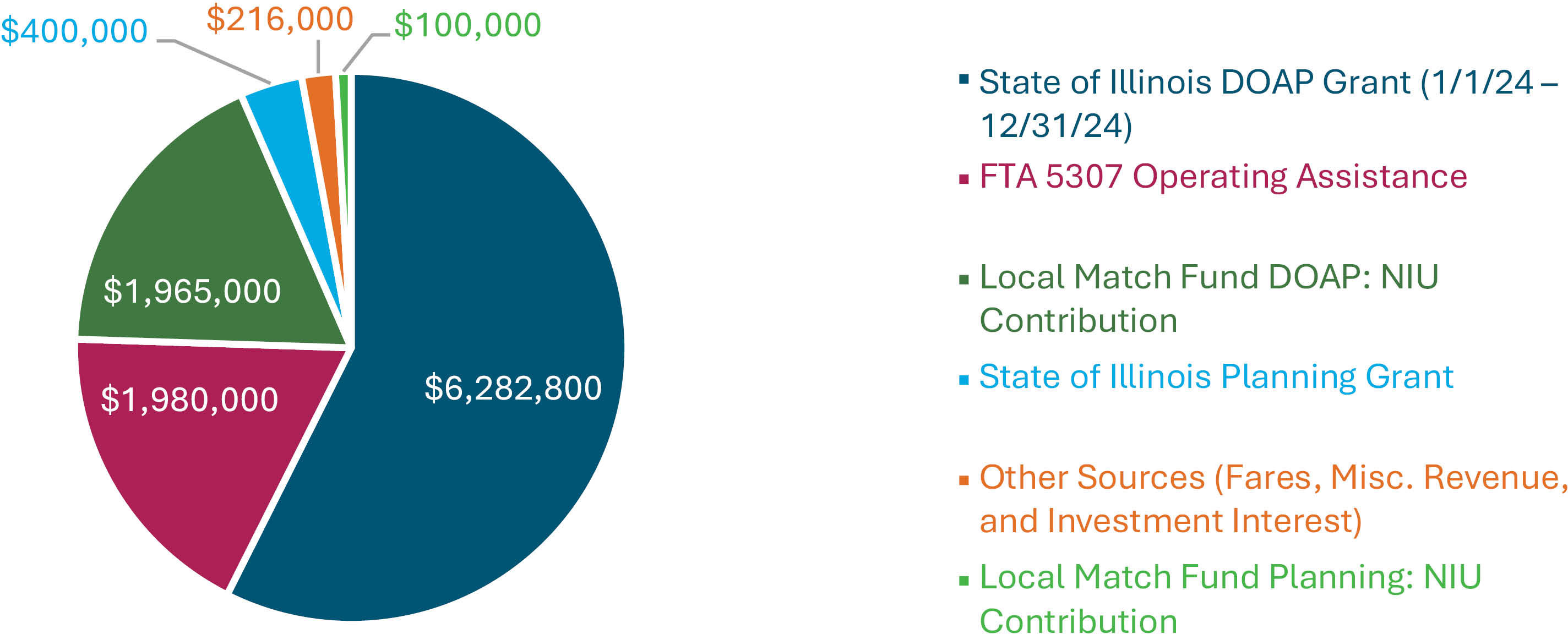
The City of Dekalb receives operations funding from federal and state sources, and from NIU. Nighttime service is funded from the same pool as daytime service funding, and the agency has not received funding specifically for its overnight service. Figure 28 shows the funding levels from each source from the Fiscal Year 2024 budget. The agency described their typical split of operations funding as 10 percent federal, 65 percent state, and 25 percent NIU funding.
Federal
Because DeKalb is a small urban system, it receives 5307 Urbanized Area Formula grant funding. The city also receives additional grant funding from Small Transit Intensive Cities (STIC) funding because it has an urbanized area population below 200,000.
State
The State of Illinois provides the majority of operations funding to the agency. Because the agency is a smaller transit provider outside of the Chicago area, the state provides the State of
Long Description.
The pie chart is divided into six sections. They are as follows: State of Illinois DOAP Grant (1/1/24 – 12/31/24): 6,282,800 dollars. FTA 5307 Operating Assistance: 1,980,000 dollars. Local Match Fund DOAP: NIU Contribution: 1,965,000 dollars. State of Illinois Planning Grant: 400,000 dollars. Other Sources (Fares, Misc. Revenue, and Investment Interest): 216,000 dollars. Local Match Fund Planning: NIU Contribution: 100,000 dollars.
Illinois Downstate Public Transportation Act referred to as the Downstate Operating Assistance Program (DOAP) operating grant. The grant programs provide assistance of up to 65 percent of operating expenses to agencies operating in counties outside the Chicago Regional Transportation Authority and St. Louis-area Bi-State Metropolitan Development District (excluding some special circumstances). Grant allocation increases as ridership does, incentivizing the agency to grow service to capture ridership demand.
Local Match from NIU
NIU contributes approximately 20 percent of overall budget funds via annual student fees.
Agency Resources
Beyond funding resources, the agency required vehicle, maintenance, and funding capacity to implement overnight service. Especially since the new service is a single route, it has had little impact on operations and maintenance and did not require many additional resources. The agency hired an overnight supervisor and reserved a few vehicles for overnight service.
Key Challenges
Due to a stable funding environment and robust ridership, the City of DeKalb Public Transit seldom encounters major challenges operating nighttime service. However, the agency identified the following minor challenges.
- During the initial implementation of nighttime service, maintaining the staffing levels of bus operators was a challenge. Once the agency was able to increase wages, operator shortages were mostly resolved.
- The City of Dekalb had a small challenge in raising public awareness about the new overnight service. Though NIU has robust internal communication, workers who would benefit most from the service are harder to reach. The agency found that bus advertising was the most effective way to raise awareness about nighttime service.
- Another challenge was the continued decrease in the university population in recent years. NIU has yet to reach its pre-pandemic campus population. Fortunately, this has limited effect on Route 19, as ridership demand outside of campus continues to grow. However, the smaller student population compels the agency to reconsider some of its campus routes to increase efficiency.
- As a smaller agency, the City of Dekalb lacks some of the advanced technology, such as automated passenger counters (APCs), limiting performance monitoring efforts. The agency is planning to pilot a microtransit service in the fall of 2024, and implementing more advanced technology into the existing system would more easily accommodate the future implementation of microtransit service.
Successes
Overall, the City of Dekalb has successfully secured funding for nighttime services, especially at the state level. The agency has gradually introduced services to meet ridership demand because state funding and local match funding increase as ridership increases. The agency experienced a healthy recovery of ridership from the peak of COVID-19 and is on track to meet pre-pandemic ridership, with some routes exceeding pre-pandemic rates. In 2023, the agency reported ridership recovered to approximately 800,000 annual trips, representing 79 percent of annual trips in 2019. Much of the ridership demand is growing outside of the NIU campus. For instance, between 2021 and 2023, ridership increased 40 percent on Route 19. This increase is driven by riders traveling to jobs at industrial parks.
The City of DeKalb also experienced unexpected benefits from running bus service all night. Because buses operate 24 hours a day, they can be used in emergency situations. For example, a bus was used as a temporary warming shelter for an emergency residential evacuation that occurred overnight during winter weather. The existence of nighttime service also fosters goodwill from the broader community for providing a service when many other services in the city close or end by 10:00 p.m.
Lessons Learned
One major lesson that the City of Dekalb Public Transit learned is that if there are levels of nighttime ridership potential in the community, implementing the service will garner nighttime ridership. The existence of an industrial cluster in the service area created a compelling location for transit investment. Although nighttime ridership does not garner significant increases to overall ridership, it certainly has a large impact among lower-income populations with low car access, many of which are working in the industrial area.
Future Initiatives
The agency believes they are currently meeting demand with their fixed-route nighttime service. However, they are considering ways to make campus routes more productive and efficient. This includes piloting a nighttime microtransit service to replace the Huskie Safe Line, to allow riders to make more direct trips.
Ridership Patterns and Recovery
Agency Overview
The Regional Transportation Commission of Southern Nevada (RTC) is a large public transportation agency serving the Las Vegas Valley. The agency operates fixed-route bus service, microtransit, and paratransit services for a service area of 396 square miles and service area population of over 2.2 million. Due to the presence of a robust nightlife economy, the agency has a long span of service and operates regular service from 5:00 a.m. to 1:00 a.m. The agency also operates what they refer to as “overnight service” between 1:00 a.m. and 5:00 a.m. During overnight service, one-third of bus routes operate consistently while the other two-thirds operate at reduced frequencies.
Planning Approach
RTCʼs goal of nighttime service is similar to that of daytime service: meet ridership demand where it exists. Ridership demand is the largest factor in determining the need to expand or
enhance nighttime service. Service levels are determined by levels of ridership and there is no specific goal to provide geographically concentrated service in a particular part of the region. The agency does not treat overnight service as particularly distinct from daytime service and nighttime service competes for resources in the same way daytime service would. However, some nighttime routes are modified at night and short-turned to prevent serving stops with low ridership and to accommodate operator restroom access. RTC has decent levels of productivity during the overnight period, which informs the decision to treat daytime and nighttime service similarly. The agency has recently finalized service guidelines for the whole system, which will help determine which routes are operating at insufficient levels of service.
The agency does not cater nighttime service to a particular population, but states that job access is a key priority. The agency has made progress in recent years in providing more early morning service during the 4:00 a.m. hour in response to employer changes to starting shift times. Many grocery stores and large shops open at 6:00 a.m., requiring workers to begin their commute prior to that time. The agency will assess ridership at the fringe of an existing routesʼ service span to determine if expanding it would capture additional ridership.
Ridership Patterns
RTC stated that ridership patterns are not particularly different between daytime and nighttime riders. Because there is a high amount of shift work in the region, origins and destinations for riders do not drastically vary across a service day. However, ridership on the “Deuce” route, which operates on the Las Vegas Strip, had the largest ridership decline and has not recovered as well as other routes in the system. The Las Vegas Strip contains many of the cityʼs main attractions and hotels, potentially indicating overall activity levels lag behind pre-pandemic levels.
Ridership Recovery
Using data comparing March 2020, March 2022, and March 2024 ridership levels, RTC found that nighttime ridership levels remained relatively stable since initially dropping at the start of the COVID-19 pandemic. Ridership retention during the nighttime has been highest during the agencyʼs overnight hours.
The agency found that changes made in response to the pandemic have lasting impacts on nighttime economy. For example, many businesses in the service area that were previously open for 24 hours closed during the nighttime at the height of the pandemic. Many have not returned to pre-pandemic hours and do not intend to. Further, many businesses (e.g., grocery stores, department stores) shifted operating hours, opening earlier to allow at-risk customers to shop during special hours and closing earlier in the day. Many have not returned to pre-COVID hours, altering work schedules and requiring employees to arrive earlier than in 2019.
Key Challenges
The agency identified two challenges specific to nighttime service in its region.
- Nighttime service directly competes with daytime service for limited resources. Because nighttime service is not considered distinct from daytime service, factors affecting resource allocation are treated the same regardless of time of day.
- Securing restroom access for operators at nighttime is challenging. Shortened business operating hours and a limited number of restrooms with public access since the onset of the pandemic created an increasing issue for operators and the agency.
Successes
Due to the RTCʼs efficiency in running the service, the agency was able to maintain nighttime service and a long span of service throughout the pandemic. RTC benefits from ridership demand across the service area and historical nighttime service has helped contribute to high ridership during nighttime hours.
The agency has been successful in identifying early morning demand and implementing service at the 4:00 a.m. hours, helping to boost nighttime ridership.
Lessons Learned
One important lesson learned is the importance of establishing a precedent of a long service span to maintain ridership. Though it can be difficult to determine how much specific nighttime service expansions will garner, agencies should not discount how much a long service span can improve ridership overall. Constrained service hours impact overall ridership, especially from low-income riders. Low amounts of service during nighttime hours (or off-peak hours in general) suppresses ridership across the full-service day because it limits the number of people who can buy into a system that serves an individualʼs different types of trips.
Another lesson learned is to match ridership, demand, and nighttime service goals to the type of service provided. For instance, RTC has relatively high nighttime ridership and is less concerned with coverage across the Las Vegas Valley so fixed-route buses serve as a suitable nighttime transit service. However, if the agency had lower levels of ridership, it would be reasonable to replace fixed-route bus service with flexible services. Microtransit and subsidized TNC vouchers can be a useful tool in bringing nighttime transit in a service area, but it is not necessarily always the most efficient solution.
Future Initiatives
As of April 2024, the agency is drafting standardized service guidelines and frequencies for fixed-route bus routes across its whole system. The service guidelines will create a framework for assessing which routes are not meeting travel demand including by service span and level of service. Although these service guidelines are not specifically targeted toward the nighttime, the results will help distill gaps during nighttime hours. Beyond the service guidelines, the agency will continue to focus expanding nighttime service during early morning hours as this time of day has proven to capture demand and generate ridership.
Partnerships
Agency Overview
Capital Metropolitan Transportation Authority, or CapMetro, is a medium-sized public transportation agency for the Greater Austin area in Texas, including Travis County and parts of Williamson County. The agency operates fixed-route bus, commuter rail, paratransit, and demand response service for a service area of 542 square miles and a service area population of over 1.3 million people. The agency began offering its Night Owl nighttime service in 1995 to accommodate late-shift employees. The Night Owl operates from 9:00 p.m.
to 3:00 a.m. on weekdays and Saturday. CapMetro extends commuter rail service to 12:00 a.m. on Fridays and Saturdays and for special events. CapMetro provided additional nighttime services, but they have since been discontinued as a result the growing popularity of ride-hailing services and then the COVID-19 pandemic. Those additional nighttime services included a nighttime campus service called University E-Bus (Entertainment-Bus) that operated three routes from 9:00 p.m. to 3:00 a.m. from 2000 to 2020. It included nighttime service on some frequent, limited-stop service, or MetroRapid, routes from 2010 to 2020. Lastly, from the 1970s to 2009, the agency operated The Armadillo Express, or “the Dillo,” a circulator that ran through entertainment districts in downtown Austin in a partnership with the city government, which was discontinued due to high operating costs.
Planning Approach
CapMetroʼs Night Owl service was planned by taking the best performing segments of the best performing routes with the goal of transporting riders to and from downtown. The service was modeled after San Antonioʼs VIA Metropolitan Transit Lineup service, a nighttime service network containing shortened segments of daytime routes that run from a single downtown location out to the suburbs.
A large student body and special events are two major nighttime trip generators in Austin. Thursday, Friday, and Saturday create the most nighttime activity in the service area, and most trips at nighttime involve the downtown area. However, student travel patterns have been changing over the last decade and increasingly more trips are made closer to campus. Students make more non-downtown trips today compared to 2019. Because downtown Austin is such a regional nighttime destination, there is a lot of ridership activity from the outer suburbs into the city. CapMetro runs hourly commuter rail service at all stops on Friday nights and half-hour service on Saturday nights. The commuter rail line is used to transport riders to special events, as it was built along the Austin Convention Center and Q2 Stadium.
Special events drive a lot of ridership from outer suburbs into the downtown area, trips that Austin serves by extending its commuter rail service.
Nighttime service expansion is determined by the potential to increase ridership. CapMetro uses ridership at both ends of span of service to determine if additional trips are needed and/or if service spans for any one route should be lengthened. The agency places importance on creating a service that allows third shift employees to complete both ends of their commute—to work and to home. Underpinning nighttime service expansion decision-making is the availability of staff and operational resources.
Partnerships
University
Austinʼs population has historically included a large share of students, creating a significant propensity for nighttime transit demand. CapMetro has had a long-standing relationship with University of Texas at Austin (UT Austin) in planning and funding nighttime services. The E-Bus was a fixed-route bus service created in 2000 in response to university interest in creating a safe ride program to reduce drinking and driving downtown. Modeled after nighttime services in California State University, Chico, and Clemson University, the E-Bus ran through the densest areas of residence halls and off-campus housing to downtown. The university generated funding for the service via a fee charged to students. With the advent and adoption of TNC services, the agency began phasing out service of the E-Bus until the COVID-19 pandemic eventually depleted demand and service was terminated.
Government
Until 2009, CapMetro partnered with the City of Austin to plan and fund the Dillo, a downtown circulator that traveled through entertainment districts in Austin. The circulator closed due to the relative high cost to the agency. Currently, partnerships between the agency and city government are focused on infrastructure improvements to improve bus operations and customer experience.
Though not focused on nighttime service, improvements are mainly focused on improving sidewalks, bus stop infrastructure such as shelters and benches, and stop lighting.
Corporate
Although CapMetro expressed interest in partnering with businesses to fund nighttime service, partnerships are less feasible due to cost. Downtown businesses helped market the Dillo but could not afford to assist with operations. Some businesses and riders have expressed interest in reinstating a downtown circulator service, but it is ultimately too expensive for the agency to fund alone and is not a current agency priority.
Key Challenges
Though largely content with existing nighttime services, CapMetro faces the following challenges in expanding nighttime service.
- Considering CapMetroʼs current priorities, there are not enough resources to expand nighttime services. There is some interest and demand for more services, specifically a downtown circulator, but money is unavailable for operations. Interest in expanded services on the local level can sometimes be eclipsed by lower prioritization for funding them from state-level government. The agency is currently prioritizing restoring and building out stronger daytime service for the fast-growing region, as well as the integration of bus service with its future light rail network.
- For commuter rail service, there are limitations in expanding service due to shared tracks with freight rail operations. There has been growing demand for earlier morning service on weekends, but the agency is limited because freight trains have right-of-way during that time on the tracks they share.
Successes
The agency believes that Night Owl adequately serves the current nighttime markets in the service area. Because the Night Owl is designed to serve third-shift workers, a group composed of essential workers, restoring service was prioritized in 2021.
Lessons Learned
An important lesson CapMetro learned in operating night service was to understand the existing capabilities of the agency and gradually build up the service. Nighttime service can be an immense undertaking and a decision to implement night service should consider both cost and resource needs.
CapMetro learned the importance of considering nighttime service from an access lens. Although implementing and expanding the service may not dramatically increase ridership, it is an investment for other reasons.
Future Initiatives
Currently, CapMetro is focused on service recovery and pre-pandemic ridership recovery (a trend they are on track to make). Nighttime service has been fully reinstated according to existing demand, while daytime service, both routes and pre-pandemic frequency levels, are gradually being reimplemented. CapMetro is planning to launch a 5-year service plan that will include Night Owl routes as one part of the transit plan, but is more generally focused on recovery. Further, the agency is preparing to focus much of its planning efforts toward integrating bus service with a new light rail service they will begin building in the service area in coming years.


