Science Writer Nicola Twilley Discusses Mummy Sleuths, the Hunt for the Ancient Microbiome, and Finding Humanity in the Past
Feature Story
By Olivia Hamilton
Last update August 6, 2026
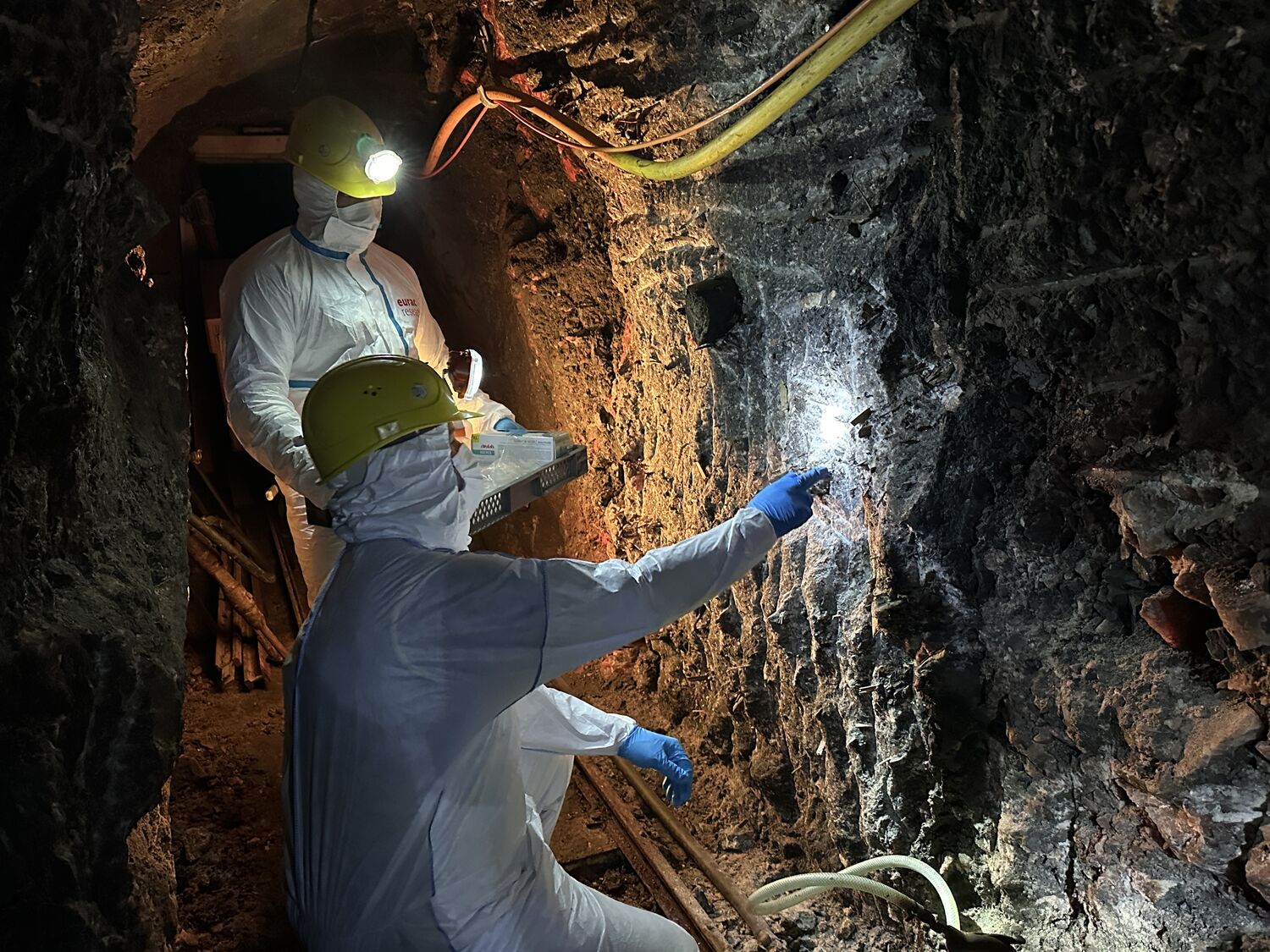
Frank Maixner and Mohamed Sabry Sarhan of the Institute for Mummy Studies examine paleofeces in a wall of the Hallstatt salt mine; photo by Nicola Twilley
Nicola Twilley is an LA-based author and contributing writer at The New Yorker. She’s written two award-winning books, Frostbite: How Refrigeration Changed Our Food, Our Planet, and Ourselves and Until Proven Safe: The History and Future of Quarantine, which was co-authored with Geoff Manaugh and named one of the best books of 2021 by Time magazine, NPR, The Guardian, and Financial Times. Twilley is also co-host of the popular Gastropod podcast, which looks at food through the lens of history and science.
Twilley was a 2025 award winner of the National Academies’ Eric and Wendy Schmidt Awards for Excellence in Science Communications, which honor excellent science communicators, journalists, and research scientists.
Her recent piece for National Geographic, On the Trail of the World’s Best Mummy Sleuths, follows scientists from the Institute for Mummy Studies as they sample paleofeces more than 2,000 years old, excavated from the oldest continuously operating salt mine. We asked about her reporting and how that story changed her perspective on humanity and the past.
The story opens with the discovery of an ancient human feces sample. What made you realize that was the strongest way into the story? What drew you into this story?
Twilley: I had originally met Frank Maixner of the Institute for Mummy Studies when my Gastropod co-host, Cynthia Graber, and I were interviewing him about what was found in the stomach of Ötzi [a mummified human found in 1991 in Europe, frozen in time some 5,300 years ago]. A listener had written in with the question.
I was lucky to be invited to speak at a Prada event in Milan a year later, and I took advantage of being in the neighborhood to visit him, see the institute, and meet Ötzi. Over lunch, he told me about the Hallstatt [salt mine] project, and showed me photos from previous visits, and I knew I had to cover it.
His excitement was contagious, and the story was at the intersection of so many things I love: microbes, underground passageways, food, archaeology. I wanted to open the story with the moment of highest tension for the scientists — extracting this priceless sample from the wall of the cave, then sampling it with exquisite care — but I also loved that there was something kind of ridiculous about all this fuss over a very old turd. I felt as though, if I could communicate that at the start, readers would feel that this story was going to be important, but also fun and quirky.
You combine archaeology, genetics, medicine, microbiology, and history. How did you decide which subjects to cover and detail throughout the story?
Twilley: The hard part, always, is what to leave out. There was so much more about the archaeological history of the site, for example, or what we’ve learned from this kind of sequencing to date. I’m not a trained scientist, so I don’t really think about stories (or science) in terms of different disciplinary fields, and I don’t think most general readers do either — we’re just driven by curiosity, and the most interesting questions require interdisciplinary answers.
Instead of highlighting kings or famous historical figures, you focused on what ordinary people ate, the microbes they carried, and even the foods they fermented. Why was that perspective important to you, and what did it teach you about everyday human life?
Twilley: Most of life is ordinary, and most of history is about the least ordinary, which is frustrating. It’s hard to really imagine yourself into the past without the texture of everyday life, and that’s exactly what nobody bothers to record. Which means that when you find those clues, they’re gold! I especially loved learning about the experimental archaeological work of trying to light a fire with a tinder fungus or dry meat in different ways — getting that embodied insight really helps bring to life what it was like to be a human thousands of years ago.
You manage to make something many people would dismiss as “gross” feel genuinely fascinating. How did you approach writing about ancient feces while considering the stigmas or biases of readers?
Twilley: I am the kind of person who told everyone I know about this story over dinner, so I guess my threshold for being grossed out is pretty high! But, seriously, my approach was just to treat readers as smart, curious people who can find feces fascinating, like me. I was much more sensitive to the ethical debates around the depiction of mummies. Many cultures find the display of their ancestors in museums and books to be disrespectful, and National Geographic was careful to consult with local communities before photographing the mummies Frank and his colleagues studied in Bolivia.
Were there any moments during reporting that surprised you? Or any “aha” moments?
Twilley: The Hallstatt mine itself took my breath away — walking, crawling, and climbing through the excavated areas and touching the actual marks made by pickaxes 5,000 years ago, feeling the softness of the braided rope, and seeing the imprint of the world’s oldest wooden staircase was a once-in-a-lifetime experience. It’s a unique place, as the world’s oldest continuously operating salt mine, and it was especially fascinating for me, as the author of a book about refrigeration, to realize just how important salt was back then. The need to preserve food has truly reshaped the world, many times over.
I also couldn’t believe how few ancient feces have been analyzed using next-generation sequencing. I often read about a new technology and assume everyone will immediately be using it on everything, but that’s not how the world works, and it’s not how science works either. There’s so much more to be analyzed and discovered! And, finally, I was truly shocked that these ancient microbes started to grow and even sporulate on petri dishes in the lab. Jurassic Park: Human Shitstorm, here we come!
Did reporting this story change how you think about archaeology itself?
Twilley: Absolutely! In particular, I really learned to appreciate the value of combining different forms of archaeological research — traditional excavation, botanical and zoo-archaeology, molecular analysis, experimental archaeology — to be able to ask and answer much more expansive questions about the past. Kerstin Kowarik also introduced me to the concept of taphonomy as a way to think about what hasn’t been preserved — the idea that we can systematically explore what isn’t there blew my mind.
What do you hope readers take away from this story?
Twilley: Forget red meat; fiber and fermented foods are the keys to the true Paleo diet! More importantly, I hope readers take away a sense of excitement about how much there is still to learn and how fascinating the kinds of questions scientists ask and answer are. Having that kind of curiosity and enthusiasm is such a fun way to move through the world.
Featured Project
National Academies Eric and Wendy Schmidt Awards for Excellence in Science Communications
Award/Competition
For individuals who are working on the frontlines of science communication, science journalism, or practicing research, and who can demonstrate the potential or ability to develop high-quality, engaging science communications or reporting.