Previous Chapter: Index
Suggested Citation: "Photos." John Sulston, et al. 2002. The Common Thread: A Story of Science, Politics, Ethics, and the Human Genome. Washington, DC: Joseph Henry Press. doi: 10.17226/10373.

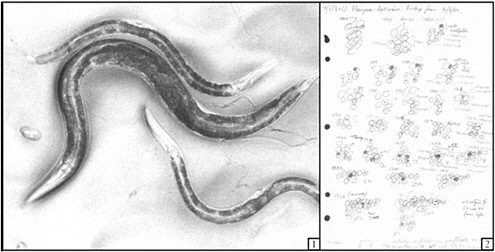
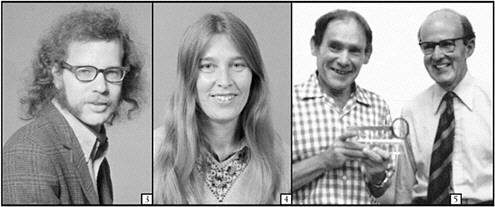
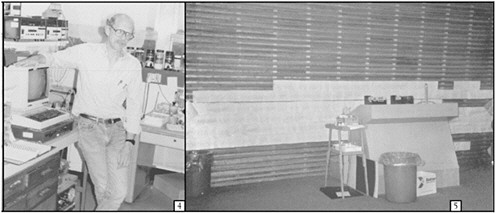
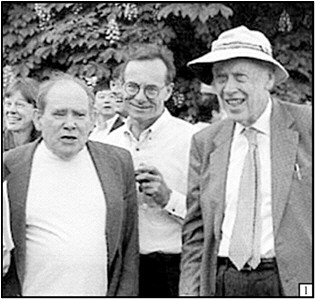
At the Laboratory of Molecular Biology in the 1970s, Sydney Brenner’s plan to trace the lineage of the nematode worm Caenorhabditis elegans (1) became a reality. Drawings of dividing cells (2) filled my notebooks. Bob Horvitz (3) and Judith Kimble (4) also worked on the worm lineage and later set up their own worm labs in the US. (5) Sydney himself (left) succeeded Max Perutz (right) as director of the LMB in 1979.
Suggested Citation: "Photos." John Sulston, et al. 2002. The Common Thread: A Story of Science, Politics, Ethics, and the Human Genome. Washington, DC: Joseph Henry Press. doi: 10.17226/10373.

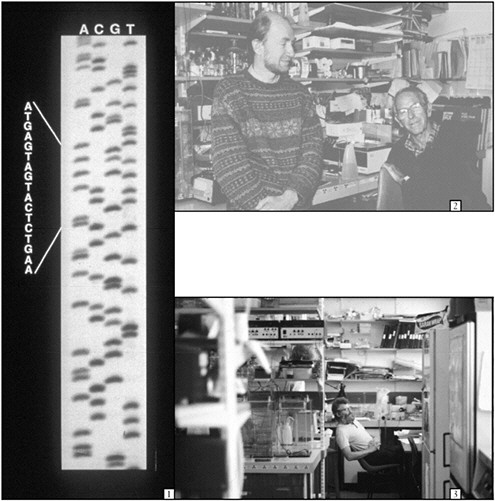
Fred Sanger invented the dideoxy method of sequencing DNA (1). (2) When Fred (right) retired in 1983, his assistant Alan Coulson (left) joined me in the cramped conditions of Room 6024 at the LMB (3), to begin the mapping of the worm genome.

Suggested Citation: "Photos." John Sulston, et al. 2002. The Common Thread: A Story of Science, Politics, Ethics, and the Human Genome. Washington, DC: Joseph Henry Press. doi: 10.17226/10373.

Bob Waterston (4) started to collaborate with us in 1985 and we have worked together ever since. Unimpressive at first sight, the map of the worm genome we stuck up on the wall at Cold Spring Harbor (5) prefaced the launch of international large-scale genome sequencing, celebrated by Bill Sanderson’s 1990 cartoon in New Scientist (6). The LMB’s new director Aaron Klug (7) gave us his full support.
Suggested Citation: "Photos." John Sulston, et al. 2002. The Common Thread: A Story of Science, Politics, Ethics, and the Human Genome. Washington, DC: Joseph Henry Press. doi: 10.17226/10373.

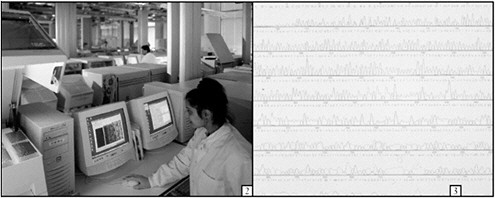
(1) Jim Watson (right, with Sydney Brenner) was the first head of the Human Genome Project. In 1992 the Wellcome Trust and the Medical Research Council founded the Sanger Centre at Hinxton, where rooms full of sequencing machines (2) read out human DNA twenty-four hours a day (3).

Suggested Citation: "Photos." John Sulston, et al. 2002. The Common Thread: A Story of Science, Politics, Ethics, and the Human Genome. Washington, DC: Joseph Henry Press. doi: 10.17226/10373.

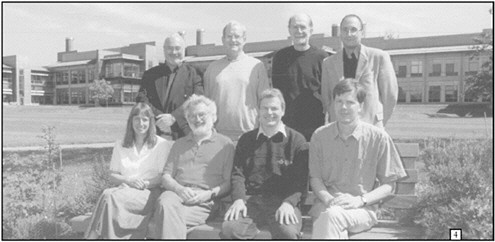
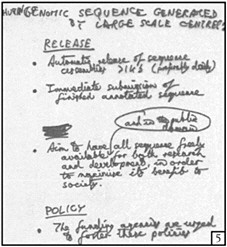
The centre was run by the board of management (4): in 2000 it consisted of (back row) Bart Barrell, Murray Cairns, Alan Coulson, Mike Stratton; (front row) Jane Rogers, John Sulston, David Bentley and Richard Durbin. At the first international strategy meeting in Bermuda, a handwritten overhead (5) outlined the principles of free release of human genomic data.
Suggested Citation: "Photos." John Sulston, et al. 2002. The Common Thread: A Story of Science, Politics, Ethics, and the Human Genome. Washington, DC: Joseph Henry Press. doi: 10.17226/10373.

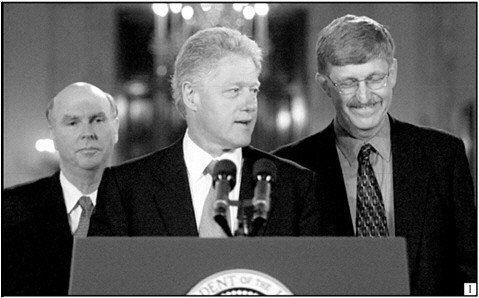
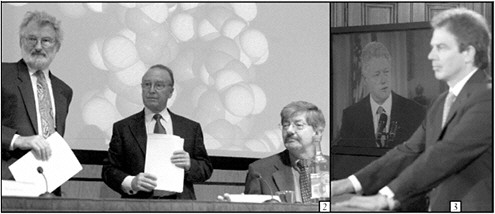
(1) President Bill Clinton, flanked by Craig Venter (left) and Francis Collins (right), called 26 June 2000 ‘a day for the ages’ as the draft sequence was announced. (2) In London Mike Dexter (right) and Michael Morgan (centre), fielded questions, while Tony Blair (3) shared the moment.

Suggested Citation: "Photos." John Sulston, et al. 2002. The Common Thread: A Story of Science, Politics, Ethics, and the Human Genome. Washington, DC: Joseph Henry Press. doi: 10.17226/10373.

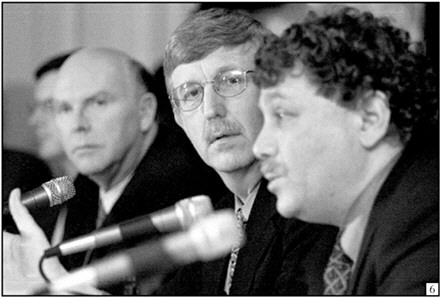
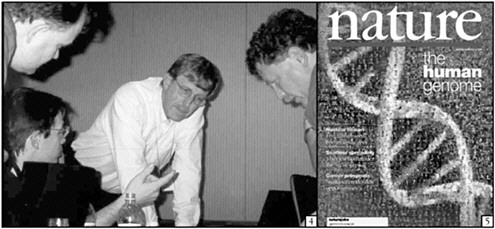
(4) At the hardcore analysis group meeting in Philadelphia in October 2000 we worked on the draft publication (left to right) Richard Gibbs, Evan Eichler, Francis Collins and Eric Lander), which finally appeared in February 2001 (5). At the 12 February Washington press conference, Eric Lander (6, right) explained who had done what, and how.
Suggested Citation: "Photos." John Sulston, et al. 2002. The Common Thread: A Story of Science, Politics, Ethics, and the Human Genome. Washington, DC: Joseph Henry Press. doi: 10.17226/10373.

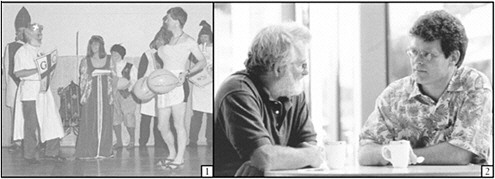
With the future of the genome secure, I retired in 2000 and received a wonderful send-off in the form of a Sanger Centre pantomime (1). My successor was Allan Bradley from Baylor College of Medicine in Houston (2, right).
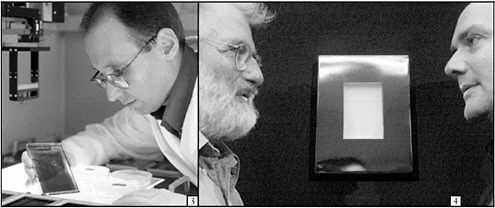
Sequencing goes on, but the centre is shifting its focus towards biological problems, such as Mike Stratton’s work on the genetic basis of cancer (3). Meanwhile the genome has passed into contemporary culture: in February 2001 the artist Marc Quinn (4, right) used my DNA in his new work for the National Portrait Gallery.

Subscribe to Email from the National Academies
Keep up with all of the activities, publications, and events by subscribing to free updates by email.