The One True Platonic Heaven: A Scientific Fiction on the Limits of Knowledge (2003)
Chapter: Chapter Five: The Boardroom
Chapter Five
THE BOARDROOM
J. Robert Oppenheimer sat slouched in his leather desk chair, necktie askew, staring out the window of the Director’s.corner office in Fuld Hall. He was considering the Institute for Advanced Study’s (IAS) Board of Trustees meeting coming up later in the day, knowing that with von Neumann’s computer project on the agenda, the meeting would be contentious. While some of the board members were in Johnny’s corner, Oppenheimer knew he had to perform a delicate balancing act to avoid statements that would surely be leaked and would then alienate those faculty members opposed to the project. As Director of this band of overachieving intellects and socially unaware misfits, Oppenheimer realized he was caught right in the middle of this particular conflict. His mind raced through myriad strategies for resolving the conflict, discarding them one by one like a gambler throwing away
low cards in a poker game. Oppenheimer ruminated on how this computer idea reached the IAS in the first place. As always, the central character in the story was von Neumann.
At the end of the war, the team of John W. Mauchly, J. Presper Eckert, Herman Goldstine, von Neumann, and others working on the Electronic Discrete Variable Computer (EDVAC) at the University of Pennsylvania’s Moore School saw that the university was not going to continue supporting their work. Despite Penn’s unchallenged technical virtuosity in computing technology, university administrators showed a lack of interest in retaining any of the participants except for von Neumann, who was never part of the Penn engineering faculty anyway but simply on leave from the IAS. Moreover, the Penn administration was keen to ensure that they retained the patent on any work done by their staff members, a policy that irritated both Eckert and Mauchly. With this writing all over the wall, they decided to form their own company to produce computing machines, a venture they hoped would be profitable. Von Neumann had another idea: He wanted his own computer, not to sell, but to use for scientific investigations.
After discussing the future of the computer project with Goldstine, von Neumann decided that future should be in Princeton—at the IAS, in fact. He felt that the environment there, together with the presence of the Radio Corporation of America (RCA) Laboratories down the road and the open intellectual climate in Princeton, was more conducive to his view of the computer as a tool for the entire scientific community than as a commercial device or one solely for the government and the military. That was when the trouble started, at least in the IAS intellectual hierarchy.
Von Neumann may have been the most productive IAS faculty member in terms of deploying his talents on behalf of the government during the war, but he certainly wasn’t the
only one. Even the great pacifist Einstein saw the need to resist the Axis powers and gave advice to the U.S. Navy on various questions in basic physics associated with naval operations. So, naturally, von Neumann thought that the faculty, even those residing in the rarefied heights of the School of Mathematics, would immediately see the virtues of having a computer close at hand and rubber-stamp his proposal for building one at the IAS. What a mistake! Clever men often have intellectual blind spots. And extremely clever men—perhaps those who are the cleverest of all—have the biggest blind spots when they depart from their areas of expertise. Von Neumann simply failed to understand the emotionally laden psyches of his colleagues. The chance to savor the pleasure of being employed at the IAS, where there are no students, no lectures, and no formal duties of any kind, attracts a very special type of intellect: the type that does not empathize with students, does not wish to be distracted by the mundane duties of giving lecture courses, and wants peace and quiet to contemplate its intellectual navel. Most especially, it attracts those who disdain mere “applications” of science as being a violation of the Platonic ideal to which they feel themselves—and the IAS—are dedicated.
So when von Neumann walked in and started lobbying the faculty for his computer project, the genius from Budapest was in for a shock. Not only did his sales pitch fall on deaf ears, in some cases it fell on manifestly hostile ones. And the expressions of hostility were definitely not sotto voce. The faculty was fundamentally opposed to such a venture on principle, as well as by precept. The IAS faculty was not about to sully itself by sanctioning an applied project if they could help it. And they could help it. Or so they thought. Von Neumann, a man who relished tackling only the most intractable and difficult of problems, thought otherwise. And therein lay Oppenheimer’s dilemma.
The Director knew that the prestige of the IAS, and thus
its position in the pecking order of academia, rested entirely on the brilliance and reputation of its faculty. And among the faculty’s many stars, only Einstein shone brighter than Johnny. He also knew that von Neumann could name his price—including the computer project—at any institution in the world, and get it. In fact, he had it on good authority that Robert Hutchins at the University of Chicago had approached von Neumann to join his radical experiment in education by bringing his brilliance and his computer to the Midwest. And local gossip had it that a similar overture had been made by the University of California. Oppenheimer had no illusions about Johnny’s readiness to jump to one of these or to another more congenial environment with his project if the Institute’s board turned down his proposal. Yes, he thought, this meeting is going to be difficult. And that’s putting it mildly.
⋮
Carl Ludwig Siegel, one of the finest—and most outspoken—mathematical analysts of the day, reflected on von Neumann’s approach to him a few days earlier to enlist his support for building a computer on the hallowed grounds of the IAS. Siegel, a man brought up in the classical German tradition of scholarship, wondered how a computer might help his work.
A traditional mathematician like Siegel uses a lot of paper and pencil, chalk and blackboard, in trying out ways of putting abstruse symbols together into beautiful patterns. What kind of patterns look beautiful? Siegel would give the very same answer to this query as a poet, sculptor, or composer: A pattern that is pleasing to the intellect, expresses ideas in a compact manner, and is in some way surprising. So, for instance, Euler’s formula eπi + 1 = 0 is just such a beautiful pattern, displaying an entirely unexpected relationship between the five most important constants in mathematics: 0, 1, e (the base of
natural logarithms), π (the ratio of a circle’s circumference to its diameter), and i (the square root of −1, which forms the basis for the complex numbers). Siegel didn’t think having a computer would have helped Euler one bit in discovering this remarkable formula. Nor did he think a machine that could compute a table of logarithms or add up a long column of numbers would help his own work any more than a lathe in a metal-working shop would help a metal sculptor create a beautiful piece for his garden. The lathe might be a useful tool in shaping some metal for such a sculpture, Siegel conceded, but it certainly was not any more necessary for creating the vision embodied in the work than was the pencil he was presently using to jot down Euler’s formula on the piece of paper on his desk.
Siegel also objected to von Neumann’s project on aesthetic grounds. He recalled seeing a message while serving in the German army at the western front in the First World War that read, “Cavalry officers entering balloons are required to remove their spurs.” A sharp-edged, applied project like von Neumann’s had no more business at a place like the IAS than did spurs in a balloon. The IAS was dedicated to the exploration of the limits of the human intellect. It just wasn’t right to be building mere machines at such a place. The Institute was an idea incubator, not a factory for cranking out ideas in a mechanical manner like a meat-processing plant spitting out sausages. No, Carl Ludwig Siegel would certainly not vote to open the Institute to such a venture. Not even his boundless respect for von Neumann’s intellect would allow him to go quite that far. In fact, he thought—and sometimes even stated, in private—that von Neumann was wasting his enormous talents on such a quixotic quest as the construction of a computing machine.
But among the mathematicians, von Neumann’s computer project had its supporters, too.
Herrontown Woods, just outside Princeton, is one of the greenest and loveliest tracts of land for miles in any direction, the perfect place for getting away from the noise and stench of motor cars to hike or just sit and think quietly. At the very moment Siegel was sitting at a desk in Fuld Hall contemplating von Neumann and his computer, one of the project’s staunchest supporters was enjoying these woods as he mulled over his view of that very same exalted personage and project. Oswald Veblen, a tall, slim Scandinavian-looking man, was one of the leaders of the American mathematical community. A nephew of the famed economist and social theorist Thorstein Veblen, author of The Theory of the Leisure Class, Veblen was known worldwide for his pioneering work in geometry and topology. He and Einstein were the first two professors recruited to the IAS in 1932 by its founding Director, Abraham Flexner. Before then Veblen had been head of the Mathematics Department at Princeton University, to which he had invited von Neumann as a visiting faculty member in 1930. When the IAS was founded a couple of years later, Veblen convinced Flexner to appoint von Neumann as the youngest permanent Professor, and he thereafter regarded von Neumann almost as the son he had never had.
At one of the IAS mathematics faculty meetings, Veblen took notes on the discussion surrounding the computer project. After detailing Siegel’s objections and Marston Morse’s less than enthusiastic remark to the effect that, while the project seemed inevitable, it was very far from desirable, Veblen noted in his characteristic self-deprecatory fashion that he simple-mindedly welcomed the advance of science in whatever direction it might go. So von Neumann could certainly count on the support of this ultrarespectable and enormously influential faculty member. The computer project certainly had its advocates, and powerful ones, too; no doubt about that.
Veblen was already head of the Mathematics Department when Fine Hall was built on the Princeton University campus to house the mathematicians. Reflecting his collegial view of mathematical practice, he had the Commons Room placed so that everyone had to pass it to get to the library, reasoning that this proximity would increase the solidarity of the mathematics faculty and students. So no one was surprised when Veblen, with his collaborative view of how mathematics should be done, used his great prestige to try to heal the intellectual rifts generated between von Neumann and some of the more unreconstructed members of the IAS faculty by the proposed computer project. In fact, though, everyone loved Johnny. Some just didn’t love his computer idea.
⋮
Reserve Admiral Lewis L. Strauss, partner in the New York investment firm of Kuhn, Loeb & Company, sprawled across the back seat of his chauffered car as it moved along the highway to Princeton for the IAS Board of Trustees meeting that afternoon. Strauss ignored the oil refineries dotting the bleak New Jersey flatlands, focusing instead on the fight he anticipated in the boardroom later. He was a trim man of medium height—but with a short man’s personality: pugnacious and combative. He was also a man of practical action and movement, who harbored a deep suspicion of most academics, whom he regarded as dreamers. As his thoughts moved to the Institute’s Director, Oppenheimer, Strauss’s eyes narrowed and his mouth turned down into a grimace, thinking about the enormous mistake the trustees had made in naming such a man to head the IAS. Oppenheimer was brilliant, yes, but unstable and, even worse, politically unreliable, in Strauss’s opinion. One might make a case for having Oppenheimer on the faculty. But Director? Never!
Strauss’s normally stern features softened considerably, though, as he shifted attention to the agenda for the meeting, noting that the very first item was consideration of Johnny von Neumann’s computer project. Now here was a man to admire, he thought. Not only the most brilliant scientist of his generation, but a man who saw the world in its proper light. And the hue of that light was definitely not the red of the Soviet Union! In Strauss’s world the red-white-and-blue of the U.S.A. was the only acceptable color scheme. If there was one thing the ultraconservative Strauss knew, it was that. And it infuriated him no end that at the IAS, from the Director on down, von Neumann was the only scientist at this glorified home for wayward intellectuals who saw things clearly.
As a nonscientist himself, but a banker and financier, Strauss had a not unusual tendency among businessmen to admire successful scientists. People like von Neumann and Einstein resided somewhere in his pantheon of heroes, although he had residual negative feelings about Einstein from their conversations when the trustees were selecting a Director. When Strauss queried Einstein on the type of man he thought should be chosen, the great physicist said he would prefer someone quiet who wouldn’t disturb people while they were thinking. Well and good, agreed Strauss. But when their conversation turned to the candidacy of Oppenheimer, whose left-leaning political views overlapped considerably with Einstein’s own, Strauss simply could not understand how a genius like Einstein could fail to see the completely obvious menace posed by the Soviet Union. Too many years hunched over the books, he finally concluded, and not enough contact with everyday reality. This was just the kind of otherwordly attitude that Strauss found most disturbing about the IAS. But at today’s meeting he would at least have the chance to strike a blow for something practical and useful when the computer project came up for consideration. Anything von Neumann wanted to do had
to be worth doing, and as an IAS trustee he felt an obligation to use his influence to strongly support any such proposal.
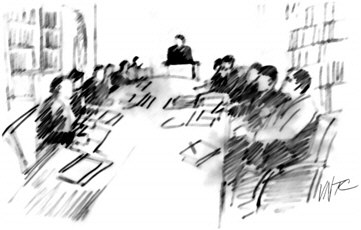
The car pulled up to the entrance to Fuld Hall, and as the driver came around the car and opened the door, Strauss shot out of the back seat as if he’d been fired from a cannon. In the Institute’s foyer, he nearly had a head-on collision with his bête noire, Oppenheimer, who was just leaving his office on his way to the meeting. Grabbing onto Oppenheimer to keep him from toppling, Strauss greeted the Director with sugar on his tongue but murder in his heart, before walking with him into the large oak-paneled conference room where the rest of the board was already assembled. The deep-pile carpeting, English hunting prints on the wall, and heavy velvet drapes pulled across the windows all reminded Strauss of a boardroom in his usual Wall Street haunts. He felt comfortable and was clearly energized and ready to fight the good fight against the pointy-headed academics standing in the way of his hero’s noble venture.
As Oppenheimer and Strauss took their seats—at opposite ends of the oversized mahogany table—the chairman of the board, a rather formidable lawyer from Philadelphia, opened the meeting. After the standard formalities of reading and approving the minutes from the last meeting, the Chairman turned to the first—and what turned out to be the only—item on the agenda that day: von Neumann’s computer project.
“Gentlemen,” the chairman intoned in a stentorian, get-the-attention-of-the-jury voice, “the first item on our agenda today is to consider Professor von Neumann’s proposal to construct a computing machine here at the IAS. As you all know, there is considerable division on the faculty as to the desirability of this venture. Perhaps it’s best if Director Oppenheimer quickly summarizes the situation as it stands today. Oppie?”
Looking up at the group from his seat, Oppenheimer quickly sketched the faculty’s principal objection to the project.
“Those on the faculty opposed to this project are quite vocal about it. They feel that the very essence of what the IAS stands for is thinking of the most rarefied kind. In their view this is what sets the IAS apart from a university, an industrial research center, or a government laboratory. The role model for this ‘Platonic heaven’ is Plato’s Academy in ancient Athens, where would-be scholars met to study abstract subjects such as philosophy and mathematics at the feet of masters like Plato himself. It is hardly a surprise, then, that those holding this view of the Institute’s raison d’être are opposed to a project they regard as mere engineering, an applied venture having no place in such an intellectual environment. Of course, there are those on the faculty who are indifferent to the project. However, I feel compelled to add that with the exception of Professor von Neumann himself, there are no members of the School of Mathematics who are genuinely enthusiastic about it. It is my understanding, though, that Professor Veblen supports the project. But that support seems more for the sake of keeping von Neumann in Princeton than for the computer itself. And that is where we stand at the moment.”
The board sat silent for a moment digesting Oppenheimer’s summary. A wooden ceiling fan turned slowly, keeping pace with their thoughts as they pondered this dilemma. Should they turn down von Neumann and thereby run the risk that this most visible member of the faculty might leave for greener pastures? Would this be tantamount to siding with the Old Guard and voting to preserve the status quo, endorsing the traditional image of the IAS as a scholarly refuge in the true Platonic mold? Or could there possibly be some course between von Neumann and the traditionalists that would give half a loaf to each side? Before any debate had a chance to begin, Oppenheimer offered a suggestion.
“I think the position of the anti-computer faction is quite clear and needs no further elaboration. But I know that many
of you are not fully aware of Professor von Neumann’s vision of what the computer means to the practice of science and why he feels so strongly that the IAS is the right place to build it. So if there are no objections, I’ve asked him to come to the meeting today and give us all a brief summary of his views and the scope of the project he has in mind.”
Looking around the room, Oppenheimer saw several trustees glancing at each other and nodding their heads in agreement. Of course, Oppenheimer knew that except for himself, Johnny was the best person in the Institute to explain an idea in terms that a nonspecialist could understand. His ploy to get von Neumann to the podium was calculated to muster as much ammunition as he could in support of the project—without being seen to be taking sides. “As I hear no objections, let me call Professor von Neumann into the room.”
As Oppenheimer left the room to fetch von Neumann, the trustee next to Strauss leaned over and whispered, “I’ve heard von Neumann is an even greater genius than Einstein. How can the IAS be debating about whether to do this project? It seems to me that the very essence of a Platonic heaven like this one is that the professors should be able to follow whatever intellectual interests they wish. Otherwise, what’s the point of a place like the IAS?”
Strauss nodded vigorously in agreement. Just then Oppenheimer reentered the room, followed by the roly-poly figure of von Neumann, dressed for success as always in a well-cut, medium-gray, three-piece banker’s suit, conservative maroon necktie, and highly polished, black, wing-tip shoes. Just the costume to make these lawyers, bankers, and high-level academics feel at ease with one of their own. Stepping up to the front of the room with a bounce in his step and a smile on his cherubic face, von Neumann looked like nothing so much as a friendly carnival pitchman or perhaps an upmar-
ket salesman for an expensive brand of automobile, such as the Cadillacs he was so fond of himself. He began by recounting the historical connection between advances in technology and advances in scientific knowledge.
“Gentlemen. Thank you very much for allowing me the time to present to you my thoughts on computing machines and their role in the future of science. Let me begin by just noting two historical examples of how technology and science go hand in hand. The first is Galileo’s dramatic exploitation of the telescope to study the moons of Jupiter in 1609. My second example is Christiaan Huygens’s construction of the microscope. Both inventions amplified the power of the human eye to see farther and deeper into the structure of matter and the universe than ever before. The galactic pattern forming the universe and the cellular structure of living organisms are but two discoveries brought about by technological advances that have changed our view of ourselves and the world we live in. The computing machine will open up vistas far greater than even these examples, I promise you.”
With the sense of timing of a good straight man in a comedy routine, Strauss immediately spoke up. “Tell me, please, Johnny, how you can be so sure of this? After all, a computing machine is simply a device for doing arithmetic, essentially addition, faster than any human brain can do it—other than perhaps yours.” This last remark brought a smile to the faces of several board members familiar with von Neumann’s legendary skill at mental arithmetic. “How does doing addition help us see the world differently?”
And just like a comedian whose straight man had fed him the right opening, von Neumann delivered the punch line. “Because the computer amplifies the power of the human mind to see further and further into the secrets of nature.”
Now everyone was paying attention. How could a device that simply added numbers extend the power of the human
mind? What is von Neumann playing at here? thought some. Even these sophisticated, educated professionals had the same, almost religious, view of the human mind clung to by the man on the street. The human mind is ineffable; it’s something mysterious, bordering on the spiritual, and what could adding numbers have to do with that? Finally, the chairman voiced the question that was on everyone’s mind.
“Dr. von Neumann. We all see that the human mind does arithmetic. That’s clear. It’s equally clear that your computer will be able to do calculations far faster and with greater reliability than any human could hope to achieve. But how can you claim that doing sums is tantamount to seeing deeper into the structure of the world around us? It may well be useful for bookkeeping, accounting for electricity bills, or even calculating important numbers like π to many digits. But this seems very far removed from the type of grand claims you are making for looking—what is your phrase?—‘further and further’ into nature.”
“I agree,” said one of the other trustees in a booming voice. “The mind certainly seems to be something more than a computing machine for calculating numbers.”
Von Neumann hesitated momentarily and turned to the chalkboard on the wall behind him, seeming to mumble something that sounded like “nebbishes” under his breath. But no one in the room could really make out what he was saying, so they simply awaited his reply. Finally, he turned back to his audience.
“Let me give you an extremely simple example. Suppose you have five people who together possess ten dollars. I ask you: What is the average amount of money each person has? If I let x denote the average amount, and then multiply this quantity by the total number of people, I arrive at the total amount of money, which is ten dollars.”
Turning to the chalkboard behind him, von Neumann
wrote on the board: 5x = 10. “Here is a simple equation expressing in mathematical language what I’ve just told you in words. The answer to the real-world question about the average amount of money is the unknown in the equation, x. Solving for this quantity involves one division, which yields the answer that the average amount of money possessed by each person is x equals 2 dollars.”
The chairman again intervened: “What is the point here, Dr. von Neumann? We can all see this.”
“The point, Mr. Chairman, is that to answer this admittedly trivial real-world question, I had to carry out a calculation. I had to solve an equation for x, which in this ultraelementary situation required a single division; or what is the same thing, several subtractions. That is the point. Solving problems about the real world always involves carrying out computations. So the better you are able to compute, the deeper you can penetrate into the world of nature and human beings.”
At this point one of the other board members, a tired-looking man in a rumpled brown suit who almost never said anything at these meetings, raised his hand rather timidly. Von Neumann thought the man looked like an accountant, and cringed at the thought of what this little mouse of a man might ask. As fortune would have it, however, no one else was saying anything at that particular moment and von Neumann could not ignore the raised hand. To everyone’s surprise, the question turned out to be crucial and dictated the course of the rest of the meeting.
“Well, it seems pretty obvious that scientific knowledge is somehow intimately tied up with solving equations,” said the trustee. “But as far as I’m aware, scientists and mathematicians have been solving equations for a very long time. Hundreds of years, it seems. So what new element is your computer going to bring to this process? How is it going to change the
way science is carried out? Besides, when I see an equation on a blackboard saying ‘x is a planet,’ I don’t see a planet; I see a symbol for a planet. I thought science was about matter, energy, things. You seem to be saying it’s about mathematical ‘pictures’ of things. Can you clarify what you mean here?”
Ah, thought von Neumann. So there is a reason this man is on the board, after all. An enquiring brain really does reside beneath that plain, rather dim-looking exterior. Finally, we come to the essence of the matter. Johnny recalled the heated discussion of this very issue of the physical world versus the mathematical one at his party just a couple of nights earlier. So he was well sensitized to the distinction and eager to present to the board his arguments for how it related to the computer project.
“Give the gentleman a cigar,” he said with a big smile. “This distinction between the physical world and the world of symbols and relations is one of the most important in all of philosophy. And it is mirrored perfectly in the computer. On the one hand, we have a physical device made of metal, glass, and other things, with electrical energy flowing through it in a particular way. Looked at from this perspective, the computer is indeed a piece of engineering, just as many of its IAS opponents claim. But there is another side to the story. And it is this side that supports its construction right here in this scholar’s paradise.”
Von Neumann could see Oppenheimer nodding enthusiastically, already far into the argument that was unfolding. Oppie knew the computer was not about matter and energy at all, but about information. It was the symbols and their relations to each other that counted, not the physical device that instantiated them. But how to explain this to the board so that it made practical, everyday sense? That was his mission. And he’d have to do it perfectly right now if he wanted their support for the project.
“The computer is just a physical device for housing a large number of electrical switches, each of which can be in one of two positions, ON or OFF, at any given moment. It is this ON–OFF pattern of the switches and how that pattern changes from moment to moment that determines what the computer is calculating. The pattern and the rule for changing the pattern are not matter or energy, they are pure information. In that sense, the computer’s ON–OFF pattern is completely analogous to my writing the symbol x here on the blackboard, asking you to think of it as representing something in the real world. It is just a symbol, not the real thing, just as a map is not the physical territory. But we can use such symbols and rules for transforming sets of symbols into other sets to represent relationships in the real world.
“The computer can process sets of symbols and make and break patterns faster and more reliably than any device in the history of mankind. That is why this machine should be built at the IAS! Not because it is a piece of avant-garde engineering, but because it is the beginning of the replacement of matter and energy by information as the focal point of science.”
“That’s an extraordinary statement, Dr. von Neumann,” asserted Strauss. “Can you justify it by a serious real-world example, not a schoolbook illustration in arithmetic like before?”
Von Neumann knew Admiral Strauss was setting him up to provide the pièce de résistance to the entire presentation, since he and Strauss had already spoken extensively about the great interest of the military, especially the U.S. Navy, in the development of computing machines. So when he walked into the room von Neumann had expected just this type of question from Strauss and was ready with his answer.
“Certainly. I think we all agree that a problem of enormous personal and economic interest to everyone is prediction of the weather. The old saying that ‘Everyone talks about the
weather, but no one does anything about it’ reflects a commonly held view that prediction and control of the weather and other atmospheric phenomena are simply beyond our ability. That is definitely true—at the moment. And the biggest single obstacle is that we just do not understand enough about how different atmospheric processes interact with each other to produce what we call ‘the weather.’ The computing capability embodied in the type of machine I’m proposing will change all this.”
Von Neumann went on to describe how the movement of fluids like air and water vapor and the transport of heat from one part of the earth to another are governed by a relationship described mathematically by the so-called Navier-Stokes equations. He told the board that unlike the simple arithmetic problem he had given earlier, there is no way to express the solution of these equations in terms of simple functions like exponentials, sines, cosines, or polynomials; the solution to the Navier-Stokes equations must be computed numerically. What this entails is a division of the earth’s atmosphere into many little “boxes,” and then solving for the numerical value of quantities like pressure, temperature, humidity, and so forth in each box at every moment in time. He went on to say that for such values to be useful in forecasting, hence understanding and controlling the weather, these values must be produced much faster than they actually unfold in nature. Calculating a prediction of tomorrow’s weather the day after tomorrow would clearly be useless.
“All right. Now I see the connection with the computer,” said the Chairman in an almost excited voice. “You need to do a very large number of calculations to obtain these values, and you have to do them fast.”
“Indeed. Far faster than even an army of humans with hand calculating machines could ever hope to do. And they have to be carried out with very high precision, since the equa-
tions describing these atmospheric processes are very sensitive to small changes in the numbers characterizing the starting state of the atmosphere when the calculation begins.
“Let me add that weather prediction and control constitute only one of many critical problems in everyday life that we cannot effectively address by traditional mathmatical equations. And for the very same reason that the solution of these equations cannot be obtained in terms of elementary functions like polynomials, exponentials and the like: We have to compute them.”
“What kinds of problems are these, Johnny?” asked Oppenheimer, again setting him up with a question calculated to impress upon the board the importance of the computer.
“Management of the national economy immediately comes to mind,” shot back von Neumann. “It involves knowing about demands for goods and services, production capacity of firms, availability of workers, interest rates, and many other things that are continually changing over time. All these quantities are linked in equations that again can be solved only numerically. So the situation with economics is the same as with the weather. We need to carry out large volumes of calculations quickly to get the answers to the questions we most care about answering.”
“So,” said Strauss, “I think we can see why you say that scientific knowledge is limited by our ability to do calculations. Most, or at least many, of the problems in modern life do not have nice, neat, mathematical solutions; they require us to calculate numbers. And your computer is the quintessential calculator.”
Von Neumann smiled at Strauss’s summary before stating, “Precisely. And this is why I feel so strongly about constructing this machine here at the IAS. If it were built in a government laboratory or a corporate research center, the calculating power of the machine would be given over to uses peculiar
to those organizations. In particular, many scientists in the academic world would never have access to the machine to further their investigations. I believe it is very important to be able to plan such a machine without any inhibitions, and to run it quite freely and governed only by scientific considerations. Building the machine here at the IAS will allow it to be available for general scientific work. Openness and accessibility are critical for the healthy development of science. And I think we all agree that that is why the IAS exists—to further the progress of knowledge by whatever means.”
“And how much do you think it will cost to construct this machine?” asked Strauss, knowing that he was in a position to direct funds to the IAS to help this effort.
“I estimate the cost at about $400,000. This is for both the materials, which are very special in some instances, and scientific and engineering personnel to design and construct the machine. Let me add that I have already received assurances from RCA that they will contribute $100,000 as well as engineering support to build some very special-purpose electronics needed for the machine.”
Sensing that the mutual admiration between Strauss and von Neumann was becoming a bit too obvious, the Chairman quickly moved to end the presentation and return the board to its deliberation on the computing project—without further input from Dr. von Neumann.
“I believe the board now has a much better sense of the potential of your project, Dr. von Neumann, as well as the way you see it fitting into the general scheme of things here at the IAS. We thank you very much for this enlightening presentation. Now I think we need to deliberate further on the matter. Dr. Oppenheimer will discuss our deliberations with you later.”
Looking each board member in the eye for a moment, von Neumann quickly responded: “I thank you, as well, Mr.
Chairman. I trust the collective wisdom of the board to produce a wise decision on this proposal. I wish you all a good day.” And with that the portly von Neumann stepped remarkably nimbly from the room, closing the door softly as he left.
⋮
As the door closed behind von Neumann, the chairman peered out at the board over his half-moon spectacles as if asking for someone, anyone, to start the discussion of what to do about this computer project. Surprisingly, it was the accountant from nowhere who spoke up first.
“I think Dr. von Neumann’s project should be supported here at the IAS. In fact, I believe we should allocate money from the discretionary fund to help make it happen here. This is the most exciting activity I’ve heard about here in Princeton since I’ve been on this board. This Institute needs more avant-garde ideas like this and a lot less polishing of the existing scientific apple to a brighter shine.”
This opening salvo energized the group and suddenly everyone wanted to speak. The chairman slapped the table and asked for a bit of decorum and order before giving the floor to Oppenheimer. As a kind of closet supporter of the computer project, Oppie had the opening he was waiting for to try to pound the last nail into the coffin of the project’s detractors—but without putting himself on the record as doing so. Standing up to give a bit more authority to his statement, Oppenheimer declared:
“There is clearly much merit in what Dr. von Neumann is proposing. The computer is certainly a tool that will advance human knowledge in many important—and most likely unpredictable—ways. Generally speaking, that is indeed the mission of the IAS. So in that sense I heartily endorse the project. But as Director I must caution the board that we have
a duty to consider as well the morale of the Institute faculty. The lifeblood of any institution is its people. And there are those here who strongly oppose this project. So I urge the board to take all these factors into account in coming to its decision.”
From the tone of Oppenheimer’s voice, his general demeanor, and the determined look in his eye, there was little doubt in anyone’s mind as to where his heart and mind stood on the matter of the computing project. Yet his words held a measure of solace and empathy for those faculty who tenaciously clung to a more classical, less edge-of-the-frontier view of knowledge and its creation. As the last words left Oppenheimer’s lips, Admiral Strauss decided to try and finish off the discussion on his terms, even though he personally loathed supporting anything that Oppenheimer endorsed. But for Johnny von Neumann he would make an exception.
“If the board will allow me, I would like to propose the following resolution of this question. Dr. von Neumann has said he has promises of substantial support from several sources in industry and government. Perhaps we might propose that if at least some of this support indeed materializes, the IAS will also contribute to the project as a kind of inducement to von Neumann to raise the rest of the money from outside sources. If he is able to do this, the Institute will then also agree to house the project.”
One of the more silent board members, a businessman from somewhere in Pennsylvania, finally spoke up. “That sounds like a workable plan to me, since it places the burden for financing the project on von Neumann’s shoulders. If he succeeds, it ensures that funding will come to the Institute at least to the level of covering all expenses—including von Neumann’s salary. This should free up money to pay for additional faculty or visitors for the School of Mathematics,
which in turn might mollify those faculty most opposed to this venture. Let me suggest additionally that the Director arrange to house this project in a separate structure, away from Fuld Hall, so the other faculty are not continually reminded of its existence.”
Oppenheimer saw that things were going in exactly the direction he wished, and so stepped in quickly to try to get a general accord on this proposal before someone spoke against it.
“I see that it’s already coming up onto 5 o’clock and I know that many of you still have long trips back to your homes. So let us hold over the remaining items on the agenda to our next meeting. I wish now to formally move that we accept the proposal just made: That the IAS agree to house this project and provide limited Institute funds to support it—provided Dr. von Neumann raises the rest of the costs beforehand from outside agencies.”
Strauss immediately seconded the motion. The chairman looked around the room, his eyebrows raised in invitation to any dissenters. No objections being raised, he called for a vote. “All in favor?” A uniform chorus of “Ayes” adjourned the meeting.