The One True Platonic Heaven: A Scientific Fiction on the Limits of Knowledge (2003)
Chapter: Front Matter
ALSO BY JOHN L. CASTI
Gödel: A Life of Logic, the Mind, and Mathematics (with Werner De Pauli)
Paradigms Regained: A Further Exploration of the Mysteries of Modern Science
Five More Golden Rules: Knots, Codes, Chaos, and Other Great Theories of 20th-Century Mathematics
The Cambridge Quintet: A Work of Scientific Speculation
Would-Be Worlds: How Simulation Is Changing the Frontiers of Science
Five Golden Rules: Great Theories of 20th-Century Mathematics—and Why They Matter
Complexification: Explaining a Paradoxical World Through the Science of Surprise
Searching for Certainty: What Scientists Can Know About the Future
Paradigms Lost: Tackling the Unanswered Mysteries of Modern Science
Joseph Henry Press
500 Fifth Street, N.W. Washington, D.C. 20001
The Joseph Henry Press, an imprint of the National Academies Press, was created with the goal of making books on science, technology, and health more widely available to professionals and the public. Joseph Henry was one of the early founders of the National Academy of Sciences and a leader in American science.
Any opinions, findings, conclusions, or recommendations expressed in this volume are those of the author and do not necessarily reflect the views of the National Academy of Sciences or its affiliated institutions.
Library of Congress Cataloging-in-Publication Data
Casti, J. L.
The one true platonic heaven : a scientific fiction on the limits of knowledge / John L. Casti.
p. cm.
ISBN 0-309-08547-0
1. Science—Philosophy. 2. Knowledge, Theory of. I. Title.
Q175.C4339 2003
501—dc21
2003002279
Copyright 2003 by John L. Casti. All rights reserved.
Printed in the United States of America.
Drawings by Tony Cavazos and Van Nguyen
PREFACE
Like my earlier work The Cambridge Quintet, this book is not a novel; but it is a work of fiction, what I like to call “scientific fiction.” The Japanese term for this kind of work is a shōsetsu. Such a work, while containing elements of fiction, is more like a chronicle than a typical novel. In this case, it is an attempt to convey, partly in fiction, partly in fact, some of the intellectual issues associated with the dawning of the computer era.
The principal conflict explored here is the problem of the limits to scientific knowledge. Are there questions about the world around us that are logically beyond the power of the scientific method to satisfactorily resolve? Here I emphasize logical barriers, since it is manifestly evident that there are many practical, political, moral, and other reasons why we cannot know as much as we’d like about the scheme of real-world things. For instance, we will very likely never know of the existence or nonexistence of a band of angelic swans inhabiting a planet circling the star 61 Cygni. But that is a
practical, not logical, limit to what we can know—it’s very time consuming and expensive to travel to and explore that planet, if it even exists. This volume explores the degree to which such a limit to the power of science, if it exists at all, is bound up with our ability to carry out computations.
This issue is explored here within the framework of the computer project promoted by John von Neumann at the Institute for Advanced Study in Princeton, New Jersey, shortly after the Second World War. As this story unfolds, a number of great thinkers from that period—Albert Einstein, J. Robert Oppenheimer, Wolfgang Pauli, Hermann Weyl, and others— weigh in with their views. Not the least of these towering intellects was the mathematician, Kurt Gödel, whose work on the logical limits to mathematics, not to science, forms the backcloth to much of the drama presented here. Interestingly, Gödel’s own strange positioning within the intellectual and administrative hierarchy at the Institute presents a second type of conflict: the conflict between human personalities and intellectual accomplishments. That story too unfolds in these pages.
A very important caveat: For the sake of exposition, I have exercised considerable literary license in moving people and events in this story from their actual time and occurrence to a different time or place. The story presented here nominally takes place around spring of 1946. However, J. Robert Oppenheimer did not become Director of the Institute until 1947, Kurt Gödel was not promoted to Professor in the School of Mathematics until 1953, but I’ve moved both events back in time for the sake of the story. And so it goes. Thus, while I have tried to maintain as much accuracy as possible in accounting for scientific and philosophical ideas in the air at that period, the reader should not take this volume as a work of historical scholarship. I reemphasize that it is a work of fiction. And in works of fiction real-world events and times are often stretched
for the sake of the story. Those knowledgeable about happenings in Princeton at the time of this book will see that that is the case here; others won’t care. And, to the best of my knowledge, none of these temporal “migrations” harms the real content of the discussions the participants have in these pages. In any event, the book’s Epilogue corrects these achronologies and gives pointers to further reading on these and other matters discussed in the body of this narrative.
In this latter connection, I want to draw the reader’s attention to the wonderfully readable book, Who Got Einstein’s Office by Ed Regis (Addison-Wesley, Reading, MA, 1987). Not only does Regis get the chronologies right, he gives a stirring nonfictional account of many of the events and personalities treated here in fictional form. Moreover, I have taken the liberty of borrowing one of the chapter titles from Regis’s volume to use as the title of this book.
A word of thanks to three people without whose untiring efforts this book would still be in my computer. The first is Gregory Benford, who served as my advisor and general scourge on matters of both literary style and scientific content. Those familiar with both his award-winning science fiction novels and his pioneering work on space science will realize that I am a very poor pupil. But he tried. And I learned a lot, even if it doesn’t always show. Many thanks, Greg.
Next is Jack Copeland, a philosopher of minds and machines, whose eagle eye and vast knowledge of mathematical logic and the theory of computation, as well as its history, saved me from a number of embarrassing, misleading—and in some cases, just plain wrong—statements.
Finally, a deep bow and tip of my hat to the book’s editor, Jeff Robbins, who always helped and never hindered. His constructive criticism and insistence on getting it right, coupled with the kind of encouragement that every author needs when it really counts, turned a long project into a short book,
DRAMATIS PERSONÆ
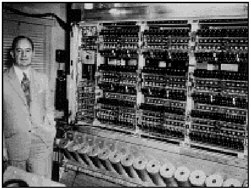
John von Neumann (1903–1957): Hungarian-American mathematician who made important contributions to the foundations of mathematics, logic, quantum theory, meteorology, science, computers, and game theory. He was noted for a phenomenal memory and the speed with which he absorbed ideas and solved problems. In 1925 he received a B.S. diploma in chemical engineering from the Eidgenössische Technische Hochschule in Zurich and in 1926 a Ph.D. in mathematics from the University of Budapest. His Ph.D. dissertation on set theory was an important contribution to the subject. At
the age of 20, von Neumann proposed a new definition of ordinal numbers that was universally adopted. While still in his twenties he made many contributions to both pure and applied mathematics that established him as a mathematician of unusual depth. His Mathematical Foundations of Quantum Mechanics (1932) built a solid framework for the new scientific discipline. During this time he also proved the minimax theorem of game theory. He gradually expanded his work in game theory, and with coauthor Oskar Morgenstern he wrote Theory of Games and Economic Behavior (1944).
In 1930, von Neumann journeyed to the United States, becoming a visiting lecturer at Princeton University; he was appointed professor there in 1931. In 1933 he became one of the original six mathematics professors at the newly founded Institute for Advanced Study (IAS) in Princeton, New Jersey, a position he kept for the remainder of his life. He became a U.S. citizen in 1937. During the 1940s and 1950s, von Neumann was one of the pioneers of computer science. He made significant contributions to the development of logical design, advanced the theory of cellular automata, advocated the adoption of the “bit” as a measurement of computer memory, and solved problems in obtaining reliable information from unreliable computer components. Moreover, his involvement attracted the interest of fellow mathematicians and sped the development of computer science.
During and after World War II, von Neumann served as a consultant to the armed forces, where his valuable contributions included a proposal of the implosion method for making a nuclear explosion and his espousal of the development of the hydrogen bomb. In 1955 he was appointed to the Atomic Energy Commission and in 1956 he received its Enrico Fermi Award. His many and varied scientific contributions made him one of the last generalists among contemporary scientists.
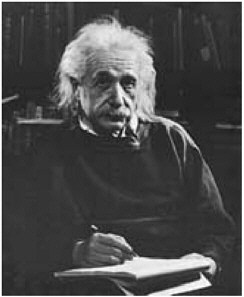
Albert Einstein (1879–1955): German-American physicist who contributed more than any other scientist to the twentieth-century vision of physical reality. In the wake of World War I, Einstein’s theories–especially his theory of relativity– seemed to many people to point to a pure quality of human thought, one far removed from the war and its aftermath. Seldom has a scientist received such public attention for having cultivated the fruit of pure learning.
By 1909, Einstein was already recognized throughout German-speaking Europe as a leading scientific thinker. In quick succession he held professorships at the German University of Prague and at Zurich Polytechnic. In 1914 he advanced to the most prestigious and highest-paying post that a theoretical physicist could hold in central Europe: professor at the Kaiser-Wilhelm Institute in Berlin. Although Einstein held a cross-appointment at the University of Berlin, from this time on he never again taught regular university courses. He remained on the staff at Berlin until 1933, from which time until his death (1955) he held an analogous research position at the IAS.
Until the end of his life Einstein sought a unified field theory whereby the phenomena of gravitation and electromag-
netism could be derived from one set of equations. Few physicists followed Einstein’s path in the years after 1920. Quantum mechanics, instead of general relativity, drew their attention. For his part, Einstein could never accept the new quantum mechanics with its principle of indeterminacy, as formulated by Werner Heisenberg and elaborated into a new epistemology by Niels Bohr. Although Einstein’s later thoughts were neglected for decades, physicists today refer seriously to Einstein’s dream—a grand unification of physical theory.
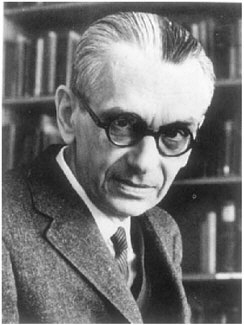
Kurt Gödel (1906–1978): Austrian-born, American mathematician and logician. He is best known for his undecidability theorems, which state that any rigidly logical mathematical system contains questions that cannot be proved or disproved on the basis of the axioms within the system. These results were an epochal landmark in twentieth-century mathematics, indicating that mathematics is not a finished object, as had been believed. His proof first appeared in a German mathematical journal in 1931. This paper ended nearly a century of attempts to establish axioms that would provide a rigorous basis
for all of mathematics. Gödel became a member of the faculty of the University of Vienna in 1930, where he belonged to the school of logical positivism. In 1940 he emigrated to the United States; he was a professor at the IAS from 1953 to his death.
In addition to his work in logic, Gödel had a strong interest in physics and found a solution to Einstein’s field equations that implied a universe in which time travel was possible. He spent the last two decades of his professional life in concentrated study of the philosophy of Leibniz and was deeply concerned with metaphysical and theological questions regarding the existence and nature of God.
As a result of a childhood bout with rheumatic fever, Gödel was always preoccupied with his health; he spent the final years of his life in what some believed to be a paranoiac obsession over it, even wearing heavy sweaters and an overcoat on the hottest summer days. Fearful of being poisoned by gases from his refrigerator, Gödel eventually refused to eat and died from self-starvation in Princeton in 1978.
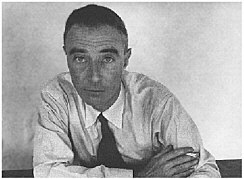
J. Robert Oppenheimer (1904–1967): One of the most influential American scientists of his day. He is renowned for his leadership in developing a strong tradition of theoretical physics in the United States, his direction of the laboratory that fashioned the atomic bombs used in World War II, and his
prominent role as a government advisor on military weapons and policy in the postwar period.
After graduating from Harvard University in 1925, Oppenheimer toured European laboratories and institutions for four years just as the theory of quantum mechanics emerged. At Cambridge University he quickly grasped the value of the various mathematical techniques developed to explore this new approach and showed how certain atomic and molecular characteristics could be derived. At the invitation of Max Born, Oppenheimer went to Göttingen in 1926, where he received his doctorate the following year.
World War II turned Oppenheimer’s energies to a new line of research. He and others recognized that an explosive chain reaction could be sustained in nearly pure fissionable material (uranium-235 or plutonium) with fast neutrons. In 1942 he was asked to coordinate an investigation into this reaction. As part of the Manhattan Project, research and development work on the atomic bomb was centralized at a remote laboratory in Los Alamos, New Mexico. Even his critics concede that Oppenheimer, as director of the laboratory, performed brilliantly in developing the atomic bomb.
In 1947 Oppenheimer moved to Princeton as director of the IAS. Until 1952 he served as chairman of the board of scientific advisors of the U.S. Atomic Energy Commission (AEC); in 1949 the board rejected a proposal to initiate a program to manufacture hydrogen bombs. Because of his influence on the AEC, his sharp tongue, his sometimes controversial views on military strategy, and his belief in arms control, Oppenheimer incurred the enmity of various members of the military, politicians, and scientists who advocated fusion bombs and a larger strategic arsenal.

Lewis L. Strauss (1896–1974): In the first dozen years of the atomic age, few men played a more pivotal role in shaping American nuclear policy than the former banker Lewis Strauss. An ardent champion of the hydrogen bomb, he was also a strong believer in the importance of maintaining a large nuclear stockpile. His appointment to the United States Atomic Energy Commission (AEC) in 1946 (an agency he chaired from 1953 to 1958) meant he was well placed to influence both President Truman’s and President Eisenhower’s decisions on nuclear issues and to oversee the atomic-related activities of all federal agencies.
The thorny, owlish-looking Lewis Strauss started out life as a traveling shoe salesman working for his father. He later became an incredibly successful investment banker. By the time he left Wall Street to join the AEC, he was earning a million dollars a year. His new government appointment required him to give up all his business interests, which he told an interviewer, made him feel “like a man who is amputating his own leg.”
Early on in his role as an AEC commissioner, Strauss argued that the United States needed to have a system in place to detect foreign atomic tests. As it turned out, the monitoring
system set up at his insistence was established just in time to detect the first Soviet atomic test in August 1949.
The news that the United States no longer had a monopoly on nuclear weapons pitted Strauss against other members of the AEC including its chairman David Lilienthal. Lilienthal wanted to respond to the Soviet test by increasing the production of atomic bombs while at the same time stepping up the effort to create international controls for weapons of mass destruction. Taking a far more aggressive stance, Strauss argued vigorously for a crash program to build a hydrogen bomb: “the time has now come for a quantum jump in our planning…. We should now make an intensive effort to get ahead with the super [hydrogen bomb].” Strauss won the day and in January 1950, President Truman publicly announced a “crash” program to build a superbomb.
Conflict over the H-bomb also created tensions between Strauss and physicist J. Robert Oppenheimer, the father of the atomic bomb. Strauss told President Eisenhower that he would only accept the position of AEC chair if Oppenheimer played no role in advising the agency. He explained that he didn’t trust Oppenheimer partly because of his consistent opposition to the superbomb. Within days of being sworn into office in July 1953, Strauss had all classified AEC material removed from Oppenheimer’s office. By the end of the year, Oppenheimer’s security clearance was revoked.
Over the years Strauss’s arrogance and his insistence that he was always right made him unpopular on Capitol Hill. In 1959, after two months of exhausting hearings, the Senate rejected his nomination to be Secretary of Commerce. The ordeal was publicly humiliating for Strauss, especially after he was caught lying under oath. Afterward the financier returned permanently to the private sector.