The One True Platonic Heaven: A Scientific Fiction on the Limits of Knowledge (2003)
Chapter: Chapter Eight: The Verdicts
Chapter Eight
THE VERDICTS
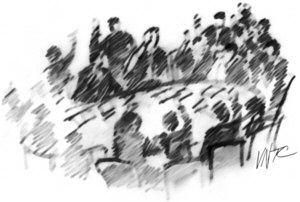
The remnants of yesterday afternoon’s talk on topological group theory were still evident in the half-erased scribblings on the blackboard in the School of Mathematics seminar room as the faculty filed in for their monthly meeting. At the small, plain, wooden table in the front of the room sat Oswald Veblen, who would chair the gathering. Veblen was the first professor hired by the Institute, and felt rightly that he was the founder of the School of Mathematics. As a result, no one ever questioned his right to chair these gatherings, a role Veblen felt might be crucial with today’s agenda. Arrayed in the first couple of rows of seats facing him were the rest of the faculty: von Neumann, Morse, Siegel, and Montgomery. As Veblen scanned the faces before him to see if anyone was absent, the door opened and Hermann Weyl
strode in, looking dapper, composed, and as confident in his step and manner as the most Germanic of German professors. Weyl slipped into a seat in the front row as Veblen called the meeting to order.
“Gentlemen. You all know we are here for two matters today,” he declared in a voice that immediately took control of the room. “One is to consider the promotion of our colleague, Kurt Gödel, to full Professor at the Institute. The other is to choose Visiting Members for the coming academic year. As I suspect that the first agenda item will be the more time consuming of the two, I suggest we begin with consideration of Gödel’s promotion. We can then deal with the visitors. Are there any objections?” Veblen asked, the look on his face saying there had better not be. “Fine. Then the floor is open for discussion of Gödel’s promotion.”
As soon as the words were out of Veblen’s mouth, von Neumann began presenting his case in support of Gödel.
“We are all mathematicians here and so I do not think I have to acquaint anyone with the content of Gödel’s work. The consensus among the world’s logicians is that Gödel is by far the greatest logician of our century. Some even say he is the greatest logician since Aristotle. If our faculty had a geometer who was seriously considered in the same breath as, say, Archimedes, or a number theorist who was termed the greatest number theorist since Gauss, is there any question whether that person would be a Professor on this faculty? Gentlemen, I say again: How can any of us call ourselves ‘Professor’ if Gödel cannot?” Following this manifesto, von Neumann quickly took his seat, folded his hands on top of his ample paunch, and looked at the group as if to challenge any of them to dispute the airtight logic of his argument.
A few heads did nod their accord with von Neumann’s impassioned plea, a rather uncommon show of emotion for the generally even-tempered Hungarian. But not everyone was in
agreement. As von Neumann sat down, Weyl, as suave and full of continental style and grace as von Neumann himself, rose to address the faculty.
“There is no one here who admires Kurt as a person and as a mathematician more than I do. But as the person here closest professionally to his work—other than Johnny, of course—I feel compelled to mention that there are those who do not share Johnny’s admiration for the incompleteness results that Kurt’s reputation rests upon.”
Von Neumann immediately jumped up and asked Weyl for details supporting this argument.
“Johnny, I’m sure you know of the Oxford philosopher, J.L. Austin.”
“Indeed, I do,” replied von Neumann, who in fact had never heard of Austin or a lot of other philosophers, whose work he regarded with grave suspicion and as almost totally irrelevant to the pursuit of either mathematics or the natural sciences.
“Well,” continued Weyl. “When informed of Gödel’s incompleteness result that says essentially that truth is always bigger than proof, Austin replied, ‘Who would have ever thought otherwise?’ I think this sums up the feelings of some mathematicians, too, in the sense that they feel this result is more of a trick of language than a hard result in mathematics.”
“I’m sorry to have to mention,” said Veblen in a rather assertive tone that made it clear he was not at all sorry to intervene,“that Hilbert himself, whom I’m sure everyone in the room will accept as a bona fide mathematician of the first rank, believed that mathematics was complete and was rather devastated when he was told of Gödel’s achievement. So whomever these mathematicians are who minimize Gödel’s accomplishment, Hilbert would not have counted himself among them. Moreover, my recollection, Hermann, is that you, yourself, have stated that Hilbert was the single greatest influence on
your own development as a mathematician.”
This remark coming from Veblen really took the wind out of Weyl’s sails and he slowly sank back down into his chair, much like a balloon from which the air was gradually leaking. But as one sat down another jumped up, this time the ever irascible and stubborn group theorist, Deane Montgomery.
“What worries me about having Gödel as a Professor is not the merit of his mathematical work. I’m happy to accept that as being of world-class quality—stunning, in fact. It’s his personality that concerns me. We have a very small faculty here, and we all know how much administrative work has to be done by each of us to manage the School of Mathematics. Even today we have to discuss and settle on applicants to be invited as visitors for the coming year. And that is but a small part of the administrative burden we each must bear. I truly wonder whether Gödel’s penchant for logical precision might interfere with the smooth running of the School by introducing interminable delays while he sorts out the logical merits of the various candidates and other issues that must be decided.”
Montgomery’s concern reflected that of several of the faculty, since even among the extreme opinions at the IAS, Gödel’s worldview and actions were very strange to a point beyond mere eccentricity. In fact, there were those who mumbled words like “certifiably insane,” “crazy,” and “out of touch with reality” in hushed corridor conversations about his ways. If he were made a Professor, he would acquire the responsibility, as well as the right, to become part of the decision-making process in the School of Mathematics. Some, like Montgomery, felt that the overall interests of the School were better served by leaving Gödel in his current position as a Permanent Member of the Institute, where he was not involved in administrative issues, than by elevating him to Professor, where his psychological instabilities might prove a major barrier to the School’s smooth functioning.
Von Neumann and Veblen started to speak at the same time, each wanting to defuse this commonly held view of Gödel’s temperament, which they both felt was an exaggerated caricature of the man’s true nature. Von Neumann, especially, knew that while Gödel, like all logicians, was extremely pedantic and precise about work, he was certainly not any more other-worldly than the rest of the faculty when it came to making decisions. In fact, von Neumann felt that Gödel might inject a much-needed note of objectivity into some of the emotionally charged faculty debates on potential visitors, who were often appointed more because some faculty member wanted them as slavish collaborators than because they were the most qualified among the pool of applicants.
“Gentlemen,” began von Neumann, “I have known Kurt Gödel since he was a student in Vienna in the 1920s, and so I feel I can speak with some confidence to his mindset and especially to the point that Montgomery just raised about him being a possible barrier to the administrative procedures needed to keep the School of Mathematics functioning. Gödel is a deliberative man; no doubt about that. But he most certainly is not ‘crazy.’ Nor is his habit of examining every logical aspect of a situation necessarily a bad thing for our faculty. For myself, I would welcome Gödel’s highly logical opinion on a number of issues that we must regularly consider, including the appointment of Professors and the choice of visitors.”
At this juncture Marston Morse added his voice to the discussion. He had been uncharacteristically silent, so his views carried more weight than they might have otherwise. Given his earlier antipathy to the promotion, he surprised many by giving a strong endorsement of Gödel’s candidacy for Professor, standing and speaking with passion: “While I have no professional overlap with Gödel, every now and then our paths cross here at the Institute and I have raised one or another question with him about aspects of my own work. On these
occasions we have even touched briefly on matters outside mathematics, including affairs of the Institute and the faculty. I have found Gödel’s opinions very well thought out and at times I can hardly even begin a chain of logical argument about something without getting the impression that he has already explored that idea to all of its possible logical conclusions even before I’ve finished my explanation of the problem. So I agree with Johnny: Gödel will be very conscientious and thorough in carrying out his administrative duties as a Professor. I should be honored to serve on the faculty with him, and urge this body to recognize his contributions to mathematics and to the Institute by finally appointing him to the rank he so richly deserves.”
Veblen, always the savvy political opportunist, saw Morse’s unexpected endorsement as just the opening he needed to provide the impetus to move Gödel’s promotion forward—now! Exercising his prerogative as chairman, he immediately terminated discussion and called for a vote. “We’ve all now had our say about Gödel. My sense of the situation is that this is the right moment to vote on the question. So unless there are any objections, I’d like each of you to write either ‘Yes’ or ‘No’ on a piece of paper and pass it up to me. ‘Yes’ indicates you are in favor of promoting Gödel to Professor, while ‘No’ means you are against it.”
As Veblen passed out the pieces of paper from his notepad, there was a bit of shuffling about because the men had been caught unawares by his speedy maneuver and had to hurriedly dig in their pockets for a fountain pen or pencil to mark their ballots. An outside observer would have been amused to see the contortions some of them went through to ensure no one could see their ballots, Siegel even hunching over his chair so that he looked like he had collapsed on the spot. Eventually the papers were passed up to Veblen who gathered them together and began opening them and tallying the result.
Completing the count, which didn’t take long for such a small group, Veblen turned to the group with a deadpan and said, “Gentlemen. I’m pleased to announce that we have a new Professor on our faculty today. I will inform Director Oppenheimer that the faculty of the School of Mathematics has voted in favor of promoting Kurt Gödel to Professor. Johnny, will you please communicate this result to Kurt informally? But caution him that the promotion will not be official until it is approved by the Board of Trustees.”
With that simple statement, Veblen consulted his notes and suggested that the faculty move on to the next item on the agenda. And so it was that Gödel was elevated to the rank of Professor in a debate that was far more peaceful and tranquil than even his staunchest supporter, von Neumann, had expected.
⋮
Things were definitely not peaceful or tranquil in the boardroom across the hall from the mathematics seminar room. The tension between Oppenheimer and Strauss had degenerated into a kind of covert guerrilla warfare, with the two men constantly at each other’s throats over Strauss’s belief that Oppenheimer was a threat to national security on account of his left-leaning political and social views, as well as his prewar membership in various Communist front organizations. The animosity between them was a long-standing affair that had now boiled over. Recent rumblings from Washington suggested that Russian work on an atomic bomb had been dramatically accelerated as a result of secrets stolen from Los Alamos during Oppenheimer’s reign as head of the Manhattan Project. At the moment, the two men simply glowered at each other across the boardroom table, temporarily set-
ting aside their differences to enter into the trustees’ debate on whether to overrule the faculty and confirm their earlier tenative approval of von Neumann’s proposal to build a computer. Looking up from his notes while avoiding eye contact with Strauss, Oppenheimer put the matter before the board.
“At our last meeting we discussed in detail Johnny’s proposal to build a computing machine here at the Institute,” he stated matter-of-factly. “Since then, Johnny has told me that he is committed to this project, even to the extent of being ready to leave Princeton and go elsewhere if necessary to carry on the project. I have it on good authority that this is no idle threat, either, as he has discussed the possibility with people at several other institutions, including the University of Chicago and the Massachusetts Institute of Technology. As the faculty is strongly divided on the matter, it is really up to us here in this room to settle it. And we must do it today, as Johnny feels that there is no more time to be wasted. He wants to move forward with this project, preferably here at the IAS but elsewhere if need be.”
The one thing that Oppenheimer and Strauss could agree upon was the importance of having von Neumann on the Institute faculty. They both knew that Johnny’s presence in Princeton lent the Institute an air of intellectual respectability in the world of mathematics that would be difficult to replace. Moreover, as a man of the world concerned with the position of the United States in the global geopolitical scheme of things, Strauss felt that von Neumann’s argument about the limits to science being determined by the limits to one’s ability to carry out computation had deep national security implications. So despite having only the dimmest awareness of what these implications might actually be, Strauss wanted to ensure that whatever they were, the power of the computer stayed firmly in hands that he could monitor and control. That meant they should stay in von Neumann’s hands at the IAS.
So as soon as the floor was open for discussion, Strauss jumped in to add,
“At our last meeting, we all heard Professor von Neumann tell us some of the reasons he feels so strongly about the computer project. I can tell you that privately he has told me even more than he said then. And what he said convinces me that this project is not just important for the advancement of science, but vitally important to the security of this country.”
“What do you mean by that?” enquired one of the lawyers, a droopy-eyed Southerner who generally half dozed through these trustee meetings. “How can a machine that simply adds and subtracts numbers—albeit very quickly—have national security implications?”
“Let me give you an example,” said Strauss, thinking that this lawyer was certainly not one of the sharpest pins in the cushion if, in light of the effect the atomic bomb had on America’s position in the world just a couple of years earlier, he needed an explanation of how scientific advancements can determine the course of a country’s fortunes. “Suppose you had a surefire method for predicting the weather. Do you think that would give you an advantage in military operations?” asked Strauss, staring at this small-town, country lawyer.
“Guess it probably would,” drawled the lawyer in agreement.
“But predicting the weather faster than it unfolds is a mathematical problem involving lots of calculations, just as Johnny explained at our last meeting. And if you have the computing power you can do these calculations; otherwise, you can’t. Now suppose, just suppose, you could use this information to modify or actually control the weather. If that’s not something vital to the security of a country, I don’t know what is. There may be some in this room who wouldn’t worry a bit about giving the Russians the ability to drop a hurricane on Miami or a drought in Kansas. But I’m not one of them.
If anyone is going to have this kind of capability, I want it to be America.”
Strauss made this rather gratuitous remark looking straight at Oppenheimer, whose pale-blue eyes returned the look with a glare chilling enough to reduce the room temperature to polar levels. But Oppie was not to be baited by the admiral into a public confrontation over their radically different positions on the Russians, national security, or the role of science in public affairs. In an attempt to use Strauss’s argument to create a rapprochement between the supporters of the computer project and those who leaned against it, he said, “I believe Admiral Strauss has made a telling point in support of the IAS being the home of Johnny’s project. This Institute is about cutting-edge intellectual endeavors, not simply polishing an existing apple to a brighter shine. No one on our faculty exemplifies this spirit more than Johnny. As the Director I believe we have a duty to support these goals of the Institute as laid down by its founders. I, therefore, stand fully behind what has just been said in support of having the computer project housed here at the IAS.”
At this juncture Oppenheimer received a strong vote of support from an unexpected source. Frank Aydelotte, a mild-mannered Quaker who had been trained in English literature at Oxford and later became President of Swarthmore College, sat on the IAS board as a representative of the American academic establishment—but from the humanistic, not the scientific, side. So when he spoke up in support of von Neumann’s avowedly scientific adventure, Oppenheimer took it as a sign from the cosmos to press forward to get the trustees behind the project while the momentum was still moving in his direction.
“Dr. Aydelotte speaks for all of us, I believe, when he says that this project is important not just for science, but for the Institute as well. If there are no objections, I suggest we
take a vote on the project now and move this matter off our agenda. Do I hear a second?”
Immediately, from the murmur of voices around the table, someone seconded the motion. Oppenheimer began to hand out paper for the trustees to mark their votes. But as he was doing so, Strauss said loudly, “I don’t think we need to have these ballots, Dr. Oppenheimer. My sense is that we can settle this with a simple show of hands. Does anyone object to that?”
In a roomful of tweedy academics, investment bankers, and sleepy lawyers, it was difficult for anyone to stand up to Strauss when he had his mind set on something. So it was hardly a surprise when nary a peep was heard against his suggestion. Shrugging his shoulders, Oppenheimer sat back resignedly and called for a show of hands.
“How many favor von Neumann’s project being carried on here at the IAS?”
Several hands shot up immediately, including, of course, those of Strauss and Aydelotte. Seeing the way the wind was blowing, the remaining trustees—some grudgingly—slowly raised their hands; a majority was achieved, and the matter was settled.
“Fine,” said Oppenheimer. “I will inform Johnny of the decision.”
Just as the last word was out of Oppie’s mouth, Aydelotte raised his hand with a question: “What about the financing of this project? We spoke only briefly about this at our last meeting. I’m sure it will involve hiring several engineers and technicians, not to mention requiring modification of physical space and acquisition of very specialized materials. Does von Neumann expect the Institute to pay for the people and equipment that will be required?”
Strauss fielded that enquiry without even blinking: “There are already commitments of funds and material, as well as expertise, from the military—the Navy, in particular.
And the Radio Corporation of America down the road has promised to supply much of the specialized hardware needed for the machine. So it should not be necessary for the Institute to dip into its own funds for this project; it will be financed one hundred percent from the outside.”
Aydelotte nodded contentedly, but then added another surprise in response to Strauss’s rosy picture. “That may be. Yet it is my experience that there’s never enough money and things always cost double what you think they will. So I would like to formally propose that the IAS allocate $100,000 from its own resources for von Neumann to draw upon as a kind of emergency fund if and when he needs it.”
“Seconded,” someone immediately boomed from the back of the room.
“In favor?” asked Oppenheimer quickly while the mood seemed to be strongly in von Neumann’s favor. Following a chorus of ‘Ayes’ from around the table, Oppie declared: “The matter is settled. The IAS will support the establishment of a computer project to be directed by Professor von Neumann. Moreover, the Institute will place $100,000 of its own funds at von Neumann’s disposal to facilitate the project. Are we all agreed on that?”
Silence gives consent, thought Oppie, as he looked at the faces around the table. I’m eager to tell Johnny the good news, he thought. This project has been in limbo long enough, and I’m relieved that the IAS will not lose Johnny to another institution over an intellectual tempest in a teapot like this.
Turning his attention away from the board, Oppenheimer glanced down at his notes and declared, “Time is fleeting and we still have much to do today. I suggest we move on to our next agenda item.”