The One True Platonic Heaven: A Scientific Fiction on the Limits of Knowledge (2003)
Chapter: Chapter One: A Walk Down Mercer Street
Chapter One
A WALK DOWN MERCER STREET
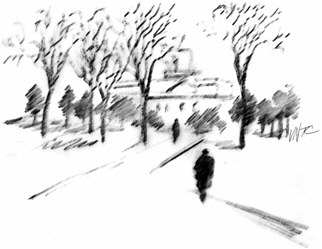
The tall, heavyset man strolling slowly down the side-walk was dressed in the rumpled, dark-blue sweat-shirt, baggy pants, and unshined shoes—with no socks—of the typical absent-minded professor. Glancing up, he saw a small boy on a bicycle bearing down on him, and had to quickly step aside, his long, white hair flying, as the boy nearly crashed into him, doing a comic double take as he caught a passing glimpse of one of the world’s best-known faces. With the famous droopy gray mustache, dark, soulful eyes, and a large, heavily built body yielding to the ravages of age, the man looked more like a retired football player or an aging wrestler than the most publicly celebrated scientist since Isaac Newton. If face and name recognition were any measure to judge by, the man might well rank higher than the President or the
Pope. Yet in the small, intensely academic town of Princeton, New Jersey, Albert Einstein, the most distinguished professor at the famed Institute for Advanced Study (IAS), was just one more senior citizen dodging young mothers with strollers— and children on bicycles—on his daily walk from the Institute to his home on Mercer Street on this rather warm, early-spring afternoon.
The diminutive figure at Einstein’s side could not have presented a sharper physical contrast to the great man. He was gaunt to the point of emaciation and a black streak running through the middle of of his thinning, gray hair plastered back in the fashion of a Roaring Twenties matinee idol gave the top of his head an astonishing resemblance to a skunk. As the pair strolled side by side, the small man struggled with a bulging briefcase that appeared to weigh almost as much as himself, making him appear more like Einstein’s lawyer than the greatest logician since Aristotle, which is how many of his peers described Kurt Gödel. He wore a thick, black scarf wound tightly about his neck and was bundled up in a winter-weight tweed suit, woolen vest, and old-fashioned necktie. Even in the moderately warm spring weather, Gödel’s hypochondria knew no bounds and dictated that he protect himself against the ever-present threat of disease from germs and other pathogens that only he seemed to sense.
Deep in his thoughts, Gödel paused for a moment and peered up at Einstein through a pair of perfectly round, dark-rimmed, thick spectacles of the type usually seen only on wartime refugees from central Europe. Stepping off the side-walk, Einstein paused to allow a car to pass. Looking over at his companion, he noticed Gödel’s hunched shoulders and deep worry lines, which prompted him to enquire, “What is troubling you, Kurt? You have been silent for too long now. Is something on your mind?”
Peering up at Einstein with a soulful, almost hangdog
look on his face, Gödel replied: “I’m sorry, Albert. I don’t really want to bother you with my small problems,” the corners of his mouth turning up in a shy, embarrassed smile.
“You are beginning to irritate me, Kurt. We are friends for a long time, no? What are friends for if not to help each other? Now tell me, what is bothering you.”
Gödel stared off into space, his mind seemingly transported to one of those ethereal realms beyond space and time that only logicians can access. A passerby would have found it comical indeed to see these two giants of the intellect, in a state of seemingly complete paralysis on the sidewalks of Princeton, totally absorbed in thought. Breaking out of his reverie, Gödel finally blurted out what was bothering him. He began with a question:
“Do you remember when I first came to the Institute?”
“Yes. It was in its first year of operation, 1933. Am I right?”
Gödel nodded and went on to tell Einstein that he had regularly shuttled back and forth between Vienna and Princeton from that initial visit until he finally left Nazi-occupied Vienna for the last time in January 1940. He moved permanently to Princeton following a tortuous journey by rail across Siberia, by ship to San Francisco, and then across the United States by train to New Jersey. This roundabout itinerary had been necessary to avoid a dangerous crossing of the U-boat-infested North Atlantic.
Passing beneath the branches of a majestic oak tree whose leaves were just starting to open, Gödel asked, “By offering me these many visiting appointments, do you think the Institute authorities have demonstrated their recognition of my work and its importance in the world of mathematics?”
“Definitely, Kurt. No question about that,” replied Einstein, wondering just where Gödel was going with these questions.
“Then why have I not been appointed Professor in the faculty of the School of Mathematics? Certainly all the professors—Veblen, Alexander, Morse, von Neumann, Weyl—fully deserve their positions. I can find no logical argument against any of them being Professor. But I am still a ‘Member’ of the Institute, not a Professor on the faculty. I find this very puzzling and, to be bluntly honest, personally and professionally insulting.”
Finally, the matter was in the open. Gödel was upset because he had not been appointed a full professor at the Institute. Despite his being universally acclaimed as the greatest logician of the twentieth century, some even calling him the greatest logician since Aristotle, the faculty of the IAS had in its strange brand of wisdom relegated Gödel to the lower rank of Member of the Institute, albeit for life, but not Professor.
Before Einstein could reply, Gödel’s unnatural fear of and inborn respect for authority percolated to the surface of his consciousness and, in some agitation, he declared: “Of course, maybe the Institute management has a good reason for not promoting me to Professor. Perhaps there is some question of my loyalty to the United States, or someone has questioned the ultimate value of my work. Do you think that could be the case?”
Taken completely aback at this plaintive, almost paranoiac, statement, Einstein was momentarily speechless. As a man who had been lionized by the entire world for decades, he just didn’t know what to say or how to soothe Gödel’s wounded ego and defuse what could easily blow up into a real conflict in upcoming faculty meetings. Like a kindly Dutch uncle, he put his hand on Gödel’s shoulder and said softly, “Kurt, the entire faculty understands the importance of your work. Professor von Neumann even asked once how any of us could consider ourselves ‘Professor’ if you are not. Your results in mathematics and logic will live as long as men do
mathematics and logic. They are the epitome of what the IAS is about: abstract thought that uncovers the deepest secrets of nature and the human mind.”
By this statement Einstein acknowledged that in an institute in which abstract theory was the coin of the realm, Gödel was the unchallenged Grand Exalted Ruler. His stunning discovery of the limitations of all axiomatic deductive systems of logic placed him—and his work—in a separate category from the normal run of academic geniuses. In the one, true, platonic heaven of the IAS, Gödel was King. Einstein’s tribute led to the inevitable rejoinder: “Then it’s only logical for me to wonder why, if the faculty holds my work in such high esteem, they have not voted to promote me to Professor. Do you have an answer for that?”
Einstein knew he would be painted into a corner if he responded in any fashion at all and desperately wished that he had walked home alone. He had to say something. Yet getting into a logical debate with Gödel was about as much fun as wrestling with an alligator—and just about as painful. Running his hand through his electrified hair, Einstein said softly, but firmly, “Kurt, von Neumann has argued the case for your promotion in the faculty meetings. I have, too. But there are always some faculty members who vote against it. The strange thing is that they don’t offer any arguments against your promotion that can really be logically analyzed. Instead they fall back on statements about how important it is to give you ample time for your research and not to distract you from it with mundane administrative chores like committee meetings, evaluating applicants for visiting positions, and the appointment of new faculty. Yes, it is very difficult to argue against such beliefs.”
“I understand the situation and I am grateful for your support. But perhaps you could have a short talk with Oppenheimer or someone else in the administration about this for
me? You are the most influential member of the faculty, and perhaps a word from you to Oppenheimer could change the faculty’s mind.”
Einstein sighed. “Unfortunately, you overrate my influence. When I came to the Institute in 1933, Mr. Flexner [founder and first director of the IAS] made it perfectly clear by his actions that he had bought me for the Institute and that my role here was to be a ceremonial figurehead, an icon, if you like. Now I am afraid the faculty thinks of me as a bit of a dinosaur. They tolerate my ideas more from respect for my past work than from enthusiasm for my current ideas, especially my very unfashionable views on quantum theory. So I don’t think my speaking with Oppenheimer is going to help your cause at all, my friend. Nevertheless, I promise you I will try.”
⋮
Glancing up at the watery sunlight streaming down from behind a fleecy cloud, Einstein was pleased to see the weather clearing. Perhaps he could even sit for a while in his garden this afternoon and take a bit of sun before the wind came up again. This benevolent turn of nature put him into an optimistic frame of mind as he declared, “Enough of petty academic politics, Kurt. Let us talk a bit about something of substance and content. What are you working on these days?”
“Your own general theory of relativity,” announced Gödel with a sly grin, surprising the great physicist. And within the blink of an eye the two were discussing Einstein’s most stunning achievement, the general theory of relativity, perhaps the greatest single piece of work in the history of physics. In essence, the general theory of relativity is a theory of gravity, and soon the pair were deep in consideration of one of the theory’s most startling implications about our everyday sense of the flow of time.
In his high-pitched, sing-song voice, Gödel said that as part of an essay he was preparing for a book honoring Einstein’s scientific and philosophical work, he had been studying the mathematical equations underpinning the theory. These equations admit different solutions, each solution leading to a very different type of universe—some with space twisted like a pretzel, others with time moving in ways counter to everyday human intuition. One universe is expanding, another contracting, while in yet another, space and time are so strongly curved that it is possible to literally look back into one’s own past. But the startling new solution Gödel had discovered involved a universe in which there is no objective lapse of time at all. So in Gödel’s universe the ideas of “before” and “after” had no intrinsic meaning. One person’s “before” could be another’s “after,” and vice versa. Gödel was concerned about whether such a mathematical universe could be taken seriously as a candidate for the actual physical universe we inhabit.
Looking over at Einstein to see how he was taking these strange notions, Gödel nearly ran head on into a housewife pulling a grocery cart down Mercer Street on her way back from the market. The woman stared in momentary puzzlement at the great Einstein, who looked vaguely familiar to her. But as he had the young cyclist earlier, Einstein ignored the woman and encouraged Gödel to elaborate.
“I have recently discovered a remarkable solution to the field equations of general relativity,” Gödel declared excitedly. “My solution implies the possibility of traveling backward in time. If this mathematical universe that I have derived—from your own theory, mind you—describes the universe we live in, then I can see no alternative to a complete denial of the reality of time; it is simply an illusion, a trick of the mind with no basis in physical reality at all.”
Stopped in his tracks by this remarkable claim, Einstein
stared at Gödel for at least a minute before saying, “Please, slow down and go through your argument carefully for me. Give me a clear explanation of the reasoning that could lead you to such an amazing statement.”
Robin redbreasts twittered in the trees, cars passed on the street, clouds moved in front of the sun. Everyday life went on all around. But Gödel was oblivious to all these everyday things, as he stood, fixed in place on the street corner, biting his lip and furrowing his brow, marshalling his arguments. He wanted to be clear, but….
“First, think about your own special theory of relativity. In that theory the notion of ‘now’ is not the same for every observer. What is ‘now’ and what is ‘before’ and ‘after’ depends entirely on what point of reference an observer uses to measure spatial and temporal events. Different frames of reference give different moments for what constitutes ‘now.’ ”
“That is certainly the case,” Einstein agreed, thinking of the now famous Twin Paradox. This involves identical twins, one of whom travels at a speed close to that of light on a space ship to the outer reaches of the galaxy, while the other twin stays at home. When the traveling twin returns, he discovers to his great surprise that his brother has aged several decades—or even centuries—relative to his own age. This so-called “paradox” is simply a manifestation of the fact that time does not move at the same rate for everyone. The closer to the speed of light you move, the slower your clock runs relative to the clock of a stationary observer like the stay-at-home twin.
“But the relativity of this kind of intuitive time implies the relativity of an objective span of time that would be the same for all observers. Such an objective interval of time, in turn, implies that only the present really exists. But this is impossible.”
Grasping Gödel’s point immediately, Einstein finished the
argument.
“So if the special theory of relativity is true, time disappears completely. No?”
“Precisely,” agreed Gödel.
Einstein thought for a moment, his sad brown eyes staring off into that same distant realm Gödel had looked into earlier, a place reserved for those few geniuses gifted with the ability to see beyond ordinary space and time. Jerking his thoughts back from distant galaxies and possible universes to the plain, simple streets of Princeton, he finally said, “But such a conclusion is very much confined to the particular—and nonphysical— situation in which there are no preferred frames of reference, a situation in which every observer is just as good as any other observer. This is the domain of the special theory of relativity. But in the general theory of relativity some reference frames are privileged. These privileged frames can be coordinated with each other to determine a single, objective, cosmic time. So in our universe time reappears. Doesn’t that destroy your argument for whatever real universe we happen to inhabit?”
“Not at all,” said Gödel, his voice rising again in the peculiar high-pitched giggle he fell into when especially excited. “My new solution of the equations of general relativity yields a set of world models that rotate. I can prove that in such worlds cosmic time disappears. Moreover, in certain nonexpanding universes of this type, there are even closed timelike world lines, paths for an individual’s movement through space and time in the four-dimensional realm of spacetime, that return to exactly where they began.”
Almost as if he were afraid to speak the words, Einstein muttered more to himself than to Gödel, “You mean time travel?”
“Yes, time travel!” Gödel smiled. “But if you can revisit the past, it never passed from existence in the first place. So once again, time disappears.”
“But, Kurt,” Einstein countered, “your new rotating universe is merely a possible world, one that comes out of the mathematics but might not correspond to any type of physical reality.”
Gödel, however, was ready for this fairly straightforward objection. “The only way our universe and a rotating universe can differ is in the global distribution of matter and in the motions of the two universes. The real universe and the mathematical one are described by the same laws of nature, and it’s certainly conceivable that they could give observers the same experiences of time. So if time is an illusion in one world, it must be an illusion in the other one, too.”
Einstein nodded his approval of this airtight chain of logical deduction. Time indeed seemed to stop for Einstein as he again retreated into his own inner world, contemplating the implications of Gödel’s result: Time would indeed disappear even in the actual world.
Breaking out of his trance, Einstein suggested, “Perhaps we could learn more about the nature of your rotating world by examining more closely the nature of the time travel it admits. What kind of time travel is it? Backward in time, forward, both, or…?”
“Yes,” said Gödel rather diffidently. “In the universe determined by my solution, travel into the future or the past is possible in exactly the same way we can travel in different directions in space.”
Einstein enquired calmly, “So there is no distinction between ‘earlier’ and ‘later’?”
Gödel’s face lit up in a grin that would do justice to a Cheshire cat, as he replied: “Exactly. What I am now puzzling over is whether there is any type of measurement that can be taken in our universe that would exclude such a time-travel universe as a candidate for the universe we actually inhabit. I must study this matter very carefully.”
“Kurt, my friend, you get closer and closer to becoming a physicist with each passing day,” joked Einstein, his saintly face breaking into a smile.
“You know, I began my university studies in theoretical physics before being seduced by the logical purity of mathematics. But to be truthful, my interests are now leaning more and more toward the philosophical, not the physical or even the logical.”
“These ideas on the illusory nature of time certainly seem far more philosophical than real to me,” Einstein agreed dryly. “I admire the logical clarity and precision of your argument. But I am still convinced that your mathematical universe is not our universe. God is subtle—but he is not malicious enough to play such a lowly trick on us poor mortals as to give us the possibility of time travel.”
Gödel thought about his friend’s comment as the pair continued their walk in silence. A few minutes later Einstein observed, “You know, Kurt, this time-travel result is very similar in spirit to your earlier work on incompleteness in mathematics. You realize that, no?”
Gödel looked as if he’d been struck by lightning. “What do you mean?” he cried. “We’re talking about a physical situation here, not a logical structure like arithmetic.”
“Yes,” said Einstein, “but your own Incompleteness Theorem uses the formal argumentation of mathematical logic to prove that it is impossible to define the ‘intuitive’ concept of Truth within any logical framework. Now you have again used mathematical methods to show that relativity theory cannot capture the ‘intuitive’ concept of time.”
Gödel nodded in agreement with Einstein’s analogy. As Gödel pondered, Einstein continued. “But what is strange to me is that in the case of truth, you conclude that the limitation lies within formalized mathematics. Yet in the situation of time, you do not say that the limitation is with relativity
theory, but that intuitive time itself is an illusion. You know, Kurt, you are coming very close to violating the logician’s first rule of life—consistency,” joked Einstein, to Gödel’s evident consternation.
⋮
While Einstein intended his little joke to relax Gödel and show that he understood that there were both serious logical and physical puzzles to be solved in coming to terms with these two great discoveries, the subtext of the joke under-scored the common methodological components forming the basis of Gödel’s two stunning foundational results in mathematics and in cosmology. The first is the use of mathematical argumentation to probe the limits of formal mathematics in capturing intuitive concepts—truth in arithmetic, time in the physical universe. The second aspect is the wish to move from the possible to the actual. Gödel believed that in certain situations what is possible tells us about what is, in fact, actual. In this latter case, his reflections on the mere possibility of a “Gödel Universe,” in which time is nonexistent, leads him to conclude that time does not exist in the actual world.
Gödel’s Incompleteness Theorem of mathematics and Einstein’s Special Theory of Relativity, along with that other foundational result of twentieth-century science, Heisenberg’s Uncertainty Principle, share considerable common ground. The first challenges the idea that every mathematical proposition can be proved or disproved by logical deduction, while the second demolishes the notion of a “cosmic clock” beating out a sequence of time moments valid for all observers. Finally, Heisenberg’s result shows the logical, not just the practical, limits to the accuracy with which we can measure the physical properties of objects, properties such as their position
and velocity or time and energy. Not only does each of these results represent one of the great theoretical achievements of the twentieth century, but each also has deep philosophical implications for how we humans see the world. Specifically, each result is established by formal mathematical methods, while demonstrating in its own way a type of limitation in the relevant area of enquiry—arithmetic and physics. Gödel shows an inherent limitation within any consistent framework of logical deduction, Einstein says there is a limit to the speed of light, and Heisenberg sets a limit on our ability to simultaneously measure different properties of a fundamental particle. Finally, all three draw conclusions about the way the world is from what are basically assumptions about the nature of knowledge, epistemological assumptions. So, in essence, they each argue that there are limits to what we can know about the world around us by using the tools of logical analysis and mathematics.
As the pair reached Einstein’s white clapboard house, a surprisingly modest dwelling for the century’s most famous scientist, the great physicist patted Gödel on the shoulder, turned into his walkway, and bade him farewell. As they parted, Einstein encouraged Gödel to develop further those strange ideas about the nature of time. Walking up the front steps and onto his porch, he turned and watched as Gödel slowly trudged down Mercer Street toward his own home. How odd, thought Einstein. The wizened little man bundled up in the heavy overcoat is one of the greatest intellects of the century. Yet no one really knows him—not even his own colleagues on the Institute faculty. Perhaps der Herr Gott really is malicious, after all.