The One True Platonic Heaven: A Scientific Fiction on the Limits of Knowledge (2003)
Chapter: Chapter Three: Goodtime Johnny
Chapter Three
GOODTIME JOHNNY
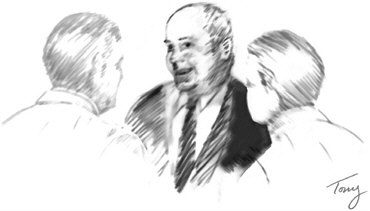
The elegant white lodge house at 26 Wescott Road was known far and wide among the Princeton cognescenti as the place for the best parties in town. A passerby, hearing the music and conversation pouring out of the windows open to the street, would be surprised to learn that the host was not some New York banker or Philadelphia industrialist, but of all things, a mathematician! But the house’s resident was no ordinary mathematician. Not by a long shot. John Louis von Neumann was a mathematician’s mathematician, a child genius who, instead of burning out as an adult as do many mathematicians, set a blazing fire in every corner of the intellectual forest his fertile mind touched.
Nevertheless, what “Johnny” liked best (after thinking, that is) was partying! This warm, spring night was typical of his social life, as the short, pudgy von Neumann and his equally short, dark-haired, vivacious wife, Klari, welcomed
their guests at the front door. Von Neumann ushered them into the large, black-and-white checkerboard-tiled foyer, with his customary courtly, central European manners. With a welcoming smile, von Neumann took pains to ensure that everyone was properly pointed in the direction of the bar set up in the kitchen. Dressed in his characteristic three-piece gray pinstripe suit and silk, patterned necktie, he looked more like a man ready to give solemn testimony before a congressional budget committee than the convivial host of an informal cocktail party at his own home. But that formal exterior hid a natural-born partyer, as everyone in Princeton knew well by now.
Von Neumann was especially pleased that his closest friend and fellow central European emigré, Stanislaw Ulam, was visiting the Institute from Los Alamos that week. Ulam would be arriving shortly, and there was much for them to catch up on. He was particularly eager to hear the news from New Mexico about how people at “the Labs” (the Los Alamos Laboratories) were thinking about the development of atomic weapons. Even though the war was over, von Neumann was deeply concerned with the growing threat posed by the totalitarian left wing in Russia. And in contrast to Oppenheimer, Einstein, and most of the other academics in Princeton, he strongly endorsed the accelerated development of the hydrogen fusion bomb, nicknamed the “Super,” as one way to put a damper on Soviet expansionist tendencies.
Drawn from the bar in the kitchen by the soft, almost liquid, sounds of Benny Goodman’s magical clarinet coming from the phonograph in the corner of the living room, the portly, balding Viennese economist Oskar Morgenstern rejoined the party, a puzzled frown on his sombre face. Yet one more intellectual from Mitteleuropa who had taken refuge from war-torn Europe at the IAS, Morgenstern thought back to a conversation he had had with von Neumann earlier that
day. The two were putting the finishing touches on one of the chapters in their magisterial work on rational behavior and economics, when von Neumann made the offhand remark that to produce decisive results in the field of economics, mathematical tools comparable in magnitude and importance to the calculus would have to be discovered. Of a slightly Napoleanic turn of mind anyway, Morgenstern interpreted this to mean that the theory of games of strategy he and von Neumann were developing at that very moment might well serve as this new kind of mathematics. He hoped that perhaps he’d have a chance to pick the great man’s brain a bit more on this topic during the evening.
As von Neumann bustled in from the hallway to join the party, which was already in full swing, one of the guests smiled and handed him a small gift-wrapped box. “I think you’ll enjoy this,” said the guest, a physicist whom von Neumann had met at the Institute but whose name—like almost everyone’s name—the great man’s prodigious memory simply could not recall. Warmly thanking the man for the present, von Neumann’s face beamed when he unwrapped it and saw inside one of those thermodynamic birds that sits on the edge of a glass of water and dips its beak into the water in a metronomic fashion, depending on whether its beak is wet from the water or dried out from evaporation. Von Neumann immediately got a glassful of water and set the bird on the fireplace mantel, declaring a new house rule: “Whenever the bird drinks,” he cried, “we all have to drink, too.” He quickly grabbed a glass and poured himself a full measure of Scotch whisky to get this new tradition off to a proper start.
“Tell us, Johnny,” said one of the other guests, turning the conversation serious for a moment, “as someone who grew up next door to the Russians, what do you think about their intentions in central Europe now that the war is over?”
Von Neumann’s soft, almost cherubic face changed sud-
denly from that of a jovial party host to that of a very sober, sombre man. Pondering in silence for a moment, he stated quite directly and unequivocally, “The Russians are now entrenched throughout central Europe. History shows that once they occupy a country, they never peacefully leave it. Sooner or later there will be a great conflict between them and us.”
“Do you believe we should use our superiority in atomic weapons right now to push them out of central Europe?” pressed the questioner, as several other partygoers gathered around to eavesdrop on this interchange.
“I am certainly no advocate of preemptive strikes against any country—usually,” von Neumann began. “But the Western way of life, whose preservation was what this great war was all about, is threatened by Soviet hegemony in central Europe,” he went on with the utmost gravity. “I’m sure no one here needs reminding of what Churchill said in Missouri just a few weeks ago. ‘An iron curtain has descended across the continent.’ Europe has now been divided into East and West. The West is going to have to defend the freedoms won by the war against this encroachment by Stalin. So in this case I say the sooner we strike, the smaller the eventual price in human suffering and death.”
“In other words, strike now while we have the clear advantage?” continued the questioner, relentlessly pressing von Neumann.
“Absolutely,” said von Neumann, clearly uncomfortable with the turn this conversation was taking. Looking for a way to escape the sobering discussion, he glanced up at the mantel-piece and said cheerfully, “I see our little bird has just dipped its beak into the glass, so perhaps we should all return to the bar and do the same.”
(On Christmas Day of that year, just a few months after von Neumann’s prophetic statement about Soviet intentions,
the Russians achieved their first nuclear chain reaction. This was the outcome of a crash effort by Soviet scientists to gain parity with the United States following the spectacular atomic weapons tests at Bikini Atoll earlier in the summer. There can be no doubt it was these two events that catalyzed the United Nations to create an international atomic energy agency to promote and oversee the peaceful uses of nuclear energy over Soviet objections calling for nuclear disarmament before any such agency could be created. Von Neumann’s concern over Russian expansionism led him to play a central role in the American nuclear program until the end of his life.)
⋮
Suddenly, almost out of nowhere it seemed, a short, slightly balding, dark-haired man in a rumpled gray sports jacket appeared at von Neumann’s side, an enigmatic smile on his face. Glancing over at him, von Neumann’s face lit up in welcome as he reached out to embrace the new arrival in a display of affection that was rare for the normally reserved, rather formal von Neumann.
“Stan!” he cried. “It’s wonderful to have you back in Princeton again. I’ve been looking forward to your coming back to us. I hope you will be able to stay a bit longer this time, so we can talk a bit.”
Stan Ulam knew Princeton well from his stay at the Institute in the mid-1930s, shortly after its formation, and long before he took up a position in Los Alamos as part of the Manhattan Project. He was now “genius-in-residence” at Los Alamos, the type of mathematician who is completely at home in a variety of areas in both pure and applied math—topology, mathematical logic, differential equations, probability theory, statistics—and with a deep interest as well in the applications of computing machines to the exploration of mathematical struc-
tures in physics and biology. It was during their time together in Princeton and then Los Alamos that he and von Neumann had become the best of friends, and their families still spent summer holidays together in New Mexico and other parts of western America.
“I just got into town today, Johnny,” he replied, “and got your invitation at the hotel. Even after a transcontinental trip, I’m never too tired for a night at the von Neumanns. So I rushed right over. We all know that a party at Johnny and Klari’s is the best show in town.” Looking around at the guests filling up the house, Ulam continued, “I can already see I’m not to be disappointed.”
“Indeed, you will not be disappointed. Come to the kitchen with me and I’ll get you fixed up with a drink. Besides, there’s something I need to ask you about,” said von Neumann as he grabbed him by the elbow and steered him toward the bar.
Von Neumann stood at the kitchen counter mixing a potent-looking Scotch-and-soda. As he turned and handed it to Ulam, they clinked glasses and von Neumann spoke in a low tone that allowed no doubt as to the gravity of what he was about to say.
“Stan, you know I’ve been increasingly frustrated by the attitude of the Institute faculty toward my proposal to build a computing machine here. It simply mystifies me how such otherwise intelligent people can be so blind when it comes to the implications of this technology for changing our way of doing science.”
Ulam raised his eyebrows over the rim of his glass and nodded.
“Tell me, Johnny, who is objecting and do they have any real basis for their opposition, other than that a computing machine is a machine and it represents a threat to their usual way of doing business here in this one, true, Platonic heaven?”
“Well, Morse says that he sees the computer as inevitable —but far from optimum. Einstein jokes that he doesn’t see how a computer will bring him any closer to a unified field theory. Then Siegel makes the inane objection that when he needs a logarithm he prefers to compute it by hand rather than look it up in a table. A table! As if the computer were nothing but a glorified calculating machine!”
“Strange, actually,” Ulam agreed with a smile, “since I think the computer is very much like a telescope, not a calculating machine at all. A telescope enables us to see things the naked eye cannot. The computer will enable us to see things that are invisible—or rather, inaccessible—to the unaided brain. Nevertheless, the faculty sounds as if they’re completely indifferent to your arguments, Johnny.”
“Indifference is putting far too kind a face on it,” von Neumann replied in a huff. “They are not only indifferent, they’re blind to how technology changes everything. But I still have a card or two to play in this game, Stan, and I will certainly play them as skillfully as I can—at just the right moment.”
Ulam smiled to himself at this remark. Vintage Johnny, he thought. Always ready to tackle the most difficult problem. And never afraid to stand up for his ideas, which are almost always years—no, decades—ahead of their time. Sometimes he wondered if von Neumann was human at all. Perhaps he was really an alien from a “second Earth” on the other side of the galaxy, who had made a detailed study of humans and could imitate them perfectly. His mind seemed so far ahead of everyone else’s. Even the other geniuses at the Institute were going to be left in the dust by Johnny’s computer project.
“Enough of our problems. Either they’ll be solved or I’ll take the project somewhere else. Tell me the news from Los Alamos, Stan. What are you working on now out there in your desert hideaway?”
Ulam looked thoughtfully and a bit soberly out the window, gazing at the carefree partyers, laughing and drinking in the back garden, before replying.
“You know, Johnny, [Edward] Teller is intent on building the ‘Super’ [the hydrogen bomb]. And there are a lot of others who support his reasoning that we have to do it to keep the Russians in check. I’m sure you number yourself among that group. And a computer like the one you’re proposing is absolutely essential to carry out the calculations we need to show us how to build it.”
Here Ulam was referring to the fact that building a workable hydrogen bomb requires understanding the flow of gas plasmas at densities and temperatures rivaling those in the interior of the sun. While it is possible to write down the mathematical equations describing these quantities, it is not possible to solve them in terms of elementary functions such as polynomials, exponentials, or trigonometric functions. So the only way to obtain the solutions is to numerically compute them directly from the equations. But the volume of calculations needed to do this is beyond the capability of even an army of human “computers” hard at work with mechanical desk calculators. Only the type of electronic computer von Neumann was proposing could do them.
Von Neumann nodded enthusiastically, saying, “I always knew that, Stan. This is precisely the type of problem I had in mind when I took up the work with Mauchly and Eckert in Philadelphia on the ENIAC during the war. The computer opens up a whole new world to us, one in which we will be able to literally see the solutions to real-life problems in physics. This is one of those problems. That’s why I find it so mystifying that the faculty here at the IAS is so indifferent to the whole idea.”
“Yes,” agreed Ulam, trying to shift the focus of the conversation a bit. “The ladies who ‘computed’ for the Manhattan
Project could not in several lifetimes have ever completed the computations needed for building the Super.”
Both men mused silently for a moment on those hectic— but now almost halcyon—days on the mesa in Los Alamos, when the “computers” consisted of a roomful of wives of the scientists, hunched over mechanical calculators, each churning out a piece of an overall calculation whose grand structure had been planned by von Neumann. As one not at all averse to the sight of a well-turned ankle or the curve of a rounded bosom, von Neumann occasionally thought back to that time with great pleasure. And now here with his best friend, Ulam, those memories came back in a rush—but only momentarily. Then he was off again to ride his latest hobbyhorse, selling the virtues of an electronic computer even to the already-converted.
“Stan, you know as well as anyone that the question of how fluids move to create a nuclear explosion is not much different from the question of how fluids move in the atmosphere to create weather. I want to use the computer we build here in Princeton to understand and control the weather, not to design weapons.”
Ulam thought this was a pretty tall order, controlling the weather, but kept the thought to himself. Again, though, he smiled inwardly at how completely typical this was of Johnny’s boundless faith in his mind’s ability to understand anything, even the weather, if it behaved according to a set of rules. If there was a rational pattern underlying any natural or human behavior, Johnny believed it must be comprehensible and explainable by the methods of science.
“But we’ll have time for more discussion of these matters in the next few days before you return to New Mexico. So let’s get back to the party before the food disappears completely,” he said, directing Ulam to the living room with a broad sweep of his arm.
In his mention of the ENIAC work (carried out just after the war at the Moore School at the University of Pennsylvania in Philadelphia), von Neumann was referring to the first large-scale electronic computer ever built in America. Von Neumann’s report on the logical structure and operation of that machine served as the blueprint for several similar computing machines built for the military and for nuclear research facilities. Believing strongly in openness and the sharing of scientific knowledge, his idea of building an improved version of the ENIAC at the IAS was to provide such a machine for purely scientific purposes.
The type of machine he envisioned for the IAS would be a “parallel” machine, operating on quantities stored in the binary digits (“bits”) 0 and 1, not the decimal digits 0 through 9. The parallel architecture meant that the machine would carry out several computations at once, rather than just a single operation during each of its clock cycles. It would have approximately 2,300 vacuum tubes for its active circuitry, with an electrostatic memory of 1,024 words, each 440 bits long. Von Neumann also planned to make use of a magnetic drum to serve as “slow,” bulk memory for the machine. He thought the computer would take about three years to build, assuming a staff of ten people to do the logical design, development of hardware, and other associated tasks.
⋮
By the time von Neumann and Ulam got back to the food it had almost all been vacuumed up by the voracious guests. But they managed to salvage a few crumbs of cheese and a tired-looking bit of bread and salmon. As they made do with these leftovers, a sandy-haired,young physicist of medium height approached von Neumann timidly and said, “Professor von Neumann, let me introduce myself. My name is David Bohm.
I’m visiting the Physics Department here at the university and am a colleague of Professor Wigner, who suggested that I ask you about something that’s troubling me in my work on quantum theory.”
Von Neumann, who was unfailingly polite to Nobel laureates and graduate students alike, looked up at the shy, self-effacing Bohm and bowed like an Old World courtier as he shook Bohm’s hand and smiled in an attempt to put him at ease. “Did you know that Wigner and I attended the same grammar school in Budapest?”
“Yes, Professor Wigner mentioned that. He said you were already a legend at the school even in his class, which I believe was a year or two behind your own.”
Shaking his head at the mention of being a “legend,” von Neumann smiled and asked Bohm how he could help him with his work.
“Well,” said Bohm, struggling to get his thoughts in order. “I have been troubled by the question of the meaning conventional quantum theory attaches to the question of the status of a particle like an electron when it is not actually being observed.”
“Yes?” encouraged von Neumann with a nod.
“The difficulty for me is that the commonly accepted view seems to be that attributes of the electron like position and momentum simply do not exist until they are brought into existence through an act of observation.”
“It is difficult to escape that interpretation when you try to match the mathematics of quantum theory with the actual experimental results,” agreed von Neumann.
“But how can that be?” queried Bohm. “How can a definite physical object like an electron literally have no properties, even something as basic as a location in space and time, until it is observed? It makes no sense. And what is to count as an observer? A human being? A photographic plate? A lowly
cockroach? I know that you have thought longer and harder about this question than almost anyone and I’d like to know what you think about this perplexing question.”
Von Neumann had indeed pondered this conundrum— for a very long time. He had been especially troubled by when, exactly, a property like an electron’s position comes into existence from the smeared-out fog of possible positions and their corresponding probabilities described by the electron’s so-called wave function. This purely mathematical object, obeying the famed Schrödinger equation, can be interpreted as a wave of probability characterizing where the electron would be found when an observation, or measurement, was actually performed. But at what moment in the process of carrying out the measurement does the probability become a certainty? That is the question von Neumann had thought deeply about for more than 20 years. Looking intently at Bohm, he gave the younger man the distilled essence of those deliberations.
“The real question, my friend, is where you put the ‘cut’ between the system being measured, an electron, for instance, and the system doing the measuring. The exact value of the electron’s position comes into existence at some stage of the measurement process. I think we all concur on that.”
“Yes,” agreed Bohm. “But if you regard both the electron and the measuring system as quantum objects, then the wave function, which has a spectrum of values before any observation of the electron, degenerates, or we might say ‘collapses,’ to a single value somewhere between the two, doesn’t it?”
“Precisely. But when you work out the mathematics, it turns out not to matter where you put the cut. As far as the final observed result goes, the wave function collapse can occur in the electron, in the measuring system, or anywhere in between.”
This startling result, the so-called “Cut Theorem,” led von Neumann to focus on the one slightly fishy element in the
whole measurement chain: the human mind. He told Bohm, “In my opinion, since you can regard the process of the wave probability characterized by the wave function collapsing into a single value as taking place anywhere, the real ‘collapsor’ of the wave function can only be human consciousness. Only when the measurement enters into the consciousness of a human observer does the electron really acquire a well-defined position.”
By now several other guests had wandered in from the backyard and from other corners of the house to gather around and listen to von Neumann and Bohm discuss this exotic question coming from the twilight zone where modern physics meets philosophy. Just as von Neumann was explaining the final point of his consciousness-based theory of quantum reality, a commotion broke out on the other side of the living room. Priding himself on harmony above all else at his parties and hearing the raised voices and general disturbance, von Neumann abandoned Bohm and walked over to the other group to see what the ruckus was all about. Bohm followed, rather like a loyal dog following his master’s lead.
The group clustered near the fireplace was composed of the mathematician Hermann Weyl, the economist Oskar Morgenstern, the young British physicist Freeman Dyson, and Ulam. As von Neumann joined them, Dyson was in the midst of excitedly arguing a point of epistemology to Morgenstern in a firm voice strongly betraying his British origins.
“I accept your claim, Morgenstern, that there is a greater certainty of knowledge in mathematics than in physics. After all, physics is about the real world of matter and energy, not about abstract relationships and logical consistency. But I most certainly do not accept the idea that there is no more real knowledge in physics than in a field like economics. The closer one comes to areas where human decisions and foibles enter in a central way, the farther one is from the kind of knowledge
one might term ‘scientific.’ ”
Despite a childhood in the same final days of the courtly Habsburg central European empire that shaped von Neumann’s youth, Morgenstern’s demeanor was by no means courtly or diplomatic—especially when he was arguing a point of philosophy or science. He went straight for the jugular, making no exceptions even for a young scientist like Dyson, still wet behind his philosophical ears.
“All right, then, Mr. Dyson, just tell me, please, what exactly you have in mind when you speak about ‘scientific knowledge.’ Is that some refined, exalted type of knowledge going beyond the brand of knowledge we obtain from art, music, literature, or any of the other means humans employ to create our realities?”
Hearing this interchange, von Neumann’s ears perked up. It was exactly the same question—but framed in a more general way—as the one he had just been discussing with Bohm: Is there such a thing as “scientific knowledge”? And if so, how does that type of knowledge differ from the knowledge of the world expressed by the poet, economist, writer, or musician? He could not hold back from the discussion.
“Gentlemen, gentlemen, let us elevate the tone of this debate and consider this fascinating topic using our intellects, and not try to win debating points simply by the volume of our voices. My young friend here, Mr. Bohm, and I have just been considering a special form of your general question about scientific knowledge in the context of quantum theory and what that theory tells us about what can actually be known about the attributes of an electron. Perhaps we can fit this question into the broader issue you are discussing here.”
At Weyl’s urging, von Neumann then explained the problem with measurement that he and Bohm had been considering, whereupon Ulam raised the obvious issue of what is meant by “knowledge” of any kind. The fat was really in the
fire now, as everyone in the group vied to be the first to put forward his own idiosyncratic answer to this seemingly simple query.
“I take a very pragmatic view of this matter,” said Ulam forcefully, his faint Polish accent becoming more evident the more excited he became. “For me, knowledge is what you get when you receive the answer to a question.”
Dyson interjected instantly: “But anyone can give an answer. It certainly can’t really be knowledge if the answer is incomplete, ambiguous, or just plain wrong. There has to be some kind of general agreement that the answer is a good and complete one for you to say you’ve gained knowledge from it. But how does that consensus arise?”
Weyl stepped in to quietly answer Dyson’s question. Calling for the group’s attention by gently tapping the side of his glass, he declared, “Your problem about who validates an answer is something Ludwig Wittgenstein agonized over for decades. Finally, Wittgenstein concluded that the acceptability of an answer ultimately came from the collective opinion of a social group. So if the question were, say, von Neumann’s puzzle about quantum measurement, then the only acceptable answer would come from the community of quantum physicists and philosophers of science agreeing on a resolution of the dilemma. But, of course, they don’t.”
Von Neumann then moved the discussion forward by proposing that, for the sake of argument, they agree that knowledge comes from a valid answer to a question. “What then,” he said, “is the difference between general knowledge and knowledge we gain using the tools of science?”
Speaking ever more rapidly, Ulam argued that there is indeed a difference. “First of all, scientific answers come from following a set of rules,” he claimed. “But not just any set of rules will do. For instance, the Ten Commandments is a set of rules. And these rules even provide the answers to questions,
such as, Can I steal this car? But no one would consider these answers to be in any way ‘scientific.’ ”
“What, then, separates the scientific answer to the question about an electron’s position coming from following a rule such as that specified by the Schrödinger equation, and the answer about stealing a car coming from the Ten Commandments?” asked Dyson.
“I think the difference rests in two different aspects of these rules that set them apart from rules in general. The first is the special properties of the rules themselves, while the second is in the way in which the rule is arrived at,” replied Ulam.
Everyone looked at Ulam expecting him to explain what he meant by scientific rules having special properties. First peering into his empty whisky glass as if seeking revelation at the bottom, Ulam finally looked up at Dyson and continued in a rather serious, low voice, “Scientific rules do have properties distinguishing them from something like the Ten Commandments. For instance, they are explicit. There is little ambiguity in what something like the Schrödinger equation means. Anyone with even a bit of training in mathematics and physics has no trouble at all in agreeing on what the rule means.”
“Yes,” nodded Morgenstern, who had been uncharacteristically silent during this discussion. “But what about objectivity? Can you say that is a property of a scientific rule?”
“Well, perhaps. But I think that term could be interpreted in two very different ways,” replied Ulam. “One would be that the rule exists independently of any human investigator, something like how some mathematicians think of the number π having a bona fide existence in some Platonic realm beyond space and time. But there is also the weaker notion that a rule is objective if it is simply independent of investigator bias or prejudice.”
“What do you mean by this second interpretation?” asked
Weyl.
“Simply that the rule is what it is and is not something that depends on, say, the politics of the investigator or the status of his bank account or his position in the scientific hierarchy. So, for instance, the exponent in Newton’s inverse-square law of gravitation is 2 and not any other number, regardless of who the investigator studying gravitational theory is or of his or her social status. That’s what I mean by ‘objectivity.’ And scientific rules have it; those in other areas may or may not.”
At this point, the group started adding other properties characteristic of scientific rules: reliability, public availability, compactness, and so on. Finally, von Neumann asked Ulam about his second filter for separating scientific rules from the pretenders.
“Stan, you said that scientific rules not only had special properties but that they were also created in a special way. What did you have in mind?”
“That’s easy. All of us here know very well that the entire edifice of science rests upon what we call the scientific method: the way we go from empirical observations to a hypothesis and then testing the hypothesis in controlled, repeatable experiments to accept or reject it. The hypotheses that survive this process then get put together into what I would call a ‘scientific’ rule.”
So there it was. The criteria by which scientific rules are generated. And, thus, the way scientific knowledge parts company from knowledge in general. Simply answering questions by invoking scientific rules. But von Neumann was not quite satisfied. He asked Ulam, “That’s all well and good, Stan. I don’t think any of us here really disagrees with you. But if the scientific answer to a question comes from applying a scientific rule, then this sounds very much like doing science is the same thing as doing a calculation. Just feed the question into the machine, the scientific rule, turn the handle of the
machine, and the scientific answer pops out the other end. Is that it? Is that all there is to science?”
In a rather skeptical tone, someone then added from the back of the group, “If the practice of science is finding a scientific rule to answer a question, then isn’t science in the same boat as mathematics? After all, Gödel showed that there is more to mathematics than simply following rules. There are mathematical truths that just cannot be accessed by applying a fixed set of rules.”
“Precisely,” added Weyl, with a gleam in his eye. “That would also imply then that there are truths about the real world that cannot be found or seen using the methodology of science, since that methodology is also rule-based.”
Here was the nub of the matter. Both Ulam and von Neumann were arguing vigorously for science being a way to create a reality by discovering, then applying, a set of rules. Von Neumann, of course, had his computer in mind as the quintessential rule-following device. It took him about three milliseconds to point this out to the assembled audience.
“It is almost certainly true that there are sound logical reasons to believe that there are questions about humans and nature that are beyond the bounds of science. But turn the matter around. If science really is essentially the carrying out of a calculation, then the limits of science are necessarily extended whenever we extend our computational capabilities. The computer promises to do this in a way that has never been seen before. That’s as good an argument as I can offer for having such a computing machine here at the IAS, don’t you think?”
Stony silence greeted this obvious sales pitch by von Neumann for his computing project. It seemed no one really wanted to either endorse the idea or speak against it, since the group consisted of supporters of both sides. Besides, who could speak out against a host as genial and welcoming as
Johnny? Finally, Morgenstern broke the silence saying, “Following Gödel’s work, we’ve found a lot of problems in mathematics that defy resolution by following a set of logical rules. But can anyone here suggest a question from physics or from the social realm that seems to be a problem whose solution is beyond the bounds of science?”
The guests digested this question in silence for a few moments. Finally, Dyson said cheerfully, “Here’s a possibility. What about the Three-Body Problem from celestial mechanics?” He was referring to the problem posed by three celestial bodies like the Sun, Earth, and Moon moving with respect to each other’s gravitational fields. Given the initial positions and velocities of the three bodies, the question is whether, after some finite amount of time, a collision between two of the bodies will occur, or if one of the bodies will exceed some predefined velocity, perhaps great enough for the object to escape the pull of the other two and fly off into interstellar space. The problem had been solved long ago for the case of two bodies (mathematically, at least). But it remained open for any system of three or more bodies.
Weyl immediately remarked, “Of course, you have to draw a distinction here between a solution to this problem in a mathematical sense, involving idealized point particles moving in a frictionless environment, and real planetary bodies moving in the physical universe.”
“Naturally,” agreed Dyson. “But we don’t even have a solution for the idealized mathematical case.”
“Besides, how would you ever verify in the physical case whether there was a set of rules that could answer the question?” added Morgenstern. “I might propose any number of such puzzles from economics, too, for example, the efficiency of a financial market. How could you ever say whether a real financial market like the New York Stock Exchange is efficient?”
By “efficiency,” Morgenstern was referring to the way prices move in response to new information that comes to the attention of investors. A perfectly efficient market would instantaneously process such information and assimilate it into the price of a security.
“This is the type of issue that separates mathematicians from physicists and philosophers,” asserted Weyl forcefully. “In mathematics we have the notion of proof, which enables us to state unequivocally that certain propositions cannot be proved or disproved. But what is the analogue of proof in the physical world? To claim that something is beyond the bounds of science, you need to put something in place that serves the same role that proof does in mathematics.”
Ulam fidgeted nervously for a moment, finally remarking, “Well, my idea was not to cross the boundary from mathematics to physics—or economics—but just to stay within the framework of computation. So I’m really only concerned with ‘science’ insofar as we deal with a mathematical model of reality, not reality itself. Life in the real world is much too difficult.”
Just as this remark seemed to set the cat among the pigeons, promising a lively debate, a flurry of activity at the archway between the living room and the rest of the house attracted the group’s attention. Klari von Neumann and a gaggle of other wives bustled into the room, looking daggers at the men.
“You men have been neglecting the ladies long enough,” she said, leaving no room for debate on the matter. “You can all think your great thoughts tomorrow. This is a party, not the Institute tearoom. It’s time to dance, drink, and relax.”
Even the great von Neumann had to acknowledge the existence of this greater force, as he bowed to his wife’s dictum and told the group, “This is definitely a theme we must return to soon. But Klari is right. We are here for a party, not an
Institute seminar. So let us join the ladies and continue our discussion another day.”
As the group disbanded and made their way to the kitchen, back patio, and other corners of the house, von Neumann buttonholed Weyl and asked for a brief word. He spoke softly in German, not wanting this conversation to attract attention from the others.
“You know, Hermann, Gödel’s case for promotion to Professor is on the agenda for our next faculty meeting. I know you have doubts about the lasting value of his work. Nevertheless, I do not believe that even you can say that his work is not of the highest caliber. And I ask for your support when we discuss this promotion.”
“My reservations about Gödel’s work have nothing whatsoever to do with its quality. They rest purely on the philsophical basis of the work, not the work itself,” replied Weyl. “Gödel is certainly the greatest logician of our time.”
“Yes,” said von Neumann. “I sometimes wonder how any of us can call ourselves ‘Professor’ if Gödel can not.”
Weyl cautioned von Neumann quietly. “Johnny, you, of all people, should know that being a Professor at the Institute is much more than just doing outstanding intellectual work. The position entails many organizational and administrative chores, arranging seminars, selecting visitors for the coming year, and so forth. Do you really want someone with Gödel’s legalistic turn of mind to be involved in these mundane—but essential—chores?”
“I’m just saying that it’s embarrassing for the Institute to have Gödel on our faculty in any position lower than that of Professor. And, yes, I am ready to accept whatever additional administrative burden having him involved in these day-to-day activities may impose on the rest of us.”
“I’m not sure I am,” demurred Weyl. “But I will think about it between now and the faculty meeting.”