The One True Platonic Heaven: A Scientific Fiction on the Limits of Knowledge (2003)
Chapter: Epilogue
EPILOGUE
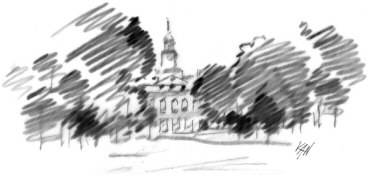
John von Neumann did finally get his computer. After the Institute’s Board of Trustees approved the project, work began in early 1947 to construct a separate building on the grounds behind the main Institute buildings to house the effort. By spring of 1951 the machine was ready for use, even though the formal dedication of the machine did not take place until June 10, 1952. The first truly large-scale problem, requiring several hundred hours of computing, was run to calculate some fluid-flow problem for the Los Alamos Laboratories, in the summer of 1951. The computer project was finally closed down in 1958, and today the building that housed the project is little more than a storage shed in the backyard of the IAS.
As a strange footnote to the episode, after the computer
project ended, the IAS faculty passed a resolution stating that never again would there be an applied project at the Institute, a resolution that stands to this day. Readers can find an excellent account of the IAS computer project in the volume, John von Neumann and the Origins of Modern Computing by William Aspray (MIT Press, Cambridge, MA, 1990). Von Neumann died in 1957 of bone cancer, most likely caused by an overdose of radiation received while observing American atomic tests on Bikini Atoll in the early 1950s.
Kurt Gödel was finally promoted to Professor in the School of Mathematics in 1953 and spent the last 25 years of his life in this exalted status. By all accounts he was a conscientious and diligent faculty member who performed the administrative tasks of a Professor promptly and efficiently. Unfortunately, the later years of his life were marred by increasing paranoia, which eventually led to his refusal to eat for fear his food was poisoned. He died in 1978, having essentially starved himself to death. A short account of Gödel’s life and work is given in the volume Gödel: A Life of Logic by John Casti and Werner DePauli (Perseus Books, Cambridge, MA, 2000). A somewhat more complete biography is the volume Logical Dilemmas by John Dawson (A.K. Peters, Wellesley, MA, 1997).
J. Robert Oppenheimer served as Director of the IAS from 1947 until his retirement in 1966. In 1953 he faced a major personal crisis when the federal government, at the instigation of President Eisenhower himself, withdrew Oppenheimer’s security clearance on the grounds that “More probably than not, J. Robert Oppenheimer is an agent of the Soviet Union.” The basis for this amazing claim was Oppenheimer’s early communist associations. His brother Frank was an avowed communist. So was Frank’s wife. And Oppen-
heimer’s own wife, Kitty, had been a communist sympathizer in her youth. The government hearings on the withdrawal of Oppenheimer’s security clearance split the scientific community of the day into those who were “with” Oppie and those who were “against.” Many accounts of this brouhaha have been given, one of the most readable being the volume Lawrence and Oppenheimer by Nuel Pharr Davis (Simon and Schuster, New York, 1968).
Albert Einstein died in 1955, isolated from the very quantum revolution in physics that he created with his pathbreaking work on the photoelectric effect, in the early part of the twentieth century. The classical physicist’s physicist, he never reconciled himself to the quantum credo that “A phenomenon is not a phenomenon until it is an observed phenomenon.” With the sole exception of his 1935 paper with Podolsky and Rosen posing the quantum measurement paradox discussed in the text, it seems his life as a working physicist was over by the time he came to Princeton. So many accounts of every aspect of Einstein’s life have been written that it would be pointless to list even one of them here. It would be hard to believe that any reader of this book has not encountered one or more of them.
The central philosophical issue of this story, the limits to scientific knowledge, remains as murky and unsettled as ever. Perhaps the difficulty lies in the very vagueness of the question. As soon as we try to define what is meant by “limits,” “scientific,” or “knowledge,” everyday language fails us and we are immediately caught up in a plethora of semantic confusions. In contrast to the situation in mathematics, in which there is a well-defined notion of what it means to “decide” a question, in science there is no clear-cut concept of an answer.