The One True Platonic Heaven: A Scientific Fiction on the Limits of Knowledge (2003)
Chapter: Chapter Seven: An Evening at Olden Manor
Chapter Seven
AN EVENING AT OLDEN MANOR
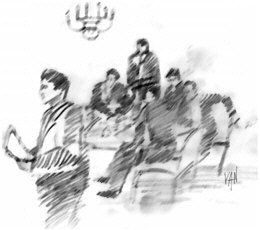
Olden Manor, the Institute for Advanced Study’s Director’s rambling, two-story, white clapboard house, would be alive with physicists on this lovely spring evening, thought Oppie, as he waited on the front porch to welcome his dinner guests. The first to arrive was Wolfgang Pauli.
“Welcome, Wolfgang,” said Oppie, greeting Pauli warmly with a handshake and ushering him into the entrance hall. “The first to arrive is always the luckiest. He gets first shot at the appetizers and drinks. They’re on the side table in the living room. Please help yourself and I’ll join you shortly.”
As Pauli moved off to the living room to join Oppie’s wife, Kitty, who was already finishing off a double shot of bourbon and water, Oppie returned to the front door to wel-
come his next guest, the young postdoctoral visitor to the university and his former student at Berkeley, David Bohm. Dressed in typical academic style in casual tweeds and a sweater, the unassuming, gentle Bohm’s hazel eyes sparked with a lively intelligence. Oppie was pleased that David had come to the gathering tonight, as he was quite sure the young man would benefit enormously from the lively discussion promised by the other physicists who would be around the table. What a pity, thought Oppie, that Einstein had another engagement and could not be here tonight. But, then, perhaps it’s just as well, as Bohm has much of his own to offer to tonight’s gathering, and the overshadowing presence of Einstein might get in the way. Besides, thought Oppie, it will be interesting to see how the others react to Bohm’s ideas, since very few people know that David is working with Einstein on, of all things, Einstein’s bête noire, quantum theory.
Hard on Bohm’s heels was the slight, cadaverous-looking Hungarian-American physicist from Princeton University, Eugene Wigner. A schoolmate of von Neumann in Budapest in his youth, Wigner was one of the four Hungarians—von Neumann, Edward Teller, and Leo Szilard being the others— who came to the United States in the 1930s and gave rise to the joke that those who claimed aliens had landed in ancient Egypt or South America were wrong; they had obviously landed in Budapest! Unlike his three compatriots, however, who were noted for their eccentricities and brusqueness, Wigner was soft-spoken, unfailingly courteous, and completely normal in every apparent way. As he shook Oppie’s hand at the doorway, Wigner quietly asked in his faint Hungarian accent, “Has Bethe yet arrived?” referring to Hans Bethe, from Cornell University, in whose honor tonight’s dinner was arranged. “Not yet,” Oppie replied. “But I expect him any moment. Meanwhile, please come in and make yourself at home,” as he waved his arm in the general direction of the living room,
inviting Wigner to join the others.
As he stood alone in the entrance hall awaiting Bethe’s arrival, Oppie thought back to the days at Los Alamos when Bethe headed the Manhattan Project’s Theoretical Division. What a dynamo the little German was, presiding over what the Project’s military leader, General Leslie R. Groves, had called “the biggest collection of eggheads ever assembled.” But Bethe’s drive, personality, and overpowering intellect, together with the shared sense of urgency to get the job done, was the perfect combination to harness that talented but unruly group. It will be very good indeed, thought Oppenheimer, to see Bethe again. And just as that thought began to fade, the man himself appeared at the door. Short, with a round, pugnacious face and bushy blond hair, Bethe bore a striking resemblance to the hen-pecked tycoon Jiggs, in the comic strip Bringing Up Father. His manner was as much like that of a longshoreman from Hamburg as of a physics professor from Cornell. But no one could deny his brilliance or his insight into the physics of the atomic nucleus, not to mention his sensitivity to the interface between science and human values, a trait finely honed by his spearheading of the theoretical work underlying development of the atomic bomb at Los Alamos.
Oppenheimer rubbed his hands in anticipation of the evening’s festivities as he followed Bethe into the house. They joined the others, who were gathered in the living room around the slim, dark-haired, fiery-tempered Kitty Oppenheimer, who as always, had a drink in one hand and a cigarette in the other. Oppie gazed at his wife from afar for a moment, wondering, not for the first time, whether her unstable nature and heavy drinking would yet transform his first marriage into her fourth divorce. Well, there was nothing for it, he thought, but to join the party and do his best to divert the discussion back into more cerebral—and intellectually productive—
directions than Kitty’s loud and slightly off-color story seemed to be taking it. Striding up to the group, Oppie smiled and his presence was felt by everyone. They turned to give the floor to him, not only as the Director of the IAS and the host of tonight’s dinner, but also as the intellectual leader he had been to all of them.
As might have been expected, the voluble Pauli opened the cocktail discussion by enquiring of Oppenheimer, “Tell us, Robert, how are you dealing with this bunch of crackpots and geniuses here in Princeton? In Los Alamos you had a war to win; here the only war is between the physicists and the mathematicians—with you in the middle. I wonder if refereeing this battle of wills isn’t even more difficult than managing the building of a bomb?”
Oppenheimer raised an eyebrow and smiled at this remark, saying slightly sarcastically, “Pauli, you never cease to amaze. Now why would you think there is any tension here at the IAS? You know we are all here to engage in deep thought of the most Platonic variety, not to backbite, gossip, maneuver, scheme, or belittle. How one might ever feel otherwise is beyond me. Perhaps another drink will help ease your mind on this count.”
Bethe couldn’t resist the temptation to poke a bit of fun at Oppenheimer either, as he added, “I hardly think Pauli is exaggerating the situation much, if at all, Robert. You have the mathematicians fighting among themselves over Gödel’s promotion. You have the entire faculty divided over Johnny’s flight of computing fancy. And now you have your own problems with the trustees, especially Admiral Strauss, and your role in national security deliberations on nuclear weapons. And these are just the most obvious matters, the things that everyone sees. Don’t you sometimes wish you were back on The Hill in Los Alamos?”
Nodding vigorously, Pauli couldn’t resist throwing in one
more jibe: “Yes, this Institute is really a snakepit. I wonder how much more real physics or even mathematics might be done if these geniuses focused more on their work and less on their colleagues.”
Oppenheimer’s penetrating blue eyes turned cold as ice as he stared daggers at Pauli, pausing momentarily to light a cigarette before replying. But before he could offer a riposte to Pauli’s acerbic remarks, Kitty gaily broke in to tell the group that they were being rude to her husband and that they must all join her in a toast to the man who had brought them together tonight. To further ease the tension, Wigner softly seconded Kitty’s proposal, adding in his charmingly polite and self-effacing manner, “Yes, Kitty. No one in this room deserves our respect more than Robert. He has turned the IAS into one of the world’s leading centers for theoretical physics in just a couple of years. I say we focus on this achievement and leave these petty academic disputes to the academics. I raise my glass to you, Robert.”
As all present held their glasses high and wished Oppie the best, a bell sounded from the next room indicating that the cook was ready to serve the meal. Kitty Oppenheimer quickly began to gather the group together like a mother hen, leading them into the dining room. They were greeted by the sight of a lovely Georgian table fully set for a formal dinner, even down to the elegant touch of handwritten place cards. Oppenheimer and his wife sat at opposite ends of the long table. As the guests found their places and settled in, Oppenheimer stood to formally welcome everyone.
“Kitty joins me in welcoming you all to Olden Manor tonight. I’m especially pleased to have my old teacher, Pauli, here, together with my own student, David Bohm. It’s not often in a group of six people that one finds three generations of physicists. I’m sure that will spark some interesting discussions before the evening is over. So let me say no more other
than to offer this small toast: To the overall health of theoretical physics. May the unified field theory remain forever elusive!”
A general round of laughter broke out at this last remark, which referred to Oppie’s confirming the generally held belief among theoretical physicists that Einstein’s decades-long quest was the physicists’ version of the quest for the Holy Grail: full of hope, adventure, romance, and naïveté, but ultimately doomed to noble failure.
At each place also was a small card announcing the menu for the dinner, a rather more formal gesture than usual for a dinner at the Oppenheimers. In fact, a more typical dinner was a handful of friends sitting around the kitchen table for a couple of hours of pretty heavy drinking, followed by Kitty finally going to the stove to rustle up a pot of chili and some fried eggs. But tonight was special. Oppie really wanted to talk some physics, and had invited a stellar cast of conversational partners for the occasion. The menu reflected the event: cold gazpacho for the warm spring evening, followed by a Caesar salad, broiled filet of sole almondine, a light lemon sorbet, and finally a dessert of German chocolate cake with coffee. Nothing too exotic or gourmet, but still something special in these years immediately following the wartime shortages, and a perfect choice for the hotter than normal weather in Princeton this spring.
“Tell, us, David,” said Oppenheimer addressing his former student, Bohm, “what kind of work are you doing with Einstein nowadays? Most of us think the Old Man is completely off the track in his pursuit of the unified field theory and totally out of touch with reality with his resolutely classical attitude to quantum theory.”
Bohm shifted uncomfortably in his chair, startled to be called upon in this way to render judgment on the greatest physicist of the century, and to have to do it before such icons as Pauli and Wigner and Bethe, not to mention his teacher,
Oppenheimer. But Bohm was not in Princeton without reason, and he had a definite point of view on the matter of quantum theory that also departed substantially from the conventional wisdom of the Copenhagen school. So while his cocktail-party chatter was self-effacing and modest to the point of deference, when it came to expounding his views on physics he was a veritable tiger, gesticulating with abandon and asserting his unconventional views with all the vigor of a young man carving out a position for himself in the world of adults. In this mode he stated with conviction, “I think Einstein’s position on quantum theory has been seriously misunderstood by many physicists. They seem to think that he believes the theory is completely wrong-headed and longs for a return to the classical view of Newton. In one sense that is correct: Einstein does long for part of that classical view.”
“And which part is that?” interrupted Wigner, setting down his glass and looking intently at Bohm. “I suppose I must be one of those many physicists who think he rejects the theory entirely. This is certainly one case in which I’d like to be wrong.”
“The part of classical physics Einstein clings to tenaciously,” answered Bohm, “is that objects—quantum or otherwise—have well-defined properties like position and momentum and energy at all times. He steadfastly holds to this view, and is totally unsympathetic to the idea that such properties mysteriously come into existence only when an object is observed, and that before a measurement the object has only a probability of being in a certain position or having a particular momentum.”
Pauli had been squirming in his chair since Bohm had uttered his first word and could no longer contain himself. “Yes, yes, I think we have all heard Einstein state this view at one time or another. Even my Austrian colleague, Schrödinger, who created the wave function that we all now, after Max
Born’s suggestion, interpret as characterizing this probability, felt uncomfortable with this interpretation. But you cannot change the facts. And it is a fact that the predictions of this statistical interpretation have never yet failed to be confirmed by every experiment that’s been done to check them.”
“Yes,” chimed in Bethe enthusiastically. “Can a scientific theory be wrong if it agrees with every experimental test we can devise to check it?”
“Well, the history of science is filled with examples of theories that agreed with experiments and predicted new observations very well, yet were later shown to be wrong,” Oppenheimer retorted. “What about the Ptolemaic theory that described planetary motion as a sequence of cycles piled upon cycles piled upon cycles? The weight of all those cycles eventually sank the theory; it just wasn’t simple enough to satisfy our aesthetic sense, although it certainly gave accurate predictions of where the planets would be found.”
“Precisely,” said Pauli, asserting that “there is more to a theory than just being right. There is an aesthetic dimension. And that’s what seems to be at the heart of Einstein’s objection to our current view of quantum theory. It is not aesthetic enough for his taste. The laws of nature must be not only understandable, but also beautiful. And the rules we use in quantum mechanics to make predictions about material objects defy ‘reasonable’ interpretation. They just don’t satisfy his standard for how things ought to be. Or at least that seems to be Einstein’s view.”
Oppenheimer waved his fork in Bohm’s direction, almost dropping a tasty-looking tidbit of anchovy from the Caesar salad in the process. The gesture silenced the table, as all wondered about the fate of the anchovy. Would it fall or not? When it did not, Oppie gave the floor back to Bohm who continued: “There’s no doubt that the standard Copenhagen interpretation accounts for everything that we have ever
observed. But the idea that objects with well-defined properties don’t really exist unless they are being observed seems preposterous—and not just to Einstein. I also find it aesthetically very unsatisfactory. So my conversations with Einstein mostly center on exploring a viable alternative interpretation.”
Oppenheimer, of course, knew Bohm was not just speculating but had actually developed just such an interpretation, or at least the idea for one. Always the teacher, he prodded his reticent student into telling the group what he thought might be a better way to view the quantum situation. Bohm looked rather like a deer caught in a bright spotlight as all eyes turned to him. As a mere postdoc amidst this star-studded cast, he was extremely hesitant to present his “heretical” ideas. But he also knew he’d never have a better opportunity to get the thoughts of the world’s greatest quantum theorists about those ideas. This was enough to overcome his nervous fears.
“My view is really a revival of an idea floated by Prince Louis de Broglie a decade or so ago. Basically, it involves regarding an object like an electron as being a classical particle at all times. So it has definite properties like position at all times, too. But associated with every such object is a wave of information I call the quantum potential.”
“Is this a real wave?” asked Bethe, “or is it a kind of mathematical wave like the wave function described by Schrödinger’s equation?”
“No, it is a real wave,” Bohm hastened to explain. “Its role is in some sense to probe the environment and transmit this information back to its associated particle. The particle then behaves in a manner consistent with the information it receives about the environment from the quantum potential.”
As Bohm noted at the outset, this idea of the pilot wave was not new. The French quantum theorist de Broglie had advanced the notion in the 1920s. But he ran into almost insurmountable mathematical obstacles in making it work,
and so it was more or less laughed out of court by proponents of the then dominant paradigm coming from Copenhagen; that is, from Danish physicist Niels Bohr and coworkers. However, Bohm thought he had figured out how to get around the mathematical problems. But the group immediately focused on other, far more evident, problems with the whole scheme. Pauli got things going by asking, “You say this quantum potential is a real wave. So why hasn’t anyone ever detected it? If it’s real, then we should be able to measure it, don’t you think?”
“I agree,” chimed in Bethe. “If you can’t measure it, at least in principle, then it doesn’t exist. It’s just a mathematical construct added to make things more complicated, not simpler.”
Oppenheimer had to jump in to defend Bohm. “Just a minute,” he said quickly. “I think recovery of an objective, classical reality is worth a lot. Maybe it’s worth enough even to swallow an unobservable pilot wave of the sort David is suggesting. After all, how many of us have seen or even measured a positron? Yet we have no trouble at all believing they exist. Initially, they came out of Dirac’s formulation of quantum theory to fill a mathematical gap in his setup; later, Carl Anderson discovered how to measure them. Bohm’s wave might follow the same path.”
Wigner quietly tapped the side of his glass to get the group’s attention. Everyone knew that when he spoke, whatever he had to say would be well thought out and not an off-the-cuff shot from the lip. So they all turned to hear the clever Hungarian’s thoughts on Bohm’s idea.
“I’m not especially worried about the measurability of this pilot wave. But it would be ironic in the extreme if Einstein endorsed this way of restoring classical properties to quantum objects since, as this young man describes things, the quantum potential seems to violate Einstein’s own special
theory of relativity.”
“What do you mean?” asked Oppie incredulously, staring at Wigner.
“Well, as I understand it, this quantum potential has to probe the environment in some way and then communicate this information back to the particle. This communication must be faster than light, for the particle to adjust its behavior to accommodate whatever attribute—position, momentum, spin—the measuring device has been set up to measure. But this kind of superluminal signaling is exactly what Einstein’s own theory forbids.”
The table fell silent. As always, the thoughtful Wigner had hit exactly upon the weakest link in Bohm’s entire setup. It would seem that either the special theory of relativity or Bohm’s theory would have to go. No one cared to place any bets on the survival of the pilot wave theory if it came down to that. But Bohm’s intellect was made of sterner stuff, and he had a ready answer to Wigner’s objection.
“To be more precise,” Bohm stated calmly, “Einstein’s theory says that no material object can transcend the speed of light. But he says nothing about immaterial objects. The quantum potential is a wave of active information, not a wave of matter. So it can have effects at long distances and does not dissipate like a sound or water wave. So I do not believe this superluminal objection applies, at all.”
Pauli was not finished with this story, though. Jutting out his chin pugnaciously, he asked, “So you think the superluminal effect can be seen only when we look at the correlations between signals at two separated locations. But if we look at what’s happening in the immediate neighborhood of either location, there is no superluminal effect. Right?”
“Precisely,” Bohm replied at an almost superluminal speed himself. “I think relativity is a statistical effect, not an absolute one. And the statistical properties of signals are totally
independent when we look in the local neighborhood of one location or the other. They show up only when the locations are separated.”
“Well, David, this is certainly an intriguing idea,” said Oppenheimer approvingly. I think we’ll have to schedule you very soon to present these ideas in more formal clothing at our weekly physics seminar. But now I see the cook signaling that it’s time for the fish. So let’s let David quickly finish up his salad before all the plates disappear.”
⋮
Leaning back in his chair to allow the servant to remove his salad plate, Oppie’s mind took a break from the complex and demanding conundrums of theoretical physics, as he remembered his own path from a privileged, precocious childhood in Manhattan to the directorship of the IAS. After finishing a bachelor’s degree at Harvard in 1925 after just three years of study, he traveled in Europe for several years, doing research in Cambridge and then Göttingen, where he received his doctorate in 1927. It was in Germany that he wrote a famous paper with his doctoral advisor, Max Born, on the quantum theory of molecules that formed the basis for quantum studies of molecules after that time. Upon his return to the United States, Oppie found himself in the unusual situation of having two halftime positions, spending the fall and winter at the University of California at Berkeley, the spring at Caltech. As an indication of his students’ love for him and his influence on his students, many of them made the same migration each fall and spring to remain continuously under his tutelage.
As the filet of sole was served, Oppenheimer thought back fondly to the period in Berkeley when he was building his school of theoretical physics. Students like Bohm were drawn to his mesmerizing lecturing style and general scientific
attitude, which shaped their own work and lives thereafter. But the drums of war were beginning to beat louder, and he was eager to serve the American war effort. He got his chance in 1942, when he was appointed leader of the theoretical effort to design the atomic bomb.
“Robert!” came the shrill voice of Kitty, breaking into Oppenheimer’s reverie, catapulting him back to the present. “Why don’t you fill everyone’s wine glass and stop daydreaming about your past successes?”
Dutiful host that he was, Oppie poured white wine all around, as Hans Bethe tried to make light of Kitty’s aggressive tone by remarking sympathetically, “Well, Robert certainly has a lot to reminisce about. Thinking of those days in Los Alamos, I’d venture. And why not? It’s hard to believe that they were only a couple of years ago. So much has happened since. But what a time! And what a collection of people and problems. I’d daydream too, if I were you, Robert.”
“I don’t think it was all that wonderful,” carped Kitty, not to be mollified so easily by Bethe’s attempt to gracefully turn the conversation. “It was boring being on top of that mountain with all those physicists,” she continued, seemingly unaware that at that moment she was surrounded by many members of that very group. “And the security and military guards made it even more horrid than being surrounded by the eggheads here in Princeton.”
As Kitty momentarily interrupted her tirade to take a long pull from her wine glass, the ever-polite and charming Wigner immediately stepped in to do some damage control and bring a measure of civility back to the table.
“The entire Manhattan Project—not just the part in Los Alamos, for which the entire nation must thank Robert—but also the gaseous production of plutonium in Hanford and Oak Ridge, Fermi’s atomic pile in Chicago, and all the other facilities involved will be remembered as the beginning of the mar-
riage between science and government. This may well turn out to be a Faustian bargain, but I don’t believe we scientists can walk away from it now. The best we can do is make every effort to exert whatever influence we have to bring about the most peaceful and constructive uses of our efforts. Don’t you agree, Robert?”
Here was a theme dear to Oppenheimer’s heart—and Bethe’s, too: the social responsibility of the scientist. “How do you view this dilemma, Hans?” asked Oppie with real curiosity. “After all, you led the theoretical effort at Los Alamos. Do you think the individual scientist is responsible for his actions?”
“My position on that has always been clear,” replied Bethe firmly. “I believe that each scientist is indeed responsible for his own individual actions. But scientists collectively have no right to refuse work on weapons of mass destruction if the cause is just. And I firmly believe that our cause in Los Alamos was as just as any cause can be.”
“And how do you feel, now that the war is over, about how these weapons should be controlled?” asked Bohm. “Should they be handed over to the military just like any other weapon? Or do they represent such a major jump in destructive power over all previous weapons that they must be handled differently?”
“There is no doubt in my mind,” interrupted Wigner, “that these weapons should be under the control of a civilian authority. They are not merely weapons; their use has such symbolic significance that it cannot be left to narrow military concerns.”
“So use of the atomic bomb is a political act. Is that what you are saying?” said Pauli, finally joining the discussion.
Before the reticent Wigner could formulate a reply, Oppenheimer asserted his view of how atomic weapons should be handled. “I believe firmly that we need an international authority to control all atomic energy work, on weapons or
otherwise. Such an agency should develop atomic reactors for power and other peaceful uses, not simply serve as a policeman to prevent individual nations from developing atomic energy and weapons on their own. So, yes, anything to do with atomic energy, not just the use of atomic bombs, is political.”
“Do you really think such a plan is workable?” asked Bethe.
“To be truthful, no. I think the only organization that could provide the basis for it is the United Nations, and it’s my belief that any plan of this sort will be immediately vetoed by the Russians. If indeed this comes to pass, the United States will have little choice but to develop reliable methods for detecting foreign nuclear weapons tests so we can keep abreast of nuclear weapons development in Russia and everywhere else in the world.”
“As Chairman of the Atomic Energy Commission’s Nuclear Advisory Committee you should be well positioned to exert influence to make that happen,” Bethe noted approvingly.
“Yes,” added Wigner in a somewhat gloomy tone, shaking his head as he did so. “It does appear as if this will be the way things will work out. It’s a sad business for mankind. Atomic energy can be used to help so many people. Yet the money and brainpower will almost entirely be channeled into making destructive weapons of even greater power.”
Bethe followed this unhappy lament with the surprisingly casual remark,“If what I hear from Los Alamos is true, things are only going to become worse, not better.”
At the offhand nature of this comment, Bohm’s head shot up, and with some intensity in his voice he asked Bethe, “What do you mean ‘worse’? How can things be worse than they are right now? For the first time in history we have a weapon that can literally destroy the human race. What could be worse than that?”
“Ah, therein lies a tale that may well define human relations for this century—and before it’s even half over,” Oppie answered for Bethe. “Let me tell you that story, David.”
Oppenheimer went on to tell Bohm and the others about ongoing debates in Washington, sparked off by a proposal from Berkeley physicist Edward Teller, to build an even grander nuclear weapon nicknamed the “Super.” Teller, another Hungarian emigré of the same generation and hawkish political leanings as von Neumann, believed strongly that the Soviets would do everything in their power to match—and possibly surpass—American hegemony in atomic weaponry. As a result, he lobbied vociferously in both the scientific and political communities to build a bomb based on nuclear fusion rather than fission. This was the process that went on in the heart of the sun to transform hydrogen into helium, and Teller believed that by employing a conventional atomic bomb to squeeze the hydrogen together, the very same process could be duplicated in a nuclear weapon with vastly greater destructive power than was possible with the bomb activated by the fission process. This was because the energy involved in forcing like-charged nuclear particles such as two protons to “fuse” when they want to stay apart is vastly greater than the energy released when a large atomic nucleus like uranium-235 throws off neutrons; that is, “splits” in a fission process. The trick is how to force the nuclear particles to stay together long enough to get the fusion process going.
“But,” said Oppie, continuing his story, “there are a number of scientists and politicians, myself among them, who think Teller’s proposal is both technically questionable and morally indefensible.”
Pauli, who strongly supported Oppenheimer’s position, quickly added, “I think as you do, Robert, that the United States should not deliberately start an arms race, and should first at least make some effort to speak with the Russians
about coming to an agreement not to develop these hydrogen weapons. Besides, as far as I know, there is no technical basis for thinking that such a weapon could be constructed even if the government were to give the effort its blessing.”
“For the sake of argument, I think it should be noted that there was no guarantee that the atomic bomb could actually be built either,” interjected Wigner. “It’s one thing to create a sustained fission reaction in a laboratory; it’s quite something else to recreate that process in a weapon that’s small enough to be delivered to its target by an airplane. Yet it was accomplished.”
After everyone had his say, Oppenheimer turned to Bethe and asked what he thought about Teller’s proposal. “After all, Hans,” he said, leaning forward and putting his arms on the table, “you have more hands-on experience at weapons design than anyone at the table. Do you believe the Super should be built?”
Bethe squirmed uncomfortably in his chair as he considered Oppie’s question. Finally, he scooted his chair forward, put his elbows on the table, and looked Oppenheimer in the eye as he said, “Personally, I would not want to work on such a device—even if it were shown to be technically doable. I said earlier that I strongly believe that each individual scientist is responsible for his own actions. I must say that I had similar misgivings about working on the Manhattan Project, but upon reflection, each step, taken on its own, seemed so logical that I finally agreed. Sometimes I wish I were a more consistent idealist.”
Oppenheimer seemed to be tiring of this line of conversation and was ready to direct discussion into other channels when Bethe added, “You know, Robert, I think you are running a grave risk with your vocal opposition to Teller’s proposal, especially in the corridors of power in Washington. Teller has many friends in high places and to have you, the
‘father’ of the atomic bomb, come out so strongly against his proposal could spell a lot of trouble for you.”
“It already has. You probably know that Admiral Strauss has been lobbying for my removal as director of the IAS. I suppose my youthful fling with the Communist Party, not to mention my brother Frank’s even more active role in Communist affairs here, doesn’t do me any good, either,” murmured Oppenheimer. “But this business of escalation of an arms race is much more important than any individual. I simply must speak out against it.”
Kitty, of all people, jumped in to rescue her husband from this dreary, depressing discussion, as she cried out loudly, “Time to refill the glasses. Now let’s talk about something a bit more cheery, like what else physics has to say about the real world besides bigger and better weapons.”
As the cook brought out dishes of lemon sorbet, Bohm recalled the conversation on the limits to scientific knowledge in which he had participated at von Neumann’s party a week or so earlier. He remembered the conversation centering on the strictly logical limits of science—how much could one really know about the real world by employing the methods and techniques of science? But here, he thought, is a very different sort of “limits” question: How much should scientists try to know about the workings of nature? This was a moral issue, one involving scientists’ consciences more than their intellects, together with the role science should play in a free and open society. As the matter was already in the air around the table tonight, he felt no hesitation in raising it again in the context of that previous discussion at von Neumann’s—but now in the reverse direction.
“We’ve just been considering how far scientists really should be allowed to go in their quest for understanding the inner workings of nature. This is a moral issue on the limits of the scientific enterprise. The other night at von Neumann’s
there was a discussion about the logical limits to science; basically, the question of what can be known about the world around us by following the scientific method. Von Neumann argued that the answer to this question is tantamount to asking about the limits to our ability to carry out a computation. As none of you was present at that discussion, I wonder what you all think about this kind of limit?”
The group sat silent for a few moments digesting this shift in the direction of the conversation. It seemed that everyone had a clear vision about the moral issue that had just been considered, if not necessarily the same vision. But this matter of logical limits was an entirely different matter and necessitated a bit of mental reorientation to consider. Pauli finally broke the silence.
“I don’t believe in any such limit. There will always be things that we do not know. But that doesn’t mean there is some intrinsic limitation placed upon our ability to know them. We didn’t know about atoms at one time; now we do. We didn’t know about planetary motion; now we do. Right now we don’t know whether the universe will ever stop expanding and start contracting; someday we will. So I don’t put a single bit of credence in the idea of this type of limit.”
Bethe quickly seconded Pauli’s anti-limits manifesto, adding, “I don’t understand what you meant by von Neumann’s remark that the limit of our science is the same as the limit of our computational capability. What can that possibly mean?”
Bohm tried to summarize von Neumann’s argument from the party.
“If I have it right, von Neumann’s belief is that the scientific answer to any question is the end result of following a set of rules, a kind of algorithm. For example, if you want to know about the position of an electron, you calculate the Schrödinger wave function for the experimental situation—
which is following a rule—and, if you believe the Copenhagen view of things, the result of following this rule is the probability of finding the electron at a particular location. This is the scientific answer to the question, ‘Where is the electron?’ ”
“So, von Neumann says that following a rule is the same thing as carrying out a computation. Is that the gist of it?” asked Pauli, his eyebrows rising in some measure of skepticism.
“As I understand it, yes,” confirmed Bohm.
“But what does all this business about computation have to do with nature?” wondered Wigner. “It is nice to know that the computer understands the problem. But I would like to understand it, too. And even though we put great faith in our theories, they are mathematical constructions, as is a computation, not the real world of matter and energy. Where do these fit into the overall issue of limits?”
Oppenheimer now weighed in.
“Yes, there is the nub of the matter. Our theories— and computations—are mathematical objects residing in some world outside of space and time. As such they have no clearcut connection to real-world objects like knives, forks, tables, and chairs. Yet suitable combinations of these mathematical symbols have an uncanny way of representing real-world relationships, as with the Schrödinger equation that David just mentioned. When it comes to limits I wonder if we are talking about limits to the amount of information we can extract from the mathematical formulations. Or are we speaking about limits of our ability to probe the depths of nature? These are two entirely different questions.”
As someone who had spent considerable time pondering the relationship between mathematics and physics, Wigner was highly sensitized to the ambiguity Oppenheimer had pinpointed. But just as he was about to speak to it, Pauli broke in to say, “As physicists we must be concerned with what can be known by the methods of science, not those of mathe-
matics. Even though Galileo told us that the secrets of nature are written in the language of mathematics, in the end it is observation and experiment that tell us how nature truly is, not mathematical equations, however beautiful.”
Wigner now could no longer remain silent and was literally squirming in his chair waiting for a chance to speak. After listening impatiently to Pauli’s interjection, he seized his chance to declare, “I think we can all agree that the appropriateness of the language of mathematics for the formulation of the laws of physics is a wonderful gift which we neither understand nor deserve. Mathematics is simply unreasonably effective in characterizing the regularities we observe in nature. So perhaps there is a correlation between limits to what we can know in mathematics and what we can know in the physical world, too.”
“This point of view brings us around to Gödel’s results on the limitations of mathematical argumentation,” Oppenheimer reminded the group. Gödel’s results show that in any consistent logical system with sufficient expressive power to talk about ordinary arithmetic—and expressive power of such a level is certainly needed to speak about the physical world— there must be statements that can be neither proved nor disproved. Following this line of argument, we must then ask if such a statement has a correlate with some real-world phenomenon, and even more generally, what is the relationship between proving a proposition in a mathematical model and the meaning of that proposition in the real-world situation the model claims to represent?”
“Now we’re coming the heart of the matter,” declared Pauli, ever the theorist. So much a theorist, in fact, that it was rumored for years that whenever Pauli got close to a laboratory, equipment broke down, test tubes mysteriously shattered, and all sorts of other unexplainable failures started to take place. This was jokingly termed, the “Pauli Effect” by
physicists worldwide.
“Yes,” agreed Bohm. “This matter of logical limits immediately raises the question of the relationship between mathematical models of reality and reality itself—the map and territory, so to speak.”
Wigner sharpened the question by noting that either you use a mathematical model to probe reality, in which case you have to establish the congruence between the mathematical symbols and observables in the real-world situation, or you abandon the mathematics altogether and simply correlate observations into some kind of empirical relationship expressing the regularities in the world. In the first case, you must come to terms with the fidelity of the model and perhaps Gödel-type results limiting what the mathematics can say. In the second case, the problem is how to replace the notion of mathematical proof with a concept that expresses real-world truth.
The group agreed that either horn of this dilemma is an extremely difficult and important problem in the philosophy of knowledge. Someone then brought the discussion back to the current Institute problems surrounding both von Neumann and Gödel.
“This must be an especially trying time for you, Robert,” said Bethe, “having to deal at the same time with the complicated matter of Johnny’s proposal to build a computer and Gödel’s unhappiness at not being a Professor.”
“Do you think Johnny will leave us and go elsewhere if the board doesn’t approve his project? What do you think, Wigner? You’ve known Johnny all your life,” enquired Pauli.
Speaking slowly and carefully on this point, which veered uncomfortably close to his special personal relationship with von Neumann, Wigner declared, “I know Johnny has a strong bond with the Institute and could not easily be persuaded to leave Princeton. But he is also extremely persistent when he
focuses on a problem. And this computer project has captured his attention like no other problem I’ve ever seen him attack. So, yes, I believe that he probably will leave if the project cannot be done here. With great reluctance. But leave he will to follow this particular Muse.”
Oppenheimer listened attentively to Wigner’s statement, as it gave invaluable insight into how strongly von Neumann felt about the computer project. The one thing he didn’t need right now was another problem with the mathematicians, who were already deeply unhappy over what they saw as him “stacking” the Institute with physicists. He would simply have to use every possible means to persuade the trustees to approve von Neumann’s proposal, and let the chips fall where they might with those faculty who were against it.
“What about the situation with Gödel?” wondered Bethe. “Is the faculty in the School of Mathematics still against promoting him to Professor?”
“I’m not entirely sure how things stand on this at the moment,” Oppenheimer said. “But I don’t think this is as important as the von Neumann computer project problem. Gödel is not going anywhere, regardless of whether he’s a Professor or a permanent Member of the Institute. This question is more a matter of his ego and the principle that intellectual work of the highest quality should be recognized by one’s status in the pecking order of an organization like the IAS.”
“But what else is there to fight for in the academic world except ego and position in the pecking order?” asked Pauli with a wry smile. “We certainly didn’t take up the intellectual life for fame or fortune. I don’t think you can dismiss Gödel’s or any other academic’s ego in such a cavalier fashion.”
A bit stunned by Pauli’s trenchant observation, Oppenheimer moved to settle things down by adding, “I did not mean to suggest that Gödel does not deserve serious consideration, only that whether he is Professor is unlikely to change
the way things are done here at the IAS. Von Neumann’s project is of an entirely different nature. That’s all I meant.”
Remembering the cocktail-party debate on limits to knowledge at von Neumann’s, Bohm felt that these two problems had perhaps more in common than Oppie might want to acknowledge. “When we spoke earlier about limits to scientific knowledge, we drew the distinction between a mathematical model of a real-world situation and the situation itself. It’s clear that Gödel’s results on incompleteness have direct bearing on the mathematical side of this matter, as does von Neumann’s claim that what we can know really comes down to what we can compute. So I think the two problems of Gödel’s promotion and von Neumann’s computer are not so separate as one might think.”
“Well, perhaps,” agreed Oppie. “The computer connection is clear. But what does this have to do with whether Gödel is a Professor or not?”
“On the surface, not much. But I think it matters for the image of the IAS as a bastion of pure thought, a home for intellectual undertakings at the boundaries of our knowledge. Making Gödel a full Professor sends a message saying the IAS acknowledges the importance of his work, not just its mathematics, but also its philosophical implications. And part of those implications relate to von Neumann’s claim about what it is that science can tell us about the world.”
“But only if you accept the notion that what science can tell us comes from mathematical models of the world,” declared Wigner. “And we have already noted that maybe you can learn about the world without using any mathematics or computing at all.”
Bethe then added: “In that case, Gödel’s work is irrelevant for the limits-to-science question, wouldn’t you say?”
Sensing that the conversation might be leading back into the same circle they had already gone around, Oppenheimer
transparently looked at his watch, a gesture not lost on the guests, nor on his wife. Kitty stood up declaring, “I don’t know about the rest of you, but I’ve had just about enough of Gödel, von Neumann, computers, and philosophy for one evening. I hope you’ll all excuse me if I leave you to sort these deep-thought matters out among yourselves. Thank you all for coming.”
Everyone took Kitty’s departure as the sign that his own would not go amiss, and began offering thanks to Oppie for the evening and moving toward the entrance hall. Oppie himself breathed an inward sigh of relief at their impending departure, knowing he had a big day ahead and glad of the opportunity to get a bit of rest. Pauli spoke for all of them as he shook Oppenheimer’s hand.
“Robert, it has been a great pleasure. I thank you and Kitty for the delicious dinner and stimulating conversation.” Turning to the others standing with him at the doorway, he expressed his pleasure at meeting them. After a bout of hand-shaking all around, the group departed en masse and Oppenheimer was left to ponder the evening briefly before turning out the lights and walking slowly upstairs to join Kitty.