Degrees Kelvin: A Tale of Genius, Invention, and Tragedy (2004)
Chapter: Image Plates
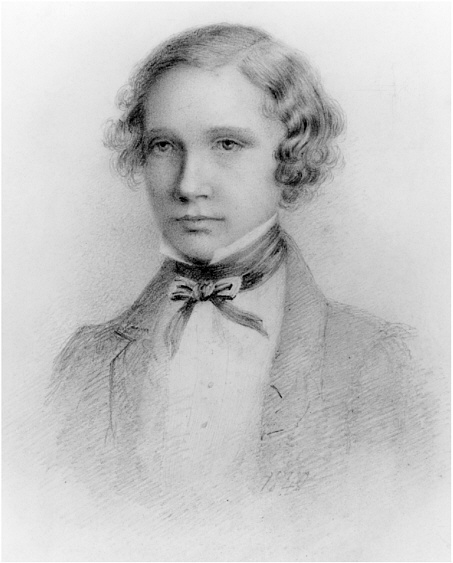
“A most engaging boy, brimful of fun and mischief, a high intellectual forehead, with fair, curly hair and a beauty that was almost girlish.”
William Thomson remembered here by a fellow Cambridge undergraduate. (Pencil portrait of William Thomson at 16 by Elizabeth Thomson. Courtesy of the National Portrait Gallery, London.)
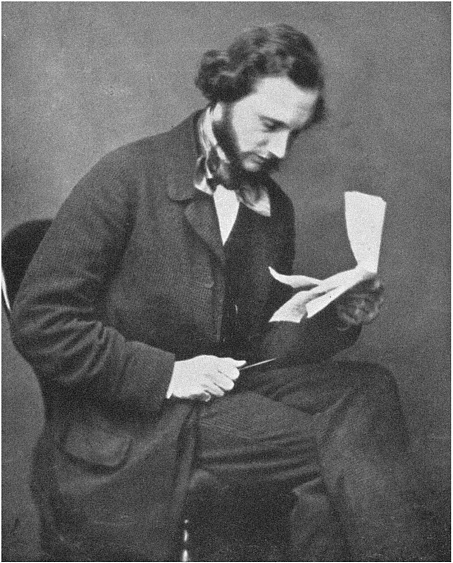
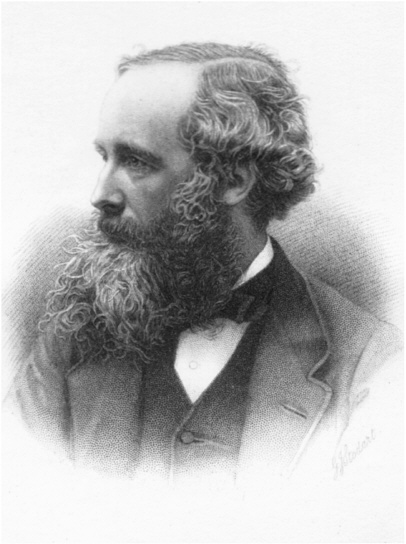
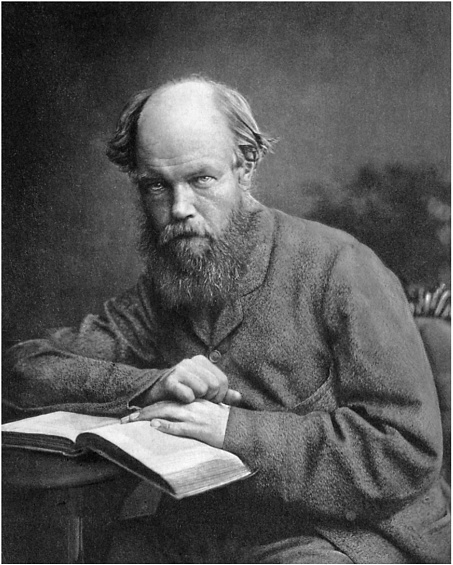
“One of the most valuable of these truly scientific, or science-forming ideas….”
For James Clerk Maxwell (pictured here), Thomson’s ingenious mathematical analogy between the geometry of electric forces and the flow of heat was the first step in turning Faraday’s acute insights into the modern theory of electromagnetism. (Photograph from Lewis and Garnett, 1884.)
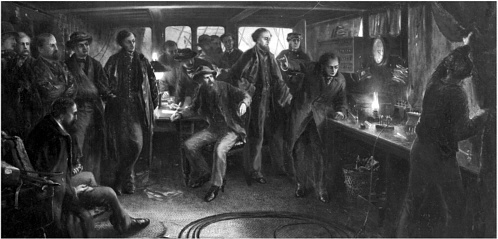
“Telegraphic work … possesses a combination of physical and … metaphysical interest, which I have never found in any other scientific pursuit.”
William Thomson overseeing the operation of his mirror galvanometer on the Great Eastern during the telegraph voyage of 1866, which finally succeeded in laying a cable from Ireland to Newfoundland. (Electric room on the Great Eastern. Painting by Robert Dudley, courtesy of Metropolitan Museum of Art, New York. Gift of Cyrus W. Field, 1892 [92.10.43].)

“A friendly and unconstrained party….”
William Thomson (left), Hugh Blackburn, James Thomson, Hermann von Helmholtz, and an unknown child and man discussing the physics of bird flight at Blackburn’s house on the Moidart Peninsula. (Watercolor by Jemima Blackburn, September 1871. Courtesy of Robert Fairley.)
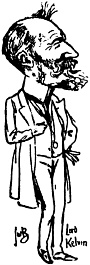
“Lord Kelvin is a gentleman of exceedingly pleasant manners [and] amiability of disposition … a remarkable example of a great man whose native character has remained unchanged despite … the elevation to a lofty social position.”
A reporter’s impression from Kelvin’s visit to the British Association meeting in Toronto, 1897. (Cartoon from Toronto Globe, August 21, 1897.)

“What I liked best was when he left us to follow or not as we could, and went on thinking aloud, as he sometimes did. His mind was full of fancies, brimming over with metaphors….”
A student recollects Kelvin as a teacher, photographed here at his last lecture, in 1899. (Photograph from Thompson, 1910.)
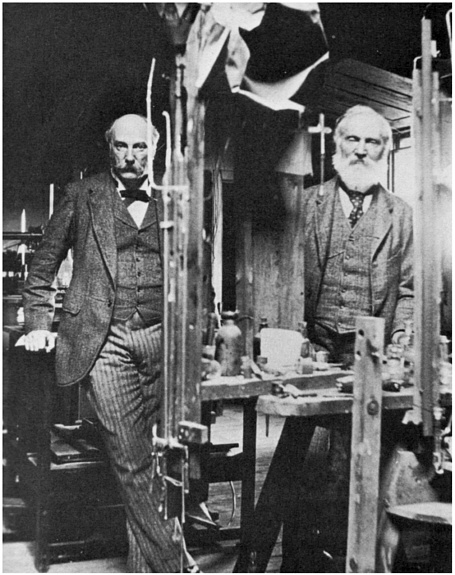
“Our discussions did not always end in agreement, and I remember his admitting that a certain amount of opposition was good for him.”
Lord Rayleigh (left) remembering Lord Kelvin. In 1900 they were photographed in Rayleigh’s laboratory at Terling, Essex. (Photograph from Strutt, 1968. Courtesy of the University of Wisconsin Press.)