Livable Cities of the Future: Proceedings of a Symposium Honoring the Legacy of George Bugliarello (2014)
Chapter: New York State Department of Transportation Sustainability Initiatives--Joan McDonald
New York State Department of Transportation Sustainability Initiatives
Joan McDonald
New York State Department of Transportation
ABSTRACT
The New York State Department of Transportation broadly assesses the state’s transportation systems to identify the needs of these systems and determine how decisions can best support the needs of a sustainable society. The department has adopted four guiding principles for maintaining and improving transportation resources: preserving current enterprises, taking a systems approach to projects, maximizing the effectiveness of investments, and making the system sustainable.
INTRODUCTION
The New York State Department of Transportation (NYSDOT) is divided into 11 regions, from Long Island to Buffalo and up to the Adirondacks. It is responsible for 113,000 highway miles, 17,400 bridges, a 3,500-mile rail network, 130 public transit operators, 485 public and private aviation facilities, and 12 major public and private ports. To manage this geographic breadth and scope of projects, department leaders need to address issues creatively and to work not only with the federal government—the Federal Highway Administration, our traditional partner—but also with partners in local government.
At NYSDOT we are investing in the future. As always safety is our top priority. We also look at demand-response, preservation, renewal of the system, and what needs to be modernized.
GUIDING PRINCIPLES FOR INVESTMENT IN SUSTAINABILITY
To fulfill its vision for sustainability, NYSDOT must integrate sustainability into all its decisions, use a multimodal and corridor approach, take care of present infrastructure for future generations, and enhance quality of life for all users.
Actions in support of sustainability follow a three-step decision-making process that considers why, what, and how to determine strategic plans, tactical moves, and operational practices, respectively (Figure 1).
Complementing the three-step process are four guiding principles for making sound investments: preservation first, a focus on the system not on discrete projects, maximized return on investment, and sustainability (Figure 2).

FIGURE 1 Sustainability Decision Levels
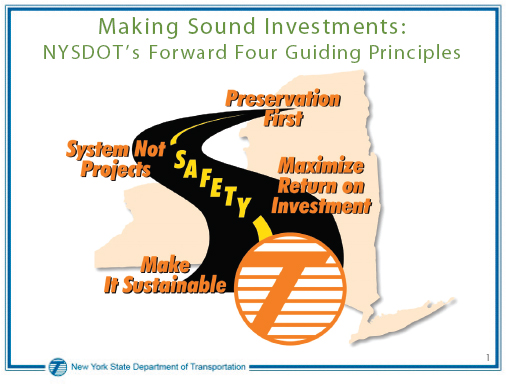
FIGURE 2 Making Sound Investments: NYSDOT’s Forward Four Guiding Principles
For example, because of the aging transportation systems, one of the state’s strategies is to shift investments from new construction to the preservation of existing infrastructure. This strategy will both maximize public benefits and be affordable over the long term. And whereas NYSDOT used to consider a project only in the context of what it meant for a very small defined area, each project is now understood as part of an overall system. This understanding can change the dynamics of decision making, maximizing return on investment and ensuring sustainability.
In these and other ways NYSDOT is incorporating sustainability into all its decisions and practices, using the triple bottom line approach in making investment decisions that affect the environment, the economy, and social concerns (Figure 3).
THE IMPORTANCE OF POLITICAL WILL
It is impossible to take politics out of transportation decision making—politicians love groundbreakings and ribbon cuttings—so it’s important to

FIGURE 3 The Triple Bottom Line Approach to Sustainability
balance the preservation-first strategy with linking big infrastructure projects to economic development.
Because each of the state’s 11 regions has a different way of making capital planning investment decisions, working across so many regions requires political will. People typically think of politics with a capital P—the president, the governor, the mayor,… But managers have to challenge staff and that takes political will. Bucking long-held systems and processes requires political will. This political will in changing how we do business is equally important for achieving a sustainable society.
PRACTICAL STEPS IN SUPPORT OF SUSTAINABILITY
One department program that fosters sustainability is GreenLITES, which recognizes Green Leadership in Transportation Environmental Sustainability in NYSDOT projects and offices that encourage the use of green processes and green design.
Traditionally, when people think of a green program and sustainability they think of design and construction: How are transportation engineers
adding bike paths? How are they using landscaping to make a road or bridge improvement project more pedestrian friendly and community friendly? With the GreenLITES program the department rewards the efforts of not only the design and construction side but also operations and maintenance, where staff adapt and use green technology by, for example, using less salt to keep highways free of snow, or using sustainable detergents and cleaning fluids at department facilities.
Sustainability must also address the needs of the community. To that end NYSDOT is working with local administrators around the state on a number of projects—the Hempstead Turnpike Pedestrian Safety Corridor, the Economic Development Corridor in Fuller Road (Albany), an Urban Waterfront Revitalization Project for Buffalo Outer Harbor, a Bus Rapid Transit Corridor along Central Avenue (Albany-Schenectady), and the Bronx River Greenway (Figure 4). For the latter, NYSDOT collaborated with New York City Parks, the US Department of the Interior, and Amtrak using federal CMAQ (Congestion Mitigation and Air Quality) funds to make some wonderful investments in the community.
All of the projects show that a lot can be done to improve safety for pedestrians and bicyclists with very small amounts of dollars, for example by raising medians, changing bus stops to be more pedestrian friendly, integrating landscaping, improving drainage, and maintaining bike and pedestrian paths.
The digital age also affords opportunities, and NYSDOT has made it a priority to use 511, the National Transportation Information System that DOTs use across the country. It provides travel information and updates on capital construction projects so that by accessing 511—whether on a computer or cellphone or mobile device—people can find out where the construction projects are, what the alternate routes are to get to their destination, and upcoming transit options.
CLOSING REMARKS
It is the responsibility of leaders to address challenges creatively and to build a legacy of safety, mobility, and economic development in order to ensure quality of life and sustainability for our children and future generations. I have found that all entities want to be part of the solution. If you engage people in dialogue at the beginning, present ways to achieve shared goals, and discuss options, the outcome is a great design. Great ideas come from great conversations, a great dialogue. NYSDOT can come up with creative

solutions by working with our partners in local government, academia, not-for-profits, and the private sector.
Through balanced, multimodal planning and actions, NYSDOT supports economic development and a transportation system that is safe, efficient, balanced, environmentally sound, and sustainable for the future. It takes vision, passion, and political will to plan and take action toward a sustainable future.


