Biographical Memoirs: Volume 62 (1993)
Chapter: THE EARLY YEARS
I. I. RABI
July 29, 1898-January 11, 1988
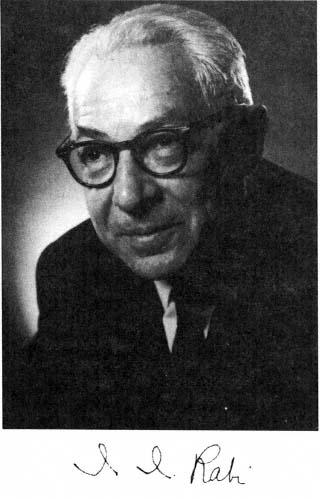
BY NORMAN F. RAMSEY
SOME SCIENTISTS MAKE their greatest contribution through their own personal research, while others are best remembered for their general wisdom and their influence on others. A few, including Rabi, excel in both respects. His own discoveries, which led to his Nobel Prize in 1944, are of great importance, including the invention of the molecular beam magnetic resonance method, which he and his associates used to measure magnetic moments and electric quadrupole moments of many atomic nuclei and to show the existence of a previously unsuspected tensor force between the neutron and the proton. But Rabi's influence extended far beyond his own laboratory. He was a creative scientist, an innovative statesman, and a philosopher. Proposals first made by Rabi have led to many of the most successful ventures in national and international cooperation in science.
THE EARLY YEARS
Rabi was born on July 29, 1898, in Rymanow, a small town in Galicia, a province in the northeast of the Austro-Hungarian empire. His parents were Orthodox Jews who gave their son the name Israel Isaac Rabi. Soon after Rabi was born, his father moved to New York City and within a
few months had earned enough money for his wife and son to join him on the Lower East Side of Manhattan. At home the young Rabi was called ''Izzy," but when his mother gave this name at the time he was first enrolled in public school, the name was recorded as Isidor and the error was never corrected. Throughout most of Rabi's professional life he was known as I. I. Rabi except to his closest friends, who called him either Rabi or Rab. The Rabi home was in a Jewish ghetto in the Manhattan slums. Rabi's education began in Hebrew school at age three. His father worked in a sweatshop making women's clothes by day, and at night he operated a small but unsuccessful grocery store that was tended by Rabi's mother during the day.
When Rabi was nine his parents moved to the Brownsville section of Brooklyn, which was crowded but still somewhat rural. Rabi attended New York public schools but did not find school inspiring. Rabi's fascinating childhood and early education have been well described by Jeremy Bernstein1 and John Rigden.2 Rabi was an avid reader and gained much of his education and interest in science through books borrowed from the public library. He was for several years particularly interested in books on socialism, science, radio and technology. His first scientific paper, written while he was still in elementary school, was on the design of a radio condenser and was published in Hugo Gernsback's Modern Electronics. In 1916, after graduating from the Manual Training High School in Brooklyn, Rabi entered Cornell University, starting in electrical engineering but graduating in the field of chemistry. After three years of uninteresting jobs, he returned to Cornell to do graduate work in chemistry, moving a year later to Columbia University and to physics. At Columbia, Rabi did his doctoral research on magnetic susceptibility with A. P. Wills, but, characteristically, it was on a subject of Rabi's own

