Acute Exposure Guideline Levels for Selected Airborne Chemicals: Volume 20 (2016)
Chapter: 2 Chloroformates Acute Exposure Guideline Levels
2
Chloroformates Acute Exposure Guideline Levels
1. GENERAL INFORMATION ON SELECTED CHLOROFORMATES
The bases of the AEGL values for the following chloroformates are described in this report: methyl chloroformate, ethyl chloroformate, isopropyl chloroformate, n-propyl chloroformate, allyl chloroformate, n-butyl chloroformate, isobutyl chloroformate, sec-butyl chloroformate, benzyl chloroformate, phenyl chloroformate, 2-ethylhexyl chloroformate, and ethyl chlorothioformate. Information relevant to all 12 compounds is presented first, and is followed by separate sections on the individual chemicals.
1.1. General Physical and Chemical Properties
Selected physicochemical properties of the chloroformates are presented in Table 2-1. Chloroformates are clear, colorless liquids with relatively low freezing points and relatively high boiling points (>100°C). The chloroformates are reactive compounds possessing both acid chloride and alkyl substituents. The alkyl substituent is responsible for the thermal stability of the chloroformate in the following order of decreasing stability: aryl (e.g., benzyl chloroformate, phenyl chloroformate) > primary alkyl (e.g., methyl chloroformate, ethyl chloroformate, n-propyl chloroformate, n-butyl chloroformate) > secondary alkyl (e.g., isopropyl chloroformate, isobutyl chloroformate) > tertiary alkyl (Kreutzberger 2001).
Chloroformates are soluble in organic solvents, and hydrolyze in water. Hydrolysis products of the chloroformates, except ethyl chlorothioformate, are an alcohol (ROH), carbon dioxide, and hydrogen chloride; hydrolysis products of ethyl chlorothioformate are ethyl mercaptan, carbon dioxide, and hydrogen chloride. Specific alcohol hydrolysis products for each chloroformate are listed in Table 2-1. Lower chloroformates (such as methyl and ethyl chloroformate) hydrolyze more rapidly in water at room temperature, and the higher and aromatic chloroformates hydrolyze more slowly at room temperature (Kreutzberger 2001). Measured hydrolysis half-life in water for methyl, ethyl, propyl, isopropyl, and phenyl chloroformate range from 1.4 to 53.2 min (Queen 1967). Rates for the
TABLE 2-1 General Chemical and Physical Properties of Selected Chloroformatesa
| Chloroformate | Molecular Weight | Solubility in Water | Hydrolysis Half-time, min (°C) | Hydrolysis Products (with CO2) | Estimated Atmospheric Half-time | Vapor Pressure, mm Hg (°C) | Vapor Density, g/L (air = 1) | Boiling Point, °C | Flash Point, °C | Flamability Limitsl | |
|---|---|---|---|---|---|---|---|---|---|---|---|
| Lower explosive limit | Upper explosive limit | ||||||||||
| Methyl chloroformate | 94.5 | Slightly soluble (hydrolyzes) | 20.5 (25)b | Methanol, HCl | 74 d at 5 × 10⁵ OH, photooxidation | 108.5 (25) | 3.26 | 71.0 | 12.2 | – | 6.7% |
| Ethyl chloroformate | 108.53 | Gradually decomposes | 33.0 (25)b | Ethanol, HCl | 11 d, photooxidation | 22.4 (25) | 3.7 | 95 | 27.8 | – | – |
| Isopropyl chloroformate | 122.55 | Hydrolyzes | 5.6 (25)b | Isopropanol, HCl | 5 d, photooxidation | 100 (47) | 4.2 | 104.6 | 27.8 | Flammable; may be ignited by heat, sparks or flame. | Flammable; may be ignited by heat, sparks or flame. |
| n-Propyl chloroformate | 122.55 | – | 29.4 (25)b | n-Propanol, HCl | – | 20 (25) | 4.2 | 112.4 | 34.4 | – | – |
| Allyl chloroformate | 120.54 | Hydrolyzes | – | Allyl alcohol, HCl | 14 h, photooxidation; 23 h, reaction with ozone | 20 (25) | 4.2 | 110 | 31.1 | – | – |
| n-Butyl chloroformate | 136.58c | Poorly soluble (hydrolyzes)d | – | n-Butanol, HCl | – | 5.3 (20)d | 4.7g | 142e | 46.0 | – | – |
| Isobutyl chloroformate | 136.58c | Gradually decomposesf | – | Isobutanol, HCl | – | 16.5 (20)g | 4.7g | 130f | 39.4f | – | – |
| sec-Butyl chloroformate | 136.58c | _ | – | sec-Butanol, HCl | – | – | – | – | 35.6 | – | – |
| Benzyl chloroformate | 170.60 | Decomposes | – | Benzyl alcohol, HCl | – | 7 (85-87) | 1h | 152 | 80 | – | – |
| Chloroformate | Molecular Weight | Solubility in Water | Hydrolysis Half-time, min (°C) | Hydrolysis Products (with CO2) | Estimated Atmospheric Half-time | Vapor Pressure, mm Hg (°C) | Vapor Density, g/L (air = 1) | Boiling Point, °C | Flash Point, °C | Flamability Limitsl | |
|---|---|---|---|---|---|---|---|---|---|---|---|
| Lower explosive limit | Upper explosive limit | ||||||||||
| Phenyl chloroformate | 156.6g | Decomposesg | 1.4 (19.6)b | Phenol, HCl | – | 0.68 (20)g | 5.41g | 188-189g | 69g | – | – |
| 2-Ethylhexyl chloroformate | 192.71i | Decomposesi | – | 2-Ethyl-1-hexanol, HCl | – | 1 (45)i | >1 | 208c | NA | – | – |
| Ethyl chlorothioformate | 124.59 | Decomposesj | 4.3 (4.6)k | Ethyl mercaptan, HCl | – | 8.3 (21)j | – | 132 j | 51.7j | – | – |
Additional chemical and physical data for individual chloroformates are presented in their respective sections.
aSource is HSDB (2003a,b, 2013, 2014a,b,c,d) except where noted.
bCalculated from empirical rate constants reported by Queen (1967).
jStauffer Chemical Company (1983).
kCalculated from empirical rate constant reported by Queen et al. (1970).
other chloroformates were not found. Data on atmospheric hydrolysis, the effect of relative humidity on hydrolysis rates, and persistence in the atmosphere of chloroformates were not available. However, data obtained from a study for structurally-similar and hydrolytically active acetyl chlorides (e.g., chloroacetyl chloride, phosgene, and trichloroacetyl chloride) indicate that gas-phase hydrolysis in an atmosphere of 40% humidity is much less than in water (Butler and Snelson 1979). A comparison of the hydrolysis half-times, vapor pressures, boiling points, flash points, and flammability limits are presented in Table 2-1.
A comparison of the chemical structures are presented in Figure 2-1.
1.2. Production and Use
Chloroformates are produced by the reaction of phosgene with alcohols or phenols. The alkyl chloroformates of low molecular weight alcohols are prepared by reaction of anhydrous alcohols with a molar excess of chlorine-free phosgene at low temperature. Hydrogen chloride is evolved during the reaction and is collected in a tower with recovered excess phosgene (Kreutzberger 2001).
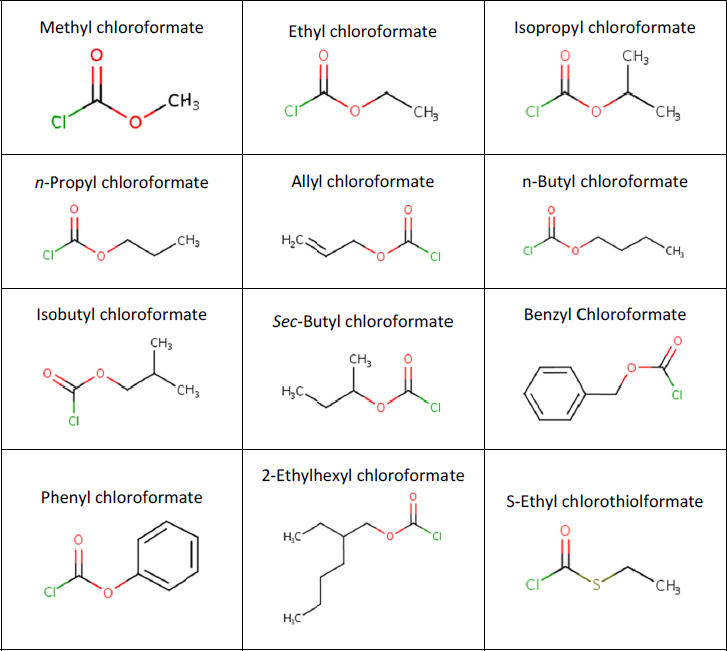
Chloroformates are used as intermediates in the synthesis of pesticides, herbicides, perfumes, pharmaceuticals, foods, polymers, and dyes. They are also used for conversion to peroxydicarbonates, which then serve as free radical initiators for polymerization of vinyl chloride, ethylene, and other unsaturated monomers (Kreutzberger 2001).
1.3. Absorption, Metabolism, Disposition, and Excretion
No specific information about the absorption, metabolism, disposition, and excretion of the chloroformates was found.
1.4. Mechanism of Toxicity
Chloroformates hydrolyze in water or moist air to produce a parent alcohol or mercaptan compound (used in the production of each chloroformate), hydrogen chloride, and carbon dioxide. Thus, exposures to chloroformates are most likely to a mixture of the parent compound and its hydrolysis products. Chloroformates are direct-acting contact irritants, and are corrosive to the eyes, skin, gastrointestinal tract, and the respiratory tract. Inhalation may result in coughing, labored breathing, sore throat, unconsciousness, convulsions, and death. Pulmonary edema frequently occurs, and its symptoms may not manifest for several hours after exposure and may be aggravated by physical exertion. Delayed pulmonary edema resulting in hospitalization and requiring treatment has occurred in people accidentally exposed to unknown concentrations of methyl chloroformate (Schuckmann 1972; Penkovitch and Anikin 1988) and ethyl chloroformate (Bowra 1981). According to AIHA (2006a), a fatality with pulmonary edema occurred after a worker was exposed to methyl chloroformate at an estimated concentration of 40,000 ppm. Ingestion of chloroformates may result in a burning sensation of the digestive tract, nausea, vomiting, and abdominal pain (Kreutzberger 2001).
Table 2-2 provides a comparison of 1-h and 4-h rat LC50 (lethal concentration, 50% lethality) values for the chloroformates and their hydrolysis products. A comparison of the toxicity data suggests that the toxicity of the chloroformates cannot be readily predicted from the toxicity of any particular hydrolysis product and supports the suggestion that the toxicity likely reflects exposure to a mixture of parent compound and hydrolysis products.
1.5. Concurrent-Exposure Issues
No information about exposure to chloroformates in conjunction with other chemicals that might be found concurrently in the workplace or the environment was found.
TABLE 2-2 Rat LC50 Values (ppm) for Selected Chloroformates and Their Hydrolysis Products
| 1 h | 4 h | |||
|---|---|---|---|---|
| Chloroformatea | Alcoholb,c | Chloroformatea | Alcoholb,c | |
| Methyl chloroformate | 88-123 | >145,000 | 15-52 | 64,000 |
| Ethyl chloroformate | 145-200 | – | – | – |
| Isopropyl chloroformate | 300 | – | – | 29,600 |
| n-Propyl chloroformate | 410 | – | – | – |
| Allyl chloroformate | 65.1 | 1,060 | – | 165 |
| n-Butyl chloroformate | 200 (LC40) | – | – | 8,000 |
| Isobutyl chloroformate | – | – | – | 8,000 |
| sec-Butyl chloroformate | – | – | – | – |
| Benzyl chloroformate | – | – | 85 | 16,800 |
| Phenyl chloroformate | – | – | 30 | – |
| 2-Ethylhexyl chloroformate | – | – | 33.9 | – |
| Ethyl chlorothioformate | – | – | 45 | 2,770 (mercaptan) |
| Hydrogen chlorideb | 3,124 | – | ||
aSee sections on the individual chloroformates for the sources of the LC50 values.
bHSDB (2003a,b, 2013, 2014a,b,c,d) is source of the alcohol and hydrogen chloride LC50 values.
cAlcohol, phenol, or mercaptan hydrolysis product is shown in Table 2-1.
1.6. Species Sensitivity
No information about differences in the acute toxicity of the chloroformates between species was available. However, because the chloroformates are highly reactive in nature and are direct-acting irritants, little interspecies variability is expected. RD50 (concentration of a substance that reduces the respiratory rate by 50%) data on methyl, ethyl, propyl, isopropyl, isobutyl, sec-butyl, and phenyl chloroformate suggest that the mouse may be more sensitive than the rat. However, the difference could be an artifact of the stressful testing procedure used with the mice, which were restrained during the exposure period, and not indicative of increased sensitivity to chloroformates.
1.7. Temporal Extrapolation
The concentration-exposure time relationship for many irritant and systemically-acting vapors and gases can be described by the equation Cn × t = k, where the exponent, n, ranges from 0.8 to 3.5 (ten Berge et al. 1986). Insufficient
data were available for deriving an empirical value for n for any of the twelve chloroformates. In the absence of chemical-specific data, a default value of n = 3 was used to extrapolate from longer to shorter durations, and a default value of n = 1 was used to extrapolate from shorter to longer durations, to provide AEGL values that are protective of human health (NRC 2001).
1.8. Data Quality
The literature search, study selection, and evidence integration follows the methods outlined in the AEGLs standing operating procedure (NRC 2001). Although the AEGLs standing operating procedure outlines methods to ensure consistency and transparency, they are not formal systematic review procedures. However, several studies on the chloroformates were conducted by Industrial Bio-Test Laboratories, Inc. (IBT). In 1976 FDA found significant deficiencies and discrepancies in reports and study procedures, which called into question the validity of IBT studies. This led to a number of investigations of IBT by government agencies, the closure of the firm and criminal convictions of some of IBT staff for fraud or falsifying data. In a post hoc audit program of IBT studies conducted by the U.S. Environmental Protection Agency and the Canadian Health and Welfare Department (EPA 1983), 618 of 867 non-acute toxicity studies (including subacute, sub-chronic, carcinogenicity, reproductive toxicity, genotoxicity, and neurotoxicity studies) were reported to be invalid (OECD 2007). Although the focus of this audit was on repeated-dose and long-term studies, in its Manual for Investigation of HPV Chemicals, the Organisation for Economic Co-operation and Development (OECD) reports that significant discrepancies and deficiencies in acute toxicity studies also were found (OECD 2007).
OECD (2007) outlined specific criteria for using data generated by IBT, and recommended rejecting a study when either a regulatory or internal audit revealed problems with respect to the reliability of the findings or when the findings of unaudited studies are inconsistent with data collected by reputable laboratories. OECD (2007) further recommended that unaudited studies should not be used as key studies, but instead be used with caution and considered only as weak evidence if supported by data from reputable laboratories. OECD (2007) also noted that if an IBT study is consistent with a well conducted and reliable study, the IBT results may be used to increase confidence in characterization of a substance’s toxicity.
In reviewing IBT studies for this report, the general recommendations of OECD (2007) were followed. First and foremost, no IBT studies were used as the principal or key study in deriving AEGLs for any of the chloroformates. In cases where IBT study reports were available, they were reviewed (but not formally audited), and if the findings were consistent with other studies of reputable validity, the results of the IBT studies are included and referred to as providing supporting evidence.
1.9. Special Considerations
A summary of the AEGL values for the chloroformates reviewed in this document is presented in Table 2-3. AEGL-1 values were not derived for any chloroformate because of insufficient toxicity data. As discussed in Section 1.4 (Mechanism of Toxicity), exposures to the chloroformates are most likely to a mixture of the parent compound and its hydrolysis products. Therefore, using AEGL-values for hydrogen chloride as the basis for establishing AEGL values for the chloroformates was considered inappropriate. Furthermore, AEGL-1 values for hydrogen chloride (shown in Table 2-4) approach or exceed the AEGL-2 and AEGL-3 values for the chloroformates.
No acute inhalation data consistent with the definition of AEGL-2 were available. Therefore, the AEGL-2 values for all chloroformates were calculated by taking a three-fold reduction in the AEGL-3 values. That approach is consistent with recommendations in the Standing Operating Procedures for Developing AEGLs for estimating a threshold for irreversible effects (NRC 2001). AEGL-3 values were based on lethality data on the individual chloroformates, although the toxicity data for chloroformates were sparse. Respiratory effects associated with direct-acting irritation and corrosion (nasal irritation, pulmonary inflammation, pulmonary edema, and emphysema and associated lethality) have been observed in humans and animals for several of the chloroformates. Interspecies and intraspecies uncertainty factors of 3 (for a total uncertainty factor of 10) were used for calculating the AEGL values for the chloroformates. Those values were chosen because pharmacodynamic variability is probably minimal (within a factor of 3) for irritants and because metabolic (pharmacokinetic) differences among species and individuals are unlikely to play a major role in direct-acting irritation or corrosion at the portal of entry (respiratory tract). The AEGL values for n-propyl chloroformate were determined on the basis of structural similarity to isopropyl chloroformate, and the AEGL values for isobutyl chloroformate and sec-butyl chloroformate were determined on the basis of structural analogy to n-butyl chloroformate.
2. METHYL CHLOROFORMATE
2.1. Summary
Data on methy chloroformate were insufficient for deriving AEGL-1 values, so no values are recommended.
No acute inhalation data appropriate for deriving AEGL-2 values for methyl chloroformate were available. Thus, the AEGL-2 values were calculated by taking one-third of the AEGL-3 values. That approached is used to estimate a threshold for irreversible effects if a chemical has a steep concentration-response curve (NRC 2001). Lethality data on methyl chloroformate provide evidence of a steep curve. In studies of rats exposed to methyl chloroformate for 4 h,
TABLE 2-3 AEGL Values for Selected Chloroformatesa
| Classification | 10 min | 30 min | 1 h | 4 h | 8 h |
|---|---|---|---|---|---|
| Methyl chloroformate | |||||
| AEGL-1 (nondisabling) | NRb | NRb | NRb | NRb | NRb |
| AEGL-2 (disabling) | 4.0 ppm (16 mg/m3) | 2.8 ppm (11 mg/m3) | 2.2 ppm (8.6 mg/m3) | 1.4 ppm (5.5 mg/m3) | 0.70 ppm (2.7 mg/m3) |
| AEGL-3 (lethal) | 12 ppm (47 mg/m3) | 8.5 ppm (33 mg/m3) | 6.7 ppm (26 mg/m3) | 4.2 ppm (16 mg/m3) | 2.1 ppm (8.2 mg/m3) |
| Ethyl chloroformate | |||||
| AEGL-1 (nondisabling) | NRb | NRb | NRb | NRb | NRb |
| AEGL-2 (disabling) | 2.9 ppm (13 mg/m3) | 2.0 ppm (8.8 mg/m3) | 1.6 ppm (7.0 mg/m3) | 0.40 ppm (1.8 mg/m3) | 0.20 ppm (0.88 mg/m3) |
| AEGL-3 (lethal) | 8.8 ppm (39 mg/m3) | 6.1 ppm (27 mg/m3) | 4.8 ppm (21 mg/m3) | 1.2 ppm (5.3 mg/m3) | 0.60 ppm (2.6 mg/m3) |
| Isopropyl chloroformate and n-propyl chloroformate | |||||
| AEGL-1 (nondisabling) | NRb | NRb | NRb | NRb | NRb |
| AEGL-2 (disabling) | 3.7 ppm (19 mg/m3) | 3.7 ppm (19 mg/m3) | 3.0 ppm (15 mg/m3) | 1.9 ppm (9.5 mg/m3) | 1.3 ppm (6.5 mg/m3) |
| AEGL-3 (lethal) | 11 ppm (55 mg/m3) | 11 ppm (55 mg/m3) | 9.1 ppm (46 mg/m3) | 5.7 ppm (29 mg/m3) | 3.8 ppm (19 mg/m3) |
| Allyl chloroformate | |||||
| AEGL-1 (nondisabling) | NRb | NRb | NRb | NRb | NRb |
| AEGL-2 (disabling) | 1.3 ppm (6.4 mg/m3) | 0.87 ppm (4.3 mg/m3) | 0.70 ppm (3.4 mg/m3) | 0.18 ppm (0.88 mg/m3) | 0.09 ppm (0.44 mg/m3) |
| AEGL-3 (lethal) | 3.8 ppm (19 mg/m3) | 2.6 ppm (13 mg/m3) | 2.1 ppm (10 mg/m3) | 0.53 ppm (2.6 mg/m3) | 0.26 ppm (1.3 mg/m3) |
| n-Butyl chloroformate, isobutyl chloroformate, and sec-butyl chloroformate | |||||
| AEGL-1 (nondisabling) | NRb | NRb | NRb | NRb | NRb |
| AEGL-2 (disabling) | 4.0 ppm (22 mg/m3) | 2.8 ppm (33 mg/m3) | 2.2 ppm (27 mg/m3) | 0.57 ppm (6.7 mg/m3) | 0.28 ppm (3.3 mg/m3) |
| AEGL-3 (lethal) | 12 ppm (68 mg/m3) | 8.4 ppm (100 mg/m3) | 6.7 ppm (80 mg/m3) | 1.7 ppm (20 mg/m3) | 0.83 ppm (10 mg/m3) |
| Classification | 10 min | 30 min | 1 h | 4 h | 8 h |
|---|---|---|---|---|---|
| Benzyl chloroformate | |||||
| AEGL-1 (nondisabling) | NRb | NRb | NRb | NRb | NRb |
| AEGL-2 (disabling) | 1.2 ppm (8.7 mg/m3) | 1.2 ppm (8.7 mg/m3) | 0.97 ppm (6.7 mg/m3) | 0.63 ppm (4.3 mg/m3) | 0.31 ppm (2.2 mg/m3) |
| AEGL-3 (lethal) | 3.7 ppm (26 mg/m3) | 3.7 ppm (26 mg/m3) | 2.9 ppm (20 mg/m3) | 1.9 ppm (13 mg/m3) | 0.93 ppm (6.5 mg/m3) |
| Phenyl chloroformate | |||||
| AEGL-1 (nondisabling) | NRb | NRb | NRb | NRb | NRb |
| AEGL-2 (disabling) | 0.24 ppm (1.5 mg/m3) | 0.24 ppm (1.5 mg/m3) | 0.19 ppm (1.2 mg/m3) | 0.12 ppm (0.77 mg/m3) | 0.06 ppm (0.38 mg/m3) |
| AEGL-3 (lethal) | 0.72 ppm (4.6 mg/m3) | 0.72 ppm (4.6 mg/m3) | 0.57 ppm (3.6 mg/m3) | 0.36 ppm (2.3 mg/m3) | 0.18 ppm (1.2 mg/m3) |
| 2-Ethylhexyl chloroformate | |||||
| AEGL-1 (nondisabling) | NRb | NRb | NRb | NRb | NRb |
| AEGL-2 (disabling) | 1.2 ppm (9.5 mg/m3) | 1.2 ppm (9.5 mg/m3) | 0.97 ppm (7.7 mg/m3) | 0.60 ppm (4.7 mg/m3) | 0.30 ppm (2.4 mg/m3) |
| AEGL-3 (lethal) | 3.6 ppm (28 mg/m3) | 3.6 ppm (28 mg/m3) | 2.9 ppm (23 mg/m3) | 1.8 ppm (14 mg/m3) | 0.91 ppm (7.2 mg/m3) |
| Ethyl chlorothioformate | |||||
| AEGL-1 (nondisabling) | NRb | NRb | NRb | NRb | NRb |
| AEGL-2 (disabling) | 1.0 ppm (5.1 mg/m3) | 1.0 ppm (5.1 mg/m3) | 0.80 ppm (4.0 mg/m3) | 0.50 ppm (2.6 mg/m3) | 0.25 ppm (1.3 mg/m3) |
| AEGL-3 (lethal) | 3.0 ppm (15 mg/m3) | 3.0 ppm (15 mg/m3) | 2.4 ppm (15 mg/m3) | 1.51 ppm (7.6 mg/m3) | 0.75 ppm (3.8 mg/m3) |
aTreatment of people exposed to chloroformates should consider that pulmonary edema frequently occurs, but its symptoms may not manifest for several hours after exposure and may be aggravated by physical exertion.
bNR, not recommended. Absence of an AEGL-1 value does not imply that exposure below the AEGL-2 value is without adverse effects.
TABLE 2-4 AEGL Values for Chloroformate Hydrolysis Products
| Classification | 10 min | 30 min | 1 h | 4 h | 8 h |
|---|---|---|---|---|---|
| Hydrogen chloride (NRC 2004) | |||||
| AEGL-1 (nondisabling) | 1.8 ppm (2.7 mg/m3) | 1.8 ppm (2.7 mg/m3) | 1.8 ppm (2.7 mg/m3) | 1.8 ppm (2.7 mg/m3) | 1.8 ppm (2.7 mg/m3) |
| AEGL-2 (disabling) | 100 ppm (156 mg/m3) | 43 ppm (65 mg/m3) | 22 ppm (33 mg/m3) | 11 ppm (17 mg/m3) | 11 ppm (17 mg/m3) |
| AEGL-3 (lethal) | 620 ppm (937 mg/m3) | 210 ppm (313 mg/m3) | 100 ppm (155 mg/m3) | 26 ppm (38 mg/m3) | 26 ppm (39 mg/m3) |
Hoeschst (Hollander et al. 1986) reported an LC50 of 51-53 ppm, no mortality at 45 ppm, and 80% mortality at 57 ppm. In another study using rats, the 1-h LC50 was 100 ppm, and rats exposed at 26 ppm for 1 h were clinically normal and had no mortality (Fisher et al. 1981a).
Using lethality data from Hoechst (Hollander et al. 1986), a 4-h BMCL05 (benchmark concentration, 95% lower confidence limit with 5% response) of 42.4 ppm was calculated (see Appendix A) and used as the point-of-departure for deriving AEGL-3 values for methyl chloroformate. That concentration is considered a threshold for lethality and is supported by data that no deaths occurred in rats exposed to methyl chloroformate at 45 ppm for 4 h (Hollander et al. 1986). The effects of the chloroformates result from the direct-acting corrosive effects on the airways, in the absence of other systemic effects. Supporting information for this mode of action comes from observations in rats of nasal irritation and respiratory effects (e.g., pulmonary congestion, pulmonary edema, and increased pulmonary weights) in short-term repeated-exposure studies of methyl chloroformate (Gage 1970; Kenny et al. 1992; BASF 1993, 1999a). Interspecies and intraspecies uncertainty factors of 3 are often used for respiratory irritants because pharmacodynamic variability is probably minimal (within a factor of 3) for irritants and because metabolic (pharmacokinetic) differences among species and individuals are unlikely to play a major role in direct-acting irritation or corrosion at the portal-of-entry (respiratory tract). Thus, interspecies and intraspecies uncertainty factors of 3 would represent the potential for any toxicodynamic variability, resulting in a total uncertainty factor of 10 applied to the estimated threshold for lethality (42.4 ppm). Time scaling was performed using the equation Cn × t = k (ten Berge et al. 1986). Data on methyl chloroformate were insufficient for calculating an empirical value for the exponent n, so default values of n = 3 when extrapolating from longer to shorter durations (10 min, 30 min, and 1 h) and n = 1 when extrapolating from shorter to longer durations (8 h) were used. Time scaling from 4 h to 10 min is supported by a 1-h LC50 study (IBT 1975); utilizing the BMCL05 from this study yields a 10-min AEGL-3 value of 13 ppm, which supports the time-scaled value of 12 ppm calculated from the study by Hoechst (Hollander et al. 1986).
The AEGL values for methyl chloroformate are presented in Table 2-5.
TABLE 2-5 AEGL Values for Methyl Chloroformatea
| Classification | 10 min | 30 min | 1 h | 4 h | 8 h | End Point (Reference) |
|---|---|---|---|---|---|---|
| AEGL-1 (nondisabling) | NRb | NRb | NRb | NRb | NRb | Insufficient data |
| AEGL-2 (disabling) | 4.0 ppm (16 mg/m3) | 2.8 ppm (11 mg/m3) | 2.2 ppm (8.6 mg/m3) | 1.4 ppm (5.5 mg/m3) | 0.70 ppm (2.7 mg/m3) | One-third the AEGL-3 values |
| AEGL-3 (lethal) | 12 ppm (47 mg/m3) | 8.5 ppm (33 mg/m3) | 6.7 ppm (26 mg/m3) | 4.2 ppm (16 mg/m3) | 2.1 ppm (8.2 mg/m3) | Estimated lethality threshold (4-h BMCL05) in rats (Hollander et al. 1986) |
aTreatment of people exposed to chloroformates should consider that pulmonary edema frequently occurs, but its symptoms may not manifest for several hours after exposure and may be aggravated by physical exertion.
bNR, not recommended. Absence of an AEGL-1 value does not imply that exposure below the AEGL-2 value is without adverse effects.
2.2. Chemical and Physical Properties
Methyl chloroformate hydrolyzes in water to form methanol, carbon dioxide, and hydrogen chloride. Selected chemical and physical properties of methyl chloroformate are presented in Table 2-6.
2.3. Human Toxicity Data
2.3.1. Acute Lethality
No data on human deaths from exposure to methyl chloroformate were found.
2.3.2. Nonlethal Toxicity
2.3.2.1. Case Reports
A healthy 41-year-old chemical production worker inhaled 2-3 breaths of an atmosphere containing methyl chloroformate in the vicinity of leaking equipment (Schuckmann 1972). The concentration of methyl chloroformate in the discharge was not reported. The worker left the contaminated area immediately because of a penetrating odor and coworkers’ warnings. About an hour after exposure, he experienced slight ocular irritation and an irritating cough and reported to the medical facility at the factory. Auscultation of lungs was largely unremarkable; isolated respiratory sounds were found in the upper
TABLE 2-6 Chemical and Physical Properties of Methyl Chloroformate
| Parameter | Value | Reference |
|---|---|---|
| Common name | Methyl chloroformate | HSDB 2014a |
| Synonyms | Carbonochloridic acid, methylethyl ester; chlorocarbonic acid, methylethyl ester; chloroformic acid methyl ester; formic acid, chloro-, methyl ester; methyl chlorocarbonate; K-stoff; methoxycarbonyl chloride; TL 438 | HSDB 2014a |
| CAS registry no. | 79-22-1 | HSDB 2014a |
| Chemical formula | C2H3ClO2 | HSDB 2014a |
| Molecular weight | 94.5 | HSDB 2014a |
| Physical state | Colorless liquid | HSDB 2014a |
| Melting point | -81°C | HSDB 2014a |
| Boiling point | 71.0°C | HSDB 2014a |
| Flash point | 12.2°C | HSDB 2014a |
| Density | HSDB 2014a | |
| Vapor | 3.26 g/L (air = 1) | |
| Liquid | 1.223 g/cm3 (water = 1) | |
| Solubility | Slightly soluble (hydrolyzes) in water; soluble in chloroform, benzene, alcohol, ether | HSDB 2014a |
| Vapor pressure | 108.5 mm Hg at 25°C | HSDB 2014a |
| Hydrolysis half-life | 20.5 min at 25°C | Queen 1967 |
| Estimated atmospheric half-time | 74 d at 5 × 10⁵ OH, photooxidation | HSDB 2014a |
| Conversion factors in air | 1 mg/m3 = 0.26 ppm 1 ppm = 3.9 mg/m3 | – |
lobes. The next day (about 24 h later), a follow-up examination was performed. The worker reported increasing cough since early morning and presented with abnormal respiratory sounds in the upper lung lobes during auscultation. A codeine preparation (Codipront) was prescribed and a follow-up examination was scheduled for the next day. However, the worker returned in the afternoon of the same day because of increasingly severe signs and symptoms as the day progressed, as evidenced by extensive abnormal sounds in the upper lung lobes, moderate dyspnea, and a temperature of 37.2°C. The worker was kept for observation overnight, with an oxygen supply, a bronchodilator (Brondilat), and 40 mg Urbason intravenously. During the night the symptoms receded and the worker slept well to the early morning hours. The cough resumed and auscultation showed slight dry rales in the right lower lung lobe. The worker was sent home after treatment with Omnicillin and Codipront. Examination performed the next day revealed no notable complaints. The following day,
however, the worker complained of a severely irritating cough and dyspnea; slight cyanosis of the lips was also observed. Auscultation of the lungs, revealing rales in all lung areas, confirmed the subjective findings. The worker was then admitted to the factory’s medical facility and stayed there for about three days. Urbason, Brondilat, and Hostacyclin were administered during this time period. The symptoms started to recede, although a morning cough persisted, and drug treatment was discontinued.
In another report, a 46-year-old male worker was exposed to methyl chloroformate while repairing a methyl chloroformate pipeline (Penkovitch and Anikin 1988). The liquid soaked his clothing and penetrated to the skin; he reported itching and burning. He was wearing a gas mask during the accident; thus, no inhalation exposure occurred until he removed the gas mask in the shower room. He then reported a sharp, choking smell and developed burning of the eyes, tearing, sore throat, and a cough while showering for 3-5 min. Methyl chloroformate concentrations were not reported. He returned to his home and reported no abnormal symptoms for 4-5 h. He then developed a sore, burning throat, chills, asthma, and productive cough. The asthma and cough progressed, and he was admitted to a hospital 22 h after the accident. He presented with pulmonary edema which resolved within 24 h after treatment with Prednisolone and Lasix.
AIHA (2006a) described a report of individual injuries and a fatality in workers exposed to methyl chloroformates; the primary reports (Hey and Thiess 1968 and Thiess and Hey 1968) were in German and were not translated. AIHA (2006a) indicated that the nonfatal symptoms consisted of ocular irritation, laryngitis, and dry, racking cough, all of which resolved within 1-2 h. In the fatal case, severe pulmonary edema and death ensued after exposure to a concentration estimated by the study authors to be about 40,000 ppm (AIHA 2006a).
2.3.3. Developmental and Reproductive Toxicity
No developmental or reproductive studies of acute human exposure to methyl chloroformate were available.
2.3.4. Genotoxicity
No genotoxic studies of acute human exposure to methyl chloroformate were available.
2.3.5. Carcinogenicity
No carcinogenicity studies of human exposure to methyl chloroformate were available.
2.3.6. Summary
Case reports of methyl chloroformate toxicity are available; however, details of exposure concentration and duration were not available. Signs of exposure included ocular and upper respiratory irritation followed by a latent period which ultimately led to pulmonary edema. For the workers in these reports, the latency periods were 36 h (Schuckmann 1972) and 22 h (Penkovitch and Anikin 1988). No human data on lethality, developmental toxicity, reproductive toxicity, genotoxicity, or carcinogenicity on methyl chloroformate were found.
2.4. Animal Toxicity Data
2.4.1. Acute Lethality
2.4.1.1. Rats
Groups of five male and five female Charles River albino rats were exposed to methyl chloroformate vapor at 0, 145, 173, 233, or 274 ppm (nominal concentrations) for 1 h, followed by a 14-day observation period (IBT 1975). Vapor was generated by bubbling clean, dry air through undiluted methyl chloroformate in a gas washing bottle. The resulting air-vapor mixture was then introduced into the exposure chamber. The 1-h LC50 was determined to be 163 ppm, and the calculated BMCL05 is 74 ppm. Male rats appeared to be more sensitive than females. Hypoactivity, ptosis, ruffed fur, enophthalmus, and dyspnea were observed in all rats during exposure. Evidence of acute bronchiolitis followed by fibrosis of the pulmonary parenchyma was observed in animals killed on day 14 post-exposure and in rats that died during the experiment. Data from this study are summarized in Table 2-7.
TABLE 2-7 Mortality in Charles River Albino Rats Exposed to Methyl Chloroformate for 1 Hour
| Concentration, ppm | Males | Females | Males and Females |
|---|---|---|---|
| 0 | 0/5 | 0/5 | 0/10 |
| 145 | 4/5 | 0/5 | 4/10 |
| 173 | 5/5 | 2/5 | 7/10 |
| 233 | 5/5 | 4/5 | 9/10 |
| 274 | 5/5 | 1/5 | 6/10 |
| BMCL05 | – | – | 74 ppm |
| LC50 | – | – | 163 ppm |
Abbreviations: BMCL05, benchmark concentration, 95% lower confidence limit with 5% response; LC50, lethal concentration, 50% lethality.
Source: Adapted from IBT 1975.
In another study, groups of 10 male Sprague Dawley rats were exposed to methyl chloroformate at 735, 2,947, 9610, or 66,235 ppm (nominal concentrations) for 1 h (WARF Institute, Inc. 1972). A “semi-portable” exposure chamber containing an exhaust fan for adjustable air flow was used. Methyl chloroformate was administered into the incoming air stream just before it entered the chamber port, and exposure concentrations were calculated by dividing the total amount sprayed into the chamber by the total cubic feet of air circulated through the chamber. All animals died within 18 h of exposure (see Table 2-8).
Groups of five male and five female Fischer 344 rats (main group) were exposed to methyl chloroformate vapor at 0, 26, 110, 133, 159, or 192 ppm for 1 h in a 3-ft wide Hinner-style chamber (Fisher et al. 1981a). Chamber concentrations were monitored by real time variable pathlength infrared photospectrometry. In addition 10, 10, and 20 rats/sex (satellite rats) were exposed concurrently to methyl chloroformate at 26, 110, or 133 ppm, respectively. One male and one female satellite rat in each exposure group and two male and two female rats in the three lower-exposure groups were killed 4 h, 24 h, 9 days, or 10 days after exposure. All other surviving animals were killed 14 days after exposure. The LC50 values were 100 ppm for females and 92-123 ppm for males at 14-days post-exposure. Respiratory distress occurred in all main group rats exposed at 110, 133, 159, and 192 ppm during the first 24 h after exposure. Respiratory distress resolved within 24 h in the 110-ppm group; however, the effect persisted through day 14 in the other exposure groups and was accompanied by lethargy, weakness, and inactivity. Concentration-related red or clear ocular and nasal discharge and gross pulmonary lesions were observed in rats exposed at 110, 133, 159, and 192 ppm. Controls and rats in the 26-ppm group were clinically normal. Rats in the satellite group responded similarly to corresponding rats in the main group. In the main study group, decreased mean body weight and body weight gain were observed in the 110-, 133-, 159-, and 192-ppm rats and correlated with poor clinical status prior to death or study termination. No effect on body weight was observed in rats exposed at 26 ppm. Lesions found in satellite rats exposed at 110 and 133 ppm were comparable at all three sacrifice times and included severe degeneration, necrosis, erosion, and ulceration of the nasal turbinates and tracheal mucosal epithelia; alveolar hemorrhage; and erosion of bronchial and bronchiolar epithelia. Effects were similar. By day 9 or 10, the nasal turbinate effects had resolved, but regeneration was incomplete and purulent rhinitis persisted. Other respiratory tract and pulmonary lesions seen at 4 and 24 h resolved after 9 or 10 days. Pulmonary edema was observed in some rats in the 110-, 133-, 159-, and 192-ppm groups. No pulmonary edema was observed in controls or in the group exposed at 26 ppm.
Vernot et al. (1977) reported a 1-h LC50 of 88 ppm (64-123 ppm) for male and 103 ppm (90-118 ppm) for female Sprague-Dawley rats. Experiments were performed in bell jars using groups of five rats per concentration; concentrations were determined analytically. No further experimental details were available.
TABLE 2-8 Mortality in Sprague-Dawley Rats Exposed to Methyl Chloroformate for 1 Hour
| Concentration, ppm | Results |
|---|---|
| 735 | 10/10 dead after 20 min of exposure |
| 2,947 | 9/10 dead at end of 1-h exposure; 1/10 dead 2-min post-exposure |
| 9,610 | 5/10 dead at end of 1-h exposure; 5/10 dead 10-min post-exposure |
| 66,235 | All 10 animals survived 7/10 dead 3-h post-exposure; 3/10 dead within 18-h post-exposure |
Source: Adapted from WARF Institute, Inc. 1972.
Groups of five male and five female SPF Wistar rats were exposed to methyl chloroformate at 35, 45, 57, or 73 ppm (analytic concentrations) for 4 h, followed by a 14-day observation period (Hollander et al. 1986). The whole body exposures were performed in a 2.25-m3 exposure chamber operated under dynamic flow conditions. Methyl chloroformate concentrations were measured every 15 min during exposure using a single beam photometer, and were measured analytically every 120 min using gas chromatography. Clinical signs observed in all treatment groups in a concentration-related manner included palpebral fissure narrowed or closed; increased grooming; squatting posture; accelerated, irregular, and jerky respiration; gasping; drowsiness; staggering movements; wimpering and crackling breathing sounds; sneezing; and piloerection. Body weight gain was reduced in both sexes after exposure, but animals surviving to study termination regained initial body weight. There were no gross treatment-related effects at necropsy in animals surviving to study termination. Gross examination of animals that died during the study showed dark red to black lungs, foamy liquid in the lungs, red aqueous liquid in the thoracic cavity, and distended gastrointestinal tracts. Histopathologic examination showed increased permeability in the alveolar septa and corresponding damage to bronchial epithelium; this effect was found in all treatment groups. Four-hour LC50 values of 51 ppm and 53 ppm were calculated for males and females, respectively. A combined male and female BMCL05 of 42.4 ppm and combined male and female BMC01 of 47.8 ppm were calculated. Mortality data are summarized in Table 2-9.
Groups of 10 male and 10 female Sprague-Dawley rats were exposed to methyl chloroformate at nominal concentrations of 16, 65, 96, or 127 ppm (analytic concentrations were 1.5, 13.7, 33.6, and 31.0 ppm, respectively) for 4 h, followed by a 14-day observation period (BASF 1980a). Whole body exposures were conducted in a 200-L glass-steel inhalation chamber. Analytic concentrations were measured by gas chromatography. Clinical signs in the 65-, 96-, and 127-ppm groups included dyspnea, gasping, blistering in front of noses, red ocular and nasal discharge and encrustations, ruffled and sticky fur, staggering, distended abdomen, poor general state, attempts to escape, impaired coordination, salivation, and squatting posture. Animals in the 16-ppm group exhibited jerky respiration and
eyelid closure. Body weight gain was initially decreased in the three highest concentration groups; this effect resolved in surviving animals by day 14 post-exposure. Four hour LC50 values of 13 ppm and 18 ppm were calculated for males and females, respectively. A combined male and female LC50 value of 15 ppm was also calculated. Data from this study are summarized in Table 2-10. The LC50 values calculated from this study are 3-4 times lower than those found in the Hoechst (Hollander et al. 1986) study and are inconsistent with other data (see Table 2-12).
Death occurred in 12/12 rats exposed to methyl chloroformate vapor (20°C) at 37,500 ppm for 3 min (BASF 1981a). Clinical signs included vigorous escape behavior, severe mucous membrane irritation, and gasping. Pulmonary emphysema with petechial hemorrhages and dilation on the right side of the heart were observed at necropsy.
TABLE 2-9 Mortality in SPF Wistar Rats Exposed to Methyl Chloroformate for 4 Hours
| Concentration, ppm | Males | Females | Males and Females |
|---|---|---|---|
| 35 | 0/5 | 0/5 | 0/10 |
| 45 | 0/5 | 0/5 | 0/10 |
| 57 | 5/5 | 3/5 | 8/10 |
| 73 | 5/5 | 5/5 | 10/10 |
| LC50 | 51 ppm | 53 ppm | – |
| BMCL05 | – | – | 42.4 ppm |
| BMC01 | – | – | 47.8 ppm |
Abbreviations: BMC05, benchmark concentration, 1% response; BMCL01, benchmark concentration, 95% lower confidence limit with 5% response; LC50, lethal concentration, 50% lethality.
Source: Hollander et al. 1986.
TABLE 2-10 Mortality in Sprague-Dawley Rats Exposed to Methyl Chloroformate for 4 Hours
| Nominal Concentration, ppm | Analytic Concentration, ppm | Males | Females | Males and Females |
|---|---|---|---|---|
| 16 | 1.5 | 0/10 | 0/10 | 0/20 |
| 65 | 13.7 | 5/10 | 3/10 | 8/20 |
| 96 | 33.6 | 10/10 | 7/10 | 17/20 |
| 127 | 31.0 | 10/10 | 10/10 | 20/20 |
| LC50 | – | 13 ppm | 18 ppm | 15 ppm |
Abbreviations: LC50, lethal concentration, 50% lethality.
Source: Adapted from BASF 1980a.
Death occurred in 11/12, 5/6, and 6/6 rats exposed to an “atmosphere enriched or saturated” with methyl chloroformate vapor (20°C) for 3, 10, and 30 min, respectively (BASF 1978). Clinical signs included vigorous escape behavior, severe mucous membrane irritation, corneal opacity, dyspnea, and convulsions. Pulmonary edema and emphysema and bilateral dilation of the heart were found at necropsy.
Death occurred in 10/10 rats exposed to an “atmosphere enriched or saturated” with methyl chloroformate vapor (20°C) for 3 min (Hollander and Weigand 1985). Clinical signs included jerky respiration, extreme excitation, and severe corneal opacity. Pleural hemorrhages were found at necropsy.
The following oral LD50 values for methyl chloroformate were reported: 190 mg/kg for male Sprague-Dawley rats (Vernot et al. 1977); 110 mg/kg for female Sprague-Dawley rats (Vernot et al. 1977); 313 mg/kg for male and female Sprague-Dawley rats (BASF 1981b); and 220 mg/kg (WARF Institute Inc. 1972). A dermal LD50 value of 894 mg/kg was reported for male and female Sprague-Dawley rats (BASF 1981c). In another study, a dermal LD50 of more than 2 mL/kg was reported for male rats (WARF Institute, Inc. 1972).
A 4-week repeated exposure study (BASF 1993) described both lethal and nonlethal effects in rats (see Section 2.3.2 [Repeated Exposure] for details of the study).
2.4.1.2. Mice
Following a 10-min fresh air control period, groups of four male Swiss-Webster mice were exposed head only to methyl chloroformate aerosol at nominal concentrations of 0, 16.5, 25, 35, 50, 75, or 125 ppm for 30 min (Carpenter 1982a). The mice were then removed and exposed to fresh air for a 10-min recovery period, and respiratory rates were monitored continuously during both the exposure and recovery periods. Undiluted methyl chloroformate was delivered to a Pitt No. 1 aerosol generator via a 2-cc syringe, driven by a pump at a known rate. Aerosol was directed into a 9-L stainless steel chamber which was continuously evacuated at a rate of 20 L/min. An RD50 (concentration that reduced the respiratory rate by 50%) of 52.4 ppm was calculated. Results of this study are summarized in Table 2-11.
Gurova et al. (1977) reported a 2-h LC50 of 47 ppm for mice. No other experimental details were available.
2.4.2. Repeated Exposure
In an inhalation range-finding study, groups of five male and five female Sprague-Dawley rats were exposed to methyl chloroformate at 0, 1.9, 6.2, or 19.5 ppm for 6 h/day for 5 days (Kenny et al. 1992). No treatment-related effects were observed in the 1.9-ppm group. Clinical signs in the 6.2- and 19.5-ppm groups included blinking, licking the inside of the mouth, ruffled fur,
and sneezing. In the 19.5-ppm group, males sneezed and had noisy nasal breathing in between exposures. Decreased body weight was accompanied by decreased food and water consumption in rats exposed at 19.5 ppm. Rats were necropsied 3 days post-exposure. Lungs failed to collapse in 1/5 males and 3/5 females in the 6.2-ppm group and 5/5 females in the 19.5-ppm group. Petechial bleeding was found in the lungs of 1/5 males in the 6.2-ppm group and 5/5 males and 1/5 females in the 19.5-ppm group. Pulmonary weight was increased in all high-concentration females; organ weights were not examined in males because of experimental error during necropsy. Inflammatory and erosive mucous membrane lesions were found in the nose, larynx, and trachea, and bronchiolitis and pneumonia were observed in high-concentration rats. Focal epithelial hyperplasia of the nasal mucosa was found in the 6.2- and 19.5-ppm groups. Comparison of histologic findings in a satellite group examined immediately after 3 days of exposure suggested that regeneration and repair of epithelial lesions had occurred in animals examined 3 days post-exposure.
In a repeated-exposure study, groups of five male and five female Sprague-Dawley rats were exposed to methyl chloroformate at 0, 0.13, 0.38, 1.01, 3.1, or 8.8 ppm for 6 h/day, 5 days/week for 4 weeks (BASF 1993). Mortality was occurred in 2/5 male and 1/5 female rats at 8.8 ppm during the final week of exposure. Clinical signs, observed only at 8.8 ppm, included blinking, hunched posture, rapid breathing pattern, and noisy breathing. Decreased body weight gain and food consumption were also observed in the 8.8-ppm animal. Increased packed cell volume, increased hemoglobin concentration, increased red cell count, increased neutrophil count, increased total protein, decreased albumin, increased globulin, decreased albumin-to-globulin ratio, and increased cholesterol were observed at 8.8 ppm as well. In addition, uncollapsed lungs, pulmonary congestion, enlarged tracheobronchial and medistinal lymph nodes, and increased pulmonary weight were observed at necropsy in rats exposed at 8.8 ppm. Histopathologic lesions of the nasal turbinates were observed at 3.1 and 8.8 ppm, whereas lesions were observed in the larynx of animals exposed at 1.01, 3.1, and 8.8 ppm.
TABLE 2-11 Effects in Male Swiss-Webster Mice Exposed to Methyl Chloroformate for 30 Minutes
| Concentration, ppm | Respiratory Rate, Control/Exposed | Decrease in Respiratory Rate, % | Mortality |
|---|---|---|---|
| 16.5 | 265/230 | 13.2 | – |
| 25 | 250/180 | 26 | – |
| 35 | 285/190 | 33.3 | – |
| 50 | 270/140 | 46.3 | 1/4 (<6 h) |
| 75 | 275/100 | 63.6 | 1/4 (<6 h) |
| 125 | 250/50 | 80 | 4/4 (<5 h) |
| 125 | 280/50 | 82.1 | 3/4 (<20 h) |
Source: Carpenter 1982a.
Groups of 10 male and 10 female Wistar rats were exposed to methyl chloroformate at 0, 0.40, 2.15, 3.98, or 7.83 ppm for 6 h/day, 5 days/week for 3, 10, 20, or 65 exposures (90-day study with interim necropsies after 3, 14, and 28 study days; satellite groups also contained 10 rats/sex/concentration) (BASF 1999a). In addition clinical evaluations and complete necropsy, cell proliferation measurements were performed in four female rats per group. 5-Bromo-2′-deoxyuridine was administered to these females via subcutaneously implanted minipumps. Pumps remained in the animals for 8 h or 3 days for evaluation of cell proliferation in the nasal cavity and laryngeal epithelia. Four male rats in the 7.83-ppm group died; deaths occurred after 24, 32, 36, and 41 exposures. Clinical signs were observed only in high-concentration animals and included rubbing of snout, sneezing, nasal crusts and abnormal respiration in the animals that died, and general morbidity. Decreased body weight and body weight gain were noted in males in the 3.98- and 7.83-ppm groups killed after three exposures and at study termination. At necropsy, gross effects were observed only in the 7.83-ppm group and included red foci in the lungs. Animals in the high-concentration group, except for those killed after three exposures, had increased pulmonary weights. Concentration and duration-related histologic effects were restricted to the respiratory tract and occurred in 2.15-, 3.98-, and 7.83-ppm animals at all sacrifice times. Nasal and laryngeal squamous cell metaplasia was found at 2.15, 3.98, and 7.83 ppm. Focal epithelial hyperplasia and squamous cell metaplasia and hyperplasia of the trachea and lungs occurred at 3.98 and 7.83 ppm. No histopathologic effects were found in the 0.40-ppm group. Cell proliferation was increased at 2.15 ppm after 20 and 65 days, and at 3.98 and 7.83 ppm after 10, 20, and 65 days. The significant increases occurred in the respiratory and transitional cell epithelium of the nose and in the ciliated and squamous epithelium of the larynx. No cell proliferation was observed at 0.40 ppm.
Groups of four male and four female Alderly Park SPF rats were exposed to methyl chloroformate vapor in isopropanol at 1, 5, or 20 ppm for 6 h for 15 exposures (Gage 1970). The vapor concentrations were produced by injecting liquid at a known rate into a metered stream of air with a controlled fluid-feed atomizer. No effects were observed at 1 ppm. Nasal irritation and lethargy were observed at 5 ppm, and nasal irritation, respiratory difficulty, weight loss, lethargy, and poor condition were observed at 20 ppm. Distended lungs and pulmonary hemorrhage, and renal congestion were found at autopsy in the 20-ppm group. No further details were provided.
2.4.3. Developmental and Reproductive Toxicity
Developmental and reproductive studies regarding animal exposure to methyl chloroformate were not available.
2.4.4. Genotoxicity
Methyl chloroformate was negative in Ames bacterial reverse-mutation-assay tests with Salmonella typhimurium strains TA98, TA100, TA1535, and TA1537 in the presence or absence of S9 mix (Hoechst 1977; Miltenburger 1985; BASF 1988a). Methyl chloroformate induced chromosome aberrations in Chinese hamster V79 cells in the presence of S9 mix; no increase in aberrations occurred in the absence of S9 mix (Miltenburger 1986).
2.4.5. Carcinogenicity
No carcinogenicity data on methyl chloroformate were found.
2.4.6. Summary
Animal toxicity data on methyl chloroformate include acute and repeated-exposure inhalation studies. Rat 1-h LC50 values were relatively consistent between studies as follows: 163 ppm for male and female Charles River rats (IBT1975); 92-123 ppm and 100 ppm for male and female Fischer 344 rats, respectively (Fisher et al. 1981a); and 88 ppm and 103 ppm for male and female Sprague Dawley rats, respectively (Vernot et al. 1977). Rat 4-h LC50 values were reported to be 51-53 ppm (Hollander et al. 1986) and 15 ppm (BASF 1980a); however, the 15-ppm value is an outlier when compared to other available data. Signs of toxicity included body weight loss, weakness and lethargy, respiratory distress, hematologic effects consistent with decreased oxygen availability (assumed secondary to pulmonary congestion and edema), and bronchiolitis, fibrosis, and pulmonary edema. A 30-min RD50 of 47.2 ppm (nominal concentration) was reported for male Swiss-Webster mice (Carpenter 1982a). Methyl chloroformate did not induce mutations in an Ames bacterial reverse mutation assay (Hoechst 1977; Miltenburger 1985; BASF 1988a) but did induce chromosomal aberrations in Chinese hamster V79 cells in the presence of S9 mix (Miltenburger 1986). No data concerning developmental or reproductive toxicity or carcinogenicity of methyl chloroformate were found in the literature. Animal data on methyl chloroformate are summarized in Table 2-12.
2.5. Data Analysis for AEGL-1
2.5.1. Human Data Relevant to AEGL-1
No human data on methyl chloroformate consistent with the definition of AEGL-1 were available.
TABLE 2-12 Summary of Inhalation Toxicity Studies of Methyl Chloroformate
| Species | Concentration, ppm | Exposure Duration | Effect | Reference |
|---|---|---|---|---|
| Acute Exposure | ||||
| Rat | 37,500 | 3 min | 12/12 dead | BASF 1978 |
| Rat | 735 (nominal) | 20 min | 10/10 dead | WARF Institute, Inc. 1972 |
| Rat | 26 | 1 h | No effects | Fisher et al. 1981a |
| Rat | 74 (nominal) | 1 h | BMCL05 | IBT 1975 |
| Rat-male | 88 | 1 h | LC50 | Vernot et al. 1977 |
| Rat-male | 92-123 | 1 h | LC50 | Fisher et al. 1981a |
| Rat-female | 100 | 1 h | LC50 | Fisher et al. 1981a |
| Rat-female | 103 | 1 h | LC50 | Vernot et al. 1977 |
| Rat | 163 (nominal) | 1 h | LC50 | IBT 1975 |
| Rat | 2,974 (nominal) | 1 h | 10/10 dead | WARF Institute, Inc. 1972 |
| Rat | 15 | 4 h | LC50 | BASF 1980a |
| Rat | 42.4 | 4 h | BMCL05 | Hollander et al. 1986 |
| Rat-male | 51 | 4 h | LC50 | Hollander et al. 1986 |
| Rat-female | 53 | 4 h | LC50 | Hollander et al. 1986 |
| Mouse | 52.4 | 30 min | RD50 | Carpenter 1982a |
| Repeated Exposure | ||||
| Rat | 0.40 | 6 h/d, 3 d | No effects | BASF 1999a |
| Rat | 2.15 | 6 h/d, 3 d | Histopathology | BASF 1999a |
| Rat | 3.98 | 6 h/d, 3 d | Histopathology, decreased body weight | BASF 1999a |
| Rat | 7.83 | 6 h/d, 3 d | Clinical signs, histopathology, decreased body weight | BASF 1999a |
| Rat | 1.9 | 6 h/d, 5 d | No effects | Kenny et al. 1992 |
| Rat | 6.2 | 6 h/d, 5 d | Clinical signs consistent with irritation, focal epithelia hyperplasia, petechial lung bleeding | Kenny et al. 1992 |
| Rat | 19.5 | 6 h/d, 5 d | Clinical signs consistent with irritation, focal epithelia hyperplasia, inflammatory and erosive mucous membrane changes, petechial lung bleeding, increased lung weight, pneumonia | Kenny et al. 1992 |
| Rat | 0.40 | 6 h/d, 5 d/wk, 2 wk | No effects | BASF 1999a |
| Rat | 2.15 | 6 h/d, 5 d/wk, 2 wk | Histopathology | BASF 1999a |
| Rat | 3.98 | 6 h/d, 5 d/wk, 2 wk | Histopathology, cell proliferation | BASF 1999a |
| Rat | 7.83 | 6 h/d, 5 d/wk, 2 wk | Clinical signs, histopathology, cell proliferation, increased lung weight | BASF 1999a |
| Rat | 1 | 6 h, 15 exposures | No effects | Gage 1970 |
| Rat | 5 | 6 h, 15 exposures | Nasal irritation, lethargy | Gage 1970 |
| Rat | 20 | 6 h, 15 exposures | Nasal irritation, respiratory difficulty, lethargy, lung pathology, renal congestion | Gage 1970 |
| Rat | 0.13 | 6 h/d, 5 d/wk, 4 wk | No effects | BASF 1993 |
| Rat | 0.38 | 6 h/d, 5 d/wk, 4 wk | No effects | BASF 1993 |
| Rat | 0.40 | 6 h/d, 5 d/wk, 4 wk | No effects | BASF 1999a |
| Rat | 1.01 | 6 h/d, 5 d/wk, 4 wk | Larynx lesions | BASF 1993 |
| Rat | 2.15 | 6 h/d, 5 d/wk, 4 wk | Histopathology, cell proliferation | BASF 1999a |
| Rat | 3.1 | 6 h/d, 5 d/wk, 4 wk | Nasal turbinate histopathology, larynx lesions | BASF 1993 |
| Rat | 3.98 | 6 h/d, 5 d/wk, 4 wk | Histopathology, cell proliferation | BASF 1999a |
| Rat | 7.83 | 6 h/d, 5 d/wk, 4 wk | Clinical signs, histopathology, cell proliferation, increased lung weight | BASF 1999a |
| Rat | 8.8 | 6 h/d, 5 d/wk, 4 wk | 3/10 deaths in final week of exposure, clinical signs, decreased body weight, hematologic effects, pulmonary congestion, increased lung weight, nasal turbinate histopathology, larynx lesions | BASF 1993 |
| Rat | 0.40 | 6 h/d, 5 d/wk, 13 wk | No effects | BASF 1999a |
| Rat | 2.15 | 6 h/d, 5 d/wk, 13 wk | Histopathology, cell proliferation | BASF 1999a |
| Species | Concentration, ppm | Exposure Duration | Effect | Reference |
|---|---|---|---|---|
| Rat | 3.98 | 6 h/d, 5 d/wk, 13 wk | Histopathology, cell proliferation, decreased body weight | BASF 1999a |
| Rat | 7.83 | 6 h/d, 5 d/wk, 13 wk | 4/10 deaths-males (after 24, 32, 36, or 41 exposures), clinical signs, histopathology, cell proliferation, increased lung weight, decreased body weight | BASF 1999a |
Abbreviations: BMCL01, benchmark concentration, 95% lower confidence limit with 5% response; LC50, lethal concentration, 50% lethality; RD50, concentration that reduces the respiratory rate by 50%.
2.5.2. Animal Data Relevant to AEGL-1
No animal data on methyl chloroformate consistent with the definition of AEGL-1 were available.
2.5.3. Derivation of AEGL-1 Values
Data were insufficient to derive AEGL-1 values for methyl chloroformate. Therefore, AEGL-1 values are not recommended.
2.6. Data Analysis for AEGL-2
2.6.1. Human Data Relevant to AEGL-2
Case reports of human poisonings with methyl chloroformate include descriptions of effects consistent with the definition of AEGL-2. However, because reliable concentration and exposure duration information were not available, the data are not appropriate for deriving AEGL-2 values.
2.6.2. Animal Data Relevant to AEGL-2
No acute animal data on methyl chloroformate consistent with the definition of AEGL-2 were available.
2.6.3. Derivation of AEGL-2 Values
No acute inhalation data appropriate for deriving AEGL-2 values for methyl chloroformate were available. Thus, the AEGL-2 values were calculated by taking one-third of the AEGL-3 values. That approached is used to estimate a threshold for irreversible effects if a chemical has a steep concentration-response curve (NRC 2001). Lethality data on methyl chloroformate provide evidence of such a curve. In studies of rats exposed to methyl chloroformate for 4 h, Hollander et al. (1986) reported an LC50 of 51-53 ppm, no mortality at 45 ppm, and 80% mortality at 57 ppm. In another study using rats, the 1-h LC50 was 100 ppm, and rats exposed at 26 ppm for 1 h were clinically normal and had no mortality (Fisher et al. 1981a). The AEGL-2 values for methyl chloroformate are presented in Table 2-13.
The AEGL-2 values are further supported by the results of repeated-exposure studies. No deaths occurred in rats repeatedly exposed to methyl chloroformate at 3.1 ppm and only histopathologic changes in the nasal turbinates and lesions of the larynx were found. Larynx lesions were the only finding in rats exposed at 1.01 ppm for 6 h/day, 5 days/week for 4 weeks (BASF 1993).
TABLE 2-13 AEGL-2 Values for Methyl Chloroformate
| 10 min | 30 min | 1 h | 4 h | 8 h |
|---|---|---|---|---|
| 4.0 ppm (16 mg/m3) | 2.8 ppm (11 mg/m3) | 2.2 ppm (8.6 mg/m3) | 1.4 ppm (5.5 mg/m3) | 0.70 ppm (2.7 mg/m3) |
2.7. Data Analysis for AEGL-3
2.7.1. Human Data Relevant to AEGL-3
Human lethality data on methyl chloroformate were anecdotal and lacked reliable concentration and exposure duration information. Thus, those reports were not appropriate for establishing AEGL-3 values.
2.7.2. Animal Data Relevant to AEGL-3
Rat 1-h LC50 values for methyl chloroformate were: 163 ppm for male and female Charles River rats (IBT 1975); 92-123 ppm and 100 ppm for male and female Fischer 344 rats, respectively (Fisher et al. 1981a); and 88 ppm and 103 ppm for male and female Sprague Dawley rats, respectively (Vernot et al. 1977). Exposure of male and female Fischer-344 rats to methyl chloroformate at 26 ppm methyl chloroformate 1 h resulted in no deaths (Fisher et al. 1981a). Four-hour LC50 values of 51 ppm and 53 ppm were calculated for male and female Wistar rats, respectively; a combined male and female BMCL05 value of 42.4 ppm and combined male and female BMC01 (benchmark concentration, 1% response) value of 47.8 ppm were also calculated (Hollander et al. 1986).
2.7.3. Derivation of AEGL-3 Values
The calculated 4-h BMCL05 value of 42.4 ppm for methyl chloroformate in rats (Hollander et al. 1986) was the point-of-departure for AEGL-3 values. The effects of the chloroformates result from the direct-acting corrosive effects of the chemicals on the airways, in the absence of other systemic effects. Supporting information for this mode of action comes from observations of nasal irritation and respiratory effects (pulmonary congestion, pulmonary edema, and increased lung weights) in short-term repeated exposure rat studies of methyl chloroformate (Gage 1970; Kenny et al. 1992; BASF 1993, 1999a). Interspecies and intraspecies uncertainty factors of 3 are often used for respiratory irritants because pharmacodynamic variability is probably minimal (within a factor of 3) for irritants and because metabolic (pharmacokinetic) differences among species and individuals are unlikely to play a major role in direct-acting irritation or corrosion at the portal-of-entry (respiratory tract). Thus, interspecies and intraspecies uncertainty factors of 3 would represent the potential for any toxicodynamic variability, resulting in a total uncertainty factor of 10 applied to
the estimated threshold for lethality (42.4 ppm). Time scaling was performed using the equation Cn × t = k, where the exponent, n, ranges from 0.8 to 3.1 (ten Berge et al. 1986). Data on methyl chloroformate were insufficient for calculating an empirical value for the exponent n, so default values of n = 3 when extrapolating from longer to shorter durations (10 min, 30 min, and 1 h) and n = 1 when extrapolating from shorter to longer durations (8 h) were used. Time scaling a 4-h point-of-departure to a 10-min AEGL-3 value is supported by a 1-h LC50 study (IBT 1975); a 10-min AEGL-3 value calculated on the basis of a BMCL05 from the study would be 13 ppm, which supports the time-scaled value of 12 ppm calculated from the study by Hoechst (Hollander et al. 1986). The AEGL-3 values for methyl chloroformate are presented in Table 2-14; the calculations are presented in Appendix B.
The AEGL-3 values are further supported by the results of repeated-exposure studies. No deaths occurred in rats exposed to methyl chloroformate at 7.8 ppm for 6 h/day, 5 days/week for 4 weeks (BASF 1999a), and no deaths occurred until week 4 in rats exposed at 8.8 ppm for 6 h/day, 5 days/week for 4 weeks) (BASF 1993).
2.8. Summary of AEGLs
2.8.1. AEGL Values and Toxicity End Points
The AEGL values for methyl chloroformate are presented in Table 2-15. Data were insufficient for deriving AEGL-1 values. AEGL-2 values were derived by dividing AEGL-3 values by 3, and AEGL-3 values were based on an estimated 4-h lethality threshold in rats. A derivation summary and category plot of the AEGL values and toxicity data are presented in Appendixes C and D, respectively.
2.8.2. Other Standards and Guidelines
The American Industrial Hygiene Association (AIHA) has developed emergency response planning guidelines (ERPGs) for methyl chloroformate (see Table 2-16). The ERPGs are very similar to the corresponding 1-h AEGL values. No other exposure standards or guidelines exposure have been established for methyl chloroformate.
TABLE 2-14 AEGL-3 Values for Methyl Chloroformate
| 10 min | 30 min | 1 h | 4 h | 8 h |
|---|---|---|---|---|
| 12 ppm (47 mg/m3) | 8.5 ppm (33 mg/m3) | 6.7 ppm (26 mg/m3) | 4.2 ppm (16 mg/m3) | 2.1 ppm (8.2 mg/m3) |
TABLE 2-15 AEGL Values for Methyl Chloroformatea
| Classification | 10 min | 30 min | 1 h | 4 h | 8 h |
|---|---|---|---|---|---|
| AEGL-1 (nondisabling) | NRb | NRb | NRb | NRb | NRb |
| AEGL-2 (disabling) | 4.0 ppm (16 mg/m3) | 2.8 ppm (11 mg/m3) | 2.2 ppm (8.6 mg/m3) | 1.4 ppm (5.5 mg/m3) | 0.70 ppm (2.7 mg/m3) |
| AEGL-3 (lethal) | 12 ppm (47 mg/m3) | 8.5 ppm (33 mg/m3) | 6.7 ppm (26 mg/m3) | 4.2 ppm (16 mg/m3) | 2.1 ppm (8.2 mg/m3) |
aTreatment of people exposed to chloroformates should consider that pulmonary edema frequently occurs, but its symptoms may not manifest for several hours after exposure and may be aggravated by physical exertion.
bNR, not recommended. Absence of an AEGL-1 value does not imply that exposure below the AEGL-2 value is without adverse effects.
TABLE 2-16 Standards and Guidelines for Methyl Chloroformate
| Guideline | Exposure Duration | ||||
|---|---|---|---|---|---|
| 10 min | 30 min | 1 h | 4 h | 8 h | |
| AEGL-1 | NRa | NRa | NRa | NRa | NRa |
| AEGL-2 | 4.0 ppm (16 mg/m3) | 2.8 ppm (11 mg/m3) | 2.2 ppm (8.6 mg/m3) | 1.4 ppm (5.5 mg/m3) | 0.70 ppm (2.7 mg/m3) |
| AEGL-3 | 12 ppm (47 mg/m3) | 8.5 ppm (33 mg/m3) | 6.7 ppm (26 mg/m3) | 4.2 ppm (16 mg/m3) | 2.1 ppm (8.2 mg/m3) |
| EPRG-1 (AIHA)b | – | – | NAc | – | – |
| EPRG-2 (AIHA)b | – | – | 2 ppm (7.8 mg/m3) | – | – |
| EPRG-3 (AIHA)b | – | – | 5 ppm (19.5 mg/m3) | – | – |
aNR, not recommended. Absence of an AEGL-1 value does not imply that exposure below the AEGL-2 value is without adverse effects.
bERPG-1 (emergency response planning guidelines, American Industrial Hygiene Association) (AIHA 2006a, 2013) is the maximum airborne concentration below which it is believed nearly all individuals could be exposed for up to 1 h without experiencing other than mild transient adverse health effects or perceiving a clearly defined objectionable odor.
EPRG-2 (emergency response planning guidelines, American Industrial Hygiene Association) (AIHA 2006a, 2013) is the maximum airborne concentration below which it is believed nearly all individuals could be exposed for up to 1 h without experiencing or developing irreversible or other serious health effects or symptoms that could impair an individual’s ability to take protective action.
EPRG-3 (emergency response planning guidelines, American Industrial Hygiene Association) (AIHA 2013) is the maximum airborne concentration below which nearly all individuals could be exposed for up to 1 hour without experiencing or developing life-threatening health effects.
cNA, not appropriate. Classified by AIHA as not appropriate because the odor threshold is above the EPRG-2 level.
2.8.3. Data Adequacy and Research Needs
The only human data on methyl chloroformate are from anecdotal reports. Animal data include acute and repeated-exposure rat inhalation studies and a mouse RD50 study. Support provided by the repeated-exposure studies adds to confidence in the AEGL values.
3. ETHYL CHLOROFORMATE
3.1. Summary
Data on ethyl chloroformate were insufficient for deriving AEGL-1 values, so no values are recommended.
No acute inhalation data appropriate for deriving AEGL-2 values for ethyl chloroformate were available. Thus, the AEGL-2 values were calculated by taking one-third of the AEGL-3 values. That approached is used to estimate a threshold for irreversible effects if a chemical has a steep concentration-response curve (NRC 2001). Lethality data on ethyl chloroformate provide evidence of a steep curve. Fisher et al. (1981b) report a 1-h rat LC50 of 189-200 ppm, and that rats exposed at 47 ppm for 1 h were clinically normal and had no mortality.
For AEGL-3 values, an estimate of the threshold for lethality was used as the point-of-departure. The threshold was estimated by taking one-third of the most conservative 1-h LC50 value (145 ppm ÷ 3 = 48 ppm) in rats (Vernot et al. 1977). That concentration is also supported by the study by Fisher et al. (1981b), which reported no deaths in rats exposed to ethyl chloroformate 47 ppm for 1 h. The effects of the chloroformates result from the direct-acting corrosive effects on the airways, in the absence of other systemic effects. Supporting information for this mode of action comes from observations in rats of respiratory effects (e.g., pulmonary congestion, pulmonary edema, and emphysema) in lethality studies of ethyl chloroformate (BASF 1970a,b; Gage 1970; WARF Institute, Inc. 1978; Fisher et al. 1981b). Interspecies and intraspecies uncertainty factors of 3 are often used for respiratory irritants because pharmacodynamic variability is probably minimal (within a factor of 3) for irritants and because metabolic (pharmacokinetic) differences among species and individuals are unlikely to play a major role in direct-acting irritation or corrosion at the portal-of-entry (respiratory tract). Thus, interspecies and intraspecies uncertainty factors of 3 would represent the potential for any toxicodynamic variability, resulting in a total uncertainty factor of 10 applied to the estimated threshold for lethality (48 ppm). Use of these factors is consistent with the ones applied in calculating AEGL-3 values for the structural analogs, methyl chloroformate, isopropyl chloroformate, and n-butyl chloroformate. The AEGL values for those analogs were considered protective when compared with chemical-specific, repeated-exposure data. Time scaling was performed using the equation Cn × t = k (ten Berge et al. 1986). Data on ethyl chloroformate were insufficient for calculating
an empirical value for the exponent n, so default values of n = 3 when extrapolating from longer to shorter durations (10 and 30 min) and n = 1 when extrapolating from shorter to longer durations (4 and 8 h) were used.
The AEGL values for ethyl chloroformate are presented in Table 2-17.
3.2. Chemical and Physical Properties
Ethyl chloroformate hydrolyzes in water to form ethanol, carbon dioxide, and hydrogen chloride. Selected chemical and physical properties of ethyl chloroformate are presented in Table 2-18.
3.3. Human Toxicity Data
3.3.1. Acute Lethality
Information concerning death in humans after inhalation exposure to ethyl chloroformate was not available.
3.3.2. Nonlethal Toxicity
3.3.2.1. Case Report
A chemical operator employed in the manufacture of polyvinyl chloride was splashed with an undetermined amount of ethyl chloroformate when a plastic hose blew off a pump that was dispensing ethyl chloroformate (Bowra 1981). The worker was wearing a polyvinyl chloride apron, safety shoes, long gloves, and a full-face fresh-air mask, which helped to restrict exposure to ethyl chloroformate to an area on his right thigh. He showered in a domestic shower, and developed ocular irritation and cough, presumably because the warmth and humidity of the shower room produced ethyl chloroformate fumes from his discarded clothing. Symptoms subsided until 3.5 h after the incident when he began to experience chest tightness and difficulty breathing. He was slightly cyanotic, had audible crepitations at the base of his right lung, and had a reddened area on the right thigh. He was hospitalized and subsequently developed pulmonary edema. He received medical treatment and his symptoms resolved over the next few days, with no long-term effects.
3.3.3. Developmental and Reproductive Toxicity
Developmental and reproductive studies of acute human exposure to ethyl chloroformate were not available.
TABLE 2-17 AEGL Values for Ethyl Chloroformatea
| Classification | 10 min | 30 min | 1 h | 4 h | 8 h | End Point (Reference) |
|---|---|---|---|---|---|---|
| AEGL-1 (nondisabling) | NRb | NRb | NRb | NRb | NRb | Insufficient data |
| AEGL-2 (disabling) | 2.9 ppm (13 mg/m3) | 2.0 ppm (8.8 mg/m3 | 1.6 ppm ) (7.0 mg/m3) | 0.40 ppm (1.8 mg/m3) | 0.20 ppm (0.88 mg/m3) | One-third the AEGL-3 values |
| AEGL-3 (lethal) | 8.8 ppm (39 mg/m3) | 6.1 ppm (27 mg/m3) | 4.8 ppm (21 mg/m3) | 1.2 ppm (5.3 mg/m3) | 0.60 ppm (2.6 mg/m3) | Estimated lethality threshold in the rat after a 1-h exposure (Vernot et al. 1977) |
aTreatment of people exposed to chloroformates should consider that pulmonary edema frequently occurs, but its symptoms may not manifest for several hours after exposure and may be aggravated by physical exertion.
bNR, not recommended. Absence of an AEGL-1 value does not imply that exposure below the AEGL-2 is without adverse effects.
TABLE 2-18 Chemical and Physical Properties of Ethyl Chloroformate
| Parameter | Value | Reference |
|---|---|---|
| Common name | Ethyl chloroformate | HSDB 2003a |
| Synonyms | Ethyl chlorocarbonate | HSDB 2003a |
| CAS registry no. | 541-41-3 | HSDB 2003a |
| Chemical formula | C3H5ClO2 | HSDB 2003a |
| Molecular weight | 108.5 | HSDB 2003a |
| Physical state | Water-white liquid | HSDB 2003a |
| Melting point | -80.6°C | HSDB 2003a |
| Boiling point | 95°C | HSDB 2003a |
| Flash point | 27.8°C | HSDB 2003a |
| Vapor density | 3.7 g/L (air = 1) | HSDB 2003a |
| Density/specific gravity | 1.403 g/cm3 | HSDB 2003a |
| Solubility | Gradually decomposes in water | HSDB 2003a |
| Vapor pressure | 22.4 mm Hg at 25°C | HSDB 2003a |
| Hydrolysis half-life | 33.0 min at 25°C | Queen 1967 |
| Estimated atmospheric half-time | 11 d, photooxidation | HSDB 2003a |
| Conversion factors in air | 1 mg/m3 = 0.23 ppm 1 ppm = 4.4 mg/m3 | – |
3.3.4. Genotoxicity
Genotoxicity studies of acute human exposure to ethyl chloroformate were not available.
3.3.5. Carcinogenicity
Carcinogenicity studies of human exposure to ethyl chloroformate were not available.
3.3.6. Summary
Information on human exposure to ethyl chloroformate is available from a single occupational case report. The report suggests that ethyl chloroformate is a respiratory-tract irritant and is capable of inducing delayed pulmonary edema, but no exposure concentration or duration information was available. No humans studies of the developmental toxicity, reproductive toxicity, genotoxicity, or carcinogenicity of ethyl chloroformate were available.
3.4. Animal Toxicity Data
3.4.1. Acute Lethality
3.4.1.1. Rats
Groups of 10 male Sprague Dawley rats were exposed to ethyl chloroformate at 365 or 730 ppm (nominal concentrations) for 1 h (WARF Institute, Inc. 1978). A “semi-portable” exposure chamber containing an exhaust fan for adjustable air flow was used. Ethyl chloroformate was administered into the incoming air stream just before it entered the chamber port, and exposure concentrations were calculated by dividing the total amount sprayed into the chamber by the total cubic feet of air circulated through the chamber. Within 1 min, and throughout the 1-h exposure period, animals in both groups had closed eyes and were gasping. Animals in the 730-ppm group fell into a semi-conscious state after 10 min of exposure, and all were dead 1-2 h after exposure. All animals in the 365-ppm group died within 24 h after exposure. Hemorrhage in all lung lobes and in the trachea were found at gross necropsy.
Groups of five male and five female Fischer-344 rats were exposed to ethyl chloroformate vapor at 0, 47, 153, 180, 245, or 270 ppm for 1 h in a 3-foot wide Hinner-style chamber, followed by a 14-day observation period (Fisher et al. 1981b). Chamber concentrations were monitored by real time variable pathlength infrared photospectrometry. The LC50 values were 189 ppm (164-216 ppm) for male rats and 200 ppm (173-232 ppm) for female rats after 14-days post-exposure.
Controls and rats in the 47-ppm group were clinically normal and had no treatment-related effects at necropsy. Body weight gain was decreased in surviving males and females in the 153- and 180-ppm groups at day 7 and at termination. All rats in the 245- and 270-ppm groups died before the scheduled sacrifice. Average relative lung weight of animals in the 245- and 270-ppm groups was approximately 3-times greater than that of controls, and corroborating lesions indicative of acute alveolar hemorrhage were observed. Relative lung weight was also increased (magnitude not specified) in the 153- and 180-ppm groups. Red lung coloration was observed in one male and one female in the 153-ppm group, and two females and one male in the 180-ppm group.
Vernot et al. (1977) reported 1-h LC50s of 145 ppm (140-150 ppm) for male and 170 ppm (150-180) ppm for female Sprague-Dawley rats. Experiments were performed in bell jars using groups of five rats per concentrations; concentrations were determined analytically. No further experimental details were available.
Death occurred in 9/10 rats exposed to ethyl chloroformate at 200 ppm for 1 h (BASF 1970a). Clinical signs included mucous membrane irritation and gasping. Pulmonary congestion and edema were found at necropsy.
Death occurred in 11/12 rats exposed to an “atmosphere enriched or saturated” with ethyl chloroformate vapor (20°C) for 3 min (BASF 1970b). Clinical signs included vigorous escape behavior, severe mucous membrane irritation, and gasping. Pulmonary congestion, pulmonary edema, and emphysema were found at necropsy.
Groups of four male and four female Alderly Park SPF rats were exposed to ethyl chloroformate vapor in isopropanol for 6 h at 1 ppm (20 exposures), 5 ppm (20 exposures), or 20 ppm (10 exposures) (Gage 1970). The vapor concen-trations were produced by injecting liquid at a known rate into a metered stream of air with a controlled fluid-feed atomizer. No effects were observed at 1 ppm, decreased weight gain was observed at 5 ppm, and nasal irritation, respiratory difficulty, weight loss, and poor condition were observed at 20 ppm. Distended lungs and pulmonary hemorrhage were found at necropsy in the 20-ppm group. No further details were provided.
Several oral LD50 values have been reported, including 470 mg/kg (Vernot et al. 1977) and 411 mg/kg (WARF Institute, Inc. 1978) for male rats; 614 mg/kg for female Wistar rats (Hoechst 1975); and 244 mg/kg for an unspecified sex and strain of rat (BASF 1970c). Dermal LD50 values have been reported to be greater than 2 mL/kg for male rats (WARF Institute, Inc. 1978) and 7,120 mg/kg for New Zealand white rabbits (Vernot et al. 1977).
3.4.1.2. Mice
Following a 10-min fresh air control period, groups of four male Swiss-Webster mice were exposed head only to ethyl chloroformate aerosol at concentrations of 0, 25, 50, 100, or 200 ppm for 30 min (Carpenter 1982b). The mice were then removed and exposed to fresh air for a 10-min recovery period,
and respiratory rates were monitored continuously during both the exposure and recovery periods. Undiluted ethyl chloroformate was delivered to a Pitt No. 1 aerosol generator via a 2-cc syringe, driven by a pump at a known rate. Aerosol was directed into a 9-L stainless steel chamber that was continuously evacuated at a rate of 20 L/min. An RD50 (concentration that reduced the respiratory rate by 50%) of 77.5 ± 5.4 ppm was calculated. Results of this study are summarized in Table 2-19.
3.4.2. Developmental and Reproductive Toxicity
Studies concerning the developmental and reproductive toxicity of ethyl chloroformate were not found.
3.4.3. Genotoxicity
Ethyl chloroformate was negative in a preincubation test both with and without metabolic activation in S. typhimurium strains TA98, TA100, TA1535, and TA1537 (BASF 1988b).
3.4.4. Carcinogenicity
Groups of 50 male Sprague-Dawley rats were exposed to ethyl chloroformate by inhalation at concentrations of 1.5, 3.0, or 6.0 ppm for 6 h/day, 5 days/week for a total of 30 exposures (Sellakumar et al. 1987). No treatment-related effect on life span was observed. One animal in the 6.0-ppm group developed a squamous cell carcinoma of the nasal mucosa; the time to tumor appearance was 700 days. No nasal tumors were noted at 1.5 or 3.0 ppm. Ethyl chloroformate has not been assessed for carcinogenicity by the International Agency for Research on Cancer (IARC) or the National Toxicology Program (NTP).
TABLE 2-19 Effects in Male Mice Exposed to Ethyl Chloroformate for 30 Minutes
| Concentration, ppm | Respiratory Rates, Control/Exposed | Decrease in Respiratory Rate, % | Mortality Within 24 h |
|---|---|---|---|
| 25 | 285/255 | 11 | 0/4 |
| 50 | 280/235 | 52 | 0/4 |
| 100 | 260/120 | 54 | 3/4 |
| 200 | 215/55 | 74 | 4/4 |
Source: Adapted from Carpenter 1982b.
Van Duuren et al. (1987) investigated the carcinogenicity of ethyl chloroformate in female ICR/Ha Swiss mice by dermal and subcutaneous administration. Groups of 30-50 mice were treated dermally with 3.0, 4.3, or 5.5 mg of ethyl chloroformate in acetone three times per week for 18-22 months. Tumor incidence was 0/50, 1/30, and 0/50, for the 3.0-, 4.3-, and 5.5-mg groups, respectively. In a dermal initiation-promotion assay, mice were administered a single 5.5 mg dose of ethyl chloroformate, followed 2 weeks later by thrice weekly applications of phorbol mysterate acetate (as a promoter) for 18-22 months. Tumors were found in 6/50 animals (four papillomas, two squamous cell carcinomas), suggesting that ethyl chloroformate may be a tumor promoter. In another study, mice were injected in the left flank once weekly with 0.3 or 1.1 mg of ethyl chloroformate in 0.1 mL of tricaprylin for 18-22 months. Tumor incidence was 1/50 in the 0.3-mg group (squamous cell carcinoma) and 0/50 in the 1.1-mg group.
3.4.5. Summary
Animal toxicity data for ethyl chloroformate are sparse. One-hour LC50 values were relatively consistent between studies as follows: 189 ppm and 200 ppm for male and female Fischer-344 rats, respectively (Fisher et al. 1981b) and 145 ppm and 170 ppm for male and female Sprague Dawley rats, respectively (Vernot et al. 1977). Signs of toxicity included decreased body weight gain, respiratory distress, increased lung weight, and pulmonary edema. A 30-min RD50 of 77.5 ppm (nominal concentration) was reported for male Swiss-Webster mice (Carpenter 1982b). No data on the developmental or reproductive toxicity of ethyl chloroformate were available. Ethyl chloroformate was negative in the Ames assay. Carcinogenicity data suggest that ethyl chloroformate may be a tumor promoter by the dermal route (Van Duuren et al. 1987). Animal data on ethyl chloroformate are summarized in Table 2-20.
3.5. Data Analysis for AEGL-1
3.5.1. Human Data Relevant to AEGL-1
No human data on ethyl chloroformate consistent with the definition of AEGL-1 were available.
3.5.2. Animal Data Relevant to AEGL-1
No animal data on ethyl chloroformate consistent with the definition of AEGL-1 were available.
TABLE 2-20 Summary of Acute Inhalation Toxicity Studies of Ethyl Chloroformate
| Species | Concentration, ppm | Exposure Duration | Effect | Reference |
|---|---|---|---|---|
| Rat | 47 | 1 h | No effects | Fisher et al. 1981b |
| Rat-male | 145 | 1 h | LC50 | Vernot et al. 1977 |
| Rat-female | 170 | 1 h | LC50 | Vernot et al. 1977 |
| Rat-male | 189 | 1 h | LC50 | Fisher et al. 1981b |
| Rat-female | 200 | 1 h | LC50 | Fisher et al. 1981b |
| Rat | 245 | 1 h | 10/10 dead | Fisher et al. 1981b |
| Rat | 270 | 1 h | 10/10 dead | Fisher et al. 1981b |
| Rat | 365 (nominal) | 1 h | 10/10 dead | WARF Institute, Inc. 1978 |
| Rat | 730 (nominal) | 1 h | 10/10 dead | WARF Institute, Inc. 1978 |
| Mouse | 77.5 (nominal) | 30 min | RD50 | Carpenter 1982b |
Abbreviations: LC50, lethal concentration, 50% lethality; RD50, concentration that reduces respiratory rate by 50%.
3.5.3. Derivation of AEGL-1 Values
Data were insufficient to derive AEGL-1 values for ethyl chloroformate, so no values are recommended.
3.6. Data Analysis for AEGL-2
3.6.1. Human Data Relevant to AEGL-2
No appropriate human data on ethyl chloroformate consistent with the definition of AEGL-2 were available.
3.6.2. Animal Data Relevant to AEGL-2
No animal data on ethyl chloroformate consistent with the definition of AEGL-2 were available.
3.6.3. Derivation of AEGL-2 Values
No acute inhalation data appropriate for deriving AEGL-2 values for ethyl chloroformate were available. Thus, the AEGL-2 values were calculated by taking one-third of the AEGL-3 values. That approached is used to estimate a threshold for irreversible effects if a chemical has a steep concentration-response curve (NRC 2001). Lethality data on ethyl chloroformate provide evidence of a steep curve. Fisher et al. (1981b) report a 1-h rat LC50 of 189-200 ppm, and that
rats exposed at 47 ppm for 1 h were clinically normal and had no mortality. The AEGL-2 values for ethyl chloroformate are presented in Table 2-21.
3.7. Data Analysis for AEGL-3
3.7.1. Human Data Relevant to AEGL-3
No human data on ethyl chloroformate consistent with the definition of AEGL-3 were available.
3.7.2. Animal Data Relevant to AEGL-3
Rat 1-hour LC50 values for ethyl chloroformate were: 189 ppm and 200 ppm for male and female Fischer-344 rats, respectively (Fisher et al. 1981b), and 145 ppm and 170 ppm for male and female Sprague Dawley rats, respectively (Vernot et al. 1977). Exposure of male and female Fischer-344 rats to ethyl chloroformate at 47 ppm for 1 h resulted in no deaths (Fisher et al. 1981b).
3.7.3. Derivation of AEGL-3 Values
One-third of the most conservative 1-h LC50 value in rats (145 ppm ÷ 3 = 48 ppm) (Vernot et al., 1977) will be used as the point-of-departure for ethyl chloroformate AEGL-3 values. That concentration is considered a threshold for lethality and is supported by the study by Fisher et al. (1981b) that reported no deaths in rats exposed to ethyl chloroformate at 47 ppm for 1 h.
The effects of the chloroformates result from the direct-acting corrosive effects on the airways, in the absence of other systemic effects. Supporting information for this mode of action comes from observations in rats of respiratory effects (e.g., pulmonary congestion, pulmonary edema, and emphysema) in lethality studies of ethyl chloroformate (BASF 1970a,b; Gage 1970; WARF Institute, Inc. 1978; Fisher et al. 1981b). Interspecies and intraspecies uncertainty factors of 3 are often used for respiratory irritants because pharmacodynamic variability is probably minimal (within a factor of 3) for irritants and because metabolic (pharmacokinetic) differences among species and individuals are unlikely to play a major role in direct-acting irritation or corrosion at the portal-of-entry (respiratory tract). Thus, interspecies and intraspecies uncertainty factors of 3 would represent the potential for any toxicodynamic
TABLE 2-21 AEGL-2 Values for Ethyl Chloroformate
| 10 min | 30 min | 1 h | 4 h | 8 h |
|---|---|---|---|---|
| 2.9 ppm (13 mg/m3) | 2.0 ppm (8.8 mg/m3) | 1.6 ppm (7.0 mg/m3) | 0.40 ppm (1.8 mg/m3) | 0.20 ppm (0.88 mg/m3) |
variability, resulting in a total uncertainty factor of 10 applied to the estimated threshold for lethality (48 ppm). Use of these factors is consistent with the ones applied in calculating AEGL-3 values for the structural analogs, methyl chloroformate (see Section 2.7.3), isopropyl chloroformate (see Section 5.7.3), and n-butyl chloroformate (see Section 6.7.3). The AEGL values for those analogs were considered protective when compared with chemical-specific, repeated-exposure data. Time scaling was performed using the equation Cn × t = k (ten Berge et al. 1986). Data on ethyl chloroformate were insufficient for calculating an empirical value for the exponent n, so default values of n = 3 when extrapolating from longer to shorter durations (10 and 30 min) and n = 1 when extrapolating from shorter to longer durations (4 and 8 h) were used. The AEGL-3 values for ethyl chloroformate are presented in Table 2-22; the calculations are presented in Appendix B.
3.8. Summary of AEGLs
3.8.1. AEGL Values and Toxicity End Points
The AEGL values for ethyl chloroformate are presented in Table 2-23. Data were insufficient for deriving AEGL-1 values. AEGL-2 values were derived by dividing AEGL-3 values by 3, and AEGL-3 values were based on an estimated 1-h lethality threshold in rats. A derivation summary and category plot of the AEGL values and toxicity data are presented in Appendixes C and D, respectively.
3.8.2. Other Standards and Guidelines
The American Industrial Hygiene Association (AIHA) has developed emergency response planning guidelines (ERGPs) for ethyl chloroformate (see Table 2-24). The ERPG-2 and ERPG-3 values are slightly higher than the 1-h AEGL-2 and AEGL-3 values. In support of the ERPG-3 value, AIHA (2006b) cites the nonlethal concentrations of 47 ppm for 1 h and of 20 ppm for repeated 6-h exposures identified in the study by Gage (1970). The rationale for the ERPG-2 value cites data from a 20-day repeated-exposure study in rats that found only weight loss at 5 ppm (Gage 1970). AIHA notes that concentrations greater than 5 ppm could result in respiratory and ocular irritation sufficient to impair escape. No other exposure standards were found for ethyl chloroformate.
TABLE 2-22 AEGL-3 Values for Ethyl Chloroformate
| 10 min | 30 min | 1 h | 4 h | 8 h |
|---|---|---|---|---|
| 8.8 ppm (39 mg/m3) | 6.1 ppm (27 mg/m3) | 4.8 ppm (21 mg/m3) | 1.2 ppm (5.3 mg/m3) | 0.60 ppm (2.6 mg/m3) |
TABLE 2-23 AEGL Values for Ethyl Chloroformatea
| Classification | 10 min | 30 min | 1 h | 4 h | 8 h |
|---|---|---|---|---|---|
| AEGL-1 (nondisabling) | NRb | NRb | NRb | NRb | NRb |
| AEGL-2 (disabling) | 2.9 ppm (13 mg/m3) | 2.0 ppm (8.8 mg/m3) | 1.6 ppm (7.0 mg/m3) | 0.40 ppm (1.8 mg/m3) | 0.20 ppm (0.88 mg/m3) |
| AEGL-3 (lethal) | 8.8 ppm (39 mg/m3) | 6.1 ppm (27 mg/m3) | 4.8 ppm (21 mg/m3) | 1.2 ppm (5.3 mg/m3) | 0.60 ppm (2.6 mg/m3) |
aTreatment of people exposed to chloroformates should consider that pulmonary edema frequently occurs, but its symptoms may not manifest for several hours after exposure and may be aggravated by physical exertion.
bNR, not recommended. Absence of an AEGL-1 value does not imply that exposure below the AEGL-2 value is without adverse effects.
TABLE 2-24 Standards and Guidelines for Ethyl Chloroformate
| Guideline | Exposure Duration | ||||
|---|---|---|---|---|---|
| 10 min | 30 min | 1 h | 4 h | 8 h | |
| AEGL-1 | NRa | NRa | NRa | NRa | NRa |
| AEGL-2 | 2.9 ppm (13 mg/m3) | 2.0 ppm (8.8 mg/m3) | 1.6 ppm (7.0 mg/m3) | 0.40 ppm (1.8 mg/m3) | 0.20 ppm (0.88 mg/m3) |
| AEGL-3 | 8.8 ppm (39 mg/m3) | 6.1 ppm (27 mg/m3) | 4.8 ppm (21 mg/m3) | 1.2 ppm (5.3 mg/m3) | 0.60 ppm (2.6 mg/m3) |
| EPRG-1 (AIHA)b | – | – | IDc | – | – |
| EPRG-2 (AIHA)b | – | – | 5 ppm (22 mg/m3) | – | – |
| EPRG-3 (AIHA)b | – | – | 10 ppm (44 mg/m3) | – | – |
aNR, not recommended. Absence of an AEGL-1 value does not imply that exposure below the AEGL-2 value is without adverse effects.
bERPG-1 (emergency response planning guidelines, American Industrial Hygiene Association) (AIHA 2006b, 2013) is the maximum airborne concentration below which it is believed nearly all individuals could be exposed for up to 1 h without experiencing other than mild transient adverse health effects or perceiving a clearly defined objectionable odor.
EPRG-2 (emergency response planning guidelines, American Industrial Hygiene Association) (AIHA 2006b, 2013) is the maximum airborne concentration below which it is believed nearly all individuals could be exposed for up to 1 h without experiencing or developing irreversible or other serious health effects or symptoms that could impair an individual’s ability to take protective action.
EPRG-3 (emergency response planning guidelines) (AIHA 2006b, 2013) is the maximum airborne concentration below which nearly all individuals could be exposed for up to 1 hour without experiencing or developing life-threatening health effects.
cID: AIHA did not derive an EPRG-1 value because of insufficient data (lack of data on odor threshold and minor irritation).
3.8.3. Data Adequacy and Research Needs
Animal data on ethyl chloroformate include acute rat inhalation studies and a mouse RD50 study. The consistency results observed in the rat LC50 studies adds to confidence in the AEGL values.
4. ISOPROPYL CHLOROFORMATE
4.1. Summary
Data on isopropyl chloroformate were insufficient to derive of AEGL-1 values, so no values are recommended.
No acute inhalation data appropriate for deriving AEGL-2 values for isopropyl chloroformate were available. Thus, the AEGL-2 values were calculated by taking one-third of the AEGL-3 values. That approached is used to estimate a threshold for irreversible effects if a chemical has a steep concentration-response curve (NRC 2001).
The point-of-departure was based on the 5-day repeated exposure study by Collins and Proctor (1984). In that study, there were no deaths in Sprague-Dawley rats from exposure to isopropyl chloroformate at 50 ppm for 6 h/day for 5 days, whereas exposure at 100 ppm for 6 h/day for 5 days resulted in deaths of 3/4 males (after 2, 4, and 5 days of treatment) and 3/4 females (after 3, 3, and 5 days of treatment). A concentration of 50 ppm was selected as the point-of-departure because there were no observed deaths in rats at 50 ppm (i.e., lethality threshold). The effects of the chloroformates result from the direct-acting corrosive effects on the airways, in the absence of other systemic effects. Supporting information for this point-of-departure is provided by the acute isopropyl chloroformate study conducted by Industrial Bio-Test Laboratories, Inc. (IBT 1970b). This study could not be used as the basis of the point of departure, due to the afformentioned issues with IBT studies. Supporting information for this mode of action comes from observations in rats of nasal irritation and respiratory effects (e.g., pulmonary inflammation, pulmonary edema, and emphysema) in short-term repeated-exposure studies of isopropyl chloroformate (Gage 1970; Collins and Proctor 1984). The 10- and 30-minute AEGL-3 of 11 ppm extrapolated from the 6-h point of departure of 50 ppm in rats are consistent with values that can potentially be derived from the estimated 15-min LC50 of 283-345 ppm based on the results in mice by Anderson (1984). Interspecies and intraspecies uncertainty factors of 3 are often used for respiratory irritants because pharmacodynamic variability is probably minimal (within a factor of 3) for irritants and because metabolic (pharmacokinetic) differences among species and individuals are unlikely to play a major role in direct-acting irritation or corrosion at the portal-of-entry (respiratory tract). Thus, interspecies and intraspecies uncertainty factors of 3 would represent the potential for any toxicodynamic variability, resulting in a total uncertainty factor of 10 applied to
the estimated threshold for lethality (50 ppm). Time scaling was performed using the equation Cn × t = k (ten Berge et al. 1986). Data on isopropyl chloroformate were insufficient for calculating an empirical value for the exponent n, so default values of n = 3 when extrapolating from longer to shorter durations and n = 1 when extrapolating from shorter to longer durations were used. The 10-min AEGL-3 value was set equal to the 30-min AEGL-3 value because of the uncertainty associated with extrapolating a point-of-departure based on a 6-h repeated exposure to a 10-min exposure value. The AEGL values for isopropyl chloroformate are presented in Table 2-25.
4.2. Chemical and Physical Properties
Isopropyl chloroformate hydrolyzes in water to form isopropanol, carbon dioxide, and hydrogen chloride. Selected chemical and physical properties of isopropyl chloroformate are present in Table 2-26.
4.3. Human Toxicity Data
4.3.1. Acute Lethality
Information on human deaths after exposure to isopropyl chloroformate was not available.
4.3.2. Nonlethal Toxicity
Short-term, task-specific industrial hygiene monitoring for isopropyl chloroformate was conducted at a resins plant (Martin 1994). The monitoring was conducted to evaluate potential employee exposure during tank-truck unloading operations. Although employees wore full-face supplied-air respirators, neoprene gloves, rubber boots, and neoprene clothing, exposures were considered possible. The study was conducted to determine if PPE should be used during these operations. Thus the employees involved in the evaluation did wear PPE as potential exposure levels were unknown and since it was determined that the levels could exceed allowable levels, PPE was mandated for this operation Concentrations of isopropyl chloroformate measured from four personal monitors were 0.2-4.6 ppm for the sampled activity (20-40 min); measurements from two area samples were 0.06 and 1.7 ppm.
4.3.3. Developmental and Reproductive Toxicity
Developmental and reproductive studies on acute human exposure to isopropyl chloroformate were not available.
TABLE 2-25 AEGL Values for Isopropyl Chloroformatea
| Classification | 10 min | 30 min | 1 h | 4 h | 8 h | End Point (Reference) |
|---|---|---|---|---|---|---|
| AEGL-1 (nondisabling) | NRb | NRb | NRb | NRb | NRb | Insufficient data |
| AEGL-2 (disabling) | 3.7 ppm (19 mg/m3) | 3.7 ppm (19 mg/m3) | 3.0 ppm (15 mg/m3) | 1.9 ppm (9.5 mg/m3) | 1.3 ppm (6.5 mg/m3) | One-third the AEGL-3 value |
| AEGL-3 (lethal) | 11 ppm (55 mg/m3) | 11 ppm (55 mg/m3) | 9.1 ppm (46 mg/m3) | 5.7 ppm (29 mg/m3) | 3.8 ppm (19 mg/m3) | No lethality in rat in repeated-exposure study (Collins and Proctor 1984) |
aTreatment of people exposed to chloroformates should consider that pulmonary edema frequently occurs, but its symptoms may not manifest for several hours after exposure and may be aggravated by physical exertion.
bNR, not recommended. Absence of an AEGL-1 value does not imply that exposure below the AEGL-2 value is without adverse effects.
TABLE 2-26 Chemical and Physical Properties of Isopropyl Chloroformate
| Parameter | Value | Reference |
|---|---|---|
| Common name | Isopropyl chloroformate | HSDB 2014b |
| Synonyms | Carbonochloride acid, 1-methylethyl ester; carbonochloridic acid, 1-methylethyl ester; chloroformic acid isopropyl ester; formic acid, chloro-, isopropyl ester; isopropyl chlorocarbonate; isopropyl chloromethonate | HSDB 2014b |
| CAS registry no. | 108-23-6 | HSDB 2014b |
| Chemical formula | C4H7ClO2 | HSDB 2014b |
| Molecular weight | 122.55 | HSDB 2014b |
| Physical state | Colorless liquid | HSDB 2014b |
| Boiling point | 104.6°C | HSDB 2014b |
| Flash point | 27.8°C | HSDB 2014b |
| Vapor density | 4.2 g/L (air = 1) | HSDB 2014b |
| Density/specific gravity | 1.08 g/cm3 | HSDB 2014b |
| Solubility | Soluble in ether; hydrolyzes in water | HSDB 2014b |
| Vapor pressure | 100 mm Hg at 47°C | HSDB 2014b |
| Hydrolysis half-life | 4.6 min at 25°C | Queen 1967 |
| Estimated atmospheric half-time | 5 d, photooxidation | HSDB 2014b |
| Conversion factors in air | 1 mg/m3 = 0.20 ppm 1 ppm = 5.0 mg/m3 | – |
4.3.4. Genotoxicity
Genotoxicity studies regarding acute human exposure to isopropyl chloroformate were not available.
4.3.5. Carcinogenicity
Carcinogenicity studies of human exposure to isopropyl chloroformate were not available.
4.3.6. Summary
No human data on the lethal toxicity, developmental toxicity, reproductive toxicity, genotoxicity, or carcinogenicity of isopropyl chloroformate were available. One industrial hygiene report was available, but was not informative about potential health effects.
4.4. Animal Toxicity Data
4.4.1. Acute Lethality
4.4.1.1. Rats
Groups of five male and five female young adult Charles River albino rats were exposed to nominal concentrations of isopropyl chloroformate vapor at 300, 1,640, or 15,600 ppm for up to 1 h (IBT 1970b). Vapor was generated by bubbling clean, dry air through undiluted isopropyl chloroformate (8-10°C) in a water bath. The resulting vapor was mixed with additional dry air to obtain the desired vapor concentration. The test atmosphere was then introduced into the top of a 70-L Plexiglass inhalation chamber, dispersed by a baffle plate, and removed at the bottom of the chamber. Average nominal concentrations were calculated by dividing the total weight of the isopropyl chloroformate vaporized by the total volume of air used during each inhalation exposure. Animals in the mid- and high-exposure groups started gasping for breath within 15 min of exposure and exhibited convulsions and salivation. Low-concentration animals exhibited gasping and slight salivation. Necropsy of animals that died revealed moderate to severe pulmonary hyperemia. Rats that survived the 14-day observation period exhibited no gross abnormalities at necropsy. The 1-h LC50 was 300 ppm. Data from this study are summarized in Table 2-27. As noted in Section 1.8, studies conducted by Industrial Bio-Test Laboratories are of questionable validity. Although the study of isopropyl chloroformate has not been externally audited, and the raw data from the study are not available, the study report was reviewed, but it was not used as a primary study for derivation of AEGLs.
TABLE 2-27 Effects in Rats Exposed to Isopropyl Chloroformate for Up to 1 Hour
| Nominal Concentration, ppm | Exposure Duration, min | Mortality | Time of Death After Initiation of Exposure |
|---|---|---|---|
| 300 | 60 | 5/10 | 2 h, 2 h, 2 h, 2 d, and 10 d |
| 1,640 | 60 | 10/10 | 40, 48, 48, 52, 57, 60, 65, 67, 70, and 70 min |
| 15,600 | 41 | 10/10 | 17, 17, 24, 24, 35, 37, 37, 37, 37, and 41 min |
Source: IBT 1970b.
In a limited study, no deaths occurred among 12 rats exposed to isopropyl chloroformate vapor at 200 ppm for 1 h (BASF 1968a). Clinical signs included slight mucosal irritation. No abnormalities were found at necropsy. BASF (1968a) did not have sufficient details about its design or the findings, so the study was considered inadequate to serve as the basis for AEGL-3 values.
Death occurred in 12/12 and 6/6 rats exposed to an “atmosphere saturated” with isopropyl chloroformate vapor for 3 or 10 min, respectively (BASF 1968b). Clinical signs included vigorous escape behavior, dyspnea, and convulsions. No abnormalities were found at necropsy.
In a repeated-exposure study (Collins and Proctor 1984), groups of four male and four female Sprague-Dawley rats were exposed to isopropyl chloroformate (analytic concentrations) at 0, 25, 50, or 100 ppm for 6 h/day for 5 days. Three high-concentration males died after 2, 4, and 5 days of treatment, respectively, and three high-concentration females died after 3, 3, and 4 days of treatment, respectively. Clinical observations on the day before death included lethargy, labored breathing, staining around the muzzle, muscular weakness, and low body temperature. At necropsy, uncollapsed lungs, fluid-filled tracheas, and red discoloration of various tissues (associated with lack of exsanguination) were observed. This study is described in more detail in Section 4.4.2.
Groups of four male and four female Alderly Park SPF rats were exposed to isopropyl chloroformate vapor in isopropanol at 5 ppm (unspecified exposure duration, 20 ppm (20 6-h exposures), 50 ppm (11 6-h exposures), or 200 ppm (1 5-h exposure) (Gage 1970). The vapor concentrations were produced by injecting liquid isopropyl chloroformate at a known rate into a metered stream of air with a controlled fluid-feed atomizer. No effects were observed at 5 ppm, and nasal irritation was observed at 20 ppm. At 50 ppm, respiratory difficulty, weight loss, and one death with pulmonary hemorrhage were observed. Two male rats died at 200 ppm. No further details of the study were available.
In an acute oral toxicity study (IBT 1971), groups of two male and two female Charles River albino rats were administered isopropyl chloroformate by gavage at 118.5, 177.8, 266.7, or 400 mg/kg and observed up to 14 days. No deaths occurred at the low dose, two animals died at 177.8 mg/kg, and all
animals died in the two highest dose groups. Deaths occurred between 1 h and 5 days post-exposure. Hypoactivity, muscular weakness, ptosis, hyperpnea, and ruffled fur were observed. Hemorrhages were found in the stomachs of animals that died during the study. An LD50 (lethal dose, 50% lethality) of 177.8 mg/kg was calculated. An approximate oral LD50 of 800 mg/kg was reported in rats (BASF 1968c).
4.4.1.2. Mice
Following a 10-min fresh air control period, groups of four male Swiss-Webster mice were exposed head only to isopropyl chloroformate at nominal concentrations of 0, 50, 75, 100, 200, or 500 ppm for 30 min (Carpenter 1982c). Although these exposures were generated as aerosols, the exposure was to the vapor based on the chemical vapor pressure. The mice were then removed to fresh air for a 10-min recovery period, and respiratory rates were monitored continuously during both the exposure and recovery periods. Undiluted isopropyl chloroformate was delivered to a Pitt No. 1 aerosol generator via a 2-cc syringe, driven by a pump at a known rate. Aerosol was directed into a 9-L stainless steel chamber, which was continuously evacuated at a rate of 20 L/min. An RD50 of 104 ppm was calculated. Data from this study are summarized in Table 2-28.
In another study (Anderson 1984), groups of four male Swiss-Webster mice were exposed head only to isopropyl chloroformate vapor at nominal concentrations of 0, 177, 306, 443, or 883 ppm for 15 min. The vapor was introduced through a Harvard apparatus syringe drive into a Pitt No. 1 generator. The glass exposure chamber had a capacity of 2.2 L, and air flow was 8.8 L/mine. Baseline respiratory rates of each mouse were recorded for 10 min before exposure. Respiratory rates were recorded after 5 and 10 min of exposure, and the percentage in respiratory depression was calculated from these values. Animals were killed 24 h after exposure. Lung and body weights were obtained at time of death or at necropsy. The 15-min RD50 was calculated to be 375 ppm, and the 15-min LC50 was estimated to be about 283-345 ppm. Concentration-related increases in lung weight, indicative of pulmonary edema, were observed in treated animals compared to controls. The data from this study are summarized in Table 2-29.
4.4.2. Nonlethal Toxicity
Collins and Proctor (1984) exposed groups of four male and four female Sprague-Dawley rats to isopropyl chloroformate vapor at 0, 25, 50, or 100 ppm (analytical) for 6 h/day for 5 days. Isopropyl chloroformate vapor was generated using a sintered glass bubbler supplied with pre-dried compressed air. Chamber concentrations were achieved by adjusting the rate of air flow through the generator. The whole-body exposures were conducted in 600-L stainless-steel
and glass chambers. Actual test concentrations were determined hourly during treatment with an infrared gas analyzer, and nominal chamber concentrations were determined daily by calculating the amount of isopropyl chloroformate consumed per liter of air passing through the chamber. Mean daily measured chamber concentrations were 25, 50, and 100 ppm and corresponding nominal concentrations were 22, 42, and 86 ppm, respectively. The investigators attribute these differences to the low accuracy of the orifice plate system used to measure flow rate through the chamber. Three high-concentration males (after 2, 4, and 5 days of treatment) and three high-concentration females (after 3, 3, and 5 days of treatment) died during the exposure period. Clinical observations on the day before death included lethargy, labored breathing, staining around the muzzle, muscular weakness, and low body temperature. Treatment-related body weight loss was observed post-exposure in the mid- and high-concentration males and females and decreased body weight gain was observed in low-concentration males. Concentration-related increases (p < 0.02) in lung weight were observed in all treatment groups compared with controls. In animals surviving to the end of the study, enlarged bronchial lymph nodes were observed at necropsy in several animals in all concentration groups. Focal alveolar edema and bronchiolitis were observed in several mid-concentration and all high-concentration animals. Peribronchiolar mononuclear cell infiltrate was observed in low- and mid-concentration animals and is assumed to have preceded the bronchiolitis observed in the high-concentration animals. Animals from all three treatment groups exhibited focal pulmonary emphysema.
4.4.3. Developmental and Reproductive Toxicity
No developmental or reproductive toxicity studies of isopropyl chloroformate were available.
TABLE 2-28 Effects in Mice Exposed to Isopropyl Chloroformate for 30 Minutes
| Concentration, ppm | Respiratory Rates, Control/Exposed | Decrease in Respiratory Rate, % | Mortality Within 24 h |
|---|---|---|---|
| 50 | 320/260 | 19 | 1/4 |
| 75 | 225/150 | 33 | 3/4 |
| 100 | 260/110 | 58 | 4/4 |
| 200 | 275/55 | 80 | 4/4 |
| 500 | – | 100 | 4/4 (during exposure) |
Source: Carpenter 1982c.
TABLE 2-29 Effects in Mice Exposed to Isopropyl Chloroformate for 15 Minutes
| Concentration, ppm | Decrease in Respiratory Rate, % | Mean Lung Weight, g | Lung:Body Weight Ratio (×100) | Mortality Within 24 h | |||
|---|---|---|---|---|---|---|---|
| Nominal | Analytic | 5 min | 10 min | Average | |||
| 0 | 0 | – | – | – | 0.17 | 0.62 | 0/4 |
| 177 | 141 | 20 | 16 | 18 | 0.26 | 0.9 | 0/4 |
| 306 | 283 | 35 | 40 | 38 | 0.35 | 1.29 | 2/4a |
| 443 | 345 | 45 | 41 | 43 | 0.39 | 1.23 | 2/4b |
| 883 | 730 | 70 | 85 | 76 | 0.45 | 1.45 | 4/4c |
aDeaths 2 h or more after exposure.
bAll deaths within 3 h of exposure.
cAll deaths within 3 h of exposure.
Source: Anderson 1984.
4.4.4. Genotoxicity
Isopropyl chloroformate was negative in the standard plate test and preincubation test both with and without metabolic activation in S. typhimurium strains TA98, TA100, TA1535, and TA1537 and in Eschericha coli WP2 uvrA (BASF 1999b).
4.4.5. Carcinogenicity
Animal carcinogenicity data on isopropyl chloroformate were not available.
4.4.6. Summary
Animal toxicity data on isopropyl chloroformate are sparse. The chemical affected the respiratory rate of male Swiss-Webster mice; a 30-min RD50 of 104 ppm (nominal concentration) was reported by Carpenter (1982c) and a 15-min RD50 of 375 ppm (analytic concentration) was reported by Anderson (1984). For lethality, a 15-min LC50 of 283-345 ppm was estimated for male Swiss-Webster mice (Anderson 1984) and a 1-h LC50 of 300 ppm was calculated for Charles River albino rats (IBT 1970b). Repeated exposure to isopropyl chloroformate at 100 ppm resulted in death in Sprague-Dawley rats. At 25 and 50 ppm concentrations, body weight loss, increased pulmonary weight, and bronchiolitis were observed. Increased pulmonary weight and edema were consistently observed at necropsy in most studies. Isopropyl chloroformate was negative in the Ames assay. No developmental toxicity, reproductive toxicity, or carcinogenicity study of isopropyl chloroformate were available. Animal inhalation data on isopropyl chloroformate are summarized in Table 2-30.
TABLE 2-30 Summary of Inhalation Toxicity Studies of Isopropyl Chloroformate
| Species | Concentration, ppma | Exposure Duration | Effect | Reference |
|---|---|---|---|---|
| Acute Exposure | ||||
| Rat | 15,600 (nominal) | 17-41 min | 10/10 dead | IBT 1970b |
| Rat | 1,640 (nominal) | 40-60 min | 10/10 dead | IBT 1970b |
| Rat | 200 (approximate) | 1 h | 0/12 dead | BASF 1968a |
| Rat | 300 (nominal) | 1 h | LC50 | IBT 1970b |
| Rat | 200 (nominal) | 5 h | 2/8 dead | Gage 1970 |
| Mouse | 283-345 (analytical) | 15 min | LC50 | Anderson 1984 |
| Mouse | 375 (analytical) | 15 min | RD50 | Anderson 1984 |
| Mouse | 104 (nominal) | 30 min | RD50 | Carpenter 1982c |
| Repeated Exposure | ||||
| Rat | 20 (nominal) | 6 h/d, 20 d | Nasal irritation. | Gage 1970 |
| Rat | 50 (nominal) | 6 h/d, 11 d | Respiratory difficulty, weight loss, pulmonary hemorrhage, 1/8 dead. | Gage 1970 |
| Rat | 25 (analytical) | 6 h/d, 5 d | Decreased body weight gain, increased pulmonary weight, enlarged bronchial lymph nodes, peribronchiolar mononuclear cell infiltrate, focal pulmonary emphysema. | Collins and Proctor 1984 |
| Rat | 50 (analytical) | 6 h/d, 5 d | Body weight loss, increased pulmonary weight, enlarged bronchial lymph nodes, focal alveolar edema, bronchiolitis, peribronchiolar mononuclear cell infiltrate, focal pulmonary emphysema. | Collins and Proctor 1984 |
| Rat | 100 (analytical) | 6 h/d, 5 d | Body weight loss, increased pulmonary weight, enlarged bronchial lymph nodes, focal alveolar edema, bronchiolitis, focal pulmonary emphysema, deaths in 3/4 males and 3/4 females. | Collins and Proctor 1984 |
aThe calculated equilibrium vapor concentration of isopropyl chloroformate is 45,800 ppm; this concentration is well above the highest reported nominal concentration (15,600 ppm) tested.
4.5. Data Analysis for AEGL-1
4.5.1. Human Data Relevant to AEGL-1
No human data on isopropyl chloroformate consistent with the definition of AEGL-1 were available.
4.5.2. Animal Data Relevant to AEGL-1
No animal data on isopropyl chloroformate consistent with the definition of AEGL-1 were available.
4.5.3. Derivation of AEGL-1 Values
AEGL-1 values for isopropyl chloroformate are not recommended because of insufficient data.
4.6. Data Analysis of AEGL-2
4.6.1. Human Data Relevant to AEGL-2
No human data on isopropyl chloroformate consistent with the definition of AEGL-2 were available.
4.6.2. Animal Data Relevant to AEGL-2
No acute animal data on isopropyl chloroformate consistent with the definition of AEGL-2 were available.
4.6.3. Derivation of AEGL-2 Values
No appropriate acute inhalation data on isopropyl chloroformate consistent with the definition of AEGL-2 were available. Thus, the AEGL-2 values were calculated by taking one-third of the AEGL-3 values. That approached is used to estimate a threshold for irreversible effects if a chemical has a steep concentration-response curve (NRC 2001). The AEGL-2 values for isopropyl chloroformate are presented in Table 2-31. The values are supported by the study by Gage (1970), which reported only nasal irritation in rats exposed to isopropyl chloroformate at 20 ppm for 6 h/day for 20 days.
TABLE 2-31 AEGL-2 Values for Isopropyl Chloroformate
| 10 min | 30 min | 1 h | 4 h | 8 h |
|---|---|---|---|---|
| 3.7 ppm 19 mg/m3) | 3.7 ppm (19 mg/m3) | 3.0 ppm (15 mg/m3) | 1.9 ppm (9.5 mg/m3) | 1.3 ppm (6.5 mg/m3) |
4.7. Data Analysis for AEGL-3
4.7.1. Human Data Relevant to AEGL-3
No human data on isopropyl chloroformate consistent with the definition of AEGL-3 were available.
4.7.2. Animal Data Relevant to AEGL-3
A 1-h LC50 value of 300 ppm was calculated from a study in rats by Industrial Bio-Test Laboratories, Inc. (IBT 1970b). A 15-min mouse LC50 of 283-345 ppm was estimated (Anderson 1984).
4.7.3. Derivation of AEGL-3 Values
The only study that provided enough information to obtain a concentration-response relationship for lethality associated with isopropyl chloroformate was one conducted by Industrial Bio-Test Laboratories, Inc. (IBT 1970b). However, as noted in Section 1.8, some studies performed by this laboratory have been discredited because of deficiencies in study conduct and discrepancies between raw data and study reports (OECD 2007). Therefore, this study was not used as a primary study for derivation of AEGL values. In the absence of suitable acute exposure studies, the point-of-departure was based on the 5-day repeated exposure study by Collins and Proctor (1984). In that study, there were no deaths from exposure to isopropyl chloroformate at 50 ppm for 6 h/day for 5 days, whereas exposure at 100 ppm resulted in deaths of 3/4 males (after 2, 4, and 5 days of treatment) and 3/4 females (after 3, 3, and 5 days of treatment). A 6-h concentration of 50 ppm was selected as the point-of-departure, which also is supported by the BASF (1968a) study that reported no deaths among 12 rats exposed to isopropyl chloroformate at approximately 200 ppm for 1 h. The effects of the chloroformates result from the direct-acting corrosive effects on the airways, in the absence of other systemic effects. Supporting information for this mode of action comes from observations in rats of nasal irritation and respiratory effects (e.g., pulmonary inflammation, pulmonary edema, and emphysema) in short-term repeated-exposure studies of isopropyl chloroformate (Gage 1970; Collins and Proctor 1984). Interspecies and intraspecies uncertainty factors of 3 are often used for respiratory irritants because pharmacodynamic variability is probably minimal (within a factor of 3) for irritants and because metabolic (pharmacokinetic) differences among species and individuals are
unlikely to play a major role in direct-acting irritation or corrosion at the portal-of-entry (respiratory tract). Thus, interspecies and intraspecies uncertainty factors of 3 would represent the potential for any toxicodynamic variability, resulting in a total uncertainty factor of 10 applied to the estimated threshold for lethality (50 ppm). Time scaling was performed using the equation Cn × t = k (ten Berge et al. 1986). Data on isopropyl chloroformate were insufficient for calculating an empirical value for the exponent n, so default values of n = 3 when extrapolating from longer to shorter durations (10 and 30 min) and n = 1 when extrapolating from shorter to longer durations (4 and 8 h) were used. The 10-min AEGL-3 value was set equal to the 30-min AEGL-3 value because of the uncertainty associated with extrapolating a point-of-departure based on a 6-h repeated exposure to a 10-min exposure value. The AEGL-3 values for isopropyl chloroformate are presented in Table 2-32; the calculations are presented in Appendix B. The 10- and 30-min AEGL-3 of 11 ppm extrapolated from the 6-h point of departure of 50 ppm in rats are consistent with values that can potentially be derived from the estimated 15-min LC50 of 283-345 ppm based on the results in mice by Anderson (1984) (see Table 2-30).
4.8. Summary of AEGLs
4.8.1. AEGL Values and Toxicity End Points
The AEGL values for isopropyl chloroformate are presented in Table 2-33. AEGL-1 values are not recommended because of insufficient data. AEGL-2 values were estimated by dividing the AEGL-3 values by 3, and AEGL-3 values were based a nonlethal concentration identified in a repeated-exposure study. A derivation summary and category plot of the AEGL values and toxicity data are presented in Appendixes C and D, respectively.
4.8.2. Other Standards and Guidelines
The following standards are available for isopropyl chloroformate and are presented in Table 2-34. The American Industrial Hygiene Association (AIHA 2004, 2013) derived emergency response planning guidelines (ERPG-2 and ERPG-3) for isopropyl chloroformate that are slightly higher than the 1-h AEGL-2 and AEGL-3 values. The ERPG-2 of 5 ppm is based in part on the RD50 of 104 ppm in mice (Carpenter 1982c) and in part on the repeated exposure study in rats in which 20 ppm resulted in nasal irritation and 5 ppm was a no-observed-effect level (Gage 1970). The ERPG-3 of 20 ppm is based on the following lethality data: 5-h LC50 of 200 ppm in rats and 1-h LC50 of 299 ppm, both values attributed to personal communication; and deaths in 6/8 rats exposed to isopropyl chloroformate at 100 ppm for 6 h/day in a repeated-exposure study, cited as Bio-Research Laboratories Ltd. (1984). These data correspond to studies cited herein as Gage (1970) and Collins and Proctor (1984). AIHA (2004) indi-
cated that the ERPG-3 would protect against the effects of the hydrogen chloride decomposition product. No further information on the derivation of the ERPGs was provided.
TABLE 2-32 AEGL-3 Values for Isopropyl Chloroformate
| 10 min | 30 min | 1 h | 4 h | 8 h |
|---|---|---|---|---|
| 11 ppm (55 mg/m3) | 11 ppm (55 mg/m3) | 9.1 ppm (46 mg/m3) | 5.7 ppm (29 mg/m3) | 3.8 ppm (19 mg/m3) |
TABLE 2-33 AEGL Values for Isopropyl Chloroformatea
| Classification | 10 min | 30 min | 1 h | 4 h | 8 h |
|---|---|---|---|---|---|
| AEGL-1 (nondisabling) | NRb | NRb | NRb | NRb | NRb |
| AEGL-2 (disabling) | 3.7 ppm (19 mg/m3) | 3.7 ppm (19 mg/m3) | 3.0 ppm (15 mg/m3) | 1.9 ppm (9.5 mg/m3) | 1.3 ppm (6.5 mg/m3) |
| AEGL-3 (lethal) | 11 ppm (55 mg/m3) | 11 ppm (55 mg/m3) | 9.1 ppm (46 mg/m3) | 5.7 ppm (29 mg/m3) | 3.8 ppm (19 mg/m3) |
aTreatment of people exposed to chloroformates should consider that pulmonary edema frequently occurs, but its symptoms may not manifest for several hours after exposure and may be aggravated by physical exertion.
bNR, not recommended. Absence of an AEGL-1 value does not imply that exposure below the AEGL-2 value is without adverse effects.
TABLE 2-34 Standards and Guidelines for Isopropyl Chloroformate
| Guideline | Exposure Duration | ||||
|---|---|---|---|---|---|
| 10 min | 30 min | 1 h | 4 h | 8 h | |
| AEGL-1 | NRa | NRa | NRa | NRa | NRa |
| AEGL-2 | 3.7 ppm (19 mg/m3) | 3.7 ppm (19 mg/m3) | 3.0 ppm (15 mg/m3) | 1.9 ppm (9.5 mg/m3) | 1.3 ppm (6.5 mg/m3) |
| AEGL-3 | 11 ppm (55 mg/m3) | 11 ppm (55 mg/m3) | 9.1 ppm (46 mg/m3) | 5.7 ppm (29 mg/m3) | 3.8 ppm (19 mg/m3) |
| ERPG-1 (AIHA)b | – | – | IDc | – | – |
| ERPG-2 (AIHA)b | – | – | 5 ppm (25 mg/m3) | – | – |
| ERPG-3 (AIHA)b | – | – | 20 ppm (100 mg/m3) | – | – |
aNR, not recommended. Absence of an AEGL-1 value does not imply that exposure below the AEGL-2 value is without adverse effects.
bERPG-1 (emergency response planning guidelines, American Industrial Hygiene Association) (AIHA 2004, 2013) is the maximum airborne concentration below which it is believed nearly all individuals could be exposed for up to 1 h without experiencing other than mild transient adverse health effects or perceiving a clearly defined objectionable odor.
cAIHA did not derive an EPRG-1 value for isopropyl chloroformate because of insufficient data (lack of data on odor threshold and minor irritation).
EPRG-2 (emergency response planning guidelines, American Industrial Hygiene Association) (AIHA 2004, 2013) is the maximum airborne concentration below which it is believed nearly all individuals could be exposed for up to 1 h without experiencing or developing irreversible or other serious health effects or symptoms that could impair an individual’s ability to take protective action.
EPRG-3 (emergency response planning guidelines, American Industrial Hygiene Association) (AIHA 2004, 2013) is the maximum airborne concentration below which nearly all individuals could be exposed for up to 1 hour without experiencing or developing life-threatening health effects.
cAIHA did not derive an EPRG-1 value for isopropyl chloroformate because of insufficient data (lack of data on odor threshold and minor irritation).
4.8.3. Data Adequacy and Research Needs
The database on isopropyl chloroformate is sparse. The most reliable data for estimating AEGL-3 values are from a repeated-exposure study in rats. The results of that study are supported by acute inhalation studies in rats and mice, although, as noted above, limitations precluded use of any of these as a primary study for derivation of AEGLs.
Acute inhalation lethality studies of isopropyl chloroformate conducted in accordance with current testing standards would help provide confirmation of the available animal toxicity data and provide chemical-specific acute 1-hour inhalation toxicity data to support the AEGL values.
5. n-PROPYL CHLOROFORMATE
5.1. Summary
Data on n-propyl chloroformate were insufficient to derive AEGL-1 values, so no values are recommended.
No appropriate acute inhalation data consistent with the definition of AEGL-2 or AEGL-3 were available on n-propyl chloroformate. However, this chemical is a structural analog of isopropyl chloroformate and has similar physical/chemical parameters. The two compounds produce similar adverse effects and appear to be of similar toxicity as demonstrated by Industrial Bio-Test Laboratories, Inc. (IBT 1970a) studies. Studies by IBT, while of uncertain quality, suggested 1-h LC50 values of 410 ppm for n-propyl chloroformate and 300 ppm for isopropyl chloroformate. As noted in Section 1.8, no IBT studies were used as the principal or key study in deriving AEGLs for any of the chloroformates. In cases where IBT study reports were available, they were reviewed (but not formally audited), and if the findings were consistent with other studies of reputable validity, the results of the IBT studies are included and referred to as providing supporting evidence. The IBT LC50 studies support the use of isopropyl chloroformate AEGL values for n-propyl chloroformate.
The database for isopropyl chloroformate is more robust, including studies conducted by other laboratories as well as repeated exposure studies. Because of the sparseness of the database on n-propyl chloroformate and the uncertainties associated with the quality of the available data, the AEGL-2 values for isopropyl chloroformate were adopted as surrogates for n-propyl chloroformate.
For AEGL-3 values, the only data on n-propyl chloroformate that provided an indication of a dose-response relationship for lethality was from a study conducted by Industrial Bio-Test Laboratories, Inc. (IBT 1970a). As noted in Section 1.8, the validity of the studies conducted by that laboratory is of questionable validity. The study of n-propyl chloroformate has not been externally audited, and the raw data from the study are not available. Because of this, the study was considered inadequate for use in deriving AEGL-3 values. A study by BASF (1970a) did not have sufficient details about its design or the findings, so the study also was considered inadequate to serve as the basis for AEGL-3 values. Because of the sparseness of the database and uncertainties in the quality of the available data for n-propyl chloroformate, AEGL-3 values for the isopropyl chloroformate were adopted as surrogates for n-propyl chloroformate (see Section 5 for details on how the values for isopropyl chloroformate were determined). The AEGL values for n-propyl chloroformate are presented in Table 2-35.
5.2. Chemical and Physical Properties
Propyl chloroformate hydrolyzes in water to form n-propanol, carbon dioxide, and hydrogen chloride. Selected chemical and physical properties of n-propyl chloroformate presented in Table 2-36.
TABLE 2-35 AEGL Values for n-Propyl Chloroformatea
| Classification | 10 min | 30 min | 1 h | 4 h | 8 h | End Point (Reference) |
|---|---|---|---|---|---|---|
| AEGL-1 (nondisabling) | NRb | NRb | NRb | NRb | NRb | Insufficient data |
| AEGL-2 (disabling) | 3.7 ppm (19 mg/m3) | 3.7 ppm (19 mg/m3) | 3.0 ppm (15 mg/m3) | 1.9 ppm (9.5 mg/m3) | 1.3 ppm (6.5 mg/m3) | By analogy to isopropyl chloroformate |
| AEGL-3 (lethal) | 11 ppm (55 mg/m3) | 11 ppm (55 mg/m3) | 9.1 ppm (46 mg/m3) | 5.7 ppm (29 mg/m3) | 3.8 ppm (19 mg/m3) | By analogy to isopropyl chloroformate |
aTreatment of people exposed to chloroformates should consider that pulmonary edema frequently occurs, but its symptoms may not manifest for several hours after exposure and may be aggravated by physical exertion.
bNR, not recommended. Absence of an AEGL-1 value does not imply that exposure below the AEGL-2 value is without adverse effects.
TABLE 2-36 Chemical and Physical Properties of Propyl Chloroformate
| Parameter | Data | Reference |
|---|---|---|
| Common name | Propyl chloroformate | HSDB 2014c |
| Synonyms | Carbonochloridic acid, propyl ester; formic acid, chloro-, propyl ester; propyl chlorocarbonate; n-propyl chloroformate | HSDB 2014c |
| CAS registry no. | 109-61-5 | HSDB 2014c |
| Chemical formula | C4H7ClO2 | HSDB 2014c |
| Molecular weight | 122.55 | HSDB 2014c |
| Physical state | Colorless liquid | HSDB 2014c |
| Boiling Point | 112.4°C | HSDB 2014c |
| Flash point | 35.4°C | HSDB 2014c |
| Vapor density | 4.2 g/L (air = 1) | HSDB 2014c |
| Density/specific gravity | 1.09 g/cm3 | HSDB 2014c |
| Solubility | Miscible in chloroform, benzene, ether | HSDB 2014c |
| Vapor pressure | 20 mm Hg at 25°C | HSDB 2014c |
| Hydrolysis half-life | 29.4 min at 25°C | Queen 1967 |
| Estimated atmospheric half-time | – | – |
| Conversion Factors in Air | 1 mg/m3 = 0.20 ppm 1 ppm = 5.0 mg/m3 | – |
5.3. Human Toxicity Data
5.3.1. Acute Lethality
No information on human lethality from exposure to n-propyl chloroformate was found.
5.3.2. Nonlethal Toxicity
No information about the nonlethal human toxicity from exposure to n-propyl chloroformate was found.
5.3.3. Developmental and Reproductive Toxicity
Developmental and reproductive studies on acute human exposure to n-propyl chloroformate were not available.
5.3.4. Genotoxicity
Genotoxicity studies on acute human exposure to n-propyl chloroformate were not available.
5.3.5. Carcinogenicity
Carcinogenicity studies on human exposure to n-propyl chloroformate were not available.
5.3.6. Summary
Data concerning human exposure to n-propyl chloroformate are not available.
5.4. Animal Toxicity Data
5.4.1. Acute Lethality
5.4.1.1. Rats
Groups of five male and five female young adult Charles River albino rats (320 g, average weight) were exposed to nominal concentrations of n-propyl chloroformate vapor at 249, 333, 1,000, 3,077, or 21,538 ppm for 1 h (IBT 1970a). Vapor was generated by bubbling clean, dry air through undiluted n-propyl chloroformate. The resulting vapor was mixed with additional dry air to obtain the desired vapor concentration. The test atmosphere was then introduced into the top of a 70-L Plexiglass inhalation chamber, dispersed by a baffle plate, and removed at the bottom of the chamber. Average nominal concentrations were calculated by dividing the total weight of the n-propyl chloroformate vaporized by the total volume of air used during each inhalation exposure. No adverse effects were observed in the 249-ppm group during exposure. Bloody nasal discharge and dyspnea were observed in the 333-ppm group near the end of the exposure period, while hyperactivity, clear nasal discharge, dyspnea, and salivation were observed in the 1,000-, 3,077-, and 21,538-ppm groups. No adverse effects on body weight were observed in any animals that survived the 14-day observation period; however, necropsy revealed slight to moderate hyperemia in these animals. Necropsy of animals that died during the study revealed moderate to severe pulmonary hyperemia. A 1-h LC50 of 410 ppm, BMCL05 of 216 ppm, and BMC01 of 229 ppm were calculated. Results from this study are summarized in Table 2-37.
As noted in Section 1.8, the validity of the studies conducted by Industrial Bio-Test Laboratories is of questionable validity. The study of n-propyl chloroformate has not been externally audited, and the raw data from the study are not available.
In a limited study, death occurred in 3/10 rats exposed to n-propyl chloroformate at 200 ppm for 1 h (BASF 1970d). Clinical signs included restlessness, mucous membrane irritation, and dyspnea. Acute pulmonary emphysema was observed at necropsy. However, the report did not have sufficient details about its study design or the findings, so the study was considered inadequate to serve as the basis for AEGL-3 values. In another report, Death occurred in 12/12 rats exposed to an “atmosphere enriched or saturated” with n-propyl chloroformate vapor (20°C) for 3 min (BASF 1970e). Clinical signs included vigorous escape behavior, severe mucous membrane irritation, and gasping. Pulmonary congestion and edema were found at necropsy.
An oral LD50 value for n-propyl chloroformate of 650 mg/kg was reported for Charles River albino rats (IBT 1970a). Oral LD50 values of 1,212 mg/kg (BASF 1980b) and 872 mg/kg (BASF 1970f) were reported for Sprague-Dawley rats.
TABLE 2-37 Effect in Rats Exposed to n-Propyl Chloroformate for 1 Hour
| Nominal Concentration, ppm | Mortality | Time of Death, Post-Exposure | Observations at Necropsy | Observations During Exposure |
|---|---|---|---|---|
| 249 | 0/10 | Not applicable | Slight to moderate pulmonary hyperemia | None |
| 333 | 2/10 | Within 60 min | Slight to moderate pulmonary hyperemia in survivors; moderate to severe pulmonary hyperemia in decedents | Bloody nasal discharge; dyspnea |
| 1,000 | 10/10 | Within 60 min | Moderate to severe pulmonary hyperemia | Hyperactivity; clear nasal discharge; dyspnea; salivation |
| 3,077 | 10/10 | Within 60 min | Moderate to severe pulmonary hyperemia | Hyperactivity; clear nasal discharge; dyspnea; salivation |
| 21,538 | 10/10 | Within 30 min | Moderate to severe pulmonary hyperemia | Hyperactivity; clear nasal discharge; dyspnea; salivation |
Source: Data from IBT 1970a.
5.4.1.2. Mice
Following a 10-min fresh air control period, groups of four male Swiss-Webster mice were exposed head only to n-propyl chloroformate aerosol at concentrations of 0, 25, 50, 75, or 100 ppm for 30 min (Carpenter 1982b). The mice were then removed to fresh air for a 10-min recovery period, and respiratory rates were monitored continuously. Undiluted n-propyl chloro-formate was delivered to a Pitt No. 1 aerosol generator via a 2-cc syringe, driven by a pump at a known rate. Aerosol was directed into a 6-L stainless steel chamber which was continuously evacuated at a rate of 18.3 L/min. An RD50 of 83.5 ± 2.17 ppm was calculated. Although RD50 values are not used in the development of AEGL values, an RD50 was reported, the data was reported and no dose response relationship was observed, limiting its usefulness in development of an AEGL3. Results of the study are summarized in Table 2-38.
5.4.2. Nonlethal Toxicity
5.4.2.1. Rabbits
Corneal opacity and iridal and conjunctival irritation were observed within 1 min after the eyes of albino rabbits were instilled with 0.1 mL of undiluted n-propyl chloroformate (IBT 1970a). The irritation became progressively worse, and maximum damage was present in all ocular tissues within 3-7 days. No improvement was observed after 14 days, so the chemical is considered extremely irritating to the eyes of albino rabbits.
Propyl chloroformate is also considered extremely irritating to the skin of albino rabbits (IBT 1970a). Severe erythema, edema, and burns were observed after dermal exposure of rabbits to 0.5 mL of undiluted n-propyl chloroformate for 24 h. Effects persisted through the 72-h observation period.
5.4.3. Developmental and Reproductive Toxicity
No information concerning the developmental or reproductive toxicity of n-propyl chloroformate was found.
TABLE 2-38 Effects in Male Swiss-Webster Mice Exposed to Propyl Chloroformate for 30 Minutes
| Concentration, ppm | Respiratory Rates, Control/Exposed | Decrease in Respiratory Rate, % | Mortality Within 24 h |
|---|---|---|---|
| 25 | 255/225 | 12 | 0/4 |
| 50 | 280/205 | 27 | 1/4 |
| 75 | 270/150 | 44 | 2/4 |
| 100 | 245/95 | 61 | 0/4 |
Source: Carpenter 1982b.
5.4.4. Genotoxicity
Propyl chloroformate was negative in a preincubation test both with and without metabolic activation in S. typhimurium strains TA98, TA100, TA1535, and TA1537 (BASF 1988c).
5.4.5. Carcinogenicity
No information on the carcinogenicity of n-propyl chloroformate was found.
5.4.6. Summary
Animal toxicity data on n-propyl chloroformate is sparse. A 1-h LC50 of 410 ppm, BMCL05 of 216 ppm, and BMC01 of 229 ppm were calculated for Charles River albino rats (IBT 1970a). n-Propyl chloroformate is severely irritating to the skin and eyes of albino rabbits (IBT 1970a).
5.5. Data Analysis for AEGL-1
5.5.1. Human Data Relevant to AEGL-1
No human data on n-propyl chloroformate consistent with the definition of AEGL-1 were available.
5.5.2. Animal Data Relevant to AEGL-1
No animal data on n-propyl chloroformate consistent with the definition of AEGL-1 were available.
5.5.3. Derivation of AEGL-1 Values
AEGL-1 values for n-propyl chloroformate are not recommended because of insufficient data.
5.6. Data Analysis for AEGL-2
5.6.1. Human Data Relevant to AEGL-2
No human data on n-propyl chloroformate consistent with the definition of AEGL-2 were available.
5.6.2. Animal Data Relevant to AEGL-2
No animal data on n-propyl chloroformate consistent with the definition of AEGL-2 were available.
5.6.3. Derivation of AEGL-2 Values
Chemical-specific data were insufficient to derive AEGL-2 values for n-propyl chloroformate. However, n-propyl chloroformate is a structural analog of isopropyl chloroformate, and the two compounds appear to be of similar toxicity (see Section 5.7.3). The database for isopropyl chloroformate is more robust, and includes studies conducted by laboratories other than IBT, as well as repeated exposure studies. Given the sparseness of the database and the uncertainties in the quality of the available data for n-propyl chloroformate, AEGL-2 values for isopropyl chloroformate were adopted as surrogates for n-propyl chloroformate (see Section 4 for how the isopropyl chloroformate values were determined). The AEGL-2 values for n-propyl chloroformate are presented in Table 2-39.
5.7. Data Analysis for AEGL-3
5.7.1. Human Data Relevant to AEGL-3
No human data on n-propyl chloroformate consistent with the definition of AEGL-3 were available.
5.7.2. Animal Data Relevant to AEGL-3
A 1-h rat LC50 of 410 ppm and BMCL05 of 216 ppm were calculated; no deaths were noted at 249 ppm (IBT 1970a). The limited BASF (1970d) reported mortalities in 3/10 rats exposed to n-propyl chloroformate at 200 ppm for 1 h. This study was inadequate to serve as the basis for AEGL-3 values because it did not provide sufficient details about its study design or the findings, and other concentrations were not tested.
TABLE 2-39 AEGL-2 Values for n-Propyl Chloroformate
| 10 min | 30 min | 1 h | 4 h | 8 h |
|---|---|---|---|---|
| 3.7 ppm (19 mg/m3) | 3.7 ppm (19 mg/m3) | 3.0 ppm (15 mg/m3) | 1.9 ppm (9.5 mg/m3) | 1.3 ppm (6.5 mg/m3) |
5.7.3. Derivation of AEGL-3 Values
Propyl chloroformate is a structural analog of isopropyl chloroformate, and the two compounds appear to be of similar toxicity. Given the sparseness of the database and uncertainties in the quality of the available data for n-propyl chloroformate, AEGL-3 values for isopropyl chloroformate were adopted as surrogates for n-propyl chloroformate (see Section 5 for how the isopropyl chloroformate values were determined). The AEGL-3 values for n-propyl chloroformate are presented in Table 2-40.
5.8. Summary of AEGLs
5.8.1. AEGL Values and Toxicity End Points
The AEGL values for n-propyl chloroformate are presented in Table 2-41. AEGL-1 values are not recommended because of insufficient data. Data were also insufficient for deriving AEGL-2 and AEGL-3 values, so the AEGL values for isopropyl chloroformate were adopted for n-propyl chloroformate, as available data indicate that the two chemicals have similar toxicity.
5.8.2. Other Standards and Guidelines
No other exposure standards or guidelines for n-propyl chloroformate were found.
TABLE 2-40 AEGL-3 Values for n-Propyl Chloroformate
| 10 min | 30 min | 1 h | 4 h | 8 h |
|---|---|---|---|---|
| 11 ppm (55 mg/m3) | 11 ppm (55 mg/m3) | 9.1 ppm (46 mg/m3) | 5.7 ppm (29 mg/m3) | 3.8 ppm (19 mg/m3) |
TABLE 2-41 AEGL Values for n-Propyl Chloroformatea
| Classification | 10 min | 30 min | 1 h | 4 h | 8 h |
|---|---|---|---|---|---|
| AEGL-1 (nondisabling) | NRb | NRb | NRb | NRb | NRb |
| AEGL-2 (disabling) | 3.7 ppm (19 mg/m3) | 3.7 ppm (19 mg/m3) | 3.0 ppm (15 mg/m3) | 1.9 ppm (9.5 mg/m3) | 1.3 ppm (6.5 mg/m3) |
| AEGL-3 (lethal) | 11 ppm (55 mg/m3) | 11 ppm (55 mg/m3) | 9.1 ppm (46 mg/m3) | 5.7 ppm (29 mg/m3) | 3.8 ppm (19 mg/m3) |
aTreatment of people exposed to chloroformates should consider that pulmonary edema frequently occurs, but its symptoms may not manifest for several hours after exposure and may be aggravated by physical exertion.
bNR, not recommended. Absence of an AEGL-1 value does not imply that exposure below the AEGL-2 value is without adverse effects.
5.8.3. Data Adequacy and Research Needs
Data on n-propyl chloroformate are sparse. Human data are not available. Animal data include two rat acute inhalation lethality studies (one of uncertain quality [IBT 1970a] and one with inadequate reporting [BASF 1970d]) and one mouse RD50 study. AEGLs for n-propyl chloroformate were therefore based on analogy to its structural analog, isopropyl chloroformate, which has a more robust database. Although, as noted in Section 1.8 and above, the IBT 1970a study was of limited usefulness and could not be relied upon as a primary study for derivation of AEGLs, the toxic effects and the LC50 value reported in this 1-hour acute inhalation study provide supporting evidence for the n-propyl chloroformate AEGL values.
Acute inhalation lethality studies of n-propyl chloroformate conducted in accordance with current testing standards would help provide confirmation of the available animal toxicity lethality data and provide chemical-specific data to support the AEGL values.
6. ALLYL CHLOROFORMATE
6.1. Summary
Data on allyl chloroformate were insufficient to derive AEGL-1 values, so no values are recommended.
No appropriate acute inhalation data consistent with the definition of AEGL-2 were available. Thus, the AEGL-2 values were calculated by taking one-third of the AEGL-3 values. That approached is used to estimate a threshold for irreversible effects if a chemical has a steep concentration-response curve (NRC 2001). Lethality data on allyl chloroformate provide evidence of a steep curve. The incidence of mortality in rats exposed to allyl chloroformate for 1 h was 0/10 at 33.7 ppm, 6/10 at 65 ppm, and 10/10 at 175.7 ppm (Stillmeadow Inc. 1987).
Lethality data from a study by Stillmeadow Inc. (1987) was used to calculate a 1-h rat BMCL05 of 21 ppm to be used as the lethality threshold point-of-departure for calculating AEGL-3 values. The effects of the chloroformates result from the direct-acting corrosive effects on the airways, in the absence of other systemic effects. Supporting information for this mode of action comes from observations of nasal irritation and respiratory effects (pulmonary inflammation, pulmonary edema, and emphysema) observed in humans and animals for several chloroformates evaluated in this report. Interspecies and intraspecies uncertainty factors of 3 are often used for respiratory irritants because pharmacodynamic variability is probably minimal (within a factor of 3) for irritants and because metabolic (pharmacokinetic) differences among species and individuals are unlikely to play a major role in direct-acting irritation or
corrosion at the portal-of-entry (respiratory tract). Thus, interspecies and intraspecies uncertainty factors of 3 would represent the potential for any toxicodynamic variability, resulting in a total uncertainty factor of 10 applied to the estimated threshold for lethality (21 ppm). Use of these factors is consistent with the ones applied in calculating AEGL-3 values for the structural analogs, methyl chloroformate, isopropyl chloroformate, and n-butyl chloroformate. The AEGL values for those analogs were considered protective when compared with chemical-specific, repeated-exposure data. Time scaling was performed using the equation Cn × t = k (ten Berge et al. 1986). Data on allyl chloroformate were insufficient for calculating an empirical value for the exponent n, so default values of n = 3 when extrapolating from longer to shorter durations (10 and 30 min) and n = 1 when extrapolating from shorter to longer durations (4 and 8 h) were used. The AEGL values for allyl chloroformate are presented in Table 2-41.
6.2. Chemical and Physical Properties
Allyl chloroformate hydrolyzes in water to form allyl alcohol, carbon dioxide, and hydrogen chloride. Selected chemical and physical properties of this chemical are presented in Table 2-42.
6.3. Human Toxicity Data
6.3.1. Acute Lethality
Information on human deaths after exposure to allyl chloroformate was not available.
TABLE 2-41 AEGL Values for Allyl Chloroformatea
| Classification | 10 min | 30 min | 1 h | 4 h | 8 h | End Point (Reference) |
|---|---|---|---|---|---|---|
| AEGL-1 (nondisabling) | NRb | NRb | NRb | NRb | NR | Insufficient data. |
| AEGL-2 (disabling) | 1.3 ppm (6.4 mg/m3) | 0.87 ppm (4.3 mg/m3) | 0.70 ppm (3.4 mg/m3) | 0.18 ppm (0.88 mg/m3) | 0.09 ppm (0.44 mg/m3) | One-third the AEGL-3 values. |
| AEGL-3 (lethal) | 3.8 ppm (19 mg/m3) | 2.6 ppm (13 mg/m3) | 2.1 ppm (10 mg/m3) | 0.53 ppm (2.6 mg/m3) | 0.26 ppm (1.3 mg/m3) | 1-h rat BMCL05 (Stillmeadow Inc. 1987) |
aTreatment of people exposed to chloroformates should consider that pulmonary edema frequently occurs, but its symptoms may not manifest for several hours after exposure and may be aggravated by physical exertion.
bNR, not recommended. Absence of a derived AEGL-1 value does not imply that exposure below the AEGL-2 value is without adverse effects.
TABLE 2-42 Chemical and Physical Properties of Allyl Chloroformate
| Parameter | Value |
|---|---|
| Common name | Allyl chloroformate |
| Synonyms | Chloroformic acid, allyl ester; allyl chlorocarbonate |
| CAS registry no. | 2937-50-0 |
| Chemical formula | C4H5ClO2 |
| Molecular weight | 120.54 |
| Physical state | Colorless liquid |
| Boiling point | 110°C |
| Flash point | 31.1°C |
| Vapor density | 4.2 g/L (air = 1) |
| Density/specific gravity | 1.14 g/cm3 |
| Solubility | Hydrolyzes in water |
| Vapor pressure | 20 mm Hg at 25°C |
| Estimated atmospheric half-time | 14 h, photooxidation; 23 h, reaction with ozone |
| Conversion factors in air | 1 mg/m3 = 0.20 ppm 1 ppm = 4.9 mg/m3 |
Source: HSDB 2013.
6.3.2. Nonlethal Toxicity
Information concerning nonlethal toxicity in humans after exposure to allyl chloroformate was not available.
6.3.3. Developmental and Reproductive Toxicity
No human data on the developmental or reproductive toxicity of allyl chloroformate were available.
6.3.4. Genotoxicity
Genotoxicity studies on acute human exposure to allyl chloroformate were not available.
6.3.5. Carcinogenicity
Carcinogenicity studies on human exposure to allyl chloroformate were not available.
6.3.6. Summary
No human studies of the lethal toxicity, nonlethal toxicity, developmental toxicity, reproductive toxicity, genotoxicity, or carcinogenicity of allyl chloroformate were available.
6.4. Animal Toxicity Data
6.4.1. Acute Lethality
6.4.1.1. Rats
Groups of five male and five female Sprague Dawley rats were exposed to allyl chloroformate at 33.7, 65.0, 77.7, 134.5, 175.7, or 233.3 ppm for 1 h, followed by a 14-day observation period (Stillmeadow Inc. 1987). Animals were exposed in a 200-L stainless steel dynamic flow inhalation chamber. Aerosol was generated by aspirating the allyl chloroformate through a pressure operated spray nozzle. The concentrated aerosol was then diluted with dried, filtered air and drawn into the exposure chamber. Air flow was maintained through the use of a calibrated critical orifice, and air flow was recorded at 30-min intervals during the exposure period. The concentration of allyl chloroformate in the exposure atmosphere was determined analytically at 30 and 60 min via gas chromatography. Clinical signs were observed in all exposure groups and included decreased activity, body tremors, constricted pupils, diarrhea, emaciation, epistaxis, gasping, lacrimation, nasal discharge, piloerection, polyuria, ptosis, respiratory gurgle, and salivation. Nine of the 10 rats exposed at 33.7 ppm gained weight over the 14-day observation period, and the tenth animal retained a constant weight. All eight of the rats exposed at higher concentrations and survived the 14-day observation period lost weight. Gross necropsy findings included discoloration of the lungs, pulmonary edema, clear fluid in the thoracic cavity, gastrointestinal tract distended with gas, and discoloration of gastrointestinal tract contents. An LC50 of 65.1 ppm, a BMCL05 of 21 ppm, and a BMC01 of 25.7 ppm were calculated. Data from this study are summarized in Table 2-43.
6.4.2. Developmental and Reproductive Toxicity
No information on the developmental or reproductive toxicity of allyl chloroformate was available.
6.4.3. Genotoxicity
No information on the genotoxicity of allyl chloroformate was available.
TABLE 2-43 Mortality in Sprague-Dawley Rats Exposed to Allyl Chloroformate for 1 Hour
| Concentration, ppm | Males | Females | Males and Females |
|---|---|---|---|
| 33.7 | 0/5 | 0/5 | 0/10 |
| 65.0 | 3/5 | 3/5 | 6/10 |
| 77.7 | 3/5 | 4/5 | 7/10 |
| 134.5 | 5/5 | 4/5 | 9/10 |
| 175.7 | 5/5 | 5/5 | 10/10 |
| 233.3 | 5/5 | 5/5 | 10/10 |
| LC50 | – | – | 65.1 ppm |
| BMCL05 | – | – | 21 ppm |
| BMC01 | – | – | 25.7 ppm |
Abbreviations: BMC01, benchmark concentration with 1% response; BMCL05, benchmark concentration, 95% lower confidence limit with 5% response; LC50, lethal concentration, 50% lethality.
Source: Adapted from Stillmeadow Inc. 1987.
6.4.4. Carcinogenicity
No information on the carcinogenicity of allyl chloroformate was available.
6.4.5. Summary
Animal toxicity data on allyl chloroformate include one well-conducted rat lethality study, which described clinical signs consistent with severe irritation. Data from the study were used to estimate an LC50 of 65.1 ppm, a BMCL05 of 21 ppm, and a BMC01 of 25.7 ppm. No studies of the reproductive toxicity, developmental toxicity, genotoxicity data, or carcinogenicity of allyl chloroformate were available.
6.5. Data Analysis for AEGL-1
6.5.1. Human Data Relevant to AEGL-1
No human data on allyl chloroformate consistent with the definition of AEGL-1 were available.
6.5.2. Animal Data Relevant to AEGL-1
No animal data on allyl chloroformate consistent with the definition of AEGL-1 were available.
6.5.3. Derivation of AEGL-1 Values
Data are insufficient to derive AEGL-1 values for allyl chloroformate, so no values are recommended.
6.6. Data Analysis for AEGL-2
6.6.1. Human Data Relevant to AEGL-2
No human data on allyl chloroformate consistent with the definition of AEGL-2 were available.
6.6.2. Animal Data Relevant to AEGL-2
No animal data on allyl chloroformate consistent with the definition of AEGL-2 were available.
6.6.3. Derivation of AEGL-2 Values
No appropriate acute inhalation data on allyl chloroformate consistent with the definition of AEGL-2 were available. Thus, the AEGL-2 values were calculated by taking one-third of the AEGL-3 values. That approached is used to estimate a threshold for irreversible effects if a chemical has a steep concentration-response curve (NRC 2001). Lethality data on allyl chloroformate provide evidence of a steep curve. The incidence of mortality in rats exposed to ally chloroformate for 1 h was 0/10 at 33.7 ppm, 6/10 at 65 ppm, and 10/10 at 175.7 ppm (Stillmeadow Inc. 1987). The AEGL-2 values for allyl chloroformate are presented in Table 2-44.
6.7. Data Analysis for AEGL-3
6.7.1. Human Data Relevant to AEGL-3
No human data on allyl chloroformate consistent with the definition of AEGL-3 were available.
6.7.2. Animal Data Relevant to AEGL-3
A 1-h rat LC50 of 65.1 ppm and a BMCL05 of 21 ppm were calculated for allyl chloroformate (Stillmeadow Inc. 1987).
6.7.3. Derivation of AEGL-3 Values
The calculated 1-h rat BMCL05 of 21 ppm (Stillmeadow Inc. 1987) was the point-of-departure for deriving AEGL-3 values for allyl chloroformate. The effects of the chloroformates result from the direct-acting corrosive effects on the airways, in the absence of other systemic effects. Supporting information for this mode of action comes from observations of nasal irritation and respiratory effects (pulmonary inflammation, pulmonary edema, and emphysema) observed in humans and animals for several chloroformates evaluated in this report. Interspecies and intraspecies uncertainty factors of 3 are often used for respiratory irritants because pharmacodynamic variability is probably minimal (within a factor of 3) for irritants and because metabolic (pharmacokinetic) differences among species and individuals are unlikely to play a major role in direct-acting irritation or corrosion at the portal-of-entry (respiratory tract). Thus, interspecies and intraspecies uncertainty factors of 3 would represent the potential for any toxicodynamic variability, resulting in a total uncertainty factor of 10 applied to the estimated threshold for lethality (21 ppm). Use of these factors is consistent with the ones applied in calculating AEGL-3 values for the structural analogs, methyl chloroformate (see Section 2.7.3), isopropyl chloroformate (see Section 5.7.3), and n-butyl chloroformate (see Section 6.7.3). The AEGL values for those analogs were considered protective when compared with chemical-specific, repeated-exposure data. Time scaling was performed using the equation Cn × t = k (ten Berge et al. 1986). Data on allyl chloroformate were insufficient for calculating an empirical value for the exponent n, so default values of n = 3 when extrapolating from longer to shorter durations (10 and 30 min) and n = 1 when extrapolating from shorter to longer durations (4 and 8 h) were used. The AEGL-3 values for allyl chloroformate are presented in Table 2-45; the calculations are presented in Appendix B.
TABLE 2-44 AEGL-2 Values for Allyl Chloroformate
| 10 min | 30 min | 1 h | 4 h | 8 h |
|---|---|---|---|---|
| 1.3 ppm (6.4 mg/m3) | 0.87 ppm (4.3 mg/m3) | 0.70 ppm (3.4 mg/m3) | 0.18 ppm (0.88 mg/m3) | 0.09 ppm (0.44 mg/m3) |
TABLE 2-45 AEGL-3 Values for Allyl Chloroformate
| 10 min | 30 min | 1 h | 4 h | 8 h |
|---|---|---|---|---|
| 3.8 ppm (19 mg/m3) | 2.6 ppm (13 mg/m3) | 2.1 ppm (10 mg/m3) | 0.53 ppm (2.6 mg/m3) | 0.26 ppm (1.3 mg/m3) |
6.8. Summary of AEGLs
6.8.1. AEGL Values and Toxicity End Points
The AEGL values for allyl chloroformate are presented in Table 2-46. Data were insufficient for deriving AEGL-1 values. AEGL-2 values were derived by dividing AEGL-3 values by 3, and AEGL-3 values were based on a 1-h BMCL05 for lethality in rats. A derivation summary and category plot of the AEGL values are presented in Appendixes C and D, respectively.
6.8.2. Other Standards and Guidelines
No other standards or guidelines for allyl chloroformate were found.
6.8.3. Data Adequacy and Research Needs
Only one study of allyl chloroformate was available.
7. n-BUTYL CHLOROFORMATE, ISOBUTYL CHLOROFORMATE, AND sec-BUTYL CHLOROFLORMATE
7.1. Summary
Data on n-butyl, isobutyl, or sec-butyl chloroformate were insufficient to derive AEGL-1 values, so no values were recommended.
The AEGL-2 and AEGL-3 values for n-butyl, isobutyl, and sec-butyl chloroformate are the same. Only n-butyl chloroformate had sufficient data from which to derive values. Because isobutyl chloroformate and sec-butyl are structural analogs of n-butyl chloroformate and appear to have similar toxicity (Carpenter 1982b), the values derived for n-butyl chloroformate were applied to these two chemicals.
TABLE 2-46 AEGL Values for Allyl Chloroformatea
| Classification | 10 min | 30 min | 1 h | 4 h | 8 h |
|---|---|---|---|---|---|
| AEGL-1 (nondisabling) | NRb | NRb | NRb | NRb | NRb |
| AEGL-2 (disabling) | 1.3 ppm (6.4 mg/m3) | 0.87 ppm (4.3 mg/m3) | 0.70 ppm (3.4 mg/m3) | 0.18 ppm (0.88 mg/m3) | 0.09 ppm (0.44 mg/m3) |
| AEGL-3 (lethal) | 3.8 ppm (19 mg/m3) | 2.6 ppm (13 mg/m3) | 2.1 ppm (10 mg/m3) | 0.53 ppm (2.6 mg/m3) | 0.26 ppm (1.3 mg/m3) |
aTreatment of people exposed to chloroformates should consider that pulmonary edema frequently occurs, but its symptoms may not manifest for several hours after exposure and may be aggravated by physical exertion.
bNR, not recommended. Absence of an AEGL-1 value does not imply that exposure below the AEGL-2 value is without adverse effects.
No acute inhalation data on n-butyl chloroformate consistent with the definition of AEGL-2 were available. Thus, the AEGL-2 values were calculated by taking one-third of the AEGL-3 values. That approached is used to estimate a threshold for irreversible effects if a chemical has a steep concentration-response curve (NRC 2001). The AEGL-2 values are supported by results of repeated-exposure studies by HRC (1990), which found no effects in rats exposed to n-butyl chloroformate at 1.8 ppm for 6 h/day, 5 days/week for 4 weeks, or at 2.9 ppm for 6 h/day for 5 days.
For AEGL-3 values, the point-of-departure was the estimated lethality threshold for n-butyl chloroformate. The estimate was calculated by taking one-third of the concentration of n-butyl chloroformate at which 4/10 rats died after a 1-h exposure (200 ppm ÷ 3 = 66.7 ppm) (BASF 1970g). The effects of the chloroformates result from the direct-acting corrosive effects on the airways, in the absence of other systemic effects. Supporting information for this mode of action comes from observations of nasal irritation and respiratory effects (pulmonary inflammation, pulmonary edema, and emphysema) observed in humans and animals for several chloroformates evaluated in this report. Interspecies and intraspecies uncertainty factors of 3 are often used for respiratory irritants because pharmacodynamic variability is probably minimal (within a factor of 3) for irritants and because metabolic (pharmacokinetic) differences among species and individuals are unlikely to play a major role in direct-acting irritation or corrosion at the portal-of-entry (respiratory tract). Thus, interspecies and intraspecies uncertainty factors of 3 would represent the potential for any toxicodynamic variability, resulting in a total uncertainty factor of 10 applied to the estimated threshold for lethality (66.7 ppm). Time scaling was performed using the equation Cn × t = k (ten Berge et al. 1986). Data on n-butyl chloroformate were insufficient for calculating an empirical value for the exponent n, so default values of n = 3 when extrapolating from longer to shorter durations (10 and 30 min) and n = 1 when extrapolating from shorter to longer durations (4 and 8 h) were used. The AEGL-3 values are also supported by results from repeated exposure studies conducted by HRC (1990); no rats died when exposed to n-butyl chloroformate 5.1 ppm for 6 h/day, 5 days/week for 4 weeks or at 28.4 ppm for 6 h/day for 5 days. The AEGL values for n-butyl chloroformate are presented in Table 2-47.
7.2. Chemical and Physical Properties
n-Butyl, isobutyl, and sec-butyl chloroformate hydrolyze in water to form n-butanol, isobutanol, and sec-butanol, respectively, and carbon dioxide, and hydrogen chloride. Selected chemical and physical properties of n-butyl chloroformate, isobutyl chloroformate, and sec-butyl chloroformate are presented in Tables 2-48, 2-49, and 2-50, respectively.
TABLE 2-47 AEGL Values for n-Butyl, Isobutyl, and sec-Butyl Chloroformatea
| Classification | 10 min | 30 min | 1 h | 4 h | 8 h | End Point (Reference) |
|---|---|---|---|---|---|---|
| AEGL-1 (nondisabling) | NRb | NRb | NRb | NRb | NRb | Insufficient data |
| AEGL-2 (disabling) | 4.0 ppm (22 mg/m3) | 2.8 ppm (33 mg/m3) | 2.2 ppm (27 mg/m3) | 0.57 ppm (6.7 mg/m3) | 0.28 ppm (3.3 mg/m3) | One-third AEGL-3 values |
| AEGL-3 (lethal) | 12 ppm (68 mg/m3) | 8.4 ppm (100 mg/m3) | 6.7 ppm (80 mg/m3) | 1.7 ppm (20 mg/m3) | 0.83 ppm (10 mg/m3) | Estimated 1-h lethality threshold in rats (BASF 1970g) |
aTreatment of people exposed to chloroformates should consider that pulmonary edema frequently occurs, but its symptoms may not manifest for several hours after exposure and may be aggravated by physical exertion.
bNR, not recommended. Absence of an AEGL-1 value does not imply that exposure below the AEGL-2 value is without adverse effects.
TABLE 2-48 Chemical and Physical Properties of n-Butyl Chloroformate
| Parameter | Value | Reference |
|---|---|---|
| Common name | n-Butyl chloroformate | Kreutzberger 2001 |
| Synonyms | Butyl chlorocarbonate; butoxycarbonyl chloride; chloroformic acid, butyl ester | BG Chemie 2005 |
| CAS registry no. | 592-34-7 | Kreutzberger 2001 |
| Chemical formula | C5H9ClO2 | Kreutzberger 2001 |
| Molecular weight | 136.58 | Kreutzberger 2001 |
| Physical state | Liquid | BG Chemie 2005 |
| Boiling point | 142°C | Bohm and Beth-Hubner 2006 |
| Flash point | 46.0°C | Kreutzberger 2001 |
| Vapor density | 4.7 g/L (air = 1) | IPCS 2005a |
| Density/specific gravity | 1.06 g/cm3 | Kreutzberger 2001 |
| Solubility | Poorly soluble (hydrolyzes) in water; miscible in ether; soluble in acetone and ethanol | BG Chemie 2005 |
| Vapor pressure | 5.3 mm Hg at 20°C | BG Chemie 2005 |
| Conversion factors in air | 1 mg/m3 = 0.18 ppm 1 ppm = 5.6 mg/m3 | – |
TABLE 2-49 Chemical and Physical Properties of Isobutyl Chloroformate
| Parameter | Value | Reference |
|---|---|---|
| Common name | Isobutyl chloroformate | Kreutzberger 2001 |
| Synonyms | Carbonochloridic acid, 2-methylpropyl ester; isobutyl chlorocarbonate | O’Neil et al. 2001a |
| CAS registry no. | 543-27-1 | O’Neil et al. 2001a |
| Chemical formula | C5H10ClO2 | O’Neil et al. 2001a |
| Molecular weight | 136.58 | O’Neil et al. 2001a |
| Physical state | Clear liquid | O’Neil et al. 2001a |
| Boiling point | 130°C | O’Neil et al. 2001a |
| Flash point | 39.4°C | O’Neil et al. 2001a |
| Vapor density | 4.7 g/L (air = 1) | IPCS 2005b |
| Density/specific gravity | 1.04 g/cm3 | O’Neil et al. 2001a |
| Solubility | Miscible in chloroform, benzene, ether; gradually decomposes in water | O’Neil et al. 2001a |
| Conversion factors in air | 1 mg/m3 = 0.18 ppm 1 ppm = 5.6 mg/m3 | – |
TABLE 2-50 Chemical and Physical Properties of sec-Butyl Chloroformate
| Parameter | Values | Reference |
|---|---|---|
| Common name | sec-Butyl chloroformate | Kreutzberger 2001 |
| Synonyms | Carbonochloridic acid, 1-methylpropyl ester | ChemIDplus 2012 |
| CAS registry no. | 17462-58-7 | ChemIDPlus 2012 |
| Chemical formula | C5H9ClO2 | Kreutzberger 2001 |
| Molecular weight | 136.58 | Kreutzberger 2001 |
| Physical state | Colorless liquid | Kreutzberger 2001 |
| Flash point | 35.6°C | Kreutzberger 2001 |
| Density/specific gravity | 1.049 g/cm3 | Kreutzberger 2001 |
| Conversion factors in air | 1 mg/m3 = 0.18 ppm 1 ppm = 5.6 mg/m3 | – |
7.3. Human Toxicity Data
7.3.1. Acute Lethality
Information on death in humans after inhalation exposure to n-butyl chloroformate, isobutyl chloroformate, or sec-butyl chloroformate was not available.
7.3.2. Nonlethal Toxicity
Information on the nonlethal toxicity of n-butyl chloroformate, isobutyl chloroformate, or sec-butyl chloroformate in humans was not available.
7.3.3. Developmental ad Reproductive Toxicity
No human data on the developmental or reproductive toxicity of n-butyl chloroformate, isobutyl chloroformate, or sec-butyl chloroformate were available.
7.3.4. Genotoxicity
No human genotoxicity studies of n-butyl chloroformate, isobutyl chloroformate, or sec-butyl chloroformate were available.
7.3.5. Carcinogenicity
No human carcinogenicity studies of n-butyl chloroformate, isobutyl chloroformate, or sec-butyl chloroformate were available.
7.3.6. Summary
No human data on the lethal toxicity, nonlethal toxicity, developmental toxicity, reproductive toxicity, genotoxicity, or carcinogenicity n-butyl chloroformate, isobutyl chloroformate, or sec-butyl chloroformate were available.
7.4 Animal Toxicity Data
7.4.1. Acute Lethality
7.4.1.1. n-Butyl Chloroformate
Death occurred in 4/10 rats exposed to n-butyl chloroformate at 200 ppm for 1 h (BASF 1970g). Dyspnea was observed, and pulmonary emphysema was found at necropsy.
Death occurred in 12/12 rats exposed for 3 min and 6/6 rats exposed for 10 min to an “atmosphere enriched or saturated” with n-butyl chloroformate vapor (20°C) (BASF 1970g). Clinical signs included vigorous escape behavior, severe mucous membrane irritation, and gasping. Pulmonary congestion and edema with hydrothorax were found at necropsy.
Oral LD50 values of 1,325 mg/kg (administered in 10% aqueous tragacanth gum emulsion) and 2,120 mg/kg (administered in 20% aqueous tragacanth gum emulsion) were reported for rats (BASF 1970g). An oral LD50 of 2,610 mg/kg was reported for male and female Sprague-Dawley rats when n-butyl chloroformate was administered in olive oil (BASF 1980c).
7.4.2. Nonlethal Toxicity
7.4.2.1. n-Butyl Chloroformate
In an inhalation range-finding study, groups of five male and five female Sprague-Dawley rats were exposed to n-butyl chloroformate at 0, 2.9, 9.9, or 28.4 ppm for 6 h/day for 5 days (HRC 1990). None of the rats died. A decrease in food consumption in a concentration-related manner was observed in all treatment groups. Clinical signs in the 9.9- and 28.4-ppm groups included concentration-dependent sneezing, rubbing the snout with paws, closed or partially closed eyes, rapid breathing, licking the inside of the mouth, and sniffing and noisy respiration between exposures. High-concentration rats also exhibited prone position, lack of reaction to acoustic stimuli, and hypoactivity (after the first exposure). Body weight loss was observed in high-concentration males throughout the study; whereas, high-concentration females showed initial body weight loss, followed by decreased body weight gain. Pulmonary weights were increased in high-concentration males and females and in mid-concentration females.
In a repeated-exposure study, groups of five male and five female Sprague-Dawley rats were exposed to n-butyl chloroformate at 0, 0.50, 1.8, or 5.1 ppm for 6 h/day, 5 days/week for 4 weeks (HRC 1990). None of the rats died. Piloerection was observed in the 5.1-ppm group during exposure. High-concentration males had increased pulmonary weight. Histologic examination of the lungs revealed minimal focal epithelial hyperplasia of the carina trachea in 1/5 males and 3/5 females and minimal focal crowding of epithelial cells in 3/5 males in the 5.1-ppm group. No other treatment-related effects were reported.
7.4.2.2. Isobutyl Chloroformate
Following a 10-min fresh air control period, groups of four male Swiss-Webster mice were exposed head only to isobutyl chloroformate aerosol at concentrations of 0, 25, 50, 100, 150, or 200 ppm for 30 min (Carpenter 1982b). The mice were then removed to fresh air for a 10-min recovery period, and respiratory rates were monitored continuously during both the exposure and recovery periods Undiluted isobutyl chloroformate was delivered to a Pitt No. 1 aerosol generator via a 2-cc syringe, driven by a pump at a known rate. Aerosol was directed into a 6-L stainless steel chamber, which was continuously evacuated at 18.3 L/min. An RD50 of 97.0 ± 5.82 ppm was calculated. Results from this study are summarized in Table 2-51.
7.4.2.3. sec-Butyl Chloroformate
Following a 10-min fresh air control period, groups of four male Swiss-Webster mice were exposed head only to sec-butyl chloroformate aerosol at concentrations of 0, 50, 100, 150, or 200 ppm for 30 min (Carpenter 1982b). Although these exposures were generated as aerosols, the exposure was to the vapor based on the chemical vapor pressure. The mice were then removed to fresh air for a 10-min recovery period, and respiratory rates were monitored continuously. Undiluted sec-butyl chloroformate was delivered to a Pitt No. 1 aerosol generator via a 2-cc syringe, driven by a pump at a known rate. Aerosol was directed into a 6-L stainless steel chamber, which was continuously evacuated at 18.3 L/min. An RD50 of 117 ± 1.64 ppm was calculated. Results of this study are summarized in Table 2-52.
7.4.3. Developmental and Reproductive Toxicity
No information on the developmental or reproductive toxicity of n-butyl chloroformate, isobutyl chloroformate, or sec-butyl chloroformate was found.
TABLE 2-51 Effects in Male Swiss-Webster Mice Exposed to Isobutyl Chloroformate for 30 Minutes
| Concentration, ppm | Respiratory Rates, Control/Exposed | Decrease in Respiratory Rate, % | Mortality Within 24 h |
|---|---|---|---|
| 25 | 265/20 | 25 | 0/4 |
| 50 | 260/155 | 40 | 0/4 |
| 100 | 310/155 | 50 | 0/4 |
| 150 | 290/145 | 50 | 0/4 |
| 200 | 295/85 | 71 | 0/4 |
Source: Carpenter 1982b.
TABLE 2-52 Effects in Male Swiss-Webster Mice Exposed to sec-Butyl Chloroformate for 30 Minutes
| Concentration, ppm | Respiratory Rates, Control/Exposed | Decrease in Respiratory Rate, % | Mortality Within 24 h |
|---|---|---|---|
| 50 | 195/175 | 10 | 0/4 |
| 100 | 280/165 | 41 | 0/4 |
| 150 | 295/130 | 55 | 0/4 |
| 200 | 225/40 | 82 | 1/4 |
Source: Carpenter 1982b.
7.4.4. Genotoxicity
n-Butyl chloroformate was negative in a preincubation test both with and without metabolic activation in S. typhimurium strains TA98, TA100, TA1535, and TA1537 (BASF 1988d), and was negative both with and without activation in a chromosome-aberration assay in Chinese hamster V79 cells (CCR 1990). No genotoxicity data on isobutyl chloroformate or sec-butyl chloroformate were available.
7.4.5. Carcinogenicity
No information on the carcinogenicity of n-butyl chloroformate, isobutyl chloroformate, or sec-butyl chloroformate was available.
7.4.6. Summary
The lethal and nonlethal toxicity of n-butyl chloroformate have been studied only in rats. Clinical signs from exposure to n-butyl chloroformate were consistent with severe irritation and respiratory distress. Animal data on isobutyl chloroformate and sec-butyl chloroformate are available only from mouse RD50 studies. n-Butyl chloroformate was negative in both bacterial reverse-mutation and mammalian-cell chromosome-aberration assays; no genotoxicity data were available for isobutyl chloroformate or sec-butyl chloroformate. No developmental toxicity, reproductive toxicity, or carcinogenicity data on n-butyl chloroformate, isobutyl chloroformate, or sec-butyl chloroformate were available.
7.5. Data Analysis for AEGL-1
7.5.1. Human Data Relevant to AEGL-1
No human data on n-butyl chloroformate, isobutyl chloroformate, or sec-butyl chloroformate consistent with the definition of AEGL-1 were available.
7.5.2. Animal Data Relevant to AEGL-1
No animal data on n-butyl chloroformate, isobutyl chloroformate, or sec-butyl chloroformate consistent with the definition of AEGL-1 were available.
7.5.3. Derivation of AEGL-1 Values
Data were insufficient to derive AEGL-1 values for n-butyl chloroformate, isobutyl chloroformate, or sec-butyl chloroformate, so no values are recommended.
7.6. Data Analysis for AEGL-2
7.6.1. Human Data Relevant to AEGL-2
No human data on n-butyl chloroformate, isobutyl chloroformate, or sec-butyl chloroformate consistent with the definition of AEGL-2 were available.
7.6.2. Animal Data Relevant to AEGL-2
No animal data on n-butyl chloroformate, isobutyl chloroformate, or sec-butyl chloroformate consistent with the definition of AEGL-2 were available.
7.6.3. Derivation of AEGL-2 Values
7.6.3.1. n-Butyl Chloroformate
No appropriate acute inhalation data on n-butyl chloroformate consistent with the definition of AEGL-2 were available. Thus, the AEGL-2 values were calculated by taking one-third of the AEGL-3 values. That approach is used to estimate a threshold for irreversible effects if a chemical has a steep concentration-response curve (NRC 2001). The AEGL-2 values for n-butyl chloroformate are presented in Table 2-53. The values are supported by results of repeated-exposure studies by HRC (1990), which found no effects in rats exposed to n-butyl chloroformate at 1.8 ppm for 6 h/day, 5 days/week for 4 weeks, or at 2.9 ppm for 6 h/day for 5 days.
7.6.3.2. Isobutyl Chloroformate and sec-Butyl Chloroformate
Chemical-specific data were insufficient to derive of AEGL-2 values for isobutyl chloroformate and sec-butyl chloroformate. Because these two compounds are structural analogs of n-butyl chloroformate, the AEGL-2 values for n-butyl chloroformate were adopted for them. Additionally, mouse RD50 data suggest that two chemicals have similar toxicity; the RD50 values from studies in male Swiss-Webster mice were 97 ppm for isobutyl chloroformate and 117 ppm for sec-butyl chloroformate (Carpenter 1982b). An RD50 was not located for n-butyl chloroformate.
TABLE 2-53 AEGL-2 Values for n-Butyl Chloroformate (and Isobutyl Chloroformate and sec-Butyl Chloroformate)
| 10 min | 30 min | 1 h | 4 h | 8 h |
|---|---|---|---|---|
| 4.0 ppm (22 mg/m3) | 2.8 ppm (33 mg/m3) | 2.2 ppm (27 mg/m3) | 0.57 ppm (6.7 mg/m3) | 0.28 ppm (3.3 mg/m3) |
7.7. Data Analysis for AEGL-3
7.7.1. Human Data Relevant to AEGL-3
No human data on n-butyl chloroformate, isobutyl chloroformate, or sec-butyl chloroformate consistent with the definition of AEGL-3 were available.
7.7.2. Animal Data Relevant to AEGL-3
Death occurred in 4/10 rats exposed to n-butyl chloroformate at 200 ppm for 1 h (BASF 1970g). No acute lethality data on isobutyl chloroformate or sec-butyl chloroformate were available.
7.7.3. Derivation of AEGL-3 Values
7.7.3.1. n-Butyl Chloroformate
A point-of-departure for deriving AEGL-3 values was estimated by taking one-third of the concentration of n-butyl chloroformate at which 4/10 rats died after a 1-h exposure (200 ppm ÷ 3 = 66.7 ppm) (BASF 1970g). The effects of the chloroformates result from the direct-acting corrosive effects on the airways, in the absence of other systemic effects. Supporting information for this mode of action comes from observations of nasal irritation and respiratory effects (pulmonary inflammation, pulmonary edema, and emphysema) observed in humans and animals for several chloroformates evaluated in this report. Interspecies and intraspecies uncertainty factors of 3 are often used for respiratory irritants because pharmacodynamic variability is probably minimal (within a factor of 3) for irritants and because metabolic (pharmacokinetic) differences among species and individuals are unlikely to play a major role in direct-acting irritation or corrosion at the portal-of-entry (respiratory tract). Thus, interspecies and intraspecies uncertainty factors of 3 would represent the potential for any toxicodynamic variability, resulting in a total uncertainty factor of 10 applied to the estimated threshold for lethality (66.7 ppm). Time scaling was performed using the equation Cn × t = k (ten Berge et al. 1986). Data on n-butyl chloroformate were insufficient for calculating an empirical value for the exponent n, so default values of n = 3 when extrapolating from longer to shorter durations (10 and 30 min) and n = 1 when extrapolating from shorter to longer durations (4 and 8 h) were used. The AEGL-3 values are also supported by results from repeated exposure studies conducted by HRC (1990); no rats died when exposed to n-butyl chloroformate 5.1 ppm for 6 h/day, 5 days/week for 4 weeks or at 28.4 ppm for 6 h/day for 5 days. The AEGL values for n-butyl chloroformate are presented in Table 2-54; the calculations are presented in Appendix B.
TABLE 2-54 AEGL-3 Values for n-Butyl Chloroformate (and Isobutyl Chloroformate and sec-Butyl Chloroformate
| 10 min | 30 min | 1 h | 4 h | 8 h |
|---|---|---|---|---|
| 12 ppm (68 mg/m3) | 8.4 ppm (100 mg/m3) | 6.7 ppm (80 mg/m3) | 1.7 ppm (20 mg/m3) | 0.83 ppm (10 mg/m3) |
7.7.3.2. Isobutyl Chloroformate and sec-Butyl Chloroformate
Chemical-specific data were insufficient to derive of AEGL-3 values for isobutyl chloroformate and sec-butyl chloroformate. Because these two compounds are structural analogs of n-butyl chloroformate, the AEGL-3 values for n-butyl chloroformate were adopted for isobutyl chloroformate and sec-butyl chloroformate. Additionally, mouse RD50 data suggest that two chemicals have similar toxicity; the RD50 values from studies in male Swiss-Webster mice were 97 ppm for isobutyl chloroformate and 117 ppm for sec-butyl chloroformate (Carpenter 1982b).
7.8. Summary of AEGLs
7.8.1. AEGL Values and Toxicity End Points
Data were insufficient to derive AEGL-1 values for n-butyl, isobutyl, or sec-butyl chloroformate, so no values recommended.
For n-butyl chloroformate, no appropriate acute inhalation data consistent with the definition of AEGL-2 were available. Thus, the AEGL-2 values were calculated by taking one-third of the AEGL-3 values. That approach is used to estimate a threshold for effects if a chemical has a steep concentration-response curve (NRC 2001). The AEGL-3 values for n-butyl chloroformate were derived on the basis of an estimated 1-h lethality threshold in rats. The AEGL values are presented in Table 2-55. A derivation summary and category plot of the AEGL values and toxicity data are presented in Appendixes C and D, respectively.
No appropriate chemical-specific data consistent with the definition of AEGL-2 or AEGL-3 were available for isobutyl chloroformate and sec-butyl chloroformate. Because the two compounds are structural analogs of n-butyl chloroformate and appear to have similar toxicity (Carpenter 1982b), the values derived for n-butyl chloroformate were applied to these two chemicals.
7.8.2. Other Standards and Guidelines
No other exposure standards or guidelines for n-butyl, isobutyl, or sec-butyl chloroformate were found.
TABLE 2-55 AEGL Values for n-Butyl Chloroformate, Isobutyl Chloroformate, and sec-Butyl Chloroformatea
| Classification | 10 min | 30 min | 1 h | 4 h | 8 h |
|---|---|---|---|---|---|
| AEGL-1 (nondisabling) | NRb | NRb | NRb | NRb | NRb |
| AEGL-2 (disabling) | 4.0 ppm (22 mg/m3) | 2.8 ppm (33 mg/m3) | 2.2 ppm (27 mg/m3) | 0.57 ppm (6.7 mg/m3) | 0.28 ppm (3.3 mg/m3) |
| AEGL-3 (lethal) | 12 ppm (68 mg/m3) | 8.4 ppm (100 mg/m3) | 6.7 ppm (80 mg/m3) | 1.7 ppm (20 mg/m3) | 0.83 ppm (10 mg/m3) |
aTreatment of people exposed to chloroformates should consider that pulmonary edema frequently occurs, but its symptoms may not manifest for several hours after exposure and may be aggravated by physical exertion.
bNR, not recommended. Absence of an AEGL-1 value does not imply that exposure below the AEGL-2 value is without adverse effects.
7.8.3. Data Adequacy and Research Needs
No human data n-butyl, isobutyl, or sec-butyl chloroformate were available, and the animal toxicity data were sparse.
8. BENZYL CHLOROFORMATE
8.1. Summary
Data on benzyl chloroformate were insufficient to derive AEGL-1 values, so no values are recommended.
No appropriate acute inhalation data on benzyl chloroformate consistent with the definition of AEGL-2 were available. Thus, the AEGL-2 values were calculated by taking one-third of the AEGL-3 values. That approach is used to estimate a threshold for effects if a chemical has a steep concentration-response curve (NRC 2001). Lethality data on benzyl chloroformate provide evidence of a steep curve. Mortality rates in rats exposed to benzyl chloroformate for 4 h were 0/10 at 18.6 ppm and 5/10 at 84.6 ppm (BASF 1990a); clinical signs in surviving rats resolved (were reversible).
The experimental concentration of benzyl chloroformate causing no deaths in rats (18.6 ppm) after a 4-h exposure (BASF 1990a) was used as the point-of-departure for AEGL-3 values. The effects of the chloroformates result from the direct-acting corrosive effects on the airways, in the absence of other systemic effects. Supporting information for this mode of action comes from observations of nasal irritation and respiratory effects (pulmonary inflammation, pulmonary edema, and emphysema) observed in humans and animals for several chloroformates evaluated in this report. Interspecies and intraspecies uncertainty factors of 3 are often used for respiratory irritants because pharmacodynamic variability is probably minimal (within a factor of 3) for irritants and because
metabolic (pharmacokinetic) differences among species and individuals are unlikely to play a major role in direct-acting irritation or corrosion at the portal-of-entry (respiratory tract). Thus, interspecies and intraspecies uncertainty factors of 3 would represent the potential for any toxicodynamic variability, resulting in a total uncertainty factor of 10 applied to the estimated threshold for lethality (18.6 ppm). Use of these factors is consistent with the ones applied in calculating AEGL-3 values for the structural analogs, methyl chloroformate, isopropyl chloroformate, and n-butyl chloroformate. The AEGL values for those analogs were considered protective when compared with chemical-specific, repeated-exposure data. Time scaling was performed using the equation Cn × t = k (ten Berge et al. 1986). Data on benzyl chloroformate were insufficient for calculating an empirical value for the exponent n, so default values of n = 3 when extrapolating from longer to shorter durations (30 min and 1 h) and n = 1 when extrapolating from shorter to longer durations (8 h) were used. The 30-min AEGL-3 value was adopted for the 10-min AEGL-3 value because of the uncertainty associated with extrapolating a point-of-departure based on a 4-h exposure to a 10-min value. The AEGL values for benzyl chloroformate are presented in Table 2-56.
8.2. Chemical and Physical Properties
Benzyl chloroformate hydrolyzes in water to form benzyl alcohol, carbon dioxide, and hydrogen chloride. Selected chemical and physical properties of benzyl chloroformate are presented in Table 2-56.
8.3. Human Toxicity Data
8.3.1. Acute Lethality
Information on death in humans after inhalation exposure to benzyl chloroformate was not available.
8.3.2. Nonlethal Toxicity
Information on the nonlethal toxicity of benzyl chloroformate in humans was not available.
8.3.3. Developmental and Reproductive Toxicity
No human studies on the developmental or reproductive of benzyl chloroformate were available.
TABLE 2-56 AEGL Values for Benzyl Chloroformatea
| Classification | 10 min | 30 min | 1 h | 4 h | 8 h | End Point (Reference) |
|---|---|---|---|---|---|---|
| AEGL-1 (nondisabling) | NRb | NRb | NRb | NRb | NRb | Insufficient data |
| AEGL-2 (disabling) | 1.2 ppm (8.7 mg/m3) | 1.2 ppm (8.7 mg/m3) | 0.97 ppm (6.7 mg/m3) | 0.63 ppm (4.3 mg/m3) | 0.31 ppm (2.2 mg/m3) | One-third the AEGL-3 values |
| AEGL-3 (lethal) | 3.7 ppm (26 mg/m3) | 3.7 ppm (26 mg/m3) | 2.9 ppm (20 mg/m3) | 1.9 ppm (13 mg/m3) | 0.93 ppm (6.5 mg/m3) | No death in rats exposed for 4 h (BASF 1990a) |
aTreatment of people exposed to chloroformates should consider that pulmonary edema frequently occurs, but its symptoms may not manifest for several hours after exposure and may be aggravated by physical exertion.
bNR, not recommended. Absence of an AEGL-1 value does not imply that exposure below the AEGL-2 values is without adverse effects.
TABLE 2-56 Chemical and Physical Data on Benzyl Chloroformate
| Parameter | Value | Reference |
|---|---|---|
| Common name | Benzyl chloroformate | HSDB 2014d |
| Synonyms | Carbonochloridic acid phenyl methyl ester; carbobenzoxy chlorode; chloroformic acid benzyl ester; benzyl carbonyl chloride | HSDB 2014d |
| CAS registry no. | 501-53-1 | HSDB 2014d |
| Chemical formula | C8H7ClO2 | HSDB 2014d |
| Molecular weight | 170.60 | HSDB 2014d |
| Physical state | Clear to pale yellow liquid | HSDB 2014d |
| Boiling point | 152°C | HSDB 2014d |
| Flash point | 80°C | HSDB 2014d |
| Vapor density | 1 g/L (air = 1) | IPCS 2004 |
| Density/specific gravity | 1.22 g/cm3 | HSDB 2014d |
| Solubility | Decomposes in water | O’Neil et al. 2001b |
| Vapor pressure | 7 mm Hg at 85-87°C | HSDB 2014d |
| Conversion factors in air | 1 mg/m3 = 0.14 ppm 1 ppm = 7.0 mg/m3 | – |
8.3.4. Genotoxicity
No genotoxicity studies on acute human exposure to benzyl chloroformate were available.
8.3.5. Carcinogenicity
No carcinogenicity studies on human exposure to benzyl chloroformate were available.
8.3.6. Summary
No reports on the lethal toxicity, nonlethal toxicity, developmental toxicity, reproductive toxicity, genotoxicity, or carcinogenicity of benzyl chloroformate in humans were available.
8.4. Animal Toxicity Data
8.4.1. Acute Lethality
Groups of five male and five female SPF Wistar rats were exposed to benzyl chloroformate at 18.6 or 84.6 ppm (analytic concentrations) for 4 h, followed by a 14-day observation period (BASF 1990a). The nose-only exposures were performed in a 55-L glass-steel system; animals were restrained in tubes and their noses inserted into the chamber. Benzyl chloroformate concentrations were measured hourly during exposure using gas chromatography. Clinical signs during exposure included accelerated respiration and restlessness in the low-concentration group and irregular respiration, reddish nasal discharge, and restlessness in the high-concentration group. Clinical signs post-exposure included accelerated respiration and ruffled fur in the low-concentration group and intermittent respiration, respiratory sounds, reddish nasal discharge, aggressiveness (males only), ruffled fur, and deteriorated general state in the high-concentration group. All clinical signs resolved by day 2 post-exposure in the 18.6-ppm group and by day 5 post-exposure in survivors in the 84.6-ppm group. Body weight gain was decreased in high-concentration animals of both sexes during the first week after exposure; however, animals surviving to study termination had normal body weight. There were no gross treatment-related effects found at necropsy in animals surviving to study termination. Gross examination of animals that died during the study revealed pulmonary emphysema with hyperemia and tympanism of the intestinal tract. An approximate LC50 of 85 ppm was reported for male and female rats combined. Mortality data from this study are presented in Table 2-57.
Death occurred in 0/12, 1/6, and 4/6 rats exposed to an “atmosphere enriched or saturated” with benzyl chloroformate vapor (20°C) for 1, 3, or 8 h, respectively (BASF 1973). Clinical signs included vigorous escape behavior, mucous membrane irritation, and dyspnea. Pulmonary emphysema, dilation of the heart, and mottled liver were found at necropsy.
TABLE 2-57 Mortalilty in Rats Exposed to Benzyl Chloroformate for 4 Hours
| Males | Time to Death, Post-Exposure Day | Females | Time to Death, Days Post-Exposure | Males and Females | |
|---|---|---|---|---|---|
| 18.6 ppm | 0/5 | – | 0/5 | – | 0/10 |
| 84.6 ppm | 2/5 | Both on day 14 | 3/5 | 1 on day of exposure; 2 on day 2 | 5/10 |
Source: BASF 1990a.
8.4.2. Nonlethal Toxicity
Information on nonlethal toxicity in animals exposed to benzyl chloroformate was not available.
8.4.3. Developmental and Reproductive Toxicity
No information on the developmental or reproductive toxicity of benzyl chloroformate was found.
8.4.4. Genotoxicity
Benzyl chloroformate was negative in a reverse mutation assay in S. typhimurium strains TA98, TA100, TA1535, and TA1537 in the presence and absence of S9 mix (Allen and Panfili 1986).
8.4.5. Carcinogenicity
No information on the carcinogenicity of benzyl chloroformate was found.
8.4.6. Summary
Little animal toxicity data on benzyl chloroformate were available. An approximate 4-h rat LC50 of 85 ppm was reported and no deaths were reported in rats exposed at 18.6 ppm for 4 h. Benzyl chloroformate was nonmutagenic in a reverse-mutation assay. No information on the developmental or reproductive toxicity or carcinogenicity were available.
8.5. Data Analysis for AEGL-1
8.5.1. Human Data Relevant to AEGL-1
No human data on benzyl chloroformate consistent with the definition of AEGL-1 were available.
8.5.2. Animal Data Relevant to AEGL-1
No animal data on benzyl chloroformate consistent with the definition of AEGL-1 were available.
8.5.3. Derivation of AEGL-1 Values
Data were insufficient to derive AEGL-1 values for benzyl chloroformate, so no values are recommended.
8.6. Data Analysis for AEGL-2
8.6.1. Human Data Relevant to AEGL-2
No human data on benzyl chloroformate consistent with the definition of AEGL-2 were available.
8.6.2. Animal Data Relevant to AEGL-2
No animal data on benzyl chloroformate consistent with the definition of AEGL-2 were available.
8.6.3. Derivation of AEGL-2 Values
No acute inhalation data on benzyl chloroformate consistent with the definition of AEGL-2 were available. Thus, the AEGL-2 values were calculated by taking one-third of the AEGL-3 values. That approached is used to estimate a threshold for irreversible effects if a chemical has a steep concentration-response curve (NRC 2001). Lethality data on benzyl chloroformate provide evidence of a steep curve; mortality rates in rats exposed for 4 h were 0/10 at 18.6 ppm and 5/10 at 84.6 ppm (BASF 1990a). Clinical signs in surviving rats resolved (were reversible). The AEGL-2 values for benzyl chloroformate are presented in Table 2-58.
8.7. Data Analysis for AEGL-3
8.7.1. Human Data Relevant to AEGL-3
No human data on benzyl chloroformate consistent with the definition of AEGL-3 were available.
TABLE 2-58 AEGL-2 Values for Benzyl Chloroformate
| 10 min | 30 min | 1 h | 4 h | 8 h |
|---|---|---|---|---|
| 1.2 ppm (8.7 mg/m3) | 1.2 ppm (8.7 mg/m3) | 0.97 ppm (6.7 mg/m3) | 0.63 ppm (4.3 mg/m3) | 0.31 ppm (2.2 mg/m3) |
8.7.2. Animal Data Relevant to AEGL-3
No deaths occurred in rats exposed to benzyl chloroformate at 18.6 ppm for 4 h, and an approximate LC50 of 85 ppm was reported (BASF 1990a).
8.7.3. Derivation of AEGL-3 Values
The experimental concentration of benzyl chloroformate causing no deaths in rats (18.6 ppm) after a 4-h exposure (BASF 1990a) was used as the point-of-departure for AEGL-3 values. The effects of the chloroformates result from the direct-acting corrosive effects on the airways, in the absence of other systemic effects. Supporting information for this mode of action comes from observations of nasal irritation and respiratory effects (pulmonary inflammation, pulmonary edema, and emphysema) observed in humans and animals for several chloroformates evaluated in this report. Interspecies and intraspecies uncertainty factors of 3 are often used for respiratory irritants because pharmacodynamic variability is probably minimal (within a factor of 3) for irritants and because metabolic (pharmacokinetic) differences among species and individuals are unlikely to play a major role in direct-acting irritation or corrosion at the portal-of-entry (respiratory tract). Thus, interspecies and intraspecies uncertainty factors of 3 would represent the potential for any toxicodynamic variability, resulting in a total uncertainty factor of 10 applied to the estimated threshold for lethality (18.6 ppm). Use of these factors is consistent with the ones applied in calculating AEGL-3 values for the structural analogs, methyl chloroformate (see Section 2.7.3), isopropyl chloroformate (see Section 5.7.3), and n-butyl chloroformate (see Section 6.7.3). The AEGL values for those analogs were considered protective when compared with chemical-specific, repeated-exposure data. Time scaling was performed using the equation Cn × t = k (ten Berge et al. 1986). Data on benzyl chloroformate were insufficient for calculating an empirical value for the exponent n, so default values of n = 3 when extrapolating from longer to shorter durations (30 min and 1 h) and n = 1 when extrapolating from shorter to longer durations (8 h) were used. The 30-min AEGL-3 value was adopted for the 10-min AEGL-3 value because of the uncertainty associated with extrapolating a point-of-departure based on a 4-h exposure to a 10-min value. The AEGL values for benzyl chloroformate are presented in Table 2-59; the calculations are presented in Appendix B.
TABLE 2-59 AEGL-3 Values for Benzyl Chloroformate
| 10 min | 30 min | 1 h | 4 h | 8 h |
|---|---|---|---|---|
| 3.7 ppm (26 mg/m3) | 3.7 ppm (26 mg/m3) | 2.9 ppm (20 mg/m3) | 1.9 ppm (13 mg/m3) | 0.93 ppm (6.5 mg/m3) |
8.8. Summary of AEGLs
8.8.1. AEGL Values and Toxicity End Points
AEGL values for benzyl chloroformate are presented in Table 2-60. Data were insufficient to derive AEGL-1 values for benzyl chloroformate, so no values are recommended. AEGL-2 values for benzyl chloroformate were based on a three-fold reduction of AEGL-3 values. AEGL-3 values were based on a concentration causing no mortality in a 4-h rat study. A derivation summary and category plot of the AEGL values and toxicity data are presented in Appendixes C and D, respectively.
8.8.2. Other Standards and Guidelines
No other exposure standards or guidelines for benzyl chloroformate were found.
8.8.3. Data Adequacy and Research Needs
No human toxicity data on benzyl chloroformate were found, and only two animal toxicity were available.
TABLE 2-60 AEGL Values for Benzyl Chloroformatea
| Classification | 10 min | 30 min | 1 h | 4 h | 8 h |
|---|---|---|---|---|---|
| AEGL-1 (nondisabling) | NRb | NRb | NRb | NRb | NRb |
| AEGL-2 (disabling) | 1.2 ppm (8.7 mg/m3) | 1.2 ppm (8.7 mg/m3) | 0.97 ppm (6.7 mg/m3) | 0.63 ppm (4.3 mg/m3) | 0.31 ppm (2.2 mg/m3) |
| AEGL-3 (lethal) | 3.7 ppm (26 mg/m3) | 3.7 ppm (26 mg/m3) | 2.9 ppm (20 mg/m3) | 1.9 ppm (13 mg/m3) | 0.93 ppm (6.5 mg/m3) |
aTreatment of people exposed to chloroformates should consider that pulmonary edema frequently occurs, but its symptoms may not manifest for several hours after exposure and may be aggravated by physical exertion.
bNR, not recommended. Absence of an AEGL-1 value does not imply that exposure below the AEGL-2 value is without adverse effects.
9. PHENYL CHLOROFORMATE
9.1. Summary
Data on phenyl chloroformate were insufficient to derive AEGL-1 values, so no values are recommended.
No appropriate acute inhalation data on phenyl chloroformate consistent with the definition of AEGL-2 were available. Thus, the AEGL-2 values were calculated by taking one-third of the AEGL-3 values. That approach is used to estimate a threshold for irreversible effects if a chemical has a steep concentration-response curve (NRC 2001). Lethality data on phenyl chloroformate provide evidence of a steep curve. Mortality rates in rats exposed to phenyl chloroformate for 4 h were 2/10 at 15.6 ppm, 7/10 at 44.5 ppm, and 9/10 at 74.9 ppm (Hofmann 1989; BASF 1990b); clinical signs resolved (were reversible) at 15.6 ppm (BASF 1990b).
A 4-h BMCL05 of 3.6 ppm, calculated on the basis of lethality data from studies of rats (Hofmann 1989; BASF 1990b), was used as the lethality threshold point-of-departure for the AEGL-3 values for phenyl chloroformate. The effects of the chloroformates result from the direct-acting corrosive effects on the airways, in the absence of other systemic effects. Supporting information for this mode of action comes from observations of nasal irritation and respiratory effects (pulmonary inflammation, pulmonary edema, and emphysema) observed in humans and animals for several chloroformates evaluated in this report. Interspecies and intraspecies uncertainty factors of 3 are often used for respiratory irritants because pharmacodynamic variability is probably minimal (within a factor of 3) for irritants and because metabolic (pharmacokinetic) differences among species and individuals are unlikely to play a major role in direct-acting irritation or corrosion at the portal-of-entry (respiratory tract). Thus, interspecies and intraspecies uncertainty factors of 3 would represent the potential for any toxicodynamic variability, resulting in a total uncertainty factor of 10 applied to the estimated threshold for lethality (3.6 ppm). Use of these factors is consistent with the ones applied in calculating AEGL-3 values for the structural analogs, methyl chloroformate, isopropyl chloroformate, and n-butyl chloroformate. The AEGL values for those analogs were considered protective when compared with chemical-specific, repeated-exposure data. Time scaling was performed using the equation Cn × t = k (ten Berge et al. 1986). Data on phenyl chloroformate were insufficient for calculating an empirical value for the exponent n, so default values of n = 3 when extrapolating from longer to shorter durations (30 min and 1 h) and n = 1 when extrapolating from shorter to longer durations (8 h) were used. The 30-min AEGL-3 value was adopted for the 10-min AEGL-3 value because of the uncertainty associated with extrapolating a point-of-departure based on a 4-h exposure to a 10-min value. The AEGL values for phenyl chloroformate are presented in Table 2-61.
9.2. Chemical and Physical Properties
Phenyl chloroformate hydrolyzes in water to form phenol, carbon dioxide, and hydrogen chloride. Selected chemical and physical properties of phenyl chloroformate are presented in Table 2-62.
TABLE 2-61 AEGL Values for Phenyl Chloroformatea
| Classification | 10 min | 30 min | 1 h | 4 h | 8 h | End Point (Reference) |
|---|---|---|---|---|---|---|
| AEGL-1 (nondisabling) | NRb | NRb | NRb | NRb | NRb | Insufficient data |
| AEGL-2 (disabling) | 0.24 ppm (1.5 mg/m3) | 0.24 ppm (1.5 mg/m3) | 0.19 ppm (1.2 mg/m3) | 0.12 ppm (0.77 mg/m3) | 0.06 ppm (0.38 mg/m3) | One-third the AEGL-3 values |
| AEGL-3 (lethal) | 0.72 ppm (4.6 mg/m3) | 0.72 ppm (4.6 mg/m3) | 0.57 ppm (3.6 mg/m3) | 0.36 ppm (2.3 mg/m3) | 0.18 ppm (1.2 mg/m3) | 4-h rat BMCL05 for lethality (Hofmann 1989; BASF 1990b) |
aTreatment of people exposed to chloroformates should consider that pulmonary edema frequently occurs, but its symptoms may not manifest for several hours after exposure and may be aggravated by physical exertion.
bNR, not recommended. Absence of an AEGL-1 value does not imply that exposure below the AEGL-2 value is without adverse effects.
TABLE 2-62 Chemical and Physical Properties of Phenyl Chloroformate
| Parameter | Value | Reference |
|---|---|---|
| Common name | Phenyl chloroformate | IPCS 2005c |
| Synonyms | Carbonochloridic acid phenyl ester; phenyl chlorocarbonate; phenoxycarbonyl chloride; formic acid, chloro-, phenyl ester | IPCS 2005c |
| CAS registry no. | 1885-14-9 | IPCS 2005c |
| Chemical formula | C7H5ClO2 | IPCS 2005c |
| Molecular weight | 156.6 | IPCS 2005c |
| Physical state | Colorless liquid | IPCS 2005c |
| Boiling point | 188-189°C | IPCS 2005c |
| Flash point | 69°C | IPCS 2005c |
| Vapor density | 5.41 g/L (air = 1) | IPCS 2005c |
| Density/specific gravity | 1.25 g/cm3 | IPCS 2005c |
| Vapor pressure | 0.68 mm Hg at 20°C | IPCS 2005c |
| Solubility | Decomposes in water | IPCS 2005c |
| Hydrolysis half-life | 1.4 min at 19.6°C | Queen 1967 |
| Conversion factors in air | 1 mg/m3 = 0.16 ppm 1 ppm = 6.4 mg/m3 | – |
9.3. Human Toxicity Data
9.3.1. Acute Lethality
Information on death in humans after inhalation exposure to phenyl chloroformate was not available.
9.3.2. Nonlethal Toxicity
Information on the nonlethal toxicity of phenyl chloroformate in humans after inhalation exposure was not available.
9.3.3. Developmental and Reproductive Toxicity
Developmental and reproductive toxicity studies on acute human exposure to phenyl chloroformate were not available.
9.3.4. Genotoxicity
No genotoxicity studies of acute human exposure to phenyl chloroformate were available.
9.3.5. Carcinogenicity
No carcinogenicity studies on human exposure to phenyl chloroformate were available.
9.3.6. Summary
No reports on the lethal toxicity, nonlethal toxicity, developmental toxicity, reproductive toxicity, genotoxicity, or carcinogenicity of phenyl chloroformate were available.
9.4. Animal Toxicity Data
9.4.1. Acute Lethality
9.4.1.1. Rats
Groups of five male and five female SPF Wistar rats were exposed to phenyl chloroformate at 15.6, 74.9, or 159.3 ppm (analytic concentrations) for 4 h, followed by a 14-day observation period (BASF 1990b). The nose-only ex-
posures were performed in a 55-L glass and steel system; animals were restrained in tubes and their noses inserted into the chamber. Phenyl chloroformate concentrations were measured hourly during exposure using gas chromatography. Clinical signs during exposure included accelerated respiration and restlessness in the low-concentration group, irregular or intermittent respiration, eyelid closure, salivation, nasal discharge, escape attempts, and decreased pain reflex in the mid- and high-concentration animals. Clinical signs post-exposure included accelerated respiration, respiratory sounds, reddish ocular and nasal discharge, and aggressiveness in all exposure groups. In addition, squatting position, urine-stained fur, high-stepping gait, and deteriorated general state were observed in mid- and high-concentration animals, and piloerection was found only in high-concentration animals. All clinical signs in the low-concentration animals had resolved by day 3 post-exposure; clinical signs persisted through observation day 13 in the mid- and high-concentration animals. Body weight gain was decreased (compared with historical controls) in low-concentration males and females and in mid-concentration males during the first week after exposure; however, animals surviving to study termination returned to normal body weight. Body weight gain of mid-concentration females and high-concentration males and females was decreased during week 1 of the observation period; all animals in these groups died by week 2. No gross treatment-related effects were found at necropsy in low-concentration males and females surviving to study termination. One male rat in the mid-concentration group exhibited small atelectatic areas in the lung. Gross examination of animals that died during the study revealed pulmonary emphysema with hyperemia and pneumonia and necrotic foci and grey-brown lobular periphery of the liver. Four-hour LC50 values of 46.8, 15.8, and 28 ppm (95% CI: 16-48 ppm) were reported for male rats, female rats, male and female rats combined, respectively. BMCL05 and BMC01 values were calculated (see Table 63); however, the validity of these values is questionable because study concentrations in the lower portion of the concentration-response curve were lacking. Mortality data from this study are summarized in Table 2-63.
TABLE 2-63 Mortality in Rats Exposed to Phenyl Chloroformate for 4 Hours
| Males | Females | Males and Females | |
|---|---|---|---|
| 15.6 ppm | 0/5 | 2/5 | 2/10 |
| 74.9 ppm | 4/5 | 5/5 | 9/10 |
| 159.3 ppm | 5/5 | 5/5 | 10/10 |
| LC50 | 46.8 ppm | 15.8 ppm | 28 ppm |
| BMCL05 | 7.45 ppm | 0.49 ppm | 3.2 ppm |
| BMC01 | 45.8 ppm | 8.99 ppm | 41.5 ppm |
Abbreviations: BMC01, benchmark concentration with 1% response; BMCL05, benchmark concentration, 95% lower confidence limit with 5% response; LC50, lethal concentration, 50% lethality.
Source: BASF 1990b.
Groups of five male and five female SPF Wistar rats were exposed to phenyl chloroformate at 1.76, 44.5, 97, 156, or 311 ppm (analytic concentrations) for 4 h, followed by a 14-day observation period (Hofmann 1989). The nose-only exposures were performed in a 60-L glass and stainless steel exposure chamber operated under dynamic flow conditions. Phenyl chloroformate concentrations were measured every 60 min during exposure by gas chromatography. Clinical signs were observed in all treatment groups in a concentration-related manner and included irregular respiration, gasping, wheezing, staggered gait, squatting posture, ruffled fur, cyanosis, shivering, squinting, red ocular discharge, salivation, red nasal discharge, and sneezing. Additionally, foamy nasal discharge and corneal cloudiness were observed in the 156- and 311-ppm groups. Body weight gain was decreased in both sexes after exposure, but animals surviving to study termination regained initial body weight. Light beige-colored lungs with dark red foci were found at necropsy in animals surviving to study termination from the 44.5-ppm group. Gross examination of animals that died during the study revealed dark red colored lungs with red foci, foamy liquid in the lungs, dark colored liver and adrenal glands, and light-colored spleen. Four-hour LC50 values of 38.9 ppm and 43 ppm were calculated for males and females, respectively. BMCL05 and BMC01 values were also calculated (see Table 2-64). Mortality results from this study are presented in Table 2-64.
Table 2-65 summarizes the mortality data from the BASF (1990b) and Hoechst (Hofmann 1989) studies. Because the test protocol (nose-only exposure) and mortality results are similar in the two studies, the datasets were combined to provide a more complete understanding of the concentration-response curve, especially at the lower-concentration portion of the curve. The LC50, BMCL05, and BMC01 values calculated on the basis of the combined data are presented in the table.
TABLE 2-64 Mortality in Rats Exposed to Phenyl Chloroformate for 4 Hours
| Males | Females | Males and Females | |
|---|---|---|---|
| 1.76 ppm | 0/5 | 0/5 | 0/10 |
| 44.5 ppm | 4/5 | 3/5 | 7/10 |
| 97 ppm | 5/5 | 4/5 | 9/10 |
| 156 ppm | 5/5 | 5/5 | 10/10 |
| 311 ppm | 5/5 | 5/5 | 10/10 |
| LC50 | 38.9 ppm | 43 ppm | 39.6 ppm |
| BMCL05 | 0.68 ppm | 1.9 ppm | 1.33 ppm |
| BMC01 | 27 ppm | 31 ppm | 5.3 ppm must be an error correct value is 29 ppm |
Abbreviations: BMC01, benchmark concentration with 1% response; BMCL05, benchmark concentration, 95% lower confidence limit with 5% response; LC50, lethal concentration, 50% lethality.
Source: Hofmann 1989.
TABLE 2-65 Mortality in Rats Exposed to Phenyl Chloroformate for 4 Hours
| Males | Females | Males and Females | Reference | |
|---|---|---|---|---|
| 1.76 ppm | 0/5 | 0/5 | 0/10 | Hofmann 1989 |
| 15.6 ppm | 0/5 | 2/5 | 2/10 | BASF 1990b |
| 44.5 ppm | 4/5 | 3/5 | 7/10 | Hofmann 1989 |
| 74.9 ppm | 4/5 | 5/5 | 9/10 | BASF 1990b |
| 97 ppm | 5/5 | 4/5 | 9/10 | Hofmann 1989 |
| 156 ppm | 5/5 | 5/5 | 10/10 | Hofmann 1989 |
| 159.3 ppm | 5/5 | 5/5 | 10/10 | BASF 1990b |
| 311 ppm | 5/5 | 5/5 | 10/10 | Hofmann 1989 |
| LC50 | 37.6 ppm | 24.2 ppm | 30.0 ppm | |
| BMCL05 | 6.3 ppm | 0.82 ppm | 3.6 ppm | |
| BMC01 | 12.4 ppm | 2.6 ppm | 5.4 ppm |
Abbreviations: BMCL01, benchmark concentration, 95% lower confidence limit with 5% response; LC50, lethal concentration, 50% lethality.
Death occurred in 0/10 rats exposed to phenyl chloroformate at 200 ppm for 1 h (BASF 1970h). Clinical signs included mucous membrane irritation. No gross effects were found at necropsy. Smyth et al. (1969) reported that 3/6 rats died within 14 days after a 4-h exposure to phenyl chloroformate at 33 ppm. No clinical signs or additional details were provided.
Death occurred in 0/12, 4/6, 6/6, and 6/6 rats exposed to an “atmosphere enriched or saturated” with phenyl chloroformate vapor (20°C) for 3, 10, 30, or 60 min, respectively (BASF 1970h). Clinical signs included vigorous escape behavior, mucous membrane irritation, and altered respiration. Pulmonary edema was found at necropsy. The maximum exposure duration reported to result in no lethality in rats exposed to “concentrated vapor” of phenyl chloroformate was 15 min (Smyth et al. 1969). No other details of this study were available.
9.4.2. Nonlethal Toxicity
9.4.2.1. Mice
Following a 10-min fresh air control period, groups of four male Swiss-Webster mice were exposed head only to phenyl chloroformate aerosol at concentrations of 0, 4.5, 6.25, 12.5, 17.5, 25, 50, or 100 ppm for 30 min (Carpenter 1982a). The mice were then removed to fresh air for a 10-min recovery period, and respiratory rates were monitored continuously during both the exposure and recovery periods. Undiluted phenyl chloroformate was delivered to a Pitt No. 1 aerosol generator via a 2-cc syringe, driven by a pump at a
known rate. Aerosol was directed into a 9-L stainless steel chamber which was continuously evacuated at a rate of 20 L/min. An RD50 of 19.5 ppm was calculated. Results of this study are summarized in Table 2-66.
9.4.3. Developmental and Reproductive Toxicity
No information on the developmental or reproductive toxicity of phenyl chloroformate was available.
9.4.4. Genotoxicity
No information on the genotoxicity of phenyl chloroformate was available.
9.4.5. Carcinogenicity
No information on the carcinogenicity of phenyl chloroformate was available.
9.4.6. Summary
Little animal data on phenyl chloroformate are available. Two 4-h inhalation studies with rats were available, and LC50 values of 28 ppm (BASF 1990b) and 39.6 ppm (Hofmann 1989) were estimated. These values are consistent with data reported by Smyth et al. (1969), in which 3/6 rats died after a 4-h exposure to phenyl chloroformate at 44 ppm. No mortality occurred in rats exposed at 200 ppm for 1 h (BASF 1970h). A 30-min RD50 of 19.5 ppm was reported for male Swiss-Webster mice (Carpenter 1982a). No animal data on the developmental toxicity, reproductive toxicity, genotoxicity, or carcinogenicity of phenyl chloroformate were available.
9.5. Data Analysis for AEGL-1
9.5.1. Human Data Relevant to AEGL-1
No human data on phenyl chloroformate consistent with the definition of AEGL-1 were available.
9.5.2. Animal Data Relevant to AEGL-1
No animal data on phenyl chloroformate consistent with the definition of AEGL-1 were available.
TABLE 2-66 Effects in Male Swiss-Webster Mice Exposed to Phenyl Chloroformate for 30 Minutes
| Concentration, ppm | Respiratory Rates, Control/Exposed | Decrease in Respiratory Rate, % | Mortality Within 24 h |
|---|---|---|---|
| 4.5 | 285/240 | 16.1 | 0/4 |
| 6.25 | 250/180 | 26.0 | 0/4 |
| 12.5 | 265/145 | 45.3 | 0/4 |
| 17.5 | 265/140 | 47.2 | 0/4 |
| 25 | 250/90 | 64.0 | 0/4 |
| 50 | 200/70 | 65.0 | 0/4 |
| 100 | 245/50 | 79.6 | 0/4 |
Source: Carpenter 1982a.
9.5.3. Derivation of AEGL-1 Values
Data were insufficient to derive AEGL-1 values for phenyl chloroformate, so no values are recommended.
9.6. Data Analysis for AEGL-2
9.6.1. Human Data Relevant to AEGL-2
No human data on phenyl chloroformate consistent with the definition of AEGL-2 were available.
9.6.2. Animal Data Relevant to AEGL-2
No animal data on phenyl chloroformate consistent with the definition of AEGL-2 were available.
9.6.3. Derivation of AEGL-2 Values
No acute inhalation data on phenyl chloroformate consistent with the definition of AEGL-2 were available. Thus, the AEGL-2 values were calculated by taking one-third of the AEGL-3 values. That approach is used to estimate a threshold for effects if a chemical has a steep concentration-response curve (NRC 2001). Lethality data on phenyl chloroformate provide evidence of a steep curve; mortality rates in rats exposed for 4 h were 2/10 at 15.6 ppm, 7/10 at 44.5 ppm, and 9/10 at 74.9 ppm (Hofmann 1989; BASF 1990b); clinical signs resolved (were reversible) at 15.6 ppm (BASF 1990b). AEGL-2 values for phenyl chloroformate are presented in Table 2-67.
TABLE 2-67 AEGL-2 Values for Phenyl Chloroformate
| 10 min | 30 min | 1 h | 4 h | 8 h |
|---|---|---|---|---|
| 0.24 ppm (1.5 mg/m3) | 0.24 ppm (1.5 mg/m3) | 0.19 ppm (1.2 mg/m3) | 0.12 ppm (0.77 mg/m3) | 0.06 ppm (0.38 mg/m3) |
9.7. Data Analysis for AEGL-3
9.7.1. Human Data Relevant to AEGL-3
No human data on phenyl chloroformate consistent with the definition of AEGL-3 were available.
9.7.2. Animal Data Relevant to AEGL-3
Four-hour LC50 values of 28 ppm (BASF 1990b) and 39.6 ppm (Hofmann 1989) have been reported for male and female rats. When the data were combined, a 4-h LC50 value of 30.00 ppm and BMCL05 value of 3.6 ppm were estimated.
9.7.3. Derivation of AEGL-3 Values
The 4-h rat BMCL05 of 3.6 ppm was used as the point-of-departure for calculating AEGL-3 values for phenyl chloroformate. The effects of the chloroformates result from the direct-acting corrosive effects on the airways, in the absence of other systemic effects. Supporting information for this mode of action comes from observations of nasal irritation and respiratory effects (pulmonary inflammation, pulmonary edema, and emphysema) observed in humans and animals for several chloroformates evaluated in this report. Interspecies and intraspecies uncertainty factors of 3 are often used for respiratory irritants because pharmacodynamic variability is probably minimal (within a factor of 3) for irritants and because metabolic (pharmacokinetic) differences among species and individuals are unlikely to play a major role in direct-acting irritation or corrosion at the portal-of-entry (respiratory tract). Thus, interspecies and intraspecies uncertainty factors of 3 would represent the potential for any toxicodynamic variability, resulting in a total uncertainty factor of 10 applied to the estimated threshold for lethality (3.6 ppm). Use of these factors is consistent with the ones applied in calculating AEGL-3 values for the structural analogs, methyl chloroformate (see Section 2.7.3), isopropyl chloroformate (see Section 5.7.3), and n-butyl chloroformate (see Section 6.7.3). The AEGL values for those analogs were considered protective when compared with chemical-specific, repeated-exposure data. Time scaling was performed using the equation Cn × t = k (ten Berge et al. 1986). Data on phenyl chloroformate were insufficient for calculating an empirical value for the exponent n, so default values of
n = 3 when extrapolating from longer to shorter durations (30 min and 1 h) and n = 1 when extrapolating from shorter to longer durations (8 h) were used. The 30-min AEGL-3 value was adopted for the 10-min AEGL-3 value because of the uncertainty associated with extrapolating a point-of-departure based on a 4-h exposure to a 10-min value. The AEGL values for phenyl chloroformate are presented in Table 2-68; the calculations are presented in Appendix B.
9.8. Summary of AEGLs
9.8.1. AEGL Values and Toxicity End Points
Data were insufficient to derive AEGL-1 values for phenyl chloroformate, so no values are recommended. AEGL-2 values for phenyl chloroformate were based on a three-fold reduction of AEGL-3 values. AEGL-3 values for phenyl chloroformate were based on a 4-h BMCL05 value for lethality in rats. The AEGL values for phenyl chloroformate are presented in Table 2-69. A derivation summary and category plot of the AEGL values and toxicity data are presented in Appendixes C and D, respectively.
9.8.2. Other Standards and Guidelines
No other exposure standards or guidelines for phenyl chloroformate were available.
TABLE 2-68 AEGL-3 Values for Phenyl Chloroformate
| 10 min | 30 min | 1 h | 4 h | 8 h |
|---|---|---|---|---|
| 0.72 ppm (4.6 mg/m3) | 0.72 ppm (4.6 mg/m3) | 0.57 ppm (3.6 mg/m3) | 0.36 ppm (2.3 mg/m3) | 0.18 ppm (1.2 mg/m3) |
TABLE 2-69 AEGL Values for Phenyl Chloroformatea
| Classification | 10 min | 30 min | 1 h | 4 h | 8 h |
|---|---|---|---|---|---|
| AEGL-1 (nondisabling) | NRb | NRb | NRb | NRb | NRb |
| AEGL-2 (disabling) | 0.24 ppm (1.5 mg/m3) | 0.24 ppm (1.5 mg/m3) | 0.19 ppm (1.2 mg/m3) | 0.12 ppm (0.77 mg/m3) | 0.06 ppm (0.38 mg/m3) |
| AEGL-3 (lethal) | 0.72 ppm (4.6 mg/m3) | 0.72 ppm (4.6 mg/m3) | 0.57 ppm (3.6 mg/m3) | 0.36 ppm (2.3 mg/m3) | 0.18 ppm (1.2 mg/m3) |
aTreatment of people exposed to chloroformates should consider that pulmonary edema frequently occurs, but its symptoms may not manifest for several hours after exposure and may be aggravated by physical exertion.
bNR, not recommended. Absence of an AEGL-1 value does not imply that exposure below the AEGL-2 value is without adverse effects.
9.8.3. Data Quality and Research Needs
No human toxicity data on phenyl chloroformate were available. The only animal toxicity data were from acute lethality studies in rats and an RD50 study in male Swiss Webster mice.
10. 2-ETHYLHEXYL CHLOROFORMATE
10.1. Summary
Data on 2-ethylhexyl chloroformate were insufficient to derive AEGL-1 values, so no values are recommended.
No appropriate acute inhalation data on 2-ethylhexyl chloroformate consistent with the definition of AEGL-2 were available. Thus, the AEGL-2 values were calculated by taking one-third of the AEGL-3 values. That approached is used to estimate a threshold for irreversible effects if a chemical has a steep concentration-response curve (NRC 2001). Lethality data on 2-ethylhexyl chloroformate provide evidence of a steep curve; the mortality rate in rats exposed for 4 h was 0/20 at 22.8 ppm, 5/20 at 26.6 ppm, 9/20 at 34.3 ppm, and 20/20 at 46.9 ppm (BASF 1985).
A 4-h BMCL05 of 18.1 ppm, calculated on the basis of lethality data from a study of male rats (BASF 1985), was used as the lethality threshold point-of-departure for deriving AEGL-3 values for 2-ethylhexyl chloroformate. The effects of the chloroformates result from the direct-acting corrosive effects on the airways, in the absence of other systemic effects. Supporting information for this mode of action comes from observations of nasal irritation and respiratory effects (pulmonary inflammation, pulmonary edema, and emphysema) observed in humans and animals for several chloroformates evaluated in this report. Interspecies and intraspecies uncertainty factors of 3 are often used for respiratory irritants because pharmacodynamic variability is probably minimal (within a factor of 3) for irritants and because metabolic (pharmacokinetic) differences among species and individuals are unlikely to play a major role in direct-acting irritation or corrosion at the portal-of-entry (respiratory tract). Thus, interspecies and intraspecies uncertainty factors of 3 would represent the potential for any toxicodynamic variability, resulting in a total uncertainty factor of 10 applied to the estimated threshold for lethality (18.1 ppm). Use of these factors is consistent with the ones applied in calculating AEGL-3 values for the structural analogs, methyl chloroformate (see Section 2.7.3), isopropyl chloroformate (see Section 5.7.3), and n-butyl chloroformate (see Section 6.7.3). The AEGL values for those analogs were considered protective when compared with chemical-specific, repeated-exposure data. Time scaling was performed using the equation Cn × t = k (ten Berge et al. 1986). Data on 3-ethylhexyl chloroformate were insufficient for calculating an empirical value for the exponent n, so default values of n = 3 when extrapolating from longer to shorter durations (30 min and 1 h)
and n = 1 when extrapolating from shorter to longer durations (8 h) were used. The 30-min AEGL-3 value was adopted for the 10-min AEGL-3 value because of the uncertainty associated with extrapolating a point-of-departure based on a 4-h exposure to a 10-min value. The AEGL values for 2-ethylhexyl chloroformate are presented in Table 2-70.
10.2. Chemical and Physical Properties
2-Ethylhexyl chloroformate hydrolyzes in water to form 2-ethyl-1-hexanol, carbon dioxide, and hydrogen chloride. Selected chemical and physical properties of 2-ethylhexyl chloroformate are presented in Table 2-71.
10.3. Human Toxicity Data
10.3.1. Acute Lethality
Information on death in humans after inhalation exposure to 2-ethylhexyl chloroformate was not available.
10.3.2. Nonlethal Toxicity
Information on the nonlethal toxicity of 2-ethylhexyl chloroformate in humans after inhalation exposure was not available.
10.3.4. Developmental and Reproductive Toxicity
Developmental and reproductive studies of acute human exposure to 2-ethylhexyl chloroformate were not available.
TABLE 2-70 AEGL Values for 2-Ethylhexyl Chloroformatea
| Classification | 10 min | 30 min | 1 h | 4 h | 8 h | End Point (Reference) |
|---|---|---|---|---|---|---|
| AEGL-1 (nondisabling) | NRb | NRb | NRb | NRb | NR | Insufficient data |
| AEGL-2 (disabling) | 1.2 ppm (9.5 mg/m3) | 1.2 ppm (9.5 mg/m3) | 0.97 ppm (7.7 mg/m3) | 0.60 ppm (4.7 mg/m3) | 0.30 ppm (2.4 mg/m3) | One-third the AEGL-3 values |
| AEGL-3 (lethal) | 3.6 ppm (28 mg/m3) | 3.6 ppm (28 mg/m3) | 2.9 ppm (23 mg/m3) | 1.8 ppm (14 mg/m3) | 0.91 ppm (7.2 mg/m3) | Lethality, 4-h rat BMCL05 (BASF 1985) |
aTreatment of people exposed to chloroformates should consider that pulmonary edema frequently occurs, but its symptoms may not manifest for several hours after exposure and may be aggravated by physical exertion.
bNR, not recommended. Absence of an AEGL-1 value does not imply that exposure below the AEGL-2 value is without adverse effects.
TABLE 2-71 Chemical and Physical Properties of 2-Ethylhexyl Chloroformate
| Parameter | Value | Reference |
|---|---|---|
| Common name | 2-Ethylhexyl chloroformate | Kreutzberger 2001 |
| Synonyms | Chloroformic acid 2-ethylhexyl ester; carbonochloridic acid, 2-ethylhexyl ester; 2-ethylhexyl chlorocarbonate; formic acid, chloro-, 2-ethylhexyl ester | Chemical Book 2016 |
| CAS registry no. | 24468-13-1 | Kreutzberger 2001 |
| Chemical formula | C9H17ClO2 | Kreutzberger 2001 |
| Molecular weight | 192.71 | Kreutzberger 2001 |
| Physical state | Clear, colorless liquid | RTECS 2005 |
| Boiling point | 208°C | Kreutzberger 2001 |
| Flash point | NA | Kreutzberger 2001 |
| Vapor density | >1 g/L (air = 1) | RTECS 2005 |
| Density/specific gravity | 0.9914 g/cm3 | Kreutzberger 2001 |
| Solubility | Decomposes in water | RTECS 2005 |
| Vapor pressure | 1 mm Hg at 45°C | RTECS 2005 |
| Conversion factors in air | 1 mg/m3 = 0.13 ppm 1 ppm = 7.9 mg/m3 | – |
10.3.4. Genotoxicity
Genotoxicity studies of acute human exposure to 2-ethylhexyl chloroformate were not available.
10.3.5. Carcinogenicity
Carcinogenicity studies of human exposure to 2-ethylhexyl chloroformate were not available.
10.3.6. Summary
No reports on the lethal toxicity, nonlethal toxicity, developmental toxicity, reproductive toxicity, genotoxicity, or carcinogenicity of 2-ethylhexyl chloroformate in humans were available.
10.4. Animal Toxicity Data
10.4.1. Acute Lethality
10.4.1.1. Rats
Groups of 10 male and 10 female SPF Wistar rats were exposed to 2-ethylhexyl chloroformate at concentrations of 22.8, 26.6, 34.3, or 46.9 ppm (analytic concentrations) for 4 h, followed by a 14-day observation period (BASF 1985). The whole body exposures were performed in a 200-L glass and steel inhalation chamber, and 2-ethylhexyl chloroformate concentrations were measured hourly during exposure using gas chromatography. Clinical signs during exposure included closed palpebral fissure, red ocular and nasal discharge, irregular respiration, restlessness, squatting posture, and ruffled fur in the 26.6-, 34.3-, and 46.9-ppm groups. Clinical signs during the post-exposure observation period included irregular respiration, respiratory sounds, reddish nasal discharge, and staggering in the 46.9-ppm group. In addition, slight apathy was observed in the 34.3- and 46.9-ppm groups, and squatting posture and ruffled fur was observed in the 26.6-, 34.3-, and 46.9-ppm groups. No clinical signs were observed during or after exposure in the 22.8-ppm group. No gross treatment-related effects were found at necropsy in animals surviving to study termination. Gross examination of animals that died during the study revealed venous congestion and pulmonary emphysema with pneumonia. A 4-h LC50 value of 33.9 ppm was reported for male and female rats. Male rats appear to be more sensitive to 2-ethylhexyl chloroformate than female rats, both with regard to lethality incidence and time of death. BMCL05 and BMC01 values were calculated and are presented in Table 2-72 (see Appendix A for the calculations), along with the mortality data from this study.
In a more recent acute lethality study, groups of five male and five female Crl:CD(SD)IGS BR rats were exposed (whole body) to 2-ethylhexyl chloroformate at concentrations of 23, 53, 96, 282, or 488 ppm (analytic concentrations) for 4 h (WIL Laboratories, Inc. 2002). Vapors were generated via evaporation of liquid flowing over glass beads and mixed with dilution air in a 130-L glass and steel inhalation chamber. Chamber concentrations were analyzed by gas chromatography. Mortality, clinical signs, and body weights were monitored for 14 days, and gross necropsy was performed on all animals. All rats died during exposure at the two highest concentrations; 7/10 and 9/10 died within the first day of exposure at 53 and 96 ppm, respectively. No deaths occurred at 23 ppm. Clinical signs observed during exposure included gasping at 282 and 488 ppm and increased respiration at 96 ppm. Immediately after exposure, increased respiration rate, clear discharge around the face, and yellow material around the urogenital area were observed in some animals in all exposure groups, along with red material around the nose in the 96-ppm group. These signs persisted during the post-exposure observation period; in addition, some animals exhibited decreased defection and urination, hypoactivity, and
hypothermia. Rats exposed at 23 ppm appeared normal by day 3. Body weight losses were found up to 3 days after exposure in the 23-ppm group and survivors exposed at 53 and 96 ppm; the body weights of all surviving animals exceeded their pre-exposure measurements at 14 days post-exposure. Gross necropsy findings in animals that died during the study included dark red and/or mottled lungs and ocular opacity. In addition, females in the 23-ppm group had dark red (1/5) or mottled lungs (2/5) at scheduled termination. The investigators estimated LC50s of 45 and 55 ppm for males and females, respectively, and a combined LC50 of 48 ppm. BMCL05 and BMC01 values were calculated and are presented in Table 2-73 (see Appendix A for the calculations), along with the mortality data from this study.
Death occurred in 0/12, 3/6, 6/6, 3/3, and 6/6 rats exposed to an “atmosphere enriched or saturated” with 2-ethylhexyl chloroformate vapor (20°C) for 3 min, 10 min, 30 min, 1 h, and 2 h, respectively (BASF 1968d). The approximate concentration of 2-ethylhexyl chloroformate was 270 ppm, and the concentration of the contaminant, phosegene, was estimated to be 40 ppm. Clinical signs included mucous membrane irritation and difficulty breathing. Pulmonary edema was found at necropsy.
10.4.2. Nonlethal Toxicity
No information on the nonlethal toxicity of 2-ethylhexyl chloroformate was found.
TABLE 2-72 Mortality in Wistar Rats Exposed to 2-Ethylhexyl Chloroformate for 4 Hours
| Males | Time to Death | Females | Time to Death | Males and Females | |
|---|---|---|---|---|---|
| 22.8 ppm | 0/10 | – | 0/10 | – | 0/20 |
| 26.6 ppm | 4/10 | 2 on day of exposure 2 on day 1 post-exposure | 1/10 | Day 14 post-exposure | 5/20 |
| 34.3 ppm | 7/10 | 2 on day of exposure 5 on day 1 post-exposure | 2/10 | Day 1 post-exposure | 9/20 |
| 46.9 ppm | 10/10 | 8 on day of exposure 2 on day 1 post-exposure | 10/10 | 3 on day of exposure 7 on day 1 post-exposure | 20/20 |
| LC50 | 29.9 ppm | 36.3 ppm | 33.9 ppm | ||
| BMCL05 | 18.1 ppm | 26.0 ppm | 20.1 ppm | ||
| BMC01 | 19.7 ppm | 31.9 ppm | 21.1 ppm | ||
Abbreviations: BMCL01, benchmark concentration, 95% lower confidence limit with 5% response; LC50, lethal concentration, 50% lethality.
Source: BASF 1985.
TABLE 2-73 Mortality in Crl:CD(SD)IGS BR Rats Exposed to 2-Ethylhexyl Chloroformate for 4 Hours
| Concentration | Males | Time to Death | Females | Time to Death | Combined Males and Females |
|---|---|---|---|---|---|
| 23 ppm | 0/5 | – | 0/5 | – | 0/10 |
| 53 ppm | 4/5 | 3 during exposure 1 at day 1 of exposure | 3/5 | Day 1 of exposure | 7/10 |
| 96 ppm | 5/5 | During exposure | 4/5 | 1 during exposure 3 on day 1 of exposure | 9/10 |
| 282 ppm | 5/5 | During exposure | 5/5 | During exposure | 10/10 |
| 488 ppm | 5/5 | During exposure | 5/5 | During exposure | 10/10 |
| LC50 (95% CI) | 45 ppm (35-57 ppm) | 55 ppm (29-102 ppm) | 48 ppm (33-70 ppm) | ||
| BMCL05 | 14.6 ppm | 7.9 ppm | 13.7 ppm | ||
| BMC01 | 36.1 ppm | 17 ppm | 18.7 ppm | ||
Abbreviations: BMCL01, benchmark concentration, 95% lower confidence limit with 5% response; LC50, lethal concentration, 50% lethality.
Source: WIL Laboratories, Inc. 2002.
10.4.3. Developmental and Reproductive Toxicity
No information on the developmental or reproductive toxicity of 2-ethylhexyl chloroformate was found.
10.4.4. Genotoxicity
No information on the genotoxicity of 2-ethylhexyl chloroformate was found.
10.4.5. Carcinogenicity
No information on the carcinogenicity of 2-ethylhexyl chloroformate was found.
10.4.6. Summary
Only three mortality studies of 2-ethylhexyl chloroformate were available. One 4-h rat inhalation study reported an LC50 value of 33.9 ppm for male and female rats (BASF 1985). No animal data on the developmental toxicity, reproductive toxicity, genotoxicity, or carcinogenicity of 2-ethylhexyl chloroformate were available.
10.5. Data Analysis for AEGL-1
10.5.1. Human Data Relevant to AEGL-1
No human data on 2-ethylhexyl chloroformate consistent with the definition of AEGL-1 were available.
10.5.2. Animal Data Relevant to AEGL-1
No animal data on 2-ethylhexyl chloroformate consistent with the definition of AEGL-1 were available.
10.5.3. Derivation of AEGL-1 Values
Data were insufficient to derive AEGL-1 values for 2-ethylhexyl chloroformate, so no values are recommended.
10.6. Data Analysis for AEGL-2
10.6.1. Human Data Relevant to AEGL-2
No human data on 2-ethylhexyl chloroformate consistent with the definition of AEGL-2 were available.
10.6.2. Animal Data Relevant to AEGL-2
No animal data on 2-ethylhexyl chloroformate consistent with the definition of AEGL-2 were available.
10.6.3. Derivation of AEGL-2 Values
No acute inhalation data on 2-ethylhexyl chloroformate consistent with the definition of AEGL-2 were available. Thus, the AEGL-2 values were calculated by taking one-third of the AEGL-3 values. That approached is used to estimate a threshold for irreversible effects if a chemical has a steep concentration-response curve (NRC 2001). Lethality data on 2-ethylhexyl chloroformate provide evidence of a steep curve; mortality rates in rats exposed for 4 h were 0/20 at 22.8 ppm, 5/20 at 26.6 ppm, 9/20 at 34.3 ppm, and 20/20 at 46.9 ppm (BASF 1985). The AEGL-2 values for 2-ethylhexyl chloroformate are presented in Table 2-74.
TABLE 2-74 AEGL-2 Values for 2-Ethylhexyl Chloroformate
| 10 min | 30 min | 1 h | 4 h | 8 h |
|---|---|---|---|---|
| 1.2 ppm (9.5 mg/m3) | 1.2 ppm (9.5 mg/m3) | 0.97 ppm (7.7 mg/m3) | 0.60 ppm (4.7 mg/m3) | 0.30 ppm (2.4 mg/m3) |
10.7. Data Analysis for AEGL-3
10.7.1. Human Data Relevant to AEGL-3
No human data on 2-ethylhexyl chloroformate consistent with the definition of AEGL-3 were available.
10.7.2. Animal Data Relevant to AEGL-3
Two lethality studies of rats exposed to 2-ethylhexyl chloroformate for 4 h were available (BASF 1985; WIL Laboratories, Inc. 2002). In the study with Wistar rats (BASF 1985), LC50 values of 29.9, 36.3, and 33.9 ppm were calculated for males, females, and males and females combined, respectively. Corresponding BMCL05 values of 18.1, 26.0, and 20.1 ppm were calculated. In the study with Crl:CD(SD)IGS BR rats (WIL Laboratories, Inc. 2002), LC50 values were 45, 55, and 48 ppm for males, females, and males and females combined, respectively. Corresponding BMCL05 values of 14.6, 7.9, and 13.7 ppm were calculated.
10.7.3. Derivation of AEGL-3 Values
The BASF (1985) study provides a more robust basis for the AEGL-3 values, because it tested lower concentrations of 2-ethylhexyl chloroformate, identified lower LC50 values, and tested a larger number of animals then the WIL Laboratories, Inc. (2002) study. Thus, although the BMCL05 values from the WIL Laboratories, Inc. (2002) study were lower than those from BASF (1985) study, the lower values appear to be due to uncertainty rather than greater vulnerability of the strain used in that study. Because the male rats appeared to be slightly more susceptible than females in the BASF (1985) study, the 4-h male rat BMCL05 of 18.1 ppm was used as the point-of-departure for the AEGL-3 values. The effects of the chloroformates result from the direct-acting corrosive effects on the airways, in the absence of other systemic effects. Supporting information for this mode of action comes from observations of nasal irritation and respiratory effects (pulmonary inflammation, pulmonary edema, and emphysema) observed in humans and animals for several chloroformates evaluated in this report. Interspecies and intraspecies uncertainty factors of 3 are often used for respiratory irritants because pharmacodynamic variability is probably minimal (within a factor of 3) for irritants and because metabolic (pharmacokinetic) differences among species and individuals are
unlikely to play a major role in direct-acting irritation or corrosion at the portal-of-entry (respiratory tract). Thus, interspecies and intraspecies uncertainty factors of 3 would represent the potential for any toxicodynamic variability, resulting in a total uncertainty factor of 10 applied to the estimated threshold for lethality (3.6 ppm). Use of these factors is consistent with the ones applied in calculating AEGL-3 values for the structural analogs, methyl chloroformate (see Section 2.7.3), isopropyl chloroformate (see Section 5.7.3), and n-butyl chloroformate (see Section 6.7.3). The AEGL values for those analogs were considered protective when compared with chemical-specific, repeated-exposure data. Time scaling was performed using the equation Cn × t = k (ten Berge et al. 1986). Data on phenyl chloroformate were insufficient for calculating an empirical value for the exponent n, so default values of n = 3 when extrapolating from longer to shorter durations (30 min and 1 h) and n = 1 when extrapolating from shorter to longer durations (8 h) were used. The 30-min AEGL-3 value was adopted for the 10-min AEGL-3 value because of the uncertainty associated with extrapolating a point-of-departure based on a 4-h exposure to a 10-min value. The AEGL values for 2-ethylhexyl chloroformate are presented in Table 2-75; the calculations are presented in Appendix B.
10.8. Summary of AEGLs
10.8.1. AEGL Values and Toxicity End Points
Data were insufficient to derive AEGL-1 values for 2-ethylhexyl chloroformate, so no values are recommended. AEGL-2 values for 2-ethylhexyl chloroformate were based on a three-fold reduction of AEGL-3 values. AEGL-3 values for 2-ethylhexyl chloroformate were based on a 4-h rat BMCL05 value for lethality. The AEGL values for 2-ethylhexyl chloroformate are presented in Table 2-76. A derivation summary and category plot of the AEGL values and toxicity data are presented in Appendixes C and D, respectively.
10.8.2. Comparison with Other Standards and Guidelines
No other exposure standards or guidelines for 2-ethylhexyl chloroformate were found.
10.8.3. Data Quality and Research Needs
No human toxicity data on 2-ethylhexyl chloroformate were available. The only animal toxicity data were from acute lethality studies in rats.
TABLE 2-75 AEGL-3 Values for 2-Ethylhexyl Chloroformate
| 10 min | 30 min | 1 h | 4 h | 8 h |
|---|---|---|---|---|
| 3.6 ppm (28 mg/m3) | 3.6 ppm (28 mg/m3) | 2.9 ppm (23 mg/m3) | 1.8 ppm (14 mg/m3) | 0.91 ppm (7.2 mg/m3) |
TABLE 2-76 AEGL Values for 2-Ethylhexyl Chloroformatea
| Classification | 10 min | 30 min | 1 h | 4 h | 8 h |
|---|---|---|---|---|---|
| AEGL-1 (nondisabling) | NRb | NRb | NRb | NRb | NRb |
| AEGL-2 (disabling) | 1.2 ppm (9.5 mg/m3) | 1.2 ppm (9.5 mg/m3) | 0.97 ppm (7.7 mg/m3) | 0.60 ppm (4.7 mg/m3) | 0.30 ppm (2.4 mg/m3) |
| AEGL-3 (lethal) | 3.6 ppm (28 mg/m3) | 3.6 ppm (28 mg/m3) | 2.9 ppm (23 mg/m3) | 1.8 ppm (14 mg/m3) | 0.91 ppm (7.2 mg/m3) |
aTreatment of people exposed to chloroformates should consider that pulmonary edema frequently occurs, but its symptoms may not manifest for several hours after exposure and may be aggravated by physical exertion.
bNR, not recommended. Absence of an AEGL-1 value does not imply that exposure below the AEGL-2 value is without adverse effects.
11. ETHYL CHLOROTHIOFORMATE
11.1. Summary
Data on ethyl chlorothioformate were insufficient to derive AEGL-1 values, so no values are recommended.
No acute inhalation data on ethyl chlorothioformate consistent with the definition of AEGL-2 were available. Thus, the AEGL-2 values were calculated by taking one-third of the AEGL-3 values. That approached is used to estimate a threshold for irreversible effects if a chemical has a steep concentration-response curve (NRC 2001). Lethality data on ethyl chlorothioformate provide evidence of a steep curve; the mortality rate in rats exposed for 4 h was 4/20 at 33 ppm, 14/20 at 59 ppm, and 20/20 at 65 ppm. Based on these results, the LC50 for a 4-h exposure to ethyl chlorothiochloroformate was calculated to be 45 ppm (Stauffer Chemical Company 1983).
An estimated 4-h lethality threshold based on taking 1/3 of the estimated 4-hr LC50 was 15 ppm in rats (Stauffer Chemical Company 1983) was used as the point-of-departure for deriving AEGL-3 values for ethyl chlorothioformate. An interspecies uncertainty factor of 3 was applied because ethyl chlorothioformate and other chloroformates are respiratory irritants and pharmacodynamic variability between species is probably minimal (within a factor of 3). An intraspecies uncertainty factor of 3 was applied was used because the observed LC50s for ethyl chlorothioformate and ethyl chloroformate were similar. Thus, the total uncertainty factor was 30. Time scaling was performed using the equation Cn × t = k (ten Berge et al. 1986). Data on ethyl chlorothioformate were
insufficient for calculating an empirical value for the exponent n, so default values of n = 3 when extrapolating from longer to shorter durations (30 min and 1 h) and n = 1 when extrapolating from shorter to longer durations (8 h) were used. The 30-min AEGL-3 value was adopted for the 10-min AEGL-3 value because of the uncertainty associated with extrapolating a point-of-departure based on a 4-h exposure to a 10-min value. The AEGL values for ethyl chlorothioformate are presented in Table 2-77.
11.2. Chemical and Physical Properties
Ethyl chlorothioformate hydrolyzes in water to form ethyl mercaptan, carbon dioxide, and hydrogen chloride. Selected chemical and physical properties of ethyl chlorothioformate are presented in Table 2-78.
11.3. Human Toxicity Data
11.3.1. Acute Lethality
No data on the lethal toxicity of ethyl chlorothioformate in humans were found.
11.3.2. Nonlethal Toxicity
No information about the nonlethal toxicity of ethyl chlorothioformate in humans was found.
TABLE 2-77 AEGL Values for Ethyl Chlorothioformatea
| Classification | 10 min | 30 min | 1 h | 4 h | 8 h | End Point (Reference) |
|---|---|---|---|---|---|---|
| AEGL-1 (nondisabling) | NRb | NRb | NRb | NRb | NRb | Insufficient data |
| AEGL-2 (disabling) | 1.0 ppm (5.1 mg/m3) | 1.0 ppm (5.1 mg/m3) | 0.80 ppm (4.0 mg/m3) | 0.50 ppm (2.6 mg/m3) | 0.25 ppm (1.3 mg/m3) | One-third of the AEGL-3 values |
| AEGL-3 (lethal) | 3.0 ppm (15 mg/m3) | 3.0 ppm (15 mg/m3) | 2.4 ppm (12 mg/m3) | 1.5 ppm (7.6 mg/m3) | 0.75 ppm (3.8 mg/m3) | Estimated 4-h lethality threshold in rats (Stauffer Chemical Company 1983) |
aTreatment of people exposed to chloroformates should consider that pulmonary edema frequently occurs, but its symptoms may not manifest for several hours after exposure and may be aggravated by physical exertion.
bNR, not recommended. Absence of an AEGL-1 value does not imply that exposure below the AEGL-2 value is without adverse effects.
TABLE 2-78 Chemical and Physical Properties of Ethyl Chlorothioformate
| Parameter | Value | Reference |
|---|---|---|
| Common name | Ethyl chlorothioformate | HSDB 2003b |
| Synonyms | Ethylthiol chloroformate; ethylthiocarbonyl chloride; formin acid, chlorothio-, S-ethyl ester | HSDB 2003b |
| CAS registry no. | 2941-64-2 | HSDB 2003b |
| Chemical formula | C3H5ClO-S | HSDB 2003b |
| Molecular weight | 124.59 | HSDB 2003b |
| Physical state | Amber liquid | Stauffer Chemical Company 1983 |
| Freezing point | -60°C | Stauffer Chemical Company 1983 |
| Boiling point | 132°C | Stauffer Chemical Company 1983 |
| Flash point | 51.7°C | Stauffer Chemical Company 1983 |
| Density/specific gravity | 1.19 g/cm3 | Stauffer Chemical Company 1983 |
| Solubility | Decomposes in water | Stauffer Chemical Company 1983 |
| Vapor pressure | 8.3 mm Hg at 21°C | Stauffer Chemical Company 1983 |
| Hydrolysis half-life | 4.3 min at 4.6°C | Queen et al. 1970 |
| Conversion factors in air | 1 mg/m3 = 0.20 ppm 1 ppm = 5.1 mg/m3 | – |
11.3.3. Developmental and Reproductive Toxicity
No developmental or reproductive toxicity studies of acute human exposure to ethyl chlorothioformate were available.
11.3.4. Genotoxicity
No genotoxicity studies of acute human exposure to ethyl chlorothioformate were available.
11.3.5. Carcinogenicity
No carcinogenicity studies of human exposure to ethyl chlorothioformate were available.
11.3.6. Summary
No reports on the lethal toxicity, nonlethal toxicity, developmental toxicity, reproductive toxicity, genotoxicity, or carcinogenicity of ethyl chlorothioformate in humans were available.
11.4. Animal Toxicity Data
11.4.1. Acute Lethality
Groups of 10 male and 10 female Sprague-Dawley rats were exposed to ethyl chlorothioformate at 263 ppm for 1 h (Stauffer Chemical Company 1982). Animals were exposed in 447-L stainless-steel and glass chambers. Ethyl chlorothioformate was aerosolized using a fritted bubbler and was delivered through 1-inch flexible stainless-steel tubing to the chamber inlet. Chamber concentrations were measured coulimetrically after 15, 30, and 45 min. Lacrimation, salivation, and closed eyes were observed in all rats within 15 min of exposure. Prostration and gasping were observed in a majority of rats within 30 min of exposure. All rats died within 24 h of exposure; findings at necropsy included red mottling of the lungs (20/20), frothiness of the trachea (17/20), moist, spongy lungs (8/20), and wetness around the nares (20/20).
In another study (Stauffer Chemical Company 1983), groups of 10 male and 10 female Sprague-Dawley rats were exposed to ethyl chlorothioformate at 0, 33, 59, 65, 69, or 124 ppm for 4 h, followed by a 14-day observation period. The exposure protocol was similar to that described in the Stauffer Chemical Company (1982) study, except that chamber concentrations were measured hourly during the 4-h exposure period. Lethargy, lacrimation, excessive salivation, and breathing difficulty were observed in all treated animals. Clinical signs included rough coats, rhinorrhea, chromorhinorrhea, salivation, dyspnea, rales, dacryrrhea, chromodachrrhea, and paleness. Rats that survived became dehydrated and some became emaciated as the 14-day observation period progressed. Treatment-related necropsy findings included discolored lungs, respiratory-tract necrosis, basal-cell hyperplasia, vascular congestion, and alveolar emphysema. Myocardial degeneration, nephrosis, hepatic necrosis, adrenal necrosis, splenic and lymphoid necrosis, and lymphoid-cell depletion also were found. Deaths occurring during or shortly after exposure were attributed to respiratory-tract corrosion, whereas deaths occurring later were attributed to a combination of local corrosive effects and systemic effects. LC50 values of 51 and 41 ppm were calculated for male and female rats, respectively; the LC50 was 45 ppm when the sexes were combined. Data from this study are presented in Table 2-79.
11.4.2. Nonlethal Toxicity
No data on the nonlethal toxicity of ethyl chlorothioformate were found.
11.4.3. Developmental and Reproductive Toxicity
No information on the developmental or reproductive toxicity of ethyl chlorothioformate were found.
TABLE 2-79 Mortality in Rats Exposed to Ethyl Chlorothioformate for 4 Hours
| Males | Time to Death, Post-Exposure Day (no. rats) | Females | Time to Death, Post-Exposure Day (no. rats) | Males and Females | |
|---|---|---|---|---|---|
| 33 ppm | 2/10 | Day 1 (2) | 2/10 | Day 1 (1) Between days 7-14 (1) |
4/20 |
| 59 ppm | 6/10 | Day 1 (5) Day 2 (1) |
8/10 | Day 1 (3) Day 2 (3) Day 3 (1) Between days 7-14 (1) |
14/20 |
| 65 ppm | 10/10 | Day 1 (8) Day 2 (2) |
10/10 | Day 1 (6) Day 2 (2) Day 3 (2) |
20/20 |
| 69 ppm | 8/10 | Day of exposure (1) Day 1 (7) |
10/10 | Day 1 (6) Day 2 (4) |
18/20 |
| 124 ppm | 10/10 | Day of exposure (6) Day 1 (4) |
10/10 | Day of exposure (4) Day 1 (6) |
20/20 |
| LC50 | 51 ppm | 41 ppm | 45 ppm |
Source: Stauffer Chemical Company 1983.
11.4.4. Genotoxicity
Ethyl chlorothioformate was negative in a bacterial reverse-mutation assay in S. typhimurium strains TA97, TA98, TA1535, and TA1537 when tested both with and without metabolic activation (Zeiger et al. 1988).
11.4.5. Carcinogenicity
No information on the carcinogenicity of ethyl chlorothioformate was found.
11.4.6. Summary
Four-hour LC50 values of 51 ppm and 41 ppm were calculated for male and female rats, respectively; the LC50 value was 45 ppm when the sexes were combined. Signs of toxicity were consistent with severe respiratory-tract irritation and corrosion, and necropsy findings suggest that ethyl chlorothioformate may cause both portal-of-entry and systemic effects (Stauffer Chemical Company 1983). Ethyl chlorothioformate was negative in an Ames assay, and no animal data on the nonlethal toxicity, developmental toxicity, reproductive toxicity, or carcinogenicity of ethyl chlorothioformate were available.
11.5. Data Analysis for AEGL-1
11.5.1. Human Data Relevant to AEGL-1
No human data on ethyl chlorothioformate consistent with the definition of AEGL-1 were available.
11.5.2. Animal Data Relevant to AEGL-1
No animal data on ethyl chlorothioformate consistent with the definition of AEGL-1 were available.
11.5.3. Derivation of AEGL-1 Values
Data were insufficient to derive AEGL-1 values for ethyl chlorothioformate, so no values are recommended.
11.6. Data Analysis for AEGL-2
11.6.1. Human Data Relevant to AEGL-2
No human data on ethyl chlorothioformate consistent with the definition of AEGL-2 were available.
11.6.2. Animal Data Relevant to AEGL-2
No animal data on ethyl chlorothioformate consistent with the definition of AEGL-2 were available.
11.6.3. Derivation of AEGL-2 Values
No acute inhalation data on ethyl chlorothioformate consistent with the definition of AEGL-2 were available. Thus, the AEGL-2 values were calculated by taking one-third of the AEGL-3 values. That approached is used to estimate a threshold for irreversible effects if a chemical has a steep concentration-response curve (NRC 2001). Lethality data on ethyl chlorothioformate provide evidence of a steep curve; mortality rates in rats exposed for 4 h were 4/20 at 33 ppm, 14/20 at 59 ppm, and 20/20 at 65 ppm (Stauffer Chemical Company 1983). The AEGL-2 values for ethyl chlorothioformate are presented in Table 2-80.
11.7. Data Analysis for AEGL-3
11.7.1. Human Data Relevant to AEGL-3
No human data on ethyl chlorothioformate consistent with the definition of AEGL-3 were available.
11.7.2. Animal Data Relevant to AEGL-3
The following 4-h LC50 values for ethyl chlorothioformate were estimated from lethality studies of rats (Stauffer Chemical Company 1983) 51 ppm for males, 41 ppm for females, and 45 ppm for males and females combined.
11.7.3. Derivation of AEGL-3 Values
A 4-h lethality threshold in rats of 15 ppm was estimated by dividing the LC50 of 45 ppm by 3 (Stauffer Chemical Company 1983). An interspecies uncertainty factor of 3 was applied because ethyl chlorothioformate and other chloroformates are respiratory irritants and pharmacodynamic variability between species is probably minimal (within a factor of 3). An intraspecies uncertainty factor of 3 (for a total uncertainty factor of 10) was used because the observed LC50s for ethyl chlorothioformate and ethyl chloroformate were similar. Thus, the total uncertainty factor was 30. Time scaling was performed using the equation Cn × t = k (ten Berge et al. 1986). Data on ethyl chlorothioformate were insufficient for calculating an empirical value for the exponent n, so default values of n = 3 when extrapolating from longer to shorter durations (30 min and 1 h) and n = 1 when extrapolating from shorter to longer durations (8 h) were used. The 30-min AEGL-3 value was adopted for the 10-min AEGL-3 value because of the uncertainty associated with extrapolating a point-of-departure based on a 4-h exposure to a 10-min value. The AEGL values for ethyl chlorothioformate are presented in Table 2-81; the calculations are presented in Appendix B.
TABLE 2-80 AEGL-2 Values for Ethyl Chlorothioformate
| 10 min | 30 min | 1 h | 4 h | 8 h |
|---|---|---|---|---|
| 1.0 ppm (5.1 mg/m3) | 1.0 ppm (5.1 mg/m3) | 0.80 ppm (4.0 mg/m3) | 0.50 ppm (2.6 mg/m3) | 0.25 ppm (1.3 mg/m3) |
TABLE 2-81 AEGL-3 Values for Ethyl Chlorothioformate
| 10 min | 30 min | 1 h | 4 h | 8 h |
|---|---|---|---|---|
| 3.0 ppm (15 mg/m3) | 3.0 ppm (15 mg/m3) | 2.4 ppm (12 mg/m3) | 1.5 ppm (7.6 mg/m3) | 0.75 ppm (3.8 mg/m3) |
11.8. Summary of AEGLs
11.8.1. AEGL Values and Toxicity End Points
Data were insufficient for deriving AEGL-1 values for ethyl chlorothioformate. AEGL-2 values were obtained by dividing the AEGL-3 values by 3, and the AEGL-3 values were based on an estimated 4-h lethality threshold in rats. The AEGL values for ethyl chlorothioformate are presented in Table 2-82; a derivation summary and category plot of the AEGL values and toxicity data are presented in Appendixes C and D, respectively.
11.8.2. Other Standards and Guidelines
No other exposure standards or guidelines for ethyl chlorothioformate were available.
11.8.3. Data Adequacy and Research Needs
No human toxicity data on ethyl chlorothioformate were available. The only animal toxicity data were from lethality studies in rats.
TABLE 2-82 AEGL Values for Ethyl Chlorothioformatea
| Classification | 10 min | 30 min | 1 h | 4 h | 8 h |
|---|---|---|---|---|---|
| AEGL-1 (nondisabling) | NRb | NRb | NRb | NRb | NRb |
| AEGL-2 (disabling) | 1.0 ppm (5.1 mg/m3) | 1.0 ppm (5.1 mg/m3) | 0.80 ppm (4.0 mg/m3) | 0.50 ppm (2.6 mg/m3) | 0.25 ppm (1.3 mg/m3) |
| AEGL-3 (lethal) | 3.0 ppm (15 mg/m3) | 3.0 ppm (15 mg/m3) | 2.4 ppm (12 mg/m3) | 1.5 ppm (7.6 mg/m3) | 0.75 ppm (3.8 mg/m3) |
aTreatment of people exposed to chloroformates should consider that pulmonary edema frequently occurs, but its symptoms may not manifest for several hours after exposure and may be aggravated by physical exertion.
bNR, not recommended. Absence of an AEGL-1 value does not imply that exposure below the AEGL-2 value is without adverse effects.
REFERENCES
AIHA (American Industrial Hygiene Association). 2004. Isopropyl Chloroformate (CAS Reg. No. 108-23-6). Emergency Response Planning Guideline. Fairfax, VA: American Industrial Hygiene Association.
AIHA (American Industrial Hygiene Association). 2006a. Methyl Chloroformate (CAS Reg. No. 79-22-1). Emergency Response Planning Guidelines. Fairfax, VA: American Industrial Hygiene Association.
AIHA (American Industrial Hygiene Association). 2006b. Ethyl Chloroformate (CAS Reg. No. 541-41-3). Emergency Response Planning Guidelines. Fairfax, VA: American Industrial Hygiene Association.
AIHA (American Industrial Hygiene Association). 2013. 2013 ERPG/WEEL Handbook. AIHA Guideline Foundation. Fairfax, VA: American Industrial Hygiene Association.
Allen, J.S., and J. Panfili. 1986. Ames Salmonella/mammalian-microsome testing of peptides and peptide synthesis reagents. Mutat. Res. 170(1-2):23-29.
Anderson, R.C. 1984. Evaluation of Sensory Irritation and Lung Weights Following Inhalation Exposure of Mice to Test Article. Report No. C-88720-36. Submitted to PPG Industries, Inc., Pittsburgh, PA, by Arthur D. Little, Inc, Cambridge, MA. September 7, 1984.
BASF. 1968a. Report on the Study of the Acute Inhalation of Isopropyl Chloroformate in Rats [in German]. BASF Aktiengesellschaft, Experimental Toxicology and Ecology, Ludwigshafen, Germany. September 13, 1968.
BASF. 1968b. Report on the Study of the Acute Inhalation Hazard of Isopropyl Chloroformate in Rats (Inhalation Hazard Test) [in German]. BASF Aktiengesellschaft, Experimental Toxicology and Ecology, Ludwigshafen, Germany. September 13, 1968.
BASF. 1968c. Report on the Study of the Acute Oral Toxicity of Isopropyl Chloroformate in Rats [in German]. BASF Aktiengesellschaft, Experimental Toxicology and Ecology, Ludwigshafen, Germany. September 13, 1968.
BASF. 1968d. Study of the Acute Inhalation Hazard (Rats). Inhalation Hazard Test. 2-Ethylhexyl Chloroformate [in German]. BASF Aktiengesellschaft, Experimental Toxicology and Ecology, Ludwigshafen, Germany. December 9, 1968.
BASF. 1970a. Report on the Study of the Acute Inhalation of Chloroformic Acid Ethyl Ester in Rats [in German]. BASF Aktiengesellschaft, Experimental Toxicology and Ecology, Ludwigshafen, Germany. February 6, 1970.
BASF. 1970b. Report on the Study of the Acute Inhalation Hazard of Chloroformic Acid Ethyl Ester in Rats (Inhalation Hazard Test) [in German]. BASF Aktiengesellschaft, Experimental Toxicology and Ecology, Ludwigshafen, Germany. February 6, 1970.
BASF. 1970c. Report on the Study of the Acute Oral Toxicity of Chloroformic Acid Ethyl Ester in Rats [in German].BASF Aktiengesellschaft, Experimental Toxicology and Ecology, Ludwigshafen, Germany. February 6, 1970.
BASF. 1970d. Report on the Study of the Acute Inhalation of Chloroformic Acid Propyl Ester in Rats [in German]. BASF Aktiengesellschaft, Experimental Toxicology and Ecology, Ludwigshafen, Germany. February 3, 1970.
BASF. 1970e. Report on the Study of the Acute Inhalation Hazard of Chloroformic Acid Propyl Ester in Rats (Inhalation Hazard Test) [in German]. BASF Aktiengesellschaft, Experimental Toxicology and Ecology, Ludwigshafen, Germany. February 3, 1970.
BASF. 1970f. Report on the Study of the Acute Oral Toxicity of Chloroformic Acid Propyl Ester in Rats [in German]. BASF Aktiengesellschaft, Experimental Toxicology and Ecology, Ludwigshafen, Germany. February 3, 1970.
BASF. 1970g. Report on the Study of the Acute Inhalation of Cloroformic Acid Butyl Ester in Rats [in German]. Report No. XIX 352. BASF Aktiengesellschaft, Experimental Toxicology and Ecology, Ludwigshafen, Germany. February 6, 1970.
BASF. 1970h. Study of the Acute Inhalation Hazard (Rats). Inhalation Hazard Test. Phenyl Chloroformate [in German]. BASF Aktiengesellschaft, Experimental Toxicology and Ecology, Ludwigshafen, Germany. May 20, 1970.
BASF. 1973. Study of the Acute Inhalation Hazard (Rats). Inhalation Hazard Test. Benzyl Chloroformate [in German]. BASF Aktiengesellschaft, Experimental Toxicology and Ecology, Ludwigshafen, Germany. December 9, 1973.
BASF. 1978. Report on the Study of the Acute Inhalation Hazard of Chloroformic Acid Methyl Ester in Rats (Inhalation Hazard Test) [in German]. BASF Aktiengesellschaft, Experimental Toxicology and Ecology, Ludwigshafen, Germany. November 26, 1978.
BASF. 1980a. Acute Inhalation Toxicity LC50 of Methyl Chloroformate as a Vapor After 4-hour Exposure in Sprague-Dawley Rats [in German]. BASF Aktiengesellschaft, Experimental Toxicology and Ecology, Ludwigshafen, Germany. December 8, 1980.
BASF. 1980b. Report on the Study of the Acute Oral Toxicity [in German]. BASF Aktiengesellschaft, Experimental Toxicology and Ecology, Ludwigshafen, Germany. December 11, 1990.
BASF. 1980c. Prufung der akuten oralen Toxizitat von n-Butylchlorformial a der Ratte. BASF Aktiengesellschaft, Experimental Toxicology and Ecology, Ludwigshafen, Germany.
BASF. 1981a. Study of the Acute Inhalation Hazard (Rats). Inhalation Hazard Test [in German]. BASF Aktiengesellschaft, Experimental Toxicology and Ecology, Ludwigshafen, Germany. February 23, 1981.
BASF. 1981b. Report on the Study of the Acute Oral Toxicity [in German]. BASF Aktiengesellschaft, Experimental Toxicology and Ecology: Ludwigshafen, Germany. January 2, 1981.
BASF. 1981c. Report on the Study of the Acute Dermal Toxicity of Methyl Chloroformate; Chloroformic Acid Methyl Ester to Rats [in German]. BASF Aktiengesellschaft, Experimental Toxicology and Ecology, Ludwigshafen, Germany. January 2, 1981.
BASF. 1985. Acute Inhalation Toxicity LC50 for a 4-hour Exposure (Rats), Vapor Test of 2-Ethylhexyl Chloroformate [in German]. BASF Aktiengesellschaft, Experimental Toxicology and Ecology, Ludwigshafen, Germany. February 8, 1985.
BASF. 1988a. Report on the Study of Chloroformic Acid Methyl Ester in the Ames Test (Preincubation Test with Salmonella typhimurium) [in German]. Project No. 40M0260/874086. BASF Aktiengesellschaft, Experimental Toxicology and Ecology: Ludwigshafen, Germany. September 7, 1988.
BASF. 1988b. Report on the Study of Chloroformic Acid Ethyl Ester in the Ames Test (Preincubation Test with Salmonella typhimurium) [in German]. Project No. 40M0261/874087. BG Chemie, Heidelberg, September 7, 1988.
BASF. 1988c. Report on the Study of Chloroformic Acid Propyl Ester in the Ames Test (Preincubation Test with Salmonella typhimurium) [in German]. Project No. 40M0523/874090. BASF Aktiengesellschaft, Experimental Toxicology and Ecology, Ludwigshafen, Germany. September 7, 1988.
BASF. 1988d. Report on the Study of Chloroformic Acid Butyl Ester in the Ames Test (Preincubation Test with Salmonella typhimurium) [in German]. Project No.
40M0522/874089. BASF Aktiengesellschaft, Experimental Toxicology and Ecology, Ludwigshafen, Germany. September 7, 1988.
BASF. 1990a. Study on the Acute Inhalation Toxicity LC50 of Benzyl Chloroformate as a Vapor in Rats, 4-hour Exposure [in German]. Project No. 13I0674/887075. BASF Aktiengesellschaft, Experimental Toxicology and Ecology, Ludwigshafen, Germany. February 15, 1990.
BASF. 1990b. Study on the Acute Inhalation Toxicity LC50 of Phenyl Chloroformate as a Vapor in Rats, 4-hour Exposure [in German]. Project No. 13I0675/887076. BASF Aktiengesellschaft, Experimental Toxicology and Ecology, Ludwigshafen, Germany. January 18, 1990.
BASF. 1993. Initial Submission: Subacute Inhalation Toxicity of Chloroformic Acid Methyl Ester in Rats. Submitted to EPA with Cover Letter Dated July 17, 1993. EPA Document No. 88-930000347. Microfiche No. OTS0570775.
BASF. 1999a. Chloroformic Acid Methyl Ester- 90-Day Vapor Inhalation Study in Wistar Rats with Interim Necropsies of Satellite Groups after 3, 10, and 20 Exposures- Study Focus: Histopathology of the Respiratory Tract and Measurement of Cell Proliferation in the Upper Respiratory Tract [in German]. Project No. 9910199/94006. BASF, Ludwigshafen, Germany. December 8. 1999.
BASF. 1999b. Salmonella typhimurium/Eschericha coli, Reverse Mutation Assay (Standard Plate Test and Preincubation Test) with Isopropyl Chloroformate [in German]. Project No. 40M0545/964336. BASF Aktiengesellschaft, Department of Toxicology, Ludwigschafen/Rhein, Germany. March 17, 1999.
BG Chemie. 2005. Chlorofomic Acid Butyl Ester (CAS Reg. No. 592-34-7). Toxicological Evaluation No. 160. BG Chemie, Heidelberg, Germany.
Bio-Research Laboratories, Ltd. 1984. A 5-Day Range Finding Inhalation Toxicity Study of Isopropyl ChIoroformate in the Albino Rat. Project No. 82005, December 27, 1984 (as cited in AIHA 2004).
Böhm, S., and M. Beth-Hübner. 2006. Chloroformic Esters. In Ullmann’s Encyclopedia of Industrial Chemistry. Wiley Online Library.
Bowra, G.T. 1981. Delayed onset of pulmonary oedema following accidental exposure to ethyl chloroformate. J. Soc. Occup. Med. 31(2):67-68.
Butler, R., and A. Snelson. 1979. Kinetics of the homogeneous gas phase hydrolysis of CCl3COCl, CCl2HCOCl, CH2CICOCl and COCl2 J. Air Pollut. Control Assoc. 29(8):803-837.
Carpenter, C.P. 1982a. Methyl and Phenyl Chloroformate Sensory Irritation. Report No. 82-19S. Prepared for PPG Industries, Pittsburgh, PA, by Mellon Institute, Pittsburgh, PA. May 14, 1982.
Carpenter, C.P. 1982b. Ethyl Chloroformate, n-Propyl Chloroformate, Isobutyl Chloroformate, sec-Butyl Chloroformate Sensory Irritation. Report No. 82-49S. Prepared for PPG Industries, Pittsburgh, PA, by Mellon Institute, Pittsburgh, PA. September 15, 1982.
Carpenter, C.P. 1982c. Isopropyl Chloroformate Sensory Irritation. Report No. 82-39S. Prepared for PPG Industries, Pittsburgh, PA, by Mellon Institute, Pittsburgh, PA. July 30, 1982.
Chemical Book. 2016. 2-Ethylhexyl chloroformate [online]. Available: http://www.chemicalbook.com/ChemicalProductProperty_EN_CB0371489.htm [accessed April 2016].
Collins, C.J., and B.G. Proctor. 1984. A 5-day Range-Finding Inhalation Toxicity Study of Isopropyl Chloroformate in the Albino Rat. Draft Report. Project No. 82005. Prepared for PPG Industries, Pittsburgh, PA, by Bio-Research Laboratories, Ltd., Quebec, Canada. December 27, 1984.
CCR (Cytotest Cell Research). 1990. Chromosome Aberration Assay in Chinese Hamster V79 Cells In Vitro with Chloroformic Acid, n-Butylester (BG No. 160). CCR Project 148803 (as cited in BG Chemie 2005).
ChemIDPlus. 2012. Methyl Chloroformate (CAS Reg. No. 79-22-1), Ethyl Chloroformate (CAS Reg. No. 541-41-3), n-Propyl Chloroformate (CAS Reg. No. 109-61-5), Isopropyl Chloroformate (CAS Reg. No. 108-23-6), Allyl Chloroformate (CAS Reg. No. 2937-50-0), n-Butyl Chloroformate (CAS Reg. No. 592-34-7), Isobutyl Chloroformate (CAS Reg. No. 543-27-1), sec-Butyl Chloroformate (CAS Reg. No. 17462-58-7), Benzyl Chloroformate (CAS Reg. No. 501-53-1), Phenyl Chloroformate (CAS Reg. No. 1885-14-9), 2-Ethylhexyl Chloroformate (CAS Reg. No. 24468-13-1), Ethyl Chlorothioformate (CAS Reg. No. 2941-64-2) TOXNET, Specialized Information Services, U.S. National Library of Medicine, Bethesda, MD [online]. Available: http://chem.sis.nlm.nih.gov/chemidplus [accessed April 2016].
EPA (U.S. Environmental Protection Agency). 1983. Summary of the IBT Review Program. Office of Pesticide Programs, Office of Pesticides and Toxic Substances, U.S. Environmental Protection Agency, Washington, DC. July 1983.
Fisher, G.L., B.A. Prentice, G.E. Wilkinson, A.T. Mosberg, C.E. Chrisp, and M.M. Connell. 1981a. Acute Vapor Inhalation Range-Finding, LC50, and Toxicity Study of Methyl Chloroformate in Rats. Project No. NO920-4400. Prepared for PPG Industries, Inc., Pittsburgh, PA, by Battelle, Columbus, OH. June 29, 1981.
Fisher, G.L., B.A. Prentice, G.E. Wilkinson, A.T. Mosberg, C.E. Chrisp, and M.M. Connell. 1981b. Acute Vapor Inhalation LC50 and Toxicity Study of Ethyl Chloroformate in Rats. Project No. NO920-4400. Prepared for PPG Industries, Inc., Pittsburgh, PA, by Battelle, Columbus, OH. June 29, 1981.
Gage, J.C. 1970. The subacute inhalation toxicity of 109 industrial chemicals. Br. J. Ind. Med. 27(1):1-18.
Gurova, A.I., N.P. Alekseeva, and O.E. Gorlova. 1977. Data for the assessment of the toxicity of methylchloroformate [in Russian]. Gig. Sanit 5:97-99.
Hey, W., and A.M. Thiess. 1968. The toxicity of methyl chloroformate based on a fatal poisoning [in German]. Archiv für Toxikologie 23:186-196 (as cited in AIHA 2006a).
Hoechst. 1975. Study of the Acute Oral Toxicity of Chloroformic Acid Ethyl Ester in Female SPF Wistar Rats. Report No. 521/75. Hoechst Aktiengesellschaft, Pharmaceutical Research Toxicology, Frankfurt, Germany. October 27, 1975.
Hoechst. 1977. Test for Mutagenicity in Bacteria Strains in the Absence and Presence of a Liver Preparation [in German]. Hoechst Aktiengesellschaft, Frankfurt am Main, Germany. September 13, 1977.
Hofmann, T. 1989. Chloroformic Acid Phenyl Ester. Aerosol Inhalation Toxicity in Male and Female SPF Wistar Rats. 4-hour LC50 [in German]. Report No. 89.0761. Hoechst Pharmaceutical Research Toxicology, Frankfurt am Main, Germany. April 26, 1989.
Hollander, H., and W. Weigand. 1985. Chloroformic Acid Methyl Ester. Inhalation Toxicity in the “Time Hazard Test” in Male and Female SPF Wistar Rats [in German]. Report No. 85.1059. Hoechst Pharmaceutical Research Toxicology, Frankfurt am Main, Germany. November 27, 1985.
Hollander, H., W. Weigand, D. Mayer, and K.H. Langer. 1986. Chloroformic Acid Methyl Ester Inhalation Toxicity in the Flow Through System in Male and Female SPF Wistar Rats, 4-hour LC50 [in German]. Report No. 86.0432. Hoechst Pharmaceutical Research Toxicology, Frankfurt am Main, Germany. April 11, 1986.
HRC (Huntingdon Research Centre, Ltd.). 1990. N-Butyl Chloroformate- 28-day Inhalation Study in the Rat. Unpublished Report, Report No. BGH 12/90156 (as cited in BG Chemie 2005).
HSDB (Hazardous Substances Data Bank). 2003a. Ethyl Chloroformate (CAS Reg. No. 541-41-3). TOXNET, Specialized Information Services, U.S. National Library of Medicine, Bethesda, MD [online]. Available: http://toxnet.nlm.nih.gov/cgi-bin/sis/htmlgen?HSDB [accessed April 2016].
HSDB (Hazardous Substances Data Bank). 2003b. Ethyl Chlorothioformate (CAS Reg. No. 2941-64-2). TOXNET, Specialized Information Services, U.S. National Library of Medicine, Bethesda, MD [online]. Available: http://toxnet.nlm.nih.gov/cgi-bin/sis/htmlgen?HSDB [accessed April 2016].
HSDB (Hazardous Substances Data Bank). 2013. Allyl Chloroformate (CAS Reg. No. 2937-50-0). TOXNET, Specialized Information Services, U.S. National Library of Medicine, Bethesda, MD [online]. Available: http://toxnet.nlm.nih.gov/cgi-bin/sis/htmlgen?HSDB [accessed April 2016].
HSDB (Hazardous Substances Data Bank). 2014a. Methyl Chloroformate (CAS Reg. No. 79-22-1). TOXNET, Specialized Information Services, U.S. National Library of Medicine, Bethesda, MD [online]. Available: http://toxnet.nlm.nih.gov/cgi-bin/sis/htmlgen?HSDB [accessed April 2016].
HSDB (Hazardous Substances Data Bank). 2014b. Isopropyl Chloroformate (CAS Reg. No. 108-23-6). TOXNET, Specialized Information Services, U.S. National Library of Medicine, Bethesda, MD [online]. Available: http://toxnet.nlm.nih.gov/cgi-bin/sis/htmlgen?HSDB [accessed April 2016].
HSDB (Hazardous Substances Data Bank). 2014c. Propyl Chloroformate (CAS Reg. No. 109-61-5). TOXNET, Specialized Information Services, U.S. National Library of Medicine, Bethesda, MD [online]. Available: http://toxnet.nlm.nih.gov/cgi-bin/sis/htmlgen?HSDB [accessed April 2016].
HSDB (Hazardous Substances Data Bank). 2014d. Benzyl Chloroformate (CAS Reg. No. 501-53-1). TOXNET, Specialized Information Services, U.S. National Library of Meidcine, Bethesda, MD [online]. Available: http://toxnet.nlm.nih.gov/cgi-bin/sis/htmlgen?HSDB [accessed August 2013].
IBT (Industrial Bio-Test Laboratories, Inc.). 1970a. Acute Toxicity Studies on n-Propyl Chloroformate. Report No. IBT A8345. Prepared for PPG Industries Inc., by Industrial Bio-Test Laboratories, Inc., Northbrook, IL.
IBT (Industrial Bio-Test Laboratories, Inc.). 1970b. Acute Vapor Inhalation Toxicity Study with IPCF in Albino Rats. Report No. IBT N9129. Prepared for PPG Industries Inc., by Industrial Bio-Test Laboratories, Inc., Northbrook, IL.
IBT (Industrial Bio-Test Laboratories, Inc.). 1971. Acute Oral Toxicity Study with Isopropyl Chloroformate (IPCF) in Male and Female Albino Rats. Report No. IBT A9128. Prepared for PPG Industries Inc., by Industrial Bio-Test Laboratories, Inc., Northbrook, IL.
IBT (Industrial Bio-Test Laboratories, Inc.). 1975. Acute Vapor Inhalation Toxicity Study with Methyl Chloroformate in Rats. Report No. IBT 663-07359. Prepared for PPG Industries Inc., by Industrial Bio-Test Laboratories, Inc., Northbrook, IL.
IPCS (International Programme on Chemical Safety). 2004. Benzyl Chloroformate (CAS Reg. No. 501-53-1). ICSC No. 0990. International Chemical Safety Card. International Programme on Chemical Safety and the Commission of the European Communities [online]. Available: http://www.inchem.org/documents/icsc/icsc/eics0990.htm [accessed April 2016].
IPCS (International Programme on Chemical Safety). 2005a. n-Butyl Chloroformate (CAS Reg. No. 592-34-7). ICSC No. 1593. International Chemical Safety Card. International Programme on Chemical Safety and the Commission of the European Communities [online]. Available: http://www.inchem.org/documents/icsc/icsc/eics1593.htm [accessed April 2016].
IPCS (International Programme on Chemical Safety). 2005b. Isobutyl Chloroformate (CAS Reg. No. 543-27-1). ICSC No. 1594. International Chemical Safety Card. International Programme on Chemical Safety and the Commission of the European Communities [online]. Available: http://www.inchem.org/documents/icsc/icsc/eics1594.htm [accessed April 2016].
IPCS (International Programme on Chemical Safety). 2005c. Phenyl Chloroformate (CAS Reg. No. 1885-14-9). ICSC No. 1007. International Chemical Safety Card. International Programme on Chemical Safety and the Commission of the European Communities [online]. Available: http://www.inchem.org/documents/icsc/icsc/eics1007.htm [accessed April 2016].
Kenny, T.J., D.W. Coombs, C.J. Hardy, P.C. Kieran, D. Crook, R.L. Gregson, and C. Gopinath. 1992. Chloroformic Acid Methyl Ester 28-Day Inhalation Study in the Rat. Report No. BGH 11/91103. Huntingdon Research Centre, Ltd., Huntington, England. July 21, 1992.
Kreutzberger, C.B. 2001. Chloroformates and carbonates. InKirk-Othmer Encyclopedia of Chemical Technology. New York: John Wiley and Sons.
Martin, D.K. 1994. Industrial Hygiene Report: Monitoring for Isopropyl Chloroformate (IPCF) During Tank Truck Unloading at the Saran Resins Plant, Midland, MI. The Dow Chemical Company, Toxicology Research Laboratory, Midland, MI.
Miltenburger, H.G. 1985. Test Report of Study LMP120. Chloroformic Acid Methyl Ester, Ames Test. Laboratory for Mutagenicity Testing of the Technical University Darmstadt. July 31, 1985 (as cited in BG Chemie 2005).
Miltenburger, H.G. 1986. Test Report of Study LMP121. Chloroformic Acid Methyl Ester, Chromosome Aberrations in Cells of Chinese Hamster Cell Line V79. Laboratory for Mutagenicity Testing of the Technical University Darmstadt. April 3, 1986 (as cited in BG Chemie 2005). NRC (National Research Council). 1993. Guidelines for Developing Community Emergency Exposure Levels for Hazardous Substances. Washington, DC: National Academy Press.
NRC (National Research Council). 2001. Standing Operating Procedures for Developing Acute Exposure Guideline Levels for Hazardous Substances. Washington, DC: National Academy Press.
NRC (National Research Council). 2002. Phosgene. Pp. 13-70 in Acute Exposure Guideline Levels Selected Airborne Chemicals, Volume 2. Washington, DC: The National Academies Press.
NRC (National Research Council). 2004. Hydrogen chloride. Pp. 77-122 in Acute Exposure Guideline Levels Selected Airborne Chemicals, Volume 4. Washington, DC: The National Academies Press.
NRC (National Research Council). 2009. Phenol. Pp. 178-234 in Acute Exposure Guideline Levels Selected Airborne Chemicals, Volume 7. Washington, DC: The National Academies Press.
OECD (Organisation for Economic Co-operation and Development). 2007. Manual for Investigation of HPV Chemicals, Chapter 3: Data Evaluation [online]. Available: http://www.oecd.org/chemicalsafety/risk-assessment/36045203.pdf [accessed September 2013].
O’Neil, M.J., A. Smith, and P.E. Heckelman, eds. 2001a. Carbobenzoxy chloride. P. 302 in The Merck Index, 13th Ed. Whitehouse Station, NJ: Merck.
O’Neil, M.J., A. Smith, and P.E. Heckelman, eds. 2001b. Isobutyl chlorocarbonate. P. 921 in The Merck Index, 13th Ed. Whitehouse Station, NJ: Merck
Penkovitch, A.A., and V.V. Anikin. 1988. A case of acute poisoning with methyl chloroformate [in Russian]. Gig. Trud. Prof. Zab. 10:57-58.
Queen, A. 1967. Kinetics of hydrolysis of acyl chlorides in pure water. Can. J. Chem. 45(14):1619-1629.
Queen, A., T.A. Nour, M.N. Paddon-Row, and K. Preston. 1970. Kinetics of the hydrolysis of thiochloroformate esters in pure water. Can. J. Chem. 48:522-527.
Schuckmann, F. 1972. Symptomatics of methyl chloroformate intoxication [in German]. Zentralbl. Arbeitsmed. Arbeitschutz 22:74-76.
Sellakumar, A.R., C.A. Snyder, and R.E. Albert. 1987. Inhalation carcinogenesis of various alkylating agents. J. Natl. Cancer Inst. 79(2):285-289.
Smyth, H.F., Jr., C.P. Carpenter, C.S. Weil, U.C. Pozzani, J.A. Striegel, and J.S. Nycum. 1969. Range-finding toxicity data: List VII. Am. Ind. Hyg. Assoc. J. 30(5):470-476.
Stillmeadow, Inc. 1987. Rat Acute Inhalation Toxicity: Allyl Chloroformate. Project No. 4438-86. Stillmeadow, Inc. Biological Testing Laboratory, Houston, TX. February 19, 1987. Submitted to EPA, by PPG Industries, Inc., Chicago, IL with Cover Letter Dated February 20, 1992. EPA Document No. 88-920001040. Microfiche No. OTS0536028.
Stauffer Chemical Company. 1982. Acute Inhalation Toxicity of Ethyl Chlorothioformate. Report No. T-10710. Environmental Health Center Inhalation Facility, Stauffer Chemical Company, Farmington, CT. May 3, 1982. Submitted to EPA, by ICI Americas Inc. with Cover Letter Dated August 28, 1992. EPA Document No. 88-920007414. Microfiche No. OTS0545667.
Stauffer Chemical Company. 1983. Acute Inhalation Toxicity of Ethyl Chlorothioformate in Rats. Report No. T-10712. Environmental Health Center Inhalation Facility, Stauffer Chemical Company, Farmington, CT. March 4, 1983. Submitted to EPA, by ICI Americas Inc. with Cover Letter Dated August 28, 1992. EPA Document No. 88-920007331. Microfiche No. OTS0538464.
ten Berge, W.F., A. Zwart, and L.M. Appelman. 1986. Concentration-time mortality response relationship of irritant and systemically acting vapours and gases. J. Hazard. Mater. 13(3):301-309.
Thiess, A.M., and W. Hey. 1968. A fatal methyl chloroformate intoxication and 13 other incidences of health impairment after exposure to methyl chloroformate [in German]. Z. Arbeitsmed. Arbeitsschutz 18(5):141-147 (as cited in AIHA 2006a).
Van Duuren, B.L., S. Melchionne, and I. Seidman. 1987. Carcinogenicity of acrylating agents: Chronic bioassays in mice and structure activity relationships (SARC). J. Am. Coll. Toxicol. 6(4):479-488.
Vernot, E.H., J.D. MacEwen, C.C. Haun, and E.R. Kinkead. 1977. Acute toxicity and skin corrosion data for some organic and inorganic compounds and aqueous solutions. Toxicol. Appl. Pharmacol. 42(2):417-423.
WARF Institute, Inc. 1972. Methyl Chloroformate (448-184). WARF No. 2053219. Report to Rock Hill Laboratory, Organic Chemicals Division, Newport, TN, from WARF Institute, Inc., Madison, WI.
WARF Institute, Inc. 1978. Initial Submission: Acute Toxicity – Ethyl Chloroformate. WARF No. 2092422. WARF Institute, Inc., Madison, WI. September 28, 1978. Submitted to EPA, by Dupont, Wilmington, DE with Letter Dated September 1, 1992. EPA Document No. 88-920008386. Microfiche No. OTS0546189.
WIL Research Laboratories, Inc. 2002. Acute Vapor Inhalation Toxicity Study of 2-Ethylhexyl Chloroformate in Albino Rats. Study No. WIL-26009. WIL Research Laboratories, Inc., Ashland, OH. April 8, 2002.
Zeiger, E., B. Anderson, S. Haworth, T. Lawlor, and K. Mortelmans. 1988. Salmonella mutagenicity tests: IV. Results from the testing of 300 chemicals. Environ. Mol. Mutagen. 11(Suppl. 12):1-18.


