Review of the Department of Veterans Affairs Presumption Decision Process (2023)
Chapter: 3 Governance of the Presumption Decision Process
3
Governance of the Presumption Decision Process
The Department of Veterans Affairs (VA) has revised its presumption decision process to include elements (1) proposed and recommended in a prior National Academies of Sciences, Engineering, and Medicine (National Academies) report (IOM, 2008), (2) codified by public law, and (3) determined by internal requirements, all with the intent of creating a process that is more transparent, scientifically based, fair, consistent, timely, and veteran centric. The presumption decision process appears to have two major parts: a governance process and a scientific evaluation of the knowledge base for a particular medical condition. This chapter focuses on the governance process as described in the pre-decisional VA document and the responses provided by VA to the committee’s information requests about that process.
The term “governance,” as used in this report, is broader than simply who or what entity is in control of something. Rather, the committee has adopted the United Nations Educational, Scientific and Cultural Organization (UNESCO) definition: “Governance has been defined to refer to structures and processes that are designed to ensure accountability, transparency, responsiveness, rule of law, stability, equity and inclusiveness, empowerment, and broad-based participation. Governance also represents the norms, values and rules of the game through which public affairs are managed in a manner that is transparent, participatory, inclusive and responsive” (UNESCO, 2023). As described in the presumption decision process document, the governance process has several overlapping elements that make it difficult to understand, including the organizational structure, timing of each review step, and role of each group or council. In this chapter, the focus is on assessing its steps, including inputs and outputs
to each step and the criteria intended for each step to move forward. The governance process is described in sections 3, 4, and 8 of the presumption decision process document (see annex to Chapter 1). Instead of assessing each element of the process only within the confines of the section that it appears, which would lead to redundancy, the committee chose to take a broader view and considers sections 3b, 3c, 4, and 8 together. The committee began by examining the governance elements while keeping the factors of fairness, consistency, transparency, timeliness, scientific basis, and veteran-centeredness at the forefront of its deliberations.
OVERALL GOVERNANCE PROCESS FOR DETERMINING PRESUMPTION
VA’s Office of Enterprise Integration, which reports to the VA Secretary, provides the overarching governance for the entire presumption decision process (VA, 2023c). Figure 3-1 is the committee’s understanding of the process; it shows the several named entities that play a governance role, which can be divided into two groups. The first group is the panels and councils that directly perform or are involved in the scientific-based reviews leading to a decision to consider and then recommend a condition for presumption or not: the Environmental Exposures Sub-Council (steps 1 and 6), a condition-specific review panel (step 5), and the Evidence-Based Policy Council (steps 2 and 7). The second group consists of the entities that are focused on the nonscience (policy, political, and financial) aspects. These include the Evidence-Based Policy Council (steps 2 and 7), the VA Executive Board (steps 3 and 8), and VA Secretary (steps 4 and 9). The role of each council and board in the decision process is described later.
The presumption decision process requires considering at least two distinct decisions:
- To evaluate or consider a potential association between an exposure and a condition of interest, and
- To grant a presumption regarding the relationship between the exposure and the condition.
The latter is a policy decision. The decision of a presumption of exposure is also implied but distinct from these two decisions and outside of the committee’s charge.
Step 0 of Figure 3-1 in the first phase, led by VA’s Health Outcomes Military Exposures (HOME) office, begins with condition identification, prioritization, and selection and includes monitoring of Veterans Health Administration (VHA) and Veterans Benefits Administration (VBA) data, literature reviews, congressional and public input, and some evidence
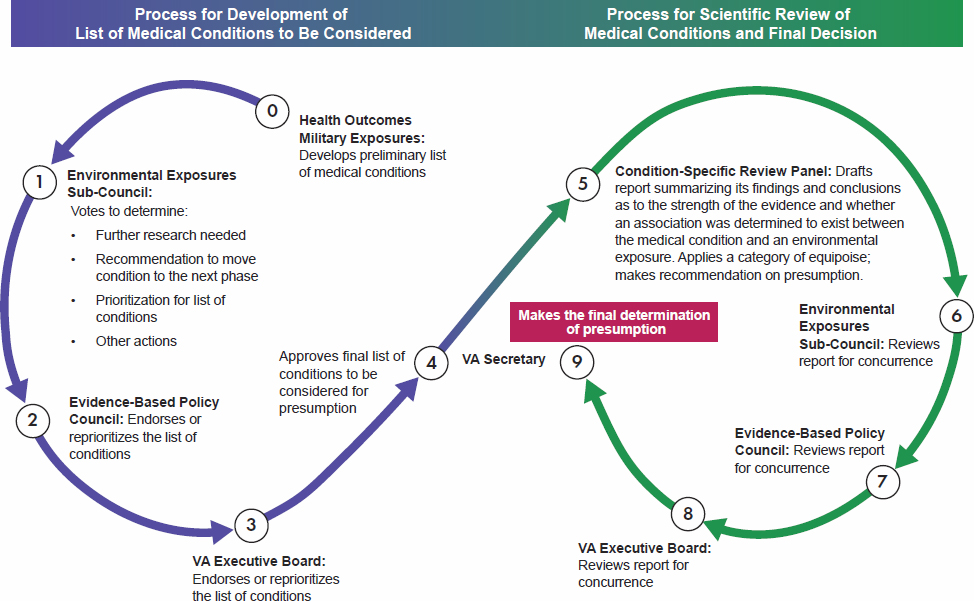
NOTES: The VA decision-making process consists of nine steps that are divided into two phases. In the first phase, shown in blue, a list of conditions to be considered for evaluation for presumption status is developed and prioritized. In the second phase, shown in green, a condition-specific scientific review is conducted and a recommendation for presumption is made.
synthesis. The review and approval process for the list of conditions involves four VA entities: the Environmental Exposures Sub-Council (step 1), the Evidence-Based Policy Council (step 2), the VA Executive Board (step 3), and the VA Secretary (step 4).
Once the VA Secretary approves the final list of conditions to be evaluated, the second phase—the scientific review of a condition—begins, starting with the condition-specific review panel (step 5) that screens, assesses, synthesizes, and integrates the evidence and issues a report on the likelihood of a positive association between an environmental exposure and specific condition with a corresponding presumption recommendation. This report is reviewed by the same councils and boards (steps 6–8) from the first phase, and they either endorse or reject the condition-specific review panel’s recommendation. The VA Secretary makes the final determination of whether to approve a recommendation. VA states that the presumption decision process itself starts when the scientific evaluation of evidence is complete and a report with a recommendation is submitted to the governance process.
GOVERNANCE PROCESS FOR GENERATING A LIST OF CONDITIONS TO BE CONSIDERED
Before the presumption decision process can begin, a planning and preparatory phase must be completed wherein specific medical conditions are identified, prioritized, and selected for a final list of medical conditions to be evaluated for a presumption. This pre-review period, led by VA’s HOME office, identifies conditions and potential exposures through internal and external data gathering and monitoring activities in an ongoing and continuous manner. VA may request an external review when many conditions are to be examined, a specific agency has required expertise to conduct an in-depth review of a condition, or Congress has made a request.
Exposure Presumption Considerations
The presumption decision process requires consideration of an exposure to a hazard or multiple hazards that veterans may have experienced while serving in the military. Many such hazards exist, including those that may be found in air, water, or soil. Individuals are often exposed to many different environmental agents or mixtures of agents (for example, complex air pollution mixtures, occupational exposures, heat waves, water pollution), which may occur simultaneously or sequentially and have synergistic or antagonistic effects, adding to the difficulty of isolating and disentangling the effects of a single exposure in the causal pathway of a health outcome. The health effects of many environmental hazards are
unknown, and many hazards may be associated with similar health effects (e.g., many airborne hazards may induce respiratory effects). As is often the case when reliable and accurate exposure information is not available for military populations—let alone individuals—exposure must be presumed based on location and dates of service, such as combat deployments during the Vietnam War, the 1990–1991 Gulf War, or post-9/11 operations. Classified deployments introduce additional difficulties with measuring or estimating exposures. Furthermore, there may be long latencies between an exposure and a health effect, making it difficult to attribute the effect to a specific exposure (NASEM, 2022).
It is not clear from the presumption decision process document how VA is making a determination of exposure presumption, despite its key role in the overall decision process. However, the committee notes that the process used to determine presumption of exposure is outside of the committee’s Statement of Task.
Identification, Prioritization, and Selection of Conditions
The first step of the presumption decision process is to determine a list of medical conditions to consider for evaluation. The following description is the committee’s best understanding of the process, but it notes inconsistencies between the eight-page presumption decision process document and other supplemental documentation that was provided. For example, the Presumption Decision Process Flow figure in the eight-page document, reproduced as Figure 3-2, shows that boxes A (preparatory phase), B (determination to review condition[s]), C (determination of best method to review), and parts of D (steps for topic) are all part of the presumption decision process, whereas in a slide deck provided by VA in response to an information request from the committee, these steps are separate from the presumption process, although they inform it (VA, 2023c). Therefore, based on this information, VA’s ongoing monitoring activities and scientific literature reviews (which may include external reviews) occur before the presumption process formally begins (VA, 2023c). VA states that the presumption process is specifically the process that prepares recommendations to the VA Secretary on presumptions, and the presumption process itself starts when analysis of the findings is complete and a presumption recommendation is submitted to the governance process (VA, 2023c).
Section 3 “Selection of Conditions” of the VA presumption decision process document outlines a process similar to what is used in the fields of evidence-based decision making and systematic review, in which a planning and preparatory phase consists of topic identification, prioritization, and selection. VA intends that phase to be ongoing and cyclical. VA states that this will be at least annual (section 3a), and a preliminary list of medical
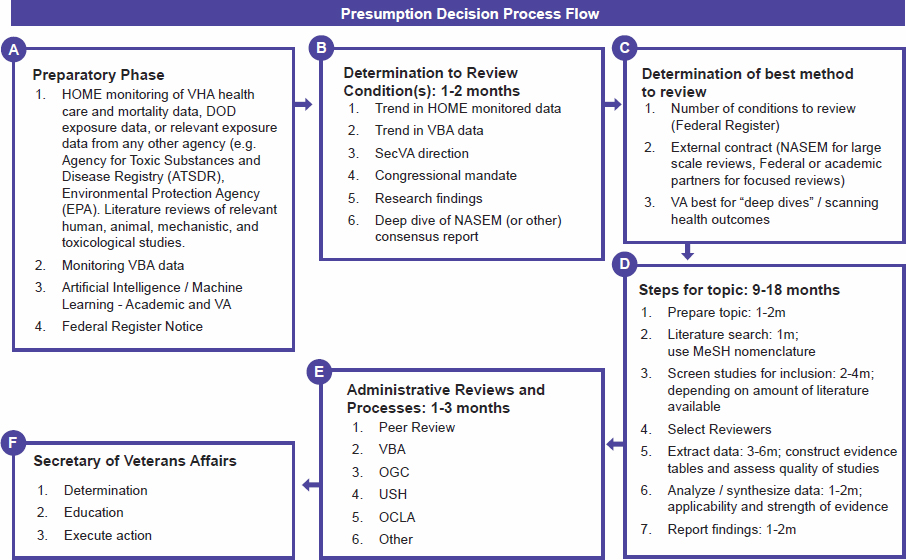
NOTES: The first three boxes and parts of the fourth box show the planning and preparatory phase components of topic identification, prioritization, and selection. DOD = Department of Defense; HOME = Health Outcomes Military Exposures; MeSH = Medical Subject Headings; NASEM = National Academies of Sciences, Engineering, and Medicine; OCLA = Office of Congressional and Legislative Affairs; OGC = VA Office of General Counsel; SecVA = Secretary of VA; USH = Undersecretary for Health (VA); VA = Department of Veterans Affairs; VBA = Veterans Benefits Administration; VHA = Veterans Health Administration.
SOURCE: VA presumption decision process document (2022); boxes have been labeled (A–F) by the committee for clarity.
conditions will be identified through various mechanisms. These mechanisms include the following:
- Monitoring VHA health care data; VBA claims data; Department of Defense (DoD), Environmental Protection Agency (EPA), Agency for Toxic Substances and Disease Registry (ATSDR), and other relevant federal agency exposure data by VA HOME;
- Conducting scientific literature reviews to include human, animal, mechanistic, and toxicologic studies by HOME; and
- Using other types of internal (e.g., VA Secretary direction, findings from intramural research) (VA, 2023b) or external (e.g., congressional direction, veteran and stakeholder responses to notifications in the Federal Register, results of a comprehensive external review, and media coverage and interest) information sources (VA, 2023c; presumption decision process document section 3).
Another mechanism listed for topic identification is shown in Figure 3-2, box A (Preparatory Phase) “Artificial Intelligence/Machine Learning, Academic and VA” (see Chapter 4).
Figure 3-2 provides some elaboration on the steps and time frames. The first three boxes (A–C) and parts of the fourth box (D) appear to be a planning and preparatory phase of topic identification, prioritization, and selection. However, the accompanying text of the presumption decision process document does not clarify if this is intended to represent both the selection of medical conditions and their scientific review. It appears that aspects of the contents of the first three boxes also correspond to section 3 on condition selection, but the text is incomplete and does not refer to this figure. Chapter 4 discusses the scientific review aspects of the planning and preparatory phase.
Topic prioritization and topic selection are described together as opposed to separate steps in Figure 3-2 boxes A and B, and these two concepts appear conflated. After identification of initial conditions and potential exposures, a process that includes explicit criteria to understand which topics are more or less important to move forward (condition prioritization) precedes the selection of conditions for further evaluation and review. Condition selection criteria often include criteria for condition prioritization but may take into account other factors, such as resources and capacity, that can dictate how many topics can move forward within a given time frame. VA states that factors that contribute to condition prioritization and selection will include “the number of veterans potentially affected, severity of the condition, amount of literature available, and VHA and/or VBA trends” (section 3). When or how these data sources are screened or what criteria will be applied to them (e.g., how many veterans
need to be affected or how severe a condition must be to be considered) is not stated.
Although the scientific methods, considerations, and aspects of topic identification, prioritization, and selection are discussed in Chapter 4, topic formulation and protocol development for how that review will occur are the first steps of any exposure–health outcome assessment. These steps provide context and background to the topic, define the specific research question, and determine the methods that will be used to evaluate it. The presumption decision process document is largely devoid of any description of the criteria or processes used to identify, prioritize, and select conditions. Transparency will be enhanced by listing sources of data or information that may be monitored or considered during the planning and preparatory phase and delineating the criteria used to select the final list of conditions to be considered.
The committee finds that leveraging a variety of data and evidence sources to inform the selection of topics is appropriate. Specifying how each data source is to be used and weighted, if appropriate, and the criteria for the selection of conditions as well as making this information publicly available will also enhance transparency.
From the text of the presumption decision process document and Figure 3-2, it is also unclear what the distinction is between the first two steps (boxes A and B). Both generally address topic identification, prioritization, and selection, which is also discussed in section 3 of the document. Condition identification and potential exposures identification appear to entail proactive monitoring of internal VA data (health and claims data) and exposure data from DoD and other agencies that perform environmental exposure monitoring (e.g., ATSDR, EPA) and consideration of external factors (e.g., congressional mandate) to generate a preliminary list of medical conditions to be considered for entry into the presumption decision process cycle.
The use of VHA and VBA data for the conditions of interest is beneficial as part of the evidence to be considered. Although these data offer real-time and important supplemental sources of information on conditions, the committee recognizes that these data are only available for those veterans who are connected to VA in some way and therefore likely represent only a selected group that is not representative of the entire veteran population for which a presumption may be considered. VA estimates that as of 2020, of the more than 19.5 million living U.S. veterans, less than half (9.26 million) were enrolled in VHA, and in fiscal year 2020, almost 6.5 million individual veterans received care in VHA (VA, 2022b). Therefore, overreliance on these data sources will miss nearly half the veteran population.
After identifying a preliminary list of conditions using the internal VA and external data sources and factors, the preliminary list is to be published as a notice in the Federal Register. The notice will explain why the conditions were chosen for evaluation and solicit additional input from the public. VA states that public feedback in response to the Federal Register notification will be used to finalize the list of conditions that will be considered for evaluation using steps 3b, 3c, 4, and 8 of the process (section 3a). Section 3a states the following:
Federal Register Notification: At least once each year, VA will publish in the Federal Register a list of conditions the Department plans to evaluate, explain why the conditions were chosen for evaluation, and solicit input from the public. This approach allows for public participation and enables transparency. VA will use the feedback to finalize the list of conditions for evaluation.
The committee finds that using the Federal Register to seek input from veterans and other stakeholders is appropriate. Whether additional communication and outreach efforts are made to reach veterans and stakeholders to solicit feedback and public comments for these notices is unknown. Additionally, the presumption decision process document does not specify how those public comments may be used to inform steps or how VA may use them in finalizing the list of conditions for evaluation; making such information public would improve transparency.
The committee concludes that making public the process and criteria used for selecting conditions that VA plans to evaluate for presumption status will further the goals of transparency, fairness, and consistency. Improved transparency will also make the process more veteran centric.
Determination of Mechanism to Review
When selecting conditions for review, some determination of the best method (see Chapter 4) or mechanism to review the scientific literature is necessary. The presumption decision process document has two stated mechanisms: VA led or externally conducted (Figure 3-2, box C1). Congressional direction to contract with another agency, such as ATSDR or the National Academies, is the most common reason for external reviews. Other reasons
___________________
1 Figure 3-2 box C, step 2 specifies “external contract”; however, to be inclusive, the committee uses “externally conducted” because reviews by another federal agency would not technically qualify. “Externally contracted” is used for specific cases, such as involving the National Academies.
may be that several conditions are to be reviewed or an agency has the required expertise (VA, 2023c). VA states that VA-led reviews may be more appropriate for a comprehensive examination of individual conditions where the evidence base is smaller and more manageable. No other criteria or decision framework was given for when a VA-led process would be invoked. Additionally, the presumption decision process document did not specify the entity responsible for determining the mechanism of review.
VA has a process for reviewing externally contracted reviews from the National Academies that is specified in VA Directive 0215 (reissued October 8, 2020); this process is separate from that specified in the presumption decision process document and in Figure 3-1 and is unique to National Academies reports. Other contracted and federal agency reports are not subject to Directive 0215. Once a National Academies consensus report has been received by VA (whether congressionally mandated or by VA request), VA forms an ad hoc technical working group under the aegis of the Strategic Working Group that consists of VHA and VBA subject matter experts related to the topic. (Directive 0215 also specifies “other subject matter experts as required to review technical aspects of or assist in the preparation of VA responses to NASEM reports,” but it is unclear whether this would include external individuals.) They review the report and develop any related findings, recommendations, and/or responses that are then submitted to the Strategic Working Group (and the VA NASEM Task Force) for review, consideration, and approval (see Figure 3-3). VA technical working groups organize and meet as needed and are disbanded when their work is complete (VA, 2020).
The Strategic Working Group is a multidisciplinary permanent body that meets monthly and monitors VA’s review of and responses to National Academies reports (from the technical working groups); approves those reports prior to them being submitted to the VA NASEM Task Force; provides advice and guidance to the technical working groups; and provides updates to the VA NASEM Task Force on the status of issues related to
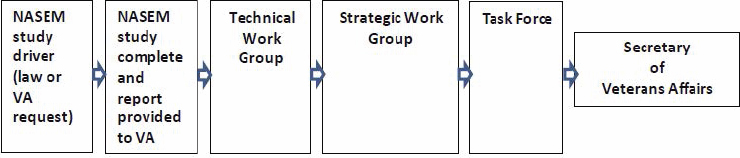
NOTE: NASEM = National Academies of Sciences, Engineering, and Medicine; VA = Department of Veterans Affairs.
SOURCE: VA (2020).
National Academies studies. The Strategic Working Group consists of members and ex-officio contributors assigned by their respective offices across VA and is chaired by the VHA Chief Consultant for HOME. Permanent members include VA National Academies contract leads. Ex-officio or non-permanent members serve as advisors or subject matter experts and include VBA Compensation Service, Office of General Counsel, Office of Regulation and Policy Management, Office of Congressional and Legislative Affairs, Office of Public and Intergovernmental Affairs, and the executive agent for the task force chair (nonvoting member) (VA, 2020).
The VA NASEM Task Force receives, reviews, evaluates, and approves or disapproves VA’s responses to a National Academies report (received from the Strategic Working Group) and presents findings and recommendations developed in response to the report to the VA Secretary. Reports that address health care issues and provide recommendations for VA actions require responses that are managed by the VA NASEM Task Force to facilitate coordination and collaboration across VA and to ensure that congressionally mandated requirements are met. This body also provides oversight of implementation of recommendations adopted by the VA Secretary and establishes the policies and processes for the VA NASEM Task Force, Strategic Working Group, and technical working groups. The VA NASEM Task Force meets quarterly. It is chaired by the Assistant Secretary for Enterprise Integration, and permanent members include the Under Secretary for Health, Under Secretary for Benefits, General Counsel, Chairman of the Board of Veterans’ Appeals, Director of the Office of Regulation Policy and Management, and the executive agent for the task force chair (who is a nonvoting member). As chair, the Assistant Secretary for Enterprise Integration appoints an executive agent for the VA NASEM Task Force, who, among other duties, implements policies and processes established by the VA NASEM Task Force and tracks, monitors, and ensures the progress of VA’s activities and contracts with the National Academies across VA (VA, 2020).
The VA Secretary reviews the VA NASEM Task Force findings and recommendations developed in response to National Academies reports and makes the final decision to approve or disapprove them. The VA Secretary then notifies Congress and the Office of Management and Budget of recommendations or decisions, as appropriate (VA, 2020).
Although the presumption decision process document does not indicate how an externally conducted review and report would “re-enter” the presumption process (e.g., Figure 3-2 after box C), VA subsequently stated that “there would not be a re-entering of the process. The request would be the entry point” (VA, 2023c). When an externally conducted review is requested and becomes available, it becomes part of the evidence base used by VA in the planning and preparatory phase of topic identification, prioritization, and selection for both generating the list of conditions to be
evaluated and the condition-specific review for recommendation of presumption (VA, 2023c).
Approval of the Final List of Conditions to Be Evaluated
Once a preliminary list of medical conditions to be considered for evaluation of presumptive status has been compiled, which includes reviews of the scientific literature, analysis of VHA health data and VBA claims data for each condition, and publication of notification in the Federal Register and consideration of public comments, it goes through review and approval by a series of VA councils and boards until it reaches the VA Secretary, corresponding to steps 1–4 of Figure 3-1. This section describes the composition of and role that each council and board has in approval of the final list of conditions.
Environmental Exposures Sub-Council
After the list of conditions is generated in the planning and preparatory phase, it is submitted to VA’s Environmental Exposures Sub-Council (see Figure 3-1, step 1).2 The Environmental Exposures Sub-Council is only mentioned in the presumption decision process document as the first governance step of the draft VA presumption decision process (sections 3b and 8); VA provided the details of its composition and roles in response to the committee’s request for additional information.
The Environmental Exposures Sub-Council consists of six voting members representing HOME, VBA, Board of Veterans Appeals Judge, Office of General Counsel, Office of Enterprise Integration, and the Office of Regulation Policy and Management Liaison to the Office of Information and Regulatory Affairs. Additional invited (nonvoting) participants of the Environmental Exposures Sub-Council are subject matter experts that include scientists, epidemiologists, public health and occupational health experts, clinicians, and VBA claims experts (VA, 2023b). Presentations are made by the subject matter experts and a vote is taken to determine one of three actions:
- Further research is needed,
- Recommendation to move the condition to the Evidence-Based Policy Council for Secretary consideration of recommendation, or
- Other action (not specified) (VA, 2023c).
___________________
2 In some documentation, the Environmental Exposures Sub-Council is referred to as the Military Environmental Exposures Sub-Council. These are the same entity, and VA HOME added “Military” to the name to denote that “military” or “toxic” exposures are the common terms used for exposures in VA (VA, 2023c).
This group reviews the list, proposes a prioritization scheme for the order in which the conditions are recommended to be reviewed, and prepares the rationale for including each condition for the Evidence-Based Policy Council (section 3b). The criteria or standards used to guide decisions regarding which of the three actions are taken were not provided to the committee.
The committee finds that to be consistent with standards in the field of evidence-based decision making, topics need first to be prioritized before they are selected for systematic review. Related to prioritization, the committee finds that the Environmental Exposures Sub-Council should not be proposing a prioritization scheme; rather, it should propose a prioritized list of conditions based on prespecified criteria.
Evidence-Based Policy Council
The Evidence-Based Policy Council was established in 2021 as part of VA’s response to PL 115-435, the Evidence-Based Policymaking Act of 2018 (VA, 2021), which requires federal executive agencies to measure results of their major programs and specifically “requires departments and agencies to acquire the expertise to provide a coherent approach to measure performance and apply modern methods of program evaluation, to ensure their budgets and policies are supported by and facilitate the generation of evidence.” The VA Secretary, through the VA Office of Enterprise Integration, established the Evidence-Based Policy Council “to guide and coordinate VA’s response to legislative requirements from the Evidence Act and related Executive Branch policies” (p. 2). This council3 is one of two councils that support the VA Operations Board (described later) (VA, 2022a). The Evidence-Based Policy Council is a standing group of representatives of VA leadership and chaired by a designee of the Office of the Secretary that serves as VA’s lead for enterprise-wide coordination, collaborative analysis, and policy implementation. It identifies or reviews major strategic and operational issues facing VA and develops recommendations for consideration by the VA Executive Board and VA Operations Board. It also develops strategies and recommendations for issues specifically identified by VA leadership and ensures that “information for policy decisions is complete and are developed as intended to improve the lives of veterans, caregivers, and their families” (VA, 2023b). Review of presumption recommendations is only one of its functions. It meets weekly or as frequently as determined necessary by the chair (VA, 2023b).
___________________
3 VA documentation sometimes also references the Evidence-based Policy Subcommittee; this is the same entity as the Evidence-Based Policy Council (VA, 2023c).
The Evidence-Based Policy Council serves as a science review board (as recommended by the 2008 National Academies report framework; however, it does not operate independently from VA) and endorses or reprioritizes the conditions from the Environmental Exposures Sub-Council (section 3c). The Evidence-Based Policy Council has operating procedures and criteria for its decisions (VA Notice 22-15); however, these were not publicly available or shared with the committee. It is composed of permanent members and advisory members, who are subject matter experts and attend as needed (see Box 3-1) (VA, 2023b).
VA Executive Board and VA Secretary
The approved list of conditions recommended for evaluation for presumptive service connection is then sent to the VA Executive Board4 (section 3c), which is one of two principal department-level boards (the other is the VA Operations Board) that serve as the principal advisory bodies to the Secretary and Deputy Secretary, respectively. Although the exact role of the VA Executive Board in this process was not provided, the committee presumes that it offers review and concurrence or comment on the Evidence-Based Policy Council–approved list of conditions recommended for evaluation to support the VA Secretary’s role in final decision making during this phase. Elaboration of the VA Executive Board’s role in this process and the criteria it uses to perform its functions will improve overall transparency. The VA Secretary will approve the final list of conditions to be considered for the current cycle and their prioritization (section 3c).
GOVERNANCE PROCESS OF EVALUATION AND REVIEW OF EACH CONDITION BEING CONSIDERED FOR PRESUMPTIVE SERVICE CONNECTION
Once the list of conditions to be considered for evaluation of presumptive status is approved by the VA Secretary, the second phase of decision making begins—scientific review of conditions. This section describes the governance process as it corresponds to the right side of Figure 3-1 (steps 5–9). It begins with formation of a condition-specific review panel and ends with a final determination to accept or reject a recommendation for presumption by the VA Secretary.
___________________
4 Although some policy decisions will go through the VA Operations Board, which is chaired by the deputy secretary, before the VA Executive Board, it was not initially planned as part of the presumption decision process because most of the issues are addressed by the Evidence-Based Policy Council (VA, 2023c).
Condition-Specific Review Panel
The VA Secretary–approved list of conditions to be evaluated for presumption status is returned to the Environmental Exposures Sub-Council co-chairs (see Figure 3-1, arrows from step 4 [VA Secretary] to step 6 [Environmental Exposures Sub-Council]). For each condition (or several related conditions) to be considered, a condition-specific review panel is created from appointments by Environmental Exposures Sub-Council co-chairs. Its composition and size are based on the amount of scientific evidence and data available for review (section 4). It is not clear from the presumption decision process document or additional information provided by VA who is responsible for making the decision of how to review a selected condition (i.e., the sub-council co-chairs, HOME, or another VA office). Moreover, the explanation of this step does not provide adequate detail, and no criteria or additional details were provided in response to committee requests. For example, how will “amount of scientific evidence” be determined? What are the criteria for assessing each type of evidence (i.e., criteria for assessing VA claims data should be different than the criteria for assessing the quality of epidemiologic or toxicologic peer-reviewed studies)?
The committee presumes that the amount of scientific evidence on a selected condition is based on the problem formulation (using information collected from monitoring, VA-led literature searches, and any results of externally conducted reviews) that occurs during the topic identification, prioritization, and selection process. The committee also understands that the condition-specific review panel is the same entity as the Working Group specified in Sections 202 §1172 and §1173 of the PACT Act directing certain components or processes of the presumption decision process.5 Section 202 §1173 specifies that the VA Secretary will establish a process to conduct a formal evaluation for each recommendation made by the Working Group under §1172. Although not specified in VA’s pre-decisional presumption decision process document, the PACT Act Section 202 §1173 (b) Evidence, Data, and Factors directs that several components will be included in each formal evaluation:
- Scientific evidence, based on the review of available scientific literature, including human, toxicological, animal, and methodological studies, and other factors;
- Claims data, based on the review of claim rate, grant rate, and service connection prevalence, and other factors; and
___________________
5 Personal communication, Dr. Patricia Hastings, Chief Consultant, Health Outcomes Military Exposures, VA. May 22, 2023.
- Other factors the Secretary determines appropriate, such as
- the level of disability and mortality caused by the health effects related to the case of toxic exposure being evaluated,
- the quantity and quality of the information available and reviewed,
- the feasibility of and period for generating relevant information and evidence,
- whether such health effects are combat or deployment-related,
- the ubiquity or rarity of the health effects, and
- any time frame during which a health effect must become manifest.
Furthermore, the legislative language of Section c of §1173 requires that each formal evaluation “(A) reviews scientific evidence in a manner that—(i) conforms to principles of scientific and data integrity; (ii) is free from suppression or distortion of scientific or technological findings, data, information, conclusions, or technical results; (B)(i) evaluates the likelihood that a positive association exists between an illness and a toxic exposure while serving in the active military; and(ii) assesses whether the evidence supports a finding of a positive association between the toxic exposure and the illness.”
Each condition-specific review panel is directed to include at least the following membership parameters:
- Four members from VHA (HOME and/or the Office of Research and Development),
- Two members from VBA,
- One member from a federal agency with subject matter experts with a substantive understanding of the exposure(s),
- One member from the DoD Deployment Health Working Group, and
- VA or other federal agency medical specialty members as needed for the specific condition(s) for review (section 4).
The committee notes that having the right subject matter experts participating is critical to the process and that minimum membership includes methodologic expertise in systematic reviews of environmental health exposures. It is not clear based on the information provided if this methodologic expertise is represented in the core VHA members. The committee also notes that the composition of the condition-specific review panel is all federal employees. This may be intentional to decrease bureaucracy and the associated time delays that would be required in the federal decision-making process by inclusion of expertise provided by non-federal participants. Moreover, membership does not appear to include representation of
the affected community. That is not to suggest that the review panel include a member of the affected community who is not a subject matter expert, but the process should not be conducted without the affected community. The addition of a mechanism to seek the perspective of the affected community during the deliberations of the VA review panel will increase transparency and likely provide for increased veteran engagement and understanding of both the process and outcomes. Although the committee appreciates that the time required for approvals and posting is a consideration, one approach for obtaining the perspective of the affected community might be to post appropriate review materials (see Chapter 4) to the Federal Register for comment.
The committee finds that because each condition-specific review panel is separately convened, without standard criteria, the potential exists for inconsistency among panels regarding depth of review, adequacy of needed panel expertise, application of the generally phrased evidence evaluation standards, or the basis of reasoning for recommendations regarding presumption status (i.e., why the review panel thinks its recommendation is the appropriate one, so that the next level of review can judge whether the recommendation is well considered in view of the available evidence).
The committee finds that although some information about membership requirements for each condition-specific review panel was provided, and PACT Act Section 202 provides further details on evidence, data, and factors to be included in each formal evaluation, some important details are missing.
The committee concludes that the composition of any review panel needs to ensure that there is sufficient subject matter expertise including core methodologic expertise in the systematic review of environmental health, and that there is a mechanism to obtain the perspective of the affected community. Additionally, the panel would have sufficient capacity to review the totality of the evidence in a timely manner.
The condition-specific review panel will assess the available evidence for the association between an exposure or exposures of interest and a specified health outcome. “Findings would normally include a literature review, review of VHA and/or VBA data and other sources of information” (VA, 2023c). The components of the review process and the criteria used for the evaluation are described in sections 5, 6, and 7 of the process. Because these sections focus on the scientific standards applied, they are not discussed here, where the focus is the governance process. The assessment of the scientific review process is discussed in Chapter 4.
When the condition-specific review panel completes its assessment of the evidence, it drafts a report summarizing its findings and conclusions as to the strength of the available evidence and whether a positive association was determined to exist between an environmental exposure and the medical condition. The condition-specific review panel uses its conclusion regarding the presence or absence of a positive association to assign a category regarding the likelihood of a positive association (section 5 “Equipoise”). In other words, the decision of how evidence maps to the likelihood of a positive association is the panel’s responsibility. Its written report and recommendations are submitted to the Environmental Exposures Sub-Council. VA states that the presumption process actually starts at this point, when analysis of the findings from the evidence review is complete and a presumption recommendation is submitted to the governance process (VA, 2023c).
Environmental Exposures Sub-Council
The Environmental Exposures Sub-Council reviews the condition-specific review panel’s report for completeness and rigor and determines if there is a logical and strong scientific rationale for the recommendation(s). During that review, the Environmental Exposures Sub-Council may ask the review panel to address any questions or concerns and modify the report accordingly. Voting members, participating subject matter experts, and ex-officio members also advise the co-chairs on recommendations and priorities (VA, 2023b). The Environmental Exposures Sub-Council then endorses or denies the review panel findings and recommendations (VA, 2023c). The committee requested VA provide explicit criteria that the Environmental Exposures Sub-Council uses to assess the condition-specific review panel report, and they were not provided. Not having those explicit criteria, the committee can only presume that consideration of each panel review by the Environmental Exposures Sub-Council would include a quality assurance check to establish that the panel executed the mandated aspects of evidence review and evaluation with sufficient expertise, depth, and rigor in view of the information available, and in a way that is consistent among review panels.
The need for “concerns and questions” from the Environmental Exposures Sub-Council to be addressed before its concurrence presumably serves to promote consistency among review panels in their methods, reasoning, and thoroughness of reporting. The committee finds that these are important aspects to make explicit and would aid in making the overall process transparent.
Evidence-Based Policy Council
Once the Environmental Exposures Sub-Council concurs with the review panel report, this report is presented to the Evidence-Based Policy Council for additional review and concurrence. The Evidence-Based Policy Council provides VA leadership review of the Environmental Exposures Sub-Council and ensures the report’s recommendations are consistent with the law and VA policy and address any remaining questions (VA, 2023c). No specific criteria or standards used by the Evidence-Based Policy Council were provided to the committee. Clarifying within the presumption decision process document potential additional aspects or factors for consideration in addition to criteria used by the Evidence-Based Policy Council to assess a recommendation by the Environmental Exposures Sub-Council will contribute to making the process transparent, fair, and consistent.
VA Executive Board and VA Secretary
The scientific review and recommendations report is transmitted through the Evidence-Based Policy Council to the VA Executive Board, which meets to advise the VA Secretary. The presumption decision process document specifies that although full consensus regarding a recommendation for presumptive status is the objective, an 80% majority (additional details of who constitutes this majority were not specified) with notation of dissent is the benchmark for presumptive status recommendations that will be sent to the VA Secretary for final decision making (section 7). The same questions that apply to the Evidence-Based Policy Council apply to the VA Executive Board with regard to what additional considerations are brought into the recommendation review and what criteria are used to ensure quality assurance at this stage. The Secretary then determines one of three responses: (1) endorses the action, (2) denies it, or (3) sends it back for further review (section 8) (VA, 2023c). Again, no additional information on criteria or processes used to review the recommendation at the VA Executive Board level were provided to the committee. Although the VA Secretary may endorse the action, some presumptive decisions have been challenged in court, leading to a revision of the statutes governing the administration of presumption decisions and associated compensation (CRS, 2014).
Following the most recent VA-determined presumption decision regarding asthma, rhinitis, and sinusitis (to include rhinosinusitis) in association with presumed exposures to fine particulate matter while serving in the applicable location of Southwest Asia in support of the 1990–1991 Gulf War and the post-9/11 operations, VA published a 24-page explanation of the decision (termed “interim final rule”) in the Federal Register (2021). As part of the notice, public comments were collected for 2 months. Although
the process used to make this presumption decision was not exactly the same as the committee was asked to review in the pre-decisional document, it contained many of the same elements (VA, 2023a). The published summary of the decision noted the sources used and what each contributed, including National Academies reports from 2010 to 2020; VA internal claims data (claims, claims rate, grants, and grant rates) for each of the three conditions (stratified by 1990–1991 Gulf War deployed and nondeployed, post-9/11 deployed and nondeployed, and a subset of veterans who were deployed to Karshi Khanabad, Uzbekistan); EPA assessment for particulate matter; and VA’s internally conducted supplemental literature search (supplemental to the last National Academies report on the topic, published in September 2020). The description of VA’s supplemental literature search and review of asthma, rhinitis, and sinusitis includes the PECOTS (population, exposure, comparator, outcomes, timing, and setting) parameters used, types of studies considered (human and nonhuman), and use of the GRADE framework (grading of recommendations assessment, development and evaluation) with accompanying scoring matrix. The assessment was conducted by VA subject matter experts (Federal Register, 2021). The findings from VA’s supplemental literature search and assessment are summarized by veteran population (1990–1991 Gulf War and post-9/11 service in Southwest Asia, post-9/11 service in Afghanistan, Syria, Djibouti, and Uzbekistan) and also describe the manifestation period for the three chronic respiratory conditions (asthma, rhinitis, and sinusitis). The rest of the notice describes the applicable adjudication regulations. Providing such detailed rationale for each presumption decision, whether that decision is positive or negative, is important and should be continued.
CONCLUSIONS AND RECOMMENDATIONS RELATED TO PRESUMPTION DECISION PROCESS GOVERNANCE
The committee finds that, in general, the governance process used to approve the list of conditions and a condition-specific report and presumption recommendation is reasonable and logical.
However, at each of the several steps in the review and approval of the condition-specific review panel findings by the three VA councils and boards, the criteria each uses to review the evidence and recommendation and other considerations that each one brings are not clear and were not provided. For processes to adhere to scientific best practices, be transparent, and yield consistent and fair results, they need explicit criteria for prioritization and selection of topics; determination of mechanism and method for review; and composition of the review panels. Criteria are also needed for governance councils and boards for the evaluations of the
recommendation for presumption of a medical condition. Having such criteria and making them public will enhance fairness, consistency, and transparency. In pointing out the need for more explicit criteria and details related to operationalizing the entire presumption decision process, flexibility is also important, especially when the amount of available information or scientific evidence will differ with each condition. The criteria guiding the evaluation and decision-making process are not intended to be rigid “rules” but rather a guide to the questions that the reviewing panels, councils, and boards should ask and assess their ability to answer with the available data and analyses. The presumption decision process document does not state whether the reports of the condition-specific review panels or decisions of the Environmental Exposures Sub-Council and Evidence-Based Policy Council are to be made public, and the committee appreciates that not all internal processes can or should be made public.
The committee concludes that the presumption decision process document provides insufficient detail on the governance process for both the review and approval of the list of conditions to be considered for presumption and the review of a condition-specific presumption report. The committee also concludes that there is a lack of detail, specificity, and criteria for how conditions are identified, selected, and prioritized for addition to the list of medical conditions for consideration for presumptive status and for how condition-specific evidence is to be identified, extracted, analyzed, synthesized, and integrated to determine the strength of evidence. Although not all decision-making attributes can be made public, the committee further concludes that a high-level distillation of the process, entities, and criteria for both positive or negative decisions could be made publicly available.
Recommendation 3-1: The committee recommends that VA make explicit the operational criteria or guiding principles for each of the governance steps and provide a description of the expertise and the entities represented at each step. To the extent possible, these criteria or principles and descriptions should be made publicly available either in the presumption decision process document or by reference to other documentation.
The overarching governance for the entire presumption decision process, from generation of a list of conditions to recommendation of presumption, is not clearly described. Given that this process is new and will necessarily evolve over time, VA will need a process and responsible entity or entities to oversee, evaluate, and make changes to it. The pre-decisional presumption decision process document does not indicate whether or when any such updates might occur, but it is to be expected that after it has been
applied to a variety of conditions, adjustments to the governance process and/or the scientific aspects of the evidence review process, including modifying the data sources or the review criteria, might be necessary. Other groups using these types of decision processes (e.g., the U.S. Preventative Services Task Force, the Guide to Community Preventive Services, the Department of Health and Human Services Secretary’s Advisory Committee on Heritable Disorders in Newborns and Children) review and update their processes as scientific standards for methods and processes evolve. Pilot testing any revised or new methodology to be used is an important component of the presumption decision process as is ensuring that it is flexible and feasible. Therefore, the presumption decision process might not be considered “new” as indicated in the purpose section of the document but rather a type of living document that is able to evolve as the science does.
Recommendation 3-2: The committee recommends that once the presumption decision process has been used by several condition-specific review panels, it be reviewed periodically (by an entity internal or external to VA with the appropriate expertise) to assess whether scientifically based, fair, consistent, transparent, timely, and veteran-centric decisions have been made and whether any modifications to improve the process are necessary.
REFERENCES
CRS (Congressional Research Service). 2014. Veterans exposed to Agent Orange: Legislative history, litigation, and current issues. https://sgp.fas.org/crs/misc/R43790.pdf.
Federal Register. 2021. Rule: Department of Veterans Affairs—presumptive service connection for respiratory conditions due to exposure to particulate matter. Federal Register 86(148):42724–42733.
IOM (Institute of Medicine). 2008. Improving the presumptive disability decision-making process for veterans. Washington, DC: The National Academies Press. https://doi.org/10.17226/11908.
NASEM (National Academies of Sciences, Engineering, and Medicine). 2022. Reassessment of the Department of Veterans Affairs airborne hazards and open burn pit registry. Washington, DC: The National Academies Press. https://doi.org/10.17226/26729.
UNESCO (United Nations Educational, Scientific and Cultural Organization) International Bureau of Education. 2023. Concept of Governance. https://www.ibe.unesco.org/en/geqaf/technical-notes/concept-governance (accessed May 8, 2023).
VA (Department of Veterans Affairs). 2020. VHA Directive 0215: Management of Reports Issued by the National Academies of Sciences, Engineering, and Medicine. Washington, DC: Department of Veterans Affairs. https://www.va.gov/vapubs/viewPublication.asp?Pub_ID=1198&FType=2 (accessed May 25, 2023).
VA. 2021. VHA Directive 1062: VHA Optimizing Health Care Value Program. Washington, DC: Department of Veterans Affairs. https://www.va.gov/vhapublications/ViewPublication.asp?pub_ID=9550 (accessed April 24, 2023).
VA. 2022a. VA Notice 22-15: Department of Veterans Affairs Governance Structure. Washington, DC: Department of Veterans Affairs. https://www.va.gov/vapubs//viewPublication.asp?Pub_ID=1396&FType=2 (accessed April 24, 2023).
VA. 2022b. Department of Veterans Affairs Statistics at a Glance. https://www.va.gov/vetdata/docs/Quickfacts/Homepage_slideshow_3_31_22.PDF (accessed May 24, 2022).
VA. 2023a. Charge to the Committee to Review the Department of Veterans Affairs Presumption Decision Process. Presentation by Dr. Patricia Hastings, Chief Consultant, Health Outcomes Military Exposures. March 7. Available from the project public access file at https://www8.nationalacademies.org/pa/managerequest.aspx?key=HMD-BPH-22-10.
VA. 2023b. Response to the Committee to Review the Department of Veterans Affairs Presumption Decision Process information and data request. Provided by Dr. Patricia Hastings, Chief Consultant, Health Outcomes Military Exposures, VA. March 10, 2023. Available from the project public access file at https://www8.nationalacademies.org/pa/managerequest.aspx?key=HMD-BPH-22-10.
VA. 2023c. Response to the Committee to Review the Department of Veterans Affairs Presumption Decision Process information and data request. Provided by Dr. Patricia Hastings, Chief Consultant, Health Outcomes Military Exposures, VA. April 19, 2023. Available from the project public access file at https://www8.nationalacademies.org/pa/managerequest.aspx?key=HMD-BPH-22-10.


