An Assessment of Selected Divisions of the National Institute of Standards and Technology Information Technology Laboratory: Fiscal Year 2024 (2025)
Chapter: 2 Overview of the Information Technology Laboratory
2
Overview of the Information Technology Laboratory
The Information Technology Laboratory (ITL) is one of the National Institute of Standards and Technology’s (NIST’s) six major laboratories.1 ITL describes its purpose as being “to cultivate trust in information technology (IT) and metrology,” with “the broad mission to promote U.S. innovation and industrial competitiveness by advancing measurement science, standards, and technology through research and development in information technology, mathematics, and statistics” (NIST 2020).
ITL is located at the NIST campus in Gaithersburg, Maryland; the National Cybersecurity Center of Excellence (NCCoE) in Rockville, Maryland; and the NIST campus in Boulder, Colorado. Its facilities include NCCoE, an Immersive Visualization Laboratory, a Biometrics Research Laboratory, and a Usability Testing Laboratory.
ITL is organized into six divisions:
- Applied and Computational Mathematics Division
- Applied Cybersecurity Division
- Computer Security Division
- Information Access Division
- Software and Systems Division
- Statistical Engineering Division
The Applied and Computational Mathematics Division develops mathematical and computational techniques and tools with wide applicability. This division’s work includes research in micromagnetic modeling; creating a digital library of mathematical functions; advanced data analysis for diagnostics, biometrology, and COVID-19; and the development of a standard reference mortar for use in building materials.
The Applied Cybersecurity Division establishes cybersecurity standards and guidelines openly, transparently, and collaboratively. It also practically applies NIST’s research, standards, testing, and measurement to cybersecurity. The division’s work includes the Cybersecurity Framework, the NICE Workforce Framework for Cybersecurity, used for cybersecurity education and workforce development, the Privacy Framework, and the NIST Cybersecurity for Internet of Things (IoT) Program.
The Computer Security Division protects federal IT systems with a suite of cybersecurity standards, guidelines, tests, and metrics. Its research is focused on cryptography, automation, identity and access management, the IoT, and public safety networks. The division’s work includes post-quantum cryptography and security testing, validation, and measurement, and it maintains a National Vulnerability Database. It has a Computer Security Resource Center that provides access to the entire body of NIST’s cybersecurity and information security-related projects, publications, news, and events.
The Information Access Division conducts research in the application of artificial intelligence (AI) in human language technologies, biometrics, search, information retrieval, and natural language processing. The division’s work includes related measurement science, novel paradigms to evaluate
___________________
1 The other five laboratories are the Center for Neutron Research, Communications Technology Laboratory, Engineering Laboratory, Material Measurement Laboratory, and Physical Measurement Laboratory.
technologies, and research to ensure that technology is developed and used correctly and efficiently. It includes a Multimodal Information Group, a Retrieval Group, an Image Group, and a Visualization and Usability Group.
The Software and Systems Division accelerates the development and adoption of correct, reliable, and testable software and information exchange standards. It develops rigorous techniques to evaluate software, which increases trust and confidence in software that is deployed across the nation and around the world. The division contributes to developing computationally enabled measurements with trust in computing and handling of high-throughput instruments built in by design. It has projects in software and quality assurance, the Configurable Data Curation System, image and text analytics, smart and connected systems, scalable systems, voting security, test methods using information technology for health and medical device applications, digital forensics, trojans in AI, category theory, cloud computing, digital twins, and timing.
The Statistical Engineering Division works to characterize measurement uncertainty, conduct foundational statistics research, and implement methods and techniques for experimental design, data analysis, statistical modeling, and probabilistic inference in computer software. The division publishes technical and educational materials in print and online, offering training courses and workshops and participating in professional conferences. The division conducts fundamental and applied statistical research on problems in metrology. It collaborates with other ITL divisions, other NIST laboratories, and industrial partners.2
This report focuses on the Applied Cybersecurity Division, the Applied and Computational Mathematics Division, and the Computer Security Division. The chapters assessing these divisions will contain information on budget, staff, and facilities specific to these divisions. Some information about ITL as a whole follows here.
BUDGET
Figure 2-1 shows ITL’s budget from fiscal year (FY) 2015 through FY 2024. The budget has increased from approximately $150 million in FY 2015 to approximately $180 million in FY 2024. ITL’s budget comes from both external and internal funding. The external funding comprises congressional scientific and technical research services appropriations and reimbursable work for other federal agencies. It also included funding from the Public Safety Trust Fund until that fund expired in FY 2022. Internal funding, which is awarded competitively within NIST, comes through the Strategic and Emerging Research Initiatives program, the Innovations in Measurement Sciences program, and an assortment of other internal funding competitions.
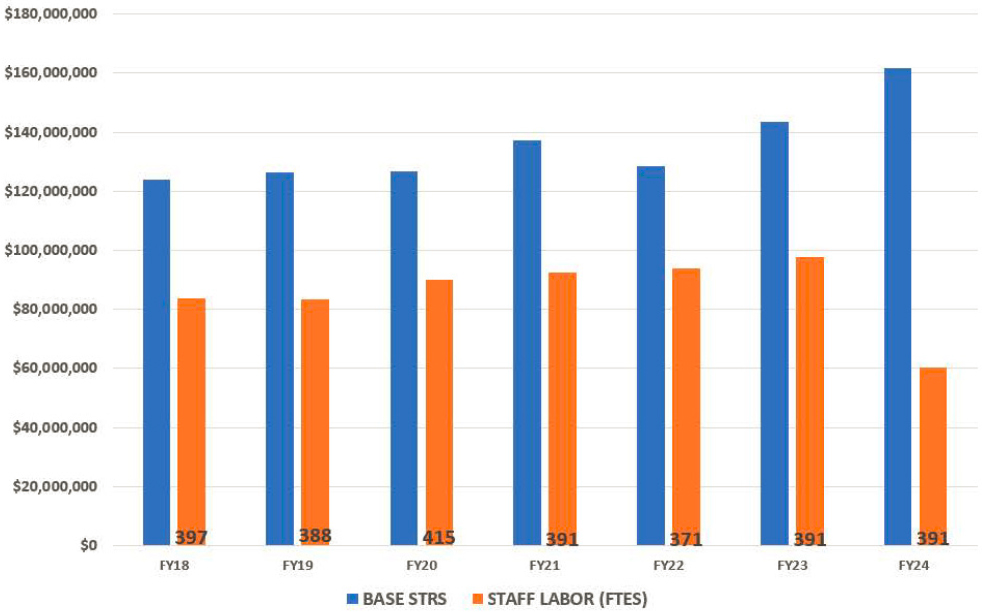
Figure 2-2 shows ITL’s labor costs for full-time equivalents (FTEs) from FY 2018 through FY 2024. A clear trend of rising labor costs is visible. The labor cost for FY 2024 is so low because it shows labor costs only from October 1, 2023, through May 31, 2024.
___________________
2 The National Institute of Standards and Technology document “National Academies of Sciences, Engineering, and Medicine: Information Technology Laboratory Assessment 2024 Read-Ahead Materials” was obtained by the panel from NIST on June 23, 2024, and is available in the public access file for this study (Email: paro@nas.edu).
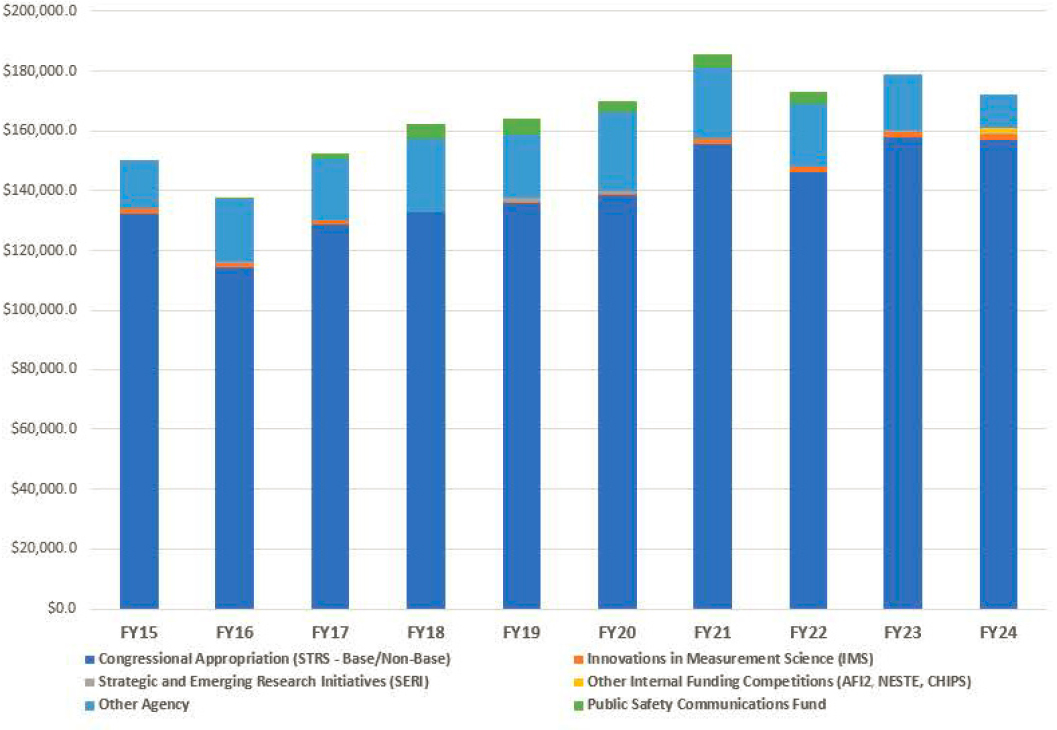
NOTES: The Public Safety Communications Fund was formally known as the Public Safety Trust Fund. AFI2, Accelerating Forensic Innovation for Impact; CHIPS, CHIPS and Science Act of 2022; NESTE, NIST Emerging Technology Standards Engagement Pilot Program; STRS, scientific and technical research services.
SOURCE: Courtesy of NIST Information Technology Laboratory.
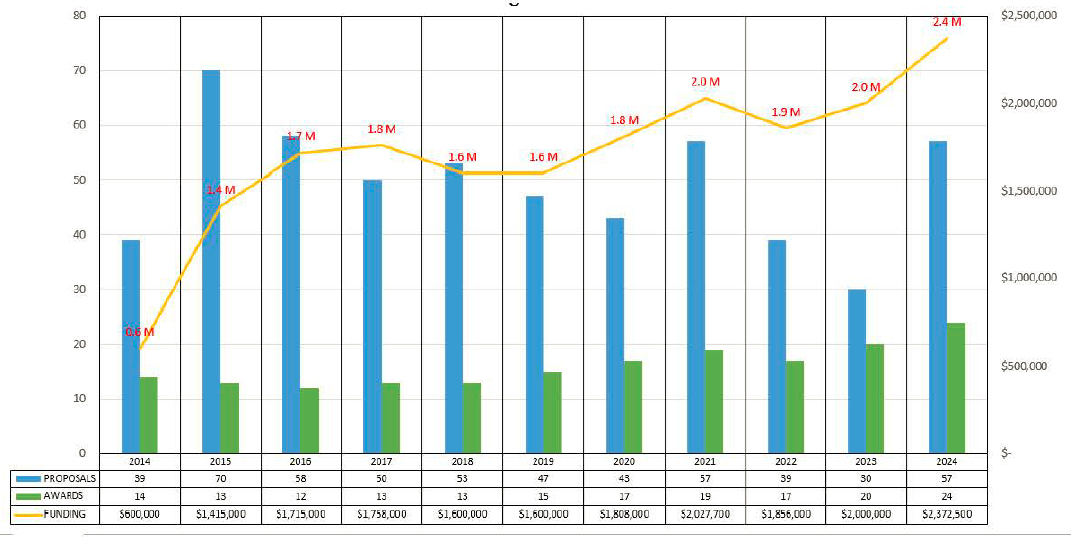
ITL also has an initiative named Building the Future. This initiative was founded in 2014. It is future-looking and intended to foster the exploration of the emerging needs of ITL stakeholders. This initiative does not support work that is only an extension or an incremental improvement. Successful projects under this initiative identify new competencies to support ITL’s mission. Teams can be collaborative, but the lead must be a federal employee. Awards are as follows:
- Seeker Awards: These are small exploratory projects to identify new technologies that ITL may want to work with in the future.
- Early Stage Research Awards: These are small to midscale projects that conduct fundamental research to lay the foundations for ITL’s measurement science work.
- Research Awards: These are larger projects aimed at building ITL’s capacity—in terms of expertise and capabilities—in research areas that have already been identified for future exploration and work.
Figure 2-3 shows the number of proposals, awards, and funding under the Building the Future initiative from its founding in 2014 through the time of the panel meeting in June 2024.
SOURCE: Courtesy of NIST Information Technology Laboratory.
SOURCE: Courtesy of NIST Information Technology Laboratory.
TABLE 2-1 Projected Retirement Eligibility Across the Information Technology Laboratory and the Divisions Assessed in This Report as of March 2024
| ITL Area | Eligibility Over Time (Percent) | ||||
|---|---|---|---|---|---|
| Now | Within 3 Years | Within 5 Years | Within 10 Years | More Than 10 Years | |
| ITL overall | 34 | 9 | 5 | 9 | 43 |
| ACMD | 42.3 | 5.8 | 3.8 | 11.5 | 36.5 |
| CSD | 32 | 15 | 6 | 10 | 37 |
| ACD | 26.1 | 6.5 | 2.2 | 8.7 | 56.5 |
NOTE: ACD, Applied Cybersecurity Division; ACMD, Applied and Computational Mathematics Division; CSD, Computer Security Division; ITL, Information Technology Laboratory.
SOURCE: Data courtesy of NIST Information Technology Laboratory.
STAFF
ITL has 689 staff in total: 393 are federal employees, 159 are contractors, 89 are guest researchers, and 48 fall into an “other” category that includes people such as postdoctoral researchers and students. Of these ITL staff members, 67 work remotely in 22 states and the District of Columbia. ITL’s personnel policies encompass telework and remote work, culture, safety, recruitment and retention, facilities and infrastructure for research computing, and faculty annuitants and foreign guest researchers. Of the job candidates across all areas referred to ITL since May 2021, 48 percent have been minorities, with the proportion of minority staff increasing from 25 percent in 2021 to 28 percent in 2024. Also since May 2021, 50 percent of ITL’s new hires have been women, and the proportion of female staff has increased from 34 percent in 2021 to 38 percent in 2024.
A significant proportion of ITL’s staff is eligible for retirement now and within the next 10 years. The data across ITL and broken out for the divisions assessed in this report are shown in Table 2-1.
PARTNERSHIPS, COLLABORATIONS, AND REACH
ITL has a number of partnerships and collaborations with industry and academia. These include NCCoE partners, communities of interest, cooperative research and development agreements, and working with the AI Safety Institute Consortium, Joint Center for Quantum Information and Computer Science, Washington Metropolitan Quantum Network Research Consortium, and Trustworthy AI in Law and Society. ITL also engages in interagency work with, for example, the Department of Homeland Security, National Security Agency, Intelligence Advanced Research Projects Activity, Federal Bureau of Investigation, National Science Foundation, and Department of State, and others.
Metrics of ITL’s reach from FY 2021 through FY 2023 include
- A growth of about 30,000 social media followers, from approximately 38,000 to approximately 68,000
- 45 blogs with approximately 95,000 views
- About 152 million unique visits to ITL websites
- Hosting more than 160 conferences and events—in-person, hybrid, and remote—with more than 55,000 total registrants
- 206 technical series publications with more than 3.1 million downloads
- 149 journal articles
- 132 conference papers
REFERENCE
NIST (National Institute of Standards and Technology). 2020. “Information Technology Laboratory: ITL Purpose.” https://www.nist.gov/itl/about-itl/itl-purpose.


