Exploring Linkages Between Soil Health and Human Health (2024)
Chapter: 6 Interactions of Soil Chemical Contaminants, Soil Health, and Human Health
6
Interactions of Soil Chemical Contaminants, Soil Health, and Human Health
Chemical contaminants in soil and other ecosystems are a significant concern for current and future security of the food system. They are also a parameter highlighted by the Planetary Boundaries Framework (PBF), which establishes a set of environmental boundaries that define the safe operating limits for humanity to maintain a stable and habitable planet (Rockström et al. 2009; Steffen et al. 2015). These boundaries represent the critical thresholds, including those related to climate change, biodiversity loss, and chemical pollution, beyond which the environment faces irreversible harm. By identifying these limits, the PBF plays a crucial role in guiding sustainable development and informing environmental policies aimed at ensuring the long-term well-being of the planet and future generations (Rockström et al. 2009).
Regarding contaminants, the PBF is concerned about the “amount emitted to, or concentration of persistent organic pollutants, plastics, endocrine disrupters, heavy metals and nuclear waste in the global environment, or the effects on ecosystem and function of Earth system thereof” (Rockström et al. 2009, 473). Initially referred to in the literature as “chemical pollution,” this planetary boundary category has been further expanded to “novel entities” (Steffen et al. 2015), which include newly developed chemicals, engineered materials, and previously undiscovered organisms within the earth system as well as naturally occurring substances such as heavy metals that are released into the environment due to human activities. Persson et al. (2022) argued that humanity has exceeded its planetary boundary concerning contaminants and novel entities. This assessment is attributed to the escalating production and release of contaminants, coupled with the challenges in evaluating and monitoring associated risks. In the context of soil, a significant repository for pollutants, chemical contaminants pose substantial threats to both human health and the environment, as summarized in Figure 6-1.
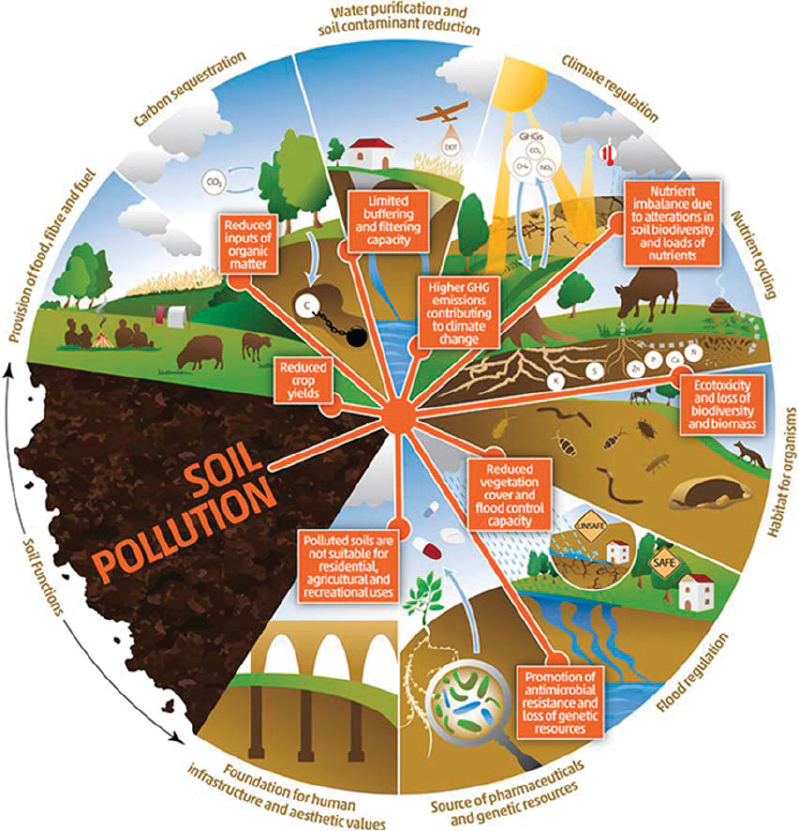
SOURCE: Food and Agriculture Organization of the United Nations. Reproduced with permission.
Each year, a vast and diverse array of chemicals enters the soil. These contaminants are often in complex mixtures, which significantly complicates the assessment of potential exposure and associated health risks, as highlighted by Persson et al. (2022). These inorganic and organic chemicals—varying in chemical composition, concentration, and behaviors—enter the soil through routine agricultural practices, industrial activities, waste disposal, atmospheric deposition, and accidental spills. Among these releases, some are intentional, such as the application of pesticides and fertilizers, while others are unintentional, leading to severe negative consequences, as seen with microplastics and per- and polyfluoroalkyl substances (PFAS).
This chapter delves into the interactions between soil processes and contaminants, exploring their impact on exposure and how soil health influences these processes. The committee recognizes that contaminants affect all soil, not just soil used to grow crops. The committee is also aware that “chemical pollution” or “novel entities,” as defined by the PBF, encompass hundreds of thousands of substances (Steffen et al. 2015). It is not within the committee’s capacity to review the interaction of the soil microbiome with all soil contaminants. Some sources of contamination, such as pesticides, are discussed briefly but are primarily addressed in Chapter 4. In this chapter, after reviewing how humans may be exposed to contaminants in soil and how, in general, soil health can mitigate exposure, the committee provides details about three major classes of contaminants: heavy metals, plastics, and PFAS. The committee selected these three classes as case studies because heavy metals have been a long-standing concern in food production and because plastics and PFAS are emerging soil contaminants with potential repercussions for food production and beyond. The case studies provide overviews of the contaminants’ sources, their fate and transport, their repercussions on human health and soil ecosystems, and strategies for mitigation and remediation. Although these contaminants enter the soil (or may be magnified in the soil) through agricultural production, the committee notes that contact with soil, crop production, and food consumption are not the only routes of exposure for all the contaminants discussed.
HUMAN EXPOSURE TO CONTAMINANTS IN SOIL
Contaminant Fate and Transport in Soil
Once chemicals enter the soil, their movements and potential impacts are determined by a range of physicochemical characteristics, such as solubility, volatility, and sorption potential, as well as their interaction with specific soil properties. These interactions and processes (Figure 6-2) govern whether contaminants will migrate deeper into the soil through percolation, escape into the atmosphere via volatilization, or remain bound to soil particles (Jury and Godhrati 1989; Linn et al. 1993; Schnoor 1996).
Transformation of contaminants—loss or removal of certain substances (e.g., reactants) and the generation or formation of new substances (e.g., products)—can occur via both abiotic and biotic processes (Linn et al. 1993; Scow and Johnson 1996; Al-Mamun 2017). Physical and chemical transformation processes include photolysis and hydrolysis reactions (Figure 6-3). Coupling or polymerization reactions, mediated by certain mineral oxides and fungal extracellular enzymes, can also transform and alter the availability of some organic contaminants (Linn et al. 1993). Biodegradation specifically refers to the transformation of a contaminant by metabolic reactions carried out by the soil organisms, primarily the microbiome. Given that the soil microbiome, with its strong connection to soil health, is a major focus of this report, the committee chose to focus on biodegradation and its role in contaminant removal.

SOURCE: Food and Agriculture Organization of the United Nations. Reproduced with permission. Adapted from Current Opinion in Environmental Science & Health, 1, Hurley and Nizzetto, “Fate and Occurrence of Micro(nano)plastics in Soils: Knowledge Gaps and Possible Risks,” 6-11, 2018, with permission from Elsevier.
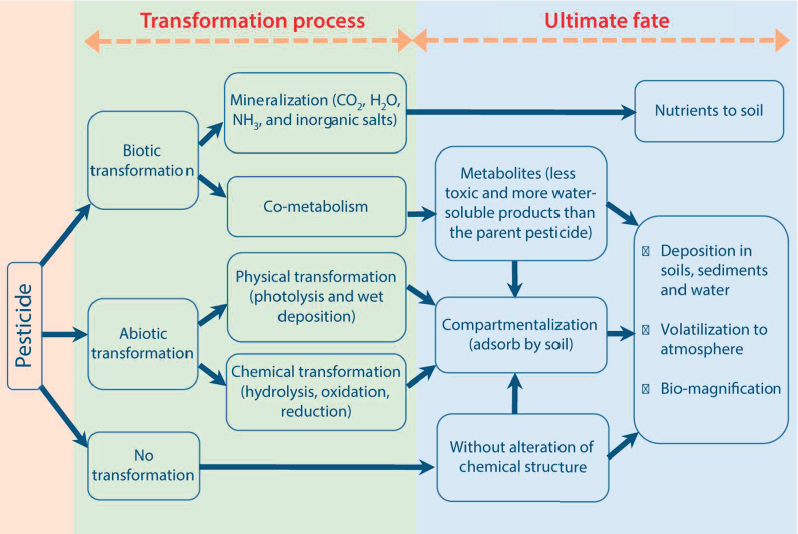
NOTE: In this example, a pesticide stands in as an example of an organic contaminant.
SOURCE: Adaptation used with permission of Spring Nature BV, from “Pesticide Degradations, Residues and Environmental Concern” in Pesticide Residue in Foods: Sources, Management, and Control, Al-Mamun, 4, 2017; permission conveyed through Copyright Clearance Center, Inc.
Biodegradation
Biodegradation is defined as the alteration of the chemical structure of a compound by a biological process (Scow and Johnson 1996; Al-Mamun 2017) and often provides a source of carbon and energy to the organisms responsible. In soil, these primarily microbial processes lead to the destruction, and thus either complete removal or change in chemical composition of the original contaminant. Many organic contaminants can be metabolized by the soil microbiome in a process known as mineralization, in which case the contaminant is converted into harmless byproducts, such as carbon dioxide (CO2) and nutrients, and into microbial biomass (Scow et al. 1995; Scow and Johnson 1996; Figure 6-3). Examples of mineralizable contaminants include many pesticides and petroleum products. In other cases, however, a contaminant may be chemically transformed into other chemical forms, some of which may persist in the environment (Scow et al. 1995). Often, metabolites are less toxic than the parent compound. Sometimes, however, metabolites are more toxic than the parent compounds (e.g., trichloroethylene to vinyl chloride) (Yoshikawa et al. 2017).
Numerous metabolic pathways for contaminants have been identified, some very specific to particular chemicals (Kolvenbach et al. 2014). The University of Minnesota Biocatalysis/Biodegradation Database (Gao et al. 2010) is a comprehensive, publicly accessible resource that provides information on the biodegradation and biotransformation of organic compounds, including many contaminants, by bacteria and fungi (Ellis and Wackett 2012). Among the data compiled are enzymatic pathways, metabolites of degradation, and organisms involved. The database is valuable for bioremediation research, assessment of contaminant degradation potential, and the study of microbial metabolic pathways (Gao et al. 2010).
Human Exposure to Contaminants in Soil
The level of threat that a contaminant poses to human health is thus determined by the complex interplay between the contaminant and the unique soil conditions at a particular location. In general, the enhancement of soil quality (for instance, increasing the level of soil organic matter) can serve as a means to mitigate the adverse effects of soil contamination. The overall health of the soil plays a pivotal role in determining the extent to which contaminants may pose harm to human health.
Exposure assessments (NRC 1991; Swartjes 2015) are frameworks used to identify potential exposure pathways for humans for specific chemicals. An important part is evaluation of how contaminants move and persist and where they end up (e.g., in water, air, or soil) after they enter the environment. From this information, the most likely pathways for human exposure can be identified (Figure 6-4). There are multiple routes by which soil is involved in human exposure (NRC 1991; Swartjes 2015). For instance, individuals near contaminated areas can be exposed directly through dermal contact of the skin with soil or through ingestion of soil, which may occur from incidental ingestion, from consumption of soil particles remaining on foods, or through consumption of contaminants concentrated in foods and animal products. Apart from these direct health effects, contaminants may also be leached through the soil into groundwater and surface water, which can affect drinking water quality and accumulate in seafood. Finally, contaminants on the soil surface may be aerosolized, leading to exposure through inhalation. Whatever the route, estimates are made of contaminant concentrations in exposure media using monitoring data, environmental fate models, or both. These estimates are then used to gauge the potential contaminant intake by individuals, considering factors such as ingestion and inhalation rates (NRC 1991; Swartjes 2015).
Bioavailability of Soil Contaminants
Bioavailability refers to the propensity of a contaminant to be taken up (e.g., absorbed by various biota, including plants, microorganisms, and human receptors. Bioavailability in soil is a multifaceted concept influenced by physical, chemical, and biological factors, as examined by the National Research Council (NRC 2003). These factors encompass a wide range of interactions that include soil properties (e.g., texture
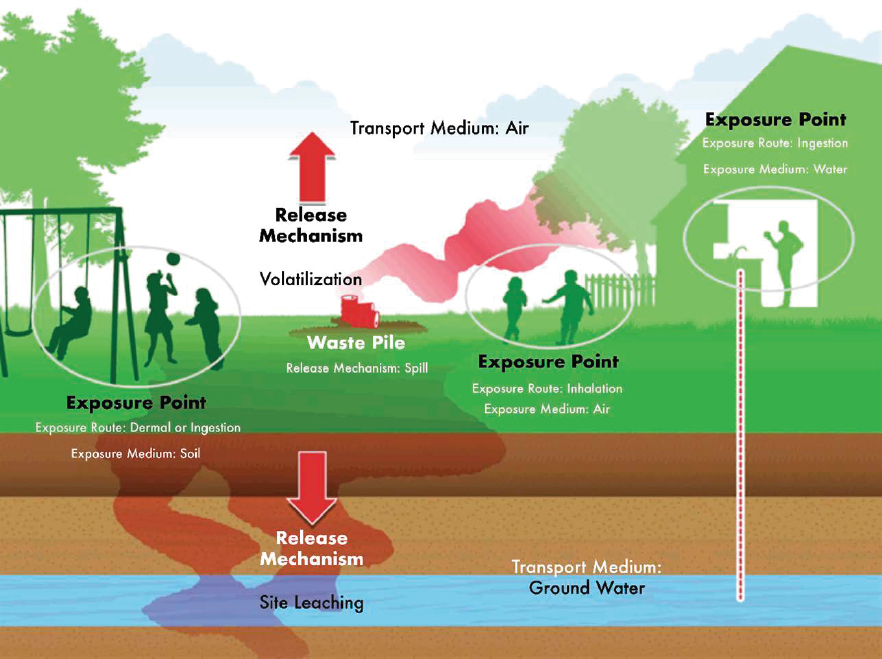
NOTE: Leaking drums are the source of contamination in this figure. Chemicals are released into the air via volatilization, soil via leakage, and water via leaching. The chemicals are transported through air and water to humans and other organisms in the environment.
SOURCE: U.S. Environmental Protection Agency. “Exposure Assessment Tools and Approaches: Indirect Estimation (Scenario Evaluation).” EPA. Accessed April 27, 2024. https://www.epa.gov/expobox/exposure-assessment-tools-approaches-indirect-estimation-scenarioevaluation.”
and pH), contaminant properties (e.g., chemical form and solubility), and biological factors, notably microbial activity. Bioavailability can vary over time due to evolving environmental conditions and processes. Considering bioavailability is paramount in the assessment of risks at contaminated sites and in the development of effective remediation strategies.
Barriers presented by soil and plants can diminish the transmission of contaminants to humans. The “soil–plant barrier” concept (Chaney and Ryan 1994; Basta et al. 2005) aids in discerning the relative significance of food chain versus soil ingestion exposure pathways, particularly for contaminants such as metals. The soil barrier, for instance, can reduce contaminant bioavailability through robust absorption mechanisms. Conversely, for the majority of plants, the plant barrier comes into play when contaminants exhibit phytotoxicity, potentially harming food crops before reaching levels detrimental to human health. Contaminants strongly adsorbed to soil, such as lead, encounter the soil barrier and do not pose a risk via the food chain; instead, ingestion of contaminated soil or dust becomes the primary risk driver. Conversely, highly mobile and weakly adsorbed contaminants such as cadmium bypass the soil–plant barrier, contaminating food crops and elevating the risk associated with the food chain pathway.
Soil properties and components, such as clay and organic matter content, exert substantial influence on contaminant solubility, mobility, and bioavailability. Soil pH, in particular, can modify contaminant bioavailability and mobility by regulating heavy metal dissolution/precipitation, by influencing the ionization of pH-dependent ion exchange sites on organic matter and metal oxide clay minerals, and by regulating strong adsorption of heavy metals and oxyanion metalloids (e.g., arsenate, arsenite) on soil clay minerals. Furthermore, pH-dependent functional groups on soil organic matter affect the formation of stable organometallic complexes. For organic contaminants such as pesticides, bioavailability varies, with nonpolar organic chemicals primarily adsorbed via partitioning to soil organic matter. Polar organic compounds, for example, perfluoroalkyl acids (a type of PFAS), exhibit anionic characteristics within the environmentally relevant pH range. The length of the hydrophobic chain controls the extent to which PFAS contaminants are adsorbed by soil organic matter.
The type of adsorption significantly shapes the environmental fate and long-term exposure of contaminants (Table 6-1). Significant advances have been made to characterize the type of metal contaminant adsorption to soil. Application of synchrotron spectroscopy including X-ray absorption near edge structure and extended X-Ray absorption fine structure for lead and arsenic have been reviewed (Sparks 2013). Limited studies have reported the relationship between metal speciation in soil and their bioavailability or bioaccessibility for lead or arsenic (Scheckel et al. 2009; Noerpel et al. 2020). Over the last two decades, in vitro gastrointestinal (IVG) soil extraction methods have been reported to be highly predictive of lead and arsenic bioavailability (Drexler and Brattin 2007; Basta and Juhasz 2014; Diamond et al. 2016; Whitacre et al. 2017). The IVG extraction methods have been shown to be more predictive of bioavailability than chemical speciation methods via synchrotron spectroscopy (Stevens et al. 2018). Weak adsorption processes, such as electrostatic and hydrophobic partitioning to organic matter, reduce bioavailability and mobility in the short term but not over the long term.
TABLE 6-1 Bioavailability and Strength of Adsorption of Select Contaminants to Soil Adsorbent Phases
| Contaminant | Examples | Soil adsorbent | Strength of adsorptiona | Bioavailability |
|---|---|---|---|---|
| Heavy metal cations | Lead, cadmium, copper | Soil organic matter | Weak or strong | Low to high |
| Reactive iron, aluminum, manganese oxide clays | Strong | Low | ||
| Heavy metal oxyanions | Arsenic, selenium | Reactive iron, aluminum, manganese oxide clays | Strong | Low |
| Organic chemicals (nonpolar) | Nonpolar pesticide | Soil organic matter | Weak | Low to high |
| Organic chemicals (polar) | Perfluoroalkyl acids | Clays Soil organic matter | Weak Weak to moderate | High Moderate to high |
| Polar pesticides Glyphosate Paraquat | Weak Strong | High Low |
a Weak adsorption is nonspecific adsorption. Strong adsorption is specific adsorption or chemisorption.
In contrast, strong and irreversible sorption is desirable for persistent contaminants like heavy metals and PFAS, effectively reducing long-term human exposure.
In addition to adsorption reactions, metal contaminants can be sequestered as minerals or in soil minerals. Formation of double layer hydroxides (LDH) have been shown to sequester metals including cobalt, nickel, and zinc. Sequestration of these metals in LDH has been reviewed (Siebecker et al. 2018). This sequestration mechanism has not been reported for the metals of concern (lead, arsenic, and cadmium) in this chapter.
Role of Soil Health in Remediation and Mitigation of Contaminants
Remediation strategies encompass a wide range of methods crucial for managing contaminated soil environments. These approaches play a pivotal role in reducing the concentrations and accessibility of harmful contaminants, thus mitigating potential harm to human and ecosystem health. Remediation, as a comprehensive term, refers to processes directed at lessening the presence, bioavailability, mobility, and potential human exposure to contaminants. It includes a spectrum of approaches, from complete removal to reducing contaminant bioavailability and mobility. Strategies primarily focus on reducing the bioavailability of contaminants in soil, making them less accessible to organisms, especially humans who may be exposed. These approaches often involve
altering the chemical and physical properties of the soil to decrease contaminant mobility and uptake.
Bioremediation is defined as “the intentional use of biodegradation processes to eliminate environmental pollutants from sites where they have been intentionally or inadvertently released” (Madsen 1997). In most cases, the treatment process harnesses the metabolic activities of indigenous microbial populations to break down contaminants into less harmful forms (Seagren 2024). Biostimulation involves adding limiting nutrients to support indigenous microbial communities in metabolizing contaminants, while bioaugmentation introduces microbial strains with the potential to degrade specific contaminants (Scow and Hicks 2005).
Chemical remediation methods, such as adsorption and precipitation, aim to reduce bioavailability by binding contaminants to soil particles or transforming them into less mobile forms; these practices are commonly used for metals and inorganic contaminants (Scheckel et al. 2009). For metals (and some organic pollutants), immobilization is the only option since complete removal is not possible. This strategy involves transforming contaminants into forms (e.g., changing oxidation state, solubility) that form strong, irreversible chemical bonds that remain stable in the environment. Contaminant aging is a natural process where contaminants become more strongly sorbed to soil particles over time, making them less bioavailable, involving both fast, reversible sorption reactions and slow, irreversible sorption reactions.
Incorporating organic matter into the soil, such as plant residues, animal manures, and biochar, improves soil physical, chemical, and biological properties (Attanayake et al. 2015). Organic inputs stimulate microbial activity, supporting the biodegradation of organic contaminants and enhancing soil health (Kästner and Miltner 2016). Soil organic matter, influenced by organic amendments, can adsorb metals and organic chemical contaminants, reducing their bioavailability. Additionally, soil pH adjustment resulting from organic matter additions can decrease the bioavailability of metal contaminants (Brown et al. 2004). The use of biochar can be particularly valuable for immobilizing metals and organic pollutants, contributing to the overall effectiveness of contaminant mitigation strategies (Zhang et al. 2013).
In summary, practices that improve soil health not only enhance the overall health of the soil but also play a crucial role in facilitating remediation and mitigation efforts. Improved soil health can effectively reduce the bioavailability of contaminants, ultimately protecting human and ecosystem health. In the “Contaminant Case Studies” section below, greater detail regarding the potential for remediation in soil is provided for various contaminant classes.
CONTAMINANT CASE STUDIES
In this section, the source, fate and transport, exposure pathway, and impacts of major classes of soil contaminants on soil ecosystems and human health are summarized. Although not exhaustive, these examples represent some of the most pressing soil contamination issues that pose a risk to human health. While contaminant sources and exposure routes are not exclusive to agriculture production, both the sources and
solutions have, in many cases, a direct connection to agricultural management practices and soil health.
Heavy Metals and Metalloids
Many heavy metals and metalloids can be toxic to humans and the environment, depending on exposure routes, concentrations, and bioavailability. Lead and arsenic are ranked as the top two substances found at national priorities sites determined to pose the most significant potential threat to human health due to their known or suspected toxicity and potential for human exposure.1 Lead is the most common heavy metal soil contaminant worldwide (Hettiarachchi et al. 2023). The environmental chemistry of lead (a cation) and arsenic (usually an oxyanion) are used here to demonstrate behavior and health impacts of these toxic trace elements. Cadmium is included as an example because it is a highly mobile toxic metal that concentrates in food crops.
Sources of Lead in the Soil Environment
Lead occurs naturally in soils, but most soil lead contamination is a consequence of anthropogenic activities. Mining, smelting, refining activities, and coal combustion have resulted in widespread contamination of soil (Rieuwerts et al. 1998; Tchounwou et al. 2012; ATSDR 2020). Leaded gasoline and paint are also major sources of soil contamination (ATSDR 2020). Ash deposits from solid waste incineration prior to the U.S. Solid Waste Disposal Act of 1965 have been found to be a source of lead contamination in soil as well (Bihari et al. 2023).
In agriculture, lead-containing inorganic pesticides such as lead arsenate (PbHAsO4) were extensively used because of its immediate effectiveness, low cost, and easy handling (Hettiarachchi et al. 2023). Lead arsenate was widely used in U.S. agriculture until the 1950s; its heavy use in orchards over many years caused the buildup of lead as well as arsenic in the soil environment (Schooley et al. 2008). Inorganic fertilizers, manure, compost, and biosolids are alternative sources of accumulation of lead, either in soil or plants (Alengebawy et al. 2021).
Sources of Arsenic in the Soil Environment
Similar to lead, arsenic is found naturally in soil, but most contamination of soil with arsenic is primarily related to anthropogenic sources. These sources include nonferrous metal mining and smelting, wood and coal combustion, wood preservation, pesticide application, and waste incineration (ATSDR 2007). Irrigation water containing high concentrations of arsenic can also be a significant source of soil contamination in India, Bangladesh, and east Asian countries (e.g., Vietnam, China) (Mitra et al. 2017).
___________________
1 The 2022 Substance Priority List of the U.S. Department of Health and Human Services’ Agency for Toxic Substances and Disease Registry. Accessed January 22, 2024. https://www.atsdr.cdc.gov/spl/index.html#2022spl.
Arsenic contamination of rice, especially brown rice, from arsenic-tainted irrigation water has been reported in the U.S. Southeast (Meharg et al. 2009) and in California (Carrijo et al. 2022). Arsenic contamination in the southeastern soils is likely from the historical use of arsenical pesticides for cotton production before these pesticides were banned in the 1980s and 1990s; conversion of land from cotton production to rice production has resulted in elevated levels of arsenic in rice in the Mississippi Delta and Texas (Zavala and Duxbury 2008).
Sources of Cadmium in the Soil Environment
Cadmium is one of the most toxic heavy metals and negatively affects essential biological processes of humans, plants, and animals (Kabata-Pendias 2010). Major sources of cadmium pollution in soil include zinc mining, processing, and smelting and the use of phosphate fertilizer produced from rock phosphate ore with elevated cadmium (Kabata-Pendias 2010). Smelter emissions from zinc and cadmium production facilities have contaminated downwind environments (Chaney and Ryan 1994; Zhou et al. 2022). Land application of phosphate fertilizer can result in significant soil pollution with cadmium that impairs crop quality (Kabata-Pendias 2010). However, long-term application of phosphate fertilizer with low cadmium content does not increase soil cadmium or impair wheat grain quality (Basta et al. 1998). Cadmium can also reach soil through land-applied biosolids (ATSDR 2012).
Impact on Soil Ecosystems
Heavy metals change soil microorganism community structures and diversity (Konopka et al. 1999; Khan et al. 2010; Rodríguez Martín et al. 2014; Gutiérrez et al. 2016). Khan et al. (2010) determined that the high levels of cadmium and lead in soils caused decreases in microbial biomass carbon, inhibited acid phosphatase and urease enzymatic activity, and changed community structure based on denaturing gradient gel electrophoresis banding patterns. They also found that bacteria are more sensitive to heavy metal concentrations than actinomycetes and fungi. Konopka et al. (1999) found lead soil content to correlate with microbial biomass and determined that some bacteria populations contained lead-resistance genes. They noted that heavy metal–contaminated soils also have reduced plant biomass that could affect microbial community composition and activity. Others have noted that the diversity and function of soil invertebrates, such as earthworms and nematodes, can be altered by cadmium and lead (Žaltauskaitė and Sodienė 2010; Rodríguez Martín et al. 2014; Gutiérrez et al. 2016; Kavehei et al. 2018).
Fate and Transport: Human Exposure Pathways
Fate and transport of heavy metals is complex and varies greatly between metals. Three exposure pathways important to human health are: soil/dust ingestion and
inhalation, ingestion of contaminated food, and ingestion of contaminated drinking water. The first two pathways, which relate to soil, are reviewed here.
Soil and dust ingestion
One of the major exposure pathways for lead, arsenic, and other heavy metals to humans is through the incidental ingestion of soil or dust. Ingestion is of special concern for children due to their increased hand-to-mouth activity and enhanced pharmacokinetics. Many heavy metals, including lead and arsenic, often have low water solubility in the environment. Low solubility reduces the transport of metals from soil to crops and from soil to source waters. The exception is cadmium, which escapes the soil–plant barrier and easily contaminates food crops (Basta et al. 2005). Many of the heavy metals in ingested dust or soil are dissolved in the acidic conditions (e.g., pH 1.5 to 2.5) of the upper gastrointestinal tract.
Soil properties and agricultural management practices can affect bioavailability and exposure to lead and arsenic. Lake et al. (2021) reported key soil properties reduced the bioavailability of arsenic by 17–96.5 percent and of lead by 1.3–38.9 percent associated with soil human ingestion. For both arsenic and lead, bioavailability decreased with increasing content of aluminum oxide and iron oxide. Soil amendments that add aluminum oxide and iron oxide to soil (e.g., via biosolids) will decrease arsenic and lead bioavailability.
Contaminant transport from soil to the food chain
In general, transport of many heavy metals from contaminated soil to plants to humans is small when compared to incidental ingestion (Chaney and Ryan 1994; Attanayake et al. 2015). However, small amounts of heavy metal absorption into crops that are diet staples (e.g., wheat, rice) can result in significant human exposure. For example, root crops such as carrots, radishes, and beets can accumulate soil lead, and surface contamination of crops with soil can affect human exposure (Attanayake et al. 2014, 2021). Human exposure from ingestion of soil adhered to vegetables has been found to be greater than amounts in those vegetables. Best management practices to reduce heavy metal exposure include washing crops thoroughly before consumption to get rid of adhering soil particles.
Diet is the largest source of exposure to arsenic, largely from grains, produce, seafood, and drinking water. Rice, in particular, is an important source of dietary arsenic because it is cultivated under flooded conditions leading to an anoxic soil environment that liberates arsenic from its minerally bound form and allows it to be taken up and concentrated in the grain. Notably, a recent study found that arsenic availability, uptake, and allocation in rice increases in warmer temperatures; therefore, global warming may increase the risk of arsenic exposure through consumption of rice in production systems that were previously considered low risk (Farhat et al. 2021).
For non-smokers, diet is the largest exposure route for cadmium (ATSDR 2012). However, the concentration of cadmium in the soil is not predictive of the concentration of cadmium in food grown in the soil; soil properties, the type of crop and its genetics, crop rotation, and fertilizer and irrigation management practices all affect the ultimate concentration of cadmium in food (Schaefer et al. 2020).
Impacts on Human Health
Lead exposure primarily occurs through incidental ingestion of contaminated soil and dust, with children being particularly vulnerable. Unlike respiratory and dermal pathways, incidental ingestion involves unintentional swallowing due to hand-to-mouth contact. Studies have consistently highlighted the significance of this pathway, with exposure typically occurring through hand-to-mouth transfer of contaminated soil or dust (Mielke and Reagan 1998; Glorennec et al. 2010; Oulhote et al. 2011; Zahran et al. 2013; Henry et al. 2015). Once lead is absorbed into the body and enters the bloodstream, it can rapidly distribute to the kidneys and liver or be slowly absorbed by soft tissues. The majority of the body’s lead burden is stored in teeth and bones. Lead is highly toxic and can affect nearly every organ, especially the nervous system. At elevated exposure levels, lead can lead to comas, convulsions, and even fatalities. There are no safe blood lead levels, and any concentration of lead can be associated with decreased IQ levels in children and behavioral challenges. These effects are considered permanent. Additionally, lead exposure can cause symptoms such as dizziness, irritability, fatigue, impaired cognition, anemia, hypertension, kidney damage, and reproductive organ toxicity (Wani et al. 2016; ATSDR 2020). Lead exposure during pregnancy has been linked to maternal health risks, including hypertension and pre-eclampsia. One study found that women living in areas with higher soil lead levels were more likely to suffer an eclampsia event (Zahran et al. 2014). Even low levels of exposure during pregnancy have been found to lead to poor birth outcomes including low birthweight and preterm birth (Bellinger 2005).
Inorganic forms of arsenic like As(III) (i.e., arsenite) and As(V) (i.e., arsenate) are associated with more severe health effects from exposure as compared exposure to organic arsenic. Ingestion of arsenic can cause gastrointestinal symptoms, decreased production of white and red blood cells leading to bruising, impaired nerve function leading to burning sensations in the hands and feet, and skin changes (Mandal and Suzuki 2002; ATSDR 2007). The U.S. Environmental Protection Agency (EPA) and the International Agency for Research on Cancer have also listed arsenic as a human carcinogen because it has been linked to cancer of the liver, skin, bladder, and lung. Fetuses, infants, and children are particularly vulnerable to the potential harmful effects from arsenic exposure, and exposure during times of active brain development has been linked to learning disabilities, behavioral problems, and lowered IQ.
As described above, the impact on human health can vary based on the timing duration, route of exposure, and host variability. Notably, recent research has shown that gut microbiota can increase the bioavailability of soil-bound arsenic thereby enhancing its toxicity (Yin et al. 2017; McDermott et al. 2020; Griggs et al. 2022). While research in humans is limited, studies using in vitro models such as the Simulator of the Human Intestinal Ecosystem have shown that human gut microbiota may increase the bioavailability of arsenic in contaminated soil samples (Laird et al. 2007; Van de Wiele et al. 2010). Despite this individual variability, the U.S. Food and Drug Administration has issued guidance to industry on acceptable levels of arsenic in foods often consumed by infants and children. It recommends that inorganic arsenic levels do not exceed 100
parts per billion (ppb) in infant rice cereal (FDA 2020) and 10 ppb of inorganic arsenic in single-strength (ready-to-drink) apple juices (FDA 2023).
Recent research has also described the impact of heavy metals and metalloids on the gut microbiome, which is important for human health. Studies using animal model systems have shown significant alterations of gut microbiomes to arsenic exposure (K. Lu et al. 2014; Gokulan et al. 2018). One study in mice showed that arsenic exposure not only caused shifts in the composition of the gut microbiota but also led to impairment of the immune response and higher inflammation. Further, these changes were dose-dependent and differed according to the age of the animals (Gokulan et al. 2018). The function of the gut microbiome also is impacted by arsenic exposure, which in one study inhibited the fermentation rate of rumen bacteria by almost one third (Forsberg 1978).
Information about the effect of arsenic on the human microbiome is scarce, but vast shifts in the composition of gut microbial communities have been observed in populations exposed to arsenic (McDermott et al. 2020). For example, in Bangladesh, there was a significantly higher abundance of Proteobacteria as well as multidrug and arsenic resistance microbial genes in children exposed to arsenic than their unexposed counterparts (Dong et al. 2017). In the United States, urinary arsenic was correlated with several taxonomic groups in naturally exposed infants, although none of them were in the Proteobacteria phylum (Hoen et al. 2018). Significant compositional shifts were also observed in a mining community in China with prolonged exposure to heavy metal contamination when compared to a community with little exposure to these pollutants. Paradoxically, metal exposure was also correlated with microbial richness in the human gut (Shao and Zhu 2020).
Evidence supports adverse effects on the kidneys and bone density from chronic dietary cadmium exposure, although in some studies, the populations also lived in areas polluted with cadmium. Studies of the effects of dietary cadmium exposure on human health have found mixed results on cardiovascular disease. Consumption of cadmium at high concentrations is known to cause gastrointestinal distress (ATSDR 2012).
Mitigation and Remediation
Remedial approaches for lead are based on removal or reducing the bioavailability of lead. Bioavailability-based remediation is a cost-effective in situ approach that does not remove the contaminant but does reduce the contaminant’s bioavailability. The use of soil amendments to remediate lead-contaminated soils focuses mainly on changing existing soil lead chemistry in situ. It is done by inducing the formation of sparingly soluble lead solids or enhancing chemisorption. Many soil amendments have been used successfully for bioavailability-based remediation (Henry et al. 2015; Wang et al. 2021; Hettiarachchi et al. 2023). Commonly used soil amendments reported to reduce lead bioavailability are summarized in Table 6-2. Other amendments are in development including formation of plumbojarosite (Sowers et al. 2023) and the use of modified biochars (Yang et al. 2019).
Several of the soil amendments are applied to agricultural fields through additions of phosphorus fertilizer, manures, compost, biochar, and liming materials. These amend-
| Soil amendment | Examples | References | Suggested mode of stabilization |
|---|---|---|---|
| Phosphate materials | Triple super phosphate, bone meal, poultry litter | Scheckel et al. 2013 Martin and Ruby 2004 Kumar et al. 2020 Zeng et al. 2017 Liu et al. 2018 Bolan et al. 2014 Kumpiene et al. 2008 Gong et al. 2018 | Formation of pyromorphites |
| Organic materials | Biosolids, biochar, manure, compost | Laidlaw et al. 2017 Martin and Ruby 2004 Kumar et al. 2020 Liu et al. 2018 Yang et al. 2019 Bolan et al. 2014 Kumpiene et al. 2008 Gong et al. 2018 | Sorption of lead on organic surfaces |
| Clay minerals | Zeolites, vermiculite | Kumar et al. 2020 Liu et al. 2018 Bolan et al. 2014 Li et al. 2017 Gong et al. 2018 | Sorption of lead on clay mineral surfaces or formation into clay minerals |
| Metal oxides | Iron oxides and iron rich wastes, manganese oxides, aluminum oxides | Laidlaw et al. 2017 Martin and Ruby 2004 Kumar et al. 2020 Liu et al. 2018 Bolan et al. 2014 Kumpiene et al. 2008 Gong et al. 2018 | Formation of lead-metal and sorption on to oxide surfaces |
| pH | Lime, fly ash, calcium hydroxide | Martin and Ruby 2004 Kumar et al. 2020 Liu et al. 2018 Bolan et al. 2014 Kumpiene et al. 2008 Gong et al. 2018 | Formation of metal precipitates |
ments decrease lead bioavailability and exposure to human and ecosystem receptors. Many amendments are green and sustainable remediation (GSR) strategies, which are holistic approaches that maximize environmental, social, and economic benefits (Wang et al. 2021).
Phytoextraction is using hyperaccumulator plants that absorb metals (e.g., more than 10,000 mg/kg) from soil followed by harvesting of the hyperaccumulator plants. Phytoremediation of cadmium, zinc, selenium, and arsenic from contamination soil has been reviewed (Chaney et al. 2014). Hyperaccumulator plants for lead do not exist.
Application of chelating ethylenediaminetetraacetic acid solution to lead-contaminated soil planted with Brassica juncea (e.g., Indian mustard) was able to accumulate more than 1 percent of the lead in plant tissue (Blaylock et al. 1997). However, this practice contaminated groundwater (Nowack et al. 2006).
Remediation strategies vary depending on the form of arsenic in the environment. Often, the dominant form of arsenic contamination in aerobic soil is arsenate. The majority of in situ remediation methods are designed to adsorb or precipitate arsenate and reduce its bioavailability and mobility (Gong et al. 2018). In particular, iron oxide clay minerals strongly adsorb arsenate and reduce arsenate bioavailability (Violante et al. 2010). More recently, GSR soil amendments for remediation or arsenic-contaminated soils include biochar (Wang et al. 2021) and biochar modified with iron oxide (Yang et al. 2021). These treatments improve soil health while remediating arsenic.
Mitigating cadmium in the food supply is complicated by the properties of the soil the food is grown in, the type of amendments that may be applied to the crop, and the genetics of the crop. Cadmium can also be introduced to the food supply from utensils, plastics, and cookware that contain cadmium. When it comes to steps to reduce cadmium uptake in the field, better understanding of geogenic sources and specific plant uptake would help mitigate cadmium in food, as would minimizing the application of phosphate fertilizers and irrigation water that contains cadmium (Schaefer et al. 2020). Producers would benefit from research that provides evidence for management strategies tailored to specific soils and specific crops that prevents plant uptake of cadmium (Schaefer et al. 2020).
Microplastics
Microplastics (MPs) are defined as small plastic particles measuring less than 5 mm in size (Masura et al. 2015). MP pollution includes primary MPs (e.g., microfibers, textiles) and secondary MPs, which are defined as degradation products of larger plastic products (Petersen and Hubbart 2021). Approximately 90 percent of synthetic polymers produced are polyethylene (PE), polypropylene (PP), polyvinyl chloride (PVC), polystyrene (PS), or polyethylene terephthalate (PET) (Andrady and Neal 2009). MPs exist in a variety of physical forms that include fibers, foam, film, and particles (Rillig et al. 2019a). Found in diverse ecosystems worldwide, MPs have become a pervasive and global environmental issue (Bolan et al. 2020; Büks and Kaupenjohann 2020) and a major reason the planetary boundary for the category of contaminants (i.e., novel entities) is being exceeded (Persson et al. 2022).
Sources
Microplastics reach soil through direct and indirect pathways, which vary based on location, land use, and management practices (Figure 6-5; Yadav et al. 2022). In agriculture, the primary sources are compost (Bläsing and Amelung 2018), biosolids (Bläsing and Amelung 2018; Crossman et al. 2020), irrigation with untreated wastewater (Bläsing and Amelung 2018; He et al. 2018), and polymer coatings of slow-release
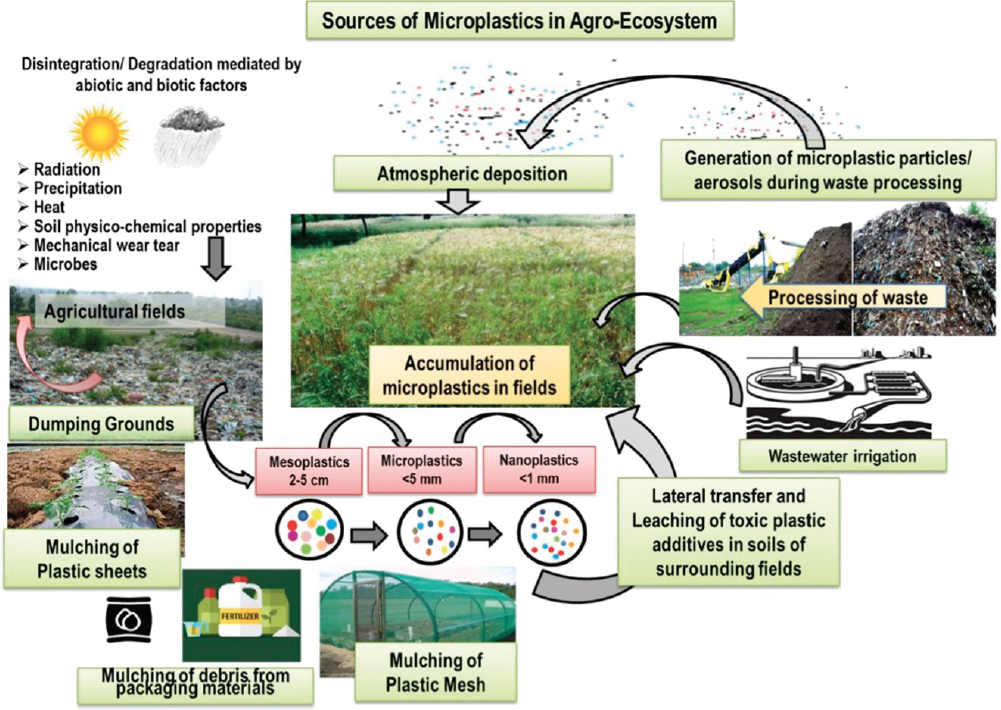
SOURCE: Used with permission of Springer Nature BV, from “Unravelling the Emerging Threats of Microplastics to Agroecosystems”, Yadav et al., Reviewers in Environmental Science and Biotechnology 21 (3), 2018; permission conveyed through Copyright Clearance Center, Inc.
fertilizers (Lian et al. 2021). Worldwide, plastic mulch use in agricultural production is a growing source as well (He et al. 2018).
Once in soil, MPs tend to accumulate near the soil surface due to their low density and small particle size. MPs can also become incorporated into soil aggregates or immobilized on to soil particles as a function of the particular soil’s texture, organic matter content, and moisture levels (Rillig and Lehmann 2020). MPs can be transported within and out of soil through processes such as surface runoff, erosion events, and leaching to groundwater and via biological activities such as earthworm burrowing and root growth.
Fate and Transport
The persistence and degradation of plastics and MPs in soil environments have been reviewed by Restrepo-Flórez et al. (2014), Krueger et al. (2015), and Bläsing and Amelung (2018). Plastics, synthesized to be durable and withstand deterioration, accumulate in soil (Bläsing and Amelung 2018) despite being susceptible to degradation by abiotic and biotic processes (Figure 6-5). Degradation rates are dependent on the type of MPs, location in soil, management practices, climate, and other factors. Degradation pathways via ultraviolet (UV) radiation are known, particularly in aquatic ecosystems, but in soil only materials near the surface are susceptible and degradation rates are generally slow. Over time, UV exposure and weathering processes cause larger MPs to fragment into smaller particles, which then move through soil and become more susceptible to both uptake and degradation (Hooge et al. 2023).
With respect to biodegradation, a microbial process, most plastics degrade very slowly (if at all) in soil, with persistence estimated to range from several years to several thousand years (Chamas et al. 2020). The usually low surface-to-volume ratio of most forms of microplastics physically limits their bioavailability to microorganisms, who need to maintain close proximity to surfaces for reactions (Hooge et al. 2023). Field studies reviewed by Bläsing and Amelung (2018) indicate minimal soil degradation of MPs with far less than 1-percent loss by weight of PE over 2.5 year (Albertsson 1980) and PP after 1 year (Arkatkar et al. 2009) and no detectable PVC degradation after 10–35 years in soil (Otake et al. 1995; Santana et al. 2012; Ali et al. 2014). Thus, although large and visible pieces of plastics may fragment over time, most data confirm that MPs are persistent in soil (Krueger et al. 2015; Bläsing and Amelung 2018). Unfortunately, rates of inputs of MPs greatly exceed their rates of removal in soil (Petersen and Hubbert 2021).
Impact on Soil Ecosystems
Physical–chemical
MPs are redistributed throughout the soil by tillage, by physical mixing from wet-dry or freeze-thaw cycles, or by soil organisms (Hooge et al. 2023). MPs can affect soil structure and porosity, leading to changes in water infiltration, retention, and drainage (Figure 6-6; de Souza et al. 2019; Lehmann et al. 2019) and, in turn, influence nutrient availability, root growth, and plant productivity. Due to

SOURCE: Used with permission of Springer Nature BV, from “Unravelling the Emerging Threats of Microplastics to Agroecosystems”, Yadav et al., Reviewers in Environmental Science and Biotechnology 21 (3), 2018; permission conveyed through Copyright Clearance Center, Inc.
their larger size (around 2 mm), fiber, foam, and film MPs can potentially increase soil aeration and microporosity (Sun et al. 2022). MP microfibers can decrease the water stable macroaggregates via both physical effects and biological effects on soil biota that contribute to soil aggregation (Boots et al. 2019). MPs can also modify soil chemical properties by adsorbing and releasing contaminants, such as heavy metals and organic pollutants, thereby influencing their bioavailability and potential toxicity to soil organisms and plants (Sajjad et al. 2022).
Impacts on soil communities
MPs have been documented to change the diversity, abundance, and functions of soil microbial communities (Rillig et al. 2021b); the extent of impact is often proportional to concentration (Sun et al. 2022). Overall effects on soil biota can be negative, positive, or neutral and occur via both direct (e.g., absorption of MP nanoparticles) and indirect (e.g., altering soil structure) pathways. Though not well understood, the impacts are many (Rillig et al. 2021b), such as shifting the composition of microbial communities and altering microbial processes, including carbon storage, organic matter decomposition, and greenhouse gas emissions (Rillig et al. 2021a,b). MPs are made up primarily of recalcitrant carbon and can slow down overall organic matter decomposition rates (Rillig et al. 2021a). MP fibers in soil resulted in an increase in CO2 fluxes and a decrease in nitrous oxide emissions, especially after urea fertilizer application, which is attributed to increased soil aggregation and air permeability (Rillig et al. 2021a).
The plastisphere—defined as the soil surfaces influenced by plastic—has a different microbial community than bulk soil. For example, more pathogens and antibiotic resistance genes are present as compared to bulk soil (Zhu et al. 2022; Rillig et al. 2024). Furthermore, plastics have been found to change soil bacteria community structure and interfere with microbial lipid metabolisms and the biosynthesis of secondary metabolites (Wu et al. 2022). MPs can detrimentally affect the growth, reproduction, lifespan, and overall survival of soil fauna through various mechanisms, including ingestion, bioaccumulation, oxidative stress, reproductive and neurotoxic effects, metabolic disruptions, and gut microbiota imbalances (Wang et al. 2022). Some soil fauna play a role in the formation and degradation of MPs, modify their movement in soil, and can potentially transfer accumulated MPs up the food chain (Helmberger et al. 2020; Wang et al. 2022).
The indirect effects of MPs on plant growth include alteration of soil structure, bulk density, and water-holding capacity, which in turn influences plant development (Helmberger et al. 2020). These effects are varied and can be both positive and negative, heavily dependent on the characteristics of the MPs (like their chemical additives) and the specific types of soil and plants in the environment (Rillig et al. 2021b). MPs can impair plant seed germination, reduce root elongation, and negatively affect plant biomass and reproductive capacity (Boots et al. 2019; de Souza et al. 2019). MPs may also interfere with plant nutrient uptake and induce oxidative stress, leading to physiological disorders and decreased overall plant performance (Rillig et al. 2019b). These impacts could have a cascading effect on other biophysical processes in the soil and may pose a threat to soil biodiversity and ecosystem functioning (Boots et al. 2019).
Human Exposure Pathways
MPs in soils can pose potential risks to human health through several exposure pathways such as direct soil ingestion, particularly by children during outdoor activities as well as inhalation of MP particles suspended in the air due to wind erosion or dust generation from contaminated soils. Consumption of contaminated foods is also possible; most research to date has focused on MPs in food that is not directly related to soil, such as seafood, fish, salt, honey, and water (Karbalaei et al. 2018). One study that investigated the quantity of MPs in fruits and vegetables found that the median distribution of MPs <10 micron in size ranged by 52,050 to 233,000 particles/g and that apples were the most contaminated samples (Conti et al. 2020). The estimated daily intakes associated with that study are smaller than the estimated daily intakes from plastic bottled mineral water (Zuccarello et al. 2019), therefore the committee concluded that consumption from soil-related agricultural produce may be less of a concern.
Impacts on Human Health
The human health effects of MPs can be categorized into chemical, physical, and biological effects, as illustrated in Figure 6-7. Chemical effects refer to the impact of additives and dyes that may be toxic, teratogenic, or carcinogenic. For example, phthalates are commonly used as plasticizers to provide flexibility to plastics. Because they are additives, they are not chemically bound (covalently bonded) and are more likely to be released and transferred to the environment (Blackburn and Green 2022). Similarly, polybrominated diphenyl ethers are used as flame retardants in many commercial products and, because they are not chemically bound, can leach during production and recycling, bioaccumulate, and cause endocrine disruption and impaired neurological development in animal models. Secondary toxins include persistent organic pollutants that can lead to immunotoxicity and secondary toxicity through interaction with other chemical pollutants. For example, plastic mulching sheets used in agriculture can both absorb pesticides and increase risks for human exposure (Huang et al. 2020, Wang et al. 2020).
Physical effects include inhalation and ingestion of MPs and subsequent immunotoxicity. Small MPs are common in the atmosphere and can be readily inhaled; however, the health effects remain poorly understood. Eyles et al. (2001) found that, once inhaled or ingested, MPs could also translocate to other tissues; fluorescent polystyrene microspheres delivered intranasally to mice were found in the spleen 10 days later. MPs have also been shown to impair gastrointestinal function and alteration of hepatic lipid metabolism in animal models (Y. Jin et al. 2019; L. Lu et al. 2019); this may also be the case for humans.
Finally, there are biological effects that primarily refer to the impact on the microbiome. Evidence thus far, mostly stemming from animal models, has shown that nano and microplastics alter microbial community structures in the gut (both alpha and beta diversity), which may in turn underlie immune impairment, as previously reviewed (Fackelmann and Sommer 2019; L. Lu et al. 2019; Santos et al. 2022).
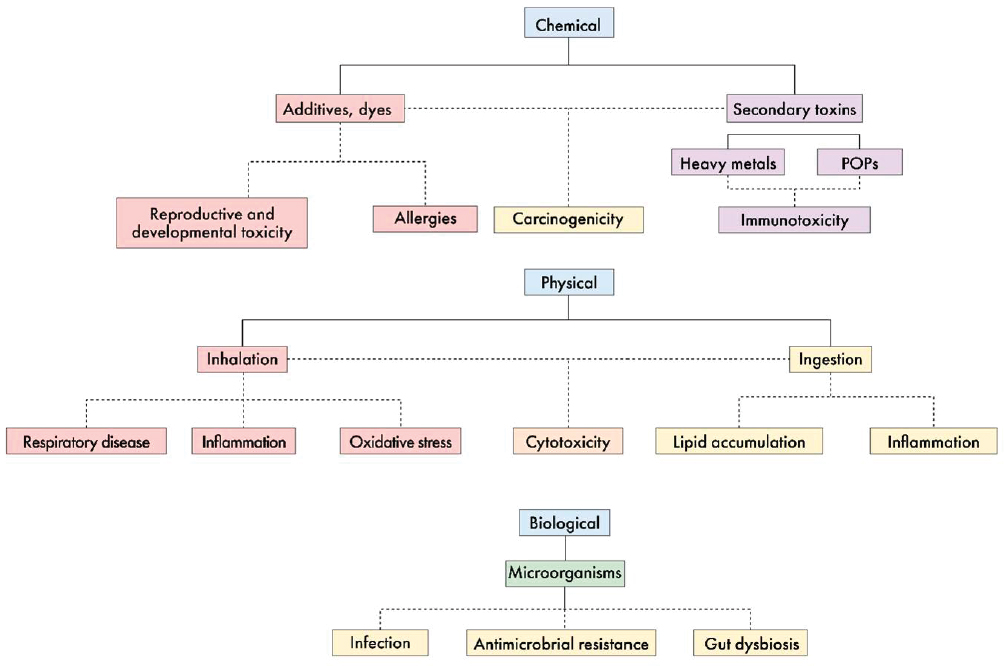
NOTE: The dotted lines represent current speculative research.
SOURCE: Used with permission of Springer Nature BV, from “The Potential Effects of Microplastics on Human Health: What is Known and What is Unknown”, Blackburn and Green, Ambio: A Journal of the Human Environment 51 (3), 2022; permission conveyed through Copyright Clearance Center, Inc.
As an additional burden, microplastics from soil may carry pathogens and other pollutants that pose a threat to human health potentially through alterations in gut microbial communities (Fackelmann and Sommer 2019). A mice study found that when co-ingested with polyethylene particles, the bioavailability of arsenate increased, and this seemed to be mediated by the metabolite output of the gut microbiota (Chen et al. 2023). Also, impacts of MPs on soil communities may translate into effects on the food system and have negative consequences for human health (Daghighi et al. 2023).
Few studies have comprehensively assessed the impact of microplastics on health concurrently with their presence in the environment. A recent study compared the soil, air, nasal, and gastrointestinal microbiomes of two populations, one with high exposure to microplastic pollution and the other with low exposure. They found overlap in the microplastic species found in gut microbiome samples and soil samples in the high exposure area, along with inverse correlations between microplastic exposure and the abundance of taxonomic groups that may be beneficial for human health (Zhang et al. 2022).
Mitigation and Remediation
The reduction of plastic use in agriculture is an essential step toward more sustainable and environmentally friendly farm management. To address these issues, the “3 R” waste hierarchy concept of reducing, reusing, and recycling plastics, before considering disposal, is crucial (Hofmann et al. 2023). Similarly, the United Nations’ Food and Agriculture Organization (FAO) has promoted the 6R model (Refuse, Redesign, Reduce, Reuse, Recycle, and Recover) for reduction of use of plastics in agriculture (FAO 2021). Both approaches advocate for plastic applications that have circular end-of-life treatment options and stress the importance of innovative material design to ensure plastics can be completely collected, recycled, and reused. Use of non-biodegradable polymer-coated fertilizers and mulching films, in particular, should be minimized and, if used, be collected after use. Additionally, in situations where plastics cannot be collected after use, or where recovered plastic is too degraded or soiled to be reused or recycled, polymers that are more biodegradable or less toxic should replace conventional persistent polymers (Galati and Scalenghe 2021; Hofmann et al. 2023).
Biodegradable polymers offer potential solutions for reducing environmental impacts of plastics for short-term uses (e.g., cutlery). Biodegradable plastics can break down through composting or exposure to UV radiation. However, uncertainties concerning biodegradable polymers involve their complex waste management, including requirement for specific collection and composting facilities, and the low volumes produced that may not justify the waste management efforts (Prata et al. 2019). Additionally, some degradable plastics produce non-degradable by products (Prata et al. 2019).
The possibility of significant and consistent biodegradation of conventional plastics in the environment remains uncertain (Krueger et al. 2015). Some strains of bacteria and fungi have been demonstrated in the laboratory to be capable of degrading many polymers via enzymatic hydrolysis or oxidation (Sivan 2011; Krueger et al. 2015). Some
conventional plastics can biodegrade under lab conditions when exposed to specific plastic-degrading organisms, such as Zalerion maritimum (Paço et al. 2017); how successful these organisms would be in soil is not known.
PFAS
Per- and polyfluoroalkyl substances are a large group of synthetic, organofluorine chemicals that are of increasing concern as environmental contaminants. Their characteristic carbon–fluorine bond is one of the strongest single bonds in chemistry, so PFAS molecules are extremely hard to break down. Thus, they are highly persistent in the environment and are often referred to as “forever chemicals.” There are thousands of PFAS compounds2 of concern with respect to the health of people and the environment.
PFAS give desirable properties to industrial and consumer products because they resist water, oil, and heat. They are used to make waterproof and stain-resistant garments, nonstick pans, and oil-resistant containers. Teflon is a well-known example. They are also used to make firefighting foams, fabrics that resist fire and stains, and a great many other products and industrial processes.
The different PFAS species vary in their length of the carbon chain, their branching structure, the number of fluorine molecules and their positions, attached functional groups, and so on (Buck et al. 2011). The large and diverse PFAS family of molecules can be divided into the polymer and non-polymer classes, with the latter most commonly found in biological and environmental samples. This non-polymer class includes per- and polyfluoroalkyl substances; the carbon chains of the perfluoroalkyl substances are fully fluorinated, while the carbon chains of the polyfluoroalkyl substances are not fully saturated with fluorine atoms. The perfluoroalkyl acids (PFAAs) are one major group of the perfluorinated subclass of the non-polymer class of PFAS. Because of their saturation, they are the most stable and thus most persistent in the environment. Their non-saturated precursors can be transformed into PFAAs through biological or chemical cleavage of their non-fluorinated moieties.
Sources
PFAS molecules are created through industrial processes. They have been manufactured since the 1940s and widely used since the 1950s. They are spread from both point sources (where they are made or used) and diffuse sources (such as water, soil, and air). Point sources include industrial sites where PFAS is made and used, such as fluorochemical production plants (Gebbink and van Leeuwen 2020).
Several studies have found soil to be a major environmental reservoir of PFAS (Strynar et al. 2012; Brusseau et al. 2020). Soils can receive PFAS from applied biosolids, contaminated irrigation water (Pepper et al. 2021), aqueous film-forming
___________________
2 U.S. Environmental Protection Agency. “PFAS Structure Dashboard.” EPA. Accessed April 27, 2024. https://comptox.epa.gov/dashboard/chemical-lists/PFASSTRUCT and “PFAS Developmental Dashboard.” EPA. Accessed April 27, 2024. https://comptox.epa.gov/dashboard/chemical-lists/PFASDEV1.
foam used extensively at military bases and airports (Yan et al. 2024), and rainfall (Pfotenhauer et al. 2022). PFAS in biosolids can come from many sources, including landfill leachate. Landfill leachate is a rich source of PFAS because of the discarded domestic products (e.g., cookware, clothing, carpets, and furniture) and industrial products deposited in these sites (Lang et al. 2017; Capozzi et al. 2023). Landfill leachate is typically treated at the municipal wastewater treatment plants where other wastes, including excreta and industrial wastes, are processed (Masoner et al. 2020; Helmer et al. 2022).
Because the biological and other treatment processes implemented through conventional wastewater treatment do not destroy PFAS, biosolids (the stabilized solids that result from municipal wastewater treatment, also known as sewer sludge) may be contaminated. Longer-chain PFAS molecules (e.g., those with an 8-carbon backbone or C8) are typically enriched in biosolids relative to liquid effluent (Helmer et al. 2022).
Fate and Transport
PFAS are highly mobile in the environment (Brunn et al. 2023). As noted above, their forms can change in the environment as non-fluorinated moieties are cleaved, yielding stable (saturated) PFAAs (Evich et al. 2022). Greater amounts of some PFAS molecules are thus found in the effluent from wastewater treatment plants than in the influent (Coggan et al. 2019; Thompson et al. 2023). Short-chain PFAS are more mobile in soils than longer-chain forms (Brusseau et al. 2020). General pathways are indicated in Figure 6-8.
Biosolids have long been used as a soil amendment, adding carbon and nutrients to agricultural and other lands (Lu et al. 2012). While it is desirable to regard organic wastes as resources, concern is rising about PFAS contamination of biosolids leading to contamination of farmland (Lowman et al. 2013; Mason-Renton and Luginaah 2018). Plants can take up PFAS, with short-chain forms showing greater mobility in plant tissues than longer-chain forms (Costello and Lee 2020). Maine recently banned the land application of biosolids after some farms were found to have high levels of contamination (Perkins 2022).
Impact on Soil Ecosystems
Studies of the effects of PFAS on soil microbiomes have shown that PFAS changes community composition and metabolite production (Senevirathna et al. 2022; Xu et al. 2022; Wu et al. 2023). Several studies have reported that PFAS reduce microbial abundance, including in laboratory experiments (Xu et al. 2022) and field studies comparing contaminated and noncontaminated sites (Senevirathna et al. 2022). Xu et al. (2022) found that soil treated with the PFAS compounds perfluorooctanoic acid (PFOA) and perfluorooctane sulfonic acid (PFOS) had bacterial reduced gene abundance as compared to the control treatment and that PFAS exposure altered soil microbial composition. The researchers speculated that the increase in Proteobacteria was due to Proteobacteria’s greater tolerance for PFAS (Xu et al. 2022). Increases in Proteobacteria

SOURCE: Diagram courtesy of Michigan Department of Environment, Great Lakes, and Energy.
have also been observed in other studies (Wu et al. 2023). Modeling also predicted that exposure to PFAS inhibited numerous microbial metabolism processes in soil. Wu et al. (2023) found that soil microorganisms downstream of a Teflon production plant had reduced lipid biosynthesis and possibly decreased metabolic activity.
Findings with regard to effects of PFAS on soil pH and microbial diversity have varied across studies. Xu et al. (2022) did not find a change in soil pH between soil treated with PFOA and PFOS and a control sample, while Xu et al. (2023) found a significant increase in soil pH in another laboratory experiment. The latter results were likely because PFAS increased litter decomposition rather than PFAS having a direct effect on soil pH. The latter researchers also found that soil aggregate stability was not affected by PFAS but water-stable aggregates decreased.
The direction of change in microbial diversity and richness of soil microorganisms exposed to PFAS is unclear, possibly due to differences in PFAS concentration and species across studies. Xu et al. (2022) found that microbial diversity and richness of soil microorganisms increased in the treatment cases as opposed to the control in a laboratory study, whereas Senevirathna et al. (2022) observed a decline in soil bacterial community population and diversity in soils collected from contaminated sites versus uncontaminated environmental samples. PFOS (a C8 molecule) had a greater effect than PFOA (a molecule with a 7-carbon backbone), suggesting the type of PFAS may influence impacts on soil microbial communities. Cai et al. (2019) also found that the type of PFAS influenced its effect on microbial diversity and richness, with longer chains having greater toxicity than shorter chains.
Additionally, PFAS may negatively affect plant growth. Xu et al. (2022) found that PFOA and PFOS inhibited the abundance of Azospirillum, a plant growth-promoting rhizobacteria. PFOS also enriched Hydrogenophaga, which are resistant to organic pollutants, while Methyloversatilis was more abundant under PFOA exposure. The abundance of Methyloversatilis suggests that it may be able to degrade PFOA. Wu et al. (2023) also determined that PFAS contamination affected the fungal community in soils. The authors noted that mycotoxin concentrations were higher downstream of the Teflon plant.
Human Exposure Pathways
People are exposed to PFAS through many pathways, including via occupational exposures, consumer and household products, environmental contamination, and ingestion. Occupational exposures are myriad and may include occur where PFAS-containing products are manufactured, in the construction industry, among food workers that handle PFAS-containing food packaging, and among firefighters. PFAS are used in thousands of consumer products ranging from personal care products like sunscreen, makeup, and dental floss to textiles, artificial turf, and paint. A recent review found that exposure from contaminated household dust could account for up to 25 percent of blood concentrations but that there were many methodologic flaws in the existing studies and that more research on household exposure pathways is needed (DeLuca et al. 2022).
Environmental contamination of soils and groundwater is also thought to be an important source of PFAS exposure. Most research in nonoccupational settings has focused on ingestion of PFAS, which can occur through drinking contaminated water or eating contaminated seafood, vegetables, game, or dairy products (Domingo and Nadal 2017; Death et al. 2021). In April 2024, EPA established a regulation for maximum contaminant levels for six PFAS compounds for public water systems in the United States (EPA 2024a). It estimated that 6–10 percent of the country’s 66,000 public drinking water systems would have to take action to reduce PFAS to meet these levels (EPA 2024b). PFAS may also be ingested through food contaminated by PFAS-containing materials including food packaging, microwave popcorn bags, and cookware. PFAS can be transferred intergenerationally through the mother’s body to a developing fetus and through breastfeeding (Manzano-Salgado et al. 2015; Gao et al. 2019; Zheng et al. 2021). Exposure pathways may also include inhalation of aerosolized or volatile PFAS, which have been detected indoors and near factory emissions. The impact of inhaled and transdermal exposures, for example through bathing in contaminated water, have been less well studied (Sunderland et al. 2019).
Impacts on Human Health
PFAS are known to affect human health in multiple ways (Sunderland et al. 2019; Brase et al. 2021; Chambers et al. 2021). A recent review by the National Academies summarized the health effects of PFAS and found that cancers, endocrine effects, dysregulation of immune function, and impacts on fertility were the health effects most frequently mentioned by speakers at that committee’s information-gathering meetings (NASEM 2022a). After a systematic synthesis of the evidence, that report concluded that there was sufficient evidence to support an association with decreased antibody response (in adults and children), dyslipidemia (in adults and children), decreased infant and fetal growth, and increased risk of kidney cancer (in adults). The report also found suggestive evidence for the following diseases and health outcomes: increased risk of breast cancer (in adults), liver enzyme alterations (in adults and children), increased risk of pregnancy-induced hypertension (gestational hypertension and pre-eclampsia), increased risk of testicular cancer (in adults), increased risk of thyroid disease and dysfunction (in adults), and increased risk of ulcerative colitis (in adults).
Mitigation and Remediation
As PFAS have been found in drinking water, foods and food packaging, and the bodies of people and animals around the world, awareness and concern become increasingly palpable. This increased awareness has led to pressure for companies to stop making these compounds. After half a century of production, companies are beginning to phase out production of certain PFAS compounds. 3M began phasing out production of PFOS in 2000 (EPA 2000) and recently paid $10.3 billion to settle a multidistrict lawsuit (Kluger 2023). The company stated in 2022 that it would work to cease manufacturing PFAS by the end of 2025 (3M 2022). Reduced production has
led to some decrease in the human body burden in the United States and Australian populations (Gomis et al. 2017). Although some PFAS forms are being phased out, there is evidence that companies are making replacement compounds with likely hazardous properties (Brase et al. 2021).
EPA recently published a roadmap related to PFAS contamination (EPA n.d.). As part of the roadmap, EPA is conducting a risk assessment for two specific PFAS compounds, PFOA and PFOS, in biosolids. The risk assessment is scheduled to be completed by December 2024.3 Given the large number of PFAS molecules, their persistence and potential to accumulate in the environment, their individual and collective hazards, and the difficulties of regulating them individually, some authors argue that they should be regulated as a class (e.g., Kwiatkowski et al. 2020). Others suggest that, because of the differences in toxicity among PFAS species, each PFAS subgroup and compounds within should be evaluated (Singh and Papanastasiou 2021). Cousins et al. (2020) argued that a rational approach to phasing out PFAS production would eliminate most applications but would recognize certain “essential uses.” Eliminating most uses but allowing exceptions for the most essential, such as certain medical applications, would likely be the most feasible approach.
Because of the extreme strength of the carbon–fluorine bonds that are the defining feature of PFAS, it is notably difficult to fully mineralize PFAS (that is, to break PFAS down to their elemental components rather than to smaller species of PFAS) (Shahsavari et al. 2021). Sorption of PFAS can block the movement of contaminants such as PFAS in the ecosystem. Porous, high-carbon materials such as activated carbon and biochar can be used to remove PFAS from drinking water (Box 6-1; Xiao et al. 2017). Granulated activated carbon is the most widely used sorbent for purification of air and water.
BOX 6-1
Biochar as Decontamination Possibility
Some of the environmental concerns about the land application of biosolids can be addressed by converting the material into biochar (Krounbi et al. 2019). The pyrolysis of biosolids can strongly reduce the presence of organic contaminants such as PFAS, hormones, and pharmaceuticals, which are destroyed at the high temperatures that are used to produce biochar (Hoffman et al. 2016; Kundu et al. 2021; Mercl et al. 2021). In addition, biochar can bind and immobilize contaminants such as heavy metals (Park et al. 2011) and PFAS, preventing their movement through soil (Krahn et al. 2023). Biochar produced from biosolids is particularly good at binding PFAS (Krahn et al. 2023).
___________________
3 U.S. Environmental Protection Agency. “Risk Assessment for Pollutants in Biosolids.” EPA. Accessed April 27, 2024. https://www.epa.gov/biosolids/risk-assessment-pollutants-biosolids#pfas.
Fecal biochar (e.g., made from biosolids) has been shown to be an effective sorbent for PFAS (Krahn et al. 2023).
That said, it is possible to degrade PFAS in soil and in amendments that might reach soil. A few alternatives are emerging, each with potential to address the issue in certain niches. Mechanochemical treatment by ball milling can be used to eliminate PFAS (Turner et al. 2021); this might be useful for extremely contaminated soils, though the committee finds it is difficult to envisage this being conducted at large scale in an economically viable way. Although bioremediation is challenging and generally not considered as a practical approach to PFAS remediation, there is hope that microbes can contribute to breaking down PFAS (LaFond et al. 2023). Another new biological approach involves use of enzyme-catalyzed oxidative humification reactions carried out by fungal extracellular enzymes (e.g., peroxidases and laccases). These processes can potentially lead to break down of certain PFAS molecules (Grgas et al. 2023; Kumar et al. 2023). Thermochemical transformation is an approach that has shown promise under certain conditions (Weber et al. 2023). Incineration can destroy PFAS but can lead to the emission of fluorinated byproducts (Stoiber et al. 2020).
There is evidence that pyrolysis at high temperatures (over 600°C) can be effective for removing PFAS from biosolids. Thoma et al. (2022) showed that 21 PFAS compounds detected in biosolid samples (ranging from 2 μg/kg–85 μg/kg) were undetectable in the biochar resulting from pyrolysis at 650°C. Kundu et al. (2021) demonstrated greater than 90-percent removal of PFOA and PFOS from sewage sludge after pyrolysis at temperatures between 500 and 600°C. McNamara et al. (2023b) showed more than 99-percent removal of target PFAS and PFAS precursors at pyrolysis temperatures up to 800°C. However, PFAS may be present in byproducts of pyrolysis (McNamara et al. 2023a,b). Further research and development is needed to assess the potential of pyrolysis as a general solution to the problem of PFAS in biosolids (Wallace et al. 2023). Other high-temperature treatments, plasma, and combustion under specific conditions can also be effective at breaking down PFAS (Singh et al. 2021; McNamara et al. 2023a,b; Weber et al. 2023). High-energy electron beam technology is also being tested to break down PFAS in soils and groundwater (Lassalle et al. 2021).
Integrated strategies for dealing with sources and flows of contamination are needed. These are likely to bring together elements of the strategies mentioned above, as well as selective mobilization of PFAS (Bolan et al. 2021). Figure 6-9 presents an overview of elements of remediation strategies that can be integrated.
CONCLUSIONS
The properties of soil facilitate the capture and remediation of many contaminants. In some cases, the soil microbiome can mitigate the risk contaminants pose, such as through the attenuation of heavy metals via sequestration, ion efflux, and extracellular chelation (Hou et al. 2020). In other cases, the physical and chemical properties of soil can trap contaminants, making them unavailable to volatilize, leach into water, or be taken up by a plant. As alluded to in Chapter 3, the degradation of contaminants is one of many soil-derived Nature’s Contributions to People.
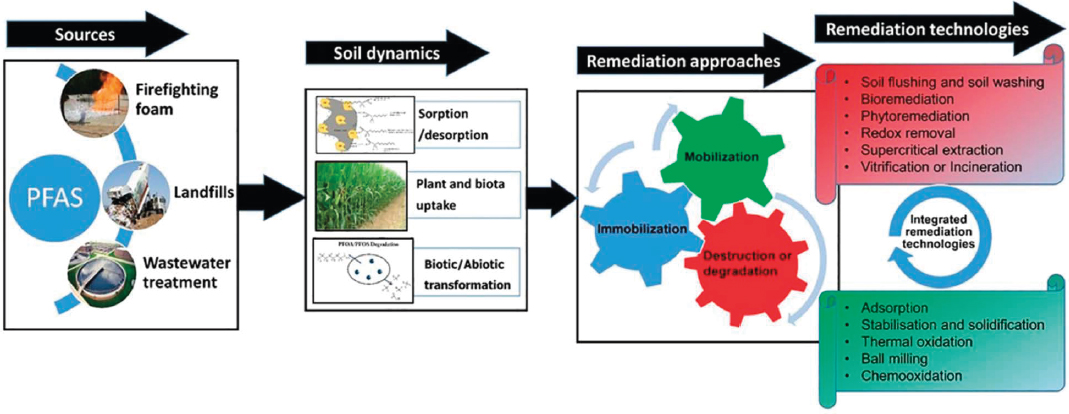
SOURCE: Reprinted from Journal of Hazardous Materials, 401, Bolan et al., “Remediation of Poly- and Perfluoroalkyl Substances (PFAS) Contaminated Soils–To Mobilize or to Immobilize or to Degrade?” 123892, 2021, with permission from Elsevier.
Soil health is key to this contribution. As reviewed in the case studies, soil organic amendments can increase the absorption of metals and organic chemical contaminants. Changes to pH can reduce the bioavailability of some contaminants. Conversely, contamination can overwhelm the capacity of soil to mitigate risk. High levels of lead and cadmium in soils reduce microbial activity and plant biomass. Microplastics can change soil structure and thereby affect water-holding capacity. The enrichment of pathogens and antibiotic resistance genes in soil microbial communities influenced by microplastics may have implications for human health, but this possibility has not yet been explored.
It is important to note that the contaminants in the case studies presented above were discussed in isolation from one another. Each contaminant class is diverse with heterogeneous impacts based on the nature and quantity of the material and the characteristics of the soil in question. The reality of soil contamination is even more complex because of the potential for co-contamination with multiple compounds. It is likely that the examples of contaminants provided here, along with contaminants found in agricultural inputs such as manure and synthetic fertilizers and pesticides, interact with one another in ways that compound the adverse effects on soil health.
Furthermore, these interacting contaminants are affected by global change factors, such as water stress and high temperatures (Rillig et al. 2019c). There is little available evidence about the effects of many combinations of soil contaminants, in part because it is prohibitively difficult to systematically test the combinatorial effects of large numbers of anything, including contaminants and stressors affecting soils. Given the practical impossibility of testing large numbers of specific combinations, Yang et al. (2022) tested a range of numbers of soil stressors under experimental reactor conditions, drawing at random from a roster of stressors that included various soil contaminants. They found that the positive ecosystem functions of soil microbial diversity were systematically compromised by the action of multiple environmental stressors, including heavy metals, pesticides, plastic film residues, and surfactants as well as nitrogen deposition, heat, drought, salinity, and compaction.
Soil plays a vital role in the cycling of nutrients, where products that are waste to humans, such as manure and biosolids, can be used as sources of energy and nutrients for soil biota and plants. However, soil can no longer be a receptacle for the untreated waste products of agricultural and industrial processes. To incorporate considerations about soil health into decisions about material processing and disposal, the committee suggests that action be taken in the following areas.
Source Identification and Targeted Surveillance
Soil contaminants have not been strategically mapped in the United States. As part of its North American Soil Geochemical Landscapes Project, the U.S. Geological Survey (USGS) mapped the spatial distribution of lead, arsenic, and cadmium (among other chemical elements) in the conterminous United States (Smith et al. 2014), but this low-density effort (one sample site per 1,600 km2) did not target agricultural lands. USGS has also recently conducted a survey of PFAS in the United States, but collection
was from tap water and soils were not included in the survey (Smalling et al. 2023). To the committee’s knowledge, no comprehensive sampling effort of microplastics in U.S. soils has taken place.
Thus, there is a lack of comprehensive knowledge regarding the geographic distribution of these contaminants in U.S. soils and the specifics of their co-occurrence in mixed forms. This gap in understanding underscores the need for more detailed research and mapping of soil contaminants to better address soil and environmental health challenges.
Recommendation 6-1: Federal agencies should work collaboratively to support surveys of soil chemical contaminants informed by systematic risk assessments to identify where contaminant levels in soil may be particularly high (e.g., locations around, downwind, or downstream of PFAS point sources). These surveys can be used to build contaminant maps (e.g., of lead, arsenic, persistent organic pollutants) that can be viewed individually or overlaid to assess the status of contamination, identify locations of concern, and, over time, evaluate the effectiveness of interventions.
Exposure Science
The effects of heavy metals on the health of soil organisms, plants, and humans have been studied for decades. Research on the same effects of novel entities such as PFAS and microplastics is just ramping up. There is still a great deal to learn about the effects of new and old chemical contaminants on soil organisms, plants, and humans, including thresholds of exposure and compounding effects of more than one contaminant. The degree to which exposure routes from soil (e.g., through inhalation, dermal contact, or direct or food consumption) affect bioavailability and how they compare to exposure routes from other sources (e.g., water or personal care products) are also unknown.
Recommendation 6-2: Federal agencies should support interdisciplinary research to reduce gaps in knowledge about exposure pathways from soil and the compounding health effects on soil biota, plants, and people from exposure to multiple chemical contaminants.
Mitigation
The emergence of PFAS and microplastics as contaminants of concern this century and their interplay with contaminants from the last century that have yet to be addressed indicate that contaminant issues will continue to mount unless explicitly curtailed. A recent report by the National Academies on the U.S. role in ocean plastic waste recommended that “the United States should substantially reduce solid waste generation (absolute and per person) to reduce plastic waste in the environment and the environmental, economic, aesthetic, and health costs of managing waste and litter” (NASEM 2022b, 6). The committee of this report on soil health and human health
wholeheartedly endorses this recommendation for reduced plastic use; this includes in agricultural production systems, as has been called for by the FAO. Use of plastic in agriculture needs to be substantially reduced by finding alternatives as well as reusing it when possible, removing it after use if persistent, stopping use of forms with toxic byproducts, and developing biodegradable plastics.
Reducing the production and use of other contaminants, such as PFAS, for all but the most essential applications, is also in order. The committee recognizes that soil is not the only exposure pathway for these contaminants to humans, but the extent to which production of these products is reduced mitigates all exposure pathways to humans and decreases their potential to enter soil.
Recommendation 6-3: The United States should mitigate the entry of plastic and PFAS contaminants into soil by reducing their overall production and use.
Biosolids can be an important source of organic matter to agricultural land and a means of recycling rather than disposing of waste. However, they can also be a route of soil contamination because water treatment processes leave heavy metals, PFAS, microplastics, and other contaminants in biosolids. The entry of contaminants into soil could also be mitigated by improvements to the processing of landfill leachate and the treatment of wastewater. Landfill leachate contains PFAS, microplastics, and many other contaminants from discarded materials, which includes municipal biosolids. Wastewater treatment plants vary in their ability to remove these contaminants during treatment. Processing landfill leachate before it enters wastewater treatment plants would be a first line of contaminant reduction.
Some PFAS precursors may be broken down in the wastewater treatment process, but the strength of the carbon–fluorine bond often means that treated water has more, shorter-chain PFAS molecules than the influent. Technology to remove PFAS during treatment needs to be advanced. Limited research has reported pyrolysis of biosolids reduces PFAS content and possibly bioavailability. The U.S. Department of Agriculture–Natural Resources Conservation Services’ recent soil carbon amendment standard (code 336) does not support application of non-gasified or non-pyrolyzed biosolids, while the standard does allow land application of biosolids biochar. Research is needed to provide information on manufacture of biochar from biosolids and the ability of pyrolysis to reduce the content and bioavailability of PFAS.
The technology exists to effectively remove microplastics from wastewater. Unfortunately, most of the plastic ends up in the biosolids (Carr et al. 2016). Pyrolysis of biosolids can result in the elimination of plastics as well as PFAS and other organic pollutants because of the high temperature attained in the process. Converting biosolids into biochar would be a means of continuing to use waste as a soil amendment while mitigating the contamination of the soil with more plastic. Biochar can also immobilize other contaminants, including PFAS and heavy metals. The carbon in biochar is stable over long periods of time, so it also has the benefit of sequestering carbon.
Recommendation 6-4: EPA should continue pursuing research and technology to remove PFAS from wastewater and biosolids.
Recommendation 6-5: EPA should pursue research to establish a threshold for plastics in land-applied soil amendments. Revisiting heavy metal thresholds would also be in order.
Remediation
Soils, especially those rich in organic matter and with healthy microbial communities, have the capacity to absorb and eliminate (e.g., through bioremediation) some, but not all, contaminants. Enhancing soil’s ability to remediate contaminants is crucial for protecting human health. Using soil organic amendments to increase organic matter as well as recycle waste can move agricultural production to a more circular approach to nutrient management. Wastes that can serve as sources of soil organic matter include food waste, agroindustrial byproducts, and human and animal excreta. The use of source-separating, container-based sanitation can enable the recycling of carbon and nutrients in excreta without the contamination risks that arise in conventional wastewater handling.
Organic amendments can be designed to be more targeted. Modified biochars with functionalized surface chemistry (“designer biochars”) can reduce contaminant bioavailability. For example, including iron in biochar production can enable greater binding of heavy metals for soil remediation while improving water holding and nutrient cycling. Research is needed to identify or produce functionalized designed biochars for soil remediation.
Recommendation 6-6: Public sector investment should be made to develop affordable technologies for converting biosolids into biochar that can be applied to agricultural land and/or used for wastewater treatment.
Recommendation 6-7: Producers and other land managers should adopt practices that increase the organic matter content, biodiversity, and other health parameters of their soils.
Recommendation 6-8: Public and private entities should invest in Green and Sustainable Remediation techniques, including the application of designer biochars and biosolids biochar, to manage soil contamination effectively.
REFERENCES
3M. December 20, 2022. “3M to Exit PFAS Manufacturing by the End of 2025,” https://news.3m.com/2022-12-20-3M-to-Exit-PFAS-Manufacturing-by-the-End-of-2025. Accessed April 29, 2024.
Albertsson, A. C. 1980. “The Shape of the Biodegradation Curve for Low and High Density Polyethenes in Prolonged Series of Experiments.” European Polymer Journal 16 (7): 623−630. https://doi.org/10.1016/0014-3057(80)90100-7.
Alengebawy, Ahmed, Sara Taha Abdelkhalek, Sundas Rana Qureshi, and Man-Qun Wang. 2021. “Heavy Metals and Pesticides Toxicity in Agricultural Soil and Plants: Ecological Risks and Human Health Implications.” Toxics 9 (3): 42. https://doi.org/10.3390%2Ftoxics9030042.
Ali, Muhammad Ishtiaq, Safia Ahmed, Geoff Robson, Imran Javed, Naeem Ali, Naima Atiq, and Abdul Hameed. 2014. “Isolation and Molecular Characterization of Polyvinyl Chloride (PVC) Plastic Degrading Fungal Isolates.” Journal of Basic Microbiology 54 (1): 18−27. https://doi.org/10.1002/jobm.201200496.
Al-Mamun, Abdullah 2017. “Pesticide Degradations, Residues and Environmental Concerns.” In Pesticides Residue in Foods: Sources, Management, and Control, edited by Mohidus Samad Khan and Mohammad Shafiur Rahman, 87−102. Cham, Switzerland: Springer.
Andrady, Anthony L., and Mike A. Neal. 2009. “Applications and Societal Benefits of Plastics.” Philosophical Transactions of the Royal Society B: Biological Sciences 364 (1526): 1977−1984. https://doi.org/10.1098/rstb.2008.0304.
Arkatkar, Ambika, J. Arutchelvi, Sumit Bhaduri, Parasu Veera Uppara, and Mukesh Doble. 2009. “Degradation of Unpretreated and Thermally Pretreated Polypropylene by Soil Consortia.” International Biodeterioration & Biodegradation 63 (1): 106−111. https://doi.org/10.1016/j.ibiod.2008.06.005.
ATSDR (Agency for Toxic Substances and Disease Registry). 2007. “Toxicological Profile for Arsenic.” Accessed May 2, 2024. https://www.atsdr.cdc.gov/ToxProfiles/tp2.pdf.
ATSDR. 2012. “Toxicological Profile for Cadmium.” Accessed May 2, 2024. https://www.atsdr.cdc.gov/toxprofiles/tp5.pdf.
ATSDR. 2020. “Toxicological Profile for Lead.” Accessed May 2, 2024. https://www.atsdr.cdc.gov/toxprofiles/tp13.pdf.
Attanayake, Chammi P., Ganga M. Hettiarachchi, Ashley Harms, DeAnn Presley, Sabine Martin, and Gary M. Pierzynski. 2014. “Field Evaluations on Soil Plant Transfer of Lead from an Urban Garden Soil.” Journal of Environmental Quality 43 (2): 475−487. https://doi.org/10.2134/jeq2013.07.0273.
Attanayake, Chammi, Ganga Hettiarachchi, Sabine Martin, and Gary Pierzynski. 2015. “Potential Bioavailability of Lead, Arsenic, and Polycyclic Aromatic Hydrocarbons in Compost-Amended Urban Soils.” Journal of Environmental Quality 44: 930–944. https://doi.org/10.2134/jeq2014.09.0400.
Attanayake, Chammi P., Ganga M. Hettiarachchi, Monica Palomo, Gary M. Pierzynski, and Blanca Calderon. 2021. “Phytoavailability of Lead for Vegetables in Urban Garden Soils.” ACS Agricultural Science & Technology 1 (3): 173−181. https://doi.org/10.1021/acsagscitech.0c00068.
Basta, Nicholas T., and Albert Juhasz. 2014. “Using In Vivo Bioavailability and/or In Vitro Gastrointestinal Bioaccessibility Testing to Adjust Human Exposure to Arsenic from Soil Ingestion.” Reviews in Mineralogy and Geochemistry 79 (1): 451−472. https://doi.org/10.2138/rmg.2014.79.9.
Basta, N. T., J. A. Ryan, and R. L. Chaney. 2005. “Trace Element Chemistry in Residual-Treated Soil: Key Concepts and Metal Bioavailability.” Journal of Environmental Quality 34 (1): 49−63. https://doi.org/10.2134/jeq2005.0049dup.
Basta, N. T., W. R. Raun, and F. Gavi. 1998. “Wheat Grain Cadmium Under Long-Term Fertilization and Continuous Winter Wheat Production.” Better Crops 82 (2).
Bellinger, David C. 2005. “Teratogen Update: Lead and Pregnancy.” Birth Defects Research Part A: Clinical and Molecular Teratology 73 (6): 409−420. https://doi.org/10.1002/bdra.20127.
Bihari, Enikoe, Garrett Grewal, and Daniel D. Richter. 2023. “Legacies of Pre-1960s Municipal Waste Incineration in the Pb of City Soils.” Environmental Science & Technology Letters 10 (10): 897−902. https://doi.org/10.1021/acs.estlett.3c00488.
Blackburn, Kirsty, and Dannielle Green. 2022. “The Potential Effects of Microplastics on Human Health: What Is Known and What Is Unknown.” Ambio 51 (3): 518−530. https://doi.org/10.1007/s13280-021-01589-9.
Bläsing, Melanie, and Wulf Amelung. 2018. “Plastics in Soil: Analytical Methods and Possible Sources.” Science of the Total Environment 612: 422−435. https://doi.org/10.1016/j.scitotenv.2017.08.086.
Blaylock, Michael J., David E. Salt, Slavik Dushenkov, Olga Zakharova, Christopher Gussman, Yoram Kapulnik, Burt D. Ensley, and Ilya Raskin. 1997. “Enhanced Accumulation of Pb in Indian Mustard by Soil-Applied Chelating Agents.” Environmental Science & Technology 31 (3): 860−865. https://doi.org/10.1021/es960552a.
Bolan, Nanthi, M. B. Kirkham, Claudia Halsband, Dayanthi Nugegoda, and Yong Sik Ok. 2020. Particulate Plastics in Terrestrial and Aquatic Environments. Boca Raton, FL: CRC Press.
Bolan, Nanthi, Anitha Kunhikrishnan, Ramya Thangarajan, Jurate Kumpiene, Jinhee Park, Tomoyuki Makino, Mary Beth Kirkham, and Kirk Scheckel. 2014. “Remediation of Heavy Metal(loid)s Contaminated Soils – To Mobilize or to Immobilize?” Journal of Hazardous Materials 266: 141−166. https://doi.org/10.1016/j.jhazmat.2013.12.018.
Bolan, Nanthi, Binoy Sarkar, Yubo Yan, Qiao Li, Hasintha Wijesekara, Kurunthachalam Kannan, Daniel C. W. Tsang, Marina Schauerte, Julian Bosch, Hendrik Noll, Yong Sik Ok, Kirk Scheckel, Jurate Kumpiene, Kapish Gobindlal, Melanie Kah, Jonathan Sperry, M. B. Kirkham, Hailong Wang, Yiu Fai Tsang, Deyi Hou, and Jörg Rinklebe. 2021. “Remediation of Poly- and Perfluoroalkyl Substances (PFAS) Contaminated Soils – To Mobilize or to Immobilize or to Degrade?” Journal of Hazardous Materials 401: 123892. https://doi.org/10.1016/j.jhazmat.2020.123892.
Boots, Bas, Connor William Russell, and Dannielle Senga Green. 2019. “Effects of Microplastics in Soil Ecosystems: Above and Below Ground.” Environmental Science & Technology 53 (19): 11496−11506. https://doi.org/10.1021/acs.est.9b03304.
Brase, Richard A., Elizabeth J. Mullin, and David C. Spink. 2021. “Legacy and Emerging Per- and Polyfluoroalkyl Substances: Analytical Techniques, Environmental Fate, and Health Effects.” International Journal of Molecular Sciences 22 (3): 995. https://doi.org/10.3390/ijms22030995.
Brown, Sally, Rufus Chaney, Judith Hallfrisch, James A. Ryan, and William R. Berti. 2004. “In Situ Soil Treatments to Reduce the Phyto- and Bioavailability of Lead, Zinc, and Cadmium.” Journal of Environmental Quality 33 (2): 522−531. https://doi.org/10.2134/jeq2004.5220.
Brunn, Hubertus, Gottfried Arnold, Wolfgang Körner, Gerd Rippen, Klaus Günter Steinhäuser, and Ingo Valentin. 2023. “PFAS: Forever Chemicals—Persistent, Bioaccumulative and Mobile. Reviewing the Status and the Need for Their Phase Out and Remediation of Contaminated Sites.” Environmental Sciences Europe 35 (1): 20. https://doi.org/10.1186/s12302-023-00721-8.
Brusseau, Mark L., R. Hunter Anderson, and Bo Guo. 2020. “PFAS Concentrations in Soils: Background Levels Versus Contaminated Sites.” Science of the Total Environment 740: 140017. https://doi.org/10.1016/j.scitotenv.2020.140017.
Buck, Robert C., James Franklin, Urs Berger, Jason M. Conder, Ian T. Cousins, Pim de Voogt, Allan Astrup Jensen, Kurunthachalam Kannan, Scott A. Mabury, and Stefan P. J. van Leeuwen. 2011. “Perfluoroalkyl and Polyfluoroalkyl Substances in the Environment: Terminology, Classification, and Origins.” Integrated Environmental Assessment and Management 7 (4): 513−541. https://doi.org/10.1002/ieam.258.
Büks, Frederick, and Martin Kaupenjohann. 2020. “Global Concentrations of Microplastics in Soils – A Review.” SOIL 6 (2): 649−662. https://doi.org/10.5194/soil-6-649-2020.
Cai, Yanping, Huilun Chen, Rongfang Yuan, Fei Wang, Zhongbing Chen, and Beihai Zhou. 2019. “Toxicity of Perfluorinated Compounds to Soil Microbial Activity: Effect of Carbon Chain Length, Functional Group and Soil Properties.” Science of the Total Environment 690: 1162−1169. https://doi.org/10.1016/j.scitotenv.2019.06.440.
Capozzi, Staci L., Amy L. Leang, Lisa A. Rodenburg, Bharat Chandramouli, Damon A. Delistraty, and Cole H. Carter. 2023. “PFAS in Municipal Landfill Leachate: Occurrence, Transformation, and Sources.” Chemosphere 334: 138924. https://doi.org/10.1016/j.chemosphere.2023.138924.
Carr, Steve A., Jin Liu, and Arnold G. Tesoro. 2016. “Transport and Fate of Microplastic Particles in Wastewater Treatment Plants.” Water Research 91: 174−182. https://doi.org/10.1016/j.watres.2016.01.002.
Carrijo, Daniela R., Gabriel T. LaHue, Sanjai J. Parikh, Rufus L. Chaney, and Bruce A. Linquist. 2022. “Mitigating the Accumulation of Arsenic and Cadmium in Rice Grain: A Quantitative Review of the Role of Water Management.” Science of the Total Environment 839: 156245. https://doi.org/10.1016/j.scitotenv.2022.156245.
Chamas, Ali, Hyunjin Moon, Jiajia Zheng, Yang Qiu, Tarnuma Tabassum, Jun Hee Jang, Mahdi Abu-Omar, Susannah L. Scott, and Sangwon Suh. 2020. “Degradation Rates of Plastics in the Environment.” ACS Sustainable Chemistry & Engineering 8 (9): 3494-3511. https://doi.org/10.1021/acssuschemeng.9b06635.
Chambers, Weston S., Jaida G. Hopkins, and Sean M. Richards. 2021. “A Review of Per- and Polyfluorinated Alkyl Substance Impairment of Reproduction.” Frontiers in Toxicology 3. https://doi.org/10.3389/ftox.2021.732436.
Chaney, Rufus L., Roger D. Reeves, Ilya A. Baklanov, Tiziana Centofanti, C. Leigh Broadhurst, Alan J. M. Baker, Antony Van der Ent, and Richard J. Roseberg. 2014. “Phytoremediation and Phytomining: Using Plants to Remediate Contaminated or Mineralized Environments.” In Plant Ecology and Evolution in Harsh Environments, edited by R. Rajakaruna, R. S. Boyd, and T. Harris, 365−392. Hauppauge, NY: Nova Science Publishers.
Chaney, Rufus L., and James A. Ryan. 1994. Risk Based Standards for Arsenic, Lead and Cadmium in Urban Soils: Summary of Information and Methods Developed to Estimate Standards for Cd, Pb and As in Urban Soils. DECHEMA.
Chen, Shan, Jin-Lei Yang, Yao-Sheng Zhang, Hong-Yu Wang, Xin-Ying Lin, Rong-Yue Xue, Meng-Ya Li, Shi-Wei Li, Albert L. Juhasz, Lena Q. Ma, Dong-Mei Zhou, and Hong-Bo Li. 2023. “Microplastics Affect Arsenic Bioavailability by Altering Gut Microbiota and Metabolites in a Mouse Model.” Environmental Pollution 324: 121376. https://doi.org/10.1016/j.envpol.2023.121376.
Coggan, Timothy L., Damien Moodie, Adam Kolobaric, Drew Szabo, Jeff Shimeta, Nicholas D. Crosbie, Elliot Lee, Milena Fernandes, and Bradley O. Clarke. 2019. “An Investigation into Per- and Polyfluoroalkyl Substances (PFAS) in Nineteen Australian Wastewater Treatment Plants (WWTPs).” Heliyon 5 (8): e02316. https://doi.org/10.1016/j.heliyon.2019.e02316.
Conti, Gea Oliveri, Margherita Ferrante, Mohamed Banni, Claudia Favara, Ilenia Nicolosi, Antonio Cristaldi, Maria Fiore, and Pietro Zuccarello. 2020. “Micro- and Nano-plastics in Edible Fruit and Vegetables. The First Diet Risks Assessment for the General Population.” Environmental Research 187: 109677. https://doi.org/10.1016/j.envres.2020.109677.
Costello, M. Christina Schilling, and Linda S. Lee. 2020. “Sources, Fate, and Plant Uptake in Agricultural Systems of Per- and Polyfluoroalkyl Substances.” Current Pollution Reports. https://doi.org/10.1007/s40726-020-00168-y.
Cousins, Ian T., Jamie C. DeWitt, Juliane Glüge, Gretta Goldenman, Dorte Herzke, Rainer Lohmann, Carla A. Ng, Martin Scheringer, and Zhanyun Wang. 2020. “The High Persistence of PFAS Is Sufficient for Their Management as a Chemical Class.” Environmental Science: Processes & Impacts 22 (12): 2307−2312. https://doi.org/10.1039/D0EM00355G.
Crossman, Jill, Rachel R. Hurley, Martyn Futter, and Luca Nizzetto. 2020. “Transfer and Transport of Microplastics from Biosolids to Agricultural Soils and the Wider Environment.” Science of the Total Environment 724: 138334. https://doi.org/10.1016/j.scitotenv.2020.138334.
Daghighi, Elaheh, Tufail Shah, R. W. Chia, Jin-Yong Lee, Jianying Shang, and Andrés Rodríguez-Seijo. 2023. “The Forgotten Impacts of Plastic Contamination on Terrestrial Micro- and Mesofauna: A Call for Research.” Environmental Research 231: 116227. https://doi.org/10.1016/j.envres.2023.116227.
de Souza Machado, Anderson Abel, Chung W. Lau, Werner Kloas, Joana Bergmann, Julien B. Bachelier, Erik Faltin, Roland Becker, Anna S. Görlich, and Matthias C. Rillig. 2019. “Microplastics Can Change Soil Properties and Affect Plant Performance.” Environmental Science & Technology 53 (10): 6044−6052. https://doi.org/10.1021/acs.est.9b01339.
Death, Clare, Cameron Bell, David Champness, Charles Milne, Suzie Reichman, and Tarah Hagen. 2021. “Per- and Polyfluoroalkyl Substances (PFAS) in Livestock and Game Species: A Review.” Science of the Total Environment 774: 144795. https://doi.org/10.1016/j.scitotenv.2020.144795.
DeLuca, Nicole M., Jeffrey M. Minucci, Ashley Mullikin, Rachel Slover, and Elaine A. Cohen Hubal. 2022. “Human Exposure Pathways to Poly- and Perfluoroalkyl Substances (PFAS) from Indoor Media: A Systematic Review.” Environment International 162: 107149. https://doi.org/10.1016/j.envint.2022.107149.
Diamond, Gary L., Karen D. Bradham, William J. Brattin, Michele Burgess, Susan Griffin, Cheryl A. Hawkins, Albert L. Juhasz, Julie M. Klotzbach, Clay Nelson, Yvette W. Lowney, Kirk G. Scheckel, and David J. Thomas. 2016. “Predicting Oral Relative Bioavailability of Arsenic in Soil from In Vitro Bioaccessibility.” Journal of Toxicology and Environmental Health, Part A 79 (4): 165−173. https://doi.org/10.1080/15287394.2015.1134038.
Domingo, José L., and Martí Nadal. 2017. “Per- and Polyfluoroalkyl Substances (PFASs) in Food and Human Dietary Intake: A Review of the Recent Scientific Literature.” Journal of Agricultural and Food Chemistry 65 (3): 533−543. https://doi.org/10.1021/acs.jafc.6b04683.
Dong, Xiaoxi, Natalia Shulzhenko, Julien Lemaitre, Renee L. Greer, Kate Peremyslova, Quazi Quamruzzaman, Mahmudar Rahman, Omar Sharif Ibn Hasan, Sakila Afroz Joya, Mostofa Golam, David C. Christiani, Andriy Morgun, and Molly L. Kile. 2017. “Arsenic Exposure and Intestinal Microbiota in Children from Sirajdikhan, Bangladesh.” PLOS ONE 12 (12): e0188487. https://doi.org/10.1371/journal.pone.0188487.
Drexler, J. W., and W. J. Brattin. 2007. “An In Vitro Procedure for Estimation of Lead Relative Bioavailability: With Validation.” Human and Ecological Risk Assessment: An International Journal 13 (2): 383−401. https://doi.org/10.1080/10807030701226350.
Ellis, Lynda B. M., and Lawrence P. Wackett. 2012. “Use of the University of Minnesota Biocatalysis/Biodegradation Database for Study of Microbial Degradation.” Microbial Informatics and Experimentation 2 (1): 1. https://doi.org/10.1186/2042-5783-2-1.
EPA (U.S. Environmental Protection Agency). n.d. “PFAS Strategic Roadmap: EPA’s Commitments to Action 2021-2024.” Accessed May 2, 2024. https://www.epa.gov/system/files/documents/2021-10/pfas-roadmap_final-508.pdf.
EPA. May 16, 2000. “EPA and 3M Announce Phase Out of PFOS,” https://www.epa.gov/archive/epapages/newsroom_archive/newsreleases/33aa946e6cb11f35852568e1005246b4.html.
EPA. 2024a. “PFAS National Primary Drinking Water Regulation Rulemaking.” Federal Register 89 (82): 32532–32757.
EPA. 2024b. “Questions & Answers: PFAS National Primary Drinking Water Regulation.” Accessed April 24, 2024. https://www.epa.gov/system/files/documents/2024-04/pfas-npdwr_qa_general_4.9.24v1.pdf.
Evich, Marina G., Mary J. B. Davis, James P. McCord, Brad Acrey, Jill A. Awkerman, Detlef R. U. Knappe, Andrew B. Lindstrom, Thomas F. Speth, Caroline Tebes-Stevens, Mark J. Strynar, Zhanyun Wang, Eric J. Weber, W. Matthew Henderson, and John W. Washington. 2022. “Per- and Polyfluoroalkyl Substances in the Environment.” Science 375 (6580): eabg9065.
Eyles, J. E., V. W. Bramwell, E. D. Williamson, and H. O. Alpar. 2001. “Microsphere Translocation and Immunopotentiation in Systemic Tissues Following Intranasal Administration.” Vaccine 19 (32): 4732−4742. https://doi.org/10.1016/s0264-410x(01)00220-1.
Fackelmann, Gloria, and Simone Sommer. 2019. “Microplastics and the Gut Microbiome: How Chronically Exposed Species May Suffer from Gut Dysbiosis.” Marine Pollution Bulletin 143: 193−203. https://doi.org/10.1016/j.marpolbul.2019.04.030.
FAO (Food and Agriculture Organization of the United Nations). 2015. “Impacts of Soil Contaminants on Key Soil Functions.” Paper presented at International Year of Soils, 2015, Rome, Italy. Accessed April 15, 2024. https://www.fao.org/global-soil-partnership/resources/communication-material/en/.
FAO. 2021. Assessment of Agricultural Plastics and Their Sustainability – A Call for Action. Rome.
FAO and UNEP (Food and Agriculture Organization of the United Nations and United Nations Environment Programme). 2021. Global Assessment of Soil Pollution: Report. Rome. https://doi.org/10.4060/cb4894en.
Farhat, Yasmine A., Soo-Hyung Kim, Angelia L. Seyfferth, Long Zhang, and Rebecca B. Neumann. 2021. “Altered Arsenic Availability, Uptake, and Allocation in Rice Under Elevated Temperature.” Science of the Total Environment 763: 143049. https://doi.org/10.1016/j.scitotenv.2020.143049.
FDA (U.S. Food and Drug Administration). 2020. “Inorganic Arsenic in Rice Cereals for Infants: Action Level Guidance for Industry.” Accessed April 17, 2024. https://www.fda.gov/media/97234/download?attachment.
FDA. 2023. “Guidance for Industry: Action Level for Inorganic Arsenic in Apple Juice.” Accessed April 17, 2024. https://www.fda.gov/regulatory-information/search-fda-guidance-documents/guidance-industry-action-level-inorganic-arsenic-apple-juice.
Forsberg, C. W. 1978. “Some Effects of Arsenic on the Rumen Microflora; An In Vitro Study.” Canadian Journal of Microbiology 24 (1): 36−44. https://doi.org/10.1139/m78-007.
Galati, Antonino, and Riccardo Scalenghe. 2021. “Plastic End-of-Life Alternatives, with a Focus on the Agricultural Sector.” Current Opinion in Chemical Engineering 32: 100681. https://doi.org/10.1016/j.coche.2021.100681.
Gao, Junfeng, Lynda B. M. Ellis, and Lawrence P. Wackett. 2010. “The University of Minnesota Biocatalysis/Biodegradation Database: Improving Public Access.” Nucleic Acids Research 38 (Suppl 1): D488-D491. https://doi.org/10.1093/nar/gkp771.
Gao, Ke, Taifeng Zhuang, Xian Liu, Jianjie Fu, Jingxing Zhang, Jie Fu, Liguo Wang, Aiqian Zhang, Yong Liang, Maoyong Song, and Guibin Jiang. 2019. “Prenatal Exposure to Per- and Polyfluoroalkyl Substances (PFASs) and Association between the Placental Transfer Efficiencies and Dissociation Constant of Serum Proteins–PFAS Complexes.” Environmental Science & Technology 53 (11): 6529−6538. https://doi.org/10.1021/acs.est.9b00715.
Gebbink, Wouter A., and Stefan P. J. van Leeuwen. 2020. “Environmental Contamination and Human Exposure to PFASs near a Fluorochemical Production Plant: Review of Historic and Current PFOA and GenX Contamination in the Netherlands.” Environment International 137: 105583. https://doi.org/10.1016/j.envint.2020.105583.
Glorennec, P., C. Peyr, J. Poupon, Y. Oulhote, and B. Le Bot. 2010. “Identifying Sources of Lead Exposure for Children, with Lead Concentrations and Isotope Ratios.” Journal of Occupational and Environmental Hygiene 7 (5): 253−260. https://doi.org/10.1080/15459621003648281.
Gokulan, Kuppan, Matthew G. Arnold, Jake Jensen, Michelle Vanlandingham, Nathan C. Twaddle, Daniel R. Doerge, Carl E. Cerniglia, and Sangeeta Khare. 2018. “Exposure to Arsenite in CD-1 Mice during Juvenile and Adult Stages: Effects on Intestinal Microbiota and Gut-Associated Immune Status.” mBio 9 (4). https://doi.org/10.1128/mbio.01418-18.
Gomis, Melissa I., Robin Vestergren, Matthew MacLeod, Jochen F. Mueller, and Ian T. Cousins. 2017. “Historical Human Exposure to Perfluoroalkyl Acids in the United States and Australia Reconstructed from Biomonitoring Data Using Population-Based Pharmacokinetic Modelling.” Environment International 108: 92−102. https://doi.org/10.1016/j.envint.2017.08.002.
Gong, Yanyan, Dongye Zhao, and Qilin Wang. 2018. “An Overview of Field-Scale Studies on Remediation of Soil Contaminated with Heavy Metals and Metalloids: Technical Progress over the Last Decade.” Water Research 147: 440-460. https://doi.org/10.1016/j.watres.2018.10.024.
Grgas, Dijana, Ana Petrina, Tea Štefanac, Drago Bešlo, and Tibela Landeka Dragičević. 2023. “A Review: Per- and Polyfluoroalkyl Substances—Biological Degradation.” Toxics 11 (5): 446. https://www.mdpi.com/2305-6304/11/5/446.
Griggs, Jennifer L., Liang Chi, Nancy M. Hanley, Michael Kohan, Karen Herbin-Davis, David J. Thomas, Kun Lu, Rebecca C. Fry, and Karen D. Bradham. 2022. “Bioaccessibility of Arsenic from Contaminated Soils and Alteration of the Gut Microbiome in an In Vitro Gastrointestinal Model.” Environmental Pollution 309: 119753. https://doi.org/10.1016/j.envpol.2022.119753.
Gutiérrez, Carmen, Carlos Fernández, Miguel Escuer, Raquel Campos-Herrera, Ma Eulalia Beltrán Rodríguez, Gregoria Carbonell, and Jose Antonio Rodríguez Martín. 2016. “Effect of Soil Properties, Heavy Metals and Emerging Contaminants in the Soil Nematodes Diversity.” Environmental Pollution 213: 184−194. https://doi.org/10.1016/j.envpol.2016.02.012.
He, Defu, Yongming Luo, Shibo Lu, Mengting Liu, Yang Song, and Lili Lei. 2018. “Microplastics in Soils: Analytical Methods, Pollution Characteristics and Ecological Risks.” TrAC Trends in Analytical Chemistry 109: 163−172. https://doi.org/10.1016/j.trac.2018.10.006.
Helmberger, Maxwell S., Lisa K. Tiemann, and Matthew J. Grieshop. 2020. “Towards an Ecology of Soil Microplastics.” Functional Ecology 34 (3): 550−560. https://doi.org/10.1111/13652435.13495.
Helmer, Ross W., Donald M. Reeves, and Daniel P. Cassidy. 2022. “Per- and Polyfluorinated Alkyl Substances (PFAS) Cycling within Michigan: Contaminated Sites, Landfills and Wastewater Treatment Plants.” Water Research 210: 117983. https://doi.org/10.1016/j.watres.2021.117983.
Henry, Heather, Marisa F. Naujokas, Chammi Attanayake, Nicholas T. Basta, Zhongqi Cheng, Ganga M. Hettiarachchi, Mark Maddaloni, Christopher Schadt, and Kirk G. Scheckel. 2015. “Bioavailability-Based In Situ Remediation to Meet Future Lead (Pb) Standards in Urban Soils and Gardens.” Environmental Science & Technology 49 (15): 8948−8958. https://doi.org/10.1021/acs.est.5b01693.
Hettiarachchi, Ganga M., Aaron R. Betts, W. G. Chandima Wekumbura, Loryssa Lake, Manfred M. Mayer, Kirk G. Scheckel, and Nicholas T. Basta. 2023. “Chapter 6 - Lead: The Most Extensively Spread Toxic Environmental Contaminant.” In Inorganic Contaminants and Radionuclides, edited by Ravi Naidu, 113−150. Amsterdam: Elsevier.
Hoen, Anne G., Juliette C. Madan, Zhigang Li, Modupe Coker, Sara N. Lundgren, Hilary G. Morrison, Thomas Palys, Brian P. Jackson, Mitchell L. Sogin, Kathryn L. Cottingham, and Margaret R. Karagas. 2018. “Sex-Specific Associations of Infants’ Gut Microbiome with Arsenic Exposure in a US Population.” Scientific Reports 8 (1): 12627. https://doi.org/10.1038/s41598-018-30581-9.
Hoffman, T. C., D. H. Zitomer, and P. J. McNamara. 2016. “Pyrolysis of Wastewater Biosolids Significantly Reduces Estrogenicity.” Journal of Hazardous Materials 317: 579−584. https://doi.org/10.1016/j.jhazmat.2016.05.088.
Hofmann, Thilo, Subhasis Ghoshal, Nathalie Tufenkji, Jan Franklin Adamowski, Stéphane Bayen, Qiqing Chen, Philip Demokritou, Markus Flury, Thorsten Hüffer, Natalia P. Ivleva, Rong Ji, Richard L. Leask, Milan Maric, Denise M. Mitrano, Michael Sander, Sabine Pahl, Matthias C. Rillig, Tony R. Walker, Jason C. White, and Kevin J. Wilkinson. 2023. “Plastics Can Be Used More Sustainably in Agriculture.” Communications Earth & Environment 4 (1): 332. https://doi.org/10.1038/s43247-023-00982-4.
Hooge, Asta, Henrik Hauggaard-Nielsen, Wiebke M. Heinze, Gry Lyngsie, Tiffany M. Ramos, Monica H. Sandgaard, Jes Vollertsen, and Kristian Syberg. 2023. “Fate of Microplastics in Sewage Sludge and in Agricultural Soils.” TrAC Trends in Analytical Chemistry 166: 117184. https://doi.org/10.1016/j.trac.2023.117184.
Hou, Deyi, David O’Connor, Avanthi D. Igalavithana, Daniel S. Alessi, Jie Luo, Daniel C. W. Tsang, Donald L. Sparks, Yusuke Yamauchi, Jörg Rinklebe, and Yong Sik Ok. 2020. “Metal Contamination and Bioremediation of Agricultural Soils for Food Safety and Sustainability.” Nature Reviews Earth & Environment 1 (7): 366−381. https://doi.org/10.1038/s43017-020-0061-y.
Huang, Yi, Qin Liu, Weiqian Jia, Changrong Yan, and Jie Wang. 2020. “Agricultural Plastic Mulching as a Source of Microplastics in the Terrestrial Environment.” Environmental Pollution 260: 114096. https://doi.org/10.1016/j.envpol.2020.114096.
Hurley, Rachel R., and Luca Nizzetto. 2018. “Fate and Occurrence of Micro(nano)plastics in Soils: Knowledge Gaps and Possible Risks.” Current Opinion in Environmental Science & Health 1: 6–11. https://doi.org/10.1016/j.coesh.2017.10.006
Jin, Yuanxiang, Liang Lu, Wenqing Tu, Ting Luo, and Zhengwei Fu. 2019. “Impacts of Polystyrene Microplastic on the Gut Barrier, Microbiota and Metabolism of Mice.” Science of the Total Environment 649: 308−317. https://doi.org/10.1016/j.scitotenv.2018.08.353.
Jury, William A., and Masoud Ghodrati. 1989. “Overview of Organic Chemical Environmental Fate and Transport Modeling Approaches.” In Reactions and Movement of Organic Chemicals in Soils, edited by B. L. Sawhney and K. Brown, 271−304. Madison, WI: Soil Science Society of America, Inc. https://doi.org/10.2136/sssaspecpub22.c11.
Kabata-Pendias, Alina. 2010. Trace Elements in Soils and Plants. 4th edition. Boca Raton, FL: CRC Press.
Karbalaei, Samaneh, Parichehr Hanachi, Tony R. Walker, and Matthew Cole. 2018. “Occurrence, Sources, Human Health Impacts and Mitigation of Microplastic Pollution.” Environmental Science and Pollution Research 25 (36): 36046−36063. https://doi.org/10.1007/s11356-0183508-7.
Kästner, Matthias, and Anja Miltner. 2016. “Application of Compost for Effective Bioremediation of Organic Contaminants and Pollutants in Soil.” Applied Microbiology and Biotechnology 100. https://doi.org/10.1007/s00253-016-7378-y.
Kavehei, Armin, Grant C. Hose, and Damian B. Gore. 2018. “Effects of Red Earthworms (Eisenia fetida) on Leachability of Lead Minerals in Soil.” Environmental Pollution 237: 851−857. https://doi.org/10.1016/j.envpol.2017.11.021.
Khan, Sardar, Abd El-Latif Hesham, Min Qiao, Shafiqur Rehman, and Ji-Zheng He. 2010. “Effects of Cd and Pb on Soil Microbial Community Structure and Activities.” Environmental Science and Pollution Research 17 (2): 288−296. https://doi.org/10.1007/s11356-009-0134-4.
Kluger, Jeffrey. 2023. “3M’s Historic $10 Billion ‘Forever Chemical’ Payout Is Just the Tip of the PFAS Iceberg.” Time. June 23, 2023. https://time.com/6289893/3m-forever-chemical-pfas-settlement/.
Kolvenbach, Boris A., Damian E. Helbling, Hans-Peter E. Kohler, and Philippe F. X. Corvini. 2014. “Emerging Chemicals and the Evolution of Biodegradation Capacities and Pathways in Bacteria.” Current Opinion in Biotechnology 27: 8−14. https://doi.org/10.1016/j.copbio.2013.08.017.
Konopka, A., T. Zakharova, M. Bischoff, L. Oliver, C. Nakatsu, and R. F. Turco. 1999. “Microbial Biomass and Activity in Lead-Contaminated Soil.” Applied and Environmental Microbiology 65 (5): 2256−2259. https://doi.org/10.1128/AEM.65.5.2256-2259.1999.
Krahn, Katinka M., Gerard Cornelissen, Gabriela Castro, Hans Peter H. Arp, Alexandros G. Asimakopoulos, Raoul Wolf, Rune Holmstad, Andrew R. Zimmerman, and Erlend Sørmo. 2023. “Sewage Sludge Biochars as Effective PFAS-Sorbents.” Journal of Hazardous Materials 445: 130449. https://doi.org/10.1016/j.jhazmat.2022.130449.
Krounbi, Leilah, Akio Enders, Harold van Es, Dominic Woolf, Brian von Herzen, and Johannes Lehmann. 2019. “Biological and Thermochemical Conversion of Human Solid Waste to Soil Amendments.” Waste Management 89: 366−378. https://doi.org/10.1016/j.wasman.2019.04.010.
Krueger, Martin, Hauke Harms, and Dietmar Schlosser. 2015. “Prospects for Microbiological Solutions to Environmental Pollution with Plastics.” Applied Microbiology and Biotechnology 99: 8857−8874. https://doi.org/10.1007/s00253-015-6879-4.
Kumar, Amit, Amit Kumar, Marina M.S. Cabral-Pinto, Ashish K. Chaturvedi, Aftab A. Shabnam, Gangavarapu Subrahmanyam, Raju Mondal, Dipak Kumar Gupta, Sandeep K. Malyan, Smita S. Kumar, Shakeel A. Khan, and Krishna K. Yadav. 2020. “Lead Toxicity: Health Hazards, Influence on Food Chain, and Sustainable Remediation Approaches.” International Journal of Environmental Research and Public Health 17 (7): 2179. https://doi.org/10.3390/ijerph17072179.
Kumar, Ravinder, Tewodros Kassa Dada, Anna Whelan, Patrick Cannon, Madoc Sheehan, Louise Reeves, and Elsa Antunes. 2023. “Microbial and Thermal Treatment Techniques for Degradation of PFAS in Biosolids: A Focus on Degradation Mechanisms and Pathways.” Journal of Hazardous Materials 452: 131212. https://doi.org/10.1016/j.jhazmat.2023.131212.
Kumpiene, Jurate, Anders Lagerkvist, and Christian Maurice. 2008. “Stabilization of As, Cr, Cu, Pb and Zn in Soil Using Amendments – A Review.” Waste Management 28 (1): 215−225. https://doi.org/10.1016/j.wasman.2006.12.012.
Kundu, Sazal, Savankumar Patel, Pobitra Halder, Tejas Patel, Mojtaba Hedayati Marzbali, Biplob Kumar Pramanik, Jorge Paz-Ferreiro, Cícero Célio de Figueiredo, David Bergmann, Aravind Surapaneni, Mallavarapu Megharaj, and Kalpit Shah. 2021. “Removal of PFASs from Biosolids Using a Semi-pilot Scale Pyrolysis Reactor and the Application of Biosolids Derived Biochar for the Removal of PFASs from Contaminated Water.” Environmental Science: Water Research & Technology 7 (3): 638−649. https://doi.org/10.1039/D0EW00763C.
Kwiatkowski, Carol F., David Q. Andrews, Linda S. Birnbaum, Thomas A. Bruton, Jamie C. DeWitt, Detlef R. U. Knappe, Maricel V. Maffini, Mark F. Miller, Katherine E. Pelch, Anna Reade, Anna Soehl, Xenia Trier, Marta Venier, Charlotte C. Wagner, Zhanyun Wang, and Arlene Blum. 2020. “Scientific Basis for Managing PFAS as a Chemical Class.” Environmental Science & Technology Letters 7 (8): 532−543. https://doi.org/10.1021/acs.estlett.0c00255.
LaFond, Jessica A., Paul B. Hatzinger, Jennifer L. Guelfo, Kayleigh Millerick, and W. Andrew Jackson. 2023. “Bacterial Transformation of Per- and Poly-fluoroalkyl Substances: A Review for the Field of Bioremediation.” Environmental Science: Advances 2 (8): 1019−1041. https://doi.org/10.1039/D3VA00031A.
Laidlaw, Mark A. S., Gabriel M. Filippelli, Sally Brown, Jorge Paz-Ferreiro, Suzie M. Reichman, Pacian Netherway, Adam Truskewycz, Andrew S. Ball, and Howard W. Mielke. 2017. “Case Studies and Evidence-Based Approaches to Addressing Urban Soil Lead Contamination.” Applied Geochemistry 83: 14−30. https://doi.org/10.1016/j.apgeochem.2017.02.015.
Laird, Brian D., Tom R. Van de Wiele, Madeleine C. Corriveau, Heather E. Jamieson, Michael B. Parsons, Willy Verstraete, and Steven D. Siciliano. 2007. “Gastrointestinal Microbes Increase Arsenic Bioaccessibility of Ingested Mine Tailings Using the Simulator of the Human Intestinal Microbial Ecosystem.” Environmental Science & Technology 41 (15): 5542−5547. https://doi.org/10.1021/es062410e.
Lake, Loryssa M., Nicholas T. Basta, and David J. Barker. 2021. “Modifying Effect of Soil Properties on Bio-Accessibility of As and Pb from Human Ingestion of Contaminated Soil.” Geosciences 11 (3): 126. https://www.mdpi.com/2076-3263/11/3/126.
Lang, Johnsie R., B. McKay Allred, Jennifer A. Field, James W. Levis, and Morton A. Barlaz. 2017. “National Estimate of Per- and Polyfluoroalkyl Substance (PFAS) Release to U.S. Municipal Landfill Leachate.” Environmental Science & Technology 51 (4): 2197−2205. https://doi.org/10.1021/acs.est.6b05005.
Lassalle, John, Ruilian Gao, Robert Rodi, Corinne Kowald, Mingbao Feng, Virender K. Sharma, Thomas Hoelen, Paul Bireta, Erika F. Houtz, David Staack, and Suresh D. Pillai. 2021. “Degradation of PFOS and PFOA in Soil and Groundwater Samples by High Dose Electron Beam Technology.” Radiation Physics and Chemistry 189: 109705. https://doi.org/10.1016/j.radphyschem.2021.109705.
Lehmann, Anika, Katharina Fitschen, and Matthias C. Rillig. 2019. “Abiotic and Biotic Factors Influencing the Effect of Microplastic on Soil Aggregation.” Soil Systems 3 (1): 21. https://www.mdpi.com/2571-8789/3/1/21.
Li, Zhen, Lingyi Tang, Yangfan Zheng, Da Tian, Mu Su, Fan Zhang, Shuojia Ma, and Shuijin Hu. 2017. “Characterizing the Mechanisms of Lead Immobilization via Bioapatite and Various Clay Minerals.” ACS Earth and Space Chemistry 1 (3): 152−157. https://doi.org/10.1021/acsearthspacechem.7b00016.
Lian, Jiapan, Weitao Liu, Lingzuo Meng, Jiani Wu, Aurang Zeb, Liping Cheng, Yuhang Lian, and Hongwen Sun. 2021. “Effects of Microplastics Derived from Polymer-Coated Fertilizer on Maize Growth, Rhizosphere, and Soil Properties.” Journal of Cleaner Production 318: 128571. https://doi.org/10.1016/j.jclepro.2021.128571.
Linn, D. M., T. H. Carski, M. L. Brusseau, and F. H. Chang. 1993. Sorption and Degradation of Pesticides and Organic Chemicals in Soil. Proceedings of a Symposium, Denver, October 1991. Madison, WI: Soil Science Society of America, Inc.
Liu, Lianwen, Wei Li, Weiping Song, and Mingxin Guo. 2018. “Remediation Techniques for Heavy Metal-Contaminated Soils: Principles and Applicability.” Science of the Total Environment 633: 206−219. https://doi.org/10.1016/j.scitotenv.2018.03.161.
Lowman, Amy, Mary Anne McDonald, Steve Wing, and Naeema Muhammad. 2013. “Land Application of Treated Sewage Sludge: Community Health and Environmental Justice.” Environmental Health Perspectives 121 (5): 537−542. https://doi.org/10.1289/ehp.1205470.
Lu, Kun, Ryan Phillip Abo, Katherine Ann Schlieper, Michelle E. Graffam, Stuart Levine, John S. Wishnok, James A. Swenberg, Steven R. Tannenbaum, and James G. Fox. 2014. “Arsenic Exposure Perturbs the Gut Microbiome and Its Metabolic Profile in Mice: An Integrated Metagenomics and Metabolomics Analysis.” Environmental Health Perspectives 122 (3): 284−291. https://doi.org/10.1289/ehp.1307429.
Lu, Liang, Ting Luo, Yao Zhao, Chunhui Cai, Zhengwei Fu, and Yuanxiang Jin. 2019. “Interaction Between Microplastics and Microorganism as Well as Gut Microbiota: A Consideration on Environmental Animal and Human Health.” Science of the Total Environment 667: 94−100. https://doi.org/10.1016/j.scitotenv.2019.02.380.
Lu, Qin, Zhenli L. He, and Peter J. Stoffella. 2012. “Land Application of Biosolids in the USA: A Review.” Applied and Environmental Soil Science 2012: 201462. https://doi.org/10.1155/2012/201462.
Madsen, E. L. 1997. “Methods for Determining Biodegradability.” In Manual of Environmental Microbiology, edited by C. J. Hurst, G. R. Knudsen, M. J. Mcinerney, L. D. Stetzenbach, and M. V. Walter, 709−720. Washington, DC: ASM Press.
Mandal, Badal Kumar, and Kazuo T. Suzuki. 2002. “Arsenic Round the World: A Review.” Talanta 58 (1): 201−235. https://doi.org/10.1016/S0039-9140(02)00268-0.
Manzano-Salgado, Cyntia B., Maribel Casas, Maria-Jose Lopez-Espinosa, Ferran Ballester, Mikel Basterrechea, Joan O. Grimalt, Ana-María Jiménez, Thomas Kraus, Thomas Schettgen, Jordi Sunyer, and Martine Vrijheid. 2015. “Transfer of Perfluoroalkyl Substances from Mother to Fetus in a Spanish Birth Cohort.” Environmental Research 142: 471−478. https://doi.org/10.1016/j.envres.2015.07.020.
Martin, Todd A., and Michael V. Ruby. 2004. “Review of In Situ Remediation Technologies for Lead, Zinc, and Cadmium in Soil.” Remediation Journal 14 (3): 35−53. https://doi.org/10.1002/rem.20011.
Masoner, Jason, Dana Kolpin, Isabelle Cozzarelli, Kelly Smalling, Stephanie Bolyard, Jennifer Field, Edward Furlong, James Gray, Duncan Lozinski, Debra Reinhart, Alix Rodowa, and Paul Bradley. 2020. “Landfill Leachate Contributes Per-/Poly-Fluoroalkyl Substances (PFAS) and Pharmaceuticals to Municipal Wastewater.” Environmental Science: Water Research & Technology 6. https://doi.org/10.1039/D0EW00045K.
Mason-Renton, Sarah, and Isaac Luginaah. 2018. “Lasting Impacts and Perceived Inequities: Community Reappraisal of the Siting of a Regional Biosolids Processing Facility in Rural Ontario.” Journal of Risk Research 22: 1−18. https://doi.org/10.1080/13669877.2018.1440413.
Masura, Julie, Joel E. Baker, Gregory D. Foster, Courtney Arthur, and Carlie Herring. 2015. Laboratory Methods for the Analysis of Microplastics in the Marine Environment: Recommendations for Quantifying Synthetic Particles in Waters and Sediments. NOAA Technical Memorandum NOS-OR&R. https://repository.library.noaa.gov/view/noaa/10296.
McDermott, Timothy R., John F. Stolz, and Ronald S. Oremland. 2020. “Arsenic and the Gastrointestinal Tract Microbiome.” Environmental Microbiology Reports 12 (2): 136−159. https://doi.org/10.1111/1758-2229.12814.
McNamara, Patrick, Zhongzhe Liu, Yiran Tong, Hari Santha, Lynne Moss, and Daniel Zitomer. 2023a. “Pyrolysis—A Tool in the Wastewater Solids Handling Portfolio, Not a Silver Bullet: Benefits, Drawbacks, and Future Directions.” Water Environment Research 95 (5): e10863. https://doi.org/10.1002/wer.10863.
McNamara, Patrick, Melvin S. Samuel, Sandeep Sathyamoorthy, Lynne Moss, Danny Valtierra, Hugo Cortes Lopez, Nick Nigro, Stephen Somerville, and Zhongzhe Liu. 2023b. “Pyrolysis Transports, and Transforms, PFAS from Biosolids to Py-liquid.” Environmental Science: Water Research & Technology 9 (2): 386−395. https://doi.org/10.1039/D2EW00677D.
Meharg, Andrew A., Paul N. Williams, Eureka Adomako, Youssef Y. Lawgali, Claire Deacon, Antia Villada, Robert C. J. Cambell, Guoxin Sun, Yong-Guan Zhu, Joerg Feldmann, Andrea Raab, Fang-Jie Zhao, Rafiqul Islam, Shahid Hossain, and Junta Yanai. 2009. “Geographical Variation in Total and Inorganic Arsenic Content of Polished (White) Rice.” Environmental Science & Technology 43 (5): 1612−1617. https://doi.org/10.1021/es802612a.
Mercl, Filip, Zdeněk Košnář, Petr Maršík, Martin Vojtíšek, Jakub Dušek, Jiřina Száková, and Pavel Tlustoš. 2021. “Pyrolysis of Biosolids as an Effective Tool to Reduce the Uptake of Pharmaceuticals by Plants.” Journal of Hazardous Materials 405: 124278. https://doi.org/10.1016/j.jhazmat.2020.124278.
Mielke, H. W., and P. L. Reagan. 1998. “Soil Is an Important Pathway of Human Lead Exposure.” Environmental Health Perspectives 106 (Suppl 1): 217−229. https://doi.org/10.1289/ehp.98106s1217.
Mitra, Anindita, Soumya Chatterjee, Roxana Moogouei, and Dharmendra K. Gupta. 2017. “Arsenic Accumulation in Rice and Probable Mitigation Approaches: A Review.” Agronomy 7 (4): 67. https://www.mdpi.com/2073-4395/7/4/67.
NASEM (National Academies of Sciences, Engineering, and Medicine). 2022a. Guidance on PFAS Exposure, Testing, and Clinical Follow-Up. Washington, DC: The National Academies Press.
NASEM. 2022b. Reckoning with the U.S. Role in Global Ocean Plastic Waste. Washington, DC: The National Academies Press.
Noerpel, Matthew, Michael Pribil, Danny Rutherford, Preston Law, Karen Bradham, Clay Nelson, Rob Weber, Gene Gunn, and Kirk Scheckel. 2020. “Lead Speciation, Bioaccessibility and Source Attribution in Missouri’s Big River Watershed.” Applied Geochemistry 123: 104757. https://doi.org/10.1016/j.apgeochem.2020.104757.
Nowack, Bernd, Rainer Schulin, and Brett H. Robinson. 2006. “Critical Assessment of Chelant-Enhanced Metal Phytoextraction.” Environmental Science & Technology 40 (17): 5225−5232. https://doi.org/10.1021/es0604919.
NRC (National Research Council). 1991. Frontiers in Assessing Human Exposures to Environmental Toxicants: Report of a Symposium. Washington, DC: National Academy Press. https://doi.org/10.17226/21344
NRC. 2003. Bioavailability of Contaminants in Soils and Sediments: Processes, Tools, and Applications. Washington, DC: National Academy Press. https://doi.org/10.17226/10523
Otake, Yoshito, Tomoko Kobayashi, Hitoshi Asabe, Nobunao Murakami, and Katsumichi Ono. 1995. “Biodegradation of Low-Density Polyethylene, Polystyrene, Polyvinyl Chloride, and Urea Formaldehyde Resin Buried Under Soil for over 32 years.” Journal of Applied Polymer Science 56 (13): 1789−1796. https://doi.org/10.1002/app.1995.070561309.
Oulhote, Youssef, Barbara Le Bot, Joel Poupon, Jean-Paul Lucas, Corinne Mandin, Anne Etchevers, Denis Zmirou-Navier, and Philippe Glorennec. 2011. “Identification of Sources of Lead Exposure in French Children by Lead Isotope Analysis: A Cross-Sectional Study.” Environmental Health 10 (1): 75. https://doi.org/10.1186/1476-069X-10-75.
Paço, Ana, Kátia Duarte, João P. da Costa, Patrícia S. M. Santos, R. Pereira, M. E. Pereira, Ana C. Freitas, Armando C. Duarte, and Teresa A. P. Rocha-Santos. 2017. “Biodegradation of Polyethylene Microplastics by the Marine Fungus Zalerion maritimum.” Science of the Total Environment 586: 10−15. https://doi.org/10.1016/j.scitotenv.2017.02.017.
Park, Jin Hee, Girish Kumar Choppala, Nanthi Sirangie Bolan, Jae Woo Chung, and Thammared Chuasavathi. 2011. “Biochar Reduces the Bioavailability and Phytotoxicity of Heavy Metals.” Plant and Soil 348 (1): 439−451. https://doi.org/10.1007/s11104-011-0948-y.
Pepper, Ian L., Mark L. Brusseau, Frank J. Prevatt, and Barbara A. Escobar. 2021. “Incidence of PFAS in Soil Following Long-Term Application of Class B Biosolids.” Science of the Total Environment 793: 148449. https://doi.org/10.1016/j.scitotenv.2021.148449.
Perkins, Tom. 2022. “Maine Bans Use of Sewage Sludge on Farms to Reduce Risk of PFAS Poisoning.” The Guardian. May 12, 2022. https://www.theguardian.com/environment/2022/may/12/maine-bans-sewage-sludge-fertilizer-farms-pfas-poisoning. Accessed April 29, 2024.
Persson, Linn, Bethanie M. Carney Almroth, Christopher D. Collins, Sarah Cornell, Cynthia A. de Wit, Miriam L. Diamond, Peter Fantke, Martin Hassellöv, Matthew MacLeod, Morten W. Ryberg, Peter Søgaard Jørgensen, Patricia Villarrubia-Gómez, Zhanyun Wang, and Michael Zwicky Hauschild. 2022. “Outside the Safe Operating Space of the Planetary Boundary for Novel Entities.” Environmental Science & Technology 56 (3): 1510−1521. https://doi.org/10.1021/acs.est.1c04158.
Petersen, Fritz, and Jason A. Hubbart. 2021. “The Occurrence and Transport of Microplastics: The State of the Science.” Science of the Total Environment 758: 143936. https://doi.org/10.1016/j.scitotenv.2020.143936.
Pfotenhauer, David, Emily Sellers, Mark Olson, Katie Praedel, and Martin Shafer. 2022. “PFAS Concentrations and Deposition in Precipitation: An Intensive 5-month study at National Atmospheric Deposition Program – National Trends Sites (NADP-NTN) Across Wisconsin, USA.” Atmospheric Environment 291: 119368. https://doi.org/10.1016/j.atmosenv.2022.119368.
Prata, Joana, A. L. Patricio Silva, Joao Da Costa, Catherine Mouneyrac, Tony Walker, Armando Duarte, and Teresa Rocha-Santos. 2019. “Solutions and Integrated Strategies for the Control and Mitigation of Plastic and Microplastic Pollution.” International Journal of Environmental Research and Public Health 16: 2411. https://doi.org/10.3390/ijerph16132411.
Restrepo-Flórez, Juan-Manuel, Amarjeet Bassi, and Michael R. Thompson. 2014. “Microbial Degradation and Deterioration of Polyethylene – A Review.” International Biodeterioration & Biodegradation 88: 83−90. https://doi.org/10.1016/j.ibiod.2013.12.014.
Rieuwerts, J. S., I. Thornton, M. E. Farago, and M. R. Ashmore. 1998. “Factors Influencing Metal Bioavailability in Soils: Preliminary Investigations for the Development of a Critical Loads Approach for Metals.” Chemical Speciation & Bioavailability 10 (2): 61−75. https://doi.org/10.3184/095422998782775835.
Rillig, Matthias C., and Anika Lehmann. 2020. “Microplastic in Terrestrial Ecosystems.” Science 368 (6498): 1430−1431. https://doi.org/10.1126/science.abb5979.
Rillig, Matthias, Anika Lehmann, Masahiro Ryo, and Joana Bergmann. 2019a. “Shaping Up: Toward Considering the Shape and Form of Pollutants.” Environmental Science & Technology 53. https://doi.org/10.1021/acs.est.9b03520.
Rillig, Matthias C., Anika Lehmann, A. Abel de Souza Machado, and Gaowen Yang. 2019b. “Microplastic Effects on Plants.” New Phytologist 223 (3): 1066-1070. https://doi.org/10.1111/nph.15794.
Rillig, Matthias C., Masahiro Ryo, Anika Lehmann, Carlos A. Aguilar-Trigueros, Sabine Buchert, Anja Wulf, Aiko Iwasaki, Julien Roy, and Gaowen Yang. 2019c. “The Role of Multiple Global Change Factors in Driving Soil Functions and Microbial Biodiversity.” Science 366 (6467): 886−890. https://doi.org/10.1126/science.aay2832.
Rillig, Matthias C., Mathias Hoffmann, Anika Lehmann, Yun Liang, Matthias Lück, and Jürgen Augustin. 2021a. “Microplastic Fibers Affect Dynamics and Intensity of CO2 and N2O Fluxes from Soil Differently.” Microplastics and Nanoplastics 1 (1): 3. https://doi.org/10.1186/s43591-021-00004-0.
Rillig, Matthias C., Eva Leifheit, and Johannes Lehmann. 2021b. “Microplastic Effects on Carbon Cycling Processes in Soils.” PLOS Biology 19 (3): e3001130. https://doi.org/10.1371/journal.pbio.3001130.
Rillig, Matthias C., Shin Woong Kim, and Yong-Guan Zhu. 2024. “The Soil Plastisphere.” Nature Reviews Microbiology 22 (2): 64−74. https://doi.org/10.1038/s41579-023-00967-2.
Rockström, Johan, Will Steffen, Kevin Noone, Åsa Persson, F. Stuart Chapin, Eric F. Lambin, Timothy M. Lenton, Marten Scheffer, Carl Folke, Hans Joachim Schellnhuber, Björn Nykvist, Cynthia A. de Wit, Terry Hughes, Sander van der Leeuw, Henning Rodhe, Sverker Sörlin, Peter K. Snyder, Robert Costanza, Uno Svedin, Malin Falkenmark, Louise Karlberg, Robert W. Corell, Victoria J. Fabry, James Hansen, Brian Walker, Diana Liverman, Katherine Richardson, Paul Crutzen, and Jonathan A. Foley. 2009. “A Safe Operating Space for Humanity.” Nature 461 (7263): 472−475. https://doi.org/10.1038/461472a.
Rodríguez Martín, José Antonio, Carmen Gutiérrez, Miguel Escuer, M. Teresa García-González, Raquel Campos-Herrera, and Nancy Águila. 2014. “Effect of Mine Tailing on the Spatial Variability of Soil Nematodes from Lead Pollution in La Union (Spain).” Science of the Total Environment 473−474: 518-529. https://doi.org/10.1016/j.scitotenv.2013.12.075.
Sajjad, Muhammad, Qing Huang, Sardar Khan, Muhammad Amjad Khan, Yin Liu, Junfeng Wang, Faqin Lian, Qingqing Wang, and Genmao Guo. 2022. “Microplastics in the Soil Environment: A Critical Review.” Environmental Technology & Innovation 27: 102408. https://doi.org/10.1016/j.eti.2022.102408.
Santana, V. T., S. P. C. Gonçalves, J. A. M. Agnelli, and S. M. Martins-Franchetti. 2012. “Biodegradation of a Polylactic Acid/Polyvinyl Chloride Blend in Soil.” Journal of Applied Polymer Science 125 (1): 536−540. https://doi.org/10.1002/app.35685.
Santos, Andressa Liberal, Cândido Carvalho Rodrigues, Miguel Oliveira, and Thiago Lopes Rocha. 2022. “Microbiome: A Forgotten Target of Environmental Micro(nano)plastics?” Science of the Total Environment 822: 153628. https://doi.org/10.1016/j.scitotenv.2022.153628.
Schaefer, Heather R., Sherri Dennis, and Suzanne Fitzpatrick. 2020. “Cadmium: Mitigation Strategies to Reduce Dietary Exposure.” Journal of Food Science 85 (2): 260-267. https://doi.org/10.1111/1750-3841.14997.
Scheckel, Kirk G., Rufus L. Chaney, Nicholas T. Basta, and James A. Ryan. 2009. “Chapter 1 Advances in Assessing Bioavailability of Metal(Loid)s in Contaminated Soils.” Advances in Agronomy 104: 1−52. https://doi.org/10.1016/S0065-2113(09)04001-2.
Scheckel, Kirk G., Gary L. Diamond, Michele F. Burgess, Julie M. Klotzbach, Mark Maddaloni, Bradley W. Miller, Charles R. Partridge, and Sophia M. Serda. 2013. “Amending Soils with Phosphate as Means to Mitigate Soil Lead Hazard: A Critical Review of the State of the Science.” Journal of Toxicology and Environmental Health, Part B 16 (6): 337−380. https://doi.org/10.1080/10937404.2013.825216.
Schnoor, Jerald L. 1996. Environmental Modeling: Fate and Transport of Pollutants in Water, Air, and Soil. New York: Wiley.
Schooley, Therese, Michael J. Weaver, Donald Mullins, and Matthew Eick. 2008. “The History of Lead Arsenate Use in Apple Production: Comparison of its Impact in Virginia with Other States.” Journal of Pesticide Safety Education 10.
Scow, Kate, and Kristin Hicks. 2005. “Natural Attenuation and Enhanced Bioremediation of Organic Contaminants in Groundwater.” Current Opinion in Biotechnology 16: 246−253. https://doi.org/10.1016/j.copbio.2005.03.009.
Scow, K. M., S. Fan, C. Johnson, and G. M. Ma. 1995. “Biodegradation of Sorbed Chemicals in Soil.” Environmental Health Perspectives 103 (Suppl 5): 93−95. https://doi.org/10.1289/ehp.95103s493.
Scow, Kate M., and Carol R. Johnson. 1996. “Effect of Sorption on Biodegradation of Soil Pollutants.” In Advances in Agronomy, edited by Donald L. Sparks, 1−56. Academic Press.
Seagren, Eric A. 2024. “Bioremediation.” In Encyclopedia of Toxicology Volume 2, edited by P. Wexler, 145−159. Oxford: Academic Press.
Senevirathna, S. T. M. L. D., K. C. Bal Krishna, Reza Mahinroosta, and Arumugam Sathasivan. 2022. “Comparative Characterization of Microbial Communities that Inhabit PFAS-rich Contaminated Sites: A Case-Control Study.” Journal of Hazardous Materials 423: 126941. https://doi.org/10.1016/j.jhazmat.2021.126941.
Shahsavari, Esmaeil, Duncan Rouch, Leadin S. Khudur, Duncan Thomas, Arturo Aburto-Medina, and Andrew S. Ball. 2021. “Challenges and Current Status of the Biological Treatment of PFAS-Contaminated Soils.” Frontiers in Bioengineering and Biotechnology 8. https://doi.org/10.3389/fbioe.2020.602040.
Shao, Mengmeng, and Yi Zhu. 2020. “Long-Term Metal Exposure Changes Gut Microbiota of Residents Surrounding a Mining and Smelting Area.” Scientific Reports 10 (1): 4453. https://doi.org/10.1038/s41598-020-61143-7.
Siebecker, Matthew G., Wei Li, and Donald L. Sparks. 2018. “Chapter One - The Important Role of Layered Double Hydroxides in Soil Chemical Processes and Remediation: What We Have Learned Over the Past 20 Years.” Advances in Agronomy 147: 1−59. https://doi.org/10.1016/bs.agron.2017.10.001.
Singh, Raj Kamal, Elizabeth Brown, Selma Mededovic Thagard, and Thomas M. Holsen. 2021. “Treatment of PFAS-Containing Landfill Leachate Using an Enhanced Contact Plasma Reactor.” Journal of Hazardous Materials 408: 124452. https://doi.org/10.1016/j.jhazmat.2020.124452.
Singh, Rajiv R., and Dimitrios K. Papanastasiou. 2021. “Comment on ‘Scientific Basis for Managing PFAS as a Chemical Class’” Environmental Science & Technology Letters 8 (2): 192−194. https://doi.org/10.1021/acs.estlett.0c00765.
Sivan, Alex. 2011. “New Perspectives in Plastic Biodegradation.” Current Opinion in Biotechnology 22 (3): 422−426. https://doi.org/10.1016/j.copbio.2011.01.013.
Smalling, Kelly L., Kristin M. Romanok, Paul M. Bradley, Mathew C. Morriss, James L. Gray, Leslie K. Kanagy, Stephanie E. Gordon, Brianna M. Williams, Sara E. Breitmeyer, Daniel K. Jones, Laura A. DeCicco, Collin A. Eagles-Smith, and Tyler Wagner. 2023. “Per- and Polyfluoroalkyl Substances (PFAS) in United States Tapwater: Comparison of Under-served Private-Well and Public-Supply Exposures and Associated Health Implications.” Environment International 178: 108033. https://doi.org/10.1016/j.envint.2023.108033.
Smith, David B., William F. Cannon, Laurel G. Woodruff, Federico Solano, and Karl J. Ellefsen. 2014. Geochemical and Mineralogical Maps for Soils of the Conterminous United States. Reston, VA: U. S. Geological Survey. https://pubs.usgs.gov/publication/ofr20141082.
Sowers, Tyler D., Matthew D. Blackmon, Aaron R. Betts, Marissa L. Jerden, Kirk G. Scheckel, and Karen D. Bradham. 2023. “Potassium Jarosite Seeding of Soils Decreases Lead and Arsenic Bioaccessibility: A Path Toward Concomitant Remediation.” Proceedings of the National Academy of Sciences 120 (50): e2311564120. https://doi.org/10.1073/pnas.2311564120.
Sparks, Donald L. 2013. “Advances in the Use of Synchrotron Radiation to Elucidate Environmental Interfacial Reaction Processes and Mechanisms in the Earth’s Critical Zone.” In Molecular Environmental Soil Science, edited by Jianming Xu and Donald L. Sparks, 93−114. Dordrecht: Springer Netherlands.
Steffen, Will, Katherine Richardson, Johan Rockström, Sarah E. Cornell, Ingo Fetzer, Elena M. Bennett, Reinette Biggs, Stephen R. Carpenter, Wim de Vries, Cynthia A. de Wit, Carl Folke, Dieter Gerten, Jens Heinke, Georgina M. Mace, Linn M. Persson, Veerabhadran Ramanathan, Belinda Reyers, and Sverker Sörlin. 2015. “Planetary Boundaries: Guiding Human Development on a Changing Planet.” Science 347 (6223): 1259855. https://doi.org/10.1126/science.1259855.
Stevens, Brooke N., Aaron R. Betts, Bradley W. Miller, Kirk G. Scheckel, Richard H. Anderson, Karen D. Bradham, Stan W. Casteel, David J. Thomas, and Nicholas T. Basta. 2018. “Arsenic Speciation of Contaminated Soils/Solid Wastes and Relative Oral Bioavailability in Swine and Mice.” Soil Systems 2 (2): 27. https://doi.org/10.3390/soilsystems2020027.
Stoiber, Tasha, Sydney Evans, and Olga V. Naidenko. 2020. “Disposal of Products and Materials Containing Per- and Polyfluoroalkyl Substances (PFAS): A Cyclical Problem.” Chemosphere 260: 127659. https://doi.org/10.1016/j.chemosphere.2020.127659.
Strynar, Mark J., Andrew B. Lindstrom, Shoji F. Nakayama, Peter P. Egeghy, and Laurence J. Helfant. 2012. “Pilot Scale Application of a Method for the Analysis of Perfluorinated Compounds in Surface Soils.” Chemosphere 86 (3): 252−257. https://doi.org/10.1016/j.chemosphere.2011.09.036.
Sun, Yuanze, Chongxue Duan, Na Cao, Xinfei Li, Xiaomin Li, Yumei Chen, Yi Huang, and Jie Wang. 2022. “Effects of Microplastics on Soil Microbiome: The Impacts of Polymer Type, Shape, and Concentration.” Science of the Total Environment 806 (Pt 2): 150516. https://doi.org/10.1016/j.scitotenv.2021.150516.
Sunderland, Elsie M., Xindi C. Hu, Clifton Dassuncao, Andrea K. Tokranov, Charlotte C. Wagner, and Joseph G. Allen. 2019. “A Review of the Pathways of Human Exposure to Poly- and Perfluoroalkyl Substances (PFASs) and Present Understanding of Health Effects.” Journal of Exposure Science & Environmental Epidemiology 29 (2): 131−147. https://doi.org/10.1038/s41370-018-0094-1.
Swartjes, F. A. 2015. “Human Health Risk Assessment Related to Contaminated Land: State of the Art.” Environmental Geochemistry and Health 37 (4): 651−673. https://doi.org/10.1007/s10653-015-9693-0.
Tchounwou, Paul B., Clement G. Yedjou, Anita K. Patlolla, and Dwayne J. Sutton. 2012. “Heavy Metal Toxicity and the Environment.” In Molecular, Clinical and Environmental Toxicology: Volume 3: Environmental Toxicology, edited by Andreas Luch, 133−164. Basel: Springer Basel.
Thoma, Eben, Robert Wright, Ingrid George, Max Krause, Dario Presezzi, Valentino Villa, William Preston, Parik Deshmukh, Phil Kauppi, and Peter Zemek. 2022. “Pyrolysis Processing of PFAS-Impacted Biosolids, a Pilot Study.” Journal of the Air & Waste Management Association 72. https://doi.org/10.1080/10962247.2021.2009935.
Thompson, Jake T., Nicole M. Robey, Thabet M. Tolaymat, John A. Bowden, Helena M. Solo-Gabriele, and Timothy G. Townsend. 2023. “Underestimation of Per- and Polyfluoroalkyl Substances in Biosolids: Precursor Transformation During Conventional Treatment.” Environmental Science and Technology 57: 3825−3832. https://doi.org/10.1021/acs.est.2c06189.
Turner, Lauren P., Bernard H. Kueper, Kevin M. Jaansalu, David J. Patch, Nick Battye, Omneya El-Sharnouby, Kevin G. Mumford, and Kela P. Weber. 2021. “Mechanochemical Remediation of Perfluorooctanesulfonic Acid (PFOS) and Perfluorooctanoic Acid (PFOA) Amended Sand and Aqueous Film-Forming Foam (AFFF) Impacted Soil by Planetary Ball Milling.” Science of the Total Environment 765: 142722. https://doi.org/10.1016/j.scitotenv.2020.142722.
Van de Wiele, Tom, Christina M. Gallawa, Kevin M. Kubachk, John T. Creed, Nicholas Basta, Elizabeth A. Dayton, Shane Whitacre, Gijs Du Laing, and Karen Bradham. 2010. “Arsenic Metabolism by Human Gut Microbiota upon In Vitro Digestion of Contaminated Soils.” Environmental Health Perspectives 118 (7): 1004−1009. https://doi.org/10.1289/ehp.0901794.
Violante, A., V. Cozzolino, L. Perelomov, A. G. Caporale, and M. Pigna. 2010. “Mobility and Bioavailability of Heavy Metals and Metalloids in Soil Environments.” Journal of Soil Science and Plant Nutrition 10 (3): 268−292. https://doi.org/10.4067/S0718-95162010000100005.
Wallace, Joshua S., Dulan Edirisinghe, Saba Seyedi, Haley Noteboom, Micah Blate, Derya Dursun Balci, Mohammad Abu-Orf, Robert Sharp, Jeanette Brown, and Diana S. Aga. 2023. “Burning Questions: Current Practices and Critical Gaps in Evaluating Removal of Per- and Polyfluoroalkyl Substances (PFAS) During Pyrolysis Treatments of Biosolids.” Journal of Hazardous Materials Letters 4: 100079. https://doi.org/10.1016/j.hazl.2023.100079.
Wang, Fayuan, Xiaoqing Zhang, Shuqi Zhang, Shuwu Zhang, and Yuhuan Sun. 2020. “Interactions of Microplastics and Cadmium on Plant Growth and Arbuscular Mycorrhizal Fungal Communities in an Agricultural Soil.” Chemosphere 254: 126791. https://doi.org/10.1016/j.chemosphere.2020.126791.
Wang, Liuwei, Jörg Rinklebe, Filip M. G. Tack, and Deyi Hou. 2021. “A Review of Green Remediation Strategies for Heavy Metal Contaminated Soil.” Soil Use and Management 37 (4): 936−963. https://doi.org/10.1111/sum.12717.
Wang, Quanlong, Catharine A. Adams, Fayuan Wang, Yuhuan Sun, and Shuwu Zhang. 2022. “Interactions Between Microplastics and Soil Fauna: A Critical Review.” Critical Reviews in Environmental Science and Technology 52: 3211−3243. https://doi.org/10.1080/10643389.2021.1915035.
Wani, Ab Latif, Anjum Ara, and Jawed Ahmad Usmani. 2016. “Lead Toxicity: A Review.” Interdisciplinary Toxicology 8 (2): 55−64. https://doi.org/10.1515/intox-2015-0009.
Weber, Nathan H., Cameron S. Delva, Sebastian P. Stockenhuber, Charles C. Grimison, John A. Lucas, John C. Mackie, Michael Stockenhuber, and Eric M. Kennedy. 2023. “Thermal Mineralization of Perfluorooctanesulfonic Acid (PFOS) to HF, CO2, and SO2.” Industrial & Engineering Chemistry Research 62 (2): 881−892. https://doi.org/10.1021/acs.iecr.2c03197.
Whitacre, Shane, Nicholas Basta, Brooke Stevens, Valerie Hanley, Richard Anderson, and Kirk Scheckel. 2017. “Modification of an Existing In Vitro Method to Predict Relative Bioavailable Arsenic in Soils.” Chemosphere 180: 545−552. https://doi.org/10.1016/j.chemosphere.2017.03.134.
Wu, Changcai, Yajie Ma, Dan Wang, Yongpan Shan, Xianpeng Song, Hongyan Hu, Xiangliang Ren, Xiaoyan Ma, Jinjie Cui, and Yan Ma. 2022. “Integrated Microbiology and Metabolomics Analysis Reveal Plastic Mulch Film Residue Affects Soil Microorganisms and Their Metabolic Functions.” Journal of Hazardous Materials 423: 127258. https://doi.org/10.1016/j.jhazmat.2021.127258.
Wu, Enhui, Kun Wang, Zhengzheng Liu, Jing Wang, Huicong Yan, Xiangyu Zhu, Xiaomin Zhu, and Baoliang Chen. 2023. “Metabolic and Microbial Profiling of Soil Microbial Community under Per- and Polyfluoroalkyl Substance (PFAS) Stress.” Environmental Science & Technology 57 (51): 21855−21865. https://doi.org/10.1021/acs.est.3c07020.
Xiao, Xin, Bridget A. Ulrich, Baoliang Chen, and Christopher P. Higgins. 2017. “Sorption of Poly- and Perfluoroalkyl Substances (PFASs) Relevant to Aqueous Film-Forming Foam (AFFF)-Impacted Groundwater by Biochars and Activated Carbon.” Environmental Science & Technology 51 (11): 6342−6351. https://doi.org/10.1021/acs.est.7b00970.
Xu, Baile, Gaowen Yang, Anika Lehmann, Sebastian Riedel, and Matthias C. Rillig. 2023. “Effects of Perfluoroalkyl and Polyfluoroalkyl Substances (PFAS) on Soil Structure and Function.” Soil Ecology Letters 5 (1): 108−117. https://doi.org/10.1007/s42832-022-0143-5.
Xu, Rui, Wan Tao, Hanzhi Lin, Duanyi Huang, Pingzhou Su, Pin Gao, Xiaoxu Sun, Zhaohui Yang, and Weimin Sun. 2022. “Effects of Perfluorooctanoic Acid (PFOA) and Perfluorooctane Sulfonic Acid (PFOS) on Soil Microbial Community.” Microbial Ecology 83, 929–941. https://doi.org/10.1007/s00248-021-01808-6.
Yadav, Shweta, Ekta Gupta, Anju Patel, Suchi Srivastava, Virendra Kumar Mishra, Poonam C. Singh, Pankaj Kumar Srivastava, and Saroj Kanta Barik. 2022. “Unravelling the Emerging Threats of Microplastics to Agroecosystems.” Reviews in Environmental Science and Bio/Technology 21 (3): 771−798. https://doi.org/10.1007/s11157-022-09621-4.
Yan, Peng-Fei, Sheng Dong, Kurt D. Pennell, and Natalie L. Cápiro. 2024. “A Review of the Occurrence and Microbial Transformation of Per- and Polyfluoroalkyl Substances (PFAS) in Aqueous Film-Forming Foam (AFFF)-impacted Environments.” Science of the Total Environment 927: 171883. https://doi.org/10.1016/j.scitotenv.2024.171883.
Yang, Gaowen, Masahiro Ryo, Julien Roy, Daniel Lammel, Max-Bernhard Ballhausen, Xin Jing, Xuefeng Zhu, and Matthias Rillig. 2022. “Multiple Anthropogenic Pressures Eliminate the Effects of Soil Microbial Diversity on Ecosystem Functions in Experimental Microcosms.” Nature Communications 13: 4260. https://doi.org/10.1038/s41467-022-31936-7.
Yang, Xing, He Pan, Sabry M. Shaheen, Hailong Wang, and Jörg Rinklebe. 2021. “Immobilization of Cadmium and Lead Using Phosphorus-Rich Animal-Derived and Iron-Modified Plant-Derived Biochars Under Dynamic Redox Conditions in a Paddy Soil.” Environment International 156: 106628. https://doi.org/10.1016/j.envint.2021.106628.
Yang, Xue, Shiqiu Zhang, Meiting Ju, and Le Liu. 2019. “Preparation and Modification of Biochar Materials and Their Application in Soil Remediation.” Applied Sciences 9 (7): 1365. https://doi.org/10.3390/app9071365.
Yin, Naiyi, Xiaolin Cai, Huili Du, Zhennan Zhang, Zejiao Li, Xiaochen Chen, Guoxin Sun, and Yanshan Cui. 2017. “In Vitro Study of Soil Arsenic Release by Human Gut Microbiota and Its Intestinal Absorption by Caco-2 Cells.” Chemosphere 168: 358−364. https://doi.org/10.1016/j.chemosphere.2016.10.091.
Yoshikawa, Miho, Ming Zhang, and Koki Toyota. 2017. “Biodegradation of Volatile Organic Compounds and Their Effects on Biodegradability under Co-Existing Conditions.” Microbes and Environments 32 (3): 188−200. https://doi.org/10.1264/jsme2.ME16188.
Zahran, Sammy, Mark A. S. Laidlaw, Shawn P. McElmurry, Gabriel M. Filippelli, and Mark Taylor. 2013. “Linking Source and Effect: Resuspended Soil Lead, Air Lead, and Children’s Blood Lead Levels in Detroit, Michigan.” Environmental Science & Technology 47 (6): 2839−2845. https://doi.org/10.1021/es303854c.
Zahran, Sammy, Sheryl Magzamen, Ian M. Breunig, and Howard W. Mielke. 2014. “Maternal Exposure to Neighborhood Soil Pb and Eclampsia Risk in New Orleans, Louisiana (USA): Evidence from a Natural Experiment in Flooding.” Environmental Research 133: 274−281. https://doi.org/10.1016/j.envres.2014.06.007.
Žaltauskaitė, Jūratė, and Inga Sodienė. 2010. “Effects of Total Cadmium and Lead Concentrations in Soil on the Growth, Reproduction and Survival of Earthworm Eisenia fetida.” Ekologija 56: 10−16. https://doi.org/10.2478/v10055-010-0002-z.
Zavala, Yamily J., and John M. Duxbury. 2008. “Arsenic in Rice: I. Estimating Normal Levels of Total Arsenic in Rice Grain.” Environmental Science & Technology 42 (10): 3856−3860. https://doi.org/10.1021/es702747y.
Zeng, Guangming, Jia Wan, Danlian Huang, Liang Hu, Chao Huang, Min Cheng, Wenjing Xue, Xiaomin Gong, Rongzhong Wang, and Danni Jiang. 2017. “Precipitation, Adsorption and Rhizosphere Effect: The Mechanisms for Phosphate-induced Pb Immobilization in Soils—A Review.” Journal of Hazardous Materials 339: 354−367. https://doi.org/10.1016/j.jhazmat.2017.05.038.
Zhang, Xiaokai, Hailong Wang, Lizhi He, Kouping Lu, Ajit Sarmah, Jianwu Li, Nanthi S. Bolan, Jianchuan Pei, and Huagang Huang. 2013. “Using Biochar for Remediation of Soils Contaminated with Heavy Metals and Organic Pollutants.” Environmental Science and Pollution Research 20 (12): 8472−8483. https://doi.org/10.1007/s11356-013-1659-0.
Zhang, Xiyu, Heting Wang, Sihan Peng, Jian Kang, Ziyan Xie, Ruobing Tang, Yiqian Xing, Yuchi He, Haipo Yuan, Chunguang Xie, and Ya Liu. 2022. “Effect of Microplastics on Nasal and Intestinal Microbiota of the High-Exposure Population.” Frontiers in Public Health 10. https://doi.org/10.3389/fpubh.2022.1005535.
Zheng, Guomao, Erika Schreder, Jennifer C. Dempsey, Nancy Uding, Valerie Chu, Gabriel Andres, Sheela Sathyanarayana, and Amina Salamova. 2021. “Per- and Polyfluoroalkyl Substances (PFAS) in Breast Milk: Concerning Trends for Current-Use PFAS.” Environmental Science & Technology 55 (11): 7510−7520. https://doi.org/10.1021/acs.est.0c06978.
Zhou, Ziruo, Chi Peng, Xu Liu, Zhichao Jiang, Zhaohui Guo, and Xiyuan Xiao. 2022. “Pollution and Risk Assessments of Heavy Metal(loid)s in the Soil around Lead-Zinc Smelteries via Data Integration Analysis.” International Journal of Environmental Research and Public Health 19 (15): 9698. https://doi.org/10.3390/ijerph19159698.
Zhu, Dong, Jun Ma, Gang Li, Matthias C Rillig, and Yong-Guan Zhu. 2022. “Soil Plastispheres as Hotspots of Antibiotic Resistance Genes and Potential Pathogens.” The ISME Journal 16 (2): 521−532. https://doi.org/10.1038/s41396-021-01103-9.
Zuccarello, P., M. Ferrante, A. Cristaldi, C. Copat, A. Grasso, D. Sangregorio, M. Fiore, and G. Oliveri Conti. 2019. “Exposure to Microplastics (<10 μm) Associated to Plastic Bottles Mineral Water Consumption: The First Quantitative Study.” Water Research 157: 365−371. https://doi.org/10.1016/j.watres.2019.03.091.


