The State of the U.S. Biomedical and Health Research Enterprise: Strategies for Achieving a Healthier America (2024)
Chapter: 6 A 21st-Century Workforce for the U.S. Biomedical Research Enterprise of the Future
6
A 21ST-CENTURY WORKFORCE FOR THE U.S. BIOMEDICAL RESEARCH ENTERPRISE OF THE FUTURE
The U.S. biomedical research enterprise would not exist without its strong knowledge capital, uniquely skilled workforce, and pipeline of new scientists. Overall, growth of the U.S. biomedical research workforce has increased over the past few decades, but at a slower rate than peer nations. For example, South Korea’s research workforce is growing five times faster than America’s, and the European Union and the United Kingdom are also outpacing the United States (OECD, n.d.a). Health profession trainees pursuing postdoctoral training, including physician-scientists in clinical research training, have not increased for more than a decade (see Figure 6-1, orange line labeled “postdocs”) (NSF NCSES, 2022a). In the biological sciences in 2020, there were more than four PhD candidates for every one PhD recipient pursuing academic postdoctoral research training (NSF NCSES, 2022a). Between 1975 and 2020, the number of graduate students grew by 51%, while the number of postdoctoral scholars grew by only 27%, indicating that PhD graduates are pursuing careers outside of academia (NSF NCSES, 2022a).
The U.S. biomedical research enterprise cannot reach its full potential without a complement of dedicated and talented scientists currently working and a robust pool of students and trainees interested in making biomedical research their career. Unfortunately, the enterprise is not living up to either of these ideals, and new and innovative approaches to recruitment and retention are necessary to support this new vision for the U.S. biomedical research enterprise.

THE CURRENT STATE OF THE U.S. BIOMEDICAL RESEARCH ENTERPRISE WORKFORCE
The on-ramp to a career in biomedical research is lengthy—beginning with K–12 science, technology, engineering, and mathematics (STEM) education, followed by undergraduate college, proceeding to one or two advanced degrees, and then moving to postdoctoral scholarship and training before full-time employment in academia, the federal government, or industry. This unique compact between postdoctoral scholars and academia originated in the 1870s as an apprenticeship model first adopted by Johns Hopkins University, where PhD graduates take on temporary mentored research experiences to prepare them for independent academic research positions, and has persisted as the default throughout the life of the U.S. biomedical research enterprise (NAS et al., 2000).
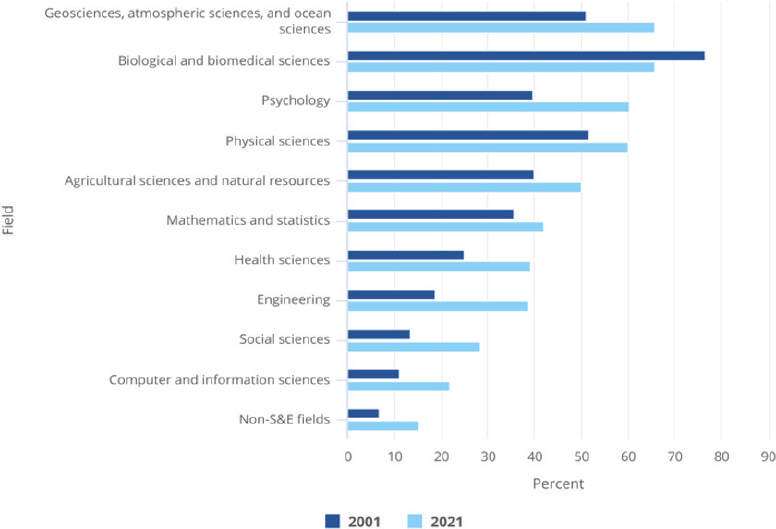
Data from 2019 to 2021 show that biological and biomedical science are the only surveyed fields in which the proportion of newly minted PhDs pursuing postdoctoral training decreased (NSF NCSES, 2021). The number of doctorate recipients in the biological and biomedical sciences committing to an industry position after earning their degree has increased to approximately 68% in 2022, compared to approximately 39% in 2002 (NSF NCSES, 2022b). In 2022, approximately 20% of new doctorate recipients in biological and biomedical sciences had committed to academic employment, down from more than 40% in 2002 (NSF NCSES, 2022b).
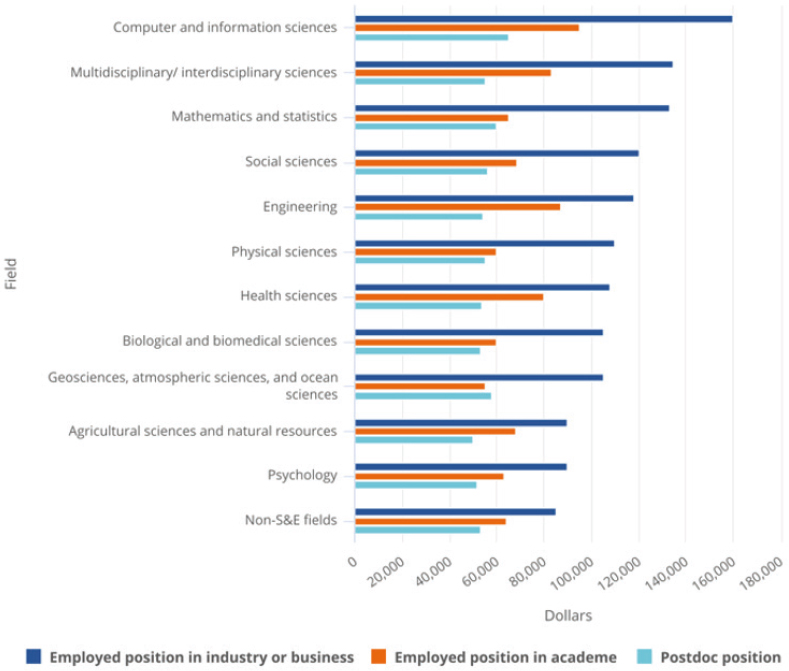
The same data set also reveals that postdoctoral salaries are lower than those offered by industry or other academic positions across all fields, a strong disincentive for entering postdoctoral training (see Figures 6-2 and 6-3). Median annual salaries for biological and biomedical science doctorate recipients were approximately $52,000 for a postdoctoral position, $68,000 for an academic position, and $110,000 for an industry position (NSF NCSES, 2022b).
Postdoctoral scholars’ employment status—whether they are considered employees or trainees—depends on their funding source and determines the benefits they receive (NPA, 2019). Postdoctoral scholars earn historically lower stipends with minimal benefits compared to employment in academia or industry, as illustrated in Figure 6-3. This lack of comprehensive compensation is considered by some to devalue the critical contributions of postdoctoral scholars to the U.S. biomedical research enterprise and provide significant disincentives to pursuing a career in academic research. This perspective appears to be supported by data showing consistently decreasing commitments of new PhDs to postdoctoral positions—a trend that is weakening the U.S. biomedical research enterprise’s pipeline of new researchers.
SOURCE: NSF NCSES, 2021.
CONTRIBUTIONS OF INTERNATIONAL SCIENTISTS
The American education system attracts more than 1 million international students every year, making higher education one of America’s top exports, generating more than $44 billion in revenue in 2019 (Khanna, 2021). However, pandemic-era visa restrictions in 2020 reduced new international student enrollment—including K–12 enrollment—by 72% (DHS, 2021).
At the predoctoral level, U.S. citizens continue to represent most of the student population in both health and biological sciences—although the percentage decreased from 87.9% in 1980 to 72.1% in 2020 in science and from 95.1% in 1980 to 89.7% in 2020 in health (NSF NCSES, 2022a). However, at the postdoctoral level, the proportion of international scholars in both fields has exceeded the number of U.S. citizens and permanent residents for the past two decades (NSF NCSES, 2022a). The number of postdoctoral scholars in both health and science professions has been relatively flat for about the past 10 years—growing or declining by less than 10% year over year—signaling a lack of growth in the biomedical research
SOURCE: NSF NCSES, 2021.
workforce (NSF NCSES, 2022a). These shifts are concerning and indicate that U.S. citizens with MDs or PhDs are not pursuing postdoctoral or academic biomedical research training at the rate that foreign-born scholars are.
Compared with 20 years ago, the number of temporary visa holders in health profession training programs pursuing U.S.-based positions after graduation has nearly doubled (NSF NCSES, 2022a). In 2020, 78% of life sciences doctorate recipients had definite commitments to remain in the United States, compared to 72.7% in 2000, demonstrating a strong and growing desire to begin a career in the United States (NSF NCSES, 2020b).
The U.S. biomedical workforce relies heavily on contributions from temporary visa holders as postdoctoral scholars, but the proportion of international predoctoral
students has plateaued—and even declined by 10% during the COVID-19 pandemic (NSF NCSES, 2022a). The data show that individuals who come to the United States to earn doctoral degrees tend to stay and accept permanent positions, enriching the research environment and America’s knowledge capital. However, temporary visa holders in postdoctoral positions are not eligible to apply for federal funding, limiting the ability of talented individuals to launch independent research careers in the United States. Efforts to ensure the current and future vibrancy of the U.S. biomedical research enterprise workforce should include a focus on reducing barriers to international student participation in U.S. higher education and subsequent transition into postdoctoral scholarship and permanent careers.
COMPETITIVE FUNDING, EMPLOYMENT, AND SALARIES ARE NECESSARY TO ENSURE FUTURE GROWTH
Federal funding for biomedical research has not experienced significant growth since 2003, with overall funding declining between 2010 and 2013 (AAAS, 2022). It is the opinion of the authors of this Special Publication that this static availability of federal research funding has led to a more cautious approach in awards, in that agencies favor what some would deem “safer” projects with longer history and more data supporting their eventual outcomes. This trend also likely favors established investigators over early-career scholars, consequently stifling the launch of promising careers, as well as potentially high-risk, high-reward research proposed by researchers across the career spectrum.
Relatively flat federal funding, compounded with more frequent continuing resolutions in the federal budget process, contributes to instability and uncertainty throughout the U.S. biomedical research enterprise (Lautz and Fano, 2024). This uncertainty is particularly felt by portions of the biomedical research workforce who rely on federal funding. Increasingly frequent threats of government shutdowns—consequently halting research for unpredictable lengths of time—likely make biomedical research less appealing to talented scholars who are already increasingly seeking employment in academia or industry. Congressional appropriations and policies should be mindful of their outsized and immediate impact on the people who make U.S. biomedical research possible. This talent pool sees growing opportunities outside of the federal government and even outside America entirely and cannot be easily replaced once lost.
Many individuals who study biomedical or health sciences in undergraduate and graduate school bring a passion for their work, scientific discovery, and helping others in their everyday lives. However, we, as a nation, cannot continue
to rely on their goodwill to carry them from school into postdoctoral positions that are often underpaid—compared to their peer positions—and do not include a living wage or basic benefits such as paid leave and disability coverage. In 2020, the median salary for a male life sciences doctorate recipient with plans to pursue postdoctoral study was $50,000, while the average median salary for the same recipient who planned to pursue full employment was $89,000 (NSF NCSES, 2020a). The math here is clear—for individuals with student loan debt, other debt, caregiving commitments, or who simply want to make a better living—there is no comparison between the compensation of postdoctoral research versus employment. Fellowship and training stipend levels are set annually by the Secretary of the Department of Health and Human Services. In 2024, the highest possible stipend for the most experienced postdoctoral scholar was $74,000—still $15,000 less per year than the median annual salary for someone pursuing full-time employment (NIH NIAID, 2024).
In 2023, the NIH Advisory Committee to the Director Working Group on Re-Envisioning NIH-Supported Postdoctoral Training completed an analysis of the state of postdoctoral training in the United States (NIH Advisory Committee to the Director, 2023). The working group identified “a systemic inertia favoring longstanding, normalized behaviors and incentive structures that do not foster a healthy research and mentoring culture” as a reason why past recommendations to improve the postdoctoral career stage remain unaddressed (NIH Advisory Committee to the Director, 2023). The report also identified fragmentation as a challenge to addressing and correcting systemic problems in workforce development. The NIH Office of the Director responded to this report by raising the pay scales of “predoctoral and postdoctoral scholars at NIH-funded external institutions who are recipients of the Ruth L. Kirschstein National Research Service Awards,” but note that “the amended pay levels do not reach the full funding increase recommended by the advisory group” because of existing NIH funding constraints, illustrating that increasing postdoctoral pay cannot be accomplished by a single institution (NIH, 2024c). As a nation, we must acknowledge the critical contributions of our current and future knowledge capital and ensure that its strength persists.
Concerns about the U.S. biomedical research workforce and plans to strengthen the pipeline can no longer ignore the need for adequate and appropriate compensation. Americans cannot ask thousands of current postdoctoral researchers to struggle with their own finances, take unpaid leave, and worry about funding interruptions to help develop therapies, diagnostics, and knowledge that benefit us all.
DIVERSIFYING THE BIOMEDICAL RESEARCH WORKFORCE
In the health professions, the postdoctoral scholar population has become slightly more diverse over time, but the trends are not yet significant enough to signal real progress. Between 2017 and 2021, the number of Black postdoctoral appointees—across all surveyed fields, not just health and biomedical research—grew by 13.1% (Gordon et al., 2023). However, that 13.1% translates to only 133 more Black postdoctoral researchers—from 1,019 in 2017 to 1,1522 in 2021 (Gordon et al., 2023). Black postdocs who are U.S. citizens compose just 26% of all appointees in 2021, a rate that dropped from 29.5% in 2017 (ethnicity and race data were not collected for temporary visa holders) (Gordon et al., 2023). Similar rates hold for Hispanic/Latino postdocs—29.1% growth from 2017 to 2021, from 1,659 to 2,142 (Gordon et al., 2023). Distressingly, appointment rates for American Indian or Alaska Native and Native Hawaiian or Other Pacific Islander postdoctoral researchers dropped precipitously during the same period—negative 36% and 66.1%, respectively (Gordon et al., 2023).
Even more confounding, the increase in Black and Hispanic/Latino postdoctoral scholars has been primarily driven by a decrease in White postdoctoral scholars rather than an absolute increase in underrepresented minorities (Gordon et al., 2023). The necessity for focused recruitment of diverse researchers—particularly American Indian or Alaska Native and Native Hawaiian or other Pacific Islanders—is clear. As described more thoroughly in Chapter 4, a diverse workforce will help ensure progress toward reducing health disparities and achieving health equity, as well as support the U.S. biomedical research enterprise in reaching its full potential.
In terms of gender differences, women in predoctoral health sciences programs in 2020 far exceeded men—76.4% women versus 23.6% men (Gordon et al., 2023). However, the number of male and female postdoctoral appointees in the same health sciences programs is nearly even, at 50.7% women versus 49.3% men (Gordon et al., 2023). It is worth investigating what is happening between graduate school and postdoctoral appointments that is causing the “loss” of greater than 25% of women with advanced degrees. This loss is particularly concerning given that patient–provider concordance can improve patient outcomes and even, in some cases, prevent death (Szabo, 2024). A dearth of female scientists and medical professionals may also exacerbate the lack of attention to health issues that disproportionately impact women.
In science, gender disparities are still apparent but less striking than in the health sciences. The percentage of women in predoctoral science programs was 51.1% in 2020, compared to 48.9% of men (Gordon et al., 2023). When moving to postdoctoral appointments, the gap widens considerably to 41.2% of
women compared to 58.8% of men—illustrating a significant gap that demands investigation and intervention (Gordon et al., 2023). Although gender equity is present in the early stages of the biomedical research pipeline, the number of women who leave the field between graduate school and full-time employment is alarming and must be addressed to ensure a diverse U.S. biomedical research enterprise workforce.
THE IMPORTANCE OF PHYSICIAN-SCIENTISTS
Physician-scientists—those “who see patients, teach the next generation of doctors, and do research to understand disease”—are a critical but diminishing section of the U.S. biomedical research enterprise workforce (Utz et al., 2022). Although the exact number of physician-scientists in the United States is difficult to measure, several indicators show that the percentage of physicians who both practice medicine and conduct research is declining (Garrison and Ley, 2022). Physician-scientists receive training that makes them especially well equipped to translate research into treatments and diagnostics, identify rising health challenges, assist in policy negotiations, and communicate science effectively (AAMC, n.d.). However, physician-scientists face the same financial challenges as their peers outlined elsewhere in this chapter, as well as unique challenges including a lack of mentors, reduced basic science education, and the increasing complexity of technology and big data required to conduct research (Utz et al., 2022). The U.S. biomedical research enterprise of the future will be incomplete without the contributions of physician-scientists, and as such, their importance—as well as the unique challenges they face—must be recognized and addressed head-on.
REINFORCING THE PIPELINE ACROSS THE EDUCATION CONTINUUM
The path to entering the U.S. biomedical research enterprise workforce is lengthy, and almost inevitably begins with K–12 STEM education. Exposing young people to careers in science, engineering, technology, mathematics, and medicine is critical to maintaining a robust pipeline of excellent scientists and ensuring that all U.S. children can pursue careers they are passionate about. Many reports, including Rising Above the Gathering Storm—mentioned in greater detail in Chapter 1—have called for a renewed focus on improving and expanding K–12 STEM education (NAS et al., 2010). This is not a novel priority area, but it is increasingly critical to maintaining and expanding our robust, effective, and productive U.S. biomedical research enterprise workforce.
CALL TO ACTION
The U.S. biomedical research enterprise cannot achieve its goals without the scientists, health care professionals, researchers, and allied personnel who support its work. Ensuring that the enterprise is a desirable and achievable employment path is critical to ensuring a pipeline of dedicated and intelligent workers who will continue to contribute to the knowledge capital of the United States and the world. However, there are several challenges to achieving this vision, including ensuring that international scientists can continue to come to America, receive an education, and start a career; that salaries and benefits packages for postdoctoral scholars are competitive with comparable positions; that federal funding for biomedical research is more accessible and stable; and that employment in the biomedical research workforce is achievable and welcoming to all—especially Native American or Alaska Native and Native Hawaiian and Other Pacific Islander individuals.
To achieve this vision, the authors of this Special Publication propose the following:
Priority 5: Steps by the federal government and Congress to increase the competitiveness of the U.S. biomedical research enterprise workforce, including the following key priorities:
- Align the U.S. biomedical research enterprise’s national strategic vision with the needs of its workforce and set goals to meet those needs;
- Incentivize and implement appropriate, specialized, and necessary education and training for all levels of the U.S. biomedical research workforce—including a reinvigorated focus on K–12 STEM education to reinforce the pipeline at its earliest stages;
- Remove barriers that may prevent full accommodation and integration of international scientists into the U.S. biomedical research enterprise workforce, including expanding eligibility for federal research funding to temporary visa holders;
- Expand Early-Stage Investigator funding opportunities, particularly for physician-scientists, to help stabilize the career-launch phase of becoming an independent investigator;
- Reclassify federally funded postdoctoral scholars as employees and provide full benefits to remove unpredictability and make these positions more attractive, including the following potential approaches:
- Significantly shortening the duration of postdoctoral training so that scholars gain independence faster,
- Allowing postdoctoral scholars to apply for their own federal funding, and
- Creating PhD-to-faculty positions, which would provide new pathways to stable employment;
- Promote the importance of physician-scientists to the biomedical research enterprise and support their training, education, and professional work, including the following potential approaches:
- Expanding and increasing scholarships specifically for physician-scientists,
- Protecting research time and salary support,
- Connecting postdoctoral scholars with mentors, and
- Employing innovative and immersive training and research programs; and
- Prioritize and implement innovative approaches to recruiting and retaining the specialized workforce, including by expanding student loan forgiveness, providing new funding modalities for postdoctoral trainees, and creating early career development awards for new investigators seeking to pursue research fields prioritized by the national strategic vision.
This page intentionally left blank.


