Developing and Assessing Ideas for Social and Behavioral Research to Speed Efficient and Equitable Industrial Decarbonization: Proceedings of a Workshop (2024)
Chapter: 3 Social Science Research Needs for Understanding and Planning for Labor Impacts of a U.S. Low-Carbon Energy Transition
3
Social Science Research Needs for Understanding and Planning for Labor Impacts of a U.S. Low-Carbon Energy Transition
The second panel, moderated by Susan Tierney, Planning Committee Chair and Senior Advisor at Analysis Group shed light on the intricate dynamics associated with potential labor impacts during the U.S. low-carbon energy transition. Delving into the broad labor impacts across sectors, occupations, and geographies, panelists considered historical as well as future industrial transitions. They also explored policies that could mitigate workforce disruption as the nation transitions to a net-zero economy and offered suggestions for developing a comprehensive social science research agenda.
UNDERSTANDING AND PREPARING FOR THE LABOR IMPACTS OF DECARBONIZING THE U.S. ECONOMY: A PROPOSED RESEARCH AGENDA
Shade Shutters, Research Scientist at the School of Complex Adaptive Systems in the College of Global Futures at Arizona State University, co-authored a paper with José Lobo1 outlining their proposed research agenda. Shutters focused his discussion on research questions related to understanding the impact—specifically on workers—of the transition to a decarbonized economy. Identifying the fear of significant labor disruptions as a potential major hindrance to decarbonization efforts, he emphasized the important role of social scientists who can conduct high-quality research and, in so doing, offer objective evidence to address these fears.
Shutters noted two significant labor concerns, explaining that neither is entirely unfounded, although each is possibly exaggerated. The first involves fears about job obsolescence in certain occupations—particularly legacy energy production. To illustrate his point, he noted coal mine closures in Germany that led to protests and right-wing extremism,2 as well as fears fueled by media reports focusing on related concerns, such as a Boston Globe
___________________
1Shutters, S. T., & Lobo, J. (2024). [Understanding and preparing for the labor impacts of decarbonizing the U.S. economy: A proposed research agenda]. Commissioned paper for the Committee on Developing and Assessing Ideas for Social and Behavioral Research to Speed Efficient and Equitable Industrial Decarbonization: A Workshop. The paper is available at: https://www.nationalacademies.org/event/41881_02-2024_developing-and-assessing-ideas-for-social-and-behavioral-research-to-speed-efficient-and-equitable-industrial-decarbonization-a-workshop
2Ibid.
SOURCE: Shutters, S. T., & Lobo, J. (2024). [Understanding and preparing for the labor impacts of decarbonizing the U.S. economy: A proposed research agenda]. Commissioned paper for the Committee on Developing and Assessing Ideas for Social and Behavioral Research to Speed Efficient and Equitable Industrial Decarbonization: A Workshop. Reprinted with permission.
article on mass layoffs.3 Highlighting the universal importance of jobs, he referenced a recent headline indicating that people in Taiwan are more worried about employment than a potential war.4
The second concern Shutters mentioned in the energy transition context relates to the potential lack of preparedness for new jobs.5 Despite the push for acquiring “green skills,” he noted the absence of a clear definition in this area. The current United Nations definition states “green skills are the knowledge, abilities, values and attitudes needed to live in, develop and support a sustainable and resource-efficient society.”6 He noted that this definition creates uncertainty about how values and attitudes equate to worker skills and suggested that social scientists could address labor concerns.
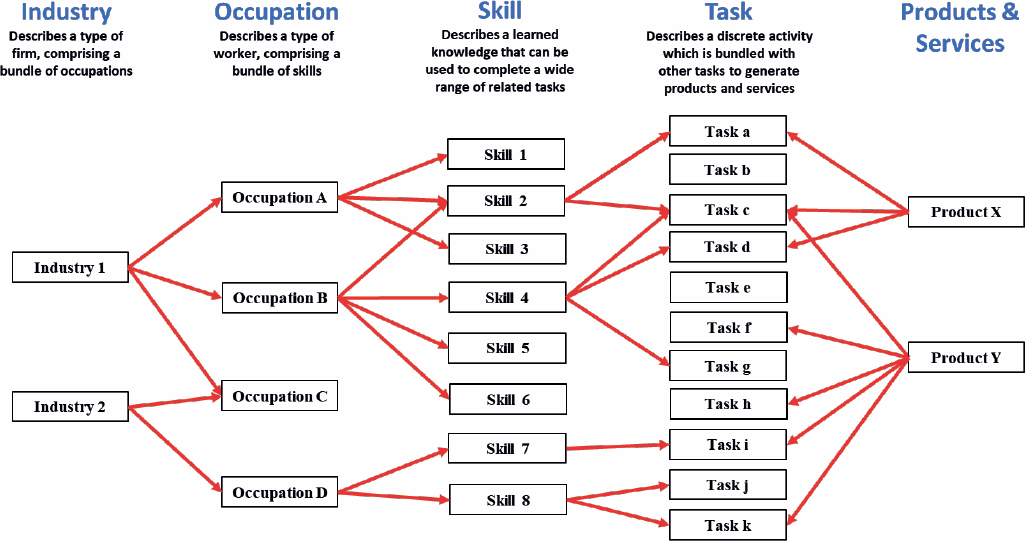
Shutters and Lobo’s research agenda revolves around two main worker- and decarbonization-related questions: 1) How will workers be impacted? 2) How can policymakers mitigate those impacts? Shutters shared a potential framework for analyzing labor impacts (Figure 3-1). He emphasized that the current focus on green skills, as well as the historical focus on “green occupations” and “green jobs” have—like the U.S. Bureau of Labor Statistics’ definition7—proven unhelpful. Shutters and Lobo’s paper argues that social scientists would benefit from shifting
___________________
3Hanson, G. (2023, February 1). Avoiding job loss in the transition to renewable energy. The Boston Globe. https://www.bostonglobe.com/2023/02/01/opinion/avoiding-job-loss-transition-renewable-energy/
4Wong, T. (2024, January 11). Taiwan election: It’s not war young voters worry about – it’s jobs. BBC News. https://www.bbc.com/news/world-asia-67945643
5Holger, D. (2023, July 6). America’s green skills gap raises concerns about energy transition. The Wall Street Journal. https://www.wsj.com/articles/americas-green-skills-gap-raises-concerns-about-energy-transition-90095ab0
6Arthur, C. (2022, August 8). What are green skills? United Nations Industrial Development Organization. https://www.unido.org/stories/what-are-green-skills
7U.S. Bureau of Labor Statistics. (2013, January 25). Green jobs overview. https://www.bls.gov/green/overview.htm
their focus to the task level, emphasizing the skills required for specific jobs (e.g., solar panel installers) linked to evolving products and services in a decarbonized economy. This dual approach, he suggested, would provide a more comprehensive analysis of the issue.
Next, Shutters discussed occupations that will remain available in a decarbonized economy. Some occupations, such as coal miners, face a significant impact, but they are exceptions. For many, their core functions may remain the same, he added. For example, auto mechanics’ job responsibilities may require a shift in focus based on the need to repair electric vehicles, but their current function will remain the same given the ongoing need to learn about new models, diagnose and repair issues, and use the same basic tools. New jobs, like solar panel installers, despite being labeled as green jobs often involve skills already present in other occupations. Such similarities, Shutters pointed out, challenge the notion that distinct new “green skills” are needed for these roles. Shutters and Lobo’s research agenda aims to systematically examine changes across occupations and responses in a decarbonized economy (i.e., worker impacts ranging from almost no noticeable difference to the obsolescence of a certain occupation). Shutters suggested that analyzing changes in tasks, skills, occupations, and industries could allow quantification of decarbonization-related job impacts and align negative impacts with appropriate interventions. It is possible that most impacts will be minimal, he went on to say, but determining the specifics represents an important challenge for social scientists.
A key component of the research agenda that Shutters shared related to investigating the impact of decarbonization on workers by addressing several major questions:
- How will employment effects of decarbonization vary across industry sectors?
- In what ways will employment-related impacts of decarbonization differ based on occupation?
- What is the influence of decarbonization on various products and services?
- How will employment impacts of decarbonization differ geographically?
Shutters emphasized the importance of disruption mitigation strategies, recognizing their contextual nature based on industry, occupation, and worker demographics—particularly age. He noted the related opportunity to gain a better understanding of how labor can build resilience against future transitions and shocks. Research agenda questions related to interventions designed to mitigate worker disruption in the context of decarbonization include the following:
- What low-resistance pathways exist for workers to transition from legacy occupations and industries to new ones?
- To what extent will decarbonization necessitate worker relocation compared to the possible need for upgraded skills?
- How do factors like worker age and experience influence the success of various strategies for mitigating disruption?
- What strategies can be employed to increase the resilience of the future workforce in the face of disruptive changes?
Shutters noted the importance of understanding how scale relates to the nature of work. As an example, he said worker skills for a specific occupation vary systematically across occupations and geographical locations, and research is needed to contextualize the impacts and thus the interventions.
Shutters went on to remark that historical analysis is integral to the research agenda. Drawing on the example of the swift transition to a war economy during World War II, he observed that this shift did not necessitate specific “war skills.” Instead, workers applied their existing skills to new tasks, resulting in minimal mass layoffs. The focus was more on adapting equipment and procedures than on workers reconfiguring or acquiring new skills. This historical perspective, Shutters suggested, demonstrates the importance of critically analyzing past transitions to extract lessons applicable to the decarbonization process.
In his closing remarks, Shutters noted that labor disruptions are hindering decarbonization policies. Given this reality, he emphasized the opportunity for social scientists to accelerate the decarbonization process by assessing
the nature of disruptions and suggesting solutions. He explained that analyzing worker tasks could offer solutions that align with the workshop’s overarching goal of advancing decarbonization efforts. To address data challenges, he noted that the paper suggests various methods and outlines diverse data sources. At the same time, crucial information is constrained by legal barriers such as those presented by the Department of Commerce and the Department of Labor. Shutters urged federal agencies to not only facilitate access to these data but also enhance the pace of research efforts and the development of solutions.
NAVIGATING THE COMPLEXITIES OF INDUSTRIAL TRANSITIONS: A HOLISTIC APPROACH TO WORKERS, WORKPLACES, AND WORK
Dimitris Stevis, Professor of Politics at Colorado State University, organized his remarks around “what we need to know” about transitions, workers, workplaces, and work. He adopted this analytic scheme based on his prior involvement in a project titled Adapting Canadian Work and Workplaces to Respond to Climate Change.8 He also noted that his past participation in the Just Transition Listening Project,9 organized by the Labor Network for Sustainability, contributed to his insight in this context and his ongoing research on and participation in Colorado’s just transition policy.10
Stevis emphasized that efficient and equitable transitions require a holistic approach focusing not only on skills and jobs but also on workers as individuals and citizens. This holistic perspective is necessary for achieving industrial decarbonization transitions, which can have broad societal impacts.11 He encouraged the continued formation of transdisciplinary teams that can help frame and conduct transition-related research.
To understand workers holistically, Stevis pointed to the need to analyze them as individuals, looking not only at factors such as age and skills but also their experience as members of families and communities.12 Especially for people in declining industrial sectors, he said, family and community obligations are essential components. Additionally, Stevis emphasized understanding the factors shaping why people end up in specific places.13
Next, Stevis reviewed the resources available to workers, including their mobility, skills, employment, income, and property. While skills are vital, the absence of employment prospects, he emphasized, can hinder a successful transition. Income loss affects families and communities, especially in areas losing key industries. He mentioned workers’ benefits and rights, particularly with respect to health care which can be a primary concern. He said the absence of a national health care system can pose challenges during transitions, highlighting the need for comprehensive solutions. Going further, he suggested a distinct need for crafting comprehensive federal policies and support for just transition.14
Stevis’s comments focused on workplace organization because broader transitions are caused by and associated with transitions in the organization of workplace-related impacts occurring during transitions. Essential factors that he noted include bundles of skills and tasks, the organization of work processes (e.g., unionization in utility scale renewables versus distributed renewables), and labor standards and rights.15 He highlighted other
___________________
8More information about Adapting Canadian Work and Workplaces to Respond to Climate Change is available at https://hdl.handle.net/10315/38593
9More information about the Just Transition Listening Project is available at https://www.labor4sustainability.org/just-transition-listening-project/
10More information on Colorado’s just transition policy is available at https://cdle.colorado.gov/the-office-of-just-transition
11Abram, S., Atkins, E., Dietzel, A., Jenkins, K., Kiamba, L., Kirshner, J., Parkhill, K., Pegram, T., & Santos Ayllón, L. (2022). Just Transition: A whole systems approach to decarbonization. Climate Policy, 22(8), 1033–1049. https://doi.org/10.1080/14693062.2022.2108365
12Cha, J. M., Price, V., Stevis, D., Vachon, T. E., & Brescia-Weiler, M. (2021). Workers and communities in transition: Report of the Just Transition Listening Project. Labor Network for Sustainability. https://www.labor4sustainability.org/jtlp-2021/jtlp-report/
13Lim, J., Aklin, M., & Frank, M. R. (2023). Location is a major barrier for transferring US fossil fuel employment to green jobs. Nature Communications, 14(5711). https://doi.org/10.1038/s41467-023-41133-9
14Aklin, M., & Urpelainen, J. (2022, August 2). Enable a just transition for American fossil fuel workers through federal action. Brookings. https://www.brookings.edu/articles/enable-a-just-transition-for-american-fossil-fuel-workers-through-federal-action/; Cha, J. M., Price, V., Stevis, D., Vachon, T. E., & Brescia-Weiler, M. (2021). Workers and communities in transition: Report of the Just Transition Listening Project. Labor Network for Sustainability. https://www.labor4sustainability.org/jtlp-2021/jtlp-report/
15Davidson, B. (2023). Labour on the leading edge: A critical review of labour rights and standards in renewable energy. Energy Research & Social Science, 97, 102928. https://doi.org/10.1016/j.erss.2022.102928
considerations such as examining the positionality of workers and workplaces within social value chains,16 workplace vulnerability and/or sensitivity to change, and positionality within systems of industrial relations and welfare policies.
Regarding “what we need to know about work,” Stevis noted that our understanding can benefit from extensive literature dating back to the 1990s, such as Kate Crowley’s research on green jobs for Australian Trade Unions. The distinction between light-green, mid-green, and deep-green jobs, outlined by Crowley, spans the spectrum from job commitments to more extensive ecological modernization commitments within firms and production processes.17 Discussions on good jobs18 and decent work,19 led by the International Labor Organization and researchers like Michael Renner, can still provide valuable insights, Stevis pointed out. He went on to mention other areas requiring more research, including whether jobs are just, equitable, and fair in terms of inclusion and exclusion.20 He emphasized that research inquiry needs to extend beyond whether green jobs contribute to a fair distribution of benefits in particular places while, possibly, leading to zones of sacrifice across space and time.21
In closing, Stevis reiterated that it is crucial to recognize that transitions impact not only workers as individuals, but also their communities. To achieve efficient and equitable transitions, he suggested a holistic research agenda involving both transdisciplinary teams and a consideration of the value of using whole systems to understand and manage transition-related complexities.
RESEARCH NEEDS FOR LABOR TRANSITIONS
Erin Mayfield, Hodgson Family Assistant Professor of Engineering in the Thayer School of Engineering at Dartmouth College, suggested moving beyond the predominant narrative of job creation and loss by fostering research that expands the understanding of and promotes planning for the complexities of labor transitions in the United States. The multi-faceted nature of these labor transitions, Mayfield emphasized, covers dimensions such as labor supply and demand; evolving labor productivity and automation; the interplay of labor with politics and public policy; the structure of organizations and labor movements; considerations of just transitions and workforce equity; and the impacts of climate change on labor, labor migration, and boom and bust cycles. Underscoring the richness of labor transition research, she emphasized that much remains to be explored.
Mayfield suggested that the numerous multi-layered dimensions associated with labor transitions require an interdisciplinary research approach that incorporates the social sciences; natural sciences; and the science, technology, engineering, and mathematics (STEM) fields. To understand the complexities involved, she proposed conceptualizing convergent research designs by looking at the interactions between computational modeling, stakeholder engagement, and decision-making tools. Computational modeling includes techno-economic pathways modeling, labor supply and demand modeling, supply chain analysis, lifecycle assessment, and multi-criteria analysis. These models include a consideration of factors such as costs, technologies, legacy pollution, air pollution, and social
___________________
16International Trade Union Confederation, IndustriALL Global Union, & LO Norway. (2022). Just transition and the energy sector: 2022 roundup. https://www.ituc-csi.org/the-just-transition-initiative-in
17Crowley, K. (1999). Jobs and environment: The “double dividend” of ecological modernisation? International Journal of Social Economics, 26(7/8/9), 1013–1027 https://doi.org/10.1108/03068299910245787
18Materra, P., Dubro, A., Gradel, T., Thompson, R., Gordon, K., & Foshay, E. (2009). High road or low road? Job quality in the new green economy. Good Jobs First. https://goodjobsfirst.org/wp-content/uploads/docs/pdf/gjfgreenjobsrpt.pdf
19Renner, M., Sweeney S., & Kubit, J. (2008). Green jobs: Towards decent work in the sustainable low-carbon world. United Nations Environment Programme, International Labour Organization, International Organisation of Employers, International Trade Union Confederation. https://www.ilo.org/global/topics/green-jobs/publications/WCMS_158727/lang--en/index.htm
20Zabin, C., Martin, A., Morello-Frosch, R., Pastor, M., & Sadd, J. (2016). Advancing equity in California climate policy: A new social contract for low-carbon transition. Center for Labor Research and Education. http://laborcenter.berkeley.edu/pdf/2016/Advancing-Equity-Executive-Summary.pdf; Stevis, D. (2012). Green jobs? Good jobs? Just jobs? USA labour unions confront climate change. In N. Räthzel & D. Uzell (Eds). Trade unions in the green economy: Working for the environment (pp. 179–195). Earthscan/Routledge.
21Riofrancos, T., Kendall, A., Dayemo, K. K., Haugen, M., McDonald, K., Hassan, B., & Slattery, M. (2023). Achieving zero emissions with more mobility and less mining. Climate and Community Project. https://www.climateandcommunity.org/more-mobility-less-mining; Zografos, C. & Robbins, P. (2020). Green sacrifice zones or why a green new deal cannot ignore the cost shifts of just transitions. One Earth 3(5), 543–546. https://doi.org/10.1016/j.oneear.2020.10.012; Stevis, D. (2023). Just transitions: Promise and contestation (Elements in Earth system governance). Cambridge University Press. https://doi.org/10.1017/9781108936569
equity. Stakeholder engagement—accomplished through surveys, interviews, workshops, mental modeling, and expert elicitation—can help incorporate individual values and preferences into the research. She pointed out that translating insights from computational modeling and stakeholder engagement into decision-making platforms and databases can help stakeholders make informed decisions regarding labor transitions.
Accessing transparent data on infrastructure investments and labor is crucial for decision making and accountability, Mayfield emphasized. Public platforms, for example, the White House platform detailing infrastructure investments, provide some data,22 but she highlighted the need for similar investment-related information on projected employment, wages, skills, and job quality. She suggested this could be achieved either through scraping data from Community Benefit Agreements or simulation modeling.
Mayfield pointed out that since understanding job creation and loss is essential, additional data collection and reporting through the Bureau of Labor Statistics could contribute to this knowledge. Models of labor as well as supply and demand are valuable for short- and long-term transition planning. She noted that anticipating energy supply-related industry job shifts occurring in the process of achieving net-zero targets requires planning for near-term shocks, labor supply constraints, and long-term boom and bust cycles. She emphasized that the nature of transitions will vary based on the pathway chosen to meet climate targets.
Mayfield’s next point was that effective planning involves recognizing complementary elements—such as geography, time, skills, and job quality—in the area of labor supply and demand. As an example, she mentioned how West Virginia might face near-term declines due to the shift away from fossil fuels, but strategic public policies could mitigate losses and foster efficient and equitable outcomes. She envisioned that mitigation efforts could involve providing incentives for manufacturing in regions that have historically hosted fossil fuels.
Mayfield explained that modeling can be used to evaluate labor implications of alternative public policy designs. For example, mechanisms within the Inflation Reduction Act can impact labor by increasing demand, supply, and redistribution of labor benefits. Provisions such as the bonus rate investment and production tax credit can reduce development costs and boost infrastructure deployment, thereby increasing labor demand. Simultaneously, certain provisions can be used to train the labor force and facilitate their retention, thus increasing labor supply. Similarly, the Energy Community Tax Credit Bonus not only boosts labor demand but also redistributes labor benefits by incentivizing investment and deployment in specific regions. Other provisions—like the 45X manufacturing tax credit—increase labor demand, which reduces costs and increases domestic manufacturing. Mayfield cited these examples to illustrate the multi-dimensional nature of labor transitions in which computational modeling, coupled with stakeholder engagement and decision-support tools, can address various aspects of labor transition-related challenges.
NAVIGATING THE COMPLEX TERRAIN OF INDUSTRIAL DECARBONIZATION LABOR IMPACTS: INSIGHTS, CHALLENGES, AND RESEARCH PRIORITIES
Tierney commented on the panelists’ comprehensive exploration of job characteristics, labor impacts, mitigation considerations, and the multidimensional nature of employment impacts as part of the industrial transition. She noted that panelists were also interested in gaining an increased understanding of work and workplaces, specifically regarding the role jobs play with respect to supporting schools, contributing to the development of vibrant communities, and promoting wealth creation. During the panel discussion, Tierney asked participants to comment on the literature describing topics such as job profiles and geographic locations relative to broader relationships tied to community involvement, community sustainability, and wealth creation. Shutters responded that his literature review examined the specific impacts of a decarbonization transition on workers rather than general characteristics of labor transitions on workers. Their review excluded broader issues such as health care, which Shutters acknowledged is significant but remains a pertinent concern irrespective of decarbonization efforts.
Acknowledging the increasing prevalence of misinformation and disinformation, Tierney’s next question related to steps social scientists are taking to counter these issues—for example, by enhancing the quality of data
___________________
22An interactive map illustrating the impact of public and private investment across the United States is available at https://www.whitehouse.gov/invest/
collection, reporting, and transparency. She sought insights into whether such efforts are effectively mitigating misinformation and disinformation or if challenges persist.
Shutters noted the difficulty of finding a clear solution to address misinformation and disinformation in the decarbonization transition. However, he expressed optimism given the research community’s robust focus on assessing levels of trust and creating online systems to ferret out misinformation and disinformation.23 Shutters underscored the need to provide policymakers with transparent and scientifically substantiated evidence to counter transition-related misinformation and disinformation. He expressed appreciation for Mayfield’s focus on computational approaches and highlighted the necessity of integrating the various tools and capabilities social scientists can offer.
Mayfield remarked on the shale gas boom, for which initial simulations projected massive job creation but actual job numbers were significantly lower. Commenting on the mistrust resulting from this discrepancy, she emphasized the importance of accurate and transparent modeling. She suggested pairing modeling efforts with a public data repository—not only to provide real-time information on the actual outcomes of transitions, but also to enhance transparency.
Stevis responded that while accurate data on numbers and types of jobs are crucial, the essence of the transition process goes beyond job figures to the ability of individuals to secure employment and sustain their families. Recognizing that the experiences of people and communities shape perceptions, he suggested that a holistic approach, designed to consider the whole person and community context can provide valuable insights. Stevis suggested that holistically focusing on affected individuals and their communities—identifying who they are, their needs, and how to support them—could address skepticism and policy resistance.
David Victor, Planning Committee Member, emphasized the uncertainty surrounding labor impacts associated with the energy transition and highlighted the idea that the more disruptive the transition, the less is known about its labor implications. He underscored the challenge of optimizing transition strategies when, as seen in the shale gas boom, key variables are both known and unknowable. Acknowledging the extensive list of potential research topics in the commissioned paper and panelist discussions, Victor noted an absence of clarity regarding prioritization and asked panelists to identify one or two crucial priorities.
Shutters, commenting on the complex and nonlinear nature of the system, advised focusing on the overarching goal of achieving carbon neutrality and then “working backward,” letting the goal guide priority setting. Shutters then asked a rhetorical question previously posed to colleagues at the Energy Transition Center: “What if society is forced to choose between an unjust transition and no transition at all?” He said this question stimulated intense discussion, with responses ranging from the view that the two could not be separated to the opinion that no possible transition would satisfy everyone’s definition of “just.” This dilemma, he said, underscores the challenging nature of decisions and prioritization that the transition demands. Regarding moral and ethical aspects, Tierney drew upon the Accelerating Decarbonization in the United States: Technology, Policy, and Societal Dimensions report,24 which concluded that an unjust transition would be both impossible and unsustainable.
Stevis suggested that the first step in the process could be prioritizing research on individuals affected by transitions, including across supply chains. Asserting that retraining alone is often ineffective, he advocated for a holistic approach addressing families’ needs in the areas of education, income maintenance, relocation support, and health care. He underscored the necessity of gathering this information early in the research process to inform policy creation. He highlighted potential surprises and pitfalls that could ensue when crucial information (e.g., health care and relocation costs) is lacking. By focusing first on understanding the needs of affected people and their communities, he remarked that valuable and comprehensive policies could be developed accordingly. Acknowledging differing perspectives on the nature of transition policies, Stevis also emphasized the need for deliberate decision making that can be used to determine standards for just, efficient, and effective policies.
___________________
23Shutters noted the Department of Defense’s Minerva Research Initiative funding social science basic research that examines misinformation and disinformation and understanding drivers of trust. More information about the initiative is available at https://minerva.defense.gov/
24National Academies of Sciences, Engineering, and Medicine. (2023). Accelerating decarbonization in the United States: Technology, policy, and societal dimensions. The National Academies Press. https://doi.org/10.17226/25931
In terms of priorities, Mayfield noted the importance of understanding barriers to implementing large federal policies aimed at labor transitions. She spoke about the need for engagement with communities, including employee and firm representatives, to gain insights into practical constraints hindering effective implementation. Echoing Stevis’s concerns, she highlighted housing as a significant constraint in meeting certain labor demand needs.
Focusing on the status of the literature related to retraining programs and workforce development, Victor asked for insights into the effectiveness of such programs and their impact on vulnerable populations. Shutters noted that, with respect to worker retraining programs, the literature contains few success stories. He added that worker retraining is a persistently obstinate problem, irrespective of ongoing transitions, technological changes, or aging workforces.
Elke Weber, Planning Committee Member, referred to Victor’s suggestion that model optimization may not be possible due to deep uncertainties. She sought reactions on incorporating approaches not previously mentioned, such as complex adaptive systems modeling. Weber also mentioned an approach used for certain robust decision-making-related work in France, which involves an iterative method for developing solutions resilient to deep uncertainties. Mayfield concurred that emphasizing a cost-optimization context is impractical for on the ground planning in both the near and long term. She suggested exploring alternative modeling frameworks, such as complex adaptive systems, which have unique uses and respective limitations. Shutters, whose background is rooted in complex adaptive systems, expressed that optimization has not been considered in relation to complex systems. He noted that these models can help guide transitions by providing quality research and transparent results to policymakers while also assisting in the implementation of decision tools. Shutters agreed that attempting to optimize outcomes in the context of such transitions might be an impractical pursuit.


