Mirror Image Biology: Pushing the Envelope in Designing Biological Systems: Proceedings of a Workshop (2026)
Chapter: 2 Chirality and Its Possible Origins
2
Chirality and Its Possible Origins
The concept of mirror biology relies on the observation that nearly all molecules of living systems are chiral, predominantly existing in a preferred form in nature. Understanding chirality is a critical prerequisite for understanding mirror biology at the molecular level and mirror life at the cellular level. This chapter begins with a brief introduction to chirality and research investigating the origins of chirality on Earth.
CHIRALITY
The planning committee1 envisioned mirror life,2 if it could exist, as comprised of synthetic biological molecules and cellular components of the opposite chirality from those found in nature, said Mukundan. In the 19th century, Louis Pasteur introduced the concept of molecular chirality (also called “handedness”), a property of a molecule that cannot be superimposed on its mirror image. Molecules exist in one or both orientations, described as “left” or “right” chirality, which cannot be superimposed on one another, in the same way human hands are oriented. Though decades old, the concept of chirality commonly is described as “handedness,” specifically achiral structures are seen to exist without “left” or “right” orientations naturally. A “left” chirality molecule is defined as an “L-isomer” or “L-enantiomer,” and a “right” chirality molecule is a “D-isomer” or “D-enantiomer.” D-DNA is found in nature, while L-DNA is a synthetic DNA made with opposite chirality. L-proteins are found in nature, so their opposite chiral forms are D-proteins and D-peptides.
Jewett named two important goals of this workshop: focusing on the technical elements necessary to activate3 or “boot up” a mirror cell and discussing the potential impacts of mirror life.4 This workshop provides an interesting opportunity to test the basic understanding of life and examine the idea of a mirror cell. Two important points to consider, he said, are the potential development of mirror-image peptides as therapeutics and awareness of the implications of mirror cells. Referring to the workshop statement of task, specifically “What is mirror biology and why is it being studied,” Jewett said that mirror biology stems from the idea of homochirality, “that the essential
___________________
1 This section is based on the presentation of Harshini Mukundan, Lawrence Berkeley National Laboratory.
2 See Table 2-1: Discussions on Defining Mirror Components for mirror biology and mirror life lexicon discussions.
3 Activation (“Booting”): The recipient cell’s existing machinery (ribosomes, enzymes, etc.) begins to “read” and execute the instructions encoded within the new, synthetic genome. This leads to the production of the proteins specified by the synthetic genome, eventually replacing the old cellular components and resulting in a new, self-replicating organism controlled entirely by the synthetic DNA.
4 This section is based on the presentation of Michael C. Jewett, Professor of Bioengineering at Stanford University.
building blocks of life exist almost exclusively in one mirror image form.” In nature, DNA and RNA are almost all right-handed because the sugars and nucleic acids that make up these genetic molecules are right-handed (or D-chiral). Amino acids, the building blocks for all proteins, are almost all in the left-handed form, or L-form, in nature.
Jewett described the different steps that would be involved in making mirror components versus mirror cells. To make mirror cells, one would follow the same steps used for making synthetic cells. The idea of building naturally chiral cells has captivated scientists for many years, said Jewett, adding that building biological systems from the ground up5 opens opportunities for new application spaces. The bottom-up approach integrates DNA, RNA, protein, and membrane synthesis in vitro, and is a build-up function. Jewett contrasted this to a common top-down synthetic biology approach of reducing bacterial genomes from natural, living cells to reduce complexity and create minimal functional, viable cells. Figure 2-1 shows a possible pathway for building synthetic cells, moving from “cell-free” or in vitro systems, specifically from systems of molecular components in a test tube, to encapsulated cell-free systems, and ultimately to synthetic cells (Rothschild et al., 2024).
Critical to efforts at creating synthetic cells (natural or mirror form) are the processes of DNA replication, transcription, and translation, and Jewett inquired about what would be needed to boot up the necessary components of these processes to create a functional synthetic cell. Specifically, he asked, how do we build the processes that construct DNA, RNA, peptides, and proteins (i.e., replication, transcription, and translation), and integrate these processes into cells to enable self-replication? The development of minimal cells built from as small as 151 genes, about 113 kilobases of DNA, has been proposed in the literature. Scientific research has reached an era

SOURCE: Presented by Michael C. Jewett on September 29, 2025. Figure created from data reported in Rothschild et al. (2024), ACS Synthetic Biology, used under the Creative Commons Attribution–NonCommercial–NoDerivatives 4.0 International license.
___________________
5 See Chapter 3: Road to Mirror Cells, section on Cell Free Systems for Creating Minimal Cells, for an explanation of building biological systems from the top down or ground up.
where it should be possible to build an entire E. coli genome at the megabase level and begin to boot up different genes in a cell free-system, he said, noting that Dr. Noireaux would be discussing the technical capability of co-expressing at least 50 molecular components later in this workshop. Jewett suggested that efforts to create minimal cells (top-down approach) is an important benchmark for the workshop’s technical framing when considering the feasibility of creating mirror life.
Terminology and Discussions on Mirror Biology vs. Mirror Life
Discussants noted the need for clear terminology to describe items that are distinct from what exists in the natural world. Even the meaning of mirror biology seems to vary in ways that are not entirely clear. Table 2-1 lists terms used during the discussion, what various participants understood each term to mean, and the workshop panel where the discussion occurred. The table is intended to frame a lexicon for these hypothetical biological entities and help clarify the discussions in these proceedings.
Box 2-1 lists terms that participants used to describe synthetic biology and biochemistry over the course of the workshop.
STUDIES ON EMERGENCE OF CHIRALITY6
Dr. Lynn Rothschild, National Aeronautics and Space Administration (NASA), and Dr. Neal Devaraj, University of California-San Diego, provided perspectives on the scientific origins of chirality and their implications for developing self-replicating mirror life. Scientists interested in how chirality emerged may examine this question in two different ways: either through astrobiology (which asks whether life exists beyond Earth) or through chemistry. The sections that follow describe how each discipline has sought to understand and describe the emergence of chirality.
How did Chirality Emerge? An Astrobiologist’s Perspective
Astrobiology is one of the oldest existing scientific disciplines, and it seeks answers to some of humankind’s most profound questions, said Rothschild. These include questions like, “where did we come from...as living organisms on planet Earth? How did we get a habitable planet…[and] solar system, galaxy, all the way back to the Big Bang? Then where are we going?” She highlighted astrobiologists’ interest in learning whether life exists beyond Earth, in studying neurobiology, and in the origins of chirality and possible existence of mirror biology elsewhere in the solar system.
Rothschild described core characteristics of biological molecules and systems that drive chirality:
- Compatibility: Biological systems require uniform chirality for their components to fit together and interact correctly, much the way a glove fits only one hand. Rothschild compared biological incompatibility to “trying to combine Lincoln Logs and Legos. It just doesn’t work.” In biology, the ribosome is an excellent polymerization machine, and dealing with two different chiralities becomes very difficult, she said. Functionally, having single chirality polymers is more efficient.
- Function: Proteins, DNA, and RNA will not function properly or fold correctly if they contain a mixture of left- and right-handed molecules.
- Efficiency: A single-handedness for molecules ensures that enzymes only need to process one type of molecular building block, preventing inefficiencies that would occur if they had to recognize and metabolize both forms.
Although the origins of chirality are not well-understood, Rothschild’s NASA colleagues speculate that a “frozen accident” resulted in a chiral preference. Francis Crick hypothesized a frozen accident scenario “for the
___________________
6 The following sections are based on the presentations of Lynn Rothschild, Senior Research Scientist, Bio and Bioinspired Technologies, Research and Technology Lead, NASA and Neal Devaraj, Professor of Chemistry and Biochemistry and the Murray Goodman Endowed Chair in Chemistry and Biochemistry at the University of California, San Diego.
TABLE 2-1 Discussions on Defining Mirror Components
| Term | Quote |
|---|---|
| Mirror biology vs. mirror lifea | Mirror biology: synthetic biological molecules…of entirely the opposite chirality from those that are found in nature. Mirror life: synthetic self-replicating organisms that are made entirely from molecules of the opposite chirality from natural life.1 |
| Mirror organismc | It is certainly within the possibility that you would have a naturally occurring mirror life form elsewhere [in the universe] … it would have that reverse chirality.2 |
| Mirror biochemistryd | Applied work with mirror biomolecules appears to be safe and should continue — this includes mirror amino acids, mirror peptides, and mirror nucleic acids.3 |
| Homochirality vs. heterochiralityc | Many organisms utilize opposite-handed molecules, and these exist quite a bit in biology, including mammals. Cell walls of bacteria incorporate D-amino acids.4 |
| Homochirality vs. heterochiralityc | [(Deng, Yu, and Blackmond, 2024)] took a racemic mixture of amino acids that were forming dipeptides. There was actually a preference for the heterodipeptide. At some point, you’re left with a homochiral mixture.2 |
| Mirror biochemistry or microbiologyc | I like mirror biochemistry … or mirror microbiology over mirror bacteria because actually, archaea are not considered bacteria, and those are an important thing out there. Mirror life is too vague, and it includes halophiles and everything.5 |
| Mirror biochemistryd | [Possible precursor technologies ranging from more benign (natural biochemistry) to more dangerous (creation of mirror bacteria)]: purely synthetic normal-handed ribosome, purely synthetic mirror ribosome, cell wall or membrane containing mirror ribosome, single isolated non-reproducing mirror cell, blocked reproduction in lab environment, blocked reproduction outside of lab environment (e.g., kill-switch).6 |
| Mirror bacteriad | There’s probably a protist out there that would be able to at least take a start at eating a mirror bacterium. While protist biology is somewhat underexplored … choanoflagellates will eat … almost anything.7 |
| Mirror proteins, L-oligonucleotides c | [With mirror image proteins] you can access … longer … more chemically pure L-oligonucleotides. I think there would be a therapeutic benefit … to make mirror image aptamers at scale for the pharmaceutical company or the DNA storage application.8 |
| Mirror molecules | The immune system tells us when something doesn’t belong, and it’s good at detecting synthetic molecules. And it can actually also detect a lot of mirror molecules, it seems, but we need to do more research in that area. But what will it do when it sees something and thinks it belongs?9 |
NOTE: Framing Type:
a Definition
b Description
c Framing
d Risk Framing
SOURCE:
1 Harshini Mukundan, Project Purpose and Goals
2 Lynn Rothschild, Panel 1: Defining Self-Replicating Mirror Biology presentation
3 James Smith, Opening Remarks - Mirror Biology Dialogues Fund
4 Neal Devaraj, Panel 1: Defining Self-Replicating Mirror Biology presentation
5 Douglas Cameron, Panel 8: Committee Reflections and Key Themes
6 Neal Devaraj, Panel 1: Defining Self-Replicating Mirror Biology presentation
7 Andrew Ellington, Panel 7: Next Steps for Modeling and Experiments presentation
8 Jonathan Sczepanski, Panel 2: Building Block Approach Question & Answer Session
9 Neha Kamat, Panel 5: Human Health Discussion presentation
BOX 2-1
Participant Terminology
Participants used the following terminology* to describe synthetic biology and biochemistry in the presentations and discussions, focusing on common terms that exist in the natural world:
Artificial cell (bottom-up): synthesis of cell-sized compartments built from natural and/or artificial molecules.a
Auxotrophy: Inability to make essential nutrients, including amino acids, often because of genetic mutation.b
Biosafety: Prevention of infections in biomedical settings or release of organisms into the environment.c
Biosecurity: Prevention of deliberate misuse of biological material and biotechnology to cause harm.c
Cell-free Gene Expression (CFE) reaction: A physiological aqueous solution that contains the machinery to express genes outside cells: cell lysate (high protein concentration), ATP regeneration system, amino acids, salts, building blocks, and solutes.a
Coacervate and protocells: Used to understand origin of life at the cellular scale, involving synthesis of cell-sized compartments using prebiotic molecules, small peptides, RNA, and fatty acids.a,d
Containment: A primary concern before considering environmental survival; informed by lab/industrial containment experiences and lessons from limited GMO releases; emphasizes testing across scales.d
Microbial diplomacy: The cooperative, negotiated side of microbial interactions (in contrast to warfare), balancing borders and limited resources.e
Microbial warfare: Environmental bacterial death through chemical warfare, predation, and phage infection. c,d
Minimal cell (bottom-up): synthesis of cell-sized compartments using natural molecules (DNA, lipids, carbohydrates, cell-free gene expression).a
Molecular chirality: a property of a molecule that cannot be superimposed on its mirror image.f
Racemate/racemic: A one-to-one mixture of L- and D-enantiomers (equal amounts of each mirror form).g
Stability: In the workshop context, the persistence of mirror molecules/proteins (e.g., D-proteins)—can be considered advantageous, but also raises concerns about environmental/physiological accumulation if ‘too stable.’h
__________________
SOURCE:
a Vincent Noireaux, Panel 3: Building Block Approach
b Douglas Cameron, Panel 8: Committee Reflections and Key Themes
c Romy Chakraborty, Panel 6: Environmental Health
d Jai Rudra, Panel 5: Human Health Discussion
e Karl Thompson, Panel 6: Environmental Health
f Harshini Mukundan, Project Purpose and Goals
g Joel Schneider, Panel 3: Building Block Approach
h Michael Imperiale, Panel 5: Human Health Discussion
* The statements and opinions listed are those of the participants and are not endorsed by other participants, the planning committee, or the National Academies.
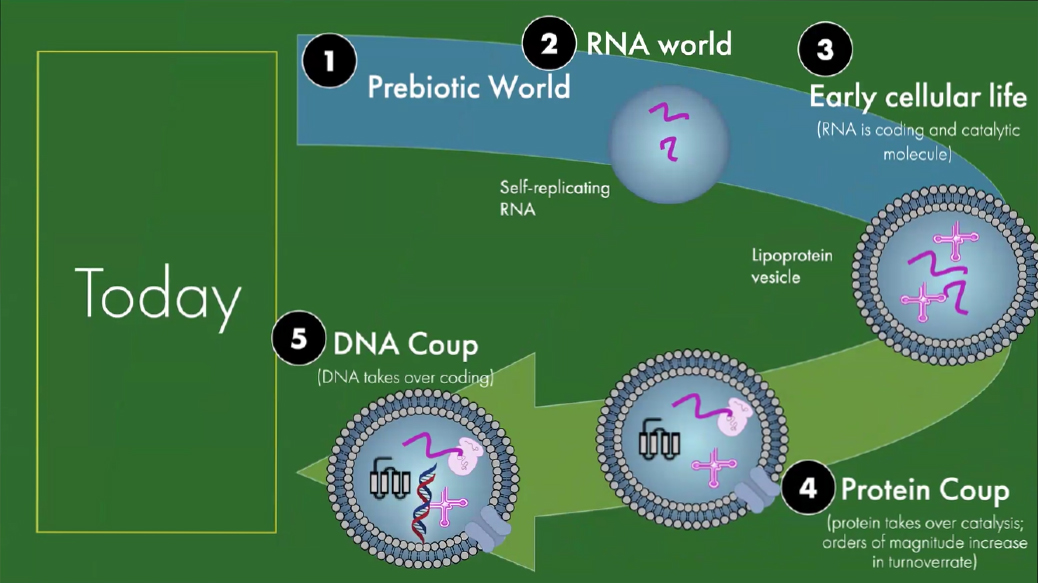
evolution of the genetic code, along with the hypothesis that the early translation system consisted primarily of RNA.” (Koonin, 2017) Koonin explains that Crick’s “frozen accident argument does not necessarily require that the original choice of codon assignment is literally and strictly random. Various factors could have contributed to the initial codon assignments…but once the choice is made, it gets frozen, i.e., only rare and minor changes may be allowed.” Scientists believe that some chiral preference occurred early during the evolution of life (see Figure 2-2), between the prebiotic and RNA worlds, added Rothschild.
Prebiotic World Theory
Rothschild highlighted a commonly held theory whereby the chirality of terrestrial life could have started in the prebiotic world. According to this theory, meteorites brought in an excess of enantiomeric molecules to Earth, serving as a great source of amino acids and sugars. This idea is supported by some scientists because neutron stars can emit circularly polarized light, which could create an enantiomeric excess, she said.
If the prebiotic theory is true, then all life in and potentially beyond our solar system is likely to be the same chirality as on Earth, said Rothschild. This would explain the tendency towards L-amino acids on earth, she said, and life with different chirality would be expected to exist only if it had been influenced by a different neutron star. Citing the OSIRIS-REx mission to asteroid Bennu (Glavin et al., 2025), she noted that samples collected from the asteroid had a remarkable range of amino acids (used in terrestrial life and non-terrestrial elements) and were a mixture of enantiomers (i.e., highly racemic). All five nucleobases (adenosine, guanine, thymine, uracil, and cytosine) were found on the asteroid, though not in any favored chiral form. Researchers who studied the molecules on Bennu suggested that comets and asteroids would have delivered a mixture to the early Earth.
Rothschild suggested that the L-handedness of amino acids may have been derived from amino acids that had an extra methyl group attached to the alpha carbon, which pushes towards a small excess of the L form (Levine et al.,2008). Amino acids containing this modification were found on the Murchison meteorite in Australia, she said,
SOURCE: Presented by Lynn Rothschild on September 29, 2025. Original image courtesy of the presenter.
noting that this excess could be amplified in water. In another study, a racemic7 mixture of amino acids forming dipeptides displayed a preference for formation of the heterodipeptide (Deng et al., 2024). The heterodipeptide tended to precipitate out of solution, providing a mixture of homochiral chains and a mechanism for enrichment of enantiomers.
RNA World Theory
Another hypothesis proposes that chirality originated in the RNA world rather than in the prebiotic world, said Rothschild. One study showed that L-amino acids force the formation of D-sugars, demonstrating a need for different chiralities for each (Breslow and Cheng, 2010). Another study found that D-RNA ribozymes interacted preferentially with L-amino acids, though the ribozymes were able to work with both L and D forms (Kenchel et al., 2024).
Today’s Biological Systems
Noting the existence of both D and L sugars, Rothschild mentioned that in various organisms, conversion between D-amino acids and L-amino acids is possible. She described the existence of two types of enzymes—epimerases, which catalyze the inversion of atoms at a molecule’s chiral center, and isomerases, which catalyze the conversion of a molecule from one isomer to another (Jin et al., 2024)—that enable inversion or conversion of D and L amino acids and sugars. Rothschild highlighted some examples of mixed chirality in nature, including: a) penicillin, which includes both D- and L-amino acids; b) the increased presence of D- and L-amino acids in the eye and brain with age; and c) table sugar, which tastes the same in D and L forms. NASA is interested in evaluating the utility of mirror biology to create novel materials that could be important for aeronautics, space exploration, or drug manufacturing, she added.
Rothschild ended her remarks by noting that the five canonical nuclear bases and almost all the amino acids on Earth are found on meteorites, and potentially on comets. She suggested that naturally occurring mirror life forms beyond Earth are possible, and they could have emerged through different evolutionary steps than occurred on Earth. As the search for life elsewhere in the universe continues, she said, it will be important to engage in both thought experiments and practical (i.e., hands-on) experiments, in order to understand where life came from.
How did Chirality Emerge? A Chemist’s Perspective
One of life’s fundamental features is that molecules are nearly all chiral and exist in one form or another, said Devaraj; indeed, this explains why NASA and other groups are looking for an overabundance of a single chirality as a sign of life. Following up on Rothschild’s remarks about homochirality as an early characteristic of life, Devaraj noted that even abiotic RNA polymerization (i.e., the chemical process of RNA synthesis without enzymes [RNA World Theory]) is inhibited by racemic mixtures. As the basis of his remarks, Devaraj posed three questions: a) how did homochirality come about; b) why do these specific orientations exist; and c) does all life, including potential synthetic or extraterrestrial life, have to adopt these orientations or have to be chiral?
Importance of Structure in Homochirality
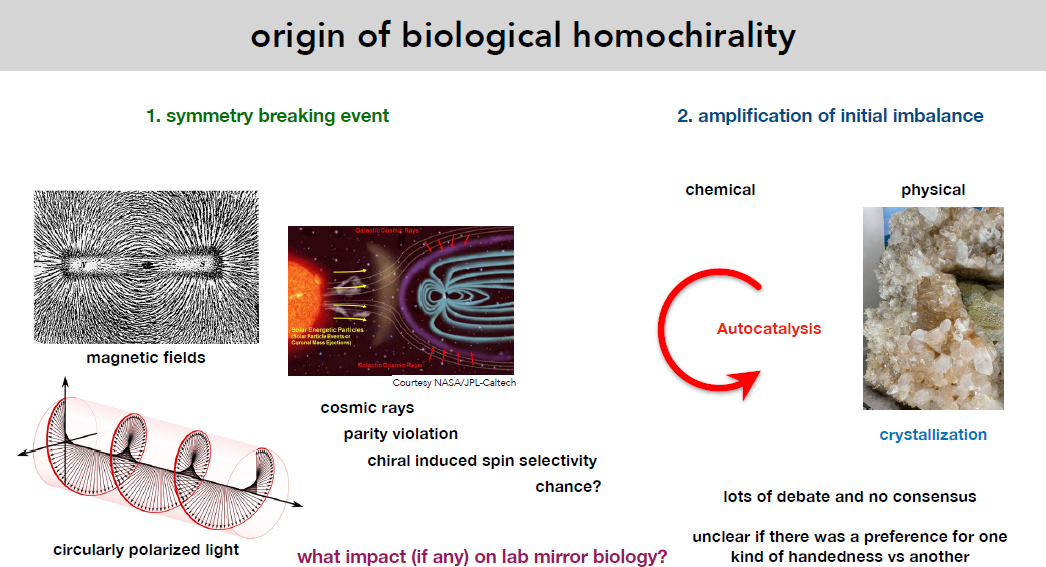
One possible reason for homochirality, said Devaraj, is its importance for maintaining stable molecular structures, such as helices. Noting that homochirality is not an absolute rule in biology, he presented two hypotheses that could explain the predominance of homochirality: symmetry breaking events and amplification of initial imbalance.
___________________
7 A racemic mixture is an equimolar mixture of two enantiomers that is optically inactive.
NOTE: Descriptions of symmetry breaking events affecting chirality, and possible sources of amplifications of the initial imbalance.
SOURCE: Presented by Neal Devaraj on September 29, 2025. Top row (left to right): Black, Newton Henry; Davis, Harvey N. (1913) “fig. 200” in Practical Physics, United States: The MacMillan Co., pp. 242. Courtesy NASA/JPL-Caltech. Smithsonian Institution. Bottom left: Available in public domain.
Symmetry breaking events
Although there is disagreement in the literature about the origin of chirality and accumulation of homochiral molecules, Devaraj noted general agreement that a symmetry-breaking event must have prompted a shift from a racemic starting mixture to one with a slight abundance of one chiral form over another (Figure 2-3). Such a symmetry-breaking event (known as parity violation8) could be caused by magnetic fields, circular polarized light (Brullot et al., 2016), or cosmic rays (Quack et al., 2022), leading to an initial imbalance in chiral forms and subsequent amplification of the slightly more common form. Devaraj cited recent studies showing that magnetic particles can influence crystallization of molecules and cause an imbalance of enantiomers. He wondered whether such phenomena would affect the creation of mirror molecules or organisms in the laboratory, perhaps leading to a slight imbalance in chiral forms, and whether this imbalance would lead to amplification of the more abundant form.
Devaraj described both chemical and physical approaches to amplifying imbalances of chiral forms. Autocatalysis is a chemical means by which a molecule catalyzes the synthesis of more copies of itself, which can lead to overabundance and turn a slight imbalance of one chiral form into a very large one. Slight differences in crystallization and solubility constitute a physical way to turn a slight imbalance into an almost completely homochiral mixture. Devaraj noted the lack of consensus among scientists as to whether these processes would lead to amplification of one chiral form over another. Repeating his and Rothschild’s previous observations that
___________________
8 “Parity conservation states that the laws of physics should not change when all the signs of a particle’s spatial coordinates are flipped.” and “The reflection (or ‘mirror’) symmetry of space is among the fundamental symmetries of physics. It is connected to the conservation law for the quantum number parity and a fundamental ‘non-observable’ property of space (as defined by an absolute ‘left-handed’ or ‘right-handed’ coordinate system). The discovery of the violation of this symmetry – the non-conservation of parity or ‘parity violation’ – in 1956/1957 had an important influence on the further development of physics. In chemistry the mirror symmetry of space is connected to the existence of enantiomers as isomers of a chiral (‘handed’) molecule.” (Quack et al., 2022)
biomolecules exist in both chiral forms naturally, but that one is significantly more abundant than another, he suggested that the idea of homochirality in nature is itself a bit of a misnomer.
Opposite-handed molecules exist in biology
Devaraj noted the existence of multiple exceptions to the rule of biological homochirality. One prominent example is the lipid divide, whereby bacteria and eukaryotes use a glycerol-3-phosphate backbone in their cell membrane lipids, while archaea use the mirror image form, glycerol-1-phosphate. He cited recent research suggesting that organisms may be able to make heterochiral membranes. Glycans also demonstrate huge stereochemical diversity.
Further examples of “opposite-handed” molecules in biology include a) the ability of many organisms to manipulate chirality of their molecular building blocks and biopolymers; b) the existence of racemases, epimerases, and non-ribosomal peptide synthesis machinery; c) the release of D-amino acids in high concentrations during bacterial synthesis of bioactive peptides; d) D-amino acids (e.g., D-alanine and D-glutamic acid) protease resistance; e) the existence of D-serine as a possible mammalian neurotransmitter in the brain; and f) the catabolism of D-amino acids of microbial origin in host organisms, said Devaraj.
Could other chiral life forms exist?
Devaraj broke down the question of whether mirror life exists into several parts. He asked whether mirror forms of life could exist in general, whether they could exist on Earth, and whether anyone had looked for them using mirror-image polymerase chain reaction (PCR). Answers to these questions will have to wait, he said, because robust and routine methodologies for identifying mirror-image life do not currently exist. However, he added, if analytic techniques were developed for detecting mirror forms of life, they might reveal more instances of life on Earth using opposite-handed molecules. Nonetheless, he noted, uncertainty would remain as to whether opposite-handed life exists on other planets.
Finally, quoting from Pasteur,9 Devaraj said, “The universe is an asymmetrical entity. I am inclined to believe that life as it is manifested to us must be a function of the asymmetry of the universe or of the consequence of this fact. The universe is asymmetrical; for if one placed the entire set of bodies that compose the solar system, each moving in its own way, before a mirror, the image shown would not be superimposable on the reality.” This statement remains relevant, said Devaraj, and raises the interesting question of whether the universe’s fundamental asymmetry biases the chirality of living organisms.
Workshop attendees discussed the feasibility of mirror image organisms surviving in the natural environment, which led to questions of risk and risk mitigation.
Committee member Dr. Doug Cameron, Alberti Advisors, raised the question of whether there was any fundamental reason to believe a mirror organism could not exist, beyond the issue of nutrient availability. Devaraj suggested that a mirror organism might not interact well with the existing biomass, perhaps leading to aggregation or other phenomena. Rothschild answered that she does not know of any fundamental reason why a mirror organism could not exist.
These presentations raised many questions from participants regarding the possible source and significance of chiral preferences in biology. Charo wondered whether there was any reason known to scientists why mirror image organisms could not have arisen on Earth or elsewhere. Cameron asked whether the absence of mirror-image organisms was due to chance or an actual physical reason. Dr. Jai Rudra, Washington University in St. Louis, sought to clarify whether chirality was selected at inception or emerged from a starting mixture of both forms,
___________________
9 Rene Vallery-Radot, Vie de Pasteur (1900), 79. Quoted in Patrice Debre, Louis Pasteur, trans. Elborg Forster (1994), 78. See https://todayinsci.com/P/Pasteur_Louis/PasteurLouis-Quotations.htm
with one outcompeting the other. Knowing whether selective evolutionary pressure picked one chirality over the other is a key question, he said.
Charo preferred the hypothesis of L-amino acids driving formation of D-sugars, highlighting the research findings in support of L-amino acid enantiomeric excess. She suggested that mirror organisms may be at a competitive disadvantage compared to natural cells in a resource-poor environment, where the mirror organisms could experience a huge metabolic burden. Dr. Philip Dawson, Scripps Institute, noted that most analytic models would incorporate competition, at least at the early stages of mirror organism growth, and whatever slight bias in chirality it creates may take time to take effect. Recalling the research demonstrating precipitation of heterochiral molecules, Rothschild pondered whether mirror life might not have started from the very beginning.


